Android flagships may get 10,000mAh batteries, thanks to iPhone


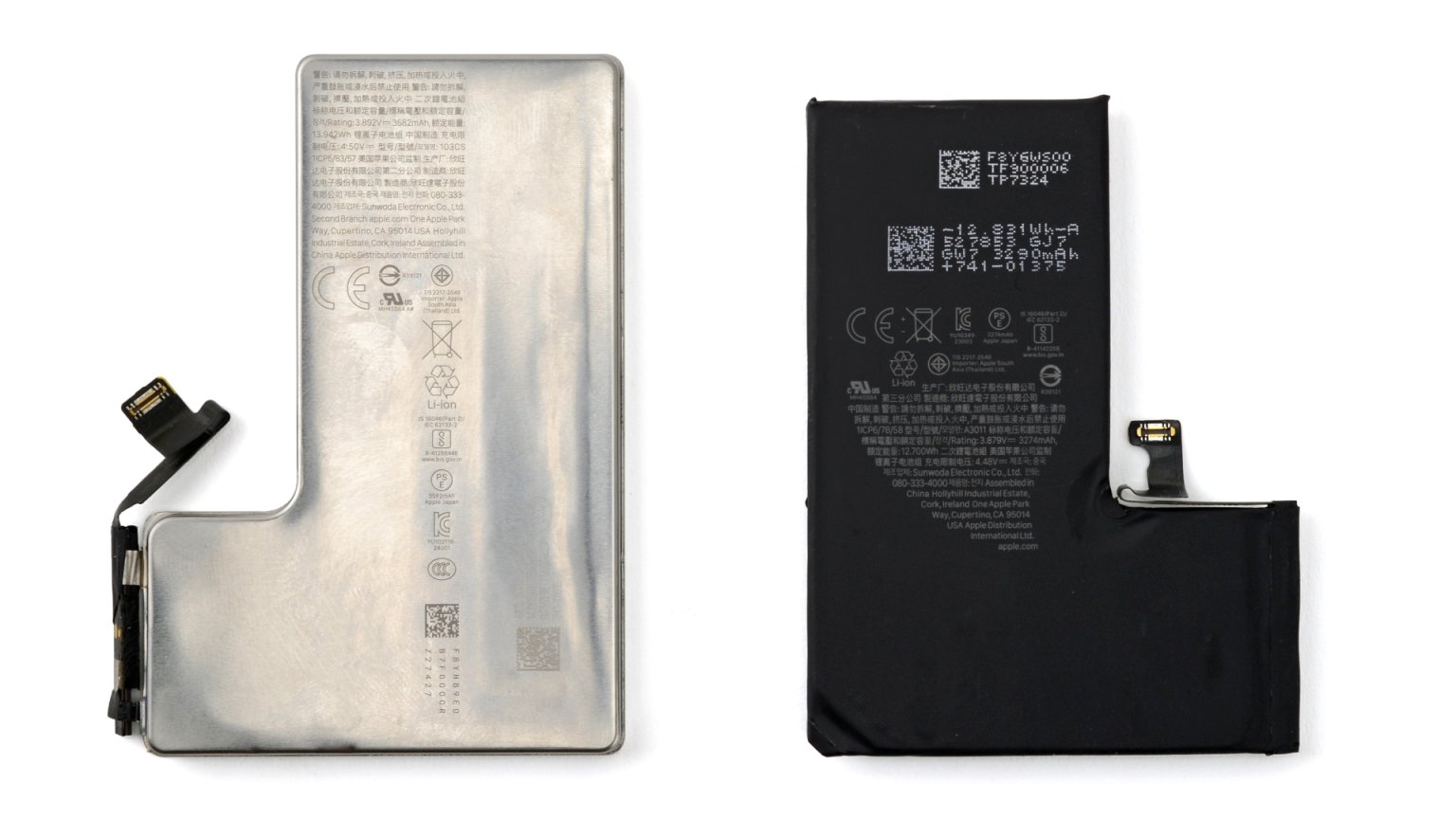
iPhone 16 Pro's aluminum encased battery vs iPhone 15 Pro's

The aluminum-cased iPhone 16 Pro battery, compared to the iPhone 15 Pro’s soft-pouch battery

Add Android Authority on Google:

TL;DR

  • A new leak suggests Chinese Android OEMs (likely Xiaomi) are looking to adopt Apple’s rigid, steel-cased battery design to replace traditional soft-pouch batteries.
  • Android brands are looking to combine steel-cased battery design with stacked-cell battery technology, aiming for 9,000mAh to 10,000mAh capacities on future flagships.
  • While rigid steel casings eliminate the extra clearance needed to accommodate potential cell swelling, they add physical weight and impose tight internal assembly constraints.

Upcoming Android flagships might soon deliver better battery endurance, both physically and in terms of battery life. According to a new leak, Android manufacturers are actively experimenting with steel-cased batteries paired with stacked-cell technology to push energy density to as high as 9,000mAh or 10,000mAh.

The revelation comes courtesy of reputable leaker Digital Chat Station on Weibo. Highlighting Apple’s continued use of steel-encased battery cells on the iPhone 18 Pro Max, which reportedly pushes the rated capacity to 5,391mAh (with typical capacity hovering around 5,500mAh), the leaker notes that a major Chinese smartphone maker (most likely to be Xiaomi, based on Digital Chat Station’s post format) is testing a similar steel-shell architecture. Combined with stacked-cell manufacturing, the brand could aim to deliver 9,000mAh to 10,000mAh batteries in future top-tier flagship devices.
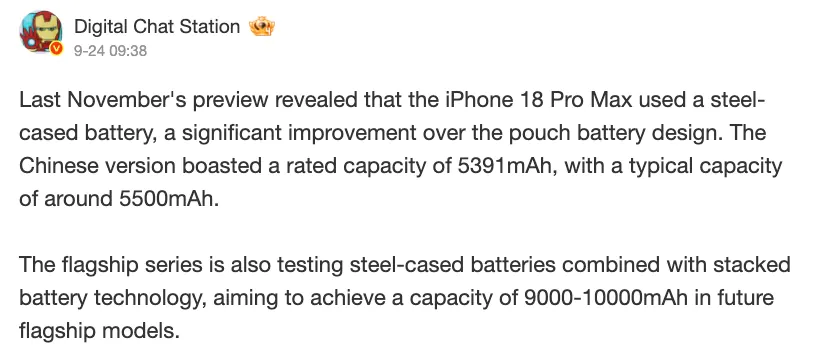
Digital Chat Station on steel encased batteries being used by Android brands 1

Metal-cased battery enclosures first gained widespread attention in smartphones when Apple adopted an aluminum casing for the iPhone 16 Pro’s battery, as highlighted in early teardowns.

iPhone 16 Pro's aluminum encased battery vs iPhone 15 Pro's

The aluminum-cased iPhone 16 Pro battery, compared to the iPhone 15 Pro’s soft-pouch battery

Traditional soft-pouch batteries rely on softer aluminum-laminated films, which require extra internal clearance to account for cell swelling and offer limited thermal dissipation. In contrast, a rigid aluminum shell allows the manufacturer to pack the cells more tightly, improve passive heat dissipation across the chassis, and safely maximize usable internal volume within the phone, with less tolerance needed for swelling hazards.

A rigid steel shell takes it a step further by providing greater rigidity while allowing for a thinner enclosure. We first saw this on the iPhone 17 Pro and iPhone 17 Pro Max, and it continues with the iPhone 18 Pro series.

iPhone 17 Pro Steel case battery 1

Steel-case battery on the iPhone 17 Pro

When paired with stacked-cell technology (where the cathode and anode layers are laminated and stacked in zig-zag sheets rather than rolled like a traditional jelly roll), internal resistance drops while energy density climbs significantly.

While Chinese OEMs have aggressively expanded battery sizes past 6,000mAh using silicon-carbon anodes, jumping toward the 10,000mAh threshold would be a generational leap for flagship devices. The newly released Xiaomi 18 Pro Max uses an 8,500mAh battery in China, which is already impressive by itself, given the camera tech and the rear display it packs — and you can imagine just how much of a leap it would take to reach the 10,000mAh mark on a proper top-tier flagship.

If these tests pan out, users could realistically see even better multi-day battery life without sacrificing the phone’s structural integrity, thermal stability, or creating a battery hazard. However, steel adds weight, and accommodating a cell that large will test internal packaging limits.

Apple has popularized steel-encased batteries, but we will have to wait and see which Android OEM manages to bring a 10,000mAh steel-cased battery flagship to market first. I wouldn’t be surprised if they needed to pair it with their own implementation of Apple’s Prepare to Ship feature, too.

Thank you for being part of our community. Read our Comment Policy before posting.
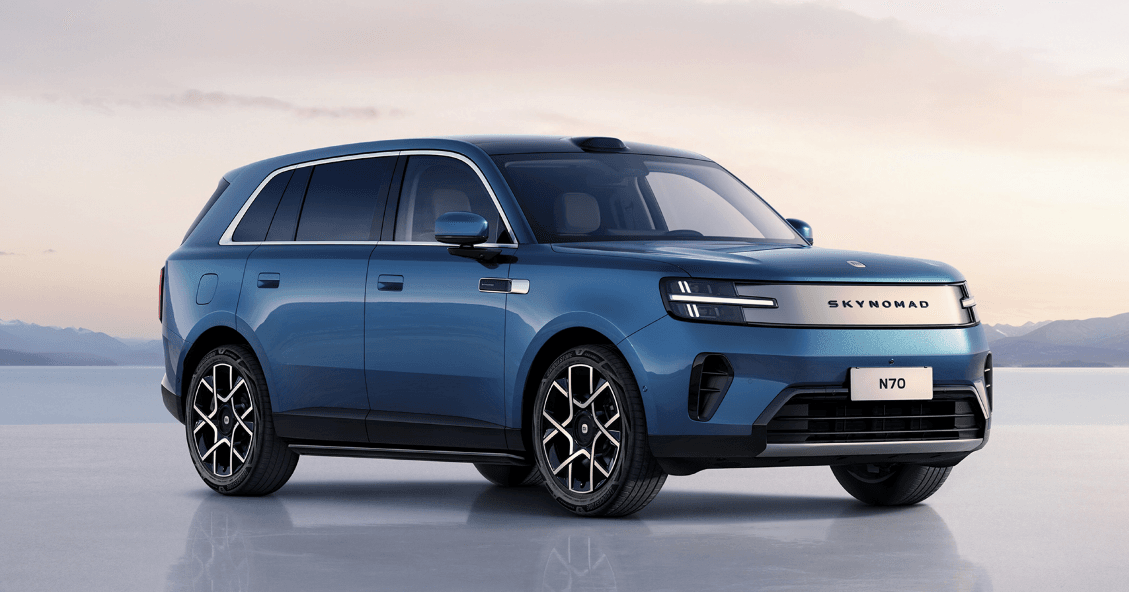
Xiaomi Has a Luxury SUV for $31,000 That All Western Brands Should Fear


If there’s one thing that can unite the world in these AI-troubled times, it’s everyone’s love of SUVs. For decades, the SUV has been the savior of the car world. Accounting for nearly half of all new sales worldwide, this is by some margin the largest segment in the global auto industry.

Sedans? Forget it. Ford doesn’t even sell a traditional sedan in the US now. China still likes a sedan. About a third of all Chinese autos are in this form, compared with less than half that for the US. But Chinese carmakers know full well how much we love our chunky SUVs, so they are focusing their efforts to lure the Western world away from familiar marques.

Indeed, Xiaomi has just played its hand in this particular game, revealing the remaining details earlier this month in Beijing—including the all-important pricing—of its coming SkyNomad SUVs. Bentley and Range Rover may well have revealed their flagship electric SUVs, but both will be mightily worried about just how many scalps Xiaomi Auto’s SkyNomad SUVs will take from them. If they’re not, they should be.

Sedan to SUV

Image may contain Transportation Vehicle Car Car  Interior Car Seat Chair and Furniture

The new Xiaomi Auto SkyNomad N70 is a five-seat, extended-range EV that has better technology than a Range Rover at half the price of a Velar.

Courtesy of Xiaomi

Trucks and SUVs represent more than 80 percent of new vehicle sales in America these days. Marc McGrath, US CEO of the automotive manufacturer Schaeffler Group, tells WIRED that one of the main reasons the company is developing its own solid-state batteries is to properly electrify the power-hungry trucks and SUVs Americans so dearly love. No one wants another F-150 Lightning U-turn.

The shocking success of the Jaecoo 7 is a prime example of SUV supremacy. This Chinese-made ride has enjoyed a staggeringly meteoric rise in the UK, going from an unknown newcomer in 2025 to now being one of the country’s best-selling new cars. Nicknamed the “Temu Range Rover,” it comes in both gas and hybrid flavors, and the company liberally uses the word “luxury” in its marketing, yet the vehicle costs just £29,210 (a little over $39,000).

These 7s are becoming ubiquitous on UK roads. My local Nissan dealer has swiftly dumped the Japanese brand and is now an official Jaecoo dealer, offering not just the 7, but the Jaecoo 5 and 8. I can’t think of another auto brand that’s enjoyed such a rapid rise.

Other Chinese brands are playing the same tactic in Europe, such as XPeng and BYD, but the big one incoming is Xiaomi Auto, set to launch in Europe in 2027, despite only making its first EV in 2024. Astonishingly, its SU7 Ultra claimed the title of “World’s Fastest Sedan” the very same year.

All the features I want to see


A Xiaomi Mi Band 7 displays an alternative watch face from he Zepp Life app.

Kaitlyn Cimino / Android Authority

The Xiaomi Mi Band 8 (a.k.a. the Xiaomi Smart Band 8 in Europe) has an incredibly long list of features considering it costs under $50, which we currently recommend for budget shoppers in our best fitness tracker guide. Every year the next Mi Band arrives bringing further refinements to the series, often delivering features previously reserved for much more expensive devices. Although we still have plenty of time before a new model, here’s my wishlist for what I’d like to see next year from the Xiaomi Mi Band 9.

A hardware back button

The Mi Band 8’s entire UI is navigated through touch, which can be a bit tricky with such a small display. I’d wager this is mostly about cutting costs, but it’s also likely at least a little bit about sticking with the Mi Band’s very barebones, minimalist philosophy. Still, a physical back button would make navigating the UI significantly easier, even if it might add a tiny bit of bulk over the current model and would clutter up the design slightly.

NFC shouldn’t be reserved just for China

The Chinese version of the Mi Band 8 includes NFC for mobile payments, which is a first for the company’s budget tracker. The band currently works with AliPay and WeChat Pay. That’s great, but what about the international version? Xiaomi has opted not to include the feature at all. It would be nice to see the Mi Band 9 bring this feature to all versions, especially since the Chinese version’s payment services are already available in other countries throughout Europe and Asia.

GPS would be nice too

A Xiaomi Mi Band 7 displays its watch face.

Kaitlyn Cimino / Android Authority

Xiaomi Mi Band 7

NFC is one of the most sought-after features for the Mi Band, right next to GPS, I’d wager. While the Mi Band 8 can use your phone’s GPS, built-in GPS continues to be one of the Mi Band’s biggest missing features. The Xiaomi Mi Band 9 should finally rectify this and offer GPS baked-in.

Now I know what you’re thinking: wouldn’t that drive the price tag above $50? Yes, and that could be a deal breaker for some, but one simple solution would be to offer a GPS variant and a cheaper base model. This might seem unnecessary since there’s already a Mi Band Pro series, but these trackers tend to be a bit closer to an entry smartwatch than a fitness tracker. Some of us want something small and affordable like the Mi Band 8 but are willing to pay a tad more for useful extras.

The Mi Fitness app could still use some UI improvements and better data integration

xiaomi mi fitness app menu 1

Andy Walker / Android Authority

Mi Fitness (formerly Xiaomi Wear)

The Mi Band’s biggest weakness has always been software and unfortunately, that’s still the case today.

In the past, the company offered two official apps, both with different UIs and feature sets; this was more than a little confusing. The Mi Band 8 is only compatible with the Mi Fitness app and that’s it, as the Mi Band doesn’t work with third party apps either. The limited support wouldn’t matter so much if the official app had a UI that worked as well as Fitbit and others, but that’s just not the case.

The app lacks a lot of customization options. For example, there’s no way to switch from metrics to US/Imperial. It’s also a bit buggy, as it’s pretty common to have connectivity problems between the app and the watch. Navigating the app isn’t so bad, but there are a lot of unnecessary steps for some features.

I realize we can only expect so much from a fitness band that’s within the impulse-buying price range, but it’s the only thing holding this tracker back from being virtually perfect. If Xiaomi could improve the app experience it would have a fitness band that’s arguably just as good as trackers that cost double or even triple the price.

Third-party app support would be even better

google fit home screen 2

Jimmy Westenberg / Android Authority

As I mentioned above, the Mi Band 7 and earlier also worked with another app, called Zepp Life. This app was better in some ways and had access to some third-party data syncing options that the Mi app doesn’t. So what does the Mi Fitness app support for data syncing? Strava and that’s it. This wouldn’t be so bad if there were third-party fitness app support, but you can’t even use something like Google Fit as a substitute either.

A revamped app would go a long way, but I could live with Mi Fitness if I could sync my data to and from other apps, or if I could use a 3rd party app altogether as a replacement. While I understand Xiaomi wants to keep the focus on its ecosystem, it also makes the band very frustrating to use for those outside of China. I want to see this change with the Mi Band 9.

Mi Band 9 wishlist: What feature would you like to see the most?

802 votes

Will there be a Mi band 9?

A Xiaomi Mi Band 7 in black rests on a mint yoga mat.

Kaitlyn Cimino / Android Authority

The Mi Band is one of the most popular budget trackers and has been a big success for the company. The Mi Band is also one of its few products formally released in the United States. It’s pretty much a foregone conclusion that there will be a Xiaomi Mi Band 9 at some point in the future.

Adding even more weight to this, a variety of new reports have surfaced recently suggesting the Mi Band 9 has been making its way through various certification agencies. Furthermore, early rumors suggest the Mi Band 9 will have the same 1.62-inch AMOLED display as last year, but with a brighter and higher resolution screen this time around. Not much else is known just yet.

As for when? Let’s take a quick look at the company’s launch history. Be aware we are focusing on global launch dates, not the initial China-only launches.

  • Mi Band 8 — Oct 26, 2023
  • Mi Band 7 — June 21, 2022
  • Mi Band 6 — April 30, 2021

As you can see, Xiaomi has released a new version of its Band every year, though the actual global launch month has varied significantly. It’s pretty much a given we’ll see the Mi Band 9 in 2024, though it is much tougher to say when it will arrive in the year, especially given the Mi Band 8 launched so late. The company would likely want to give at least close to a year’s space in between models, so I’d say we are likely to see the Mi Band 9 in late summer or sometime in the fall.

Should you wait for the Mi band 9?

A Xiaomi Mi Band 7 displays a user's text notification on screen.

Kaitlyn Cimino / Android Authority

There’s no need to wait for the Xiaomi Mi Band 9 because the current model isn’t even three months old yet. There’s likely close to nine months or more before a successor will be released. The good news is that the Mi Band 8 is already one of the best budget trackers, so if you’re looking to save money, there’s no reason not to pick it up today.

Xiaomi Mi Band 8Xiaomi Mi Band 8

Xiaomi Mi Band 8

Accurate health and fitness tracking • Affordable price point • Unique form factor

Once again, Xiaomi delivers a well-rounded fitness tracker at an approachable price.

The Xiaomi Mi Band 8 features an all-new strap design and the same vibrant touchscreen display found on the previous generation. On the wrist, as a necklace, or even attached to a running shoe, the device tracks key fitness stats and offers useful health monitoring tools to users eager to keep an eye on their wellness. It’s a powerful, entry-level tracker at a great price.

If the Mi Band doesn’t impress you, the HUAWEI Band 7 ($41 at Amazon) is a worthwhile alternative, although it’s a bit harder to find in the US. For those seeking something with a bit more oomph, and don’t mind paying extra for the privilege, we also recommend the Fitbit Charge 6 ($159.95 at Amazon).

You might like