In Fiza Ali’s recent blog post on Neowin, she presents an in-depth review of the SanDisk Professional PRO-BLADE TRANSPORT modular NVMe SSD, showcasing its suitability for professionals looking to enhance their storage capabilities. This detailed examination also highlights current discounts on specific variants, making it an appealing choice for users seeking premium storage solutions.
The SanDisk Professional PRO-BLADE TRANSPORT boasts impressive features tailored for professional use. Its standout qualities include the preloaded PRO-BLADE SSD mag, delivering USB-C speeds of up to 2000MB/s for seamless read and write operations. The device’s modular design allows for effortless SSD mag swapping, facilitating swift capacity expansion with minimal effort.
Durability is a key focus, with the PRO-BLADE SSD mag designed to withstand drops of up to 3 meters and offer up to 4,000 pounds of crush resistance, ensuring data protection in various environments. Users can customize their storage needs by combining the device with multiple SSD mags, enabling the portability of terabytes of data in a compact and lightweight format.
Additionally, the PRO-BLADE TRANSPORT incorporates an aluminum heat sink to efficiently dissipate heat, ensuring sustained high performance during intensive workloads. Ali’s comprehensive review underscores the SSD’s versatility, durability, and exceptional performance, making it a compelling choice for professionals seeking reliable and expandable storage solutions.
Read the full blog post by Fiza Ali for Neowin HERE
You are currently changing a dirty diaper with this morning’s breakfast stuck to your shirt, toys are scattered everywhere, there are dishes in the sink, and one child is running around coloring (with marker of course) on every surface imaginable.
Your husband walks through the door from work looking forward to the date night you had planned; meanwhile you are wondering if you even showered today.
Does this sound like anyone else’s life or just me?
It can be difficult to find time to date your spouse as a stay-at-home-mom of young children. But it is possible!
Read on to see how to date your spouse EVEN after kids!!!
How to Date Your Spouse Even After Kids
Let’s start out with why we should even continue to date each other.
Think back to when you were dating and engaged to your significant other. I bet you just smiled when you started thinking about it! Why is that?
When you are dating you are solely focused on doing things that show love and respect to the other person. You laugh at all their jokes. You take care of them when they are sick. You send encouraging texts for that big meeting they told you they had.
Why does this change when we get married? One word.
LIFE.
We have kids (see the scenario above), get new jobs, move houses, pay bills, and stress about money, all while trying to adjust to life with another person.
Our attention becomes divided. I don’t think it’s a coincidence that the devil does everything he can to bring you together before marriage, and everything he can to keep you apart after.
This is the main reason we need todate our spouses even after marriage. Keep dating. Don’t give Satan a foothold. Spend time investing into people and things that matter. This can keep a marriage from falling apart.
Now I understand that circumstances change. For example, when we have children, our lives take a complete 180!
Our kids, especially toddlers and babies, need lots of attention. And that is okay! I get it! This is why what I’m about to tell you is so important when planning intentional “date nights” with your spouse…
Go over your weekly schedule together.
This is crucial.
Pick one day a week (we prefer Sundays after our daughter goes to bed) and go over your schedules for the week ahead. Take the time to discuss meetings, play dates, grocery store trips, work events, etc. Set a specific day (or days) and time where you and your spouse can connect with no distractions.
I cannot stress the importance of this enough. When my husband and I started going over our weekly schedule together, we found there was a lot less tension between us and unrealistic expectations. Obviously, things can happen outside of our control, but we knew what our week would look like, and when we would have our time together.
You might think, “We don’t have time to do that, we’ll see each other at some point,” or “Why would I schedule in time with my spouse? That seems cold.” Well, there’s a clear answer for both of these questions.
“We don’t have time.”
Our first and foremost priority in life should be our relationship with the Lord, because everything else flows from that.
Second, is our time with our spouse. If we aren’t continually investing into our marriages, how are we supposed to show our kids what a godly marriage looks like?
I get that there are times and seasons that require a little extra grace (having a newborn, moving into a new house, travel, etc.), but there isn’t one single person on this planet who you are supposed to be closer with than your spouse.
“The two shall become one flesh.” 1 Corinthians 6:16
We make time for things that are important to us, which brings us to the next concern…
“Scheduling time for your spouse seems cold.”
Let’s think about some different things we put on our schedules:
church
work
doctor appointments
sporting events
movies
meetings
These are all things that are important enough to be on our schedule so we can be prepared and on time… shouldn’t it be that way with our spouse?
Shouldn’t they get top priority on our to do lists and not just our leftovers?
When we have that time set aside, you both know what to expect and can mentally prepare to invest during that time.
So, with all that said, let’s get to the good stuff.
Now that we know why it’s important to date our spouses, and how to set aside intentional time to do so, what do we do during that time?
Ta-da! Here are 10 fun and creative ways we can connect with our spouses:
Side Note: This will be broken down into two sections – 5 date nights at home after the kids go to bed, and 5 date nights outside of the house that require a babysitter (Hello Grandma and Grandpa!)
Date Nights In Ideas
Ask each other random questions
This can be such an awesome way to connect with your spouse! Having a good mix of serious and funny questions is ideal, so you can laugh together and connect emotionally as well.
Go to the movies – in your living room!
Turn your living room into your own local cinema! Bring your mattress out into the living room with lots of blankets and pillows. One of you can grab a movie from Redbox while the other stays home and makes the popcorn. Put on your favorite jammies, turn out all the lights, and you are ready to roll!
If you don’t have a Redbox near you, Hulu or Netflix would work just fine.
Have an at home spa
Really get into this one! Set up the bedroom with lit candles, Pandora spa radio, towels and essential oils (here’s some romantic diffuser blends). Take turns massaging each other and just relax! This is a great stress reliever, AND helps you both connect on a more physical level. It’s the perfect way to date your husband at home!
Bust out the board games
Not just any board games though; pick ones that you know will get you laughing and/or thinking hard! Pass the Pigs, Name 5, Battle of the Sexes, and Farkle are some great non-card game options, although cards are fine too.
One game my husband and I love to play is “Heads Up.” It’s a guessing game app that you can download for free on your phone. We have spent hours playing this before. It’s such a great way to loosen up and laugh with each other!
Binge watch a TV show/movie series
Pick out a show or movie series that you enjoy watching TOGETHER, and binge watch an entire season/series! Some options could be The Voice, America’s Got Talent, Friends, or our personal favorite… The Hobbit Trilogy!
This might be a good Friday date night so your spouse doesn’t have to get up super early for work.
Date Nights Out
Dinner scavenger hunt
This isn’t your typical dinner date that you might be used to… let’s make it a little more interesting.
[Set aside a little bit of a higher budget for this one]
Ask your husband to hide 15-20 pieces of candy or chocolate (think tootsie rolls, mints, small things) around the house. However many you find will determine the cost of where you eat. For example:
1 piece of candy = fast food dollar menu dinner
20 pieces of candy = nice steakhouse dinner + dessert!
Go on a hike/walk
Find a park nearby, and take some time to soak in God’s creation. Leave the phones in the car, and take the time to get active and focus on each other!
Dollar dash
This one is fun! Head to your local store, and each pick out 2-3 items you think your spouse would like. Then, go to 2-3 fast food places, and each order only one thing off the lower-priced menu at each location.
Head on home, and talk about why you chose what gifts you did over dinner!
Learn something new together
You can take a class together – cooking, painting, pottery making, golf lessons, rock climbing, etc. Experiencing new things together will automatically bring you closer.
Go see a drive-in movie
Load up the car with snacks and blankets, and go see a movie at a drive-in! This is great because unlike in a movie theater, you can actually talk to each other during the movie.
Back to the scenario at the beginning…
Being a parent is TOUGH; it takes a lot of energy, time, love, patience, sacrifice and focus. And YOU are doing an awesome job.
But, let’s not get so caught up in life that we forget to connect with our spouses.
Remember, your kids will grow up and leave home, but your spouse is by your side forever. And now that we have all the tools, we can make dating our spouse a priority.
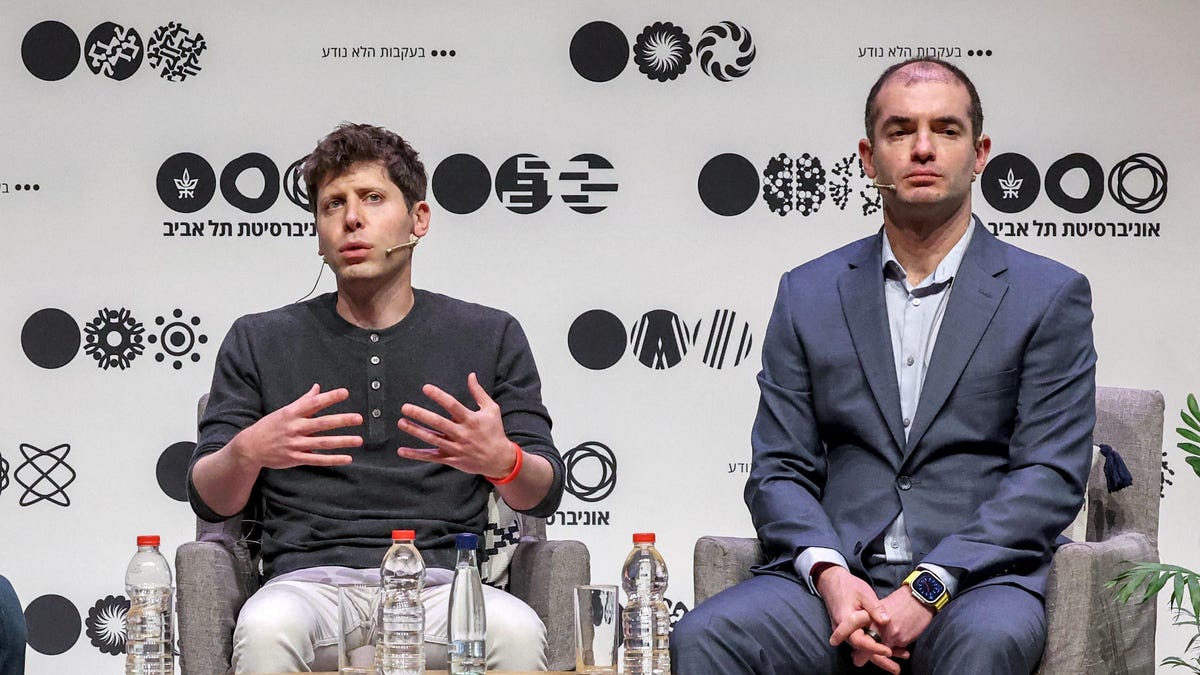
Ilya Sutskever, OpenAI’s co-founder and chief scientist, announced he was leaving the company on Tuesday. OpenAI confirmed the departure in a press release. Sutskever’s official exit comes nearly six months after he helped lead an effort with other board members to fire CEO Sam Altman, the move backfired days later.
I Gave Sam Altman a Copy of My Eyeballs | Future Tech
“After almost a decade, I have made the decision to leave OpenAI,” said Sutskever via a tweet on Tuesday afternoon. “I am excited for what comes next — a project that is very personally meaningful to me about which I will share details in due time.”
“Ilya and OpenAI are going to part ways,” said Altman in a tweet shortly after. “This is very sad to me; Ilya is easily one of the greatest minds of our generation, a guiding light of our field, and a dear friend.”
Altman went on to say that Jakub Pachocki, a senior researcher on Sutskever’s team, would be replacing him as OpenAI’s Chief Scientist. Sutskever notes an undisclosed project that is very “meaningful” to him moving forward. It’s unclear at this time what that project is.
Jan Leike, another OpenAI executive who worked with Sutskever on safeguarding future AI, also resigned on Tuesday, according to The Information. Leike and Sutskever led OpenAI’s superalignment team, charged with the grandiose task of making sure the company’s super-powerful AI does not turn against humans.
For the last six months, Sutskever’s status has been unclear at OpenAI. When Altman returned to the company in late Nov. of 2023, he said this on Sutskever: “we hope to continue our working relationship and are discussing how he can continue his work at OpenAI.” Sutskever was the only member of OpenAI left in limbo at the time—neither fired nor rehired.
Since then, Altman has refused to answer questions about Sutskever’s status at the company in multiple interviews. We barely heard from Sutskever himself during this time period. This is Sutskever’s first tweet in over five months, and OpenAI’s chief scientist was missing from major announcements such as Sora and this week’s GPT-4 Omni.
Earlier this year, founding OpenAI member Andrej Karpathy left the company. In that case as well, Karpathy did not provide a particular reason for his exit, and later described that he would work on personal projects.
Sutskever posted a photo with OpenAI leaders Altman, Mira Murati, Greg Brockman, and Jakub Pachocki shortly after announcing his exit. Severa; featured in the photo posted kind messages about Sutskever’s tenure at OpenAI, praising the well-renowned scientist for his contributions to the artificial intelligence world.
Greetings from Worldof-pcgames, the ideal gaming destination for fans of video games! Explore the fascinating world of Family Breeding, a cutting-edge simulation game that is sure to provide you with countless hours of fun. In Family Breeding, users take on an exciting adventure of virtual family rearing and nurturing, generating various lineages with unique attributes. With the game’s smooth integration of strategy, creativity, and realism, players may let their imaginations run wild and plan their path to victory. Family Breeding is just one of the newest and best games that we at Worldof-pcgames are committed to giving you access to. You can start your breeding journey for free by downloading Family Breeding thanks to our special offer. To obtain your free download, just visit our website, go to the Family Breeding page, and follow the simple instructions.
But there’s still more! When you get Family Breeding from Worldof-pcgames, you’ll not only get it for free, but you’ll also be able to access a ton of special content and added features. In the field of family breeding, there’s always something new to learn, from unusual genetic features to unique breeding difficulties. Don’t pass up this fantastic chance to improve your gaming and become fully immersed in the fascinating virtual genetics world. Are you prepared to start your breeding journey? Get Family Breeding for free at Worldof-pcgames now, and get started creating your virtual dynasty. You’ll be plunging into the realm of family breeding in no time thanks to our simple instructions and quick download process.
Features and System Requirements:
Players oversee the growth and development of a family lineage across multiple generations. They’ll need to make decisions about marriages, inheritances, and alliances to ensure the prosperity and longevity of their family.
The game could incorporate a detailed genetic system where traits are passed down from one generation to the next. Players might need to consider genetic traits such as intelligence, strength, or specific skills when arranging marriages to optimize their family’s attributes.
Beyond just managing the family members, players might also be responsible for maintaining and expanding the family’s estate or holdings. This could involve managing resources, upgrading buildings, and investing in improvements to ensure the family’s wealth and status.
1 :: Operating System :: Windows XP/7/8/8./10. 2 :: Processor: 2.0 Ghz 64-bit Intel-compatible. 3 :: Ram :: 1 GB RAM 4 :: DirectX: Version 9.0 5 :: Graphics:: Integrated or better 6 :: Space Storage:: 1 GB space
Turn Off Your Antivirus Before Installing Any Game
1 :: Download Game 2 :: Extract Game 3 :: Launch The Game 4 :: Have Fun 🙂
This blog post focuses on new features and improvements. For a comprehensive list, including bug fixes, please see the release notes.
We are introducing pre-built, ready-to-use templates that simplifies the app creation process for various usecases. Each template comes with a range of resources, such as datasets, models, workflows, and modules, allowing you to quickly get started with your app creation process.
When you choose a template to create an app, the configurations and resources available in the template will be preemptively applied to your new application. You can use the pre-built components to quickly apply AI to your specific use case.
Along with the existing templates in the recent release, added new templates such as Sentiment Analysis and Text Moderation. Let’s look at the details of each template:
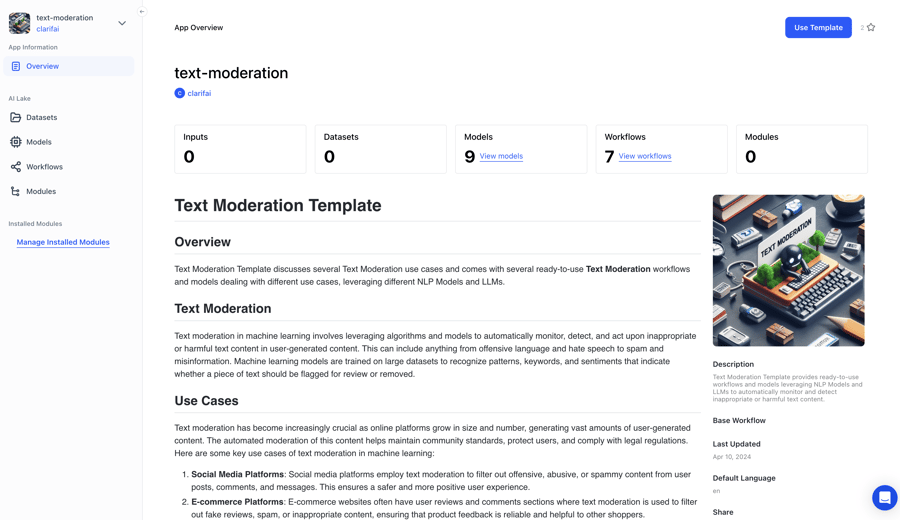
Text Moderation Template, which provides ready-to-use workflows and models, leveraging NLP Models and LLMs to automatically monitor and detect inappropriate or harmful text content.
Here are some of the workflows available in the Text Moderation template for various usecases:
3. Text-moderation-mistral-7b:Workflow usesMistral-7bModel with specified prompt template for text moderation that identify andfilter out any hate speech, violent language and explicit content and Respond with ‘Inappropriate’ if such content is present and ‘Appropriate’ otherwise.
4. Text-moderation-misinformation-dbrx: Workflow usesDBRXModel with specified prompt template for Misinformation moderation that identify andfilter out misinformation or unsubstantiated claims, especially related to health, science, or news eventsand respond with ‘Potential Misinformation’ if the content seems questionable or ‘Likely Reliable’ if the information appears to be credible.
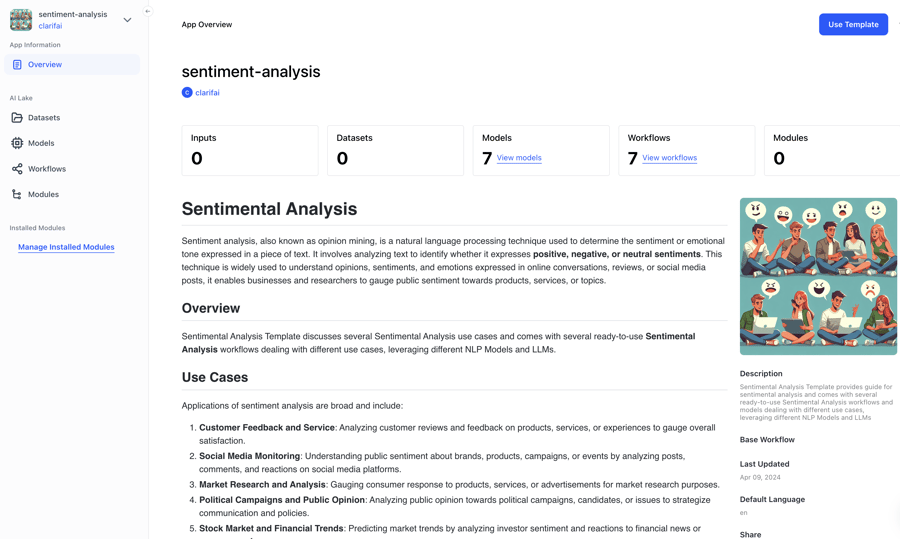
Sentimental Analysis Template, which provides a guide for sentimental analysis and comes with several ready-to-use sentimental analysis workflows and models dealing with different use cases, leveraging different NLP models and LLMs.
3. Financial sentiments Analysis-FinBERT Workflow: This workflow usesfinbert, A BERT-based model fine-tuned on financial text for high-accuracy sentiment analysis in the finance domain.
4. Sentimental-analysis-mistral-7b Workflow: Workflow uses Mistral-7b Model with a specified prompt template for sentimental analysis and predicts if the sentence/ pargraph is positive/negative or neutral sentiment.
Chatbot Template, which allows you to develop AI chatbots swiftly using Clarifai LLMs, offering personalized assistance and integrating external data with RAG framework for enhanced capabilities.
The template consists of Clarifai’s Chatbot Module that lets you chat with several Large Language Models with a single UI interface.
Image Moderation Template, which provides diverse AI-powered workflows for automatically filtering and categorizing inappropriate or harmful images based on various criteria.
Here are a few models and workflows that the Image Moderation Template consists of.
1. NSFW Recognition model predicts the likelihood that an image contains suggestive or sexually explicit nudity. It’s a great solution for anyone trying to moderate or filter nudity from their platform automatically. It is limited to nudity-specific use cases.
Content Generation Template, which empowers users to efficiently create diverse, tailored text, from emails and blogs to social media content and stories, enhancing communication and creativity.
This App Template discusses several content generation use cases such as Email writing, Blog writing, Question Answering, Storytelling, Social media content and comes with several ready-to-use workflows for content creation.
Document Summarization Template, which is an app template for document summarization — supports 3 levels that start with Novice and end up with Expert.
This template explore 3 primary methods for summarization that start with Novice and end up with Expert.
1. Sentence and Paragraph Summarization: This helps to summarise a few paragraphs and want to one-off summarize. You can simply submit the text for summarization through the following workflow, and it will return a condensed version:
2. Page-level Summarization: This method addresses the challenge of summarizing texts spanning multiple pages.
3. Summarize an entire book: This method can help to summarise the entire book with the Best Representation Vectors Method.
RAG Template, which streamlines the creation of Retrieval-Augmented Generation (RAG) applications with Clarifai, enhancing LLMs with external knowledge for accurate, up-to-date information generation.
The App template includes pre-built RAG agents, leveraging different LLM models and optimized through various prompt engineering techniques, to name a few.
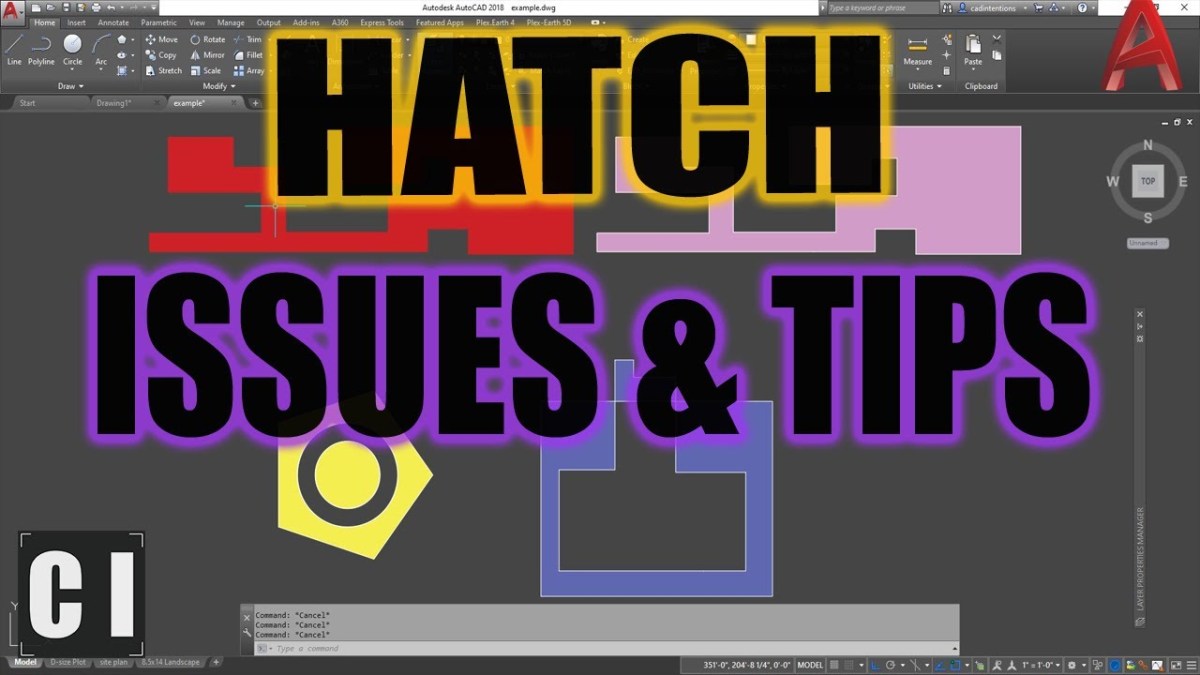
Hey Everybody! I hope you’re ready for this weeks new video and post. In it we are taking a look at the hatch command and in particular, some of the most common issues and errors we encounter when hatching in AutoCAD.
The Prepared is a free, high-quality weekly newsletter about engineering, manufacturing, and infrastructure. It’s nerdy, useful, and fun! Learn more and Subscribe here: theprepared.org
If you’ve used AutoCAD for any amount of time recently, I’m sure you have encountered any number of Hatching issues when trying to fill irregular or complicated shapes.
In today’s video, I wanted to take a look at some of the most common hatching issues & errors that you’ll encounter, and walk you through exactly how to fix them.
Whether you have unclosed areas or boundary issues with hatches, today’s video will help you solve them in just a few clicks!
That’s all for today’s quick Autocad Tip, I hope you all were able to take something away from it and able to add a new tool to your CAD toolbox!
Thank you again to this weeks Sponsor: ThePrepared.org Be sure to check them out and subscribe to their awesome weekly newsletter, it’s honestly one of my few must-read emails when it hits my inbox.
Be sure to subscribe and follow on Twitter @cadintentions to keep up to date and be the first to get updates on the newest videos, posts, and downloads.
As always, thank you so much for reading and watching, I am super excited to be back and posting regularly on the blog and hope you all will follow along. Cheers and happy Drafting!
PS. In case you missed out or are interested in the brand new AutoCAD Fundamentals & Workflows Course, check it out here (Available for Instant Download NOW): https://gum.co/learnautocad
The following two tabs change content below.
Brandon is a Civil Designer, Aspiring Blogger/Creator, Husband, Father to two Amazing Kids and Tech Aficionado from a small town in Canada. He has been obsessed with design and technology since he can remember and working as a Civil Designer for nearly as long. Brandon’s blog and Youtube channel, CADIntentions.com has been his outlet and excuse for keeping up with new tech and trends in the CAD design world for the last 10 years growing to more than 60,000 subscribers and over 15,000,000 views, while also being the source of many great friendships and unique opportunities.
If you would like to Sponsor CAD Intentions or Work together in some way, Please visit my About Page and send me an email: http://cadintentions.com/about-me/
For years, people have asked all-knowing Google how big data can help businesses to succeed, what big data technologies are the best, and other important questions. A lot has been written and said about big data already, but the term itself remains unexplained. To be fair, we do not count a widespread definition “big data is big.” This concept raises another question: what are the measures for “big” – 1 terabyte, 1 petabyte, 1 exabyte or more?
Here, our big data consulting team defines the concept of big data through describing its key features. To give a complete picture, we also share an overview of big data examples from different industries, enumerate different sources of big data and fundamental technologies.
Big data defined
Here’s our definition:
Big data is the data that is characterized by such informational features as the log-of-events nature and statistical correctness, and that imposes such technical requirements as distributed storage, parallel data processing and easy scalability of the solution.
Below, you can read about these features and requirements in more detail.
Informational features: In contrast to traditional data that may change at any moment (e.g., bank accounts, quantity of goods in a warehouse), big data represents a log of records where each describes some event (e.g., a purchase in a store, a web page view, a sensor value at a given moment, a comment on a social network). Due to its very nature, event data does not change.
Besides, big data may contain omissions and errors, which makes it a bad choice for the tasks where absolute accuracy is crucial. So, it doesn’t make much sense to use big data for bookkeeping. However, big data is correct statistically and can give a clear understanding of the overall picture, trends and dependencies. Another example from Finance: big data can help identify and measure market risks based on the analysis of customer behavior, industry benchmarks, product portfolio performance, interest rates history, commodity price changes, etc.
Technical requirements: Big data has a volume that requires parallel processing and a special approach to storage: one computer (or one node as IT gurus call it) is not sufficient to perform these tasks – we need many, typically from 10 to 100.
Besides, big data solution needs scalability. To cope with ever-growing data volume, we don’t need to introduce any changes to the software each time the amount of data increases. If this happens, we just involve more nodes, and the data will be redistributed among them automatically.
Big data examples
To better understand what big data is, let’s go beyond the definition and look at some examples of practical application from different industries.
1. Customer analytics
To create a 360-degree customer view, companies need to collect, store and analyze a plethora of data. The more data sources they use, the more complete picture they will get. Say, for each of their 10+ million customers they can analyze 5 types of customer big data:
Demographic data (this customer is a woman, 35 years old, has two children, etc.).
Transactional data (the products she buys each time, the time of purchases, etc.)
Web behavior data (the products she puts into her basket when she shops online).
Data from customer-created texts (comments about the company that this woman leaves on the internet).
Data about product/service use (feedback on the quality of the goods ordered, the speed of delivery, etc.).
Customer analytics is equally beneficial for companies and customers. The former can adjust their product portfolio to better satisfy customer needs and organize efficient marketing activities. The latter can enjoy favorite products, relevant promotions and personalized communication.
2. Industrial analytics
To avoid expensive downtimes that affect all the related processes, manufacturers can use sensor data to foster proactive maintenance. Imagine that the analytical system has been collecting and analyzing sensor data for several months to form a history of observations. Based on this historical data, the system has identified a set of patterns that are likely to end up with a machine breakdown. For instance, the system recognizes that picture formed by temperature and load sensors is similar to pre-failure situation #3 and alerts the maintenance team to check the machinery.
It’s important to mention that preventive maintenance is not the only example of how manufacturers can use big data. In this article, you’ll find a detailed description of other real-life big data use cases.
3. Business process analytics
Companies also use big data analytics to monitor the performance of their remote employees and improve the efficiency of the processes. Let’s take transportation as an example. Companies can collect and store the telemetry data that comes from each truck in real time to identify a typical behavior of each driver. Once the pattern is defined, the system analyzes real-time data, compares it with the pattern and signals if there is a mismatch. Thus, the company can ensure safe working conditions (as drivers should change to have a rest, but they sometimes neglect the rule).
4. Analytics for fraud detection
Banks can detect an unusual card behavior in real time (if somebody else, not the owner, is using it) and block suspicious activities or at least postpone them to notify the owner. For example, if the user is trying to withdraw money in Spain, while they reside in Texas, before declining the transaction, the bank can check the user’s info on the social network – maybe they are simply on vacations. Besides, the bank can verify if this user has any linkage with fraud-related accounts or activities across all other channels.
Big data sources: internal and external
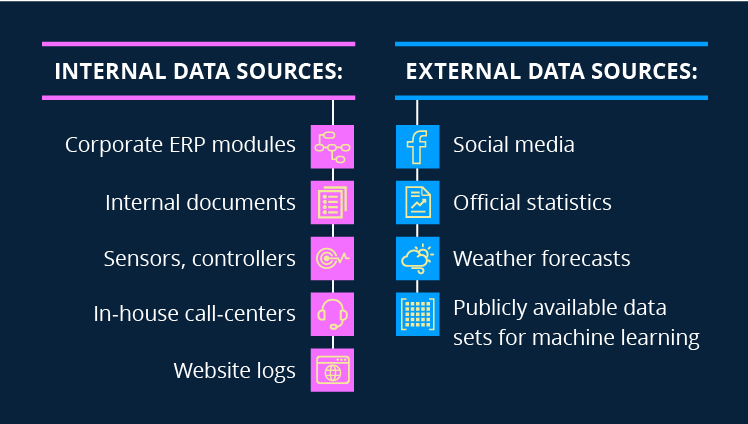
There are two types of big data sources: internal and external ones. Data is internal if a company generates, owns and controls it. External data is public data or the data generated outside the company; correspondingly, the company neither owns nor controls it.
Let’s look at some self-explanatory examples of data sources.
Autonomous system or a part of traditional BI?
Big data can be used both as a part of traditional BI and in an independent system. Let’s turn to examples again. A company analyzes big data to identify behavior patterns of every customer. Based on these insights, it allocates the customers with similar behavior patterns to a particular segment. Finally, a traditional BI system uses customer segments as another attribute for reporting. For instance, users can create reports that show the sales per customer segment or their response to a recent promotion.
Another example: Imagine an ecommerce website supported by the analytical system that identifies the preferences of each user by monitoring the products they buy or are interested in (according to the time spent on a product page). Based on this information, the system recommends “you-may-also-like” products. This is an independent system.
Big data technologies: overview of good-to-know names and terms
The world of big data speaks its own language. Let’s look at some good-to-know terms and most popular technologies:
Cloudis the delivery of on-demand computing resources on a pay-for-use basis. This approach is widely used in big data, as the latter requires fast scalability. E.g., an administrator can add 20 computers in a few clicks.
Hadoopis a framework used for distributed storage of huge amounts of data (its HDFS component) and parallel data processing (Hadoop MapReduce). It breaks a large chunk into smaller ones to be processed separately on different data nodes (computers) and automatically gathers the results across the multiple nodes to return a single result. Quite often Hadoop means the ecosystem that covers multiple big data technologies, such as Apache Hive, Apache HBase, Apache Zookeeper and Apache Oozie.
Apache Spark is a framework used for in-memory parallel data processing, which makes real-time big data analytics possible. E.g., an analytical system may identify that a visitor has been spending quite a long time on particular product pages, but has not added them to the cart yet. To motivate a purchase, the system can offer a discount coupon for the product of interest.
Read more:
Now you know what big data is, don’t you?
Our big data consultants created a short quiz. There are five questions for you to check how much you’ve learned about big data:
What kind of data processing does big data require?
Is big data 100% reliable and accurate?
If your goal is to create a unique customer experience, what kind of big data analytics do you need?
Name at least three external sources of big data.
Is there any similarity between Hadoop and Apache Spark?
Well done! We hope that the article was helpful to you and that after reading it you’ve found the quiz easy.
Big data is another step to your business success. We will help you to adopt an advanced approach to big data to unleash its full potential.
The Casting of Frank Stone, the upcoming narrative horror game set in the Dead By Daylight universe by Until Dawn developer Supermassive Games, has its first gameplay trailer. The game was first announced at the 2023 Game Awards.
The story unfolds in 1980 in the town of Cedar Hills, a town scarred by the murderous killer Frank Stone. It stars four friends who set out to create a horror film at a derelict steel mill dubbed Murder Mill. Naturally, that goes as horribly as you’d imagine, and players must survive by making choices that decide the characters’ relationships and fates. Sudden quick-time events can also be the deciding factor between whether someone lives or dies.
Similar to Supermassive’s previous titles like The Quarry and the Dark Pictures Anthology, The Casting of Frank Stone can go down multiple paths based on your choices. Players will also solve environmental puzzles and gather clues to learn more about Cedar Hills
The Casting of Frank Stone still has no release date, but it will launch later this year for PlayStation 5, Xbox Series X/S, and PC.
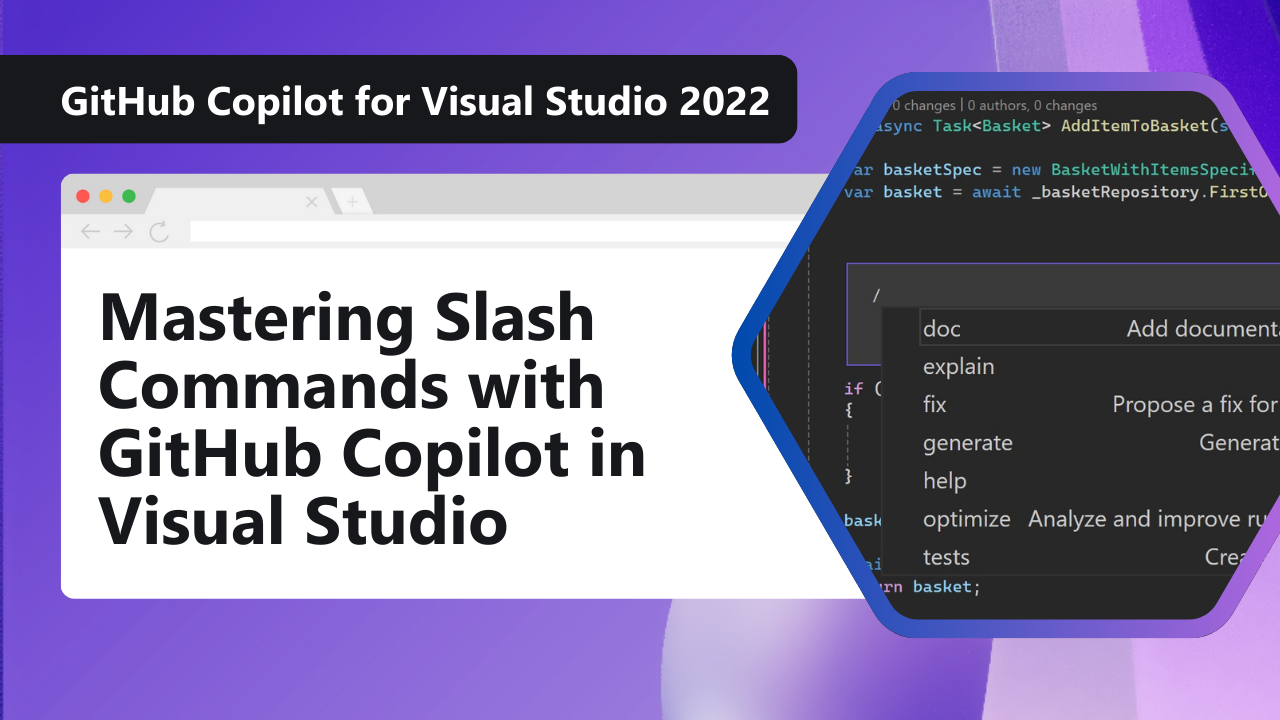
GitHub Copilot, the AI-powered coding assistant, offers a range of features designed to streamline your coding experience in Visual Studio. In this new series, we take a closer look at the power of Slash Commands and discuss how they can make your coding workflow smoother and more efficient.
Introducing Slash Commands
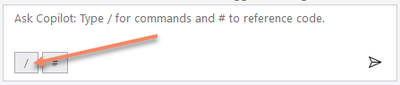
Slash Commands are a set of predefined actions accessible through the GitHub Copilot prompt. According to Bruno Capuano, who explains them in his latest video, you can open the Slash Commands menu by clicking the Slash button in the Copilot Chat window.
Alternatively, you can also access the Slash Commands by typing a forward slash in the message box.
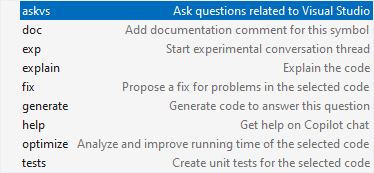
Below are some of the key Slash Commands and their functions:
askvs: Ask Visual Studio questions about your code, functions, or other features.
doc: Insert a documentation comment in the current cursor position.
exp: Start a new conversation thread with a fresh context.
explain: Provide an explanation for the selected code.
fix: Suggest fixes for code errors and typos.
generate: Generate new code snippets based on your input.
optimize: Recommend code optimizations to improve performance.
tests: Create a unit test for the current code selection.
To illustrate, let’s consider the /fix command. In the video, Bruno demonstrates how GitHub Copilot can automatically suggest corrections for typos and other issues. This command can be used in the main chat window, and it’s also accessible in the inline chat by pressing Alt-Slash (Alt-/) or through the right-click context menu.