Chocolate Poke Cake with Caramel


This Chocolate Poke Cake with Caramel is an ultra-moist, decadent dessert that combines rich chocolate cake with luscious caramel in every bite. The perfect treat for potlucks, birthdays, or any chocolate lover’s gathering.

chocolate poke cake with caramel sauce seeping into holes

This post may contain affiliate links. Please refer to the terms page for more information.

This gem starts with a soft, fluffy homemade chocolate cake. After it’s baked, poke holes all over the top using the handle of a wooden spoon, a chopstick, or even a straw. Then, pour warm caramel sauce over the cake so it sinks into the holes and makes every bite extra gooey and sweet. To finish it off, spread a layer of sweet whipped cream on top.

Jump to:

Ingredients

Chocolate cake ingredients

You need the following ingredients to make the chocolate cake portion of this dessert:

ingredients needed to make chocolate cake batter
  • All-purpose flour – sift flour if necessary to remove any lumps
  • Granulated sugar
  • Cornstarch – softens the cake’s texture
  • Cocoa powder – use Dutch-processed cocoa powder. Sift if necessary to remove any lumps.
  • Vegetable oil
  • Eggs – bring eggs to room temperature before starting this recipe
  • Baking powder, baking soda
  • Brewed coffee – use room temperature coffee. You may substitute water for the coffee – I prefer coffee as it enhances the chocolate flavor.

See recipe card for quantities.

Caramel filling ingredients

ingredients needed to make sauce to pour over poke cakeingredients needed to make sauce to pour over poke cake
  • Caramel sauce – you may purchase caramel sauce at your grocer’s or consider using this recipe to make your own.
  • White chocolate chips
  • Heavy cream

See recipe card for quantities.

Whipped cream topping ingredients

ingredients needed to make chocolate whipped cream frostingingredients needed to make chocolate whipped cream frosting
  • Powdered sugar and cocoa powder – sift ingredients together to remove any lumps
  • Heavy cream
  • Vanilla extract
  • Optional – caramel and chocolate sauce to drizzle over the frosting

See recipe card for quantities.

Instructions

Although there are several steps to make this chocolate poke cake with caramel sauce, the instructions below are easy to follow.

Chocolate cake instructions

square baking pan lined with parchment papersquare baking pan lined with parchment paper

1 – Prepare a 9″ x 9″ square cake pan by lining the bottom with parchment paper or greasing the pan. Alternatively, you can use a 10″ round pan instead if you prefer.

whisking together dry ingredients to make chocolate cake batterwhisking together dry ingredients to make chocolate cake batter

2 – Combine flour, cocoa powder, sugar, cornstarch, baking powder and baking soda in a mixing bowl.

eggs and oil added to dry ingredients to make chocolate poke cake with carameleggs and oil added to dry ingredients to make chocolate poke cake with caramel

3 – Add oil and eggs. Mix until well combined.

pouring coffee into mixing bowl to make cake batterpouring coffee into mixing bowl to make cake batter

4 – Slowly pour brewed coffee into bowl while continuing to mix, scraping bottom and sides of bowl occasionally.

pouring chocolate cake batter into a square baking panpouring chocolate cake batter into a square baking pan

5 – Pour cake batter into prepared baking pan. Bake for 35 – 40 minutes at 350℉ (180℃). When done, cake will be well-risen and a toothpick inserted in the center of the cake comes out clean.

cake cooling on a wire rackcake cooling on a wire rack

6 – Place cake on a wire rack and cool for approximately 1 hour. After cake has cooled, remove from pan and place on a serving platter.

Assemble chocolate poke cake

caramel drizzle in a saucepancaramel drizzle in a saucepan

1 – Combine caramel, heavy cream and white chocolate chips in a saucepan. Heat over medium-low heat, stirring frequently, until chips are melted. Set aside and cool for 10 minutes.

using a chopstick to poke holes into a cakeusing a chopstick to poke holes into a cake

2 – Use the end of a wooden spoon, a straw or a chopstick to poke holes all over the cake, making sure you go all the way down to the bottom. Try to poke a hole at least every ⅓ inch.

pouring caramel sauce over cake to soak into holespouring caramel sauce over cake to soak into holes

3 – Slowly pour caramel sauce over top of cake in three additions. Allow a few minutes between each addition to allow caramel to soak into holes. Place cake in refrigerator for 2 hours.

chocolate whipped cream frosting in a mixing bowlchocolate whipped cream frosting in a mixing bowl

4 – Place heavy cream, powdered sugar, cocoa powder and vanilla extract in a mixing bowl. Using the whisk attachment, begin mixing on medium speed and continue to mix until cream reaches medium peaks. Note – medium peaks hold their shape with tips that curl slightly when the beaters are lifted.

using a knife to create swirls of chocolate and caramel sauce in the whipped cream frostingusing a knife to create swirls of chocolate and caramel sauce in the whipped cream frosting

5 – Spread frosting evenly over the top of the cake. If you want, drizzle some chocolate and caramel sauce on top, then drag a knife gently through the sauces to make a design.

Equipment

You need the following equipment to create this chocolate poke cake recipe:

  • Hand Mixer, stand mixer or wire whisk
  • Silicone spatula
  • Food Scale (optional to measure ingredients by weight)
  • Bowls, measuring cups and spoons
  • 9″ x 9″ square cake pan or a 10″ round cake pan
  • Parchment paper
  • Wooden spoon, straw or chopstick for poking holes in cake
  • Saucepan
slice of chocolate poke cake with caramel fillingslice of chocolate poke cake with caramel filling

Storage

Store the chocolate poke cake in an airtight container in the fridge for up to 4 days. It doesn’t freeze well, so it’s best to enjoy it fresh.

overhead view of finished cake on a serving platteroverhead view of finished cake on a serving platter

FAQ

What is the origin of a poke cake?

The poke cake started in the U.S. in the 1970s and became popular through a Jell-O ad campaign. It was created to help sell gelatin and pudding by giving people a fun and easy dessert to make. Since then, poke cakes have evolved, and now you can fill them with all kinds of things—not just Jell-O.

More chocolate lovers’ dessert recipes

Looking for other recipes loaded with chocolate goodness? Try these:

I hope you enjoy this chocolate poke cake with caramel filling as much as my family and friends have over the years!

📋 Recipe

slice of chocolate poke cake with caramel fillingslice of chocolate poke cake with caramel filling

Chocolate Poke Cake with Caramel

This Chocolate Poke Cake with Caramel is an ultra-moist, decadent dessert that combines rich chocolate cake with luscious caramel in every bite. The perfect treat for potlucks, birthdays, or any chocolate lover’s gathering.

Prep Time 35 minutes

Cook Time 40 minutes

Setting time 2 hours

Total Time 3 hours 15 minutes

Course Dessert

Cuisine American

Servings 18 people

Calories 344 kcal

Equipment

  • Hand Mixer or stand mixer or wire whisk

  • 1 Bowls, measuring cups and spoons

  • 1 9″ x 9″ square cake pan or a 10″ round cake pan

  • Parchment paper

  • 1 Wooden spoon, straw or chopstick for poking holes in cake

  • 1 Saucepan

Ingredients 


  • ½ cup Cocoa Powder Dutch processed
  • cups All Purpose Flour
  • cups Granulated Sugar
  • 1 Tablespoon Corn Starch
  • teaspoons Baking Powder
  • ½ teaspoon Baking Soda
  • ½ Cup Vegetable or Canola Oil
  • 3 Large Eggs Room temperature
  • 1 Cup Brewed Coffee, may substitute water

Caramel sauce

  • 1 Cup Caramel sauce
  • ¾ Cup White chocolate chips
  • ¼ Cup Heavy cream

Whipped topping

  • 1 Cups Heavy cream
  • ¼ Cup Powdered sugar
  • 2 teaspoons Vanilla extract
  • 1 Tablespoon Cocoa powder
  • ¼ Cup Caramel sauce Optional
  • ¼ Cup Chocolate sauce Optional

Instructions 

Chocolate cake

  • Preheat oven to 350℉ (180℃).

  • Prepare a 9″ x 9″ cake pan by lining the bottom with parchment paper or greasing the pan.

  • Combine flour, cocoa powder, sugar, cornstarch, baking powder and baking soda in the bowl of a stand mixer. If mixing by hand or with a hand mixer, combine ingredients in a large mixing bowl.

  • Add oil and eggs. Mix until combined.

  • Slowly pour brewed coffee into bowl while continuing to mix, scraping the bowl occasionally. The batter should be smooth.

  • Pour cake batter into prepared baking pan.

  • Bake for 35 – 40 minutes, or until cake is fully risen and a toothpick inserted in the center of the cake comes out clean.

  • Place cake on a rack and allow to cool.

Caramel sauce

  • Combine caramel, heavy cream and white chocolate chips in a saucepan.

  • Heat over medium-low heat, stirring frequently, until chips are melted.

  • Set aside to cool for 10 minutes.

  • Remove cake from pan and place on a serving platter.

  • Use the end of a wooden spoon, straw or a chopstick to poke holes all over the cake, making sure you go all the way down to the bottom. Try to poke a hole at least every half-inch – if not closer.

  • Slowly pour caramel sauce over top of cake in three additions. Allow a few minutes between each addition to allow caramel to soak into holes.

  • Place cake in refrigerator for 2 hours.

Frosting

  • Place heavy cream, powdered sugar, cocoa powder and vanilla extract in a mixing bowl. Using the whisk attachment, begin mixing on medium speed and continue to mix until cream reaches medium peaks. Note – medium peaks hold their shape with tips that curl slightly when the beaters are lifted.

  • Spread frosting evenly over top of cake.

  • Optional – drizzle with caramel and chocolate sauce.

Video

YouTube videoYouTube video

Nutrition

Calories: 344kcalCarbohydrates: 54gProtein: 3gFat: 15gSaturated Fat: 3gPolyunsaturated Fat: 8gMonounsaturated Fat: 3gTrans Fat: 0.1gCholesterol: 0.04mgSodium: 119mgPotassium: 117mgFiber: 3gSugar: 34gVitamin A: 1IUVitamin C: 0.01mgCalcium: 51mgIron: 2mg

Keyword caramel desserts, chocolate cake, poke cake

Musk clashes with neighbors in exclusive Austin suburb


Elon Musk may have a sizable fan base, but residents of the upscale Austin suburb of West Lake Hills, Texas, are unimpressed by their celebrity neighbor, reports the New York Times. Instead, a $6 million home Musk purchased in 2022 has become the center of a battle after his team erected an unauthorized 16-foot chain-link fence, installed a metal gate, and mounted outward-facing cameras.

“I call that place Fort Knox,” says Paul Hemmer, a Tesla owner and retired real estate agent who lives across the street and serves as president of the neighborhood homeowners association.

Musk’s security personnel, many visibly armed, and their vehicles have disrupted the tranquil street, and the prospect of his return from Washington has some worried over more than Musk’s failure to obtain construction permits. “If you follow him at all in the news, he’s always guilty of building stuff and then asking for permission later,” Hemmer complained in a planning meeting.

For Hemmer, the billionaire’s proximity may come at the steepest price. Per the Times, Musk’s security team once reported him to police, claiming he was naked in the street. Hemmer, who has flown drones over Musk’s house looking for ordinance violations, countered he was on his own property in his underwear.

Wordle today: Answer and hint #1417 for May 6


Sail straight through to a nice, clean, winning row of green letters with our easily accessed answer to the May 6 (1417) Wordle if you’re in the mood for a quick win. And if you’re in the mood for a longer session, we can still help. We’ve got general tips ready to check out, as well as a clue for today’s puzzle too.

I learned a lot today. I wish what I’d learned hadn’t been ‘this particular combination of green letters has way more valid possible answers than either I realised or I had rows to poke around with’ but here we are. Still, that’s all part of the fun, isn’t it? To see four green letters and still not be sure what’s going to happen next. That’s what I’m telling myself, anyway.

Today’s Wordle hint

(Image credit: Josh Wardle)

Wordle today: A hint for Tuesday, May 6

MCP (Model Context Protocol) vs A2A (Agent-to-Agent Protocol) Clearly Explained


MCP (Model Context Protocol) vs A2A (Agent-to-Agent) Clearly Explained_blog_hero

Why AI Agents Need a Common Language

AI is getting incredibly smart. We’re moving past single, giant AI models towards teams of specialized AI agents working together. Think of them like expert helpers, each tackling a specific task – from automating business processes to being your personal assistant. These agent teams are popping up everywhere.

But there’s a catch. Right now, getting these different agents to actually talk to each other smoothly is a big challenge. Imagine trying to run a global company where every department speaks a different language and uses incompatible tools. That’s kind of where we are with AI agents. They’re often built differently, by different companies, and live on different platforms. Without standard ways to communicate, teamwork gets messy and inefficient.

This feels a lot like the early days of the internet. Before universal rules like HTTP came along, connecting different computer networks was a nightmare. We face a similar problem now with AI. As more agent systems appear, we desperately need a universal communication layer. Otherwise, we’ll end up tangled in a web of custom integrations, which just isn’t sustainable.

Two protocols are starting to address this: Google’s Agent-to-Agent (A2A) protocol and Anthropic’s Model Context Protocol (MCP).

  • Google’s A2A is an open effort (backed by over 50 companies!) focused on letting different AI agents talk directly to each other. The goal is a universal language so agents can find each other, share info securely, and coordinate tasks, no matter who built them or where they run.

  • Anthropic’s MCP, on the other hand, tackles a different piece of the puzzle. It helps individual language model agents (like chatbots) access real-time information, use external tools, and follow specific instructions while they’re working. Think of it as giving an agent superpowers by connecting it to outside resources.

These two protocols solve different parts of the communication problem: A2A focuses on how agents communicate with each other (horizontally), while MCP focuses on how a single agent connects to tools or memory (vertically).

Getting to Know Google’s A2A

What’s A2A Really About?

Google’s Agent-to-Agent (A2A) protocol is a big step towards making AI agents communicate and coordinate more effectively. The main idea is simple: create a standard way for independent AI agents to interact, no matter who built them, where they live online, or what software framework they use.

A2A aims to do three key things:

  1. Create a universal language all agents understand.

  2. Ensure information is exchanged securely and efficiently.

  3. Make it easy to build complex workflows where different agents team up to reach a common goal.

A2A Under the Hood: The Technical Bits

Let’s peek at the main components that make A2A work:

1. Agent Cards: The AI Business Card

How does one AI agent learn what another can do? Through an Agent Card. Think of it like a digital business card. It’s a public file (usually found at a standard web address like /.well-known/agent.json) written in JSON format.

This card tells other agents crucial details:

  • Where the agent lives online (its address).

  • Its version (to make sure they’re compatible).

  • A list of its skills and what it can do.

  • What security methods it requires to talk.

  • The data formats it understands (input and output).

Agent Cards enable capability discovery by letting agents advertise what they can do in a standardized way. This allows client agents to identify the most suitable agent for a given task and initiate A2A communication automatically. It’s similar to how web browsers check a robots.txt file to know the rules for crawling a website. Agent Cards allow agents to discover each other’s abilities and figure out how to connect, without needing any prior manual setup.

2. Task Management: Keeping Work Organized

A2A organizes interactions around Tasks. A Task is simply a specific piece of work that needs doing, and it gets a unique ID so everyone can track it.

Each Task goes through a clear lifecycle:

  • Submitted: The request is sent.

  • Working: The agent is actively processing the task.

  • Input-Required: The agent needs more information to continue, typically prompting a notification for the user to intervene and provide the necessary details.

  • Completed / Failed / Canceled: The final outcome.

This structured process brings order to complex jobs spread across multiple agents. A “client” agent kicks off a task by sending a Task description to a “remote” agent capable of handling it. This clear lifecycle ensures everyone knows the status of the work and holds agents accountable, making complex collaborations manageable and predictable.

3. Messages and Artifacts: Sharing Information

How do agents actually exchange information? Conceptually, they communicate through messages, which are implemented under the hood using standard protocols like JSON-RPC, webhooks, or server-sent events (SSE)depending on the context. A2A messages are flexible and can contain multiple parts with different types of content:

  • TextPart: Plain old text.

  • FilePart: Binary data like images or documents (sent directly or linked via a web address).

  • DataPart: Structured information (using JSON).

This allows agents to communicate in rich ways, going beyond just text to share files, data, and more.

When a task is finished, the result is packaged as an Artifact. Like messages, Artifacts can also contain multiple parts, letting the remote agent send back complex results with various data types. This flexibility in sharing information is vital for sophisticated teamwork.

4. Communication Channels: How They Connect

A2A uses common web technologies to make connections easy:

  • Standard Requests (JSON-RPC over HTTP/S): For typical, quick request-and-response interactions, it uses a simple JSON-RPC running over standard web connections (HTTP or secure HTTPS).

  • Streaming Updates (Server-Sent Events – SSE): For tasks that take longer, A2A can use SSE. This lets the remote agent “stream” updates back to the client over a persistent connection, useful for progress reports or partial results.

  • Push Notifications (Webhooks): If the remote agent needs to send an update later (asynchronously), it can use webhooks. This means it sends a notification to a specific web address provided by the client agent.

Developers can choose the best communication method for each task. For quick, one-time requests, tasks/send can be used, while for long-running tasks that require real-time updates, tasks/sendSubscribe is ideal. By leveraging familiar web technologies, A2A makes it easier for developers to integrate and ensures better compatibility with existing systems.

Keeping it Secure: A2A’s Security Approach

Security is a core part of A2A. The protocol includes robust methods for verifying agent identities (authentication) and controlling access (authorization).

The Agent Card plays a crucial role, outlining the specific security methods required by an agent. A2A supports widely trusted security protocols, including:

  • OAuth 2.0 methods (a standard for delegated access)

  • Standard HTTP authentication (e.g., Basic or Bearer tokens)

  • API Keys

A key security feature is support for PKCE (Proof Key for Code Exchange), an enhancement to OAuth 2.0 that improves security. These strong, standard security measures are essential for businesses to protect sensitive data and ensure secure communication between agents.

Where Can A2A Shine? Use Cases Across Industries

A2A is perfect for situations where multiple AI agents need to collaborate across different platforms or tools. Here are some potential applications:

  • Software Engineering: AI agents could assist with automated code review, bug detection, and code generation across different development environments and tools. For example, one agent could analyze code for syntax errors, another could check for security vulnerabilities, and a third could propose optimizations, all working together to streamline the development process.

  • Smarter Supply Chains: AI agents could monitor inventory, predict disruptions, automatically adjust shipping routes, and provide advanced analytics by collaborating across different logistics systems.

  • Collaborative Healthcare: Specialized AI agents could analyze different types of patient data (such as scans, medical history, and genetics) and work together via A2A to suggest diagnoses or treatment plans.

  • Research Workflows: AI agents could automate key steps in research. One agent finds relevant data, another analyzes it, a third runs experiments, and another drafts results. Together, they streamline the entire process through collaboration.

  • Cross-Platform Fraud Detection: AI agents could simultaneously analyze transaction patterns across different banks or payment processors, sharing insights through A2A to detect fraud more quickly.

These examples show A2A’s power to automate complex, end-to-end processes that rely on the combined smarts of multiple specialized AI systems, boosting efficiency everywhere.

Unpacking Anthropic’s MCP: Giving Models Tools & Context

What’s MCP Really About?

Anthropic’s Model Context Protocol (MCP) tackles a different but equally important challenge: helping LLM-based AI systems connect to the outside world while they’re working, rather than enabling communication between multiple agents. The core idea is to provide language models with relevant information and access to external tools (such as APIs or functions). This allows models to go beyond their training data and interact with current or task-specific information.

Without a shared protocol like MCP, each AI vendor is forced to define its own way of integrating external tools. For example, if a developer wants to call a function like “generate image” from Clarifai, they must write vendor-specific code to interact with Clarifai’s API. The same is true for every other tool they might use, resulting in a fragmented system where teams must create and maintain separate logic for each provider. In some cases, models are even given direct access to systems or APIs — for example, calling terminal commands or sending HTTP requests without proper control or security measures.

MCP solves this problem by standardizing how AI systems interact with external resources. Rather than building new integrations for every tool, developers can use a shared protocol, making it easier to extend AI capabilities with new tools and data sources.

MCP Under the Hood: The Technical Bits

Here’s how MCP enables this connection:

1. Client-Server Setup

MCP uses a clear client-server structure:

  • MCP Host: This is the application where the AI model lives (e.g., Anthropic’s Claude Desktop app, a coding assistant in your IDE, or a custom AI app).

  • MCP Client: Embedded within the Host, the Client manages the connection to a server.

  • MCP Server: This is a separate component that can run locally or in the cloud. It provides the tools, data (called Resources), or predefined instructions (called Prompts) that the AI model might need.

The Host’s Client makes a dedicated, one-to-one connection to a Server. The Server then exposes its capabilities (tools, data) for the Client to use on behalf of the AI model. This setup keeps things modular and scalable – the AI app asks for help, and specialized servers provide it.
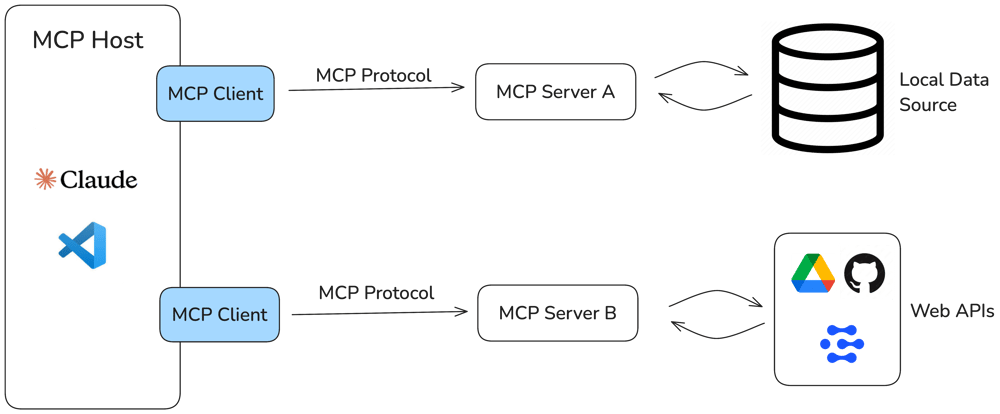
2. Communication

MCP offers flexibility in how clients and servers talk:

  • Local Connection (stdio): If the client and server are running on the same computer, they can use standard input/output (stdio) for very fast, low-latency communication. An added benefit is that locally hosted MCP servers can directly read from and write to the file system, avoiding the need to serialize file contents into the LLM context.

  • Network Connection (HTTP with SSE): For connections over a network (different machines or the internet), MCP uses standard HTTP with Server-Sent Events (SSE). This allows two-way communication, where the server can push updates to the client whenever needed (great for longer tasks or notifications).

Developers choose the transport based on where the components are running and what the application needs, optimizing for speed or network reach.

3. Key Building Blocks: Tools, Resources, and Prompts

MCP Servers provide their capabilities through three core building blocks: Tools, Resources, and Prompts. Each one is controlled by a different part of the system.

  • Tools (Model Controlled): Tools are executable operations that the AI model can autonomously invoke to interact with the environment. These could include tasks like writing to a database, sending a request, or performing a search. MCP Servers expose a list of available tools, each defined by a name, a description, and an input schema (usually in JSON format). The application passes this list to the LLM, which then decides which tools to use and how to use them to complete a task. Tools give the model agency in executing dynamic actions during inference.
  • Resources (Application Controlled): Resources are structured data elements such as files, database records, or contextual documents made available to the LLM-powered application. They are not selected or used autonomously by the model. Instead, the application (usually built by an AI engineer) determines how these resources are surfaced and integrated into workflows. Resources are typically static and predefined, providing reliable context to guide model behavior.
  • Prompts (User Controlled): Prompts are reusable, user-defined templates that shape how the model communicates and operates. They often contain placeholders for dynamic values and can incorporate data from resources. The server programmer defines which prompts are available to the application, ensuring alignment with the available data and tools. These prompts are surfaced to users within the application interface, giving them direct influence over how the model is guided and instructed.

Example: Clarifai provides an MCP Server that enables direct interaction with tools, models, and data resources on the Platform. For example, given a prompt to generate an image, the MCP Client can call the generate_image Tool. The Clarifai MCP Server runs a text-to-image model from the community and returns the result. This is an unofficial early preview and will be live soon.

These primitives provide a standard way for AI models to interact with the external world predictably.

MCP in Action: Use Cases Across Key Domains

MCP opens up many possibilities by letting AI models tap into external tools and data:

  • Smarter Enterprise Assistants: Create AI helpers that can securely access company databases, documents, and internal APIs to answer employee questions or automate internal tasks.

  • Powerful Coding Assistants: AI coding tools can use MCP to access your entire codebase, documentation, and build systems, providing much more accurate suggestions and analysis.

  • Easier Data Analysis: Connect AI models directly to databases via MCP, allowing users to query data and generate reports using natural language.

  • Tool Integration: MCP makes it easier to connect AI to various developer platforms and services, enabling things like:

    • Automated data scraping from websites.

    • Real-time data processing (e.g., using MCP with Confluent to manage Kafka data streams via chat).

    • Giving AI persistent memory (e.g., using MCP with vector databases to let AI search past conversations or documents).

These examples show how MCP can dramatically boost the intelligence and usefulness of AI systems in many different areas.

A2A and MCP Working Together

So, are A2A and MCP competitors? Not really. Google has even stated they see A2A as complementing MCP, suggesting that advanced AI applications will likely need both. They recommend using MCP for tool access and A2A for agent-to-agent communication.

A useful way to think about it:

  • MCP provides vertical integration: Connecting an application (and its AI model) deeply with the specific tools and data it needs.

  • A2A provides horizontal integration: Connecting different, independent agents across various systems.

Imagine MCP gives an individual agent the knowledge and tools it needs to do its job well. Then, A2A provides the way for these well-equipped agents to collaborate as a team.

This suggests powerful ways they could be used together:

Let’s understand this with an example: an HR onboarding workflow.

  1. An “Orchestrator” agent is in charge of onboarding a new employee.

  2. It uses A2A to delegate tasks to specialized agents:

    • Tells the “HR Agent” to create the employee record.

    • Tells the “IT Agent” to provision necessary accounts (email, software access).

    • Tells the “Facilities Agent” to prepare a desk and equipment.

  3. The “IT Agent,” when provisioning accounts, might internally use MCP to:

In this scenario, A2A handles the high-level coordination between agents, while MCP handles the specific, low-level interactions with tools and data needed by individual agents. This layered approach allows for building more modular, scalable, and secure AI systems.

While these protocols are currently seen as complementary, it’s possible that, as they evolve, their functionalities may start to overlap in some areas. But for now, the clearest path forward seems to be using them together to tackle different parts of the AI communication puzzle.

Wrapping Up

Protocols like A2A and MCP are shaping how AI agents work. A2A helps agents talk to each other and coordinate tasks. MCP helps individual agents use tools, memory, and other external information to be more useful. When used together, they can make AI systems more powerful and flexible.

The next step is adoption. These protocols will only matter if developers start using them in real systems. There may be some competition between different approaches, but most experts think the best systems will use both A2A and MCP together.

As these protocols grow, they may take on new roles. The AI community will play a big part in deciding what comes next.

We’ll be sharing more about MCP and A2A in the coming weeks. Follow us on X and LinkedIn, and join our Discord channel to stay updated!



It took Oblivion Remastered a single week to become the third best-selling game of 2025 behind Assassin’s Creed Shadows and Monster Hunter Wilds


Oblivion Remastered is already the third best-selling game of 2025, and that’s only going by data from its first week on the market.

This is according to Circana gaming analyst Mat Piscatella (thanks, PC Gamer), going by dollar sales from Oblivion Remastered’s first week on the market.

Build Your THRIVING YouTube Channel (without spending HOURS Creating Videos) | Ep. 49Build Your THRIVING Channel (without spending HOURS Creating Videos)


If your YouTube channel has between 0 and 1,000 YouTube subscribers, and you’re not seeing new subscribers come into your channel every day, despite your best effort to create good content and upload regularly, I’d like to show you how to build a thriving YouTube channel without spending hours creating videos so that your content starts getting the attention it deserves!

This topic is a favorite among Video Brand Academy members and I’m excited to share it with you!

I want to show you how to unlock that growth get your content seen and discovered in the algorithm so you can build your thriving YouTube channel…

(without becoming a full-time YouTuber!)

Because, let’s face it… you have a business to run and have a life to live!

VIDEO: Build Your THRIVING Channel (without spending HOURS Creating Videos) | Ep. 49

Some product links in this post are affiliate links, and I will be compensated when you purchase by clicking our links. Read my disclosure policy here.

Why Most YouTube Channels Struggle to Grow Let’s be honest:

Growing a YouTube channel can feel overwhelming, especially when you’re juggling a business, family, and life. Many creators believe they need to go viral, churn out YouTube Shorts, or use faceless AI-generated videos to succeed. But the real secret? Building a library of binge-worthy videos that serve your ideal audience.

Key YouTube Growth Challenges:

– Not knowing what actually works for growth

– Feeling like you don’t have time to figure out the algorithm.

– Comparing yourself to faster-growing channels.

– Struggling to create content consistently.

If any of these sound familiar, you’re not alone! But there’s a better, more sustainable way to grow.

The Most Powerful Way to Grow Your YouTube Channel

Let me be clear about something right away: the most powerful way to build a thriving YouTube channel is to create a library of binge-worthy videos. It’s not about:

  • Creating faceless videos with generative AI
  • Going viral with one-off content
  • Focusing solely on YouTube Shorts

Instead, it’s about creating a niche space designed specifically for your ideal audience that makes it easy for YouTube to drive the right viewers to you. Think of it as building your own corner of YouTube where your perfect clients and customers can find exactly what they’re looking for.

Understanding YouTube’s Goal

YouTube’s goal has always been the same: maximize watch time. With approximately 2.5 billion people on the platform, YouTube wants to:

  1. Bring people onto the platform
  2. Keep them watching content
  3. Ensure they return for more

When you upload videos that follow a specific strategy aligned with these goals, it becomes almost impossible for YouTube not to promote your content. According to YouTube’s own statistics, a whopping 70% of videos watched on the platform are recommended by the algorithm.

By aligning your strategy with these goals, you make it nearly impossible for YouTube to resist promoting your videos to a wider audience.

Related: Become Binge-worthy – Build Your Thriving Channel without spending HOURS Creating Videos

The Spider Web Effect

I call this strategic approach the spider web effect inside my 90 Days to 1K YouTube Subscribers bootcamp. The concept is simple yet incredibly effective:

Create simple videos on specific topics around a single niche.

The more videos you have that are interconnected by topic and audience interest, the tighter your “web” becomes, making it easier for your ideal audience to find you and get caught in your content.

Related: YouTube Growth Strategies for New Channels (under 1000 Subscribers) | Ep. 17

How I Started (and Why Simplicity Was Key)

When I started my channel 10 years ago, I had a full-time job and two small children. I didn’t have time for elaborate productions. Instead, I committed to creating:

  • Simple videos: Nothing fancy—just talking heads or screencast tutorials
  • Specific topics: Addressing exact problems my audience was facing
  • Single niche: Staying focused in one area where I had expertise

Create simple videos on specific topics around a single niche.

This approach worked wonders for me when I started my channel, and it continues to be effective today. Here’s why it works:

1. It’s manageable for creators with limited time and resources

2. It allows you to build a cohesive content library

3. It makes it easy for YouTube to understand and promote your content

These videos weren’t spectacular—honestly, they were pretty cringey when I look back—but they formed the foundation of my channel growth.

After one year, I noticed something interesting: while I had a small core audience who watched everything I published, the majority of my new views and subscribers were coming from my backlog—that spider web of content YouTube was pushing out consistently on autopilot.

Related: SIMPLE Talking Head Videos that *actually* Grow Your Channel

Overcoming Common Roadblocks

Many creators struggle to implement this strategy due to two main roadblocks:

1. “What I’m Doing Isn’t Working.”

Maybe you’ve been uploading consistently, but you’re not seeing traction. That’s incredibly frustrating. It’s easy to look at others who seem to be growing fast and wonder what secret they know that you don’t.

But often, the missing piece is a clear video content strategy—not more effort.

2. “I Don’t Have Time.”

I hear this one all the time, and I felt it too. Running a business, serving clients, managing life—who has time to produce five videos a week?

Here’s the truth: if creating each video takes 20+ hours and you’re not seeing ROI, you’re not going to keep doing it. And you shouldn’t.

That’s why keeping your videos simple, specific, and niche-focused is so important.

The 3×4 Method: Create More Videos in Less Time

If you’re feeling overwhelmed by the idea of consistently creating content, I’ve got a solution for you. I’ve developed a framework called the 3×4 Method, which allows you to create 12 binge-worthy videos in the time it typically takes to produce just one.

If you’re struggling to find time for video creation, you’ll love my 3×4 Method. This framework helps you batch-produce 12 binge-worthy videos in the time it usually takes to make just one!

Here’s a quick overview:

– Planning: Outline 12 video topics within your niche.

– Filming: Record multiple videos in one session.

– Editing: Edit all your videos together to streamline the process. This method has helped countless creators in my Video Brand Academy save time and stay consistent, even with busy schedules.

This method is a game-changer for busy entrepreneurs and content creators who want to grow their channels without sacrificing their entire schedule. It’s like a turbo-charged spider web-making machine for your YouTube strategy!

How to Access the 3×4 Method Training

I’ve created a separate video that dives deep into the 3×4 Method. This training is usually reserved for members of my Video Brand Academy, but I’m offering temporary access to my blog readers. You can find the link to this bonus training in the description of this blog post.

Conclusion: Your Path to YouTube Success

Building a thriving YouTube channel doesn’t have to be an uphill battle. By focusing on creating simple, niche-specific videos and leveraging strategies like the Spider Web Effect and the 3×4 Method, you can:

1. Grow your audience organically

2. Increase your visibility on the platform

3. Build momentum for your channel and business

Remember, the key is to create content that serves your existing audience while allowing YouTube to promote your videos to potential new viewers. With consistency and the right approach, you’ll be well on your way to YouTube success, without sacrificing your work-life balance.

Are you ready to transform your YouTube strategy and take your channel to the next level? Check out the 3×4 Method training video and start building your binge-worthy video library today!

Build your binge-worthy video library, grow your audience, and become the go-to expert in your niche-without burning out! Start your YouTube journey today and let the algorithm work for you!

Related: Consistent Sales of Your Online Course with YouTube

If you have an online business with a course, program, or any other kind of offer, and you’re not currently generating consistent sales on autopilot, I’d like to introduce you to the hands off youtube funnel that has made me over $20k on a $147 course! That way, you too can make consistent sales of your offer, with the beauty and simplicity of organic, evergreen traffic from YouTube! Start here with my free “AIT Method” training.

How to style the text of a collapsed outline region?


I’m working on a Visual Studio 2022 C# extension to customize the text of C++ #pragma region #pragma endregion

enter image description here

1: default, 2: modified using the code below, 3: collapsed

I would like to ask how i could customize the text show when the block is collapsed and how to remove that outline border around it.

What i’m trying to achieve is to make it show just // REGION when collapsed:

enter image description here

And if possible to customize the text when its at the "collapsed state", i.e another font color, size, etc.

using Microsoft.VisualStudio.Text;
using Microsoft.VisualStudio.Text.Classification;
using Microsoft.VisualStudio.Text.Tagging;
using Microsoft.VisualStudio.Utilities;
using System;
using System.Collections.Generic;
using System.ComponentModel.Composition;
using System.Windows.Media;

namespace Extension;


internal class PragmaRegion : ITagger<ClassificationTag>
{
    private IClassificationType _regionClassificationType      = null;
    private IClassificationType _transparentClassificationType = null;

    internal PragmaRegion(ITextBuffer buffer,
                          IClassificationTypeRegistryService classificationTypeRegistry)
    {
        _regionClassificationType      = classificationTypeRegistry.GetClassificationType("region");
        _transparentClassificationType = classificationTypeRegistry.GetClassificationType("transparent");
    }


    public event EventHandler<SnapshotSpanEventArgs> TagsChanged;


    private static bool isPragmaRegion(string lineText, out int i)
    {
        for (i = 0; i < lineText.Length; i++)
        {
            char textAt = lineText[i];
            if (textAt == '#') // Search for \s*#p
            {
                if (i + 1 < lineText.Length && lineText[i + 1] == 'p')
                    return true;
                return false;
            }
            if (textAt != ' ' && textAt != '\t')
                return false;
        }
        i = -1;
        return false;
    }

    private static int _minLength = 14; // Length of the text "#pragma region"

    IEnumerable<ITagSpan<ClassificationTag>> ITagger<ClassificationTag>.GetTags(NormalizedSnapshotSpanCollection spans)
    {
        if (spans.Count == 0)
            yield break;

        foreach (var currentSpan in spans)
        {
            foreach (var line in currentSpan.Snapshot.Lines)
            {
                var lineText = line.GetText();
                if (lineText.Length < _minLength || !isPragmaRegion(lineText, out int regionIndex))
                    continue;

                // Starting from regionIndex, look for "#pragma region" or "#pragma endregion"
                string pragmaText = lineText.Substring(regionIndex);
                if (pragmaText.Length < _minLength)
                    continue;

                // Check if its #pragma region (14) or #pragma endregion (17)
                int pragmaLength     = pragmaText[8] == 'r' ? _minLength : 17;
                int displayNameIndex = regionIndex + pragmaLength;

                // Create tag for the pragma directive
                yield return new TagSpan<ClassificationTag>(
                    new SnapshotSpan(line.Start + regionIndex, pragmaLength),
                    new ClassificationTag(_transparentClassificationType));

                // Create tag for the display name (if any)
                if (displayNameIndex >= 0 && displayNameIndex < lineText.Length)
                {
                    string displayName = lineText.Substring(displayNameIndex);
                    if (!string.IsNullOrWhiteSpace(displayName))
                    {
                        yield return new TagSpan<ClassificationTag>(
                            new SnapshotSpan(line.Start + displayNameIndex, displayName.Length),
                            new ClassificationTag(_regionClassificationType));
                    }
                }
            }
        }
    }
}


// https://github.com/smhoff/regionsareevil

internal sealed class ClassifierProvider
{
    [Export]
    [Name("transparent")]
    internal static ClassificationTypeDefinition TransparentDefinition;

    [Export]
    [Name("region")]
    internal static ClassificationTypeDefinition RegionDefinition;
}


[Export(typeof(EditorFormatDefinition))]
[ClassificationType(ClassificationTypeNames = "transparent")]
[Name("Transparent")]
[DisplayName("Transparent")]
[UserVisible(true)]
[Order(After = "Default Priority", Before = "High Priority")]
internal sealed class TransparentClassification : ClassificationFormatDefinition
{
    public TransparentClassification()
    {
        FontRenderingSize = 0.1;
    }
}


[Export(typeof(EditorFormatDefinition))]
[ClassificationType(ClassificationTypeNames = "region")]
[Name("Region")]
[DisplayName("Region")]
[UserVisible(true)]
[Order(After = "Default Priority", Before = "High Priority")]
internal sealed class RegionClassification : ClassificationFormatDefinition
{
    public RegionClassification()
    {
        ForegroundColor = Color.FromArgb(255, 71, 165, 10);
        FontRenderingSize = 10;
        //ForegroundOpacity = 0.5;
    }
}


[Export(typeof(ITaggerProvider))]
[ContentType("C/C++")]
[TagType(typeof(ClassificationTag))]
internal class TaggerProvider : ITaggerProvider
{
    [Import]
    internal IClassificationTypeRegistryService _classificationTypeRegistry = null;

    public ITagger<T> CreateTagger<T>(ITextBuffer buffer) where T : ITag
    {
        if (buffer == null)
            return null;

        return buffer.Properties.GetOrCreateSingletonProperty(
            () => new PragmaRegion(buffer, _classificationTypeRegistry)) as ITagger<T>;
    }
}

Google launches 100 Zeroes TV and movie production initiative


Last month, the new season of the dystopian sci-fi series Black Mirror was released on Netflix to critical acclaim. However, while most viewers enjoyed Season 7, a few social media posts went viral wondering what a show with an optimistic view on tech would look like.

Well, we just might soon find out.

Google has recently launched a new movie and TV show initiative called “100 Zeroes,” according to a report from Business Insider. Google is partnering with Range Media Partners, the production company behind films such as A Complete Unknown and Longlegs for the initiative.

According to the report, one of Google’s goals is promoting its own products. For example, a movie produced by 100 Zeroes could see its characters using an Android device instead of an iPhone. 

However, product placement isn’t actually the main goal of the initiative. Google is more interested in promoting an overall positive view of technology, especially to young people.

Mashable Light Speed

The 100 Zeroes initiative actually started last year with quiet contributions to the marketing budget for the Neon horror film Cuckoo. The 100 Zeroes’s logo was displayed in the opening credits based on its funding, but Google didn’t play a role in the actual content of the movie. 

But, according to Business Insider, the film represents the type of projects Google wants to create: Movies and TV shows from respected indie studios that target Gen Z. 

In addition, the projects that Google’s 100 Zeroes will back could get picked up and distributed by major film studios and streamers like Netflix. Google isn’t looking to bring YouTube into the fold for this initiative, but rather mainstream TV and movie platforms.

In a post on X, Google clarified that 100 Zeroes is not a movie or TV studio. “This is not a new studio, it’s an initiative driven by our Platforms & Devices team which includes Android. We’re working with Range to assist the creative community in integrating cutting-edge technologies and platforms, like XR and AI, into their filmmaking.”

So far, many creative professionals and artists have been extremely skeptical to any adoption of AI technology into the arts. With 100 Zeroes, Google will be able to promote its tools, such as its AI products, to the creatives who make movies and TV shows.

One such 100 Zeroes project to promote the use of AI has already been launched by the company. Last month, Google and Range announced its “AI On Screen” partnership, which will fund short films about AI and then greenlight a select few for full-length features.

So, those social media users who had hoped for a “tech positive” Black Mirror may soon get their wish.


How To Integrate ChatGPT Into Your Business By Industry?


How to Integrate ChatGPT into Your Business by Industry?

The integration of ChatGPT in business applications has brought in extraordinary advantages besides just improving the basic business functionalities, giving better customer experiences, and driving efficiencies over time. It could be applied to all other fields of organizations where there exist a need and potentialities by using the power of Artificial Intelligence (AI) and Generative AI (Gen AI).


In this article, we expand on how to better incorporate ChatGPT into various sectors, supply examples of its function by industry, and explain the advantages so that you can get the most out of this tool.

1. Healthcare Industry

The following a few best strategies of ChatGPT integration in healthcare systems.

Patient Support

ChatGPT can be a virtual assistant for both on your website and patient portal. It can be used to respond to specific user questions regarding symptoms, treatments, and medications. ChatGPT integration with EHR systems helps companies process data and provide personalized recommendations based on patient information.

Quick Appointment scheduling

Artificial Intelligence (AI) based ChatGPT integration in healthcare assists in organizing appointments, confirmations, and reminders. Integrating LLM models with internal scheduling software makes communications between healthcare providers and patients seamless.

Mental Health Help

The incorporation of ChatGPT into mental health applications offers users preliminary assistance and guidance. So, the integration of ChatGPT with healthcare apps facilitates the process of establishing a communication bridge between patients with appropriate professionals for additional healthcare support.

Generative AI in Healthcare

Key Benefits of Integrating ChatGPT with Healthcare Mobile Apps

  • 24/7 Support: ChatGPT provides 24/7 support to the patient, thus improving the access of information and services in any time zone.
  • Less paper work: It automates routine procedures like appointments and many frequently asked questions, thus free ups employees for more complex tasks.
  • Patient Experience Improved: Gives immediate and personalized answers that enhance the experience and interaction level of a patient.

2. Retail

The retail sector is one of the most promising sectors that could benefit from ChatGPT integration in its internal software applications.

Top GPT integration strategies in retail.

Customer support

ChatGPT integration on your e-commerce website or end-user applications helps you manage requests about product details, the status of an order, return policies, refund statuses, etc. ChatGPT can be connected with CRM for more personalized support.

Personalized shopping experiences

Using ChatGPT, businesses can keep track of customer preferences, browsing history, and needs. It helps them provide personalized product recommendations and improve their experiences.

Virtual Shopping Assistant

ChatGPT integration in AI shopping assistants can aid in assisting customers on your website, comparing products, and making purchases.

Artificial Intelligence in Retail Industry

Benefits of integrating ChatGPT in Retail Systems

  • Boost Sales: ChatGPT integration in retail helps retailers provide personalized recommendations and ensures effective handling of queries that would increase sales and conversions.
  • Cost-effectiveness: Since there is a reduced need for large pools of customer service personnel, routine interactions are reduced with chatbots.
  • Higher Customer Engagement: It offers a much more interactive and responsive shopping experience and boosts customer engagements.

3. Financial Services

The following are the top three ChatGPT Integration Strategies for the Finance Sector.

Customer Support

ChatGPT can automate time-consuming repetitive admin tasks, such as customer communications and transaction monitoring and management. With its integration into banking systems, financial organizations can boost their employee productivity.

Fraud Detection and Security

Through the integration of AI ChatGPT, companies can track irregular patterns in customers’ behavior and identify suspicious transactions.

Financial Advisory

Introduce ChatGPT in financial advisory websites to provide simple financial advice and counseling to customers through the chat service, as per their queries and monetary goals.

AI-accounting-finance-blog

Top Benefits of integrating LLM Models into Finance Software

  • Process Efficiency: Automates daily customer communications and transactions so that employees’ time is utilized for complex work.
  • High Security: It helps to detect fraudulent transactions and eventually brings about much better security.
  • Superior Customer Service: It helps companies provide instant and accurate responses to financial questions. Thus, GPT is augmenting the customer satisfaction level.

4. Education

ChatGPT Incorporation Methods into Education Systems

Student Support

Incorporate ChatGPT into educational applications to provide prompt responses to students about their inquiries about courses, administrative procedures, and also research and tutorial support.

Administrative Tasks

Use ChatGPT for streamlining routine administrative tasks, such as queries related to admissions and scheduling, to minimize the workload for the educational workers.

Interactive Learning

Deploy ChatGPT in educational apps to improving students’ engagement, especially through quizzes and personalized feedback.

education-in-ai

Benefits delivered to educational institutions with ChatGPT integration

  • ChatGPT integration will help educational institutions provide instant access to the entire information and provide 24/7 support to the students, thus improving their learning experiences.
  • It also streamlines administrative processes, helping staff to undertake some more strategic work and boost productivity.
  • LLM Models supports the students even after class hours by offering them help without time constraints. It enhances their learning experiences and skills.

5. Travel and Hospitality

The following are the best ideas to integrate ChatGPT in travel apps.

Booking Support

With the integration of ChatGPT with travel booking apps, it would speed up the process of booking flights, hotels, and rental cars. It would be able to also address all enquiries including questions on availability, prices, and change in details of the booking.

Customer Service

Using ChatGPT, you can even answer questions that consumers have concerning their travel, changes in journeys, cancellations, even what to see locally.

Local Recommendations

Use ChatGPT in travel apps to provide locals with personal suggestions on dining places, attractions, and activities that best fit the preferences of the users.

AI-in-travel

Top benefits of ChatGPT Integration into travel apps.

  • Enhanced Customer Experience: By deploying ChatGPT in travel apps, businesses can provide seamless booking assistance and personalized recommendations to their users. Thus, it improves overall travel experiences.
  • Operational Efficiency: By automating end-to-end procedures, AI ChatGPT reduces the need for manual intervention and improves operational efficiencies.
  • Increased Revenue: Facilitates upselling and cross-selling of additional services and experiences, potentially boosting revenue.

6. Real Estate

ChatGPT Integration Strategies

•        Property Inquiries 

Usage of ChatGPT on your website helps customers inquire about their property listings, availability, and prices.

•        Lead generation

Apply ChatGPT when you engage with buyers and sellers to qualify them and schedule a viewing for the property. This will harmonize lead management with the systems in the CRM.

•        Market Insights

Use ChatGPT to let clients have an opportunity of market trends, properties, and any other type of investment-related possibility for their questions.

ai in real estate usa

Benefits Of ChatGPT Integration in Real Estate Apps


  • Lead Management Efficiency: Integration of ChatGPT in real estate mobile apps will help companies better manage the process of communicating with potential clients and qualifies leads in the conversion process.
  • Better Discovery of Properties: Helps clients find properties that come within their scope of interest, therefore enhancing their experience.
  • Cost-Saving: It reduces the need for detailed tracking and time-consuming follow-through that saves the operational costs.


Conclusion

ChatGPT would integrate into the business and would provide a transformative benefit across all sectors. Implementation of ChatGPT in areas to meet industry needs of healthcare, retail, finance services, education, travel, real estate, human resource, or automotive, maximizes experiences for customers and streamlining operations for greater efficiency. Strategic integration with continuous iteration and aligned to your business objectives will result in ChatGPT as a catalyst in further success towards your strategic objectives.


Common Structural Design Mistakes to Avoid When Hiring Engineering Design Firms


You’re finally embarking on that building project—perhaps it’s an apartment complex, a bespoke house, a warehouse, or a gleaming office tower. You’ve got architects on deck, timelines set, and renderings that take your breath away. But wait a minute—before you go live with an engineering design firm from industry giant Cad Crowd, there’s something that warrants a double-take: structural design mistakes.

These aren’t just technical footnotes. They’re the kinds of mistakes that can blow your budget, wreck your schedule, and in worst-case scenarios, compromise safety. Even best-of-class firms aren’t immune to missteps, particularly when the project complexity increases or communication falls apart. So, what are these prevalent pitfalls—and how can you avoid them? Can you even stay away from them in the first place?

Let’s take it all apart, with examples, advice, and some cautionary anecdotes to keep your project firmly on the ground.

Failing to consider site-specific factors

It’s easy to think of every project as a generic template. You might even go as far as assuming that all projects are pretty much the same inside and out. Alas, structural soundness doesn’t function like that. Weather, soil types, earthquakes, wind pressures, snow loads—all of these environmental factors directly dictate the manner in which a building must be built.

RELATED: How to choose the right BIM services provider for your architectural firm

What goes wrong What you’ll see later How to avoid it
Certain architectural design companies leap to a structural design without performing an entire geotechnical analysis. Others apply canned loads from the building code and overlook the particular characteristics of the project site. • Should your estimates appear drastically higher compared to similar endeavors, ask why.
• If the firm promises “cost-cutting design,” ask what corners they’re cutting.
Has a site-specific geotechnical survey been done?
Were wind and seismic loads computed based on your precise location?

Overengineering or underengineering

This one’s the good old Goldilocks issue. A few companies go too cautiously, and others cut corners and gamble.

What goes wrong What you’ll see later How to avoid it
Overengineering may be the perceived safer option, but it has a way of driving material prices up unnecessarily. Over-adding steel, concrete, or rebar might double your expenditure—without enhancing safety. Underengineering, conversely, is a time bomb. It may pass the inspection test in the initial stages, but light loads or environmental conditions can reveal weakness in no time. • Should your estimates appear drastically higher compared to similar endeavors, ask why.
• If the firm promises “cost-cutting design,” ask what corners they’re cutting.
Ask for a value engineering review. A good firm should be balancing strength, code compliance, and cost optimization—not swinging wildly in one direction or another.

Inadequate coordination with architects and MEP designers

If the structural engineering experts are working in a vacuum, you’re in for a coordination nightmare.

3D structural detailing examples
What goes wrong What you’ll see later How to avoid it
Structural elements might clash with HVAC ducts, electrical conduit, or plumbing lines. Beams might interfere with ceiling heights. Columns might land in the middle of a hallway or window. Field fixes, redesigns, change orders, or even tearing down sections to rebuild. Seek out engineering design companies with excellent BIM (Building Information Modeling) skills. Coordinating 3D with architects and MEP (mechanical, electrical, plumbing) drafting services prevents these errors prior to construction commencement.

Communication skills also count. If the engineering team is not active in meetings or misses coordination calls, that’s a warning sign.

Insufficient load path consideration

Load paths are how forces travel through a structure—from the roof, down the walls, through the foundation, and into the ground. Mess this up, and even the most beautiful building could behave like Jenga under stress.

What goes wrong What you’ll see later How to avoid it
• Missing lateral load paths
• Unclear vertical load transfer
• Oversimplified assumptions about load distribution
Construction delays, mounting labor costs, and on-the-fly design changes. Don’t simply query, “Is this design to code?” Instead, request a quick walk-through of the load path logic. A self-assured engineer should be able to describe, in plain language, how the structure resists gravity and lateral forces.

RELATED: How structural engineers improve custom home design when you hire architects & design firms

Disregarding constructability

    A structure can be theoretically sound on paper but not feasible to construct economically on the job site. This is where theoretical thinking collides with job site realities.

    What goes wrong What you’ll see later How to avoid it
    Designs call for custom steel members that are hard to fabricate or specify complicated assemblies that delay construction. Poor detailing may confuse contractors, leading to errors or improvisation on-site. Construction delays, mounting labor costs, and on-the-fly design changes. Select an architectural planning and design company that brings in contractors or construction managers early. Better still, inquire if they’ve worked on similar projects from design to build. Construction experience makes engineers more pragmatic in their detailing and design choices.

    Lack of adequate attention to structural detailing

    Here’s where the devil resides: the details.

    What goes wrong What you’ll see later How to avoid it
    Missing or unclear connection details, incorrect rebar layouts, and ambiguous annotations. These details may seem small, but they are crucial for safety and execution. Contractors calling for clarification, misinterpretations, incorrect installations, or—worst of all—safety hazards during use. Review a set of completed structural drawings from a past project. Are the details clear, complete, and well-notated? If they look rushed or vague, think twice before proceeding.

    Overreliance on software without manual checks

    Structural analysis software has revolutionized the field. But it’s only as good as the inputs. If an engineer doesn’t question the output—or skips manual calculations to cross-check—you could be heading toward a digital disaster.

    What goes wrong What you’ll see later How to avoid it
    Wrong load assumptions entered into the software, misapplied boundary conditions, or incorrect element properties. The design passes validation on the screen—but fails in reality. Expensive redesigns, structural weakness, or collapse under actual conditions. Ask if the company performs hand calculations to check important structural features. It’s not about being traditional—it’s about redundantly designing and catching errors before they hit the site.

    Not keeping current with local codes and standards

    Structural codes change. They adapt to new science, new materials, and even shifting environmental conditions. Old ways, even if well-known, are risky or even against the law. This is where you can use services like structural analysis experts.

    What goes wrong What you’ll see later How to avoid it
    Drawings using outdated seismic charts or expired wind loads may not pass current safety requirements. Worse, you could get red-flagged in the permitting process. Permitting holdups, redesign expenses, or liabilities to litigation. Ask: Which version of the building code are you designing to?
    steel detailing and structural analysis example

    A reputable firm will not hesitate to specify the exact code year and local amendments.

    RELATED: How 3D commercial rendering services help present commercial architectural projects

    Inexperience with the project type

    A design team that specializes in bridges may not be ideal for a wood-framed multifamily housing project. Structural engineering is a specialty, and although most firms are generalists, it’s dangerous to take a one-size-fits-all approach.

    What goes wrong What you’ll see later How to avoid it
    The team overlooks key architectural needs, uses inefficient framing systems, or simply isn’t familiar with the construction techniques typically used for your project type. Frustration on both sides—plus redesign costs and wasted time. Ask to see portfolio examples that closely match your project. If they haven’t done similar work, you’re paying for their learning curve.

    Lack of quality control and peer review

    Even the most seasoned design engineering expert can miss something. That’s why peer reviews exist. Without them, small oversights snowball into major issues.

    What goes wrong: What you’ll see later How to avoid it
    Undetected calculation errors, flawed assumptions, or missed detailing steps. Expensive late-stage corrections, safety concerns, or structural inefficiencies. Ask the company about their in-house quality control process. Is a second engineer checking over every project? Do they work from checklists? A proper peer review is one of the cheapest methods of finding errors before they make you pay through your nose.

    Final thoughts: Let the firm prove you trust them

    Engaging a structural engineering design company isn’t merely checking off an item on your development to-do list. It’s a collaboration. A quality company will plan ahead, work cooperatively, and design responsibly. An exceptional one will challenge assumptions, clarify doubts, and stand behind their work from design to construction.

    So how do you identify the great ones? What are the things you need to look for before anything else? Here are some pointers to consider to ensure that you don’t make a mistake that you might regret in the end.

    • Ask difficult questions. Yes, don’t just inquire merely about timelines and deliverables, but about engineering principles.
    • Ask for samples of their work and the clarity with which they can communicate.
    • Verify credentials and interview for relevant experience on projects.
    • Seek out curiosity—those engineers who query your project constructively are many times more personally invested in success.

    Ultimately, structural design is not all about physics and mathematics. It’s about judgment, vision, and accountability. And when you discover a firm that places as much importance on those as you do, you’re already a winner. Browse Cad Crowd to search for that ideal firm for your requirements and ask for a quote for free today!

    author avatar

    MacKenzie Brown is the founder and CEO of Cad Crowd. With over 18 years of experience in launching and scaling platforms specializing in CAD services, product design, manufacturing, hardware, and software development, MacKenzie is a recognized authority in the engineering industry. Under his leadership, Cad Crowd serves esteemed clients like NASA, JPL, the U.S. Navy, and Fortune 500 companies, empowering innovators with access to high-quality design and engineering talent.

    Connect with me: LinkedInXCad Crowd