An anonymous reader quotes a report from TechCrunch: Spyware maker NSO Group will have to pay more than $167 million in damages to WhatsApp for a 2019 hacking campaign against more than 1,400 users. On Tuesday, after a five-year legal battle, a jury ruled that NSO Group must pay $167,256,000 in punitive damages and around $444,719 in compensatory damages. This is a huge legal win for WhatsApp, which had asked for more than $400,000 in compensatory damages, based on the time its employees had to dedicate to remediate the attacks, investigate them, and push fixes to patch the vulnerability abused by NSO Group, as well as unspecified punitive damages.
The trial, as well as the whole lawsuit, prompted a series of revelations, such as the location of the victims of the 2019 spyware campaign, as well as the names of some of NSO Group’s customers. The ruling marks the end — pending a potential appeal — of a legal battle that started in more than five years ago, when WhatsApp filed a lawsuit against the spyware maker. The Meta-owned company accused NSO Group of accessing WhatsApp servers and exploiting an audio-calling vulnerability in the chat app to target around 1,400 people, including dissidents, human rights activists, and journalists. NSO Group’s spokesperson Gil Lainer left the door open for an appeal. “We will carefully examine the verdict’s details and pursue appropriate legal remedies, including further proceedings and an appeal,” Lainer said in a statement.
All of us here at Tuesday Tips Headquarters love getting feedback from our readers. It may take the form of expanding on a tip or maybe explaining how they utilize it at their job. Of course, we get plenty of suggestions for tips (lots of great ideas have made their way into the blog.)
We also get a lot of readers looking for a solution to a particular problem they’re having. Much like Santa at the North Pole, we try to answer as many as we can, but there’s just not enough time. So, occasionally, we like to open up the old mailbag and pick out a few that deserve attention but may not warrant an entire blog post. We like to call it AutoCAD Potpourri because you never know just what you’ll get.
Murray from Minneapolis writes:
I have a co-worker who’s driving me crazy by forgetting to set their newly created Layout Viewports as being locked. Is there an automated lisp routine or something to help me with this? I don’t know how many times the zoom or scale has been messed up because of this.
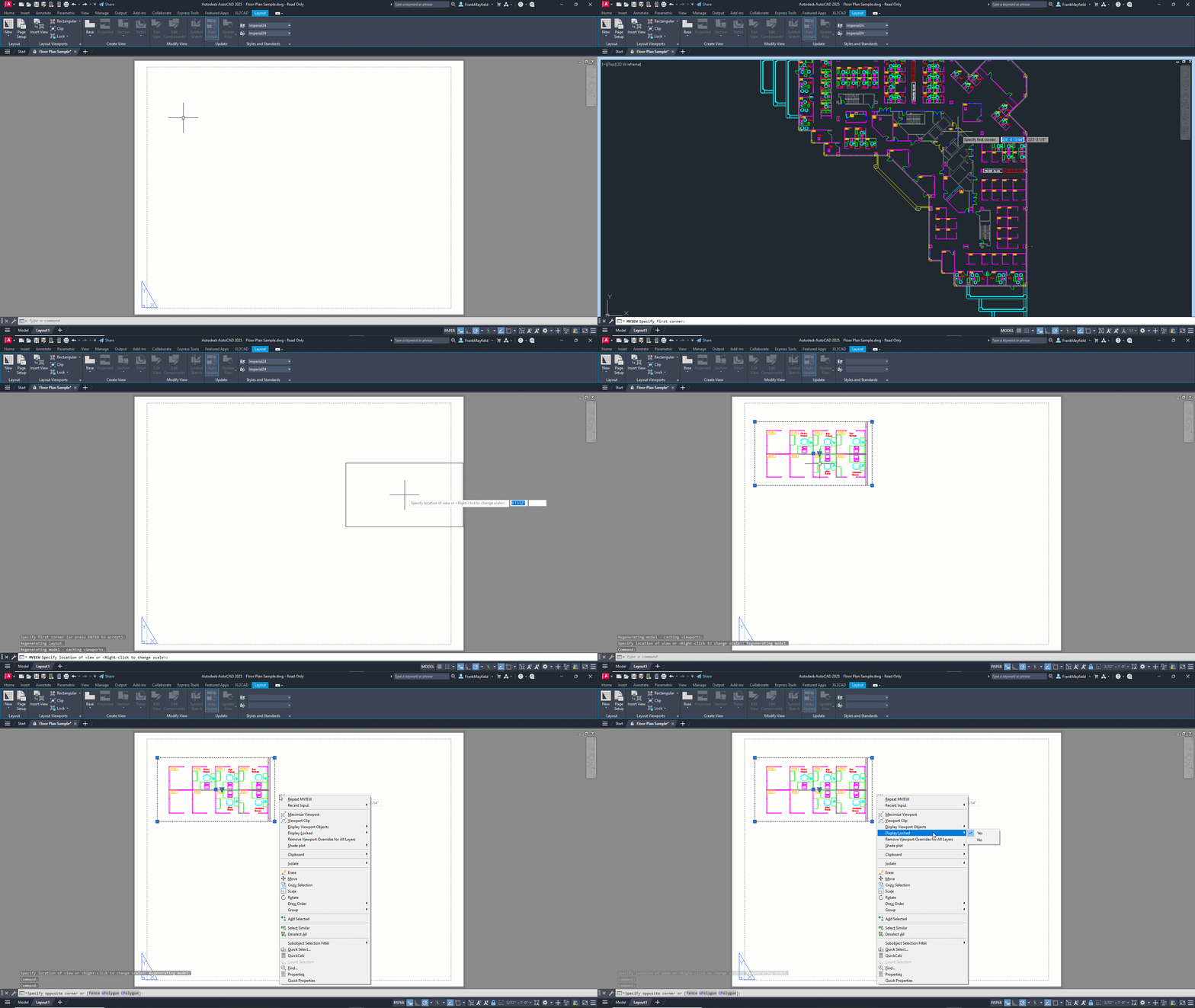
Hi Murray, instead of that, how about you just make an easy change in your workflow? From the blue contextual Layout ribbon tab, you’ll find an Insert View tool in the Layer Viewports panel. This will let you insert any named view as a viewport. You don’t even have to use named views to use it. If you don’t have any views, it will go directly into New View mode, where you can select an area of your model. When you’re satisfied with the selection, hit enter, and you’ll return to your layout, where you can now drop in the viewport.
AutoCAD will do its best to scale it correctly for you, but you can always change it. And, best of all, it will automatically be locked after you insert it using this method. Viola! Problem solved.
Utilize Activity Insights
Emily from Chicago asks us:
Is there an easy way to know who did what in our drawings? In particular, who was working on it, who saved it, and who managed the Xrefs in it?
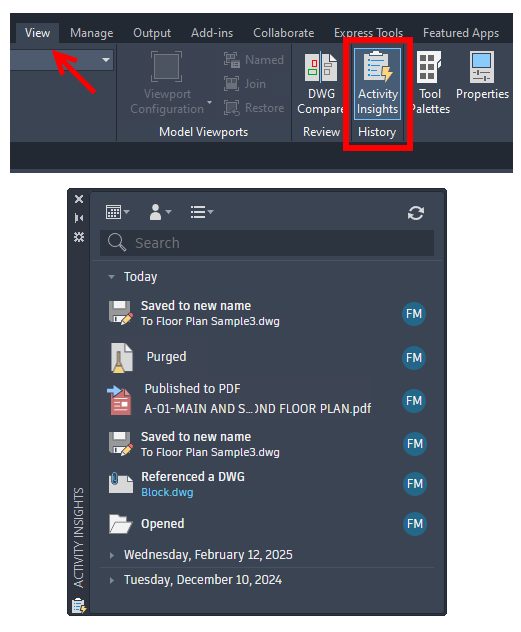
Emily – you didn’t mention what version of AutoCAD you are using, but if you’re on 2024.1 or higher, you sound like a perfect fit for the new Activity Insights palette. You’ll find it in the View tab of the ribbon. It’s the only icon in the History panel. Turn it on, and you’ll get a palette view of various activities, telling you who did what and when they did it. Click on any entry to get more info on it. Just follow this link to learn more about it.
Use Paste Special to Insert Image Files
Louie from New York wants to know:
We don’t use externally referenced drawing files in our work, but we do insert numerous images into our drawings. Of course, this references the image, which, in turn, creates problems for our users who aren’t used to working with the image paths. In other words, the path is often broken. Is there a way to attach an image so that it’s not externally referenced (thus pathed?)
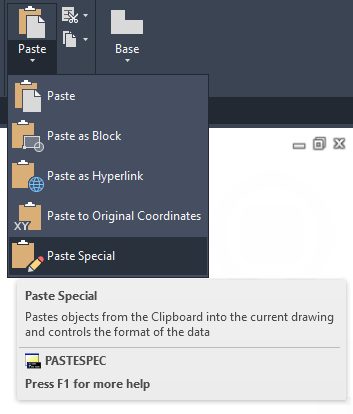
Louie, in a word, yes! It’s a simple three-step process. First, open the image file in MS Paint® or pretty much any graphic software. Next, select “all” and perform a clipboard copy. Finally, in AutoCAD, do a “paste special” (not a regular paste) to place the image directly into your drawing. Baddabing! No more lost image files.
Reset Overridden Dimension Strings
Bailey from Cincinnati asks:
Let me start by saying that I work with that co-worker. The lazy drafter who prefers to override dimension text instead of just doing it right to begin with. Of course, there’s no way to know if it’s been overridden or not (I wish they would get flagged similar to Anno Monitor). Do you have any suggestions for me?
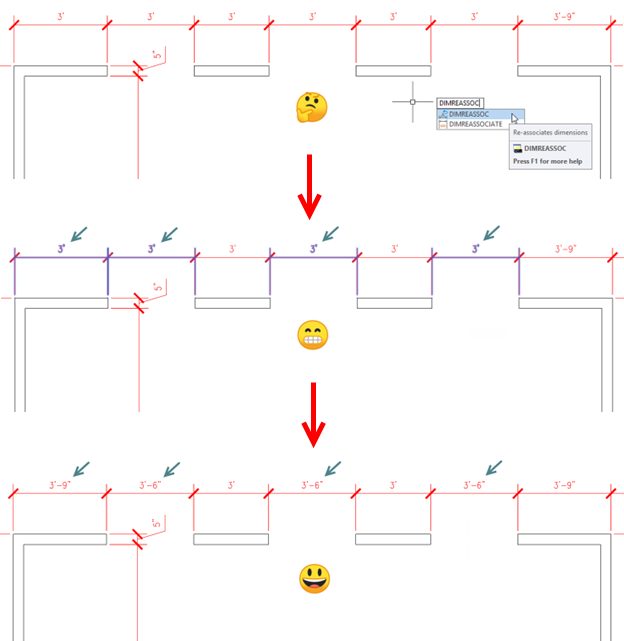
Yes, Bailey, I do! There’s an Express Tool called DIMREASSOC. You can type it into either the Dynamic Input Box or the Command Line. You can also find it as “Reset Text” in the Dimension panel of the Express Tools tab in the ribbon. To use it, select an area of dimensions or just type in ALL since the command filters out anything that’s not a dimension.
Any dimensions that have overridden text will immediately be highlighted for you. Just hit Enter to end object selection, and Boom! All the overridden dimensions now read accurately.
How’s that for an easy fix? I just wish we could do the same with your co-worker!
Coming Clean
If you were paying close attention, you may have noticed a pattern in our questions. They were all from fictional characters in classic TV sitcoms.
That’s right, there’s no actual mailbag full of letters that we pulled from. That’s shocking here in 2025, I know. But we do hear from a lot of you via emails or comments, so we also have plenty of shorter tips to share, so this is always a fun way to get them out there.
I hope to do another AutoCAD Potpourri post someday, so please make sure you keep those letters and questions coming!
Celebrity Guest Stars:
Murray Slaughter – The Mary Tyler Moore Show
Emily Hartley – The Bob Newhart Show
Louie De Palma – Taxi
Bailey Quarters – WKRP in Cincinnati
More Tuesday Tips
Check out our whole Tuesday Tips series for ideas on how to make AutoCAD work for you.
I’ve started receiving this warning at Visual Studio Code startup:
So I downloaded Git for Windows v2.27.0. Upon running the installer, I encountered this prompt:
I’d like to choose the same default behavior that Visual Studio did when it first installed Git for me, so as to keep everything working smoothly. I’m enough of a novice at Git that I wouldn’t want things to go awry.
I haven’t proceeded yet; I don’t want to risk mucking it up.
This Q&A discusses the concept but doesn’t quite get there on finding out what the default is. The official documentation comes up short here as well.
Is there a way to determine the current default?
If there isn’t, is it possible to change the default after the fact, in case I choose the wrong option?
FutureHouse, an Eric Schmidt-backed nonprofit that aims to build an “AI scientist” within the next decade, has released a new tool that it claims can help support “data-driven discovery” in biology. The new tool comes just a week after FutureHouse launched its API and platform.
The tool, called Finch, takes in biology data (primarily in the form of research papers) and a prompt (e.g. “What can you tell me about molecular drivers of cancer mataseses?”) and runs code before generating figures and inspecting the results. In a series of posts on X, FutureHouse co-founder and CEO Sam Rodriques compared it to a “first-year grad student.”
“[B]eing able to [do all] this in minutes is a superpower,” Rodriques wrote. “[Finch] actually ends up finding some really cool stuff […] For our own projects internally, we have found it to be pretty awesome.”
In addition to open-ended analysis, Finch can also do directed data analysis. In this example, we had it do a differential expression and functional enrichment analysis of some RNAseq data (GEO accession GSE87466). It identifies upregulated genes (e.g. inflammatory modulators,… pic.twitter.com/phRybhTVpb
FutureHouse’s proposition, like that of many, manystartups and tech giants, is that Finch and other AI tools will someday automate steps in the scientific process.
Biology, particularly on the drug discovery side, is an attractive target for AI companies. Precedence Research estimates the market was worth $65.88 billion in 2024 and could reach $160.31 billion by 2034.
While there have been some successes, AI hasn’t provided an immediate magical solution in the lab. Several firms employing AI for drug discovery, including Exscientia and BenevolentAI, have suffered high-profileclinical trial failures in recent years. Meanwhile, the accuracy of leading AI systems for drug discovery, like Google DeepMind’s AlphaFold 3, tends to vary widely.
Finch similarly makes “silly mistakes,” Rodriques said — which is why FutureHouse is recruiting bioinformaticians and computational biologists to help evaluate its accuracy and reliability and train it while it’s in closed beta.
Searching for a new job can often feel like a time-consuming and overwhelming endeavor. With so many steps involved, from crafting the perfect resume to networking and preparing for interviews, it’s easy to get bogged down. However, with the right strategies and a focused approach, you can streamline your job hunt and land your next opportunity faster.
In this blog, we’ll explore effective tips to help you speed up the job search process, ensuring you find the right fit for your career goals as quickly as possible.
10 Tips to Speed Up the Job Search Process
Job searching can often feel like a lengthy and daunting process. However, with the right strategies and a focused approach, you can significantly speed up your job search and land your next opportunity faster. Here are some effective tips to help you streamline your job hunt and secure a position that aligns with your career goals.
1. Set Clear Goals
Define Your Objectives: Know what type of job you’re looking for, including industry, role, and company size. Clear goals help you focus your search and avoid wasting time on irrelevant opportunities.
2. Optimize Your Resume and LinkedIn Profile
Tailor Your Resume: Customize your resume for each job application to highlight relevant skills and experiences.
Update LinkedIn: Ensure your LinkedIn profile is complete, professional, and aligned with your resume. Use keywords related to your desired job to improve visibility.
3. Leverage Job Search Engines and Apps
Use Multiple Platforms: Utilize job search engines like Indeed, Glassdoor, and LinkedIn to find job listings. Set up job alerts to receive notifications about new opportunities.
Download Job Apps: Use mobile apps to search for jobs on the go and apply quickly.
4. Network Effectively
Reach Out: Connect with industry professionals, former colleagues, and friends. Let them know you’re looking for a job and ask for referrals or recommendations.
Attend Events: Participate in industry events, webinars, and networking meetups to expand your connections.
5. Use Professional Services
Recruitment Agencies: Consider working with recruitment agencies that specialize in your industry. They can help match you with suitable job openings.
Career Coaches: Hire a career coach to provide personalized guidance, resume reviews, and interview preparation.
6. Apply Strategically
Quality Over Quantity: Focus on applying to jobs that closely match your skills and interests. Tailor each application to the specific job and company.
Follow Up: After applying, follow up with a polite email to express your continued interest and inquire about the status of your application.
7. Prepare for Interviews
Practice Common Questions: Prepare answers for common interview questions and practice with a friend or mentor.
Research Companies: Research potential employers thoroughly to understand their culture, values, and recent news. This will help you tailor your responses and ask insightful questions during interviews.
8. Stay Organized
Track Applications: Keep a spreadsheet or use a job search app to track your applications, including dates, contact information, and follow-up actions.
Set a Schedule: Dedicate specific times each day to job searching, networking, and skill development to stay consistent and focused.
9. Enhance Your Skills
Online Courses: Take online courses or certifications related to your field to improve your skills and make your resume more attractive to employers.
Volunteer or Freelance: Engage in volunteer work or freelance projects to gain experience and expand your portfolio.
10. Stay Positive and Persistent
Maintain a Positive Attitude: Job searching can be challenging, but staying positive and persistent will help you stay motivated.
Seek Support: Lean on friends, family, and professional networks for support and encouragement.
Conclusion
Speeding up the job search process requires a strategic and organized approach. By setting clear goals, optimizing your resume and LinkedIn profile, leveraging job search engines and networks, and preparing thoroughly for interviews, you can increase your chances of finding the right job more quickly.
If you are looking for remote jobs, there’s no better place to start than DailyRemote. So, what are you waiting for? Get started today, find the remote job of your dreams, start applying today. Join like-minded people in our
Amazon is about to end Kindle content download support in old versions of its Android app.
The move would close a loophole used to retrieve files vulnerable to DRM removal.
This follows Amazon ending “Download & transfer via USB” support.
Getting new books for your Kindle is just about the easiest thing in the world. Amazon’s got a stupid number of books available for you to buy à la carte, Kindle Unlimited offers a convenient subscription option, and you can borrow books from participating libraries. But even with so many curated paths towards growing your Kindle library, some users are always going to want to do things their own way, and for that we’ve still got Kindle sideloading. Earlier this year we heard about Amazon closing one loophole that let users convert their legitimately purchased Kindle titles into easily sideloadable content, and now it looks like another is on borrowed time.
Basically, these Kindle libertarians have been interested in getting their hands on e-book downloads from Amazon, then running those files through tools that strip the DRM and remove the limitations on how that book can be shared and read. For this to work, though, they need to have access to those files in the first place.
Back in February, Amazon deprecated its “Download & transfer via USB” functionality, which had previously been a source for these files. But it turns out that wasn’t the only way to retrieve these downloads from Amazon’s servers, and some clever users have instead been turning to older versions of the company’s Android app, which still supported a similar download mode.
Unfortunately, that window is about to close, as well. It’s unclear if Amazon is actively trying to eliminate the workaround, or is just doing some housekeeping, but the company has sent out notice that old Android builds will no longer support Kindle downloads, as shared by MobileRead forum user trishau (via Android Police):
We are reaching out to ask you to update the Kindle app on your Android device to the latest available version (Android OS v9.0+). Starting May 26, 2025 Kindle for Android app versions released prior to March 2022 (v8.51 or earlier) will no longer support Kindle content downloads. This update will ensure you get the most out of the Kindle experience and that the app operates as intended.
As you can see, we were talking about some seriously ancient app versions being used to pull off this trick, so even this loophole business notwithstanding, it wouldn’t have been crazy to see Amazon ending support for users who haven’t updated in years.
If you’ve been running an old version for precisely that reason, though, at least Amazon’s giving you a few weeks’ notice before pulling the plug — again.
Got a tip? Talk to us! Email our staff at news@androidauthority.com. You can stay anonymous or get credit for the info, it’s your choice.
Grab a friend and blast-off in May with exclusive limited-time Steam launch perks. Purchase Revenge of the Savage Planet within the first month of launch to receive the Trash Panda Suit and a bonus copy of Journey to the Savage Planet. This buy-one-get-one bundle is only available on Steam and for the first month of launch. Additionally, purchase the first week on Steam and you’ll also receive a 10% discount. Don’t miss out, wishlist today so you can be notified of the release and to secure your spot in space! Launch news is right around the corner. In a future knocked off its axis by corporate greed and stupidity, you have been made redundant and abandoned on the far edge of space with little gear and no safety net. Drop Duchy
You must explore every nook and cranny, collect dozens of upgrades, and turn over every mysterious alien rock if you want to get revenge on your former employer and return to Earth. Across multiple planets and through myriad challenges, you will be tasked with exploring and understanding these beautiful alien worlds. There are plants to scan, creatures to capture, lakes to swim, caves to spelunk, mountains to climb, upgrades to craft, and hundreds of secrets to uncover… Play with your best friend, partner or hellspawn on or between any platform! Or better still, experience the nostalgia tinged joy of sitting on the same couch and playing on the same screen with someone you love. Like the olden days when the world was young and we were happy.
Features and System Requirements:
Team up with a friend in either local split-screen or online co-op modes. The game supports cross-platform multiplayer, allowing players on different systems to adventure together seamlessly
Capture various species and store them in pens near your habitat, adding a layer of strategy and collection to the gameplay.
This feature adds a creative outlet and a sense of ownership as you progress through the game.
Screenshots
System Requirements
Recommended
Requires a 64-bit processor and operating system
OS: Windows 10 64-bit
Processor: Intel Core i7-9700 / AMD Ryzen 5 5500
Memory: 16 GB RAM
Graphics: NVIDIA GeForce RTX 2060 / AMD Radeon RX 5700 XT / INTEL Arc A750
DirectX: Version 12
Storage: 20 GB available space
Support the game developers by purchasing the game on Steam
Installation Guide
Turn Off Your Antivirus Before Installing Any Game
1 :: Download Game 2 :: Extract Game 3 :: Launch The Game 4 :: Have Fun 🙂
Clair Obscur: Expedition 33 completely blew my expectations out of the water. Its story and combat quickly became all-consuming—I sank 13 hours into it over just one weekend. But the best part of this French RPG has to be its soundtrack, which is apparently all thanks to just one composer.
Lorien Testard had never worked on a videogame before (via BBC) and was discovered by Expedition 33’s director, Guillaume Broche, on Soundcloud. He then proceeded to make the entire score, comprising 154 songs and clocking in at an impressive, and slightly terrifying, eight hours and nine minutes long.
But it seems like it was meant to be from the very beginning, as Broche says that they were just on the same wavelength. “When we discussed the game for the first time, we had exactly the same references,” Broche says in an interview with the BBC. “We loved the same thing. We watched the same things. The discussion was so fluid.”
I pretty much have the soundtrack running all day on Spotify, with my favourite song being Monoco’s theme, because who doesn’t love listening to jazz while fighting bosses? The album has since passed 1.5 million track streams and was the number one selling album on Bandcamp last week.
“I call this the Guillaume effect,” the lead writer, Jennifer Svedberg-Yen, says. “He’s very good at finding really cool people.”
Somehow it worked, which still makes no sense to me after all these years.
Guillaume Broche
Broche also managed to find his lead writer via unconventional means. Svedberg-Yen initially applied for a voice acting role via Reddit. “I saw a post on Reddit by Guillaume asking for voice actors to record something for free for a demo,” Svedberg-Yen says. “I was like: ‘I’ve never done that, it sounds kinda cool’, so I sent him an audition.” The audition obviously went well as Svedberg-Yen was actually cast as a major character in an early version of the game, but after a couple of rewrites and role switches, she then became the lead writer.
Broche seems to think the two factors helped massively in his bid to fill roles in the development team: Covid-19 pushing more creatives to display their art online, and a healthy dose of luck. “It’s always the same story,” Broche says. “I have a list of 15 people to contact, and I’m like ‘Okay, I’m probably going to get maybe no one at all’, and every time, the first one is like, ‘Yeah, let’s do it’.”
Keep up to date with the most important stories and the best deals, as picked by the PC Gamer team.
Finding an outstanding composer via Soundcloud and a clearly very talented lead writer on Reddit isn’t just impressive, it’s also a great way to cut costs. Expedition 33 has managed to rival games worked on by hundreds or thousands of devs with much more money.
“We have, I think, an amazing team, mostly of junior people, but they are so incredibly invested in the project and talented,” Broche says. “Somehow it worked, which still makes no sense to me after all these years.”
Atomos has newly appointed Peter Barber as its new chief executive officer who will officially take control of the helm next week! Along with announcing Barber as their new CEO they also launched four new products including a recurring revenue cloud solutions platform.
“Barber brings heavyweight industry credibility, with over 30 years of experience in the video production industry, having co-founded Blackmagic Design and orchestrating substantial corporate plays across the video tech space,” says James Pearson of Buisness News.
On LinkedIn Barber said “My focus is building an agile, innovative, and globally competitive organisation that continues to deliver cutting-edge creative tools for filmmakers, creators, and professionals — while strengthening Atomos’ position as a world-class global technology brand.”
At the NAB 2025 show, Atomos announced it’s brand-new entry into the audio space with its StudioSonic headphones, its TR-RX Series video transmission system, it’s A-EYE PTZ camera range and ATOMOSphere. Atomos says the move to release so many new offerings in one hit aligns with a management decision to diversify its product range.
Atomos Limited chief executive officer-elect Peter Barber said: “The work we have done over the past year to rebuild and restructure the Company has laid a strong foundation for the future. We are creating a more agile, resilient organisation — one that is better positioned to navigate change and seize new opportunities. I believe Atomos has an extraordinary opportunity to expand into new markets, drive broader innovation, and build upon its proud history of pioneering technology in the video production and content creation space.”
Our expert reviewers spend hours testing and comparing products and services so you can choose the best for you. Find out more about how we test.
I have colleagues who’ve reviewed EarFun products and speak highly of them. This is my first go with the brand, and as much as I enjoy having a critical ear, and catching something others have missed, that isn’t the case here. EarFun has gained a new believer.
Currently on sale on Amazon for $60, the EarFun OpenJump is easy to recommend for those on a budget who also want excellent battery life and an open-ear style for work or play.
Compelling sound and features
Image 1 of 5
(Image credit: @tshakaarmstrong)
There is a lot to like about the EarFun OpenJump open-ear earbuds! They are one of the least expensive open-ear products and compete with more expensive options, like the excellent Nothing Ear Open.
Let’s talk hardware and features first. Unboxing the EarFun OpenJump, you’ll find the earbuds case with the earbuds inside. Below the tray the case sits in, you’ll find the usual paperwork and a short charge cable. There are no ear tips because this is, after all, an open-ear affair.
Though not as large as some, the case will dominate a pocket despite being very light and not feeling particularly reassuring regarding its build quality. That said, it doesn’t creak, and the hinges don’t have any lateral give, making the “plasticky” feel a bit deceptive.
(Image credit: @tshakaarmstrong)
At this price point, you do get a well-spec’d clamshell case. It comes with USB-C charging and Qi wireless charging support, which is something even more expensive offerings don’t have. There is a pairing button inside the case, and a status LED on the front face of the case, just below the opening. EarFun says you’ll get a total of 42 hours of additional charging out of it.
After examining the case, it was time to set up and pair the EarFun OpenJump. When I first opened the app, I was notified that a firmware update was available. Once that was done, my review began in earnest.
Listening to the EarFun OpenJump in its default setting is enjoyable, but the experience comes alive when you customize the sound to your hearing, with a caveat. We’ll get to that in a moment.
(Image credit: @tshakaarmstrong)
I’ve worn these all day at my day job, and I have to say that they are quite comfortable! They don’t have the adjustability of the AeroFit 2 that I just reviewed, and they aren’t as large as the Nothing Ear Open, but they are tiny, light, and for my ears, a great fit. Depending on the size and shape of your ears, your mileage may vary, though.
I’ve found them for as cheap as $60, and at that price, they have a lot to offer in the sound quality department. I went back to some of my favorite open-ear TWS earbuds that I’ve reviewed over the last year and performed some A/B testing. They are competitive with open earbuds that cost much more. The Soundcore AeroFit 2, the Nothing Ear Open, and the Bose Ultra Open all fare a bit better when it comes to clarity in the mids and sparkle in the high frequencies.
Given the cost difference, even with the sub-$100 AeroFit 2, that difference is expected. That said, if cost is your primary concern, the sound signature of the OpenJump is nothing to sneeze at.
(Image credit: @tshakaarmstrong)
I tested the OpenJump with LDAC activated. Doing so deactivates multipoint functionality, but it’s worth it to increase the dynamic range. Having tested quite a few open earbuds, in my opinion, HiRes Wireless Audio support makes a difference in the listening experience.
As with all open-ear earbuds, in the silence of a quiet room, the sound signature is much different than when you’re out on the streets or at a beach. In a quiet room, the EarFun OpenJump sound very good. The highs, lows, and mids are all well represented with my custom EQ profile.
While my custom profile is great in quiet rooms or out on the streets with busy metropolitan life buzzing around me, the Bass Boost 1 preset gave me an enjoyable representation of all the frequencies despite competing audio from passing cars and other urban jungle sounds. Most importantly, playing at the lower volumes that you’ll want to listen to open-ear products, I still had solid sounds pumping into my ears.
Image 1 of 5
(Image credit: @tshakaarmstrong)
Battery life is excellent with the EarFun OpenJump. Playing a Tidal LoFi stream at about 55% of maximum volume from a Google Pixel 9 with LDAC activated in the app, I saw about 10 hours of battery life. EarFun advertises 11 hours, and those estimates are usually under “ideal conditions,” so having a high-quality codec activated, which drains battery faster, makes that an excellent showing.
Why didn’t I test them at max volume? That isn’t a realistic use case for open-ears. The whole point is to have your volume mixed with ambient sound at a level where the ambient sound is not only audible but also discernible — enabling you to hear cars or people coming up from behind you, for example.
Room for improvement
(Image credit: @tshakaarmstrong)
There are some things you should know if you’re seriously looking at the OpenJump. At full price, or on sale, there are some tradeoffs. They aren’t deal breakers, just things you should be aware of.
The Spatial Audio feature, Theater Mode, is not effective in creating a larger soundstage with quality sound. It also overemphasizes mids and highs to the detriment of the music or video content you’re listening to. Music sounds better with it deactivated.
(Image credit: @tshakaarmstrong)
The touch controls could be better implemented. The part of the earbud that sits over your ear and houses the speakers is angled, making it a bit awkward to tap the controls. In the couple of weeks I’ve had the earbuds, those controls are still problematic for me. Part of that is the diminutive size of the touch surface.
All is not lost, though. You can customize the controls, adding or removing features to make them work for your situation.
The EarFun OpenJump competes with Soundcore AeroFit 2 (more expensive) and Baseus Eli Sport 1 (cheaper). Outside the US, Honor and Huawei are also competitors. While I haven’t tested some of those, Harish Jonnalagadda’s reviews of the Baseus Eli Sport 1 and Honor Earbuds Open are positive.
The most significant difference here is that EarFun has significantly better battery life. Given this, and the OpenJump’s good sound quality, it may have the edge over the Eli Sport 1 and Earbuds Open.
The EarFun OpenJump are a steal under $100
(Image credit: @tshakaarmstrong)
At the sale price of $60, these are the budget open-ear earbuds to beat in the States! At their suggested retail price of $80, they’re still a compelling option compared to earbuds priced at $100 or more.
For their fit, their sound quality, HiRes Wireless Audio support, wireless charging support, and battery life, the EarFun OpenJump are easy to recommend for those looking for open-ear TWS earbuds.
Leap into quality, budget, open-ear sound!
The EarFun OpenJump are a great option for those looking to buy into open-ear audio without breaking the bank. The OpenJump earbuds have excellent battery life, a great app, and sound quality that is competes well against costlier open-ear options.