If you’ve been following the Forza Horizon series for years, you already know the feeling. That moment when a new Horizon game gets announced, and suddenly you’re counting down the days until you’re tearing through a whole new locale.
Well, Forza Horizon 6 is shaping up to be exactly that kind of game. It’s bigger, bolder, and packed with features that feel like they were designed specifically for long-time fans.
From its setting to its soundtrack, here are five confirmed features in Forza Horizon 6 that have us seriously excited.
1. Japan Is the Perfect Horizon Location
Let’s be honest. If there’s one place that feels like it was built for Forza Horizon 6, it’s Japan.
This is the home of drifting culture, legendary street racing history, and some of the most iconic cars ever made. From neon city streets to winding mountain roads, Japan has the perfect mix of environments for both casual cruising and full send racing.
Whether you’re blasting through Tokyo at night or carving corners on rural passes, this setting feels like the ultimate Horizon playground.
If you’ve been dreaming of a modern Horizon game set in Japan, you’re not alone. And now it’s finally happening.
2. A Soundtrack That’s Going to Hit Different
A great Horizon game brings great music. It’s not just background noise. It’s part of the identity.
Forza Horizon 6 is bringing nine radio stations packed with tracks across multiple genres. That means there will be something for every kind of player, whether you’re into electronic beats, rock anthems, hip hop, or something more lo-fi for those long highway drives.
The soundtrack is a huge part of what makes Horizon feel like a festival. If they nail it, the vibes are going to be immaculate.
And yes, you already know we’ll be switching stations mid-drift just to find the perfect track.
3. Over 550 Cars at Launch
This is the one we all care about.
Forza Horizon 6 is launching with over 550 vehicles, and that number alone is enough to make any racing fan grin. That means classics, modern performance monsters, rare collector cars, and plenty of machines built for pure chaos.
With Japan as the setting, we’re also expecting the JDM lineup to be absolutely stacked. If you’ve ever wanted to build your dream garage full of iconic Japanese legends, this is going to be the game.
And let’s face it. Half the fun is scrolling through the car list and immediately planning what you’re unlocking first.
4. Estate Building and Custom Garages
This might be the sleeper feature that ends up becoming a fan favourite.
Forza Horizon 6 introduces estate building, letting players create a personal home base in rural Japan. It’s not just a menu screen. It’s a proper space where you can build up your garages, display your favourite cars, and make your Horizon experience feel more personal.
If you love collecting cars, this is going to hit different. Having an estate that actually represents your collection adds a whole new layer of immersion.
It’s these kind of features that makes you want to keep playing, even after you’ve already won everything.
5. New Progression and Event Variety
Horizon games always shine when the map is packed with things to do. Forza Horizon 6 is continuing that tradition, bringing back the festival-style progression system while expanding it with more event types and challenges.
There are new race categories, Horizon Rush obstacle events, drag meets, and time attack circuits spread throughout the world. That means you won’t just be doing the same races over and over again.
Instead, you’ll constantly be stumbling into something new. And that’s when Horizon is at its best.
The festival vibe is back, and it sounds like it’s going to be bigger than ever.
Final Thoughts
Between Japan as the setting, a huge car roster, proper festival music, estate building, and expanded event variety, Forza Horizon 6 is already looking like a dream game for racing fans.
If Playground Games delivers on what they’ve confirmed so far, this could easily be the best Horizon yet.
And yes, we are absolutely ready to lose hundreds of hours to it.
Green Man Gaming
The Green Man Gaming Staff account represents the voices of the team behind Green Man Gaming, bringing you the latest in store news, industry insights, and curated gaming recommendations.
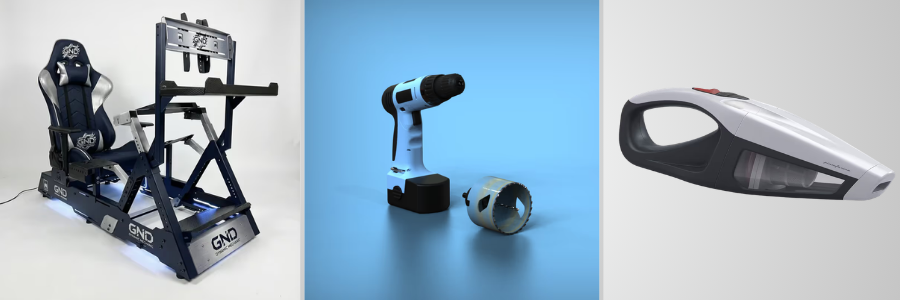
NPD, or new product development, is a complex undertaking with one purpose in mind: transforming an idea into a market-ready product. It’s a systematic process that involves in-depth market research, design and engineering, iterative prototyping, testing and validation, and commercialization. There is no single correct formula for new product development. Every company can implement its own unique approach and strategy as it sees fit. In the vast majority of cases, however, an NPD starts with concept design services.
Think of a concept design as the earliest version of a product that represents the big picture of what you’re trying to build. It’s meant to show what problems the product will solve and how it should achieve that objective. Generating a concept design might actually be the most creative stage of a product development process; this is where you make notes and drawings on napkins and scrapbooks, then slap them on the wall and whiteboards. Only when all possibilities are explored, and every idea from varying perspectives is taken into consideration, can a concept design generation lead to innovation. In other words, the task runs in its most effective fashion as a team effort – preferably a team populated by professionals experienced in hardware product development.
Finding and hiring design professionals isn’t necessarily difficult. Freelancing platforms make it easy for you to discover and connect with talented product designers, fabricators, PCB makers, firmware developers, and engineers. Cad Crowd, a platform that specializes in product design and development, is always a safe bet. It’s home to a vast network of industrial designers from all over the world, ready to take on your NPD project at every stage of the process, be it concept generation or the entirety of the workflow. Having professionals with the right credentials and track record on your side means you have a much higher chance of formulating a proper concept – a design that you can plausibly develop into a working prototype in a cost-efficient manner.
Cad Crowd can connect you with pre-vetted experts capable of delving deep into hardware design research for products of any category, from fully mechanical tools and equipment to sophisticated electronics. They help you experiment with components, assemblies, fabrication techniques, PCB layouts, and all possibilities within DFM (design for manufacturability) services. While there’s always a degree of uncertainty with every concept design, the talents at Cad Crowd strive to eliminate the risk from the get-go, allowing you to focus on what’s technically feasible rather than trying to fix mistakes as the project moves along.
🚀 Table of contents
Ideation and concept design
When you come up with an idea for a hardware product, whether home appliances, power tools, medical devices, peripherals, toys, gadgets, or anything else in between, almost immediately, your mind ventures into the “concept design” territory, chances are, you visualize the product in your mind and wonder if the design makes sense or is at least possible. The notion that you have to separate ideation and concept design generation isn’t as clear-cut as it may seem.
They’re usually considered separate stages in an NPD process, but a concept design is, in essence, an idea waiting to be materialized all the same. A concept design is somewhat more tangible than an idea, but not quite tangible enough that you can call it a PoC (Proof of Concept). It’s somewhere between the two, and its main purpose is to point you in the right direction before you go too far ahead. You need a feasible concept to form the foundation of a prototype, which eventually becomes the ultimate reference point for the final production version.
For a lot of product designers, a concept design is where they make rough sketches sprinkled with symbols and handwritten notes. It shouldn’t be too elaborate because the important point here is to entertain the ideas with only some basic visualizations. Pencils and paper are the best tools, allowing the designers to quickly generate a concept every time they have a brain wave. There’s no need to overthink every single design that comes to mind, considering how everything still has to go through a screening process later on.
Detailed design, on the other hand, is often viewed as a phase that requires CAD tools. It’s a phase that immediately follows the screening process, where only the most plausible concepts are shortlisted for further development. Product design experts will probably discard dozens of concepts generated during the previous phase for the sake of effective resource allocation. If every concept must be drawn using CAD software, it’s going to take too much time before they can move on to the next phase.
The thing is that just because someone mentions CAD, it doesn’t necessarily mean the time has come for you to worry about such technical matters as clearances, material selections, simulations, electrical engineering, or manufacturability. If the development team has just one person familiar enough with 3D CAD modeling, creating a basic concept of a simple hardware product will probably take anywhere from 4 to 8 hours (especially when using digital sculpting software like ZBrush, Blender, Mudbox, or the alternatives). The model will be pretty basic without texturing, detailed specifications, and the like, but then again, one concept per day is a respectably productive pace in an NPD process.
The road to concept designs for hardware products
A concept design isn’t a development phase reserved only for complex products like cars, humanoid robots, medical equipment, or any high-dollar machinery. Every product worth developing needs to (or at least should) go through some form of concept design phase.
Much like the entire NPD process, there’s no one best formula for an effective conceptual design. If you ask a dozen industrial designers about it, you’ll end up even more confused by their varying explanations. There’s nothing wrong with the different answers, and confusion isn’t always unexpected, either. After all, concept generation is inherently an exercise of creativity, and your method of crafting a solution might be different from the others’. Although variations are nothing unusual, the path leading toward a hardware concept design tends to include the following major steps.
Define the design requirements
In the countless guides you’ve come across all over the Internet about product development for product design firms, you’ll often see that market research is also listed as its own separate phase, rather than a subcategory of concept generation. Most of these guides mention “research” in the broadest sense of the term, including the business sides of NPD such as profitability, IP protection, target demographics, and so forth.
Concept generation also needs market research, at least the part where it digs into unsolved problems, unmet demands, and user preferences. You want to develop a concept design based on valid research, so that every design decision you make actually addresses real needs rather than an assumed necessity. Assumptions have their uses, for example, when you try to form a hypothesis about how a product fails or why consumers choose a particular brand over others. But these assumptions mean very little unless they’re validated by findings from thorough research. A concept design with no solid foundation in market research is prone to common blunders, such as the lack of desired features, terrible ergonomics, outdated functionality, poor user interface, or compatibility issues.
A market research of the sort might involve interviewing a lot of people, or a survey if you’d like – about the problems they have with the existing products, the solutions they want, what features they need, what kind of activities they do with the products, frequent pain points, and prices.
Let’s say you’re developing a concept design of a modern lawnmower led by new invention development design services. The research can cover a lot of topics, from the size of the motor and horsepower to app connectivity and remote monitoring. They’re all broad questions, but you might want to be very specific about every topic, because the best answers/responses are supposed to be narrow-focused as well, for instance:
“A power-reserve gauge will be great, even a light indicator is good enough to tell me exactly when to recharge.”
“My partner is much taller than I, so an adjustable handle would be helpful.”
“Why isn’t there any affordable hybrid lawnmower I can buy already?”
“I don’t mind a gas-powered lawnmower, if only the fuel doesn’t spill so easily.”
“Fancy mowers aren’t for me. An old-school heavy-duty hardware is still best, perhaps with a little bit of battery goodness.”
“So long as it’s durable and easy to repair, I will buy it.”
As casual as the answers might sound, they offer true insight into users’ viewpoints and can lead you to some market differentiators. The answers touch on a lot of issues, and you should be able to formulate a coherent design intent from the information you gather. Here’s just an example:
A lawnmower, even if it comes with various modern features like Bluetooth and a solar panel, should strive to preserve ergonomics and ease-of-use. Convenient features are always welcome additions, whether a pair of cupholders, an included second mulch attachment, or a foldable design for easy storage. Durability and repairability remain two major issues to address, regardless of design and powertrain configuration.
The more users involved in the survey, the more specific the design intent you get. And everything that you come across while specifying the design intent ends up as design requirements, which can be defined as specific criteria derived from end-user research and meant to guide the development of the product’s features and intended use cases.
With only a few exceptions, most hardware products developed by electronic device design services in the last several decades or so aren’t exactly brand-new innovations. Some of them use novel technologies like 5G connectivity (IoT or smartphones), electromechanical biosensors (wearable devices), an assortment of exotic metals (heavy-duty vehicles), and high-performance semiconductors (medical and industrial robots), but much of their shape and form is built on existing products.
For example, the basic form of a car has been pretty much the same for decades, down to the pedal arrangement and drivetrain. The same thing applies to many smartphones and laptops, which still take design cues from their earliest generations. Consumer medical devices like pacemakers, hearing aids, fitness trackers, pulse oximeters, thermometers, and blood pressure monitors haven’t changed as drastically as you might expect, either.
This doesn’t mean copying the look and feel of an existing product is the right way to generate a concept design. A unique product stands out from the crowd. On a store shelf filled with similar-looking products from various brands, a distinctive design gets all the attention from consumers. At the same time, straying too far from the “recognizability” factor comes with the inherent risk of people avoiding it altogether. Imagine a scenario where a company makes bicycles that use steering wheels as opposed to the conventional handlebars; a high point for uniqueness, but minus one for familiarity.
A few people probably buy it just for its peculiarity value, while most end-users take a second glance, and that’s about it. Having a unique design is commendable, but sticking to what’s already been proven effective and marketable is always a wise decision. It’s probably why nobody has successfully reinvented the wheel. A balance between uniqueness and familiarity in hardware design is the safe bet, and this is where product benchmarking comes in. To do that, you have to examine the competition. Benchmarking allows you to assess competitors’ product designs and understand why consumers prefer certain brands over alternatives.
There are times during the design development where you may have to isolate yourself from external influences and focus on putting bits of ideas together to build a coherent concept. It enables you to filter the noise more easily and come up with a truly unique design of your own. At other times, studying competitors’ designs would also be beneficial as they provide an insight into the good, the bad, and the ugly. Benchmarking opens the door to a better view of the market landscape and trends, which hopefully reveal or present clear pathways to design differentiation and product innovation.
Attributes to benchmark
For most consumer hardware products, whether mechanical or electronic (or a combination of both), the idea behind benchmarking is to figure out the best and the worst popular design elements and features of the existing products. There are plenty of design attributes to focus on. Among the obvious ones for consumer product design companies are as follows:
Physical characteristics
Style/visual appeal
User interface
Convenient factors
Material Shape Form Size Durability
Color Finishes Packaging
Display (if any) Controls/buttons Feedback
Ease of use Ergonomics Portability Safety features Power efficiency Repairability Compatibility Instructions
Remember that you’re not in the process of creating imitations of all those features. The point is that no matter what concept design you come up with, at the end of the day, it has to be an improvement over the existing designs or at least perform just as well. Anything subpar defeats the purpose of a concept design.
About the user interface
Assuming the product being developed is an electronic, it probably has some kind of digital control for the user to operate the device. Modern electronics like home appliances or consumer-grade medical devices often have a screen to display status indicators (battery power, speed, timer, heat, and so on), data received from the built-in or attached sensors, and error information, to name a few. In case the product isn’t meant to have a screen, it probably has a few buttons or switches to activate certain features or initiate operation in the first place. Even a mechanical alarm clock has a few knobs to adjust the time, a trigger ice cream scoop has a lever, and a basic computer mouse has two buttons and a scroll wheel. Physical controls are fundamental parts of the user interface.
Complex hardware products like smart thermostats, car infotainment systems, digital cameras, handheld GPS, laser distance meters, and, of course, smartphones have much more sophisticated user interface designs from the embedded software. The good thing is that creating a concept design of a digital user interface doesn’t require tinkering with software development for concept design experts. During the concept phase, you can sketch a simple version of a UI on a whiteboard or paper. Although it won’t work (because you can’t actually operate it anyway), the drawing gives you an idea of the display layout and how to position the physical buttons accordingly.
Vision statement
Out of the design requirements and benchmarking results comes a better understanding of the market opportunity. At this point, you’ve already learned about the range of problems typical users have and have had a reasonable grasp of how the existing products failed to deliver effective solutions. However, it’s important to remember that every product is usually a result of a design compromise. For example, a company probably has what it takes to build an exceptionally good digital audio player (DAP) equipped with sophisticated software and a high-grade metal enclosure.
But a premium product isn’t cheap. Given the substantial resources spent on research and development and manufacturing, the price tag must reflect production costs if the company wants to make a profit on every sale. Some compromises are necessary to keep the price down to a reasonable level for the target market. The metal enclosure might use a less-durable alloy, the touchscreen is resistive instead of capacitive, the battery has a smaller capacity, or the storage device is built-in rather than removable. Every downgrade means lower development cost, and therefore friendlier retail price.
A vision statement has no regard for such compromises. Unlike a design intent, where you tend to delve into specific features and functionality, a vision statement speaks only in generalities. This is how you describe a perfect concept. Take a look at the following excerpt of a hypothetical lawnmower concept design: The lawnmower must be optimized for compatibility with modern technologies, in terms of connectivity and sustainability. Control via smartphone, the use of eco-friendly energy sources, and automation within the IoT framework allow for simplified and more practical operation in both residential and commercial settings.
All the hardware parts and assemblies, including the self-sharpening blade, are replaceable for easy maintenance and repair by design for manufacturing and assembly services. A vision statement is supposed to be a general description, albeit with a clear focus on durability and ease of use. Don’t overthink about what to put into the statement; the eventual product will most likely end up with a design compromise or two, and the vision statement simply acts as a guardrail to prevent you from straying too far off the objectives and a reminder to keep you striving for improvement.
Concept generation
Backed by a combination of detailed user research, benchmarking results, and the vision statement, you’re now ready to enter the actual phase of concept generation. The goal is to come up with as many concepts as possible to be evaluated during the next stage of product development. With every concept, there’s no need to get bogged down with technical feasibilities, engineering constraints, potential for profits, and overall manufacturability. Many of your concepts may be closer to being imaginary than they are to feasibility, some could be pretty convincing, and a select few might fall just right under the umbrella of real market opportunity. Although you will eventually discard most of those concepts, never prejudge any of them.
Generating concept designs should be an entirely creative, if not imaginative, phase where you enjoy exploring ideas. Putting all those concepts into assessment, on the other hand, is an entirely different matter. You need to narrow the selection down, for example, from a list of 20 concept designs to only 5, based on various factors such as technical or engineering feasibility, budget, time-to-market, and conformity with the vision statement. Use the attributes you observed during the benchmarking phase as the assessment criteria. Because it’s never a good idea to evaluate your own work, make the effort to assemble a small team of professionals consisting of at least one industrial design expert and one engineer.
Suppose the product is an electronic device with a digital user interface; a firmware/software developer should be involved as well. It’s not uncommon for companies to hire some “representatives” of the target demographics to take part in the assessment process. For instance, if the product is a medical device, the team includes a primary care physician, a specialist, or a nurse; if it’s sports equipment, you need an athlete or a coach; if it’s a home appliance, include a technician or an electrician, and so forth.
Having an industry-specific professional in the team is advisable, especially when your product has to meet strict standards and regulations. As the assessment concludes, you’ll end up with two – perhaps three – concepts that warrant further analysis and testing to determine if they can plausibly satisfy user needs and meet the design requirements while maintaining conformity with standards.
Takeaway
Concept generation is often listed as its own phase in an NPD process. In reality, this phase alone comprises multiple steps to ensure that the resulting concepts are grounded in sound analysis of market opportunities, research on the target demographics, and a well-founded understanding of existing products.
At every step of the concept generation phase, from defining design requirements and benchmarking to formulating the vision statement and conducting assessments, you have a much better chance of producing valid results and development-worthy concepts by bringing professionals on board. Industry-specific expertise and experience in NPD go a long way to transform your concept design generation into a systematic plan of action without all the guesswork.
How Cad Crowd can help
With Cad Crowd around, hiring the right professionals for the job doesn’t have to be an expensive hurdle. You can find thousands of industrial designers, engineers, market analysts, and even turnkey NPD professionals on the platform with just a few clicks of a button. More importantly, Cad Crowd has pre-vetted all the freelancers beforehand, leaving only the most talented and best qualified partners for you to collaborate with. Request a quote today.
MacKenzie Brown is the founder and CEO of Cad Crowd. With over 18 years of experience in launching and scaling platforms specializing in CAD services, product design, manufacturing, hardware, and software development, MacKenzie is a recognized authority in the engineering industry. Under his leadership, Cad Crowd serves esteemed clients like NASA, JPL, the U.S. Navy, and Fortune 500 companies, empowering innovators with access to high-quality design and engineering talent.
I’m losing you, naked blue placeholder person with a tiny red blaster and tiny bare bottom standing on my arm! Wait, what was that? Oh no, I, purple-faced placeholder robo-person am being sucked out of an airlock, as is my partner, red-faced placeholder robo-person. Our bare bottoms will never survive in the lethal void of space! It’s ok, though. Thanks to some quick thinking, we’ll make it out of what appears to be an early-in-production cinematic from the first interation of the Star Wars: Knights Of The Old Republic remake, which has been in relative development limbo for a while now.
AS if to divert our attention, Apple announces WWDC 2026 is set to run from June 8-12.
The company plans to give viewers insights into its new technologies during the main keynote on June 8 at 10 am PT (1 pm ET).
However, our sights are firmly set on Google’s I/O 2026 event tomorrow, May 19 at 1 pm ET, where Android XR, Android 17, and Gemini Intelligence will likely shine.
As if it were written in the script, Apple has started sending out notifications for its next major event, and it’s all about what’s next for its tech.
Today (May 18), Apple officially announced what’s coming up next, and if you guessed WWDC 2026, you’d be right. The company’s reveal comes with a brief view schedule for the event, which runs from June 8-12. As usual, Apple states this conference will bring together “developers from around the world to explore the tools, frameworks, and technologies” across its platforms.
The “main event” is set for June 8 at 10 am PT (1 pm ET), involving Apple’s keynote and a “first look at the latest updates coming to Apple platforms.” Of course, users can tune in via Apple’s YouTube or its main website (even the Apple TV app). Following this, users can continue to stay on board for the Platforms State of the Union. If you’re looking to get your nose into Apple’s tech, it says users will find a deeper dive into its new features, APIs, and more.
Latest Videos From
The Apple Developer YouTube channel will take the lead here, as well as the associated app and developer website. Video Sessions and Guides, Group Labs, the Apple Design Awards, and the Swift Student Challenge are all lined up from June 8-12.
Let’s not get ahead of ourselves
(Image credit: Derrek Lee / Android Central)
Apple will get its time to shine early on in June; however, facing our immediate future is Google’s I/O 2026 event. The meat and potatoes of this event are set for May 19 at 1 p.m. ET. It’s during this time that we’re expecting to see what Google’s been cooking for Gemini (Gemini Intelligence, too, maybe), Android XR, smart home updates, and much more. We’ve been speculating what could go down tomorrow for a while now, and all that’s left is to see the event.
Samsung’s Galaxy glasses are another aspect. While Android XR is likely to be a major feature during I/O 2026, perhaps Samsung’s first pair of smart glasses will make an appearance. Either way, we’re less than 24 hours away from the main event. To keep you involved and “in the know” about I/O, you can check our I/O 2026 Live Blog up until the event, and even after.
Android Central’s Take
Apple had quite a bit to talk about last year, and some of it looked like it was directly inspired by Google. I’m expecting quite a bit from Apple this year, too. It’s always interesting just seeing what they’re coming up with, even if I don’t own an iPhone. My main focus right now is on I/O (and that Live Blog, which you should check out). Gemini Intelligence, Android XR, and Android 17 are my big expectations for tomorrow.
Get the latest news from Android Central, your trusted companion in the world of Android
iOS 27 will include a custom wallpaper generator and an option to automatically create shortcuts using AI, reports Bloomberg.
When choosing a new wallpaper, users will have the option to generate something custom using the Image Playground app. Image Playground is used for generating custom emoji and images that can be used throughout iOS, and it is set to get an upgrade in iOS 27.
Apple is testing models that produce more lifelike images, so the version of Image Playground that’s used for generating custom wallpapers could be different from the current version.
Shortcuts is also getting a major update, with users able to use natural language to ask Siri to make a shortcut. There is an option for users to tell Siri what they want to accomplish with a shortcut to have the workflow created using AI.
Bloomberg says the Shortcuts app has a prompt that says “What do you want your shortcut to do?” with a text field to enter a description. Shortcuts that are created using AI are then automatically installed and immediately available for use.
Shortcut creation is largely done manually now, and it is a tool that has remained out of reach of many casual iPhone users. A Shortcuts app that’s able to work with natural language capabilities will see the app getting more widespread use.
The new Shortcuts app and the wallpaper generation tool will be previewed at the WWDC keynote that’s set to take place on June 8.
Apple’s WWDC 2026 graphic provides “a glimpse of the revamped Siri interface coming in iOS 27,” according to Bloomberg’s Mark Gurman.
In his Power On newsletter today, Gurman said iOS 27 will include a new Siri interface in the Dynamic Island. When you trigger Siri, he said the Dynamic Island will show a “Search or Ask” prompt, and this will apparently be accompanied by a “glowing cursor”…
Apple is planning to add “Undo” and “Redo” options to the iPhone’s Home Screen customization menu on iOS 27, according to Bloomberg’s Mark Gurman.
These two options will make it easier to reverse or redo your Home Screen changes.
”Right now, when you long-press on the home screen, you get a bubble in the top left corner with four options: Add Widget, Customize, Edit Wallpaper and Edit…
If you regularly spend time reshuffling your iPhone’s Home screen, you’ll likely welcome a couple of new options reportedly coming in iOS 27.
According to Bloomberg’s Mark Gurman, Apple’s next major software update will add Undo and Redo buttons to the Home Screen customization menu. Long-press the screen, and alongside the existing Add Widget, Customize, Edit Wallpaper, and Edit Pages…
While the otome genre has its own conventions and distinctive features, Saccharine Echo reimagines some of them to create a fresh, cross-genre experience. Out today on XBOX Series X|S, it combines themes uncommon for a romantic visual novel with pixel art and vivid characters, creating a story that leaves a lasting impression.
Through the Looking-Glass and the Fear of Loneliness
At its core, this visual novel draws heavily on the works of Lewis Carroll, but it’s not meant to be a straightforward retelling. Alice’s dreams in “Through the Looking-Glass” are usually interpreted as a product of a child’s vivid imagination—but what if they were those of an adult woman, tired of everyday life and its problems?
As a child, Alice’s adventures had a strong influence on me, captivating me with a sense of wonder — and sometimes even fear — because you never knew what surprises lay in wait in Wonderland or “Through the Looking-Glass”. I wanted to reinterpret these feelings through a more grounded lens, blending them with struggles familiar to many, such as the fear of loneliness and self-rejection. In Saccharine Echo, Alice does not physically travel through imaginary worlds, but at some point, this other world begins to seep into her reality, and for a time, it feels like salvation.
Whether this is a form of escapism or simply taking everything at face value is entirely up to you.
The heroine may see things differently from the player. In the game, I draw a clear distinction between the player and the protagonist, deliberately choosing not to let you play ‘yourself,’ as I believe this approach creates a more cohesive and compelling narrative. Alice has her own problems and fears — ones I hope most people do not share — but it was important to make them understandable to a wide audience.
A Non-Human Creature as a Love Interest
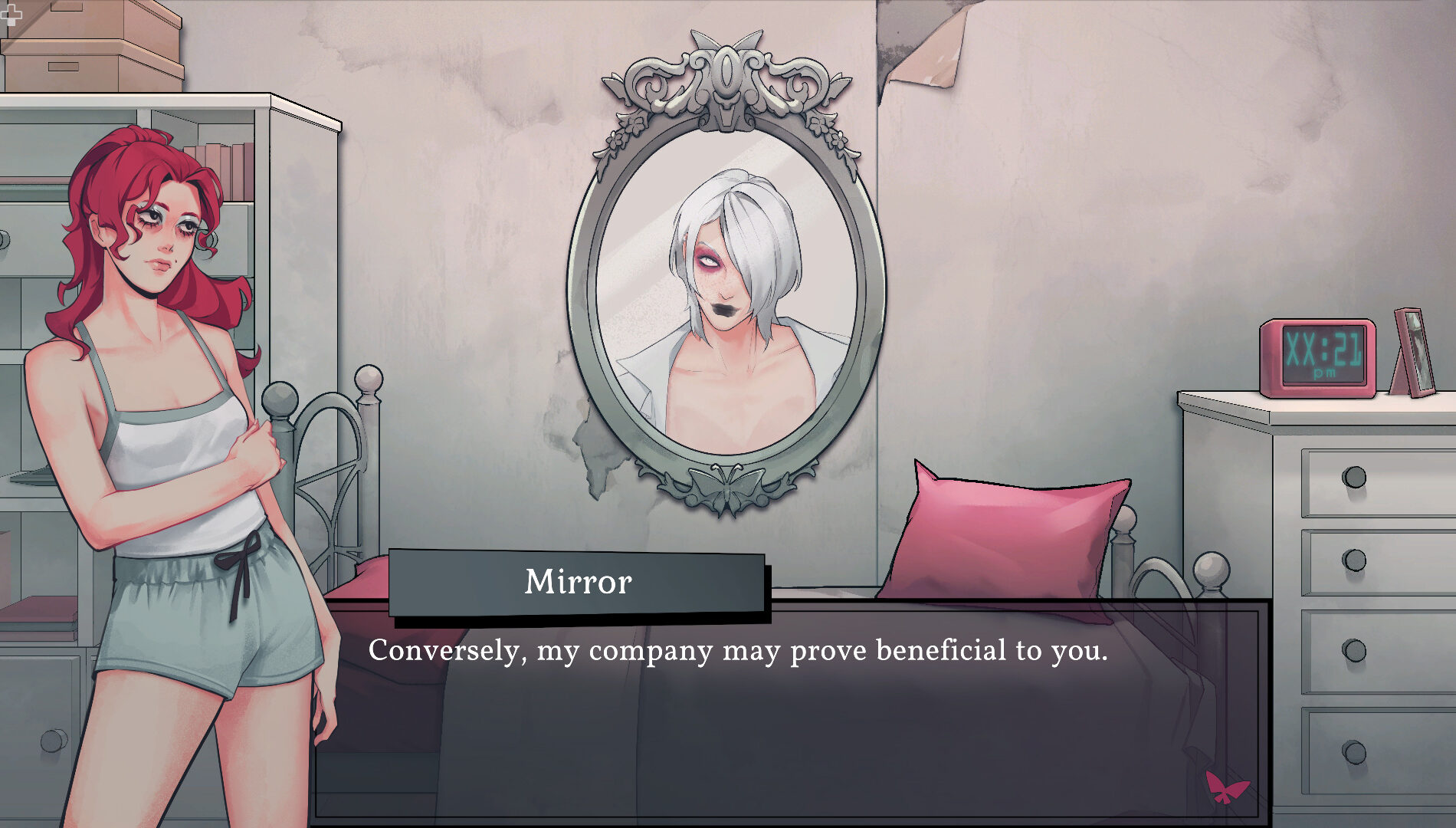
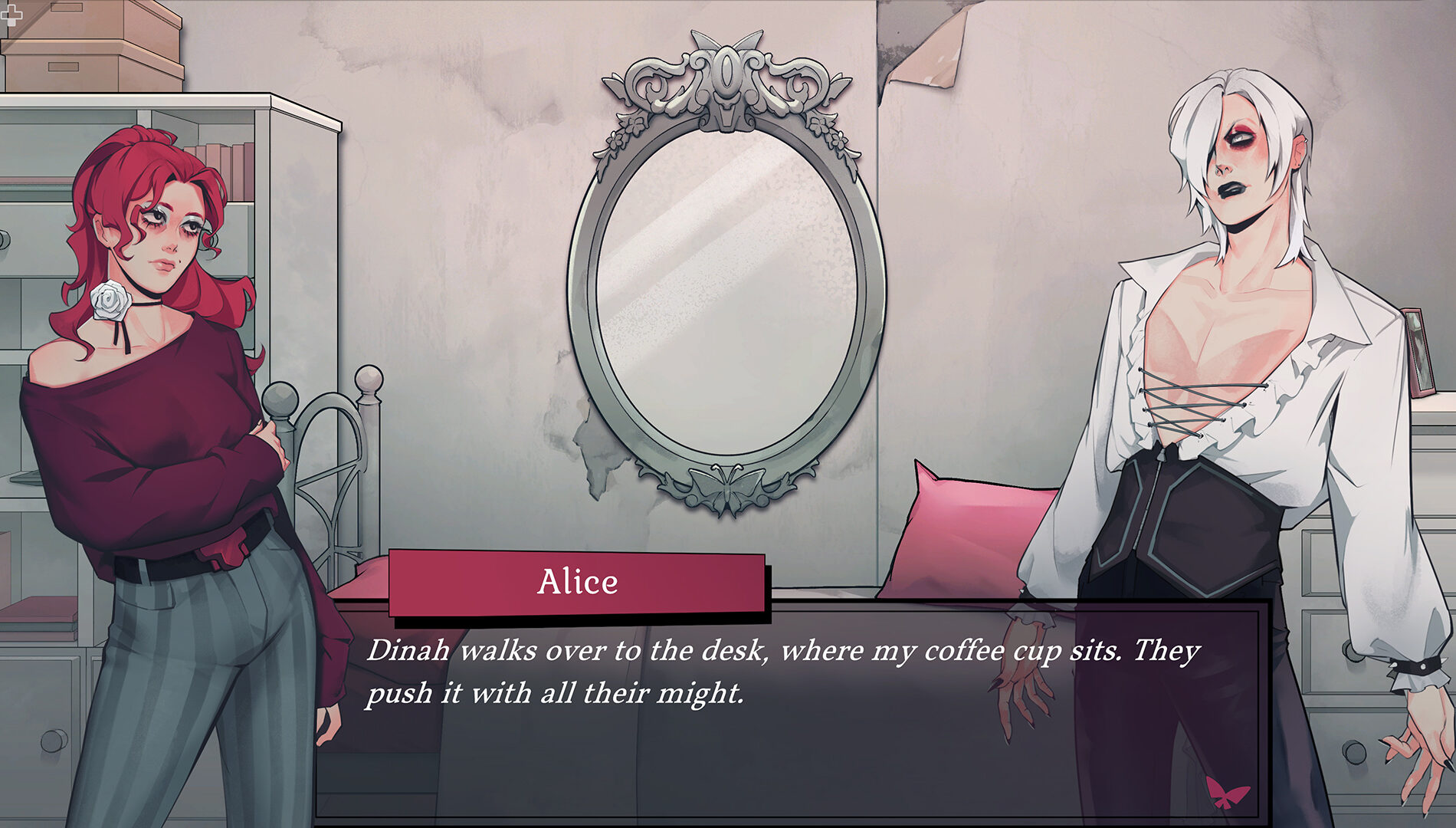
Memorable characters are essential to any romantic story. Love, hate, intrigue — Dinah, a new presence in the heroine’s life, is sure to evoke at least one of these feelings. The only thing that can be said for certain is that Dinah is far from a good person. Vague phrasing, gaslighting, and anger issues are far from a complete list of their “crimes,” yet they remain a romantic interest in Saccharine Echo.
When working on this character, I faced a difficult challenge: making someone whose actions and words are far removed from the idea of “good” appealing to the player.
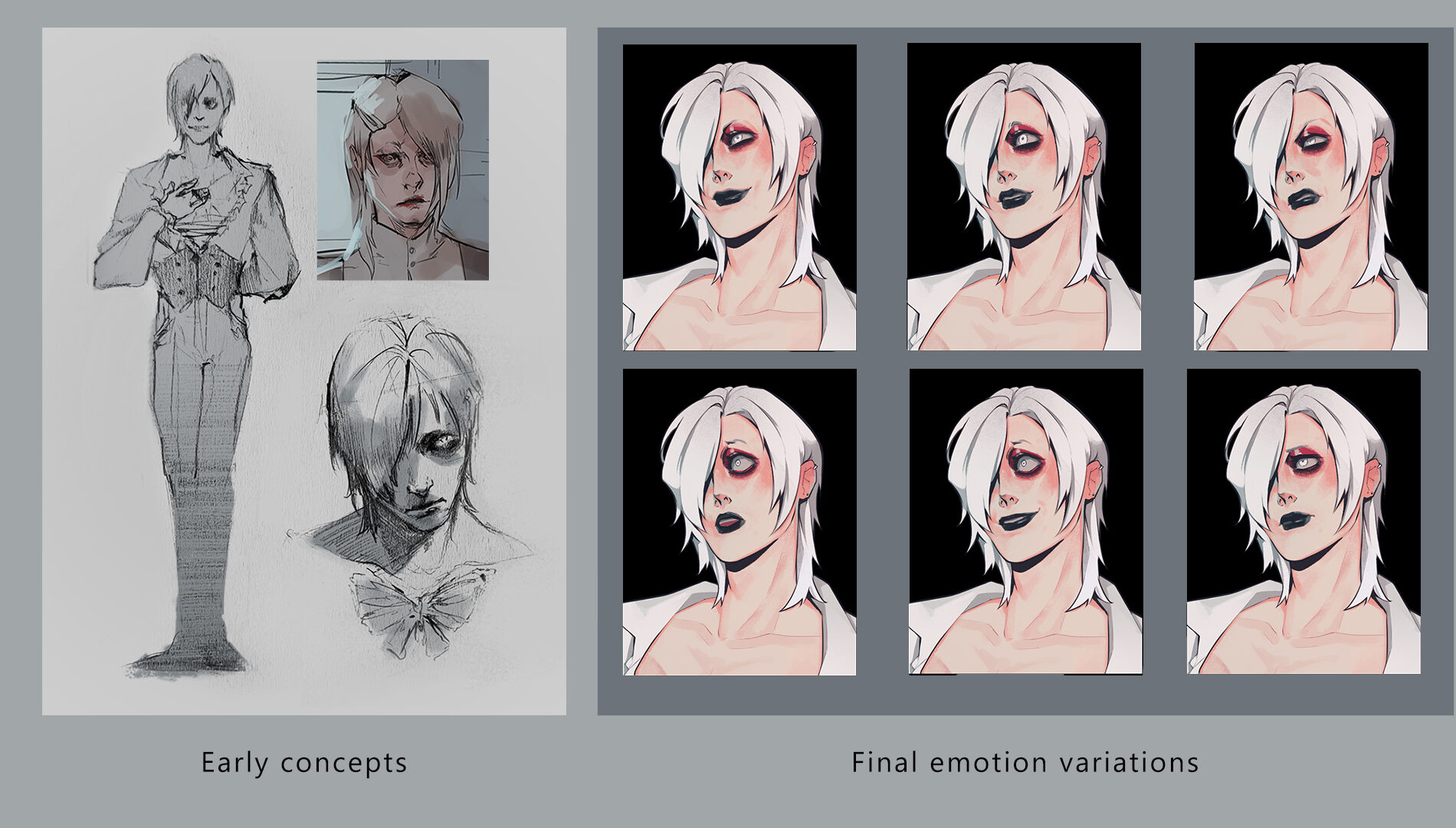
I approached this largely through Dinah’s appearance, as visual is often the first thing that shapes a player’s perception of a character. Whether they are attractive is a matter of opinion, but Dinah is undoubtedly a striking presence who stands out within the game environment, and their cocky, eccentric personality only reinforces that impression.
Charisma is also an abstract quality, but it remains an important aspect of creating a morally ambiguous character, just as empathy does.
The player needs to understand the difficult circumstances that force a character to reveal the darker side of their personality — or at least understand where it comes from. Dinah is something entirely different, a mysterious creature that does not conform to human boundaries. This character is a prisoner who is clearly insincere and takes too many liberties, but they have their own reasons for acting that way. Most of the time.
Why Pixel Art?
Some of the in-game art is done in pixel art, a style rarely seen in this genre, but I deliberately chose to experiment with it. Beyond optimizing the development process, it also posed a creative challenge that allowed me to fully realize a key aspect of Saccharine Echo: symbolism. You will notice a cohesive color palette built around variations of carmine and gray blue, reflecting the main characters.
Keen-eyed players may also catch a subtle connection in the character design, echoed in the recurring imagery of a rose and a butterfly or make-up choices emphasizing the contrast between the characters while keeping them visually complementary.
Short Story with a Lot of Potential
What fate awaits this Alice?
Your choices shape how she deals with her problems and what she truly wants from life. It takes around two hours on average to reach an ending, and thanks to Skip Mode, those who wish to can easily and quickly explore the alternative ending. At the same time, the game dives into difficult themes, explores the dark sides of the human nature and leaves you with reflection.
See you through the looking glass.
Saccharine Echo
Xitilon
☆☆☆☆☆ 1
★★★★★
$4.99
Scotland, 2020. Alice is a young woman struggling through a painful breakup. Hoping to distract herself with online shopping, she buys a vintage mirror; then whispers begin to echo through her flat. Soon, she discovers that a mysterious figure is trapped inside the mirror, and only she can help them break free by forming a deeper connection.
Black nails and lipstick. Theatrical charm wrapped in sweet words.
Who is the creature that watches through the mirror? A ghost? A demon? Something far more dangerous? And what intentions are they hiding behind that smile?
Your choices will shape Alice’s personality, how she copes with her trauma, and the nature of her relationship with the enigmatic entity known as Dinah. Are they a romantic saviour… or a dangerous escape from reality?
Is this true love, manipulation, or something far stranger?
And most importantly — who is Dinah, really?
Unified infrastructure intelligence is the foundation every AI initiative needs.
Automation without intelligence fails
IT leaders are being asked to move faster with less margin for error. Fragmented data makes that impossible – and the risk invisible.
Unknown dependencies create dangerous blind spots
Stale CMDB data undermines every AI initiative
Reactive firefighting replaces strategic work
Download the Whitepaper
Download the Whitepaper
Error: Contact form not found.
Give your AI the foundation it actually needs
See everything. Miss nothing.
Automated discovery and dependency mapping eliminate blind spots, giving every process a single, trusted source of truth.
Respond faster. Escalate smarter.
Infrastructure intelligence embedded in incident workflows means teams understand service impact immediately and act with precision.
Make every AI initiative deliver on its promise
Validated infrastructure data separates AI that reduces risk from AI that amplifies it. Build the foundation that makes the difference.
Ready to build AI-ready IT operations?
Learn how to unify infrastructure intelligence and make every AI initiative deliver.
About Freshworks Inc.
Freshworks Inc. (NASDAQ: FRSH) creates AI-boosted business software anyone can use. Purpose-built for IT, customer support, and sales and marketing teams, our products are designed to let everyone work more efficiently and deliver more value for immediate business impact. Headquartered in San Mateo, California, Freshworks operates around the world to serve more than 67,000 customers, including American Express, Blue Nile, Bridgestone, Databricks, Fila, Klarna, and OfficeMax. For the freshest company news, visit www.freshworks.com and follow us on Facebook, LinkedIn, and X
A zero-day exploit circulating online allows people with physical access to a Windows 11 system to bypass default BitLocker protections and gain complete access to an encrypted drive within seconds.
The exploit, named YellowKey, was published earlier this week by a researcher who goes by the alias Nightmare-Eclipse. It reliably bypasses default Windows 11 deployments of BitLocker, the full-volume encryption protection Microsoft provides to make disk contents off-limits to anyone without the decryption key, which is stored in a secured piece of hardware known as a trusted platform module (TPM). BitLocker is a mandatory protection for many organizations, including those that contract with governments.
When one disk volume manipulates another
The core of the YellowKey exploit is a custom-made FsTx folder. Online documentation of this folder is hard to find. As explained later, the directory associated with the file fstx.dll appears to involve what Microsoft calls the transactional NTFS, which allows developers to have “transactional atomicity” for file operations in transactions with a single file, multiple files, or ones that span multiple sources.
The steps for carrying out the bypass are simple:
Copy the custom FsTx folder from the Nightmare-Eclipse exploit page to an NTFS- or FAT-formatted USB drive
Connect the USB drive to the BitLocker-protected device
Boot up the device and immediately press and hold down the [Ctrl] key
Enter Windows recovery
There are at least two ways to accomplish the third step. One way is to boot into Windows, hold down the [Shift] key, click on the power icon, and click restart. Another is to power on the device and restart it as soon as Windows starts booting.
In either case, a command (CMD.EXE) prompt appears. The prompt has full access to the entire drive contents, allowing an attacker to copy, modify, or delete them. In a normal Windows Recovery flow, the attacker would need to enter a BitLocker recovery key. Somehow, the YellowKey exploit bypasses this safeguard. Multiple researchers, including Kevin Beaumont and Will Dormann, have confirmed the exploit works as described here.
It’s unclear what in the custom FsTx folder causes the bypass. Dormann said that it appears to be related to Transactional NTFS, which itself uses command-log file system under the hood. Dormann further noted that by looking at the Windows fstx.dll, one will see code that explicitly looks for \System Volume Information\FsTx in the FsTxFindSessions() function.”
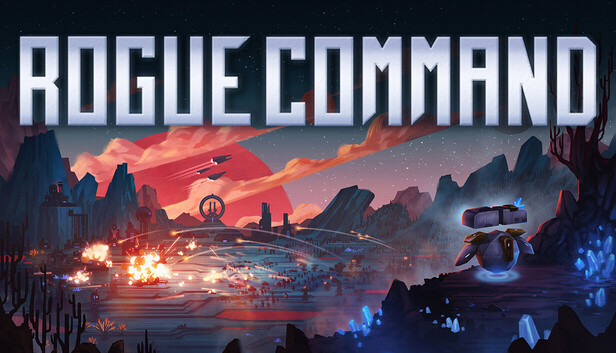
True RTS gameplay reinforced with roguelite build crafting. Control units with bullet-time precision. Call down bases and raise armies. Drafted from a different arsenal every run. Weave builds that break the game. Or the game breaks you.
THE RTS… Rogue Command is a single-player RTS that plays like the classics that defined the genre. Control your units, build your base, harvest resources, explore the map, defend positions and come up with a plan of attack. But now with every run the rules of the battlefield change and each battle is an opportunity to discover new ways to play.
GET SMARTER & GROW STRONGER Earn archive tokens to unlock permanent improvements in the vast skill tree of the Battle Archive. Push hard into a specific trait or spread your points wide to accumulate many smaller bonuses. Or unlock ways to control the randomness.
NUMEROUS ENEMIES & ENDLESS BATTLEFIELDS The planet-devouring PCX (Planetary Core Extraction Corporation) – has spread across the galaxy. Only the occasional Engineer with a crystalline consciousness infection standing in their way. Psychic Kung Fu Master
Dozens of enemy variants fielding armies with more than 150 units and buildings of their own will keep you sweating over every decision and force you to adapt. No battlefield will be the same. And conditions can suddenly shift:
“JUST ONE MORE RUN…” – AGAIN AND AGAIN A first win is only the start: 15 Ascensions with unique bosses provide escalating challenges for dozens or even hundreds of hours. Your command of the battlefield grows.
Most entrepreneurs take months to fine-tune their products, get their brand messaging right, and design an effective website. However, most of them have not bothered once about figuring out who exactly owns their domain name or if they can recover it in case anything happens tomorrow.
Digital systems are not fancy. They do not add to your revenues, and no one praises you for maintaining proper DNS systems. However, for individuals working from home or remotely, digital systems are crucial, because they underlie everything that you build online. Fail to take care of them, and you may be digging your own grave.
Your Domain Name Is Your Business Address — Treat It Like One
The domain name is not just a website address when running an online business. It is the digital property that your business identity, emails, and reputation depend on. Loss of control over your domain due to registration expiry, account lockout, or a dispute with the registrar can result in your whole site going offline and shutting down your business.
That is why you should be aware of the basics of a domain transfer, regardless of your intentions to ever switch domains. The knowledge of the domain transfer process will ensure that you are not trapped in any system, you are not a hostage to any platform, and you are always making independent decisions.
Why Home-Based Businesses Are Especially Vulnerable
Big firms have IT personnel, legal departments, and vendor relationships with service level agreements. When running an online business, the home office often has only one person handling everything, which makes information technology easy to ignore.
A few scenarios that trip up small and solo operators more often than you’d expect:
Registrar account tied to an old email address. If you can’t access that email, you may not be able to renew, transfer, or make changes to your domain at all.
Domain registered in a contractor’s name. Designers and developers sometimes register domains on behalf of clients. When the relationship ends, reclaiming ownership can become a legal headache.
Auto-renewal turned off during a billing change. Domains expire fast, and some expire quietly. Once a domain lapses, the path to recovery is expensive and not always guaranteed.
Hosting and registrar bundled together. Convenience bundles are appealing until you want to switch hosts — and realize your domain is locked in the same account.
None of these are catastrophic on their own, but each one represents a gap in ownership that can be exploited by circumstance.
What “Full Digital Ownership” Actually Looks Like
Owning your digital presence isn’t about micromanaging every setting. It’s about having access and clarity across the assets your business depends on. Here’s a practical checklist:
Domain Registration
Is the domain registered under your name or your business entity?
Are your contact details current in the registrar account?
Is auto-renewal enabled with a reliable payment method?
Do you know when it expires?
Email Infrastructure
Is your business email tied to your own domain (not a free email service)?
Are you using a professional email host, or is it bundled with your web hosting?
Do you have SPF, DKIM, and DMARC records configured? (Your email provider can help set these up — they protect against spoofing and improve deliverability.)
Website Hosting
Do you have independent access to your hosting account, separate from your domain registrar?
Can you move your site if your host changes pricing or discontinues a plan?
SSL Certificate
Is your site running on HTTPS?
Do you know when your certificate renews, and who manages it?
Going through this list once a year — even just as a 30-minute audit — can save you from problems that take weeks to untangle.
Building a Business You Actually Own
And there is another mind shift inherent in all of this: the distinction between utilizing digital technology and having digital infrastructure.
Social media profiles, e-commerce marketplaces, email marketing software — these are the means by which you work. They are valuable and important, but they are owned by someone else, run on someone else’s servers, governed by someone else’s terms of service, and they can be altered, limited, or revoked at any time. More than one entrepreneur or content creator has found out about this the hard way.
But your own domain name, your website, is something you own. Your own list of email subscribers, once exported and backed up elsewhere, is something you can control.
Practical Moves to Strengthen Your Ownership
If you’ve been operating reactively rather than intentionally when it comes to your digital assets, here are some concrete steps worth taking:
Consolidate where it makes sense. If your domain, hosting, and email are all with different providers, you’re managing three separate accounts, three sets of billing dates, and three support relationships. Consolidating can reduce friction — but make sure the registrar and host stay separate to preserve flexibility.
Keep credentials in a secure, accessible place. A password manager is the simplest solution. Every login tied to your business — registrar, hosting, email, analytics, CMS — should be documented and stored somewhere your business can recover if you’re unavailable.
Understand your renewal timeline. Most domain registrars allow you to register for multiple years at once. Paying for two or three years upfront isn’t just economical — it also removes the risk of an accidental lapse.
Separate your business and personal accounts. Your domain and hosting shouldn’t be registered to a personal email you might change or abandon. Use a dedicated business email as the account holder.
Download and back up your data regularly. Your website files, your email list, your customer database — these should be backed up somewhere outside your primary platform. Cloud storage is fine; total dependency on a single provider is not.
The Infrastructure Nobody Talks About in Business Content
All entrepreneurial advice deals primarily with marketing strategies, generating revenue and growth hacks. Infrastructure is almost an afterthought – both because infrastructure works without being seen, and because it’s not particularly sexy as content.
The entrepreneurs who end up creating sustainable businesses, however, are more likely to be those who understand the realities of running an online business and have attended to the mundane aspects of their operations. You know exactly where your domain is hosted and how to access it; you’ve checked your backup services; you’ve had that tough talk with a developer about getting your accounts transferred.
This is not only to avoid trouble in the future – it will also allow you to grow quicker when necessary. Whether you need to move your website to a faster hosting service, upgrade your email provider, or hire a new technical administrator, all these actions are easier when you don’t have to fix a mess first.
A Note on Growing Teams
If you’re expanding from solo freelancer to a small team, digital ownership becomes even more important. You’ll need to think about:
Shared account access (without sharing your personal master credentials)
Role-based permissions for platforms that support them
Clear documentation of who manages what
Offboarding processes so access is revoked when someone leaves
None of this requires an IT department. It requires about an afternoon of focused attention and the discipline to keep the documentation updated.
Conclusion: Boring Infrastructure Is Good Business
Those that view their technological backbone as a dynamic ecosystem, rather than something that can simply be set up and ignored, are more likely to survive in tough times and adapt quickly to favorable conditions.
Running an online business does not require becoming a technologist. It requires knowing what you control, knowing how to get to it, and making sure that no one else has the key to your business behind your back.
This is not a technical question. It is a business discipline. And it is one of the most under-appreciated competitive advantages of operating your business from home.