Weigh yourself at the same time: To get a consistent reading when using any scale, it’s important to weigh yourself first thing in the morning before you’ve drunk or eaten anything. “You should weigh yourself without clothes, or minimal clothing, and if you do so, try to wear the same clothing each time you weigh yourself,” said Stella Lucia Volpe, professor and head of the Department of Human Nutrition, Foods and Exercise at Virginia Tech.
Volpe recommends weighing yourself no more than once a week. “If you weigh yourself more than that, you will see fluctuations in your body weight, and it may be frustrating if you are trying to lose weight,” she said.
Choose an even surface: You want to make sure your scale is on an even surface otherwise that imbalance will throw off the reading. Make sure to weigh yourself in the same place each time.
Keep in mind that the smart scale can be flawed: Remember that just because a smart scale can offer more data than an analog scale doesn’t always mean it’s better. “Smart scales have not been shown to have high accuracy and cannot be compared to the ‘gold standard’ measures of assessing bone mineral density and body composition as it relates to body fat and lean body mass, which is via using dual-energy X-ray absorptiometry,” said Volpe.
Most people don’t have access to a Dexa scan, so the next best thing is a smart scale. “The smart scale can provide an estimation of body fat and total body water; but note that the ‘gold standard’ ways to measure these would provide the more accurate data,” Volpe explains.
Make sure it’s set to zero: As with any scale, you want to make sure that it’s set to zero so you get an accurate reading.
Remember your weight fluctuates: It’s easy to get caught up in a number, but remember your weight is a range instead of an exact number and will fluctuate throughout the day. Fluctuations can be affected if you work out, eat more than normal, go to the bathroom or even if your muscles are sore and retaining fluid.
Know that the data are estimations: Smart scales include data on your heart rate, bone mineral density, total body water, body fat and more. Keep in mind these are estimations based on your age, sex and body weight. Therefore, these scales are not completely accurate. “Knowing that these scales are providing an estimation — but without the highest of accuracy — is important, but can help provide some guidance to the user of these products, especially when many individuals may not have the ability to have their bone mineral density and body composition evaluated by DXA,” said Volpe.
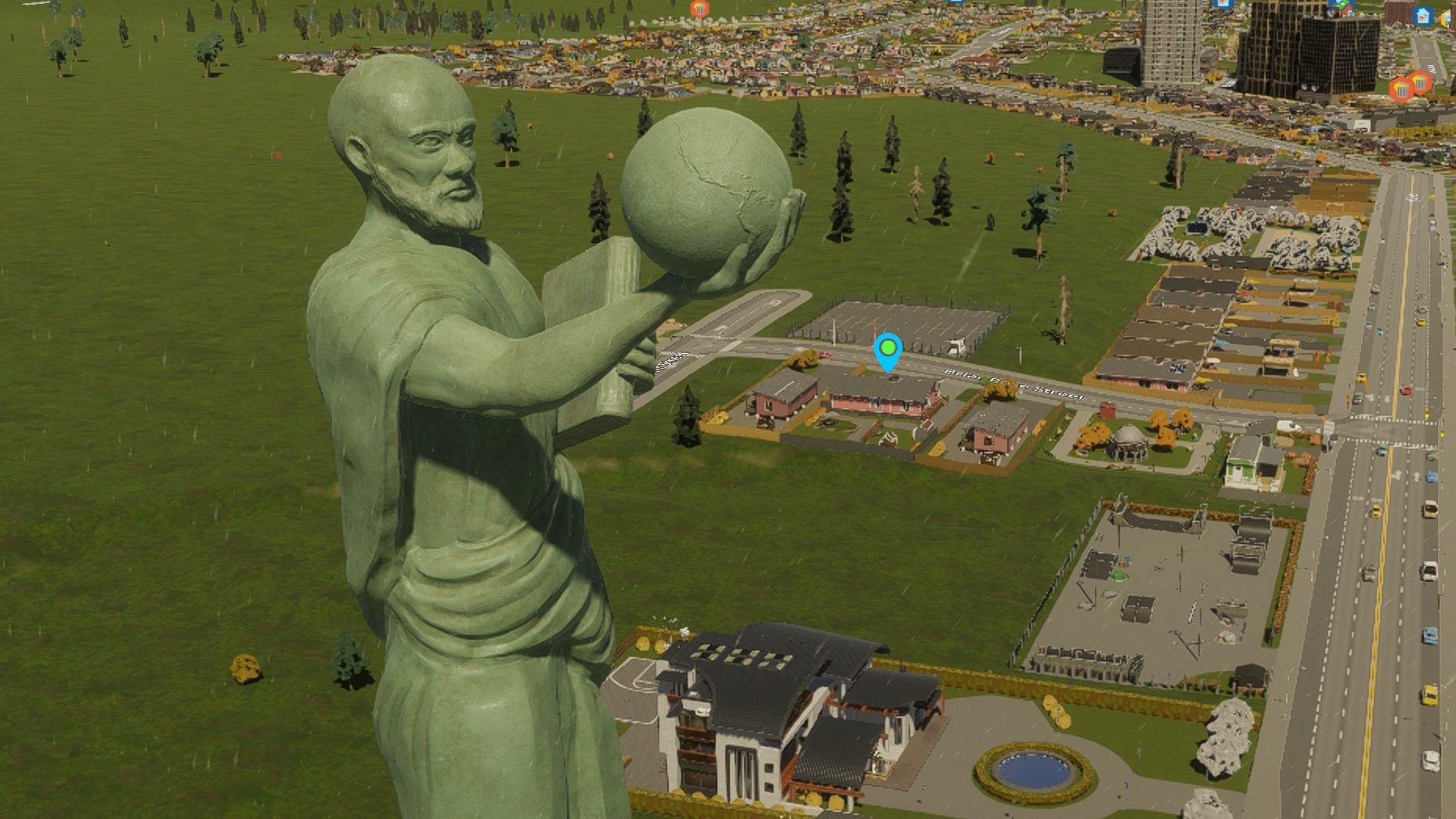
Cities: Skylines 2 just received its first update from new developer Iceflake Studios, which replaced Colossal Order at the end of 2025. You might think this would be a prime opportunity to breathe new life into the struggling city-builder. To come out swinging with some big new features. To make the flowers bloom, the birds sing, the babies gurgle in a way that makes you think “Are they happy or about to barf?”
Nope! Instead, Iceflake’s debut patch is utterly obsessed with death. Turns out your idiot citizens have been croaking in completely the wrong ways in Cities: Skylines 2, so Iceflake has donned its black robe and sharpened its scythe to sort things out.
Dubbed First Frost (though really it should be Last Rites) the update makes numerous tweaks to systems that govern the lights going out, the buckets being kicked, the farms being bought, etc. Chiefly, it fixes a bug that prevented time of day being taken into account when determining citizens’ demises, which meant everyone was popping their clogs between midnight and six o’clock. It also quadruples the number of times the game calculates deaths from four to sixteen, in order to “further reduce the number of citizens dying at the same time”.
In addition, the patch fixes an especially peculiar bug that made most of your citizens immortal when playing in easy mode. “Previously, about 80% of them never died of old age,” Iceflake writes in a Steam post. An ageing population is difficult enough for modern governments to deal with, so I can imagine how challenging an immortal one would be. Shuffle off, grandad! How else am I to get a house in this economy?
Official Release Trailer | OUT NOW I Cities: Skylines II – YouTube
Not everything in First Frost is about departures from the mortal realm. The patch also reduces trips made on the bicycles introduced by Colossal Order before it moved on to pastures new, by 80%. In short, your citizens are spending less time cycling and more time dying, which I suppose is how exercise works in real life too.
Elsewhere, the patch introduces a bunch of new UI icons for roundabouts, cul-de-sacs, road maintenance depots, pollution types, and more. It updates the onboarding tutorial for new players, makes terraforming tools less aggressive (otherwise known as a terrorforming tool), and makes a bunch of graphical improvements like improved shadow rendering, snow support for decal-based lots, and fog that adjusts according to weather conditions.
Oh, and the update finally switches autosave on by default, which is good, but also kinda wild that it’s only happening now. It took two years, four months, and a change in developer, but Cities: Skylines 2 will now save automatically without player intervention.
Keep up to date with the most important stories and the best deals, as picked by the PC Gamer team.
While not bristling with new features, Iceflake’s first patch still seems to have improved the sequel’s immediate fortunes. Recent Steam reviews stand at 67% positive at the time of writing, compared to 54% positive overall. Let’s hope this proves a new foundation for a brighter future for the sequel.
Large language models (LLMs) have evolved from simple statistical language predictors into intricate systems capable of reasoning, synthesizing information and even interacting with external tools. Yet most people still see them as auto‑complete engines rather than the modular, evolving architectures they’ve become. Understanding how these models are built is vital for anyone deploying AI: it clarifies why certain models perform better on long documents or multi‑modal tasks and how you can adapt them with minimal compute using tools like Clarifai.
Quick Summary
Question:What is LLM architecture and why should we care? Answer: Modern LLM architectures are layered systems built on transformers, sparse experts and retrieval systems. Understanding their mechanics—how attention works, why mixture‑of‑experts (MoE) layers route tokens efficiently, how retrieval‑augmented generation (RAG) grounds responses—helps developers choose or customize the right model. Clarifai’s platform simplifies many of these complexities by offering pre‑built components (e.g., MoE‑based reasoning models, vector databases and local inference runners) for efficient deployment.
Quick Digest
Transformers replaced recurrent networks to model long sequences via self‑attention.
Efficiency innovations such as Mixture‑of‑Experts, FlashAttention and Grouped‑Query Attention push context windows to hundreds of thousands of tokens.
Retrieval‑augmented systems like RAG and GraphRAG ground LLM responses in up‑to‑date knowledge.
Parameter‑efficient tuning methods (LoRA, QLoRA, DCFT) let you customize models with minimal hardware.
Reasoning paradigms have progressed from Chain‑of‑Thought to Graph‑of‑Thought and multi‑agent systems, pushing LLMs towards deeper reasoning.
Clarifai’s platform integrates these innovations with fairness dashboards, vector stores, LoRA modules and local runners to simplify deployment.
1. Evolution of LLM Architecture: From RNNs to Transformers
How Did We Get Here?
Early language models relied on n‑grams and recurrent neural networks (RNNs) to predict the next word, but they struggled with long dependencies. In 2017, the transformer architecture introduced self‑attention, enabling models to capture relationships across entire sequences while permitting parallel computation. This breakthrough triggered a cascade of innovations.
Quick Summary
Question:Why did transformers replace RNNs? Answer: RNNs process tokens sequentially, which hampers long‑range dependencies and parallelism. Transformers use self‑attention to weigh how every token relates to every other, capturing context efficiently and enabling parallel training.
Expert Insights
Transformers unlocked scaling: By decoupling sequence modeling from recursion, transformers can scale to billions of parameters, providing the foundation for GPT‑style LLMs.
Clarifai perspective: Clarifai’s AI Trends report notes that the transformer has become the default backbone across domains, powering models from text to video. Their platform offers an intuitive interface for developers to explore transformer architectures and fine‑tune them for specific tasks.
Discussion
Transformers incorporate multi‑head attention and feed‑forward networks. Each layer allows the model to attend to different positions in the sequence, encode positional relationships and then transform outputs via feed‑forward networks. Later sections dive into these components, but the key takeaway is that self‑attention replaced sequential RNN processing, enabling LLMs to learn long‑range dependencies in parallel. The ability to process tokens simultaneously is what makes large models such as GPT‑3 possible.
As you’ll see, the transformer is still at the heart of most architectures, but efficiency layers like mixture‑of‑experts and sparse attention have been grafted on top to mitigate its quadratic complexity.
2. Fundamentals of Transformer Architecture
How Does Transformer Attention Work?
The self‑attention mechanism is the core of modern LLMs. Each token is projected into query, key and value vectors; the model computes similarity between queries and keys to decide how much each token should attend to others. This mechanism runs in parallel across multiple “heads,” letting models capture diverse patterns.
Quick Summary
Question:What components form a transformer? Answer: A transformer consists of stacked layers of multi‑head self‑attention, feed‑forward networks (FFN), and positional encodings. Multi‑head attention computes relationships between all tokens, FFN applies token‑wise transformations, and positional encoding ensures sequence order is captured.
Expert Insights
Efficiency matters: FlashAttention is a low‑level algorithm that fuses softmax operations to reduce memory usage and boost performance, enabling 64K‑token contexts. Grouped‑Query Attention (GQA) further reduces key/value cache by sharing key and value vectors among query heads.
Positional encoding innovations: Rotary Positional Encoding (RoPE) rotates embeddings in complex space to encode order, scaling to longer sequences. Techniques like YARN stretch RoPE to 128K tokens without retraining.
Clarifai integration: Clarifai’s inference engine leverages FlashAttention and GQA under the hood, allowing developers to serve models with long contexts while controlling compute costs.
How Positional Encoding Evolves
Transformers do not have a built‑in notion of sequence order, so they add positional encodings. Traditional sinusoids embed token positions; RoPE rotates embeddings in complex space and supports extended contexts. YARN modifies RoPE to stretch models trained with a 4k context to handle 128k tokens. Clarifai users benefit from these innovations by choosing models with extended contexts for tasks like analyzing long legal documents.
Feed‑Forward Networks
Between attention layers, feed‑forward networks apply non‑linear transformations to each token. They expand the hidden dimension, apply activation functions (often GELU or variants), and compress back to the original dimension. While conceptually simple, FFNs contribute significantly to compute costs; this is why later innovations like Mixture‑of‑Experts replace FFNs with smaller expert networks to reduce active parameters while maintaining capacity.
3. Mixture‑of‑Experts (MoE) and Sparse Architectures
What Is a Mixture‑of‑Experts Layer?
A Mixture‑of‑Experts replaces a single feed‑forward network with multiple smaller networks (“experts”) and a router that dispatches tokens to the most appropriate experts. Only a subset of experts is activated per token, achieving conditional computation and reducing runtime.
Quick Summary
Question:Why do we need MoE layers? Answer: MoE layers drastically increase the total number of parameters (for knowledge storage) while activating only a fraction for each token. This yields models that are both capacity‑rich and compute‑efficient. For example, Mixtral 8×7B has 47B total parameters but uses only ~13B per token.
Expert Insights
Performance boost: Mixtral’s sparse MoE architecture outperforms larger dense models like GPT‑3.5, thanks to targeted experts.
Clarifai use cases: Clarifai’s industrial customers employ MoE‑based models for manufacturing intelligence and policy drafting; they route domain‑specific queries through specialized experts while minimizing compute.
MoE mechanics: Routers analyze incoming tokens and assign them to experts; tokens with similar semantic patterns are processed by the same expert, improving specialization.
Other models: Open‑source systems like DeepSeek and Mistral also use MoE layers to balance context length and cost.
Creative Example
Imagine a manufacturing firm analyzing sensor logs. A dense model might process every log line with the same network, but a MoE model dispatches temperature logs to one expert, vibration readings to another, and chemical data to a third—improving accuracy and reducing compute. Clarifai’s platform allows such domain‑specific expert training through LoRA modules (see Section 6).
Why MoE Matters for EEAT
Mixture‑of‑Experts models often achieve higher factual accuracy thanks to specialized experts, which enhances EEAT. However, routing introduces complexity; mis‑routing tokens can degrade performance. Clarifai mitigates this by providing curated MoE models and monitoring tools to audit expert usage, ensuring fairness and reliability.
4. Sparse Attention and Long‑Context Innovations
Why Do We Need Sparse Attention?
Standard self‑attention scales quadratically with sequence length; for a sequence of length L, computing attention is O(L²). For 100k tokens, this is prohibitive. Sparse attention variants reduce complexity by limiting which tokens attend to which.
Quick Summary
Question:How do models handle millions of tokens efficiently? Answer: Techniques like Grouped‑Query Attention (GQA) share key/value vectors among query heads, reducing the memory footprint. DeepSeek’s Sparse Attention (DSA) uses a lightning indexer to select top‑k relevant tokens, converting O(L²) complexity to O(L·k). Hierarchical attention (CCA) compresses global context and preserves local detail.
Expert Insights
Hierarchical designs: Core Context Aware (CCA) attention splits inputs into global and local branches and fuses them via learnable gates, achieving near‑linear complexity and 3–6× speedups.
Compression strategies: ParallelComp splits sequences into chunks, performs local attention, evicts redundant tokens and applies global attention across compressed tokens. Dynamic Chunking adapts chunk size based on semantic similarity to prune irrelevant tokens.
State‑space alternatives:Mamba uses selective state‑space models with adaptive recurrences, reducing self‑attention’s quadratic cost to linear time. Mamba 7B matches or exceeds comparable transformer models while maintaining constant memory usage for million‑token sequences.
Memory innovations: Artificial Hippocampus Networks combine a sliding window cache with recurrent compression, saving 74% memory and 40.5% FLOPs.
Clarifai advantage: Clarifai’s compute orchestration supports models with extended context windows and includes vector stores for retrieval, ensuring that long‑context queries remain efficient.
RAG vs Long Context
Articles often debate whether long‑context models will replace retrieval systems. A recent study notes that OpenAI’s GPT‑4 Turbo supports 128K tokens; Google’s Gemini Flash supports 1M tokens; and DeepSeek matches this with 128K. However, large contexts do not guarantee that models can find relevant information. They still face attention challenges and compute costs. Clarifai recommends combining long contexts with retrieval, using RAG to retrieve only relevant snippets instead of stuffing entire documents.
5. Retrieval‑Augmented Generation (RAG) and GraphRAG
How Does RAG Ground LLMs?
Retrieval‑Augmented Generation (RAG) improves factual accuracy by retrieving relevant context from external sources before generating an answer. The pipeline ingests data, preprocesses it (tokenization, chunking), stores embeddings in a vector database and retrieves top‑k matches at query time.
Quick Summary
Question:Why is retrieval necessary if context windows are large? Answer: Even with 100K tokens, models may not find the right information because self‑attention’s cost and limited search capability can hinder effective retrieval. RAG retrieves targeted snippets and grounds outputs in verifiable knowledge.
Expert Insights
Process steps: Data ingestion, preprocessing (chunking, metadata enrichment), vectorization, indexing and retrieval form the backbone of RAG.
Clarifai features: Clarifai’s platform integrates vector databases and model inference into a single workflow. Their fairness dashboard can monitor retrieval results for bias, while the local runner can run RAG pipelines on‑premises.
GraphRAG evolution: GraphRAG uses knowledge graphs to retrieve connected context, not just isolated snippets. It traces relationships through nodes to support multi‑hop reasoning.
When to choose GraphRAG: Use GraphRAG when relationships matter (e.g., supply chain analysis), and simple similarity search is insufficient.
Limitations: Graph construction requires domain knowledge and may introduce complexity, but its relational context can drastically improve reasoning for tasks like root‑cause analysis.
Creative Example
Suppose you’re building an AI assistant for compliance officers. The assistant uses RAG to pull relevant sections of regulations from multiple jurisdictions. GraphRAG enhances this by connecting laws and amendments via relationships (e.g., “regulation A supersedes regulation B”), ensuring the model understands how rules interact. Clarifai’s vector and knowledge graph APIs make it straightforward to build such pipelines.
6. Parameter‑Efficient Fine‑Tuning (PEFT), LoRA and QLoRA
How Can We Tune Gigantic Models Efficiently?
Fine‑tuning a 70B‑parameter model can be prohibitively expensive. Parameter‑Efficient Fine‑Tuning (PEFT) methods, such as LoRA (Low‑Rank Adaptation), insert small trainable matrices into attention layers and freeze most of the base model.
Quick Summary
Question:What are LoRA and QLoRA? Answer: LoRA fine‑tunes LLMs by learning low‑rank updates added to existing weights, training only a few million parameters. QLoRA combines LoRA with 4‑bit quantization, enabling fine‑tuning on consumer‑grade GPUs while retaining accuracy.
Expert Insights
LoRA advantages: LoRA reduces trainable parameters by orders of magnitude and can be merged into the base model at inference with no overhead.
QLoRA benefits: QLoRA stores model weights in 4‑bit precision and trains LoRA adapters, allowing a 65B model to be fine‑tuned on a single GPU.
New PEFT methods: Deconvolution in Subspace (DCFT) provides an 8× parameter reduction over LoRA by using deconvolution layers and dynamically controlling kernel size.
Clarifai integration: Clarifai offers a LoRA manager to upload, train and deploy LoRA modules. Users can fine‑tune domain‑specific LLMs without full retraining, combine LoRA with quantization for edge deployment and manage adapters through the platform.
Creative Example
Imagine customizing a legal language model to draft privacy policies for multiple countries. Instead of full fine‑tuning, you create LoRA modules for each jurisdiction. The model keeps its core knowledge but adapts to local legal nuances. With QLoRA, you can even run these adapters on a laptop. Clarifai’s API automates adapter deployment and versioning.
7. Reasoning and Prompting Techniques: Chain‑, Tree‑ and Graph‑of‑Thought
How Do We Get LLMs to Think Step by Step?
Large language models excel at predicting next tokens, but complex tasks require structured reasoning. Prompting techniques such as Chain‑of‑Thought (CoT) instruct models to generate intermediate reasoning steps before delivering an answer.
Quick Summary
Question:What are Chain‑, Tree‑ and Graph‑of‑Thought? Answer: These are prompting paradigms that scaffold LLM reasoning. CoT generates linear reasoning steps; Tree‑of‑Thought (ToT) creates multiple candidate paths and prunes the best; Graph‑of‑Thought (GoT) generalizes ToT into a directed acyclic graph, enabling dynamic branching and merging.
Expert Insights
CoT benefits and limits: CoT dramatically improves performance on math and logical tasks but is fragile—errors in early steps can derail the entire chain.
ToT innovations: ToT treats reasoning as a search problem; multiple candidate thoughts are proposed, evaluated and pruned, boosting success rates on puzzles like Game‑of‑24 from ~4% to ~74%.
GoT power: GoT represents reasoning steps as nodes in a DAG, enabling dynamic branching, aggregation and refinement. It supports multi‑modal reasoning and domain‑specific applications like sequential recommendation.
Reasoning stack: The field is evolving from CoT to ToT and GoT, with frameworks like MindMap orchestrating LLM calls and external tools.
Massively Decomposed Agentic Processes: The MAKER framework decomposes tasks into micro‑agents and uses multi‑agent voting to achieve error‑free reasoning over millions of steps.
Clarifai models: Clarifai’s reasoning models incorporate extended context, mixture‑of‑experts layers and CoT-style prompting, delivering improved performance on reasoning benchmarks.
Creative Example
A question like “How many marbles will Julie have left if she gives half to Bob, buys seven, then loses three?” can be answered by CoT: 1) Julie gives half, 2) buys seven, 3) subtracts three. A ToT approach might propose multiple sequences—perhaps she gives away more than half—and evaluate which path leads to a plausible answer, while GoT might combine reasoning with external tool calls (e.g., a calculator or knowledge graph). Clarifai’s platform allows developers to implement these prompting patterns and integrate external tools via actions, making multi‑step reasoning robust and auditable.
8. Agentic AI and Multi‑Agent Architectures
What Is Agentic AI?
Agentic AI describes systems that plan, decide and act autonomously, often coordinating multiple models or tools. These agents rely on planning modules, memory architectures, tool‑use interfaces and learning engines.
Quick Summary
Question:How does agentic AI work? Answer: Agentic AI combines reasoning models with memory (vector or semantic), interfaces to invoke external tools (APIs, databases), and reinforcement learning or self‑reflection to improve over time. These agents can break down tasks, retrieve information, call functions and compose answers.
Expert Insights
Components: Planning modules decompose tasks; memory modules store context; tool‑use interfaces execute API calls; reinforcement or self‑reflective learning adapts strategies.
Benefits and challenges: Agentic systems offer operational efficiency and adaptability but raise safety and alignment challenges.
ReMemR1 agents: ReMemR1 introduces revisitable memory and multi‑level reward shaping, allowing agents to revisit earlier evidence and achieve superior long‑context QA performance.
Massive decomposition: The MAKER framework decomposes long tasks into micro‑agents and uses voting schemes to maintain accuracy over millions of steps.
Clarifai tools: Clarifai’s local runner supports agentic workflows by running models and LoRA adapters locally, while their fairness dashboard helps monitor agent behavior and enforce governance.
Creative Example
Consider a travel‑planning agent that books flights, finds hotels, checks visa requirements and monitors weather. It must plan subtasks, recall past decisions, call booking APIs and adapt if plans change. Clarifai’s platform integrates vector search, tool invocation and RL‑based fine‑tuning so that developers can build such agents with built‑in safety checks and fairness auditing.
9. Multi‑Modal LLMs and Vision‑Language Models
How Do LLMs Understand Images and Audio?
Multi‑modal models process different types of input—text, images, audio—and combine them in a unified framework. They typically use a vision encoder (e.g., ViT) to convert images into “visual tokens,” then align these tokens with language embeddings via a projector and feed them to a transformer.
Quick Summary
Question:What makes multi‑modal models special? Answer: Multi‑modal LLMs, such as GPT‑4V or Gemini, can reason across modalities by processing visual and textual information simultaneously. They enable tasks like visual question answering, captioning and cross‑modal retrieval.
Expert Insights
Architecture: Vision tokens from encoders are combined with text tokens and fed into a unified transformer.
Context windows: Some multi‑modal models support extremely long contexts (1M tokens for Gemini 2.0), enabling them to analyze whole documents or codebases.
Clarifai support: Clarifai provides image and video models that can be paired with LLMs to build custom multi‑modal solutions for tasks like product categorization or defect detection.
Future direction: Research is moving toward audio and 3‑D models, and Mamba‑based architectures may further reduce costs for multi‑modal tasks.
Creative Example
Imagine an AI assistant for an e‑commerce site that analyzes product photos, reads their descriptions and generates marketing copy. It uses a vision encoder to extract features from images, merges them with textual descriptions and produces engaging text. Clarifai’s multi‑modal APIs streamline such workflows, while LoRA modules can tune the model to the brand’s tone.
10. Safety, Fairness and Governance in LLM Architecture
Why Should We Care About Safety?
Powerful language models can propagate biases, hallucinate facts or violate regulations. As AI adoption accelerates, safety and fairness become non‑negotiable requirements.
Quick Summary
Question:How do we ensure LLM safety and fairness? Answer: By auditing models for bias, grounding outputs via retrieval, using human feedback to align behavior and complying with regulations (e.g., EU AI Act). Tools like Clarifai’s fairness dashboard and governance APIs assist in monitoring and controlling models.
Expert Insights
Fairness dashboards: Clarifai’s platform provides fairness and governance tools that audit outputs for bias and facilitate compliance.
RLHF and DPO: Reinforcement learning from human feedback teaches models to align with human preferences, while Direct Preference Optimization simplifies the process.
RAG for safety: Retrieval‑augmented generation grounds answers in verifiable sources, reducing hallucinations. Graph‑augmented retrieval further improves context linkage.
Risk mitigation: Clarifai recommends domain‑specific models and RAG pipelines to reduce hallucinations and ensure outputs adhere to regulatory standards.
Creative Example
A healthcare chatbot must not hallucinate diagnoses. By using RAG to retrieve validated medical guidelines and checking outputs with a fairness dashboard, Clarifai helps ensure that the bot provides safe and unbiased advice while complying with privacy regulations.
11. Hardware and Energy Efficiency: Edge Deployment and Local Runners
How Do We Run LLMs Locally?
Deploying LLMs on edge devices improves privacy and latency but requires reducing compute and memory demands.
Quick Summary
Question:How can we deploy models on edge hardware? Answer: Techniques like 4‑bit quantization and low‑rank fine‑tuning shrink model size, while innovations such as GQA reduce KV cache usage. Clarifai’s local runner lets you serve models (including LoRA‑adapted versions) on on‑premises hardware.
Expert Insights
Quantization: Methods like GPTQ and AWQ reduce weight precision from 16‑bit to 4‑bit, shrinking model size and enabling deployment on consumer hardware.
LoRA adapters for edge: LoRA modules can be merged into quantized models without overhead, meaning you can fine‑tune once and deploy anywhere.
Compute orchestration: Clarifai’s orchestration helps schedule workloads across CPUs and GPUs, optimizing throughput and energy consumption.
State‑space models: Mamba’s linear complexity may further reduce hardware costs, making million‑token inference feasible on smaller clusters.
Creative Example
A retailer wants to analyze customer interactions on in‑store devices to personalize offers without sending data to the cloud. They use a quantized and LoRA‑adapted model running on the Clarifai local runner. The device processes audio/text, runs RAG on a local vector store and produces recommendations in real time, preserving privacy and saving bandwidth.
12. Emerging Research and Future Directions
What New Directions Are Researchers Exploring?
The pace of innovation in LLM architecture is accelerating. Researchers are pushing models toward longer contexts, deeper reasoning and energy efficiency.
Quick Summary
Question:What’s next for LLMs? Answer: Emerging trends include ultra‑long context modeling, state‑space models like Mamba, massively decomposed agentic processes, revisitable memory agents, advanced retrieval and new parameter‑efficient methods.
Expert Insights
Ultra‑long context modeling: Techniques such as hierarchical attention (CCA), chunk‑based compression (ParallelComp) and dynamic selection push context windows into the millions while controlling compute.
Selective state‑space models: Mamba generalizes state‑space models with input‑dependent transitions, achieving linear‑time complexity. Variants like Mamba‑3 and hybrid architectures (e.g., Mamba‑UNet) are appearing across domains.
Massively decomposed processes: The MAKER framework achieves zero errors in tasks requiring over one million reasoning steps by decomposing tasks into micro‑agents and using ensemble voting.
Revisitable memory agents: ReMemR1 introduces memory callbacks and multi‑level reward shaping, mitigating irreversible memory updates and improving long‑context QA.
New PEFT methods: Deconvolution in Subspace (DCFT) reduces parameters by 8× relative to LoRA, hinting at even more efficient tuning.
Evaluation benchmarks: Benchmarks like NoLiMa test long‑context reasoning where there is no literal keyword match, spurring innovations in retrieval and reasoning.
Clarifai R&D: Clarifai is researching Graph‑augmented retrieval and agentic controllers integrated with their platform. They plan to support Mamba‑based models and implement fairness‑aware LoRA modules.
Creative Example
Consider a legal research assistant tasked with synthesizing case law across multiple jurisdictions. Future systems might combine GraphRAG to retrieve case relationships, a Mamba‑based long‑context model to read entire judgments, and a multi‑agent framework to decompose tasks (e.g., summarization, citation analysis). Clarifai’s platform will provide the tools to deploy this agent on secure infrastructure, monitor fairness, and maintain compliance with evolving regulations.
Frequently Asked Questions (FAQs)
Is the transformer architecture obsolete? No. Transform ers remain the backbone of modern LLMs, but they’re being enhanced with sparsity, expert routing and state‑space innovations.
Are retrieval systems still needed when models support million‑token contexts? Yes. Large contexts don’t guarantee models will locate relevant facts. Retrieval (RAG or GraphRAG) narrows the search space and grounds responses.
How can I customize a model without retraining it fully? Use parameter‑efficient tuning like LoRA or QLoRA. Clarifai’s LoRA manager helps you upload, train and deploy small adapters.
What’s the difference between Chain‑, Tree‑ and Graph‑of‑Thought? Chain‑of‑Thought is linear reasoning; Tree‑of‑Thought explores multiple candidate paths; Graph‑of‑Thought allows dynamic branching and merging, enabling complex reasoning.
How do I ensure my model is fair and compliant? Use fairness audits, retrieval grounding and alignment techniques (RLHF, DPO). Clarifai’s fairness dashboard and governance APIs facilitate monitoring and compliance.
What hardware do I need to run LLMs on the edge? Quantized models (e.g., 4‑bit) and LoRA adapters can run on consumer GPUs. Clarifai’s local runner provides an optimized environment for local deployment, while Mamba‑based models may further reduce hardware requirements.
Conclusion
Large language model architecture is advancing rapidly, blending transformer fundamentals with mixture‑of‑experts, sparse attention, retrieval and agentic AI. Efficiency and safety are driving innovation: new methods reduce computation while grounding outputs in verifiable knowledge, and agentic systems promise autonomous reasoning with built‑in governance. Clarifai sits at the nexus of these trends—its platform offers a unified hub for hosting modern architectures, customizing models via LoRA, orchestrating compute workloads, enabling retrieval and ensuring fairness. By understanding how these components interconnect, you can confidently choose, tune and deploy LLMs for your business
First, the Baldur’s Gate 3 modding community gave Elminster Big Naturals, and then everyone’s favorite dignified corpse Withers too. The Skyrim modding community, not one to be left behind, has finally followed suit.
Response has been positive. “This is actually how he is first described in the original lore”, one commenter helpfully explains. “Finally, a good reason to join the Stormcloaks!” says another.
If you’re wondering why the fuck this is happening, apparently Gandalf Big Naturals was a Tumblr meme back in 2022? This one went right by me at the time, or maybe I just blocked it out of my mind. The idea of giving videogame wizards and other authority figures huge honking norks has also spread to Stardew Valley and Oblivion Remastered. Nowhere is safe. Soon wizards with tig ol’ bitties will be everywhere. Tear out your eyes before it’s too late.
Keep up to date with the most important stories and the best deals, as picked by the PC Gamer team.
The Pixel 10a is finally here, and it’s… familiar. Google’s newly unveiled mid-range Pixel is up for preorder now and will hit stores on March 5, giving you a couple of weeks to decide if it’s for you. However, if you’re familiar with Google’s recent Pixel launches, including last year’s Pixel 9a, the decision might not be easy.
At first glance, there’s a lot to like about the Pixel 10a, but there’s a lot that may make you hesitate to purchase one over another Pixel device. So let’s break down what we know about the Pixel 10a to help you decide if it’s worth buying and to highlight who the 10a is really for.
Why you should buy the Pixel 10a
(Image credit: Google)
Out of the gate, one of the most obvious reasons you should buy the Pixel 10a is the price. At $499, the Pixel 10a is squarely in the mid-range and almost half the price of the base Pixel 10. This is the same price the Pixel 9a launched at, and it’s nice to see that Google didn’t raise it despite the memory shortage ravaging the tech industry.
The Pixel 10a is probably one of the better options at this price point. Not only does it come with a (technically) flagship chipset, but you get all the benefits of other Pixel smartphones, including Google’s Gemini AI features and long software update promise (seven years of OS upgrades, security patches, and Pixel Drops).
(Image credit: Google)
In addition to the camera quality and features we’ve come to expect from most Pixel smartphones, the Pixel 10a offers some you won’t find on the Pixel 9a, such as Macro Focus. Auto Best Take is one of our favorite features that helps you capture better group shots, allowing you to select the perfect expressions for each person. Camera Coach is another feature introduced with the Pixel 10 series, which uses AI to help you compose better photos based on the image subject.
The Pixel 10a also brings some other notable upgrades that we love to see on a $500 phone. The upgraded Gorilla Glass 7i should provide more protection than the Pixel 9a, and the screen is also brighter at 3,000 nits, making it plenty usable outdoors. Satellite SOS also isn’t a common feature on Android phones, and it can be handy if you find yourself in an emergency with no network reception.
(Image credit: Google)
Finally, the improved battery and charging specs should appeal to anyone who prefers to have their phone last all day. Despite having the same-sized battery as its predecessor, the 10a is rated to last longer on a single charge: 30+ hours or up to 120 hours with Battery Saver. We called the Pixel 9a the “Energizer phone” when we reviewed it last year, and we expect the Pixel 10a to live up to the name.
Get the latest news from Android Central, your trusted companion in the world of Android
The faster 30W charging is a nice upgrade, especially since it’s technically faster than the $800 Galaxy 25, and if you like wireless charging, Google has upped the speed from 7.5W on the Pixel 9a to 10W on the Pixel 10a. It’s not a speed demon, but it’s still a nice upgrade nonetheless.
Why you shouldn’t buy the Pixel 10a
(Image credit: Google)
The Pixel 10a isn’t a bad phone for the price, but when compared to its predecessor and other phones in its price range, some may find it hard to justify buying this over something else. In fact, it’s probably one of the smallest generational upgrades we’ve seen on Pixel phones.
You’d have to squint to see the differences between the Pixel 9a and Pixel 10a. The latter has a more flush back, which should make the overall design a tad nicer, but ultimately, if you weren’t a fan of the Pixel 9a’s design, you won’t like this one either. At 9mm, it’s a thick phone, thicker than the Galaxy S25 Ultra and even the Galaxy Z Fold 7 (not counting the cameras). And you’ll likely want to throw on a case, which will make the phone even thicker.
The Google Pixel 9a in Iris. (Image credit: Brady Snyder / Android Central)
Speaking of cameras, if you need a telephoto lens, the Pixel 10a might not be for you. True, Google’s Super Res Zoom can deliver impressive results, but it’s just not the same as a dedicated telephoto sensor. A phone like the Galaxy S25 FE would be a better option if you don’t mind spending a little more for a telephoto lens and faster 45W charging.
The Pixel 10a also lacks Qi2 support, which was introduced on the Pixel 10 series. This likely would have made the phone thicker and more expensive, but it’s unfortunate that Google didn’t even include the spec sans the built-in magnets, similar to the Galaxy S25 series. Google already has Pixelsnap cases, which include built-in magnets themselves, so it could have just leaned on this while giving us faster wireless charging speeds.
(Image credit: Google)
But of course, I have to address the elephant in the room: the chipset. The Pixel 10a is powered by the same Tensor G4 chip and 8GB of RAM found in the Pixel 9a. It’s a curious move not to use the Tensor G5, one likely made to keep the 10a affordable amid the memory shortage. Still, it seems to limit the 10a’s performance and capabilities, as the phone does not support certain AI features found on the Pixel 10 series, such as Magic Cue and Pixel Screenshots.
That’s not to say the Tensor G4 isn’t still a fine chip, but Tensor already tends to fall short next to comparable Snapdragon chips, so we would have liked to see some improvements on the chipset front, at least to the latest version. I already hate seeing companies like Motorola pull the same move with their midrange smartphones, which sometimes sport the same chips as their predecessors.
Google Pixel 9a part 2
(Image credit: Google)
Ultimately, the Google Pixel 10a is a mixed bag as far as upgrades go. There are some noteworthy changes and spec bumps, but the phone is nearly identical to its predecessor, inside and out. It feels less like a cheaper Pixel 10 and more like a redo of the Pixel 9a.
Google no doubt had to make some tough choices to keep the 10a affordable. On paper, it’s not a bad phone, but as a consumer, why get the new thing when the old thing is pretty much the same and likely going to be cheaper? Especially when the old thing will most likely receive many of the same “new” features. That said, if you can find some good Pixel 10a preorder deals, then it might very well be worth grabbing.
Let us know what you think: Are you interested in buying the Pixel 10a? Also, check out this exclusive article from IDC, which highlights why the Pixel 10a is actually a smart move from Google.
The Stop Killing Games campaign is evolving into more than just a movement. In a YouTube video, the campaign’s creator, Ross Scott, explained that organizers are planning to establish two non-governmental organizations, one for the European Union and another for the US. According to Scott, these NGOs would allow for “long-term counter lobbying” when publishers end support for certain video games.
“Let me start off by saying I think we’re going to win this, namely the problem of publishers destroying video games that you’ve already paid for,” Scott said in the video. According to Scott, the NGOs will work on getting the original Stop Killing Games petition codified into EU law, while also pursuing more watchdog actions, like setting up a system to report publishers for revoking access to purchased video games.
The Stop Killing Games campaign started as a reaction to Ubisoft’s delisting of The Crew from players’ libraries. The controversial decision stirred up concerns about how publishers have the ultimate say on delisting video games. After crossing a million signatures last year, the movement’s leadership has been busy exploring the next steps.
According to Scott, the campaign leadership will meet with the European Commission soon, but is also working on a 500-page legal paper that reveals some of the industry’s current controversial practices. In the meantime, the ongoing efforts have led to a change of heart from Ubisoft since the publisher updated The Crew 2 with an offline mode.
Architecture, as a practice in itself, has always been a tightrope walk in that it is always balancing art and commerce. On one hand, they are so visionary because what they do is take a white empty canvas, which is a space, and make it what makes your eyes pop.
On the other side, of course, the clock is ticking, reminding these visionaries that clients don’t await excellence but a deadline. This, in itself, has always been an age-old struggle, per se. Lately, however, because of the need for high-quality architectural 3D imaging, a different situation has been brought into this tightrope walk, where clients want to see the result even before the construction of the first brick.
Companies are spending a pretty penny on learning internal staff, on the best software that dates faster than bread, or on a strategy that is slowly becoming a rule rather than an exception, outsourcing architectural 3D rendering services to competent freelancers. Once, it used to be a competitive advantage. It is just a strategic advantage that distinguishes adapting businesses from non-adapting ones, which are bound by outdated strategies.
🚀 Table of contents
The permanence of outsourcing & its future
Others might go further with the idea that outsourcing, in a way, is no more than ‘skimping on labor’ with fancy semantics. This, of course, is simply not true. In outsourcing, when it is properly performed, it is a thoroughly thought-out plan that is chock-full of freedom, efficiency, and the brightest and best personnel with no correlation with headcount, rather than people in a permanent employment capacity. The level of skill one employs in regard to architectural 3D rendering is, quite literally, staggeringly specific: from textures, lighting, to a subtle degree concerning the physics of textures.
For such an occasional need to provide a service, in what way would a full complement of personnel be retained when it would really be the same as having a sports car to drive to the grocery store every week, because, yes, it is possible, but is it really a sound solution?
Such freelancer resources, such as Cad Crowd, are basically a network forum that helps pre-approved, highly competent 3D artists in the realm of architectural visualization. The companies will therefore be at an advantage in terms of people who are experts in the realm of space, lighting, and textures, and hence all the work is going to be performed with the utmost possibility of highest speed and accuracy, given the fact that they would not be concerned with recruitment, training, and benefits-all this literally turns into a superpower to unleash when needed.
Now, here are a number of obvious benefits that come with outsourcing architectural design services. The first advantage that this service provides is scalability. Not all businesses require a similar amount of 3D rendering hours. Mostly, when a small house is undergoing renovation, the 3D rendering hours are not similar to the number of offices and shops that are accumulated in a single giant structure. It therefore means that with outsourcing, businesses are capable of scaling with minimal effects on the cost of human resources.
The second reason is innovation advantage. The freelance 3D artist is generally faced with a situation where they are forced to work with different clients from different parts of the globe, hence giving them a chance to be introduced to different designs, software, and even different creative thoughts from other freelance 3D artists. The innovation advantage that the freelance 3D artist brings to your design is that when they are working on your project, they tend to bring a fresh perspective, which has the potential to refresh your projects that might not be fresh anymore in your design office. This is practically the same thing as looking out of the window to see what the best the entire world has to offer.
Thirdly, cost efficiency is an issue that should never be overlooked. This is because of the consideration that a full-time rendering professional would have factors such as cost of labor, employee benefits, equipment, as well as training that need to be considered, but with outsourcing, now such costs are variable, which is always cost-effective, especially taking into consideration the fluctuating workflow that is within the business. In most cases, most freelancers come along with state-of-the-art computers, rendering software, as well as rendering pipes, which means that the business would not have to spend a lot on infrastructure.
Timing is everything
Time is the most non-forgetting part, even when things are going in a positive manner. The clients always ask for wow presentations, sometimes to be produced in a record-breaking short span of time. There might be a team that has a couple of projects, other than some meetings, other than some other boring tasks, which are part of the admin work, that keeps putting things on the back burner. A freelancer can only work on a single project, hence the tight deadlines and faster speeds.
Consider the following example: a presentation to a high-value client with an attractive design but a flat, lifeless rendering. This presentation can be upgraded to a work of art presentation through photorealistic rendering services, a presentation that shifts from good to unforgettable, a presentation that strategic outsourcing is far more concerned with, convenience, and the competitive advantage.
Quality without compromise
This list of outsourcing-related fallacies may also include a concession regarding the quality of service to be delivered. Nothing is less true, especially when the best freelancer is involved. This is what is known by the top 3D artists. It’s not a matter of pretty pictures; it’s a matter of storytelling. The messages that are being told are the following: scale, light, material, function, sense of space, journey from the lobby, and effect of sunlight on a façade during golden hour.
Cad Crowd is where the businesses are linked with the artists who have such skills to a professional level. The freelancers are restricted to either residential design, commercial design, or urban design. The subtlety, whether it is in one space or the other, is known at a profound level. It is, therefore, implied that when a professional is hired, it is because the aim is to improve such subtlety as opposed to sustaining it.
Skill-based risk reduction
All construction projects have inherent risks. The lack of communication, design problems, and cost overruns that come with such a state are still bound to affect the concerned construction project. The outsourcing of 3D rendering tasks to professional freelancers is associated with the reduction of risks that might affect a construction project, to a certain extent. Even before the construction process starts, a professional graphic artist is able to identify design discrepancies, a reasonable interpretation, and design errors.
For instance, if the case is critical, say, in a process that needs acceptance from the regulatory bodies, there are cases in which visualizations are needed even when pitching proposals to potential investors. The process of architectural visualization services is supposed to identify problems in design, ensure design solutions are creatively reached, and also ensure that the entire team is on the same page. The activity can be subcontracted to detail-oriented individuals with the aim that potential problems are not experienced when the process is smoother than expected.
The outsourcing organizations are also capable of enjoying such benefits from the diversity of cultures. Freelance 3-D artists may come from different parts of the globe. This is because they thus make contributions that are regarded as being linked with different models of architecture, which might exist far away from the outsourcing firms. Such synergies are required for a particular firm that might wish to research models that might never have been considered by the outsourcing firms.
Global talent adds a belief component, a futurism component, to the theme. Manpower on a global scale essentially increases the belief component, the futurism, and the scope of the talks. The client is seeking law firms that possess the talent to speak to a certain amount of innovation, a certain amount of familiarity with what is going on on a global scale, and a certain amount of gesturing with the limits of conventional design.
Banning software because of a learning curve
The software used in architectural rendering is all about being complicated. Even the friendliest of software platforms takes several years to master, with some updates taking place more frequently than a coffee break that a human is given in a day. Freelance renderers are most probably very experienced people who know a number of platforms. The learning curve is never a problem with outsourcing. They learn extensively about the most complicated software, such as ray tracing, real-time rendering, photorealistic textures, etc.
Freelancers have been known to make use of creative software/plugins that may not have been used in the said company, thus giving the architectural design freelancers a sense of experimentation that easily gives them a chance to produce a technically correct graphical presentation that is aesthetic, thus ensuring excellence in presentations and winning in customer competitions.
Global collaboration
It is somewhat intimidating even to think about working with people who are literally thousands of miles away, but with collaboration software, it is now second nature. The outsourcing strategy is used as a collaboration tool since cloud project management software, instant messages, and video conferencing are available. Freelancers now work entirely with office personnel.
This portability further extends into the labor pools. The skills that a company possesses are no longer constrained to the skills available in the locality. If the best 3D graphic artist in the world is somewhere, this is no longer a problem. This outsourcing gives a firm the best talent, irrespective of its source.
Competitive advantage in bidding
It is known that the visual attributes of the presentation have the potential to make or break a tender, especially when it is a competitive market. The application of 3D visualizer services in tendering appears to have an edge, especially when it is a competitive market, as it gives a competitive advantage to the concerned firms. The fact that outsourcing is capable makes small businesses competitive against other big businesses, which have a team of experts working for them. In this way, the small business is actually capable of providing similar photorealistic visualizations that are offered by the giant, but at a cost that is considered exorbitant to maintain a team of experts.
It is literally the difference between winning a position that has been forfeited. It’s not merely a cosmetic issue, a matter of a pretty face; it’s a matter of life and death, a matter of success in a particular industry.
Critical situations where outsourcing pays off
A number of architecture projects are confronting high cost, tight schedules, and zero tolerance. The identified imperative environment has made it very clear that the outsourcing of 3D rendering design services is a need rather than a luxury. The following are the points to be noted:
There is pre-approval that may be necessary in major construction projects, which are basically linked to trade, as well as urban development. Most states, especially different regulatory systems, may require visual aids that are highly detailed in order to evaluate the possible impact that the said development may have on the environment, with consideration of factors relating to light, shade, and aesthetics. The application of poorly prepared visual aids might, in most cases, result in difficulties in interpretation, delays, and failure. Freelancers are able to produce visual aids that are easy to interpret in relation to the purpose of the structure, hence easy to approve.
Dealing with presentations when it comes to potential financiers is also an environment full of pressure. Potential financiers would hardly be in a position to interpret the technological diagrams and the floor plans, but a photorealistic 3D image somehow provides them with a kind of “test drive” within the development. It is this that gives them a feeling that they have experienced it before, actually investing money in the development, which, again, may be all that there is to make a difference in securing a tender against competition. An overlook on precision is a possibility when set against highly competitive financial conditions.
The changes that might come from the poor clients might literally mean complete chaos. For instance, they might need different changes concerning lighting, matter, finish, or even changes concerning landscaping. The in-house team might not be grounded enough to tackle changes that have to be submitted within a short while, but the freelancer, who might work best in such a project environment, can easily tackle the changes.
For instance, when a mid-size architectural design firm handling the task of designing a high-rise residential skyscraper in an urban area lacked the skills for rendering, the architecture firm thought of outsourcing the skills for the necessary 3D rendering from freelancers on the website of Cad Crowd. The particular architecture firm had the potential to finish a project with photo-realistic images of the whole construction project, with incredible lighting effects, on time, with clients going wild with joy.
The other design project that the designer might have worked on is a design boutique shop for a resort hotel. The client made several passes before they came up with a conclusion on how the villas that would be on either side of the pool, as well as the spa, would look in the design. The freelancers were sought to carry out a high volume of requests for rendering. The job entailed a number of passes on the images, experiments on lighting effects at different times of the day, as well as the use of materials that played a huge part in ensuring the success of the rendering.
This situation is being utilized even by giant firms. Giant architecture firms are literally dealing with a dozen projects, with some of which they might need to visualize simultaneously. This outsourcing of such a job has a positive consequence on giant firms, which now invest more in the design and planning development, and outsource the minute details of the job to freelancers.
Risk management & outsourcing
The architecture design projects are vulnerable to high amounts of risk. This is because of the cost escalation, lack of understanding of design plans, and lag in the completion of a particular project. Outsourcing services for 3D rendering is devoid of risks. This is because one gets highly experienced people who are very much aware of design difficulties.
This 3D rendering freelancer would be in a position to indicate the flaws that are in the design, look for areas that require improvement, and check whether the design meets the technological specification, thereby ensuring there are fewer faults that affect the construction industry, thereby conserving resources. Freelancers, in most cases, have a whole list of clients, thus are subjected to standards and best practices, with a huge amount of irreplaceable information that is pricelessly invaluable in order to avoid costly mistakes.
Outsourcing is a mechanism that ensures potential risks, which are involved when one is in business, are minimized. Full-time employment means a business commits obligations entailing the spending of capital on labor, equipment, and similar costs. Freelancers carry out business on a project-by-project basis; hence, a business spends capital on what it wants when it wants, irrespective of the cost of financial risks.
Strategies for outsourcing for efficiency
Efficiency is the level of speed, but it is also concerned with the use of resources, for which optimum results are obtained with minimum wastage. Outsourcing the service of architectural 3D rendering is going to make it easy for the company to apply the plan of efficiency on different dimensions.
It helps the teams inside concentrate on the core competencies. This is because it states that the architects, designers, etc., are going to concentrate on designs, discussions with clients, and plans because they are not going to be involved in rendering. This is known as the division of labour, which results in increased productivity because, in this way, every part of the project is treated with importance.
Outsourcing has another advantage, involving parallel workflows. The development of workflow within the structure of the business can be carried out simultaneously with freelancing CAD outsourcing, which involves working on rendering processes with the aim of ensuring that the workflow pipeline will remain full at all times, especially in large projects that have different stages that always need visualization.
Thirdly, outsourcing enhances the availability of specialty equipment and software with no capital investment whatsoever. This is because the freelancers are basically equipped with high-performance workstations, rendering software, and plugins. In this regard, the business is capable of accessing modern equipment with no capital investment in high-performance software, as well as the cost of keeping such software.
Finally, scalability, which is scalable upwards or downwards, happens to be one of the sectors that largely helps in making sure that efficiencies are offered. This is mainly because most of the projects are known to have variability in the requirements of rendering. This is because, when outsourcing is considered, businesses are known to have the potential to scale services upwards when the demand is high, but when the amount of work is reduced, they are known to have the potential to scale services downward.
Creative collaboration beyond the constraints of geography
Where the whole idea of this outsourcing era is now past, and the trend would be to make an outsourcing process some sort of a separated, fragmented process when it comes to accomplishing tasks. This is because, with modern means of communications, the outsourcing process is now seamless, really collaborative. The outsourcing process isn’t a sort of separated, fragmented process when it comes to accomplishing tasks.
Talent searching is not location-specific anymore. That would mean when a business entity is set up in New York, it can acquire a rendering expert from London, Mumbai, or even from São Paolo, which gives them a list of potential talent that might or might not be available to them even in their own locality. The best part is that it brings different perspectives to the table. It results in innovation, even more so in the case of HDR rendering design services.
Another issue is that the problem with the time zone will contribute to increasing the rate of progress of the project. This is because even during a break of the locals, freelancers from different time zones are going to continue with the rendering.
Supply management
Apart from this, outsourcing may also imply that there would be no loss of control. This is why, assuming there is proper communication, other than regular reviews, outsourcing has the potential to ensure that high standards are met. Freelancers are charged with tasks such as preparing drafts, editing, and making changes in renderings within the client and/or firm guidelines specified.
There are websites such as Cad Crowd that make it easy with the portfolios, reviews, and ratings that the freelancers have. The company can see the freelancers who have work that meets the standards of quality that are demanded, and also that which is required for the project. It is easy to warrant that outsourcing is a quality improvement.
Ambiguity in contracts, as well as project briefs, is a highly needed component when considered from the point of view of the management of the project expectations, the definition of a project deliverable, and miscommunication. It is pretty easy for a business to assimilate a freelancer into the organizational process.
Cost-benefit analysis
It is worth noting that outsourcing 3D architectural visualizer services is a highly cost-effective proposal. This is because, in a way, when a business decides on whether it is going to have a whole department dedicated to the service, it has to consider spending on salaries, benefits, equipment, software, as well as training, which is clearly not worth spending, especially when such businesses are regularly confronted with fluctuating demands. On the aspect of freelancers, they charge on a project, an hourly rate; this means fixed costs are now variable costs.
Outsourcing is saving money in the business, but over and above that, it helps eradicate all the other hidden costs that are being generated due to overtime, project procrastination, as well as inefficient designs that need to be rebuilt. The best freelancers are used to get the best results on a timely basis. Resource scalability here would mean that the scaling of resources within projects would be easy for businesses, as per the projects undertaken according to need. This, in a way, would imply that this helps businesses to undertake more projects, thereby increasing profitability.
Innovation through outsourcing
Despite that, with 3D architectural visualization freelancers, apart from the challenges, there are risks that come with exposure to worldwide trends, best practices, and innovations. Most of the experiences that are acquired from different projects, as well as different markets, tend to result in solutions that would most probably have been overlooked.
For instance, a freelancer with design skills that are environmentally sustainable would bring value in terms of how to highlight environmentally sustainable design aspects, which may include lighting, within a design rendition that would make such a development attractive to potential clients who are concerned with environmentally sustainable practices.
On the other hand, artists who have been involved in urban development designs would indicate how a design rendition of a complex urban environment is supposed to be highlighted. It is this use of the external source for knowledge, innovation, and creativity that leads to the optimization of businesses, making them the best in a competitive marketplace.
Despite this, the outsourcing of 3D rendering is even more valuable to a business when taking a long-term perspective, as opposed to the short-term return on investment. This is because outsourcing is valuable to a business. After all, it helps a business to come up with a list of freelancers who are reliable, making it easy for a business to call such freelancers when the business is involved in other tasks.
This helps in ensuring that it is easy for the companies to respond to the changes that are taking place within the marketplace. In this regard, it is easy for the companies to grow because of the increased demand for high-quality rendering, without necessarily needing to increase the permanent employee members. This helps in ensuring that the business is more sustainable.
The human factor
Of course, it is the effect of technological advancements on 3D rendering for architectural planning and design firms, but there is no way that it can surpass the power of human creativity. It is the whole team of artists who know how to use the software but also know the psychology of art, storytelling, and space psychology that are included in the entire outsourcing process. The dynamic effect derived from the enthusiasm that freelancers bring to the business, with a fresh perspective that they bring to their work, gives design an enhancement. It is the human element in rendering that gives such tasks a certain allure that is emotionally compelling and touching and convincing that the vision and not the sight is assuring to the client.
Cad Crowd and talent unleashed
It is not a luxury anymore to consider outsourcing the 3D rendering of architectural designs; rather, it is now a plan that will make it possible for them to come up with stellar work within a tight deadline, with a close eye on cost, and with the requisite aptitude to be adaptable. Indeed, from the stages of approval to the stages of presentation before the investors, the massive importance considered is about high-level visual presentation, and it is experienced freelancers who can show ways to make a hundred experiences out of a project.
Cad Crowd is another platform that aids in connecting the company with professional freelancers who are 3D rendering artists. For this company, the freelancers are imperative as they bring professionalism, art, and diverse viewpoints from different quarters of the globe, which would be extremely hard to find in common employees. Outsourcing has been pretty helpful to businesses in making them realize how they can develop, progress, and maintain standards high, thus making them go beyond the standards set by the clients.
To those businesses that wish to develop the design of architecture, it is a wonderful approach to take into consideration of the potential help that can be derived from consulting with Cad Crowd. It is high time you explore the website, contact the best freelancers, and your design should be photorealistic, making it 3D. Request a quote today.
MacKenzie Brown is the founder and CEO of Cad Crowd. With over 18 years of experience in launching and scaling platforms specializing in CAD services, product design, manufacturing, hardware, and software development, MacKenzie is a recognized authority in the engineering industry. Under his leadership, Cad Crowd serves esteemed clients like NASA, JPL, the U.S. Navy, and Fortune 500 companies, empowering innovators with access to high-quality design and engineering talent.
Daredevil: Born Again season 2 is set to see the newly elected Mayor Fisk (Vincent D’Onofrio) crack down even harder on New York City, which spells trouble for Matt Murdock (Charlie Cox) and his fellow New Yorkers.
As Fisk’s vicelike grip on the city tightens, the parallels to the contemporary US off-screen aren’t lost on showrunner Dario Scardapane.
“The playbook is pretty well established, so when we were writing this stuff we were like, ‘Here’s what he does.’ The anti-vigilante task force is part of the comics. We built them and costumed them based on the comics. There are a few sequences that were shot a year ago that could be off the news, and it’s weirding all of us out,” Scardapane said in a new interview with SFX magazine.
“I have mixed feelings,” he continued when asked if he enjoys the fact that the show has a renewed political energy. “Stan Lee once said that he wanted to make his comic books a reflection of the world you saw outside your window. Then I also believe that what’s fun about the genre, and definitely fun in working with superheroes, is you’re dealing with huge archetypes, almost mythological characters, and that’s fun writing.”
“Getting into the realm of politics, New York politics, the Game of Thrones intrigue behind the scenes… okay, that’s fun too, but as it becomes almost too topical it feels like it’s going away from the large, mythological genre stuff,” Scardapane concluded. “So as we finish up the Mayor Fisk run with season 2, as that storyline comes to its inevitable conclusion, what we’re doing going forward feels more like a return to the [Frank] Miller-era comics. So yeah, it was fun to play in the realm of politics but I like something a little more street level, personally.”
The new season will also see the return of Krysten Ritter’s Jessica Jones to the small screen, as well as the arrival of a new antagonist in the form of Matthew Lillard’s mysterious Mr. Charles.