Most marketing teams are using AI to do the same work faster. That, says Liza Adams, is the wrong goal. Doing things differently is where growth happens. Continue reading “Using AI-Powered Workflows to Do Work That Wasn’t Possible Before”
Most marketing teams are using AI to do the same work faster. That, says Liza Adams, is the wrong goal. Doing things differently is where growth happens. Continue reading “Using AI-Powered Workflows to Do Work That Wasn’t Possible Before”
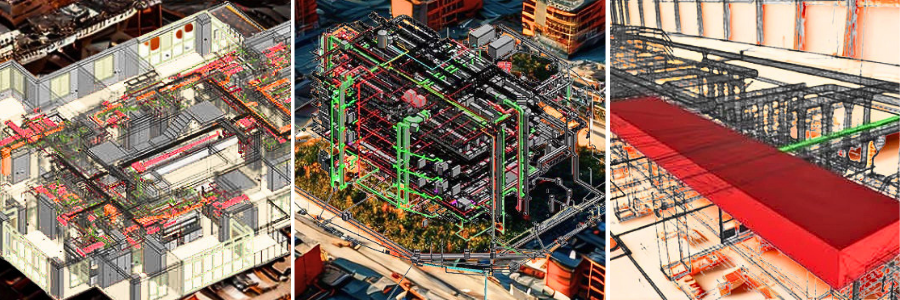
A single pipe clashing with a beam used to cost a project weeks, but with BIM, you can easily check these problems. Building Information Modeling (BIM) has deliberately taken its place in the architecture and construction industry, shifting the way design and management planning progress in projects. Designing and planning have evolved into 3D models rather than the usual traditional 2D drawings, which use a 3D digital model containing data and information on how the building is made up, comprising multiple disciplines and systems, with identified material specifications.
BIM also allows real-time collaboration with everyone, making it easier for the other team members to check on and add their feedback. This provides an advantage for your company or any start-up because you can detect the problems that may arise early, preventing you from editing a project in the middle of the timeline. For companies looking for experts who specialize in BIM, Cad Crowd helps in finding the right professional who can assist and support the team with technical expertise and quality deliverables.
🚀 Table of contents
RELATED: Fundamentals of BIM & Modeling Design Services at Building Information Modeling Companies
Building Information Modeling (BIM) is not just about creating a visual representation to show how the structure looks, but it is a detailed digital process with a lot of important information. The data it holds includes its structural makeup, materials, and everything that makes the building. This digital tool is created for the team to collaborate in one space throughout the project. It helps the team to visualize and simulate the construction and examine how it will go. This helps in the decision-making of the team from start to finish.
One of the most remarkable and relevant advantages of BIM design process is its capability to be a model space for multidisciplinary systems. BIM can incorporate electrical, structural, and architectural features into a single space and let the entire team collaborate on it. This way, if there’s a change or an update to the architectural element, structural engineers can see it and adjust as well. Potential clashes can now be easily detected early on, so there’s no need to wait until the construction itself to see the problems that may arise.
Before BIM was introduced, the only way to know there was a clash, say a pipe running through the structural beam, was when it was already reported on site. This will cause a delay since there will be a lot of discussion about why this happened and what will govern. There would be costly reworks and redesigns to fix this. Now that BIM can simulate all the systems that act on the building, it is possible for experts to detect clashes even before the construction period.
RELATED: How to Choose the Right BIM Services Provider For Your Architectural Firm
There are clients who prefer to have a clear visualization and representation of the project. To build their confidence, 3D models are used to visualize the project. It gives the client an experience and speeds up approval processes. This also builds transparency since the client has an idea or context of what is happening within the project.
In “4D” BIM services, the construction companies can visualize the day-by-day process of the construction project. This helps project managers to set expectations of logistics and how material procurement is scheduled to prevent site traffic.
Construction sites are known to be prone to danger. This, however, can be addressed and mitigated by utilizing a simulation of the construction processes to determine high-risk zones. From this, it can be checked what methods could be done and what should not be recommended. By having the ability to visualize edge protection, crane swings, and routes of heavy machinery in the model, a safety plan can be developed and implemented to safeguard and protect all workers on site.
RELATED: Features and Benefits of BIM Services for Architectural Design Companies
Sustainable Design and LEED Certification have been integrated into the projects and complied with. This can be simulated in BIM to examine energy efficiency, solar heat gain, and ventilation patterns. Running this and generating results helps in achieving the certification to prove that the building aims to minimize its carbon footprint over decades.
In traditional drawings, most of the time, it has triggered a lot of RFIs due to unclear information in the drawings or conflicts and discrepancies across all technical documents. BIM provides a high level of information that makes it clear to be understood by all disciplines. It lessens the need for RFIs and reduces administrative burdens and turnaround time for correspondence.
Since the BIM design service has the capability to generate and provide a precise number of materials, it can help reduce the global issue of construction waste. Knowing the exact number of materials needed lessens guesswork and wastage allowances. It gives the company confidence in quantity and purchasing just enough materials.
RELATED: CAD Outsourcing: Architecture & BIM Drafting Strategies for Architectural Design Firms
Adapting to BIM design services shifts toward a standardized protocol, ISO 19650, for instance. This makes sure that the data being shared is aligned and in a consistent manner, making it easier for businesses and companies to partner with large projects. This creates a flawless partnership between companies since they have the same digital language. There are projects that need their project to be shown visually, for transparency. Most of the time, public sector projects make use of BIM design to represent infrastructure for the taxpayers to know where their money is being spent. This encourages data-driven accountability while strengthening trust in government institutions.
Structural engineers can directly link their analysis software to BIM in case you want to update any changes in the architectural layout. This means that all updates will be reflected in structural calculations to generate a new and updated one. Using this lessens the risk of not being able to apply the change, compromising the safety of the building. The MEP system experts is often called the “veins and arteries” of the building since it is hidden and gives the flow in the building. It is also hard to coordinate it. But, in BIM, it is now easier to spot its routing and observe if there are systems that clash or interfere, most of the time, with structural elements. Early detection can now be done, and rework can be reduced.
The philosophy behind “build it twice” stems from an idea that the first construction happens in the virtual or digital space, which in this case is the BIM, and the second one is the actual construction. Building virtually can be beneficial since it saves a lot of resources, time, and money. It exposes a lot of issues that may surface and resolve them from there on. It saves the actual construction from costly changes in a few clicks, virtually.
RELATED: Embracing BIM: The Future of Building Information Modeling for Construction Companies

Before, only high-end companies could afford to utilize innovative technologies. It has created a division in the design industry, but now that there are platforms like Cad Crowd that can conveniently give access to a pool of professionals who can help with advanced technologies, it has leveled the playing field. It gave chances to small firms to leverage and compete for large-scale projects as well.
BIM has real-time tracking of progress against the planned schedule. This allows stakeholders to see where the project stands, and it gives them an idea and context of how it will be days after. It strengthens transparency and provides accurate progress reports to clients and investors.
Through BIM’s simulation experiences, the designers can alter material properties and ensure that the building’s acoustic and thermal properties are aligned with its needs and those of the occupants. It allows for adaptation to achieve a desired comfort level. In any case, if it should be re-adjusted, a few clicks can be done to do so. With this, there’s no need to do guesswork in actual construction just to know what is needed for the building.
RELATED: Building Information Modeling (BIM) Freelance Contractors on Cad Crowd
The BIM has an archive of documentation and data, and it is sometimes used to record a design decision, should there be a discourse regarding changes. It is helpful that the documentation is timestamped so it can resolve conflicts and disputes. It determines who, why, and when, so there’s no need for ambiguous speculations since everything is recorded and documented.
BIM is actually an asset as a marketing tool, especially when the produced models are of high quality and are photorealistic design. Using this visualization makes it easier for marketers to encourage buyers to close the deal and speed up their decisions. It secures funding even before the construction has started, helping the cash flow of the construction operations.
One of the unique attributes of BIM is that it can be done remotely, so there are no limitations as to where your designer is. If the right designer for you is miles away or on the other side of the world, they can still be reached and add value to the project. This global acquisition can be found in Cad Crowd, and it allows firms to connect with their global pool of experts, ensuring that they are screened and are experts in their specified niche.
RELATED: How CAD and BIM Services Improve Public Facility Design for Architectural Projects
In BIM design services, 2D drawings specialist in floor plans, elevations, and sections are all derived from the 3D model. This means that all plans are coordinated and have reflected everything that is on the 3D model. This prevents instances wherein there is a missing element that was not reflected in some plants. BIM has improved technical documentation, making it a more precise reference.
BIM helps in planning disaster response because it stores architectural data, such as building layout, that can help rescuers in times of need. A fire responder can use the building layout to locate victims or emergency exits for a safer and more efficient rescue response.
Now that the construction industry has caught up to the digital evolution, there is a need for constant innovations to remain at the top of its position. Automation and integration of AI in the design industry and BIM are needed to ensure that processes are ready whenever they are needed. It gives the company an edge to be competitive and adaptable in the construction market.
RELATED: The Critical Role of Construction Drawing Services for Urban Development for Design Firms

Having a BIM design reduces stress on the project teams since there would be less guesswork and conflicts during discussion, since they can see clearly the whole context of the project. It actually boosts their morale, knowing they have a solid reference, making their performance even better. BIM’s use has been growing to simulate the building’s scale in the entire neighborhood and in cities. This is used to help urban planners come up with and improve their traffic, utilities, and wind patterns.
Since BIM has proved to lessen some costly reworks and has provided workflows that improve work efficiency, it has allowed firms to be more competitive with their pricing, without compromising quality. This way, they provide better offers to their clients, especially to price-sensitive markets.
BIM design does not end with the construction of the buildings. It also offers long-term consultancy services, as well as support to the building’s life cycle. It helps in tracking down maintenance, renovations, and system performance over time. Having this kind of service strengthens the trust between the firm and the partner even after construction.
RELATED: Types of Architectural Renderings: A Complete Guide to Choosing the Right Visuals
BIM design services can serve as the benchmark of how the project has to be done, and by this, it enables a higher degree of quality control. Site engineers and supervisors can use the model as a reference to ensure that everything is installed according to specifications.
BIM is used as a simulation to ensure that the building can provide optimal natural lighting while minimizing glare. This can be done by integrating the sun’s path throughout the year, and designers would have to assess what window placement can be done for it to create a more comfortable experience. BIM design is not limited to exterior design, but they extend to the interior layout of the building. This allows detailed interior vision of finishes, furniture layouts, and lighting.
Funding approval from investors will likely speed up should there be BIM design services used, because it gives a higher degree of logistical predictability. When the stakeholders are shown a model, it gives them assurance that no traditional processes can match. It adds confidence when shown with realistic context and data.
RELATED: How 3D Exterior Visualization Showcases Architectural Projects for Design Firms
Airflow and thermal load simulations that are integrated into BIM help you visualize the capability and performance of any building. From this, it can be improved or utilized to offer better indoor air quality, which is beneficial for potential occupants of the building.
BIM design services have often been said to be advantageous for large-scale projects, but they can also add value to high-end residential projects. Customized homes use BIM to handle complex architectural details to create a visualization of luxury finishes. This ensures that the home to be built reflects the client’s preferences. Since BIM design services hold an archive of documentation, they allow for the preservation and accurate restoration of heritage sites. This can be useful to safeguard and maintain the heritage, as there are potential risks due to natural disasters.
BIM design services can improve the model airflow, temperature, and electrical layouts by simulating them in the system, which can help in optimizing the cooling efficiency and reducing high energy consumption that comes with running large-scale data centers.
RELATED: How MEP Engineering Consultants Can Help Architectural & Engineering Construction Firms
When doing a revision in a traditional way, making adjustments to one layout means changing the whole set that is affected by it. This change could take days to update, and sometimes, when the deadline is tight, it will be overlooked and missed on some drawings. Inaccuracies can be prevented by using BIM design services because it is not challenging to learn, and every design change is automatically reflected in all drawings. Aside from that, good communication with subcontractors and freelancers is a smart move because you can use a 3D model services instead of a 2D Sketch. Doing this saves time not only for you, but also for your team, freelancers, and contractors, since there would be less time for review and clarifications. They have a base reference of the construction outcome and improve clarity and accuracy.
Before BIM, there was a need for mock-ups to show representations and testing. This is for the safety assurance of the materials. However, with the usage of BIM design services, it has the ability to do virtual prototyping, which can be a much more sustainable alternative since it is less costly and reduces material wastage. BIM design assists architects and designers in coming up with building envelope designs that are more energy-efficient, airtight, and can perform well in all possible conditions. By modeling and simulating it, the team can collaborate and identify potential heat loss or air leaks and come up with solutions to adjust it early. The level of precision is important to ensure long-term comfort and energy savings for it to achieve certifications.
When the client is able to see how the building develops and evolves into a full 3D model process, they feel much more secure and satisfied. It increases client satisfaction and makes the client feel involved. It strengthens the trust between the client and the company.
RELATED: Essential Modern CAD Tools for Architectural Design Firms and CAD Drafting Companies
Companies that utilize BIM design in their project are known to be working more efficiently and have less resource wastage and schedule delays. This efficiency makes the companies more resilient when the economy shifts. They can offer lower costs while not compromising quality, making it competitive in the market, which is clearly an advantage in securing clients even in difficult situations. Another thing with using BIM is that it is reported to increase service job satisfaction since the designers can focus on their scope in design instead of reworking or adjusting design updates across all drawings. It allows them to work on their creativity more efficiently.
BIM design makes it possible to produce highly accurate steel connection details. In the model, the beam-column connections can be seen to fit perfectly, and they can reduce welding and assembly adjustments during the construction phase. This improves the efficiency and safety of workers as well.
Changing orders can be unprofitable since redesigning and reworking are not just costly, but also time-consuming, since they have to redo everything. But with a virtual model, you can easily apply changes and iterations because you don’t have to pay for new materials and wait for new production, which also helps to detect errors early in the design.
RELATED: Reasons Why Clients Reject 3D Renderings for Architectural, Engineering & Construction Projects
BIM design works well with every type of building material, such as steel, concrete, wood, or glass. Having a wide range of materials to be used can add uniqueness to the design. The digital models take into consideration all necessary properties and behaviors of each material for a more accurate depiction of it in the model.
Availing BIM design services can help you stand out in the construction industry because its benefits are not just limited to the design and technical aspects, as it extends as a marketing and advertising tool to secure funding approvals. It also helps in the decision-making of the stakeholders. It impacts not only the initial stages of the project but also up to post-construction, making it still possible to handle maintenance and renovations in the future. Using BIM has proved to enhance the accuracy and efficiency of the project methods. It has greatly reduced environmental impact and supports sustainability. Cad Crowd helps find the right experts for firms to collaborate with. It has a great pool and network of professionals specializing in BIM design services. Exploring Cad Crowd can give your team a competitive edge, which helps in delivering accurate results that stand the test of time.
Cad Crowd connects you with experienced BIM professionals who can support every stage of your project, from 3D modeling and clash detection to construction documentation and project coordination. Our global network of vetted experts delivers accurate BIM solutions that improve collaboration, reduce costly errors, and keep projects on track. Contact Cad Crowd today for a free quote.


Take-Two Interactive’s hunt for the person or people responsible for recent GTA 6 leaks is “rapidly evolving,” the publisher says in newly revealed court documents.
Take-Two was quick to file DMCA subpoena requests for Discord and Microsoft in the wake of the initial leaks, but a new filing (via TorrentFreak) is very different in nature. Not only is it much more specific, seeking “targeted information” related to the previous subpoena and individual Discord users, but Take-Two is also requesting that it remain sealed to avoid benefitting the leakers. The previous request, which cast an extremely wide net in terms of the information it sought, remains available to the public.
“Take-Two has identified one additional Discord user and obtained additional identifying information for a previously identified Discord user, as well as additional information concerning the community servers identified in its prior subpoena for which it now seeks more targeted information,” reads the new request.
Latest Videos FromGamesRadar+
Take-Two says the subpoena attachment “reveals highly sensitive, confidential information about an ongoing investigation into copyright infringement and the misappropriation of Take-Two’s confidential information.”
“Public disclosure of this information could compromise Take-Two’s ongoing investigation and even tip off the alleged infringers as to the nature and progress of Take-Two’s investigation and information Take-Two has gathered about the infringement,” Take-Two writes. In a footnote, it adds that its investigation “is rapidly evolving and ongoing,” and that the new subpoena request “seeks different information” than the first one.
It’s worth noting that Discord’s marketing director, Ryan Rigney, said as recently as August 25 that the company had yet to be served a subpoena from Take-Two, which may or may not have contributed to the language in the latest request. Either way, the court has yet to make a decision on Take-Two’s request for a sealed subpoena and nothing new has been issued so far.
This does seem to suggest Take-Two’s investigation is heating up very quickly as the GTA 6 leaks have only been going on for a couple of weeks. It also seems the company is narrowing the scope of its investigation down to specific people potentially involved, which would definitely make me very nervous if I had anything to do with the leaks.
Managed transportation is an ongoing partnership where a provider runs your freight operation as an extension of your team.
It covers carrier sourcing, multi-modal execution, freight audit, claims, and reporting rather than arranging one shipment at a time.
Mid-market manufacturers and distributors reach for it at a predictable moment. Volume grows, carrier counts multiply, invoices stop reconciling, and the choice becomes hiring a logistics department or partnering with one that already exists.
The pressure points are consistent. Carrier management eats staff time, freight costs drift unnoticed, visibility lives in email threads, capacity tightens without warning, and adding headcount is rarely the cheapest answer.
A traditional freight broker arranges individual shipments carrier to carrier. Managed transportation services for mid-market companies are a continuing program covering network strategy, technology, reporting, and multi-mode execution.
The 3PL and 4PL distinction sits alongside that. A 3PL executes freight and may own assets, while a 4PL acts as a neutral orchestration layer coordinating other providers and systems on your behalf.
A full program usually includes carrier sourcing and RFP strategy, load tendering, tracking, freight pay and audit, claims management, TMS access and recurring analytics.
Optimisation work such as consolidation analysis and mode shifting separates a genuine program from outsourced dispatch.
Seven criteria drove this list. Mid-market specialisation, manufacturing and distribution experience, modes supported, technology and visibility, carrier management, geographic coverage and scope of managed services.
Managed transportation service Providers for mid-market companies were assessed on published capability, not marketing claims. Anything unverifiable against a company’s own materials was left out.
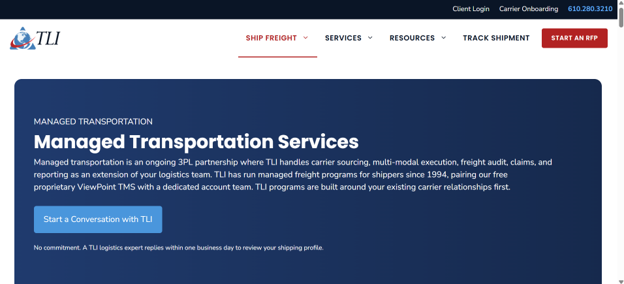
TLI has run managed freight programs for shippers since 1994, pairing its proprietary ViewPoint TMS with a dedicated account team.
Programs are built around your existing carrier relationships first, supplementing with TLI’s network only where gaps appear.
The technology is where TLI separates itself. Its rating engine reads your actual shipment history rather than working from estimates.
That foundation matters most in LTL, where pricing is genuinely opaque. Base rates, discounts off tariff, accessorials, and fuel surcharges all move independently, making costs easy to lose track of.
TLI is direct about a trap that catches many shippers. A headline discount tells you little on its own, because a 70% discount off an inflated tariff can cost more than a 55% discount off a competitive one.
Their position is that total net cost per hundredweight is the only metric worth comparing. The rating engine models contract types, weight breaks, and variables across many lanes at once, evaluating the real cost structure behind a carrier’s pricing.
Those insights then feed the negotiation. Shippers running a structured RFP through TLI’s tools benchmark base rate savings of 4% to 15% against existing direct-carrier or spot pricing.
Customization goes beyond line-haul rates. TLI negotiates custom fuel surcharge tables and tailored accessorial schedules through its motor carrier RFP sourcing events rather than accepting standard tariff terms and generic fees.
Cargo protection works the same way. TLI Advantage+ covers a shipment’s full declared value and resolves claims within 30 days without proof of carrier negligence, a different outcome from standard weight-based liability.
The audit side is quantified. TLI shippers collectively recovered $634,608 in freight bill audit findings, with TLI’s data showing an audit typically recovers 2 to 3 percent of annual freight spend in the first year.
Implementation runs roughly five to six weeks from the point historical data is shared. TLI suits companies shipping $1 million or more annually in LTL or truckload freight, particularly those with multiple facilities.
Founded in 2009 in Chesterfield, Missouri, Sheer Logistics was built around the argument that mid-market shippers have been underserved by managed transportation service providers.
It operates as a 4PL, pairing the Sheer TMS with SheerExchange, a proprietary integration platform.
That integration layer is the differentiator. Sheer states it can implement a TMS in as little as eight weeks against an industry norm of six to eighteen months, drawing on 1,000 or more pre-built integrations.
The company targets shippers moving $5 million to $100 million in freight annually and claims average cost reductions of 15 percent.
It serves mid-market manufacturers, consumer products, food and beverage, plus chemical producers.
Operating since 1978, Land-Link is a privately held 3PL with an execution-focused managed transportation offering.
Its management team carries over 200 years of combined experience, and one founding-year client reportedly remains with the business.
Retail compliance is a genuine specialisation. For manufacturers shipping to major retailers, Land-Link provides OTIF support and chargeback management aimed at protecting vendor scorecards.
Services span LTL, truckload, volume and drayage, plus freight audit and payment, analytics and KPI development. Land-Link suggests a fit for shippers with annual freight spend above $400,000.
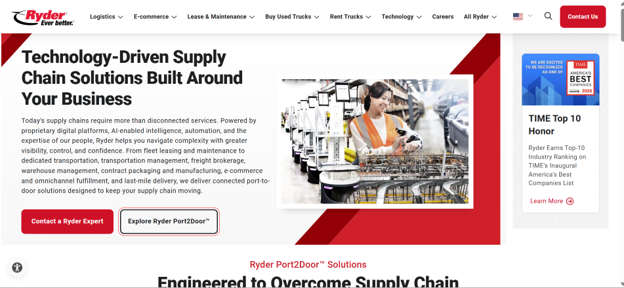
Ryder is the enterprise option, a roughly $13 billion port-to-door logistics company listed on the NYSE.
Its managed transportation sits inside a portfolio covering dedicated contract carriage, brokerage, warehousing, and fleet management.
Scale is the argument, with around $10 billion in freight managed annually and roughly 250,000 commercial vehicles across more than 20 industries.
Visibility runs through RyderShare, a collaborative platform connecting shippers, receivers and carriers in real time.
Transportation management covers network design, shipment planning, procurement, tendering, and freight bill audit.
The trade-off for mid-market shippers is whether they will be a priority account inside an operation of that size.

Founded in 2003, GlobalTranz operates within WWEX Group alongside Worldwide Express, Unishippers, JEAR Logistics and BLX Logistics. That group reported approximately $5 billion in systemwide revenue in 2025.
Carrier network breadth is the headline, with published access to more than 75 LTL carriers and over 45,000 active truckload carriers.
Managed transportation includes freight invoice coding, approval, and payment processing, plus custom reporting and quarterly consulting from an account team.
The model suits shippers wanting flexibility between self-service booking and full outsourcing. Buyers should confirm whether their account sits with GlobalTranz directly or with an independent agent, since the service model differs.
| Capability | Managed Transportation | Traditional 3PL or Broker |
| Engagement | Ongoing program | Per shipment |
| Pricing basis | Contract rates from your shipment history | Spot or published tariff rates |
| Technology | TMS included and configured | Usually none provided |
| Carrier sourcing | Structured RFP run for you | Provider’s existing panel |
| Freight audit | Every invoice reviewed | Rarely included |
| Claims | Filed and tracked for you | Filed internally |
| Reporting | Recurring KPI and business reviews | Transactional only |
| Team | Dedicated account team | Rotating reps |
Start with freight volume and spend, since most programs have a practical entry threshold. TLI points to $125000 million or more annually; Sheer works in the $5 million to $100 million band, while Land-Link suggests $400,000 upward.
Then match your modes against what each provider does well. A heavy LTL profile calls for rating engine depth, while dedicated fleet needs point toward asset-backed providers, and manufacturing specifics like vendor inbound routing or retail compliance are learned specialisms worth testing for.
Finally, interrogate the carrier network, reporting cadence, pricing model, and support structure. Establish whether you get a named account team or a ticket queue, because that difference shows up on your worst day.
There is no universally correct answer, only a correct one for your freight profile. Enterprise shippers with dedicated fleet needs will find Ryder compelling, while pure network breadth points toward GlobalTranz.
For mid-market manufacturers and distributors, the deciding factor in managed transportation services is usually analytical depth rather than size.
TLI’s data-driven RFP approach and Sheer’s rapid integration model both target the same problem, that most shippers cannot see their true transportation costs clearly enough to negotiate against them.
Brokerage arranges individual shipments as one-off transactions. Managed transportation is an ongoing program covering network strategy, technology, execution, and reporting as an extension of your logistics team.
Thresholds vary by provider, from around $400,000 to $5 million in annual freight spend. Complexity often matters more than raw volume, particularly with multiple facilities or inbound vendor routing.
No, and this is one of the most common misunderstandings in LTL pricing. A large discount applied to an inflated base tariff can produce a higher net cost than a smaller discount off a competitive tariff, so compare net cost per hundredweight instead.
Find a Home-Based Business to Start-Up >>> Hundreds of Business Listings.
A well-known, pro-AI super political action committee is behind a new group that plans to blast voters in key battleground states with ads advocating for data centers, several outlets are reporting.
That new group, called Build American AI, wants to convince citizens of the virtues of having data centers in their backyards. It says it is affiliated with Leading the Future (LTF), a super PAC heavily funded by VCs Marc Andreessen and Ben Horowitz, along with OpenAI President Greg Brockman.
Build American AI told Bloomberg it will focus its ads on Kansas, Ohio, and Wisconsin, where concerns about data centers have become a central theme in statewide elections. It said its ad budget is millions of dollars.
LTF launched with over $50 million in funding and has mostly used that money to donate to specific politicians, Politico reports. It supports candidates who advocate for AI, but it also works to oppose candidates who lobby against the technology, sources have told Politico.
LTF has become such a well-known, and not particularly beloved, force in AI-related election politics that OpenAI publicly distanced itself from it in a blog post in June.
“There have been questions around Leading the Future (LTF), which has received support from our President and co-founder, Greg Brockman, and his wife Anna,” OpenAI wrote. “OpenAI does not direct the activities of LTF, or have visibility into their operations.”
OpenAI also condemned some of LTF’s tactics, writing: “Groups that are advocating on AI should be clear about their policy views, be honest about whom they represent, and not use tactics like astroturfing that obscure the real choices facing policymakers and the public.” (Astroturfing means making a paid, organized campaign look like grassroots support.)
While LTF has gained attention in Silicon Valley, it is not the only super PAC pushing an AI agenda that is backed by big Valley names. Anthropic, for instance, is a known supporter of Public First Action, a group that backs AI regulation.
Meanwhile, Marc Andreessen and Ben Horowitz have been “spending on politics like no other” as The New York Times put it. By the outlet’s calculations, their venture firm, Andreessen Horowitz, is the biggest donor so far to the midterm elections, spending more than high-profile donors like Elon Musk and George Soros. The firm has spread over $115 million around so far in disclosed federal contributions. In addition to LTF and AI causes, it is also heavily supporting pro-crypto efforts, especially through the crypto super PAC Fairshake.
When you purchase through links in our articles, we may earn a small commission. This doesn’t affect our editorial independence.
Sony is promising an extended look at Final Fantasy 7 Revelation.

It’s almost Tokyo Game Show time and, as ever, Sony is running a State of Play showcase ahead of the event. Make that two, actually, as the company is doubling up with back-to-back broadcasts on September 3. It’ll get started with the (hopefully) fun and (definitely) games at 9AM ET. You’ll be able to watch the stream on YouTube and Twitch.
We’ll get things started with a broader State of Play that features news and updates from PlayStation Studios and Sony’s partners from around the world. That’ll wrap up with an extended look at Final Fantasy 7 Revelation. That title’s appearance at Gamescom’s Opening Night Live was brief, so it’s good that fans won’t have to wait long for more details. Perhaps we’ll get a release date too — the game is slated to arrive next spring.
Immediately after the first showcase, we’ll dive into State of Play Japan. This will feature games from studios in Asia.
Some rumors suggest this double bill will feature a peek at Naughty Dog’s Intergalactic: The Heretic Prophet, which we haven’t seen much of since its 2024 reveal. I’m a bit skeptical about that, given the final chapter of the FF7 remake trilogy is wrapping up the broader showcase.
I’m curious as to whether Sony will enable live chat for the YouTube stream or set the Twitch chat to emotes only. Every single social media post from PlayStation over the last couple of months has had many replies from folks protesting the company’s decision to stop producing physical game discs almost entirely. That issue is likely to flood out any conversation about game reveals in the live chat unless Sony locks things down.
TL;DR: Live stream Safiullin vs. Alcaraz in the 2026 U.S. Open for free on 9Now. Access this free streaming platform from anywhere in the world with ExpressVPN.
The 2026 U.S. Open is up and running, and all eyes will be on the return of Carlos Alcaraz. We’re sorry Sinner, but nobody gets the people going like Alcaraz.
The second seed faces off against Safiullin in the first round. Fans will expect a confident win from the Spaniard, but he’s been out of action for some time, and a shock result could be on the cards.
If you want to watch Safiullin vs. Alcaraz in the 2026 U.S. Open for free from anywhere in the world, we have all the information you need.
Safiullin vs. Alcaraz in the 2026 U.S. Open is available to live stream for free on 9Now.
Mashable Top Stories
9Now is geo-restricted to Australia, but anyone can access this free streaming platform with a VPN. These tools can hide your real IP address (digital location) and connect you to a secure server in Australia, meaning you can stream the 2026 U.S. Open for free from anywhere in the world.
Live stream the 2026 U.S. Open for free by following these simple steps:
Sign up for a streaming-friendly VPN (we recommend ExpressVPN)
Download the app to your device of choice (the best VPNs have apps for Windows, Mac, iOS, Android, Linux, and more)
Open up the app and connect to a server in Australia
Connect to 9Now
Watch the 2026 U.S. Open for free from anywhere in the world
$12.95 only at ExpressVPN (with money-back guarantee)
The best VPNs for streaming are not free, but they do tend to offer pretty generous money-back guarantees. By leveraging these offers, you can watch Roland-Garros without committing with your cash. This is obviously not a long-term strategy, but it gives you enough time to stream the 2026 2026 U.S. Open before recovering your investment.
If you want to retain permanent access to free streaming platforms from around the world, you’ll need a subscription. Fortunately, the best VPN for streaming live sport is on sale for a limited time.
ExpressVPN is the best choice for bypassing geo-restrictions to stream live sport on 9Now, for a number of reasons:
Servers in 105 countries, including Australia
Easy-to-use app available on all major devices, including iPhone, Android, Windows, Mac, and more
Strict no-logging policy so your data is secure
Fast connection speeds
Up to 10 simultaneous connections
30-day money-back guarantee
A two-year subscription to ExpressVPN is on sale for $68.40 and includes an extra four months for free — 81% off for a limited time. This plan includes a year of free unlimited cloud backup and a generous 30-day money-back guarantee. Alternatively, you can get a one-month plan for just $12.99 (with money-back guarantee).
Live stream Safiullin vs. Alcaraz in the 2026 U.S. Open for free with ExpressVPN.
Chicken cookies! Crumbl has revealed a Minecraft collaboration that introduces six different desserts based on the sandbox game to the menu starting today. Yes, they’re all square shaped, and no, there isn’t a chicken jockey. Available tomorrow, August 31, through September 5, the four-sided treats include a cookie butter cookie with a chicken topper, a Creeper Key lime sandwich, and a lemon poppyseed cookie topped with a boxy bee.
Those three treats are joined by an Enderman cookies-and-cream sandwich, which has purple marshmallow mousse in the middle. Who knew those weirdos could have such a tasty-sounding filling? Meanwhile, the pig-themed dessert is a cherry blossom cookie, with maraschino cherries and cherry cream cheese frosting as two of the key ingredients. Last but not least, there’s a grass block cake that features a cinnamon vanilla base, brown cream cheese frosting, and lawn-textured frosting.

The partnership doesn’t stop there, either. Crumbl notes that there will be Minecraft mystery spoons, with a special exclusive one for the first 200 people who pick up a six-pack of the crossover cookie treats.
Minecraft is not a new kid on the block when it comes to crossovers. Bluey came to the hugely popular game earlier this year, and there have been Minecraft Crocs available in the past. This new collaboration with Crumbl follows Krispy Kreme offering up special Pokemon doughnuts.
Looking ahead, Minecraft Dungeons II is set to launch September 29 on PC, PS5, Switch 2, and Xbox Series X|S.
In July and August, Washington tightened restrictions on foreign-made advanced robotic systems and imposed steep tariffs on imported drones and their components, both moves citing national-security concerns. The drone tariffs take effect in September, with additional component tariffs following in 2027.
These moves are part of a broader U.S. effort to restrict foreign technology in strategically important industries. The FCC’s Covered List, established in 2021, initially targeted telecommunications and surveillance equipment from companies including Huawei, ZTE and Hikvision before expanding to foreign-made drones and, most recently, to advanced robotic devices.
The latest move comes as Chinese manufacturers have built commanding positions in both drones and humanoid robots, often competing at prices U.S. and European rivals struggle to match.
Taken together, the restrictions are raising a bigger question for the global robotics industry: If Chinese drones and humanoids are increasingly shut out of the U.S., where does the competition move next?
The restrictions may protect parts of the American market, but they don’t directly address China’s global manufacturing scale and cost advantages.
Industry analysts and executives who spoke with TechCrunch said the result may be less a clean U.S.-China split than a more fragmented global market, with Chinese companies expanding elsewhere while U.S. and allied manufacturers compete in markets where security requirements matter more.
The U.S. and Chinese robotics industries remain deeply connected, but the two countries enter the competition with very different advantages. Unlike semiconductors, robotics does not hinge on a single technology that one country can easily control, said Ankur Saxena, an investment director at TDK Ventures.
China dominates global humanoid robot manufacturing, with global shipments hitting 22,000 units in the first half of this year — the vast majority from Chinese manufacturers — according to a report by Counterpoint. U.S. companies, by contrast, are operating at a far smaller scale, said Soumen Mandal, a principal analyst at Counterpoint Research.
The world’s five largest humanoid robot makers by shipments — AgiBot, Unitree, Galbot, UBTECH and Leju Robotics — were all Chinese and together accounted for 86% of global shipments in the first half of 2026, according to Counterpoint.
That advantage could compound. Lower prices allow Chinese manufacturers to put more robots into use, generating real-world data that can improve their technology. Higher production volumes, in turn, can drive costs down further, Saxena said.
Mandal said Chinese humanoid makers are also pushing costs down by bringing more of the technology stack in-house and drawing on China’s existing manufacturing base. Unitree, for example, is developing more components internally, while automakers such as XPeng can draw on their experience in chips and vehicle manufacturing as they move into robotics.
“The United States leads in frontier AI, software and semiconductor innovation,” Saxena told TechCrunch. “China leads in manufacturing scale, supply-chain depth and cost.”
That manufacturing edge has let Chinese companies cut humanoid prices faster than most U.S. competitors can match.
“You cannot sanction your way around a cost curve. You can only out-build it, and America has yet to begin making the decade-long investment that will require,” Saxena said.
The answer may increasingly be outside the U.S. Even if Chinese robotics companies lose access to the American market, they still have a large domestic market and room to expand elsewhere, particularly in regions where demand for affordable automation is growing, Saxena said.
Chinese robotics companies are already targeting price-sensitive markets with severe labor shortages across Europe, Southeast Asia, Latin America and the Middle East, said Mandal.
Mandal expects humanoid makers to follow a path similar to Chinese electric-vehicle companies: build scale at home, expand into overseas markets, and eventually establish local production. Countries facing labor shortages and demographic decline could become early markets for humanoids, particularly in manufacturing, where robots can take on repetitive work.
The drone market offers an early glimpse of what that more fragmented robotics landscape could look like. The industry is increasingly splitting into two ecosystems: a U.S.-led market built around American-made, NDAA-compliant systems, and a China-led market focused on low-cost, high-volume production, said Bentzion Levinson, founder and CEO of Virginia-based drone maker Heven AeroTech.
Levinson said Western manufacturers are unlikely to beat Chinese companies in the low-end consumer drone market, where cost remains a major advantage. Instead, U.S. and allied companies could increasingly compete in long-range autonomous systems for defense and critical infrastructure, where security requirements carry more weight.
Levinson sees the next competitive frontier shifting from the drones themselves to the technology that powers them and the equipment they carry. “The next battleground is over who owns the next-gen energy and payload architecture,” he said, pointing to battery constraints in particular. As drones become more capable, he added, battery limitations could make power systems an increasingly important point of competition.
Agility Robotics welcomed the FCC’s decision in July, saying it could address security concerns around foreign-made advanced robots before they become deeply embedded in the U.S. market, as has happened in the drone industry. The company pointed to its Digit humanoid, which is designed and assembled in the U.S., while also calling for continued access to the tools and technologies needed to advance robotics research.
“The alternative to China isn’t a purely domestic U.S. supply chain; it’s a diversified allied one,” Saxena said.
That could create opportunities elsewhere in Asia. Japan has decades of experience in industrial robotics and precision manufacturing, South Korea brings strengths in electronics, batteries and automobiles, and Taiwan is a major player in semiconductors. But none can simply replace China, Saxena said, given how deeply Chinese components remain embedded across the global robotics industry.
Asian manufacturers could emerge as a middle ground between lower-cost Chinese robots and more expensive U.S. offerings, Mandal said. South Korea’s Hyundai, which owns Boston Dynamics, and Japan’s Toyota are among the automakers investing in robotics, drawing on their expertise in vehicles, manufacturing and autonomous systems as they move into humanoid robots.
Yang Fang of Beagle Technology, a California-based agtech startup that uses AI and robotics software to turn conventional farm equipment into autonomous machines, told TechCrunch that robotics is likely to become more regional as companies design machines for the labor needs, working conditions and customers in their home markets. Chinese robotics companies, for example, may focus on products suited to China and nearby markets, while U.S. companies are more likely to build for industries across North America, he said.
The result may not be two neatly separated U.S.- and China-led robotics industries. Instead, the restrictions could accelerate the emergence of regional markets: Chinese companies competing on cost and scale across much of the world, U.S. and allied manufacturers gaining ground where security requirements matter most, and manufacturers in Japan, Taiwan and South Korea trying to carve out space between the two.
When you purchase through links in our articles, we may earn a small commission. This doesn’t affect our editorial independence.
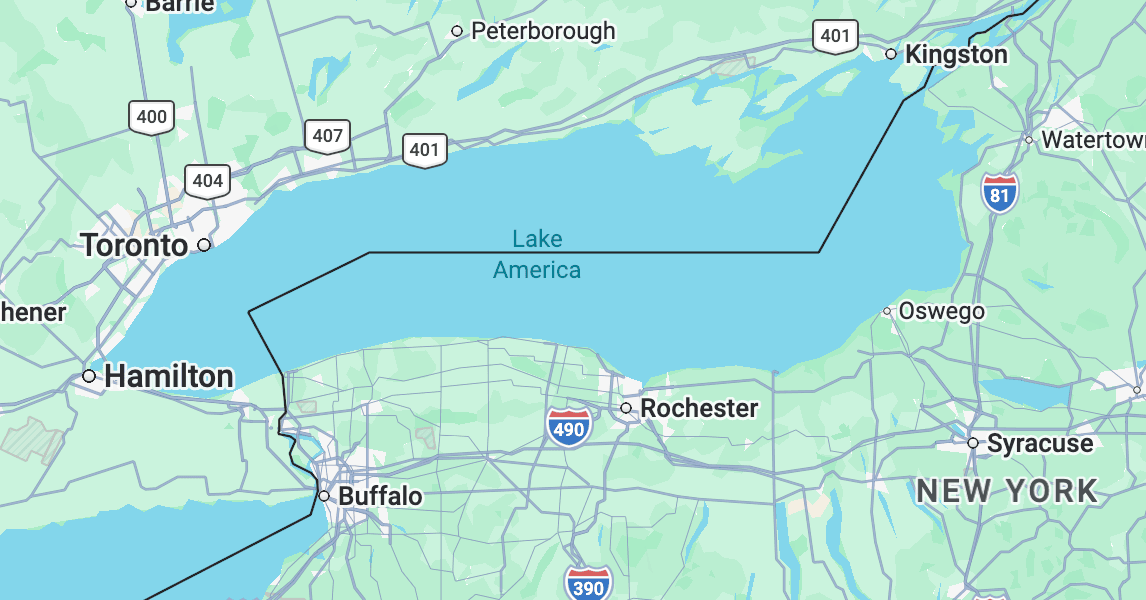
Lake Ontario is no more on Google Maps in the US. Google changed the name of the easternmost of the Great Lakes to “Lake America” late Saturday, days after President Donald Trump ordered its rebranding in official government databases.
Trump issued the executive order on Thursday as part of an ongoing feud over tariffs with Canada, whose province of Ontario borders the lake. It followed a similar order he issued in January 2025 to rename the Gulf of Mexico as the Gulf of America as part of a fight with the US trading partner to the south.
Google, Apple, Microsoft, and other maps providers adopted the Gulf of America naming as soon as the US Department of the Interior updated its records, which came a couple of weeks after Trump’s order. So it was no surprise that when those records—which are used to determine names on roadway signs and in government literature—reflected Lake America, digital maps from Google also quickly took on the new name.
Apple Maps and Bing Maps have not yet reflected the change but are expected to. In fact, the map for the federal government’s Geographic Names Information System database, which informs these changes, still showed Lake Ontario as of Sunday morning, with a note that the maps are “in the process of being updated to reflect this name change.”
While Google and other private organizations that provide maps are not bound by law to use official names, they generally follow government databases like GNIS. The location names a user sees depends on their own geography.
“People using Maps in the US will see ‘Lake America,’ those in Canada will continue to see ‘Lake Ontario,’ and those outside of the US and Canada will see both names,” Google said in an unsigned statement. “These updates follow our long-standing policy for bodies of water with names that vary from country to country, and are starting to roll out now.”
Trump’s efforts to rewrite maps have generated considerable public debate in open-source mapping communities such as OpenStreetMap, whose technology is used by companies such as Uber and Lyft. Ultimately, OpenStreetMap recognizes both the US and foreign names and gives organizations using its maps the choice over which to show.
One map provider that has so far declined to make the change is MapQuest, which said in a social media post in response to Trump’s order, “We’re not changing it.”