Generative AI Landscape In The Mobile App Development Industry


Generative AI Landscape in the Mobile App Development Industry

The emergence of Generative Artificial Intelligence (Gen AI) and its intersection with mobile app development has led to remarkable advancements in creativity, personalization, and user engagement. Generative AI models, leveraging machine learning, deep learning, and artificial neural networks, can generate unique content, videos, audio, and images based on user prompts.

In this article, we would like to walk you through how Generative AI is evolving in the mobile app development industry, highlighting its applications, challenges, and future of Gen AI in Android and iOS development.

What is Generative AI?

Generative AI refers to a class of algorithms capable of generating new data based on the user prompts and patterns learned. This revolutionizing AI technology can learn from a dataset of input, process structured and unstructured data, and generate accurate data and insights. Generative AI models, such as Generative Adversarial Networks (GANs), Variational Autoencoders (VAEs), and Transformer models, have demonstrated remarkable capabilities in generating realistic images, text, and even entire video scripts.

Significant Use Cases of Generative AI in Mobile App Development

Generative AI holds immense promise for enhancing mobile app experiences across various domains. Our expert mobile app developers with best practices in software development have listed a few key applications of generative AI in mobile app development.

  • Generative AI for Content Generation

Generative AI can be used to automatically generate text, images, and videos for social media, content marketing, and personalized recommendations. Integration of Generative AI into mobile apps helps to create engaging content and videos tailored to user preferences.

  • Gen AI Ideas for Intuitive App Design

Generative AI enables the creation of unique designs and illustrations for Android, iPhone, and web apps. UI designers can generate custom logos, graphics, and visual elements using generative AI algorithms. Hence, Gen AI in mobile application development empowers designers to create intuitive UI designs.

  • Gen AI for Generating Realistic Effects

The trend for AI-generated images is all everywhere. Generative AI applications and solutions allow mobile application developers to integrate photo editing capabilities in mobile apps. This integration helps users apply creative filters, remove imperfections, and generate realistic effects with minimal effort, enhancing photo quality and visibility.

  • Collaborative and Interactive Virtual Assistants

AI Chatbots or virtual assistants are the best innovations that are assisting industries to serve their client base in an optimized and the best way. Generative AI empowers conversational chatbots in mobile apps to better interpret user prompts and generate responses, enabling personalized experiences. Hence, Gen AI-powered Chatbots can engage users in human-like conversations, answer queries, provide recommendations, and perform tasks, enhancing customer support and user engagement.

  • Gen AI in Gaming app Development

Generative AI is revolutionizing mobile gaming experiences by enabling procedurally generated content, dynamic storytelling, and interactive gaming sessions. Game app developers can use generative algorithms to create virtual environments, characters, and narratives that evolve and adapt based on player actions and preferences.

  • Behavior Analysis and Personalization

Generative AI integration in mobile apps helps organizations analyze user behavior, preferences, and historical data to generate insights. These insights will help companies to deliver personalized recommendations, product suggestions, and customized content in mobile apps. By understanding user preferences, mobile apps can deliver tailored experiences that resonate with individual users.


Key Challenges Involved in Generative AI Implementation

Despite its potential, generative AI in mobile app development poses several challenges, including:

  • Data Privacy and Security

Generative AI applications or solutions trained on user data might pose a few concerns about privacy and security. Mobile app developers must implement robust data protection measures and ensure compliance with privacy regulations to safeguard user information and prevent misuse of generative models. USM Business System has expert AI app developers who have best practices in developing AI and Gen AI-powered apps that ensure high data security and privacy.

Generative AI algorithms may involuntarily continue biases and stereotypes present in the training data. Mobile app developers should evaluate and mitigate potential biases in generative models to ensure fairness, diversity, and inclusivity in the generated content and recommendations.

  • User Experience and Adoption

Introducing generative AI features in mobile apps requires careful consideration of user experience and adoption. Developers should design intuitive interfaces, provide clear explanations of generative features, and solicit user feedback to ensure acceptance and usability among diverse user groups.


The future of generative AI in mobile app development

The future of generative AI in mobile app development is promising, with ongoing advancements in GPT models, algorithms, tools, and applications.

Developments are continuously improving generative AI algorithms to generate more realistic, diverse, and high-quality content such as text, images, audio, and video. The Gen AI is further optimized using self-supervised learning, reinforcement learning, and meta-learning to enhance its capabilities.

Further, with the rise of edge computing and on-device AI, mobile devices are becoming increasingly capable of running sophisticated generative models locally, without relying on cloud infrastructure. Mobile apps may leverage on-device inference to deliver real-time generative experiences while preserving user privacy and reducing delay.

Generative AI will also continue to find applications in domain-specific tasks such as design, interior decoration, music composition, and virtual reality content creation. Mobile apps tailored to specific industries and niches will leverage generative models to automate creative workflows, inspire innovation, and enhance productivity.

Moreover, as Gen AI becomes more integrated into creative workflows, the focus will shift towards enabling seamless collaboration between humans and AI. Future mobile apps will empower users to co-create, customize, and refine generative content, blurring the lines between human creativity and artificial intelligence.


Wrapping Up!

The use cases of Gen AI in mobile app development are incredible. Every application of Gen AI in mobile application development contributes to improving ROI. As we discussed in this article, while the benefits of generative AI for mobile app development are huge, there are a few challenges. But USM will help you overcome implementation challenges and optimize operational efficiencies. By harnessing the power of generative models, our mobile app developers can create innovative experiences that delight users, inspire creativity, and drive business growth in the digital age.
 

Apple Acquires AI Startup DarwinAI to Boost Tim Cook’s


March 15th, 2024: Apple has reportedly acquired DarwinAI, a Canada-based startup focused on artificial intelligence (AI), in a deal that could significantly boost the tech giant’s AI ambitions.

The acquisition, which took place earlier this year, has not been officially announced by Apple, but sources familiar with the matter have confirmed the development to Bloomberg’s Mark Gurman.

DarwinAI, known for its expertise in developing AI systems to inspect components in the manufacturing process visually, has also seen many of its employees join Apple’s AI division.

Most notably, the startup’s co-founder and Chief Scientist, Alexander Wong, has been hired as a Director of Machine Learning Research at Apple.

The acquisition comes when Apple CEO Tim Cook has emphasized the company’s focus on AI development.

During the company’s quarterly earnings call in February, Cook revealed that Apple was investing a “tremendous amount of time and effort” in AI and hinted at the possibility of new AI-driven features being unveiled later this year.

Speculation surrounding Apple’s AI plans has been rife, with rumors suggesting the development of a native foundation model called AppleGPT, an enhanced version of Siri that could function as a chatbot similar to ChatGPT and Google Gemini, AI-generated playlists for Apple Music, and AI integration into productivity apps like Pages and Keynote.

The upcoming iOS 18 update, expected to launch alongside the iPhone 16 series, is also rumored to bring several new AI features to Apple smartphones.

The acquisition of DarwinAI could play a crucial role in Apple’s AI strategy, particularly in developing on-device AI models and features.

This approach aligns with Apple’s emphasis on user privacy and security, as on-device AI processing minimizes the need for cloud-based data processing.

As Apple continues to invest in AI and expand its capabilities, integrating DarwinAI’s expertise and technology could lead to significant advancements in the company’s products and services.

While the specifics of the acquisition and its implications remain under wraps, the tech world eagerly awaits the curtain-raiser of Apple’s AI-driven innovations in the coming months.


Best voice changer in the world 2024


LOVO.AI

Multimodal AI with Cross-Modal Search


First Venture Into Multimodal AI_ Cross-Modal Search In 5 Minutes-1

Introduction

Cross-modal search is an emerging frontier in the world of information retrieval and data science. It represents a paradigm shift from traditional search methods, allowing users to query across diverse data types, such as text, images, audio, and video. It breaks down the barriers between different data modalities, offering a more holistic and intuitive search experience. This blog post aims to explore the concept of cross-modal search and its potential applications, and dive into the technical intricacies that make it possible. As the digital world continues to expand and diversify, cross-modal search technology is paving the way for more advanced, flexible, and accurate data retrieval.

Understanding Search Modalities: Unimodal, Cross-Modal, and Multimodal Search Explained

Unimodal, cross-modal, and multimodal search are terms that refer to the types of data inputs or sources that an artificial intelligence system uses to perform search tasks.  Here’s a brief explanation of each:

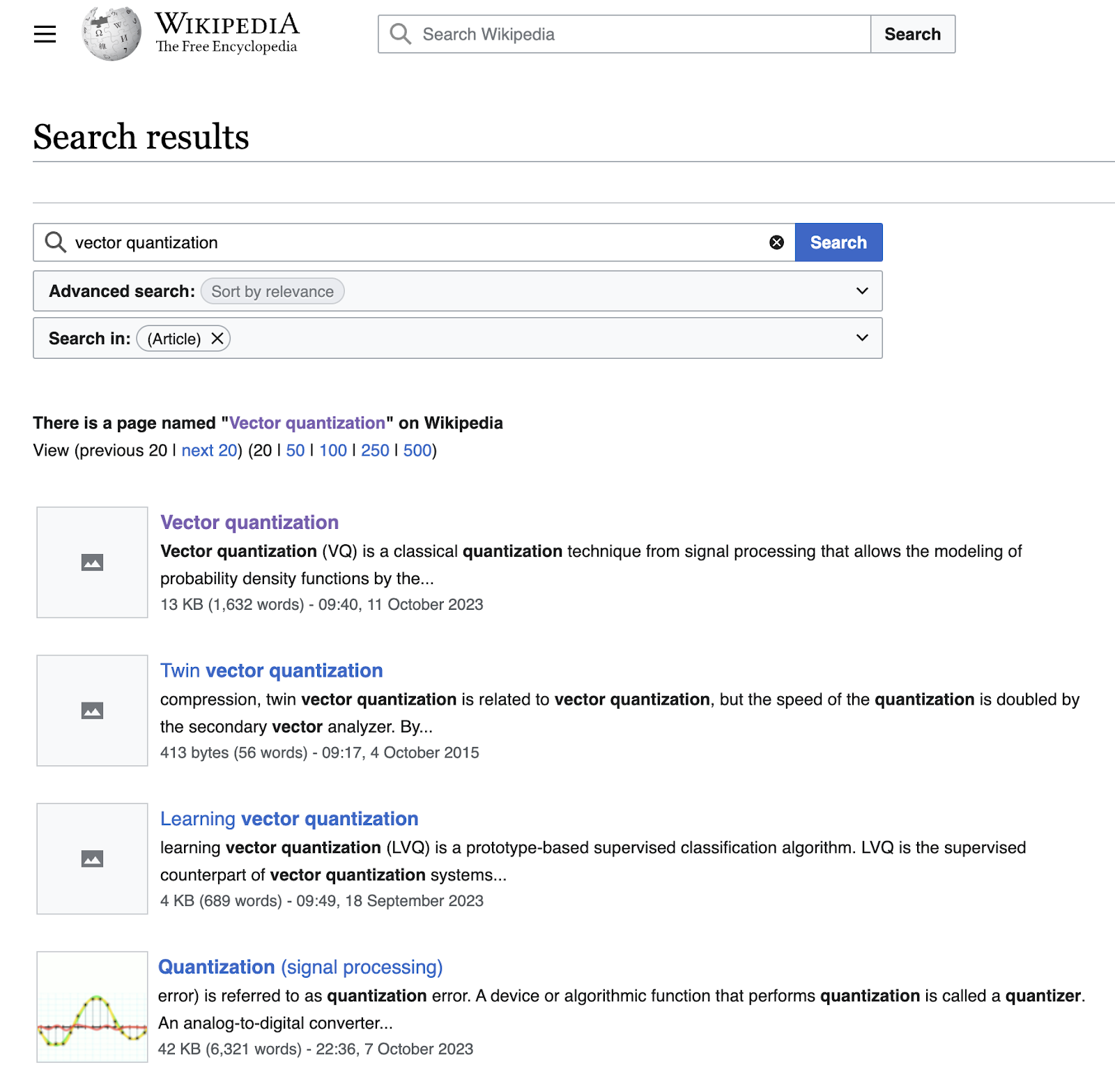
  • Unimodal search is a common type of search that only involves a single mode or type of data. Unimodal search is important when the query and the content to be searched are the same modality. This could mean that you have a short text description of what you are looking for and receive a ranked list of search results containing short paragraphs. For instance, if we’re trying to look for recipes, answers from Quora, or a short history lesson from Wikipedia, we are performing an unimodal search (in this case, with text). This can similarly be applicable to image-to-image search, like using Pinterest Lens to find similar apparel designs. Unimodal is the simplest form of search and is widely used in traditional search engines and databases.


Example Wikipedia article search on “vector quantization”

  • Cross-modal search refers to the ability to search across different modalities, where the query is expressed in one modality, and the content to be retrieved is  a different type (modality) of data. Imagine using a text description to search over images within your personal photo album. That would save so much scrolling time!
  • Multimodal search involves using two or more modalities in the search query and the retrieval process. This could mean combining text, images, audio, video, and other data types in the search.  Multimodal is important because it reflects the rich and complex nature of human communication

With Clarifai, you could use the “General” workflow for image-to-image search and the “Text” workflow for text-to-text search, both unimodal. Previously, to mimic text-to-image (cross-modal) search, we’d leverage the 9000+ concepts in the General model as our vocabulary. Now with the advent of visual-language models like CLIP, we launched the “Universal” workflow to enable anyone to use natural language to search over images.

How to perform Text-to-Image search with Clarifai

Operations can be done via the API or the portal UI. First, login to your account or sign up here for free.

Using the API

In this example, we will use Clarifai’s Python SDK to help us use as few lines as possible. Before you get started, get your Personal Access Token (PAT) by following these steps. Also follow the homepage instructions to install the SDK in one step. Use this notebook to follow along in your development environment or in Google Colab.

1. Create a new app with the default workflow specified as the “Universal” workflow

2. Upload the following 3 example images. Since this is a short demo, we directly ingest the inputs into the app. For production purposes, we recommend using datasets to organize your inputs. The SDK currently supports uploading from a csv file and from a folder and you can find the details in the examples.


3. Perform search by calling the query method and passing in a ranking.

4. Response is a generator. See the results by checking the “hits” attribute.

Using the UI

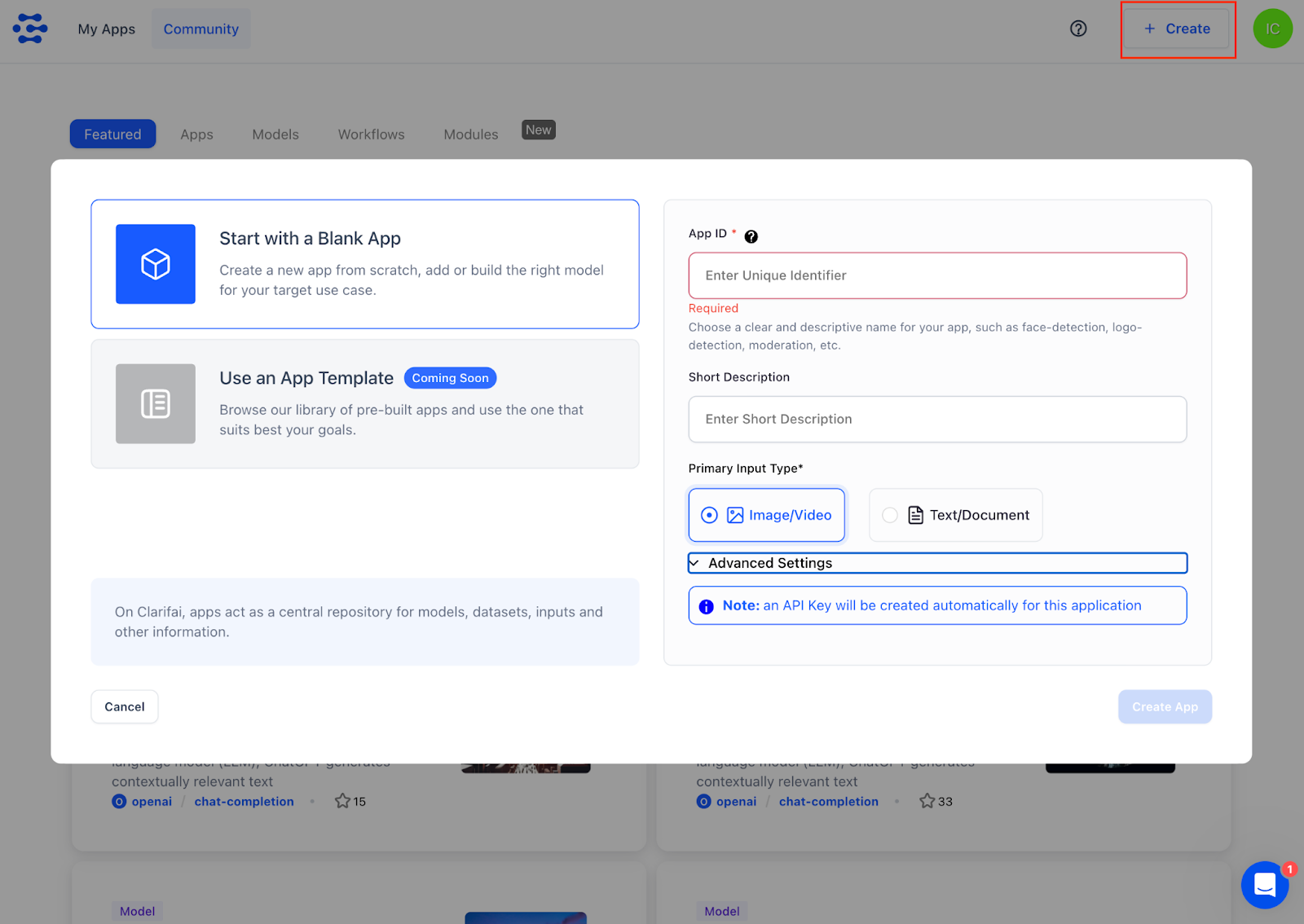
1. Create a new app by clicking the “+ Create” button on the top right corner in the portal screen. By default, “Start with a Blank App” is selected for you. For “Primary Input Type”, leave the default “Image/Video” selected as it sets the app’s base workflow with the Universal workflow. To verify that, click on “Advanced Settings”. Once the App ID and the short description have been filled in, click “Create App”.

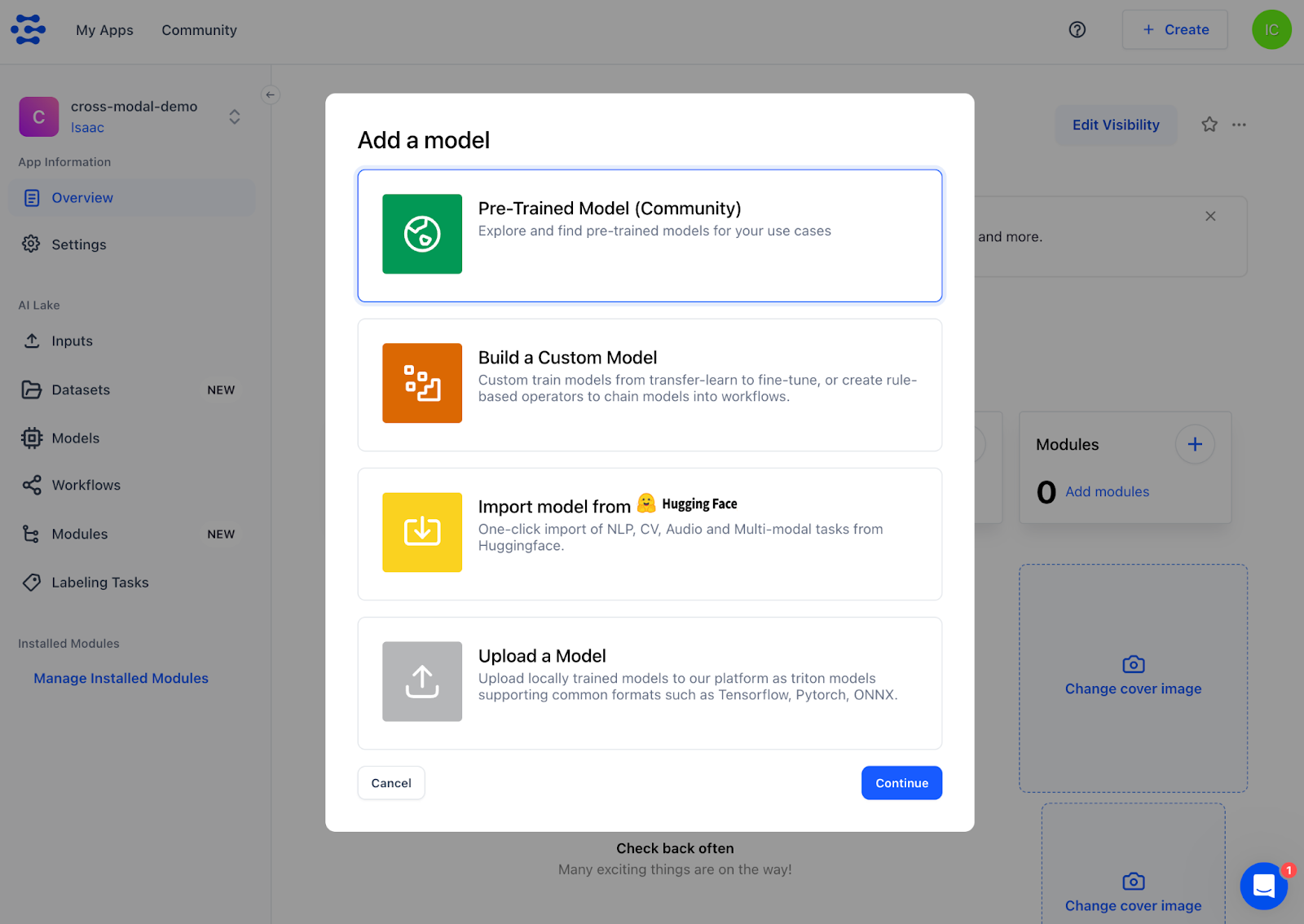
2. You’ll then be automatically navigated to the app you just created. At this time, you might see the following “Add a model” pop-up. Click “Cancel” on the bottom left corner as we do not need this for our tutorial.

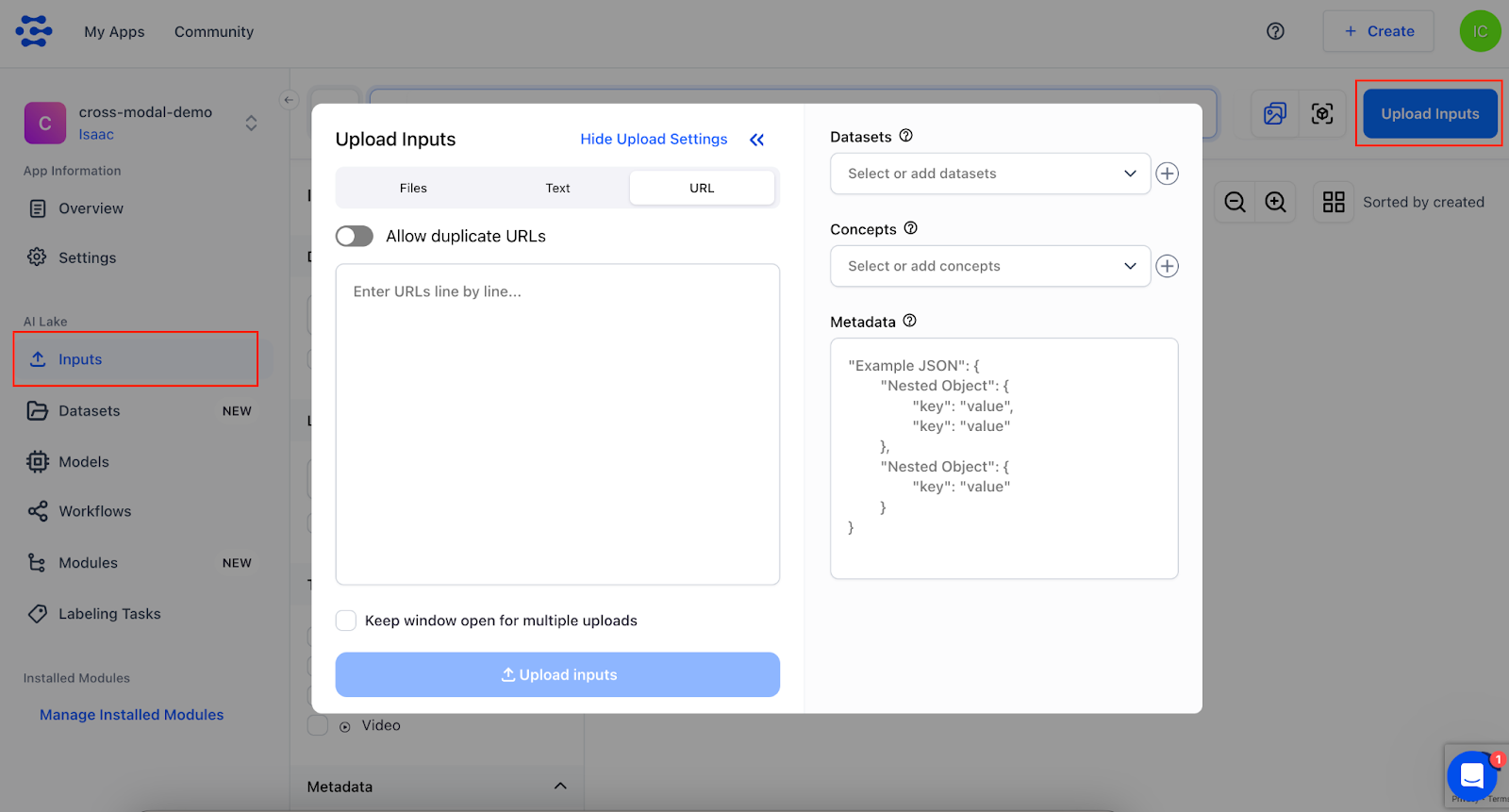
3. Upload images! On the left sidebar, click “Inputs”. Then click the blue button “Upload Inputs” on the top right. We can enter the image URLs line by line. Alternatively, we can upload them via a CSV file with a specific format. Here we use the following URLs. Copy and paste these into the box without new lines. 


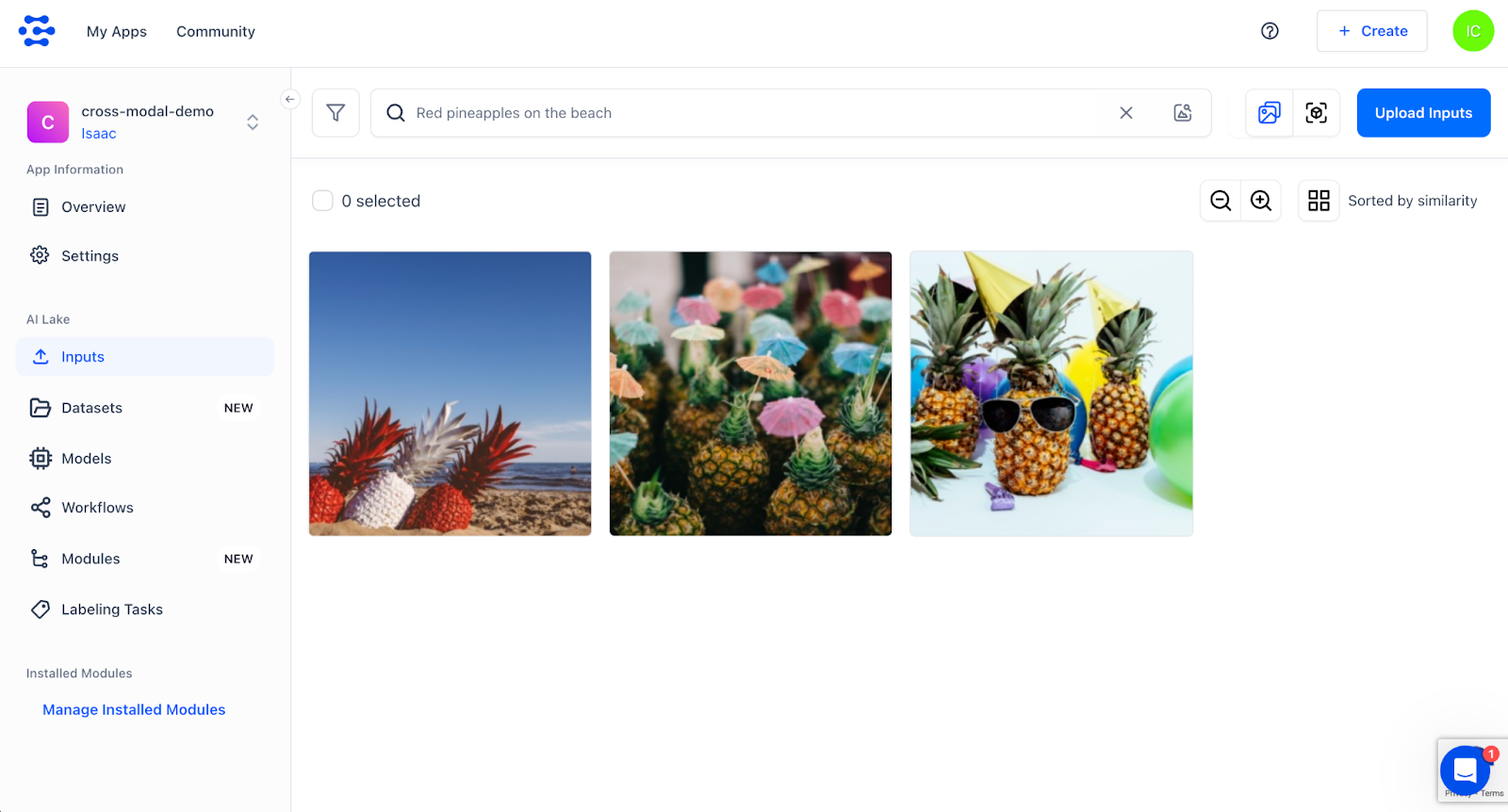
4. After the upload is complete, you should see all 3 images. In the search bar, enter a text query and hit enter. Here we have used “Red pineapples on the beach” as an example, and indeed, the search returns a ranked list with the most semantically similar image first. 

Summary

The choice between unimodal, cross-modal, and multimodal search depends on the nature of your data and the goals of your search. If you need to find information across different types of data, a cross-modal search is necessary. As AI technology advances, there is a growing trend towards multimodal and cross-modal systems due to their ability to provide richer and more contextually relevant search results.

Try it out on the Clarifai platform today! Can’t find what you need? Consult our Docs Page or send us a message in our Community Discord channel.


The AI Advantage: Top Applications of Artificial Intelligence Beyond the Books


Times have changed. We now live in a world where we are surrounded by AI-powered devices and gadgets. Many apps and services that assist us in doing routine tasks, such as chatting with friends, using email, or using a taxi service, are now driven by AI. With the everyday advancements in AI technology, artificial intelligence will most likely be an indispensable part of our daily tasks. The strength of artificial intelligence is there for everyone to see. From Google Maps to self-driving vehicles, there are several applications of AI in real life. Be it banking or AI in education examples, AI is everywhere. The AI market is expected to rise from $327.4 billion in 2022 to $390.9 billion in 2023. (Source: Analytics Insight)


What is Artificial Intelligence?


The replication of human intellect in robots that are built for performing cognitive functions like humans is referred to as artificial intelligence (AI). It is an extensive subject of computer science that includes the building of artificially intelligent systems capable of doing activities that would normally need human thought.

AI systems are intended to sense their surroundings, understand and translate data, analyze and make judgments, and behave appropriately. They adapt from and enhance their abilities over time by using computations, mathematical structures, and big datasets. There are several applications of AI in real life – banking and finance, healthcare, logistics, education, entertainment, etc.. Its objective is to develop intelligent robots capable of augmenting human skills, automating processes, solving complicated issues, and providing important insights and support.


Why AI is used?


When we talk about the different real world applications of AI, there are several reasons why AI is used. Here are some of them.

  • Automation of repetitive tasks.
  • Providing humans more valuable time for focusing on important tasks
  • Increased efficiency and productivity
  • Offer personalized suggestions and recommendations to customers
  • Understand, interpret, and respond when interacting with humans like in case of chatbots
  • Analyze enormous amounts of data rapidly and correctly, detecting trends, patterns, and insights.
  • Image, video, and audio analysis and interpretation, allowing intelligent machines to distinguish people, things, actions as well as emotions.


Understanding the real world applications of AI


There are several applications of AI in real life. Here are some of them.


Medical and healthcare


  • When we talk about real world applications of AI, the field of medical and healthcare comes right at the top.
  • At present, AI programs are being used by top healthcare organizations across the globe to make improved and faster predictions and diagnosis of diseases in humans.
  • The application of AI in real life in healthcare includes improving the consistency and predictability of identifying life-threatening diseases such as cancer, stroke, heart diseases, etc.
  • With the strength of artificial intelligence, patient care in hospitals and medical care centers can be increased.
  • In addition to making predictions of diseases, AI-powered bots can also respond to human queries related to hospitalization, etc.

Education


There are several AI in education examples that have the capability and potential to transform learning in educational institutions.

Here are some of the AI in education examples.


Personalized learning


  • In the work of education, every student is different.
  • An AI program can analyze the learning abilities of students and identify their strengths and weaknesses.
  • For example, Student A may be good in languages, but may find math difficult.
  • In such cases, AI can be used to provide personalized learning to students based on their specific needs.


Automated assessments of tests


  • Most teachers spend their time on administrative work such as assessment of examination papers and tests.
  • One of the examples of artificial intelligence in education is the automated assessment of examinations, especially those which are objective-based that includes multiple choice questions, fill in the blanks, true or false, etc. having specific answers.
  • Automation of assessment of test papers helps teachers save valuable time, thus allowing them to focus on their teaching and the students.


Feedback to students


An AI program has the capability to provide automated feedback to students by assessing their written responses. The feedback given to students will help them improve and understand where they are going wrong.


Curriculum designing and content creation


  • Another one of the AI in education examples is curriculum designing and content development.
  • Curriculum development is notoriously challenging since the subject matter and its applications are always being upgraded.
  • While AI is good at generating individualized educational materials for each pupil, it may also be extremely useful in improving educational institutions’ curriculum.
  • AI can evaluate massive volumes of data on students’ progress, interests, skills, and obstacles over the course of an academic year and assist teachers and educators on how to increase the efficacy of their educational programs on a big scale. 
  • AI algorithms can detect patterns and trends, evaluate the efficacy of various pedagogical techniques, and forecast the consequences of various educational tactics.

Transportation with smart automobiles

  • Similar to AI in education examples, smart automobiles are another field where AI is becoming more prevalent in our daily lives.
  • Not only are businesses like Tesla at the forefront of employing smart, but many car manufacturers are also working at combining AI with automobiles to give seamless services of many technologies that you use.
  • To effectively manage through traffic, information is shared and transferred between automobiles. 
  • Inputs about traffic statistics, current information on obstacles, and so on are instantly broadcast to inform other cars, allowing for re-routing.

Emails


  • Most of us will send at least one email everyday, if not many. 
  • When you create an email, various tools will perform the spell check and help you generate error-free communications. AI, machine learning, and natural language processing are used in these tools. 
  • Spam filters on the receiving end of your communication utilize AI to either reject emails suspected of being spam or recognize an email that they believe you would like to see in your inbox.

Finance


In the world of finance, artificial intelligence is used in a number of ways. It is crucial to ensure the safety of the transactions we perform and for finding instances of fraudulent activities. When the balance in your account goes below the minimum, you receive a notification automatically on your phone. This is possible through the strength of artificial intelligence. Whether you go to a restaurant for lunch and buy a new pair of clothing, artificial intelligence will evaluate the transaction to see whether it’s a “normal” transaction and either confirm or refuse the transaction in case someone else is using your credit card.


The AI in education market reached $4 billion in 2022 and is expected to increase at a CAGR of more than 10% from 2023 to 2032, owing to an increasing demand for personalized education. (Source: GM Insights) The given statistic provides the increasing AI in education examples. Not just education, AI has penetrated into several industries. With the tremendous potential and real world applications of AI, this technology offers students with opportunities to take their learning beyond the classrooms. Considering the different AI in education examples, its adoption will help students learn valuable skills for transforming their future.

Cost To Develop An Online Shopping And Delivery App Like InstaShop


How Much Does It Cost To Develop An Online Shopping and Delivery App Like InstaShop?

How To Make An Instant Shopping & Delivery App Like InstaShop?

Instant shopping and delivery apps made online purchases of a wide range of products, including household, personal, and kitchen essentials easier and more convenient. People do need not to travel long to buy groceries, pharmacies, fresh flowers, food items & desserts, stationery products, cosmetics, perfumes, etc. Instant online shopping and delivery apps like InstaShop will bring everything to the fingertips of users.

InstaShop is one of the Top Online Shopping and Delivery Apps in The Middle East, incorporated in 2015. InstaShop Android app/iOS app offers nearly 100,000 products across various categories at store prices. Users can order products from their favorite nearby supermarkets, pharmacies, restaurants, and bakeries and get instant delivery within 30 minutes.

Its user-friendly features and instant deliveries have made it a popular grocery delivery app in the UAE. Wide Product Varieties from top brands, Instant Online Deliveries, location tracking facilities, and discounts on products are its core features that are playing a vital role in its successful journey in the Middle East.

Today, InstaShop is well-recognized by millions of users across the United Arab Emirates, Saudi Arabia, Oman, Bahrain, Qatar, Egypt, Lebanon & Greece.

Do you want to create an online grocery shopping app like InstaShop and grab the opportunities of the on-demand grocery delivery app market in the UAE or Saudi?

If yes, then our article will give you a detailed guide on features, technology stack, and development cost of InstaShop-like leading Instant Shopping and delivery app.     

Cost To Develop An App Like InstaShop

Must-Have Features and Functionalities In Online Grocery Delivery App Like InstaShop 

InstaShop is the most downloaded mobile app for grocery delivery in the UAE. Its simple design and set of easy-to-access features are the core reasons behind its success. Being a leading custom grocery app development company, our top mobile app developers in UAE, with their proven experience, have compiled a list of the top features that offer hassle-free online shopping experiences to users.

Let’s take a look at the best features of online grocery delivery apps for Android and iOS.

Must-have Features In InstaShop Clone App For Customer Panel 

  • Easy sign-up and login
  • Hassle-free Social media login
  • Location Tracking feature for delivering user’s location and offering quick delivery services
  • Search option with product or shop name
  • Customized filters to make the search easier and faster
  • Add To Cart for listing the products
  • Wish list
  • Secure Checkout
  • Multiple Payment Modes for user convenience
  • Real-time order tracking facility
  • My Orders to check previous and scheduled orders
  • User Profile to view, edit/modify profile details, account details, address details, language settings, etc.
  • Pickup or Door Delivery suppleness
  • Alerts on arrivals and push notifications
  • Ratings & Review facility for reporting the application performance and dropping their feedback on app experiences 

Must-Add Features of On-demand Delivery Apps like InstaShop For Store Owners 

  • Restaurant/Pharmacy/Supermarkets register and login facility
  • Product listings
  • Add/delete out of the stock products
  • Order accept or reject flexibility
  • Payment tracking
  • Orders history and Payments status checking
  • Read Ratings and Customer Feedback

Top Features Of Grocery Delivery Apps For Rider Panel Development 

  • Registration and login
  • Orders View and Accept/reject delivery requests
  • In-app map integration for tracking delivery locations
  • Delivery status updates features
  • In-app calling or chat facility for getting user assistance in reaching the delivery address
  • Rider Profile Management
  • Link bank account feature to get delivery charges directly to the accounts from restaurants and tips given by the customers


Recommend To Read: How Much Does It Cost To Develop A Walgreens-like E-Pharmacy Delivery App?


Must-Add Features To Develop Admin Panel For InstaShop-like Top Grocery Delivery App UAE 

  • Users Management
  • Supermarkets/Restaurants Management
  • Orders management
  • Rider Management
  • Content management
  • Reviews and ratings management
  • Exclusive discounts management
  • Returns and refund management
  • Personalized push notifications to Users
  • Payment tracking for ensuring secure transactions
  • Customer support and in-app assistance

Get a free quote for grocery delivery app development quote!


Tips To Remember For Building A Results-driven Online Grocery Delivery App Like InstaShop?

If you plan to invest in online grocery delivery apps, marketplace apps, E-commerce apps, food delivery apps, or online pharmacy ordering apps, app developers must consider a few things for creating a top-notch application that improves user experiences and generate sales.

  • Attractive and Simple User Interfaces (UIs)

The design of the marketplace application plays an essential role in increasing or decreasing app downloads and conversions as well. Since marketplace or e-commerce apps will comprise various products, the app interface must be clean and catchy with better organizing every feature at the fingertips of users. Hence, the application’s front end should not be messy and assist your app users in accessing the features smoothly.

  • Reliable In-App User Assistance

It is where you can improve the app as well as your brand’s reliability. To provide this facility, you must integrate Artificial Intelligence features into your novel grocery delivery app. AI-powered in-app customer assistant features will provide instant responses to customer issues and trigger auto notifications about deals, discounts, price drop alerts, etc.

  • Personalized Notifications For Clutch Sales

Using the capabilities of Ai and Machine Learning-based pattern recognition techniques, app developers can derive patterns into buyer preferences and interests. Hence, companies can trigger personalized product purchase recommendations to individuals and optimize sales.

  • Order Now or Schedule For Later

Adding this feature to your new online grocery delivery application will allow app users an instant delivery service or schedule their deliveries as per their preferences. This type of feature in on-demand delivery apps will increase the weightage of your application and deliver customer-friendly services.

  • Add Crazy Functionalities

Re-order is one of the craziest features that you can add to your Android/iOS grocery delivery application. Features like Re-order will save the users’ time in again choosing the restaurant and products.

App localization is the most important factor that you must remember. Let your application support users in their native language. It will increase app localization and customer loyalty.

  • Voice-based Search Is Added Plus Benefit

Grocery apps or marketplace apps with voice-based search features will grab the user’s attention. Such apps make users search faster and display the content they are looking for.

These are a few tips to make your application more unique and keep it out of the clone app world.


Recommend To Read: How Much Does It Cost To Develop An e-Commerce App like Amazon?


The Tech Stack You Need For Developing InstaShop-Like An On-Demand Grocery Delivery App

Being one of the top custom mobile app developers, InstaShop-like trending and most popular online grocery delivery clone application development need the below tech stack.

  • Programming Languages: Java and Kotlin for Android app development & Swift and Objective C for iOS app development
  • Database: MongoDB, MySQL
  • Storage: AWS, Azure, Google Cloud
  • In-app Payment Integrations: PayPal, Stripe
  • Location Tracking: Google Maps, Maps SDK for iOS
  • Push Notifications: Twilio
  • Front–end development: React and AngularJS
  • Backend Development: NodeJS


How Much Does It Cost To Develop An Online Grocery Delivery Platform like InstaShop? 

The cost of an on-demand grocery delivery app development will cost from $35,000 to $150,000 and above.

But, the final cost of a grocery delivery app like InstaShop will depend on the hourly rate of mobile app development companies, application development process, technology stack, app type, development platform, and design complexity, etc. The grocery delivery app development cost will be greatly impacted by these factors. 

If you are looking to hire the best online grocery delivery app development company USA, USM is your perfect partner. We build budget-friendly Android/iOS e-commerce and marketplace apps.

Get In Touch!

Key Monetization Strategies of On-demand Grocery Delivery Apps Like InstaShop

We have discussed grocery delivery app features, the technology stack for on-demand grocery app development, and also the cost to create the InstaShop clone app. Now, let’s discuss for a few seconds the best ways to monetize grocery apps like InstaShop. 

  1. In-app Advertisements 

It is one of the proven, evergreen, and best mobile app monetization strategies that let app owners generate revenues beyond app services. Let e-commerce or other brands post their ads on your application wall and collect fees for their brand promotion through your app.

  1. Commissions from Supermarkets or Stores

The most traditional way to generate revenues beyond actual sales. Not only app developers and customers will benefit from online services, but suppliers and retailers will also gain huge benefits. Listing services or products on InstaShop-like mobile apps, stores can expand brand reach and gain more customers. So, app owners can take commissions from stores, supermarkets, or restaurants for listing their products in your grocery app.

  1. Delivery Commissions From Customers

App owners can charge money from customers for convenient delivery services. Based on the proximity of the store to the customer’s location, the app owners can take delivery charges.         


Online Grocery Delivery Market Growth In UAE, Middle East

Let’s take a look at stats that tell you how online grocery delivery apps in UAE and other Middle Eastern countries are witnessing massive growth in the recent past.

Online grocery delivery demand and users switching to grocery shopping apps in the country has been witnessing tremendous growth in the past few years. The year 2021 is a landmark year for online businesses in the region. Due to COVID vibes in the country, grocery retailers have witnessed a basket full of online and offline sales.

According to Statista, the revenues from Online Grocery Delivery Apps will reach US$526.60 million by the end of 2022 and are anticipated to reach US$1,897.00 million by 2027. Since the future of online grocery delivery apps in the UAE is hopeful, it is the right time to introduce your new online grocery shopping and delivery app like InstaShop.


Why Is USM The Best Company For Grocery App Development? 

USM Business System is a #1 mobile app development company in the UAE. We have almost two decades of proven industry experience in the design, development, and deployment of on-demand grocery delivery apps like InstaShop.

Our expert custom mobile app developers in the Middle East have created bespoke app solutions for enterprises across various industries. Being the best App Development Company in UAE, we use next-generation technologies and build solutions that derive great value for your business. Our team of grocery app developers will do deep market research and develops a unique instant grocery delivery app with best-in-class features.

Let’s discuss your app requirements and build a dream project together!

Cognition Reveals Devin the World’s First Fully Autonomous AI Software Engineer


March 17th, 2024: US-based startup Cognition introduced Devin, an AI-powered tool the company claims is the “world’s first fully autonomous AI software engineer.”

Devin is designed to solve engineering tasks independently using its own shell, code editor, and web browser.

devin ai
Devin AI fixing GitHub bugs autonomously

According to demonstrations provided by Cognition, Devin can utilize its web browser to access and learn from API documentation, enabling it to plug into various APIs.

When the AI agent encounters an error, it automatically adds a debugging print statement to the main code within its code editor interface and reruns the code.

Cognition has showcased Devin’s capabilities in building and deploying apps, identifying and fixing bugs in codebases, and even fine-tuning AI models.

To assess Devin’s accuracy, Cognition tested the AI agent on SWE-bench, a benchmarking platform that challenges agents to resolve real-world issues found in open-source projects on GitHub.

Devin successfully resolved 13.86% of the issues end-to-end, surpassing the performance of GPT4 (1.74%) and the previous best score held by Anthropic’s Claude 2 (4.80%).

Notably, Devin achieved this without assistance in locating the relevant files within the repository.

While Microsoft offers AI-powered developer tools like GitHub Copilot, which provides code completion and assistive features for programmers, it cannot complete codes end-to-end without human interference or assistance.

In contrast, Devin is capable of autonomously completing coding tasks.

Cognition is currently offering early access to Devin for businesses who wish to utilize the AI agent for engineering work. Interested customers can request early access through the company’s website.

With its impressive performance on the SWE-bench platform and its ability to operate independently, Devin represents a significant step forward in the development of AI-powered software engineering solutions.


DAN PROMPT | Best Prompt for ChatGPT 2024


chatgpt dan prompt

NextGen GPT AI Hackathon with Clarifai


Next Gen Winners Blog-1

To kick off 2024, we have partnered with Lablab.ai to host the NextGen GPT AI Hackathon with Clarifai. The purpose of the Hackathon is to nurture creativity in the development of AI-first products utilizing powerful models, including GPT-4 (Vision), Text to Speech, GPT-4 Turbo, and the Image Generation DALL·E 3 from the Clarifai community.  A total of 1,491 enthusiasts, forming 207 teams, have registered, resulting in an impressive 47 project submissions.

Building with GPT-4 Vision, GPT-4 Turbo, DALL.E 3 and other models from Clarifai Community

The challenge required participants to create a Generative AI project and showcase an innovative application using the GPT-4 Vision, GPT-4 Turbo, DALL.E 3, Text-to-Speech, and other diverse ranges of text, audio, and vision models from the Clarifai community.

47 impressive projects were created and submitted for judging. Here are some of the standout projects.

1st Place 🥇: Story Prep

Story Prep won the top prize. It is an app that helps you learn a language by reading your favourite author. You don’t need a dictionary at hand to read the entire story. All you need to do is upload your story, and the application will convert the story into lessons that teach just what is necessary for you to enjoy that particular story.

It also allows you to generate vocabulary sheets and downloadable listening exercises based on any work of fiction. This material will teach you all the necessary words and grammar to jump into an uninterrupted reading experience.

Check out the project to learn more about the App.

Screenshot 2024-02-01 at 4.49.41 PM

2nd Place 🥈: AI Project Manager Assistant

AI Project Manager Assistant won second place with its aim to save time by keeping track of meeting notes. The team created a Slack bot that automatically records meeting transcripts and sends the summary in a specified Slack channel. The assistant has a /dailysummary command to get the summaries of all meetings during the day. 

Here’s how AI Project Manager Assistant works:

1. Record a Meeting: As a first step, the assistant uses Fathom to record a Zoom meeting and sends the transcript as JSON to Zapier.

2. Convert JSON to .txt: Zapier converts JSON to .txt and sends as POST request to the server.

3. Summarize the transcript: The server calls the GPT-4-turbo model from Clarifai to summarize the .txt file.

4. Store the summary: The summarized .txt file is stored in the database.

5. Slackbot returns the summary: Finally, Slackbot returns the summarized meeting transcript upon typing /dailysummary.

Check out the project to learn more about AI Project Manager Assistants.

Screenshot 2024-02-01 at 5.00.14 PM

3rd Place 🥉: Recovery Pal

Recovery Pal, the third-place winner, is a mobile app designed for addiction recovery. The app supports various features, including:

1. Emotional Check-in to monitor and track a user’s emotional state.

2. Custom Affirmations tailored to each user’s needs and recovery progress, generated using the GPT-4 model from the Clarifai community.

3. Journaling for self-reflection.

4. Art Interpretation, where users can submit their art, and it will be interpreted by AI based on context; this is done using the GPT-4 Vision model and also uses the DALL·E 3 model to enhance the artistic expression.

5. Finally, Custom Meditations are created based on individual needs and preferences, which use the Text-to-speech model from the Clarifai community.

Check out the YouTube video below or project to learn more about Recovery Pal.


Special Mentions 🏆

Chatting with Historical Icons

Chatting with Historical Icons is an app designed to assist children with visual impairment, dyslexia, ADHD, auditory processing disorder, language disorders, and cognitive disabilities. The app’s core features include:

1. Interactive Story Creation: By utilizing CrewAI, this application turns a child’s ideas into personalized learning adventures, encouraging them to become story creators.

2. Rich Story Elements: Using models from the Clarifai community, the app generates diverse story elements (images, audio, text) to create an immersive, multi-sensory reading experience.

3. Dynamic Story Branching: The app integrates the object identification and the GPT-4 Vision models for real-time, interactive story alterations, enhancing engagement.

Food Complaint Resolution

The food complaint resolution application is an AI-based customer complaint system tailored to the food delivery industry. This app helps a food delivery company significantly reduce processing time and human effort in handling complaints. The application can swiftly process customer complaints, streamlining the resolution process.

It utilizes Food Item Recognition, GPT-4 Turbo, and GPT-4 Vision models from the Clarifai community.

EyeCue – Inspiring Recruiting Videos by AI

Traditional recruitment methods often neglect a substantial workforce segment: individuals not actively job hunting but open to a change. This widens the employee gap in many companies. EyeCue addresses this challenge by leveraging AI-generated videos to engage both active and passive candidates.

Final Words

We’d like to give a special thanks to Lablab.ai for partnering and hosting this hackathon. Congratulations to all of the hackers who came together to make it a success.

Narrowing down the winners was tough, with so many great projects submitted. Check out all the submitted concepts. prototypes and pitches from the Lablab.ai dashboard.

This was our first hackathon in 2024. It was great to see participants leveraging various text, vision, and audio models from the Clarifai community to build cool Generative AI projects. We were delighted and surprised by the submission number and quality. Can’t wait to see what the hackers build for our next hackathon!

Want to stay in the loop for the next Clarifai Hackathon and developer events? Follow us on X and join the Discord Community to stay up to date!