Category: Artificial Intelligence (AI)
Integration AI in Schools: Understanding the Benefits, Challenges, and Best Practices
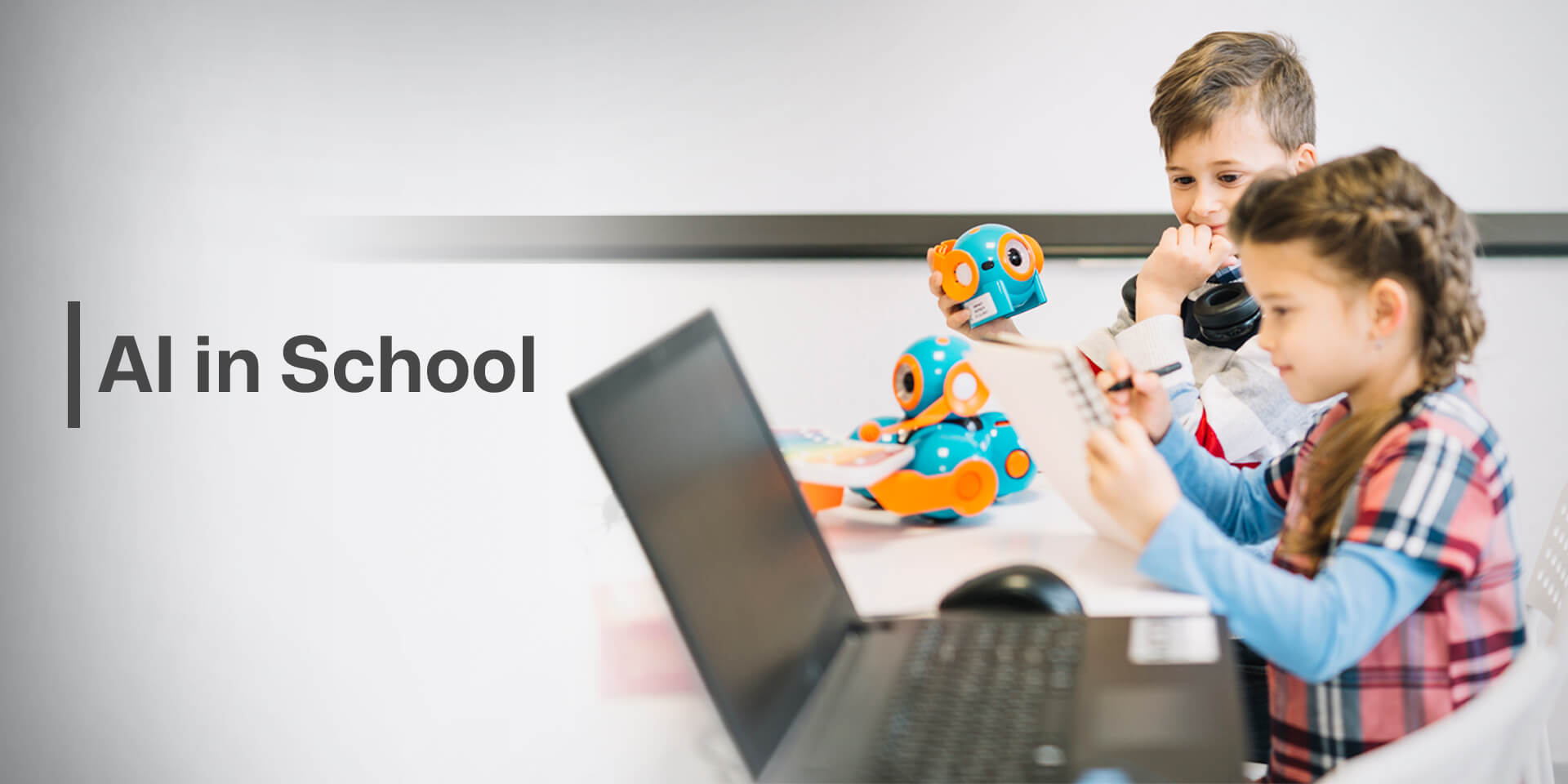
Artificial Intelligence (AI) provides a lot of benefits to various fields such as finance, retail, agriculture and farming, healthcare, and education. AI in schools has the potential to transform the way students learn and instructors teach. By implementing AI in the classroom, students are getting ready to compete in the digital world. AI curriculum helps improve the creativity of students and fosters critical thinking and problem-solving skills. AI curriculum for schools improves the learning process and makes things easier for teachers, allowing them to focus on students.
AI curriculum for schools, students, and teachers
- Bringing AI into the classroom necessitates meticulous conceptualization.
- Developing a school policy that defines criteria for efficiently using AI is an essential starting point since it may provide students with strategies for knowing how to utilize AI technologies in an effective manner.
- Once these standards are in place, instructors will be able to integrate AI into the curriculum for a broad range of activities such as using ML algorithms for individualized analysis of student performance.
- In today’s digital world, where we are surrounded by AI-powered gadgets, having an AI curriculum is a must.
Benefits of using AI in schools
There are several benefits of using AI in schools for students, teachers, and schools.
For students
Personalized learning
- The use of AI in classroom can help provide personalized learning experiences to students depending on their strengths and weaknesses.
- AI systems may perform an assessment of student data and adjust to their learning patterns, delivering personalized feedback and recommendations based on their specific needs and talents.
- This can help keep learners interested and motivated, resulting in better academic achievement.
Interactive learning process
- The use of AI in schools can make the learning process more fun, interactive, and engaging for learners.
- Through the use of AI chatbots or virtual simulations generates curiosity in students and enables them to learn certain subjects better by creating immersive experiences.
- For example, many students find math difficult and boring. However, by using AI in the classroom, learning math can be quite interesting.
Prepares students for the digital world
- Another advantage of introducing AI in schools is that it allows students to have a better knowledge of this fast changing technology.
- Teachers may assist students acquire an informed viewpoint on AI by introducing it into the curriculum, preparing them for the hurdles and opportunities that lie ahead in the digital era.
Developing 21st century skills
- Using AI in the classroom can also help pupils learn essential 21st-century abilities like problem-solving, communication, leadership, critical thinking, and collaboration.
- Such skills are vital to be successful in today’s age of technology.
- These skills can be nurtured via hands-on experience with artificial intelligence tools and apps.
For schools and teachers
Make informed decisions
- AI algorithms have the power to analyze a large number of data sets.
- The results obtained from such analysis help teachers and the top management in school to make informed data-driven decisions.
- The information may be pertaining to parameters such as attendance of students, their performance, demand for courses, etc.
Saves valuable time
- Be it the teachers or school staff, a lot of time is unnecessarily spent on unproductive activities.
- By implementing AI in schools, a lot of the administrative tasks can be automated.
- Thus, time saved in monotonous activities can be utilized for doing something more productive.
- For example, with AI in schools, teachers can focus on making learning more interactive and effective for students.
Improve security
- Implementation of AI in school helps improve the safety and security through intelligent surveillance systems.
- The various AI systems and cameras in school ensure that the students and staff are safe from any threats and vulnerabilities.
Understanding the challenges of implementing AI in schools
There are numerous benefits of using AI in the classroom for everyone. However, there are certain challenges in its implementation.
Need for technical understanding
- One of the major challenges in the implementation of AI in schools is the need for technical knowledge.
- Many teachers lack practical hands-on knowledge of AI.
- In order to effectively implement AI in their teaching practical, they require the necessary professional training and support.
- The school must organize professional training programs to help teachers understand and adopt AI in the classroom.
Ethical issues
- The adoption of AI in schools raises ethical concerns related to transparency, biasness, data privacy, security, etc.
- It is important for educators to be aware of the ethical issues about AI, and ensure that the students are protected.
- Responsible use of AI is what needs to be practiced in schools.
High cost
AI as a technology is quite expensive. Not all schools have the budget to purchase the AI resources and maintain them. Hence, they require
Best practices for implementing AI in schools
Choose a trusted AI service provider
- The first step towards effective implementation of AI in schools is choosing a reliable and trustworthy service provider.
- The provider may be a startup company, a large organization, or even an NGO having practical knowledge about AI curriculum and use of AI in classroom.
- The service provider can help provide training and guidance to teachers and enable seamless adoption of AI in the classroom.
Begin small
- Rather than implementing an entire AI curriculum for schools, teachers must begin small and gradually make their way up.
- For example, they can connect AI with real-world applications, use AI for checking the papers of students, etc.
Collaborate with research institutions
- The field of AI is continuously expanding.
- It is important for schools and educators to remain up-to-date with the latest technological advancements.
- Partnering with a research institution will help educators to the latest experiences and advancements in the classroom.
AI curriculum for schools has got tremendous scope and potential for transforming education for the learners. From providing personalized and immersive learning experiences to generating feedback for students, AI in schools can do a lot. Schools can unleash the revolutionary power of AI curriculum by carefully navigating the difficulties and implementing best practices, resulting in an equitable schooling system for all learners.
AI In Retail: Uses Of Artificial Intelligence In Retail Business

Artificial Intelligence In Retail
Artificial Intelligence (AI) has made significant changes in various industries. The retail sector is not an exemption. Artificial Intelligence in the retail industry has brought tremendous advancements in the industry.
AI is helping retailers in many ways. Artificial intelligence usage in the retail business allows retailers to offer improved shopping experiences to their customers. Due to high costs and less awareness of this cutting-edge technology, few retailers are not using AI.
Herein, you can get to know-
- How is AI used in the retail industry?
- What are the applications of AI in retail?
- Future of the retail industry with AI
What AI Can Do for Retailers?
The uses of AI in retail are incredible. AI in retail is empowering businesses to improve operational efficiencies with automation, intelligence, and transparency features of the technology.
AI use cases in Retail like improved decision-making, optimized inventory tracking & management, and demand forecasting are all attracting retailers to adopt and transform their traditional retail operations. Moreover, the use of artificial intelligence in the retail business allows retailers to offer an improved shopping experience to customers.
Let’s take a look at the top benefits of AI in retail business.
Top Benefits Of Artificial Intelligence In Retail Business
The future of either online or in-store shopping will be around AI. Modern AI technology benefits retail businesses in multiple ways. AI-powered retail solutions help retailers offer new business avenues and improve the customer shopping experience.
Further, with a blend of Machine Learning (ML), Deep learning, and predictive analytics techniques, AI apps in retail can efficiently process in-store customer experiences automatically and enable retailers to improve their services. This AI strategy for retail helps retailers improve overall service quality and increase customer retention rate.
Likewise, there are so many benefits of AI in retail. Let’s look at a few of the best applications of AI in retail industry.
Top 6 Real-world Applications of AI in Retail Industry
How does artificial intelligence help in retail industry?
For sending personalized customer recommendations, hassle-free in-store navigation, increasing visibility across supply-chain & logistics functions, better price prediction, and quick auto/scanner-enabled checkout, etc., are all a few of the best applications of AI in retail industry.
Let’s look at the top applications of AI in retail.
#1. Digital Racks for Apparel & Fashion Products
It is the best application of artificial intelligence in the retail industry. Using AI technology, virtual trial rooms and virtual shelves offer a more personalized experience to customers.
With this kind of AI apparel application, customers can easily find the best and perfect outfit. Hence, AI in the retail industry improves the shopping experience and helps customers select suitable products from a pool of fashion and apparel products.
#2. Quick Decision Making
Artificial intelligence in the retail business gives business insights to retailers for making quick decisions.
AI in retail helps customers to make quick decisions in buying products. AI-based virtual trail rooms with digital mirrors improve customer decision-making power. These intelligent retail systems help offline buyers in saving valuable time for online buyers too.With a touch-based screen, customers can select different options like accessories, shoes, etc. They can easily pick the products which look perfect to them. These services are not only for clothing, but beauty and cosmetic brands are also using AI. Artificial intelligence helps customers in checking how foundation or lipstick suits them.
USM develops Artificial intelligence retail apps for retail clients. Get a free product quote right now.
#3. Virtual or Digital Assistants
AI for retail has a bright future in the near term future. The deployment of AI technology has been growing in the market.
Using AI, NLP, and semantic analytics, retailers can provide quick and 24*7 support to their customers.
Retail stores are using touch screen panels and robots to improve the in-store experience of customers. AI in-store robots provide useful information to customers regarding product location and all a few of the benefits of using AI virtual assistants inside stores.
Thus, AI assistants for retailers can reduce the costs spent on their employees. This AI application for retail improves retail services, saves money, and attracts new customers.
#4. Enhanced Customer Support Using Chatbots
Artificial Intelligence has changed the retail industry. AI-based Chatbots allow retailers to engage their customers confidentially and efficiently. Using Chatbot applications, retail brands can process thousands of customer queries simultaneously.
In general, AI Chatbots for retail give an immediate response to user queries. They suggest and recommend customers just like a human. Human intelligence, along with AI Chatbots, is transforming the retail sector into digital.
#5. High Security Backed By AI
It is another best application of artificial intelligence in the retail industry. The modern and the best AI-powered security equipment enables retailers to capture customer acts inside the store. Thus, enhanced security and optimized services are ensured.
On the other hand, by using video analytics, retailers reduce thefts. Using footage captured by AI-powered security equipment, the retailers can do real-time monitoring. AI apps send security alerts to the admins so that the owners can take instant action.
#6. Robotics In Retail
The benefits of AI in retail are uncountable. AI Robot is one of them. Artificial intelligence robots for the retail industry are driving innovation in retail.
From logistics and supply chain, in-store operations, marketing, and sales to back-office operations, AI robots play a vital role in retail businesses. Speed and accuracy as capabilities, intelligent robots are altering the way of retailer businesses.
The best examples of artificial intelligence robots for the retail sector are:
- LoweBot, a retail service robot, helps customers navigate the store
Location: San Francisco, California - Tally Robot, an autonomous robot, keeps track of products list (quantity) on shelves
Location: San Francisco, California - Pepper Robot: It can interact with customers, navigates them, and respond to their queries
Location: San Francisco, California, and Boston, Massachusetts
All the above applications are a few, but AI will completely control the retail industry in the coming years. Is your retail business is ready to adopt the true potential of AI? Get started!
#7. High Security Backed By AI
It is another significant benefit of using artificial intelligence in the retail industry. The modern and the best AI-powered security applications or surveillance systems enable retailers to capture customer acts inside the store, reduce thefts, and optimize security levels. Hence, AI-based real-time monitoring capabilities of AI apps. Such continuous monitoring potentialities of AI applications help retailers find suspicious activities and prevent losses.
How will AI benefit in the future for retailers and customers?
AI in retail brings automation and makes tremendous changes in the future. Here are a few concepts that make sense in the future of retail stores.
- No need to wait in a long queue
- No need to stand for hours for billing
- The concept of in-store drones will go viral
- AI-powered virtual in-store assistants
- Biometric technologies recognize the face of a customer soon expand in the future
- Physical retailers will embed more online functionalities to provide an online experience to the customers
- The concept of brain-computer interface
Why Retailers Should Adopt AI?
Most of us don’t wish long wait times when we visit retail stores. But, unfortunately, we have to stand in queue for billing for a long time. Artificial intelligence in retail will solve this burden.
Besides, we feel happy if we get personalized product recommendations and hassle-free checkout practices. Am I right?
Yes, AI will do this seamlessly.
As we discussed above, the applications of AI in retail offers outstanding business growth to retailers. AI brings retailer businesses online to retain customers and fuel their revenues.
The Future Of Retail With Artificial Intelligence
- AI is a more promising technology for retailers because of its efficiency. This AI technology avoids manual errors and provides accurate results. According to Forrester, the best AI applications will augment 70% of the workforce by 2025.
- The companies are observing profits with AI. Increased production rate, customer experience and satisfaction, and perfect delivery are few benefits of AI in the retail business. As per Tractica, AI retail solutions help to increase industry value to $36.8 billion by 2025.
- According to the global analysis, Artificial intelligence in the retail market is estimated to be US$ 27.2 billion by 2025. Driven by the changing customer preferences and their shopping patterns are the significant factors for this growth.
The above market values of AI for retail might go beyond estimated numbers with increasing demand for AI.
Therefore, a radical shift in the global retail industry with AI is guaranteed. And, we can say that AI is the future technology for retail.
ML in retail helps retailers in optimizing price structure, collecting customer information, and making logistic decisions. It reduces costs and builds long-term relationships with customers. Hence, Artificial intelligence and ML revolutionize the future of retail marketing.
Conclusion
The retail domains are interested in AI. They are looking to harness the power of AI technology in retail to grab business benefits. The use of artificial intelligence in retail ensures a blushing opportunity for retailers. AI makes retailers a strong competitor in the retail industry.
Now, it’s your turn. Are you a retailer? Redesign your retail store with AI products and services. USM is the best artificial intelligence service provider, based in Chantilly, Virginia, USA.
We design and offer intelligent retail solutions and strive to transform your hazy business approaches to digital and automated. Hurry up, expand your brand with retail intelligence!
USM is the best AI development company based in Chantilly, Virginia (USA). We design and develop intelligent retail solutions that transform your traditional operational ways.
Tyler Perry Pauses $800 Million Studio Expansion Due to Open AI’s Sora

March 18th, 2024: Renowned filmmaker and producer Tyler Perry has put his $800 million expansion plans for his Atlanta studio on indefinite hold after witnessing the capabilities of OpenAI’s new text-to-video model, Sora.
The AI technology, which debuted on February 15, allows users to create video images from text prompts, potentially revolutionizing the filmmaking process.
In an interview with The Hollywood Reporter, Perry expressed his astonishment at Sora’s capabilities, stating, “Being told that it can do all of these things is one thing, but actually seeing the capabilities, it was mind-blowing.”
The planned expansion would have added 12 more sound stages to Perry’s 330-acre production facility, one of the largest in the United States.
Perry, known for his successful “Madea” film series, believes that Sora could significantly reduce the need for filming on location or building sets. “I no longer would have to travel to locations.
If I wanted to be in the snow in Colorado, it’s text,” he said. “If I wanted to write a scene on the moon, it’s text, and this AI can generate it like nothing.”
While acknowledging that Sora could enable filmmakers to produce movies and pilots at a fraction of the current cost, Perry expressed grave concerns about the potential impact on jobs in the entertainment industry.
“I am very, very concerned that in the near future, a lot of jobs are going to be lost,” he said. “It makes me worry so much about all of the people in the business. Because as I was looking at it, I immediately started thinking of everyone in the industry who would be affected by this, including actors and grip and electric and transportation and sound and editors, and looking at this, I’m thinking this will touch every corner of our industry.”
Perry admitted to using AI technology in two of his recent projects to avoid spending hours in aging makeup, but like other studios, he is still trying to navigate the implications of this rapidly evolving technology.
He emphasized the need for regulations to protect the industry and its workers, stating, “There’s got to be some sort of regulations in order to protect us. If not, I just don’t see how we survive.”
Looking beyond the entertainment industry, Perry called for a government approach to help everyone sustain employment in the age of AI.
“If you look at it across the world, how it’s changing so quickly, I’m hoping that there’s a whole government approach to help everyone be able to sustain,” he said.
As the entertainment industry grapples with the potential impact of AI technology on jobs and production processes, Tyler Perry’s decision to pause his studio expansion serves as a stark reminder of the challenges that lie ahead.
Best AI website Text-to-image Generator Tool 2024

What is dezgo?
It is a fantastic tool that uses smart technology to make awesome pictures. It turns words into pictures using something called “Stable diffusion.”
This tool is great for business or personal use because it makes high-quality images. It even helps make images bigger and lets you change them with just text.
The best aspect is that you don’t have to worry about your work or information being taken because it is protected, spacelogo.
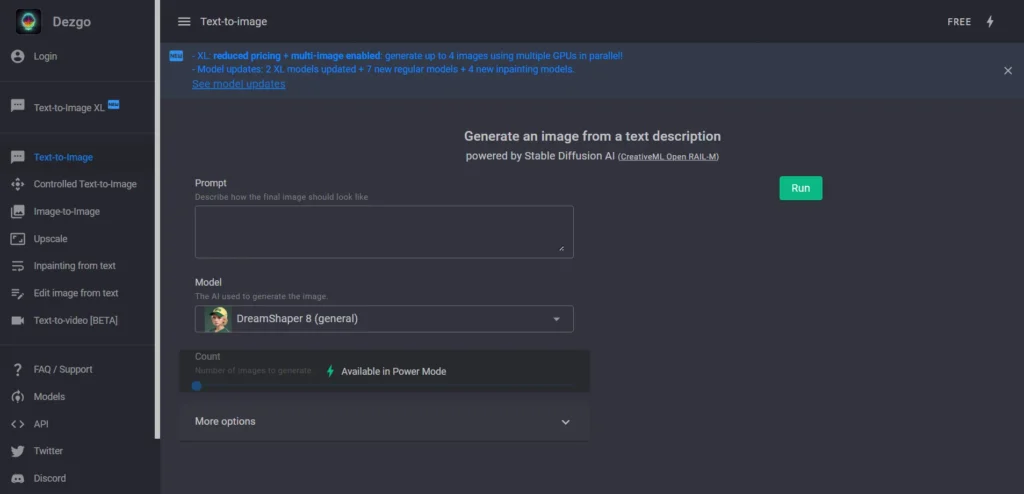
Create captivating and professional images only by entering texts
It may be used to generate images for social media, advertisements, and websites.
It also makes pictures in different shapes for different places.
Text-to-Image is a cool tool in the Image Generator world. It makes awesome pictures from the words you give it.
The best thing? It’s free! Regardless of your background—design, education, or simply a simple interest in creating images—this tool is ideal for you. And since the AI handles all the difficult tasks, it’s all quite simple.
What can dezgo do?
With AI, you can do these things:
Make Good Pictures from Words
You can turn words into nice pictures. So, if you describe something with words, this tool can create a picture of it.
Make Pictures in Different Looks
You’re not stuck with just one style. You can get pictures in different styles, which means they can look different.
Change the Pictures
You can also tweak the pictures to make them how you like. It’s like customizing them to fit your needs.
Make Pictures Clearer
If you have a picture that’s not very clear, this tool can make it sharper and better.
Edit Pictures with Words
If you already have a picture, you can tell the Stable Diffusion AI Generator what changes you want, and it will do them based on your words. It’s like giving instructions to improve the picture.
So, it’s like a magic tool that makes pictures from words and lets you change them or make them better as you want.
Features
Here are the main features which help users in several ways.
Features of this tool
Creates captivating and professional images within minutes.
Helps to generate images by just entering the text prompts.
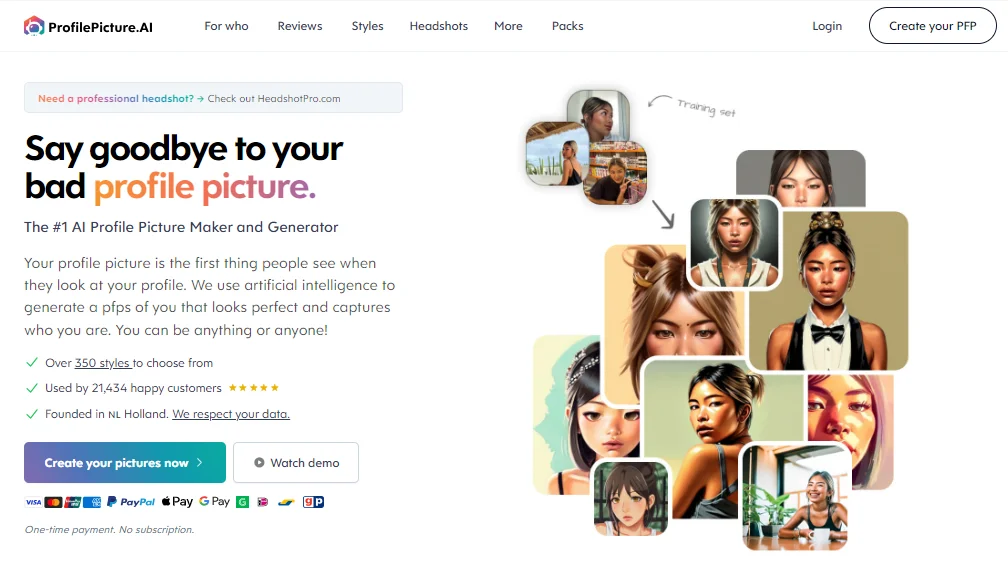
Helps to boost your social media presence with the help of a professional profile picture.
Smart AI-Powered
Design is super smart because it uses fancy computer algorithms (like a robot brain) to look at the words you give it and make really good pictures from them.
Customize It
Using Dezgo.com, you can alter the image’s appearance, color scheme, and other elements to get it just as you like.
Nice Pictures
The pictures make are good. They show exactly what you described, and they look amazing.
Quick and Speedy
It doesn’t waste time. It works fast so that you can take lots of pictures in no time at all.
Useful for Many Things
You can use this for all kinds of stuff, like making pictures for social media, creating cool art, and much more. It’s like a helpful tool for lots of different jobs.
Pros and Cons
Pros
- Different AI Models: It has many smart computer models to make different types of pictures. Whether you want realistic images, old-style art, or even cartoon characters, It also has the right model for each job.
- You Can Make It Just Right: You are in control of how closely the images fit your description, how clear they are, and what you would and would not like to see in the photos. It also has a “Power Mode” where you may adjust other parameters, such as the number of times the computer considers before generating an image.
- Nice Pictures: It makes good pictures. And if you want them to be even better, you can change the quality from inside the tool.
- Great Deal: It is a strong and helpful tool, especially considering it’s free. It’s like getting something really useful without paying for it.
Cons
- Needs More Work: Some parts of it still need improvement. For instance, the feature that’s supposed to change pictures based on what you describe doesn’t work as well as expected.
- Pictures Can Get Weird: Sometimes, it makes pictures that look strange or not quite right. This can happen even when you tell it not to make pictures blurry or distorted by using negative instructions like “don’t distort or blur images.” So, it’s not always perfect to make the pictures exactly how you want them.
How to access dezgo?
Sure, here’s a simplified explanation of how to access and use this AI:
Accessing
- Go to its website using your web browser.
- You can start using this AI without registration. It’s free to use.
Create Professional Profile Images
| TOOL NAME | Dezgo AI |
| VERSION | 2023 |
| LAST UPDATE | 12/11/2023 |
| PRICE | FREE & PAID |
| TRAFFIC | 2.8M |
Using this AI Tool
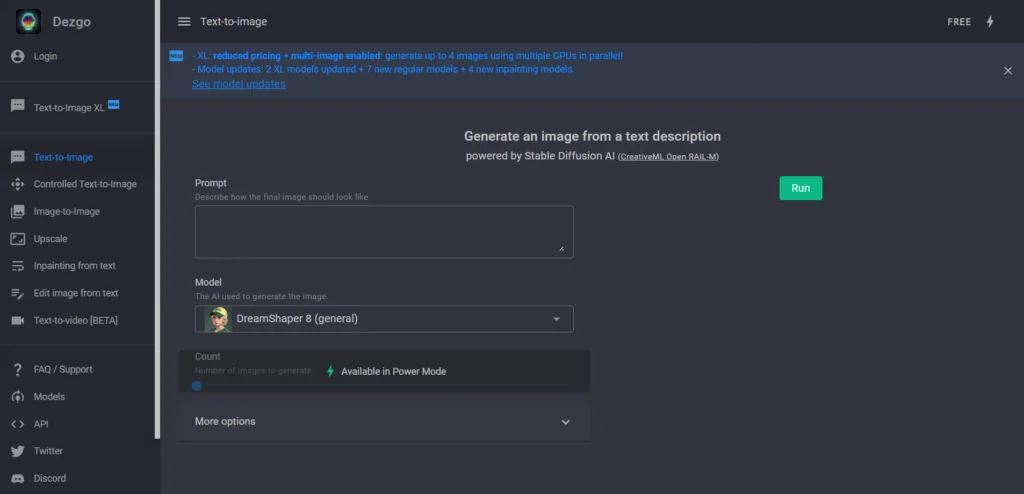
- Text-to-Image Generator:
- Its main feature is creating images from text descriptions.
- Choose an AI model that matches the image style you want (e.g., realistic or anime).
- Select the image resolution (e.g., square or custom).
- Click “Run” to generate the image.
- You can also use a “Negative prompt” to specify what you don’t want in the image.
- Controlled Text-To-Image:
- You can provide a sample image and guide the AI in creating an image from scratch.
- Specify the structure you want the AI to extract from the sample image.
- The result will closely match your input, making it convenient and time-saving.
- Image-To-Image Editor:
- You can edit existing images to match your text descriptions.
- For example, remove blemishes from a person’s face.
- The AI might use the original image for inspiration but won’t transform it entirely.
- Upscale:
- This feature increases image resolution without losing quality.
- It works best with moderately low-resolution images, improving their sharpness.
- For very low-quality images, consider using dedicated design tools like Photoshop.
- Inpainting From Text:
- You can describe the parts of an image you want to replace or fix using text.
- It will generate a new image based on your description.
- It’s great for adding or fixing elements in images but may struggle with complex requests.
- In a nutshell, this AI helps you create images from text, control image generation, edit images, upscale them, and fix or replace parts of images.
While it’s good for simple and specific tasks, it may not handle very complex or detailed requests as effectively. For those, dedicated design tools like Photoshop might be more suitable.
FAQs
How does It work?
You Tell It What to Make:
You start by typing in the words that describe the picture you want.
The Smart Part:
It uses its super-smart computer brain to look at those words and turn them into a real picture.
Make It Yours:
You can change how the picture looks. Like picking the colors and style, you like to make it just right.
It Looks Good:
The picture that comes out is awesome. It shows exactly what you described and looks amazing.
Grab It and Share:
You may use your computer to store the image and share it with others on social media or any other place you want.
It’s a useful tool that converts your words into an awesome image that you can share and utilize.
Similar Posts
February 17, 2024
Smart technology with best features .Really amazing .
john
RAG in 4 lines of code

 This blog post focuses on new features and improvements. For a comprehensive list, including bug fixes, please see the release notes.
RAG in 4 lines of code
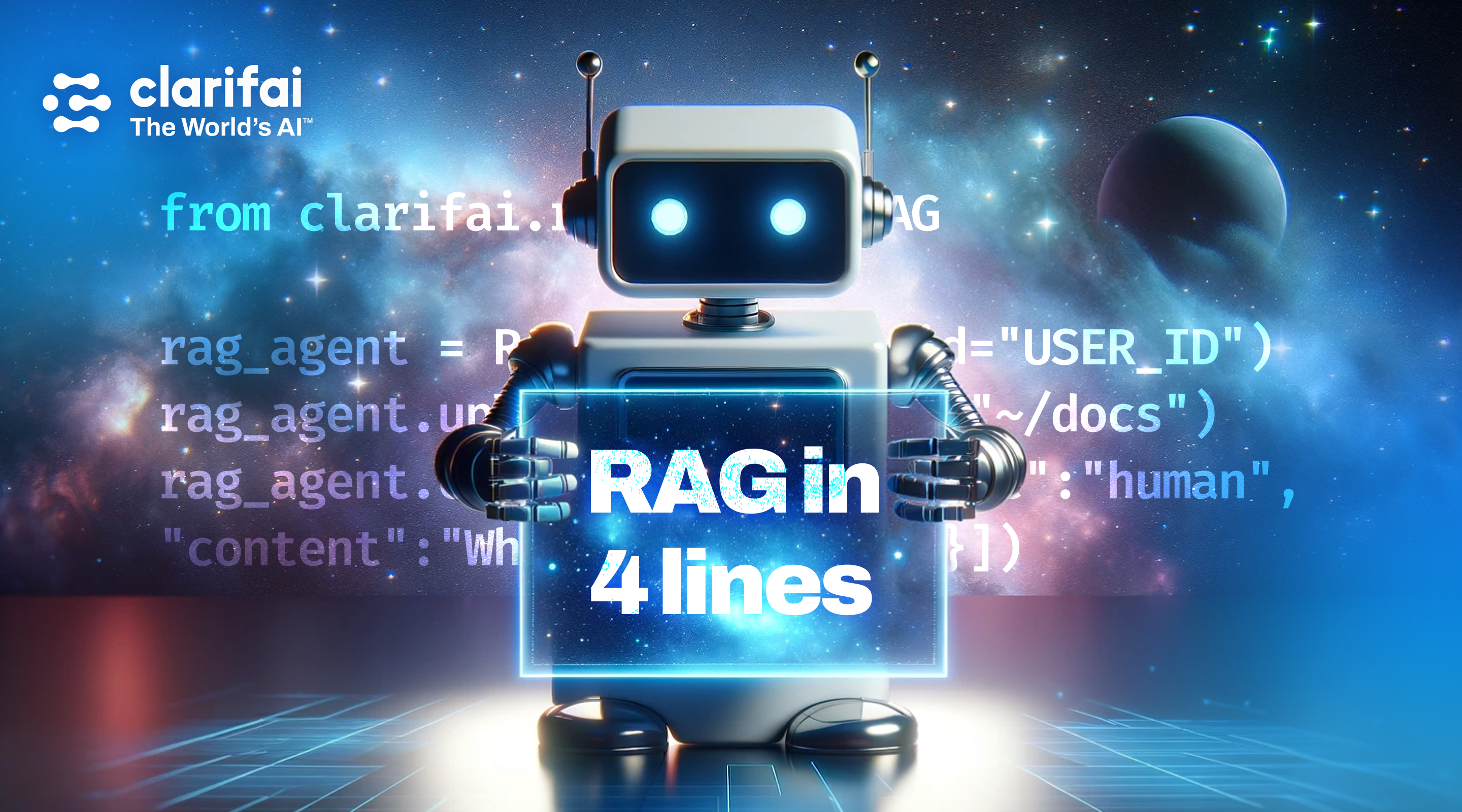
RAG is an architecture that provides the most relevant and contextually important data to the LLMs when answering questions. You can use it for applications such as advanced question-answering systems, information retrieval systems, chatting with your data, and much more.
We have integrated the new RAG-Prompter operator model. You can now use the RAG-Prompter, an agent system operator in the Python SDK, to perform RAG tasks in just 4 lines of code.
Check out the following video that walks you through a step-by-step process of building a RAG system in 4 lines of code.
Integrated Clarifai into DSPy
- DSPy is the framework for solving advanced tasks with language and retrieval models. It unifies techniques for prompting and fine-tuning language models.
This integration, now a part of the recently released DSPy version 2.1.7, helps you consume Clarifai’s LLM models and utilize your Clarifai apps as a vector search engine within DSPy. Clarifai is the only provider enabling users to harness multiple LLM models. You can get started on how to use DSPy with Clarifai here.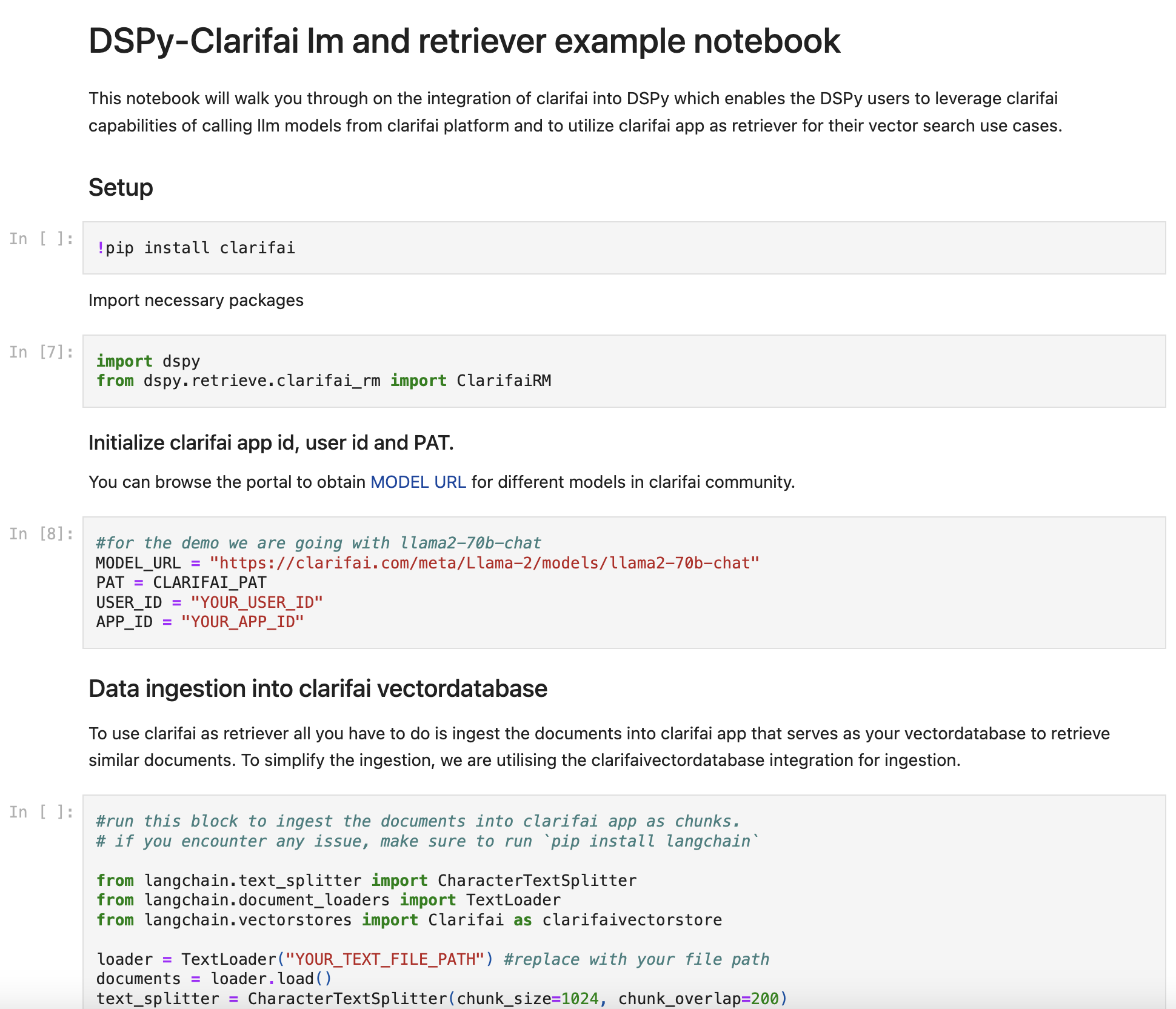
Introduced incremental training of model versions
- You can now update existing models with new data without retraining from scratch. After training a model version, a checkpoint file is automatically saved. You can initiate incremental training from that previously trained version checkpoint. Alternatively, you provide the URL of a checkpoint file from a supported 3rd party toolkit like HuggingFace or MMCV.
Introduced the ability to add inputs through cloud storage URLs
- You can now provide URLs from cloud storage platforms such as S3, GCP, and Azure, accompanied by the requisite access credentials. This functionality simplifies adding inputs to our platform, offering a more efficient alternative to the conventional method of utilizing PostInputs for individual inputs.
Enhanced the evaluation process for detector models
- Enriched the metrics by introducing additional fields, namely “Total Predicted,” “True Positives,” “False Negatives,” and “False Positives.” These additional metrics provide a more comprehensive and detailed assessment of a detector’s performance.
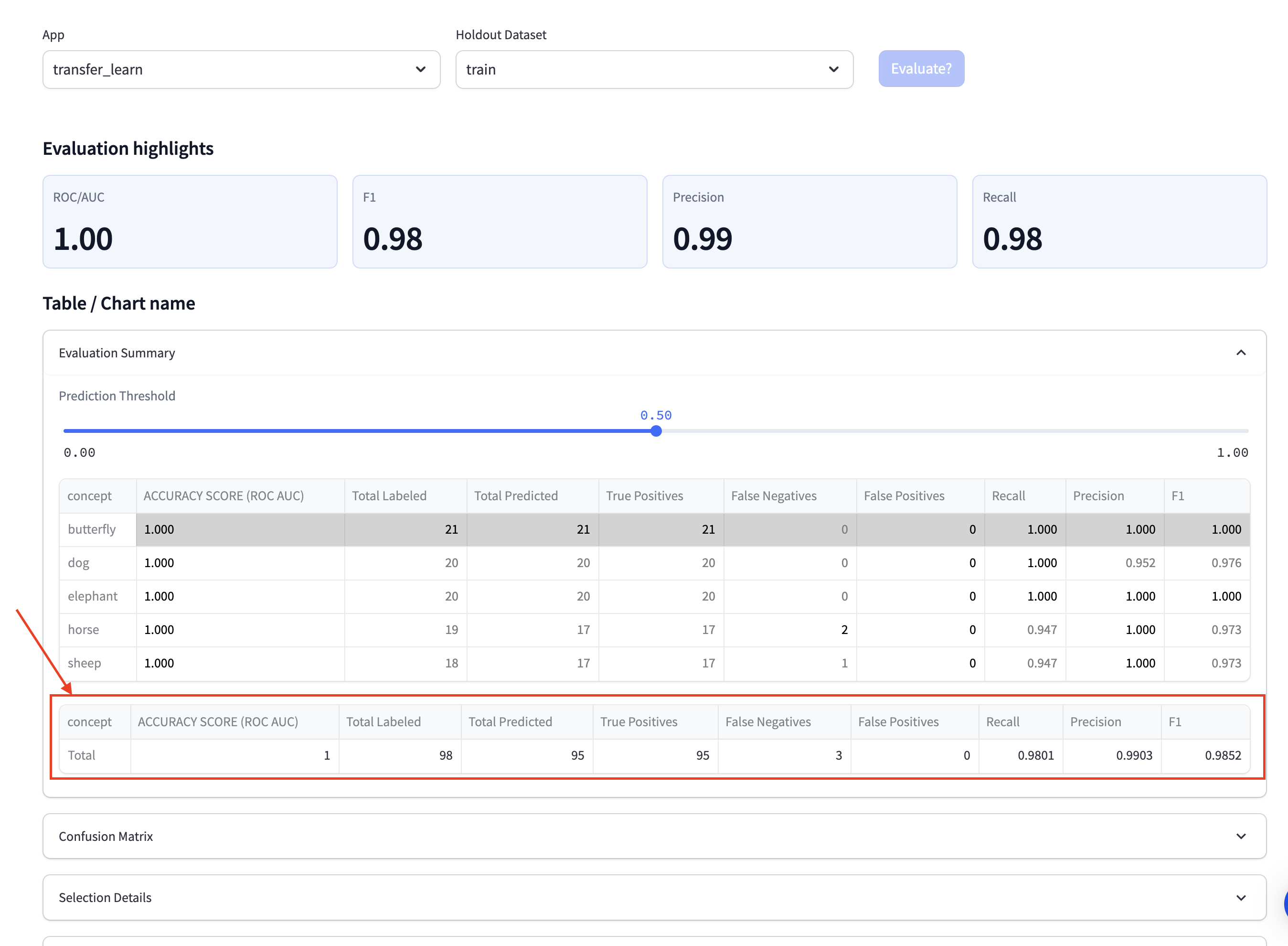
- Previously, a multi-selector was used to select an Intersection over Union (IoU). We replaced that confusing selection with a radio button format, emphasizing a single, mutually exclusive choice for IoU selection.
- We also made other minor UI/UX improvements to ensure consistency with the evaluation process for classification models.
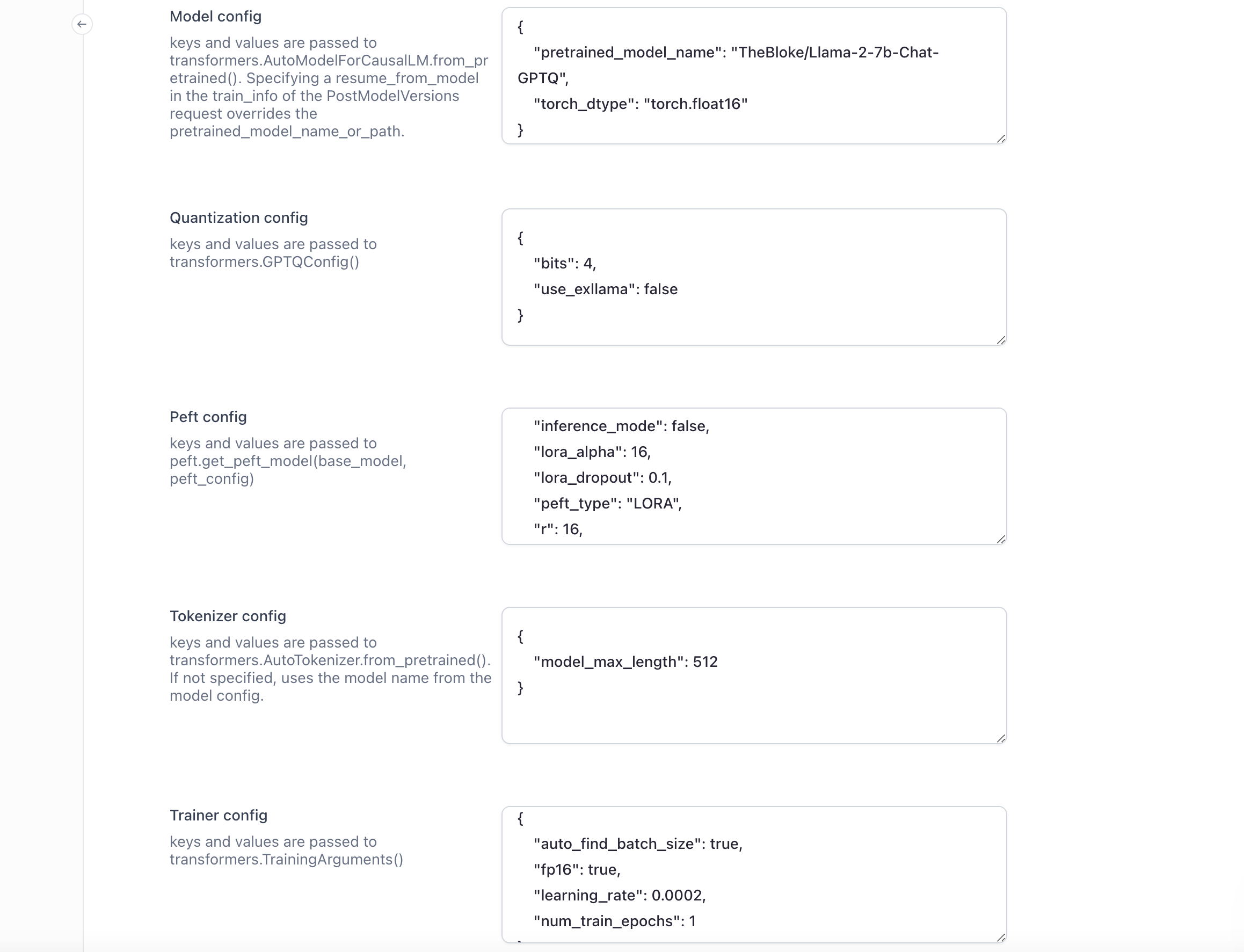
Made improvements to LLM fine-tuning
- Added support for CSV upload for streamlined data integration.
- Added more training templates to tailor the fine-tuning process to diverse use cases.
- Added advanced configuration options, including quantization parameters via GPTQ, which further empowers users to fine-tune models with heightened precision and efficiency.
Improved the Model-Viewer’s version table
- Cross-app evaluation is now supported in the model version tab to have a more cohesive experience with the Leaderboard.
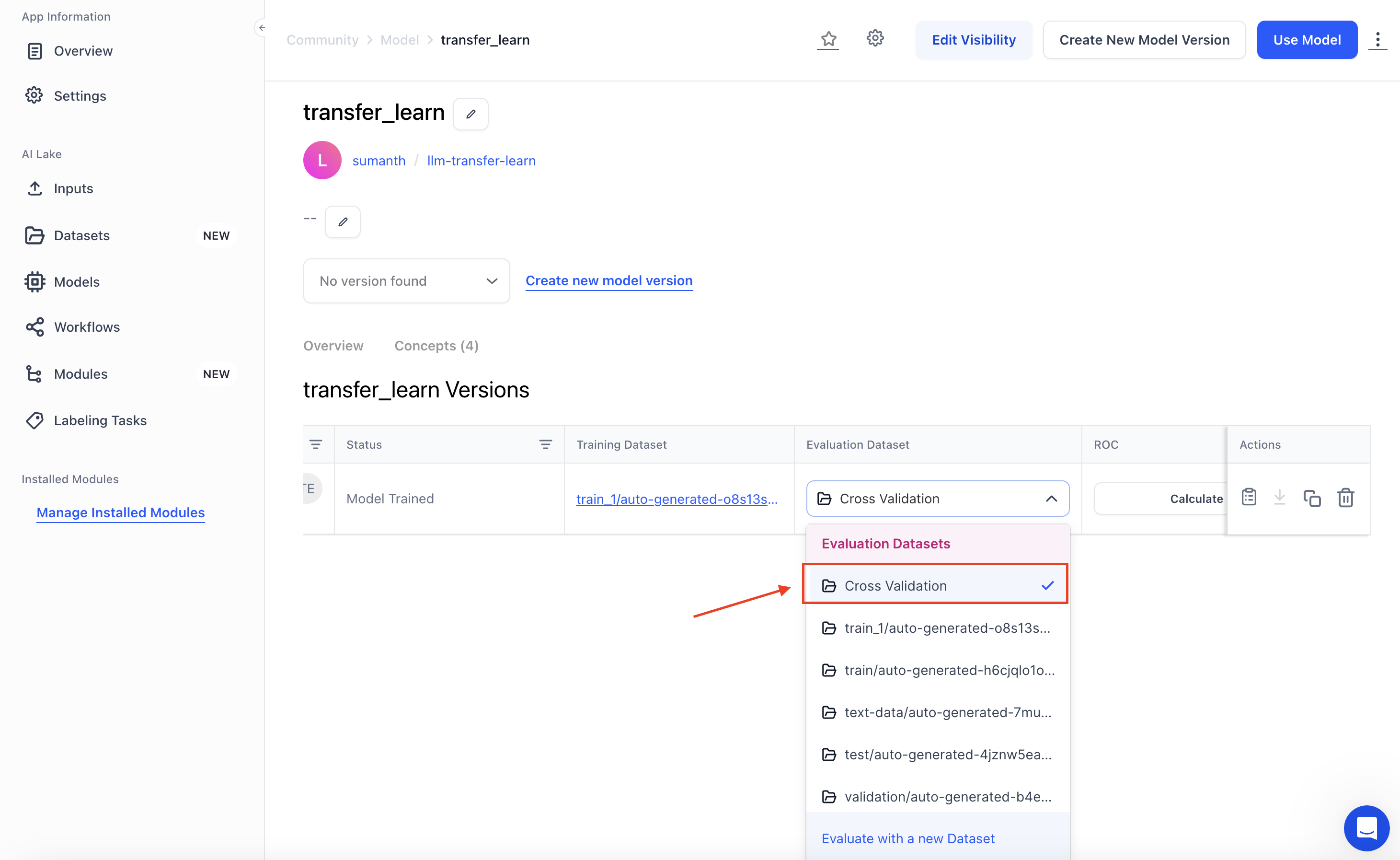
- Users and collaborators with access permissions can also select datasets or dataset versions from org apps, ensuring a comprehensive evaluation across various contexts.
- This improvement lets users view training and evaluation data across different model versions in a centralized location, enhancing the overall version-tracking experience.
Improved the management of model annotations and associated assets
- Previously, when a model annotation was deleted, the corresponding model assets remained unaffected. If you now delete a model annotation, a simultaneous action will mark the associated model assets as deleted. This ensures the deletion process is comprehensive, avoiding lingering or orphaned assets.
Published several new, ground-breaking models
- Published Phi-2, a Clarifai-hosted, 2.7 billion-parameter large language model (LLM), achieving state-of-the-art performance in QA, chat, and code tasks. It is focused on high-quality training data and has demonstrated improved behavior in toxicity and bias.
- Wrapped Deepgram Nova-2. It sets a new benchmark in speech-to-text with 30% lower error rates and unmatched speed, making it the superior choice in automatic speech recognition.
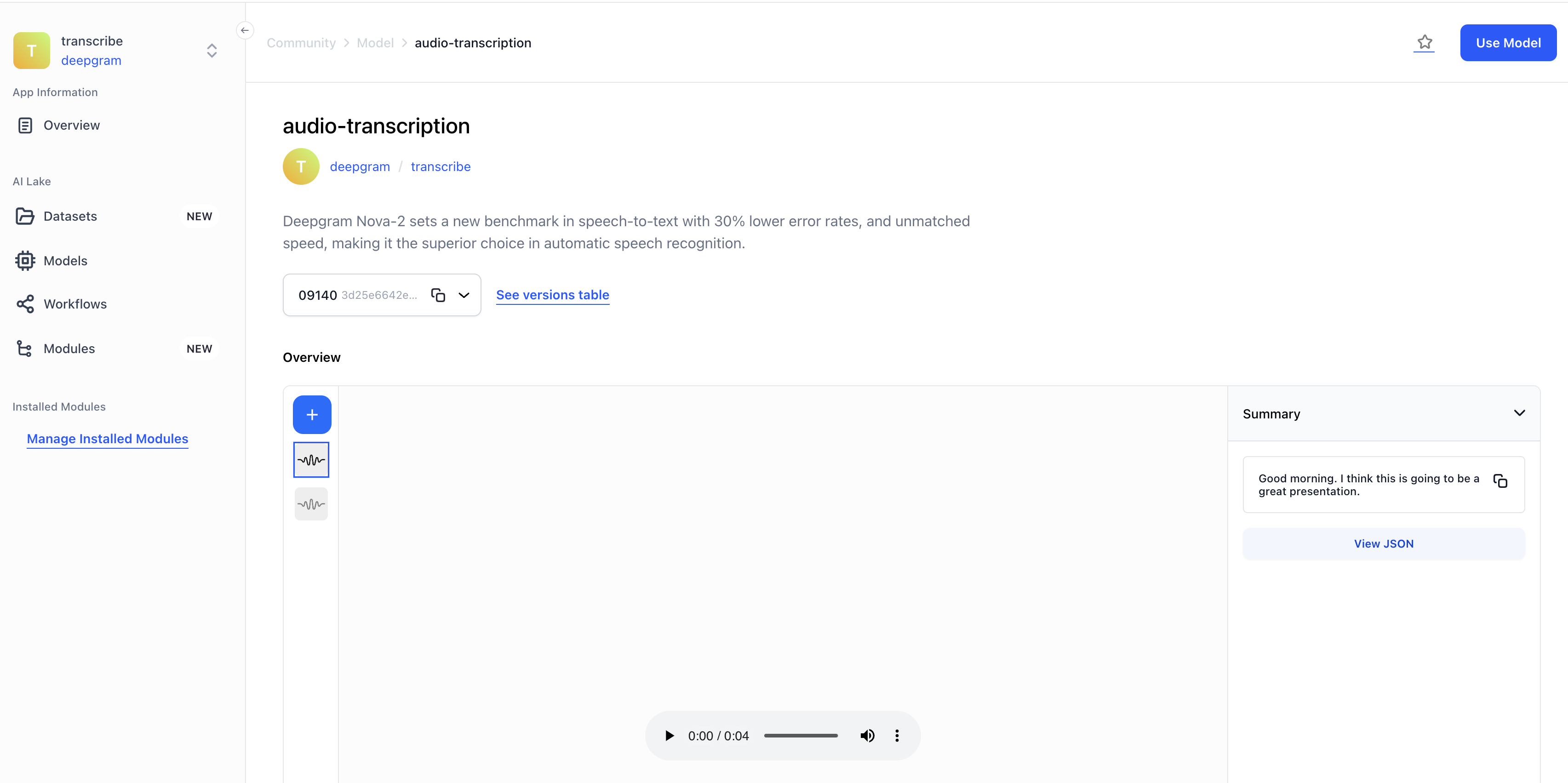
- Wrapped Deepgram Audio Summarization. It offers efficient and accurate summarization of audio content, automating call notes, meeting summaries, and podcast previews with superior transcription capabilities.
- Wrapped Text-Embedding-3-Large, a high-performance, flexible text embedding model with up to 3072 dimensions, outperforming its predecessor.
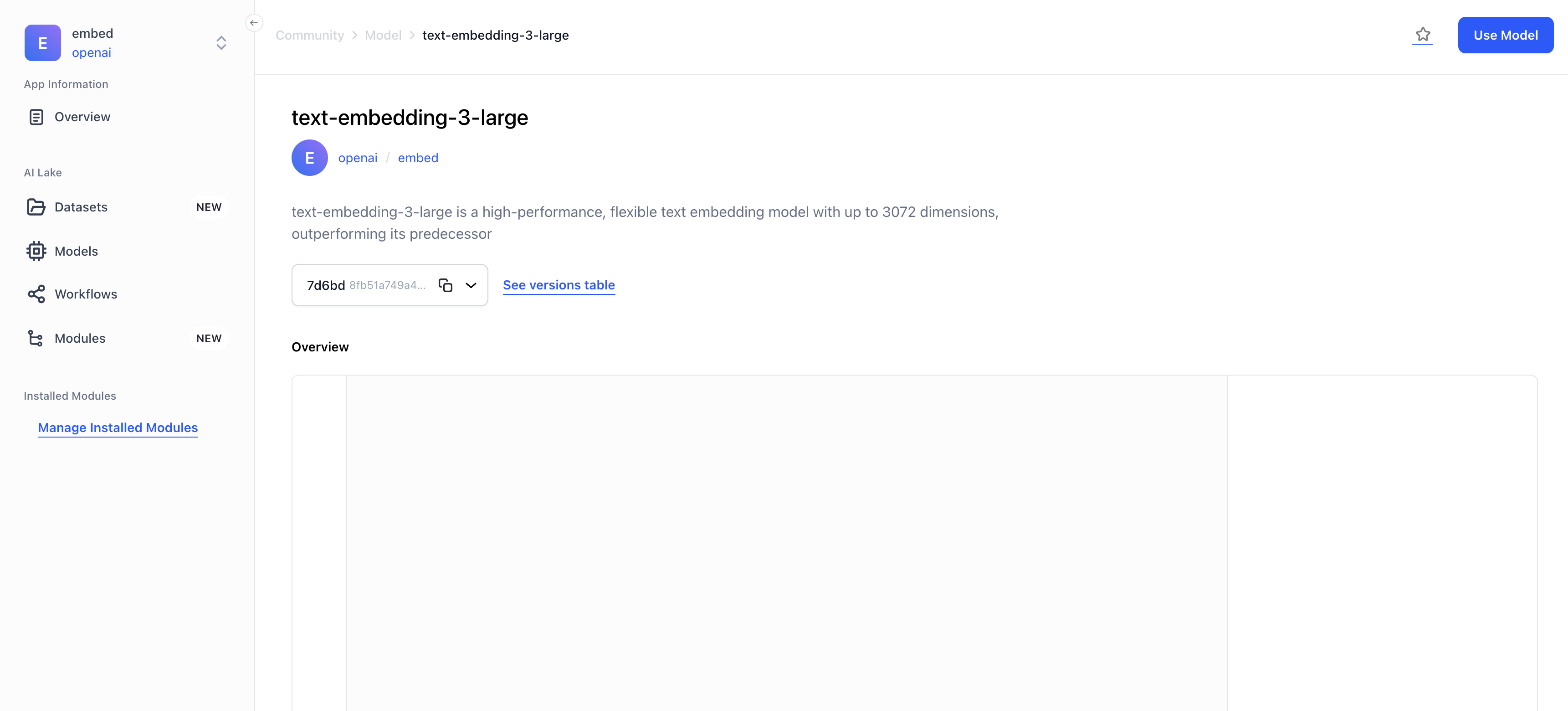
- Wrapped Text-Embedding-3-Small, a highly efficient, flexible model with improved performance over its predecessor, Text-Embedding-ADA-002, in various natural language processing tasks.
- Wrapped CodeLlama-70b-Instruct, a state-of-the-art AI model specialized in code generation and understanding based on natural language instructions.
- Wrapped CodeLlama-70b-Python, a state-of-the-art AI model specialized in Python code generation and understanding, excelling in accuracy and efficiency.
Improved the mobile version of the onboarding flow
- Updated the “create an app” guided tour modal for mobile platforms.
- Made other improvements such as updating the “Add a Model” modal and the “Find a Pre-Trained model” modal for mobile platforms.
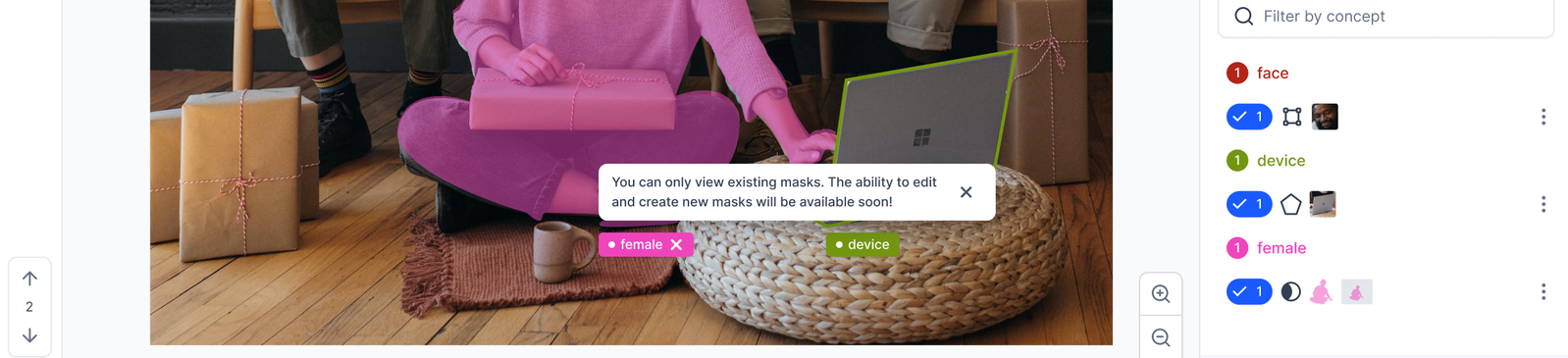
Added ability to minimally review existing image mask annotations on the Input-Viewer
- You can view your image mask annotations uploaded via the API.
- You can delete an entire image mask annotation on an input
- You can view the mask annotation items displayed on the Input-Viewer sidebar.
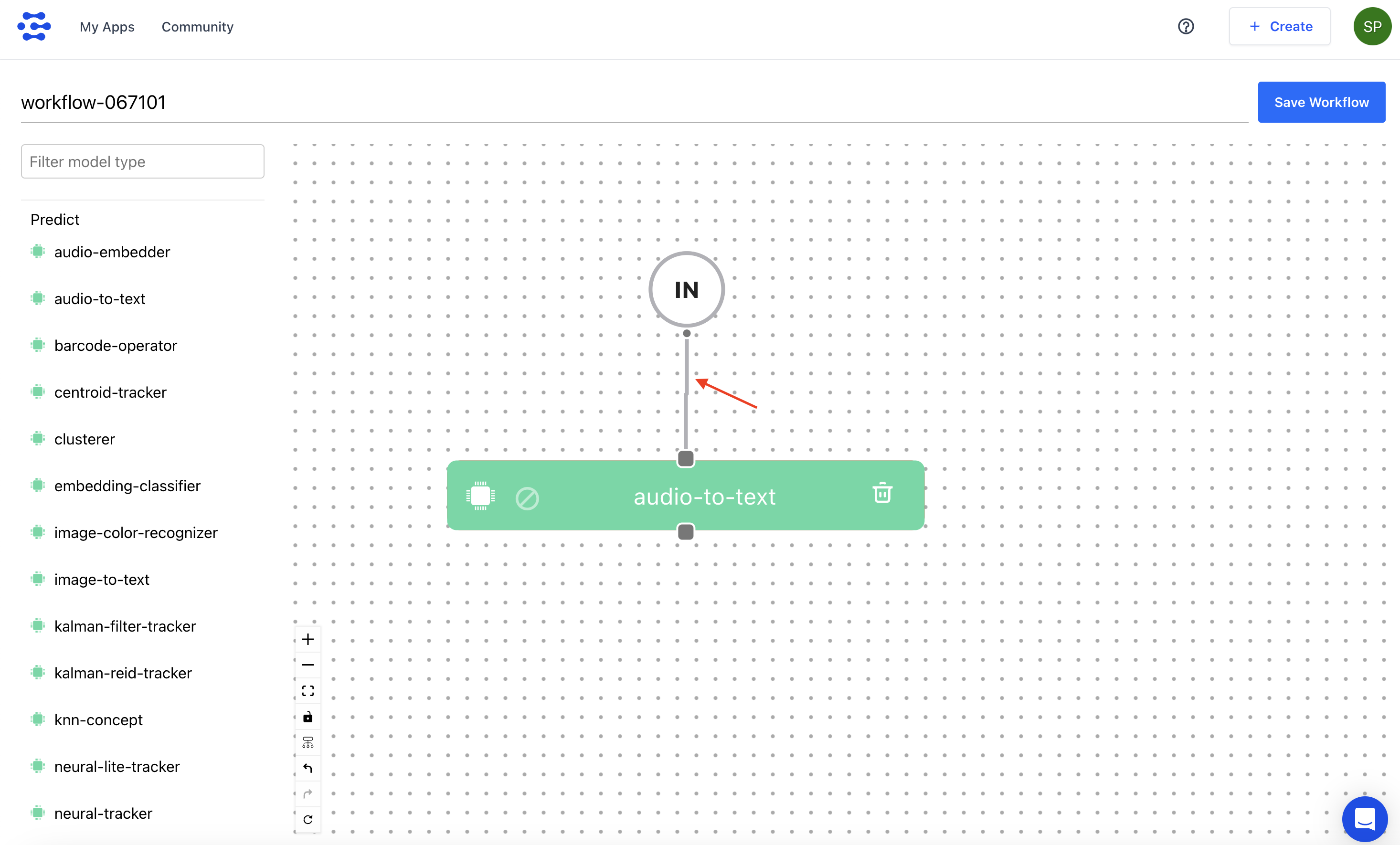
Made minor enhancements to the Workflow builder UI
- Rectified the alignment discrepancy in some left-side models to ensure uniform left alignment.
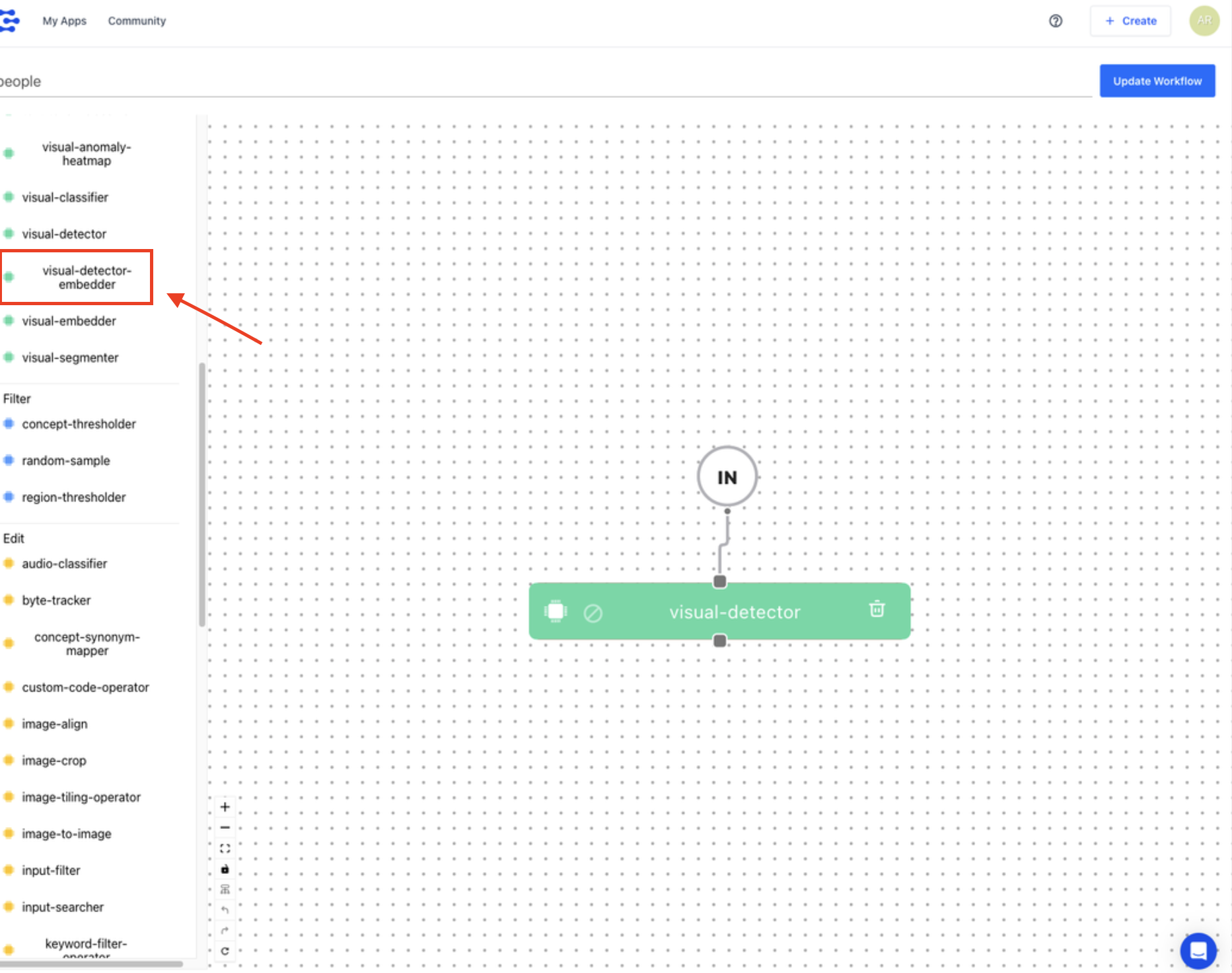
- Introduced an X or Close/Cancel button for improved user interaction and clarity.
- Ensured that users can easily straighten the line connecting two nodes.
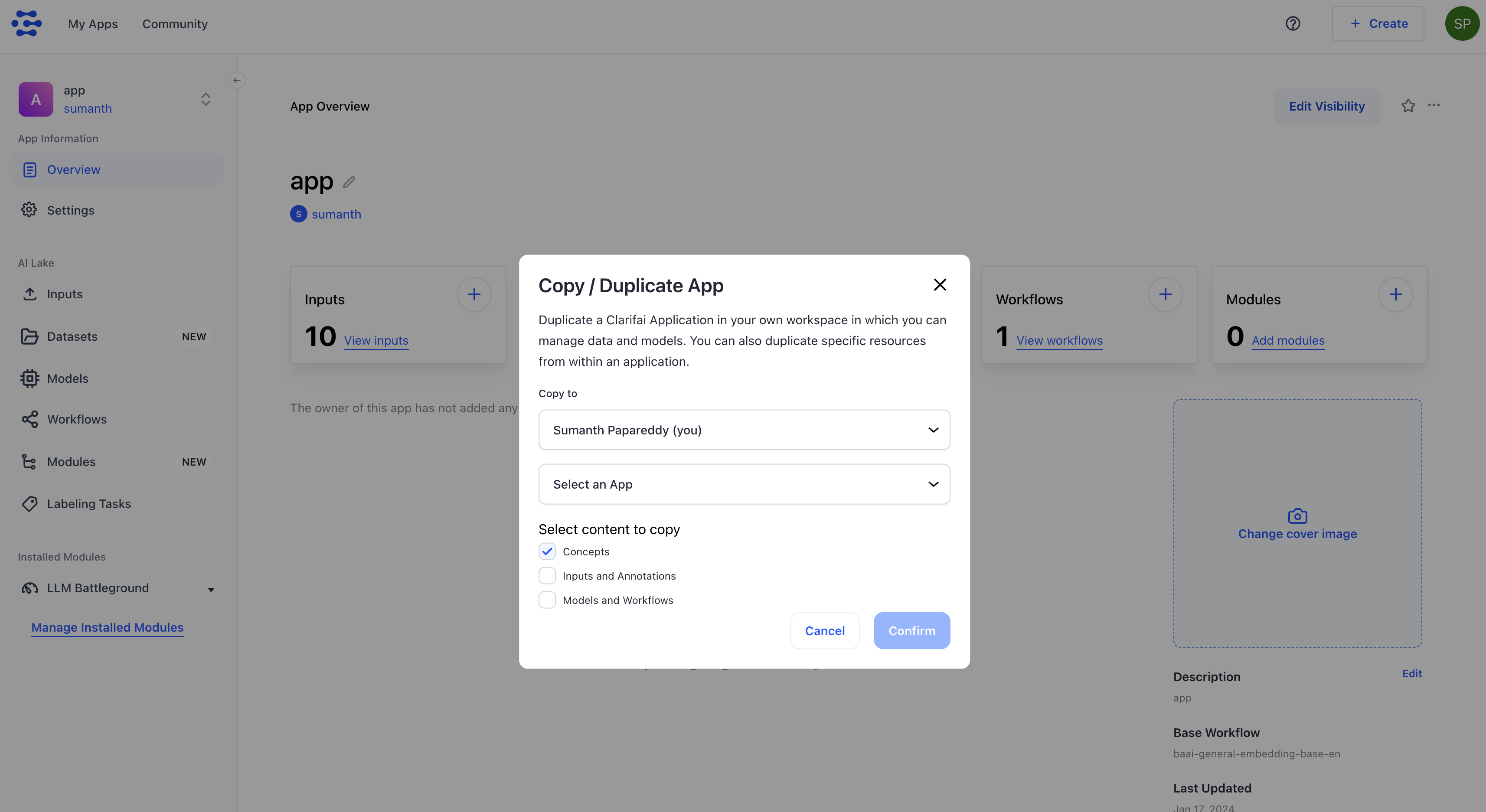
Added ability to copy an app to an organization
- Previously, in the Copy / Duplicate App modal, the dropdown for selecting users lacked an option for organizations. You can now select an organization directly from the dropdown list of potential destinations when copying or duplicating an app.
Improved the search behavior within the use_cases field
- Previously, the
use_casesfield within the ListModels feature was configured as an AND search, unlike other fields such asinput_fieldsandoutput_fields. We improved theuse_casesattribute to operate with an OR logic, just like the other fields. This adjustment broadens the scope of search results, accommodating scenarios where models may apply to diverse use cases.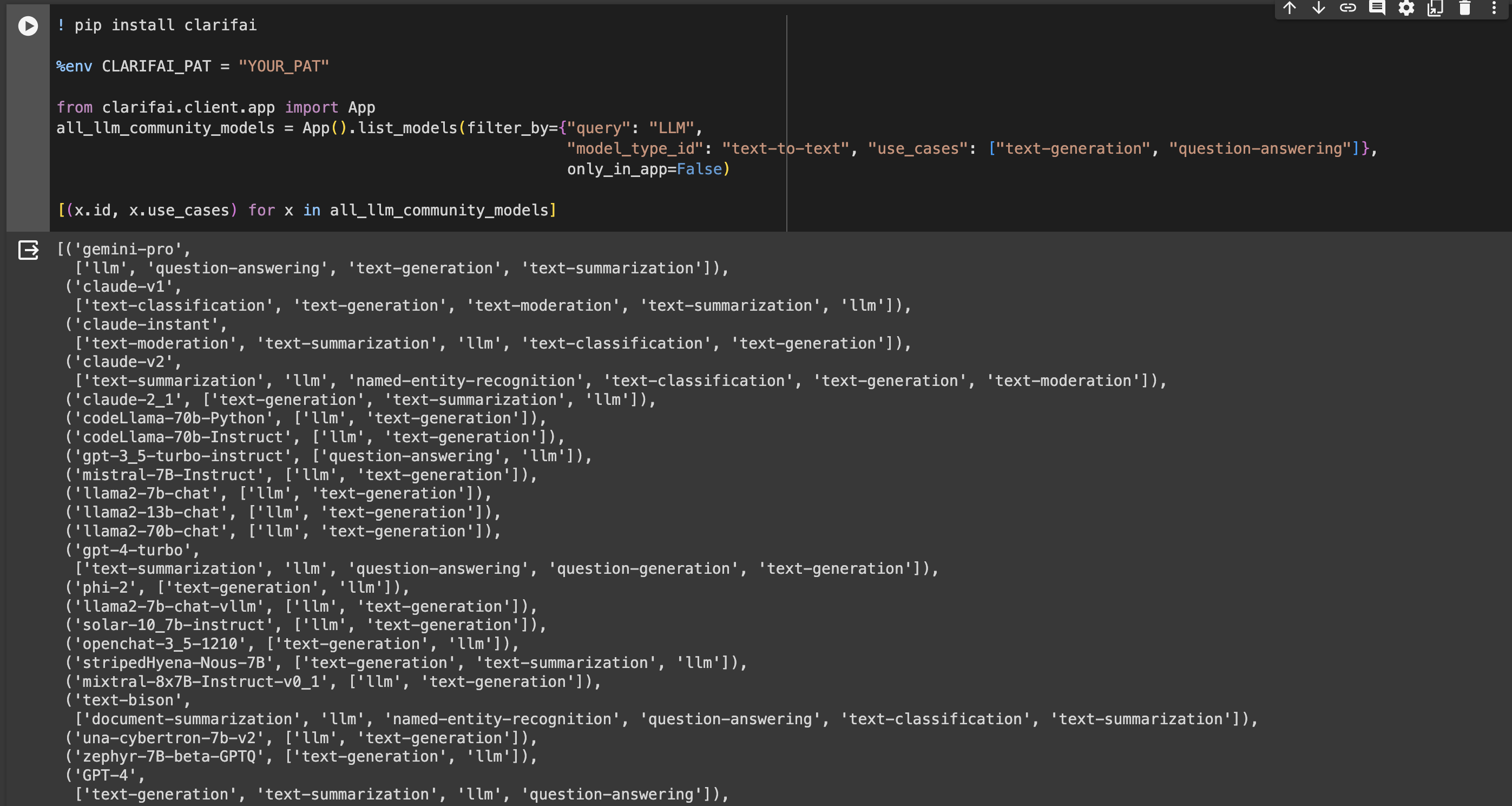
Changed the thumbnails for listing resources to use small versions of cover images
- Previously, the thumbnails for listing resources used large versions of cover images. We changed them to use the small versions—just like for other resources like Apps, Models, Workflows, Modules, and Datasets. We also made the change to the left sidebars.
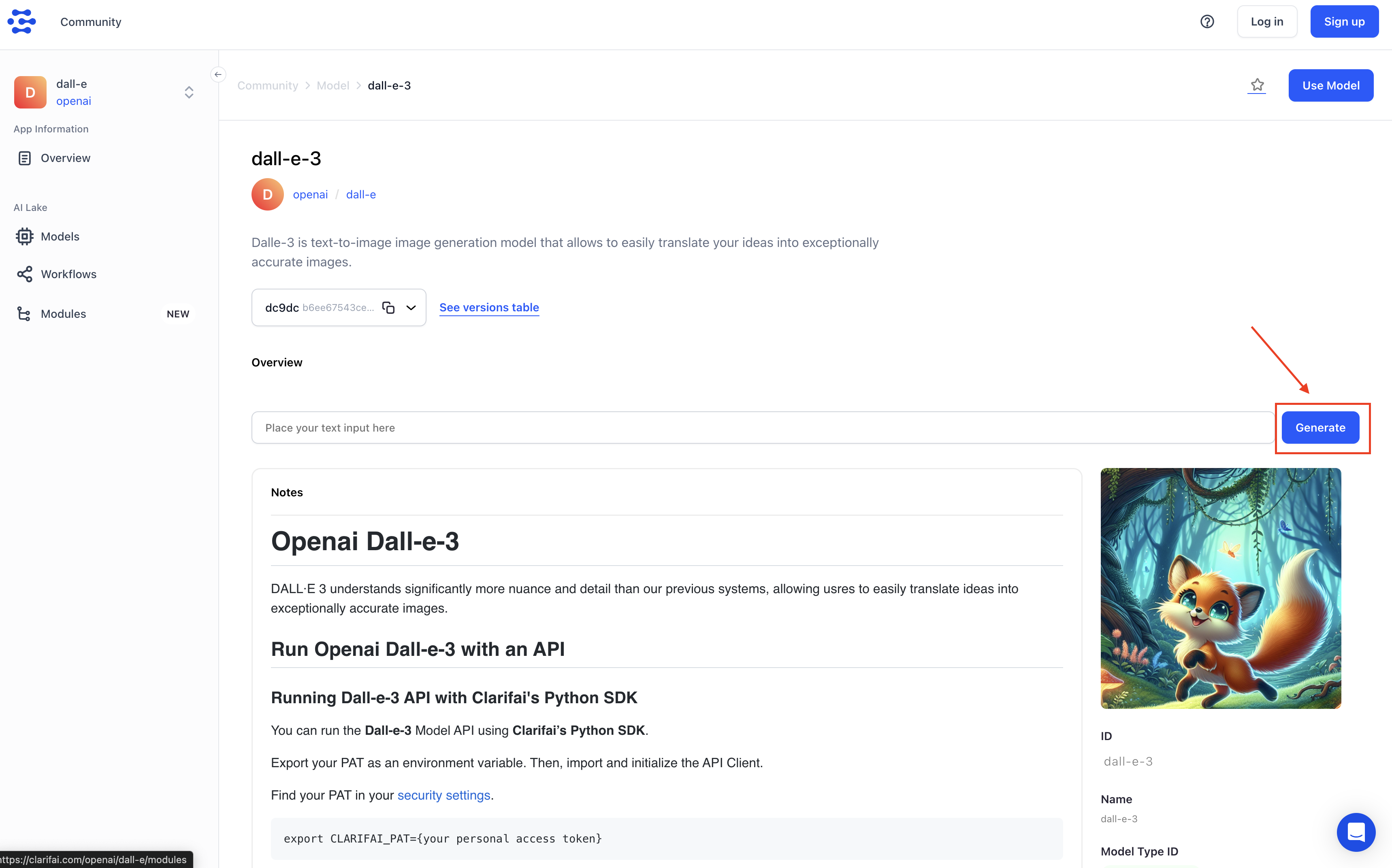
Implemented a modification to facilitate a more user-friendly experience for non-logged-in users interacting with text-to-image models
- Clicking the “Generate” button now triggers a login/sign-up pop-up modal. This guides users not currently logged in through the necessary authentication steps, ensuring a smoother transition into utilizing the model’s functionality.
Fixed an issue where a user could get added multiple times to the same organization
- We implemented safeguards against the unintended duplication of users within an organization. Previously, if a user clicked the “Accept” button on the organization invitation page multiple times, they could be redundantly registered within the same organization. Consequently, the user interface exhibited numerous instances of the same organization.
Improved the module installation process
- The modal has been refined to use app IDs, eliminating reliance on deprecated app names. Previously, the pop-up modal for installing a module into an app retained the usage of deprecated app names.
Improved the relevance of the link to GitHub on the module page
- Previously, a small GitHub button was at the top of any module’s overview page. We relocated it to the right-hand side, aligning it with other metadata such as description, thereby improving its clarity as a clickable link.
Google Just Released an Insanely Valuable Prompting Guide
Google just released a massive prompting 101 guide packed with useful advice. Continue reading “Google Just Released an Insanely Valuable Prompting Guide”
AI in Science and Math: Unlocking New Possibilities
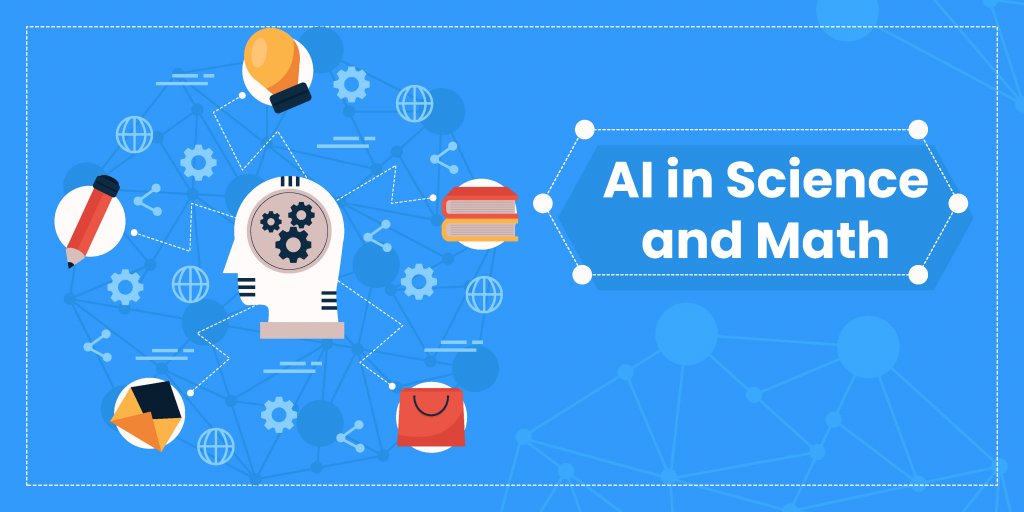
Today, AI is employed in practically every field, and the tools given by AI in science and math are no exception. Many of today’s science and mathematics investigations create so much data that no individual or group of people could ever keep up. AI is being unleashed by researchers, most commonly in the way of neural networks that are artificial. With the advancements in artificial intelligence, the implementation of AI in science and math is going to be bigger and more important than ever before.
AI for science drug research and discovery
-
The use of AI for science research and discoveries is one possible area of progress.
-
For example, AI can assist in expediting the development of drugs by evaluating massive volumes of scientific data and uncovering possible drug ideas that human researchers may have overlooked.
-
By studying the structures of various chemical molecules and compounds, forecasting interactions, and modeling effects of drugs in biological contexts, AI can aid in the identification of potential drugs.
Ask questions and get the relevant answers
-
AI in science and math can help students ask questions and get the correct response to them.
-
ChatGPT and Google Bard are the two recent advancements in artificial intelligence in which students can ask answers to specific questions or even ask the AI bot to frame questions to test their knowledge.
-
For example a biology student may ask ‘Define flower’ in scientific terms.
-
Answer by the AI bot could be something like this:
-
A flower is defined as a condensed modified shoot specialized in sexual reproduction in Angiosperm plants.
-
It is crucial for students to understand that whether AI in science or AI in math, students are expected to carry out their own research and not just use AI bots for getting answers.
Summaries and vital points
AI models are great for summarizing, providing bullet points, and conveying vital information.
The math or science students can give the text to be summarized, or they can ask the AI to search the information for them.
For example,
AI in science
Summarize, write all the key points and important structures of polymers in chemistry.
AI in math
Summarize the probability chapter and list of the basic probability formulae.
Data mining and pattern recognition
-
AI can analyze massive volumes of data swiftly and uncover patterns that humans may fail to see right away.
-
This is extremely useful for students, researchers, and scientists in astronomy, genetics, molecular biology, computational geometry, and meteorology.
-
AI in math can recognize patterns in vast datasets, which is very helpful in numerical theory research.
-
It can aid mathematicians in their study of trends in mathematical sequences.
Problem solving automation
Virtual labs and simulations
-
AI-powered models and simulated labs may give students hands-on experience while also assisting them in visualizing intricate topics.
-
Students may use these tools to experiment with various scenarios and understand how science and math principles relate to real-life situations.
Bridging the gap between various academic disciplines
-
AI can help students interact and exchange information more efficiently by bridging the divide between various scientific domains and disciplines.
-
AI algorithms, for example, may be used to combine data from many technical domains such as physics, chemistry, biology, and mathematics in order to uncover new research possibilities and prospective areas of collaboration.
-
AI can assist to expedite the pace of technological breakthroughs by breaking down boundaries between academic disciplines.
Limitations of using AI in science and math
AI models do not have up-to-date information
-
AI models undergo training on data that only runs up to a specific date, which means that any novel findings and advances that occur beyond that date are completely undiscovered to the AI.
-
For example, ChatGPT’s knowledge is confined to September 2021.
-
This means that it can answer questions and has information about the events that have occurred only up to September 2021.
AI may give unnecessary (irrelevant) information
-
The use of AI in science and math may provide correct information.
-
However, many times, the information may be just too much or irrelevant.
-
For example, if a student of Grade 8 searches for information about DNA (Deoxyribonucleic Acid), the AI bot may provide excess, irrelevant information of higher grades.
-
This may make things much more complicated for the student.
AI can give incorrect responses
-
AI tools like ChatGPT will undoubtedly make mistakes because they are continually changing language models.
-
While utilizing them, it is vital to cross-verify the responses generated from reliable sources.
-
The responses may have grammatical, arithmetic, factual, and logical mistakes.
-
It is not always accurate for answering complex questions in specialized areas such as linguistics or mathematics, so keep these kinds of questions simple.
If the recent advancements in artificial intelligence are applied thoughtfully and correctly by researchers, scientists, and students, they can save valuable time and efforts. With the use of AI in science and math, novel paths of knowledge and information can be unlocked. The journey towards learning the so-called difficult subjects of science and math can be made more fun, interactive, and exciting.
5 Powerful AI Use Cases Healthcare

5 Powerful Artificial Intelligence In Healthcare Use Cases
Role of Artificial Intelligence (AI) in Healthcare
The use of AI is not limited to any business division. Though being utilized in many sectors, applications of AI use cases healthcare are huge. The global healthcare sector remains one of the fastest-growing sectors in adopting AI.
With more focus on improving patient outcomes, hospitals are increasingly investing in artificial intelligence technology. AI, together with IoT and Cloud technologies, is becoming popular. It builds advanced healthcare solutions to assist physicians.
There are many benefits of AI in the healthcare sector. AI for automation, AI for radiology, AI for drug design, and AI for cancer detection are a few significant use cases of AI in healthcare.
Besides, healthcare companies are using AI virtual assistants to provide continuous services to patients at remote locations.
Herein, we covered the top five (5) potential developments of artificial intelligence in healthcare.
Use Cases of AI in Healthcare
#1 AI-powered Robotic Surgery
Investments in AI-based robots are continuing to climb in the fast few years, especially in the healthcare sector.
Intelligent robots can analyze data from previous medical logs. Based on medical reports of a patient, robots can guide & control a surgeon’s instrument all through surgery.
This process will reduce the time of the patient’s hospital stay. Robot-assisted surgery minimizes surgical incisions, and hence it is considered as minimally invasive surgery.
Generally, using AI, robots use data from previous tasks to introduce new medical procedures. In addition, it was proven that the complication rate is less with AI-powered robotic surgery.
I hope you’ve heard about the da Vinci Surgical System. It is a robotic surgical system developed by Intuitive Surgical Inc., (an American manufacturer of robotic products). It can enhance the patient’s outcome with minimum surgical incisions. This intelligent system allows doctors to do virtual surgical processes with more confidence and control.
Further, robots automatically learn from medical records. Hence, the positive results delivered by intelligent robots are helpful for physicians.
#2 AI-based Virtual Nursing Assistants
It is one of the best use cases of Artificial intelligence in healthcare. AI virtual nursing assistants maintain a smooth interaction with patients. They provide solutions for patient queries and also helps physicians in knowing their patient’s conditions.
These assistants reduce hospital visits and also lessen the load on physicians. The value of AI-based virtual nursing assistants is approximately $20 billion per annum.
USM Business Systems provide employee/self-service mobility solutions for the healthcare industry. We create intelligent mobile solutions that reduce admin costs. Know more about what type of healthcare apps supports your business growth @ USM.
#3 Artificial Intelligence in Support Diagnosis
AI is playing a critical role in the healthcare industry. The healthcare segment is an open area for implementing intelligent technologies. Using AI tools and devices, healthcare service providers are providing improved healthcare services.
A noteworthy point is that the implementation of AI technologies in healthcare will helps physicians efficiently treat life-threatening diseases.
For instance, AI is highly using for detecting tumors. Few diseases are difficult to diagnose like oncology and cardiology diseases. However, AI-based diagnosis help doctors to provide treatment at the right time.
Besides, Machine Learning (ML) and deep learning algorithms also benefiting the healthcare industry. These technologies enable machines to learn from data and deliver insights into patient’s data. Hence, the doctors can check and analyze the severity level of the disease.
Likewise, AI-based wearables are developed to detect cardiac diseases in early phases. Thus, AI devices, together with IoT & cloud, avoids human errors and automates diagnosing process.
#4 Automate Administrative Tasks
AI in healthcare automates end-to-end administrative functions. It could help the healthcare industry to save approximately $18- $20 billion every year.
AI-powered machines are the best examples of artificial intelligence in healthcare for cutting admin costs. The AI systems are well-trained to perform all administrative tasks with more accuracy and efficiency.
#5 AI for Image Analysis
Manual image analysis takes a long time and leaves minimum human errors. But, Artificial Intelligence machines using deep learning can view and scan thousands of medical images simultaneously. AI systems for radiology detect patterns of various diseases. This feature of AI in healthcare allows radiologists to diagnose a disease exactly.
The role of AI in healthcare is not only limited to these healthcare applications. AI also be used for CT scans, drug discovery, pregnancy management, brand marketing, Management risk analysis, and many more.
USM has a proven AI solution for healthcare. Our patient data analytics solutions efficiently manage patient’s records. USM’s AI solutions bring a real-time communication platform where service providers and patients can interact 24*7.
Moreover, through Artificial intelligence-powered image analysis, healthcare service providers can also aid patients in remote locations.
Telemedicine service is the best example for this scenario. This innovative healthcare service allows patients to send images of rashes, cuts, etc., and get help from doctors to determine the disease and provide necessary treatment.
The future of AI in healthcare
The future of AI in healthcare will be around hybrid models. Over the next few years, AI handovers treatment planning, disease identification, and image processing. The faster adoption of AI in healthcare enhances operational efficiency, prevents risks, and delivers improved patients outcomes.
Conclusion
Health matters for everyone. Right?
When a physician saves minutes means that he is saving lives.
Artificial intelligence and machine learning technologies consume less time in detecting and analyzing diseases and health conditions. AI tools for healthcare supports service providers deliver faster services to their patients.
If you are looking for an AI solution for healthcare, USM is your best partner. Get your artificial intelligence solution for healthcare now!
Nvidia Reveals New AI Superchip, Quantum Computing Service, and Humanoid Robotics Tools
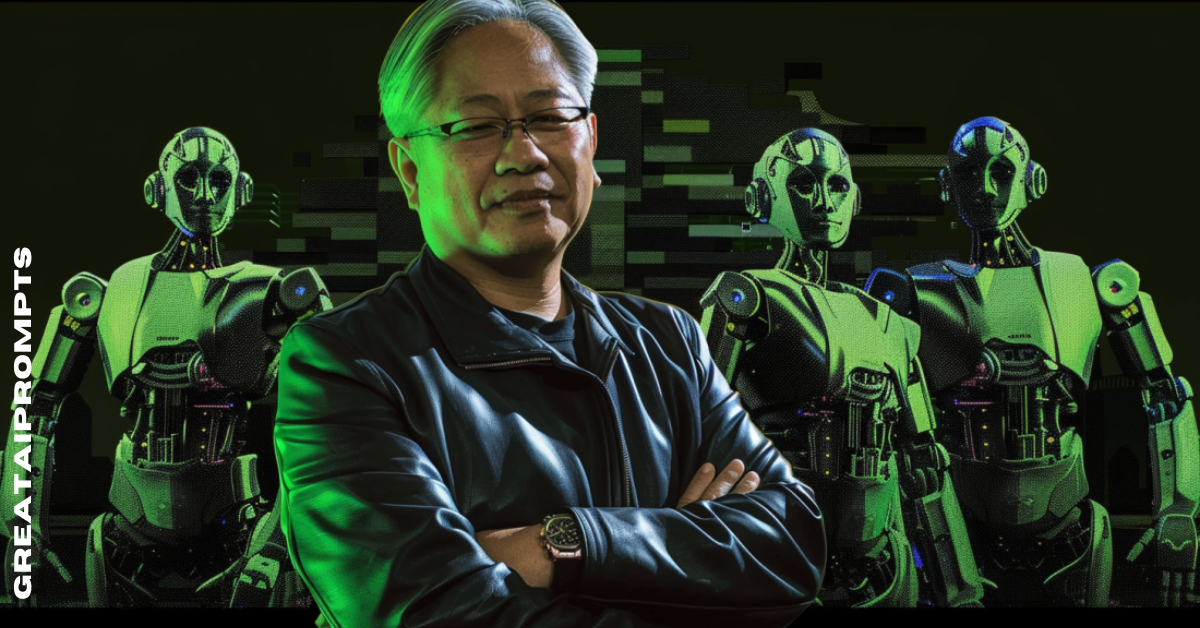
March 20, 2024: Nvidia, the US chipmaker with a market value of over $2 trillion, has extended its lead in the artificial intelligence sector with the announcement of several groundbreaking technologies at its annual developer conference on Monday.
The company unveiled the “Blackwell” series of AI chips, designed to power the expensive datacentres that train cutting-edge AI models such as the latest generations of GPT, Claude, and Gemini.
The Blackwell B200 chip is a significant upgrade over Nvidia’s previous H100 AI chip, reducing the number of chips and power required to train a massive AI model like GPT-4 by 75%.
The company also introduced the GB200 “superchip,” which combines two B200 chips and Nvidia’s Grace CPU on a single board, offering “30x the performance” for server farms that run chatbots like Claude or ChatGPT, while reducing energy consumption by up to 25 times.
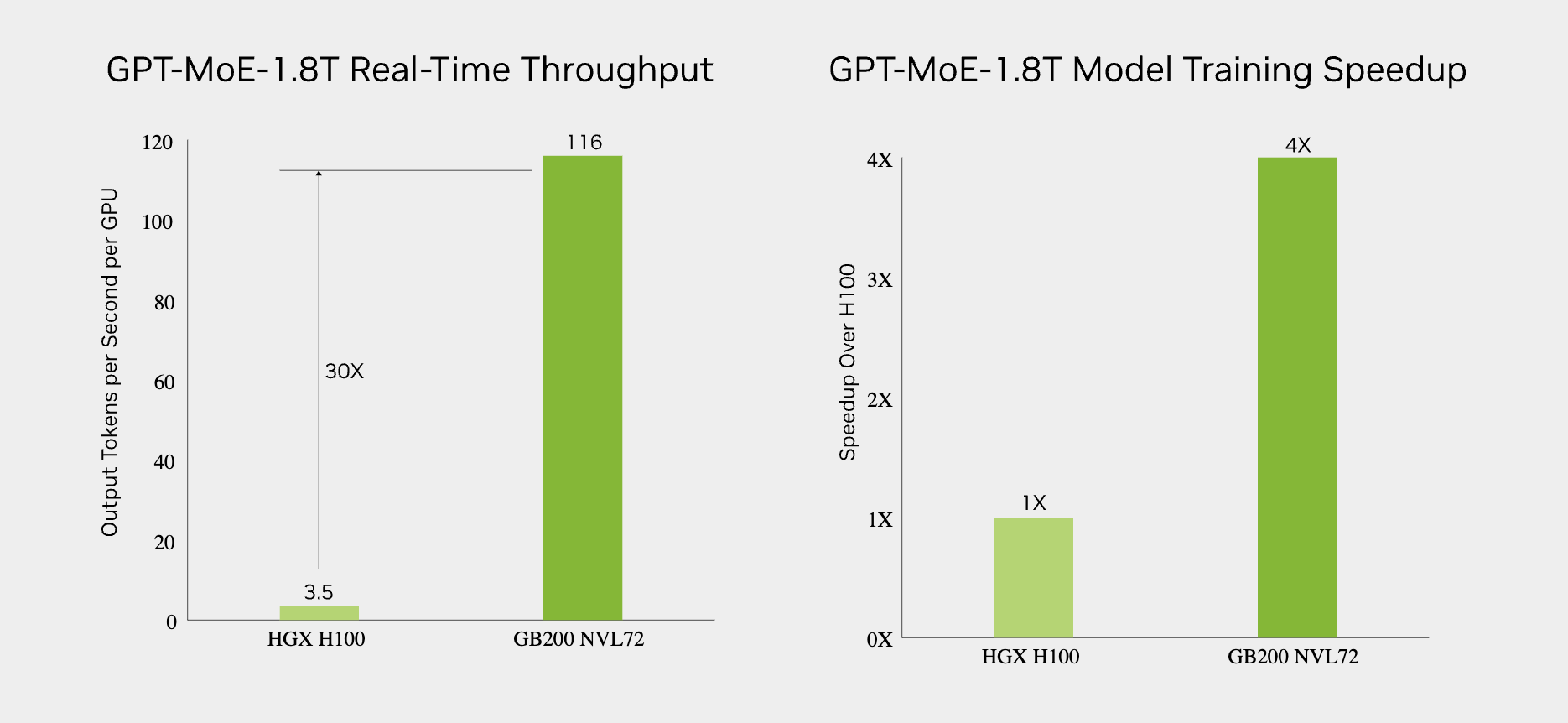
Nvidia CEO Jensen Huang showcased even larger configurations, such as the GB200 NVL72, a single server rack with 72 B200 chips connected by nearly two miles of cabling, and the DGX Superpod, which combines eight of these racks into a shipping-container-sized AI datacentre in a box.
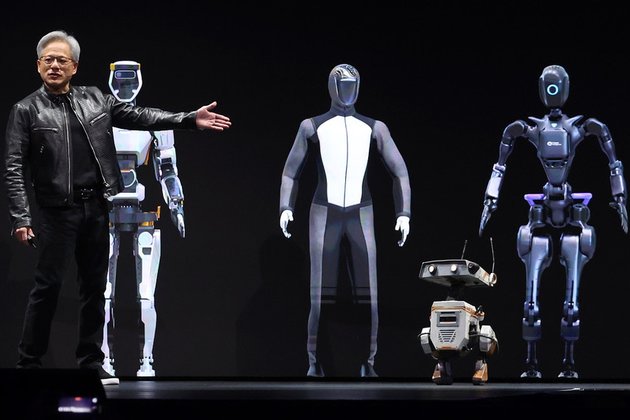
In addition to the new AI chips, Nvidia announced Project GR00T, a foundation model for controlling humanoid robots.
This model, paired with the Jetson Thor system-on-a-chip, aims to create autonomous machines that can be instructed using natural language to carry out general tasks, even those they haven’t been specifically trained for.
“Project GR00T will help robots understand natural language and emulate movements by observing human actions – quickly learning coordination, dexterity, and other skills in order to navigate, adapt, and interact with the real world,” Huang explained.
Nvidia also entered the quantum computing sector with the introduction of a cloud service that uses its AI chips to simulate quantum computers.
While the service will not initially be connected to a real quantum computer, it will allow researchers to test their ideas without the expense of accessing rare and costly quantum hardware.
In the future, Nvidia plans to provide access to third-party quantum computers through the platform.
As Nvidia continues to push the boundaries of artificial intelligence and robotics, the company’s latest innovations showcase its commitment to leading the industry and shaping the future of these transformative technologies.