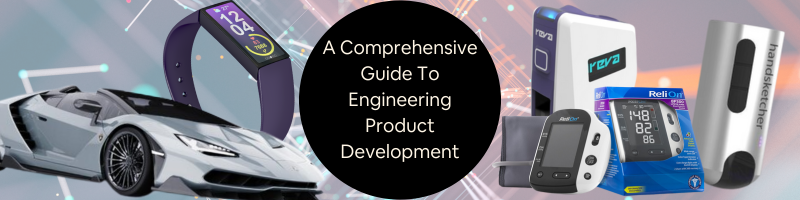
If you’re wondering what engineering product development is, why it matters to your business, and how to use these services to supercharge your company, you’ve come to the right spot. I’m here to demystify the lingo and bring some humor to the high-flying business of creating products that impact.
Table of contents
What exactly is engineering product development?
Engineering product development is where visions become a reality. Imagine a great idea for a new gadget, smart device, or machine that can change the game. It takes that moment of brilliance and systematically shapes it into something real that you can grip in your hand, use, and sell. It’s not just creating great designs. Engineering product development is combining creativity with technical expertise to guarantee that the idea can actually be realized. It is looking at how the product would function, how it can be produced economically, and if it would meet the needs of customers.
It’s an interdisciplinary team effort, where experts from different fields like mechanical and electrical engineering services, software engineering, product design, manufacturing, and even materials science come together. The process begins with sketches and preliminary models. These initial sketches define what works and what does not. There is then testing and revision, making improvements on any deficiency or lack of effectiveness.
RELATED: How to Find an Electronic Design Company for Outsourcing New Product Engineering
The item only advances to mass production after critical examination, ready to encounter the adversities of the marketplace. Finally, engineering product development ensures that a good idea is not an illusion. It’s real, concrete, and affordable, withstanding everyday use as well as marketplace stress. It’s the necessary linkage between fantasy and everyday innovation.
Why do companies and startups need engineering product development services?
When you’re discussing product development engineering services with startups and businesses, of course, you’re considering making and manufacturing something new. That’s only the beginning. The real value comes in identifying those small, subtle things that would otherwise kill a product launch. This is where design engineering experts come in handy. Designing a quality product means having eagle-eyed scanning precision to ensure that every single component clicks into position just right before you soar into the marketplace.
Startups are usually brimming with new ideas and grand plans, but this time perhaps lack the adequate technical knowledge or facilities to put such ideas into reality in an optimal way. On the other hand, established companies may at times fail to optimize or innovate upon their existing offerings, or otherwise revolutionize entirely. It is in such situations that engineering product development services are able to come to the forefront, under both scenarios. One of the greatest advantages is in-depth expertise. These services bring skills not already resident in your organization, filling gaps and offering insight born of years of experience.
RELATED: Key Factors to Consider When Vetting Engineering Firms for Design & Consulting Services
Efficiency is a big advantage as well. Instead of making blind experiments, the process uses tried-and-true methods to eliminate expensive trial-and-error stages. That translates right away into cost savings because successful planning forestalls costly blunders. Quality is not sacrificed whatsoever. Through extreme testing and tweaking, experienced product design firms provide a product of higher quality that functions well consistently every time under real-world conditions. And where time is most valuable today — in today’s fast-moving marketplace — money is time.
Shortening development cycles translates to getting your product on the market earlier, staying ahead of your competitors, and capturing opportunities before they become lost opportunities. In the end, engineering product development services are really an innovation accelerator. They are taking raw concepts and turning them into market-fit products that are seen as industrial-grade, not dusty-concept shelf life. It’s about your vision thriving, not just persisting.
Product development process: from concept to market
Consider building a house — you would not start tossing bricks at one another without a blueprint. The same holds true for product development. Instead of brick and mortar, the instruments are CAD models, prototypes, and simulations from skilled mechanical design experts. It’s an ardently layered process that turns an idea from a spark into something consumers can hold in their hands, use, and love. Shattering it down serves to make it clear how product development is equally about collaboration and problem-solving as it is about creativity.
RELATED: How to Improve Product Development For Your Company with Engineering Firms & Design Consultants
The spark: ideation and concept development
Every product starts with an idea. Sometimes it is a sudden burst of insight born of a problem to be solved. Other times, it is a simmer — much brainstorming, sketching, and dreaming up what might be. This is the sandbox where nothing is off-limits, and all ideas are valid. You find yourself jotting down rapid sketches, jotting down user stories to understand how the users will interact with the product, or making outright decisions that will differentiate it.
But with this, there is a subtle catch: the willingness to jump right in and start building at once. Everyone is enthusiastic, racing ahead, but hitting the brakes to determine if the idea itself can be done helps to sidestep headaches down the line. This is where the engineers’ opinions shine through. Engineers check if the idea can be properly built within budgets and timeframes, and whether technology is available or may be achievable.

Great product development teams don’t just smile and OK your brainstorms. They challenge assumptions, suggest how things could be done better, and help clean up the vision. This kind of creativity, team-based, gives the solid foundation that successful products need.
RELATED: How Much Do Mechanical Engineer Services Typically Charge for Rates & Firms?
Designing the dream: detailed design and engineering
Once the idea is approved, it’s time to roll up your sleeves and get down to business with detailed design. This phase transforms your fuzzy idea into concrete technical drawings. CAD technology is now the designer’s tool, helping in the drafting of every curve, every junction, every mechanism in 3D accuracy. Practice use design means considering beyond appearance or initial-use functionality. Engineers consider manufacturability — how easy or difficult will it be to make the product in quantities?
They calculate the mathematics of how things go together and how easy it will be to build or fix the product at some point. Simulations come into play here in a big way. Software such as Finite Element Analysis (FEA) mimics how the product will react to stress, heat, or vibration. Pre-test is a test run — finding defects prior to production saves time and money.
Materials are chosen to carefully fit in this phase to determine, according to strength, weight, price, and sustainability. Everything here leads to a product that doesn’t just work amazingly well but goes further and can be made affordably and sold competitively.
Getting it real: prototyping and testing
With plans in place, the second giant leap is building a prototype. Here, your concept takes shape in three-dimensional form, which you can pick up, touch, and try. Prototypes permit verification that yes, the design does what it’s intended to do, and also open up insights that drawings and simulation simply cannot fully deliver. Today’s technology allows for quicker and more versatile prototyping than ever before.
RELATED: How Reverse Engineering Services Use 3D Laser Scanning for Design
Rapid prototyping services such as 3D printing have the ability to make physical models in days or hours as opposed to weeks. CNC machining makes accurate parts possible, and sophisticated virtual prototyping software allows engineers to experiment with designs in virtual space.
Prototype. Those are the moments that test what. Maybe the button is too tiny, or the device is heating up for no apparent reason. Sometimes issues of user experience reveal themselves when users first interact with the prototype ever. It’s simply human nature — iteration is all. Input. From engineers, designers, and end-users, and cycle back into experimenting and experimenting with the product. It won’t be surprising that several copies of a prototype would be developed, tested, and refactored until they have a final product with all specifications.
From prototype to production: manufacturing engineering
Finding a great product is merely half the contest. Getting it made reliably, at an affordable cost, and in bulk is equally vital. Manufacturing engineering is committed to doing this. Here, professionals decide the most appropriate process of making conducive to the product design and numbers. Injection molding and casting firms or assembly-line processes, whichever is appropriate, are assigned to attain maximum efficiency and quality.
Manufacturing operations include supplier and vendor selection, supply chain management, and proper quality control usage. Adherence to regulation and certification — e.g., FDA for medical devices or CE marking for the EU market — is typically carried out here. Smooth planning prevents the risk of delay, cost overruns, or defects. Every phase is closely tracked by manufacturing engineers to ensure that what was once a prototype now emerges as a product that customers get exactly as planned.
RELATED: How is Product Design Different From Industrial Design Services Companies?
Launch and beyond: post-launch support and iteration
Placing a product on the market is a positive thing, but barely so. The real world is always full of new issues and aspects to be improved upon. That’s why most product rendering and design companies offer continuing support after product introduction. When released, developers can also fix problems customers have complained about, release updates with patches or improvements, and occasionally create entirely new versions from scratch depending on the reception from customers.
This continuous loop of refinement keeps products competitive, in-timing, and attuned to evolving customer requirements. No other process achieves this level of effectiveness. Sort of, the process actually turns full circle in a way back to ideation — customer feedback is based on new ideas, which feed back into the development loop repeatedly, which causes the company to learn and expand as time goes on.

Why it matters to know the journey
Learning the product development journey is what sets realistic expectations and brings out coordination that produces wonderful products. Not a straight line — lots of give-and-take, polish, and negotiations between creative and engineering brains. For 3D design companies, investing time and effort in each step reaps dividends in avoiding expensive errors and compressing time-to-market. For customers, it means products that are higher in quality and actually deliver what they need.
Whether you’re a start-up contemplating the next big thing or an incumbent unveiling the latest model, grasping these phases — from inspiration to continuous refinement — primes you to meet the essential process head-on. It’s the meeting of engineering professionalism, innovation, and continuous testing that allows for it. So the next time you’re clenching your nicely crafted product in your hand, do take into account the path it had to follow — from paper drawings to CAD designs, prototype-tested in laboratories, and then the equipment on the manufacturing floor making it all a reality for you.
RELATED: Ultimate Guide to Product Design Services with Mechanical Engineering Companies
Various types of engineering product development services
Engineering product development is far from one-size-fits-all. The services your project requires really depend on what kind of product you’re creating, the industry you’re in, and the size of your business. For example, if your product involves physical parts, mechanical engineering becomes critical. This covers everything from structural design to thermal analysis and picking the right materials to make sure your product holds up in the real world.
Conversely, products with electronics—i.e., sensors, circuits, or power systems—will have electrical engineering expertise to ensure. Similarly, if your product does some sort of embedded software or even smart components like IoT integration, software engineering is involved. There’s not just writing code; there is integration in a big way involved here. And then systems engineering, with an even wider perspective. It keeps in mind that all these different parts—mechanical, electrical, and software—are integrated as a single system.
Manufacturing engineering comes into play when it comes to making the prototype stage large-scale by scaling it up to production with the aim of having effective manufacturing processes and quality checks. Lastly, industrial design isn’t necessarily “engineering,” but it’s critical to making sure your product is both attractive, comfortable, and easy to use. The right mix of these services differs depending on how complex your product is and what your in-house staff can do.
RELATED: What is Engineering for Manufacturing (EFM) for New Products at a Prototype Design Services Firm?
What to expect when hiring engineering product development services
Hiring engineering product development services isn’t just hiring someone to build your idea—it’s building a relationship that brings your project from concept, past launch, and into the future. Your dream partner will be what sets your vision alive as a thriving product or a crash. Discovery is the most common starting point of any idea. This prepares your team to do a much deeper research, which answers deeper questions about your consumers, budget limit, and project deadlines.
Collaboration follows closely behind. It’s not just about sending emails back and forth; it’s an ongoing, transparent dialogue. You’ll likely be involved in regular check-ins, brainstorming workshops, and feedback sessions. The best engineering design firms become an extension of your team, working side-by-side to refine and improve the product throughout its development. This partnership approach keeps everyone on the same page and allows for swift adjustments when needed.
There’s execution, where it’s for real. It’s where engineers provide detailed design reports, functional models, and detailed progress reports. With each milestone achieved and deliverable reached, you’re one step closer to releasing a product on the market that fulfills your specs and your quality expectations. Support doesn’t stop with product release. The majority of companies stick around to iron out bugs, refine functionality, and add refinements gained from hands-on experience.
RELATED: Manufacturing Services and Tool Design Engineering
Engineering product development is never a cakewalk. Startups would need to tolerate shoestring budgets and tight deadlines, and established firms have to tolerate legacy systems of the past and intricate cross-functional coordination. They can slow down developments or even stall innovation. That is where expert engineering services come in to bring in a revolutionary change. Maybe the biggest challenge is complexity.
Products aren’t the mechanical gadgets they once were; they’re filled with hardware, software, and connectivity. Our engineering specialists employ a systems-thinking methodology that includes all those gears working in concert to provide a frictionless user experience. Finding the intersection of visionary innovation and reality is also a delicate area. Brainstorming wild features is exhilarating, but bringing them into being as affordable, manufacturable products is an art.
Product development engineers are a bridge and make intelligent compromises that don’t abandon vision but finish projects. Risk reduction is also imperative. Technical breakdown, regulatory and compliance problems, and supply chain disruption are expensive to happen. Stringent testing and compliance regimes of engineering teams catch issues early so that they do not lead to nasty surprises.

Last but not least, transferring production from prototype to volume manufacturing has the propensity to expose defects that were not identified earlier. Production engineers design processes that are reliable and reproducible, enabling smooth transfer from small manufacturing to volume manufacturing. All the engineering services make successful products out of complex problems.
RELATED: DFM For New Product Design Excellence: Complete Guide for Company Success
How startups can maximize value from engineering product development
Startups must be savvy with how they invest in engineering product development to derive the most bang for their buck and keep themselves competitive in a sprint. One of the savviest things to do is to hire engineers early. If engineers are recruited early, they can avoid costly design mistakes before they are made and make the product do what customers want it to do, rather than what the startup thinks they should.
Yet another important practice is adopting iterative development. Having a minimum viable product (MVP) out in the world in a short time frame enables startups to test in the real world and improve incrementally continuously, on the basis of feedback from actual users. Engineering teams adopting agile enable faster cycles by converting feedback to improvement at lower cost and velocity. It’s also worth finding engineering partners who are able to provide something beyond technical support.
When engineering designers have access to the market or investor prospects, they add immense value beyond product development. This kind of multi-faceted partnership easily turns into a startup success attribute. In addition to this, startups can be significantly assisted by online mediums. Cloud collaboration platforms and virtual modeling or digital twins of the product assist in staying in sync with teams, provided they are distributed geographically. This reduces lag and enables early release of the product to the market, which is a mere necessity for startups working under deadlines and under budgetary constraints.
Engineering product development in different industries
Engineering product design is truly specific to the shapes based on the industry that it serves. Consumer electronics, for example, effectively, there, one is concerned with pushing boundaries in reducing size, creating high-tech, design-led solutions, and streamlining wireless connectivity. There is a frenzied pace to this cycle of innovation, so quick to respond to consumer needs and technology cycles. The situation is different with regard to medical device design services.
RELATED: The Future of Electronic Design Engineering: Innovations and Trends for CAD Services Companies
High precision and accuracy are needed to address the reliability and safety issues of the consumers and distributors. Achieving this kind of engineered product must be combined with intense dedication and rigorous process, as well as a handful of documents, including clinical trials and safety compliance. Automotive engineering, though, is marrying ultra-high precision production with outlier testing in durability. Throw in software and AI as behemoths as autos are becoming more intelligent and autonomous.
Product design is an issue of marrying bleeding-edge technology with granny engineering strength. Industrial hardware completes the scenario with its own requirements: durability, maintainability, and compatibility with installed bases. Long-term deployment and downtime reduction are most critical here. Recall of such field-specific requirements is necessary to customize product development strategies. It helps engineers address special problems, standards, and requirements of each industry for improved results and successful products.
Technology trends shaping engineering product development
Technology is transforming the way engineering product development is carried out, accelerating the process, making it smarter, and more innovative. Under the emerging trends is the application of digital twins—virtual replicas of actual products where engineers can experiment, play around, and alter without forking out significant amounts on expensive prototypes. This implies that issues will be detected early enough, and time and money will be saved.
Additive printing, or 3D printing services, is another. It accelerates prototyping and creates design opportunities that conventional production can’t even begin to approach. It’s easier to produce complex shapes and customized parts, expanding what products are able to do. Machine learning and artificial intelligence are revolutionizing design through the analysis of huge amounts of data to enhance product performance, predict maintenance requirements, and gain insight into how products are used. Smarter and more reliable products are the outcome.
RELATED: 3D Printing Technologies for Modeling and Prototyping
The Internet of Things (IoT) is linking products in ways never before imagined. Hardware and software capabilities need to be married by engineers to create intelligent, networked products that interact effortlessly. Sustainability is no longer a choice. Clean technologies and energy-saving processes are driving product designs, such as increasing customer and regulatory demands for cleaner products. Embracing these technology trends can potentially give any product a clear edge in today’s competitive marketplace.
Wrapping up: why engineering product development services matter
Behind each successful hit product lies a well-coordinated engineering development process. It is that which converts ideas into products by fusing creativity, technical know-how, and prescience. Such start-ups and companies that outsource these services are not merely churning out products, but are forging customer confidence, differentiating in competitive markets, and sowing the seeds of innovation and growth.
How Cad Crowd can help
Don’t stall that idea and let us here at Cad Crowd help you connect with the best team and expert for your project. Doesn’t matter if that is a new project or an existing one, our professionals can elevate any of your engineered products. Reach out to us now and get your FREE quote!