The True Cost of Injection Molding vs. 3D Printing for Product Prototyping Services


As regards product prototyping, the selection of manufacturing processes lies at the center of the time-quality-cost tradeoff. Two of the most widely used processes with different advantages are injection molding and 3D printing. Injection molding produces a mold where molten material is poured in, and therefore, it is ideally suited for large-scale production as it can be replicated and is affordable.

Whereas front-end tooling is expensive to buy, it is expensive. But 3D printing or additive manufacturing services print objects by object off computer blueprints, and that is more generic and lower initial upfront cost to begin with, and that is more appropriate for small volume manufacturing or complex design. It is useful to have the approximate actual cost of each process to companies so that they can maximize prototyping.


🚀 Table of contents


Injection molding versus 3D printing of product prototypes: What’s most effective?

Product prototyping is a highly important phase of new product development, whereby designers and engineers have an opportunity to prototype, test, and refine their ideas prior to production being in mass quantities. Injection molding and 3D printing are among the most used manufacturing methods applied in prototyping. Both processes have pros and cons, and the right one to be used depends on the complexity of the design, cost, time, and production volume. In this article, we’ll compare injection molding and 3D printing for product prototyping, exploring their key advantages and limitations.

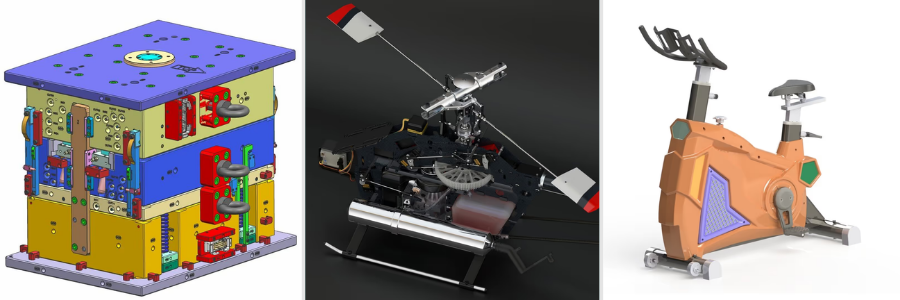
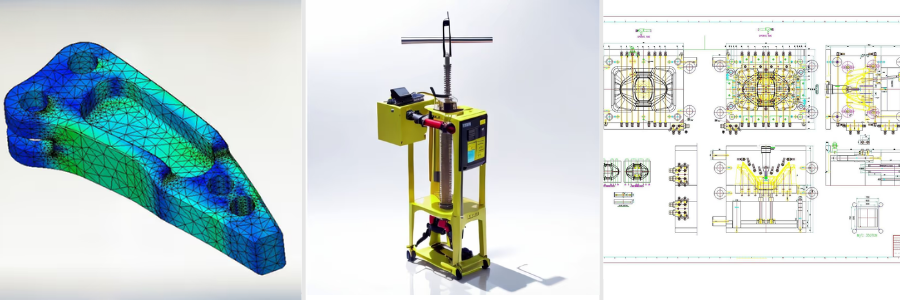
Injection molding design examples by Cad Crowd design experts

RELATED: How CAD modernizes product concept design at industrial design services companies

Injection molding: An overview

Injection molding is a manufacturing process whereby hot material – plastic in the majority of instances – is inserted into a mold. The mold is of the same shape as the model, and when the material has hardened and set, the part is pushed out. Injection molding services are a widespread practice in the automotive, consumer goods, and medical devices sectors to produce high-quality, long-lasting parts.

Advantages of using injection molding for prototyping:

1. Accuracy and smooth finish parts: Injection molding is also used to create parts with accuracy and a smooth finish. Injection molding is easy to handle without compromising fit and performance.

2. Material versatility: Materials used in injection molding can be anything from plastic, elastomers, or thermosets, with freedom of product forms.

3. Scalability: Once the first prototype has been produced, mass production can be done with injection molding and thus is best adapted for production on a large scale.

4. Strength and durability: The products produced with injection molding are stronger and more durable compared to those produced by 3D printing and thus best adapted for use in actual conditions.

Disadvantages of using injection molding for a prototype

1. Extremely high initial capital: Injection molds are expensive and require a massive initial investment. Injection molding becomes uneconomical to produce prototypes in phase one or to make low runs.

2. Longer lead time: Taking weeks to create an injection mold may not be suitable for the need for immediate prototyping.

3. Limitations of design complexity: Injection molding is suitable for simple flat designs, but it is not easy to design products with internal complexity or complicated details.

3D printing: Overview

Additive printing or three-dimensional printing is the layer-by-layer building of parts directly from a computer-aided design model of 3D through CAD design services. The technology is known to be highly flexible, such that designers can model prototypes of complex geometry at an extremely fast speed that would be impossible or would take an unrealistic amount of time using conventional production techniques.

RELATED: Guide for the new product design process when hiring a design services firm

Benefits of 3D printing for prototyping:

1. Big turnaround time: 3D printing enables prototypes to be printed in days or hours, and hence is apt for rapid iteration and rapid prototyping.

2. Less expensive for low-volume: There are no expensive molds and tooling involved when employing 3D printing, and hence, a cheaper process for low-volume or one-off prototyping.

3. Design flexibility: 3D printing designs are precise and possess much detail, such as inner detail and contours, which are possibly hard to achieve using injection molding.

4. No tooling charge: Since in 3D printing there is no special mould or tooling needed, there is no extra charge involved in manufacturing such a part, thus making it less expensive for a one-off model or small numbers.

Disadvantages of 3D printing as a prototyping technique

1. Weaker strength and wear resistance: Parts produced via 3D printing services will either be weaker, more prone to wear, or have a compromised surface finish in comparison to the injection-molded parts, particularly when produced with certain materials. This is a disadvantage for functional part tests in harsh environments.

2. Material limitations: While 3D printing can handle a ginormous list of materials, this is not always true. The material that has been used may not be as mechanically stable as its utilization via some plastic injection, and may only be applied on a limited basis in specific industries.

3. Surface quality: Prototype parts printed using 3D printing show visible lines of layers that need to be removed using post-processing, such that a level surface is exposed. That is a plus point when producing prototype parts with quality finishes.

What is the best prototyping option?

The choice between injection molding and 3D printing is mostly a function of the specific needs of the project.

For rapid prototyping: If time and cost are concerns, especially with low-volume or complex designs, the initial best choice is 3D printing. There can be quick iteration, and designers can update their prototypes without sacrificing costly molds or huge lead times.

High volume production: When functional prototypes close to the final product’s strength, durability, and material properties are to be made, then injection molding would be best for product engineering services. Though it might be costly to start with, it is more cost-effective in the long term for high-volume production.

For detailed designs: 3D printing is best utilized when geometries in question are complicated, which would be extremely difficult or even not possible to possess in the case of injection molding. It is thus ideal for subtle details or inner geometries.

In prototyping a product, the process that is being used can truly break or make a project’s timeline and budget. Among the most common kinds of prototyping processes that are being used are injection molding and 3D printing, and both are good at and bad at something. Knowing how much each of these processes costs is incredibly crucial in knowing which is best to use that is most suited for your individual requirements.

Second, let’s consider cost differences between injection molding and 3D printing when considering material prototyping service expenses, including material expenses, tooling expenses, labor, rate of production, and other basic factors.

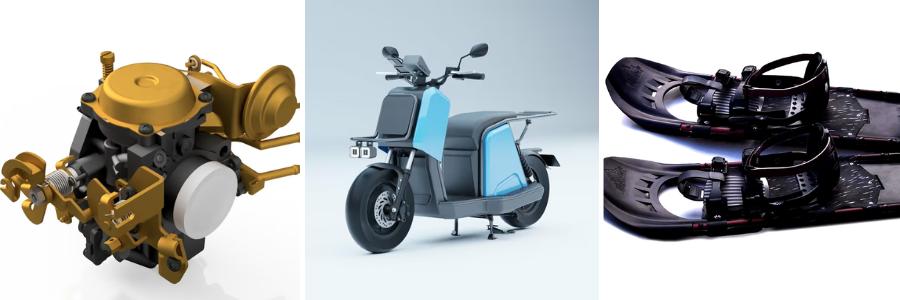
injection molding design by Cad Crowd design experts

RELATED: What are proven product design principles when working with companies & freelancers?

Material costs

At the core of each item of work of prototyping design services are materials, and they constitute a considerable cost. Injection molding is based on the raw material treatment process, where raw material in plastic pellet form is melted and compressed under pressure into the mold in an attempt to produce a part. Material used for molding can be blended, but typical molding materials are thermoplastics such as ABS, polycarbonate, and polypropylene. All these are normally purchased in bulk and therefore become easy to determine prices and reduce the cost of material per unit while producing en masse.

3D printing uses filaments or resins, which are available in all the material combinations, such as PLA, PETG, nylon, or special resins such as carbon-fiber-reinforced resins. They are usually purchased on spools or vats and, though sometimes cheaper than injection-molded bulk plastics, are not. A range of advanced 3D printing resins, such as those with extremely high heat stability or which deliver specific mechanical properties, enables a cost per unit at times. Besides, material supply to 3D printing increases but remains a monstrous deficit behind capability relative to applications using injection molding, especially industrial-grade polymers relevant in specific environments.

Tooling and setup costs

The second critical region where injection molding and 3D printing differ is tooling. Injection molding requires the building of a mold for each part to be manufactured. The mold is aluminum or steel and varies based on the design complexity. The true cost of the mold itself will be thousands to tens of thousands of dollars, especially if there are a multitude of parts or intricate designs to make.

The cost of the tool in injection molding is front-end-biased to a tremendous extent for product design companies – tremendous upfront capital expenditure, but unit cost drops like a stone as the volume of units produced increases. Basically, the bigger the units you produce, the more you can spread your initial tool investment over the units, and therefore it becomes economically feasible for bulk quantities.

3D printing is a “tool-less” process, though. There’s no need to have a mold setup, and setting it up online is just a matter of accessing the 3D design files and configuring the printer. That’s a heck of a lot less startup expense. There is some cost of capital involved in 3D printing; however, in terms of an industrial-grade or high-end printer, that may be several hundred thousand to a few thousand dollars, depending on what the printer will be doing.

Labor costs

3D printing and injection molding are going to bear differing labor costs considerably, though in the overall sense, 3D printing will incur less human labor in the procedure. Injection molding requires people who have been instructed to operate the equipment, maintain the process, check for quality, and, if possible, strip and coat parts upon completion of molding. Labor cost on such injection molding, then, may be higher, especially for high precision or produced in a nation where manpower is costly.

Conversely, 3D printing, while still controlled, is arguably less labor-intensive and more machine-intensive in printing. Most of the coming generation of 3D printers will have the capability of printing with minimal direct supervision. This reduces the cost of labor in printing, although design intricacy and post-processing may be more time-consuming and involve experienced personnel. Also, the price of labor on printing 3D models, debugging, and post-processing, like sanding, washing, or curing, will add some extra cost to the end-product.

Production time and speed-to-market

Speed will be one of the biggest drivers for deciding between using injection mold tooling and 3D printing for prototyping, or even rapid prototyping services. Injection mold tooling is faster to produce in volume once mold development is set in motion. The actual molding cycle is minutes or seconds per part based on part size and complexity. But initially, the use of the original previously used to take until one can experiment, draw, and build the mold can take weeks from the project. And with any design change, the mold has to be rebuilt, thus it is more costly and time-consuming.

On the other hand, 3D printing is faster to print prototypes, especially one-off or low-series parts. The printer will begin to print out the part once the design file has been readied, and the part is available within hours to days, depending on the material and complexity. It is significantly an attractive solution if iteration needs to be fast and product development is emergent.

But keep in mind that 3D printing will not be so fast for very big and complicated parts, or where huge amounts of prints need to be produced. Large batches take away the speed advantage that injection molding has. Costs decrease.

Post-processing and finishing costs

Post-processing is also the kind where 3D printing and injection molding both have costs. Post-processing in injection molding generally consists of performing any other process, excess removal, and part ejection from molds. These are processes that may incur labor cost and project time but are largely routine and well-documented.

Post-processing in 3D printing may be more time-consuming, especially for parts that are printed using SLA (stereolithography) or other resin-based technologies. It could be part cleaning, support removal, curing the resin, and polishing and sanding of the surface to provide a finished look for consumer product companies. All these consume efforts and time, and post-processing expense will be largely dependent on the finish and part complexity. Post-processing may be extremely time-consuming and a function of total cost in case of high-definition 3D printing, but nothing in case of low-key prints.

Design flexibility and complexity

Design flexibility is an area where 3D printing is head and shoulders above the rest. Since 3D printing builds parts in layers, it will not mind high-complexity geometries, internal geometry, and custom geometries without paying the costs of expensive molds or tool overhauls. One can reverse-engineer and iterate as fast as if one were sketching out parts impossible or downright too expensive to manufacture with injection molding. The price of adding fine detail or re-designing is free in 3D printing, and it is more design-experimentation-culture-friendly.

In contrast, injection molding is not as forgiving of design change or complexity. Design change will typically involve changing the molds, and this costs money and takes time. Small changes in the design can even require new molds or new molds to be made, and injection molding is less amenable to quick iteration or highly complex designs.

Economies of scale

Most importantly, injection molding can be volume-multiplied. After the master mold is created, it is much cheaper to produce each subsequent unit as volume grows. It is costly initially, but for volume production, the unit cost is very low, especially with the help of injection molding services. This is why injection molding is particularly well-suited to massive runs of production where thousands and even millions of units must be produced.

3D printing lacks these economies of scale, however. It costs roughly as much to make additional units as it does to make the first unit, and so unit prices never fall with higher unit quantities. Thus, 3D printing is most suitable for low-run production, rapid prototyping, and where having the ability to customize and be flexible is valued more than cost-per-unit.

RELATED: Designing rototypes: 3D design services for inventors and companies

Environmental impact

While both injection molding and 3D printing do have some environmental impact, the character of their impact is different. Injection molding generates an enormous amount of scrap in the production of the mold, as the excess material not absorbed by the part generally must be discarded. It is a plastic material and energy-based, and very non-biodegradable.

3D printing would be more environmentally friendly in the sense that it generates less scrap. Since 3D printing is an additive, layer-by-layer technology, it uses as much material as the part and therefore does not waste. In addition, with increasingly advanced 3D printing technology, more eco-friendly materials such as biodegradable filaments and recyclable resins are now available in the market. But like in injection molding, 3D printing too consumes energy and burns it, and some of the 3D printers (especially the industrial ones) consume massive amounts of energy.

Maintenance

Maintenance of an injection molding system is an example of keeping up with a whole bunch of small things. The mold wear-and-tear will need to be monitored regularly, and how much fixin’ or mold finaglin’ will be done will be questionable. The injection molding machines themselves will need servicing and eventual replacement or rebuilding from time to time, at least in applications where they’re being worked hard by tool design services.

3D printer maintenance is predominantly model-dependent. Low-end machines are low-maintenance with a higher rate of generic type breakdowns, primarily in manufacturing applications. High-end machines, particularly those utilizing resin processes, involve a high level of labor and effort to clean and service in order to produce high-level prints.

Lastly, injection or 3D printing in product design is an option that relies on a series of variables: volume, design complexity, time to make, and material requirements. Injection molding provides a lower cost per unit at high volume, but 3D printing provides unparalleled flexibility and rapid iteration at low volume or complex designs.

For companies trying to determine how best to handle prototyping services, it will depend on the volume of production, design sophistication, and expense. All have pros and cons, and expenses per stage, from material and tooling to man-hours and post-processing, can make the decision an informed one.

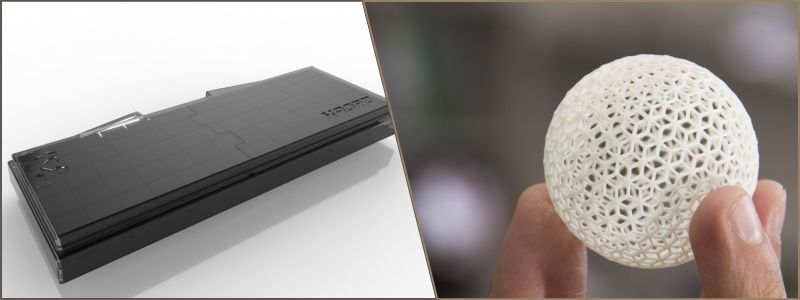
3d printed and injection molded design by Cad Crowd freelance experts

RELATED: How innovative design techniques can supercharge your new product concept

Cad Crowd is here to help

The choice between injection molding and 3D printing largely depends on your project requirements, including production volume, design complexity, and cost. Injection molding is cheaper for high production, while 3D printing is cheaper at low production with little initial investment. Expert advice will allow for a seamless transition through alternatives.

Companies like Cad Crowd are acting as bridges to a global pool of freelance CAD designers and engineers who are waiting to provide specialist services and consultancy to fulfill your prototyping requirements. For more information on how Cad Crowd can help your project and receive a price quote within your budget, call Cad Crowd and talk to experts who are ready to turn your idea into reality. Your price quote is free, so call us today. Request a quote today.

author avatar

MacKenzie Brown is the founder and CEO of Cad Crowd. With over 18 years of experience in launching and scaling platforms specializing in CAD services, product design, manufacturing, hardware, and software development, MacKenzie is a recognized authority in the engineering industry. Under his leadership, Cad Crowd serves esteemed clients like NASA, JPL, the U.S. Navy, and Fortune 500 companies, empowering innovators with access to high-quality design and engineering talent.

Connect with me: LinkedInXCad Crowd

A Comprehensive Guide to Engineering Product Development Services for Companies & Startups


If you’re wondering what engineering product development is, why it matters to your business, and how to use these services to supercharge your company, you’ve come to the right spot. I’m here to demystify the lingo and bring some humor to the high-flying business of creating products that impact.

Table of contents


What exactly is engineering product development?

Engineering product development is where visions become a reality. Imagine a great idea for a new gadget, smart device, or machine that can change the game. It takes that moment of brilliance and systematically shapes it into something real that you can grip in your hand, use, and sell. It’s not just creating great designs. Engineering product development is combining creativity with technical expertise to guarantee that the idea can actually be realized. It is looking at how the product would function, how it can be produced economically, and if it would meet the needs of customers.

It’s an interdisciplinary team effort, where experts from different fields like mechanical and electrical engineering services, software engineering, product design, manufacturing, and even materials science come together. The process begins with sketches and preliminary models. These initial sketches define what works and what does not. There is then testing and revision, making improvements on any deficiency or lack of effectiveness.

RELATED: How to Find an Electronic Design Company for Outsourcing New Product Engineering

The item only advances to mass production after critical examination, ready to encounter the adversities of the marketplace. Finally, engineering product development ensures that a good idea is not an illusion. It’s real, concrete, and affordable, withstanding everyday use as well as marketplace stress. It’s the necessary linkage between fantasy and everyday innovation.

Why do companies and startups need engineering product development services?

When you’re discussing product development engineering services with startups and businesses, of course, you’re considering making and manufacturing something new. That’s only the beginning. The real value comes in identifying those small, subtle things that would otherwise kill a product launch. This is where design engineering experts come in handy. Designing a quality product means having eagle-eyed scanning precision to ensure that every single component clicks into position just right before you soar into the marketplace.

Startups are usually brimming with new ideas and grand plans, but this time perhaps lack the adequate technical knowledge or facilities to put such ideas into reality in an optimal way. On the other hand, established companies may at times fail to optimize or innovate upon their existing offerings, or otherwise revolutionize entirely. It is in such situations that engineering product development services are able to come to the forefront, under both scenarios. One of the greatest advantages is in-depth expertise. These services bring skills not already resident in your organization, filling gaps and offering insight born of years of experience.

RELATED: Key Factors to Consider When Vetting Engineering Firms for Design & Consulting Services

Efficiency is a big advantage as well. Instead of making blind experiments, the process uses tried-and-true methods to eliminate expensive trial-and-error stages. That translates right away into cost savings because successful planning forestalls costly blunders. Quality is not sacrificed whatsoever. Through extreme testing and tweaking, experienced product design firms provide a product of higher quality that functions well consistently every time under real-world conditions. And where time is most valuable today — in today’s fast-moving marketplace — money is time.

Shortening development cycles translates to getting your product on the market earlier, staying ahead of your competitors, and capturing opportunities before they become lost opportunities. In the end, engineering product development services are really an innovation accelerator. They are taking raw concepts and turning them into market-fit products that are seen as industrial-grade, not dusty-concept shelf life. It’s about your vision thriving, not just persisting.

Product development process: from concept to market

Consider building a house — you would not start tossing bricks at one another without a blueprint. The same holds true for product development. Instead of brick and mortar, the instruments are CAD models, prototypes, and simulations from skilled mechanical design experts. It’s an ardently layered process that turns an idea from a spark into something consumers can hold in their hands, use, and love. Shattering it down serves to make it clear how product development is equally about collaboration and problem-solving as it is about creativity.

RELATED: How to Improve Product Development For Your Company with Engineering Firms & Design Consultants

The spark: ideation and concept development

Every product starts with an idea. Sometimes it is a sudden burst of insight born of a problem to be solved. Other times, it is a simmer — much brainstorming, sketching, and dreaming up what might be. This is the sandbox where nothing is off-limits, and all ideas are valid. You find yourself jotting down rapid sketches, jotting down user stories to understand how the users will interact with the product, or making outright decisions that will differentiate it.

But with this, there is a subtle catch: the willingness to jump right in and start building at once. Everyone is enthusiastic, racing ahead, but hitting the brakes to determine if the idea itself can be done helps to sidestep headaches down the line. This is where the engineers’ opinions shine through. Engineers check if the idea can be properly built within budgets and timeframes, and whether technology is available or may be achievable.

engineering product development firms

Great product development teams don’t just smile and OK your brainstorms. They challenge assumptions, suggest how things could be done better, and help clean up the vision. This kind of creativity, team-based, gives the solid foundation that successful products need.

RELATED: How Much Do Mechanical Engineer Services Typically Charge for Rates & Firms?

Designing the dream: detailed design and engineering

Once the idea is approved, it’s time to roll up your sleeves and get down to business with detailed design. This phase transforms your fuzzy idea into concrete technical drawings. CAD technology is now the designer’s tool, helping in the drafting of every curve, every junction, every mechanism in 3D accuracy. Practice use design means considering beyond appearance or initial-use functionality. Engineers consider manufacturability — how easy or difficult will it be to make the product in quantities?

They calculate the mathematics of how things go together and how easy it will be to build or fix the product at some point. Simulations come into play here in a big way. Software such as Finite Element Analysis (FEA) mimics how the product will react to stress, heat, or vibration. Pre-test is a test run — finding defects prior to production saves time and money.

Materials are chosen to carefully fit in this phase to determine, according to strength, weight, price, and sustainability. Everything here leads to a product that doesn’t just work amazingly well but goes further and can be made affordably and sold competitively.

Getting it real: prototyping and testing

With plans in place, the second giant leap is building a prototype. Here, your concept takes shape in three-dimensional form, which you can pick up, touch, and try. Prototypes permit verification that yes, the design does what it’s intended to do, and also open up insights that drawings and simulation simply cannot fully deliver. Today’s technology allows for quicker and more versatile prototyping than ever before.

RELATED: How Reverse Engineering Services Use 3D Laser Scanning for Design

Rapid prototyping services such as 3D printing have the ability to make physical models in days or hours as opposed to weeks. CNC machining makes accurate parts possible, and sophisticated virtual prototyping software allows engineers to experiment with designs in virtual space.

Prototype. Those are the moments that test what. Maybe the button is too tiny, or the device is heating up for no apparent reason. Sometimes issues of user experience reveal themselves when users first interact with the prototype ever. It’s simply human nature — iteration is all. Input. From engineers, designers, and end-users, and cycle back into experimenting and experimenting with the product. It won’t be surprising that several copies of a prototype would be developed, tested, and refactored until they have a final product with all specifications.

From prototype to production: manufacturing engineering

Finding a great product is merely half the contest. Getting it made reliably, at an affordable cost, and in bulk is equally vital. Manufacturing engineering is committed to doing this. Here, professionals decide the most appropriate process of making conducive to the product design and numbers. Injection molding and casting firms or assembly-line processes, whichever is appropriate, are assigned to attain maximum efficiency and quality.

Manufacturing operations include supplier and vendor selection, supply chain management, and proper quality control usage. Adherence to regulation and certification — e.g., FDA for medical devices or CE marking for the EU market — is typically carried out here. Smooth planning prevents the risk of delay, cost overruns, or defects. Every phase is closely tracked by manufacturing engineers to ensure that what was once a prototype now emerges as a product that customers get exactly as planned.

RELATED: How is Product Design Different From Industrial Design Services Companies?

Launch and beyond: post-launch support and iteration

Placing a product on the market is a positive thing, but barely so. The real world is always full of new issues and aspects to be improved upon. That’s why most product rendering and design companies offer continuing support after product introduction. When released, developers can also fix problems customers have complained about, release updates with patches or improvements, and occasionally create entirely new versions from scratch depending on the reception from customers.

This continuous loop of refinement keeps products competitive, in-timing, and attuned to evolving customer requirements. No other process achieves this level of effectiveness. Sort of, the process actually turns full circle in a way back to ideation — customer feedback is based on new ideas, which feed back into the development loop repeatedly, which causes the company to learn and expand as time goes on.

design engineering services company

Why it matters to know the journey

Learning the product development journey is what sets realistic expectations and brings out coordination that produces wonderful products. Not a straight line — lots of give-and-take, polish, and negotiations between creative and engineering brains. For 3D design companies, investing time and effort in each step reaps dividends in avoiding expensive errors and compressing time-to-market. For customers, it means products that are higher in quality and actually deliver what they need.

Whether you’re a start-up contemplating the next big thing or an incumbent unveiling the latest model, grasping these phases — from inspiration to continuous refinement — primes you to meet the essential process head-on. It’s the meeting of engineering professionalism, innovation, and continuous testing that allows for it. So the next time you’re clenching your nicely crafted product in your hand, do take into account the path it had to follow — from paper drawings to CAD designs, prototype-tested in laboratories, and then the equipment on the manufacturing floor making it all a reality for you.

RELATED: Ultimate Guide to Product Design Services with Mechanical Engineering Companies

Various types of engineering product development services

Engineering product development is far from one-size-fits-all. The services your project requires really depend on what kind of product you’re creating, the industry you’re in, and the size of your business. For example, if your product involves physical parts, mechanical engineering becomes critical. This covers everything from structural design to thermal analysis and picking the right materials to make sure your product holds up in the real world.

Conversely, products with electronics—i.e., sensors, circuits, or power systems—will have electrical engineering expertise to ensure. Similarly, if your product does some sort of embedded software or even smart components like IoT integration, software engineering is involved. There’s not just writing code; there is integration in a big way involved here. And then systems engineering, with an even wider perspective. It keeps in mind that all these different parts—mechanical, electrical, and software—are integrated as a single system.

Manufacturing engineering comes into play when it comes to making the prototype stage large-scale by scaling it up to production with the aim of having effective manufacturing processes and quality checks. Lastly, industrial design isn’t necessarily “engineering,” but it’s critical to making sure your product is both attractive, comfortable, and easy to use. The right mix of these services differs depending on how complex your product is and what your in-house staff can do.

RELATED: What is Engineering for Manufacturing (EFM) for New Products at a Prototype Design Services Firm?

What to expect when hiring engineering product development services

Hiring engineering product development services isn’t just hiring someone to build your idea—it’s building a relationship that brings your project from concept, past launch, and into the future. Your dream partner will be what sets your vision alive as a thriving product or a crash. Discovery is the most common starting point of any idea. This prepares your team to do a much deeper research, which answers deeper questions about your consumers, budget limit, and project deadlines.

Collaboration follows closely behind. It’s not just about sending emails back and forth; it’s an ongoing, transparent dialogue. You’ll likely be involved in regular check-ins, brainstorming workshops, and feedback sessions. The best engineering design firms become an extension of your team, working side-by-side to refine and improve the product throughout its development. This partnership approach keeps everyone on the same page and allows for swift adjustments when needed.

There’s execution, where it’s for real. It’s where engineers provide detailed design reports, functional models, and detailed progress reports. With each milestone achieved and deliverable reached, you’re one step closer to releasing a product on the market that fulfills your specs and your quality expectations. Support doesn’t stop with product release. The majority of companies stick around to iron out bugs, refine functionality, and add refinements gained from hands-on experience.

RELATED: Manufacturing Services and Tool Design Engineering

Challenges shared by all and how engineering services address them

Engineering product development is never a cakewalk. Startups would need to tolerate shoestring budgets and tight deadlines, and established firms have to tolerate legacy systems of the past and intricate cross-functional coordination. They can slow down developments or even stall innovation. That is where expert engineering services come in to bring in a revolutionary change. Maybe the biggest challenge is complexity.

Products aren’t the mechanical gadgets they once were; they’re filled with hardware, software, and connectivity. Our engineering specialists employ a systems-thinking methodology that includes all those gears working in concert to provide a frictionless user experience. Finding the intersection of visionary innovation and reality is also a delicate area. Brainstorming wild features is exhilarating, but bringing them into being as affordable, manufacturable products is an art.

Product development engineers are a bridge and make intelligent compromises that don’t abandon vision but finish projects. Risk reduction is also imperative. Technical breakdown, regulatory and compliance problems, and supply chain disruption are expensive to happen. Stringent testing and compliance regimes of engineering teams catch issues early so that they do not lead to nasty surprises.

automotive engineering design services

Last but not least, transferring production from prototype to volume manufacturing has the propensity to expose defects that were not identified earlier. Production engineers design processes that are reliable and reproducible, enabling smooth transfer from small manufacturing to volume manufacturing. All the engineering services make successful products out of complex problems.

RELATED: DFM For New Product Design Excellence: Complete Guide for Company Success

How startups can maximize value from engineering product development

Startups must be savvy with how they invest in engineering product development to derive the most bang for their buck and keep themselves competitive in a sprint. One of the savviest things to do is to hire engineers early. If engineers are recruited early, they can avoid costly design mistakes before they are made and make the product do what customers want it to do, rather than what the startup thinks they should.

Yet another important practice is adopting iterative development. Having a minimum viable product (MVP) out in the world in a short time frame enables startups to test in the real world and improve incrementally continuously, on the basis of feedback from actual users. Engineering teams adopting agile enable faster cycles by converting feedback to improvement at lower cost and velocity. It’s also worth finding engineering partners who are able to provide something beyond technical support.

When engineering designers have access to the market or investor prospects, they add immense value beyond product development. This kind of multi-faceted partnership easily turns into a startup success attribute. In addition to this, startups can be significantly assisted by online mediums. Cloud collaboration platforms and virtual modeling or digital twins of the product assist in staying in sync with teams, provided they are distributed geographically. This reduces lag and enables early release of the product to the market, which is a mere necessity for startups working under deadlines and under budgetary constraints.

Engineering product development in different industries

Engineering product design is truly specific to the shapes based on the industry that it serves. Consumer electronics, for example, effectively, there, one is concerned with pushing boundaries in reducing size, creating high-tech, design-led solutions, and streamlining wireless connectivity. There is a frenzied pace to this cycle of innovation, so quick to respond to consumer needs and technology cycles. The situation is different with regard to medical device design services.

RELATED: The Future of Electronic Design Engineering: Innovations and Trends for CAD Services Companies

High precision and accuracy are needed to address the reliability and safety issues of the consumers and distributors. Achieving this kind of engineered product must be combined with intense dedication and rigorous process, as well as a handful of documents, including clinical trials and safety compliance. Automotive engineering, though, is marrying ultra-high precision production with outlier testing in durability. Throw in software and AI as behemoths as autos are becoming more intelligent and autonomous.

Product design is an issue of marrying bleeding-edge technology with granny engineering strength. Industrial hardware completes the scenario with its own requirements: durability, maintainability, and compatibility with installed bases. Long-term deployment and downtime reduction are most critical here. Recall of such field-specific requirements is necessary to customize product development strategies. It helps engineers address special problems, standards, and requirements of each industry for improved results and successful products.

Technology trends shaping engineering product development

Technology is transforming the way engineering product development is carried out, accelerating the process, making it smarter, and more innovative. Under the emerging trends is the application of digital twins—virtual replicas of actual products where engineers can experiment, play around, and alter without forking out significant amounts on expensive prototypes. This implies that issues will be detected early enough, and time and money will be saved.

Additive printing, or 3D printing services, is another. It accelerates prototyping and creates design opportunities that conventional production can’t even begin to approach. It’s easier to produce complex shapes and customized parts, expanding what products are able to do. Machine learning and artificial intelligence are revolutionizing design through the analysis of huge amounts of data to enhance product performance, predict maintenance requirements, and gain insight into how products are used. Smarter and more reliable products are the outcome.

RELATED: 3D Printing Technologies for Modeling and Prototyping

The Internet of Things (IoT) is linking products in ways never before imagined. Hardware and software capabilities need to be married by engineers to create intelligent, networked products that interact effortlessly. Sustainability is no longer a choice. Clean technologies and energy-saving processes are driving product designs, such as increasing customer and regulatory demands for cleaner products. Embracing these technology trends can potentially give any product a clear edge in today’s competitive marketplace.

Wrapping up: why engineering product development services matter

Behind each successful hit product lies a well-coordinated engineering development process. It is that which converts ideas into products by fusing creativity, technical know-how, and prescience. Such start-ups and companies that outsource these services are not merely churning out products, but are forging customer confidence, differentiating in competitive markets, and sowing the seeds of innovation and growth.

How Cad Crowd can help

Don’t stall that idea and let us here at Cad Crowd help you connect with the best team and expert for your project. Doesn’t matter if that is a new project or an existing one, our professionals can elevate any of your engineered products. Reach out to us now and get your FREE quote!

author avatar

MacKenzie Brown is the founder and CEO of Cad Crowd. With over 18 years of experience in launching and scaling platforms specializing in CAD services, product design, manufacturing, hardware, and software development, MacKenzie is a recognized authority in the engineering industry. Under his leadership, Cad Crowd serves esteemed clients like NASA, JPL, the U.S. Navy, and Fortune 500 companies, empowering innovators with access to high-quality design and engineering talent.

Connect with me: LinkedInXCad Crowd

Why Additive Manufacturing is the Future of CAD and 3D Modeling Services for Engineering Firms


AM, or additive layer manufacturing services, is the new evolution in industrial production methods. Indeed, commonly called 3D printing, it is a new technology that has the capability of producing three-dimensional objects through computer-controlled process with deposition of materials in layers. This paper takes readers deep into the world of additive manufacturing, discussing how it works, processes, advantages, materials, applications, and future prospects in different industries.


🚀 Table of contents


How does additive manufacturing work?

As simple as it gets, additive manufacturing uses CAD or 3D object scanning to create geometrically exact objects. Compared to conventional manufacturing, which is generally subtractive—the removal of material from a solid block—additive manufacturing adds material layer by layer. This not only saves material but also enables the creation of geometries that cannot be built using most traditional manufacturing methods.

The process

  1. Design creation: The journey begins with a digital model created with CAD software, which will be the base of the object to be printed.
  2. Slicing: The digital model is broken down into very thin horizontal layers by slicing software and is interpreted for the 3D printer.
  3. Printing: With the printer, the material is deposited layer by layer, which builds up to the eventual object. Each layer bonds with the previous one until forming a final shape.
  4. Post-processing: After printing, the printed object may need post-processing, which includes cleansing, curing, finishing, or other operations to attain the desired surface quality and characteristics.

This process depicts the openness of additive manufacturing; it allows for rapid prototyping services, designing, and economical runs.

RELATED: Unleashing potential: Complete comprehensive guide to SLS 3D printing services for companies

Additive manufacturing processes

There are a lot of additive manufacturing techniques, and each one has its own standards and application. Among all the techniques used, the following is the list of mostly used techniques:

1. Binder Jetting

In binder jetting, a 3D printing head follows paths along the X, Y, and Z axes to deposit alternating layers of powdered material and a liquid binder. With this process, a strong structure is formed because the adhesive sticks the powder particles together. Binder jetting is extremely rapid and allows for large parts with very little waste of material.

2. Directed energy deposition (DED)

Directed energy deposition has been accessed through a focused energy source such as the laser or electron beam that melts the material. Such a process is capable of handling a wide variety of materials, from metals to ceramics to polymers. Wire or powdered feedstock, which is delivered by a movable arm, is melted within the melting zone; this makes it accessible for creating intricate geometries.

3. Material extrusion

The most commonly used AM process is material extrusion. It involves spooled polymers that melt and then get pressed out through a nozzle, and the nozzle progresses horizontally as the build platform moves in a vertical motion, layering the molten material to create the desired shape. It’s very popular for home 3D printing, and it can have items with reasonable strength and detail. However, it is still a great choice for manufacturing services.

4. Powder bed fusion

Powder bed fusion encompasses a wide category of technologies, including DMLM, SLS, and EBM. In this process, the powdered material is melted selectively through laser or electron beams, thus allowing for the creation of complex parts of great accuracy. At the very end, the excessive powder is removed.

5. Sheet lamination

Sheet lamination can be further divided into laminated object manufacturing (LOM) and ultrasonic additive manufacturing (UAM). In LOM, sheets of paper or plastic are built up in layers with adhesives. In UAM, thin metal sheets are bonded using ultrasonic welding, which keeps temperature processes low and allows for multiple metals.

6. Vat polymerization

This process uses a vat of liquid photopolymer resin that is cured layer by layer with ultraviolet light. Mirrors steer the light to targeted areas, where the resin is hardened, and the object is built up incrementally. Vat polymerization is known for producing parts with high resolutions and surface finish.

7. Wire arc additive manufacturing

Named now as directed energy deposition-arc (DED-arc), this process uses arc welding power sources for the formation of three-dimensional shapes. The wire travels along a pre-programmed path that makes it feasible to deposit layer after layer uniformly and with very high accuracy. This technique often integrates robotic systems to enhance precision and speed.

3D printed objects

RELATED: Smart manufacturing using CAD design is the future for OEM’s

Additive manufacturing technologies

Depending upon the ways additive manufacturing design firms produce objects, there are three chief types classified as follows:

1. Sintering

This involves heating materials to near but below their melting points, causing particles to fuse together and make an overall solid structure. The most common ones in this category are Direct Metal Laser Sintering and Selective Laser Sintering, which use metal powder for DMLS, whereas SLS always uses thermoplastic powders.

2. Melting

This class melts all materials completely for the production of solid, dense parts. Examples here include direct laser metal sintering and electron beam melting. Both use laser beams and electron beams in melting layers of powder to create full-scale, solid objects.

3. Stereolithography

Stereolithography applies photopolymerization to create an object using an ultraviolet laser. It is perfect for various complex designs and high-resolution parts. The ceramic parts produced can endure extreme temperatures, which makes them fit for specific applications.

Benefits of additive manufacturing

Additive manufacturing provides a number of benefits over conventional manufacturing, and it appears to be gaining more ground across industries:

1. Least amount of material waste

AM produces much less waste compared to subtractive manufacturing techniques. Since materials are deposited layer by layer, only that which is required is used, which is particularly advantageous for expensive materials.

2. Design flexibility

One of the major advantages of additive manufacturing is the ability to produce complex geometries and bespoke parts. Designs can be altered quickly; quick prototyping is possible during the manufacturing process, and it goes without saying that rapid prototyping services use additive manufacturing a lot.

3. Shorter lead times

Additive manufacturing can bring the lead time down dramatically, meaning companies can get products to market sooner. This is particularly useful in markets where the ability to get a product to market is vital.

4. Merger of parts

AM allows for the building of parts that otherwise would be an assembly of a number of parts. It enables the production of stronger and more robust final products by minimizing assembly stages and reducing possible failure points at the same time.

5. Customization

Additive manufacturing will particularly be good at manufacturing customized products for precisely designed user needs. Perhaps no area represents this, as well as the healthcare sector, in which unique medical implants can make a significant difference in how patients recover.

RELATED: 6 ways 3D printing will change the world

Factors that affect processing time

The time required to print a part can depend on several factors:

  • Part size: The more enormous the object, the longer it takes to print
  • Quality settings: Generally, higher quality will take longer processing time because of increased layer resolution and detail.
  • Volume of the material: The amount of material to be laid down also sets the overall time.
  • Complexity: Designs that carry a lot of complexity take more time to allow proper bonding and layering.

The overall AM time might lie in the range of some minutes to days or even hours, depending on the factors stated above.

Materials used for additive manufacturing

There are various materials that can be used in additive manufacturing and differ in their properties and areas of usage for expert engineers:

1. Biochemicals

Biochemicals are also gaining acceptance, especially for health care applications comprising silicon and, calcium phosphate,e and zinc. Bio-inks based on stem cells are also of interest for potential application in tissue engineering and regenerative medicine.

2. Ceramics

Some of the common ceramics used in AM include alumina, tricalcium phosphate, and zirconia; they are suitable for those applications with a requirement for high strength and temperature resistance.

3. Metals

A wide variety of metals and metal alloys, including stainless steel, titanium, gold, and silver, are used in additive manufacturing. This diversity allows making parts from the most complex jewelry to structural aerospace components.

4. Thermoplastics

The most common materials used in additive manufacturing are thermoplastics. Examples include but are not limited to, acrylonitrile butadiene styrene (ABS), polylactic acid (PLA), and polycarbonate (PC). It can also utilize water-soluble materials for the temporary support structure, polyvinyl alcohol (PVA) being one of them, which will dissolve after printing has been completed.

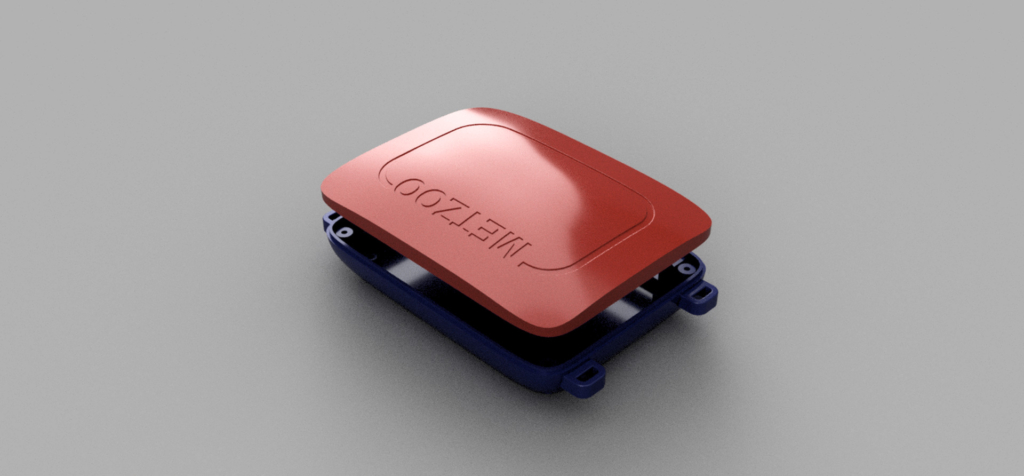
3d printed pcb enclosure

RELATED: A brief history of 3D printing

Applications of additive manufacturing

Additive manufacturing is increasingly applied in many areas: drafting and design firms can exploit its unique capabilities for a wide range of products such as:

1. Aerospace

Advantages of additive manufacturing in the aerospace industry include weight savings and the capability of producing complex geometries, such as blisks and bladed disks. The ability to generate lightweight yet powerful components contributes to higher fuel efficiency and aircraft performance.

2. Automotive

The significant benefit to the auto industry has been from rapid prototyping allied with the material flexibility of additive manufacturing: manufacturers can test designs rapidly while reducing weight and costs inherent in traditional production approaches.

3. Medical

AM changes the face of medicine because it allows for the production of customized implants and medical devices to address specific patient needs. Technology can now produce customized parts that enhance patient comfort as well as outcomes from dental implants to orthopedic devices.

Additive manufacturing for the future

Additive manufacturing is bound to experience rapid growth in the era of Industry 4.0. The demand globally for AM is going to surge high, thus reaching an essential figure of $76.16 billion by the end of 2030 in various sectors.

1. Prototyping and low-volume production

Among the biggest attractions of additive manufacturing is still the rapid prototype fabrication. Technology keeps improving, and more firms are increasingly using 3D printing for low-run volume production, thus enabling them to manufacture customized products at minimum costs that may be associated with traditional mass production. It is also easy to acquire 3D modeling services to help you speed things up in the pre-prototyping phase.

2. Sophistication and accessibility

As the technology of 3D printing advances, machines get more sophisticated and yet cost-effective. Accessibility to such AM by small businesses, even startups, allows businesses to tap the potential of AM for all manufacturing works, stimulating innovation and creativity in most industries.

3. Rapid production of new components

Turnaround time for new components or prototype parts is usually very fast in industries such as automotive and aerospace. Additive manufacturing facilitates a streamlined process that is geared to meet their needs better by allowing fast product development with quick market time.

4. Scalability

The other critical factor driving the adoption of additive manufacturing is scalability. The same technology can be used for a whole spectrum of products, ranging from tiny components to large structures, thus making it possible for companies to respond correctly to varied customer demands.

RELATED: Top applications of thermoplastic polyurethane (TPU) for 3D printing companies

Wrapping it up

Additive manufacturing revolutionizes the landscape of manufacturing and product development. Its capacity to create complex shapes, minimize waste, and offer customization has changed the approach toward design and production on the part of industries.

Because technology is very prolific and its applications in the field of AM are broadening day by day, it is promising to revolutionize manufacturing in the future with unmatched efficiency, innovation, and sustainability. Business enterprises that utilize the power of additive manufacturing will not only save time and costs but will also be able to develop excellent quality products to meet their evolving customers’ needs.

How Cad Crowd can help

Additive manufacturing- the future of CAD and 3D modeling services for engineering firms: on its way. Need a model for a new product? Or perhaps you’re just shopping around? Cad Crowd has worked with the best engineering firms to find the best fit for their projects quickly. Learn more about how to take advantage of our network with a free quote today.

author avatar

MacKenzie Brown is the founder and CEO of Cad Crowd. With over 18 years of experience in launching and scaling platforms specializing in CAD services, product design, manufacturing, hardware, and software development, MacKenzie is a recognized authority in the engineering industry. Under his leadership, Cad Crowd serves esteemed clients like NASA, JPL, the U.S. Navy, and Fortune 500 companies, empowering innovators with access to high-quality design and engineering talent.

Connect with me: LinkedInXCad Crowd

Exploring How 3D Printing Services Have Impacted Aerospace Supply Chain


Like other fields, the aerospace industry needs a competitive edge to overcome challenges. 3D printing is helping aerospace find an advantage and overcome obstacles. 3D printing is now being adopted to develop higher-risk parts. Key industry players feel more confident moving past aerospace components parts into critical systems and secondary structures applications. But how does 3D printing services impact the aerospace supply chain in the first place? The benefits of using 3D printing components for the aerospace industry are plentiful, and some of these are the following:

How 3D printing services have impacted aerospace supply chain

1. 3D printing enables timely manufacturing, production & distribution of parts

One of the critical drivers of faster time to market in the aerospace field is innovations in the supply chain that facilitate quicker production of parts. Time-to-market is crucial for success regardless of the industry in question. On-demand manufacturing is the best way to expedite your production cycles. Whatever qualifications or certifications are required, the manufacturing process can use standard equipment with no need for part-specific tooling just to come up with specialized components no matter where you are. 

3D printing can help accelerate production timelines. With all design files in digital form, aerospace engineering firms can easily customize them according to specific use cases. Since 3D printing doesn’t need mold or tool changes, the process is focused exclusively on updating designs. However, mass customization doesn’t necessarily mean a single size. It allows for reducing production quantity from 10,000 using traditional manufacturing techniques to as low as 100 with 3D printing.  

RELATED: How 3D modeling technology enhances aviation design services for aerospace companies

2. Cut back on supply chain costs

Shrinking a component from 80 individual parts to just one part, for example, has a significant trickle-down effect on the entire supply chain. This reduction of parts will result in a leaner supply chain. Imagine a tighter and more improved supply chain with a more consistent and reliable production level. The aerospace industry, for example, no longer requires a front-end factor to produce metal parts that still need to be sent to the machine shop, where they will be finished before shipping to the destination.

Vertical integration is now possible with self-sustaining machine shops using ordinary and certified powder to deliver components and parts. Vertical integration opens the door to localized production and can help reduce the lead times and shipping costs that traditional manufacturing techniques often require. 

3. Simplify parts through BOM consolidation 

Many design engineering companies have enjoyed more freedom in design with the help of 3D printing. 3D printing can bring so much to the table from a design perspective. However, the secret here is to think beyond the individual parts. For instance, a fan in a cooling system comprises several time-consuming and labor-intensive parts. With the help of 3D printing, you can consolidate the fan down to just one part. However, the benefits can go beyond the design itself. The use of 3D-printed parts can reduce potential failure points and assembly time.

RELATED: Freelance aerospace engineering services, cost, rates, and pricing for companies

Through this, 3D printing technologies simplify the parts and reduce the waste produced by traditional subtractive manufacturing techniques. Even though simplification is the main advantage of 3D printing in the aerospace industry, it also gives the chance to manufacture complicated designs that are impossible to make with traditional methods such as injection molding. It gives engineers the design freedom to develop parts that can render maximum performance. It means you can use more brilliant design geometries from a manufacturing perspective. It can also eliminate fixture and tooling costs and improve the lifecycle and durability of parts. 

aerospace-engineering-services

Certification and qualification for 3D printing in the aerospace supply chain

Industries with the most significant and complex compliance and qualification requirements, such as aerospace, can enjoy the most important benefits of 3D printing design services. For technology to shift from niche to broader industrial use, it must undergo several essential maturity stages. The first stage is the necessary engineering rigor to guarantee repeatability and stability for volume or large-scale manufacturing. The next stage is the characterization and documentation required for qualification efforts; this is where 3D printing is.

RELATED: How the aerospace industry is using CAD design services: drafting, modeling, and prototyping

Generally, 3D printing can provide high-quality production worldwide with the help of distributed manufacturing. However, a few best practices should be in place to cater to the stringent demands of aerospace manufacturing before turning this capability into a reality. Standard processes should also be across several locations to allow true build portability. These include consistent input materials, proper equipment calibration, a secure digital file transfer mechanism, standard equipment, and proper quality certifications.  

3D printing applications in the aerospace industry

The first-ever 3D-printed aircraft parts used worldwide were in an Airbus test aircraft that sped down the airstrip in 2014. It was a tiny titanium bracket part of the tower to secure the engine. Since then, 3D printing has enjoyed a rapid escalation, although new concept design & product development firms continue to learn and master how to adapt to the different 3D printing solutions to gain and leverage its many benefits. These include lowering costs, shortening time to market, and maximizing production output. 

RELATED: What is 3D printing? A beginner’s guide

Commercial airplanes

There is also a skyrocketing demand for new commercial airplanes. The global fleet doubles every 15 years. 3D printing can assist companies with the intimidating mountain of orders to reduce their production time. For instance, in November 2018, Airbus reported a backlog of over 7,000 aircrafts. Considering the existing process, this figure is equivalent to a production time of nine years. Similarly, Boeing’s commercial aircraft backlog was almost 6,000 at the end of September 2018. 

Several internal features in aircraft design often don’t lend themselves by complexity or volume to injection composites and other molding processes. While traditional metalworking can make creating these parts more time-consuming and expensive, 3D printing can simplify the process. This capability can be beneficial in the aerospace industry for producing turbine and engine parts, cabin interior components, and parts with more defined aerodynamic properties. The entire process can also be done at a lower cost within a shorter timeframe. 

Since 3D printing enables easy customization, part consolidation, and on-demand manufacturing, design for manufacturing (DFMA) companies in the aerospace industry can substantially cut down their time to market. 3D printing is at least 2x faster than traditional methods of manufacturing. It can even reduce time to market by more than half in aerospace manufacturing. However, the aviation influx always comes with a price. Twice the number of aircrafts that circle the world means more excellent noise roaring from overboard, heavier carbon emissions, and higher fuel consumption. 

RELATED: 7 Benefits of additive manufacturing for product design & development

Environmental-friendly design

The good news is that 3D printing can also help mitigate the environmental impact of aircrafts. 3D printing can help make an aircraft lighter by up to 55%. For instance, the Boeing 737-800, the average-sized plane that most popular commercial airlines fly, has an average weight of 90,000 pounds, excluding the passengers and fuel. However, a 55% reduction can lower it to just over 40,000 pounds. 

Since an aircraft’s weight directly correlates with the airframe’s helpful life and fuel consumption, it will also reduce its fuel consumption. Simply put, design for additive manufacturing services can help increase the overall sustainability of the present and future aerospace industry. 

design-engineering-services-1

Global possibilities await the aerospace industry with 3D printing 

On-site production is ultimately the most significant benefit of 3D printing in the aerospace industry. Transporting materials and parts can incur costs in terms of money and time. But 3D printing makes it possible to print customized components on location. The potential for an internationally distributed manufacturing network can improve overall efficiency and provide substantial savings.

RELATED: Unlocking the advantages of 3D printing spare parts for your company’s success 

This will product design companies to keep ideal inventory levels to boost productivity and make way for new value chains in the aerospace industry verticals. This capability can enable future companies to do more than act and think globally. It can give them the chance to operate beyond the planet’s boundaries. 3D printing might be the key to exploring space and embarking on planetary and lunar colonization. 

The bottom line 

Whether it is used to print a wrench made from lunar dust for the very first settlers on Mars or help an airline finish its backlog of orders, 3D printing and its many possibilities in the aerospace industry go beyond Earth’s atmosphere. It will be exciting to see and look forward to the new applications that will come to fruition as 3D printing establishes itself as a critical tool in aerospace. But one thing is for sure: the aircraft of the future and beyond will only be able to get off the ground and soar to great heights with the help of 3D printing. 

How Cad Crowd can assist

Cad Crowd offers aerospace engineering and 3D printing services to companies such as NASA. Contact us for a free quote if your organization needs help with aerospace and CAD designs.