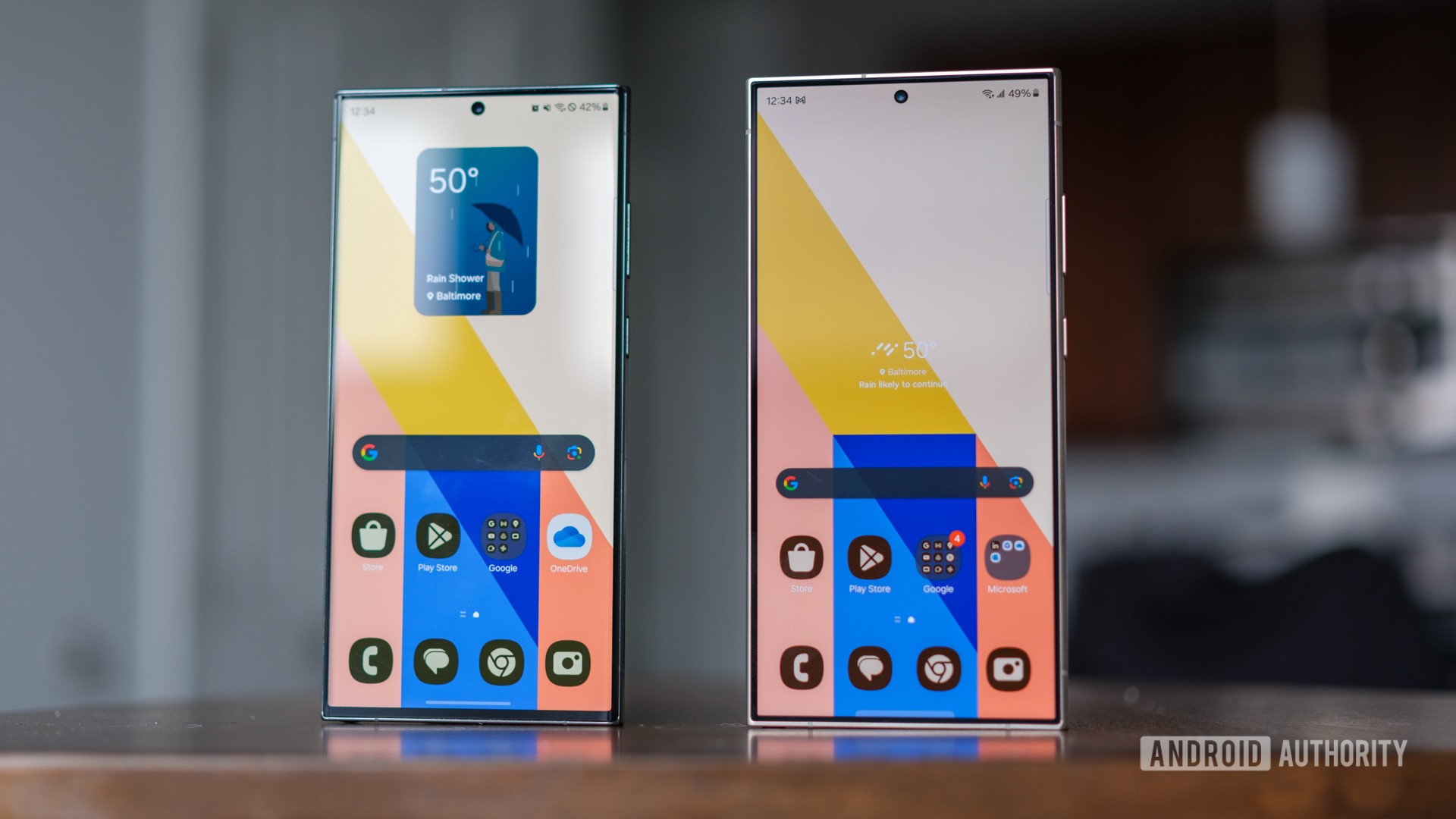
Apple will reportedly offer scratch-resistant, anti-reflective coatings on the iPhone 17 Pro and Pro Max.
This comes months after a report that Apple has decided against using this tech due to yield issues.
The Samsung Galaxy S24 Ultra and Galaxy S25 Ultra already offer protective glass with an anti-glare coating.
The Samsung Galaxy S24 Ultra and Galaxy S25 Ultra both use Corning’s Gorilla Armor display protection. In addition to improved durability, Gorilla Armor drastically reduces screen glare. It looks like Apple could also jump on the anti-glare bandwagon later this year.
A “reliable source” told MacRumors (spotted via SamMobile) that the iPhone 17 Pro and Pro Max will get scratch-resistant, anti-reflective glass on their screens. Unfortunately, the standard iPhone 17 and iPhone 17 Air aren’t tipped to get this feature.
This isn’t the first time we’ve heard about Apple potentially copying Samsung in this regard. We initially heard this rumor back in March 2024. However, a MacRumors source noted in April that Apple had yield issues and may have canceled it for the iPhone 17 line. So it seems like Apple’s supplier has now improved production to the point where it can actually be used.
We hope Apple’s anti-reflective tech is as good as the Gorilla Armor and Gorilla Armor 2 coatings seen on Samsung’s last two Ultra phones.
It is shockingly glare-free, to the point that you start noticing how bad the light reflections can be on other competing devices.
In any event, we’re glad to see Apple apparently embracing anti-glare tech on iPhones. But we hope this is just the beginning and that more smartphone makers adopt these coatings soon.
Got a tip? Talk to us! Email our staff at news@androidauthority.com. You can stay anonymous or get credit for the info, it’s your choice.
When Apple unveiled Image Playground last year, the company touted it as a quick and easy way to generate personalized, original images with the help of Apple Intelligence. Upon launch, the app was met with skepticism, as some users were disappointed by its limitations and low-quality results.
For example, one Reddit user was surprised to find that Image Playground kept generating an image of a hand with six fingers when prompted to create an “up close image of a hand.” In another instance, a user was unable to receive images of simple descriptions, such as “old man” or “flower.”
Fast-forward to this year’s WWDC, where the tech giant announced that it’s going to boost Image Playground with a ChatGPT integration, which should allow for a better, more advanced AI image generation service.
With the new ChatGPT integration, users will be able to access more styles that move beyond the emoji-like creations that Image Playground has become known for.
Images can be created in the following new styles: Oil Painting, Watercolor, Vector, Anime, and Print. In addition, people will be able to select a new “Any Style” option that allows them to describe exactly what they want. These new styles will be visible under a banner that reads “ChatGPT style.”
Image Credits:Apple
In the past, users were limited to Animation, Illustration, Sketch, and Genmoji styles.
Apple says that Image Playground will send a user’s description to ChatGPT to generate an image. The tech giant notes that it won’t share anything with ChatGPT without users’ permission.
By integrating ChatGPT into Image Playground, Apple is giving the app another shot at attracting users while positioning its AI image creation tool as a more well-rounded competitor to other similar free apps.
Plus, it makes sense for Apple to leverage ChatGPT to boost Image Playground, especially since the company has already tapped OpenAI’s tools in other ways.
Last year, Apple announced that it was bringing ChatGPT to Siri and other first-party apps and capabilities across its operating systems. With Siri, the assistant leverages ChatGPT when it’s unable to answer a question on its own or when a user specifically asks Siri to send an inquiry to ChatGPT. Apple has also integrated ChatGPT into system-wide tools like Writing Tools, allowing users to generate, rewrite, and summarize text in apps like Notes and Mail.
The updated Image Playground app is expected to launch alongside the release of iOS 26 this fall.
Since 2015, Daring Fireball‘s John Gruber has hosted a special live episode of his The Talk Show podcast from WWDC each year, with senior executives from Apple routinely participating as guests for the episodes. While the executives typically do not break major news during these appearances, the lively conversations have offered some interesting insights and perspectives on various topics surrounding Apple’s WWDC announcements.
In his March blog post, Gruber faulted himself for not seeing the “red flags” that were appearing as early as last year’s WWDC, with Apple apparently showing off planned Apple Intelligence features that were not actually functional at the time and some of which may not even yet be functional.
He faulted Apple for showing off what amounted to vaporware at last year’s WWDC, a significant departure from Apple’s history over the past several decades of almost always shipping features close to their suggested timelines even when they have been pre-announced before they are fully ready.
Gruber’s comments were notable given his status as one of the most well-known Apple pundits, not to mention the fact that Apple had chosen him to be the one to share the news days earlier that the Apple Intelligence-powered Siri revamp had been delayed.
It’s hard not to view Apple’s move as a form of retribution for Gruber’s criticism, and also potentially an acknowledgement that Gruber would be liable to ask Apple executives some difficult questions about what occurred to force the Siri delay and where things go from here.
While the iPhone 17 Pro and iPhone 17 Pro Max are not expected to launch until September, there are already plenty of rumors about the devices.
Below, we recap key changes rumored for the iPhone 17 Pro models as of May 2025:
Aluminum frame: iPhone 17 Pro models are rumored to have an aluminum frame, whereas the iPhone 15 Pro and iPhone 16 Pro models have a titanium frame, and the iPhone X …
With the design overhaul that’s coming this year, Apple plans to rename all of its operating systems, reports Bloomberg. Going forward, iOS, iPadOS, macOS, tvOS, watchOS, and visionOS will be identified by year, rather than by version number. We’re not going to be getting iOS 19, we’re getting iOS 26.
iOS 26 will be accompanied by iPadOS 26, macOS 26, tvOS 26, watchOS 26, and visionOS 26…
Apple is reportedly preparing to implement significant iPhone hardware redesigns each year for the next three generations.
According leaks from the Chinese supply chain disclosed by Weibo user “Digital Chat Station,” Apple plans to carry out a series of phased industrial design changes affecting different parts of the iPhone across three consecutive years: 2025, 2026, and 2027. The changes…
The popular messaging app WhatsApp has teased a long-awaited iPad app, which would be offered alongside its existing iPhone and Mac apps.
The official WhatsApp account on X today reacted with an eyes emoji to a post saying that WhatsApp should release an iPad app. This could be a hint that Meta is gearing up to release WhatsApp for iPad, which has already been available for beta testing via…
WWDC 2025 is just two weeks away as of today, with Apple’s opening keynote scheduled for Monday, June 9 at 10 a.m. Pacific Time.
During the keynote, Apple is expected to announce iOS 19, iPadOS 19, macOS 16, watchOS 12, tvOS 19, visionOS 3, and other software updates, along with new Apple Intelligence features. In some years, there are also hardware announcements at WWDC, but there are no…
Apple had plans to offer a Starlink-like satellite home internet service in collaboration with Boeing, The Information reports.
Starting in 2015, Apple held discussions with Boeing about “Project Eagle,” a plan to launch a service to provide wireless internet services to iPhones and homes. The companies would have launched thousands of satellites into orbit around the Earth to beam internet…
The next major version of macOS, now dubbed “macOS 26,” is rumored to drop support for several older Intel-based Mac models currently compatible with macOS Sequoia.
According to individuals familiar with the matter cited by AppleInsider, the following Macs will not be supported by the next version of macOS:
MacBook Pro (2018)
iMac (2019)
iMac Pro (2017)
Mac mini (2018)
MacB…
OpenAI has fully acquired Io, a joint venture it cocreated last year with Jony Ive, the famed British designer behind the sleek industrial aesthetic that defined the iPhone and more than two decades of Apple products.
In a nearly 10-minute video posted to X Wednesday, Ive and OpenAI CEO Sam Altman said the Apple pioneer’s “creative collective” will “merge with OpenAI to work more intimately with the research, engineering, and product teams in San Francisco.” OpenAI says it’s paying $5 billion dollars in equity to acquire io.
The promotional video included musings on technology from both Ive and Altman, set against the golden-hour backdrop of the streets of San Francisco, but the two never share exactly what it is they’re building. “We look forward to sharing our work next year,” a text statement at the end of the video reads. Given the pair’s emphasis on building a hardware device for the AI era, and Ive’s pedigree at Apple, it’s likely a consumer-facing product.
Io launched last spring as part of a joint project between Ive’s design firm LoveFrom and OpenAI. In the fourth quarter of last year, Io and OpenAI entered into an official agreement for OpenAI to receive a 23 percent stake in io. Now, OpenAI is buying the entity outright.
The merger is a slightly complicated one. The Io team was made up of 55 people prior to this announcement. Now it will expand to include both io and OpenAI employees—hardware and software engineers, physicists, scientists, and “experts in product development and manufacturing,” according to a blog post on OpenAI’s website. Ive and Lovefrom will manage the creative design process. But Ive himself will remain independent, OpenAI says, and his firm LoveFrom will continue to operate as a separate entity. The io team will instead report into Peter Welinder, OpenAI’s vice president of product, who has worked at OpenAI for eight and a half years.
Io’s founding team has major design chops. Beyond Ive, the founders include Evans Hankey and Tang Tan, who both worked at Apple. Those who’ve worked closely with them say they’re known to hire people whom they believe have exceptional taste.
By bringing on Ive, OpenAI is officially embarking on what is likely one of the more ambitious AI hardware project to date. A number of other major tech companies, including Meta and Google, have tried developing AI-powered devices such as smartglasses in recent years, but mainstream adoption of the technology has been slow and some devices have been plagued by glitches.
Humane, another high-profile AI hardware startup founded by former Apple employees, debuted a wearable device in late 2023. Reviewers later found the device, a pin, was susceptible to overheating and a number of other issues. Less than two years later, Humane’s devices were pulled from the market and its operating system software and patents were sold to printer giant HP.
The joint effort between Altman and Ive was spurred by advancements in AI and also compute power. In its blog post, OpenAI wrote that “computers are now seeing, thinking and understanding.”
Altman reportedly has hardware ambitions beyond the generative AI software his company develops and sells, and Ive has seemingly been eager to make new imprints in the design world since he left Apple in 2019. “I have a growing sense that everything I have learned over the past 30 years has led me to this moment,” Ive said in the video. “While I am both anxious and excited about the responsibility of the substantial work ahead, I am so grateful for the opportunity to be a part of such an important collaboration.”
Apple has sent the invites for its in-person WWDC 2025 festivities on Monday, June 9, featuring the keynote session at 1PM ET/10AM PT. Attendees will be able to watch the keynote presentation at the company’s Cupertino campus, as well as meet with developers and participating in special activities. For everyone who hasn’t received an invite to Apple Park, the keynote will stream online. Developers can also participate in the rest of WWDC’s programming online for free.
We’ve already got pretty high hopes for the keynote announcements, with a lot of potential news expected about the upcoming redesign for iOS 19. We’ve heard that the operating system could have features including AI-powered battery management and improved public Wi-Fi sign ins, and our own Nathan Ingraham has penned an impassioned plea for a normal letter “a” in the Notes app. The full WWDC conference runs from June 9-13.
The pink and yellow models of Apple’s latest entry-level iPad with the A16 chip have just hit a new low of $278 at Amazon, down from the retail price of $349. Walmart is currently matching that discount for the tablet in pink. The other colors are still on sale, but for a lesser discount at $299. That’s still $50 off and is available from Amazon, Best Buy, Target and Walmart. All discounts apply to the base configuration, which includes 128GB of storage and 6GB of RAM.
Apple released the iPad A16 back in March, and we’ve since named it the budget pick in our iPad buying guide. It’s not quite as refined or powerful as the iPad Air, as it’s a bit slower for more involved tasks, and its non-laminated display has a harder time fending off glare. That said, it costs significantly less, and it’s still more than enough tablet for the things most people do with an iPad. We gave it a score of 84 in our review.
Apple
Apple’s brand new entry-level iPad with the A16 chip is cheaper than ever at Amazon — but only in pink or yellow. Other colors are still $50 off.
Apple didn’t increase the price of this latest base iPad compared to the previous model, but it added 2GB of RAM, doubled the storage space and slotted in a more powerful chipset that’s fast enough for most common tasks, including moderate gaming and lighter media editing. However, the iPad doesn’t support Apple Intelligence — which may be a positive or negative, depending on your feelings about generative AI.
The build quality is still as solid as ever, while the battery lasts around 10 hours on a charge, depending on the tasks you carry out with it. On the downside, the accessory situation isn’t ideal. It only supports the more basic USB-C and first-gen Apple Pencils, neither of which can charge wirelessly when you magnetically attach them to the tablet’s side — instead, you’ll need a USB-C cable and/or USB-C to Lightning adapter to juice those up. The Magic Keyboard support isn’t great either, as the model that works with this base iPad is tough to stabilize on your lap.
Now, it’s worth noting that the current iPad Air M3 is on sale for $100 off right now, too. That model is nearly identical in terms of size and weight, but adds the better antireflective screen, Apple Intelligence compatibility and support for the more robust Magic Keyboard add-on. But if those step-ups don’t appeal to you — or, at least, aren’t worth another $200 — the iPad A16 is still an ideal way to watch some movies while you’re flying or to read the news without breaking the bank.
Check out our coverage of the best Apple deals for more discounts, and follow @EngadgetDeals on X for the latest tech deals and buying advice.
The recently-released seventh-gen Apple iPad mini is on sale for , which represents a record low price. You can scoop up a 128GB model for just $399, though . The 256GB model is available for $499 and the 512GB version costs $699. All colorways are on sale, but the deals don’t apply to the 5G cellular models. If Amazon isn’t your bag, these prices are also live at and .
This particular model made our list of the , and for one obvious reason. It’s the only compact tablet that Apple makes. It’s small, but powerful enough for everyday computing tasks. The design recalls the iPad Air, with squared-off edges and thin bezels. There’s a Touch ID sensor in the power button, decent stereo speakers, a useful camera system and a USB-C port. It’s a regular iPad, just smaller.
Apple
We appreciated this release , saying it was everything we wanted in a small tablet. It offers support for the Apple Pencil Pro and includes the powerful A17 Pro chip. This chip allows for Apple Intelligence integration, though your mileage .
The Liquid Retina display is crisp, but it maxes out at 60Hz. Apple typically reserves its most advanced screen technologies for the iPad Pro. We also found in our testing that the tablet didn’t quite stack up to Apple’s advertised battery life of 10 hours. We typically got around eight hours before the iPad required a charge.
Check out our coverage of the best Apple deals for more discounts, and follow @EngadgetDeals on X for the latest tech deals and buying advice.
I spend an unhealthy amount of time lurking in communities where people share aesthetic desktop setups. One of my friends recently set the group chat on fire with a triple monitor setup that had two vertical screens and an ultrawide curved panel at the center. An impulse swipe later, I achieved a similar makeover for my desk at home.
Here’s the problem, though. My $600 workstation overhaul did bring me visual joy, but not much utility. For reporting assignments, I spend the majority of the year away from home, working from deserted cafes or unnaturally uncomfortable bunk beds. I do miss the convenience of large secondary screens. Interestingly, that yearning is addressed by a rather unconventional device —the humble iPad.
Over the past couple of years, I have carried iPads in all shapes and sizes. From the tiny iPad mini and the entry-level iPad to the 13-inch iPad Pro. I have used them extensively for video editing, photo touch-ups, gaming, and reading comics. But the best utility that I’ve got from Apple’s tablet is pushing it as an external monitor.
The problems an iPad solves
Nadeem Sarwar / Digital Trends
There is no dearth of minimalist monitors out there. Some are even thinner than the MacBook Air, while a few snap right to the lid, like some protective case. However, there are a few fundamental issues with external monitors, even if you aren’t vexed by lugging one around in your bag.
First, they burden you with the hassle of a wired connection. That, in itself, is troublesome for a couple of reasons. It leads to unnecessary wire clutter. Plus, plugging in an external monitor means you lose one port, for as long as you are working.
In the age of ultra-sleek laptops, ports are a luxury. The MacBook Air, for example, only features a couple of ports. That means you will have to juggle between charging and peripheral connection with the other USB-C port, but can’t do any of it simultaneously.
Yes, that is a full-fledged macOS running on the iPad mini.Nadeem Sarwar / Digital Trends
If your profession entails handling heavy media files, plugging in (or out) external storage is a part of the daily routine. And that means you really a free port always at your disposal. The solution? Of course, prepare to live the dongle life. Or fork out extra cash for a dongle.
The biggest problem of them all? Power draw. You may not always have a power outlet at your disposal, especially if you are someone who works on the move or away from home. I recently tried a sleek external monitor from Arzopa, and quite liked it. But booking up to my laptop drained its battery, and I quickly found myself hunting for a power port.
So there I was, juggling with power bricks, wires, and port anxiety, once again. The iPad solves all those problems in one go. You don’t need any cables. You aren’t burdened by a power-sipping peripheral. You aren’t tasked with handling a clunky third-party app. The iPad is just ready.
The world’s most convenient monitor
Nadeem Sarwar / Digital Trends
The Apple ecosystem is just seamless.
No situation exemplifies the above argument better than pairing an iPad to your Mac. Actually, no pairing process is involved. As long as your Mac and iPad are signed in with the same Apple account, you’re good to go. No pain-in-the-back Bluetooth pairing or manual Wi-Fi tethering is needed.
Just bring the two devices close, and it’s a smooth-sailing journey from there. All you need to do is expand the control center, click on the screen mirroring icon, and select your iPad from the drop-down menu. Heck, you can skip that, too.
Just hover the cursor over the green window shortcut in any Mac app, and you will see a dedicated option that says “move to iPad.” A click is all it takes to move that app to your iPad’s screen. That’s it. Your external display is now in action mode.
Nadeem Sarwar / Digital Trends
In fact, you don’t have to worry about unlocking your iPad. Even in a locked state, you just have to click on the aforementioned window control on your Mac, and it will open on your iPad’s screen directly. No unlock or preparatory setup is needed across either device.
There is nothing that comes even close to this kind of seamless interplay between two entirely different classes of devices — separated across operating systems — except the Apple ecosystem.
Pushing an iPad as a secondary screen
My workflow is divided across more apps than I’d like. Technically, I can access a healthy few of them across browser tabs, but juggling between them is a hassle. I’d much rather hit the Command+Tab shortcut to shift between apps than head back to the mouse, find the appropriate tab, and switch back and forth. Apps, or web instances running as apps, do the job for me.
Moreover, with browsers, it becomes a chore to track the notifications on platforms such as Slack and Discord, where multiple buzzy channels can quickly throw your zen into disarray. It becomes difficult to track such conversations spread across multiple browser tabs.
Nadeem Sarwar / Digital Trends
Apps, therefore, are the most convenient option for me. Of course, that means dedicated windows for each of them. But there’s only so much screen real estate you have on a 13-inch laptop, even with Stage Manager, you only get a partial reprieve.
With an iPad coming into the picture, I can safely switch at least two non-important or chat apps, in split-screen mode on the iPad. That leaves wme ith a near obstructed view of the apps that make up the bulk of my workflow, right in front of my eyes on the laptop screen.
In my case, Teams and Slack usually go on the iPad. Off the work hours, it’s usually a no-distraction slate for writing articles. When I have the iPad Pro handy, photo and video editing is deployed on the tablet’s OLED screen due to the superior color output.
I love that the macOS clipboard works just fine with iPadOS, too.Nadeem Sarwar / Digital Trends
In the lowest-stakes scenario, the iPad mini simply serves as a screen for music playback control, watching lecture videos, or keeping an eye on my social media feed for gathering breaking news events.
A surprising OS versatility
One of the nicest things about Sidecar — the inherent tech that allows an iPad to work well alongside a Mac — is the OS flexibility. You can choose to either wirelessly mirror or extend the screen of your Mac to an iPad. But here’s the nicest part.
Nadeem Sarwar / Digital Trends
Apple’s Universal Control tech allows you to use the Mac’s monitor as the input source on a nearby iPad. And once again, there’s no complex setup required. All you need to do is drag the cursor towards the screen edge near the iPad, and voila, your Mac’s keyboard and touchpad now serve as input devices on the tablet, too.
That means I can control the tablet running iPadOS, and interact with mobile apps in their natural state. It may not sound like much from a functional perspective, but this convenience slowly grows on you. For example, social media platforms such as X or TikTok work better as an app.
Compared to desktop apps, especially task management platforms where the workflow is updated in the cloud, I’ve found mobile apps to be the snappier option. What they lack in features, they make up for with speed and fluidity.
Nadeem Sarwar / Digital Trends
Plus, it’s easier to track notifications on a mobile device compared to a desktop environment. Despite the OS disparity, there is virtually no input, and I can easily copy-paste material across both devices.
I do a lot of standalone work on my iPad Pro, and even used the baseline iPad for the better part of a whole year, but the inherent limitations of iPadOS often repulse me. Overall, my iPads — of which I have an unhealthy number lying on my desk — have found more utility as a secondary screen for my Mac than standalone tablets.
I just wish could solve some of the scaling and screen rotation bugs. And while at it, maybe, enable Stage Manager for the iPad mini, now that it is technically ready from a hardware perspective.
Apple’s Find My feature has finally been enabled in South Korea, translated by. This comes after years of public demand in which the finding network tool was absent from the country. The omission was especially odd when you consider that Apple sold AirTags throughout the region. Without Find My, they are basically just puck-shaped paperweights.
The company never explicitly stated why it limited access to Find My in South Korea, but it that could have allowed the government access to the location data. The service first appeared during a beta test of iOS 18.4, but the makes it available to everyone in the country. Find My has long been functional in South Korea’s outlying territories like Baengnyeongdo and Ulleungdo.
“Find My is an important tool that allows users to grasp the location of the most precious things to them, such as friends, family and personal items, and I am very happy to be able to introduce this function to Korea,” said David Dorn, senior director of Apple’s service products, in a statement on the company’s local website.
The modern iteration of Find My launched in the US in 2019 as part of iOS 13. However, the tool actually dates back to a service called Find My iPhone that started in 2010. Apple to let users share the location of a lost item with other people on the network. This is helpful when negotiating the return of a lost item with a stranger.
If you buy something through a link in this article, we may earn commission.
The M4 also gives the MacBook Air its AI boost with Apple Intelligence. The 38 TOPS of local AI processing through the faster 16-core Neural Engine makes the M4 MacBook Air closer to the 48 TOPS on Intel’s Lunar Lake chips and 45 TOPS of Qualcomm’s Snapdragon X chips.
This is difficult to judge, because Apple Intelligence is very much still unfinished, but there are some new third-party apps that Apple is showcasing that use Apple Intelligence right out of the box in third-party applications, such as the note-taking app, Bear. You can now do things like automatically format text into tables or summarize a report. It also comes with Image Playground, the updated version of Siri with ChatGPT integration, and lots more. On the other hand, you’ve never needed fast local AI processing to get Apple Intelligence, as AI tasks on older devices just get run on Apple’s Private Cloud Compute system.
The raw performance bump you’ll see on the M4 MacBook Air over last year’s M3 is 22 percent faster GPU, 31 percent multi-core, and 18 percent single-core, as measured in Cinebench R24. That’s a really solid step up for one generation, particularly in single-core performance, where Apple silicon continues to dominate the competition. In terms of the graphics, that’s also over double the performance from the M2. Whether you’re photo-editing or doing 3D modeling, that’s enough to feel the difference if you’re coming from an M1 or M2 MacBook Air.
As with all MacBook Airs, it’s a completely fanless machine. That feels incredible at certain points, especially when you’re in heaving applications like a game. I whipped out Baldur’s Gate 3, and while it’s far from ideal performance, the utterly silent system means you won’t even need headphones to play. But at 1200p, medium settings, and upscaling, it wasn’t too hard to find a balance of performance and image quality that felt enjoyable. Achieving that performance without fans is something that can’t be done on any other laptop right now.
The downside of being fanless, of course, is you’re not getting quite as much out of the M4 as you would on a system with active cooling, namely the 14-inch MacBook Pro. The Air’s system has to throttle frequencies down to prevent a meltdown, and even still, I recorded CPU temperatures as high as 102 degrees Celsius. Fortunately, the surface temperatures never got unbearable in my time with it, even while running under full load.