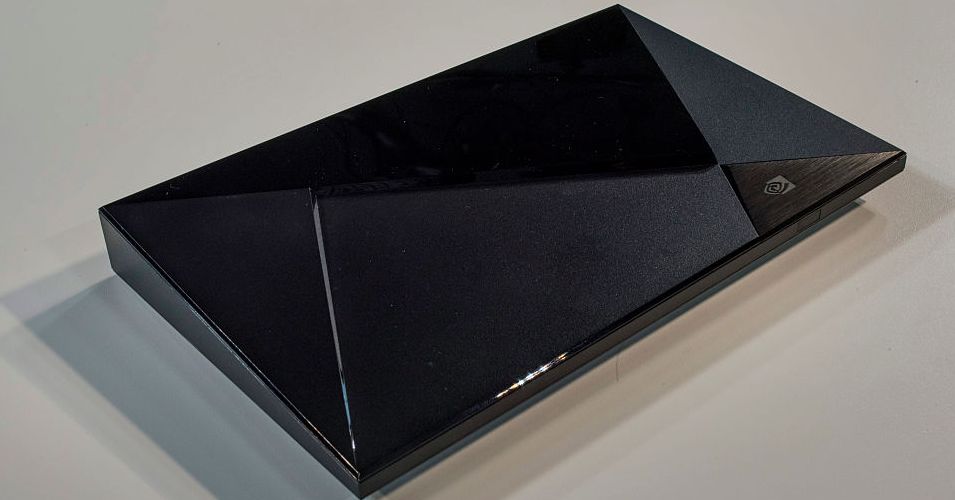
The era of generative AI has upended technology supply chains, and there is one ironclad rule in 2026: If it has memory or storage, it’s getting more expensive. Even devices with years-old tech inside are still apparently subject to that unwritten rule. Nvidia has just announced that the Shield TV Pro is getting $100 more expensive, effective immediately.
The most recent version of the Shield streaming box debuted in 2019, running Android TV with AI upscaling and hardware decoding for almost any type of media. While it ran an aging Tegra X1+ processor, that was (and still is) fast for a TV media streamer. The device launched at $199.99, with a non-Pro variant at $149.99. The non-Pro Shield has since been discontinued, but the Shield TV Pro lives on at the new $299.99 price.
Nvidia has confirmed that you can blame AI for the higher Shield TV pricing. “Starting October 2, SHIELD Pro will be priced at $299. The cost of components, including memory, has increased substantially across the industry,” a spokesperson told Ars.
When Ars Technica talked to Nvidia’s Andrew Bell earlier this year, he framed the Shield as a passion project, but it looks like passion projects still have to pay the bills at Nvidia. In that interview, Bell explained that Nvidia still actively manufactures the Shield and sells every unit it makes. Without a stockpile of pre-AI hardware to sell, new Shield TV units are subject to the same supply chain constraints as today’s smartphones and computers.
Nvidia isn’t a victim here, though. As a key player in AI hyper scaling, the company is more responsible than most for the sky-high cost of components. It has also become one of the most valuable firms in the world thanks to its market-leading AI accelerators and GPUs. As a consequence, we’re seeing new products launch at higher prices than their predecessors, and many end up getting more expensive during their lifetimes. Game consoles have been particularly affected, with Nintendo, Microsoft, and Sony all bumping the prices of their current-gen hardware. The PS5 Pro, for example, has gone from $699.99 at launch in 2024 to $899.99 today.
Stock of the Shield TV Pro has been slim for the last few months, probably because it became too expensive to manufacture new units with component prices rising so quickly. At $300, it will make sense for Nvidia to churn out more devices. However, this higher price will cause an already niche set-top box to be even less appealing to people who just want to stream Netflix.
Unless you need the Shield’s extensive codec support or Plex server capability, it makes more sense to get a cheaper streamer. The Shield is still out of stock on Nvidia’s store, but it’s available at the new price from Best Buy.
Think of a professional athlete. What separates elite performers is what happens between games: continuous refinement, adjusting to new opponents and sharpening skills based on what the last game exposed.
Agentic AI works the same way. A model is no longer asked for an answer. It’s given a goal and has to keep adapting as environments shift, edge cases emerge and tools change. Unlike a generative model responding to a prompt, an agentic model must plan, use different tools and recover from problems it encounters mid-run.
That’s why post-training, the phase that refines a model after initial training on raw data, is no longer a one-time finishing step. It’s continuous, because the environment that agentic models operate in shifts fast. The tools an agent uses can change week to week. Edge cases surface in production that no test set anticipated. Each deployment brings its own codebase, policies and environment.
Post-training runs loop back from production as new problems surface. The compute footprint grows not because any single run is larger, but because the runs never stop. Agentic AI introduces a new compute pattern for post-training, making it the central workload of the agentic era and the primary driver of intelligence per dollar.
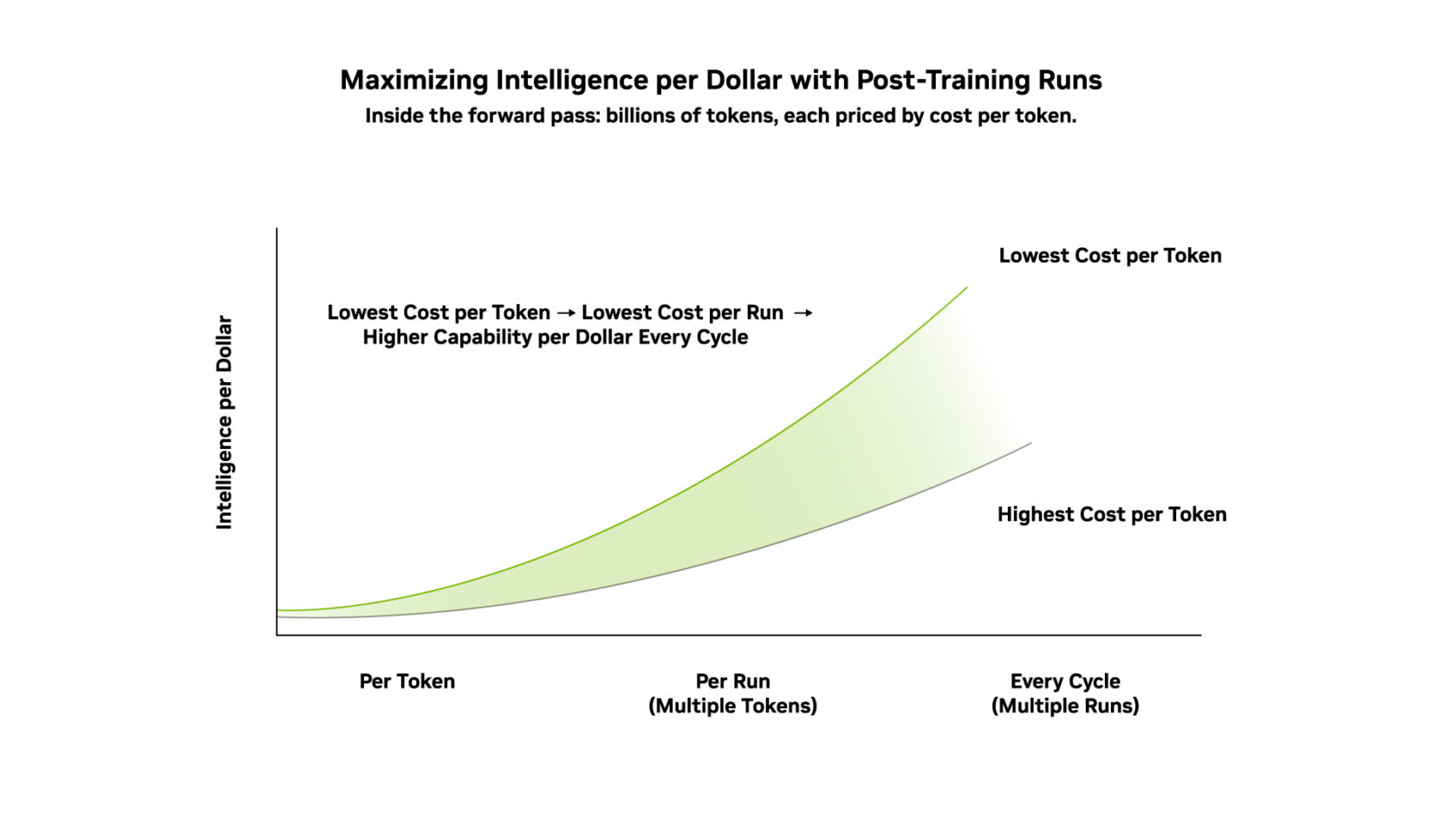
The goal of post-training is to maximize intelligence per dollar by maximizing the yield of every forward and backward pass in the continuous learning cycle. The forward pass — inference — is measured in cost per token. That means that every improvement to cost per token flows directly into intelligence per dollar.
Agentic Post-Training Demystified
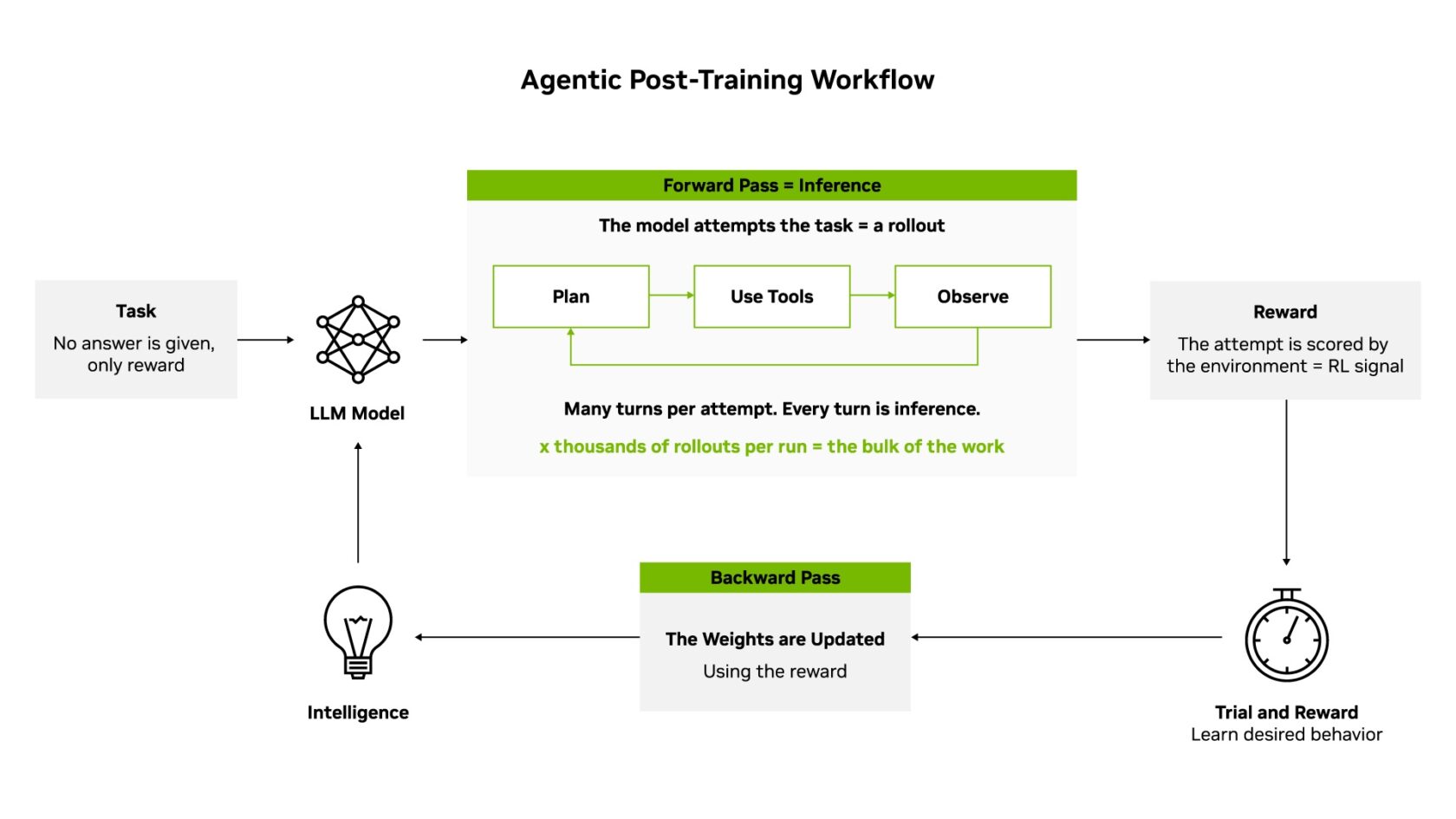
Post-training is where intelligence is built. In pretraining, the model learns to predict the next token, which gives it fluency but not intelligence. Post-training is where it learns to write code, plan a multistep task, use a search tool and recover when something goes wrong. Inference is what comes after: the model working on the job, priced in cost per token.
Because there’s no answer key to memorize, only a reward, the model learns by reinforcement learning (RL) techniques. When given a task, it writes out an attempt — the forward pass — the same work it does on the job. The attempt is scored, and the lesson updates the model’s weights — the backward pass. Across millions of attempts, intelligence grows.
Each step is compute intensive, and running this loop at scale is an orchestration problem: thousands of environments generating rollouts in parallel, rewards being verified and updated weights flowing back into training with accelerators fully utilized. NVIDIA NeMo open libraries, such as NeMo Gym for training environments and NeMo RL for distributed post-training, turn post-training from bespoke research code into repeatable infrastructure.
Why Intelligence per Dollar Extends Cost per Token
If inference is the revenue engine, post-training is the multiplier: the more capable the model, the higher the value of every token served.
Cost per token is the key metric for the inference factory: the all-in cost of delivering 1 million tokens. Intelligence per dollar sits one layer up, answering a different question: what does it cost to build a model worth serving, and keep it worth serving as its environment changes?
The two are nested, not competing. AI infrastructure that lowers cost per token also lowers the cost of every point of intelligence built into the model. And every point of intelligence built in raises the value of every token the inference factory serves.
In other words, cost per token measures operating yield; intelligence per dollar measures whether the investment in model intelligence is paying off.
Maximizing Intelligence per Dollar: Post-Training Nemotron 3 Ultra
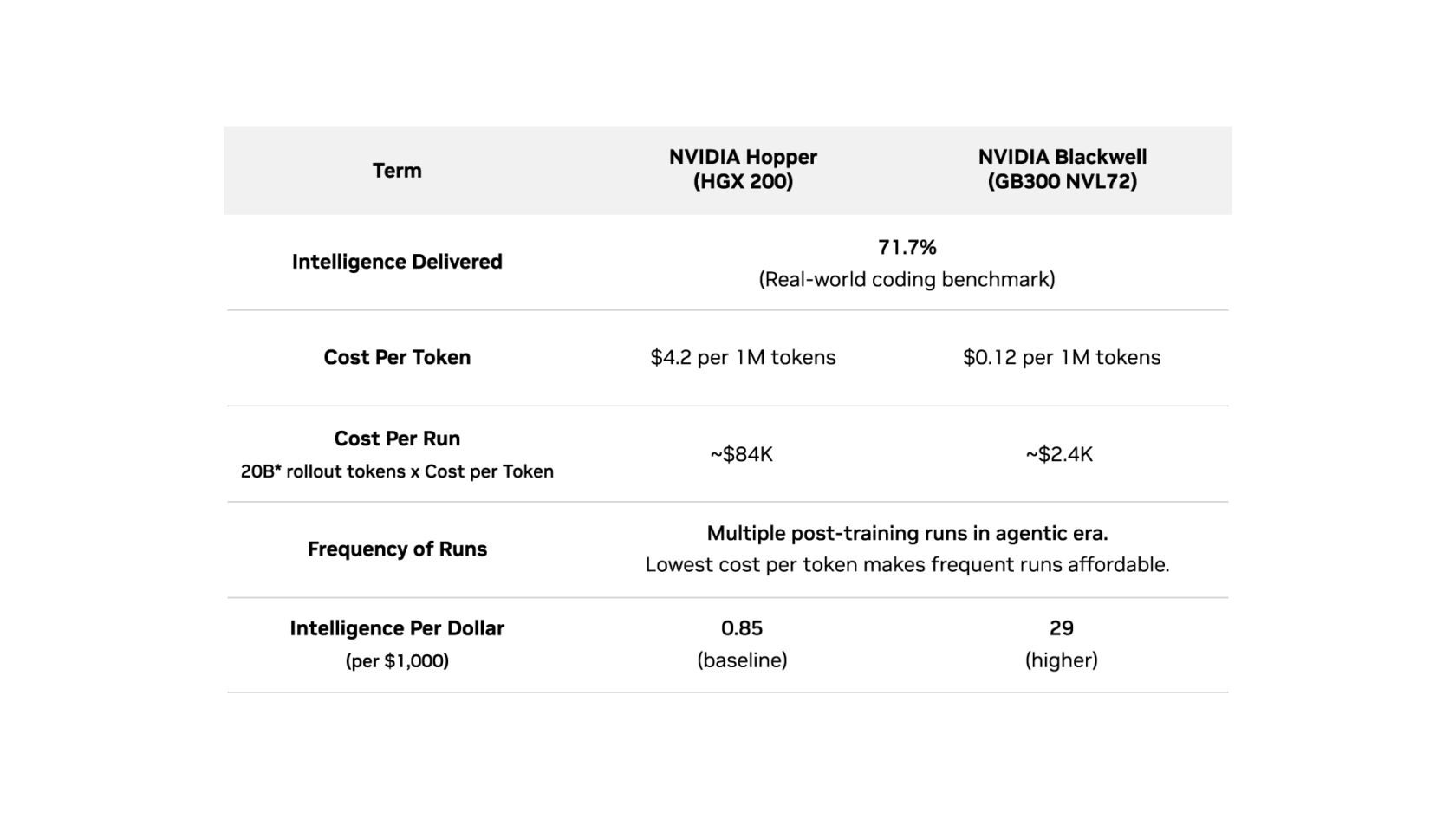
NVIDIA Nemotron 3 Ultra — an open weight, 550-billion-parameter mixture-of-experts (MoE) model, offers verifiable benchmarks and a fully disclosed post-training recipe run on NeMo RL. It scored 71.7% on a standard real-world coding benchmark, SWE-bench verified, where it produced a working fix for roughly seven in 10 real software bugs from open source projects, each one checked against the project’s own tests.
Illustrative 20 billion rollout tokens, based on prior-generation Nemotron 3 Super’s ~1.2 million rollouts at ~10,000 tokens each, scaled up for the larger Ultra model. Intelligence per dollar between platforms is independent of this assumption; the absolute values scale with the token count.
The NVIDIA Blackwell platform lowers cost per run and makes the frequent post-training the agentic era demands economically viable. That intelligence is reaped across every token served.
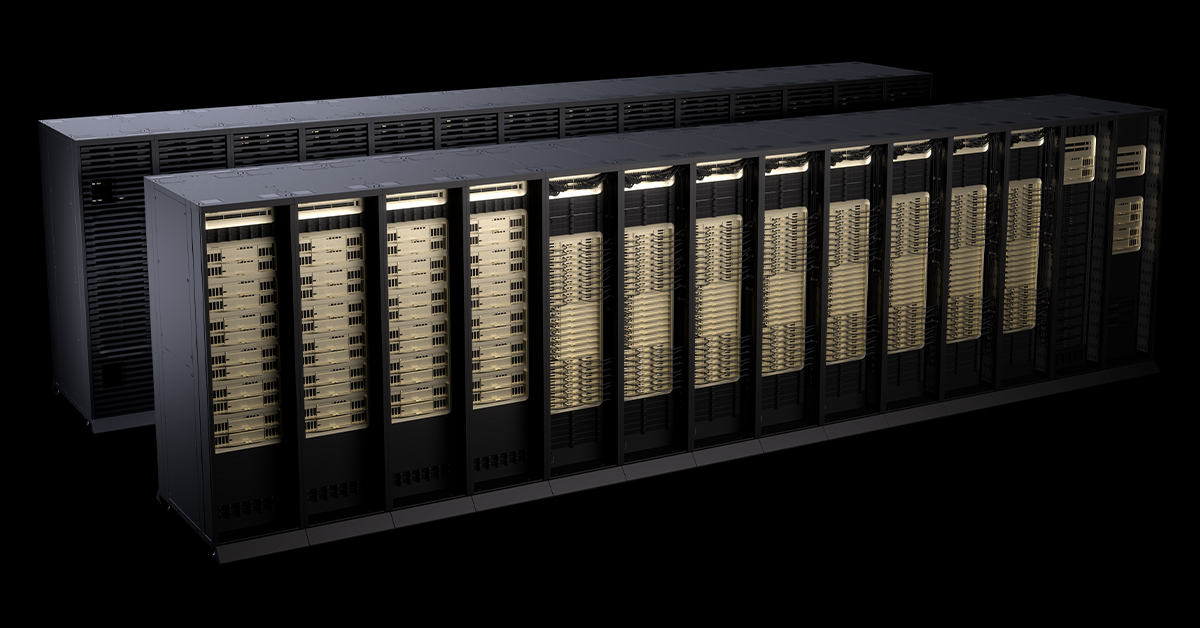
The NVIDIA Vera Rubin platform extends the trajectory further, training the largest models with one-fourth the GPUs of the Blackwell generation. It was codesigned from end to end to maximize intelligence per dollar for the agentic post-training load: more rollouts per run, more environments in play and post-training cycles that never stop.
Post-Training Workflows in Action
Prime Intellect’s Lab continuously post-trains frontier open models on NVIDIA Blackwell and uses NVIDIA Dynamo for inference orchestration. With Vera Rubin, Prime Intellect plans to scale reinforcement learning environments, generate more rollouts per run and accelerate training-to-inference iteration loops to maximize intelligence per dollar for businesses.
Prime Intellect has optimized its sandbox infrastructure to integrate with NVIDIA Vera CPUs, enabling low-latency, energy-efficient reinforcement learning. Open source tools and models such as NVIDIA Nemotron and NVIDIA NeMo Gym are also integrated into its software stack. When comparing realistic RL sandbox workloads against alternative x86 architectures, Prime Intellect found that Vera delivers, on average, 30% greater throughput per CPU.
Perplexity’s RL post-training stack runs asynchronously across hundreds of NVIDIA GPUs, with an RDMA-based weight transfer engine that syncs trillion-parameter models in under two seconds between training and inference compute nodes. The resulting post-trained Qwen3 235B models are then served on NVIDIA GB200 NVL72 systems.
Together AI provides post-training as a service, including supervised fine-tuning, RL and direct preference optimization. The service is delivered via a feature-rich application programming interface and software development kit that supports the full range of post-training on its AI Native Cloud platform. It has been running on NVIDIA’s platform and optimized kernel libraries, and is looking to harness the Vera Rubin platform next.
Learn more about NVIDIA Vera Rubin, the platform for AI factories to maximize intelligence per dollar across workloads. And explore NVIDIA’s full-stack platform for training frontier models.
OpenAI has fully acquired Io, a joint venture it cocreated last year with Jony Ive, the famed British designer behind the sleek industrial aesthetic that defined the iPhone and more than two decades of Apple products.
In a nearly 10-minute video posted to X Wednesday, Ive and OpenAI CEO Sam Altman said the Apple pioneer’s “creative collective” will “merge with OpenAI to work more intimately with the research, engineering, and product teams in San Francisco.” OpenAI says it’s paying $5 billion dollars in equity to acquire io.
The promotional video included musings on technology from both Ive and Altman, set against the golden-hour backdrop of the streets of San Francisco, but the two never share exactly what it is they’re building. “We look forward to sharing our work next year,” a text statement at the end of the video reads. Given the pair’s emphasis on building a hardware device for the AI era, and Ive’s pedigree at Apple, it’s likely a consumer-facing product.
Io launched last spring as part of a joint project between Ive’s design firm LoveFrom and OpenAI. In the fourth quarter of last year, Io and OpenAI entered into an official agreement for OpenAI to receive a 23 percent stake in io. Now, OpenAI is buying the entity outright.
The merger is a slightly complicated one. The Io team was made up of 55 people prior to this announcement. Now it will expand to include both io and OpenAI employees—hardware and software engineers, physicists, scientists, and “experts in product development and manufacturing,” according to a blog post on OpenAI’s website. Ive and Lovefrom will manage the creative design process. But Ive himself will remain independent, OpenAI says, and his firm LoveFrom will continue to operate as a separate entity. The io team will instead report into Peter Welinder, OpenAI’s vice president of product, who has worked at OpenAI for eight and a half years.
Io’s founding team has major design chops. Beyond Ive, the founders include Evans Hankey and Tang Tan, who both worked at Apple. Those who’ve worked closely with them say they’re known to hire people whom they believe have exceptional taste.
By bringing on Ive, OpenAI is officially embarking on what is likely one of the more ambitious AI hardware project to date. A number of other major tech companies, including Meta and Google, have tried developing AI-powered devices such as smartglasses in recent years, but mainstream adoption of the technology has been slow and some devices have been plagued by glitches.
Humane, another high-profile AI hardware startup founded by former Apple employees, debuted a wearable device in late 2023. Reviewers later found the device, a pin, was susceptible to overheating and a number of other issues. Less than two years later, Humane’s devices were pulled from the market and its operating system software and patents were sold to printer giant HP.
The joint effort between Altman and Ive was spurred by advancements in AI and also compute power. In its blog post, OpenAI wrote that “computers are now seeing, thinking and understanding.”
Altman reportedly has hardware ambitions beyond the generative AI software his company develops and sells, and Ive has seemingly been eager to make new imprints in the design world since he left Apple in 2019. “I have a growing sense that everything I have learned over the past 30 years has led me to this moment,” Ive said in the video. “While I am both anxious and excited about the responsibility of the substantial work ahead, I am so grateful for the opportunity to be a part of such an important collaboration.”
It’s no longer Black Friday, but don’t take that to mean that we’re left with scraps on Cyber Monday. Many of the best deals from last week are still raging on, and Cyber Monday marks the debut of some brand-new deals. In other words, you haven’t missed out on the deals, so get to shopping for the gamer in your life before these deals disappear in the coming days and weeks.
If you’re returning from last week, you’ll likely notice some familiar products below, mixed with some new ones. For a brief recap of the best deals, this may be your last chance to save $75 on a Nintendo Switch OLED (the first big discount!), or get $20 off a set of Joy-Con controllers. As far as game deals go, we’re still blown away by the discounts on 2024’s biggest games, including Metaphor: ReFantazio ($50), Warhammer 40K: Space Marine 2($50), and more. Expect new deals to land here regularly on Cyber Monday.