Sakeena Fiza Helps NVIDIA Hardware Succeed at Scale


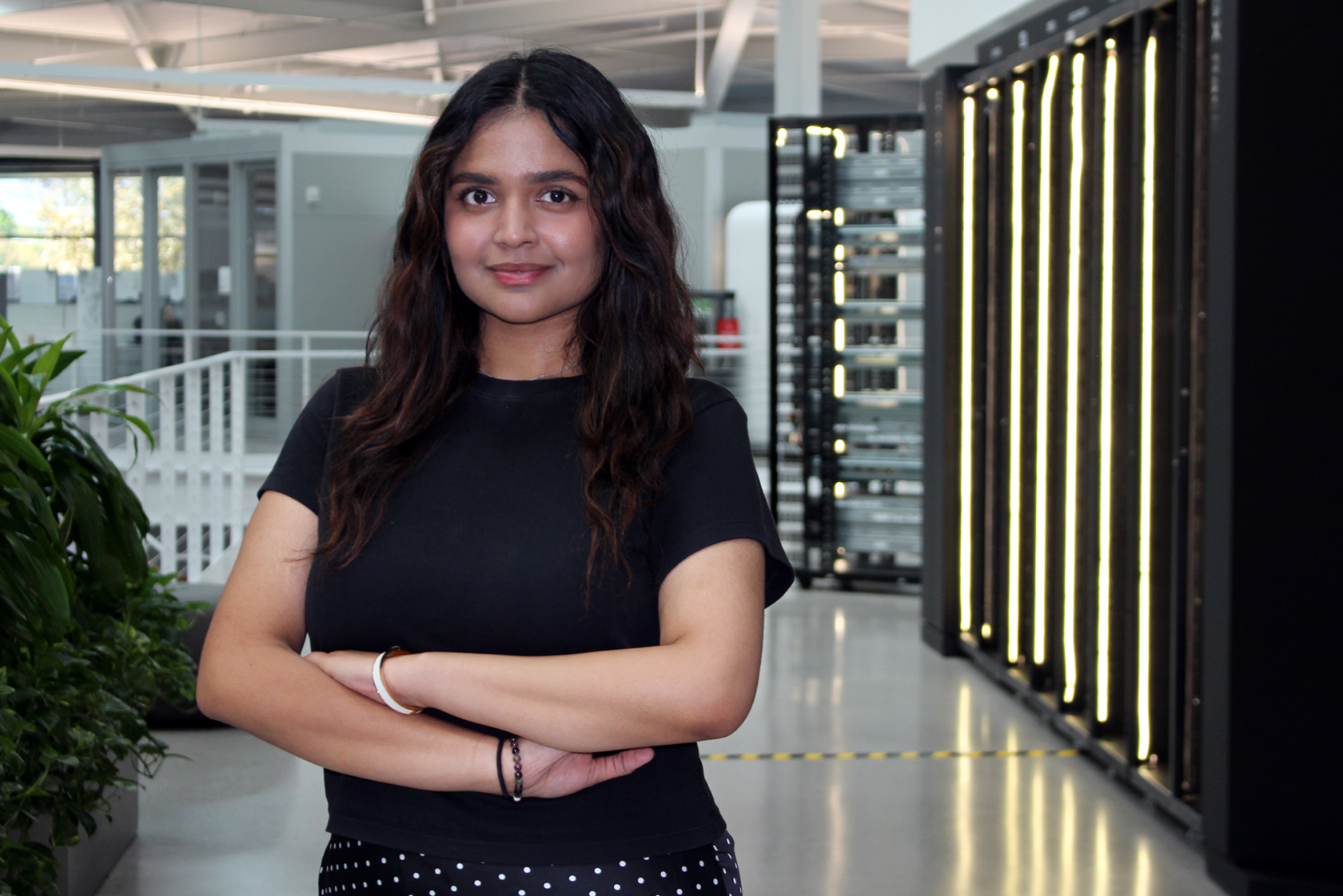
When Sakeena Fiza describes her work as a validation engineer at NVIDIA, she does so in terms more befitting a detective story than a world-class engineering lab.

“Validation engineers look in the shadows and shine a light into every corner,” Fiza said. “Every time we get a system, our first thought is: how can it break?”

And when it does? 

“I always like to think of it as a mystery to solve,” she said.

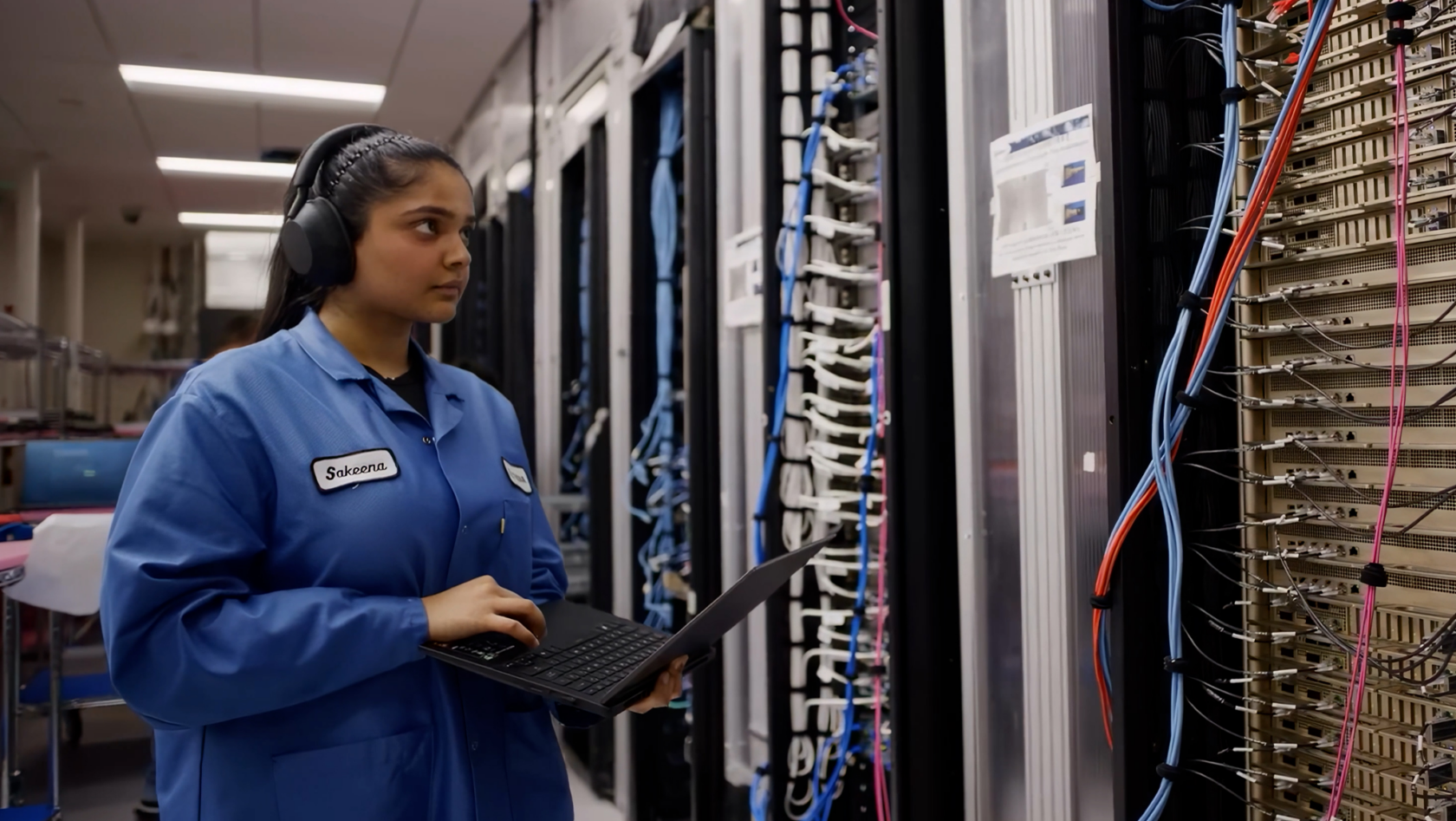
At NVIDIA, the systems Fiza and her colleagues in the data center systems engineering lab investigate are the engines of the AI era. Her work begins before the rest of the world knows a product exists — in the lab — when a new system first receives power.

Components are brought up one by one, boards are integrated, firmware and software teams swarm, and engineers watch for the first signs of life. 

One of Fiza’s earliest and most enduring memories of working at NVIDIA is the collective joy she experienced when she saw the NVIDIA Rubin GPU working for the first time at a system level.

“It literally just said, ‘NVIDIA Corporation Device,’” she recalls. “And everyone’s cheering and celebrating because it’s the first time in the world that a Rubin GPU enumerated at a system level.”

Those moments, electric as they are, are only the beginning. From there, the system must be made resilient: from tray to rack to cluster to production line to customer AI factory. 

Fiza describes validation — the process of ensuring a physical device works correctly before mass production begins — as becoming “the first customers for the product,” exercising hardware to its limits in a range of real-world conditions before anyone else has to depend on it.

“The goal is to always catch issues before customers catch it,” she said. 

Beyond the lab, Fiza and colleagues collaborate in coworking spaces across our Santa Clara offices.

Fiza arrived at NVIDIA after earning her bachelor’s degree at the University of California, Irvine, where she studied computer science and engineering. Her path into hardware was the result of an accumulating fascination with systems. 

Growing up in Dubai, she was introduced to coding via the Logo programming language, prompting future forays into systems design that included building Mars rovers at a high school robotics camp and working on unmanned aerial vehicles in college.

What drew her to work with data center systems was the chance to work with the whole machine. At NVIDIA, she said, validation sits at exactly that intersection: firmware, hardware, software, mechanical design, thermal behavior, manufacturing and customer experience.

“I get to be a mechanical engineer when I want to be,” she said. “I get to be an electrical engineer when I want to be. I get to be a firmware engineer when I want to be.”

The failures she chases can be immense or microscopic. A rack-scale issue might involve high-speed signaling, thermal margins or power integrity. Another might come down to a screw tightened too far or the level of dust in a customer facility.

“The solution can be elusive,” Fiza said. “We have to follow the clues, ignore the red herrings and know where to look.”

When a log shows how something failed, Fiza’s job is to discover why. Validation engineers reproduce the issue, vary the conditions, investigate firmware, remove mechanical variables, probe signals, study scope shots and narrow the possible causes.

A single board may contain tens of thousands of components; a rack may approach half a million. Those parts must not merely coexist. They must behave as one system under stress, at scale, in the complex realities of production and deployment across diverse AI factory configurations.

“I wish people understood how complex the hardware is that AI needs to run on,” Fiza said.

For Fiza, the pressure of the work is inseparable from the pleasure of it. Bring-up, she said, is “like the Avengers assembling”: architects, designers, software engineers, firmware engineers, validation engineers, all in the room, racing toward a working system.

“One thing I know when I come to work is I’m never alone,” she said. 

To be a validation engineer is to practice a disciplined kind of suspicion: believe a system can work, then try to conceive of every way it might not. The job requires the doggedness of a great detective, as well as the diagnostic abilities of a general practitioner and the temperament of someone who meets catastrophic failure in the way others might a crossword.

Each project brings a new puzzle, a new failure mode and, in turn, a chance to make the next system better.

“With the products we have in the pipeline, I’m so excited,” Fiza said. “They’re going to change the world.”
Firebird Launches CIS Region’s Largest AI Factory in Armenia


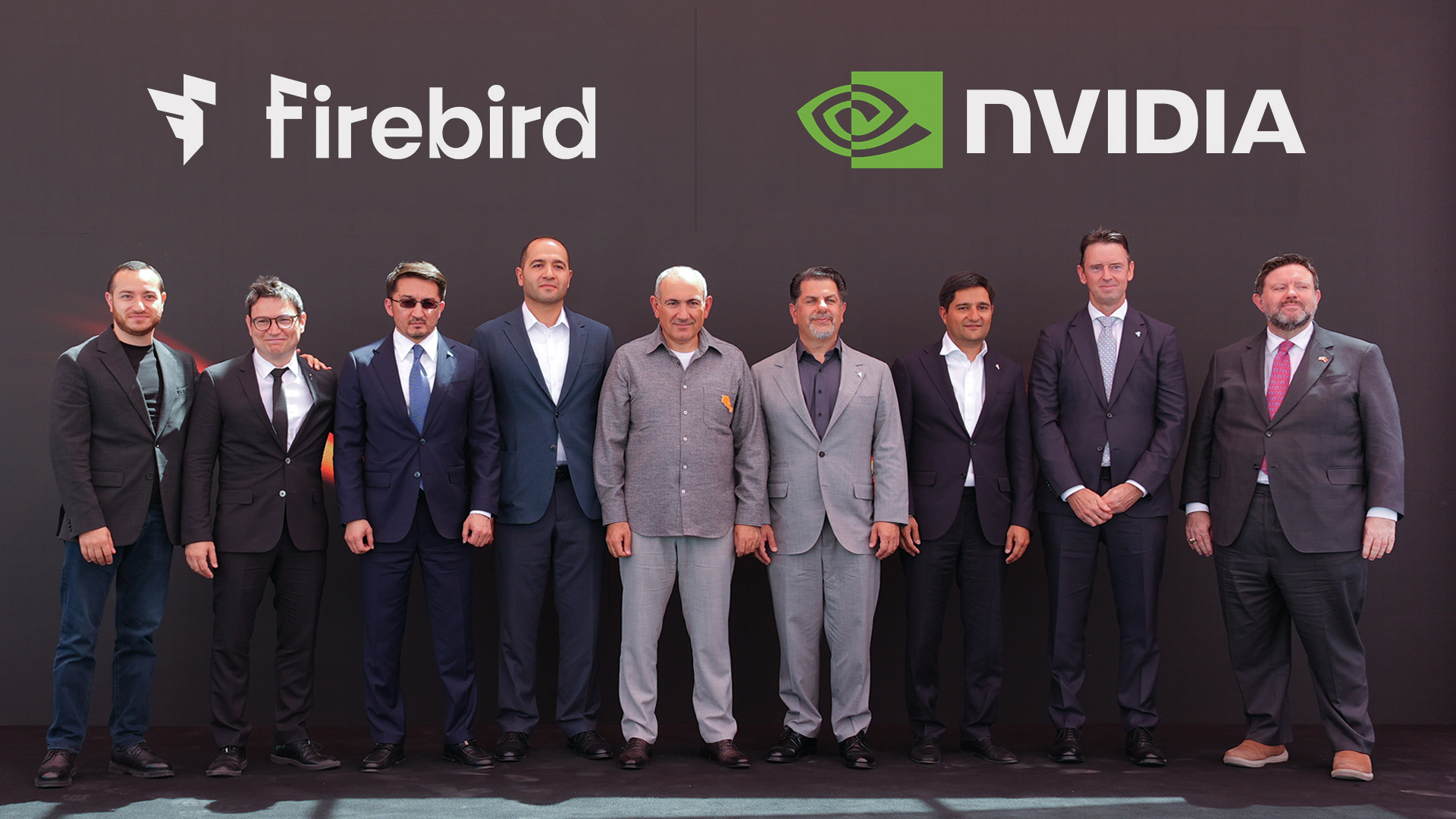
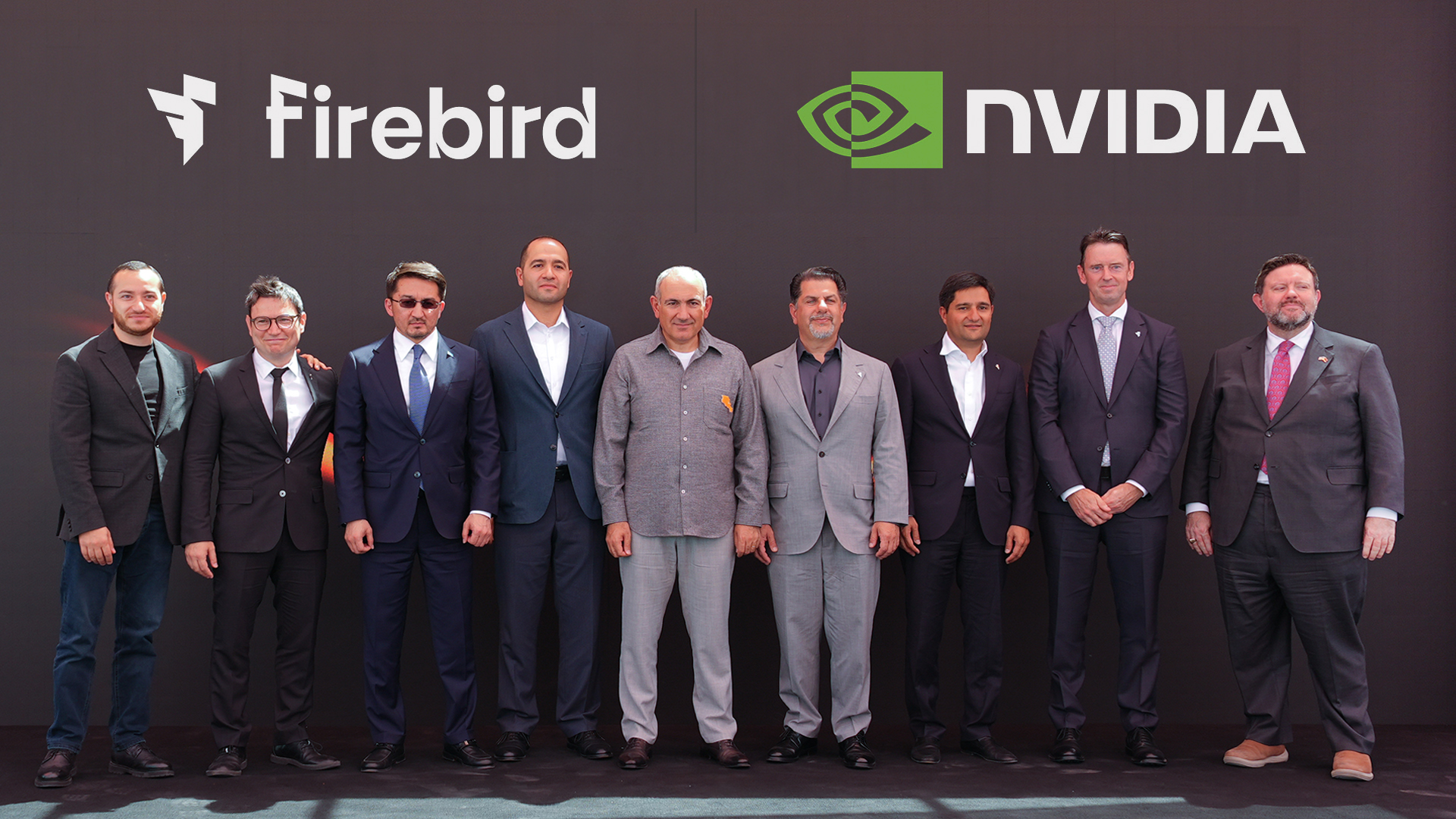
The global buildout of AI infrastructure reached a new milestone today — Firebird, an emerging AI cloud, launched the CIS region’s largest AI factory in Armenia, establishing a new AI computing hub powered by NVIDIA accelerated computing and Dell Technologies high-performance AI infrastructure. 

Nikol Pashinyan, prime minister of the Republic of Armenia; Zhaslan Madiyev, deputy prime minister of the Republic of Kazakhstan; and David Allen, U.S. chargé d`affaires, a.i. in Armenia, attended the AI factory opening ceremony. 

AI factories are the foundational infrastructure for the AI era, providing the computing capacity needed to train, fine-tune and deploy AI models for every domain at scale.

Building the Infrastructure to Create Intelligence at Home

While AI services are available globally, countries also need the capacity to develop and run AI for their own languages, industries and national priorities. Firebird’s AI factory brings that capacity to Armenia, giving developers, startups, enterprises, universities and public institutions the compute to build and scale AI at home.

Firebird plans to deploy more than 70,000 NVIDIA Rubin and Blackwell GPUs and 300 megawatts of AI infrastructure capacity in Armenia by the end of 2027, accelerating the country’s development as a center for AI research, advanced computing and innovation. 

“Our ambition for what we are building in the next 2 years or so is roughly 2 gigawatts of capacity around the world. We’re very focused on merging into frontier markets,” said Alexander Yesayan, co-founder of Firebird.

At this scale, energy efficiency is essential. Built on the NVIDIA DSX platform, this AI factory integrates accelerated computing, networking, power and cooling as one codesigned system. Firebird’s AI factory is designed from the ground up to turn compute into revenue. With DSX, it can run up to 40% more GPUs on the same footprint, producing more tokens per dollar and extracting more value from every megawatt of capacity.

A Magnet for Global AI, a Catalyst for Local Innovation

Firebird’s ambitions extend beyond a single site. With NVIDIA’s support, the company is pursuing an approximately 2-gigawatt AI infrastructure roadmap spanning Armenia, Kazakhstan and additional markets. 

Firebird also announced that NVIDIA intends to invest in the company, following an earlier investment by CoreWeave this year. These investments will help Firebird expand its global infrastructure and operational footprint, and support its efforts to establish the largest and most advanced compute clusters across frontier markets.

Delivered in just over six months, the Armenia AI factory demonstrates Firebird’s ability to turn ambitious infrastructure plans into operational AI capacity with exceptional speed.

Schneider Electric provides the power infrastructure supporting Firebird’s AI factory in Hrazdan, helping Firebird meet its accelerated deployment schedule by rapidly delivering and setting up critical systems, including medium- and low-voltage switchgear, three-phase uninterruptible power supply systems and rack enclosures. This keeps the power buildout moving at the pace of the compute and provides a reliable foundation to bring NVIDIA accelerated computing online at scale.

To support the facility’s thermal needs, Vertiv provided a cooling architecture combining chilled-water technology, advanced controls and Vertiv TrimCooler technology for efficient heat rejection. Vertiv’s iCOM CWM Chilled Water Manager centrally coordinates cooling resources, improving visibility, efficiency and responsiveness as demand shifts with AI workloads.

Early demand is coming from AI-native companies including Perplexity, which is working with Firebird to access high-performance AI infrastructure for its AI agent platform and answer engine. 

As AI becomes essential infrastructure worldwide, Firebird’s expansion can help make the CIS region a magnet for global companies building and running AI — and a catalyst for local developers, researchers and enterprises. 

Powered by NVIDIA’s total AI factory platform — reference architecture, accelerated computing, networking and AI software — and deployed on Dell PowerEdge servers, the new Firebird AI factory will help Armenia’s builders turn energy into intelligence and connect their innovations to the global AI economy.


NVIDIA Vera Rubin Maximizes Intelligence per Dollar for Post-Training


Think of a professional athlete. What separates elite performers is what happens between games: continuous refinement, adjusting to new opponents and sharpening skills based on what the last game exposed.

Agentic AI works the same way. A model is no longer asked for an answer. It’s given a goal and has to keep adapting as environments shift, edge cases emerge and tools change. Unlike a generative model responding to a prompt, an agentic model must plan, use different tools and recover from problems it encounters mid-run.

That’s why post-training, the phase that refines a model after initial training on raw data, is no longer a one-time finishing step. It’s continuous, because the environment that agentic models operate in shifts fast. The tools an agent uses can change week to week. Edge cases surface in production that no test set anticipated. Each deployment brings its own codebase, policies and environment.

Post-training runs loop back from production as new problems surface. The compute footprint grows not because any single run is larger, but because the runs never stop. Agentic AI introduces a new compute pattern for post-training, making it the central workload of the agentic era and the primary driver of intelligence per dollar.

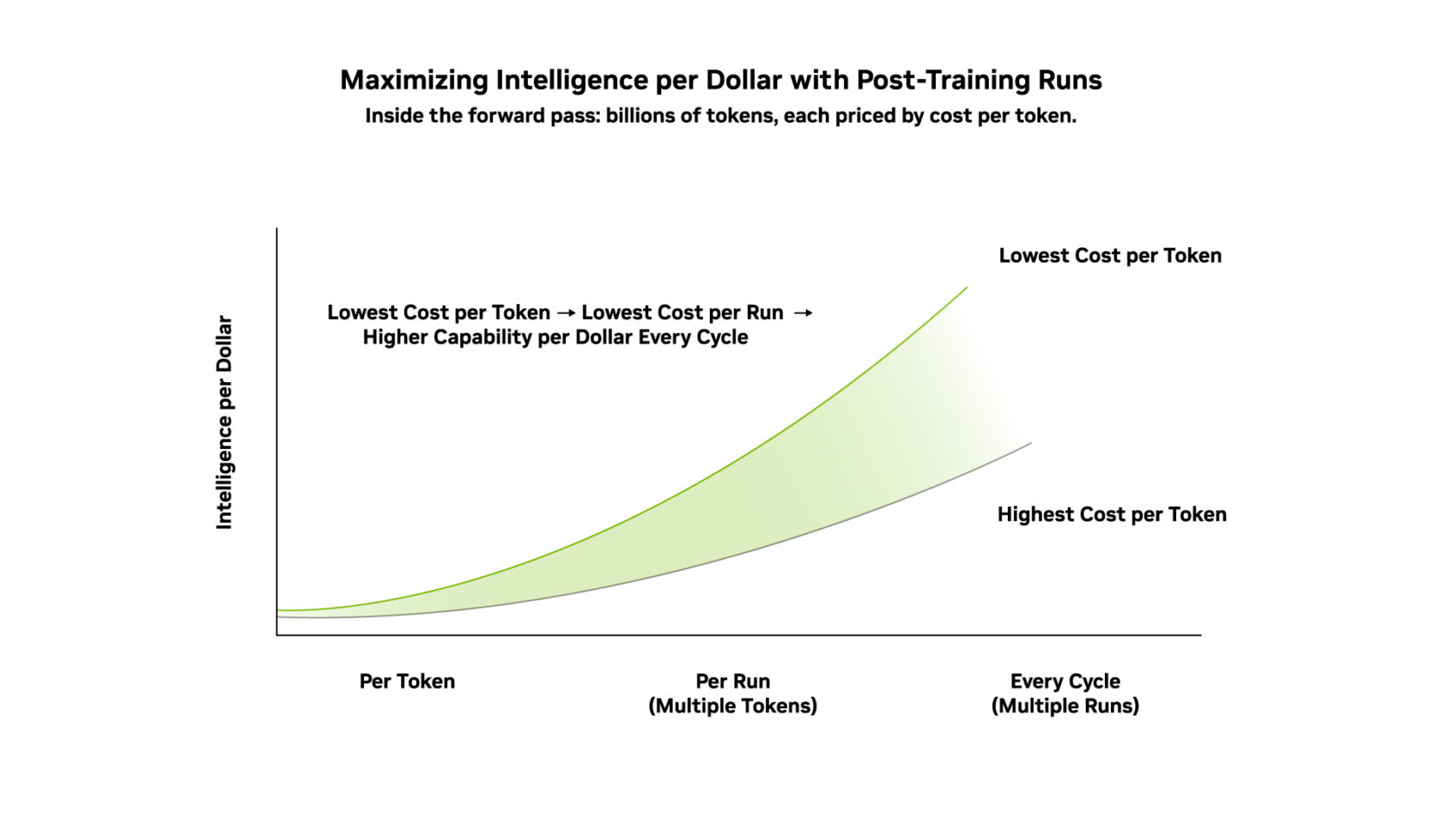
The goal of post-training is to maximize intelligence per dollar by maximizing the yield of every forward and backward pass in the continuous learning cycle. The forward pass — inference — is measured in cost per token. That means that every improvement to cost per token flows directly into intelligence per dollar. 

Agentic Post-Training Demystified

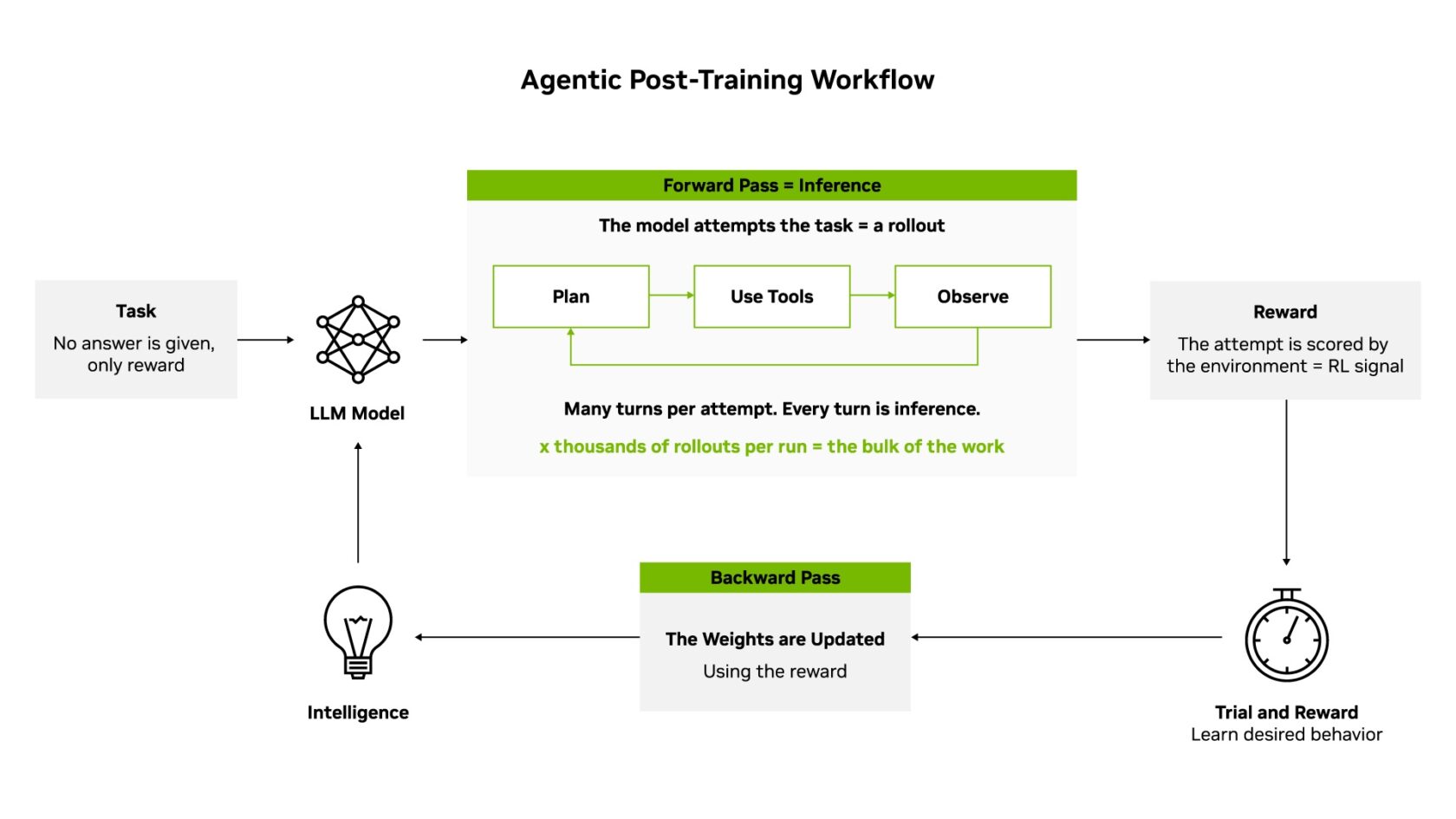
Post-training is where intelligence is built. In pretraining, the model learns to predict the next token, which gives it fluency but not intelligence. Post-training is where it learns to write code, plan a multistep task, use a search tool and recover when something goes wrong. Inference is what comes after: the model working on the job, priced in cost per token.

Because there’s no answer key to memorize, only a reward, the model learns by reinforcement learning (RL) techniques. When given a task, it writes out an attempt — the forward pass — the same work it does on the job. The attempt is scored, and the lesson updates the model’s weights — the backward pass. Across millions of attempts, intelligence grows.

Each step is compute intensive, and running this loop at scale is an orchestration problem: thousands of environments generating rollouts in parallel, rewards being verified and updated weights flowing back into training with accelerators fully utilized. NVIDIA NeMo open libraries, such as NeMo Gym for training environments and NeMo RL for distributed post-training, turn post-training from bespoke research code into repeatable infrastructure. 

Why Intelligence per Dollar Extends Cost per Token 

If inference is the revenue engine, post-training is the multiplier: the more capable the model, the higher the value of every token served. 

Cost per token is the key metric for the inference factory: the all-in cost of delivering 1 million tokens. Intelligence per dollar sits one layer up, answering a different question: what does it cost to build a model worth serving, and keep it worth serving as its environment changes?

The two are nested, not competing. AI infrastructure that lowers cost per token also lowers the cost of every point of intelligence built into the model. And every point of intelligence built in raises the value of every token the inference factory serves. 

In other words, cost per token measures operating yield; intelligence per dollar measures whether the investment in model intelligence is paying off. 

Maximizing Intelligence per Dollar: Post-Training Nemotron 3 Ultra

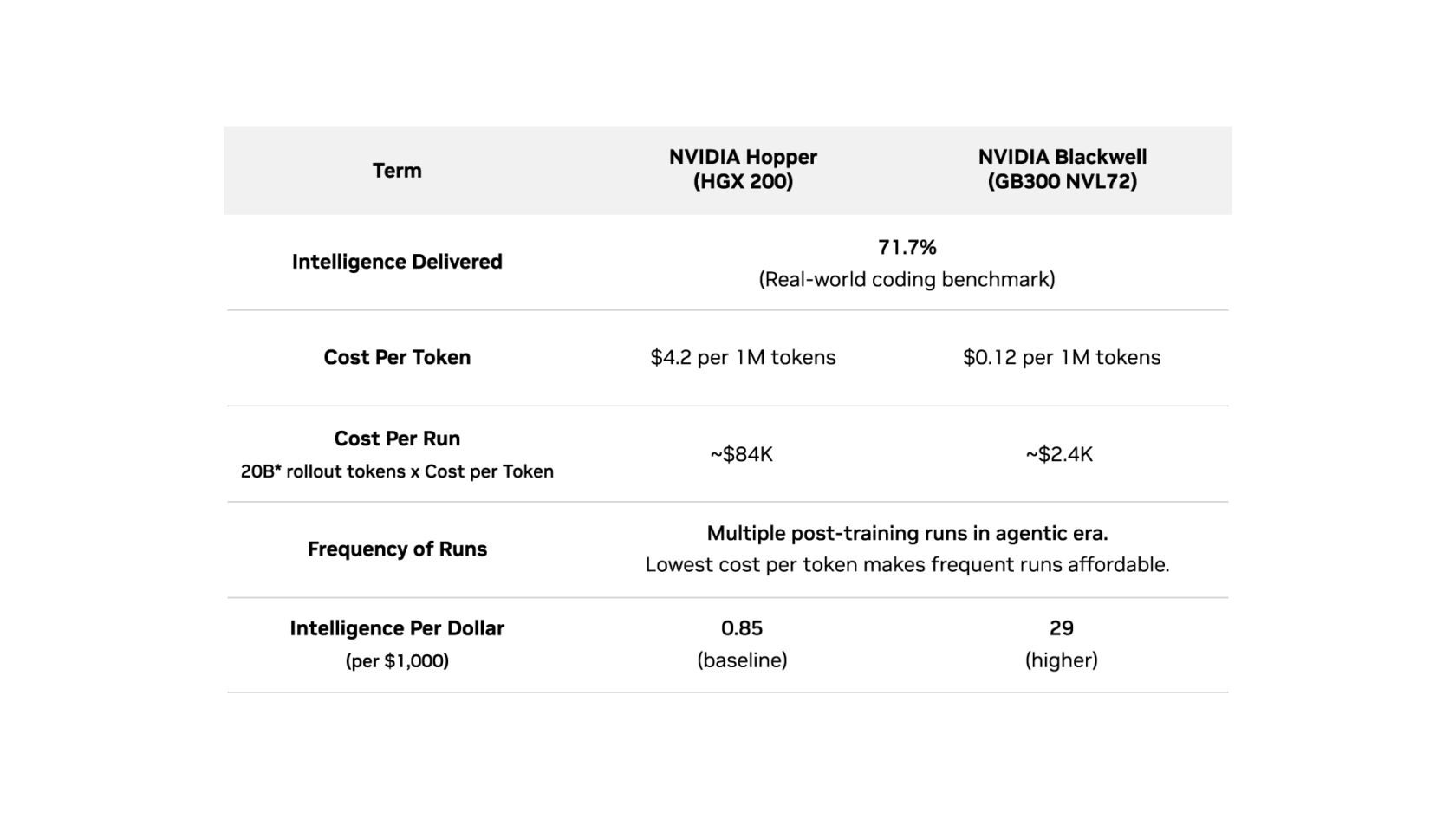
NVIDIA Nemotron 3 Ultra — an open weight, 550-billion-parameter mixture-of-experts (MoE) model, offers verifiable benchmarks and a fully disclosed post-training recipe run on NeMo RL. It scored 71.7% on a standard real-world coding benchmark, SWE-bench verified, where it produced a working fix for roughly seven in 10 real software bugs from open source projects, each one checked against the project’s own tests.  

Illustrative 20 billion rollout tokens, based on prior-generation Nemotron 3 Super’s ~1.2 million rollouts at ~10,000 tokens each, scaled up for the larger Ultra model. Intelligence per dollar between platforms is independent of this assumption; the absolute values scale with the token count.

The NVIDIA Blackwell platform lowers cost per run and makes the frequent post-training the agentic era demands economically viable. That intelligence is reaped across every token served.

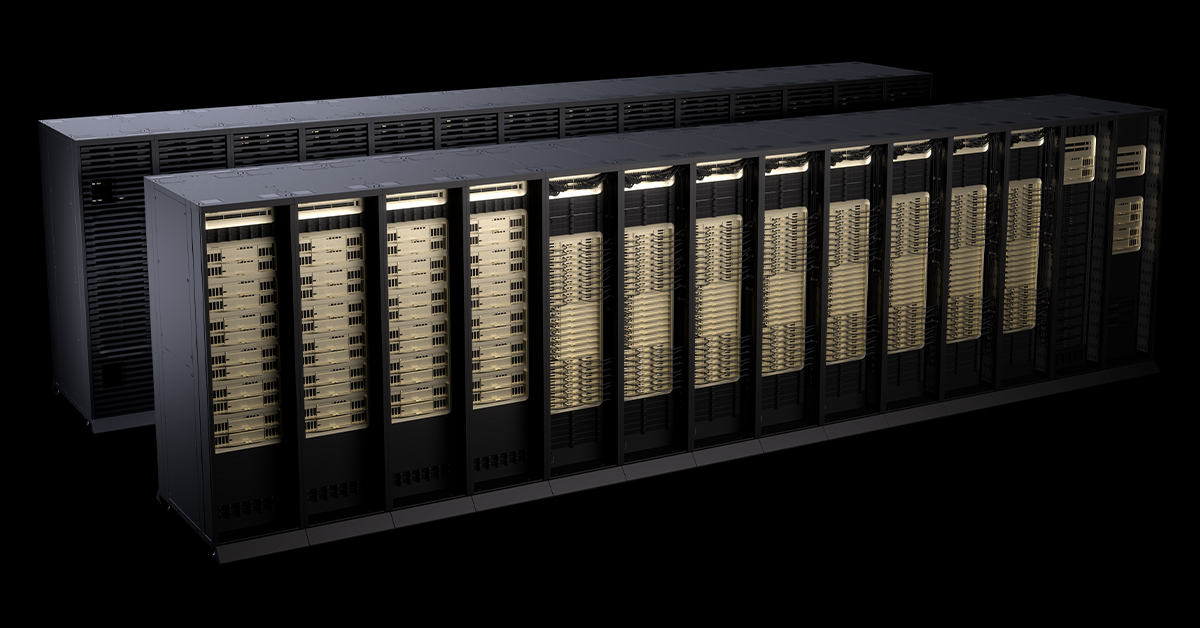
The NVIDIA Vera Rubin platform extends the trajectory further, training the largest models with one-fourth the GPUs of the Blackwell generation. It was codesigned from end to end to maximize intelligence per dollar for the agentic post-training load: more rollouts per run, more environments in play and post-training cycles that never stop.

Post-Training Workflows in Action

Prime Intellect’s Lab continuously post-trains frontier open models on NVIDIA Blackwell and uses NVIDIA Dynamo for inference orchestration. With Vera Rubin, Prime Intellect plans to scale reinforcement learning environments, generate more rollouts per run and accelerate training-to-inference iteration loops to maximize intelligence per dollar for businesses.

Prime Intellect has optimized its sandbox infrastructure to integrate with NVIDIA Vera CPUs, enabling low-latency, energy-efficient reinforcement learning. Open source tools and models such as NVIDIA Nemotron and NVIDIA NeMo Gym are also integrated into its software stack. When comparing realistic RL sandbox workloads against alternative x86 architectures, Prime Intellect found that Vera delivers, on average, 30% greater throughput per CPU.

Perplexity’s RL post-training stack runs asynchronously across hundreds of NVIDIA GPUs, with an RDMA-based weight transfer engine that syncs trillion-parameter models in under two seconds between training and inference compute nodes. The resulting post-trained Qwen3 235B models are then served on NVIDIA GB200 NVL72 systems.

Together AI provides post-training as a service, including supervised fine-tuning, RL and direct preference optimization. The service is delivered via a feature-rich application programming interface and software development kit that supports the full range of post-training on its AI Native Cloud platform. It has been running on NVIDIA’s platform and optimized kernel libraries, and is looking to harness the Vera Rubin platform next.

Learn more about NVIDIA Vera Rubin, the platform for AI factories to maximize intelligence per dollar across workloads. And explore NVIDIA’s full-stack platform for training frontier models.

NVIDIA and Google Cloud Empower the Next Wave of AI Builders


At this year’s Google I/O conference, NVIDIA and Google Cloud are accelerating the work of more than 100,000 developers in the companies’ joint developer community, which provides curated learning paths, hands-on labs and events that help them build using the full-stack NVIDIA AI platform on Google Cloud. 

Launched at Google I/O last year, the community brings together developers, data scientists and machine learning engineers who want to sharpen their AI skills on the latest NVIDIA and Google Cloud technologies. 

New additions for the community are rolling out this year, including a learning path for using the JAX library on NVIDIA GPUs, a new NVIDIA Dynamo codelab focused on inference optimizations, as well as monthly developer livestreams. 

Over the last year, the community has become a go‑to hub for AI builders using NVIDIA‑accelerated tools for data science and machine learning. The result has been production‑ready retrieval-augmented generation applications on Google Kubernetes Engine (GKE) and instrumenting observability for agent workloads. 

These AI builders are also experimenting with new large language model research and prototyping hybrid on‑premises and cloud inference for real‑world use cases like sports analytics and enterprise data pipelines. 

Building With Google DeepMind’s Gemma, NVIDIA Nemotron and Open Frameworks

NVIDIA and Google Cloud are equipping developers with learning resources and hands-on labs that combine NVIDIA libraries, open models and tools with Google Cloud’s AI platform — so they can build optimized, production‑ready AI applications faster.

For example, developers can accelerate data science and analytics with the NVIDIA cuDF library in Google Colab Enterprise or Dataproc, or deploy multi-agent applications by combining Google DeepMind’s Gemma 4 models, NVIDIA Nemotron open models and Google Agent Development Kit with Google Cloud G4 VMs powered by NVIDIA RTX PRO 6000 Blackwell GPUs in Google Cloud Run or with spot instances. 

NVIDIA and Google Cloud work closely across open frameworks like JAX so developers can build, scale and productize JAX workloads on NVIDIA AI infrastructure on Google Cloud — from single‑GPU experiments to multi‑rack deployments — while getting strong performance and a consistent experience. 

This work extends to Google Cloud AI Hypercomputer, where the MaxText framework uses these JAX optimizations to train large models efficiently on NVIDIA GPUs.

Building on the same foundation, NVIDIA Dynamo on GKE helps developers optimize large-scale inference — including mixture-of-experts models — so they can serve AI applications more efficiently with NVIDIA accelerated infrastructure on Google Cloud.

To help developers get hands-on with these capabilities, a new learning path on running and scaling JAX on NVIDIA GPUs and a new NVIDIA Dynamo on GKE inference codelab will become available next month for members in the Google Cloud and NVIDIA developer community.

Advancing Responsible AI With Google DeepMind’s SynthID and NVIDIA Cosmos

AI agents are increasingly built from a system of AI models — combining proprietary and open source models that reason, plan and act on users’ behalf. 

Amid this shift, trust and transparency are foundational, so developers and organizations can understand how these systems work and what they generate.

NVIDIA was the first industry partner to collaborate with Google DeepMind on SynthID, an AI watermarking technology that embeds robust digital watermarks directly into AI‑generated content, which helps preserve the integrity of outputs from NVIDIA Cosmos world foundation models available on build.nvidia.com.

Cosmos models provide rich 3D perception and simulation capabilities for robots, autonomous machines and other physical AI systems, while SynthID brings content transparency to the imagery and video they rely on. 

Together, they help preserve the integrity of AI‑generated content so developers can build and deploy agentic applications more responsibly across cloud, edge and real‑world environments.

Building on a Full-Stack NVIDIA and Google Cloud Platform

This year, Google I/O is putting the spotlight on new agentic experiences and tools for developers — and NVIDIA and Google Cloud are focused on ensuring builders have the infrastructure, software and learning resources they need to make the most of them. 

For developers in the community building on NVIDIA and Google Cloud, the skills and tools they learn can scale, effortlessly taking projects from prototype to enterprise‑grade workloads. 

At Google Cloud Next, Google Cloud and NVIDIA expanded their full‑stack platform to help developers train, deploy and operationalize agents on Google Cloud. This collaboration includes work on NVIDIA Vera Rubin-powered A5X instances, Google DeepMind Gemini models and more, and is being harnessed by leading AI labs and enterprises including OpenAI, Thinking Machine Labs, Schrodinger, Salesforce, Snap and Crowdstrike. Learn more in this blog.

Join the NVIDIA and Google Cloud developer community to connect with other builders and stay up to date on new tools, developer events and programs.