California residents can use new tool to demand brokers delete their personal data


California is giving residents a new tool that should make it easier for them to limit data brokers’ ability to store and sell their personal information.

While state residents have had the right to demand that a company stop collecting and selling their data since 2020, doing so required a laborious process of opting out with each individual company. The Delete Act, passed in 2023, was supposed to simplify things, allowing residents to make a single request that more than 500 registered data brokers delete their information.

Now the Delete Requests and Opt-Out Platform (DROP) actually gives residents the ability to make that request. Once DROP users verify that they are California residents, they can submit a deletion request that will go to all current and future data brokers registered with the state.

But that doesn’t necessarily mean that all your data will be deleted immediately. Brokers are supposed to start processing requests in August 2026, then they have 90 days to actually process requests and report back. If they don’t delete your data, you’ll have the option to submit additional information that may help them locate your records.

Companies will also be able to keep first-party data that they’ve collected from users. It’s only brokers who seek to buy or sell that data — which can include your social security number, browsing history, email address, phone number, and more — who will be required to delete it.

Some information, such vehicle registration and voter records, is exempt from deletion because it comes from public documents. Other information, such as sensitive medical information, may be covered under other laws like HIPAA.

The California Privacy Protection Agency says that in addition to giving residents more control over their data, the tool could result in fewer “unwanted texts, calls, or emails” and also decrease the “risk of identity theft, fraud, AI impersonations, or that your data is leaked or hacked.”

Techcrunch event

San Francisco
|
October 13-15, 2026

The penalty for data brokers who fail to register or fail to delete requested consumer data is $200 per day, plus enforcement costs, according to the agency.
California Just Legalized Waymo in Some of the Nation’s Most Populous Areas


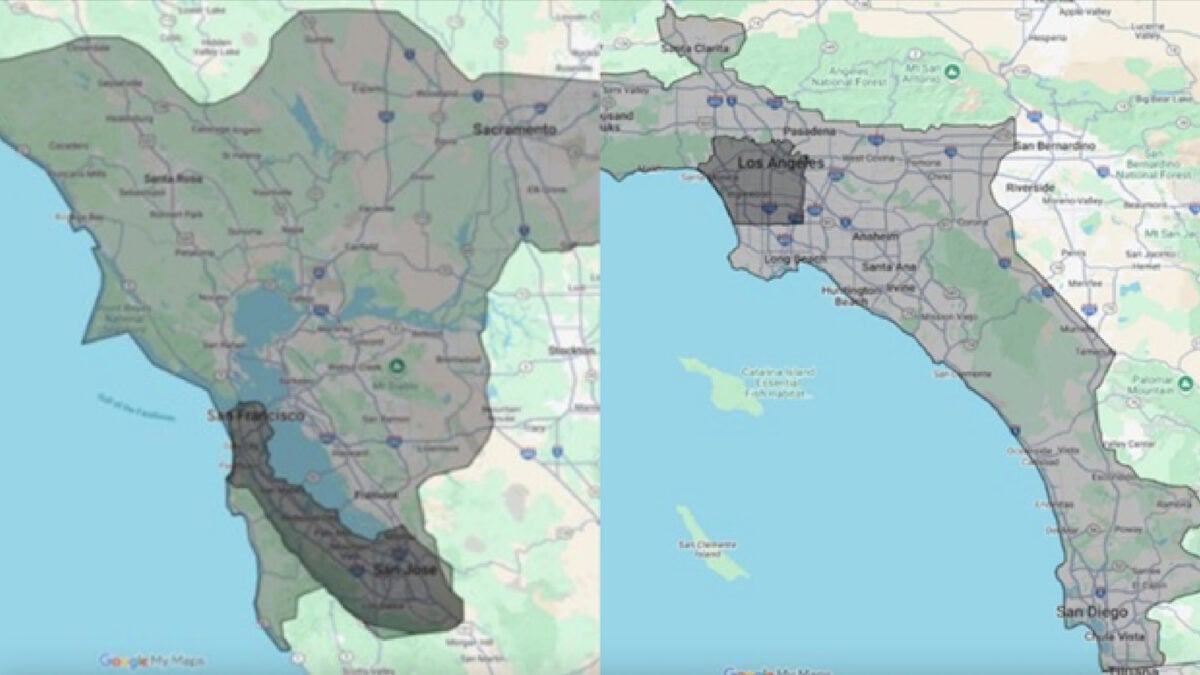
On Friday, the California Department of Motor Vehicles published a document outlining a list of newly approved areas of coverage for Alphabet, Inc.’s robotaxi service Waymo, and the implications could be massive.

The areas where “testing and deployment” of Waymo driverless taxis will now be legally tolerated by the state include two massive, apparently continuous swaths of geography full of interconnected urban population centers, suburbs, exurbs, and the rural land in between them. This includes chunks of (in alphabetical order) Alameda, Contra Costa, Los Angeles, Marin, Napa, Orange, Riverside, Sacramento, San Bernardino, San Diego, San Francisco, San Mateo, Santa Clara, Solano, Sonoma, Ventura, and Yolo Counties.

The new map includes much of California wine country, and fills in the remainder of the Bay Area. It also adds a great deal of coverage to densely populated parts of southern California. Most of Orange and San Diego Counties are now state-approved Waymo zones, for instance, and each of those accounts for millions of residents. If Waymo follows this approval with a rollout of its service in all these areas, it means commuters can travel for hours in Waymo vehicles, sightseers can take long day trips. Exurban residents can take Waymo rides to Los Angeles International Airport.

Famous expanses of California highways—and freeways—could potentially open up to driverless taxi traffic. You could take the scenic route up Pacific Coast Highway from San Diego to Malibu, or driverlessly reenact the first episode of The O.C. by hailing a ride from Chino to Newport Beach.

Of course, the price of doing any of these things could be breathtaking. At the average of $11.22 per kilometer cited by one Waymo price analysis from June, it would cost, by my count, $2,636 to travel from San Diego to Malibu in a Waymo if the current pricing pattern holds—though a new pricing pattern would probably emerge for longer rides. A similar ride would cost about $200 in a human-piloted Lyft or Uber, according to the fare estimator site Rideguru.

Waymo says it has no specific plan for rolling out its service in most of these newly permitted areas, though it does have its eyes on one of these areas. “We appreciate the DMV’s approval of our expanded fully autonomous operations,” a Waymo representative told CBS News, who claimed the company’s next expansion “will be San Diego, where we’ll welcome our first riders in mid-2026.”

California Lawmakers Once Again Challenge Newsom’s Tech Ties with AI Bill


Last year, California Governor Gavin Newsom vetoed a wildly popular (among the public) and wildly controversial (among tech companies) bill that would have established robust safety guidelines for the development and operation of artificial intelligence models. Now he’ll have a second shot—this time with at least part of the tech industry giving him the green light. On Saturday, California lawmakers passed Senate Bill 53, a landmark piece of legislation that would require AI companies to submit to new safety tests.

Senate Bill 53, which now awaits the governor’s signature to become law in the state, would require companies building “frontier” AI models—systems that require massive amounts of data and computing power to operate—to provide more transparency into their processes. That would include disclosing safety incidents involving dangerous or deceptive behavior by autonomous AI systems, providing more clarity into safety and security protocols and risk evaluations, and providing protections for whistleblowers who are concerned about the potential harms that may come from models they are working on.

The bill—which would apply to the work of companies like OpenAI, Google, xAI, Anthropic, and others—has certainly been dulled from previous attempts to set up a broad safety framework for the AI industry. The bill that Newsom vetoed last year, for instance, would have established a mandatory “kill switch” for models to address the potential of them going rogue. That’s nowhere to be found here. An earlier version of SB 53 also applied the safety requirements to smaller companies, but that has changed. In the version that passed the Senate and Assembly, companies bringing in less than $500 million in annual revenue only have to disclose high-level safety details rather than more granular information, per Politico—a change made in part at the behest of the tech industry.

Whether that’s enough to satisfy Newsom (or more specifically, satisfy the tech companies from whom he would like to continue receiving campaign contributions) is yet to be seen. Anthropic recently softened on the legislation, opting to throw its support behind it just days before it officially passed. But trade groups like the Consumer Technology Association (CTA) and Chamber for Progress, which count among its members companies like Amazon, Google, and Meta, have come out in opposition to the bill. OpenAI also signaled its opposition to regulations California has been pursuing without specifically naming SB 53.

After the Trump administration tried and failed to implement a 10-year moratorium on states implementing regulations on AI, California has the opportunity to lead on the issue—which makes sense, given most of the companies at the forefront of the space are operating within its borders. But that fact also seems to be part of the reason Newsom is so shy to pull the trigger on regulations despite all his bluster on many other issues. His political ambitions require money to run, and those companies have a whole lot of it to offer.

Here is what’s illegal under California’s 8 (and counting) new AI laws


California Governor Gavin Newsom is currently considering 38 AI-related bills, including the highly contentious SB 1047, which the state’s legislature sent to his desk for final approval. These bills try to address the most pressing issues in artificial intelligence: everything from futuristic AI systems creating existential risk, deepfake nudes from AI image generators, to Hollywood studios creating AI clones of dead performers.

“Home to the majority of the world’s leading AI companies, California is working to harness these transformative technologies to help address pressing challenges while studying the risks they present,” said Governor Newsom’s office in a press release.

So far, Governor Newsom has signed eight of them into law, some of which are America’s most far reaching AI laws yet.

Deepfake nudes

Newsom signed two laws that address the creation and spread of deepfake nudes on Thursday. SB 926 criminalizes the act, making it illegal to blackmail someone with AI-generated nude images that resemble them.

SB 981, which also became law on Thursday, requires social media platforms to establish channels for users to report deepfake nudes that resemble them. The content must then be temporarily blocked while the platform investigates it, and permanently removed if confirmed.

Watermarks

Also on Thursday, Newsom signed a bill into law to help the public identify AI-generated content. SB 942 requires widely used generative AI systems to disclose they are AI-generated in their content’s provenance data. For example, all images created by OpenAI’s Dall-E now need a little tag in their metadata saying they’re AI generated.

Many AI companies already do this, and there are several free tools out there that can help people read this provenance data and detect AI-generated content.

Election deepfakes

Earlier this week, California’s governor signed three laws cracking down on AI deepfakes that could influence elections.

One of California’s new laws, AB 2655, requires large online platforms, like Facebook and X, to remove or label AI deepfakes related to elections, as well as create channels to report such content. Candidates and elected officials can seek injunctive relief if a large online platform is not complying with the act.

Another law, AB 2839, takes aim at social media users who post, or repost, AI deepfakes that could deceive voters about upcoming elections. The law went into effect immediately on Tuesday, and Newsom suggested Elon Musk may be at risk of violating it.

AI-generated political advertisements now require outright disclosures under California’s new law, AB 2355. That means moving forward, Trump may not be able to get away with posting AI deepfakes of Taylor Swift endorsing him on Truth Social (she endorsed Kamala Harris). The FCC has proposed a similar disclosure requirement at a national level and has already made robocalls using AI-generated voices illegal.

Actors and AI

Two laws that Newsom signed on Tuesday — which SAG-AFTRA, the nation’s largest film and broadcast actors union, was pushing for — create new standards for California’s media industry. AB 2602 requires studios to obtain permission from an actor before creating an AI-generated replica of their voice or likeness.

Meanwhile, AB 1836 prohibits studios from creating digital replicas of deceased performers without consent from their estates (e.g., legally cleared replicas were used in the recent “Alien” and “Star Wars” movies, as well as in other films).

What’s left?

Governor Newsom still has 30 AI-related bills to decide on before the end of September. During a chat with Salesforce CEO Marc Benioff on Tuesday during the 2024 Dreamforce conference, Newsom may have tipped his hat about SB 1047, and how he’s thinking about regulating the AI industry more broadly.

“There’s one bill that is sort of outsized in terms of public discourse and consciousness; it’s this SB 1047,” said Newsom onstage Tuesday. “What are the demonstrable risks in AI and what are the hypothetical risks? I can’t solve for everything. What can we solve for? And so that’s the approach we’re taking across the spectrum on this.”

Check back on this article for updates on what AI laws California’s governor signs, and what he doesn’t.

Media coalition asks the feds to investigate Google’s removal of California news links


The News/Media Alliance, formerly the Newspaper Association of America, asked US federal agencies to investigate Google’s removal of links to California news media outlets. Google’s tactic is in response to the proposed California Journalism Preservation Act (CJPA), which would require it and other tech companies to pay for links to California-based publishers’ news content.

The News/Media Alliance, which represents over 2,200 publishers, sent letters to the Department of Justice, Federal Trade Commission and California State Attorney General on Tuesday. It says the removal “appears to be either coercive or retaliatory, driven by Google’s opposition to a pending legislative measure in Sacramento.”

The CJPA would require Google and other tech platforms to pay California media outlets in exchange for links. The proposed bill passed the state Assembly last year.

In a blog post last week announcing the removal, Google VP of Global News Partnerships Jaffer Zaidi warned that the CJPA is “the wrong approach to supporting journalism” (because Google’s current approach totally hasn’t left the industry in smoldering ruins!). Zaidi said the CJPA “would also put small publishers at a disadvantage and limit consumers’ access to a diverse local media ecosystem.” Nothing to see here, folks: just your friendly neighborhood multi-trillion-dollar company looking out for the little guy!

Google described its link removal as a test to see how the bill would impact its platform:

“To prepare for possible CJPA implications, we are beginning a short-term test for a small percentage of California users,” Zaidi wrote. “The testing process involves removing links to California news websites, potentially covered by CJPA, to measure the impact of the legislation on our product experience. Until there’s clarity on California’s regulatory environment, we’re also pausing further investments in the California news ecosystem, including new partnerships through Google News Showcase, our product and licensing program for news organizations, and planned expansions of the Google News Initiative.”

In its letters, The News/Media Alliance lists several laws it believes Google may be breaking with the “short-term” removal. Potential federal violations include the Lanham Act, the Sherman Antitrust Act and the Federal Trade Commission Act. The letter to California’s AG cites the state’s Unruh Civil Rights Act, regulations against false advertising and misrepresentation, the California Consumer Privacy Act and California’s Unfair Competition Law (UCL).

“Importantly, Google released no further details on how many Californians will be affected, how the Californians who will be denied news access were chosen, what publications will be affected, how long the compelled news blackouts will persist, and whether access will be blocked entirely or just to content Google particularly disfavors,” News/Media Alliance President / CEO Danielle Coffey wrote in the letter to the DOJ and FTC. “Because of these unknowns, there are many ways Google’s unilateral decision to turn off access to news websites for Californians could violate laws.”

Google has a mixed track record in dealing with similar legislation. It pulled Google News from Spain for seven years in response to local copyright laws that would have required licensing fees to publishers. However, it signed deals worth around $150 million to pay Australian publishers and retreated from threats to pull news from search results in Canada, instead spending the $74 million required by the Online News Act.

Google made more than $73 billion in profits in 2023. The company currently has a $1.94 trillion market cap.