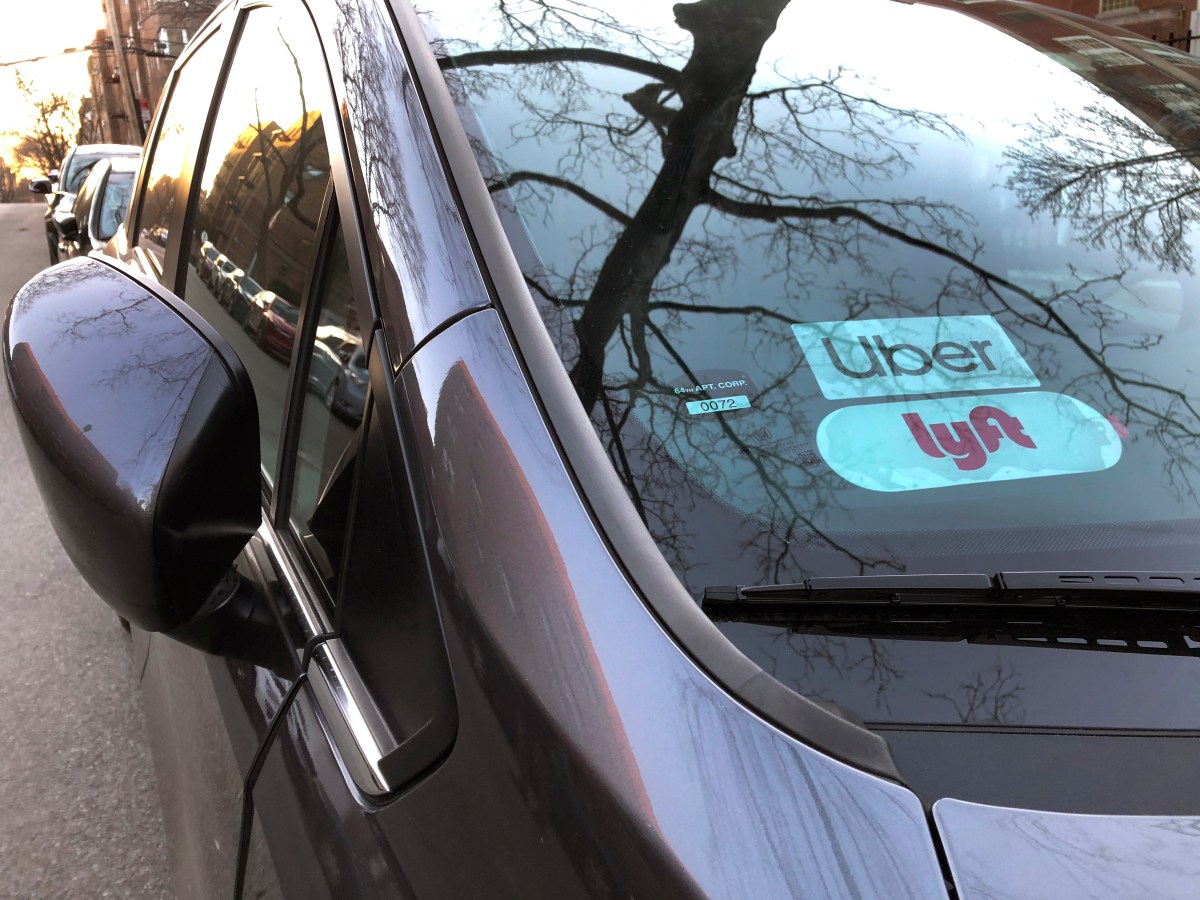
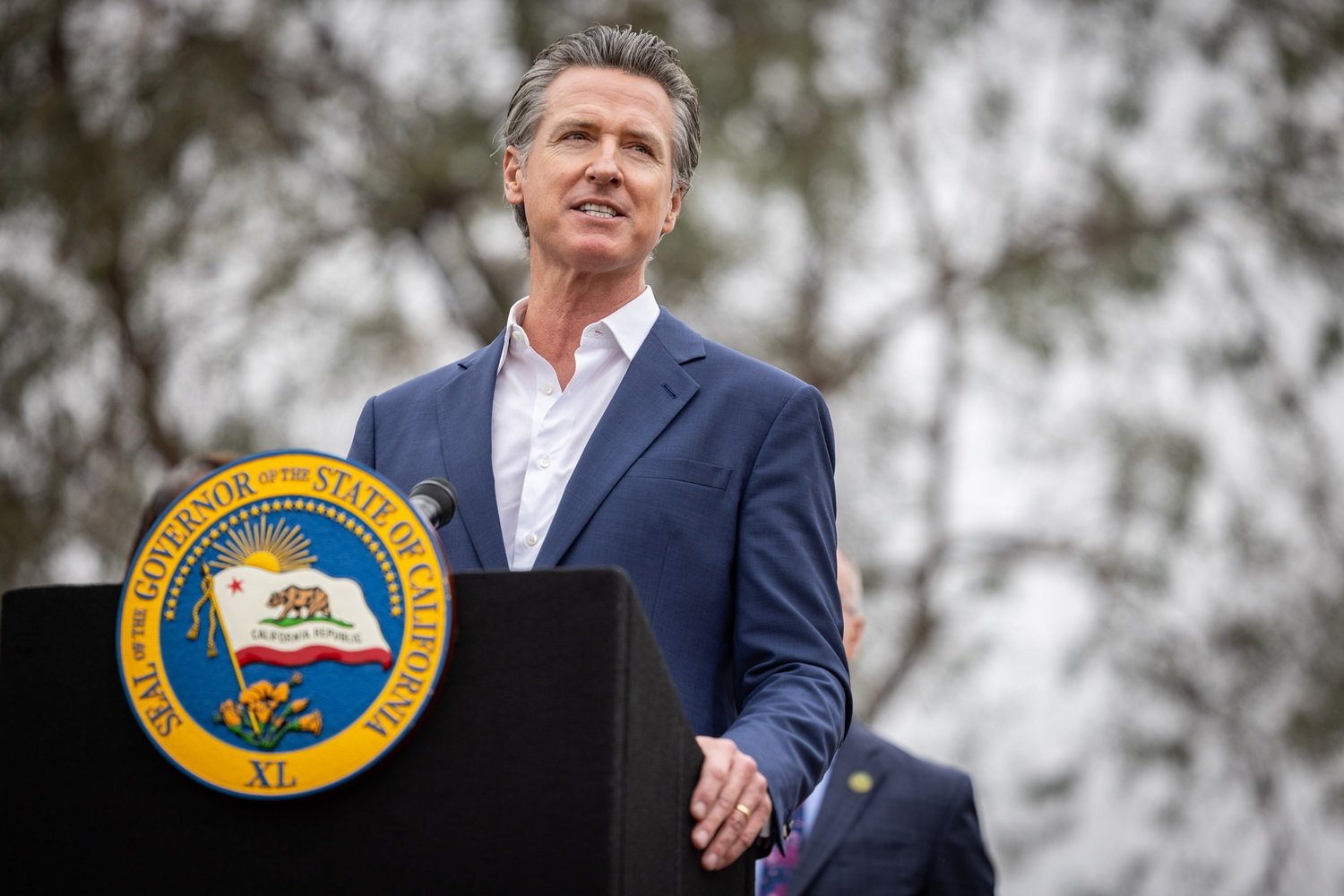
Drivers for ride-hailing apps like Uber and Lyft will soon have the right to unionize in California as independent contractors, thanks to a bill signed Friday by Governor Gavin Newsom.
This is part of a larger deal between lawmakers, unions, and ride-hailing companies, resulting in the passage of separate bills supporting lower insurance requirements for Uber and Lyft, along with union rights for their drivers. When the deal was first announced in August, Newsom described it as an “historic agreement between workers and business that only California could deliver.”
The Associated Press reports that more than 800,000 drivers will gain the right to join a union and collectively bargain for better pay and benefits. Ramona Prieto, Uber’s head of public policy for California, told the AP in a statement that the two bills “represent a compromise that lowers costs for riders while creating stronger voices for drivers.”
California’s state senate recently gave final approval to a new AI safety bill, SB 53, sending it to Governor Gavin Newsom to either sign or veto.
If this all sounds familiar, that’s because Newsom vetoed another AI safety bill, also written by state senator Scott Wiener, last year. But SB 53 is narrower than Wiener’s previous SB 1047, with a focus on big AI companies making more than $500 million in annual revenue.
I got the chance to discuss SB 53 with my colleagues Max Zeff and Kirsten Korosec on the latest episode of TechCrunch’s flagship podcast Equity. Max believes that Wiener’s new bill has a better shot of becoming law, partly because of that big company focus, and because it’s been endorsed by AI company Anthropic.
Read a preview of our conversation about AI safety and state-level legislation below. (I’ve edited the transcript for length and clarity, and to make us sound slightly smarter.)
Max: Why should you care about AI safety legislation that’s passing a chamber in California? We’re entering this era where AI companies are becoming the most powerful companies in the world, and this is going to be potentially one of the few checks on their power.
This is much narrower than SB 1047, which got a lot of pushback last year. But I think SB 53 still puts some meaningful regulations on the AI labs. It makes them publish safety reports for their models. If they have an incident, it basically forces them to report that to the government. And it also, for employees at these labs, if they have concerns, gives them a channel to report that to the government and not face pushback from the companies, even though a lot of them have signed NDAs.
To me, this feels like a potentially meaningful check on tech companies’ power, something we haven’t really had for the last couple of decades.
Techcrunch event
San Francisco | October 27-29, 2025
Kirsten: To your point about why it matters at the state level, it’s important to think about the fact that it’s California. Every major AI company is pretty much, if not based here, it has a major footprint in this state. Not that other states don’t matter — I do not want to be getting emails from the folks in Colorado or whatever — but it does matter that it’s specifically California because it’s really a hub of AI activity.
My question for you, though, Max, is it just seems like there’s a lot of exceptions and carve-outs. It’s narrower, but is it more complicated than the previous [bill]?
Max: In some ways, yes. I would say the main carve-out of this bill is that it really tries to not apply to small startups. And basically, one of the main controversies around the last legislative effort from Senator Scott Weiner, who represents San Francisco, who authored this bill, a lot of people said it could harm the startup ecosystem, which a lot of people take issue with because that’s such a booming part of California’s economy right now.
This bill specifically applies to AI developers that are [generating] more than $500 million [from] their AI models. This really tries to target OpenAI, Google DeepMind, these big companies and not your run-of-the-mill startup.
Anthony: As I understand it, if you’re a smaller startup, you do have to share some safety information, but not nearly as much.
It’s [also] worth talking about the broader landscape around AI regulation and the fact that one of the big changes between last year and this year is now we have a new president. The federal administration has taken much more of a stance of no regulation and companies should be able to do what they want, to the extent that they’ve actually included [language] in funding bills saying states cannot have their own AI regulation.
I don’t think any of that has passed so far, but potentially they could try to get that through in the future. So this could be another front in which the Trump administration and blue states are fighting.
Equity is TechCrunch’s flagship podcast, produced by Theresa Loconsolo, and posts every Wednesday and Friday.
Last year, California Governor Gavin Newsom vetoed a wildly popular (among the public) and wildly controversial (among tech companies) bill that would have established robust safety guidelines for the development and operation of artificial intelligence models. Now he’ll have a second shot—this time with at least part of the tech industry giving him the green light. On Saturday, California lawmakers passed Senate Bill 53, a landmark piece of legislation that would require AI companies to submit to new safety tests.
Senate Bill 53, which now awaits the governor’s signature to become law in the state, would require companies building “frontier” AI models—systems that require massive amounts of data and computing power to operate—to provide more transparency into their processes. That would include disclosing safety incidents involving dangerous or deceptive behavior by autonomous AI systems, providing more clarity into safety and security protocols and risk evaluations, and providing protections for whistleblowers who are concerned about the potential harms that may come from models they are working on.
The bill—which would apply to the work of companies like OpenAI, Google, xAI, Anthropic, and others—has certainly been dulled from previous attempts to set up a broad safety framework for the AI industry. The bill that Newsom vetoed last year, for instance, would have established a mandatory “kill switch” for models to address the potential of them going rogue. That’s nowhere to be found here. An earlier version of SB 53 also applied the safety requirements to smaller companies, but that has changed. In the version that passed the Senate and Assembly, companies bringing in less than $500 million in annual revenue only have to disclose high-level safety details rather than more granular information, per Politico—a change made in part at the behest of the tech industry.
Whether that’s enough to satisfy Newsom (or more specifically, satisfy the tech companies from whom he would like to continue receiving campaign contributions) is yet to be seen. Anthropic recently softened on the legislation, opting to throw its support behind it just days before it officially passed. But trade groups like the Consumer Technology Association (CTA) and Chamber for Progress, which count among its members companies like Amazon, Google, and Meta, have come out in opposition to the bill. OpenAI also signaled its opposition to regulations California has been pursuing without specifically naming SB 53.
California Governor Gavin Newsom is currently considering 38 AI-related bills, including the highly contentious SB 1047, which the state’s legislature sent to his desk for final approval. These bills try to address the most pressing issues in artificial intelligence: everything from futuristic AI systems creating existential risk, deepfake nudes from AI image generators, to Hollywood studios creating AI clones of dead performers.
“Home to the majority of the world’s leading AI companies, California is working to harness these transformative technologies to help address pressing challenges while studying the risks they present,” said Governor Newsom’s office in a press release.
So far, Governor Newsom has signed eight of them into law, some of which are America’s most far reaching AI laws yet.
Deepfake nudes
Newsom signed two laws that address the creation and spread of deepfake nudes on Thursday. SB 926 criminalizes the act, making it illegal to blackmail someone with AI-generated nude images that resemble them.
SB 981, which also became law on Thursday, requires social media platforms to establish channels for users to report deepfake nudes that resemble them. The content must then be temporarily blocked while the platform investigates it, and permanently removed if confirmed.
Watermarks
Also on Thursday, Newsom signed a bill into law to help the public identify AI-generated content.SB 942 requires widely used generative AI systems to disclose they are AI-generated in their content’s provenance data. For example, all images created by OpenAI’s Dall-E now need a little tag in their metadata saying they’re AI generated.
Many AI companies already do this, and there are several free tools out there that can help people read this provenance data and detect AI-generated content.
Election deepfakes
Earlier this week, California’s governor signed three laws cracking down on AI deepfakes that could influence elections.
One of California’s new laws, AB 2655, requires large online platforms, like Facebook and X, to remove or label AI deepfakes related to elections, as well as create channels to report such content. Candidates and elected officials can seek injunctive relief if a large online platform is not complying with the act.
Another law, AB 2839, takes aim at social media users who post, or repost, AI deepfakes that could deceive voters about upcoming elections. The law went into effect immediately on Tuesday, and Newsom suggested Elon Musk may be at risk of violating it.
Two laws that Newsom signed on Tuesday — which SAG-AFTRA, the nation’s largest film and broadcast actors union, was pushing for — create new standards for California’s media industry. AB 2602 requires studios to obtain permission from an actor before creating an AI-generated replica of their voice or likeness.
Meanwhile, AB 1836 prohibits studios from creating digital replicas of deceased performers without consent from their estates (e.g., legally cleared replicas were used in the recent “Alien” and “Star Wars” movies, as well as in other films).
What’s left?
Governor Newsom still has 30 AI-related bills to decide on before the end of September. During a chat with Salesforce CEO Marc Benioff on Tuesday during the 2024 Dreamforce conference, Newsom may have tipped his hat about SB 1047, and how he’s thinking about regulating the AI industry more broadly.
“There’s one bill that is sort of outsized in terms of public discourse and consciousness; it’s this SB 1047,” said Newsom onstage Tuesday. “What are the demonstrable risks in AI and what are the hypothetical risks? I can’t solve for everything. What can we solve for? And so that’s the approach we’re taking across the spectrum on this.”
Check back on this article for updates on what AI laws California’s governor signs, and what he doesn’t.