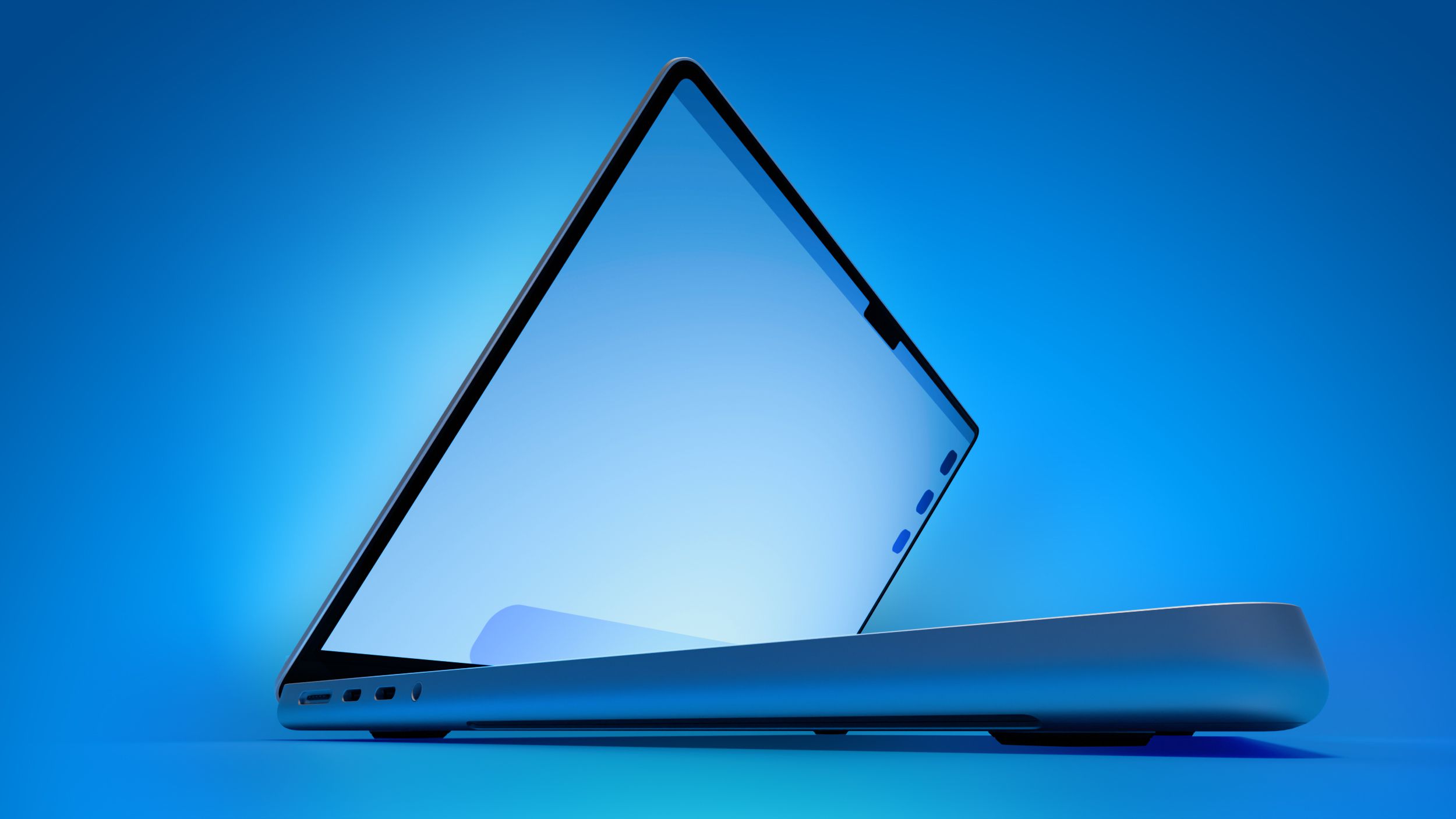
Apple is working on a high-end MacBook Pro that could be called the “MacBook Ultra.” The device will have several firsts in a Mac, including an OLED display and a touchscreen.
The “Ultra” name isn’t a sure thing, and Apple could also continue to call the device the MacBook Pro. It will be a “Pro” device in the MacBook Pro line.
Design
Apple hasn’t redesigned the MacBook Pro since it added Apple silicon chips in 2021, so the device is due for a new look. The MacBook Ultra could feature some design changes, including a thinner chassis.
Apple could get rid of the notch on the MacBook Ultra, replacing it with an iPhone-style Dynamic Island. A Dynamic Island would unify the way Siri AI behaves across the iPhone and the Mac with iOS 27 and macOS Golden Gate.
Size Options
The MacBook Ultra will be available in both 14-inch and 16-inch size options.
Display
Apple’s upcoming MacBook will be the first with an OLED display. OLED display technology is already used for the iPhone, Apple Watch, and iPad Pro, but it has taken time for larger-sized OLED screens to come down in price.
OLED will be an upgrade over the current mini-LED display technology in most cases, bringing deeper colors and a higher contrast ratio with true blacks. In an OLED display, individual pixels turn off instead of dim when not activated, so there’s less light leakage. OLED displays tend to have better HDR than mini-LED, but sometimes don’t match the overall mini-LED brightness levels.
Along with OLED technology, the MacBook Ultra is expected to have the first touchscreen display on a Mac. Users will be able to use their fingers for tapping and interacting with items on the Mac’s display, similar to an iPad.
Touchscreen capabilities will be used alongside the trackpad and keyboard, and so Apple may be viewing them as more supplementary than a main control method. Apple is rumored to be adapting macOS Golden Gate for touch input.
Apple plans to add a reinforced hinge to the MacBook Ultra’s display so that it doesn’t wobble when it’s tapped.
M5 Pro and M5 Max Chips
The current MacBook Pro models are equipped with M5 Pro and M5 Max chips, and Apple plans to use the same chips for the rumored MacBook Ultra.
Apple is planning to introduce the M6 chip as soon as late 2026, but Bloomberg says Apple isn’t going to release any other chips in the M6 series. Apple’s chip plans have changed in recent months, and there won’t be an M6 Pro or an M6 Max. With no M6 Pro or M6 Max, Apple will need to use the M5 Pro and M5 Max so it doesn’t have to wait for the M7 series.
A second-generation MacBook Ultra will use the M7 Pro and M7 Max chips.
With the MacBook Ultra set to use the same chips that are in the existing MacBook Pro, it’s unclear if it will replace the existing 14-inch and 16-inch MacBook Pro models or be sold alongside them as a higher-end option.
MacBook Ultra Hints
There are features in macOS Golden Gate that hint at a future touchscreen Mac. Apple added direct touch input to Sidecar so users can tap and interact with macOS elements when using the iPad as a Mac display.
macOS Golden Gate supports an iPhone-style pull-to-refresh option, and it can be used across apps like Safari, Mail, News, Podcasts, and Calendar. A pull-to-refresh option makes the most sense on a touch display.
Pricing
Apple’s OLED MacBook is expected to be a premium product, with a price tag higher than current MacBook Pro models. Apple raised the prices of all Macs in June, and so the MacBook Ultra will likely be even more expensive than expected.
The higher-end 14-inch MacBook Pro with M5 Pro chip starts at $2,499, while the 16-inch MacBook Pro starts at $2,999. The OLED MacBook will be priced even higher.
Launch Date
Rumors suggest the MacBook Ultra will launch in late 2026 or early 2027, with mass production to start in late 2026. If the MacBook Ultra comes in 2026, it could be released sometime between October and December, but it won’t be unveiled at Apple’s September iPhone event.
If it launches in 2027, it could come early in the year at Apple’s first 2027 event.


