How to Quickly Cut Prototype Design Costs in 2026 for Product Design & Engineering Firms


In today’s post, we provide helpful information on how to cut prototype design costs for product design and engineering firms. Developing a new product can get expensive rapidly. And a big portion of the budget goes to the prototyping phase, which happens in an iterative fashion where you have to make a model, discover some flaws, improve them, and repeat the process over and over again until you manage to build the most refined, manufacturing-ready version. The cost of prototyping design firms probably accounts for at least a third of the entire product development budget.

Of course, there can be various factors that affect how much money goes into the prototyping phase, but in general, the more complex the product is and the more expensive the materials are, the higher the budget should be. For example, if you discover a lot of design flaws in a prototype, you need to do a lot of refinements and make it better the next time, and this process costs time and a good amount of money.

Another problem is that there’s no guarantee the new prototype won’t have any issues either, so you have to give it another go and repeat. Prototyping stands as one of the most crucial phases in product development services. It’s not like you can cut corners and cheap out on every model. At least not when you want the product to work well and look good, as intended. The good thing is, there are many things you can do to reduce the cost and make the phase as efficient as possible while still maintaining accuracy and overall quality.

Let’s not forget that there’s always Cad Crowd, a freelancing platform mostly frequented by thousands of New Product Development (NPD) professionals based in the US, the UK, Canada, and Europe. Whether you’re looking for engineers, designers, fabricators, contract manufacturers, or project managers to reinforce your team, Cad Crowd connects you with qualified specialists through flexible hiring options.

RELATED: Designing Prototypes: 3D Design Services for Inventors and Companies

Efficient prototyping

We’ve mentioned earlier that prototyping is crucial and likely expensive, but it turns out there might be a few good measures to help you run it in a much more efficient manner and hopefully reduce the cost to hire product designers.

Build your own prototype, if you can

This might’ve been a hot take in the old days, but it shouldn’t be the case anymore now that 3D printers are getting more affordable. What if you want to prototype using metal materials? Yes, you can now 3D-print metals, too. Some entry-level metal 3D printers cost around $10,000 – $20,000 these days, which isn’t exactly a bargain, but not ridiculously expensive either. Also, the idea of prototyping is to build early versions of a product’s design. You’ll be doing it in an iterative fashion until you’re satisfied with the model.

Once the design is finalized, you can always partner with a third-party fabricator to make a high-fidelity “production version” prototype to send to a contract manufacturer as a sample. Because the outsourcing part doesn’t happen until the final build, you can save a lot of money by creating every other model in-house. Metal parts like aluminum, stainless steel, titanium, or alloys can be quite a hindrance. However, it only applies to designs that require you to build prototypes from those materials. For products that are mostly or entirely made of plastic, in-house rapid prototyping with 3D printers is a no-brainer.

There are plenty of small desktop 3D printers from reputable brands available for under $1000. But just to be safe and have more options, budget anywhere between $1500 and $2000 to get a larger and more capable 3D printer. But not every company, especially startups and small design firms, can afford to purchase a complete package of 3D printing equipment. When the budget is tight and you don’t have the funds to invest in the right tools, outsourced prototyping still makes good sense.

RELATED: What Are The Main Prototypes Used By Companies in Industrial Design Prototyping?
electronics design services

The right methods for the right job

Now, whether you outsource prototyping or do it in-house, it’s important to determine exactly what you need from the model. The prototype design expert may have to build multiple models throughout the prototyping phase, and each model serves a different purpose. The earliest version is the most basic form of the product, with some rough edges and almost no functionality. A follow-up model is slightly more refined with better aesthetics and a little bit more useful. You keep going with the gradual improvement, sometimes by focusing on one aspect at a time.

For example, a basic concept only needs to show that the idea is technically feasible. It might be crude, but so long as it delivers a solution to a problem, you can say that the model serves its purpose well. Finishes and details are not the biggest concerns at this point. In many cases, building a PoC (Proof of Concept) needs no fancy tools. You can make it using cardboard, plywood, or maybe LEGO bricks. For the electronic parts (if the product is an electronic device at all), development kits such as Arduino, Raspberry Pi, and ESP32 are the usual options. A concept isn’t simple because it shouldn’t be. You make do with off-the-shelf materials.

The time will come when you have to blend good aesthetics and functionality into a single model. Before you get to that point, however, separate the “looks-like” prototypes from the “works-like” ones.

  • “Looks-like” prototype focuses on the aesthetics, or the outer shell of a product. With electronics device design services, for instance, the outer shell is the hardware enclosure, the sides that people see.
  • “Works-like” model cares only about the functional parts, such as the inner mechanisms, the electronic components, or both. This allows the engineers to rig all the features and functionalities correctly without having to worry too much about aesthetics. Of course, there are still concerns like dimension and user interface (button placement, screen, battery compartment, etc.) because the components have to fit inside the outer shell eventually anyway.

RELATED: Complete Guide to Prototyping Methods Used in Product Development Services for Companies and Firms

As you progress from PoC and move closer toward the more refined models, 3D printing companies are your true saviors for efficient prototyping. That being said, not all 3D printers are created equal. For instance, FDM (fused deposition modeling) printers come with affordability and simplicity for anyone looking to get started with additive manufacturing. The big trade-off is part quality.

Say you want to build a prototype for the visual presentation. Part surfaces must be smooth with good details without sacrificing structural integrity. While you can use an FDM method for it, SLA (Stereolithography) printing is the better choice thanks to its tighter tolerance and higher accuracy. Parts made using SLS (Selective Laser Sintering) services and a 3D printer might not look as refined, yet they have excellent mechanical characteristics.

Despite being separate streams in the early prototyping phase, start merging the “looks-like” and “works-like” as soon as possible. You don’t want to keep them in siloed development environments any longer than necessary. Better still, avoid siloed development and use a cross-functional team to handle the entire project instead. This way, the designers responsible for the aesthetics and the engineers working on the inner mechanisms can do their jobs in a more collaborative fashion. Integration at a later stage is risky. If the internal and external parts don’t fit, it’s best to discover the issue sooner rather than later.

Digital twin and simulations

Without a doubt, the biggest money-saving factor of them all is the digital twin, particularly the simulation part. A product development project is riddled with errors. You build a prototype, hoping everything will be perfect, only to discover so many flaws in the model. While it’s practically impossible to build the ideal and flawless production version model on the first try, you can at least minimize the chance of mistakes using a digital twin. It’s a hard pill to swallow, but physical prototyping has always been a major hurdle in a product development cycle.

RELATED: Prototyping Techniques Utilized for Complex Products at New Product Design Companies

The complex fabrication, lengthy testing, and the nature of a hit-and-miss approach to engineering day in and day out can get tiresome quickly. Thanks to CAD (computer-aided design) firms and virtual prototyping, thankfully, most of those issues are completely avoidable. Digital twins and simulation become the new standards in just about every NPD project out there. CAD has come a long way since its first day in the 1960s, if not earlier. In 2026, you’re spoiled with advanced tools to build both the traditional 2D imagery and a photorealistic 3D visualization of any object.

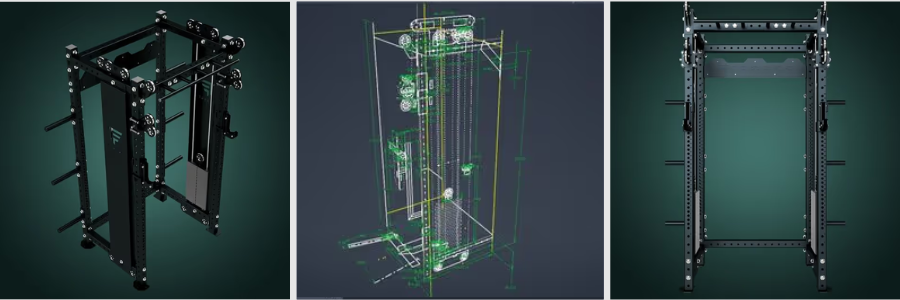
You can think of it as creating a blueprint of a product, but instead of drawing it as a static diagram on paper, CAD generates an interactive digital twin. It doesn’t completely eliminate the need for physical prototyping, because you still need a physical model for testing and evaluation, but virtual prototyping saves you a lot of headaches and prevents wasteful use of resources. The term “virtual prototyping” is pretty much self-explanatory. 3D CAD designers have all the tools you need to build a prototype as a digital visualization on a computer screen. The product exists first as a virtual object, so no matter what you do to the object, it only happens on a computer screen.

You can remove parts, add more components, change the shape, or modify it in any way without having a physical prototype made. And more than just an image, popular CAD software like Autodesk Inventor, SOLIDWORKS, and PTC Creo are loaded with options that allow you to test the virtual prototype with simulations. Even the open-source FreeCAD has robust simulation capabilities as well.

Among the most common (and useful) tools include FEA (Finite Element Analysis) services to simulate vibration, thermal response, and structural test; CFD (Computational Fluid Dynamics) for airflow analysis, fluid behavior, and thermal distribution; Mechanism Dynamics to analyze motion, interaction, and interference between components; and Behavioral Modeling that evaluates how a design reacts to an external factor like changes in temperature or pressure, to name a few. In general, virtual prototyping and simulation open the door to a detailed analysis of how a design, product, or system behaves under different use case scenarios.

RELATED: 10 Tips on How To Find the Best Prototype Engineering Firm Services
product engineering services

Software like Altium and KiCad can do PCB simulation with such features as signal integrity analysis, error debugging, electromagnetic interference checking, and more. The only requirement is that your model, in this case the digital twin, has to be identical to the actual product. It can be rather problematic because you’ve only been building the prototype as a digital file, so there’s nothing physical to compare the model to. You don’t have clear points of reference, but that’s exactly what virtual prototyping is all about. Advanced 3D CAD software comes equipped with tools and options to help you build a virtual object, including a product design, from scratch.

You can experiment with various materials, form factors, colors, dimensions, PCB layout design, and every single specification imaginable. All without having a physical model in hand. It’s basically a CGI (computer-generated imagery) done under the constraints of actual physics. Being able to produce a prototype in a complete virtual environment is a major relief, both technically and financially. Since you don’t have to go through a lengthy process of trial-and-error with multiple physical models and consume a whole lot of development resources on them, the entire prototyping phase runs more efficiently at very low cost, objectively much lower than the alternative.

For example, running a simulation to see the thermal distribution of a product takes several hours. You have the data ready by the end of the simulation, as it is generated almost in an instant by the computer. The more powerful the computer, the faster it goes. The same analysis done on a physical model can take days to complete. On Day 1, you use the product extensively or expose it to a high temperature to see how it reacts to heat. You also need to know at what point the product begins to fail. On Day 2, you revisit everything to analyze the failure and compile evaluation reports. On Day 3, you may want to try to reproduce the first test just to see whether there’s any inaccuracy.

And at the end of the process, the tested models are damaged beyond repair, costing you hundreds of dollars, if not more. While simulation has a big impact on cutting down the prototyping cost, it’s not the only thing that matters in new product design services. Another major advantage of digital twins is improved collaboration. Because everybody works on a single model stored in the cloud, a cross-functional team can see all the changes made to the virtual prototype in real-time. Designers and engineers use the same model to make better, more educated, and informed decisions each time, based on the latest available data.

RELATED: Adaptive and Iterative Prototyping: Iterate on Your Product Design With Industrial Design Firms

Practical tips for physical prototyping

Digital twins and simulations are great and all, but they will never completely replace physical prototyping. You still need physical models to evaluate the product’s actual real-world performance in the hands of testers. For instance, the simulation might show that the product can withstand a drop from 10ft onto a pavement or submersion in water up to 15ft deep. Sometimes, you just have to see it happening in the real world to be 100% convinced.

Does this make the simulation less useful? No, because CAD and digital twins mainly function as a guide to help you build a product that’s at least as good as what the virtual model demonstrates. You put what you see on the screen to life, and hope that the result of the product delivers the expected performance, reliability, and durability. Only with physical prototype design engineering experts can you get a taste of that coveted hand-feel experience. Is it comfortable to hold, enjoyable to use, and practical to store? No amount of simulation can answer those questions. When the time comes to build a physical prototype, mind the following:

  • Be prepared to iterate. Just because you’ve done all the simulations, it doesn’t mean the next physical model is going to be exactly what it’s intended to be. Most of the time, the product still needs further refinement. Products that look good on screen aren’t always that good in real life.
  • Only build what you need. Have a clear plan for what you want to do with the prototype once it’s built. If the prototype is meant to be a “Beta” version, perhaps you don’t have to use the most expensive materials and the highest level of detail. Remember that CAD modeling, simulations, and physical prototyping don’t all have to happen in one go. They’re all part of an iterative process.
  • Use additive manufacturing. As mentioned earlier, 3D printing (and CNC machining, actually) are still the most affordable methods to build prototypes. You’re not making hundreds or thousands of units at this point. The cost per unit is more expensive compared to injection molding, but for a very low production volume, additive manufacturing is the way to go.

Also, build one prototype at a time. Do not build another prototype unless you’ve fully tested the current one. You need all the data from the tests to make sure that the next iteration addresses all the issues.

RELATED: How to Make a Prototype for Your New Product Design

Closing thoughts

Additive manufacturing has been around for quite a while now, so there is no reason for design firms not to take advantage of it now in 2026. Some would say that 3D printing is basically an extension of CAD because the printable model must be created first on a computer. Together with virtual prototyping and simulations, they’re often regarded as the best things to have ever happened to product development at large.

How Cad Crowd can help

Having said that, all those great technologies are simply tools. And no matter how sophisticated the tools are, they make little to no difference to your NPD project if you put them in the wrong hands. You need professionals to create the printable model, build a 3D digital twin, and run the simulations so that you gain nothing but accurate, relevant, and usable data from the process. Cad Crowd is home to experienced CAD technicians, 3D printing specialists, and fabricators to help you build prototypes efficiently. Get a quote today!

author avatar

MacKenzie Brown is the founder and CEO of Cad Crowd. With over 18 years of experience in launching and scaling platforms specializing in CAD services, product design, manufacturing, hardware, and software development, MacKenzie is a recognized authority in the engineering industry. Under his leadership, Cad Crowd serves esteemed clients like NASA, JPL, the U.S. Navy, and Fortune 500 companies, empowering innovators with access to high-quality design and engineering talent.

Connect with me: LinkedInXCad Crowd

Why Your Business Needs Product Engineering Services to Innovate & Accelerate


Why does your business need product engineering services for innovation and acceleration? The irony is that the need for innovation in your business seems to disappear into thin air. On one side, it is as tame as your pet, and on the other side, it wanders into the woods, making you go whiteboarding, assuming that overall competition is three steps ahead of you with product innovation. This is exactly the need for product engineering services. It helps one not roam aimlessly in the woods with a foggy forest sense of innovation, with expert hands waiting to reach out to help with product engineering.

Product engineering services are the unsung heroes of making the business grow. It is what makes dreams come true, giving a person the chance to make his biggest dreams come true without losing his mind in the process. In a way, product engineering services are all linked up to a set of skills that are a deep knowledge base of how things work, markets, and people’s responses when interacting with things, all mixed with a dash of problem-solving skills, specifically a workflow that ensures design disasters don’t happen, which helps take your product from that cool, hot new gadget that can heat things up faster than a toaster to a software upgrade that crashes when someone sneezes on it.

It becomes even simpler when you have a solid platform such as Cad Crowd, and the best of the best rise to the top with relative ease, except for the freelancers who are, in fact, experts at what they do. Instead of embarking on a mission to scour profiles that are pretty much the same, almost, with your hopes resting on your second cousin’s friend probably being a design guru, Cad Crowd brings you people who actually know what they are talking about.

RELATED: How to Find an Electronic Design Company for Outsourcing New Product Engineering

The modern business battlefield

It’s a masochist obstacle course, and fun is had watching top executives break a sweat. The customer’s needs are never satisfied, with technologies that are changing on a daily basis and a new competitor that looms every night in the marketplace. Even the most stable industry is being forced along by an unseen power that urges, “Move faster, or be gone.” It is a certain degree of innovation is required to survive. It is not the loose innovation that is idle, but the sprinting innovation. This is essentially saying that one has to produce innovations, prototypes, execute prototypes, take feedback, design, and develop a product that customers are passionate about, all before the competition even gets in.

In fact, it is one of these problems that can turn even what appears to be a shy-looking squad into a desperate, frantic, and solution-seeking mob. Product engineering services are a way to give order to the chaos that is evident in product development experts. Through product engineering services, organizations are assisted in harnessing the force of pressure to their advantage in product development. It is not a situation where organizations have to grapple with competition, but are now the ones who derive advantage from outsmarting the competition. It is no longer a game of catch-up in the race for technological advancement, but a force that propels organizations towards faster development.

How to turn ideas into product reality without losing your mind

Every single human being has thoughts. Every thought is an idea. Ideas are cheap. They are, of course, stellar; some of them are a little dubious, but some of them are such that they should never see the light of day, safely locked in a bank vault. Then, the problem is to separate them, to see which ones are worth the trouble, to develop them into a product that is usable, that is marketable. And that is no easy trip, no easy ride. Most businesses forget how many decisions need to be made, not to talk of headaches that come with advancements in technology. It is no easy job to get a product together, yes, to make a multi-tiered cake with your eyes closed.

RELATED: Innovation Best Practices: Strategies for Better & Faster Product Design Services

The services delivered by product engineering expert designers make it easier for a person to remove the blindfold from his eyes, as they provide a real recipe for him. Being part of the development, they are aware of how your idea should be developed. They help develop your idea, assess its feasibility, and deliver it as per your vision, what the markets want, and a plan to avoid accidental disasters. Not only development, but they are experts in developing a balance between development and feasibility, which, when developed, is impressive as well as useful.

The second reason is that working with product engineering experts would eliminate a situation where something has been developed, that is, a product, where customers would tilt their head to say, “customers tilt their head to say, ‘Interesting, but why?’” The product engineering experts are going to make sure that what is being developed is what is desired and is worth a pretty penny.

Smarter, faster development with no corners cut

It is evident that one of the most dominant factors for every single business is to simply get going quickly in the marketplace, but it also has some really embarrassing product launches. There are reels and reels of instances of products that were launched quickly in the marketplace, which ended up with disastrous effects, as there were a number of reasons – some buggy, some are harmful, and some, although useless, are merely that. There is a thread that connects all these instances, which is the development that happened quickly with relatively less engineering input for engineering design firms.

RELATED: Trends Shaping the Future of Product Design for Industrial Design Services

In this way, these product engineering services are going to make the companies faster, smarter, more structured, and sustainable. The product engineering services offered accelerate company development by improving workflows, leveraging the latest technologies, and leveraging real knowledge. It is a process that helps a business cut no corners but go around them. It helps businesses cut no corners but eliminate the unnecessary waiting. This has geared the organizations towards achieving competitive advantage when launching new, innovative products and entering markets before rivals, with a promise to deliver high-quality products.

product engineering design firms

Speed with precision is one of the most significant advantages that come with partnering with experienced engineers. For instance, there is a website called Cad Crowd that connects businesses with the best engineers and designers in the world who are capable of handling the product from design to completion with efficiency. The website also connects businesses with freelancers who are capable of handling the timeline of a project with quality work.

Smarter engineering = lower prices

Additionally, most businessmen believe that the incorporation of freelance engineering experts would cost them a lot to carry out the task. Most of the time, this is contrary to the fact because professional engineers reduce costs by preventing problems from happening, which would be costly to repair if they occurred. It is many times more expensive to correct a design error in a mass-produced product than to correct it when the product is initially designed.

Product engineering services might be the solution to overcome such difficulties because they identify inefficiencies, indicate areas where costs could be optimized with respect to materials and processes, and highlight potential problems that could prove costly. Smart’s best engineering practices ensure the feasibility of this potentially costly development process through their solutions. The cost is used entirely for better product development, unlike repairing those errors that should have been prevented.

RELATED: Product-Centric vs. Customer-Centric: Which Is Best for Consumer Product Design Companies?

Prototyping & testing – The magic

It is here that the most delicate stages of prototype design services and product development take place, before the launch of the product. It is here that dreams are made to change from success to failure within a short span of overnight success. It is because here the product prototype may realize that what seemed awesome on paper is, in fact, a temperamental product with buttons that are stuck together, things that fall apart, and software that hangs during the most critical stages. The product engineering service also takes into consideration the relevance of prototypes.

They go on with the development of prototypes, which are accurate representations of real life. The prototypes are also subjected to tests to identify their strengths, weaknesses, usability, safety, and speed. This is part of what is supposed to happen with a view to determining what is working out and what needs improvement. Prototyping is not a laughing matter; it is research, a trial, or a revelation of the truth. It is only after a set of tests that the engineers are confident that the final product is going to offer a user-friendly experience, unlike an experience that can make the user furious.

The product’s robustness is also tested by engineers with unpredictable scenarios likely to come from the customer, such as throwing, bending, poking, shaking, pushing, and even acting as a paperweight. The phases that go into the construction of prototypes can also be taken care of by freelancers on the Cad Crowd platform. The skills required to implement 3D modeling design services, prototypes, and mechanical testing, among others, are carefully considered by freelancers on the platform.

RELATED: Top 33 Electronic Device Design Services Companies for Engineering & Product Design Firms

Designing for a better user experience

User Experience is the feel that the customer experiences when they are actually using a product. If a product is engineered in a proper way, User Experience provides customers with a sense of trust, comfort, and happiness. On the other side, when it goes south, customers should feel that sense as if they have made a bad life choice. The product engineering service includes the idea of user experience design on various interfaces during the product development life cycle. Product engineers analyze the nature of product attributes, including ergonomic design, user interface design, usability, user comfort, and mechanisms that provide user feedback.

The aim is to develop a user-friendly, comfortable, and even delightful product to use. Such a user might find that the design engineering service brings him amazing satisfaction. They cannot resist the products that might be solutions for problems with such a lucid approach. A design that reads his mind really impresses such a user because it is surely user-centric. So what that means is it’s a lot of product engineering. It brings together technology, design, and behavior. The goal is to make a product, but on top of that, it’s critical that when people use it, it feels right.

Strategic risk-reduction approach

With every product, there is promise as well as danger. Every single business has had a trial by choice from the moment it started, a choice to produce a product, which means that even with the best design plan on earth, the path is fraught with hidden dangers waiting to strike in the background at every opportune moment. The hidden dangers are going to strike, whether in design, production, compatibility, regulatory, supply chain, or software. The product design services minimize such risks with careful planning and expert execution.

RELATED: A Comprehensive Guide to Engineering Product Development Services for Companies & Startups

Such problems that product engineers do not need to address themselves include those that are already in production. It is apparent that they can even predict potential problems before they happen. Other people, who are also non-experts, would be surprised to find out what might go wrong, which is already known to product engineers. This is the way that gives an individual a sense of confidence. Unlike pacing with a sense of care because of uncertainties that are bound to exist, organizations can progress with utmost confidence.

The sense that complexities will be handled by experts gives the top-level management enough scope to look after marketing, strategy, brand, and distribution. The overall effect is that there is a significantly more compact process from concept to completion, with significantly fewer nights of frantic calls, design changes, and unsalable inventory.

electronic device design services

Scalability for growing businesses

Not all growth, naturally, occurs in exactly this manner. It can sucker punch us in the face, ambush us when that welcome guest arrives with a welcome splash of panic, along with a splash of joy. Then, once a business is airborne, a call for more product and faster development cycles ensues. Product engineering services add scalability to businesses. This means that businesses can actually scale up in terms of development and growth, even though they might not have engineers for everything within the business.

RELATED: Secrets of Creative Brainstorming & Tips from Product Design & Engineering Services Firms

This is necessary for small- to medium-scale consumer product businesses, as they are interested in development but do not need a large engineering team within their establishment. Even more challenging tasks can now be accomplished with the assistance of engineers. Businesses can now determine whether to use such tasks to expand the product into other markets, including adopting the latest technologies. The whole development task can now take as long as a person wants, with a more consistent development process, unlike all over the place.

This is even more important in magnitude because Cad Crowd is going to expose this particular instance of the project to a worldwide freelance community. This may very well be what is required to make design inputs, temporarily at least, or even engineering inputs, but what is required is certainly more than what can be managed with the best people on board.

Innovation, innovation, innovation! 

Innovation is what playing the game of the modern customer is all about. Too much quality is ruining the customer. It finally gives them a realization that improvement, maximization, and innovation are necessary. Customers want more, better, faster, stronger, and smarter, irrespective of what is being offered to them. The moment a company reaches the pinnacle, something better is offered, which the customers switch to.

This would ensure that corporations have a constant need for innovation, as they upgrade existing products not only to provide new technologies but also to introduce changes that keep customers interested and maintain the brand in a fast-moving sector. The new product concept design companies that have the ability to maintain such innovation are mostly the ones that have a phenomenally high level of customer loyalty. This is because it provides customers with a sense of importance by listening to their feedback and delivering improved products, which is a promise of the product.

RELATED: Why Electronics Product Prototyping Is Important for Successful Product Development at PCB Design Companies

Technology: Source of competitive advantage

Technology is improved and upgraded uninterruptedly at a rate that seems, for some reason, vindictive. The minute one has learned what is happening, it is already replaced by another one that has been waiting in the wings, waving a flag and saying, “What is keeping you so long?” Artificial Intelligence, Digital Prototyping, Robotics, Smart Sensors, Machine Learning, and Materials Science are a few of the names from the dozens of technologies that have impacted how your products are made.

Product designers support the use of such technologies in businesses; otherwise, a business involving such a technology might end up being disrupted. In this context, product engineers employ such technologies in product development, enabling faster, more accurate development and creative problem-solving. Technologies such as 3D modeling, simulation, and generative design culminate in a certain competitive advantage for such businesses with a prototyping, simulative environment.

In contemporary engineering practices, organizations can respond faster with better decisions, yielding better products, compared to those that use the traditional engineering approach. It is considered competitive because technology is a requirement, not a complementary element. Cad Crowd connects clients with contractors who are some of the earliest to use developments in technological advancements. The contractors that they bring with them come with a set of perspectives that are highly advanced in terms of technological skills.

RELATED: 15 Engineering Design Constraints that Product Design Companies & Engineering Firms Can’t Avoid

Collaboration that empowers innovation

Product engineering is a team process. It is, of course, known to thrive when teamwork is desired. There are so many benefits to a fresh perspective, as engineers are forced to interact with designers, producers, marketers, managers, and customers. The skills are diverse, and once they come for the solution, this solution is optimized. This is probably the most creative piece, where different ideas conflict, melt, and coalesce into a full idea. The product engineering service minimizes this intersection point.

The partnerships that result from the corporations, through the design engineers, open an entirely different set of perspectives, thus a different level of innovation. The innovators come from different backgrounds, technologies, and design ideologies that, in themselves, might ignite innovations that would never occur in a closed environment. The most important strengths are that “great product engineering” has a synergistic effect on a team. It avoids tunnel vision from taking place.

Innovation as long-term strategy

Innovation is a commitment, not a moment. It is the hard work that takes businesses on a journey of growth when they are thinking of engineering as a strategic investment. It is a culture of improvement, experimentation, and innovation that businesses adopt over time. Contribution streams, on the other hand, are channeled through product engineering services that are known to be a good fit when it comes to the life cycles of different products.

Whether it is the development of “the first,” “the fiftieth,” or even “the hundredth” product for the business, the aim of product engineering, as far as its purpose is concerned, would remain the same, which is to make all products shine with intelligence and customers at the forefront. Investing in engineering is essentially investing in the future. The bottom line gives businesses what they need to react, compete, and succeed in a rapidly changing marketplace. It is these businesses that learn the significance of the bottom line, which culminates in giants in their own right.

RELATED: How Do Engineers Evaluate Different Design Ideas?

The future of innovation inside the enterprise

Product engineering services bring clarity, vision, as well as competitive advantage. This is with the aim of ensuring that workable solutions are developed. The development process would take a faster rate, with no compromise on the quality. It would also result in a better user experience in the long run, owing to the fact that it is set to reduce the cost of production complexity for the enterprises.

It has assisted enterprises in staying up to date with technological advancements, meeting client demands, and capitalizing on opportunities. This, in short, is a way of stating that product engineering services have matured to the point of being a matter of economic force, rather than a matter of economic choice, within an industry that is desperately seeking a means to innovate, never mind grow.

How Cad Crowd can help

What Cad Crowd brings to the table is taking it to a different level, thanks to the fact that there is a community of freelance 3D design talent that is comprised of the best that the world has to offer. Additionally, that is what gives every project a touch of distinction in terms of engineering, creativity, and professionalism. Now that you are set to turn your vision into fantastic products, benefits, and so on, it is high time for your considered input. Contact us for a free quote.

author avatar

MacKenzie Brown is the founder and CEO of Cad Crowd. With over 18 years of experience in launching and scaling platforms specializing in CAD services, product design, manufacturing, hardware, and software development, MacKenzie is a recognized authority in the engineering industry. Under his leadership, Cad Crowd serves esteemed clients like NASA, JPL, the U.S. Navy, and Fortune 500 companies, empowering innovators with access to high-quality design and engineering talent.

Connect with me: LinkedInXCad Crowd