Investors won’t give you the real reason they are passing on your startup


“When an investor passes on you, they will not tell you the real reason,” said Tom Blomfield, group partner at Y Combinator. “At seed stage, frankly, no one knows what’s going to fucking happen. The future is so uncertain. All they’re judging is the perceived quality of the founder. When they pass, what they’re thinking in their head is that this person is not impressive enough. Not formidable. Not smart enough. Not hardworking enough. Whatever it is, ‘I am not convinced this person is a winner.’ And they will never say that to you, because you would get upset. And then you would never want to pitch them again.”

Blomfield should know – he was the founder of Monzo Bank, one of the brightest-shining stars in the UK startup sky. For the past three years or so, he’s been a partner at Y Combinator. He joined me on stage at TechCrunch Early Stage in Boston on Thursday, in a session titled “How to Raise Money and Come Out Alive.” There were no minced words or pulled punches: only real talk and the occasional F-bomb flowed.

Understand the Power Law of Investor Returns

At the heart of the venture capital model lies the Power Law of Returns, a concept that every founder must grasp to navigate the fundraising landscape effectively. In summary: a small number of highly successful investments will generate the majority of a VC firm’s returns, offsetting the losses from the many investments that fail to take off.

For VCs, this means a relentless focus on identifying and backing those rare startups with the potential for 100x to 1000x returns. As a founder, your challenge is to convince investors that your startup has the potential to be one of those outliers, even if the probability of achieving such massive success seems as low as 1%.

Demonstrating this outsized potential requires a compelling vision, a deep understanding of your market, and a clear path to rapid growth. Founders must paint a picture of a future where their startup has captured a significant portion of a large and growing market, with a business model that can scale efficiently and profitably.

“Every VC, when they’re looking at your company, is not asking, ‘oh, this founder’s asked me to invest at $5 million. Will it get to $10 million or $20 million?’ For a VC, that’s as good as failure,” said Blomfield. “Batting singles is literally identical to zeros for them. It does not move the needle in any way. The only thing that moves the needle for VC returns is home runs, is the 100x return, the 1,000x return.”

VCs are looking for founders who can back up their claims with data, traction, and a deep understanding of their industry. This means clearly grasping your key metrics, such as customer acquisition costs, lifetime value, and growth rates, and articulating how these metrics will evolve as you scale.

The importance of addressable market

One proxy for power law, is the size of your addressable market: It’s crucial to have a clear understanding of your Total Addressable Market (TAM) and to be able to articulate this to investors in a compelling way. Your TAM represents the total revenue opportunity available to your startup if you were to capture 100% of your target market. It’s a theoretical ceiling on your potential growth, and it’s a key metric that VCs use to evaluate the potential scale of your business.

When presenting your TAM to investors, be realistic and to back up your estimates with data and research. VCs are highly skilled at evaluating market potential, and they’ll quickly see through any attempts to inflate or exaggerate your market size. Instead, focus on presenting a clear and compelling case for why your market is attractive, how you plan to capture a significant share of it, and what unique advantages your startup brings to the table.

Leverage is the name of the game

Raising venture capital is not just about pitching your startup to investors and hoping for the best. It’s a strategic process that involves creating leverage and competition among investors to secure the best possible terms for your company. 

“YC is very, very good at [generating leverage. We basically collect a bunch of the best companies in the world, we put them through a program, and at the end, we have a demo day where the world’s best investors basically run an auction process to try and invest in the companies,” Blomfield summarized. “And whether or not you’re doing an accelerator, trying to create that kind of pressured situation, that kind of high leverage situation where you have multiple investors bidding for your company. It’s really the only way you get great investment outcomes. YC just manufactures that for you. It’s very, very useful.”

Even if you’re not part of an accelerator program, there are still ways to create competition and leverage among investors. One strategy is to run a tight fundraising process, setting a clear timeline for when you’ll be making a decision and communicating this to investors upfront. This creates a sense of urgency and scarcity, as investors know they have a limited offer window.

Another tactic is to be strategic about the order in which you meet with investors. Start with investors who are likely to be more skeptical or have a longer decision-making process, and then move on to those who are more likely to move quickly. This allows you to build momentum and create a sense of inevitability around your fundraise.

Angels invest with their heart

Blomfield also discussed how angel investors often have different motivations and rubrics for investing than professional investors: they usually invest at a higher rate than VCs, particularly for early-stage deals. This is because angels typically invest their own money and are more likely to be swayed by a compelling founder or vision, even if the business is still in its early stages.

Another key advantage of working with angel investors is that they can often provide introductions to other investors and help you build momentum in your fundraising efforts. Many successful fundraising rounds start with a few key angel investors coming on board, which then helps attract the interest of larger VCs.

Blomfield shared the example of a round that came together slowly; over 180 meetings and 4.5 months worth of hard slog.

“This is actually the reality of most rounds that are done today: You read about the blockbuster round in TechCrunch. You know, ‘I raised $100 million from Sequoia kind of rounds’. But honestly, TechCrunch doesn’t write so much about the ‘I ground it out for 4 and 1/2 months and finally closed my round after meeting 190 investors,’” Blomfield said. “Actually, this is how most rounds get done. And a lot of it depends on angel investors.”

Investor feedback can be misleading

One of the most challenging aspects of the fundraising process for founders is navigating the feedback they receive from investors. While it’s natural to seek out and carefully consider any advice or criticism from potential backers, it’s crucial to recognize that investor feedback can often be misleading or counterproductive.

Blomfield explains that investors will often pass on a deal for reasons they don’t fully disclose to the founder. They may cite concerns about the market, the product, or the team, but these are often just superficial justifications for a more fundamental lack of conviction or fit with their investment thesis.

“The takeaway from this is when an investor gives you a bunch of feedback on your seed stage pitch, some founders are like, ‘oh my god, they said my go-to-market isn’t developed enough. Better go and do that.’ But it leads people astray, because the reasons are mostly bullshit,” says Blomfield. “You might end up pivoting your whole company strategy based on some random feedback that an investor gave you, when actually they’re thinking, ‘I don’t think the founders are good enough,’ which is a tough truth they’ll never tell you.”

Investors are not always right. Just because an investor has passed on your deal doesn’t necessarily mean that your startup is flawed or lacking in potential. Many of the most successful companies in history have been passed over by countless investors before finding the right fit.

Do diligence on your investors

The investors you bring on board will not only provide the capital you need to grow but will also serve as key partners and advisors as you navigate the challenges of scaling your business. Choosing the wrong investors can lead to misaligned incentives, conflicts, and even the failure of your company. A lot of that is avoidable by doing thorough due diligence on potential investors before signing any deals. This means looking beyond just the size of their fund or the names in their portfolio and really digging into their reputation, track record, and approach to working with founders.

“80-odd percent of investors give you money. The money is the same. And you get back to running your business. And you have to figure it out. I think, unfortunately, there are about 15 percent to 20 percent of investors who are actively destructive,” Blomfield said. “They give you money, and then they try to help out, and they fuck shit up. They are super demanding, or push you to pivot the business in a crazy direction, or push you to spend the money they’ve just given you to hire faster.”

One key piece advice from Blomfield is to speak with founders of companies that have not performed well within an investor’s portfolio. While it’s natural for investors to tout their successful investments, you can often learn more by examining how they behave when things aren’t going according to plan.

“The successful founders are going to say nice things. But the middling, the singles, and the strikeouts, the failures, go and talk to those people. And don’t get an introduction from the investor. Go and do your own research. Find those founders and ask, how did these investors act when times got tough,” Blomfield advised.


How His Side Hustle Brought In Close To $2 Million –


Greg Kerr smilingGreg Kerr smiling

Greg Kerr was looking for a way to earn some extra money for his daughter’s education fund- and came up with an idea that earned him almost $2 Million in annual sales!

Greg shares with us how Alchemy Merch was created and how his business has become so successful. He talks about the challenges he has faced along the way and what marketing strategies have worked for him.

Make sure you read until the end to see his advice for entrepreneurs looking to start a business and where you can go to find more information on Alchemy Merch.

1. Can you tell us a little bit about yourself and what inspired you to start your
business?

I’ve been self employed for all of my adult life. The majority of that has involved being broke while doing it, but it’s always been the only way for me. I started my first business making belt buckles for my band while I was touring.

I made the merch so I could pay my bills while out on the road and other bands started asking if I could make them belts as well and my first business was born.

When I moved to Arizona in 2007, I decided I wanted to start an apparel brand and I started Miles to go, a literary inspired clothing brand. We sold online and to indie book stores all over the world and it was my full time business for almost 10 years.

When my wife and I decided we wanted to start a family in 2016, I had been helping some friends make enamel pins on the side. It was never intended to be an additional business, but the day we found out we were pregnant, I decided to buy a domain for Pin Game Strong and offer the service publicly.

I’ve always loved working with artists and had a lot of experience from the first business working with musicians and brands and through my apparel business where I’d hire artists to fit my vision.

Pin Game took off and quickly became the focus of all of my attention. Within six months, it had overtaken the apparel brand in revenue and hit $1 million in sales in the first 18 months.

It was intended to be a side hustle to add money to our soon-to-be daughter’s education fund, but it ended up being our family’s full time focus.

The entire goal was and still remains to help people create. We want to help remove some of the obstacles that creators face and if we can make their life easier so they can focus on other aspects of their business, then we have succeeded.

Working with creative people every day is continually inspiring. Getting a chance to be a sidecar on their journey and build relationships is very fulfilling. We try to focus on educating our clients and doing what we can to make production appear much easier than it really is.

It was very important to me to offer a service for 100% custom products that focused on brands that would make items to sell for their own merchandise.

The promotional products industry is focused on churn and burn products that are meant as handouts at events. That doesn’t really interest me. I wanted to help make real merchandise, not cheap items that are discarded. That’s still an integral part of our decision making.

2. Could you detail the steps involved in launching your business?

I had been making enamel pins for Miles to go for about two years and thought I had a pretty good understanding of how they were made and I’d developed a good relationship with a factory overseas.

My first time offering to help people was via a comment post on a podcast episode and I saw there was a need for help in the market from someone who understood things from an artist and brand owner perspective.

Before launching officially, I had to lock in the domain, social media accounts, get a logo thrown together and figure out some base pricing I could offer. With making custom items, pricing can vary depending on the details, so I needed to find an easy way to price them that wouldn’t require me having to get exact quotes on every order.

Once the site went live, word of mouth spread quickly within the independent artist community and orders started rolling in. I’d had experience operating businesses, so I was able to focus quickly on what I thought was needed before launching.

Pin Game Strong kept growing and I started to hire people to help us grow. We kept adding in new products and the name no longer seemed to fit and was too niche, so although we’d gained a lot of name recognition, we decided to transition to Alchemy Merch and continue to expand the items we offered.

Alchemy Merch Logo, a woman surrounded by chemistry vialsAlchemy Merch Logo, a woman surrounded by chemistry vials

3. Can you walk us through your business model and how it works?

We work with artists and brands as a production partner to help them make products overseas. Trying to randomly pick a factory on Alibaba is like aiming in the dark and hoping for the best.

It can also be a big financial risk to trust your money and art with a place you know nothing about. Communication with the factories can also be very challenging if you are new to it.

When we decided to figure out pricing, I went off of the promotional products industry model that I was familiar with and then tried to beat it. Promotional products are also priced in a very cloudy way. There are tons of hidden fees and shipping added at the end.

I chose to price everything all upfront, so the price you saw on the site was what you paid at checkout. I knew this would be a volume play, so when figuring out that initial pricing, I tried to think about it as a time based fee. If I’ll accept a minimum order of 50 items, how much do I need to make to make it worth it, while not price gouging.

I believe more in pricing off of time for the lower order amounts than slapping a blind 2x on everything. I knew our customers are price savvy and very diy oriented, so I had to price fairly.

4. How do you handle issues such as copyright and intellectual property rights when dealing with artists’ designs?

We do our best to not accept any work that is someone else’s IP. Alchemy works on a lot of officially licensed products and directly with companies and we understand that it doesn’t matter the size of the artist, it’s still making money off of something you don’t own.

We try to protect artists of all sizes. If an order comes in with unlicensed IP, we refuse or refund it and tell them that we don’t make items like that.

There is a huge market for artist’s stealing IP to make a Pokemon pin or whatever it is because it’s an easy sale for them. We turn those orders down.

I’d had my apparel brand knocked off all over the world and I know how terrible it feels when that happens. Making quick money to support that is not something I’ve ever had interest in.

We can’t know everything, but we do our best and if anyone on the team recognizes the art, we won’t take the order.

5. What challenges have you faced with your business? How did you overcome them?

There are daily challenges and I doubt that will ever end, but we do our best to plan and discuss pain points or obstacles as a team and how to resolve them.

The biggest initial hurdle was that in those first 18 months, when it went from zero to 1 million, it was just me. I was doing everything and a mentor pushed me into hiring some help for artwork. It helped me delegate some of the busy work and continue focusing on sales.

We continued to expand and add in another sales rep, more art help, etc. We are still a small team of 6. The vast majority of our orders are paid upfront and we don’t carry inventory, so our margin is already built in before we place the order with the factory.

6. How much do you make with your business?

We are operated as a sole proprietorship, so all of the business profits get filed with our own personal. The company has to keep a healthy float amount to cover payments to vendors, so we don’t draw out every penny we can.

We’ve been doing just shy of $2 million in sales a year for the past few years. Covid put us into crab mode, going left and right but not forward. This year is looking like we are getting back on track for growth.

For our personal earnings, our lifestyle has improved, but our family only takes draws and payroll to be a little above our bills and investment plans, so we can max out our 401k, IRA’s and our daughter’s 529 education fund.

7. What tools and equipment do you use to run your business?

Because we aren’t physically making the products, most of our tools are software based. We use the Adobe design suite all day, every day. For a shared team inbox system, we use Front and Monday for our CRM/production software.

Our team uses Slack because we are all remote as well and do weekly video meetings to plan and keep connected.

A person working on a laptopA person working on a laptop

8. What marketing strategies have you found most effective to grow your business?

Although it can be the toughest to consistently produce, word of mouth is hands down the most effective for us.  Our industry is very trust based and another artist suggesting to work with us is the best scenario we can have.  We try our best to provide a smooth and positive experience for our clients, and when they tell a friend, it goes a long way.

We run google ads and do FB/IG from time to time.  One of our most popular promos we do each year during the Chinese New Year is to offer a +10% more on all orders.  

Most of our clients are makers, so giving them more product for free that is 100% profit after sell through has proven to be much more effective than coupon codes.  We never really do any coupons.  Those work great for a retail item, but for our service based pricing, they don’t really work out well on our end.  

That being said, maybe it’s time to try one out again to test it out.  I sometimes write industry articles or do interviews like this one

9. What do you envision for the future of Alchemy Merch?

We have some financial goals we’d like to hit and we want to continue to expand the products we offer.  Alchemy puts a lot of time, care and consideration into the products we have on our site.  

We spend a lot of time trying to work out all of the details and kinks before anything ever goes live.  It’s important for us to build a relationship with any factory we plan to work with and invest time and resources into it. 

My personal goal would be to one day be able to operate in more of a true CEO position and have the team expanded to allow me to focus all of my time and energy on the things that help us progress.

10. How can others find you- as we are all fans of you now?

The easiest way is to go to https://alchemymerch.com to see all of the custom products we offer. We can also be found on Instagram instagram.com/alchemy.merch.

We are here to help, so anyone can email us with any questions about a project and we will walk them through it and try to find a solution.


Thank you, Greg Kerr for this amazing interview! We love this story of a dad starting a side hustle to earn some extra income for his family. It took off and now brings in $2 Million is sales.

It shows that all you need is an idea and a passion to get your business started!

Be sure to check out Alchemy Merch on Instagram and their website to get more information.


10 Best Robot Vacuums (2024): Mops, Budget Vacs, Great Mapping


No other product I’ve tested has advanced as quickly as the humble robot vacuum. Just a few short years ago, they were mostly annoying, overpriced devices that fell off steps and got stuck on rugs. Now you can find robot vacs at every price point with an incredible array of features, including mapping capabilities, self-emptying bins, and even cameras.

Vacuuming an ever-changing household is a complex task, and no robot vacuum is perfect. However, I test them in one of the most challenging environments possible—a carpeted, two-story family home with messy kids and a shedding dog—and I find them indispensable. Whether you’re choking on cat hair, need to lighten your chore load, or just want to spend more time with your family, we have a pick that will help.

Looking for more cleaning solutions? Check out our Best Dyson Vacuums, Best Cordless Vacuums, and Best Air Purifiers guides for more.

Updated April 2024: We added the Eufy S1 Pro and X10 Pro Omni, the Dyson 360 Vis Nav, the TP-Link Tapo RV30C Plus, and the Dreame X30. We also added more information on the iRobot and Amazon acquisition and noted a new Samsung robot. We also updated prices and links throughout.

Special offer for Gear readers: Get WIRED for just $5 ($25 off). This includes unlimited access to WIRED.com, full Gear coverage, and subscriber-only newsletters. Subscriptions help fund the work we do every day.

chat gpt login free | Best Tool For Free OpenAI 2024


chat GPT login free

How Digital Prototyping Influences Company Product Development and Design


If you’re a product developer, you might already know how challenging the new product development process can get, especially once you get to the point when you need to build a prototype.

Product prototypes are among the most time-consuming and expensive stages of the product development process. You need to develop a unique and new item, build it from scratch, and check to see if you missed anything so you can change it before it’s too late. However, most of these problems are now eradicated with the help of technology. This article discusses how digital prototyping influences company product development and design.

Digital prototyping defined

Digital prototyping refers to the concept of creating real-world product models. Product models allow product developers to acquire early feedback from potential product users without releasing the product to market. Here, the prototypes are produced digitally with all the necessary transitions and animations that resemble the actual product. This differs from a throwaway or paper prototype, as product details are the main focus of digital prototypes.

During digital prototyping, the product’s functioning model is made before its actual development. It is made possible with the help of different tools for digital prototyping available in the market. Being in a digital format, these digital prototypes allow developers to quickly iterate and make a few adjustments without too much hassle, according to the feedback from the users.

The following primary phases are part of the digital prototyping process:

  1. Analysis of the problem and exploration of the product and its core idea.
  2. Brainstorming on the prototype’s development in digital format.
  3. Development of a real-world model of the prototype that allows testing using a reliable tool.
  4. Presentation of the prototype model to potential users to obtain valuable insights.
  5. Adjust the prototype based on the acquired feedback and start the process again.

RELATED: How Much Does it Cost to Make A Prototype for My New Product Invention?

Principles of digital prototyping

product1

Aside from helping you create prototypes that are as realistic as possible, digital prototyping has the following broad principles:

Build enough to learn but nothing else beyond that

Digital prototypes are not fully functioning designs. Instead, these digital prototype designs function as a test to answer critical questions regarding your hypothesis. Will people buy your product online? You can’t wait to test and develop your products at this point. Digital product prototype images will help answer the question and show how to fill the orders to ensure that clients won’t be disappointed.

You can discard prototypes

The main point is that digital prototypes are meant to be produced only as part of the product to present the appearance and features of the product and not necessarily the product itself. This is when you will test the idea. It means you’ll be wasting time if you spend more extended hours than necessary on prototype development. Aside from that, working longer on something will only increase your attachment to it. Depending on customer feedback, it’s never recommended to be too attached to a prototype because of the possibility of pivoting 180 degrees.

Anything can be developed into a prototype

There’s often significant time pressure when making digital prototypes. However, you can prototype almost anything under the sun.

RELATED: Elevating Your Company Using CAD Product Design Services During Product Development

Why is digital prototyping important in product development and design?

product2-1

Digital prototyping services can help you save money and time and assist with complex conversions to create better products. Developing digital prototypes offers many benefits, and the following are the most important ones:

Accuracy

You can create modern digital prototypes with excellent tolerances that are much tighter than physical prototypes. It lets developers create an accurate model of how the product’s production version might function without the need to go through the trouble of building it.

Visual aid for meticulous feedback

If you’ve ever tried articulating a visual concept, you know how difficult it can be. Sometimes, you may use paper and pen to illustrate your product concept. Digital prototypes work to help create visual representations to allow feedback.

Attainable

There’s a reason why digital prototyping plays a critical role in companies’ product development and design processes. The expertise and software required to work it are tricky, if possible, to implement on a smaller scale. However, this is starting to change gradually with the improved accessibility of digital prototyping technology, even for more minor scales.

Validate business goals

It’s common for businesses not to understand their goals aside from lowering costs and making money. Digital prototyping will force a company to see solutions in full action and consider whether these will solve their concerns.

product3

Better collaboration

In today’s manufacturing industry, an entire product design team typically works together on just one prototype. This is why it’s invaluable to be able to work on similar data at the same time. This luxury is possible with the help of a good package for digital prototyping.

Collaboration is fundamental for the success of any project. When the product development team works with a client, they meet regularly to run through things they’re working on. Introducing digital prototyping at this stage allows clients to work with the team to troubleshoot issues that require their technical expertise and industry knowledge.

Compatibility

Pen and paper prototype designs still come in handy in various respects. However, there’s no way that you can manipulate them. Digital prototypes can be tweaked endlessly, and multiple versions can be kept in storage that can be worked on using different devices.

Efficiency

Since it’s possible to conduct digital prototyping faster, it ensures a more thorough prototyping stage as part of the production process. It results in products superior to those that undergo the creaking cumbersomeness of traditional projects.

Lower budget

The first and most important concern of most product developers and freelance product designers is the cost involved in prototyping. Digital prototyping minimizes the need to build something. As a result, it lowers the materials and labor necessary for the process.

RELATED: Guide to Prototyping Methods Used in Product Development Services for Companies and Firms

Testing

One of the most critical purposes of digital prototyping is to confirm that the product will work as it is meant to. It also ensures that any initial errors will be addressed before the actual production stage. Since creating digital prototypes is faster, more tests can be conducted before abandoning the production stage.

Large applications may also take several months to reach the point where users can offer feedback. Digital prototyping can cut down this process so that users are given the chance to test the product. Digital prototypes are also faster to build and change and come in handy for validating new ideas for the product developer.

Shared understanding

One of the almost unavoidable concerns during product development is assuming everyone is on the same page regarding the idea. While some may recognize the limitations of concepts and techniques, others may not. Some developers may also misinterpret certain features specific to the industry since they lack information regarding how things work. Digital prototyping allows all parties to reach a shared understanding since the details are fully visualized.

Singular point of reference for developers and designers

Information is acquired from various places, including project managers, client meetings, emails, use stories, and more when a project starts. Consolidating everything into a digital prototype allows developers and designers a source of truth that they can refer to so they can start with product development.

Speed up the development process

Regarding product development, building products will be faster if the details have been hashed out in full and the number of reworks is minimized. Spending time on digital prototyping can help catch some of the issues that may otherwise show up during the actual development, which may result in longer delays to the product’s release.

Time

Digital prototyping also helps shorten the production stage as much as possible. It shortens the product development cycle, allowing better agility for the manufacturer when launching the product in the market.

product4

Confirm user needs

The most severe concern about new products is when they don’t fully cater to the target users’ needs. It often happens when the product developer assumes they have a fantastic idea that people will buy without bothering to check if they will buy it. Digital prototyping offers a rudimentary means for product developers to match with users and confirm if the product will simplify their lives.

Explore challenging concepts

Several concepts are difficult to understand and may be more challenging to design. Since digital prototyping isn’t focused on the details alone, it allows for exploring concerns without being too focused on trivial details.

RELATED: 5 Ways How Rapid Product Development & Prototyping Benefits Your Company

How Cad Crowd can help

Cad Crowd will help you find skilled digital prototyping professionals for easier product development and design. Our product prototyping experts will provide top-notch services that will help you simplify and streamline your product design and development process. With Cad Crowd, you can bring your new products to life efficiently and effectively and take your product development to the next level. Get a free quote now!

5 Main Benefits of Business Intelligence Shown on a Real-Life Example


So why is business intelligence important? Business analysts often say that the main advantage of a BI solution is “eliminating guesswork from your business processes”. This becomes possible because business intelligence is used to analyze data and present actionable insights to stimulate informed decision making within an enterprise.

We employ our experience in BI implementation services to explain what advantages a company can get leveraging business intelligence. To add practicality, we’ll show how these major benefits of business intelligence are rocked by Starbucks, an early BI adopter and savvy user of data-driven business analytics.

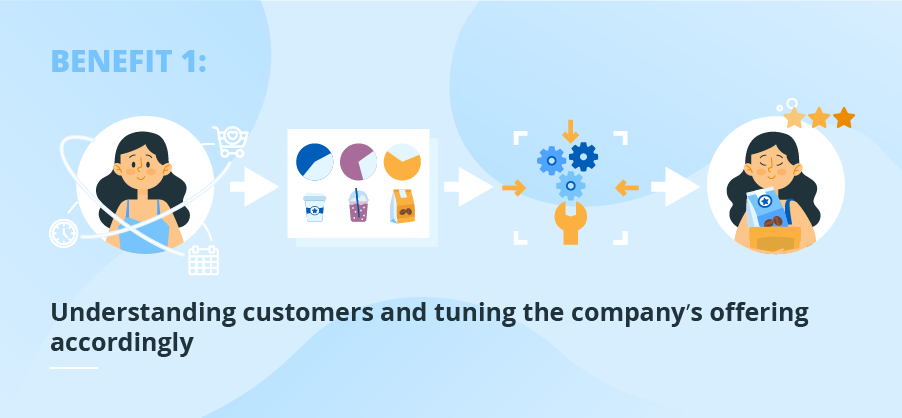
Benefit 1. Understanding customers and tuning the company’s offering accordingly

understanding customers with bi

BI tools enable companies to process customer data from multiple sources and create a 360-degree customer profile. As one of the goals of business intelligence is to present business-critical data in an easy-to-understand manner, companies can clearly understand their customers’ needs and behavior. As a result, they are empowered to tune their offering accordingly and deliver top-notch products and services.

Launching new product lines

Starbucks used BI to analyze industry reports about at-home beverage consumption and data about how customers order products while in a Starbucks shop. The company employed this info to create K-Cups and bottled beverages to sell in grocery stores. This let the company prevent customers from using other coffee brands at home.

Defining store locations

Since 2008, Starbucks has used Atlas, BI mapping software, to locate their new stores. The platform allows the company to estimate the economic viability of a new store location by evaluating massive amounts of data, such as area population density, average income of the residents, traffic patterns and proximity to other Starbucks locations. Thus, the company opens stores exactly where customers need them, which boosts sales without hurting the business in other locations.

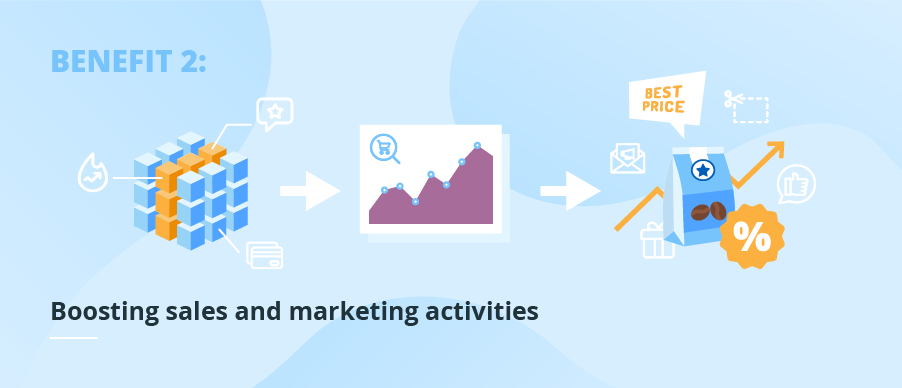
Benefit 2. Boosting sales and marketing activities

boosting sales with bi

With BI solutions, companies take a closer look at multidimensional retail data (from transactions to social media) to forecast customer needs and define sales and marketing activities to meet the demand.

Anticipating customer demand

Using predictive analytics, Starbucks successfully beefs up sales with analytics-powered in-store digital boards. The boards display items based on time of the day, weather, social trends and more: for example, breakfast items in the morning, hot drinks in colder weather, holiday specialties, dairy-free alternatives, etc. Such a data-driven approach allows Starbucks to entice customers with a more appealing offering.

Customizing order suggestions

Starbucks’ mobile app with more than 16 million active users presents the wealth of data on customers’ purchasing habits. To make use of that data correctly, the company uses a reinforcement learning platform to offer customers tailor-made order suggestions based on their popular selections, order history and the inventory of a local store. Through providing such personalized experience for customers, the company boosts both customer loyalty and sales.

Watch BI in action!

ScienceSoft shows how a couple of customized dashboards can tell you the whole story about your company’s health and performance.

Benefit 3. Optimizing back-end operations

optimizing operations with bi

A BI solution can analyze data to advance a company’s internal business processes, such as order management, scheduling, staffing, inventory management, and supply chain management.

Staffing and staff scheduling in a smart way

Due to staff scheduling optimization, it takes about three minutes from the time when a Starbucks customer gets in line until the order is delivered – regardless of the part of the day they come in. BI tools help store managers constantly monitor store performance against labor efforts to identify how well the store is doing with the current staff. With these tools, managers can optimize the work by growing or downsizing staff and rescheduling some duties (cleaning work areas, coffee machines, etc.) to perform them in quiet periods or after hours. That way, baristas are not overloaded and have the time for small talk with a customer or, for example, drawing a balloon on a cup for a birthday person. Such personalized approach increases customer satisfaction, which lies in the heart of the company’s customer-centric policy.

Optimizing supply chain management

Starbucks’ supply chain has no room for waste and inefficiency due to the centralized BI practice. BI software enables on-demand access to constantly updated information on stock inventory, transport scheduling and storage capacity. Based on real-time reports, the company manages to react with agility to, for example, poor quality of raw products by finding alternative suppliers while maintaining competitive prices.

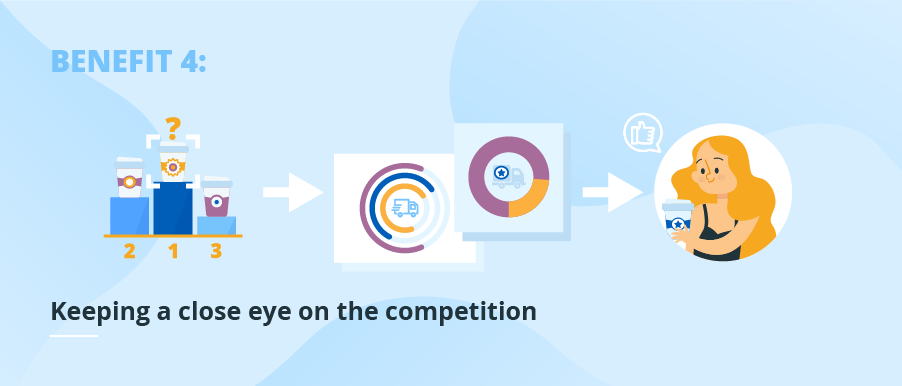
Benefit 4. Keeping a close eye on the competition

benchmarking with bi

As a part of a BI solution, benchmarking delivers practical insights on how to outperform competitors. Competitive analysis allows continuously improving a company’s performance.

Finding new ways of service delivery

Competitive benchmarking empowered Starbucks to uncover the need to reconfigure their third place strategy, which presupposed stores that provide both take-away and eat-in options. Following in the footsteps of McDonald’s, Luckin Coffee and other competitors, Starbucks launched food delivery service and opened pick-up only stores. The company’s efforts seem to be working: they managed to reach customers beyond those who already include Starbucks as part of their morning or afternoon routine.

And this all leads to – Benefit 5. Revenue increase and cost reduction

increase revenue with bi

Businesses effectively employing BI software earn more by analyzing customers and their demands, boosting marketing and sales activities, optimizing business-supporting operations and benchmarking.

As for Starbucks, successfully employed BI and data analytics practices empower them not only to attract customers, consequently boosting the volume of sales, but also to follow the ever-changing consumers’ behavior to the extent that few companies have yet been able to accomplish.

How to gain from BI?

ScienceSoft can help you leverage the BI benefits that Starbucks and many other companies already enjoy. Turn to our BI consultants as a first step to introducing a BI solution to your business.

Start your BI implementation journey


BI expertise since 2005. Full-cycle services to deliver powerful BI solutions with rich analysis options. Iterative development to bring quick wins.

Deathbound is Coming to Xbox Series X|S


Brace yourselves for a one-of-a-kind party-based soulslike. Deathbound is a passion project developed by Brazilian developers at Trialforge Studio, with the game already garnering critical acclaim from IGN, Kotaku, The Escapist, and many others.

In Deathbound, your journey through the city of Akratya isn’t a solo quest. You’ll need to forge bonds with seven fallen warriors whose stories you’ll discover during your crusade through the forbidden city. Take advantage of the four-hero party system, something new to soulslike games, and switch warriors at any time during gameplay – even while executing attacks and dodges.

Deathbound character closeup

Each of the playable characters available in Deathbound is unique with their own skill sets, combat styles, and rich histories. Fallen warriors are intricately connected to the world of Deathbound and each other, belonging to conflicting factions and driven by diverse motivations. Synergies between warriors can provide combat buffs, while conflicts among them can lead to debuffs within your party.

The combat system in Deathbound was meticulously crafted over many months, with developers implementing feedback from players and fans of the genre. A key element of the combat system, and one of the most important mechanics in Deathbound, is the Morphstrike – a devastating attack similar to combos that crushes every enemy in your path, uniting the forces of the fallen warriors in your party.

Deathbound screenshot

But what would a soulslike game be without unforgiving monsters and bosses? In Deathbound, you’ll confront challenging enemies meticulously crafted to test your skills to the fullest. Encounter abominations created in dark laboratories by a cult devoted to eternal life. Each battle could be lethal for you, don’t underestimate any of the enemies that stand in your way.

Deathbound screenshot

Deathbound is coming to Xbox Series X|S consoles later this year. If you’re intrigued by what you’ve read, we encourage you to visit the game’s store page and add Deathbound to your Wishlist.

See you in Akratya, Fallen Warrior!

Xbox Live

Deathbound

Tate Multimedia Sp. z o.o.


Deathbound is a one-of-a-kind party-based soulslike set in a callous world where Faith and Science clash. The forbidden city of Akratya is an unforgiving land that cannot be conquered alone. Bind with fallen warriors found throughout your crusade and dynamically transform between characters seamlessly in mid-combat with the unique 4-hero party system.

The fallen are individual characters with their own unique skill sets, combat styles, and rich history. By absorbing their essence, you inherit the fiber of their very being. Conflicts and synergies between characters greatly impact gameplay, so relationships must be balanced. Strong synergies may offer combat buffs that can spell disaster for the ruthless boss awaiting your steel and magic.

Throughout combat, you will charge a sync meter shared across all characters. During an opportune moment, dispel your sync meter and unleash a devastating Morphstrike using the combined power of the bound fallen warriors. When faced with a formidable abomination, a precisely executed Morphstrike can be the deciding factor between life and death.

The world of Deathbound has been lovingly crafted and influenced by the developer’s homeland of Brazil, a vibrant culture brimming with life, creativity, rhythm, and a rich history. From the Afro-Brazilian martial art of capoeira to the sweeping music cascading through Akratya, Trialforge’s origins shine throughout every aspect of Deathbound.

Dr. Cross on NDI and Innovation of IP Video Production


In Andrew Cross, Ph.D.’s article, the story of NewTek’s journey from an office cluttered with cardboard boxes to pioneering the video production industry with NDI is compellingly narrated. Despite initial challenges with healthcare renewals and traditional market growth, Cross realized the necessity to burst the company’s comfortable bubble and embrace the inevitable shift towards IP video transmission.

Cross recounts the pivotal moment when he proposed making NDI, NewTek’s proprietary IP video technology, freely available to the industry. Despite concerns about competitiveness, Cross believed that fostering widespread adoption would ultimately benefit NewTek and the entire industry. His philosophy centered on disrupting the market and democratizing video production, a vision that resonated with industry giants and smaller players alike.

Through relentless promotion and support, NDI gained traction, eventually becoming the de facto standard in video production. Cross emphasizes the importance of storytelling in driving adoption, highlighting how NDI’s success was less about the technology itself and more about the narrative behind it.

Today, NDI boasts unparalleled usage across various sectors, from broadcasting to online streaming, symbolizing a paradigm shift in video production. Cross’s departure from NewTek marks a transition to new leadership but underscores the enduring legacy of NDI as a testament to the power of visionary storytelling in shaping industries.

Read the full article from Andrew Cross, Ph.D HERE


Learn more about NDI below:

c# – I followed a tutorial and got an error message with dll


Visual Studio C#
.net Framework

Hi, I have followed this tutorial: https://www.youtube.com/watch?v=oKQlPE57gYg to 4:20 but after testing then I got this error message and I don’t know how to fix it.

Error Message

This is all my code

using System;
using System.Collections.Generic;
using System.ComponentModel;
using System.Data;
using System.Drawing;
using System.Drawing.Printing;
using System.Linq;
using System.Text;
using System.Threading.Tasks;
using System.Windows.Forms;

namespace Energy_Organizer
{
    public partial class Form1 : Form
    {
        private bool drag;
        private int mouseX;
        private int mouseY;

        private const int WM_NCHITTEST = 0x84;
        private const int HTCLIENT = 0x1;
        private const int HTCAPTION = 0x2;

        private bool m_aeroEnabled;

        private const int CS_DROPSHADOW = 0x00020000;
        private const int WM_NCPAINT = 0x0085;
        private const int WM_ACTIVEAPP = 0x001C;

        [System.Runtime.InteropServices.DllImport("dwmapi.dll")]

        public static extern int DwmExtendFrameIntoClientArea(IntPtr hWnd, ref MARGINS pMarInset);
        [System.Runtime.InteropServices.DllImport("dwmapi.dll")]

        public static extern int DwmSetWindowAttribute(IntPtr hwnd, int attr, ref int attrValue, int attrSize);
        [System.Runtime.InteropServices.DllImport("dwampi.dll")]

        public static extern int DwmIsCompoisionEnabled(ref int pfEnabled);
        [System.Runtime.InteropServices.DllImport("Gdi32.dll", EntryPoint = "CreateRoundRectRgn")]
         private static extern IntPtr CreateRoundRectRgn
            (
            int nLeftRect,
            int nTopRect,
            int nRightRect,
            int nBottomRect,
            int nWidthEllipse,
            int nHeightEllipse
            );

        public struct MARGINS
        {
            public int leftWidth;
            public int rightWidth;
            public int topHeight;
            public int bottomHeight;
        }

        protected override CreateParams CreateParams
        {
            get
            {
                m_aeroEnabled = CheckAeroEnabled();
                CreateParams cp = base.CreateParams;
                if (!m_aeroEnabled)
                    cp.ClassStyle |= CS_DROPSHADOW; return cp;
            }
        }

        private bool CheckAeroEnabled()
        {
            if (Environment.OSVersion.Version.Major >= 6)
            {
                int enabled = 0; DwmIsCompoisionEnabled(ref enabled);
                return (enabled == 1) ? true : false;
            }
            return false;
        }

        protected override void WndProc(ref Message m)
        {
            switch (m.Msg)
            {
                case WM_NCPAINT:
                    if (m_aeroEnabled)
                    {
                        var v = 2;
                        DwmSetWindowAttribute(this.Handle, 2, ref v, 4);
                        MARGINS margins = new MARGINS()
                        {
                            bottomHeight = 1,
                            leftWidth = 0,
                            rightWidth = 0,
                            topHeight = 0
                        }; DwmExtendFrameIntoClientArea(this.Handle, ref margins);
                    }
                    break;
                default: break;
            }
            base.WndProc(ref m);
            if (m.Msg == WM_NCHITTEST && (int)m.Result == HTCLIENT) m.Result = (IntPtr)HTCAPTION;
        }

        public Form1()
        {
            InitializeComponent();
        }
    }
}
using System;
using System.Collections.Generic;
using System.Drawing;
using System.Drawing.Drawing2D;
using System.Linq;
using System.Text;
using System.Threading.Tasks;
using System.Windows.Controls;
using System.Windows.Forms;

namespace Energy_Organizer
{
    internal class Gradient_Sidebar_Panel : System.Windows.Forms.Panel
    {
        public Color gradientTop {get; set;}
        public Color gradientBottom {get; set;}

        protected override void OnPaint(PaintEventArgs e)
        {
            LinearGradientBrush linear = new LinearGradientBrush(this.ClientRectangle, this.gradientTop, this.gradientBottom, 90F);
            Graphics graphics = e.Graphics;

            graphics.FillRectangle(linear, this.ClientRectangle);
            base.OnPaint(e);
        }
    }
}

I have already tried the basic tipps from Visual Studio but nothing works.
I hope somebody can Help me 🙂 Thx

Top Android Apps for Math Practice and Skill Development


An open palm holding an android phone

In an era where education increasingly incorporates technology, Android apps have become crucial tools for students seeking to enhance their math skills. These applications offer interactive and engaging ways to practice and master mathematical concepts, making learning fun and effective. Below, we explore the top Android apps for math practice and skill development, each offering unique features to cater to various learning styles and objectives.

1. Photomath

Photomath is a revolutionary app that has changed how students approach math homework. By simply pointing your smartphone camera at a math problem, Photomath provides instant solutions and step-by-step explanations.

  • Scan and Solve: Use your camera to scan printed or handwritten math problems.
  • Interactive Tutorials: Each step has interactive tutorials that help you understand the process.
  • Multiple Solving Methods: The app shows different methods to solve the same problem, enhancing conceptual understanding.
  • Smart Calculator: Enter or edit scanned math problems using an intuitive keyboard.

Photomath is ideal for students who need quick help with homework and desire a deeper understanding of how math problems are solved.

While exploring the top Android apps for math practice and skill development, students might find their schedules heavily loaded with complex assignments and tight deadlines. In such cases, an expert assignment writer UK can provide much-needed relief. These services can help learners tackle their written assignments, such as math problem explanations or related research papers, allowing them to focus more on honing their mathematical skills through these interactive apps. This support ensures students can maintain a balanced approach to learning, effectively managing both their app-based practice and academic responsibilities.

2. Khan Academy

Khan Academy is renowned for its comprehensive learning programs, and its Android app is no exception, providing a vast range of math topics from basic arithmetic to advanced calculus.

  • Structured Courses: Follow structured paths for different math levels.
  • Interactive Exercises: Practice with thousands of interactive exercises with instant feedback.
  • Progress Tracking: The app tracks your progress and recommends topics based on your performance.
  • Video Tutorials: Learn through easy-to-understand video tutorials that cover every topic in detail.

Khan Academy’s app is perfect for students who prefer a structured, classroom-like environment with the flexibility of learning at their own pace.

3. Mathway

For higher education students facing complex calculus, algebra, or other advanced math subjects, Mathway is a go-to app. It offers powerful computational abilities to solve even the most challenging problems.

  • Advanced Problem Solver: Input various math problems, from introductory algebra to complex calculus equations.
  • Step-by-Step Explanations: See the steps to solve each problem, which helps you learn the methodology.
  • Graphing Capabilities: Plot graphs to visualize equations and enhance your understanding.
  • User-Friendly Interface: The simple, clean interface makes entering and solving problems easy.

Mathway is especially useful for college students and adults returning to education who need help tackling high-level math problems.

4. MyScript Calculator

MyScript Calculator takes a unique approach by allowing users to write math problems on their touchscreen as if using paper and pen. This natural input method makes it especially appealing to users who find traditional calculators restrictive.

  • Handwriting Recognition: Write any mathematical expression on the screen, and the app converts it into text and solves it.
  • Scratch-Out Gestures: Easily erase mistakes with simple scratch-out gestures.
  • Immediate Results: Solutions are displayed instantly as you write.
  • Supports Complex Problems: Supports operations like powers, roots, and exponentials.

MyScript Calculator is perfect for those who prefer a more hands-on approach to solving math problems and enjoy the tactile feel of writing out equations.

5. Brilliant

Brilliant is designed to deepen understanding of math concepts through problem-solving and interactive learning. This app challenges users with engaging puzzles and conceptual quizzes focusing on critical thinking.

  • Conceptual Quizzes: Test and build your understanding with quizzes that challenge how you think, not just what you know.
  • Learning Through Puzzles: Solve intriguing puzzles that incorporate mathematical concepts.
  • Interactive Learning: Participate in active learning instead of passive watching.
  • Personalized Courses: Tailor your learning experience with courses that adapt to your skill level.

Brilliant is excellent for students who enjoy a challenge and want to improve their critical thinking and problem-solving skills in math.

The Bottom Line

These Android apps cater to diverse learning needs and styles, offering tools for solving simple arithmetic and tackling advanced mathematical problems. Integrating these apps into your study routine can dramatically improve your mathematical skills and confidence, making math a more enjoyable and rewarding subject.