For COD’s sake: One player’s 763-day legal quest to make Activision unban their account ends in total success: ‘Worth the effort’


I’ve never been banned from a videogame or even got a single warning before. But sometimes, simply playing by the book isn’t enough to avoid a ban. Maybe you’ve run into a few too many salty players who’ve reported you out of spite, or maybe you got a message in-game telling you that third-party software has been found on your PC, even though that’s not true. I can’t imagine what I would do in this situation, but one player known as b00lin decided that he wasn’t going to stand for it.

One day, after 36.2 hours of playing the early beta version of Call of Duty: Modern Warfare 2, b00lin opened his Steam profile to find a ban message. At first, he thought that it could’ve been a result of encountering a couple of bugs in the beta. But after appealing the decision, Activision held fast: “We’ve confirmed with our security team that your account has been permanently banned for using unauthorised software and manipulation of game data. As you were the account holder at the time of the infraction, your ban will not be overturned.”

This short message from Activision Support was the start of a long and arduous process of using the legal system to get his account unbanned and receive a refund for his initial purchase of Modern Warfare 2—all of this would take two years.

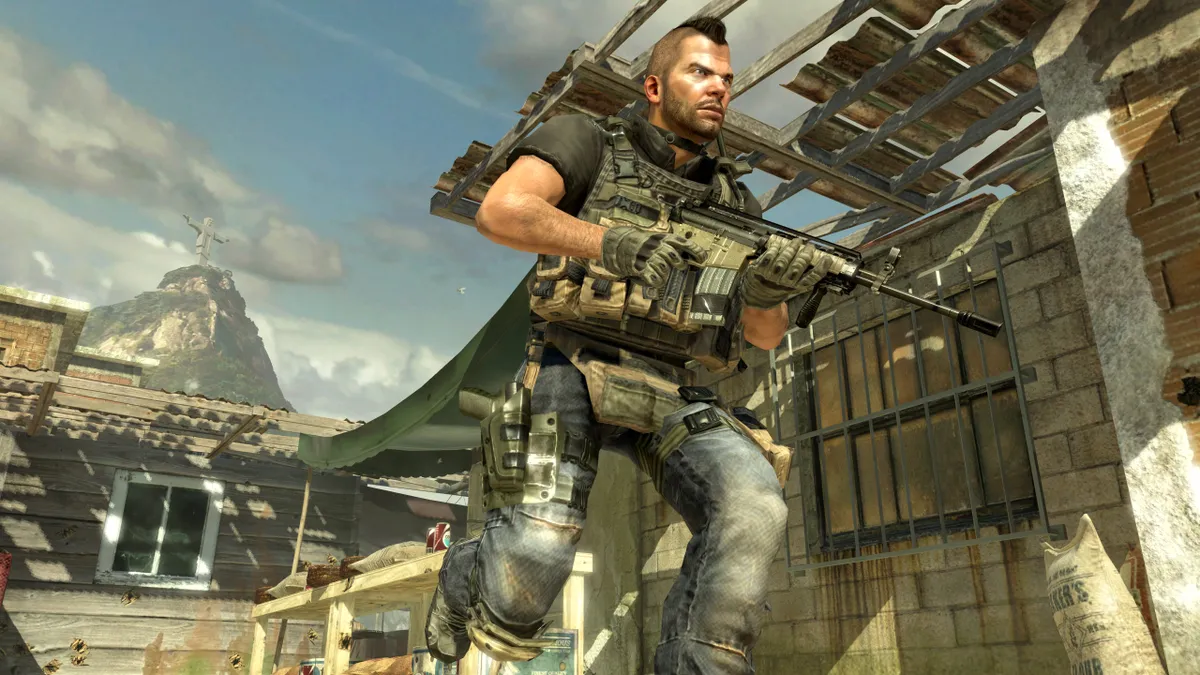
Soldier crouched down in front of a helicopter.

(Image credit: Activision)

Before taking the matter to court, b00lin tried going through Activision one last time. He used Activision’s ticket system, attempted to phone Activision support, and even tried contacting someone who works at Activision through Linkedin, but nothing seemed to work.


This fintech has a fix for the biggest cross-border payments issues in Francophone Africa


Until a few years ago, it used to be difficult to make payments across borders almost anywhere in the world. But it’s still a big problem in Africa, where fragmented, disconnected systems, high fees, and poor infrastructure make it tough for businesses and individuals to move money quickly and affordably.

The majority of people and businesses still rely on outdated agent networks or grapple with mobile wallet integrations. But there is tangible demand for cheaper and easier alternatives, particularly in underserved regions like Francophone Africa.

Ivorian fintech Cauridor is setting out to solve that, and it recently raised $3.5 million in seed funding to continue building its payment rails that let merchants, banks, telecom operators, and money transfer companies move funds in and out of Africa.

Cauridor says its platform supports mobile wallets, bank transfers, and cash pickups through a network of more than 25,000 agents across Guinea, Senegal, Ivory Coast, Sierra Leone and Liberia. These agents are part of a popular distribution method in the region — they’re usually small business owners equipped with point-of-sale (POS) devices and enable cash deposits, withdrawals and bill payments.

Cauridor is adopting a hybrid approach to solving the money transfer problem — the same way other fintechs in the region combine cash networks with digital infrastructure for local payment needs. Still, the approach has enabled it to operate remittance corridors to key markets like Ghana and Nigeria, and establish group-level contracts with major players such as Ria, MoneyGram, and Western Union, alongside partnerships with Orange and MTN.

From remittance to B2B payments

Cauridor’s founders Oumar Rafiou Barry and Abdoulaye Bah experienced first-hand the challenges of sending money back home to Guinea when studying in Canada. They faced slow, expensive remittance options in Francophone Africa, a region long underserved by the global remittance industry.

In 2019, this frustration drove them to start BNB CashApp, a consumer-focused remittance platform for users in Canada to send money to Africa. The app integrated directly with banks, mobile wallets like MTN, and an agent network equipped with a mobile portal to facilitate cash payouts.

But as the platform grew, the founders encountered a larger challenge: Africa’s fragmented and inefficient payment infrastructure. “We realized early on that the rails in Francophone Africa were almost non-existent. So we had to go in and start building payment rails in the region since the payments there were fragmented,” CEO Barry told TechCrunch. 

Sensing an opportunity, the team pivoted in 2022 to build payment rails for the region. By 2023, the company had merged its consumer remittance business and B2B payment infrastructure under the Cauridor brand, much like Tanzania’s Nala and Rafiki’s operational model.

The shift paid off: Over 90% of the company’s revenue now comes from its payment rails business. In 2023, Cauridor processed 2 million transactions and recorded total payment volume (TPV) of $300 million, which grew to $500 million in 2024, the company said.

Competition and future plans

While Barry references more prominent players like Onafriq and Thunes as Cauridor’s main competition, he says his company has remained relevant because it built payment rails in markets “no one was looking at,” like Guinea and Liberia.

He noted that hands-on customer service and pricing have also helped it retain customers. The fintech provides customer service to resolve common issues like rejected mobile money transactions due to incomplete KYC. For example, if a recipient can only receive $10 out of a $700 payment, Cauridor steps in to help upgrade their account and ensure the transaction goes through. 

Barry thinks Corridor’s strong local presence gives it an edge in securing better forex margins, which it passes on to its customers. He said this advantage has helped the company attract major clients like MoneyGram, which switched from competitors for better rates and improved customer support.

Interestingly, competition in the cross-border payments space doesn’t rule out collaboration. Some of Cauridor’s competitors rely on its infrastructure in specific regions, just as it partners with companies like Thunes for a global reach.

Cauridor employs about 200 people globally and has offices in Ivory Coast, Senegal, Guinea, Sierra Leone, and Liberia.

The seed round was led by pan-African VC firm Oui Capital, and saw participation from Rally Cap, BKR Capital, and some angel investors.

With the fresh cash, the company plans to expand into new markets (it has new offices in Mali and Nigeria opening this year), flesh out its teams, and boost marketing efforts. Barry told TechCrunch that Cauridor is also preparing for a Series A round and exploring blockchain integration to streamline settlements and tap into the growing adoption of stablecoins in Africa’s cross-border payment space.

Empowering Black Leaders at the 10th Annual AAMA Conference


Atlanta, GA – April 24-26, 2024

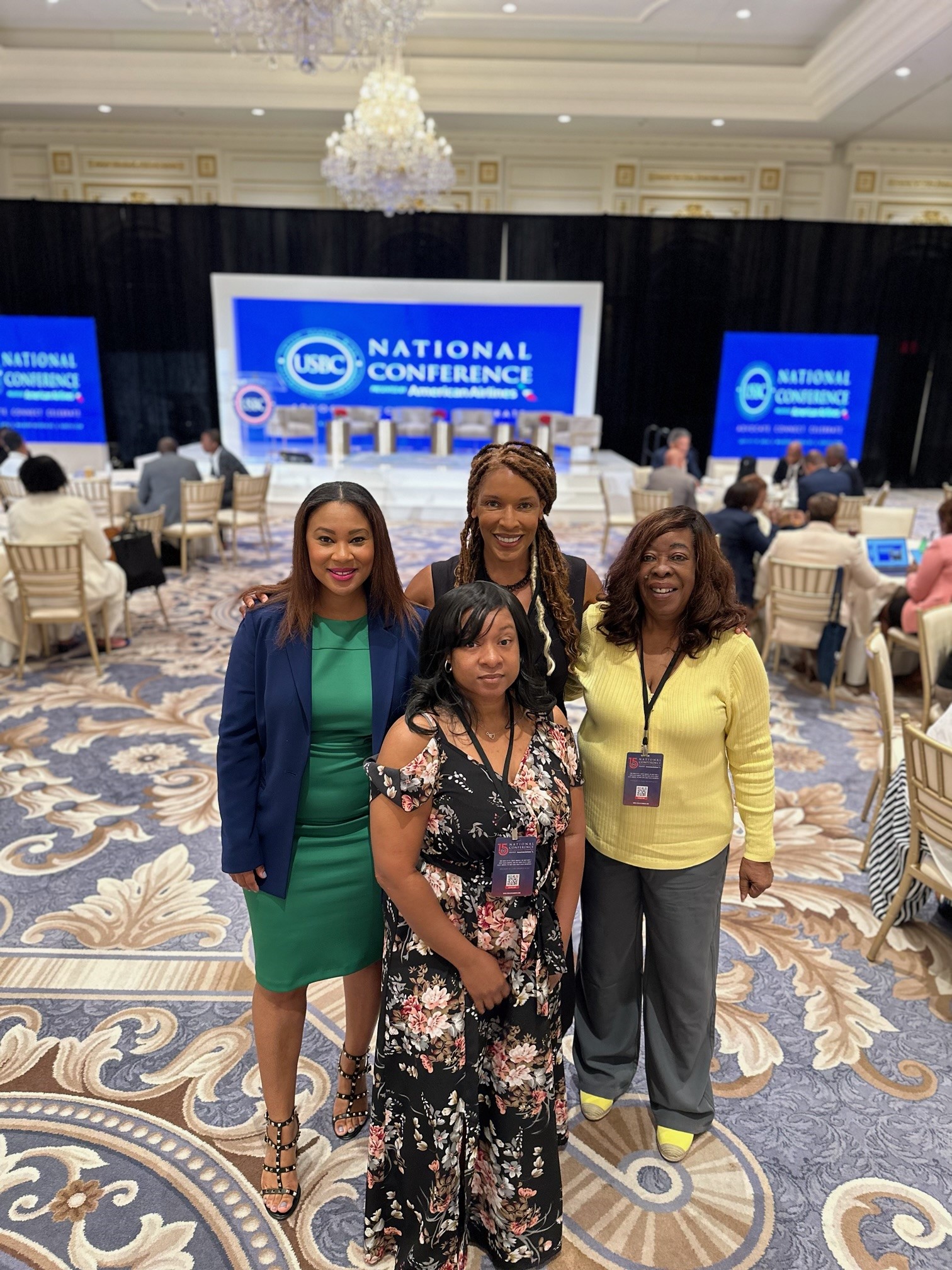
The African American Mayors Association (AAMA) is the nation’s only organization dedicated exclusively to supporting and advocating for the needs of Black mayors and Black-led cities. African American mayors are leading the country’s largest and smallest communities, impacting the everyday lives of more than 30 million Americans. As a first-time attendee, it was truly an honor meeting some of the nation’s brightest and most inspiring city executives while highlighting the contributions of the thousands of business owners in their communities who make the Arise® Platform thrive.

The highlight of the conference, of course, was the opportunity to meet up and have dinner with our amazing Service Partners. We even got photobombed by Darby, PA mayor Darren Burrell!

The conference was an occasion to converse with decision-makers in the public sector and an opportunity to share successful strategies and new ideas. We look forward to continuing engagement with vital stakeholders about our Service Partner community and the many benefits of the Arise® Platform.

T-Mobile rolls out satellite texting support to select iPhone users


Android satellite messaging settings

Mishaal Rahman / Android Authority

TL;DR

  • Earlier this month, T-Mobile started testing messaging via Starlink satellites with select Samsung users.
  • The latest iOS 18.3 update brings the satellite texting feature to eligible iPhone users on T-Mobile.
  • Interested users can sign up for the beta on T-Mobile’s website.

In 2022, Apple partnered with Globalstar to enable its Emergency SOS via satellite tool on the iPhone 14 and newer models. With iOS 18, the firm expanded satellite texting beyond emergency services, letting iPhone users reach their friends and family when off the grid. To give users more options, iOS 18.3 introduces support for T-Mobile’s own version of the feature, which relies on SpaceX’s Starlink satellites.

A couple of weeks ago, T-Mobile started rolling out satellite messaging support to those using the latest Samsung phones. According to Bloomberg, the carrier has been working with Apple and SpaceX to implement the perk on iPhones, and the recently released iOS 18.3 update finally activates it. While T-Mobile’s satellite connectivity feature is initially limited to texting, a future update could allow iPhone users to make phone calls and access the web using Starlink’s service.

The most notable difference between the Globalstar and Starlink satellite connectivity tools is that the latter doesn’t require you to point your iPhone to the sky in a specific direction. Eligible users can receive texts in areas lacking network coverage without taking their phones out of their pockets. Unlike the former, though, the feature only works in the US.

To enable satellite texting on your iPhone, you must sign up for the beta on T-Mobile’s website. Once the carrier rolls out the feature to your account, you’ll find new options to manage it in the Settings app on iOS 18.3. Although the exact timing remains unclear, T-Mobile aims to launch the perk to all users in 2025.

Got a tip? Talk to us! Email our staff at news@androidauthority.com. You can stay anonymous or get credit for the info, it’s your choice.

Optimizing Inference in the Age of Open-Source Innovation


DeepSeek’s R1 Model Sparks Excitement

The recent release of DeepSeek’s R1 model, a groundbreaking open-source model from the Chinese AI startup, has sparked a wave of excitement in the AI community. What makes the DeepSeek model so revolutionary is its focus on “inference-time computing”, a technique that emphasizes multi-step reasoning and iterative refinement during the inference process to generate more accurate and contextually relevant responses. While this approach greatly reduces computational costs and improves efficiency during model training time—as evidenced by the R1 model’s reported $5.6 million training cost, a fraction of the estimated training cost of OpenAI’s GPT-4 model—it shifts the computational bottleneck from training to inference, marking a significant shift in how we should think about AI deployment. While DeepSeek’s release is a milestone, it also highlights a broader trend: the growing importance of optimized model inferencing as the new frontier in AI.


For years, the focus in AI has been on training—building bigger, more powerful models. But as models like DeepSeek demonstrate, the real-world value of AI comes from efficient inference. As model training becomes cheaper and more accessible, organizations will turn towards AI and deploy it more widely, driving up the need for compute resources and tools that can manage this growth. This shift is already underway, driven by the rise of open-source models, which are making state-of-the-art AI more accessible than ever.


Yann LeCun captured this perfectly in his response on LinkedIn to DeepSeek’s success:

To people who see the performance of DeepSeek and think: ‘China is surpassing the US in AI.’ You are reading this wrong. The correct reading is: ‘Open-source models are surpassing proprietary ones.'”


Open-source models like DeepSeek are not just cost-effective to train—they also democratize access to cutting-edge AI, enabling organizations of all sizes to innovate. However, this democratization comes with a challenge: as more companies adopt AI, the demand for efficient, scalable inference will skyrocket.


The Case for Optimized Compute

This is where Clarifai’s Compute Orchestration steps in. While models like DeepSeek push the boundaries of what’s possible, they also underscore the need for tools that can optimize inference at scale. Compute Orchestration is designed to address this need, offering a unified platform to manage and deploy AI models efficiently, whether open-source or proprietary.


Here’s how Compute Orchestration helps organizations navigate this new era:

  1. Optimized Inference: Features like GPU fractioning to pack multiple models on the same GPU and traffic-based autoscaling to dynamically up when traffic increases and, just as importantly, down to zero when it decreases are built-in, reducing costs without sacrificing performance.
  2. Control Center: A unified, single-pane-of-glass view for monitoring and managing AI compute resources, models, and deployments across multiple environments, giving companies better insight and control over their AI infrastructure, preventing runaway costs.
  3. Enterprise-Grade Features: RBAC controls, Organizations and Teams, logging and auditing, and centralized governance provide the security and oversight enterprises require, making it easier to deploy AI in regulated industries.


As Clarifai CEO Matt Zeiler notes, “Every open-source model needs a place to run it, and we make it easy to run it on every cloud and on-premise environment with the same set of tools.” Compute Orchestration is the backbone of this new AI ecosystem, enabling companies to seamlessly deploy and manage models, whether they’re running on cloud clusters, on-premise servers, or edge devices.


The rise of models like DeepSeek is a reminder that the future of AI lies not just in building better models, but in deploying them efficiently. As inference becomes the bottleneck, companies need tools that can scale with their needs. Clarifai’s Compute Orchestration is poised to play a pivotal role in this transition, providing the infrastructure needed to harness the full potential of AI.


Whether you’re running open-source models like Deepseek or your own proprietary ones, Clarifai ensures you’re ready for the future of AI. Experiment with DeepSeek models on Clarifai today, free for a limited time on our community:


Ready to take control of your AI infrastructure?

Learn more about Compute Orchestration or sign up for the public preview and see how we can help transform the way you deploy, manage, and scale your AI models.


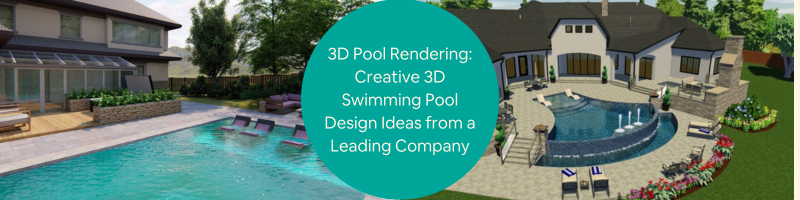
3D Pool Rendering: Creative 3D Swimming Pool Design Ideas from a Leading Company


The best thing about 3D rendering services is that you get to see how the swimming pool should look, even before construction begins. Modern CAD technology allows you to design everything in a virtual space where you can build, make changes, and basically fine tune the plan on a computer screen. Rendering does cost money, but it helps you avoid potential costly mistakes during the construction. You can consider it a three-dimensional photorealistic blueprint but without all the confusing technical construction annotations.


🚀 Table of contents


Swimming pool 3D rendering

Photorealistic rendering is a WYSIWYG (What You See Is What You Get) construction document digitally drawn to scale, so you get a clear idea of what the final outcome will be early on in the project. To make the rendering as accurate as possible, it has to go through several steps:

1. Concept: the process starts with some simple sketches on paper to determine basic specifications such as shape, dimensions, materials, and location relative to the house or main building. If there needs to be structures around the swimming pool, like glass enclosure, deck, furniture, and decorative elements, they should be included and detailed in the sketch as well. The sketch will have to go through one or two refinements before everything is ready for digital drawing.

2. Modeling: the render artist begins creating 3D models of all objects in the pool and the surrounding landscape. If the pool is close enough to the main building, a small part of it might be included in the modeling to put everything to scale.

3. Detailing: once the modeling is done, it’s time to put more details into each object. The process may involve adding colors, textures, lighting, and shadows.

4. Water simulation: one of the most challenging parts of 3D rendering is creating photorealistic water. Most render artists use specific drafting services to generate depth, transparency, reflection, and the illusion of motion on the surface.

5. Lights and shadows: the viewing angle along with light direction determines the shadow. Since the rendering also involves water, there should be some refractions as well. Shadows on the water surface should be different from those on hard surfaces, too.

6. Rendering: the actual rendering task is done by the computer, but the artist still needs to configure a few settings like the resolution and output format.

7. Post-processing: once the rendering is done, post-processing helps improve fine details such as brightness, saturation, contrast, and specific effects.

Swimming pool 3D rendering costs between $500 to $1500. Keep in mind that the rendering fee has nothing to do with how much the actual swimming pool will cost you.

RELATED: Creating exterior renderings using 3D exterior rendering services for architects

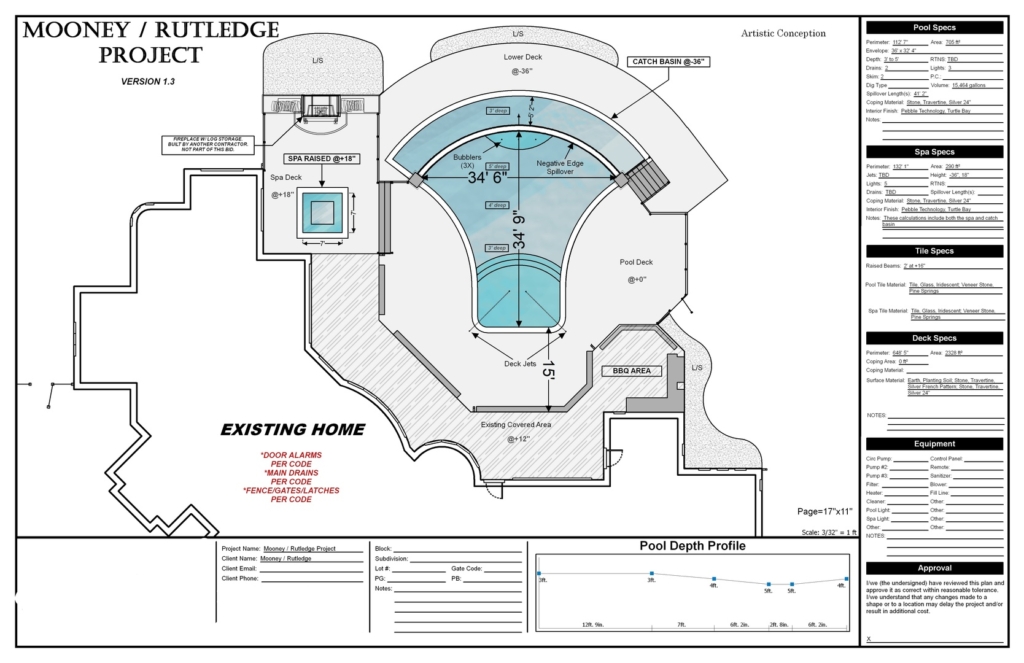
architectural plan for a pool design for an existing home

Types of swimming pool

A swimming pool is a striking home improvement element. It comes in plenty of different sizes, shapes, and styles, but sometimes more options make it even harder to make the right choice. You have many things to consider, from functions and maintenance to design and complexity. But one thing is certain: a swimming pool is not cheap. Pool design services don’t have to be expensive, however.

In-ground

A multi-use recreational swimming pool is often a standard feature in a luxury house. In some real estate markets, such as the Sun Belt region in the US (stretching from Virginia and Florida in the southeast through Nevada and southern California in the southwest), an in-ground pool – or any type of swimming pool, for that matter – is pretty commonplace in middle-class neighborhoods as well. Even if you’re not overly keen to swim, the feature will come out as an excellent investment that brings a significant addition to the property’s long-term value. And if you do find swimming enjoyable, an in-ground swimming pool requires regular maintenance, at least several hours a week for cleaning.

Above ground

Soft-sided and hard-sided options are available for above-ground swimming pools. And if you add a frame around the outside walls or elevated deck, the final outcome is barely distinguishable from the in-ground type. Pool designers use the soft-sided option allows you to disassemble the entire structure in case you need the extra space or during cold winter. Reassembly is relatively easy for DIYers, but then again, you may come across some difficulties when the structure is poorly built in the first place due to clumsy planning. Compared to the in-ground type, an above-ground swimming pool is a much more affordable investment and easier to maintain.

RELATED: Architectural illustrations vs. architectural visualization services

Lap pool

Most lap pools are built as an in-ground type, but there are also above-ground variants installed as either permanent or non-permanent structures. The ideal size for a lap pool is anywhere from 45 ft. to 75 ft. long; the standard Olympic-sized length is 164 ft. As for the depth, it usually has three levels: 3 ft. at the shallow end (for entrance), 4 ft. in the middle, and 5 ft. at the other end. While the entrance seems suitable for children, a lap pool is intended only for workout use without additional elements like water slides or diving boards. A lap pool is long, narrow, and shallow. It’s constructed in a rectangular shape, making it an ideal option for a small backyard area because it doesn’t take up too much space. The installation of an in-ground lap pool with the aforementioned size costs around $45,000. But if you’re looking for a store-bought above-ground type, expect to pay around $10,000, including labor.

Indoor pool

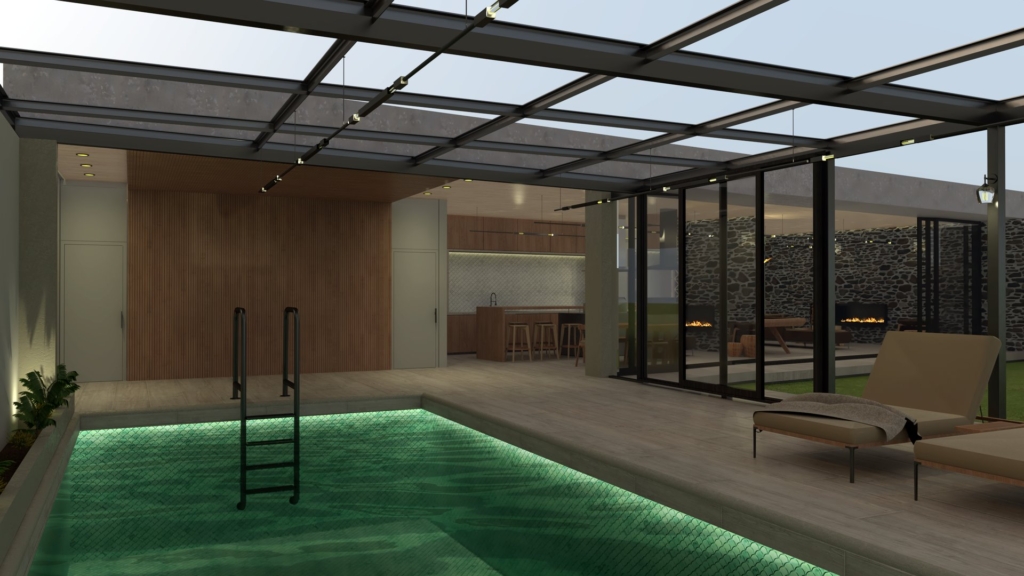
If budget is not a concern, an indoor pool is a no-brainer. As the name suggests, the swimming pool is located inside – therefore not exposed to the outside environment – and under a roof for better privacy and cleanliness. An indoor pool is usually in-ground and built for swimming exercises throughout the year rather than being part of a playground. Think of it as a fancier and larger version of a lap pool kept safe from the elements. When installed outside the main building (such as in a backyard), freelance pool designers will often cover it with a glass enclosure; if you have enough space, you can even have the pool and enclosure constructed as a detached structure. Whether the shape is rectangular, circular, oval, semi-circle, or any other geometry you find pleasing and complementing the architectural style, an indoor pool is a true statement of taste and style.

indoor pool example

RELATED: Best practices for architecture firms: Residential and commercial architectural site planning

Infinity edge pool

At least one side of an infinity pool is set below the water level with an out-of-sight skimmer tray. The edge is designed in such a way that it looks as if the pool blends seamlessly with the surrounding landscape. Done right, the water at the edge of the pool gives the illusion that it falls over the wall, just like a small waterfall, although you don’t exactly hear the sound of rumbling water. Infinity pool is a common feature in luxury homes located on hilltops or near the ocean. It’s always custom-built as part of the house blueprint and intended to highlight the view.

Spool

A blend of spa and pool, a spool is larger than a spa yet smaller compared to a typical pool. You can’t swim in it, although some spools have directional jets with adjustable power for the purpose. But most spools are built for relaxation – a place where you can soak comfortably with friends after a hectic day. Spools are usually an in-ground affair constructed from poured concrete, but there are also ready-made models installed with elevated decks. You can almost say that spools are oversized hot tubs. Some of the fancier models feature full temperature control, insulated cover, LED lighting, and a filtration system.

Note: if your spool turns out to be quite large, it may fall under the full-size swimming category according to the local building code. You may need to install protective fencing to meet the code requirements.

Plunge pool

Often an addition to an already existing in-ground swimming pool instead of a stand-alone feature, a plunge pool is not designed for swimming. It’s relatively small (about 10 x 15 ft.) and shallow at around 6 ft. Although it looks like an ordinary spa, the water inside the pool is intentionally kept cold to help you cool down and relax after an intense exercise. But just because plunge pools are small and shallow, it doesn’t mean they’re cheap. Installation may cost between $15,000 and upward of $20,000.

Natural pool

No, this is not a pool that naturally takes shape on your property, but an artificial pool designed to appear as if it has already been there for many years. It’s built as part of the landscaping and therefore equipped with a regeneration zone for an organic cleaning system. Since this is intended to serve as landscape appeal, the pool is not used for swimming. Even if you want to swim in it, you probably won’t have an enjoyable experience due to the shallow depth. Depending on the size, a plain natural pool is likely more affordable than an in-ground swimming pool, although you might spend more on styling elements such as small streams/waterfalls, boulders, and aquatic plant life.

RELATED: Architectural design services costs: All you need to know

Architectural pool

The name says it all: an architectural pool is built to complement the design of the main building. The structure, materials, colors, and shape must be carefully selected to create a cohesive look. It might be an addition to an existing structure, but most are built as part of the house plan and designed by an architect. While it’s always a stand-out feature, an architectural pool should create the impression that it blends seamlessly with the main building as if each is an inseparable part of the other. If you’re building an architectural pool as part of a renovation, the cost can be more expensive than the house itself. Maintenance is just about the same as a regular in-ground type.

How Cad Crowd can help

A swimming pool is not a small investment, but proper planning and detailed 3D rendering can help you make sure that it is worth every penny you spend. Cad Crowd is home to professional render artists offering flexible solutions and customizations to meet even your most diverse requirements. Get in touch with Cad Crowd to get your free quote, and you can expect nothing but the best working with the best in the industry.

author avatar

MacKenzie Brown is the founder and CEO of Cad Crowd. With over 18 years of experience in launching and scaling platforms specializing in CAD services, product design, manufacturing, hardware, and software development, MacKenzie is a recognized authority in the engineering industry. Under his leadership, Cad Crowd serves esteemed clients like NASA, JPL, the U.S. Navy, and Fortune 500 companies, empowering innovators with access to high-quality design and engineering talent.

Connect with me: LinkedInXCad Crowd

Doom + Doom II now supports multiplayers mods


Old-school Doom fans have something new to chew on until The Dark Ages arrives. Doom + Doom II, the latest in a long line of rereleases of the two id Software classics, was updated on Tuesday with multiplayer mod support. And balance was restored in Hades.

At launch in August, the bundle — available for PC, PS5/PS4, Xbox Series X/S and Switch — supported mods and multiplayer, but not the two together. The game’s second update, which Bethesda pushed on Tuesday, only adds multiplayer mod support if everyone in your match does a little planning.

First, hosts need to activate each mod before entering the multiplayer menu. In addition, all players in the match have to subscribe to the same mod before joining. Only mods authored with Vanilla DOOM, DeHackEd, MBF21 or BOOM are compatible.

Doom: The Dark Ages is set to launch on May 15. It takes place in the medieval wastelands of Hell and adds new goodies like mech battles and a ridable cyber dragon. If that isn’t an elevator pitch for a Doom game, I don’t know what is.

fonts – Visual Studio Highlighting Variable Declarations


My apologies if this has already been asked and answered but I have searched for an answer and cannot find what I am looking for despite always feeling like I am close yto the solution.

I am using Visual Studio 2022 and I am working with a CMake project (though I do not believe this is relevant). I have Environment->General->Color Theme = Dark. I did not set any custom color schemes. I even went so far as to set everything, that I could find, back to defaults.

The issue I am experiencing is when I am declaring a variable, i.e. uint8_t myVar. While I am typing “myVar” Visual Studio highlights the text, which then makes it unreadable
myVar unreadable in dark them

Once I finish it with a semi-colon the highlighting goes away and I can read it. Until I want to modify the text. I’m aware I can do a refactor but I shouldn’t have to do that to be able to read text I want to modify.

If I perform the same action in Theme = Light I get
enter image description here

Clearly visible and highlighted.

How do I adjust the highlighting to be a better color or just disable it altogether?

I have searched through Options->Environment->Fonts and Colors until I ran out of ideas on more than one occasion.

My current workaround is to comment the line so that I can modify the text without it highlighting. However, I feel as though I shouldn’t have to do this.

I have also noticed that it only happens with the variable declarations. The highlighting does not appear when I modify the variable name inside of a function that I am using it in.

It also does not matter whether the variable is a public global, local variable in a function, or a static variable in or outside a function. They all exhibit the issue for declared variables.

40 Free Writing Contests: Competitions With Cash Prizes


Have you ever Googled “writing contests”? Many require reading fees or prizes—like seeing your work in print—that you can only receive if you pay for it.

Some legitimate contests charge small entry fees, but often a fee can be a red flag for a scam, so those might be the ones you want to stay away from. 

Besides, there are plenty of free writing contests that encourage and inspire boundless creativity with real cash prizes and career-advancing opportunities! Since it can be hard for a writer to know where to find them, we did the legwork for you.

We found 40 reputable, well-reviewed, free writing contests for poets, fiction writers, essayists and more

With thousands of dollars in cash prizes and numerous opportunities to secure a publishing contract, you’re sure to find the right free writing contest for your work.

If you don’t mind paying a little money to enter, our friends over at Smart Blogger have rounded up some great writing contests that have small entry fees. And if you’re still hungry for more opportunities, we also have posts on writers grants and writing fellowships.

Fiction and nonfiction writing contests this year

Ready to share your novel or personal essay with the world? Whether you’re a newbie or more established writer, you’re likely eligible for a few of these contests.

Here are some fiction and nonfiction writing contests worth considering.

1. L. Ron Hubbard Writers of the Future Contest

Whatever your feelings about L. Ron Hubbard’s work and philosophy, the prizes for this regular contest are nothing to sneeze at. Every three months, winners earn $1,000, $750 and $500, plus an additional annual grand prize of $5,000.

Submissions must be short stories or novelettes (up to 17,000 words) in the genre of science fiction or fantasy, and new and amateur writers are welcome to apply.

Deadlines: Quarterly on March 31, June 30 and September 30

Website: Writers of the Future

2. Inkitt

This boutique publishing firm offers cash prizes and promotional packages to winning authors. Submit a novel of 10,000 words or more in any fiction genre (no fanfic or poetry).

Inkitt’s writing contest runs monthly and gives authors the chance to win cash prizes up to $300, exclusive book badges and promotional packages while showcasing their books to Inkitt’s audience of more than 3 million users. Winners are determined by Inkitt’s unique algorithm based on overall reader engagement.

Deadline: See individual contest pages

Website: Inkitt

Disclosure: Inkitt is an advertising partner of The Write Life. We hold our advertisers to high standards and vetted this contest just like others on this list. 

3. Drue Heinz Literature Prize

You can win $15,000 and publication by the University of Pittsburgh Press with this prize, awarded for a collection of short fiction.

You may submit an unpublished manuscript of short stories, two or more novellas or a combination of novellas and short stories. Your total word count should be between 150 and 300 typed pages. You must also have already published a novel or book-length work of fiction “with a reputable publisher,” or no fewer than three short stories or novellas in nationally-recognized journals.

Deadline: Annual submissions must be postmarked between May 1 through June 30

Website: University of Pittsburgh Press

4. Young Lions Fiction Award

This $10,000 award recognizes “young authors,” which the rules define as any author aged 35 or younger. Submit any novel or collection of short stories published or scheduled to be published in the calendar year. Works must be written for adults; children’s or YA pieces are ineligible.

Deadline: Submission information is available on the award website

Website: New York Public Library

5. Graywolf Press Nonfiction Prizes

One of the best-loved small presses in the creative writing world, Graywolf Press hosts a variety of contests for both established and up-and-coming writers. Graywolf also offers smaller fiction and nonfiction prizes, with genres rotating by year; 2020 was a nonfiction year, so fiction was up in 2021, then back to nonfiction in 2022, and so on. These awards include a sizable advance—$12,000 in previous years—as well as publication with Graywolf.

Deadline: Contest is held annually with rotating genres

Website: Graywolf Press

6. The Jeff Sharlet Memorial Award for Veterans

Hosted by the prestigious Iowa Review, the Jeff Sharlet Memorial Award is offered to U.S. military veterans and active-duty members writing in any genre about any subject. Manuscripts of up to 20 pages will be accepted, and the first-prize winner will receive $1,000 and publication in the Review. A second place prize of $750 is also available, as well as three runner-up prizes of $500 each.

Deadline: Biennially

Website: The Iowa Review

7. Ernest J. Gaines Award for Literary Excellence

For 15 years, this contest has provided visibility for emerging African American fiction writers and enables them to focus on their writing by awarding a $15,000 cash prize. Eligible authors should submit a work of fiction, such as a novel or short story collection, published in the calendar year. (Galleys for publication within the year are also accepted.)

Deadline: Annually. The entry window closes on December 31

Website: The Ernest J. Gaines Award for Literary Excellence

8. PEN/Faulkner Award for Fiction

Honoring the best work of fiction published by an American author in a single calendar year, this award has been given to the likes of John Updike, Philip Roth and Ann Patchett. Novels, novellas and collections of short stories are all eligible.

The winner receives a hefty cash prize—up to $15,000 in the past—and an invitation to read at the award ceremony in Washington, D.C. Plus, there are no submission fees or application forms to deal with; just send a PDF of each book (as many as you’d like) to [email protected].

Deadline: Submissions will be accepted from July 1 to September 30

Website: Pen/Faulkner

9. PEN/Robert J. Dau Short Story Prize for Emerging Writers

This contest requires you to have already published a short story in a literary magazine or journal or cultural website. But if you’ve made your debut (but gone no further), you may be eligible for the generous cash prize of $2,000, which is annually awarded to 12 emerging writers, whose works are then published together in an anthology.

Short stories of up to 12,000 words are eligible and must be published in the calendar year preceding the year in which the award is given. Additionally, keep this in mind: Submissions are only eligible if submitted by an editor. Authors may not submit their own work.

Deadline: Submissions close November 1

Website: PEN America

10. Anisfield-Wolf Book Awards

Fiction and nonfiction writers who have recently published a book that “contribute[s] to our understanding of racism and our appreciation of cultural diversity” are eligible for this award, which offers $10,000 cash as well as media and publicity opportunities. Plus, winners receive their prize at a ceremony in Cleveland.

Submissions must be published in the prior year (so books published last year are eligible for the award this year).

Deadline: Annual submission window is September 1 through December 31

Website: Anisfield-Wolf Book Awards

We’ll also send you our weekly newsletter, which offers helpful advice for freelancing and publishing. You can unsubscribe at any time.

11. Marfield Prize (aka National Award for Arts Writing)

Presented by the Arts Club of Washington, this award seeks to honor nonfiction books that deal with the “visual, literary, media, or performing arts.” The prize is $10,000 and may be awarded to works of criticism, art history, memoirs and biographies, and essays.

Deadline: Annually in the last quarter of the year. The submission window in 2023 is October 15

Website: The Marfield Prize

12. W.Y. Boyd Literary Award for Excellence in Military Fiction

If you’re a war buff, this competition is for you. It awards $5,000—and a 24-karat-gold-framed citation of achievement—to the best piece of fiction set during a period when the U.S. was at war (war may either be the main plot of the piece or simply provide the setting). Submissions may be adult or YA novels.

Deadline: Annually on December 31

Website: American Library Association

13. Friends of American Writers Chicago Awards

FAW presents two annual awards: an Adult Literature Award for literary fiction or nonfiction, and a Young People’s Literature Award for a children’s/YA book.

Authors must reside in the state of Illinois, Indiana, Iowa, Kansas, Michigan, Minnesota, Missouri, North Dakota, Nebraska, Ohio, South Dakota or Wisconsin—or they must set their book in one of those locations. Prize amounts vary from year to year, but you don’t have to bother with an application and all winners are celebrated at the organization’s May luncheon.

Deadline: Annually in December

Website: Friends of American Writers Chicago

14. Hektoen Grand Prix Essay Contest

Hektoen International, an online journal dedicated to medical humanities, offers two prizes annually for essays of no more than 1,500 words: $5,000 is awarded to the winner and $2,500 to the first runner-up. Eligible topics are broad so long as they have a relation to medicine, and many include art, history, literature, education and more.

Deadline: Annually; September 15 is usually the deadline

Website: Hektoen International

15. Biopage Storytelling Writing Contest

There’s no denying it: social media is a huge part of our modern-day lives. It’s easy to get used to limiting our communications to 280-character and emoji-strewn snippets, which is why this marketing firm is hosting an essay writing contest to “remind people of the benefits of writing.”

Essays of up to 5,000 characters (roughly 1,000 words) will be accepted, and right now they’re looking for stories of COVID-19 quarantine life. The grand prize winner will receive $300, and five runners-up will be awarded $100 each.

The contest is free to enter, but you’ll need to register for a Biopage account to be eligible.

Deadline: The contest ends January 31 each year

Website: Biopage

16. St. Martin’s Minotaur / Mystery Writers of America First Crime Novel Competition

Writers 18 and older who have never had a novel published (in any genre) are eligible for this prize, awarded to an original book-length manuscript where “murder or another serious crime or crimes is at the heart of the story.” The winner receives a publication contract with Minotaur Books and an advance of $10,000 against future royalties.

Deadline: December 17 each yea

Website: Edgar Awards

17. ServiceScape Short Story Award

ServiceScape, a platform matching freelance writers, editors and graphic designers with clients (i.e. a great place to look for paid writing work!) offers a yearly Short Story Award of $1,000 to a winning fiction or nonfiction work of 5,000 words or fewer. The winner will also have their story featured on the ServiceScape blog, which sees thousands of readers each month.

Deadline: November 29 each year

Website: ServiceScape

18. Stowe Prize

This biennial prize of $10,000 honors an American author whose adult fiction or nonfiction work has had an impact on a critical social justice issue (as did Harriet Beecher Stowe’s novel Uncle Tom’s Cabin). The book must be written by a U.S. author and have been published in the United States during the previous three calendar years.

Deadline: Contact the Harriet Beecher Stowe Center for this year’s deadline.

Website: Harriet Beecher Stowe Center

19. The Diana Woods Memorial Award in Creative Nonfiction

Creative nonfiction essays of no more than 5,000 words on any subject are eligible for consideration for this award, whose winner receives $250 and publication in Lunch Ticket, the literary and art journal produced by the MFA community of Antioch University Los Angeles.

Works must not have been published elsewhere. Award winners are required to submit a 100-word biography, recent photo and a short note thanking the Woods family for their generosity and support.

Deadlines: Biannual reading periods are in February for the Summer/Fall issue and in August for the Winter/Spring issue

Website: Lunch Ticket

20. The 2023 Brandon Langhjelm Memorial Essay Contest

Each year, this Canadian organization offers three prizes, ranging from $500 to $1,500, to the essay with the most thoughtful, well-reasoned arguments around a specific human-rights theme. (For example, 2022’s prompt was, “Canadian governments are making Digital ID technologies a precondition of access to essential services and goods. What can Canadians do to protect their Charter rights and freedoms against the dangers of these technologies?)

The contest is open to Canadian college and university students, and essays should be 2,500 words or less in length.

Deadline: November 5

Website: Justice Center for Constitutional Freedoms

We’ll also send you our weekly newsletter, which offers helpful advice for freelancing and publishing. You can unsubscribe at any time.

21. Write the World

For young writers ages 13-18, these cool contests also serve as mini workshops. Recognizing that “a first draft is never perfect,” submissions actually receive peer review by authors, writing teachers and other experts and writers are given the chance to revise their pieces based on this feedback before submitting them for final prize consideration.

Contests vary each month, but there’s a $100 prize for the winner and $50 for the runner-up (plus $50 for the best peer-reviewer). All three are featured on Write the World’s blog alongside comments from a guest judge. And since each month’s prompt is from a different genre, developing writers get a chance to test out different styles.

Deadline: Monthly

Website: Write the World

22. Prose.

Stuck with writer’s block and looking for a way to jumpstart your escape? Prose offers weekly challenges meant to spark your creativity; many are just for fun, but look for the weekly numbered challenges posted by Prose (rather than community members or sponsors) for a chance to win money.

Prizes are typically between $100 to $200 and word counts are low—some as low as under 150, some as high as 500. So even if all you get from the prompt is a chance to flex your brain, it’s not a bad deal.

Deadline: Weekly and monthly

Website: Prose.

23. The Restless Books Prize for New Immigrant Writing

First-generation immigrants have a chance to win $10,000 and publication by Restless Books for telling their stories (real or imagined). The contest alternates annually between fiction (novel or short story collection) and nonfiction (memoir, essay collection, narrative nonfiction).

Deadline: Submission window is usually between December and March

Website: Restless Books

24. AFSA National High School Essay Contest

The U.S. Institute of Peace and the American Foreign Service Association sponsor this annual high school essay contest, where the winner receives a $2,500 cash prize, an all-expense paid trip to Washington, D.C., and a full-tuition paid voyage with Semester at Sea upon the student’s enrollment at an accredited university. Essays should be between 1,000 and 1,250 words and have to answer all aspects of the prompt as well as demonstrate an understanding of the Foreign Service.

Runners-up get a pretty sweet deal too, a $1,250 cash prize and a full scholarship to participate in the International Diplomacy Program of the National Student Leadership Conference.

Deadline: April each year

Website: American Foreign Service Association

25. Science-me a Story

Born in 2018, the Society of Spanish Researchers invites talented and original writers to write a 100-word blurb for a hypothetical novel. This might sound really easy, but your blurb has to quickly hook readers and make them want to read more. Open to anyone over 18 anywhere in the world, your real or fictional short story for this competition must be either in English or Spanish and “conceived from the objective of scientific dissemination to primary school” to qualify for the cash prizes: £150, £100 and £50. 

Deadline: April each year

Website: Society of Spanish Researchers in the United Kingdom

26. VCU Cabell First Novelist Award

Virginia Commonwealth University sponsors this award that honors an outstanding debut novel published in the preceding calendar year. While you may have published previous books in a different form, the submission must be your first published book marketed as a novel.

The award is a $5,000 cash prize, and the winning author must agree to attend the award event, usually scheduled for November.

Deadline: Annually; the submission window runs from July 1 through December 30

Website: Virginia Commonwealth University

27. Daisy Utemorrah Award

The Daisy Utemorrah Award is for an unpublished manuscript of junior or YA fiction written by Aboriginal and Torres Strait Islander peoples currently living in Australia. Generously supported by the Copyright Agency’s Cultural Fund and the State Government of Western Australia, the winner of the award receives $15,000 and a publishing contract with Magabala Books.

Deadline: Submission window usually opens at the beginning of each year

Website: Magabala Books

28. Short Fiction Prize

If you’re an undergrad at a college in the U.S. or Canada, this writing competition is for you. (Traditionally, this contest has encouraged applicants with an Asian background, but anyone is invited to apply.) Submissions should be no more than 7,500 words.

One winner will get a $1,000 prize as well as a scholarship to the next Southampton Writers Conference.

Deadline: Submission window is usually between March 1- July 14

Website: Stony Brook University | Lichtenstein Center

29. Bacopa Literary Review Contest

The Bacopa Literary Review is an international journal published by the Writers Alliance of Gainesville. Each year, it opens submissions for pieces in four genres: fiction, creative nonfiction, poetry and prose poetry. Find detailed guidelines for each genre on its website. First place gets $300, and the second prize in each of the four genres gets $100.

Deadline: May 30 each year

Website: Writers Alliance of Gainesville

30. Insecure Writer’s Support Group Annual Anthology Contest

As long as you stick to the guidelines, The Insecure Writer’s Support Group’s annual contest welcomes your 5,000- to 6,000-word (previously unpublished) creative story. But before you send it off, make sure your story is polished and formatted! Plus, the prizes aren’t too shabby—winning stories will be edited and published, authors will receive royalties, and the top story will even get to give the anthology its title. 

Deadlines: September 1 each year

Website: Insecure Writer’s Support Group

31. New Voices Award

Presented by Lee & Low Books, an award-winning children’s book publisher, this award is given for a previously unpublished children’s picture book manuscript of no more than 1,500 words written by a writer of color or Indigenous/Native writers who’s a resident of the U.S.

The winner receives $2,000 cash and a standard publication contract, and an additional Honor Award winner will receive a cash prize of $1,000. You may submit up to two manuscripts.

Deadline: Watch the website for details. 

Website: Lee & Low Books

32. St. Francis College Literary Prize

Since 2009, this biennial literary award has honored mid-career writers who have recently published their third, fourth or fifth work of fiction. The winner receives $50,000 and may be invited to the St. Francis College campus in Brooklyn, New York, to deliver a talk about their work or teach a mini fiction workshop to St. Francis students.

Deadline: Biennially. The contest was not offered the last three years due to the pandemic and limited campus access

Website: St. Francis College

33. Future Scholar Foundation Short Story Competition

The Future Scholar Foundation is a nonprofit organization started and run by high school students in Redmond, WA. Their mission is to empower young students to develop their self-expression skills through monthly short story competitions. Their efforts have been recognized by the Seattle Times and Northwest Asian Weekly, and their short story competitions have received hundreds of submissions from over 15 US states and five countries.

Deadline: Monthly on the 28th

Website: Future Scholar Foundation

Free poetry contests to enter

Curious about opportunities for poets? Your stanzas—rhyming or not—could be worth a fair amount of money in these poetry competitions.

Check out these poetry writing contests.

34. Black Voices in Children’s Literature Writing Contest

This contest is open to Black writers who are over the age of 18 and residents of Illinois, Indiana, Iowa, Michigan, Minnesota, Missouri, Nebraska, North Dakota, Ohio, South Dakota or Wisconsin.  It’s hosted by Strive Publishing and Free Spirit Publishing and seeks to fill the need for Black representation in children’s and young adult books. Original board and picture books for children aged 0-4 and picture books for ages 4-8 are eligible, provided they feature contemporary, realistic Black characters and culture and focus on character development, self esteem, community and other aspects of positive childhood development.

Three prizes, ranging from $250 to $1,000, will be awarded, and the first-place winner will be “seriously considered” for publication, though it’s not guaranteed.

Deadline: Usually late July, each year

Website: Free Spirit Publishing 

35. James Laughlin Award

If you’re already a published poet, this is the award for you; it’s given for a second book of poetry due to come out in the forthcoming year. The winner receives $5,000 and an all-expenses-paid week-long residency at The Betsy Hotel in Miami Beach, Florida. In addition, copies of the winning book are distributed to 1,000 members of the Academy of American Poets.

Deadline: Annual submission window is January 1 through May 15

Website: Academy of American Poets

36. African Poetry Book Fund Prizes

The APBF awards three prizes annually for African Poetry. The Luschei Prize for African Poetry gives $1,000 for a book of original African poetry published in the prior year.

The Sillerman First Book Prize for African Poets gives $1,000 and a publication contract for a book-length collection of poetry by an as-yet-unpublished African author.

The Brunel International African Poetry Prize is a new prize that grants £3,000 to a poet who was born in Africa, or has African parents, who has not yet had a full-length book of poetry published. (U.S. citizens qualify.) To submit, you’ll need 10 poems.

Deadlines: See individual prize pages or details

Website: African Poetry Book Fund

37. Tufts Poetry Awards

Claremont Graduate University presents two awards each year to poets they deem to be “outstanding.” The Kate Tufts Poetry Award grants $10,000 for a published first book of poetry that shows promise.

The Kingsley Tufts Poetry Award grants a mammoth $100,000 for a published book of poetry by an established or mid-career poet.

Deadline: Submission window is July 1 to June 30 each year

Website: Claremont Graduate University

38. Graywolf Press Walt Whitman Award 

The Walt Whitman Award is a $5,000 prize awarded, along with publication, to an American poet with a winning first book manuscript. He or she also receives an all-expenses-paid six-week residency at the Civitella Ranieri Center in Umbria, Italy.

Graywolf Press is also one of the publishers of the Cave Canem Poetry Prize, “a first book award dedicated to the discovery of exceptional manuscripts by Black poets.” Winners receive $1,000 and Graywolf publishes every third winner of the prize.

Deadline: July 1 to September 1 each year

Website: Poets

39. Wergle Flomp Humor Poetry Contest

Now in its 23rd year, this humor contest wants your best published or unpublished work for a grand prize of $2,000; runners-up are awarded $500 and 10 honorable mentions will receive $100 each. Writers of all ages from eligible countries can submit an original, humorous poem with 250 lines or less, and it must be in English.

Deadline: April 1, each year (and no, this isn’t an April Fools joke)

Website: Winning Writers

40. The Alpine Fellowship Writing Prize

This writing competition is looking for the best piece of unpublished, themed writing. For example, one year, the theme was “Untamed: On Wilderness and Civilization.” Submissions may be prose, poetry or non-academic essays. Maximum word count is 2,500, and this is open to all nationalities and to anyone 18 or older. The winner gets a £10,000 cash prize, second place gets £3,000 and third place gets £2,000.

Deadline: Applications open at the beginning of each year. Follow the Alpine Fellowship on Instagram for updates

Website: The Alpine Fellowship

Where to find more legitimate, free writing contests

Looking for more opportunities to submit your work? Here are a few great sites to keep an eye on for writing contests.

Winning Writers

A number of the contests found on our list came highly recommended by this site, which compiles some of the best free literary contests out there. Along with a wide range of recommended contests for writers of all stripes, Winning Writers also lists some contests and services to avoid, which is just as useful!

They also offer a handful of contests themselves, including the North Street Book Prize.

Poets & Writers

Another fantastic source for legitimate writing contests we consulted when compiling this list, Poets & Writers vets competitions, contests, awards and grants to make sure they’re following legitimate practices and policies. It’s worth checking out regularly as it features both annual and one-time contests.

We’ll also send you our weekly newsletter, which offers helpful advice for freelancing and publishing. You can unsubscribe at any time.

This listing contains affiliate links. That means if you purchase through our links, you’re supporting The Write Life—and we thank you for that!

The original version of this story was written by Kelly Gurnett. We updated the post so it’s more useful for our readers. 

Photo via Viktoriia Hnatiuk / Shutterstock



DeepSeek: Everything you need to know about the AI chatbot app


DeepSeek has gone viral.

Chinese AI lab DeepSeek broke into the mainstream consciousness this week after its chatbot app rose to the top of the Apple App Store charts. DeepSeek’s AI models, which were trained using compute-efficient techniques, have led Wall Street analysts — and technologists — to question whether the U.S. can maintain its lead in the AI race and whether the demand for AI chips will sustain.

But where did DeepSeek come from, and how did it rise to international fame so quickly?

DeepSeek’s trader origins

DeepSeek is backed by High-Flyer Capital Management, a Chinese quantitative hedge fund that uses AI to inform its trading decisions.

AI enthusiast Liang Wenfeng co-founded High-Flyer in 2015. Wenfeng, who reportedly began dabbling in trading while a student at Zhejiang University, launched High-Flyer Capital Management as a hedge fund in 2019 focused on developing and deploying AI algorithms.

In 2023, High-Flyer started DeepSeek as a lab dedicated to researching AI tools separate from its financial business. With High-Flyer as one of its investors, the lab spun off into its own company, also called DeepSeek.

From day one, DeepSeek built its own datacenter clusters for model training. But like other AI companies in China, DeepSeek has been affected by U.S. export bans on hardware. To train one of its more recent models, the company was forced to use Nvidia H800 chips, a less-powerful version of a chip, the H100, available to U.S. companies.

DeepSeek’s technical team is said to skew young. The company reportedly aggressively recruits doctorate AI researchers from top Chinese universities. DeepSeek also hires people without any computer science background to help its tech better understand a wide range of subjects, per The New York Times.

DeepSeek’s strong models

DeepSeek unveiled its first set of models — DeepSeek Coder, DeepSeek LLM, and DeepSeek Chat — in November 2023. But it wasn’t until last spring, when the startup released its next-gen DeepSeek-V2 family of models, that the AI industry started to take notice.

DeepSeek-V2, a general-purpose text- and image-analyzing system, performed well in various AI benchmarks — and was far cheaper to run than comparable models at the time. It forced DeepSeek’s domestic competition, including ByteDance and Alibaba, to cut the usage prices for some of their models, and make others completely free.

DeepSeek-V3, launched in December 2024, only added to DeepSeek’s notoriety.

According to DeepSeek’s internal benchmark testing, DeepSeek V3 outperforms both downloadable, openly available models like Meta’s Llama and “closed” models that can only be accessed through an API, like OpenAI’s GPT-4o.

Equally impressive is DeepSeek’s R1 “reasoning” model. Released in January, DeepSeek claims R1 performs as well as OpenAI’s o1 model on key benchmarks.

Being a reasoning model, R1 effectively fact-checks itself, which helps it to avoid some of the pitfalls that normally trip up models. Reasoning models take a little longer — usually seconds to minutes longer — to arrive at solutions compared to a typical non-reasoning model. The upside is that they tend to be more reliable in domains such as physics, science, and math.

There is a downside to R1, DeepSeek V3, and DeepSeek’s other models, however. Being Chinese-developed AI, they’re subject to benchmarking by China’s internet regulator to ensure that its responses “embody core socialist values.” In DeepSeek’s chatbot app, for example, R1 won’t answer questions about Tiananmen Square or Taiwan’s autonomy.

A disruptive approach

If DeepSeek has a business model, it’s not clear what that model is, exactly. The company prices its products and services well below market value — and gives others away for free.

The way DeepSeek tells it, efficiency breakthroughs have enabled it to maintain extreme cost competitiveness. Some experts dispute the figures the company has supplied, however.

Whatever the case may be, developers have taken to DeepSeek’s models, which aren’t open source as the phrase is commonly understood but are available under permissive licenses that allow for commercial use. According to Clem Delangue, the CEO of Hugging Face, one of the platforms hosting DeepSeek’s models, developers on Hugging Face have created over 500 “derivative” models of R1 that have racked up 2.5 million downloads combined.

DeepSeek’s success against larger and more established rivals has been described as “upending AI” and ushering in “a new era of AI brinkmanship.” The company’s success was at least in part responsible for causing Nvidia’s stock price to drop by 18% on Monday, and for eliciting a public response from OpenAI CEO Sam Altman.

As for what DeepSeek’s future might hold, it’s not clear. Improved models are a given. But the U.S. government appears to be growing wary of what it perceives as harmful foreign influence.

TechCrunch has an AI-focused newsletter! Sign up here to get it in your inbox every Wednesday.