This error typically means that the required SQL Server platform schema provider — specifically the one for SQL Server 2022 (Sql160DatabaseSchemaProvider) — is missing on the machine where the DACPAC deployment is being executed. In your case, even though the build pipeline is working fine and the DACPAC file is being generated successfully, the deployment fails because the target machine (likely your on-premises SQL Server or a jumpbox) doesn’t have the necessary components installed.
The key issue is that the actual deployment step is being run on the target machine (via WinRM), and not on your Azure DevOps agent. For this reason, the target machine itself needs to have the latest version of the SQL Server Data-Tier Application Framework (DACFx) that supports SQL Server 2022 (also referred to as DACFx v160). Without this, the deployment process doesn’t recognize the schema provider required by your DACPAC file, resulting in the internal error you’re seeing.
To fix this, you need to install DACFx v160 on the machine where the DACPAC is being deployed. You can download the latest DACFx installer from Microsoft’s official site here. Choose the .msi version and install it on the target server. This will include support for SQL Server 2022 deployments. Once installed, you can verify the installation using PowerShell by running Get-Command "SqlPackage.exe" and checking that it’s pointing to the correct version and path (ideally something like C:\Program Files\Microsoft SQL Server\160\DAC\bin\SqlPackage.exe).
If the built-in Azure DevOps task (SqlDacpacDeploy@2) continues to give you issues, a reliable alternative is to bypass it and run the deployment directly using SqlPackage.exe within a PowerShell task. This gives you full control over the deployment process and ensures you’re using the correct DACFx version. A simple inline PowerShell script within your pipeline can handle this, where you specify the path to your DACPAC file, your target server and database name, and your SQL authentication credentials.
Lastly, make sure that your Visual Studio database project is targeting SQL Server 2022 (v160) and that all connectivity and permissions (especially for WinRM if you’re still using the extension) are correctly configured on the deployment server.
While OpenAI has cemented its lead in the U.S., Perplexity is taking a different route — quietly expanding into India to compete in the next phase of AI adoption. The search-focused AI startup is rapidly adding millions of users in the world’s second-largest internet and smartphone market, positioning itself for mass-market scale.
This week, Perplexity partnered with Bharti Airtel, India’s second-largest telecom operator after Reliance Jio, to offer a free 12-month Perplexity Pro subscription — normally worth $200 — to all 360 million Airtel subscribers. Airtel confirmed to TechCrunch that the deal is exclusive, meaning no other telco in the country can offer Perplexity’s services, including free access, to their subscribers.
The Airtel partnership is one of Perplexity’s most significant moves yet in a global expansion strategy that includes partnerships with more than 25 telcos globally, including those recently announced with SoftBank in Japan and SK Telecom in South Korea. It comes down to volume. India, the world’s most populous country, brings a mass market that the San Francisco-based startup will not find in other geographies.
Perplexity is already gaining major traction in the country. In Q2, Perplexity’s downloads in India surged 600% year-over-year to 2.8 million, according to Sensor Tower data shared exclusively with TechCrunch. In comparison, OpenAI’s ChatGPT saw a 587% increase, reaching 46.7 million downloads in the same period.
The growth trend extended to active users as well: Perplexity’s monthly active users (MAUs) in India increased by 640% year-over-year in Q2, while ChatGPT’s MAUs grew by 350%. India was also the largest market by MAUs for Perplexity in the last quarter, per Sensor Tower. However, ChatGPT maintained a significant lead in absolute numbers, with 19.8 million MAUs versus 3.7 million for Perplexity.
Image Credits:Jagmeet Singh / TechCrunch
Building on earlier partnerships, Perplexity has been working to leverage India’s user base to leapfrog Western markets, where OpenAI dominates paid subscribers. Earlier this year, Perplexity partnered with the Indian fintech giant Paytm to offer access to its AI-powered search through the Paytm app, which has over 500 million downloads and is among the top-three apps on the Indian government’s Unified Payment Interface network, processing over 1.2 billion transactions worth over ₹1,34,000 crores (approximately $15.6 billion).
The startup has also internally discussed offering its AI search engine to Indian students to grow its reach, sources told TechCrunch.
One reason Perplexity views India as a key growth market is the relatively limited number of local AI startups, particularly in the AI search space. At the same time, the country has a large and active base of tech-savvy users — a fact that has even prompted Perplexity’s archrival, Google, to launch AI-powered search features like AI Mode and AI Overviews in India ahead of many other markets.
Monetizing that large user base remains a challenge. Perplexity still lags far behind ChatGPT globally in terms of revenue, even as both offer the same $20-per-month starting price. In Q2, ChatGPT’s in-app purchase revenue worldwide surged 731% year-over-year to $773 million, while Perplexity saw a 300% increase, reaching $8 million, per Sensor Tower.
Image Credits:Jagmeet Singh / TechCrunch
The revenue challenge is particularly acute in India, where consumers are notoriously price-sensitive. Still, there are promising signs. ChatGPT saw an 800% year-over-year increase in in-app purchases to $9 million in the country in Q2. Perplexity has not generated any notable in-app revenue from India, but the startup has room to expand its paid subscriber base through India. Deals like the one with Airtel could help Perplexity effectively increase its subscriber base, at least in the short term.
Strategic partnerships in markets like India could help Perplexity catch the eye of investors who value user growth and geographic diversification. But to turn that attention into long-term backing, the startup will need to show that it can convert its expanding user base into revenue.
MAICON brings together top visionaries and experts in the field of AI during a three-day conference packed with actionable sessions and networking events—all to position you as the change agent your organization (and career) needs. In this ongoing speaker series, we’re featuring these extraordinary leaders, with forward-looking predictions, actionable tips you can use today, and a preview of their MAICON 2025 sessions. Continue reading “How to Combine AI + Automation for Maximum Impact with Brian Brinkman [MAICON 2025 Speaker Series]”
Outsourcing architectural drafting services that form part of the industry leader Cad Crowd can seem a little like giving your beloved secret recipe to a stranger halfway around the world. You want to receive exactly the flavor, texture, and presentation, but there’s always this creeping fear: What if the end dish is not right? Or worse, what if the mistakes creep in and ruin your whole project timeline? Whilst outsourcing has proved to be a useful leverage for architecture firms to expand, economize, and access specialized expertise, it’s also full of pitfalls if not carefully managed.
But let’s get one thing straight: mishaps in outsourcing architectural drafting are not a given. They are problems waiting to be addressed with the right attitude, approach, and communication. If you’ve ever been stuck in the frustration of lost details, misaligned plans, or expensive reworks from outsourced drafting services, buckle up. We’re going deep on how you can outwit these mistakes and make outsourcing a winning proposition.
🚀 Table of contents
The allure and difficulty of outsourcing architectural drafting
Offshoring architectural drafting work presents a tempting combination of benefits: specialized skill, faster turnarounds, and usually a less costly financial impact than your own staff. You have access to worldwide talent pools where CAD coordinators and BIM experts provide innovative ideas and usually more current technical expertise. And, it releases your key architects to concentrate on design creativity instead of the drudgery of line work and documentation.
But here’s where it gets interesting. In contrast to working side by side, outsourcing introduces layers of complexity, distance, cultural subtleties, communication barriers, and time zone variations that can misplace or distort information. A misplaced dimension here, a misnamed layer there, and what was originally a simple drawing can turn into a mess.
So, what is the secret ingredient to getting past mistakes? Spoiler: It has nothing to do with eliminating outsourcing in general, but doing it right.
If there’s one word that can rescue your outsourcing endeavor, that word would be communication. Not mere communication, but clear-as-day, regular, and collective communication. Without it, even the most skilled drafting group will struggle.
Think of it as a handoff in a relay race. If the hand is sloppy, the team trips. When you outsource drafting, you’re handing over key architectural information to another team, usually at a distance. You have to be clear about what you expect, what you require, and what your goals are.
Most architectural design companies err by believing the drafting team ‘just knows’ what they need. In fact, assumptions are the source of all errors. A misplaced wall thickness or an ambiguous note on structural support can snowball into costly reworks.
Instead, create detailed briefs that do not leave any scope for assumption. Add annotated sketches, 3D models, reference standards, and even video, if necessary. Be prepared to answer queries in a timely manner, and arrange frequent check-ins to monitor progress. Video conferencing or screen-sharing sessions can establish rapport and clarify details more quickly than round-the-clock emails.
Choosing the right architectural drafting partner
Not all outsourcing companies are the same, and selecting a good drafting service provider is deciding upon a co-pilot for your project flight. Experience is important, but so are processes, technology competence, and cultural alignment.
Be cautious of companies that offer low prices but lack strong quality control or industry expertise. A drafting company that is familiar with your area’s building codes, design requirements, and software applications (such as AutoCAD, Revit, and ArchiCAD) will provide fewer mistakes and quicker revisions.
Ask future partners about their quality control processes. Do they use multi-layered review procedures? Double-check drawings versus original specs? How do they manage revisions and client comments? These questions speak volumes about how seriously they take accuracy.
Also, think about their communication responsiveness and style. The best architectural planning and design partner is proactive, open about issues, and accommodating enough to work with as your project changes.
Clear standards and documentation: The architect’s shield against errors
One such underestimated aspect of outsourcing mistakes is that there are no clear drafting standards and documentation. Picture every project as a rich language, and without a common dictionary, the misunderstandings accumulate.
Having a complete drafting standards manual for your outsourcing partner is a game-changer. This manual should define layer naming conventions, rules for dimensioning, line weights, symbols, annotation styles, and file formats.
In addition to that, specify examples of desired deliverables, timelines, and revision procedures. The aim is to ensure your architectural vision flows smoothly into the drafting language.
When everyone is literally on the same page, the likelihood of mistakes diminishes significantly, including those that might affect collaborators such as mechanical engineering experts. It also accelerates onboarding new drafting crews or rotating personnel in the outsourcing company.
Using technology to overcome distance
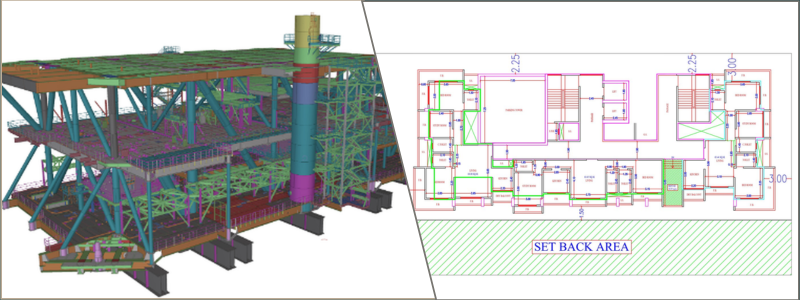
Technology is your friend when it comes to working remotely with architectural drafting. Real-time file sharing, change tracking, and version control are available through cloud-based collaboration platforms such as Autodesk Docs, Trimble Connect, or BIM 360.
No more emailing huge CAD files between each other, with the possibility of working with old versions. Everyone has the latest model, and comments or markups appear on the screen instantly.
Moreover, most companies have project management software like Asana or Trello to manage tasks and deadlines and create transparency regarding project status.
Using Building Information Modeling (BIM) software, where the model combines architectural, structural, and MEP services, allows clashes to be detected early, before any drafting starts. This minimizes mistakes downstream and keeps all the stakeholders aligned.
Training and relationship building: Outsourcing as a partnership, not a transaction
Too often, outsourcing is treated as a cost-cutting transactional activity and not as a co-operative relationship. This approach will plant seeds of neglect, poor communication, and ultimately mistakes.
Rather, view your outsourcing company as an extension of your very own staff. Take the time to train them on your business culture, project details, and feedback system.
This could mean virtual workshops or sharing recorded sessions on your design philosophy and quality expectations. The more aligned your partner is with your vision, the fewer surprises you’ll face.
Building relationships takes effort, but it pays dividends in trust and reliability. A trusted drafting partner will flag potential errors early, suggest improvements, and champion your project’s success.
Vigilant quality control: Catching errors before they catch you
Despite the best communication and standards, errors still do get through. The best way to deal with this is by catching them early through strong quality control procedures.
Before signing off on any outsourced drawing, have your internal team thoroughly review it against the original design documents. Utilize checklists that are specific to your project complexity, involving dimensions, annotations, layer compliance, and regulatory needs.
Some architectural design experts also have third-party reviewers or use computer programs that automatically review for drafting errors or code compliance.
Don’t hurry this process. A slight holdup here may save weeks of expensive rework on-site. Get your drafting partner to provide iterative review drafts instead of waiting till the last minute.
Managing time zones without losing time
One significant challenge in outsourcing architectural drafting services abroad is managing time zones. While your staff is waking up, your drafting firm might be closing down, and this window can hamper communication.
The key is astute scheduling and overlapping times. Determine periods in the day when both staff are working and make the most of that time for live communications.
Also, utilize asynchronous communication using emails, recorded video walkthroughs, and shared documents that enable every team to work effectively according to their schedule without relying on instant response.
You will find a rhythm over time that makes time zones a strength rather than a weakness, basically making your project a 24-hour shop.
Embracing flexibility and continuous improvement
Architectural projects are living things. Requirements evolve, regulations change, and design tweaks happen frequently. Outsourcing drafting services needs to embrace this flexibility.
Avoid rigid contracts that punish changes or revisions. Instead, build in scope flexibility and encourage ongoing feedback loops.
After each project phase, conduct post-mortems with your outsourcing firm. What worked? What errors crept in? What processes can be improved?
Sustained improvement is a hallmark of high-performing partnerships, resulting in fewer errors over the long term.
Real-world stories: Learning from outsourcing mishaps
The best lessons sometimes result from real-world anecdotes. One small architectural design and planning firm outsourced its drawings to a low-cost provider who was unfamiliar with local fire safety standards. The plans omitted necessary escape routes, leading to significant project delays and redesign expenses.
Conversely, another company spent big on ramping up their outsourcing partner, exchanging detailed CAD standards, having weekly video conferences, and creating a collaborative digital workspace. The payoff? Smooth drafting deliveries, negligible revisions, and an 18% quicker project cycle.
These anecdotes highlight the value of selecting the proper partner and spending in communication and standards from the outset.
Outsourcing architectural drawing services doesn’t have to be a gamble filled with errors and headaches. It’s about approach, seeing your outsourcing partner as a collaborator, investing in clear communication and standards, leveraging technology, and rigorously managing quality.
Imagine it as cultivating a garden. You can’t simply sow seeds and wait for things to happen. You water, trim, and pamper the plants so they grow well. Likewise, by caring for your outsourcing relationships, you’ll reap precision, effectiveness, and success in your architecture projects.
Partner with Cad Crowd now!
So the next time you are inclined to turn away from outsourcing drafting due to tales of woe about mistakes, keep in mind, it’s not the tool that breaks, it’s how it is used. At Cad Crowd, the leading platform for freelance engineering and design services, we’re here to help you. With these tactics under your belt, you’re better than equipped to use them like a pro.
MacKenzie Brown is the founder and CEO of Cad Crowd. With over 18 years of experience in launching and scaling platforms specializing in CAD services, product design, manufacturing, hardware, and software development, MacKenzie is a recognized authority in the engineering industry. Under his leadership, Cad Crowd serves esteemed clients like NASA, JPL, the U.S. Navy, and Fortune 500 companies, empowering innovators with access to high-quality design and engineering talent.
In Planet Coaster 2, you can push the boundaries of your creativity like never before. With enhanced and improved building tools, you can design a true water and theme park paradise that will delight and thrill your guests.
The latest free updates have included many new features for players to explore including modular souvenir shops, on-ride photos for guests to take home their memories, and tasty sit-down restaurants that can be fully customised to fit any theme in your park. Returning themes from the original Planet Coaster have also unlocked even more creative possibilities!
With this in mind, we’ve picked some of our favourite Xbox community creations from the Frontier Workshop to get you inspired and we can’t wait to share them with you!
These blueprints and park builds show off the fantastic tools and features you can use to create amazing theme and water parks in Planet Coaster 2, which can be downloaded into your game.
1. Lazy River by Baaty
Share Code – 62T-9L7-44L
A lazy river is a classic staple in any water park! The use of scenery items like the inflatables scattered around the pool add a fun moment of realism to the paradise created by the trees and plants along the water’s edge. A great example of the scenery brush, a tool that gives you the ability to place lots of objects in a short amount of time!
2. Ragnarök Ridge – Viking Themed Coaster by BluerRoosterUK
Share Code – 1NY-G28-19L
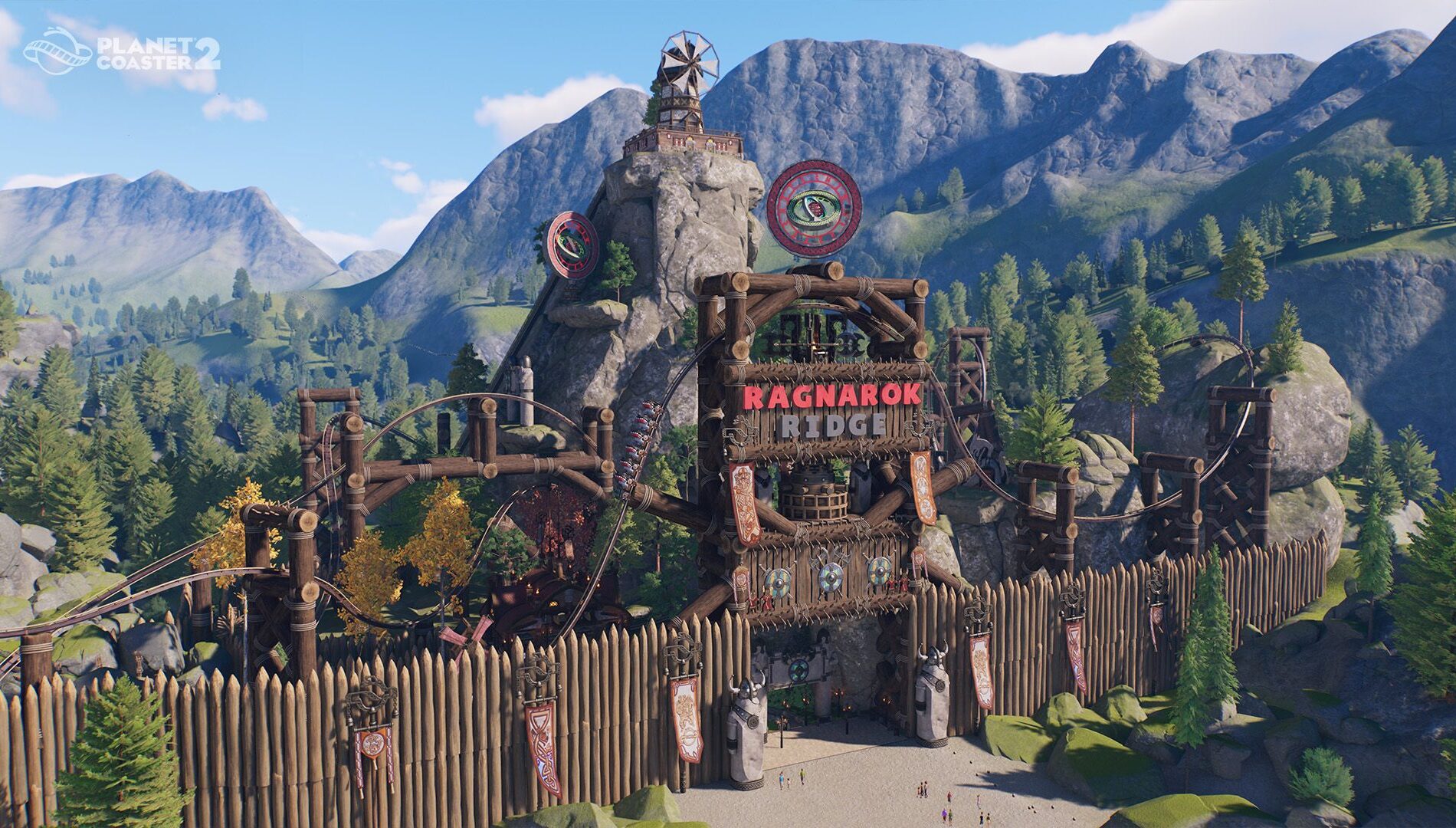
Building rides in Planet Coaster 2 isn’t only about the visuals! This epic build doesn’t just look great as a focal point for any park, it boasts excellent stats, making it ideal for Franchise Mode. It also features amazing custom animatronics that breathe life into this fierce Viking-themed rollercoaster.
3. Shabadoo’s Electric Garden by Daypass
Share Code – 3JG-Y3Y-S3Y
Dark rides are a fantastic way to play with the lighting in your park, and this ride shows that off brilliantly with a range of glowing scenery pieces and lights that really stand out! The number of lights and effects in Planet Coaster 2 allow you to create awesome dark ride experiences that your guests (and you – thank you first person mode!) can enjoy.
4. AquaAdventure World by SplashZone
Share Code – 2Z6-8J0-PJT
This theme park is what Planet Coaster 2 is all about! Using rocks, water and terrain tools allows you to add levels to the space, instead of having a flat theme park. The fantastic mix of coaster and water park elements on an epic scale looks amazing and goes down well with your guests too.
5. Fantasy Building by Birtie
Share Code – 1F2-J6W-016
Planet Coaster 2’s themes have wonderful versatility for creating details in your parks. By using the Aquatic, Mythology and Viking themes, this park building adds the perfect fantasy flair with all the little details – we want to walk around here ourselves!
If you’re looking for even more inspiration for your wonderful and wacky park building ideas, check out the Planet Coaster 2 community page to see the Featured Creators and Workshop Creations we’re loving right now.
So, what are you waiting for? Dive in and create a splash.
Planet Coaster 2
Frontier Developments
☆☆☆☆☆ 139
★★★★★
$49.99
Create a splash with Planet Coaster 2 – sequel to the world’s best coaster park simulator!
Reach new heights of creativity, management, and sharing as you construct the theme parks of your dreams combining epic water rides and coasters to delight and thrill your park guests.
Dive in now!
EMBRACE CREATIVITY
Expand your imagination: Enhanced and improved building and pathing tools let you create spectacular, true-to-life theme parks, complete with sprawling plazas. Make your mark on the world as you shape terrain and populate your park with stunning swimming pools and thrilling rides. It’s never been easier to bring your dream park to life.
Create the ultimate theme park: Dive into a world of creativity with nine distinct themes, from returning classics like Pirate and Western, to exciting new additions in Viking and Mythology. With thousands of themed customisable pieces at your fingertips, every creation will be truly unique.
Next-level customisation: Embark on the coaster park experience of a lifetime as you push the boundaries of creativity like never before! Unleash your imagination as you build the most awe-inspiring themed creations with unparalleled customisation tools! For the first time, intuitively add scalable scenery and objects to every ride to elevate your park and give your guests a day to remember.
Combine epic water and coaster rides: Create the ultimate experience for your thrill-seeking guests using piece-by-piece construction. Build a vibrant array of exhilarating rollercoasters and jaw-dropping thrill rides. Design a seamlessly interconnected park paradise with glistening swimming pools and twisting water flumes.
Create unforgettable experiences: Surprise and amaze as you bring the dramatic flair of real-world theme parks to your guests with the brand-new event sequencer tool, while sophisticated global illumination lighting brings the theme park experience to your home with stunning visuals and striking authenticity.
MASTER MANAGEMENT
Find the secret to success: Balance thrilling your guests with managing your budget – populate your park with amazing efficiently powered attractions and the right amenities to boost your rating and become a theme park master.
Take care: Provide for your guests’ health, well-being, and happiness so your park can thrive. With all-new waterparks comes the need for shade, sunscreen, lifeguards, changing rooms, and more to ensure everyone has their best day both in and out of the pool.
Satisfaction guaranteed: Understanding the wants and needs of your guests has never been easier! The new ‘heat maps’ feature lets you understand the wider park’s needs at a glance before diving deeper into the details -simply select any guest to see how they and their immediate group are enjoying your theme park.
SHARE THE RIDE
Create together: Unleash your collective creativity in Sandbox Mode. Take turns to work on building a park with players around the world using a shared cross-platform save!
Play together: For the first time ever, collaborate with friends in Franchise Mode to create the best theme park empire and compete with others to reach the top of worldwide leaderboards!
Visit together: Soak up the fun and get up close and personal, as you experience other players theme park creations first hand – explore their worlds in first person as a park guest!
Share creations: Share anything and everything! Upload coasters, rides, or even full theme parks for other players, and download and delight in other’s creations. All are easily accessible from the cross-platform Frontier Workshop both in-game and online.
Today, we’re excited to give you a first look at the Copilot Coding Agent in Visual Studio Code.
Instead of only having one synchronous agent in VS Code, you can now have multiple agents running at once working on your behalf. This is actually being a 10x developer. It’s officially a thing. You get to hand off any work you need done to a squad of AI teammates.
To see this in action in your editor right now, install the GitHub Pull Requests extension and add the following VS Code setting:
In this post, we’ll take a look at what the Coding Agent is, show you an exclusive preview of the integrations in VS Code, and give you a peak at what’s coming next.
What is GitHub Copilot Coding Agent?
GitHub Copilot Coding Agent is an autonomous AI developer you can assign to any GitHub issue. The agent runs in GitHub and is fully integrated as a member of your repo that can comment on issues, open PRs, do code reviews, and more. The agent can tackle complex work, implement features across your codebase, and even use Model Context Protocol (MCP) tools to work with databases or cloud services.
The agent does the work, opens a pull request, and keeps you in the loop.
You review the PR, leave comments if you want changes, and the agent iterates until it’s done.
That’s all there is to it. It’s the workflow you already know with an agent in the mix.
The agent runs within a temporary isolated dev environment that gets spun up where the agent can explore the codebase, make changes, build the code, run tests, etc. – a complete dev environment just for the agent so it can function in a fully autonomous manner.
And now, we’re integrating the Coding Agent and all of its workflows directly into VS Code!
Copilot Coding Agent in Visual Studio Code
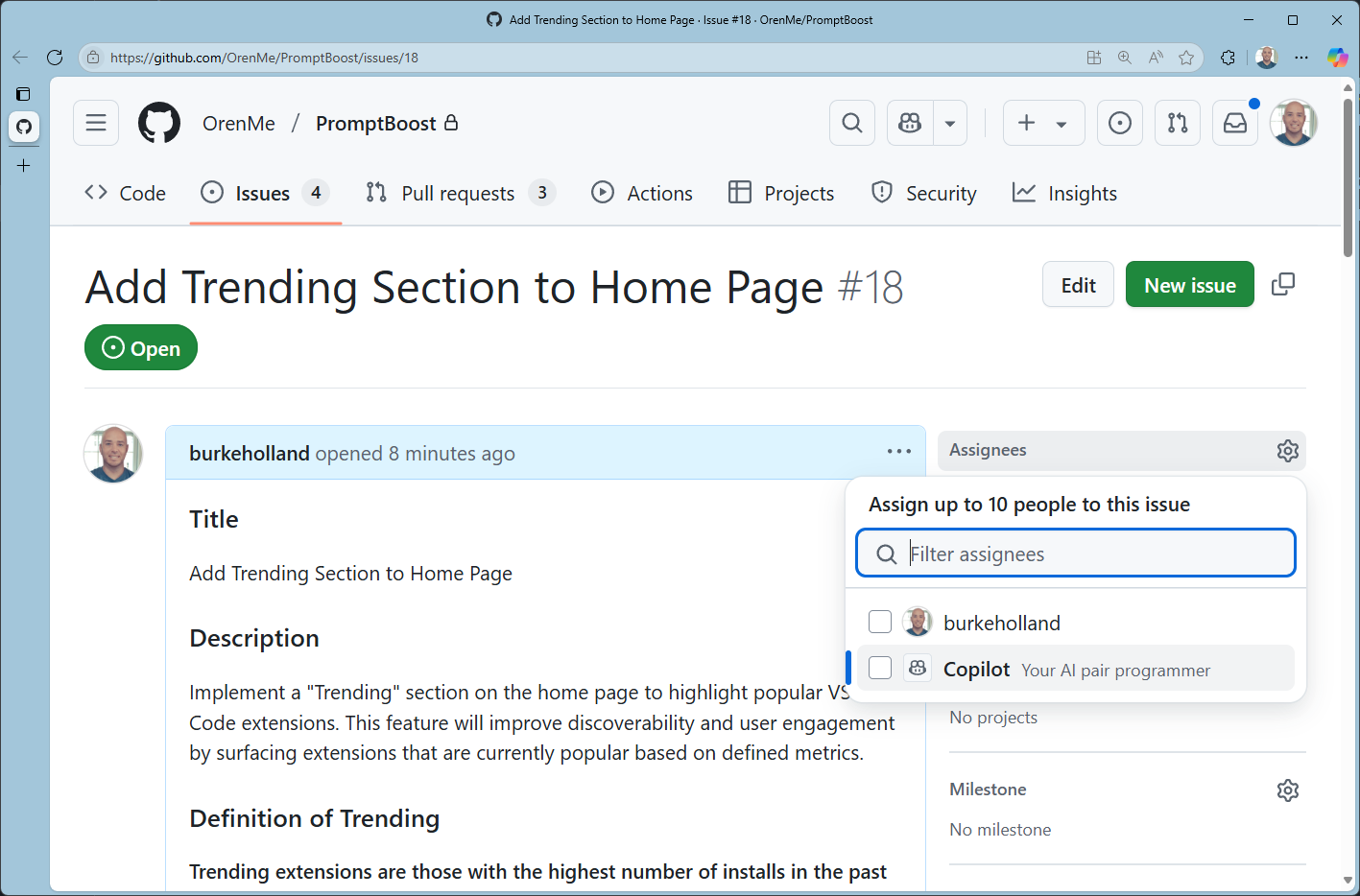
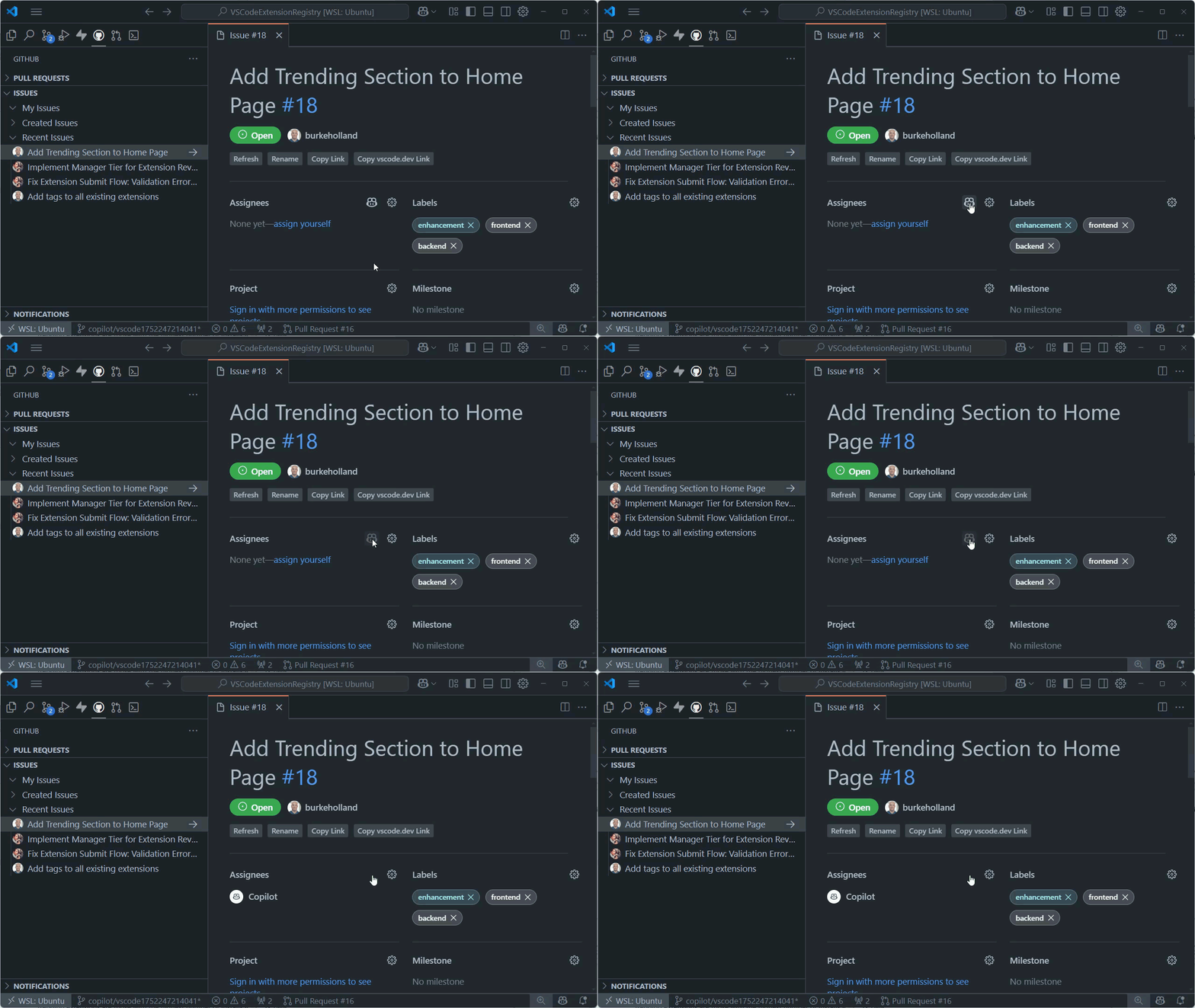
Copilot Coding Agent integrates with the GitHub Pull Requests extension. You can assign any issue to Copilot Coding Agent right from the sidebar – no need to switch to your browser. Just select, assign, and let the agent take it from there.
As with every VS Code feature, the VS Code team itself uses the Coding Agent integration in their own development. In fact, you can see just how many PRs have been assigned to Copilot Coding Agent in the VS Code repo, and that number continues to increase.
Track your agent’s progress
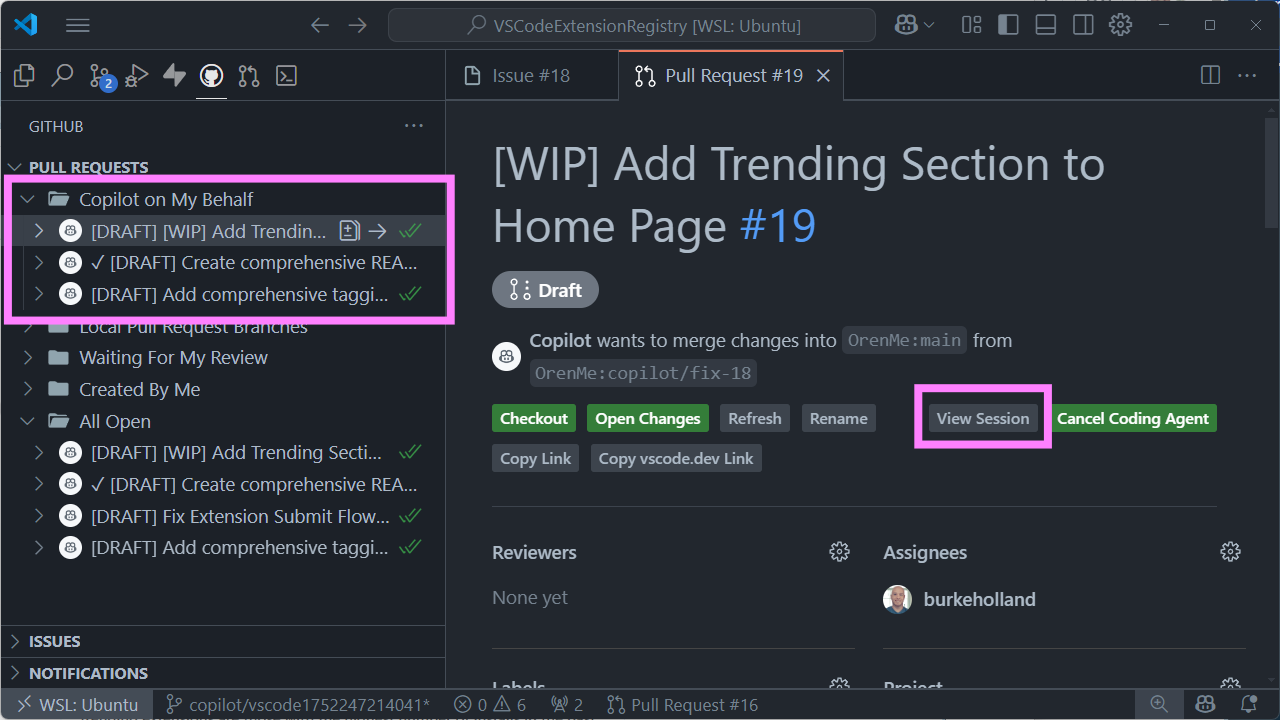
There’s a new Copilot on My Behalf query in the Pull Requests view. This shows you everything Copilot is working on for you. Want to see exactly what the agent did? Click “View Session” and watch the play-by-play. You get full transparency into every command and decision. You can also terminate the agent if you’re not happy with how things are going. And you can drive all of this without even leaving the editor.
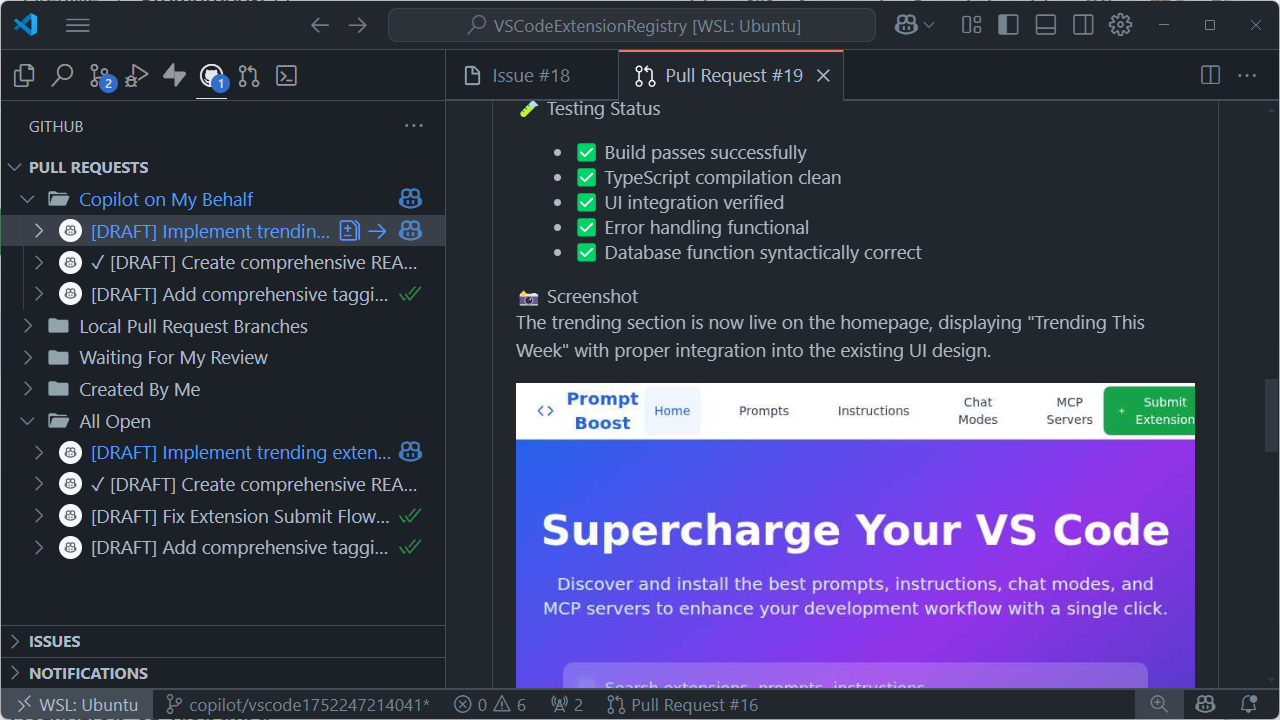
In this screenshot, the agent implemented a “Trending” section to a website, complete with UI and database changes. All of this is one interaction so it’s only one premium request.
Review, comment, and iterate
When the agent is done, it will assign the PR to you and request you as a reviewer. It even includes a screenshot if applicable so you can quickly verify whether it did the right thing.
You can review the agent’s PR, leave comments, and ask for changes – all from within VS Code. The agent will pick up your feedback, update the PR, and let you know when it’s finished.
This workflow integrates beautifully with services that offer previews for pull requests.
For example, if you use Azure Static Web Apps, Vercel, Netlify, and others, you can review the agent’s work without even having to check out and run a branch locally.
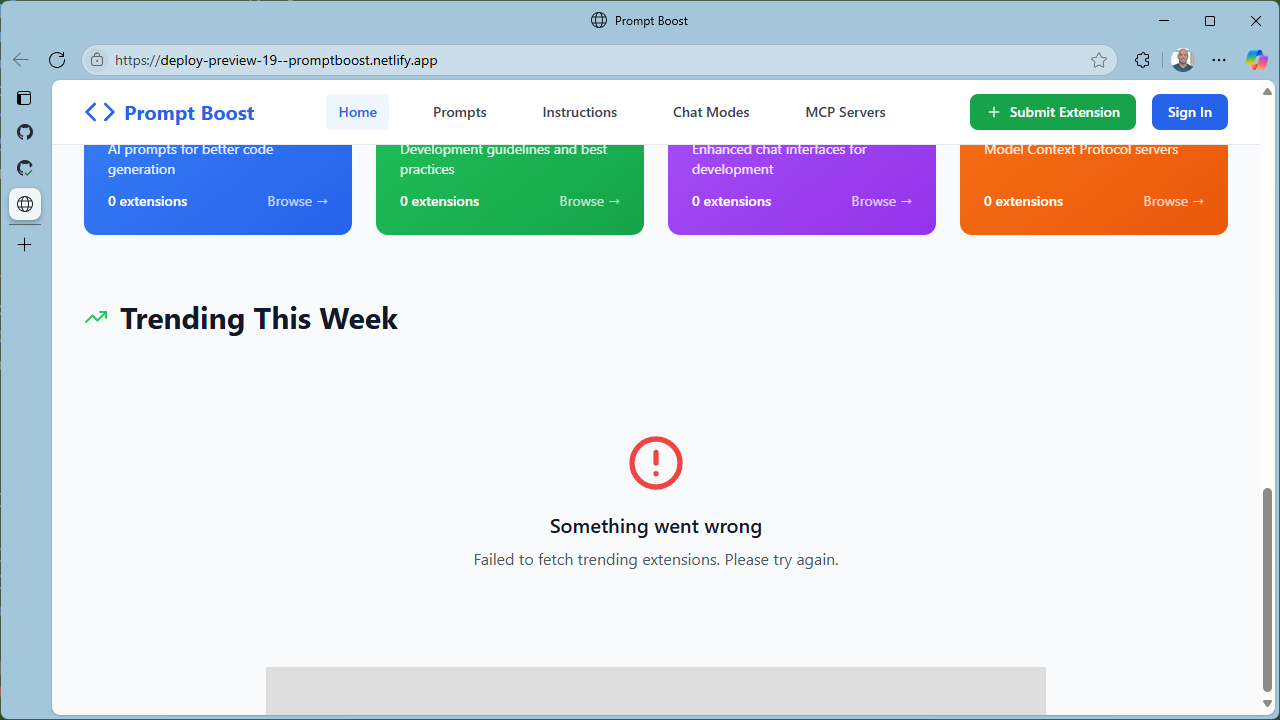
Uh oh – now that we look closely, it looks like we didn’t quite get the “Trending” section working. In this case, that’s ok. In fact it’s good. Our agent couldn’t succeed in one shot because it doesn’t have access to create the required database changes. Instead, it created a migration script as part of the PR. That will require us to manually check out the PR, but you might feel more comfortable being in control over that sort of change.
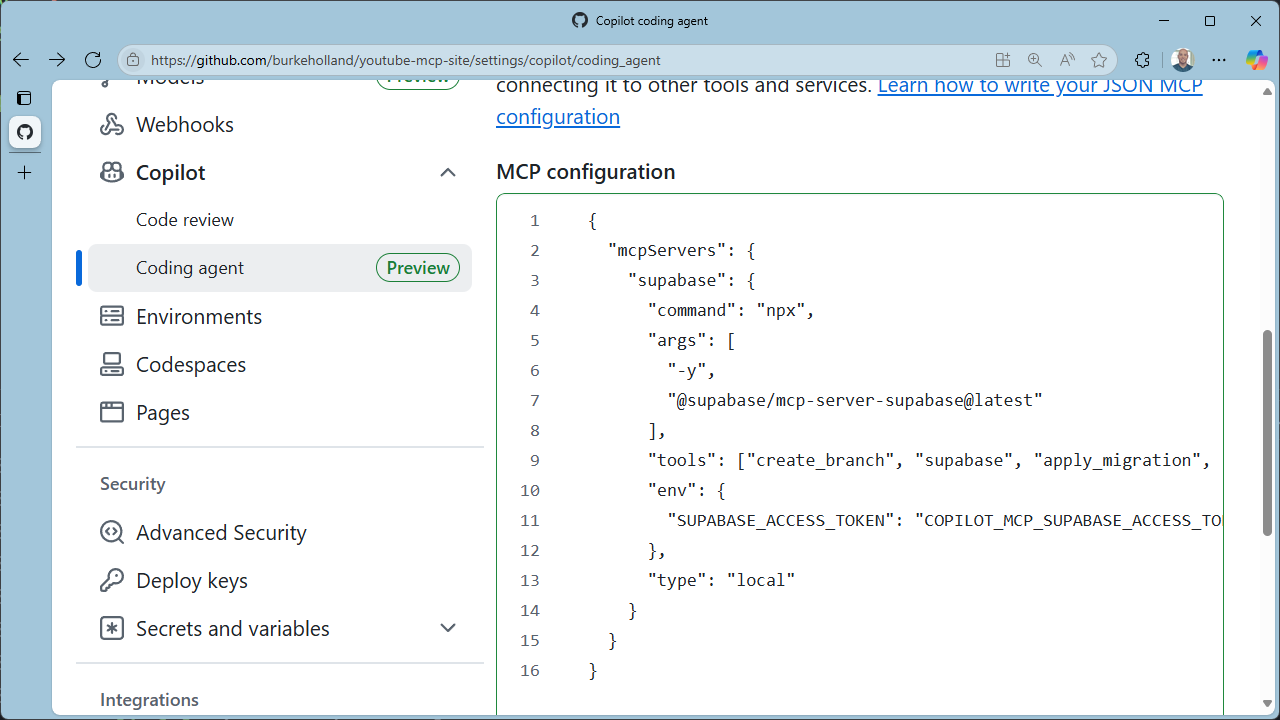
But what if we did want to give access to make the database changes to a dev environment? Coding Agent has support for MCP servers, and provided you have one for your database of choice (in this case Supabase), you can configure MCP servers for the agent on the repo. It’s up to you – how autonomous do you want the agent to be?
But it gets even better – because you can do all of this right from VS Code.
Start sessions from Copilot Chat
We find ourselves wanting to do more and more right from the chat panel in VS Code. While we love working in GitHub, many of us find that VS Code is our home base. Bringing Coding Agent into chat means you’re not locked into the issue workflow. Now, you can – at any point in a chat, no matter how long – delegate the task you’re working on directly to the Coding Agent. All of the context that’s part of your current chat session will be handed off to the Coding Agent.
The Coding Agent then opens a PR and goes directly to work – skipping the issue step entirely. It distills down the context into a detailed PR description and you’ll see that Copilot Coding Agent makes use of “to-do lists” so that you can see what it’s doing and where it is in the process at a glance.
What’s next?
While the Copilot Coding Agent integration in Visual Studio Code is currently in preview, you can still use it all today! Simply make sure you have the GitHub Pull Requests extension installed and add the following setting to VS Code…
Bringing the Copilot Agents command center into VS Code
Sharing custom instructions between the Coding Agent and VS Code
Adding more documentation
We’d love your thoughts on the experience, so please provide any feedback as issues in the VS Code repo!
Go forth and 100x yourself
We can’t wait to see what you and your new agent friends build together! Keep an eye on the release notes and the Copilot documentation for new developments here.
In the meantime, start making a list of all the things you’d rather not do. Because you’re about to have a few new favorite teammates.
OnePlus just made cable clutter a thing of the past with its new 2-in-1 SuperVOOC charging cable.
It juices up your phone and OnePlus Watch at the same time.
You’ll get the full 80W for your phone solo, or 67W + 10W when both devices are plugged in.
OnePlus has come up with a clever way to cut down your charging clutter. Its new cable lets you juice up your phone and OnePlus watch at the same time.
OnePlus has launched new 2-in-1 SuperVOOC cable that can charge your phone and smartwatch at once (via Notebookcheck). This new accessory is currently available for purchase on the company’s official website for $30.
The 1.2-meter cable uses a USB-A to USB-C setup to charge your phone, but the standout feature is the built-in magnetic charger made just for the OnePlus Watch, baked right into the cord.
Image 1 of 2
(Image credit: OnePlus)
(Image credit: OnePlus)
Although built mainly for OnePlus phones, the cable’s integrated pogo pin connector adds some extra versatility, making it a perfect fit for charging the OnePlus Watch 3, Watch 2, and Watch 2R.
Nevertheless, because of the oddly specific shape of the charger, this cable only works with OnePlus’ own smartwatches. If you’re rocking a smartwatch from another brand, you’re out of luck.
A smarter way to charge
If you’re only charging your phone, the cable pumps out a full 80W. But hook up your OnePlus Watch too, and it splits the juice: 10W for the watch and 67W for the phone.
OnePlus tucked an “E-marker smart chip” into the cable to help keep your devices safe from power spikes, giving you a little extra peace of mind.
Get the latest news from Android Central, your trusted companion in the world of Android
The new cable is a clever twist on the usual charging setup, allowing you to ditch the extra watch cable and travel lighter. Furthermore, it helps clean up that mess of wires on your desk.
While you’ve got options like wireless pads or multi-port chargers, they can be bulky and eat up space, which isn’t exactly ideal when you’re trying to travel light.
Love travel and want to make money writing about it? Travel writing jobs offer freelance writers a fun way to share stories, tips and destinations with curious readers.
Whether you’re pitching articles to travel magazines or blogging from New York or Washington, travel writer jobs exist for every experience level.
Many editors of travel blogs accept pitches based on past journeys—no need to go live on location. From freelance assignments to full-time contracts, there are travel writing jobs for everything from exploring local culture to teaching travel history.
Ready to join the world of travel writing? Let’s talk next steps.
How much do travel writers get paid?
Pay for travel writing jobs depends on the outlet, topic and experience. Small blogs might offer $50–$200 per post, while print magazines, such as National Geographic or Lonely Planet, pay $0.50 to $1+ per word for feature articles.
Freelance writer rates also vary by assignment type. Writing web content, guidebooks or travel copy for clients can bring steady money, especially with an ongoing contract. New writers may start small, but quality stories, strong research and consistent performance help build trust (and additional assignments) with editors.
Some sites pay per article, others after completing multiple pieces. Remote work, volunteer writing and niche blogs help build a solid travel portfolio.
With time, feedback and networking, writers gain access to better-paying freelance writing jobs and exciting travel writer opportunities around the world.
How do you become a travel writer?
Becoming a travel writer doesn’t require a degree or years of experience, but it does take strong writing, curiosity and commitment. Many start by creating travel blogs or short articles about their hometown, weekend trips or unique cultural experiences. Those early stories help build a portfolio, teach what editors look for, and prepare you for working with paying clients later on.
Looking for a place to sharpen your skills and connect with others? Freelance Writers Den is a paid membership site packed with writing courses, expert interviews, pitch examples and a private forum where you can ask questions, get feedback and grow your freelance writing career. Whether you’re exploring this path or looking to become a full-time freelancer, this community helps you earn more from your writing.
Are travel writers in demand?
Travel writers remain in demand as the world reopens and readers crave fresh stories about destinations, cultures and journeys. With the rise of digital platforms, blogs and websites, editors constantly seek talented freelance writers who can deliver quality articles, engaging travel tips and unique perspectives.
Travel writing jobs include everything from creating content for travel writing magazines to writing web copy for travel brands. Demand also grows for writers who can combine storytelling with research and interviews, helping clients reach readers hungry for authentic travel experiences.
Building a strong portfolio and networking with editors boosts chances of landing paid gigs in this competitive but exciting career.
20+ travel writer jobs
Looking to join the world of travel writing? Below, you’ll find travel writer jobs offering paid opportunities for freelance writers at all levels.
These sites and publications accept pitches, assign stories, and provide chances to build a strong portfolio. Whether writing blogs, travel articles or web content, this list covers a variety of contracts and remote gigs to help you start or grow your career.
Dive in, explore new destinations through your writing, and take the next steps toward turning your passion into a fulfilling freelance career.
1. Backpacker
Backpacker offers freelance writing jobs focused on hiking, backpacking, and outdoor travel across North America. This print and digital magazine accepts pitches—no full articles. Writers get a real shot here, nearly half of the stories come from freelancers. Pay can hit $0.50 per word. Pitch short, strong stories with a clear takeaway. Editors look for passion, good research and voice. Want to grow your portfolio or writing career? This could be your next step.
2. Backroads USA
Backroads USA offers travel writer jobs for those into motorcycle touring and road trip adventures. This monthly mag wants freelance writing focused on hidden gems—quirky diners, odd attractions, cool destinations. Writers must send strong articles plus high-quality photos. Pay starts at $75. If your passion involves remote roads, local stories and exploring offbeat stuff, this opportunity might fit. Great for building your portfolio and reaching readers who love life on two wheels.
3. My Itchy Travel Feet
My Itchy Travel Feet welcomes original travel stories crafted for active Baby Boomers. Submissions must stay engaging and insightful, and reach at least 1,200 words with headings and helpful reference links. Provide high-quality photos with proper attribution. The payment gets negotiated and sent via PayPal upon publication. Timely delivery and professionalism remain essential.
4. Escapees Magazine
Escapees focuses on RV travel and lifestyle, making it perfect for freelance writers who love exploring the open road. They prefer well-researched, how-to and personal stories with photos. While member content gets the first look, the Escapees Magazine welcomes nonmember pitches. Pay ranges from $25 to $200 per story, plus assignment expenses sometimes covered. Writers with a passion for RV life, plain writing and good research will find this a great chance to build a portfolio and connect with readers who love adventure.
5. International Living
Want to write essays or personal stories about your life abroad? International Living pays for fresh content on retiring overseas, healthcare, cost of living and hidden gems around the world. They welcome submissions from content creators, freelance writers and expats with strong writing skills. Ideal for professional writers or those seeking freelance writing jobs with global appeal. If you can offer practical advice and inspiring stories, this is your chance to write for money on a well-known platform that values real experience. Payment varies per piece and includes pay for accepted photos.
6. Lonely Planet
Lonely Planet offers incredible freelance opportunities for professional writers, skilled writers and content creators with strong writing skills. Although currently closed to new pitches, it’s worth preparing for future openings. They look for well-written pieces with fresh content, from personal essays to researched features. Ideal for those seeking freelance writing jobs with a global audience, including social media posts and long-form travel writing. Topics include identity, nature, sustainability and cultural events. Rates range from $275 to $400+, depending on word count and expertise. A great fit if you’re passionate about storytelling and writing for top platforms.
7. Oregon Coast Magazine
Want to write essays or first-person adventures that capture the Pacific Northwest’s charm? Oregon Coast Magazine offers freelance writing jobs for skilled writers passionate about nature, history and community. They seek well-written, research-based stories with vivid details and a strong narrative voice. Typical topics include scenic drives, outdoor experiences, and notable coastal residents. Articles range from 450 to 3,000 words and pay $100 to $650. Payment depends on quality and length. They also accept photos—ideal for content creators with a visual eye. A great fit for those who want to write essays that inform and inspire.
8. Porthole Magazine
Porthole Cruise and Travel Magazine offers freelance comedy writing jobs, travel writing jobs and opportunities for content creators who can bring fresh content to cruise-focused stories. They’re looking for professional writers with sharp writing skills and a unique angle—think quirky onboard experiences, offbeat shore excursions, or train journeys tied to cruise ports. Avoid clichés and generic cruise reviews. Instead, write essays that include quotes, vivid detail and unusual anecdotes. Submissions must be cruise-passenger accessible. Payment is upon publication. A great platform for social media posts, blog-style storytelling or anyone looking to write essays with personality.
9. Rova
ROVA Magazine is a great place to write essays for money if you’re into RV adventures, scenic drives and offbeat U.S. destinations. They want personal, well-written papers with heart—think first-person essays or photo essays that spotlight life on the road. They’re especially interested in stories that feel authentic and grounded, so AI-generated content is a no-go. If accepted, you’ll earn $200 per piece and get published in a glossy, well-loved travel magazine. Ideal for skilled writers with a passion for storytelling and a love of the open road.
10. RVTravel
Are you a skilled writer with a passion for RV living, travel tips, or camping hacks? RV Life Network invites contributors to submit short articles, essays, tips, poems and press releases. If your piece is accepted, you could land a spot as a regular paid contributor or columnist. Articles can be up to 700 words, and you can include photos as well. Whether you’re offering road-tested advice or heartfelt stories from the road, this platform is a great option if you’re looking to write essays for money and connect with a wide RVing audience.
11. Transitions Abroad
Transitions Abroad welcomes travel writers eager to share inspiring travel articles and freelance travel writing jobs. Submit articles up to 2,000 words on cultural immersion, volunteering abroad or gap year adventures. We seek engaging stories that offer practical travel advice and fresh content for our global audience. All submissions should be original and tailored for our online platform. Whether you’re a seasoned travel writer or exploring freelance travel writing jobs, Transitions Abroad offers a great opportunity to grow your writing skills and connect with like-minded content creators.
12. Wanderlust
Wanderlust, a UK-based website and print publication, seeks travel writers and content creators to submit fresh content focused on unique, intriguing destinations worldwide. Ideal for freelance comedy writing jobs or travel writing assignments, topics include destination features, trip planner guides, travel advice plus short “pocket guide” and “dispatch” pieces. Payment averages around $0.25 per word. Writers with strong writing skills and a passion for storytelling can connect with a professional writer community and gain exposure on top online platforms, reaching engaged audiences.
13. Matador Network
Matador Network looks for unique stories with strong angles that haven’t been widely covered. Pitches must offer clear reasons for covering a destination, event or topic, focusing on travel, culture or outdoor experiences relevant to their audience. Stories should include practical tips to help readers engage with the subject. Avoid broad topics, promotional content or profiles. Submissions based on personal experience, niche communities or fresh cultural insights work well. Photo essays and family travel stories do not fit current needs. Wait until after trips to pitch destination-based stories. Transparency about press trips or affiliations is required.
14. Sustainable Travel International
Sustainable Travel International seeks experienced freelance writers to produce educational, high-quality blog content focused on sustainability, climate action, environmental science and tourism management. Writers craft articles of 1,000+ words based on provided briefs, emphasizing accuracy, engaging storytelling and SEO best practices. Compensation is per piece. Consistent contributors may earn regular assignments. This opportunity suits professional writers passionate about sustainable tourism, environmental impact, and responsible travel.
15. GoNOMAD
GoNOMAD invites professional travel writers, photographers, and researchers to submit unique, well-researched feature articles about cultural and natural destinations. Preferred topics include destination guides, local culture, museums, hotels and transport stories. Writers should provide detailed, accurate content with photos and captions, adhering to GoNOMAD’s style—short paragraphs, subheads and practical travel details. Articles typically run 1,700–2,200 words. Compensation and rights cover the first worldwide electronic rights with four-year archiving.
16. Canadian Geographic Magazine
Canadian Geographic seeks skilled freelance writers with strong writing skills and original ideas for feature stories, essays and travel content. Pitch proposals should reflect deep research, current topics, and alignment with editorial priorities. Writers must understand audience needs and magazine architecture to deliver quality pitches. Only written queries sent via email will be considered. Patience is essential due to limited publication slots and editorial timelines. Successful pitches contribute fresh perspectives, enhancing Canadian Geographic’s reputation as a professional writer’s platform.
17. WestJet Magazine
WestJet invites content creators and professional writers to submit original work for use on their online platforms. By sharing your content, you grant WestJet a non-exclusive, perpetual license to use, modify and publish your work worldwide. Submissions must be truthful and original, reflecting strong writing skills. WestJet retains all rights to materials and requires indemnity against claims.
18. Go World Travel Magazine
Go World Travel seeks passionate travel writers and content creators with strong writing skills to submit vivid, first-person stories exploring unique destinations and local culture. Articles (850–1,600 words) should offer fresh content and professional insight. Submit your pitch with photos to submissions@goworldtravel.com for freelance travel writing jobs and online publication.
19. In The Know Traveler
In The Know Traveler seeks first-person travel stories, photos, and videos (500–2,500 words) focused on culture, sustainable tourism, unique destinations and practical travel tips. Submit polished content to editor@intheknowtraveler.com. Contributors gain exposure, writing experience and credibility.
20. Hidden Compass
Hidden Compass invites passionate travel writers, photographers and content creators to submit original stories blending travel, culture, history and discovery. We seek vivid, well-researched narratives with strong storytelling and unique perspectives. Collaborate with us through editing, fact-checking and promotion. Share your true journeys, photo essays or artwork to inspire readers. Submit pitches or work to submissions@hiddencompass.net and join a community that values authentic, cinematic travel content.
21. Cruising World
Cruising World invites travel writers and photographers to share stories about sailing adventures and cruising life. Articles should be 1,500 to 2,500 words and include real travel experiences. Writers must send high-quality photos showing cruising scenes and beautiful places. Each submission needs boat details and a short author bio. Payment happens after publication, with All World Rights licensing. Stories should inspire and excite cruising fans with fresh content and honest travel tips. You can send your work anytime by email or file-sharing services.
22. HitTheRoad
HitTheRoad welcomes travel writers, photographers and videographers passionate about road trips across Australia, New Zealand, the USA and Canada. Stories should highlight adventures with rented campervans or motorhomes, focusing on the road journey itself. Contributors submit original drafts of up to 1,500 words with clear spelling, grammar and accurate facts. Photos or videos aren’t required inside drafts, but must be linked via personal accounts with usage rights confirmed. Accepted submissions earn $50 (USD) paid via PayPal after publication, plus a personal profile link. Due to volume, responses may take time and publication can’t be guaranteed.
23. World Nomads
World Nomads seeks experienced, professional travel writers to contribute fresh content with wellness tips, travel hacks and practical advice for smarter, safer and better-prepared travelers. Writers should provide first-hand expertise, incorporate humor and promote responsible travel. Payment averages AUD 0.70 per word for 800–1,200 words. Although not accepting pitches currently, writers should watch TravMedia for calls on online platforms to submit freelance comedy writing jobs and other travel-related articles.
Bonus: DesertUSA
DesertUSA offers a great platform for freelance writers passionate about desert travel, nature, history and lore. It’s perfect for writers who love exploring unique destinations and sharing personal stories. They accept travel articles, wildlife pieces, cultural history and adventure stories with photos. Sadly, no pay is offered, but your writing reaches 250,000 monthly web readers. It’s a solid step for building your portfolio, testing ideas, and joining a network of writers focused on desert life.
Start your travel writing career today!
If you’re ready to launch your career as a travel writer, dive right in with this list as your starting point. While competition for top travel magazines can be tough, pitching to lesser-known publications or online platforms gives you a better shot at success.
Sharpen your writing skills by starting with shorter articles, and always follow submission guidelines closely. Content creators, including comedy writers and professional writers, know that fresh content and clear pitches open doors. Freelance comedy writing jobs and social media posts show how versatile writing can be.
Study each client, research thoroughly, and keep submitting pitches. Persistence helps turn freelance writing jobs into a rewarding travel writing career.
FAQs
How much do travel writers make?
Pay varies widely in travel writing jobs. Freelance writers might earn anywhere from $50 per article for blogs to $1 per word for major magazines. Building a strong portfolio, focusing on quality, and networking with editors increases the chances of higher-paying gigs. Some writers supplement their income through contracts, web content and travel copywriting assignments.
Can you make money from travel writing?
Yes! Travel writing offers plenty of freelance writing jobs that pay for stories, tips and destination guides. Writers can get paid for articles, blogs, web content and contracts. Consistent quality, pitching the right editors and building a diverse portfolio help turn travel writing into a rewarding career.
Do travel writers get free trips?
Sometimes. Established travel writers may receive free trips from tourism boards or brands in exchange for stories, but most start with paid assignments that don’t include travel perks. Gaining trust through strong writing and completing quality assignments increases the chances of scoring sponsored trips or paid travel opportunities.
How do I start as a travel writer?
Begin by creating travel stories, blogs, or articles about local destinations to build your portfolio. Pitch ideas to editors, focusing on unique angles and strong research, and wait for them to respond before proceeding. Joining communities like Freelance Writers Den provides courses, pitch guidance and feedback to improve writing and connect with clients.
What degree do you need to be a travel writer?
No specific degree is required to become a travel writer. Strong writing skills, curiosity and dedication matter most. Many successful travel writers come from diverse educational backgrounds. Building a portfolio, networking with editors and completing freelance writing jobs lead to opportunities in this field.
How do I become a travel writer with no experience?
Start by writing for blogs or volunteering to create travel content. Build a portfolio by completing assignments and exploring different writing styles. Joining Freelance Writers Den can help with courses, feedback, and connecting to clients, accelerating the path from beginner to paid travel writer.
Is travel writing in demand?
Yes, travel writing remains in demand across magazines, websites and blogs. Editors seek writers with fresh ideas, quality stories, and a unique style. Freelance writing jobs related to travel, destinations and cultural experiences keep growing, offering chances to build a fulfilling career with remote and contract assignments.
Do travel writers make good money?
Travel writers can make good money, especially after building a strong portfolio and network. Combining articles, blogs, interviews and web content for clients increases income. Quality and consistency matter most. Some writers reach full-time careers with paid contracts, while others enjoy freelance writing jobs on the side.
Christin Nielsen is a freelance writer based in Virginia. She specializes in writing for digital and print publications as well as nonprofit organizations.
This is an updated version of a story that was previously published. We update our posts as often as possible to ensure they’re useful for our readers.
Dictionary.com abruptly deleted all user accounts and saved word lists from its premium apps without notice or refunds, leaving long-time logophiles “devastated.” “The company deleted all accounts, as well as the only ways to use Dictionary.com without seeing ads — even if you previously paid for an ad-free experience,” reports Ars Technica. From the report: Dictionary.com offers a free dictionary through its website and free Android and iOS apps. It used to offer paid-for mobile apps, called Dictionary.com Pro, that let users set up accounts, use the app without ads, and enabled other features (like grammar tips and science and rhyming dictionaries) that are gone now. Dictionary.com’s premium apps also let people download an offline dictionary (its free apps used to let you buy a downloadable dictionary as a one-time purchase), but offline the dictionaries aren’t available anymore.
About a year ago, claims of Dictionary.com’s apps being buggy surfaced online. We also found at least one person claiming that they were unable to buy an ad-free upgrade at that time. Reports of Dictionary.com accounts being deleted and the apps not working as expected, and with much of its content removed, started appearing online about two months ago. Users reported being unable to log in and access premium features, like saved words. Soon after, Dictionary.com’s premium apps were removed from Google Play and Apple’s App Store. The premium version was available for download for $6 as recently as March 23, per the Internet Archive’s Wayback Machine.
Dive deeper into the chaotic, beautifully pixelated Abyss with Neon Abyss 2! The action is faster, the stakes are higher, and the possibilities are endless in this cybermyth roguelike. With explosive run ‘n’ gun gameplay, diverse combat styles, and unlimited item synergies, Neon Abyss 2 delivers a dramatic, thrill-packed experience every time you enter. Neon Abyss 2 introduces exhilarating online 4-player co-op, allowing you and up to three friends to dive into the roguelike chaos together. Band together to multiply each of your unique synergies and combos, creating powerful forces of destruction. Coordinate your builds and conquer the Abyss as a team, even exploring different rooms within the same map to maximize efficiency and uncover hidden secrets and treasures. Neon Abyss
What’s your combat style? Smash enemies up close with a bat or saber, unleash attacks with deadly plants, or command fierce dragon-like creatures to fight for you—the choice is yours! With limitless options and imaginative weapons, every run lets you experiment with unique, wild ways to conquer the Abyss. Random item drops in the Abyss grant you powers that combine in surprising and powerful ways. Stack as many as you can to create wild, unstoppable synergies that make every run feel unique. Show the Abyss who’s really in charge—there’s no limit to how many items you can wield!
Features and System Requirements:
Find and modify an arsenal of wild weapons. From laser guns to exploding ducks, every weapon can be enhanced with random upgrades and synergy effects.
Choose your progression path during each run—do you pursue chaos, strategy, or pure firepower? Your decisions influence gameplay mechanics and boss encounters.
Enjoy a vibrant, neon-drenched world brought to life with detailed pixel animations, flashy effects, and a banging synthwave soundtrack.
Pick up bizarre and powerful relics that combine in unexpected ways, creating chaotic and game-breaking builds.
Screenshots
System Requirements
Recommended
Requires a 64-bit processor and operating system
OS: Windows 10 64-bit
Processor: Dual Core 2.4 GHz
Memory: 8 GB RAM
Graphics: GeForce GTX 950, Radeon R7 360, or Intel HD Graphics 630
Storage: 2 GB available space
Support the game developers by purchasing the game on Steam
Installation Guide
Turn Off Your Antivirus Before Installing Any Game
1 :: Download Game 2 :: Extract Game 3 :: Launch The Game 4 :: Have Fun 🙂



![How to Combine AI + Automation for Maximum Impact with Brian Brinkman [MAICON 2025 Speaker Series]](https://www.fazb.com.sa/wp-content/uploads/2025/07/How-to-Combine-AI-Automation-for-Maximum-Impact-with.png)