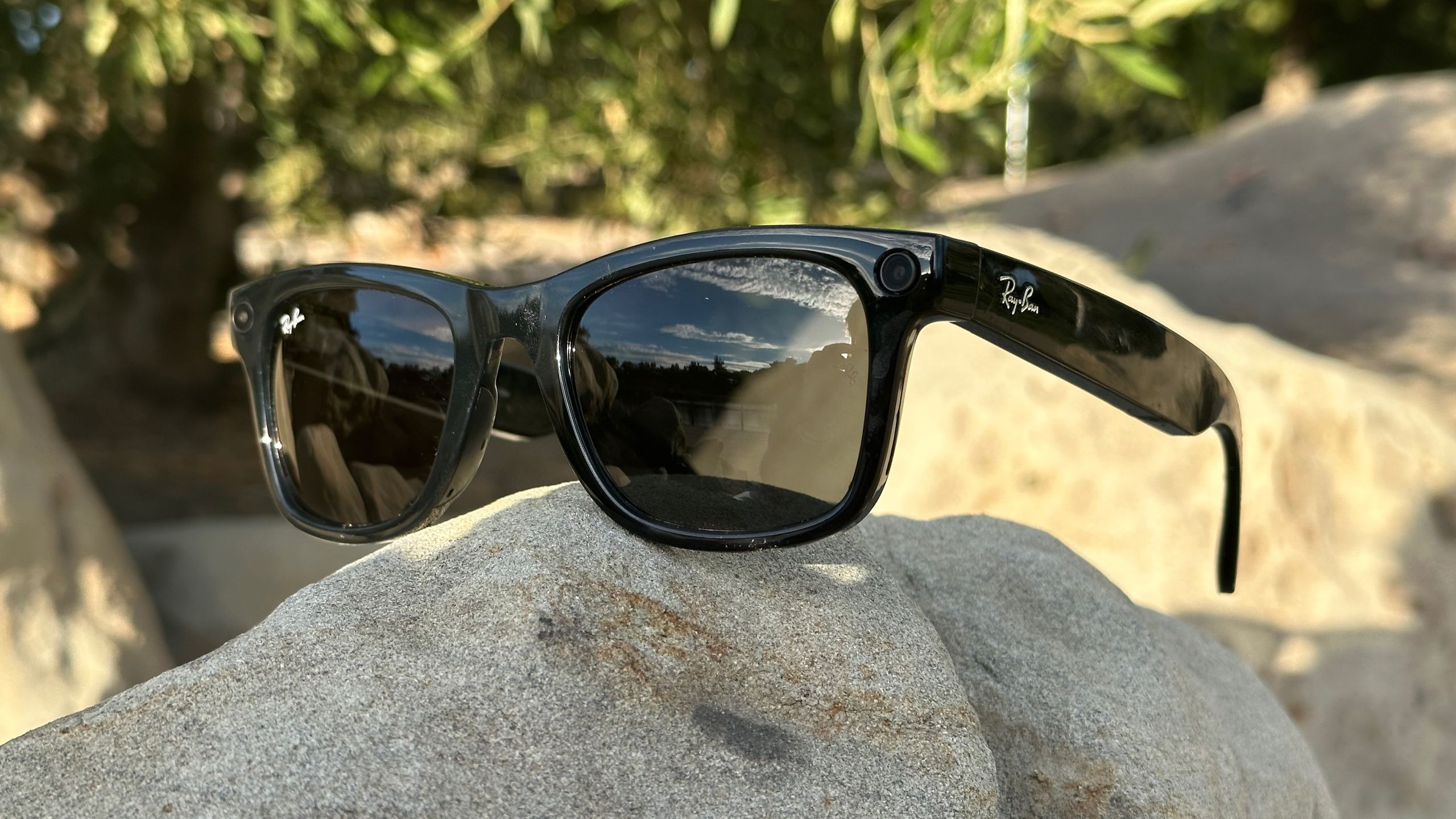
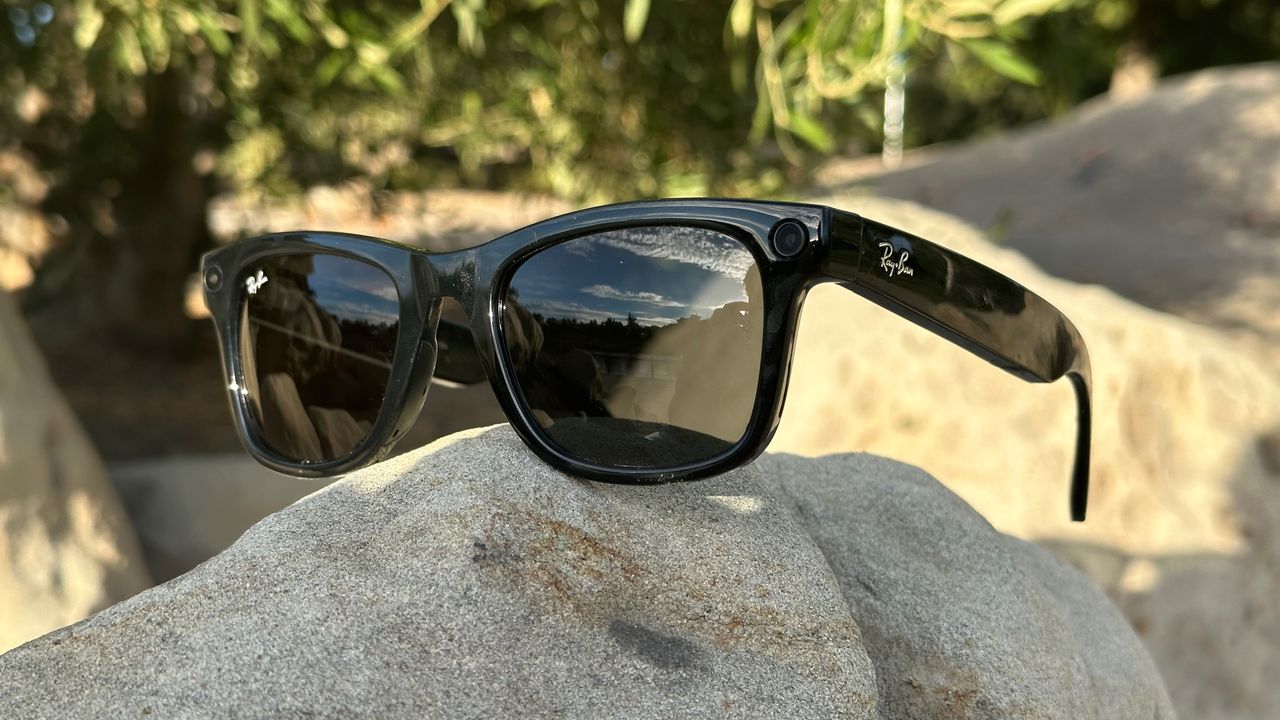
To be clear, these aren’t AR or XR glasses, so they don’t feature the built-in HUD displays that can be found on some of those models. They do include tons of AI features and a lot of great hands-free functions, however, and the Meta Gen 1 glasses are fairly similar to the newer-generation versions, albeit with a cheaper price tag.
The first-gen Meta smart glasses still come with ultra-wide camera lenses and high-res photo capabilities, along with two open-ear speakers and IPX4 ingress protection. All that to say, they’re a little easier sell at $224 than at $299.
✅Recommended if: you’re in the market for some highly capable smart glasses but you want to save money; you want a pair of smart glasses with lots of storage for photos and videos; you’d rather save money going last-gen than purchase the new second-gen version of these glasses.
❌Skip this deal if: you’d prefer to go with the Gen 2 Meta smart glasses for slightly improved battery life, a lighter overall build, and higher-quality video; you’re looking for XR glasses more so than traditional AI smart glasses; you’d rather go with a modular competitor to Meta’s smart glasses such as the Solos AirGo V or XR-focused ones like the Xreal 1S or RayNeo Air 3S Pros.
The first-generation Ray-Ban Meta smart glasses still have a lot to offer, from crisp, on-the-go video- and photo-taking, and the option for most prescriptions in each clear, polarized, and transitional lenses. While their battery life is not quite as long lasting as the Gen 2s, they’ll still offer up to 4 hours of battery per charge, or 30 minutes of live streaming. They’ll also charge to 50% battery in just 20 minutes, which tends to offer plenty of capacity for most casual or new users.
Still, the second-gen pair boasts a lighter build and longer battery life, plus higher-quality video. With that comes a higher price tag and fewer discounts, however, so choose carefully.
Samsung was one of the first manufacturers to offer a 200MP camera when it launched the Galaxy S23 Ultra back in 2023. We’ve since seen many other brands adopt this tech for use on both primary and telephoto cameras.
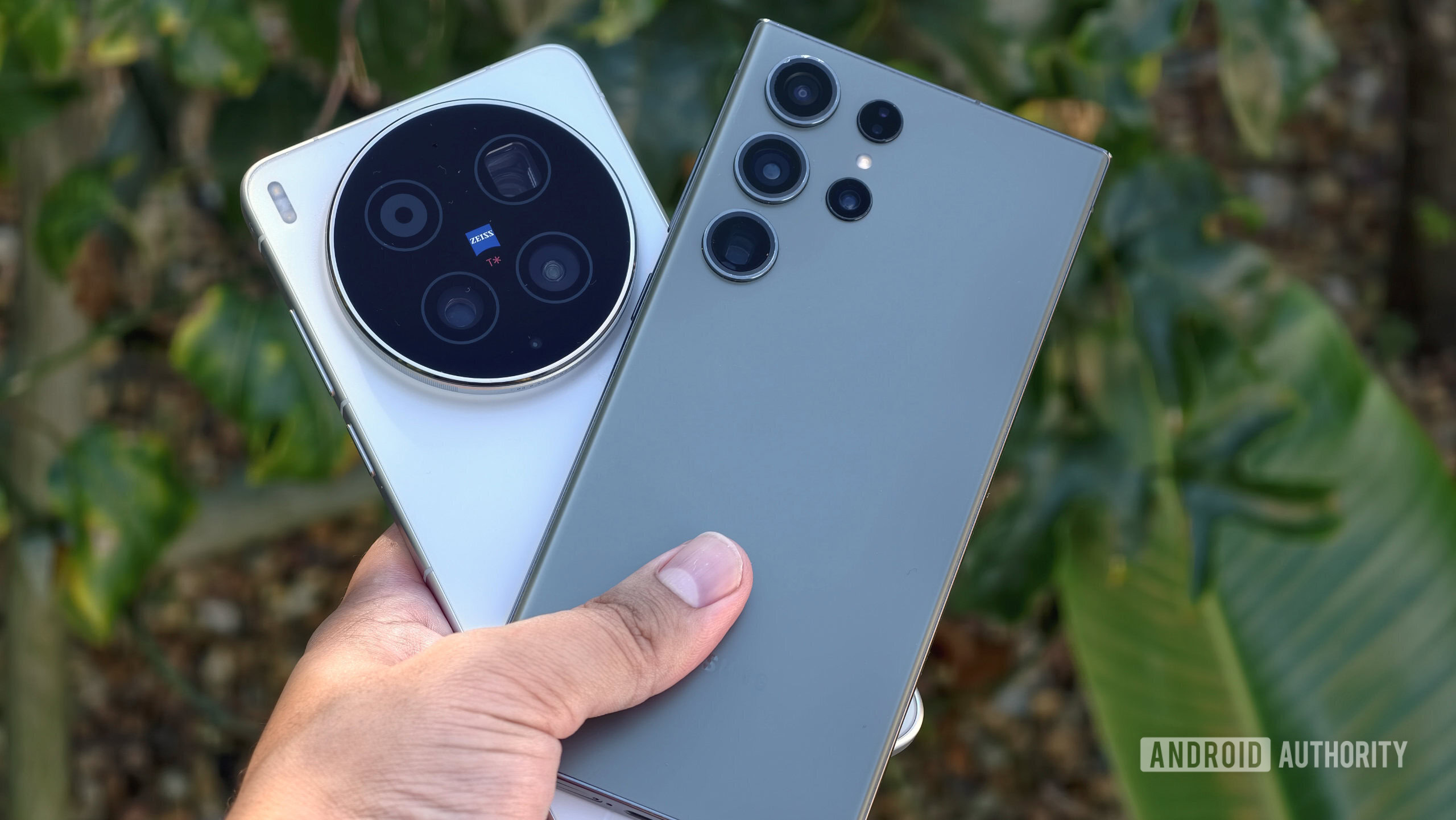
We haven’t seen a major change in the sensor size of 200MP cameras, though. Until now, that is. The vivo X300 Ultra has just been released, and it offers a significantly larger 200MP main camera. But how does this fare in practice compared to the first-generation 200MP main camera on the Galaxy S23 Ultra? I put these two phones to the test in a 200MP camera shootout.
Have 200MP main cameras lived up to the hype?
102 votes
What to know about Samsung and vivo’s 200MP main cameras
Hadlee Simons / Android Authority
The Galaxy S23 Ultra’s main camera features a 200MP Samsung ISOCELL HP2 sensor, which was cutting-edge at the time. This is a large, 1/1.3-inch sensor with tiny 0.6-micron pixels. But it also featured tricks like 16-in-one pixel binning (equivalent to a 12.5MP, 2.4-micron pixel camera) or conventional four-in-one binning (equivalent to a 50MP, 1.2-micron pixel camera). Other notable tricks include Super Quad Phase Detection autofocus, as well as dual-slope gain and Smart ISO Pro for improved dynamic range.
Don’t want to miss the best from Android Authority?
Meanwhile, the vivo X300 Ultra’s main camera uses the Sony LYT-901 camera sensor. This is Sony’s first 200MP camera sensor, and the 1/1.12-inch sensor size makes it notably larger than Samsung’s 200MP cameras. The Sony sensor also offers 0.7-micron pixels, which are still small by the standards of other camera sensors, but larger than those in previous 200MP sensors. Bigger pixels mean greater light capture, which should lead to brighter, cleaner photos with less blur. Sony adds that the sensor offers all-pixel autofocus, DCG-HDR tech for improved single-frame HDR, and Hybrid-Frame HDR.
I approached this shootout by sticking with the Galaxy S23 Ultra’s regular camera settings, save for enabling the Quick Tap Shutter option. I also mostly used the X300 Ultra’s default settings, though I switched from the default Vivid color profile to the Authentic option for more realistic colors.
Galaxy S23 Ultra vs vivo X300 Ultra: Pixel-binned shots
Early 200MP cameras often took full-resolution photos with minimal processing compared to the pixel-binned snap. This meant that there was often a stark difference between the 200MP and 12.5MP photos. Nevertheless, the latest sensors offer more advanced HDR tricks, while today’s flagship processors offer multi-frame processing at 200MP. So how do the two phones and their camera sensors fare in a demanding, backlit scenario?
The difference between full-resolution and pixel-binned shots seems to be narrowing in 2026. vivo’s 200MP and 12.5MP images look very similar, featuring a washed-out appearance that’s ostensibly due to the more realistic color profile. However, the lower-resolution shot offers slightly lifted shadows and a brighter face, likely due to better HDR capabilities at 12.5MP.
There’s a massive difference between Samsung’s 12.5MP and 200MP photos, though. The pixel-binned snap offers an aggressive HDR treatment with very saturated colors, while the full-resolution shot features plenty of blown-out highlights (particularly in the background and around the subject’s head). What’s more concerning is that the Samsung phone’s 200MP photo has grid artifacts when zooming in. Take a closer look at the image below.
Hadlee Simons / Android Authority
It’s clear that vivo’s 200MP shot is the better full-resolution snap, owing to tamed highlights and a lack of grid artifacts. Neither 12.5MP shot was perfect, though, as I felt the ideal picture was somewhere in the middle. Nevertheless, both phones did a solid job of exposing the subject’s face.
I then switched to the standard 12.5MP mode and a more conventional scenario to see how the phone’s pixel-binning capabilities compare. It’s worth noting that the X300 Ultra’s main camera has a 35mm focal length, which is effectively equivalent to 1.5x of the Galaxy S23 Ultra’s 24mm focal length, as seen on the vast majority of smartphone cameras. Colleague Rob Triggs previously noted that he preferred a 35mm camera as he felt the 24mm perspective was too wide, especially when he already has an ultrawide camera on tap for wide shots. So this perspective comes down to your own preference. Check out the gallery below.
The Samsung phone opts for a more saturated shot, while vivo’s authentic color profile understandably delivers a colder, more washed-out look. However, a closer peek also reveals that the vivo handset offers far more detail and less smearing than the S23 Ultra. The 35mm focal length ostensibly works to vivo’s advantage here, but that doesn’t fully explain the gulf in detail.
What about low-light photography, though? Shooting a moving subject after dark is a tough challenge, so how did the two phones handle my cat in the dimly lit backyard? Check out the pixel-binned samples below.
I kept automatic night mode processing enabled on both phones. Needless to say, this scene required a few snaps on both devices, as my cat kept moving her head. Nevertheless, the Samsung phone clearly struggled compared to the vivo handset. Note how the fur in the Samsung photo is basically a noisy smear. The X300 Ultra’s main camera also delivered good subject separation, presumably due to the focal length and larger sensor.
I disabled the automatic low-light processing on both phones for this early morning scene of some flowers. This should give us a rough idea of how well each phone’s camera performs in terms of autofocus, light capture, and more. Unfortunately, neither phone captured truly sharp flowers. However, the Samsung photo has significant splotchiness upon closer inspection compared to the vivo’s cleaner, slightly brighter presentation. The X300 Ultra also delivers a shallower depth of field, helping the flowers stand out from the background.
What about 200MP photos?
I also took plenty of full-resolution 200MP photos during the shootout. The gallery above shows the Camps Bay beachfront in Cape Town, and both phones understandably offer plenty of detail at this resolution. There’s enough headroom here to crop in on either snap. But look closer, and you’ll see that the vivo handset does a much better job of capturing fine detail, which is especially important when it comes to people. By contrast, the people in Samsung’s shot look splotchy and feature color banding.
The vivo device also offers greater definition and detail for the scenery and buildings. Go back to the full scene and take a look at the white houses at the foot of the mountain, as well as the small building on the beach. There’s still some minor fringing in this scene, such as white buildings, as you might expect in the late afternoon. I’m also not a fan of the excess sharpening in some parts of the scene, such as the roofs of some buildings.
Moving on to the next comparison, conventional wisdom says you should stick with the pixel-binned 12.5MP mode when shooting in low-light scenarios. But I decided to shoot a few full-resolution photos at night to see how the first-generation and new-generation sensors perform. Check out the gallery below, showing my gaming shelf in a dimly lit room.
A close look at these 200MP crops reveals that the vivo handset delivers a cleaner, less washed-out rendition of the scene. The X300 Ultra image also offers sharper text, although I think the AI-assisted processing makes some characters look overly sharp and janky.
A trip to the local indoor market after dark also gives us a good full-resolution workout. The Samsung phone’s wider perspective and vivo’s more realistic color profile presumably account for the differences in exposure and white balance. More specifically, the Galaxy S23 Ultra lifted the shadows compared to the vivo shot while offering a warmer scene. Neither phone accurately captures the “Mojo Bar” lighting, though. The vivo rendition is just too dull while the Samsung snap has notable fringing.
Take a closer look at this scene, and it’s clear that the X300 Ultra delivers more resolvable detail. Text is significantly more legible on the bottles and beer taps compared to the Galaxy S23 Ultra shot. The light sources are also kept in check by the vivo handset’s ZEISS lens coatings. You can view the image comparison below for a closer look.
Want to pixel-peep our full-resolution photos? You can view and download all these snaps via our Google Drive folder.
How far have 200MP cameras progressed?
C. Scott Brown / Android Authority
I’m a big proponent of 200MP cameras for zoom, but I’ve otherwise been a 200MP skeptic for a few years now. The first 200MP cameras were capable of capturing decent detail at full resolution, but this was often undone by slow processing times, tiny pixels, and rudimentary processing. While these sensors could capture great pixel-binned snaps in most conditions, so could lower-resolution 50MP cameras with large sensors.
However, our comparison between the first 200MP cameras and the latest hardware suggests that these sensors are finally living up to the hype. Detail is far better, as is HDR and low-light performance, which really make high-resolution photography much more viable. I’m keen to see more phones with cutting-edge 200MP sensors like the Sony LYT-901. In fact, I’d love to see Samsung adopt a similarly large 200MP camera next year.
200MP photography is much more versatile on recent phones.
It’s also worth noting that other factors, such as chipsets and brand-specific camera tuning, can make a big difference. In fact, phones like the vivo X300 series and OPPO Find X9 series support multi-frame image processing at 200MP. This allows for full-resolution photos with improved noise and blur reduction, as well as 200MP portraits and night mode snaps. This was unthinkable just a couple of years ago. I’m therefore interested to see what else phone makers can do with these cameras in the future, thanks to these newfound processing capabilities.
Thank you for being part of our community. Read our Comment Policy before posting.
Architect vs. draftsperson: who should you hire for your next construction project? The short answer is: it depends, on quite a lot of things really, but mostly it all comes down to how big or complex the project is and the range of skills necessary to get the job done. An architect is, of course, a licensed professional in the sense that nobody can randomly call themselves an “architect” unless they have at least a bachelor’s degree in architecture, completed a lengthy paid internship, and passed a qualifying exam. On the other hand, the requirement to be a draftsperson does not include any of the above.
An associate’s degree is often enough to become one. Some draftspersons also earn a diploma or certificate to tell everyone that they actually know what they’re doing. Before we delve deeper into answering the question, let us first make clear that we’re not in any way implying that an architect is in every case a “better” hire than an unlicensed architectural drafting professional for a construction project. There is indeed a pretty substantial gap in the educational and legal requirements between an architect and a draftsperson. In terms of general design talent and architectural knowledge, though, you’ll be pleased to know that many draftspersons are no slouches either.
An architect is more qualified, alright, but sometimes hiring one can only be a good waste of money when a draftsperson has what it takes to get the job done. At Cad Crowd, we have both licensed architects and professional draftspersons for a wide range of construction projects, from small-scale remodeling and renovations to brand-new construction. Here is another thing to make clear: an architect, having passed the qualifying exam and all, is likely capable of doing everything that a draftsperson can, but not the other way around.
This is why that colleague of yours, whose distant cousin happens to be an architect, always says that spending more to hire an architect is a safe bet, no matter the construction project. In this economy, however, sometimes you just want to spend exactly on what you need. To be certain that you hire the right professional for the right amount of money to handle the right kind of project, you need to get a grasp of the difference to begin with.
What’s what
Although data from the BLS or any statistics, for that matter, can be confusing at times, the site has done a pretty good job of making the distinction between architects and drafters. Here’s a quick summary of what it says about the two occupations.
Architects: people who plan and design buildings and other structures. A reasonably straightforward definition, until you get to the part where the BLS mentions what an architect typically does in a project. An architect’s duties and services include client consultations, cost estimates, construction schedules, structural specifications, contract documents, construction management, and scaled drawings, among others.
Draftsperson: Some architects refer to a draftsperson as a “CAD operator” because they like to use big words for everything. An architectural draftsperson serves a very specific purpose: to convert an architect’s design into a technical drawing. A draftsperson may work as an independent professional or under the supervision of an architect. Either way, the job of producing a technical drawing often involves enhancing an architectural plan with additional details such as utility systems layout, construction materials, timeframe, accurate measurements, assemblies, sections, and more.
Many types of construction projects require an architect because they call for all (or at least most) of the services only an architect can legally provide. That said, there are situations where hiring one is almost definitely overkill, and a draftsperson is plenty adequate.
We’re sorry to disappoint, but there isn’t really any easy answer. As mentioned earlier, it depends on the type of construction project you have and the scope of work it entails. Still, to make an informed (and the right) decision, you have to see things from both legal and design viewpoints.
Legal perspective
Every state has its own rules and regulations about the matter. For example, the California Architects Board determines that only four professions are legally qualified to provide construction and design services. They include architects, civil engineers, and structural engineers. The fourth type is uninterestingly referred to as “unlicensed persons” for some reason.
Here is the important bit. Since drafters are not categorized under the first three professions, they must be in the “unlicensed persons” group, obviously. Any of these unlicensed persons, according to the board, are allowed to handle the following construction projects without worries that someone in uniform may stop by and ask them to produce a license:
A single-family dwelling, so long as it has no more than two stories and a basement. Also, the building can only be a wood-frame building.
Multiple dwellings that contain up to four units. It needs to be a wood-frame house with no more than two stories and a basement.
Garages of wood frame construction, with no more than two stories and a basement.
Ranches and agricultural buildings of wood frame construction, unless the local authorities say otherwise, because of potential risks to public health and safety.
The design limitation for licensed architects is much simpler. The CAB grants them the legal right to design any type of building, except the structural portion of a hospital. Civil engineers cannot design public schools and hospitals, whereas structural engineers practically have no design limitations. There you have it. If your construction project fits into the above criteria, an unlicensed draftsperson is probably all you need. A draftsperson is also likely more affordable than an architect, so it’s a good way to save money without cutting corners.
Design perspective
This is going to be a much trickier viewpoint. If you look only at the educational differences between a licensed architect and a draftsperson, the former is always seen as the better option. To reiterate, an architect has to have at least a bachelor’s degree in architecture, followed by a paid internship. Say the degree takes five years, and the internship runs for three, for a total of eight years. As if that’s not enough, an architect has to pass a licensing exam, which consists of at least six divisions. All in, it typically takes anywhere from 9 to 12 years for someone to become a licensed architect.
Let’s not forget about the mandatory post-licensure education to maintain that licensure. When it comes to design qualification, the long journey that a licensed architect has to go through in the career should result in an accumulation of knowledge and skills in such subjects as space planning, construction methods and techniques, MEP systems, material specifications, site design, bidding evaluation, passive heating and cooling systems, sustainable architecture, building code, zoning laws, and possibly many other specialties. An architect is certainly qualified to handle just about any construction project, regardless of scale.
The problem is that a licensed architect can be overqualified for a small project, meaning you’ll be spending money on things you don’t really need. Meanwhile, a draftsperson isn’t even a designer. Professional CAD drafters are typically people who provide, as you’ve probably expected, drafting services. The job mainly involves translating or converting design sketches into technical drawings that a contractor can understand, and acquiring permits. They DO NOT usually offer design services, but draftspersons can definitely develop the skills to become a capable designer. They learn the trades by either taking design courses or working under an architect.
Drafters with years of experience working with clients on many different projects should have nurtured the ability to turn any simple design sketch into construction drawings. In some cases, the sketches aren’t even made by architects; the clients themselves make them. While your colleague is right about an architect being a safe bet, there’s a good chance that your project actually needs a much simpler approach that an experienced draftsperson can handle just fine. Just remember: if you decide to hire a draftsman instead of an architect for your construction project, be certain that nothing violates the “design limitations by unlicensed persons” regulations in your state.
Takeaway
Not every construction project needs a licensed architect. There are times when hiring a CAD draftsperson is the right choice, especially if you already have a clear idea of what the design will be. Always seek further information from the local authorities about the design limitations for architectural professionals. But manage your expectations. A draftsperson, even an experienced one, might not be able to offer suggestions beyond the basics of a design. These “basics” are usually much more in-depth than what the average client might think, yet still reasonably shallow compared to what an architect can come up with.
How Cad Crowd can help
Regardless of what you decide at the end of the day, Cad Crowd is here to help you connect with the right professional for your project, be it a licensed architect or an experienced draftsperson. If you find yourself indecisive, as many other clients do, Cad Crowd can provide all the guidance you need and match the project with the most qualified professional based on the project requirements, including scale, schedule, and budget. Contact us for a quote today!
MacKenzie Brown is the founder and CEO of Cad Crowd. With over 18 years of experience in launching and scaling platforms specializing in CAD services, product design, manufacturing, hardware, and software development, MacKenzie is a recognized authority in the engineering industry. Under his leadership, Cad Crowd serves esteemed clients like NASA, JPL, the U.S. Navy, and Fortune 500 companies, empowering innovators with access to high-quality design and engineering talent.
Although there’s a lot of anticipation surrounding the upcoming remake of Assassin’s Creed 4: Black Flag, another pirate game is already taking Steam by storm. Kraken Express launched Windrose into Steam Early Access on April 14, and it has already attracted nearly 200,000 players this weekend.
At the time of publication, Windrose has hit an all-time concurrent player count peak of 200,162 and is trending upward, according to data from SteamDB. It’s currently the sixth most-played game on Steam, only behind heavy hitters like Counter-Strike 2, PUBG, Dota 2, Slay the Spire 2, and Apex Legends. The game sits at a Very Positive rating on Steam despite some server issues, so players really like it.
Windrose, which was featured in the Triple-i Initiative showcase earlier this month, is a survival-crafting game in the vein of Valheim. The game starts with the same stone-and-wood-gathering gameplay loop as many survival games, but eventually embraces its pirate fantasy setting to let players build their own pirate ships and sail the high seas. There’s no PvP support in the game currently, but it does support co-op for those who want to establish their own pirate crew on a private server.
I’ve been playing Windrose since launch have enjoyed my time with it. Although this is not the most innovative survival game, it shows just how much a unique setting and clear aesthetic can help a game stand out. Outside of Black Flag and Sea of Thieves, we don’t get many games that scratch that pirate itch, and Windrose does. Something about the rags-to-riches trajectory that the survival-crafting genre often puts players on is also a snug fit for a game about pirates. Its successbodes well for Black Flag’s remake, even though that game is a very different single-player-focused adventure.
Kraken Express expects Windrose to remain a Steam Early Access game for up to two-and-a-half years. It received an update on Sunday to address the server stability issues that have plagued the game since launch.
JAECOO 7’s finance
positioning success
story in the UK C-SUV
segment
This insight deck looks at what is driving JAECOO’s early numbers
and what they suggest about where competition in the C-SUV
segment is heading. The analysis draws on both captive and non-
captive finance data giving a full picture across the market.
What you’ll learn
How JAECOO outperformed more established rivals in its opening months despite launching at a similar price point.
What the data shows about how monthly affordability has overtaken list price as the primary driver of perceived value.
How APR, discounting patterns and consistent monthly instalments enable strong price positioning.
Download the Insight Deck
Download the Insight Deck
Error: Contact form not found.
About JATO
JATO is the global leader in automotive data, analysis, and intelligence. With 40 years of experience tracking vehicle registrations, pricing, specifications, and market trends, JATO helps automotive manufacturers, suppliers, financial institutions, and industry stakeholders make informed strategic decisions. Their strategic intent is to help customers create significant competitive advantage by constantly leading in connected data, information, and knowledge provision, ultimately improving customers’ work processes, informed decision making and business results.
It happens in every emerging industry: founders and investors push toward a common goal, until the money starts to roll in and that shared vision begins to diverge.
Cracks are emerging in the fusion power world, which I saw firsthand at The Economist’s Fusion Fest in London last week. It didn’t dampen the overall buoyant mood, lifted by fusion startups’ fundraising haul of $1.6 billion in the last 12 months. But people had differing opinions on two key questions: When should fusion startups go public? And are side businesses a distraction?
Going public was at the top of everyone’s minds. In the last four months, TAE Technologies and General Fusion have announced plans to merge with publicly traded companies. Both stand to receive hundreds of millions of dollars to keep their R&D efforts alive, and investors, some of whom have kept the faith for 20 years, finally see an opportunity to cash out.
Not everyone is in agreement. Most of those who I spoke to were worried these companies were going public far too early and that they hadn’t achieved key milestones that many view as vital in judging the progress of a fusion company.
First, a recap: TAE announced its merger with Trump Media & Technology Group in December. Though the deal isn’t yet completed, the fusion side of the business has already received $200 million of a potential $300 million in cash from the deal, giving it some runway to continue planning its power plant. (The remainder will reportedly land in its bank account once it files the S-4 form with the U.S. Securities and Exchange Commission.)
General Fusion said in January that it would go public via a reverse merger with a special purpose acquisition company. The deal could net the company $335 million and value the combined entity at $1 billion.
Both companies could use the cash.
Techcrunch event
San Francisco, CA | October 13-15, 2026
Before the merger announcement, General Fusion was struggling to raise funds, and around this time last year it laid off 25% of its staff as CEO Greg Twinney posted a public letter pleading for investment. It received a brief reprieve in August when investors threw it a $22 million lifeline, but that sort of money doesn’t last long in the fusion world, where equipment, experiments, and employees don’t come cheap.
TAE’s position wasn’t quite as dire, but it still required some funds. Pre-merger, the company raised nearly $2 billion, which sounds like a lot, but keep in mind the company is nearly 30 years old. What’s more, its valuation pre-merger was $2 billion, according to PitchBook. Investors were breaking even at best.
Neither company has hit scientific breakeven, a key milestone that shows a reactor design has power plant potential. Many observers doubt they’ll hit that mark before other privately held startups do. One executive told me, if they were in those shoes, they’re not sure how they would fill time on quarterly earnings calls if the companies didn’t hit scientific breakeven soon.
If TAE or General Fusion doesn’t deliver results, several people feared the public markets would sour on the entire fusion industry.
Now, not all may be lost. TAE has already started marketing other products, including power electronics and radiation therapy for cancer. That could give the company some near-term revenue to placate shareholders. General Fusion, though, hasn’t revealed any such plans.
And therein lies another divide: fusion companies remain split on whether they should pursue revenue now or wait until they have a working power plant.
Some companies are embracing the opportunity to make money along the way. Not a bad strategy! Fusion is a long game, so why not improve your odds? Both Commonwealth Fusion Systems and Tokamak Energy have said they’ll be selling magnets. TAE and Shine Technologies are both in nuclear medicine.
Other startups are worried that side hustles could become a distraction. Inertia Enterprises, for example, told me that they’re laser-focused on their power plant. That jibes with what another investor told me months ago: — they were worried that fusion startups could get distracted by profitable, but tangential businesses and fall off the lead.
There wasn’t consensus on the right time to go public either. I heard a few proposed milestones. Some believe startups should first reach that scientific breakeven milestone, in which a fusion reaction generates more energy than it needs to ignite. No startup has achieved that yet. The other possibilities are facility breakeven — when the reactor makes more energy than the entire site needs to operate — and commercial viability — when a reactor makes enough electrons to sell a meaningful amount to the grid.
We may have an answer to that question sooner than later. Commonwealth Fusion Systems expects it will hit scientific breakeven sometime next year, and some think the company might use that as an opportunity to go public.
Manage Hell. Manipulate the Overworld. Build the resurrection business of your dreams! In Sintopia, you’re tasked with managing the bureaucratic administration of Hell: “re-educate” the sinful, generate profit, play god and expand your hellish empire. All part of a day’s work at Hell Incorporated.
Hell is full. Bureaucracy is eternal. And you’re in charge. Sintopia is a darkly comedic strategy and management sim where you run the underworld’s most dysfunctional punishment facility. As a freshly promoted middle manager of Hell Incorporated, your job is simple: “re-educate” sinners, resurrect the worthy, and turn eternal damnation into an optimized business machine.
HELL YOUR WAY Build a devilishly efficient underworld to process the endless stream of sinful souls arriving from above. Punish souls to turn a profit and expand your capabilities or divine influence. Hire eclectic imployees to keep the paperwork flowing… just make sure they’re paid on time.
SEVEN DEADLY SINS Souls accumulate sins across their many lifetimes. Keep an eye on these levels and build specialized purification centres to stop corruption from spiralling out of control. Otherwise, you may have a monstrous demon on your hands or even worse, a devastating hit to your efficiency… truly diabolical. Pebble Knights
A DIABOLICAL CAREER Office politics has never been so dangerous! Enact biblical-level corporate intrigues in the story-based campaign mode. Test your organizational mettle in Challenge Mode. Perfect the art of Hell building or slack-off for the day in the fully customizable Sandbox Mode.
Features and System Requirements:
Rule a chaotic underworld where you manage sinners, demons, and punishment systems.
Build and expand your infernal realm with management and city-building mechanics.
Balance resources while deciding how souls are processed and controlled.
Use dark humor in a world that mixes strategy with absurd supernatural themes.
Shape your underworld through choices that affect efficiency and chaos.
Screenshots
SystemRequirements
Minimum Requires a 64-bit processor and operating system
OS: Windows 10 x64
Processor: i5 10400 (6 x 2.9GHz) / Ryzen 5 3600 (6 x 3.6GHz)
Memory: 12 GB RAM
Graphics: RTX 2060 SUPER (8 GB) / RX 5700 XT (8 GB)
Storage: 12 GB available space
Support the game developers by purchasing the game on Steam
InstallationGuide
TurnOff Your Antivirus Before Installing Any Game
1 :: Download Game 2 :: Extract Game 3 :: Launch The Game 4 :: Have Fun 🙂
Today’s Wordle answer should be easy to solve if you can never sit down.
If you just want to be told today’s word, you can jump to the bottom of this article for today’s Wordle solution revealed. But if you’d rather solve it yourself, keep reading for some clues, tips, and strategies to assist you.
Originally created by engineer Josh Wardle as a gift for his partner, Wordle rapidly spread to become an international phenomenon, with thousands of people around the globe playing every day. Alternate Wordle versions created by fans also sprang up, including battle royale Squabble, music identification game Heardle, and variations like Dordle and Quordle that make you guess multiple words at once.
The best Wordle starting word is the one that speaks to you. But if you prefer to be strategic in your approach, we have a few ideas to help you pick a word that might help you find the solution faster. One tip is to select a word that includes at least two different vowels, plus some common consonants like S, T, R, or N.
Get your last guesses in now, because it’s your final chance to solve today’s Wordle before we reveal the solution.
Drumroll please!
The solution to today’s Wordle is…
STAND
Don’t feel down if you didn’t manage to guess it this time. There will be a new Wordle for you to stretch your brain with tomorrow, and we’ll be back again to guide you with more helpful hints. Are you also playing NYT Strands? See hints and answers for today’s Strands.
Reporting by Chance Townsend, Caitlin Welsh, Sam Haysom, Amanda Yeo, Shannon Connellan, Cecily Mauran, Mike Pearl, and Adam Rosenberg contributed to this article.
Monitors are kind of important. Like, you need them to see the games you play, man. But on a deeper level, picking the right one to see your games as intended actually is important—be that going up to 4K for those beautifully rendered textures or OLED for true blacks. Monitor manufacturer AOC seems to agree, and it has a whole new range for you to pick from.
In a press conference I attended in Croatia today, Cesar Reyes Acosta, European commercial leader for AOC, showed off said new monitors, and asked questions as ‘food for thought’. These were a series of prodding inquiries intended to explain why one might want a new monitor right now (or, I suppose, in a few months, with some of them out in June and July).
The first and most important question was “Is it smart to buy an OLED monitor today?” Effectively, with the memory crisis continuing to rage, taking GPU prices up with it, Acosta argues that swapping to OLED will feel more monumental than paying all that cash for quicker memory or an upgraded GPU.
Following up, he pointed to how things have changed in five years, showing that the AOC 24G2SPU launched for €239 with a 23.8 HD 165 Hz screen and 4 ms response time. Inversely, the AOC 127G4ZR is a 27-inch 1440p 260 Hz panel, with a 1 ms response time and HDR 400, and it comes in at the same price.
After showing this comparison, Acosta asked: “Are monitors anti-inflation?”
Image 1 of 2
Philips 27M2D5901A(Image credit: Future)
AOC AG326UZD2 (Image credit: Future)
When compared to what has happened to the price of memory? Monitors are certainly in a better situation. When we consider the normal passage of time and the development of tech? Absolutely not. But the point is taken, even if presented playfully. Monitors are getting better-priced and higher-specced with time, and it is becoming much easier to buy monitors for less money.
But not all of AOC’s new monitor announcements are about getting more monitor for less money. On the OLED front, AOC is releasing the AGP346UCSD, which uses the 5th-generation QD-OLED tech (bye bye, font fringe) and offers a 34-inch HDR 500 TrueBlack panel with a 1440p resolution, for €999. It is also launching a 4th-generation W-OLED 1440p 27-inch 540 Hz monitor called the AGP277QCKD for €899 in June.
Keep up to date with the most important stories and the best deals, as picked by the PC Gamer team.
Its sister company Philips has also unveiled the Evnia 27M2K5901A, which is a €799 5K (165 Hz) monitor with a dual-mode to swap to 1440p (at 330 Hz).
I stand by the fact that swapping to OLED is arguably one of the most monumental changes I’ve made in my gaming setup, but it’s definitely strange to think of a monitor as being a good buy for your rig because you can’t afford memory or a graphics card. That’s perhaps made a little weirder by the fact that it’s coming from the company selling the monitor to you. Even if the monitors seem pretty great.