How AI Is Transforming Franchise Development In 2026


How AI Is Transforming Franchise Development

A franchise inquiry that waits four hours for a response is usually gone.

Not officially. The candidate rarely withdraws. They just fill out three more forms on the same portal. The brand that calls back within ten minutes wins the conversation.

Everyone in franchise development knows this. Almost no pipeline is built for it.

That gap explains why AI has entered franchise development. The competitive pressure is real. The IFA’s 2026 Franchising Economic Outlook projects roughly 845,000 franchise establishments and $921.4 billion in output this year. The report states a clear theme: franchisors now recruit qualified operators instead of expanding at all costs. More brands compete for the same small pool of serious candidates. Meanwhile, McKinsey’s State of AI report puts regular AI use at 88% of organizations, up from 78% a year earlier. Franchisors no longer ask whether to use AI. They ask where AI improves franchise development without creating sales, legal, or brand risk.

We build AI systems for franchise organizations. So this is not a neutral survey. It reports what we saw work, what breaks, where automation should stop, and how teams roll it out safely.

Here is the short version. AI should not replace franchise sales. A candidate signs with people, not with an autoresponder. AI removes the work that blocks those conversations: slow response times, messy CRM records, manual follow-ups, and inconsistent messaging.

Read these two things first:

The “What to Automate First” table and the Franchise AI Readiness Scorecard below. Together, they show what to hand to AI, what to keep human, and whether your pipeline is ready.

What Franchise Development Really Means

Franchise development is the process a franchisor uses to attract, evaluate, and onboard new franchisees. It runs from lead generation and qualification through discovery calls, franchisee validation, Franchise Disclosure Document (FDD) review, franchise sales, territory planning, signing, and onboarding.

Get the language right first. Your AI system should mirror the real franchise funnel, not a generic sales process:

Funnel Stage What It Means AI Role
Lead A raw inquiry from a portal, ad, referral, event, or website form Capture, tag, acknowledge, route
Prospect A lead who engages: replies, books, or asks a serious question Score, prioritize, summarize, follow up
Candidate A qualified prospect moving through discovery and evaluation Support reps, prepare notes, keep CRM clean
Franchisee A signed operator entering onboarding Trigger training, onboarding tasks, and operational handoff

The distinction matters. AI can do a lot with leads and prospects. AI needs tight control once a person becomes a candidate. This matters most when conversations touch the FDD, Item 19, financial expectations, or territory rights.
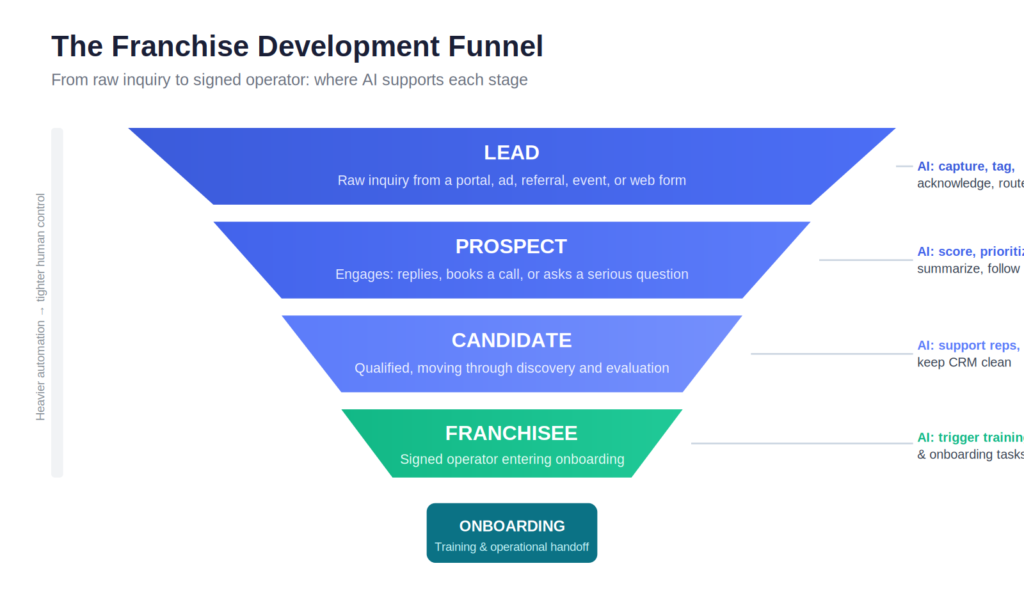
Franchise development process funnel from lead generation to onboarding

Figure 1: Franchise Development Funnel. Concept illustration of a franchise development funnel, from raw inquiry to signed franchisee and onboarding.

Where Franchise Development Funnels Actually Leak

We audit franchise pipelines. The same problems appear again and again.

Roughly 70% of inbound leads are unqualified or exploratory. Reps burn hours sorting low-fit inquiries. Better candidates wait in the same queue. Median first response time sits between 4 and 7 hours. After an expo or an ad spike, it stretches past a day. That delay hands the first conversation to a competing brand.

The data side is usually worse. Fewer than half of candidate interactions reach the CRM. Leadership loses pipeline visibility. Reps lose context between calls. Follow-up depends on rep memory, so warm prospects go cold. Different reps explain fees, territories, and timelines differently. That inconsistency erodes trust and raises compliance risk.

The problem is not effort. The problem is fragmentation. A rep keeps portal leads in one place, referral emails in another, discovery calls on Zoom, FDD notes in a folder, and territory questions in Slack. CRM updates wait until Friday. This setup survives low volume. It breaks when serious inquiry flow arrives.

Where AI Actually Helps

AI helps most when it removes repetitive work and leaves judgment to people. The best use cases are not flashy. They are practical.

1. Lead qualification and candidate scoring

This automation delivers the most leverage. An AI scoring layer reviews every inbound lead against your ideal candidate profile: financial indicators, stated experience, geography, lead source, and engagement behavior. It then routes the top tier to the right rep within minutes. AI does not decide who becomes a franchisee. AI makes sure the right people talk to the right candidates first.

We learned three things while building these systems.

First, trusted form fields often give weak signals. Candidates overstate their liquid capital about one-third of the time. Behavioral signals reveal more. Watch how fast a person replies. Watch whether they open the brochure twice. Watch whether they ask real territory questions. Watch whether they reference the FDD after they receive it.

Second, lead source changes everything, and most franchisors overlook the broker ecosystem. Many franchise deals flow through broker and consultant networks such as IFPG, FranNet, and the Franchise Brokers Association. A broker-referred candidate arrives pre-screened and financially verified. That candidate often talks to three brands at once. A cold portal lead behaves differently. Score both the same way, and you rank them wrong. Broker referrals need faster human contact and lighter automation. Portal leads need heavier triage. Your scoring model must know the difference.

Third, a volume floor exists. Below roughly 50 inquiries per month, a scoring model may not pay off. A disciplined shared inbox and a same-day response rule can be enough. AI lead scoring earns its place when manual triage slows the team down.

2. Instant acknowledgment and follow-up

This fix costs the least and pays back the fastest. Every lead receives a personalized acknowledgment within a minute. The message confirms the inquiry, explains the next step, shares a scheduling link, and promises a review. The message stays simple. It arrives instantly and consistently, even outside business hours.

Control is the key. AI should not free-write franchise sales emails. A safer approach uses approved templates and structured prompts. AI personalizes by location or stated interest. AI cannot invent claims about earnings, success rates, or payback periods. Teams that already run approval-based workflows can connect this with AI prompts for franchise marketing managers with approval rules.

3. Meeting summaries and CRM hygiene

Franchise reps lose hours each week to call notes, CRM updates, and recap emails. AI meeting assistants transcribe discovery calls. They extract the fields that matter: budget range, timeline, territory preference, objections, and next step. They draft the CRM update. The rep approves and saves it.

In our builds, about 1 in 10 extractions still needs a human correction. That accuracy removes most manual logging. It does not justify skipping review on high-stakes fields. Draft, review, then save. Keep that order.

4. Internal knowledge assistants

Reps should not ping a senior teammate for every routine question. Candidates ask whether a territory is open, what the franchise fee is in Texas, or what training follows signing. An internal assistant trained on approved documents answers instantly. It answers identically for every rep. This consistency matters most for multi-location businesses, where the same questions repeat across markets. The same approach powers customer-facing voice agents at the franchise location level. The investment compounds across development and operations.

5. Document workflow and onboarding

Not every win needs an “AI strategy.” Some of the best wins are plumbing. The system sends FDD packages when a candidate reaches the right stage. It schedules validation calls. It drafts territory agreement inputs for legal review. It assigns onboarding modules after signing. It flags missing documents before launch. This is how a franchise business scales without depending on one person’s memory.

6. Pipeline reporting and drop-off analysis

Most franchisors count their leads. Few know where qualified candidates drop off, or why. AI-assisted reporting shows which lead sources create qualified candidates, not just inquiries. It shows which reps follow up slowly. It shows which objections precede drop-off. That insight also feeds marketing, including multi-location ad performance and franchise location pages, once new units go live.
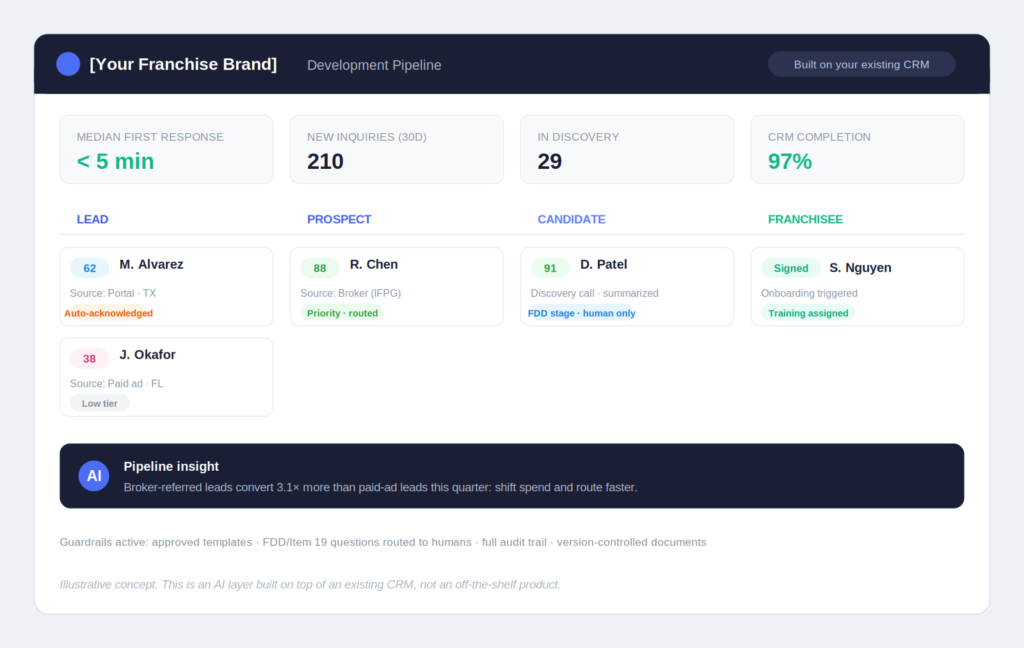
AI-powered CRM dashboard showing franchise candidate scoring and pipeline stages

Figure 2: AI-Assisted CRM Pipeline. Concept illustration of an AI-assisted CRM layer showing lead scoring, candidate status, and pipeline movement. Systems like this are built on top of a franchisor’s existing CRM; they are not an off-the-shelf product.

Picture a 60-unit home services franchisor. It averages 210 portal inquiries per month. Two development reps handle them. The team runs a CRM, but they call it “a suggestion.” Median first response takes 6 hours. Nine percent of inquiries reach a discovery call. Each rep loses about 11 hours a week to triage, logging, and follow-up admin.

We automate three tasks and leave two alone. We automate instant scored acknowledgment on every inquiry. We automate behavioral lead scoring with tiered routing. We automate call-summary-to-CRM extraction with rep review. We keep two tasks human: final qualification decisions, and every conversation that touches the FDD, Item 19, financial expectations, or territory commitments.

Metric Before After 90 Days
Median first response time 6 hours Under 5 minutes
Inquiry-to-discovery-call rate 9% 14% (roughly 55% more candidates in discovery)
Rep admin time ~11 hrs/week per rep ~3 hrs/week per rep (~16 hrs/week recovered across the team)
CRM records Inconsistent Standardized summaries and field updates
Candidate messaging Rep-dependent Approved message framework
Headcount 2 reps 2 reps

Speed is not the number that matters most here. Consistency is. Both reps now say the same things. They use the same next steps. Leadership sees a clean view of the pipeline. That is where AI earns its place in franchise development. AI does not replace the sales team. AI gives the sales team a better operating system.
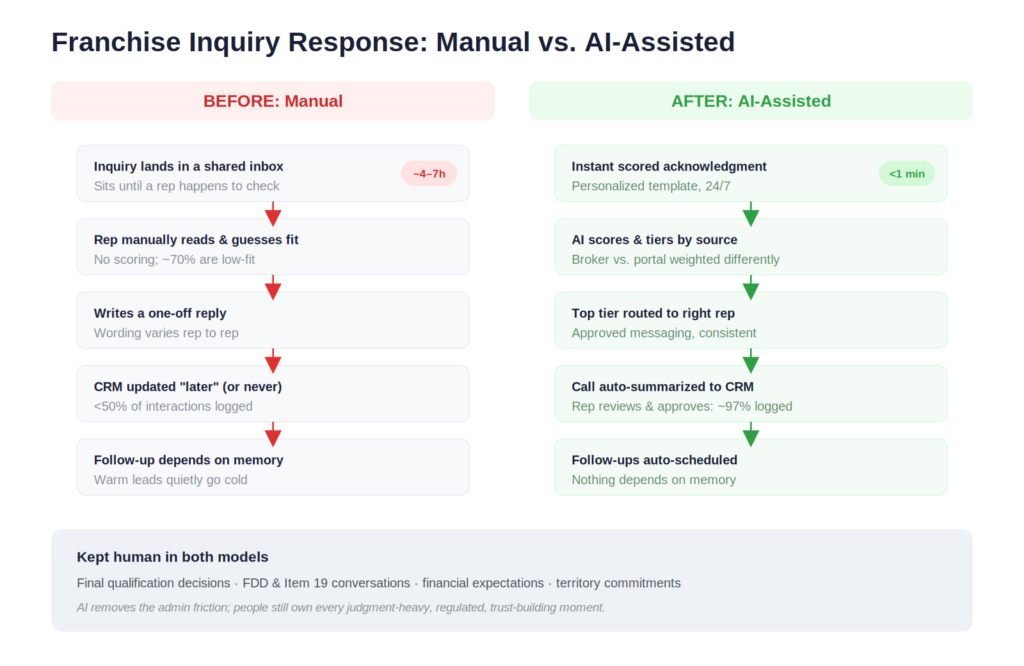
Comparison of manual versus AI-assisted franchise candidate response workflow

Figure 3: Before / After Response Workflow. Comparison of a manual franchise inquiry workflow versus an AI-assisted one.

Franchise AI Readiness Scorecard

Not every franchisor needs AI lead scoring today. Give yourself 1 point for every “yes.”

Question Yes / No
Do you receive 50+ franchise inquiries per month?
Is your median first response time over 1 hour?
Are less than 80% of candidate interactions logged in your CRM?
Do reps manually write most follow-up emails?
Do candidates ask the same questions repeatedly across reps?
Do reps answer fee, territory, or FDD-related questions inconsistently?
Do you lack clear reporting on why candidates drop off?
Do you have multiple lead sources feeding into different systems?
Does your team spend 5+ hours/week per rep on CRM updates or admin work?
Are you planning to grow into new markets in the next 12 months?
Score What It Means Recommended Next Step
0–2 You may not need AI yet Fix basic process, response time, and CRM discipline first
3–5 Ready for light automation Start with instant response, CRM hygiene, and approved follow-ups
6–8 AI can create real leverage Add lead scoring, routing, call summaries, and reporting
9–10 Ready for a full AI layer Build a connected franchise development automation system

The scorecard stays practical on purpose. AI should follow operational pain, not hype.

What to Automate First

Start with high-volume, low-risk tasks. We use this priority order in franchise AI audits:

Task Volume Compliance Risk Verdict
Initial inquiry acknowledgment High Low Automate day one
Lead source tagging High Low Automate day one
Lead scoring and routing High Low Automate early if 50+ inquiries/month
CRM updates from calls/emails High Low Automate with rep review
Follow-up reminders Medium Low Automate early
Follow-up email sequences Medium Medium Automate with approved templates only
Internal Q&A for reps Medium Low/Medium Automate once docs are clean
Pipeline reporting Medium Low Automate once CRM fields are reliable
Onboarding task assignment Medium Low Automate after signing
FDD-related communication Low High Keep human, always
Financial performance conversations Low High Keep human, always
Final qualification decisions Low High Keep human, always
Territory commitments Low High Keep human, always

The pattern is simple. Automate speed, organization, routing, and reporting. Keep people in charge of judgment, legal, financial, and trust-heavy conversations. A structured AI cost-saving audit maps this table onto your own mix of volume, risk, and CRM maturity.

A 30/60/90-Day Rollout Plan

Many teams try to automate the entire process at once. That is a mistake. A better approach builds in layers.

Days 1–30 cover audit and guardrails. Map every lead source, form, inbox, CRM field, and follow-up path. Baseline your metrics: response time, discovery-call rate, CRM completion, and drop-off points. A baseline lets you prove the automation worked. Define what AI can and cannot say about the FDD, Item 19, fees, and territories. Get your first-response and follow-up templates approved. Clean up duplicate CRM records and inconsistent lead stages. Assign clear ownership for approvals and exceptions. By day 30, you know where automation pays back fastest and where it should not touch anything yet.

Days 31–60 build the first automation layer. This layer handles low-risk, high-volume work. It covers instant inquiry acknowledgment, lead source tagging, basic scoring, and rep routing. It adds follow-up reminders and automated CRM activity capture. It ships a first dashboard for response time and pipeline movement. Most teams see their first measurable wins here.

Days 61–90 make the system smarter. Behavioral scoring replaces reliance on form fields. Call summaries feed structured CRM notes. An internal knowledge assistant answers rep questions. Drop-off reporting exposes weak stages. A compliance review loop catches risky messages before they become habits. A weekly leadership report closes the loop. The goal by day 90 is not a perfect AI system. The goal is a faster, safer, and more consistent process.

A Simple Architecture (Without Rebuilding Your Stack)

You do not need to replace your tech stack. Most franchisors need a connected layer around the tools they already run.

The inputs already exist in your business. You have lead sources such as portals, ads, referrals, and events. You have a CRM such as HubSpot, Salesforce, Zoho, or FranConnect. You have communication channels such as email, SMS, and call recordings. You have documents such as the FDD, territory maps, and playbooks. You also have calendars and marketing data.

The AI layer sits on top. It enriches and scores leads. It routes candidates. It drafts approved messages. It summarizes calls into CRM notes. It answers rep questions from approved documents. It finds patterns in drop-off and conversion.

Most teams skip the guardrail layer. In franchise development, that layer is not optional. Approved templates block risky free-form claims. Restricted topics stop the AI from answering FDD or Item 19 questions without review. Human approval keeps reps in control. An audit trail records what was sent and when. Version control keeps the AI on the latest FDD. Escalation rules route sensitive questions to a person. Guardrails separate useful automation from unnecessary risk.

The Part Most AI Vendors Won’t Tell You: Compliance

Regulators govern franchise sales. Under the FTC Franchise Rule (16 C.F.R. Part 436), the franchisor must deliver the FDD at least 14 calendar days before a prospect signs or pays. The rule also limits financial performance representations to what Item 19 discloses.

This rule creates a real AI risk. A general-purpose AI tool can write “most of our owners recoup their investment in 18 months.” That single sentence becomes an earnings claim your legal team never approved.

Ask these questions before any AI system talks to candidates. Can it make financial or performance claims, or does the system block that? Does every outbound template pass legal or brand approval? Does the system keep a full audit trail of every message? Does automation pause during the FDD review stage? Can it flag questions that need human review? Who owns the fix when the system sends something wrong? How fast can you pull a message?

Not legal advice. Franchise counsel should review any AI workflow that touches candidate communication, FDD conversations, financial performance, or franchise agreements. The implementation rule is simple: never let AI improvise in regulated parts of franchise sales.

Safe vs. unsafe AI use in practice

Area Safer AI Use Risky AI Use
Initial response Approved “we received your inquiry” message with next steps Promising success, ROI, or fast payback
Lead scoring Prioritizing leads for human review Rejecting candidates automatically
FDD questions Routing to a rep or legal-reviewed response Summarizing FDD obligations freely
Financial expectations Pointing candidates to the approved Item 19 process Saying “owners usually earn X”
Territory questions Flagging territory interest for rep review Promising availability or exclusivity
Follow-up emails Approved templates with limited personalization Custom persuasive claims without review
CRM notes Drafting notes for rep approval Saving high-stakes fields without review
Internal Q&A Answering from current approved documents Using outdated FDDs or old sales decks
Onboarding Assigning training tasks after signing Interpreting legal or contractual terms

The Mistakes Franchise Development Teams Should Avoid

A bad AI rollout rarely fails because the model is weak. It fails because the process around it is weak.

Automating before fixing the funnel. Messy lead stages and different definitions of “qualified” only speed up the mess. Fix the process first. Then automate.

Treating all lead sources the same. A portal lead, a broker referral, a paid ad click, and an expo scan behave differently. Broker-referred candidates arrive pre-screened and time-sensitive. Score by source, or you optimize for volume over fit.

Letting AI make qualification decisions. AI ranks and organizes. People decide who qualifies to buy a franchise.

Letting AI free-write candidate emails. Free-form emails are the fastest route to compliance risk. Use approved templates, restricted language, and clear review rules.

Training AI on outdated documents. An assistant that runs on last year’s FDD or an old territory map gives confident wrong answers. Wrong answers are worse than no answers.

Measuring only speed. Track more than response time. Measure discovery-call rate, qualified candidate rate, show rate, CRM completion, drop-off by stage, and compliance exceptions. A faster bad process is still a bad process.

Ignoring rep adoption. Reps who distrust the system work around it. Involve them early. Let them review AI summaries. Show them how scoring works. Make the tool useful enough that they want it.

Questions to Ask Before Buying Franchise AI Tools

A good demo is not enough. Ask these questions before you hire a vendor or buy a tool:

  1. Can the system structurally block financial performance claims?
  2. Can every automated message be approved before launch, and can we pause or pull one quickly?
  3. Does it keep a full audit trail of what was sent, when, and to whom?
  4. Can automation pause or change behavior during FDD review stages?
  5. Does it integrate with our existing CRM, or is it another disconnected system?
  6. Can we see how lead scores are calculated, and can different sources be scored differently?
  7. Can it route sensitive questions to humans instead of answering them?
  8. Does it support version control so it never answers from an outdated FDD?
  9. Who owns prompt updates and workflow changes, and what happens when the system is wrong?
  10. Can we export reports and audit logs for leadership and compliance review?

A vendor who cannot answer these questions is not ready for franchise development. The demo does not matter.

Beyond Sales: What the Same AI Layer Does for the Rest of the Business

Better franchise development is the first win. The value then compounds. Once the data, workflows, and guardrails exist, the same layer improves brand consistency. Every candidate gets the same approved next steps. Every internal answer comes from one source of truth. The layer supports faster expansion without more headcount. It also cleans up the sales-to-operations handoff. It triggers onboarding, training, and launch checklists the moment a candidate signs.

It also fixes the marketing feedback loop. Accurate lead-source tracking lets marketing target qualified candidates instead of cheap inquiries. That focus improves portal spend, paid campaigns, and location-level advertising. Leadership gains real visibility too: pipeline health, rep follow-up speed, territory demand, and drop-off. That view replaces a patchwork of private rep notes.

What Humans Should Still Own

People keep the judgment-heavy work: final qualification, discovery calls, FDD conversations, financial performance discussions, territory negotiations, franchisee validation, final approval, and conflict handling. These parts are regulated and trust-building. They stay human-led.

The best AI systems make reps more present, not less. They remove the admin work. Reps then spend more time in the conversations that move a candidate forward.

FAQ: AI in Franchise Development

What is franchise development?

Franchise development is the process a franchisor uses to attract, qualify, sell, and onboard new franchisees. It includes lead generation, candidate qualification, discovery calls, FDD review, franchise sales, territory planning, signing, and onboarding.

How can AI help franchise development teams?

AI helps with lead scoring, instant inquiry response, follow-up reminders, CRM updates, call summaries, internal knowledge search, onboarding workflows, and pipeline reporting. The biggest gains are faster response time, cleaner data, and more consistent candidate communication.

Can AI qualify franchise leads?

AI can prioritize and score franchise leads. AI should not make the final qualification decision. A human reviews candidate fit, financial readiness, experience, territory interest, and brand alignment.

Should AI communicate directly with franchise candidates?

AI can support candidate communication with approved templates, limited personalization, and clear guardrails. AI should not free-write messages about earnings, Item 19, territory commitments, FDD interpretation, or financial expectations.

What franchise development tasks should not be automated?

Do not fully automate FDD conversations, financial performance discussions, final qualification decisions, territory commitments, legal questions, or final franchisee approval. AI can support these workflows. Humans stay in control.

When is a franchisor too small for AI lead scoring?

A franchisor with fewer than roughly 50 inquiries per month may not need full AI lead scoring yet. At that stage, better response time, CRM discipline, and follow-up create stronger ROI.

How are broker-referred franchise leads different from portal leads?

Broker and consultant networks such as IFPG or FranNet send pre-screened, financially verified candidates. These candidates often evaluate several brands at once. They need faster human contact and lighter automation than cold portal leads. Scoring models should treat the two sources differently.

What CRM data is needed before using AI?

You need clean lead-source data, candidate stage, territory interest, contact history, follow-up status, discovery-call notes, qualification criteria, and outcome tracking. AI performs poorly on incomplete or inconsistent data.

How do franchisors reduce AI compliance risk?

Franchisors use approved templates, block restricted topics, keep an audit trail, and require human approval for sensitive messages. They train AI only on current approved documents. They ask franchise counsel to review any workflow that touches the FDD, Item 19, financial performance, or franchise agreements.

What is the best first AI automation for franchise development?

Start with instant inquiry acknowledgment, lead source tagging, and rep routing. This automation carries low risk, measures easily, and improves speed-to-lead.

The Bottom Line

A serious candidate does not choose a franchise because of an impressive autoresponder. They choose because they trust the brand, the model, the people, and the process. AI removes the friction that blocks that trust: the 4-hour response gaps, the missing CRM records, the memory-based follow-ups, and the messaging that drifts as the business grows into a true multi-location operation.

Start small and start at the top of the funnel. Measure your current response time. Count the candidate interactions missing from your CRM. Automate the low-risk, high-volume work first. Keep humans in charge of qualification, FDD conversations, financial expectations, and every final decision. AI works best as an operating layer, not a replacement. It lets your team spend more time with the candidates worth pursuing.

Want to know which automation pays back fastest in your pipeline? Our franchise AI audit answers exactly that.

immersion dans un monde de jeux et de bonus


Brutal Casino, reconnu pour son ambiance immersive et ses offres généreuses, se distingue sur le marché des jeux en ligne. Cette plateforme attire les amateurs de jeux grâce à sa vaste sélection de jeux et à sa structure de bonus attractive qui permet aux joueurs de maximiser leur expérience. En intégrant brutal casino, les utilisateurs découvrent un monde dynamique où chaque partie est une aventure excitante.

Une Large Sélection de Jeux

Brutal Casino propose un vaste catalogue de jeux adaptés à tous les goûts. Des machines à sous aux jeux de table en passant par les options de casino en direct, les joueurs ont accès à une diversité impressionnante. Les titres sont offerts par des fournisseurs renommés, assurant ainsi qualité et innovation.

  • Machines à sous variées
  • Jeux de table classiques tels que le blackjack et la roulette
  • Expérience de casino en direct avec de véritables croupiers

Les jeux sont régulièrement mis à jour, garantissant aux joueurs de toujours trouver des nouveautés et des expériences palpitantes.

La Mécanique des Bonus

La structure de bonus de Brutal Casino est conçue pour attirer et fidéliser les joueurs. Les nouveaux utilisateurs peuvent bénéficier de bonus de bienvenue significatifs, tandis que les joueurs réguliers peuvent profiter de promotions régulières et de programmes de fidélité. Voici quelques types de bonus offerts :

Type de Bonus Conditions Récupération
Bonus de Bienvenue Dépôt initial requis 100% jusqu’à 500€
Recharges Hebdomadaires Validation chaque semaine 50% jusqu’à 200€
Programme de Fidélité Accumulation de points Échanges contre des bonus

Les modalités de mise sont claires et accessibles, permettant aux joueurs de se familiariser facilement avec l’écosystème de la plateforme.

Fiabilité et Sécurité

Brutal Casino place la sécurité des joueurs au centre de ses priorités. Licencié et réglementé, le casino utilise un cryptage avancé pour protéger les données des utilisateurs. Faisant également la promotion d’un jeu responsable, il offre des outils pour gérer le temps de jeu et les limites de dépôt.

Cette attention portée à la sécurité contribue à bâtir la confiance des joueurs, essentiel dans l’univers du jeu en ligne.

FAQ

Quels types de jeux puis-je trouver sur Brutal Casino?
La plateforme propose des machines à sous, des jeux de table et une section de casino en direct avec des croupiers en temps réel.

Y a-t-il des bonus pour les nouveaux joueurs?
Oui, Brutal Casino offre un bonus de bienvenue très attractif lors de l’inscription et du premier dépôt.

Comment la sécurité est-elle assurée sur cette plateforme?
Brutal Casino est sous licence, utilise le cryptage des données et promeut un jeu responsable pour garantir une expérience sécurisée.

Author Bio


Dinoblade, out now, is equal parts janky, genuinely sick and silly as hell


Four years ago, a developer called Jean Nguyen shared a short video on Dwitter of a spinosaurus pulling off a sick combo with Cloud Strife‘s Buster Sword. This, of course, blew up, but it wasn’t actually a game, just some animation work from the dev. And then, somewhere along the line, Nguyen decided to make it into an actual game. It’s now called Dinoblade, it’s out today, and it is jank and over top in exactly the right ways, and genuinely a rip roaring time.


The whole concept is deliciously silly. Some kind of cataclysmic event took place, and now dinosaurs all fight each other using various bladed weapons. You, still a spinosaurus, seemingly forge a pact with some kind of mysterious maybe evil but I’m not quite sure Other Dinosaur, and upon doing so the fighting begins. The best immediate comparison mechanically is Sekiro, as you can parry attacks, but there’s a bit more emphasis on the action element.

Watch on YouTube


As ridiculous as the entire thing is, the combat genuinely feels good. Parrying is responsive, you’ve got quick and heavy attacks that make for some swish combos, and enemy animations are surprisingly readable. When it works, it works! There is that aforementioned jank though, which mostly comes from the environments.


It’s a little awkward, a touch clunky, but I forgive this given that you are a giant ass dinosaur, the feeling at least makes sense with that in mind. Though, sometimes the enemies were invisible and the environments wouldn’t quite load properly, but I think it was just one person making this to the end, so I can extend some grace there as well.


Perhaps my favourite moment was what came after beating the first boss, in which I discovered that doing so then allows you to summon said dinosaur you killed to perform a powerful attack for you. Absurd! I love it, especially when paired with other powers such as an energy beam you can shoot out from your sword, or a roar you can emit that freezes enemies in place.


You are not going to find a revolution here, but you won’t find something that wastes your time either. It’s rare for these sorts of games, ones born from a viral post, that materialise into something as cohesive and enjoyable as Dinoblad, and feels like it fits quite well into the echelons of obscure PS2 or Dreamcast games that never were.


Dinoblad has a demo you can try out for yourself, or you can just pick it up on Steam right now.

The Friday Roundup – On Camera Tips & Video Upgrades


Cheesy guy trying to look natural on camera.Cheesy guy trying to look natural on camera.

This One Move Makes You Look Natural on Camera

If you are anything like me then what happens when you practice presenting a video to the camera, you look natural, approachable and someone worth listening to.

However the second you get in front of the camera, or at least the you become aware the camera is now recording, it all goes to hell in a handbasket!

From that point forward there are pretty much only two scenarios that follow.

The first is that you become stiff, unnatural and spend hours fumbling your way through the script only to end up looking like someone stiff, unnatural and fumbling through a script!

The second is that you end up delivering a lecture or like someone who is talking at the audience and not to it.

So to counter that here are a few tips for overcoming all of that and perhaps communicating to the audience instead!


I Ranked Every Video Upgrade (The #1 Might Surprise You)

This is a rather subjective experiment that Gabriel did on the most commonly recommended upgrades for creating social media videos.

Although the results are based on what he feels are important or unimportant, I can’t help but agree with what he is saying and the logic behind it.

See what you think.


Customize Moving a Graphic Object and Save as a Preset – PowerDirector

OK! Well this is pretty much what it says on the box!

It is a good example of how you can control movement of objects in PowerDirector but I think the more important point is that you can save setups like this and apply them to other projects.

For that purpose make sure you check out that part of the tutorial.


Speaker-Based Subtitles? Filmora Just Solved Your Biggest Editing Problem

To be honest I am still catching up on the recent updates to Filmora 15 as they rolled out pretty fast this time!

As I mentioned in previous posts on the subject, in this version of Filmora they have put the brakes on developing more A.I. driven features a little.

Instead they have been revisiting quite a few of the existing modules and either adding capabilities to them or as in the example below, totally revamping it entirely.

The one features this week is the subtitling module which on the surface may not seems so exciting.

However before you dismiss the need for comprehensive subtitling remember the number of users watching videos with NO AUDIO looks something like this:

  • Facebook: 85% of videos are watched completely muted.
  • Instagram: Between 80% and 85% of users consume Reels and video content silently.
  • LinkedIn: Approximately 79% to 80% of professionals watch videos with the sound turned off.
  • Mobile Devices: Up to 92% of consumers watch video content on mute when browsing on their phones.

That’s why you need to use subtitles and that’s why a good subtitling module is something you should be interested in!


How to Make a 3-layer Collage – Movavi Ideas

This is another in the basic series of How to videos from the folks at Movavi.

If you are using Movavi or are thinking of taking it up as your video editing app of choice then these video give a good understanding of what the program can do.

Of course their market is international so it makes sense that they use their own A.I. voices to narrate the video so lets just overlook that part!


Exposure Triangle Explained: ISO, Aperture Shutter Speed for Beginners

When you make the switch from shooting your videos in auto mode to manual there are a number of factors you have to understand.

If you don’t work these out the end result will be you thinking its all garbage because your auto footage looks better than your manual stuff!

One of those key points is the exposure triangle of ISO, Aperture and shutter speed as it all relates to video.

In this video you can see a good explanation of how it all works and if you are interested to learn more, there is a comprehensive article in the link below.


Being a Full Time Creator Isn’t What You Think (QA)

Many people start off with the possible goal of learning how to shoot and edit videos as well as creating an online profile in the process.

This often follows the path of creating a social media presence based on their own videos and building from there.

In reality those many people end up going nowhere on the whole process or end up becoming a slave to their own media channels!

These days getting started regardless of the intended outcome, is pretty easy.

The real task at hand if you have these intentions is to get a grip on the reality of what the day to day process really looks like.

The video below is a 20 min. or so discussion of what that reality actually looks like from a creator who is both successful in building a presence as well as getting freelance work.


Make Soccer Videos Look More Cinematic? Here’s How – Filmora

As much as we have access to a whole bunch of fancy schmancy A.I tools these days, the reality is that a good edit will always come down to the little details.

Just before you go any further no, this is not about making soccer videos, it’s about making any kind of video.

Even if you have good looking footage and enough of that footage to piece together a cohesive video, that is still not enough.

Of course you need to cut it appropriately but in the end those little fine tuning steps are the nose that will set your project apart.

Here’s a look at that process in Filmora using the available tool to address those things.


Master YouTube Lighting in 15 Minutes

If you are just about to fall into that old trap of thinking that the reason your footage doesn’t look as good as it should, so its time for an expensive camera, wait!

Check this video first because it gives an excellent rundown of how light works in a shot and how you can easily deal with it, no camera purchase necessary.


Amazing Effects in Classic Films – How Did They Pull It Off? – Part 14

I always love it when the guys from Film Riot deconstruct visual effects from classic movies.

They started of this series a while back and dealt mainly with movies from long ago when there was zero SFX technology to fall back on.

In other words all the effects were pretty much practical in their nature and showed just how inventive the early film makers were.

These days they look at some more recent examples but its always fun to peek behind the curtain and see how they were done.


Key Takeaways

  • Feeling natural on camera is challenging, but practicing presentation skills can help.
  • Upgrading video techniques can enhance social media content; viewers often overlook subtitling but it’s crucial.
  • Understanding the exposure triangle (ISO, aperture, shutter speed) is key for manual video shooting.
  • Realizing the realities of being a full-time creator is important and managing expectations can prevent burnout.
  • Mastering small editing details and lighting can dramatically improve the quality of your videos.

Scientists Develop Handheld Device For Measuring When Your Body Is Burning Fat


The breathalyzer identifies the amount of acetone in your breath to determine if your body is in ketosis.

Smart scales and smartwatches often rely on bioelectrical impedance to calculate body fat percentage, a quick, though not necessarily accurate, way to get a sense of the amount of lean mass in your body without having to take multiple measurements. Accurately measuring when your body is burning fat is a whole other ball game, though, which makes new research into a handheld fat burning measurement device all the more intriguing.

In a study for the scientific journal Device spotted by New Scientist, researchers supervised by Andreas Güntner created a handheld breathalyzer that can detect when your body is burning fat by measuring the amount of acetone in your breath. The study measured when the bodies of 12 participants burned fat across a variety of diet and exercise scenarios, and found the breathalyzer closely matched traditional lab results.

Scientists identify ketosis, the term for when your body is burning fat for energy, by either measuring ketones in your blood or acetone in your breath — both are byproducts of fat being turned into fuel. As New Scientist notes, acetone tests are usually most accurate in a laboratory setting where things like humidity and breathing patterns can be controlled. The researchers in this study got around those limitations by creating a breathalyzer that can filter out excess moisture and contaminants, and using a companion app that can guide the user through the breathing process. The app was not only able to identify when users were applying too much or too little pressure, but also help adjust when the breathalyzer collected its sample to make sure the measurement was as close as possible to what would be observed with a blood-based test.

Nutrion, now the commercial name of the device the researchers used, is similar in concept to an older device called Lumen that aimed to spot fat burning using carbon dioxide rather than acetone. In either case, frequent metabolic measurements could be useful in a variety of health settings, from determining whether GLP-1 therapies are effective, to enabling athletes to fine-tune their metabolism.

Rubinite Free Download (Build 24347317)


Rubinite PC GameRubinite PC Game


Rubinite Direct Download:

Rubinite is a boss rush action game set in a dark fantasy world. DragonSword : Awakening

The key to combat is one distinctive core mechanic: Focus. Use Focus to read an enemy, expose its weak point, and land a lethal strike. You play as Ruby, a princess on a journey of revenge to reclaim her home: The Scarlet Kingdom.

Fight the Bloodstained to the Death
Ruby’s blade alone will barely wound them. Find their weak points, drive the lethal strike home, and make it out alive.

Your Bloodline: Both a Blessing and a Curse
To take back the Scarlet Kingdom, Ruby must face the Bloodstained in every form they take, whether it be an ancient secret cult, undying parasites, or the source of a deadly plague. Grip your blade and challenge foes that grow deadlier with every step.

Exquisite Pixel Environments
Step into beautifully crafted pixelated scenes, where the poignancy and grandeur of the Scarlet Kingdom come alive in every hazardous battle.

Absorb Pureblood, Forge Talismans
Every Bloodstained you kill surrenders its power. Absorb it to grow stronger for the fight ahead, craft a wide range of Talismans, and build a combat style that’s entirely your own.

Screenshots

System Requirements

Minimum
Requires a 64-bit processor and operating system
OS: Windows10
Processor: Intel(R) Core(TM) i5
Memory: 8 GB RAM
Storage: 2 GB available space
Support the game developers by purchasing the game on Steam

Installation Guide

Turn Off Your Antivirus Before Installing Any Game

1 :: Download Game
2 :: Extract Game
3 :: Launch The Game
4 :: Have Fun 🙂


Rugged Product Design Strategy: How Product Development Firms Can Deliver for Startups


Product design does produce products that are robust, effective, and capable of overcoming obstacles in the real world. A plan that can make a difference and lead to success is essential for companies or firms that are just getting started.

Platforms like Cad Crowd can play an important role by connecting startups with skilled designers and engineers who can help transform early-stage concepts into functional, production-ready products. Any startup must have a strategy that focuses on making its ideas turn into reality, and thus, rugged product design is the key to fulfilling these areas. Having a successful strategy will result in growth in the areas.


🚀 Table of contents


What is rugged product design?

Rugged Product Design is a strategy that can withstand any challenges that could hinder the process of any product. May it be in harsh conditions, situations that are unexpected, and the frequency of use. It is not just about the physical appearance or the design of the product. It is about the longevity of its use and the function that it can contribute to any company. Having a rugged product design ensures that any problems can be solved with its use.

RELATED: A Startup Guide to Concept Design for Hardware with Product Design Services Companies 

Businesses that are just getting started look forward to success because it’s a make-or-break situation. Clients often fear failing in their new endeavor or perhaps receiving unfavorable comments from prospective clients.

The function of product development companies

A helping hand that continues to serve the companies to perform and give them the product that keeps the companies alive. Businesses and corporations that specialize in product development assist entrepreneurs in bringing their innovative concepts to life. This reality can be incorporated into a high-performing product that sustains local businesses.

Before mass production begins, product development companies offer experience in design, engineering, and product testing. A rugged product design strategy is a valuable tool that may help any new business with every step of the process. It ensures that the product being pushed through and released is robust, functional, and prepared for any potential criticism.

RELATED: 10 Costs of New Product Development (NPD) with Design Firms

Being aware of the environment and user

When developing a product, good communication and planning are crucial. The product’s intended usage and location should be made clear. Any product’s longevity and functionality should be considered since they can assist businesses in creating a product that is appropriate for their needs.

Product development firms and companies do not just produce the product; they carefully study and plan the product, together with the demands of it in the environment, and how a user can use it. One example of this is a scenario where a product aims to be used outdoors; with this, the product should be able to withstand any conditions, such as hot weather and storms. By being able to fully grasp and comprehend these situations, designing any products should not be difficult anymore.

Right and suitable materials

A product design is not completed without the proper use of materials. It is important to have a product that is durable, as durability also guarantees that potential customers will be able to use it. Having a product that is strong and durable will result in a product that lasts longer and will not tarnish the reputation of any startup because of its capacity to perform better.

RELATED: How the Engineering Design Process Helps You Craft New Products for Consumer Goods Firms

There are alternatives on the market that can function far better without requiring a large investment of resources; thus, not all materials need to be expensive. It is essential to be able to select materials that are not only useful but also enable startups to grow without incurring additional costs. This will ensure that the manufactured products are dependable and will stay on the market for a long time.

The importance of key testing and validation

To guarantee that a product will withstand in the market, testing should be done. This will ensure that the product released in the market is already in good and stable condition. Testing also guarantees durability. Drop tests, pressure tests, exposure to hot temperatures, and even cold ones are some of the tests that a product design firm uses. This will ensure that the product is certain to be released on the market once it undergoes the validation needed.

Being able to try and test these products will help to pinpoint problems or errors that could be seen in the product.  By doing these, it can solve the problems and fix them right before mass production of a product is made and is released to the public. It is very important to ensure that quality is being upheld because clients or companies are not just releasing a product, they are gaining the trust of any potential buyers. Testing process enables the minimization of any errors or failures that could happen, and it also ensures that the overall quality will be at the best standard.

RELATED: How Design for Manufacturability (DFM) Services Help with New Product Design at Your Startup

Additionally, testing ensures that safety is being ingrained in the product as a whole. Furthermore, safety must be ensured because failure to do so could result in harm, the closure of the business, and the loss of resources. It will verify the product and assess every component that leads to optimal production. To survive in the real world, testing is the key to ensuring that any product will be useful once released in the market. The following are the types of testing that could be used:

Types of testing:

Drop testing – This type of testing is performed when such products are accidentally dropped. This makes sure that the product is still able to function despite being dropped from various heights. It ensures the product won’t break quickly and will remain useful.

Vibration testing – Through shaking and vibrations process, the product is exposed. This will check if there are parts or components that will loosen. This guarantees that even when transporting, the products are still intact despite all the shaking and vibrations.

Temperature testing – Products are being placed into conditions that are too hot or too cold. The experts or companies will see how the products react when put into certain temperatures or conditions. When exposed to too much heat, the product might shrink, or the materials may weaken, thus, the product will result in something unutilized.

RELATED: How CAD Modernizes Product Concept Design at Industrial Design Services Companies

Water resistance testing – When products are being put into water, whether it be rain or splashes of water, the product tends not to work. This testing will guarantee that, despite being affected by rain or water, the product will still work.

Dust and dirt testing – Dirt and dust are being blown into a product to see if the product will still work even if dirt is present. The presence of dirt and dust can damage the internal parts and components because it can block the passages. The use of these tests can make it possible for the product to still work.

Startups-rugged-product-design-success-strategy

Pressure or load testing – When a product is made to be used under heavy loads, testing can be helpful. The pressure or load testing can provide insight into how heavy the product can handle, whether it will break or not.

Shock testing – This is different from drop testing. Shock testing is made by applying a force or an impact without the need to drop the product. This means of testing can make sure that the product will still function even if a sudden collision occurs.

Chemical resistance testing – Some products react quickly to chemicals, and the product tends to be damaged. The chemicals used are oils, cleaning agents, and others. Why is chemical resistance testing a must? It is due to the fact that a product will be functional once materials work perfectly without reacting to any chemicals, even if they are exposed.

RELATED: Top Product Usability Factors for Good Product Design Services & New Prototypes 

Sunlight testing – When products are exposed to too much sunlight, they tend to fade or weaken the materials of the products. It is important that even if it is exposed to too much light, the product stays the same.

These tests are being used by the rugged product design to guarantee that even in the long term, or in case of any problems, the product will stay functional and useful to any clients and customers. Before any mass production happens, testing should really happen as a way to determine if it is ready to be released. Rugged design is all about making the products strong and reliable. Testing them will really help the companies and clients to attain success.

By having these tests, products being carefully planned will last for the future, and will perform at their best. It can also guarantee that the customers’ expectations will be met and they will be satisfied.

Simplicity leads to reliability

Clients would prefer designs that are much simpler than those that are complex. In their logic, simple designs would result in a product that is attainable. Through this, it will be much better if the products are still functional. Rather than having complex designs that are difficult to achieve, where parts and components can cause failures. Clients would want to have a product that is easier to use and can be produced with practicality.

RELATED: Injection Molding Tips for Cost-Effective Prototypes and Mass-Manufacturing by a Mold Design Firm

Cost efficiency

Startups, companies, or businesses do have limited resources. But with a rugged design, even though it will be costly at first, the clients will have the trust of those potential buyers. This is what people call “investment”. Even though it may be costly, over time it will save resources because of the help the rugged design strategy provides.  Once investing in a strategy that could be an aid to a company that is pursuing, it ensures that the product will be long-term and will be functional once it is released.

Building trust with customers and brand reputation

A product reaches its success when a customer comes to trust it. It is crucial for any product to attain the trust given by its customers, as it makes the business thrive in the industry. People use word of mouth to determine whether customers are satisfied or not. If they are not satisfied with the outcome of the product, they tend to recommend it to others. On the other hand, when a product fails its customers, customers tell others to never buy or use the product again due to its insufficiency in use.  Trust given by clients makes the brand reliable. In the long run, when trust is established, the business or company’s startups will grow in the competitive market.

Rugged product design is a strategy that can be used by startups that are planning to venture out. This is a practical and effective strategy that not only ensures the product design but also the endurance, durability, and reliability to be able to release it in the market. It is vital to have these as support for the product development firms, and companies can help the startups have the best quality products, which can make the clients trust the brand. Having a brand that is fully trusted by the clients guarantees that the startups will continue to develop throughout time as long as the product maintains its consistency over time.

RELATED: 38 Top Tips for Outsourcing Physical Product Development with US Product Design Firms

What is ruggedization in electronics design?

Ruggedization is a process wherein the design and manufacturing of any electronic devices can withstand the presence of a harsh environment. Reliability of the product is needed, as it is a must that any product can operate. Making sure that the electronics being built continue to work even with rough handling, ruggedization is the key for these.

How is ruggedization important?

When a startup centers on electronic devices, it should bear in mind that not all devices can be safe to use. It is crucial to have someone or any professionals who could lead the project so that errors cannot happen. Electronics are used in different types, such as outdoor, military, or in construction.

Product-development-rugged-design-startup-strategy

Ruggedization can help prevent any accidents and can improve the lifespan and functionality of any electronic device designed. Ruggedization ensures that the product is made for hard use and that consumers can rely on it under all circumstances.

RELATED: How the Engineering Design Process Helps You Craft New Products for Consumer Goods Firms

Which standards are applicable to the design and testing of rugged product designs?

IP or Ingress Protection ratings are usually used for water resistance, and on the other hand, MIL- STD is a standard for building military-grade equipment. These are the standards that can help to have a required tolerance analysis of things that can affect a product.

How can Cad Crowd support a rugged product design strategy

If you’re wondering how Cad Crowd can assist with rugged product design strategy. Cad Crowd can be an efficient partner for any startups that want to have their product in the process of development and would like to apply the rugged product design strategy to their products. Cad Crowd has a vast network where clients can be connected to different professionals, experts, and even freelancers who specialize in the field that the clients are looking for.

The following are the reasons why Cad Crowd can support a rugged product design strategy:

Access to skilled and specialized designers

Clients and businesses can benefit greatly from using Cad Crowd to access a variety of individuals with specialized knowledge. Startups, companies, and businesses can look for professionals such as engineers who specialize in product testing, including durability and materials engineering.

RELATED: Tips for Product Design Firms: Validate New Product Ideas & Squash Launch Failures

The touch of professionals can help products that are designed to run for a long time. As well, the product is designed to align with strength and function, which is really essential in rugged design.

Improved design accuracy through CAD tools

Cad Crowd makes use of computer-aided design software that can create a plan that is informative and can make the product precise. Being able to utilize this allows the digital design to give the startups a view of what their product will look like once produced in the real world. It is vital that every element involved in the design process is accurate, as this will ensure that any problems being faced can be solved. Hence, all of it will allow us to have a product that is durable and functional.

Early detection of design problems

It is important that a rugged design is carefully tested before being made available to the public. The use of virtual testing and simulation ensures that the products are analyzed carefully. This cannot be done with the use of Cad Crowd professionals, because they examine every part to guarantee that there will be no errors. And if an error is detected, it will be solved quickly so that it will not delay the entire process of the product.

In addition, by having Cad Crowd professionals, startups can be free from the stress that a product might give. It is due to the fact that these professionals make it even more possible to have a product that is ready to be used in the market. Being able to detect the errors in the design could result in a product that is efficient and effective to be used in the market, as flaws have already been solved before being made public for release.

RELATED: Top 50 Industrial Design Services Firms for New Product Design & Development in the US

Cost-effective solutions for startups

Hiring a full staff and a team can cost startups a lot of money. Cad Crowd can be hired on a project-by-project basis, which means that they can only provide service once you have hired them for a certain product. Cad Crowd professionals are affordable, so startups can attain all of their goals with the help of these experts.

Quick product development

When the design process is slow, customers are more likely to reject the product. For any startup, speed is essential. Cad Crowd can expedite the design process. Quick processes make it possible to make more modifications and enable firms to swiftly go public while maintaining a high-quality product.

Scalable and flexible collaboration

Startups modify their designs to be competitive as time goes on and trends shift. Cad Crows is a great help for any business because it allows them to have an additional member of the team who could contribute to the project once needed. This makes room for improvement that could lead to success while having the quality and maintaining the rugged design standards.

RELATED: How is Product Design Different From Industrial Design Services Companies?

Why is Cad Crowd essential for the rugged product design?

Every progress and detail is a big deal in a rugged product design strategy. From materials to testing to mass production of the product. Cad Crowd plays a significant role by guiding the startups in their plans and ideas. It offers support, help, and solutions that could make the startups successful. By being able to use Cad Crowd, startups can have a durable, flexible, and high-quality product that can withstand any conditions and can be successful in the competitive market.

A strong, reliable product with the aid of a rugged product design strategy

It cannot be denied that in today’s world, where the market is competitive despite supply and demand, startups should take a step that can help them thrive and be part of the market. From ideas down to the testing and mass production, it is vital that the products should not just perform their function, but they can be something that a potential buyer could trust.

Rugged design is an important method that not only helps entrepreneurs achieve their goals but also enhances their product by making it dependable and long-lasting while maintaining its usefulness. The brand reputation relies on the trust that is given by the customers; from there, it can build credibility, where products can be made successful. Rugged design strategy guarantees that any products being released are ready for hindrances and problems that could possibly occur, such as accidental dropping, heat exposure, which can affect the business.

RELATED: The Importance of Iteration in Product Development & Working with Product Design Companies

In every progress that a product goes through, every step plays an important role, from communicating with the clients, to using the plans, to selecting every suitable material, to making it through testing. These steps are needed and must work together to have a product that can function and perform well. For every startup, it is important for them not to fail because failing will mean that resources are wasted and the progress of the project can be delayed, which clients do not want to happen.

Rather than struggling, the Cad Crowd platform can help. As this platform has a massive pool of experts, such as designers, engineers, architects, and other professionals who have a talent in their desired path. Startups can also look into the portfolios being available, where they can view the designs or the works of the professionals and decide if that specific expert is suitable for the product. These experts can identify errors and work on them without wasting too much time.

Time is very much needed in the rigorous process. Startups’ clients tend to prefer professionals who can offer a simple design that is attainable and easy to implement. Resources and budgets are also limited; if the design is too complex for a product design, clients would tend to reject it and look for something that is practical and easier to succeed with. A simple structure would also make it easier to maintain over time. Additionally, it would remove uncertainty and be simpler to understand. If a product is difficult to use, any client or customer might struggle to use it, which will lead to rejection.

Conclusion

With proper testing, planning, and communication, every product design can be attained successfully. It is important to have a product that continues to thrive despite the changes in market development. Being competitive means that more customers and buyers are satisfied with the products being offered. This cannot be made possible without the help of a rugged product design strategy, which acts as the key to having a product that can perform overall without errors and risks.

RELATED: What Are Proven Product Design Principles when Working with Companies & Freelancers?

The use of Cad Crowd is beneficial as it can help any startups and product development firms to have a connection to the large pool of professionals that they need. Rather than having an internal team, Cad Crowd has a lot of professionals who specialize in creating a durable, high-quality product that is in line with the standards being given. Having access to Cad Crowd will also mean that resources can be cut down, as you can only hire them once you need them.

Rugged product design strategy focuses on making a product intelligent, useful, and capable of being used in a competitive market. It goes beyond simply making a product sturdy. Startups may stop worrying about what will happen to the product by combining all the plans, testing, and recruiting experts from Cad Crowd. They can be certain that there is a product on the market that fulfills the expectations of prospective buyers.

How Cad Crowd can help

A strong product should never feel rushed or incomplete, especially in rugged product design where real-world performance, durability, and reliability are essential. Instead, it should be carefully planned and developed to ensure it can withstand everyday use, environmental challenges, and long-term demands while still delivering consistent function and quality. This is where Cad Crowd helps startups and businesses by connecting them with experienced designers and engineers who can turn early ideas into well-developed, production-ready solutions built for real-world conditions. Contact us now for a free quote!

author avatar

MacKenzie Brown is the founder and CEO of Cad Crowd. With over 18 years of experience in launching and scaling platforms specializing in CAD services, product design, manufacturing, hardware, and software development, MacKenzie is a recognized authority in the engineering industry. Under his leadership, Cad Crowd serves esteemed clients like NASA, JPL, the U.S. Navy, and Fortune 500 companies, empowering innovators with access to high-quality design and engineering talent.

Connect with me: LinkedInXCad Crowd

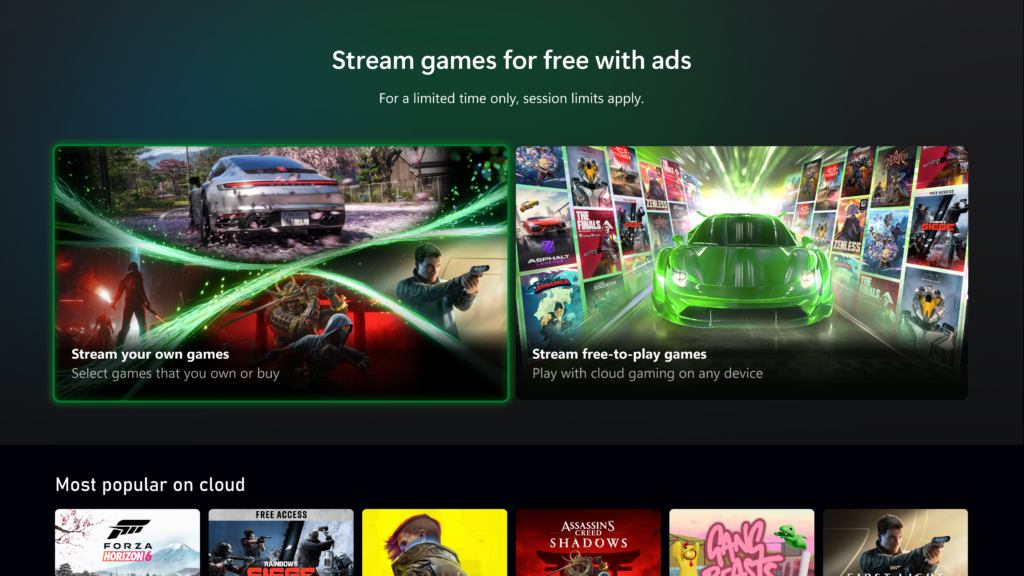
Beginning Ad-supported Game Streaming Test & Learn


Today, we’re starting to test an ad-supported way to stream select games from your library for a limited time, available to XBOX Insiders. 

During this test period, XBOX Insiders with an XBOX account will be able to stream games they own for free with ads. Players will have one hour session limits across supported devices and regions.  

Here’s what you can expect:  

  1. Ads will play before sessions begin. 
  1. The core game experience is unchanged. 
  1. This is optional. Players can choose other ways to play at any time.  

For many players, the device they already own now allows them to stream games with XBOX. Cloud can also help XBOX One owners play newer games built for XBOX Series X|S without needing to purchase new hardware right away. That can be especially meaningful in places where consoles are harder to find or less affordable, giving more players another way to access great games on devices they already have.  

Advertising has existed in gaming for decades, from in-game placements to free-to-play models. But it hasn’t always been built with the player in mind. When done well, advertising can help lower the cost of access. It creates another way for players to get into games without an upfront streaming purchase and expands audiences through new ways to play.  

For brands, this only works if showing up here adds to the experience, not takes away from it. 

Given that, we want to be clear about how we will approach ad-supported services across XBOX: 

  1. We start with the player. Ads should create value. 
  1. We do not interrupt the flow of gameplay. 
  1. We hold ads to the same quality bar as our content. 
  1. We’re clear about what’s advertising. 
  1. We make sure ads fit what players expect on each platform. 

We’ll learn from this test and continue to improve it based on how players use it and what they tell us. Our goal is simple. Give more people more affordable ways to play.  

How to Get XBOX Insider Support and Share Your Feedback

Thanks to XBOX Insiders for all of the feedback. You can also visit aka.ms/XBOXplayervoice to share what you think.  

If you’re an XBOX Insider looking for support, please join our community on the XBOX Insider subreddit. Official XBOX staff, moderators, and fellow XBOX Insiders are there to help. We recommend adding to threads with the same topic before posting a brand new one. This helps us support you the best we can!

If you aren’t part of the XBOX Insider Program yet and want to help create the future of XBOX and get early access to new features, join the Program today by downloading the XBOX Insider Hub for XBOX Series X|S & XBOX One or Windows PC. For more information on the XBOX Insider Program, follow us on Twitter at @XBOXInsider and keep an eye on this blog for all the latest news.

Other resources:

For more information: follow us on X/Twitter at @XboxInsider and this blog for announcements and more. And feel free to interact with the community on the XBOX Insider SubReddit.


Best Buy is selling the LG C5 OLED for nearly 50% off – and I recommend it


lg-c5-oled-65in-08

Follow ZDNET: Add us as a preferred source on Google.


The LG C5 OLED is one of our favorite TVs here at ZDNET, and for good reason. You get signature OLED picture quality, VRR support for console gaming, built-in voice controls, and support for both Dolby Vision HDR and Dolby Atmos virtual surround sound, along with “dazzling brightness and color,” according to our reviewer. 

Right now at Best Buy during the Black Friday in July sale, you can pick up the 65-inch version for 48% off, bringing the price down to $1,399. The sale ends this weekend, and we aren’t sure if this deal will stick around.

Also: LG C5 OLED review

It may be last year’s flagship model, but the C5 OLED still gives you plenty of reasons to buy (aside from the discount). The OLED panel uses individually-lit pixels to create billions of colors, deep inky blacks, and bright whites. This creates sharper contrast, more accurate colors, and finer details than LED and LCD screens. It also works with built-in sensors that monitor ambient lighting and automatically adjust brightness for the best visibility in any room.

As our reviewer noted, “the C5 has a unique construction and a futuristic aesthetic,” including “one of the thinnest screens I’ve ever seen — at a mere 0.25 inches thick.” 

Also: LG C6 vs. LG C5

The 120Hz base refresh rate is perfect for live sports, as well as streaming, but it can be boosted up to 144Hz with support for both Nvidia G-Sync and AMD FreeSync VRR for console gaming. The dedicated gaming picture mode also automatically lowers input latency for response times as low as 0.1ms, bringing it on par with PC monitors purpose-built for gaming. 

You’ll also get premium sound to match your OLED picture, with support for Dolby Atmos virtual surround sound, native 2.2CH audio, and Bluetooth connectivity for setting up custom home audio equipment. Pair the LG C5 OLED with an LG-branded soundbar to take advantage of the LG Sound Sync feature, which makes the soundbar and TV speakers work in tandem for fuller, richer sound.

How I rated this deal 

This is one of the best deals I’ve seen on an OLED TV this year, bringing signature picture quality within reach of more shoppers. You’ll get a 120Hz refresh rate, built-in voice controls, support for both Nvidia and AMD VRR for console gaming, and both Dolby Vision and Dolby Atmos for enhanced picture and audio. All for half the price of what it would normally cost. That’s why I gave this deal a 5/5 Editor’s rating.

Deals are subject to sell out or expire any time, though ZDNET remains committed to finding, sharing, and updating the best product deals for you to score the best savings. Our team of experts regularly checks in on the deals we share to ensure they are still live and obtainable. We’re sorry if you’ve missed out on this deal, but don’t fret — we’re constantly finding new chances to save and sharing them with you at ZDNET.com


Show more

We aim to deliver the most accurate advice to help you shop smarter. ZDNET offers 33 years of experience, 30 hands-on product reviewers, and 10,000 square feet of lab space to ensure we bring you the best of tech. 

In 2025, we refined our approach to deals, developing a measurable system for sharing savings with readers like you. Our editor’s deal rating badges are affixed to most of our deal content, making it easy to interpret our expertise to help you make the best purchase decision.

At the core of this approach is a percentage-off-based system to classify savings offered on top-tech products, combined with a sliding-scale system based on our team members’ expertise and several factors like frequency, brand or product recognition, and more. The result? Hand-crafted deals chosen specifically for ZDNET readers like you, fully backed by our experts. 

Also: How we rate deals at ZDNET in 2026


Show more


Total War: Warhammer 40k shows off its first full battle live, providing its biggest info dump yet


Total War: WARHAMMER 40,000 – Alpha Strike Livestream: Ranged Combat – YouTube
Total War: WARHAMMER 40,000 - Alpha Strike Livestream: Ranged Combat - YouTube


Watch On

As the closed beta for Total War: Warhammer 40k grows ever closer, we’re getting to see a lot more gameplay recently. The first reveal was at our very own PC Gaming Show, and then a couple of weeks back, courtesy of BiliBili, we got to see a kind of battle report overview of the same encounter with narration.

Well, in the latest Alpha Strike livestream, Creative Assembly shows off that same battle, but running the entire thing through three times from the player’s perspective. We got to witness the Astra Militarum trying to defend a river crossing against the Orks, as well as lots of info about ranged combat, cover, reserves, army abilities, and all sorts of other juicy details.