If you play Mobile Legends, PUBG Mobile, Free Fire, Genshin Impact or Honkai: Star Rail on your Android phone, sooner or later you’ll want diamonds, UC or crystals. Buying in-game currency is easy, but not every method is equally safe or good value. Here’s a quick checklist to protect your account and your wallet.
1. Never share your password
A legitimate top-up only needs your player ID (and sometimes your server or zone ID). Any site or “seller” that asks for your login, password or verification code is a red flag. Sharing credentials is the most common way accounts get stolen.
2. Double-check your player ID
Copy your ID straight from your in-game profile instead of typing it by hand. One wrong digit can send your diamonds to a stranger, and those purchases usually can’t be reversed.
3. Avoid “free diamonds” generators and modded APKs
Apps that promise unlimited currency are scams at best and malware at worst. Stick to Google Play, the official in-game store, or an established top-up service, and keep Google Play Protect switched on.
4. Compare prices before you pay
Official in-app prices include store fees, so dedicated top-up stores can be cheaper, especially during promotions. For example, VGTopup (https://vgtopup.com/) lets players top up popular titles like Mobile Legends, Free Fire, PUBG Mobile, Honkai: Star Rail and Wuthering Waves, as well as live-app coins and digital gift cards, often at discounted rates. Delivery is done with your player ID only, so you never hand over your login details.
5. Use a payment method with a record
Whichever service you use, pay with a method that gives you a receipt, and screenshot your order confirmation. If something goes wrong, you’ll have proof for customer support.
6. Watch out for fake event pages
Big events and anniversaries bring a wave of phishing pages that copy official designs. Check the address bar carefully, and don’t trust top-up links sent by strangers in chats or comment sections.
7. Set a budget
Gacha games and battle passes are designed to keep you spending. Decide on a monthly limit before an event starts, and use Google Play’s purchase authentication settings so nobody else on your phone can buy items without permission.
Final thoughts
Topping up on Android doesn’t have to be risky. Protect your login, double-check your ID, skip anything that sounds too good to be true, and compare a couple of trusted options before you buy. A few seconds of care keeps your account, and your rank, safe.
Target’s Black Friday 2026 sale is coming in hot, folks. Things kick off extra early this year, with the first official shopping event of the season on Nov. 5. In other words, you might want to get your lists ready ASAP.
While most holiday shopping is done online these days, Target still offers that classic Black Friday in-store shopping experience for those who want to soak it all in. The deals will really start to heat up as we get closer to Black Friday proper, but you can start checking off your lists as soon as today.
With every retailer holding major Black Friday events, it’s easy to get your wires crossed. To help you keep all the details straight and get ready to shop at Target on Black Friday 2026, here’s everything you need to know, including store hours, what will be on sale, and how to get early access to the best deals.
When is Target’s Black Friday sale?
Black Friday proper falls on Nov. 27 in 2026, but most retailers start dropping deals well before that. Target’s first early Black Friday sale kicks off on Nov. 5 and runs through Nov. 7, followed by new limited-time deal drops every weekend throughout the holiday season. The official Cyber Week schedule has yet to be unveiled, but Target has announced that its Deal of the Day program will return on Nov. 1. Shoppers can score a new featured deal each day until Dec. 24, with a one-day preview of the offers.
Here’s a breakdown of Target’s Black Friday schedule so far:
Mashable Light Speed
Nov. 1: Target Deal of the Day offers kick off
Nov. 5-7: Target’s first early Black Friday sale
Every weekend after: New limited-time holiday deal offers
What time do Target stores open on Black Friday?
You can shop Target’s Black Friday sale both online and in stores. Most Target stores will open their doors at 6 a.m. local time on Black Friday, Nov. 27. There may be exceptions to those hours, so double-check the exact opening hours for your local store. Target stores are closed on Thanksgiving Day.
Last year, Target made waking up early on Black Friday worth it, as the first 100 guests in line received limited-edition iridescent tote bags. Among those 100, 10 lucky shoppers got a surprise gift inside, ranging in value from $99 to $350. Those gifts included Target Circle 360 memberships, gift cards, a Ninja Slushie machine, and more. Target stores with Starbucks Cafés inside also offered samples of their Frozen Peppermint Hot Chocolate.
Target Circle 360 Black Friday early access
In 2025, Target gave its Target Circle 360 members early access to select deals during their Black Friday sales. It’s highly likely that members will get early access this year as well.
Target Circle 360 is the retailer’s paid membership program (separate from its free Circle membership). It costs $99 annually or $10.99 per month and offers perks like same-day delivery, free shipping, monthly freebies, early access to sales, and an extra 30 days for returns.
What will be on sale at Target for Black Friday?
Target has a wide assortment of Black Friday deals, ranging from toys to tech. We expect to see some steep discounts on toys and will definitely be keeping an eye on Lego sets and Pokémon 30th Anniversary products. In years past, we’ve also seen great deals on small appliances, TVs, headphones, floor care, and gift cards. Standout deals from 2025 included $69 AirPods, $600 off TCL’s The Frame TV dupe, 20% off gift cards, and a $49 air fryer.
Best early Black Friday deals at Target
While Target’s first early Black Friday sale doesn’t kick off until Nov. 5, there are definitely already deals floating around. We’ve found a few worth shopping ahead of time. Here’s a glimpse at some of our favorite early Black Friday deals at Target.
Your grandfather’s new auto-sorting spell backfired.Airport Contraband Every potion in the apothecary tipped off its shelf. Every finished potion unravelled back into raw essence, and the loose colors pooled together in one enormous pile in the middle of the lab. He chuckled. “Ah, it does that sometimes.” Then he pulled on his coat for the annual Alchemists Gathering and asked you to mind the place while he is away. He’ll be gone about a month. There is no rush at all.
Two puzzles Every potion needs two things done to it.
Decant. Pour the scrambled liquids from bottle to bottle until each one holds a single pure color. If you have ever played a water-sort puzzle, your hands already know this part.
Shelve. Carry the finished potion across the lab to the shelf it belongs on. Color gets you to the right wall. The sigil on its label picks the exact shelf. You can only levitate a few bottles at a time, so the two puzzles compete for the same hands. Pour greedily and you have nothing free to carry with. Carry too much and you have nothing free to pour into. Deciding what to hold is the game.
One laboratory. 4,160 potions. A gothic stone rotunda, two floors, tall arched windows and warm afternoon light. 52 shelved sections across thirteen families of potion. Every one of the 4,160 potions is in that pile from the moment you start. Nothing respawns, nothing refills, nothing quietly re-stirs itself behind your back. The mess only ever gets smaller. The room is the progress bar. The floor clears. The shelves fill and light up. A dark, dusty laboratory slowly becomes a glowing apothecary.
Relaxing is the whole point No timers. No pressure. No penalties. No fail state. There is nothing here you can lose. Warm window light, a quiet score, and the sound of glass and liquid. Put a potion on the wrong shelf and nothing scolds you. No buzzer, no shake, nothing taken away. Set a bottle down mid-pour, walk off, and come back next week to exactly where you left it.
Features
Two interlocking puzzles: water-sort decanting and tidy-up shelving
4,160 potions across 52 sections and 364 shelf rows, in one continuous laboratory of 2 floors
No fail state, no timers, no penalties
A 24-node skill board that hands you better tools and never plays for you
Full input rebinding, an FOV slider, and a HUD you can switch off
Autosaves after every pour and every placement
Unlike the free mobile versions of this genre: buy it once. No ads, no energy timers, no shop, no dark patterns.
Screenshots
SystemRequirements
Minimum Requires a 64-bit processor and operating system
OS: Windows 10 64-bit
Processor: Intel Core i5-6600 / AMD Ryzen 3 1200
Memory: 8 GB RAM
Graphics: NVIDIA GeForce GTX 1050 Ti / AMD Radeon RX 570 (4 GB VRAM)
DirectX: Version 11
Storage: 2 GB available space
Support the game developers by purchasing the game on Steam
InstallationGuide
TurnOff Your Antivirus Before Installing Any Game
1 :: Download Game 2 :: Extract Game 3 :: Launch The Game 4 :: Have Fun 🙂
Indie horror game Mouthwashing is making the jump to film. Sony Pictures Entertainment has acquired the rights to the game from developer Wrong Organ, according to The Hollywood Reporter, and Karyn Kusama, director of Jennifer’s Body and The Invitation, is attached to direct.
The project will be written by Matt Manfredi and Phil Hay, the screenwriters behind The Invitation, and produced by Scott Derrickson, the director of The Black Phone and Sinister. Sony is likely hoping the combination of horror talent and hit video game IP will repeat the success it saw with Resident Evil. Zach Cregger’s adaptation of Capcom’s survival horror series was not only a critical hit, but also a financial success.
Mouthwashing is much more grounded than Resident Evil‘s goofier flavor of horror. The game follows the crew of a stranded spaceship as they slowly lose their grip on reality. It isn’t chock-full of jump scares, but its heavy themes and surreal imagery make it an interesting choice for a film adaptation.
The film doesn’t yet have a release date, but the game has gotten a lot easier to play if you want to experience the story before you watch. Mouthwashing launched on PC in 2024 and as of today, it’s also available on Nintendo Switch, PlayStation 5, Xbox Series X/S and through Xbox Game Pass.
T-Mobile isn’t interested in turning SpaceX into a wireless partner, and CEO Srini Gopalan isn’t exactly being subtle about it. While Starlink has larger aspirations to branch into mobile connectivity, the carrier says a deeper partnership would add little value to its business.
Speaking during T-Mobile’s third-quarter 2026 earnings call, Gopalan reiterated that the company has no plans to enter a mobile virtual network operator (MVNO) agreement with SpaceX. Such a deal would let SpaceX offer wireless services on top of T-Mobile’s existing cell network, paving an easier route into the U.S. mobile market for the satellite company.
Gopalan said T-Mobile evaluates potential MVNO partnerships based on whether they open up new addressable markets, distribution channels, or capabilities. He doesn’t believe a SpaceX deal will accomplish any of those things. The company would still consider a straight commercial or resale arrangement, but that’s a very different proposition to providing SpaceX access through an MVNO deal.
Latest Videos FromAndroid Central
T-Mobile thinks satellite has some catching up to do
The main problem is that T-Mobile doesn’t see satellite connectivity as a big alternative to its current broadband services. Gopalan described satellite internet as an inferior alternative to fixed wireless access (FWA), except in some remote rural locations, where traditional cellular coverage is harder to deliver.
That assessment isn’t entirely surprising. Roughly two-thirds of T-Mobile’s FWA customers live in densely populated urban areas, where the carrier believes there is plenty of unused network capacity to support more growth. Meanwhile, satellite connectivity is constrained in terms of beam size and available coverage capacity.
There is also little reason for the company to merge the two technologies when its current infrastructure can already cater to its largest customer markets.
SpaceX has bigger plans, but carriers aren’t buying in
SpaceX’s ambitions go way beyond satellite messaging. The company reportedly wants access to at least 80,000 U.S. cell sites as it seeks to build a more meaningful terrestrial wireless presence. It also has FCC approval to deploy up to 15,000 next-gen Starlink satellites that can connect directly to smartphones.
Get the latest news from Android Central, your trusted companion in the world of Android
That growth could put SpaceX in closer competition with established U.S. carriers. But T-Mobile isn’t the only major carrier keeping its distance. Verizon CEO Dan Schulman also dismissed an MVNO deal, and AT&T boss John Stankey downplayed the competitive threat.
That said, T-Mobile’s existing T-Satellite service already uses SpaceX technology, but Gopalan previously revealed that T-Satellite accounts for just 0.0002% of T-Mobile’s total network usage during normal conditions. It’s hardly a vote of confidence in satellite connectivity as a big growth driver.
Right now, T-Mobile would prefer to spend money on its own 5G network and get ready for 6G than to make a wider deal with SpaceX. The carrier sees more opportunity to squeeze more capacity out of its existing network than to bring a satellite operator into its wireless business.
If you run a business from home and you have asked three developers to quote on the same idea, you already know the uncomfortable part. The three documents in front of you do not agree on the price, the timeline or even what is being built, and you have no way to tell which one is right. You can judge a plumber by the last job they did in your kitchen. You cannot look at a line of code and know whether it is good. Comparing Software Developer Quotes helps you evaluate each proposal and choose the right developer for your business.
Most owners resolve this the only way they can: they pick the middle price, or the person who answered the phone fastest, or the one with the slickest website. Some of those choices turn out fine. The ones that do not tend to cost more than the whole budget, because the project has to be rescued or rebuilt. Carefully comparing Software Developer Quotes helps you look beyond price and avoid costly mistakes when choosing a developer.
There is a better way to read those three quotes, and it does not require learning to program. It requires knowing what a trustworthy proposal looks like, what to ask in the first meeting, and which answers should end the conversation. This is the method I would give a friend who was about to sign.
The Proposal That Says Yes to Everything
Start with the easiest red flag to spot, because it is the one I have seen most often in the proposals that clients bring us after a project has gone wrong. The agency agreed to everything. Every feature on the wish list is in the scope. Nobody asked why a feature was there, nobody suggested leaving something for later, nobody said “that will double the cost, are you sure?” The document reads like a receipt for the client’s own email. When comparing Software Developer Quotes, look for a developer who questions requirements and helps you prioritize features instead of simply agreeing to everything.
It feels good to receive. It is also the clearest sign that nobody on the other side has thought about your product yet. A team that has built things before knows that a first version with twenty features ships late, if at all, and that half of those features will be used by nobody. If they are not pushing back now, when it costs them nothing, they will not push back later, when it costs you money.
The opposite signal is worth as much. A developer who asks what problem the app solves, who questions a feature, who proposes a smaller first step, is doing the part of the job that matters most before any code is written. It can feel like resistance. It is usually the first piece of free advice you have received. When comparing Software Developer Quotes, prioritize developers who challenge assumptions and recommend practical solutions that fit your business goals and budget.
What a Proposal Worth Trusting Contains
Once you have set aside the documents that agree with everything, look for three things in the ones that remain. These are the parts of a proposal that I would want to see before I signed with anyone, and they are rarer than they should be.
A list of what is not included. Every proposal lists features. A good one also lists the assumptions and the exclusions: the app runs on one platform first, payments use a standard provider rather than a custom one, the content and the images come from you, the design has one revision round. Exclusions are where the surprises hide. If the document has none, the surprises are still there; they just have not been written down.
A first release that is actually defined. Beware the plan that describes the finished product in loving detail and the road to it in one line. The reverse is what you want: a concrete first version, with its scope and its date, and the later phases sketched as an outline. The first release is the only part anyone can commit to honestly. Everything after it depends on what you learn from real users.
The risks, written down. Two or three sentences on what is most likely to go wrong and what happens then. The third-party service that may change its pricing, the app store review that may bounce the first submission, the integration that depends on another vendor’s documentation. A proposal that admits risk is written by people who have hit those risks before. One that promises a smooth road has either not travelled it or does not plan to tell you when the road gets rough.
None of this needs technical knowledge to evaluate. You are reading for honesty and structure, and those show up in plain English.
The First Meeting: One Problem and One Uncomfortable Question
The first call is where most owners lose the advantage without knowing it. They arrive with a feature list, read it out, and ask for a price. The developer writes the list down and quotes on it. The one thing nobody has discussed is the business. When comparing Software Developer Quotes, make sure each developer understands your business goals, target users, and the problem you want the software to solve.
Do it the other way round. Bring the one problem the software has to solve and describe it the way you would to a friend: customers cannot book outside office hours, orders are copied by hand between two systems, the same five questions arrive by email every day. Then let the developer propose what to build. The proposals you get back will differ far more than quotes on a fixed list, and the differences will tell you who understood the problem. Comparing Software Developer Quotes becomes easier when each developer explains how their proposed solution addresses your specific business problem.
Then ask the uncomfortable question: what in this idea would you refuse to build, or cut from the first version? A team with experience will have an answer within seconds, usually a feature they have watched fail elsewhere. A team that says “we can build anything you want” has just told you how the project will go.
Ask one more, and listen for whether the answer comes from the person who will actually do the work or from someone whose job is to close the sale. What happens after launch? Who fixes the bug that appears on a Sunday, how is that paid for, and whose name is on the app store account, the domain and the hosting? If the answers are vague, the relationship ends on launch day, and the hardest part of owning software starts after that.
Ownership, Maintenance and the Month-Seven Problem
That last question deserves its own section, because it is the one I most wish clients asked before they signed rather than after. Three things should be settled in writing before a project starts.
Who owns what when it ends. The code, the designs, and every account the product depends on should belong to you from day one. The team gets access as a collaborator; you keep the keys. If the developer registers the accounts in their own name “to make it easier”, it will be easy right up to the day you part ways.
Who looks after it afterwards. Software keeps needing work after launch: operating system updates, security patches, the small fixes that real users surface. Agree who does that, how quickly, and on what terms, before launch, when you still have leverage.
Who will actually build it. Ask to meet the developers, not only the account manager. Ask how many other projects they run at the same time. The answer tells you how much of their attention your project will get in month seven, when the novelty has worn off on both sides.
Agencies that handle these questions well tend to raise them unprompted. If you have to drag the answers out, you have learned something too.
References, Portfolios and What They Can Prove
Every proposal arrives with a portfolio, and most owners glance at it without knowing what to look for. Here is a simple test that does not require technical skill: can you use the products? Screenshots prove that a design was made. A live app you can download, a website you can open, a client who will take a call, prove that something shipped and survived contact with users.
On references, be realistic. Most agencies, mine included, will put you in touch with a past client when asked, but very few prospects ask, so the offer is not always made first. Ask anyway. A ten-minute call with someone who went through the process a year ago is worth more than any case study, because they will tell you what the months after launch were like.
When you do get that call, do not ask whether they were happy. Ask what went wrong, how the team handled it, and whether the product is still running. Every project has a rough patch. The reference check is about how the agency behaves in one.
Comparing Three Quotes Without an Engineer
Now return to the three documents on your desk and compare them on the things you can actually judge, in this order.
Scope and exclusions. Do all three describe the same product? Usually they do not. The cheapest quote is often cheaper because it quietly builds less, and that is only a problem if you did not notice.
The first release. Which proposal names a concrete first version with a date? That is the one written by people who plan to be accountable for something.
Risks and pushback. Which one told you something you did not want to hear? That is the one that treated you as a client rather than a lead.
The people. Which one introduced the developers and answered the month-seven questions without hesitation?
The price. Last, and only between the proposals that survived the first four. By now the spread is usually smaller than it looked, because you are comparing like with like.
If two proposals are close after that, choose the team you would rather have a difficult conversation with. You will have one at some point, and how it goes matters more than the headline number.
For owners who want to go deeper, there is a longer guide to vetting a development partner on the IvorySoft site that covers the discovery phase, the contract clauses that matter and how to read a proposal line by line. The method above is the short version, and it is enough to avoid the expensive mistakes.
Where to Start This Week
Write the one business problem in two sentences and send it to each developer before the call, instead of a feature list.
Ask every candidate what they would cut or refuse, and what happens after launch. Note who answers from experience.
Read each proposal for exclusions, a defined first release and written risks before you read the price.
Ask for one reference call, and use it to ask what went wrong.
Settle ownership of the code and the accounts in writing before any money changes hands.
You still will not be able to judge the code. You will not need to. The teams that write honest proposals, push back on bad ideas and plan past launch day are, almost without exception, the ones that write good code too. The signals are there in plain language, and they are yours to read.
AUTHOR BIO
Artemii Tkachuk
Artemii Tkachuk is the founder and CEO of IvorySoft, a software development agency that has built mobile, web and AI products for startups and small businesses since 2018. The company also builds and runs its own products, ThauRed and My Baby is Hero.
A winged Chinese spacecraft bearing a strong resemblance to the US military’s X-37B spaceplane was photographed in orbit by a passing US-owned commercial satellite in 2024, and we finally have the image.
The Chinese spaceplane has delta wings, payload bay doors, a dark heat shield, and a rear-mounted service module with power-generating solar arrays. In other words, the design of the winged ship is, to a great degree, a copy of the X-37B spaceplane flown by the US Space Force.
The photo was taken by a commercial imaging satellite owned by a company called Vantor, known as Maxar in 2024. Vantor is one of several companies that provide reconnaissance imagery of locations around the world to the US military and US intelligence agencies. The same Earth-imaging satellites can point their telescopes at objects in space.
Lower-resolution views of a Chinese spaceplane showing the vehicle’s general shape were publicly available before the Defense Intelligence Agency assessment. A US Space Force official revealed Maxar’s observation at a 2024 conference in South Korea, but the Pentagon did not release the full-resolution image to the public until Monday, when it appeared in an unclassified DIA assessment of threats to the United States in space.
Catch and Release
The DIA report doesn’t reveal much new about what the Chinese spaceplane does in orbit. China has launched four spaceplane missions since 2020, with durations of up to nine months. The fourth mission is in orbit today after launching in February. It is not publicly known whether China has one or more such spaceplanes in its inventory.
The Space Force has two X-37Bs flying in rotation, with the longest of their eight missions to date running two-and-a-half years from launch until landing. US officials have released photos of the X-37B vehicles, published information about their design and dimensions, and disclosed a handful of experiments they have carried into orbit. Most of the X-37B’s activities in space are classified.
Like the X-37B, China’s spaceplane lifts off inside the payload shroud of a conventional rocket, then operates as a satellite once in orbit. The spaceplane flies like a miniature unpiloted version of NASA’s Space Shuttle and reenters the atmosphere for an autonomous land runway landing at the end of each mission. Ground teams then refurbish it for another flight.
The “enhanced maneuverability” of spaceplanes makes them “more suitable for certain missions than traditional satellites,” the DIA said in its report. So far, the Chinese spaceplane has only flown in low-Earth orbit (LEO) at an altitude of a few hundred miles. One of the Space Force’s X-37B flights soared to an altitude of more than 24,000 miles before using aerobraking to set up for reentry and landing.
Reddit will become a “logged-in only experience,” and the company plans to move fast, beginning testing soon in regions outside the US before flipping the switch globally.
The popular community website—home to a great many official and unofficial gaming message boards—lost one million search engine referrals per week on average in October, CEO Steve Huffman said on an investor call today.
The culprit, of course, was AI. A Google search that once might have led someone to a 14-year-old Reddit thread containing the answer to a rare household cleaning problem is now likely to present that answer in an AI summary, no click required.
Latest Videos FromPC Gamer
“Google has really shifted in their relationship with the rest of the internet,” Huffman said during a Q&A.
The CEO emphasized, however, that most of Reddit’s revenue (over 80%) comes from logged-in and app users, and said that the company will focus on establishing the site as “a direct daily habit” that doesn’t rely on search traffic.
Efforts cited in that direction include algorithmic feeds, improved app design and performance, AI-powered moderation tools, and “new experiences like games and visual podcasts,” the latter referring to, I believe, a feature that uses generative AI to turn posts into videos.
The switch to a logged-in only experience will also help “protect access to Reddit’s extremely valuable corpus of data,” Huffman said.
Keep up to date with the most important stories and the best deals, as picked by the PC Gamer team.
Reddit currently has AI training arrangements with OpenAI and Google. In the Q&A portion of the call, Huffman said that Reddit has nothing to announce about those deals, but that it is in “active discussions” and that its leadership will “do what makes sense and is in the best interest for Reddit strategically and economically.”
Although it reported 53% year-over-year revenue growth in its 2026 third-quarter results, as well as 16% growth in weekly active users, Reddit’s share price dropped today due to a lower-than-expected forecast for the next quarter.
Repetitive geometry corrections, inconsistent drawing standards, and revision conflicts slow down CAD production, even when teams use mature software. AutoCAD 2027 introduces features that address selected drafting tasks. This article distinguishes AI-assisted functions from rule-based geometry cleanup and cloud-based collaboration tools, explaining how each addresses specific bottlenecks in CAD production workflows.
Why CAD Production Teams Are Rethinking Traditional Drafting Workflows
Drafting delays can accumulate through repeated corrections: a line that stops short of an adjoining element, a layer that conflicts with the project standard, or an external reference that breaks after a folder is renamed. The time required to resolve these issues depends on their frequency, the number of affected drawings, and the team’s review process.
Imported drawings may contain geometry defects, while standards checks can vary between reviewers when project rules are inconsistently documented or applied. Shared DWG files can also lead to editing conflicts when multiple contributors need access to the same geometry. AutoCAD’s newer functions address selected tasks within this process; input validation, revision control, and review capacity still need defined ownership.
Key AI and Automation Capabilities in AutoCAD 2027
Autodesk introduced AutoCAD 2027 and subsequently released the 2027.1 update, adding enhancements across several drafting workflows. These capabilities serve different purposes: Autodesk Assistant provides AI-assisted guidance, Geometry Cleanup applies configurable checks to identify and correct supported geometry defects, and Checkout and Connected References support collaborative editing and reference management. Graphics system improvements focus on visualization and performance rather than AI-driven drafting. The following sections examine how each capability functions, where it fits into production workflows, and what teams should verify before adoption.
Autodesk Assistant for CAD Standards Checking
Autodesk Assistant is an in-product assistant, currently in tech preview, that gives in-context guidance without pulling the drafter out of the drawing. One documented drafting use in AutoCAD 2027 is checking drawings against an organization’s CAD standards. A user uploads a reference file containing the organization’s CAD standards, then uses conversational prompts to check the open drawing against those standards. Autodesk describes the assistant’s standards-checking capabilities and its use of Model Context Protocol (MCP). Consult the release documentation for the supported interactions and availability in the relevant AutoCAD environment.
The 2027.1 update adds Proactive Assistance, which offers tips based on user actions, along with recommended starter prompts and selection-aware interactions with enhanced Count and Query. CAD managers can test whether the assistant identifies standard deviations before formal review, then compare its findings with those of their existing checking process. Because this is a tech preview, behavior and availability can change, so confirm what your subscription and region include before building a process around it. Review each finding against the applicable CAD standard before recording the drawing as compliant.
Geometry Cleanup for Drawing Quality
Geometry Cleanup scans selected objects, identifies common geometry issues such as gaps, overshoots, undershoots, and misaligned angles, and suggests targeted fixes. Autodesk documents the supported checks, object types, and tolerance controls in its Geometry Cleanup guidance.
Configure error types and tolerances according to the drawing category and the defects being checked. Tolerance settings determine which geometric deviations Geometry Cleanup flags for review, so thresholds must be validated against the intended geometry and drafting requirements. Test the configuration on representative drawings, particularly scanned or converted legacy files, where source quality may be inconsistent. Review proposed corrections individually, then rescan the geometry to verify the results. The tool’s checks apply only to supported geometry and do not establish design intent or certify compliance with engineering requirements.
The tool supports only selected 2D geometry in model space on the XY plane, including lines, polylines, arcs, and elliptical arcs. Blocks, hatches, objects with nonzero Z values, paper-space objects, and objects on locked or frozen layers are excluded. Review proposed fixes individually and rescan the selected geometry to verify the results.
Checkout for Collaborative Drawing Edits
Checkout allows multiple people to make controlled edits to the same DWG file when the drawing is stored in Forma Data Management. Instead of locking the whole drawing, a contributor checks out only the geometry to be modified, works in an isolated editing environment, and merges the changes back when ready. The AutoCAD 2027.1 update refines the workflow with an improved read-only mode for checkouts, automatic launch of the Trace palette, protection against checking out newly created unsaved objects, and better filtering of checked-out objects in Find and Replace.
Connected References and Connected Support Files
For drawings in supported cloud-managed projects, Connected References can identify certain moved or renamed external references and suggest path repairs through the Xref palette. Connected Support Files provide centralized management of supported project resources, including the additional resource types documented for AutoCAD 2027. Teams should continue checking references during QA, particularly in local or mixed environments.
Performance and Visualization Improvements
AutoCAD 2027 expands support for the Graphics System Framework (GSF) to improve performance and reliability in 3D workflows, including smoother navigation and support for Realistic visual styles, materials, and lighting. Test responsiveness on representative project files and hardware before estimating the effect on production work. Autodesk also documents a full-save workflow for SAVEAS in the 2027.1 update. Compare the resulting file sizes and save times against your current workflow before estimating any production benefit.
Pilot each feature on representative drawings before adopting it in production. Validate its documented technical capabilities separately from productivity gains measured through your team’s own workflow tests.
How These Capabilities Affect Everyday CAD Workflows
The following example shows how a CAD manager could incorporate AutoCAD 2027 capabilities into a drawing production cycle, from input validation to final release. Adapt the order to the project’s review gates and collaboration setup.
A practical production sequence for a drawing package:
Input validation: Confirm source files, references, and the project CAD standard before drafting begins.
Drafting with Checkout: Define edit zones, assign ownership, and establish how contributors’ changes will be reviewed before the drawing is released.
Geometry Cleanup: Scan selected objects, review each proposed fix against the agreed tolerance, and record what changed.
Standards check: Review the assistant’s findings against the project CAD standard and record which issues require correction.
Human review: A reviewer checks layers, annotations, dimensions, and design intent, then approves or returns the sheet.
Delivery: Confirm that references resolve, then issue the approved deliverable.
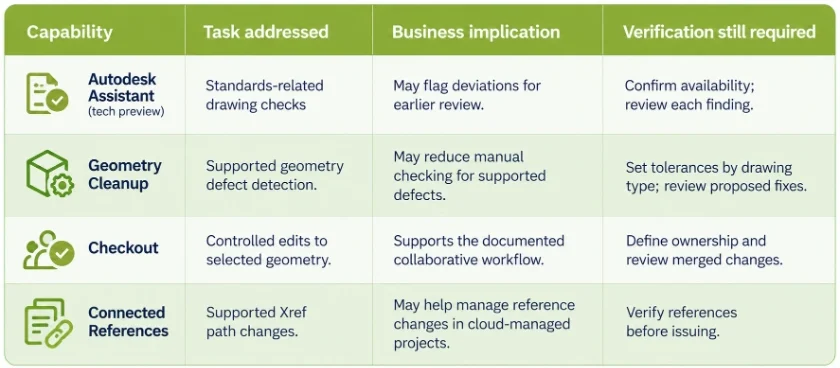
The table below identifies each feature’s production task and the checks required before the resulting drawing is released.
How each capability maps to a production task:
How to Measure CAD Drafting Productivity and Drawing Quality
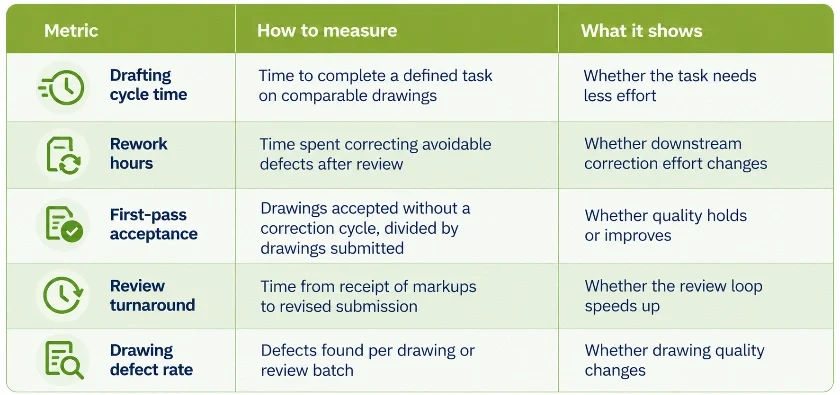
Measure the effect of a workflow change using comparable drawings, consistent acceptance criteria, and a defined review period. The following metrics can help identify changes in drafting effort, rework, and drawing quality.
Five metrics give a workable baseline:
Record the number, type, and complexity of drawings in each sample, along with correction time and review criteria. Keep the acceptance rules consistent and report the sample size with the results. A CAD manager could compare manual cleanup with Geometry Cleanup on comparable sets of converted drawings, then assess cycle time and first-pass acceptance. Report findings for the tested workflow without generalizing them to other teams or project types.
Expand only the functions that demonstrate reduced correction effort or improved first-pass acceptance without compromising drawing quality. Compare results across equivalent drawing sets, report sample sizes, and account for differences in drawing complexity to determine whether the measured gains justify broader adoption.
CAD Review Responsibilities That Remain with Your Team
AI assistance and automated checks do not determine engineering design intent or replace professional judgment. Assign a named reviewer responsibility for interpreting client-specific CAD standards, approving exceptions, verifying drawing and reference integrity, and authorizing final releases. Before wider adoption, test scripts, plug-ins, and custom support files separately in the AutoCAD 2027 environment to confirm compatibility with existing workflows.
When Should Engineering Teams Consider External CAD Drafting Support?
Software improvements may reduce effort on selected drafting tasks, but they do not remove capacity constraints across the entire production process. When incoming work exceeds available drafting hours, teams need to assess backlog, staffing, priorities, and delivery commitments.
Conditions that may justify external drafting capacity:
Project volume exceeds in-house drafting capacity during peaks.
A backlog of drawings is delaying issue dates.
CAD conversion or drawing updates need dedicated production resources.
Internal engineers spend design time on repetitive documentation.
IndiaCADworks provides AutoCAD drafting services that add capacity under your CAD standards, layer conventions, and review rounds, while your team keeps control of priorities and approvals. Our AI-assisted drafting steps are reviewed by experienced CAD professionals before delivery, and 2D drafting services follow the same standards-based review.
Need Additional CAD Drafting Capacity?
IndiaCADworks provides AutoCAD drafting services and engineering drafting support for teams managing drawing backlogs, conversion work, and fluctuating project volumes.
Share sample drawing types, expected monthly volume, CAD standards, turnaround targets, and approval checkpoints so IndiaCADworks can assess a scoped drafting engagement.
AutoCAD 2027’s documented AI-assisted drafting capabilities include standards-related assistance via Autodesk Assistant and geometry checks via Geometry Cleanup. Their availability and behavior depend on the applicable release and environment.
AutoCAD 2027 includes standards-related assistance and Geometry Cleanup, as well as collaboration and reference management features. Checkout and Connected References address drawing coordination, while Autodesk Assistant and Geometry Cleanup address selected checking and correction tasks.
The AutoCAD 2027 tech preview supports standards-related checks using a reference file and conversational prompts. Review the findings against the applicable project standard before approving the drawing.
Geometry Cleanup identifies supported issues such as gaps, overshoots, undershoots, and misaligned angles, then suggests corrections. Review the proposed changes against drawing tolerances and engineering requirements.
Checkout lets contributors edit selected geometry in supported shared DWG workflows stored in Forma Data Management. Define edit ownership and review merged changes before releasing the drawing.
No. Automated checks cover supported geometry defects and standards-related findings. CAD professionals must still assess design intent and approve the final drawing.
Compare drafting cycle time, rework hours, first-pass acceptance, review turnaround, and defect rate across comparable drawing sets. Keep acceptance criteria consistent and report the sample size so the results can be interpreted in context.
Consider outsourced CAD drafting when peak workloads exceed internal capacity, backlogs threaten issue dates, or conversion work requires dedicated production resources. Assess the provider’s ability to follow your CAD standards, review process, and delivery requirements.
Akhil Krishnan B focuses on engineering workflows, operational processes, and service delivery models. With over 7 years of experience, he analyzes execution gaps that impact project outcomes and creates content that reflects real workflow structures, documentation standards, and delivery requirements.
Are you looking for the Serpent Houses in Phantom Blade Zero? It’s imperative that you visit these locations while exploring, as doing so allows you to progress to the late-game stages of the campaign. We’ve got all the details for you in this article, but be ready for a few minor spoilers in the sections below.
Pangzhen: Green Serpent House
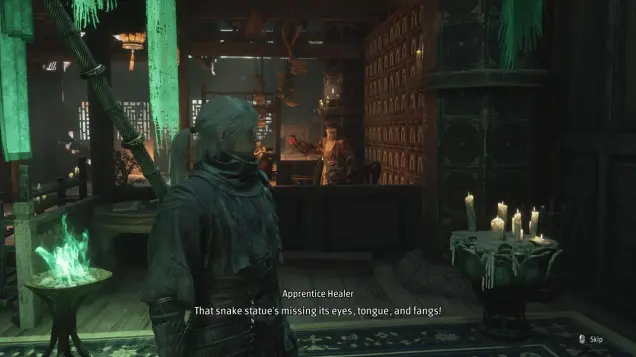
The Green Serpent House is practically unmissable, since you head there while tackling main quest objectives in Pangzhen. The apprentice, Xie Xaorong, unlocks the medicine upgrade function at bells. He tells you that the ornate snake door is locked, as it’s missing the eyes, tongue, and fang.
This location also nets you the following goodies:
Green Serpent Brew (medicine)
Serpent Gall: Green (fragment)
This fella has a few tips for ya.
Crimson Forest: Red Serpent House
This Phantom Blade Zero Serpent House will likely be the first that you stumble upon in the campaign. It’s due north of the Thieves’ Camp, but you’ll only be able to enter it once you have the Flaming Mane. The Phantom Edge comes from the Lion Dance Grandmaster boss in northwest Pangzhen, so just do the main quest objectives there until you obtain it.
The Flaming Mane is used to burn the brambles in this area. Once you’re inside, pick up the loot, including:
Red Serpent Tongue (quest item)
Loong Emblem: Yin (quest item)
Serpent Rattle: Red (fragment)
Revisit the Crimson Forest to enter the Red Serpent House.
Village of Lu: Black Serpent House
Next, use the Flaming Mane to torch the brambles in the Village of Lu and grab the following in the den:
Black Serpent Fang (quest item)
Loong Emblem: Yang (quest item)
Serpent Venom Sac: Black (fragment)
Reinforced Bowstring (Soul Temper – Feather Bow)
Return to the Village of Lu for the Black Serpent House.
Meigu Lake: White Serpent House
The Lóng Emblems that you’ve collected are needed for the Serpent House in Phantom Blade Zero. The den is on an island at the eastern part of the lake, and the emblems can unlock the main area. You’ll find the following items there:
Treasure Basin (accessory) – Inside the small building to the right.
Sha-Chi Amber Fragment (upgrade) – Go to the back of said building.
Note: The four fragments that you’ve collected are automatically combined to create the Serpent’s Memory, a Soul Temper material for the White Serpent & Crimson Viper.
Sail across Meigu Lake and gain access to the White Serpent House.
The Serpent Door and the Mirage Estate – Point of no return
You can place the three quest items–Red Serpent Tongue, Black Serpent Fang, and White Serpent Eye–in the ornate door in Pangzhen’s Green Serpent House. Doing so opens a hidden passageway that leads to the Mirage Estate.
To be clear, this is a point of no return. When you go through the passageway, you’ll receive a warning telling you that you still have “unfinished business.” If you proceed further, you’ll arrive at the Mirage Estate, though it’s possible that several quests will also fail abruptly. That’s why it’s important to tackle key objectives before you proceed.
In any case, that does it for our guide on where to find all Serpent Houses in Phantom Blade Zero. At this stage, we encourage you to thoroughly explore other regions. You can gather more main weapons and their respective Soul Temper materials.
Join Soul as he faces numerous threats in the Wulin and be sure to check out more tips in our Phantom Blade Zero guides hub.