AWS Cost Optimization: Closing the Hidden Cloud Savings Gap


The original promise of cloud infrastructure was simple: replace fixed capital expenditure (CapEx) with a variable cost model that scales precisely with what the business needs. Pay for what you use. Stop paying when you stop using it.

That logic worked well enough when workloads were predictable. It gets structurally harder to execute when you layer in Generative AI training, high-volume data pipelines, and machine learning inference. These workloads are computationally heavy, highly variable, and increasingly central to product strategy. The infrastructure supporting them shifts constantly. Costs don’t follow a pattern that forecasting tools were built to handle. And unlike a slow-moving spike in database storage, a single AI model training run can move the monthly bill by tens of thousands of dollars in a matter of days.

This is not a hypothetical risk. The Flexera 2026 State of the Cloud Report estimates that 29% of all public cloud spend is wasted. Not invested in infrastructure that supports product development or model training, but structural leakage with no corresponding business output. Furthermore, Deloitte Insights data adds another layer: 50% of organizations routinely exceed their cloud budgets, with an average overrun of 15%.

That’s not a billing anomaly. When half of all enterprise cloud users cannot hold their infrastructure budgets despite having dedicated cost management tools, something more fundamental is broken.

Request Cloud Audit >>

The Tools Are Working. The Structure Around Them Isn’t.

AWS Cost Explorer, Trusted Advisor, AWS Budgets, and Anomaly Detection are genuinely capable platforms. They surface real utilization data, flag idle resources, and alert on spending anomalies. The signals they generate are accurate. Most of them go unacted on, and the reason isn’t technical.

Engineering and DevOps teams are already carrying a full mandate. Keeping systems fast, reliable, and available is demanding enough on its own. When cloud cost optimization gets added to the same team without dedicated support or analytical infrastructure, it almost always gets deprioritized. Not because anyone is being careless. Because keeping the platform running is the more urgent obligation, and that priority is entirely rational.

The second layer is a data interpretation problem. A dashboard can show that data transfer costs spiked 40% last month. It cannot explain whether that spike was tied to a successful product launch, an inefficient pipeline, or a migration job that was never properly closed out. Connecting raw infrastructure data to business context requires an analytical layer that most engineering teams were never set up to provide, and that most finance teams can’t access directly.

This isn’t a paradox. It’s a predictable outcome of an incentive structure that assigns cost accountability to a team whose primary metric has nothing to do with cost efficiency.

Where the AWS Spend Actually Leaks

The overspend rarely sits in one obvious line item. It distributes across categories that are each individually defensible and collectively expensive.

1. AWS Commitment Mispricing

AWS offers meaningful discounts through Savings Plans and Reserved Instances (RIs) for organizations that commit to a specific usage level over one to three years. Getting the commitment level right is genuinely difficult, particularly for organizations whose AI and ML workloads are growing unpredictably.

A specialized cloud operations study by Harness found that 55% of engineering leaders describe their cloud purchasing commitments as essentially guesswork. Overcommit and you pay for capacity no one uses. Undercommit and you pay premium on-demand rates for workloads that could have been discounted. Both outcomes are common, and organizations running large model training cycles are disproportionately exposed because the compute requirements for those workloads can change significantly between commitment periods.

2. Idle Resource Accumulation

In environments that are actively building and testing AI models, infrastructure gets spun up for training runs, model verification, or short-term data migrations and stays running after the project ends. The individual cost of any single idle resource is small enough to escape notice in a large bill. Across dozens of teams and months of accumulation, the aggregate is not. This category of waste is hard to catch because the cost doesn’t spike. It erodes margins slowly.

3. No Line of Sight Into Unit Economics

This is the structural problem that makes the other two worse. Gartner Enterprise Research indicates that only 43% of organizations track cloud costs at the business unit level. The remaining 57% see their AWS bill as a single aggregate number.

Without the ability to break spend down by product line, team, customer segment, or AI initiative, leadership cannot determine which parts of the business are driving infrastructure costs or identify where spending has drifted out of proportion to the value it generates. When a generative AI project runs three times over its compute budget, a consolidated bill won’t tell you that until the quarterly review.

Bridging the Gap

Your developers do not need to work harder. The optimization tools you already have are not the problem. What’s missing is the layer between raw billing data and business decision-making.

An AWS bill is, at its core, a very large dataset. The organizations that reduce waste meaningfully treat it as one, matching what they spend to the specific business activity that drove it, identifying which workloads justify their cost and which don’t, and building commitment strategies around actual usage patterns rather than estimates.

That work requires data skills, not engineering skills. It also requires someone whose mandate is cost efficiency rather than uptime, and that separation of accountability is where most organizations are still underinvested.

Building that analytical layer internally takes time most teams don’t have. A cloud cost audit gets you there faster, surfacing exactly where your bill is leaking and what it would take to stop it, without waiting for a new hire or a reorganization to fix a problem that’s billing you every day.BizAcuity is an AWS Partner. To help organizations find hidden efficiencies with zero downside, we provide an independent, data-verified AWS cloud audit.


Smarter Corporate Spending Strategies for E-commerce Business


Corporate Spending Strategies for E-commerce
Photo by Tima Miroshnichenko

E-commerce businesses can grow fast, but spending can grow even faster. Current retail data, business finance practices, and e-commerce operating trends were reviewed to identify practical ways for online sellers to control costs without slowing growth.

For many e-commerce companies, expenses are spread across ads, inventory, shipping, software, freelancers, agencies, packaging, and marketplace fees. Each cost may be useful, but problems start when leaders cannot clearly see who spent what, why it was approved, and whether it helped the business grow.

Smarter corporate spending strategies for E-commerce businesses is not about cutting every cost. It is about giving teams better rules, tools, and visibility so money supports the right goals.

Set Spending Controls Before Costs Spread

Many e-commerce businesses start with informal spending habits. A founder pays for ads. A marketing lead buys software. An operations manager orders packaging. A team member hires a contractor. At first, this feels simple.

As the business grows, that setup can become hard to manage. Receipts get missed. Subscriptions renew without review. Ad budgets increase across several platforms. Vendor charges appear under different team members. Finance leaders may not see the full picture until the month is closed.

Clear spending controls help prevent that. E-commerce businesses need rules for who can spend, how much they can spend, and when approval is required. They also need a simple way to track purchases by category, team, channel, or vendor.

A dedicated ecommerce credit card can help online retailers separate ecommerce expenses from general company costs, especially when used with limits, approval workflows and reporting tools. This makes it easier to understand how money moves through the business.

Start by grouping the biggest spending areas, such as ads, inventory, fulfillment, software, contractors, and customer service tools. Then assign an owner to each category. That person should know the budget, the goal, and how often spending will be reviewed.

The U.S. Census Bureau reported that e-commerce made up 16.9 percent of total U.S. retail sales in the first quarter of 2026. E-commerce sales also rose 9.8 percent from the same quarter one year earlier. As digital sales grow, companies need tighter control over the costs tied to serving those customers.

Connect Spending to Business Goals

Every major expense should answer one question: What should this money help the business achieve?

For e-commerce businesses, common goals include higher profitability, better margins, faster shipping, stronger retention, and healthier cash flow. Effective corporate spending strategies should connect spending to those outcomes.

Ad spend is a common example. A campaign can bring in revenue while still losing money after accounting for product costs, shipping, discounts, returns, and platform fees. Teams should measure ad performance by profit, not just sales.

Inventory also needs close attention. Buying too much can trap cash in slow-moving products. Buying too little can lead to stockouts and missed orders. Smarter purchasing uses sales trends, seasonality, and supplier timelines to guide decisions.

Software costs should also be reviewed often. E-commerce teams may use tools for email, SMS, reviews, analytics, customer service, loyalty, subscriptions, and fulfillment. Some tools create value. Others overlap or go unused. A quarterly review can help teams decide what to keep, pause, or replace.

Monthly spending reviews do not need to be complex. Leaders can focus on three questions: Did spending stay within budget? Which costs supported revenue, margin, or customer experience? Which expenses should be reduced or tested again?

This rhythm creates accountability without slowing the business down.

Use Automation to Reduce Waste

Manual spend tracking takes time and creates errors. If finance teams rely on spreadsheets, inbox searches, and delayed reports, they may spot problems too late.

Automation gives e-commerce businesses faster visibility. Alerts can flag when ad spend rises too quickly, when a vendor charge looks unusual, or when a purchase falls outside policy. Reporting can also link expenses to campaigns, products, or teams, making it easier to compare costs and returns.

Gartner has reported that 91 percent of retail IT leaders are prioritizing AI as the top technology to implement by 2026. For e-commerce businesses, automation and AI can support spend analysis, demand forecasting, fraud detection, and customer service routing.

Still, technology works best when the process is clear. Before adding more tools, define spending limits, approval steps, review timing, and category ownership. Then use automation to make those rules easier to follow.

Security should be part of the strategy, too. Shared cards, broad permissions,s and informal approvals create risk. Businesses should limit access by role, use separate cards or virtual cards for vendors,s and review permissions when team members change roles.

Better spending systems also support cash flow. E-commerce companies often pay for inventory, ads,s and fulfillment before sales revenue fully arrives. When leaders can see upcoming costs and current balances more clearly, they can plan with more confidence.

Better Spending Habits Create Room to Scale

Smarter corporate spending strategies gives e-commerce businesses more control over growth. It helps teams move quickly while protecting margins, cash flow, and accountability.

The best strategy is not a one-time cost cut. It is a set of better habits: assign spending owners, link expenses to clear goals, automate tracking, and review costs before they become problems.

When ecommerce companies understand where money is going and why, they can invest more confidently in the areas that drive profitable growth.

Find a Home-Based Business to Start-Up >>> Hundreds of Business Listings.

Alphabet plans to raise $80 billion to pay for AI buildout


Google parent company Alphabet said Monday that it plans to raise $80 billion to help pay for the massive AI infrastructure buildout it has planned. Alphabet will sell off that amount in stock, and will then use the funds to pay for “general corporate purposes, including capital expenditures to scale AI infrastructure and global compute,” the company said in a statement.

Part of the plan involves selling $10 billion in stock to Berkshire Hathaway, the massive global holding company formerly led by Warren Buffet.

“The company is experiencing strong demand for its AI solutions and services from enterprises and consumers, at levels that are exceeding the company’s available supply,” Alphabet said in its statement. “By scaling its investments, the company seeks to expand its foundational infrastructure to support the significant growth opportunity ahead.”

The company added that the stock plan represented a way to “fund its investments in a balanced way while retaining a healthy balance sheet.”

Like other tech giants, Google has announced plans for a massive investment in compute this year, the likes of which will be used to support a flurry of new AI services. At Google I/O last month, CEO Sundar Pichai said that the company expects to spend between $180 and $190 billion on capex before the year is out. Google and other tech giants are expected to spend as much as $700 billion this year on AI capex.

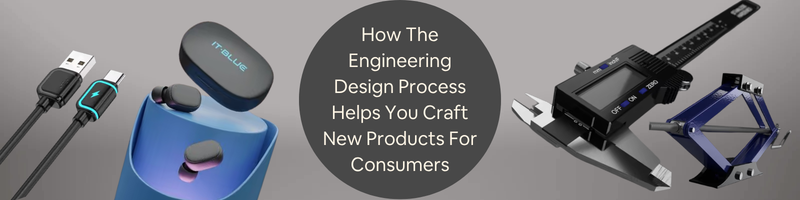
How the Engineering Design Process Helps You Craft New Products for Consumer Goods Firms


The engineering design process, the kind of work that you can tell from the name alone, isn’t for the fainthearted. You need the willingness, the resolve, and the bloody-mindedness to keep going in the face of many setbacks and challenges, or, in some cases, the nerve to quit. Now that sounds quite interesting, so what is it exactly?

According to The Accreditation Board for Engineering and Technology (ABET), the engineering design process is an iterative workflow for devising components, products, or systems to meet specific needs. ABET says the process uses the applied sciences to turn resources into a practical, useful object. At this point, you wonder, “Why does a formal definition of anything always sound awfully boring and mouthful?” Boring as the definition might be, it’s true.

The definition goes on to state that the fundamental parts of the process involve specifying the objectives, conducting analysis, constructing, running tests, and performing evaluation. In general, not entirely unlike the empirical way of the scientific method. If we’re talking specifically about product design, the process needs to take into account some realistic constraints such as budgets, technical feasibility, user-friendliness, environmental impact, and so forth. 

RELATED: Top 30 Recruiters for Electrical Engineers, Staffing Agencies, And Recruiting Companies for US Engineers

Because an engineering design process can be as complex as ABET suggests, it shouldn’t come as a surprise that everybody needs assistance from experienced engineering design professionals and designers to develop a new product. And by “everybody” we do mean absolutely everybody, from creative inventors and startups to design firms and big companies. When it comes to hiring NPD (New Product Development) professionals, Cad Crowd has consistently been at the top of the recommendation list. It has a massive network of talents you need, flexible hiring options, affordable rates, and, best of all, a guarantee of design accuracy. 

What’s in an engineering design process?

The expectation is that when you’ve finished the process and done so well, you’ll end up with engineering solutions for crafting a new product. A solution can be as simple as a ball bearing to reduce friction in a mechanical system, or as complex as using 3D printing services to fabricate intricate parts. It can also be as exceedingly complex as creating a high-tech communication device or building an engine from the ground up. Despite the wide variety of products, functions, and features, the engineers working on them follow roughly the same steps throughout the design process.

  1. Problem Identification: You can’t develop a solution for a problem unless there’s a problem that needs solving to begin with. From the business side of things, a problem signals a market opportunity you can pursue. Perhaps you can create a product, offer it as a solution to the problem, and make a profit from it.
  1. Research: the next step is to analyze the problem to gather more information. Why does this problem exist? Has anyone attempted to solve it before? Have any of those attempts succeeded? If they failed, why and how miserably did they fail?
  1. Solution Ideas: Knowing that a problem exists and that no one has a good solution, now it’s time to ask yourself whether there’s something you can do to solve it. And for every idea you have, how different is it from the others? This is the point where the actual design process begins. The design engineer and designer handle much of the work here, conducting experiments and simulations to generate possible solutions, in this case, a concept. They produce sketches and CAD drawings, which eventually become some sort of formula, or a recipe that they like to refer to as “product requirements,” just to make it sound a bit more technical.
  1. Prototypes: based on the product requirements, the process steps into the prototyping phase. The prototype is typically known as the Proof of Concept (PoC) model. But this won’t be the only prototype you need to build. There will be many more before you get to the final production version.
  1. Evaluation: Every prototype iteration must undergo a series of tests and evaluations to determine how well it works, or whether it works at all. In a proper evaluation, the product (or prototype) is tested across various usage scenarios to assess usability, performance, durability, and overall alignment with the product requirements.
  1. Refinements: The data gathered from the evaluation phase serves as a guide for improving the product. Refinements can take many forms, such as better materials or a simpler user interface. Sometimes a prototype needs a complete redesign if you discover serious flaws during evaluation. Steps 4, 5, and 6 run in a loop due to the iterative nature of the tasks. When the prototype design experts finally builds a prototype that meets all the product requirements, the circle stops spinning, so you can move on to the next phase.
  1. Production: the design is finalized and ready for mass production.

RELATED: Top Reasons to Hire Engineering Consultants & Engineering Consulting Firms

new product design services

It’s a systematic method that engineers and designers follow to develop a functional product that solves (presumably) a complex problem. This makes good sense because if the problem is anything but complex and intricate, there’s little point in spending time, money, and effort on the whole exercise. Say a toy car makes squeaky noises each time you open and close one of the doors. It doesn’t take a licensed engineer to determine that the hinges need some lubrication. When you’re talking about the engineering design process, the “identified problem” is likely a whole lot more complicated than that.

It’s worth noting that the engineering design process is often collaborative and multidisciplinary. You’ll need input from an industrial designer, a prototype fabricator, a programmer if the product is an electronic device, a market researcher, and even the manufacturer to help optimize the design for mass production. Customers might also be directly involved in beta testing and feedback generation. 

In what ways is it important?

Much of the engineering design process, no matter what specific product you want to build, revolves around four major steps: discovery, ideation, development, and optimization. One of the key elements of the entire process is iterative design. The product development team has to repeatedly re-evaluate and refine the prototype until they build a truly optimized solution. They learn from every test result and mistake in every iteration, so they adjust the approach to better suit the goals. Sometimes, and probably more often than not, this iterative loop presents one or two unexpected issues with the design.

This isn’t entirely bad, because you can then ensure the next prototype iteration won’t carry the same surprises. The engineering design process is important to product development in many ways. Everything you do across the steps outlined above contributes to product quality, budget efficiency, and your chances of commercial success after launch. Here are just a few examples of how it can help you set the course for the project.

RELATED: 7 Steps of the Engineering Design Process Used by Freelance Engineers & Companies

Decide which design approach is best

In nearly all cases, a modern-day product development project can be categorized under one of the following three approaches.

Adaptive design A great portion of your work in an adaptive design approach will be about creating an adaptation of an existing product. Still remember why the problem exists? And that there have been some attempts to offer a solution, but none have worked quite as well as expected? There are plenty of product categories in which manufacturing and engineering development have practically ceased, leaving you with hardly anything to do but make minor changes to the already-established form.
An easy example of such a product is the claw hammer, which has remained essentially the same since the 1920s, maybe even earlier. Seriously, what can you do to improve the design? Maybe you can introduce a new material or a handle with a unique ergonomic shape, but other than those, nothing really. Another example is the modern laptop, with its recognizable clamshell design developed mainly in the 1980s – 1990s. Several decades after the first PowerBook came to market, laptop design hasn’t changed much since.
The work is somewhat easy with adaptive design, mostly because you’re using an already-established basic conceptual design and only making changes wherever possible. Changes can be in the form of dimensions, power specifications, and aesthetics. But no matter what modifications you propose, the final product should not look strikingly different from the existing ones.
Development design You also start with an existing idea. However, a development design approach requires you to build a product that’s markedly different from the initial concept. We’re pleased to say that the best examples of such an approach were Nokia phones from the past. Nokia made dozens of mobile phone models, including the bar, flip, leaf-shaped, the slider, the twist, the camcorder look-alike, the gamepad aesthetic, and so on. Underneath, most of those models ran the same operating system, but the shapes were unique enough that you could easily tell them apart from miles away.
Another example could be CRT monitors, which have now been replaced by thin plasma or LED screens. Cars can also make the case for development design. The exterior might be all about aesthetics, but powertrain technology has advanced so much that you now have electric and hydrogen-fueled models. Some cars are hybrid, combining internal combustion and electric motors to power the drivetrain.
So, development design means you take an existing product and build a distinct variety based on that. This new variety has to have unique characteristics to the point where you can objectively call it “different.”
New design It’s the most difficult design approach of them all. Very few, if any, product developments are actually a new design. It takes some real ingenuity, scientific insight, great foresight, and a good chunk of imagination. Think of the invention of the wheel, the first general-purpose computer, and the Benz Patent-Motorwagen. What do you think is the latest genuinely original physical product design? It’s probably something invented decades ago, maybe centuries even. 

RELATED: How Do Engineers Evaluate Different Design Ideas?

consumer product design firm

Every problem can have one or more possible solutions. And there can be different ways to develop the most efficient solution when it comes to product concept design services. For instance, you discover that the typical lawn mowers use blades that need sharpening every 20 hours or so of usage. You can either focus solely on the blade (adaptive design), create a new lawn mower model to accommodate the new blades (development), or build entirely new equipment for cutting grass (new design).

Although all the approaches share the same goals (that is, providing a more user-friendly way to cut grass and maintain a lawn mower), each has a different difficulty level, with “new design” being the most challenging. The best design approach is always the one you feel most comfortable with, both in terms of technical capabilities and budget.

Understand the competitions

Any information you can get about products similar to your idea can play a huge role in how you proceed with product development. This is not to say that you’ll end up copying some design elements. Quite the contrary, you may want to avoid having any resemblance to the competitors for both legal and technical reasons. Some companies include a “patent attorney” in the new product development team for one purpose: making sure that any part of the product idea isn’t a copy of an already patented design. This way, they don’t have to pay royalties to the patent holder.

RELATED: Top 101 Sites for Freelance Engineering Jobs, Mechanical Design Projects, & Remote Work

From a technical perspective, the information should contain a list of all the available design solutions (to the identified problem you’re trying to solve). There might be one or two competitors selling similar products. Even if your idea isn’t identical to those products, your design may come across as unoriginal. We’re not saying you won’t make a sale for that reason alone because it’s simply untrue. Case in point: smartphones. Every single one of them looks pretty much the same at a glance, and yet millions of people still rush to buy the latest fad every few months.

But that’s more like an exception than the rule, so tread with caution. For a lot of other products, however, knowledge of existing designs will prevent you from pursuing some kind of an imitation of a solution that has been attempted before. It also must have been an ineffective solution; you wouldn’t have discovered the problem in the first place. But why waste time and money making a copy? Making a unique alternative would be a better use of your creativity and resources.

Focus on the “functions”

Anybody would expect that “goals” and “functions” are basically the same, but this isn’t always the case. If the goal of a product development is, for instance, to build a safe stepladder, it only makes sense to say that the ladder in question must work or function safely. While it’s true to a certain degree, the engineering designer can make you understand that there’s a real difference between the two.

RELATED: IoT Electronic Device Design Tips for Startups Working With Electronics Engineering Companies

A goal is often stated in a general fashion. It’s the final objective, so no matter what you do in the development work, the end product has to fulfill that very purpose. At the same time, the engineering design process is all about doing experiments with all sorts of design options until you get everything right. The experiments only end when the design meets the objective. But the good thing is that it’s not a freestyle experiment in the sense that you have guardrails and constraints to keep it focused on the main goal.

Function is all about “what the product can do to make it safe” for users. And it turns out there’s a lot it can do. Say the spreaders have a locking mechanism that prevents the rails from snapping together while in use. You can also include anti-slip feet so the stepladder doesn’t move around as easily. A tool tray may seem like an add-on rather than a main feature, but it improves safety by giving users a convenient place to put their hammers and spanners. Perhaps you want to use safety handrails or rear braces for certain designs, too.

Such a technique opens the door to greater creativity, too. Referring back to our previous example of a lawnmower, the goal for a product designer is to make a more user-friendly version of the equipment with less frequent blade sharpening. If you’re stuck with designing new blades and using a peculiar onboard sharpening mechanism, you’ve practically enforced an unnecessary constraint that limits design exploration. Constraints are useful in many cases, but not when the development is still in its early phases. Keep in mind that the main function of a lawn mower is to cut grass.

Would it be possible to use non-metal blades? Does adding a string trimmer attachment make sense? The engineering design process helps you focus on functions that enable the product to meet its objectives. It converts a general statement of goals into a much more specific to-do list. If you have a particularly big team, you can probably even run a simultaneous (as opposed to sequential) design development.

RELATED: Top 32 Sites for Freelance PCB Designer Jobs & Remote Electronics Engineer Work Projects 

electronics design firm

Avoid disasters

Not every product development effort succeeded. In fact, many of them proved disastrous enough that the makers had to face costly consequences.

  • Remember the Concorde? The spectacular crash in 2000 led the authorities to strip the supersonic passenger plane of its airworthiness. Long story short, it’s no longer produced.
  • What about the exploding Samsung battery? Manufacturing defects caused many Galaxy Note 7 units to overheat and explode. Samsung was forced to recall the units, causing an estimated revenue loss of US$17 billion.
  • Lancia Beta, anyone? The exotic, terminally rust-prone car cost the company a fortune through a buyback program. But even after spending a tremendous sum of money, Lancia never fully recovered from the PR disaster caused by the poorly built model.

Catastrophic failures can happen for many different reasons, however, can be avoided with the help of the right design engineering firm at your side. Failures can happen due to the lack of understanding of the problem, incorrect design requirements, incomplete market research, inadequate testing and evaluation, faulty assembly, manufacturing defects, and so forth. An engineering design process, thanks to its iterative and collaborative nature, should at least minimize the risk of mistakes. This doesn’t suggest in any way that those companies failed to follow their own engineering design process. It’s just that the products were so complex, it’s possible that at some point in the development, somebody didn’t think something through and started a daisy-chain of issues.

RELATED: Key Factors to Consider When Vetting Engineering Firms for Design & Consulting Services

Closing thoughts

An engineering design process is more than just a simple checklist you need to go through in a product development project. It is a checklist, alright, but more importantly, every item on the list keeps you on the right track while giving you the freedom to be just playful enough with your creative engineering side. It’s a systematic problem-solving method used by companies everywhere to decide what to make next and how to build it as efficiently as possible.

There might be some little variations in how different design for manufacturability (DFM) companies handle the process, but for the most part, it’s fundamentally the same. They discover problems, set out to develop a solution, test it, find mistakes, go back to the drawing board, and repeat until they iron out all the details. One of the biggest differences, in fact, lies in those companies’ abilities to put the engineering design process to good use. Some companies do an excellent job at discovering problems and market research, but are terrible at prototyping and optimization. A few have what it takes to take a “new design” approach, while others are experts in adaptive design.

RELATED: Top 33 Electronic Device Design Services Companies for Engineering & Product Design Firms

How Cad Crowd can help

Very rarely is a product development firm perfect in everything, and this is where Cad Crowd comes as a balancing force. It doesn’t really matter if you’re a small 3D design firm trying to break into the market with a new product, an established company looking to bring on board specialists’ perspectives, or anything else in between; you can always count on Cad Crowd to connect you with the best talents to boost your engineering design process. With flexible hiring options, an easy project management dashboard, and a massive network of experienced professionals, it’s safe to say that you can always find qualified engineers and designers on the platform to reinforce your team. Contact us for a quote.

author avatar

MacKenzie Brown is the founder and CEO of Cad Crowd. With over 18 years of experience in launching and scaling platforms specializing in CAD services, product design, manufacturing, hardware, and software development, MacKenzie is a recognized authority in the engineering industry. Under his leadership, Cad Crowd serves esteemed clients like NASA, JPL, the U.S. Navy, and Fortune 500 companies, empowering innovators with access to high-quality design and engineering talent.

Connect with me: LinkedIn ✦ X ✦ Cad Crowd

NVIDIA AI Cloud Ecosystem Expands Worldwide to Meet Global AI Compute Demand


The NVIDIA AI Cloud ecosystem is accelerating the global buildout of AI factory infrastructure. Partners are expanding capacity to meet growing demand from enterprises, startups, nations, AI labs and developers scaling agentic AI applications. 

NVIDIA AI Clouds are a growing ecosystem of purpose-built clouds serving the exploding token demand behind today’s most popular AI applications. These AI clouds have been co-designed with NVIDIA’s full-stack AI infrastructure to meet surging demand for AI from enterprises, startups and nations looking for new vendors and regional capacity. 

They combine NVIDIA accelerated computing, networking and AI software to help partners support training, fine-tuning, inference, agentic AI, physical AI and sovereign AI deployments. Specific configurations vary by partner and workload.

AI cloud partners choose NVIDIA for the best economics — lowest token cost, best throughput per watt — to run frontier and open source AI. Built with NVIDIA accelerated computing, networking and AI software, these clouds bring AI factories closer to where data, developers, users and industries are, helping customers train, tune and run agentic AI applications at scale. The ecosystem spans nearly every geography, supporting regional and sovereign AI capacity for frontier model builders, enterprises, startups, software providers and national AI programs.

“Every company and every country needs AI factory infrastructure to turn data into intelligence,” said Jensen Huang, founder and CEO of NVIDIA. “NVIDIA AI Clouds bring full-stack AI factories closer to the regions, industries and developers building the next generation of AI, from model training to real-time inference and AI agents that will transform how people and organizations work.”

Broad AI Cloud Ecosystem

AI cloud providers, telcos, sovereign AI builders and vertically integrated infrastructure providers are building AI factories with NVIDIA to serve customers across frontier AI, enterprise AI, telecommunications, developer clouds and national AI programs.

Regional growth is accelerating across Southeast Asia, Australia and the Americas, with NVIDIA AI Clouds now reaching six continents following the addition of Cassava in Africa and Claro in South America.

NVIDIA AI Clouds are pairing large-scale AI factory buildouts with demand from leading AI labs, enterprises, governments and digital service providers. Partners including CoreWeave, Firmus, IREN and Nscale are expanding AI infrastructure to support frontier model development, enterprise AI, agentic applications and high-volume inference.

Across regions, NVIDIA AI Clouds are bringing AI factories closer to local industries and sovereign AI ecosystems. Partners including Firebird, GMI Cloud, Indosat Ooredoo Hutchison, Lambda, Naver Cloud, Sharon AI, Yotta and YTL are supporting emerging AI companies, national AI initiatives, financial services, telecommunications, manufacturing, education, healthcare and developer ecosystems.

For governments and regulated industries, regional AI clouds can support sovereign controls and local compliance requirements. For developers and enterprises, they can reduce friction in accessing accelerated infrastructure for AI agents, enterprise copilots, digital workers and other AI services that must run close to users and data.

Firmus Expands AI Factory Footprint Across Australia and Asia-Pacific

Firmus Technologies is expanding its AI factory footprint across South Australia and Southeast Asia, building energy-efficient infrastructure to support growing demand for large-scale training, inference and agentic AI workloads.

Through Project Southgate, Firmus is developing AI factories in Tasmania, Melbourne, South Australia and New South Wales, with an emphasis on renewable power, advanced cooling and modular infrastructure that can bring capacity online faster. The company has also deployed AI infrastructure in Singapore through a partnership with ST Telemedia Global Data Centres.

Firmus is using NVIDIA’s accelerated computing and reference architecture as part of its buildout, with NVIDIA DSX helping streamline AI factory design, deployment and operations.

Engineered in alignment with the NVIDIA DSX platform, the liquid-cooled Firmus HyperCube is designed to fast-track modular AI Factory builds and optimize for low cost per token. Firmus is innovating across the AI factory supply chain, including cooling and energy.

“AI agents are creating a new class of industrial-scale demand for tokens, and Asia-Pacific needs AI factories that can be built faster, liquid-cooled more efficiently and operated at gigawatt scale,” said Tim Rosenfield, co-CEO of Firmus. “Together with NVIDIA, Firmus is building liquid-cooled, AI infrastructure designed to deliver AI tokens as efficiently and rapidly as possible for the region’s most important customers.”

CoreWeave Advances Physical AI and Next-Generation AI Factories

CoreWeave is expanding its NVIDIA AI Cloud platform to support the next wave of agentic AI, physical AI and frontier model workloads. 

An early adopter of NVIDIA Vera Rubin and the NVIDIA Vera CPU, CoreWeave is also among the first to adopt NVIDIA Spectrum-X Ethernet Photonics, helping provide the networking foundation for million-GPU AI factories. CoreWeave is extending its platform for robotics and physical AI workflows, including using NVIDIA Cosmos 3, the latest frontier world foundation model, to help teams generate synthetic data, fine-tune models and accelerate robotics data flywheels. Leading AI labs, including Anthropic, build on CoreWeave’s infrastructure to support frontier models at scale.

“AI factories are becoming the foundation for the agentic era,” said Michael Intrator, cofounder, chairman and CEO of CoreWeave. “Together with NVIDIA, CoreWeave is building the full-stack cloud infrastructure that gives AI labs, enterprises and developers the performance, scale and reliability they need to turn frontier models, AI agents and physical AI systems into production applications.”

Nebius Builds an Open Physical AI Workbench for Agentic Workflows

Nebius is expanding its NVIDIA AI Cloud with a full-stack platform for training, inference and physical AI development.

An early adopter of NVIDIA Vera Rubin, Nebius is building integrated AI infrastructure from silicon to software, including its Nebius AI Cloud, Token Factory inference layer and new Physical AI Workbench. The workbench brings technologies including NVIDIA Cosmos 3, NVIDIA Isaac Sim and Isaac GR00T into composable workflows that can be assembled by AI agents, helping robotics and autonomous systems teams move faster from simulation and synthetic data to training and evaluation.

“Developers should be able to build AI systems without spending weeks wiring together infrastructure,” said Arkady Volozh, founder and CEO of Nebius. “With NVIDIA, Nebius is creating an AI cloud where AI  agents can compose the tools, data and compute needed to accelerate AI workloads — from robotics and life sciences to the enterprise — from experimentation to production.”

NVIDIA Exemplar Cloud Momentum

Since NVIDIA introduced Exemplar Cloud last year, six NVIDIA Cloud Partners have achieved Exemplar Cloud status: CoreWeave, Crusoe, Lambda, Nebius, Vultr and YTL. The growing roster reflects increasing demand for AI cloud infrastructure that can deliver consistent performance, reliability and efficiency for production AI workloads.

These providers are helping raise the performance bar across the AI cloud ecosystem, giving enterprises, developers and AI labs more validated options for scaling training, inference and agentic AI services.

Engineered for AI Factory Economics

As AI shifts from model development to reasoning and high-volume inference, the measure of infrastructure is no longer just capacity announced but also the economics of token output driven by platform utilization, uptime, long asset life and the breadth and depth of useful AI agents people can put to work. 

Built on NVIDIA full-stack AI factory platforms, AI Clouds help partners optimize infrastructure for these measures.

Cost per token is the total cost of ownership metric that directly accounts for hardware performance, software optimization, ecosystem support and real-world utilization. NVIDIA delivers the lowest cost per token in the industry, driven by delivered token throughput, software optimization and full-stack codesign across compute, networking, memory and storage.

DSX Helps AI Clouds Bring Capacity Online Faster

NVIDIA AI Clouds are adopting the NVIDIA DSX platform to design, build and operate AI factories.

DSX brings together validated reference designs, simulation, software and ecosystem technologies to help cloud providers bring capacity online faster, operate more efficiently and maximize revenue.

DSX Sim helps teams model and validate AI factories before deployment. DSX Flex helps AI factories dynamically adapt workloads to grid conditions. DSX MaxLPS helps power-constrained AI factories maximize compute within a fixed power budget, enabling up to 40% more GPUs. DSX OS helps automate lifecycle management and operations at scale.

DSX helps AI Clouds reduce deployment risk, improve resiliency, deliver more tokens per watt and achieve the lowest cost token.

Strava declares war on scrapers ahead of IPO


AI companies have grown into data-hungry entities as their models require ever-larger datasets to train on. To meet that need, many AI startups defy long-standing internet conventions — like respecting robots.txt files, which signal to automated crawlers which parts of a website are off-limits — and scrape data aggressively. This has forced websites to restrict access to their data and, in some cases, strike licensing deals with AI companies. Fitness and social running company Strava is making a move in this direction by restricting its website and introducing fees for developer access.

To stop scraping, the company is increasing security around its website and will now only allow authenticated users to view certain data. Earlier, users were able to see details like public profiles and fitness club listings without logging in. The company is putting all that data behind authentication to protect it from unauthorized AI scraping.

On the API front, developers could previously start building apps on Strava through a free, tiered access program — applying for basic access first, then requesting more as their app grew. Now the company is adding a flat $11.99 per month fee for all developers, though it noted the price may vary by geography.

Strava said its developer community has grown from 185,000 members last year to 241,000 this year, and the company plans to continue supporting them. As part of that, Strava also plans to add support for Model Context Protocol (MCP), an emerging standard that lets AI assistants and apps access external data in a structured way, giving Strava more control over exactly what gets shared and how.

The company is also planning to retire some API endpoints — discrete access points that let outside apps pull specific data, like club details — to protect user data. Strava had already tightened API rules in 2024, banning its use for AI training and limiting third-party apps from displaying other users’ data. Those changes drew backlash from developers who said their apps would be severely affected.

While some developers may accept paying a subscription fee, sunsetting certain API endpoints could still impact dependent apps. Strava is giving developers a 90-day grace period before making these changes.

In an interview with TechCrunch, Michael Martin, Strava’s CEO, said unchecked AI scraping could be the death knell of the public internet.

“AI companies are ruthlessly scraping public websites, given their endless need for training data, which is degrading site performance across the board,” Martin said. We’ve had multiple instances in the last several months where performance has been diminished and, in some cases, impaired. Beyond scraping the public sites, they’re also trying to use our API to get access to our data, ignoring API terms.”

He noted that Strava has refused overtures from leading AI labs seeking data licensing deals. He specifically singled out Perplexity, saying the AI search startup routed its scraping through aggregator services to obscure its origin despite being turned away. This is consistent with Perplexity having been accused of similar behavior elsewhere in the past.

Martin also flagged server overload caused by poorly built vibe-coded apps, whose API calls are often inefficiently structured and generate a disproportionate load on Strava’s systems. It’s a pattern: when Meta banned third-party chatbots from WhatsApp last year, it made a similar argument about system overhead.

The timing probably isn’t coincidental. Strava confidentially filed for an IPO earlier this year, and its move to protect its data may be intended to signal data discipline to prospective investors. The comparison to Reddit’s 2024 crackdown on API access is one Martin was quick to address. Unlike Reddit, which priced API access by the number of calls (making it unaffordable for many app developers), Strava is betting a flat fee keeps the developer ecosystem intact.

“We want the users to feel that they own their data and feel comfortable with how we are controlling and securing it. But we want the developers to continue to flourish and grow,” Martin said.

When you purchase through links in our articles, we may earn a small commission. This doesn’t affect our editorial independence.

Apple’s smart glasses have been delayed into 2027, report claims


Apple‘s oft-rumored smart glasses probably aren’t coming this year.

A new report by Bloomberg’s Mark Gurman says the glasses are planned for “late 2027,” with the reason being unspecified development roadblocks.

Just last month, Gurman said Apple was working on four different designs for its smart glasses, with a planned unveiling in late 2026 and a launch in 2027.

Apple still considers the smart glasses, which would be a direct competitor to the Meta Ray-Bans, a very important part of its future lineup, according to Gurman’s latest report. The devices will likely have cameras for capturing photos and videos, as well as microphones and speakers for phone calls and music. AI integration and health-related features should be big selling points, too.

Design-wise, Apple is reportedly looking into four different variants: One with a larger, rectangular frame (think Ray-Ban Wayfarers), one with a slimmer rectangular design, and two oval designs, one larger and one smaller. Color options that Apple is said to be looking into include light brown, ocean blue, and black.

As for the price, Gurman has a range, but it’s not very precise: They could cost anywhere between $200 and $500 in the U.S.

As far as the also-rumored, cheaper version of the company’s Vision Pro mixed reality headset goes, that’s probably not coming until 2028 or even 2029, wrote Gurman.

Nvidia RTX Spark’s gaming battery life will be ‘better than anything you’ve seen before on RTX laptops’


The new Nvidia RTX Spark is an Arm-powered system-on-chip (SoC) set to be the heart of new super thin-and-light gaming laptops and mini PCs. It comes packing up to 20 Grace CPU cores and up to 6188 CUDA cores in its GPU, alongside up to 128 GB unified LPDDR5x memory. And one of the most tantalising things of having an Arm chip powering a genuinely gaming-capable skinny laptop is the promise of unprecedented gaming battery life.

During our pre-Computex briefing on the introduction of the new “superchip” product marketing lead, Mark Aevermann was careful not to make any definitive promises of extreme battery life, despite calling it “the most efficient pc chip ever built”. But he did note that we “should expect it to be much better than anything you’ve seen before on RTX laptops.”

I actually don’t hate the new Google Health app, but it could still use some work. Here are my highlights after testing the revamped Fitbit app, and how I think Google can improve


The revamped Google Health app (formerly Fitbit) has landed alongside the new Fitbit Air, and while not everyone is happy with the changes, my experience has been pretty positive.

I’ve been using the new UI for six months, staring with the Health Coach preview launches toward the end of 2025, and while the upgrade to Google Health has brought in some useful changes and features, there are still some improvements I would like to see. These are my biggest highlights after spending some time with the new Google Health app.

A welcome redesign and AI overload

The Google Health app focus metrics

(Image credit: Derrek Lee / Android Central)

I should start by saying that, unlike some long-time Fitbit users, I was not married to the old Fitbit app design, which I found dull and uninteresting.

Latest Videos From

Everyone Has Their Targets Set on the MacBook Neo


Yet it’s only $699 (or $599 for students). The XPS 13 makes similar trade-offs as the MacBook Neo. First, it starts with only 8 GB of RAM and 256 GB of storage. It also starts with a slower Intel Core 5 processor (note: not Intel Core Ultra). I’ll be interested to find how the performance and battery life stack up against the MacBook Neo, but Dell is clearly taking notes from Apple, which used a slower iPhone chip in the Neo instead of an M-series laptop-grade processor.

What’s nice about the Dell XPS 13, though, is that you can scale it up appropriately. The MacBook Neo is capped in both storage and memory, but the XPS 13 can be configured up to 32 GB of RAM and 1 TB of storage.

I’ve been testing a lot of $500 to $600 laptops recently from companies like Acer, Lenovo, and HP, many of which take a more conventional Windows approach to rivaling the MacBook Neo by offering better specs at lower prices. They all have 16 GB of RAM and use more powerful chips, too. But none challenge the MacBook Neo in display quality and chassis materials. That doesn’t mean there isn’t a place for something like the HP OmniBook 3, but it doesn’t play for the same audience as the Dell XPS 13 and MacBook Neo.

The Wrong Direction

Inevitably there would be a company that thinks it can ride on the success of the MacBook Neo without understanding what makes it tick. Last week, Microsoft announced two versions of its Surface Laptop for Business PCs: a higher-end 13.8-inch model and a cheaper 13-inch device. The 13.8-inch model is a more standard refresh, implementing Intel’s new Core Ultra X7 368H Panther Lake chip—and most notably, it still starts with 16 GB of RAM.

The smaller 13-inch model is where things get problematic. Despite its starting price of $1,200, that configuration only comes with 8 GB of RAM. Don’t get too caught up in the price, since business PCs always come with an up charge. The starting RAM is the eyebrow-raising spec. Unlike the new Dell XPS 13, Microsoft isn’t tricking this out with a thinner chassis and an upgraded screen—it’s just giving you less computing power and calling it good.

And to be fair, this “optional” 8 GB model is coming later this year, separate from the 16 GB and 24 GB versions. But it’s hard to imagine Microsoft being willing to sell an 8 GB laptop in 2026 if Apple hadn’t paved the way. While there’s no 2025 Surface Laptop 13 for Business for direct comparison, the consumer version of the Surface Laptop 13 started with 16 GB of RAM. This feels like a straight generational downgrade.

Image may contain Computer Electronics Laptop Pc Computer Hardware Computer Keyboard and Hardware

Microsoft Surface Laptop for Business, 13-inch.