There was a time when revisiting an old hometown carried the emotional logic of a movie ending. Familiar streets were supposed to unlock nostalgia. Former apartments were expected to glow with emotional significance. A favorite café from university years was meant to confirm that some version of the past still existed intact.
Instead, many people now return to visit your old cities and feel strangely disconnected from them. The discomfort rarely comes from architecture or weather. It comes from the disturbing realization that identity is no longer bound by physical locations as it used to be. Cities are emotional archives of a “passed away” self and revisiting these places is not quite like coming home but more like stumbling on a forgotten social account.
The Geography of Former Versions of the Self
The walk through the old neighbourhood produces a peculiar contrast between reality and memory. Once a restaurant that seemed to be in every Instagram story is now vacant. There are only tagged photos from 2018 that remain from years of friendships that were once part of a bar. The apartment building itself becomes unfamiliar, its personality is no longer there even at apartment buildings.
Nostalgia Became Socially Complicated
The emotional tension becomes even more visible because moving has turned into its own kind of internet culture. Entire corners of social media revolve around reinvention content, moving diaries, apartment resets, and starting over in unfamiliar cities. Even moving companies like Elatemoving have become part of that modern cycle of leaving one version of life behind and building another somewhere else.
Why Familiar Places Suddenly Feel Hostile
The emotional discomfort often comes from subtle social rituals that nobody openly discusses:
running into people connected to abandoned versions of identity
realizing favorite locations were emotionally important only within a specific social era
noticing how much personal style, language, humor, or ambition changed over time
understanding that online reputation sometimes outlives real emotional connection
feeling unexpectedly invisible inside spaces that once felt central to daily life
These moments rarely create dramatic breakdowns. The feeling is quieter and more culturally modern than that. It resembles opening an old streaming account and discovering recommendation algorithms still trying to reconstruct a personality that disappeared years ago.
The New Anxiety Around Recognition
There’s something bizarre about going back to an old town, finding out how much people really wanted some control over how they’re recognized. In between lies the discomfort of full anonymity, while the discomfort of full recognition is reconnecting someone to a past identity that they are no longer associated with.
People’s social behaviour is becoming more and more centered on selective visibility. Online culture encourages constant editing of the self, where older versions remain technically accessible but emotionally distant. Returning to visit your old city disrupts that carefully managed separation. Suddenly, old coworkers remember outdated ambitions. Former classmates reference forgotten habits. Even local routines begin exposing how much personality was shaped by the environment itself.
The Emotional Risk of Looking Backward
It is always interesting to see how things have changed when one encounters an old place again, and one gains a larger perspective of what is to be found in modern culture. Emotional affiliation is increasingly being achieved in short term “digital communities” rather than consistent “real-world” communities. Friendships transfer from one platform to another. Personal reinventions are public. There is a split of recognition between the virtual and real spaces.
That’s why it might feel like it’s emotionally wrong to return even when nothing bad actually happens. The city is still there but the emotional network with it is already archived and reformatted, and in some respects replaced by newer versions of the self, seeking survival elsewhere.
With evidence that the tools had overlapping infrastructure, company attorneys invoked RICO statutes that target organized crime; the legal action was then able to treat both tools as part of a single conspiracy. As a result, Microsoft said, it disrupted more than 200 command-and-control servers and severed criminal control of more than 18,000 infected computers. Europol, which helped coordinate the law-enforcement part of the operation, said it recovered as many as 27 million stolen login credentials and uncovered $47 million worth of “crypto assets of criminal origin.”
“During this action, 326 servers and 142 domains were actioned by law enforcement and the private sector partners, severely crippling the malware’s distribution network,” Europol said. “By taking down these tools simultaneously, the collaboration between law enforcement and private parties has increased friction for cybercriminals, making it harder for attacks to succeed, spread, or recover.”
Europol said that another tool disrupted in Operation Endgame is SocGholish, a malware loader linked to the Russian cybercrime group Evil Corp. that spreads through compromised websites. Visitors to these sites are tricked into installing trojanized apps posing as browser extensions or other legitimate software. Europol said it has responded by cleaning infected WordPress sites and urging administrators of the sites to change credentials and tighten security. It has also worked to notify parties whose data and credentials were exposed through SocGholish activities. Countries involved in the enforcement action include Canada, Denmark, Germany, the Netherlands, the UK, and the US.
The Cat Lady follows Susan Ashworth, a lonely 40-year old on the verge of suicide. She has no family, no friends and no hope for a better future. One day she discovers that five strangers will come along and change everything… Moldwasher
By author Remigiusz Michalski (Harvester Games) this suspenseful psychological horror game features stylized artwork, a simple keyboard control method and English voice acting, plus a compelling, atmospheric 70 minute soundtrack by micAmic (now included free with every copy in Library > Music) and featured artists Warmer, 5iah and Tears Of Mars.
The Cat Lady contains strong adult themes and is recommended only for players over 18.
Enjoy even more games in this series with Downfall and Lorelai, available now on Steam!
Screenshots
SystemRequirements
Minimum
OS *: Windows 7, 8, 10
Processor: Intel or AMD CPU
Memory: 512 MB RAM
Graphics: DirectX compatible card
DirectX: Version 9.0
Storage: 2 GB available space
Support the game developers by purchasing the game on Steam
InstallationGuide
TurnOff Your Antivirus Before Installing Any Game
1 :: Download Game 2 :: Extract Game 3 :: Launch The Game 4 :: Have Fun 🙂
Let’s get real: outsourcing electronics design services and PCB engineering company is not something you do over coffee and croissants. It’s a gamble that can make or break your entire product. Whether you’re creating the next wearable fitness tracker, designing complex industrial automation systems, or introducing a sleek consumer device, the folks behind the circuit boards are just as important as the vision behind the product. Platforms like Cad Crowd help companies find CAD designers and mechanical engineers who already understand the practical side of electronic enclosure design and hardware product development. The goal is to build an enclosure that works properly in the real world and still makes sense once production starts.
The electronics design outsourcing space is massive, occasionally bewildering, and not always clear. There are companies that claim rocket science and produce spaghetti wiring. There are others that are gems quietly driving some of the hippest gadgets available. The secret? Knowing how to move through this landscape with confidence, clarity, and an eye for detail. So grab a cup of coffee (or something stronger), and let’s dive into the real, no-fluff guide to finding the perfect outsourcing partner for your electronics and PCB engineering needs.
Outsourcing isn’t a shortcut because it fits as a strategy. When companies decide to outsource electronics design or PCB engineering design, it’s rarely about trimming the fat. It’s about being sharp with time, money, and talent. You might be a startup trying to stretch your runway, or a fast-growing firm juggling deadlines that move faster than your hiring process. Maybe your in-house team is brilliant but doesn’t have deep experience in RF systems, high-speed layout, or that thorny EMC compliance issue. That’s where outsourcing excels. It allows you to tap into a universe of talent without the overhead of full-time employees or hefty design software investments. You’re now working with people who eat, sleep, and breathe this kind of thing, and who’ve likely cracked the same problem five times before breakfast. The time to market decreases.
But it’s not plain sailing. The wrong partner can make your fantasy project a financial headache. Flubbed milestones, muddled communication, or shoddy hardware construction can cascade into failed tests, lost launch windows, and angry stakeholders. Worse? Losing the trust of your investors or users. So no, outsourcing isn’t lazy when done correctly. The sweet spot is getting the right partner who understands your vision, is fluent in your tech speak, and ships without drama. Outsourcing done well isn’t a risk; it’s a rocket booster.
Not all design firms are created equal: know what you’re really outsourcing
It’s all too simple to get swept up in gaudy promises and technology-infused buzzwords. “End-to-end design solution”? Sounds great, not until you stop and consider that it can range anywhere from soup-to-nuts concept-to-production assistance to, you know, just schematic capture and a smile. The reality? Not all design houses carry the same toolset, and you wouldn’t want to learn that midway through a key project. Some companies are geniuses at prototyping design services but stumble over regulatory obstacles. Some companies are wizards with heavy-duty, industrial-grade PCBs that wither over-flogged conditions such as heat, dust, and high voltage but don’t even put their hands near high-frequency RF design with a ten-foot pole. There are companies that can blindfold-tune an antenna, and companies that give system integration or embedded firmware only cursory glances.
So don’t shake hands or send the first PO until you zoom in on the details. What exactly are you outsourcing? Are you paying for layout only, or full stack support like firmware, testing, and the works? Will they mark manufacturability issues for you or leave you with a pretty but flaky board? There is a lane for every firm, and attempting to push them into yours is a recipe for frustration. Your role is finding the partner that doesn’t just self-proclaim alignment but demonstrates it. That involves asking higher questions, drilling down into actual capabilities, and reading between the hype words.
Vetting a company: the real-world checklist (no corporate speak)
We’ve all been there, browsing a company’s glossy website, awestruck by high-resolution images of circuit boards that would qualify as abstract art and buzzwords piled like pancakes. “Cutting-edge.” “Turnkey.” “End-to-end synergy.” Yeah, it sounds cool. But inside, you know better.
Since branding doesn’t cause your prototype to boot at 3 a.m. Branding won’t locate the pesky EMI gremlin that’s causing trouble for your wireless module. Actual engineering design services will. And finding the right personnel to work on your electronics or PCB design project requires cutting through the hype. Here’s the no-nonsense, boots-on-the-ground list you really need. No jargon. No filler. Just good advice from people who’ve been burned enough times to know what counts.
1. Technical Breadth and Depth (a.k.a. “Have they seen some things?”)
You don’t want to have a team that’s just discovering how to route a power plane. You want a team that’s been there, done that, who’ve struggled with tough analog-digital interfaces, wrestled with high-speed traces, and survived to tell the story. Begin with their portfolio and case studies. If all they have ever worked on are Arduino breakouts and LED blinkers, that’s likely not your team for a six-layer board with Bluetooth mesh networking and impedance controls and whatnot.
Have they worked with regulatory agencies such as the FCC, CE, or UL in the past? If not, be prepared to plan for a compliance consultant down the line.
Do they possess domain knowledge? Aerospace is different from wearables. Medical devices are not IoT doorbells.
Can they work with small form factors or thermal issues?
Do they know EMI shielding design and grounding strategy beyond the simple “slap on some copper pour and pray”?
You want evidence, not promises. True experience has a track record.
2. Team Composition (Who’s actually behind the curtain?)
This one’s subtle. Some firms appear to be large operations up front, but in the back room? It’s a single guy, two screens, and a cat on the keyboard. Solo engineers are fine; most of them are terrific. But complexity demands co-conspirators. If your project involves firmware, enclosure design, RF, power electronics, and compliance testing, you’ll need more than a layout jockey.
Ask point-blank:
Who exactly will be working on your project?
Is the person you’re corresponding to merely a sales rep?
The objective is to identify a team with the proper blend of skills in-house or a well-established network of experts they work with on an ongoing basis. Otherwise, you’re the one stuck dealing with freelancers and patching integration problems. And believe me, nobody likes that circus.
3. Communication Fluency (The underappreciated dealbreaker)
Even the best engineering team can sabotage a project with bad communications. It begins quietly: a fuzzy project timeline, a confusing spec sheet, an email that sits for three days unanswered. Next thing you know, you’re two weeks behind schedule and still debating the pinout of a connector. You desire a team that understands how to talk to people. No tech jargon for the purposes of appearing intelligent. Just straightforward, truthful updates.
Listen closely from day one:
Do they clarify their process in a way that makes sense to you?
Are they at ease with answering difficult or “simple” questions without sounding irritated?
Do they follow through when they promise to?
Are their project reports clear, with versioning and change logs?
The greatest teams don’t ghost you. They don’t speak around you with buzzwords or overused language. They keep it moving and inform you.
4. Toolchain Compatibility (A quiet time-saver you’ll thank yourself for later)
You don’t want a “tools arms race” in the middle of your project. You know the type: they use some esoteric software design, your factory can’t open the files, and now everybody’s exchanging PDFs and screenshots back and forth. It’s 2026. We can do better.
Ask up front:
What CAD and simulation tools do they employ? Altium? Eagle? KiCad? OrCAD?
Do they have the ability to export files in industry-standard formats; Gerber, ODB++, pick-and-place files, BOMs?
Can they integrate with your workflow, maybe your GitHub repo, or your PM tool like Jira or Trello?
Toolchain compatibility isn’t just about convenience. It’s about risk reduction. Misaligned tools mean misaligned expectations, and that usually leads to costly mistakes. Save yourself that headache.
5. IP Protection & Legal Frameworks (Because your brilliant idea shouldn’t become someone else’s asset)
Here’s the ugly truth: everyone doesn’t play by the same rules. And your intellectual property is something you should protect whether you’re a startup with a new design or a Fortune 500 business spinning up a new R&D initiative services. Any serious company should be embracing the legal discussion. If they start to get nervous about NDAs or ownership provisions, that’s a huge red flag.
Things you have to be crystal clear on:
Who retains ownership of the design files after the project is completed?
What happens in the event the project gets terminated mid-stream?
Are there any subcontractors, and if there are, are they held to the same contracts?
Is the IP subject to your nation’s laws or theirs?
These aren’t hypotheticals. The last thing you want is to see your identical board, design, firmware, BOM design and all turning up on Alibaba six months later under a different label. Guard your work as your retirement nest egg because, in a few instances, it could be.
Location, location… or perhaps not?
Geography is no longer a deal-breaker when outsourcing electronics deign or PCB design work, but it still holds some importance. Local companies tend to be the more conservative choice; however, if you wish to have face-to-face meetings, instant feedback, and convenient legal harmonization. The convenience of popping into an office or jumping on a call without having to do timezone math is a luxury, but one that costs a premium. Local talent is expensive, and in certain markets, very expensive.
On the other hand, global companies, particularly in Eastern Europe, Southeast Asia, or Latin America, can provide dazzling technical talent for much lower prices. The catch? You’ll just have to do some extra legwork on quality control, make sure IP protections are sound, and be prepared for the occasional 2 a.m. email. For most companies, the sweet spot is a hybrid model. Consider local project managers who know your language (literally and culturally), combined with remote engineers who provide the horsepower. You get the comfort of homegrown management and the cost-effectiveness of international talent. It’s not always simple, but when it does happen, it really does.
Know what stage you’re in before outsourcing
Not all electronics design companies are equal and not all of them are designed to take you by the hand through your entire product process. The reality is, your perfect outsourcing partner will change based on where you are in your process. If you’re in the idea-generating stage, you require big-picture thinkers. This is where system architecture, component selection, and proof-of-concept enter the picture. You want a company that knows how to take napkin sketches and turn them into functional prototypes design. Moving into the mid-stage? This is where things get real and messy. You’ll need quick iteration cycles, tight design-for-manufacturing practices, and someone who knows how to navigate compliance testing without holding up your timeline. Delays often pile up here, so process-driven partners are worth their weight in gold.
Once you’re in the late stage, the game is all about scaling. Now you want a company that knows cost-saving strategies, production line idiosyncrasies, and supply chain quirks on a worldwide level. They must be at ease with exchanging components mid-process, fixing vendor bottlenecks, and catching problems before they hit the factory floor. It’s easy to think that you can be taken through from ideation to mass production by one firm. Some will, but others specialize in only one stage. Knowing that upfront can save you time, budget, and some serious headaches. Knowing where you are isn’t only intelligent, it’s a must. The right person for the wrong time can do more damage than good. So before you sign on that dotted line, take a moment to match your needs with their strengths. It’ll be worth it in the long run.
Ask the uncomfortable questions (even if it feels awkward)
Employing an electronics design or PCB engineering firm isn’t buying a new phone from the store; furthermore, it’s selecting a co-pilot for a lengthy, high-risk flight. So why do so many businesses insist on being placid and surface-level with interview questions? It’s time to probe deeper. Try turning the tables on them during that discovery call. Be a devil’s advocate. Spew out some curveball questions and observe how they take the heat. Ask them about their most epic project failure and what they learned from it. Is there a design that failed certification and what did they do to get back on track? Push harder: what happens if a critical engineer drops off the face of the earth halfway through the project? Who takes their place? Is your project hung up?
And here’s the punchline: ask if you can speak to one of their past clients, ideally someone from your line of business. If they hesitate, that’s a bad sign. If they embrace the challenge, you’re likely working with a company that is proud of what it does. You’re not being rude; you’re being responsible. You’re not just vetting their skills; you’re testing their character, their communication, and their resilience. A great company won’t just pass the test, they’ll also appreciate that you’re asking the tough stuff.
A design may shimmer on a screen, all smooth edges and perfect geometry but the real world won’t care how nice it looks in CAD software. When road meets rubber, or circuit board meets plastic, that’s when things get serious. That is when prototyping becomes the make-or-break phase and how a company goes about it says it all. Are they getting their hands dirty making and testing initial-stage prototypes? That indicates they’re not simply pixel pushers; they’re problem solvers. It’s even better when they’ve got trusted rapid prototyping partners on speed dial. That type of relationship halves wait times and headaches. But the great companies do better. They don’t give you a prototype and walk away. They get feedback, listen, and turn sometimes quickly. Iteration is where excellent designs become outstanding products.
And if you’re lucky, the company might offer access to in-house or partner testing labs where your design can brave simulated rainstorms, bone-rattling vibrations, or desert heat. That kind of environmental and thermal testing services isn’t just bells and whistles. It’s essential when your product needs to survive the real world, not just a desk demo. All in all, prototyping is the integrity test of any design process. If a company gets this step right with grit, velocity, and accuracy, chances are they’ll transfer that same intensity directly to final production. And you know who you want on your team.
Red flags to avoid like a corroded trace
In the outsourcing business of electronics design and PCB engineering, a slick website or a charming salesperson isn’t always a promise of quality work. Behind all that shine may be a whole multitude of red flags just waiting to short-circuit your project. Begin with the proposal. If pricing sounds unclear or always “depends,” but no one can ever provide you with context, back off. A solid firm should be able to describe costs clearly, not tiptoe around them. And if you’re constantly hearing from the sales reps but never actually getting to talk to an actual engineer, that’s another warning sign. Engineers don’t merely construct the product because they contribute the logic, feasibility, and technical spirit to it. You need to get your hands on them early. Documentation services is another smoking gun. A decent firm ought to have clean version control and open revisions, not a disparate hodgepodge of file names such as “Final-Final-v7-BobEdit.” If test, validation, and compliance requirements aren’t addressed, you’re looking at a possible catastrophe. These aren’t add-ons; they’re must-haves.
And lastly, watch out for promises of miracles. A firm that says they can provide a certified, production-capable device within two weeks for only $500 is not being bold; they’re being unrealistic. That’s not innovation; that’s a formula for failure. In this business, a little doubt is worth a lot. Trust your instincts, ask intelligent questions, and always examine the breadcrumbs before you engage. The right partner won’t just simply give you confidence; they’ll do it with actual proof.
When outsourcing hardware design, the actual victory is not merely accomplishing a task but rather having a partner that follows you through each iteration, each late-night adjustment, and each surprise in the supply chain. A good company will provide you with clean schematics, sound layouts, carefully considered documentation, and prices that don’t make you cringe. But a great company? That’s something else. Good companies don’t wait to be told; they are eager to learn about you. They know how you think over time, what’s most important to your product, and how you want things done. When items are going on backorder, they’re already sending you good substitutions in your email. When the design choice will save you money or increase efficiency, they bring it up without prompting. They’re the sort of team that alerts you to risks before you even realize there’s a cliff in front of you.
This kind of collaboration doesn’t happen overnight. It’s earned, built one project at a time. That’s why it’s important to stop treating every job as a one-off transaction. If you’ve found a firm that genuinely adds value to your process, nurture that connection. Don’t just squeeze them on cost but also reward their insight, loyalty, and reliability. Because in this industry, long-term success isn’t just about having the best tools or fastest turnarounds. It’s about having the right people in your corner. This isn’t a one-night stand; it’s a business marriage. Treat it that way, and you’ll build something far more valuable than just a PCB.
Final thoughts: trust, but verify, because your idea deserves better
Choosing the right electronics design and PCB engineering company is a bit like picking a co-pilot for a long, risky flight because you’re not just hiring someone to do a job; you’re trusting them with your vision, your product, maybe even your startup’s future. It’s tempting to go for the cheapest quote or the company promising lightning-fast turnaround, but that shortcut often leads straight into a maze of reworks, poor communication, and disappointing results. What’s actually important is compatibility. Does the team understand what you’re creating? Are they posing thought-provoking questions and presenting more than buzzwords? Do they appear to have a stake in the result, not only the receipt? You need someone who contributes experience and curiosity. And you deserve a partner who listens, tests, and constructs carefully.
Cad Crowd is the perfect place to start that search. It puts you in touch with pre-screened, expert electronics designers and PCB engineers who actually care about providing results that work. Because when you discover the right fit? When the schematics click, the communication is smooth, and the first prototype whirs to life just as dreamed, that’s when it all seems worth it. That’s when you know that you didn’t merely hire a business. You discovered your people.
How Cad Crowd can help
Working with the right experts makes the dream work. Having clear communication and collaboration is a step toward making a product successful. With suitable and right deliberation, communication, and support, any simple idea can be turned into a fully made product that customers will trust and be happy to buy. Contact Cad Crowd today and start bringing your ideas to life with a free quote.
MacKenzie Brown is the founder and CEO of Cad Crowd. With over 18 years of experience in launching and scaling platforms specializing in CAD services, product design, manufacturing, hardware, and software development, MacKenzie is a recognized authority in the engineering industry. Under his leadership, Cad Crowd serves esteemed clients like NASA, JPL, the U.S. Navy, and Fortune 500 companies, empowering innovators with access to high-quality design and engineering talent.
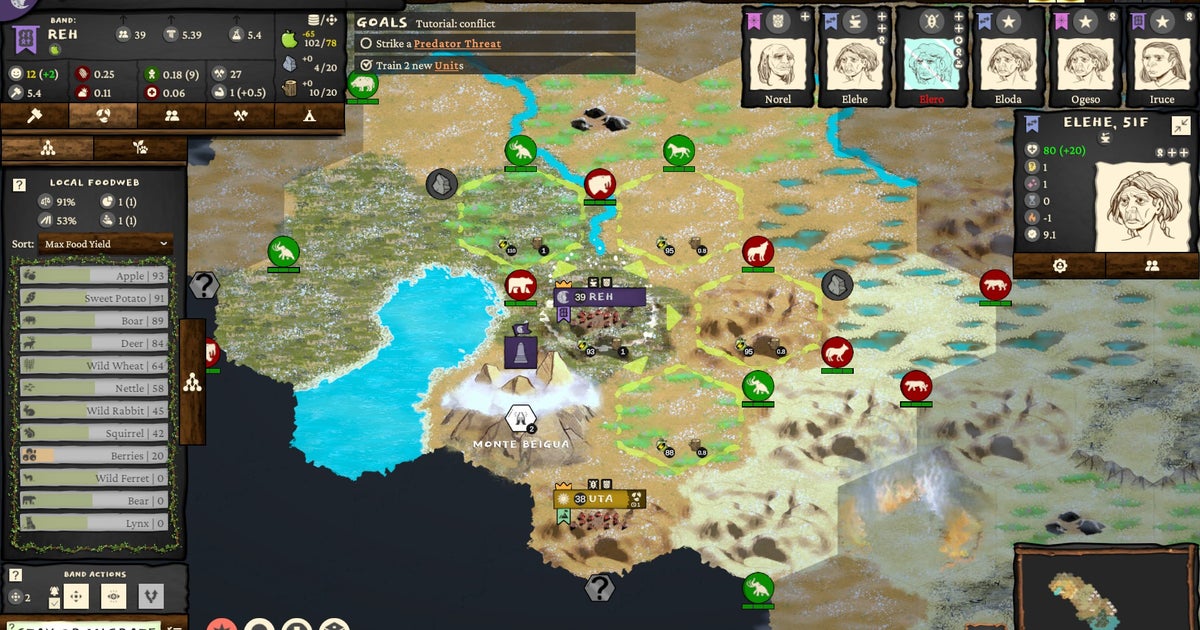
As the permafrost disappeared from the fjords of Edwinland – gosh, I’d absolutely kill to be living through a miniature Ice Age right now – Norel, shaman of the Moon tribe, gathered his people to make a fateful proclamation. The tribe had prospered during the colder years, fishing and hunting boar as they traversed the steppes, but that prosperity had its drawbacks: our population had swelled past 40. We had far too many quarrelsome youths, bumping elbows around the campfires. What’s more, the local boar herds were starting to look a mite see-through.
As such, the sage and humorous Norel proposed to split the tribe in two. One band, led by Norel himself, would continue the Moon tribe’s exploration of northern Edwinland, following the hexagonal coast. They would scour the cliffs for game, while trudging steadily towards the mountains in the east – a source of shiny rocks to trade with rival tribes for more immediately useful objects, such as pointy sticks.
Image credit: Curious Dynamics / Rock Paper Shotgun
The other band, led by the testy young Warmaster Ekine, would roam back in-land, exploiting food caches diligently stored against this very eventuality, and camp near the sacred monument of Monte Belgua. Ekine’s group would decorate the shrine with soapstone, unlocking the blessings of the spirits. Then, they would travel further south to the savannahs and rainforests around another sacred mountain, Tebel Uweinat, there to gather fruit and experiment with a curious new technology known as “agriculture”.
I can’t say whether Folk Emerging is a careful and substantial portrayal of what human life was like in the Paleolithic era. I suspect the above three paragraphs are going to piss off any number of anthropologists and archaeologists. But I can say that it’s one of the more conceptually engrossing 4X sims I’ve played of late – a 4X sim that hacks away the city-building element with a sharpened flint, rewilding the genre for the benefit of people who are extremely bored of upgrading town centres.
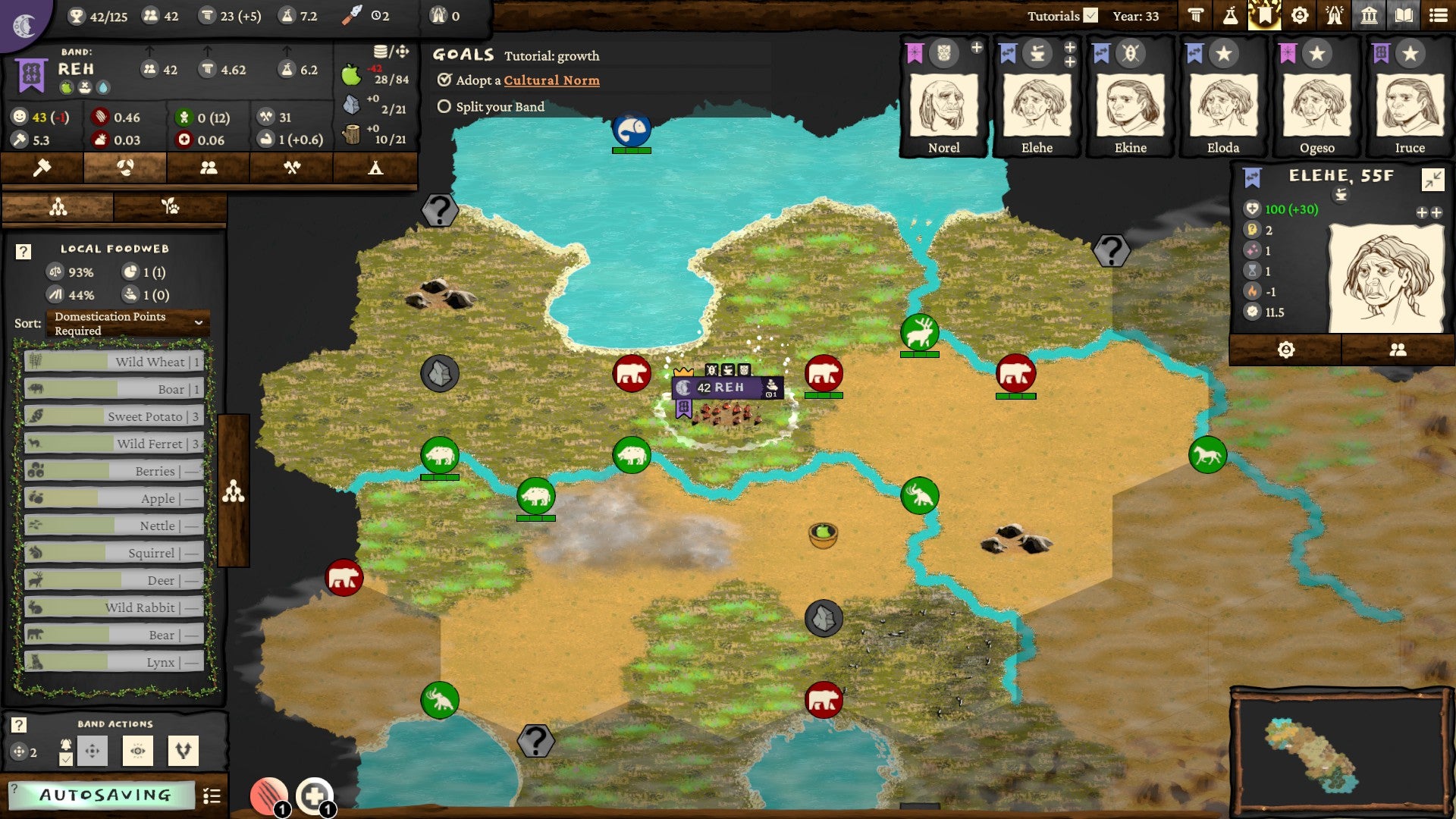
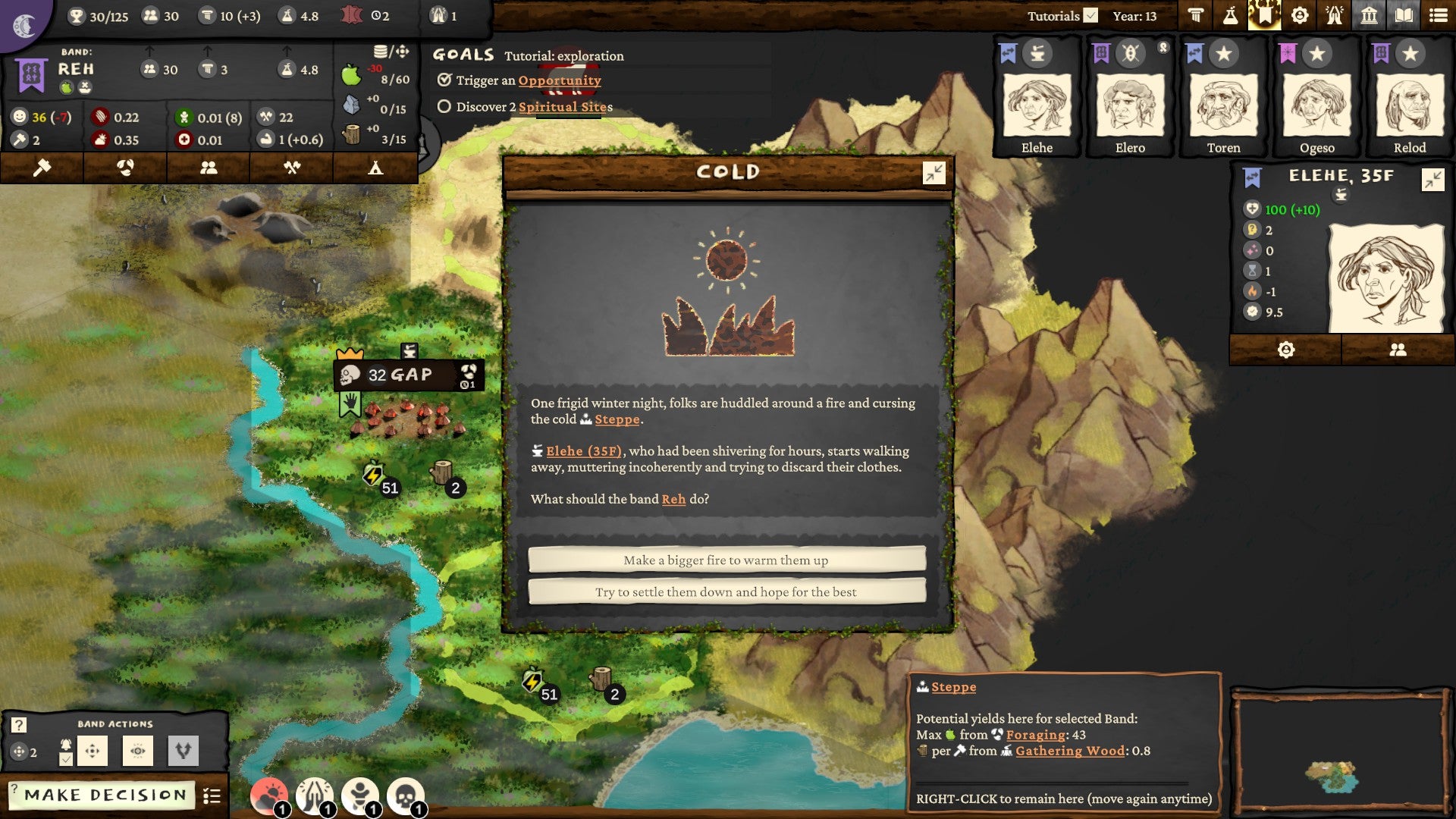
The key to Folk Emerging is that you have to keep moving, because the world isn’t inexhaustible, nor static; if you stand still for too long, it will wash over you or shrivel up underfoot. When you order your people to forage, you’re pulling biomass from a local, finite web of carnivores, herbivores and edible flora. Develop a taste for roasted weasels, and eventually there will be no weasels to roast. The stress on the ecology is inevitably greater when several tribes are gathered together; enemy tribes are to be feared not just because they might pelt you with stones, but because they’re passively collaborating with you to pick the landscape clean.
Image credit: Curious Dynamics
Helpfully, your tribe forages while travelling, scraping together a little “bonus” grub for every hex unfogged, and thereby freeing up productivity points for basketweaving, the whittling of figurines, and other activities that go beyond pure subsistence. There are also sacred sites you can claim and decorate for tribe-wide buffs and “victory points”, because this is still a game about Winning History.
Those are a few of the positive incentives to roam. The negative pressures include clusters of predators, who migrate from hex to hex: when those red icons are right next to your campsite, it’s not brilliant for morale, and there’s the risk of a pop-up story encounter that typically involves a maiming. Sabretooths and bears aside, you have to worry about the treacherous churn of the climate: storms, floods, heatwaves that may lead to deaths of exposure, and wildfires that leave patches of burned soil. All told, committing to one corner of the map feels like a recipe for slow disaster.
In terms of genre expectations, the interesting thing about all this that it’s still an exercise in “settling the land”. It’s just that rather than screwing a city into the juiciest clump of icons, then steadily colonising the tiles around it, you’re living in different parts of the realm at different times, as dictated by cycles of growth and predation.
Image credit: Curious Dynamics / Rock Paper Shotgun
You need to remember where certain animals and plants are found, and how long you should spend away to let their numbers replenish. You need to remember where you’ve stored any food or resources your emerging folk are unable to carry. You do slowly learn technologies that allow you to build lasting structures on tiles – cropfields, watchtowers, pastures – but these fixtures don’t add up, for me, into anything approximating a city. Not yet, anyway. The tech tree carries an air of inevitability.
It’s an absorbing, curious experience, although the Steam demo – which I’ve played for all of three hours – does feel a little molten and embryonic. I’m still working out whether certain systems aren’t very impactful, or the presentation just isn’t doing enough to communicate the impact.
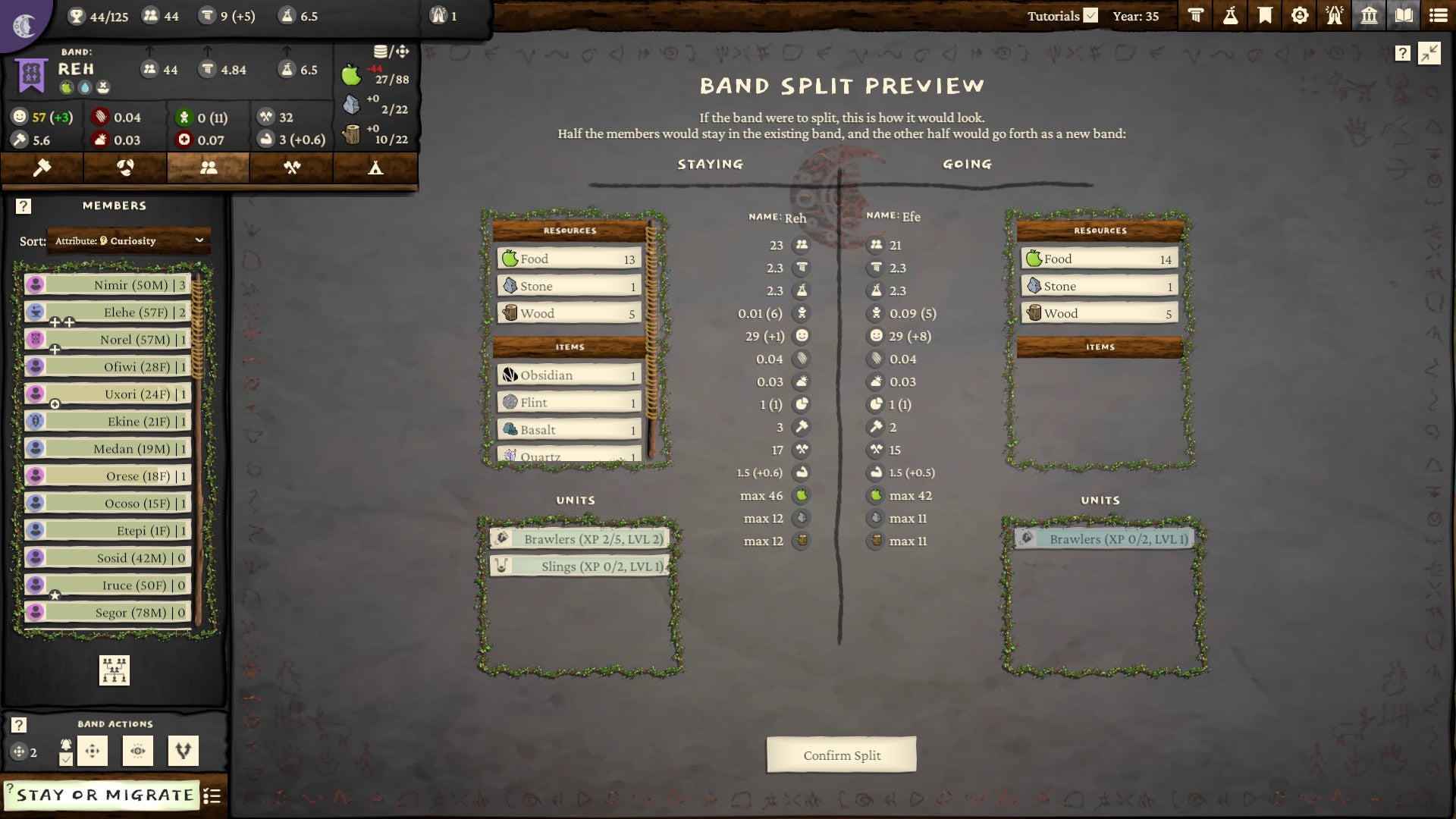
This is particularly true of what happens inside your tribe. Each tribesperson has a name, age, character stats, a clan allegiance such as Sage or Trader, and an opinion on everybody else. Once you’ve researched the requisite technologies, you can appoint the most gifted of them as tribal elders. The details are fed to you by means of some immediately confusing menus, each apparently conceived in isolation from the others. On the one hand, you’ve got the prehistoric medium of spreadsheets – dusty, but effective. On the other, a stretchy 3D octopus of family relationships, which feels like a glorified fidget spinner.
Image credit: Curious Dynamics / Rock Paper Shotgun
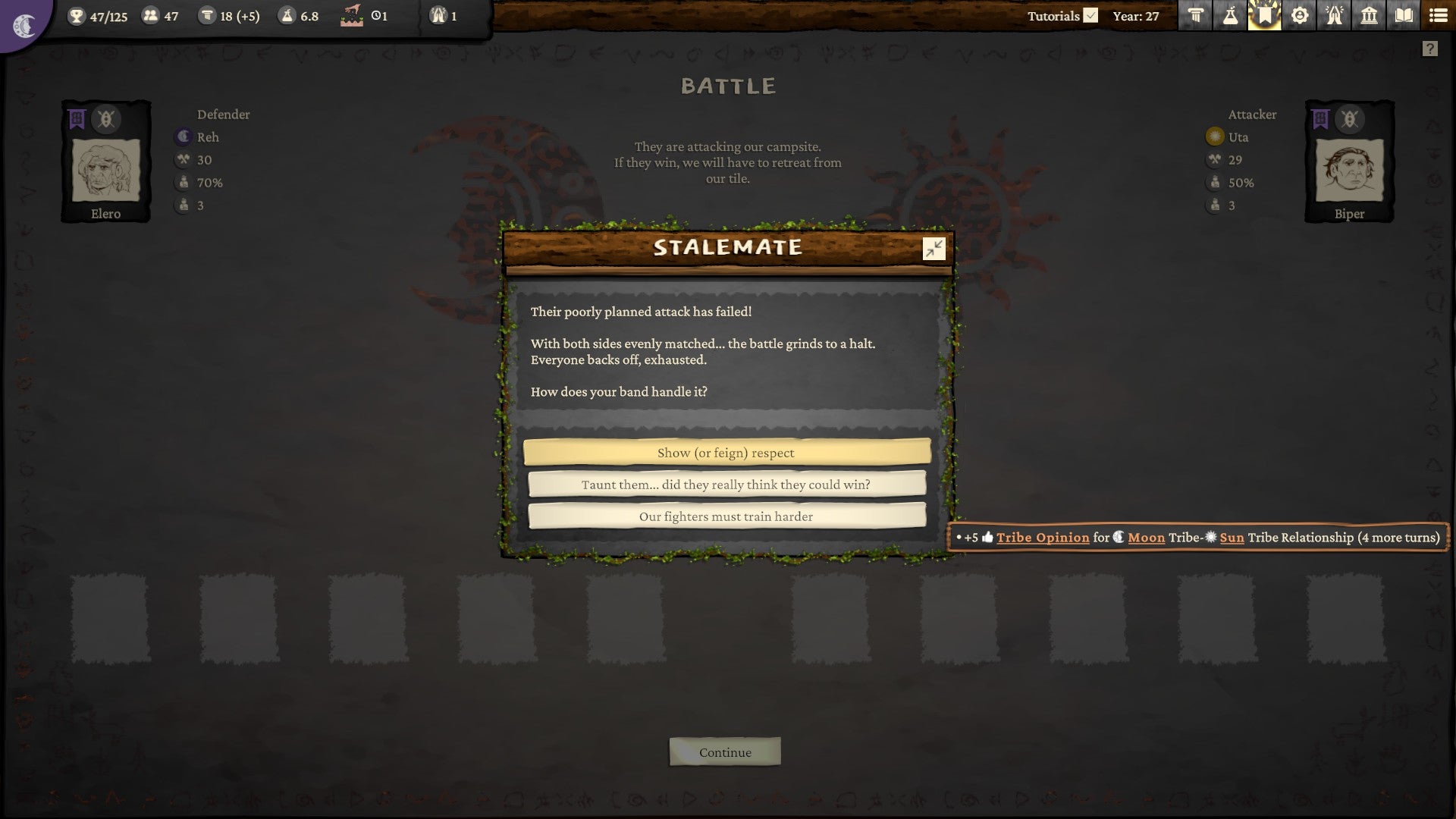
You can broadly shape the disposition of your tribe by means of unlockable pairs of contrasting philosophies, such as diligence and hedonism. These shunt everybody’s stats one way or another. During autobattles with other tribes, meanwhile, your warriors become flickering charcoal designs on a cave wall. There’s no bog-standard “military” element – rather, you’ll initiate training periodically to acquire discipline points, which then lets you form your folk into combat units as needed, such as Brawlers and Throwers. The catch is that discipline points are also required for other tasks.
I do like the mildly clashing interface design. It’s the kind of disorder you expect from a solo developer who is trying to wrangle a bunch of complex systems, and since when did games have to be these perfectly congealed aesthetic objects, anyway? This is the Stone Age, you snoots – symmetry hasn’t been invented yet. It reminds me of King of Dragon Pass and Mech Engineer, two games I respectively love and love hating. Still, it can make it hard to discern and imagine the lives you’re presiding over. These Folk have yet to Emerge fully from all the screen furniture.
My opening anecdote about Norel and Ekine is, in that sense, a little misleading: it represents the kind of intimacy I want to have with the people in this game. I find I remember them better when they star in those pop-up questlets, which tie them more persuasively into the larger strategic pressures. For example, you might have to decide whether a skilled craftswoman who’s past her prime should risk her life for a baby who could make a fine contribution in a couple of turns. Assuming you don’t just decide to save the baby because, you know, she’s a baby. You monster.
It does feel like my criticisms might disappear on the second playthrough, once I’ve acclimatised to the UI. In general, I’m really enjoying the experience of a 4X in which you are at the mercy of a volatile world.
I’m interested to see how long that feeling will persist, as my tribe advances along what appears to be the opening sixth of a Civilization tech tree. It makes me wonder if we could perhaps call the whole ‘civilization’ project off, dispense with any baked-in ideas about historical progress, and investigate some of the alternatives expressed by, for example, the presence of Neanderthal tribes. It would be a shame, I think, if every game of Folk Emerging ended simply with the founding of a city.
Whether AI is already replacing jobs is the subject of fierce debate.
Tech layoffs hit their highest single month total in years in May, and AI was the most-cited reason, according to outplacement firm Challenger, Gray & Christmas.
Software engineering, in theory, is the professional field most vulnerable to automation, given the rapid adoption of AI-powered coding tools. However, researchers at venture firm SignalFire say the hiring data tells a different story.
“The rationale given for lots of layoffs is consistently AI, and specifically they’ll say AI with respect to code; they’ll say one engineer could do the job of however many engineers in the past,” said Asher Bantock, SignalFire’s head of research. “What we’re seeing on the ground is a little inconsistent with that.”
SignalFire’s analysis, which tracked the careers of millions of employees across more than 80 million companies, suggests that engineering was the most resilient job function in 2025. Instead of focusing on layoffs, which are difficult to track because people often delay updating their employment status after job cuts, SignalFire examined hiring data as a more accurate indicator of real-time workforce trends.
While total hiring across large tech companies dropped 25% compared to 2019 levels, engineering roles saw a much smaller decline of just 11%, according to SignalFire’s latest “State of Talent Report.”
In fact, engineers comprised 55% of all new hires in 2025 across the 12 companies SignalFire classifies as “Tech Majors” — Alphabet, Meta, Apple, Amazon, Microsoft, Netflix, Nvidia, Tesla, Uber, Airbnb, Block, and Stripe. This is a significant jump from 2019, when engineers represented only 46% of new recruits, according to the report.
The continued need for engineers was even more evident at early-stage startups, which collectively brought on 7% more engineers in 2025 than they did in 2019, SignalFire’s data shows.
If AI were truly substituting for engineering talent, Bantock argued, engineering hiring would be the first to fall amid the current tech hiring contraction. Instead, SignalFire’s data shows that engineering headcount is growing faster than most other job functions in tech.
While Anthropic CEO Dario Amodei warned last year that AI could wipe out half of all entry-level white-collar jobs and push unemployment as high as 20% within five years, the company’s own head of economics, Peter McCrory, told TechCrunch in March that he had not yet seen any significant AI-driven effects on the workforce.
Said McCrory at the time: “There’s at least no larger material difference in unemployment rates” between workers who use Claude for the “most central task of their job in automated ways” — like technical writers, data entry clerks, and software engineers — and workers in jobs less exposed to AI that require “physical interaction and dexterity with the real world.”
Nvidia CEO Jensen Huang went further still, outright rejecting the theory that AI will replace engineers. “Somebody said that AI is going to destroy all of the software engineering jobs,” Huang said in an interview at the Stanford Graduate School of Business in April. He then argued the opposite is true. Now that all engineers at Nvidia are using agentic AI, “software engineers are busier than ever,” he said.
Huang added that while agents are writing code near instantaneously, they are constantly pushing engineers to generate “the next idea.”
For now at least, it seems that armed with AI, engineering has become a classic example of the Jevons paradox — the idea that greater efficiency doesn’t reduce demand for a resource; it increases it, because the work expands to fill the new capacity. As Bantock said of engineering talent in this moment: “They’re suddenly a lot more productive, and there’s endless work for them to do.”
When you purchase through links in our articles, we may earn a small commission. This doesn’t affect our editorial independence.
The 30th anniversary of Quake recently passed by—June 22, 2026 was the day—and of course there were acknowledgements, salutes, and celebrations a-plenty, as you’d expect for such a groundbreaking, influential, and enduring game. But it also got a couple of the driving forces behind it reflecting on those days rather more deeply, and as sometimes happens when youthful memories come to the surface, they got pretty deep into their feelings.
Quake co-designer Sandy Petersen, who joined id Software in 1993, got the ball rolling, writing bluntly on X that “Quake ruined id Software.” He said Quake “is an amazing feat of art, programming, and design,” and credited everyone on the development team for doing “a brilliant job, fulfilling tasks just right.” But, he added, the workload was intense, “and I think it broke us spiritually.”
Petersen then ran through a list of everyone who left id “within a couple years of finishing Quake,” including John Romero, Shawn Green, Dave Taylor, Mike Abrash, American McGee, and of course Petersen himself. All of them went on to have long and fruitful careers in game development, “so plainly we didn’t depart because of some kind of talent issue,” Petersen wrote. “We were all highly competent, just a little burnt out after the labor of Quake.”
Latest Videos From
“Id Software was never the same after,” Petersen wrote. “In my opinion (only an opinion), the only other truly great game that id produced was Quake 3, and it was not at the level of the pre-Quake games.”
(Image credit: Sandy Peterson (Twitter))
Despite clearly being a bit melancholy about the whole thing, Petersen said Quake was “absolutely” worth the cost it extracted from id: “Games are more important than game companies, and Quake is an iconic titan of the gaming world.” But, he added, “man alive it seems like the company could have had its act together better and kept that dream team.”
Sandy Petersen is pretty famous for having his recollections repeatedly (but respectfully) knifed by John Romero, but in this instance his reminiscences were met with agreement, mostly, from the other John of the original id Software squad: Carmack.
In response to Petersen’s missive, Carmack said Quake was “overly ambitious technically,” and that the studio “could have done all the great multiplayer and modding work inside a Doom++ engine, allowing the designers to work with a more stable base instead of rug-pulling everything out from underneath them a couple times.”
Keep up to date with the most important stories and the best deals, as picked by the PC Gamer team.
“I pushed everyone too hard,” Carmack wrote. “I didn’t appreciate how maturing companies need more slack, and that running people at startup intensity constantly will wear them out. Quake was also where I really had to accept my personal limits. I was working pretty much as hard as humanly possible, and I was still slipping past my goal points.
“On all of the founders’ shoulders, our original corporate stock arrangement and buy/sell agreement was a mistake, and resulted in bad incentives. We wanted to ensure that all ownership rested in the hands of people working hard on current projects, but the Silicon Valley standard approach of vesting stock would have worked out better.”
Carmack said he doesn’t think having elevated expectations for Quake level designers was a mistake (and credited Romero with setting that bar high right from the studio’s early days), but acknowledged that “we should have figured out how to pair up artists and designers earlier.” But, he continued, “there was infighting among the designers, and the ones that could manage the visuals were happy to disparage the ones that couldn’t.”
And then, simply and directly, he apologized: “Sorry, Sandy.”
(Image credit: John Carmack (Twitter))
The dissolution of id Software under somewhat acrimonious circumstances has been well documented over the subsequent years: American McGee, for instance, was reportedly fired by Carmack for sub-par performance on Quake, although Petersen later suggested that McGee was actually done dirty by another employee. Petersen also pointed a finger at Carmack’s “intensity” in particular in a separate post, writing that Carmack “decided we all needed to be in the same big room together. He’d read about this way of “focusing” the team and it did. But we also had nowhere we could decompress or hide out.”
(Image credit: Sandy Peterson (Twitter))
It didn’t take long for the other other John—Romero—to enter the convo with his own thoughts on the matter, which aren’t too far removed from Carmack’s: He echoed the in-hindsight belief that they should have stuck with a Doom++ game while ironing out the fully-3D Quake engine, and that everyone at id was “pushing ourselves past what was reasonable because that was how id had always worked.” He also gave particular credit to McGee for being “really good” at building Quake levels, a notably pointed comment given how McGee’s time at id ended.
“There are a hundred things we could have done differently, but we did the best we could do at the time with what we knew. Having a media circus around us certainly didn’t help,” Romero wrote. “id still goes on, and so does Wolf, Doom, and Quake. Maybe that was what we came together to do. That is more than enough for any game dev, any team, any lifetime really.”
(Image credit: John Romero (Twitter))
Taken altogether, it’s a really interesting conversation about one of the most storied game studios in history. But I love a happy ending, and so what really lands for me is how it all wraps up: With an understanding that everyone was younger then, the world was a different place, and as Romero put it, we did the best we could. Following Carmack’s apology, Petersen said he didn’t blame him for how it all worked out and told Romero he “did an incredible job” on Quake, and Romero thanked Petersen for getting them talking: “It really was a hell of a game.”
Universa, the powerful Chosen of her people, and ancient warrior, The Immortal, join theInvincible VSroster on June 30, starting Season 1. Get a look ahead at Seasons 2 and 3.
Skybound’s in-house studio, Quarter Up, is headed to Evo Las Vegas from June 26-28 as an official tournament partner, where players will get the chance to play Universa and The Immortal ahead of their official launch.
Invincible VS is a new 3v3 tag fighting game based on the beloved comic book and TV series, and is available now on XBOX Series X|S, XBOX on PC, and XBOX Cloud as an XBOX Play Anywhere title.
It feels like just yesterday that Invincible VS launched, and the support from our community has been nothing short of amazing. Now, we’re excited to keep things going and welcome our first two DLC characters into the game – the unstoppable Universa and the looks-great-for-his-age superhuman, The Immortal, both launching on June 30!
First up is Universa. The Chosen of her people, she is a lone cosmic warrior tasked with saving her dying world. With her mighty Staff of Leadership, she can absorb and unleash massive amounts of energy, but only while it is in her grasp. Driven by duty above all else, Universa will stop at nothing to drain planet Earth of its energy resources in order to bring salvation to her own world, no matter the cost.
In Invincible VS, Universa is a highly technical Fighter built around momentum and resource control. Her power grows immensely as her Boost Meter fills, and she can even siphon Boost energy from her opponents to weaken them as she gains strength, leaving them extremely vulnerable to her attacks. Universa is versatile and well balanced, and is at her best when players are able to master her Max Boost Specials to completely devastate her foes.
I’ll let you in on a tip for Universa: One of our team’s favorite moves is her “Entropy” super, which allows her to absorb incoming projectiles and convert them into Boost gauge. This works great for getting through some assists or dealing with characters like Ella Mental or Cecil who rely on heavy projectiles. If you can master Universa’s tit-for-tat energy absorption and release, she may just become your new main.
Next is The Immortal, and yes, his name is quite fitting. He is one of the oldest living characters within the Invincibleuniverse, and his origin is a true mystery. The Immortal has lived many lives as a warrior, king, knight, crusader and now, leader of the Guardians of the Globe. Relentless and hardened by battle, he carries an incredible amount of grief from centuries-spanning loss, especially after surviving Omni-Man’s massacre of the original Guardians of the Globe. Though not a Viltrumite himself, The Immortal possesses similar powers and will never back down from a fight, no matter who stands before him.
In Invincible VS, The Immortal is an aggressive Striker Fighter who excels at closing distance and overwhelming opponents with relentless pressure. His explosive moveset lets him attack from multiple angles, while his Install Super boosts his speed and combo potential even further. True to his name, he also has a unique Revive ability that can bring him back into the fight once per match, allowing him to return in a berserk state and continue beating up his opponents.
One super cool aspect of The Immortal that we think fans will love is his walk-off. For a character that’s had so many iconic entrances and exits throughout the years, we made sure to give him a proper animation to fit, and might I say, it’s one of the best animations in the game. You’ll want to pay attention to that once the round ends.
Better yet, you can check it early at Evo! We’re heading to Las Vegas from Friday, June 26 to Sunday, June 28, and attendees can swing by our Quarter Up booth to go hands-on with Universa and The Immortal before anyone else. Who knows, you might just find your new main!
We’re also honored to say that Invincible VS is an official Evo tournament partner, and we can’t wait to see the highest caliber players face off against each other throughout the whole weekend. As expected, the stakes are high. The first-place winner gets more than just bragging rights; they get to take home quite the spectacle – a life-sized Conquest Gauntlet trophy! May the best player win.
Looking to the future, we’re also excited to reveal our 2026 roadmap, giving you all a look at what’s coming for the rest of the year. To give you the highlights, we’ve got Season 1 launching on June 30, alongside Universa and The Immortal, plus an all-new Endless Arcade mode and fresh cosmetic releases. Then, Season 2 launches in October, where players can look forward to an all-new fighter, game mode and even more cosmetics. And to end the year with a bang, Season 3 launches in December with another brand-new fighter, a whole new arena and you guessed it, more awesome cosmetics.
There’s tons of amazing content coming but for now, we’re starting the summer off with a strong punch. We look forward to seeing some of you at Evo next week and checking out what you can all do with Universa and The Immortal. Show us what you’ve got!
Invincible VS is available on XBOX Series X|S, XBOX on PC, and XBOX Cloud as an XBOX Play Anywhere title, and can be purchased at invinciblevs.com.
Invincible VS is a brutal superhero 3v3 tag fighting game set in the Invincible universe, where you can battle to the death as a team of fan-favorite characters in iconic locations. Unleash bone-breaking combos through fast combat and smart defensive tactics to leave a trail of blood and destruction. Land vicious Super moves and Ultimates to leave your opponents in a mess of blood.
Invincible VS features a variety of game modes including a captivating cinematic story mode with an original narrative from a writer of the animated series. Jump into Arcade and battle with your team, hone your combos in Training mode, and test your skills against the world in competitive and casual multiplayer. Show, comic fans, and fighting game lovers will experience unparalleled heroic brutality, where every earth-shattering blow will leave you feeling… Invincible.
This is the debut title from the newly formed Quarter Up™—the first in-house studio at Skybound—led by former members of the core Killer Instinct (2013) dev team.
Over the years, considerable effort has gone into making the Android permission model more user-friendly, and most Android users today reflexively disregard requests for camera, microphone, contact, or location permissions. However, there is one category that users forget about — network activity.
Apps don’t need to request your location or contact information to create a profile on you. By monitoring your network activity, apps can learn your online hours, which services you use, and how much data you consume. Android tries to limit access to this information, but there are some permissions that provide insights into your network usage.
This article will examine some of the more concerning Android permissions and what data they allow applications to collect. It will also discuss how the use of a trusted Android VPN can limit this data collection.
Network Activity Permissions
The Android permission used most often in connection with network activity is ACCESS_NETWORK_STATE. This permission is used to determine if an Android device has an active Wi-Fi network connection, if data is being transmitted over a mobile connection, or if the Android device is not connected to the internet at all.
At first, this might not appear to be a problematic permission to grant; many applications require the knowledge of a user being online in order to fetch content. This information can, however, be used for analytics, advertisements, and even behavioral tracking.
Another commonly requested permission is INTERNET. Most Android apps request this permission because it allows apps to send and receive information from remote servers. While this permission doesn’t compromise your network statistics but combined with other permissions by itself, apps can send collected data to developers, advertisers, and analysts.
PACKAGE_USAGE_STATS is the most concerning permission. This privilege allows the app to collect detailed statistics about user behavior, including network statistics. This is made possible by the use of the Android NetworkStatsManager API. In certain cases, this could allow the app to analyze network data consumption along with device behavior.
Unlike standard permissions, the Usage Access permission is granted through Android’s Special App Access settings, meaning that many users are likely unaware of actually granting this permission.
Why Apps Require Access to Network Information
Developers often argue that requesting access to network data is vital for the app to function. In certain cases, this may actually be true.
For example, streaming apps may need to determine the quality of the connection. Cloud apps may need to know the availability of data. Messaging apps may need to check for a connection.
Unfortunately, there are many other cases where this data is requested for less user-friendly purposes.
Advertising SDKs need network statistics to refine user targeting. Analytics services need this data to analyze user engagement and in-app behavior. Some apps even combine this data with device identifiers to enrich data collection.
Studies show that the majority of Android users grant permissions without properly evaluating the consequences, which makes permission requests and privacy a persistent issue.
How to Check Your Android Permissions
If you are worried about privacy and data collection via networks, take a look at the permissions your apps are using from your device.
Go to:
Settings → Apps → Special App Access → Usage Access
Focus on apps that seem to have no reason for needing access to Usage Stats. Battery monitors, launchers, parental controls, and some security apps may need access. Casual games and random tools should not need this permission.
You should check the permissions of each app and ask the following: “Do apps need permission to use the internet and network in order to perform their primary function?”
If the answer is no, uninstall and find a more privacy-conscious app.
How VPNs Fit In
A VPN cannot stop an app from seeing permissions you already granted. If you give an app Usage Access, it will have access to the information that Android allows.
What VPNs can do is limit what network information can be seen.
When you use a VPN, your internet traffic is encrypted before it leaves your device. Because of this, internet service providers, Wi-Fi that you access in public, and a bunch of other third parties will not be able to see your browsing and what you are connected to.
A VPN also hides your IP address. This will make your network data less location-specific. For Android users who have to use public Wi-Fi, this will reduce the risk of their online activities being exposed.
Protecting Privacy With Permission Control
With Android, privacy is in your control like never before, but those controls only work if they are used.
Regularly check what permissions you’ve granted and remove access from applications that don’t need it. Be smart about special permissions. Each and every permission request should have a clear reason.
While a VPN alone won’t protect your privacy, combined with careful permission management, it can prevent most of your online activities from being exposed.
The more data is collected, the more that can be harvested.