The Portable Chargers We’d Actually Buy This Spring


Spring travel season is also peak portable charger season. Weekend trips, outdoor events, airport layovers, long commutes, and café work sessions all push people toward lighter everyday carry setups where bulky accessories start feeling unnecessary. That shift is changing what buyers now expect from power banks. Capacity still matters, though portability, charging speed, and design have become equally important.

This year’s best spring deals reflect that change clearly. Compact chargers with faster charging support and cleaner designs are replacing oversized utility-focused power banks that were built purely around battery size. Several major brands are also pushing aggressive seasonal discounts right now, making this one of the better times to upgrade.

1. INIU Pocket Rocket P50 – Ultra-Compact Fast Charging for Everyday Travel

Approx. Deal Price: $32.99, with additional bundle savings currently available on INIU’s official store.

INIU is clearly targeting the growing shift toward lighter everyday carry tech with the Pocket Rocket P50. The charger focuses on combining portability and high-speed charging inside a compact body that feels practical for commuting, travel, café work sessions, concerts, and daily movement instead of being another oversized power bank built purely around battery size.

The compact footprint is easily the biggest highlight. INIU positions the Pocket Rocket P50 as the world’s smallest charger in its category, making it dramatically easier to carry compared to bulkier fast-charging alternatives currently dominating the market. Weighing just 160g, the charger fits naturally into jacket pockets, handbags, sling bags, and smaller travel kits without becoming inconvenient during long days outside.

Charging performance is another area where the Pocket Rocket P50 stands out. The charger supports high-speed wired charging capable of rapidly topping up smartphones, tablets, handheld gaming devices, and USB-C accessories during short breaks between meetings, flights, or travel stops. INIU says the charger can power a smartphone up to 70 percent in around 25 minutes while also supporting Samsung Super Fast Charging 2.0 compatibility.

INIU has also focused heavily on charging stability and long-term usability by incorporating Temp-Guard battery protection, NVIDIA-grade inductors, enhanced heat dissipation systems, and E-Marker chip safety protection. Those additions become particularly valuable for users relying on portable chargers continuously throughout the day during travel or outdoor usage.

The overall design feels noticeably more refined than the typical utility-focused portable chargers flooding online marketplaces right now. Rounded edges, minimalist styling, softer finishes, and optional custom engraving help the Pocket Rocket P50 feel closer to a lifestyle accessory than generic travel tech. That design direction aligns closely with current consumer trends where buyers increasingly expect accessories to complement personal style alongside functionality.

Approx. Deal Price: $49.99 on the official website, with lower pricing often available during retailer sales.

The Anker Nano 10,000mAh power bank works particularly well for users who want a simpler everyday carry setup instead of a larger laptop-focused charging brick. The charger supports 30W USB-C fast charging, which is enough to comfortably handle smartphones, tablets, handheld gaming devices, and lightweight USB-C accessories during daily use.

One of the biggest advantages here is the built-in USB-C cable, which eliminates the need to carry separate charging cables during commutes, flights, or travel. The compact footprint also makes the Nano significantly easier to slip into jacket pockets, handbags, sling bags, and airport carry-ons compared to bulkier high-output power banks.

The 10,000mAh battery capacity strikes a practical middle ground for most users by offering enough power for multiple smartphone top-ups without making the charger feel oversized. Bi-directional charging support also allows the built-in cable to recharge the power bank itself, adding another layer of convenience for everyday travel and work setups.

Approx. Deal Price: $39.99 during current seasonal promotions

The Belkin BoostCharge 10K combines a 10,000mAh battery with 20W USB-C PD fast charging in a slimmer, travel-friendly design built for everyday use. The charger supports simultaneous charging for up to three devices, making it particularly useful for users carrying smartphones, earbuds, smartwatches, and other accessories throughout the day.

The compact footprint helps the BoostCharge fit easily into backpacks, handbags, laptop sleeves, and airport carry-ons without adding unnecessary bulk. USB-C PD fast charging also allows for quicker smartphone top-ups during flights, workdays, and daily commutes compared to standard portable chargers still limited to slower output speeds.

Belkin’s strong ecosystem compatibility remains another major advantage, especially for users carrying a mix of Apple and Samsung devices. Combined with multi-device charging support and airline-friendly battery capacity, the BoostCharge 10K continues to work well as a practical everyday travel charger instead of a larger desk-focused power bank.

Approx. Deal Price: Around $59.99 during current spring promotions

The UGREEN Nexode 20000mAh 130W power bank is built for users carrying multiple power-hungry devices throughout the day. The charger supports up to 100W USB-C output, making it capable of charging MacBooks, ultrabooks, tablets, handheld gaming devices, and flagship smartphones without needing separate charging solutions.

The 20,000mAh capacity is large enough for multiple smartphone recharges or meaningful laptop top-ups during flights, workdays, or travel. Despite the higher output, the Nexode still maintains a relatively compact footprint compared to many laptop-focused charging bricks currently available in the market.

UGREEN has also included a smart digital display that shows real-time battery levels and charging status, which adds far more practical usability compared to standard LED indicator systems. Combined with multi-port charging support and high-output USB-C PD performance, the Nexode 130W remains one of the stronger fast-charging options currently available for users looking to consolidate their charging setup into a single portable device.

5. Baseus Blade Power Bank – A Smart Choice for Laptop and Tablet Users

Approx. Deal Price: $89.99 during spring promotions

The Baseus Blade stands out immediately because of its shape. Instead of using the traditional thick brick-like design common with high-capacity chargers, the Blade uses a slim flat-body construction that slides naturally into backpacks, laptop sleeves, and messenger bags.

The charger typically offers a 20,000mAh battery combined with high-speed USB-C charging, making it practical not only for smartphones but also for tablets and lightweight laptops. For remote workers, students, and frequent travellers, that flexibility can eliminate the need to carry multiple chargers during the day.

Despite the larger battery capacity, the Blade still feels surprisingly portable, which explains why it has become increasingly popular among users looking for a cleaner and more premium-looking travel charging setup.

6. Mophie 10000mAh Powerstation – Compact Fast Charging With a Cleaner Premium Design

Approx. Deal Price: $39.99 during current spring promotions

Mophie’s newer Powerstation models focus heavily on balancing portability with practical everyday charging performance. The charger packs a 10,000mAh battery along with 20W USB-C PD fast charging support, giving users enough capacity to comfortably handle multiple smartphone top-ups during travel days, long commutes, or extended work sessions away from charging outlets.

The slimmer construction is one of the biggest advantages here. Unlike thicker high-capacity power banks that quickly become inconvenient inside smaller bags, the Powerstation is designed to slide naturally into backpacks, handbags, airport carry-ons, and daily carry setups without adding unnecessary bulk. The lightweight body also makes it far more practical for concerts, café work sessions, and weekend travel where portability matters just as much as charging capacity.

Mophie’s industrial design continues to stand out in a category flooded with generic utility-focused chargers. The cleaner finish, understated styling, and softer texture help the Powerstation feel noticeably more premium while still remaining practical for daily use. Combined with USB-C PD charging speeds and a more compact footprint, the current spring pricing makes it a solid option for users looking for a dependable fast charger that does not feel oversized or overly utilitarian.

Why Compact Fast Chargers Are Dominating This Spring

The biggest shift happening in portable charging right now is not just about battery size. Buyers are increasingly prioritising products that fit naturally into daily life. A charger that feels too bulky to carry often ends up left behind entirely, which defeats the purpose of portable power in the first place. That is exactly why compact fast chargers are dominating spring deals this year. Smaller form factors, faster charging speeds, cleaner industrial design, and better portability are becoming more valuable than simply carrying the largest battery possible.

Products like the INIU Pocket Rocket P50 highlight that transition clearly. Instead of focusing purely on raw capacity numbers, the P50 combines 10,000mAh battery capacity, 45W fast charging, advanced thermal protection, and a highly compact design built specifically for modern mobile lifestyles. For users planning spring travel, upgrading their everyday carry setup, or simply looking for a more convenient charging solution, this season’s deals offer some of the strongest portable charging options currently available across multiple price points.

She Got 3x More YouTube Reach


What if your YouTube growth didn’t come from doing more…

But from finally doing it strategically?

Because that’s exactly what happened for Mikki.

She went from posting random videos with no clear direction to tripling her impressions, reaching 2,000 subscribers, and building not one, but two paid membership communities.

All while creating content about mindful art journaling from a small village in the south of France.

And here’s the part that matters most:
This wasn’t about chasing trends, uploading every day, or trying to outsmart the algorithm.

It was about clarity.

For the first time, Mikki understood how her videos could work together, how each piece of content could build momentum instead of sitting in isolation.

When she joined Video Brand Academy, she didn’t just consume content; she implemented it.
She showed up to live sessions, took notes, watched replays, and actually applied what she was learning.

And that’s when everything shifted.

Not just her analytics but her entire approach to YouTube and her business.

In this episode, Mikki breaks down exactly how she did it using the spiderweb and snowball strategies to organize her content, increase watch time, and build a growing, engaged community.

If you’ve ever felt like your videos aren’t “connecting” or working together, this story will show you what’s possible when they finally do.

VIDEO: She Got 3x More YouTube Reach

Some product links in this post are affiliate links, and I will be compensated when you purchase by clicking our links. Read my disclosure policy here.

From Random Uploads to a Focused YouTube Strategy

Mikki originally started her YouTube channel back in 2021.

At the time, she loved creating videos, but there wasn’t much structure behind what she was posting. She uploaded content based on inspiration in the moment without really understanding how YouTube connected videos together or how audiences moved through content over time.

A lot of creators stay stuck in that cycle for years.

You upload one video.
Then another completely unrelated video.
Then something different the next week.

Eventually, the channel starts feeling scattered, and growth becomes inconsistent because neither viewers nor the algorithm fully understand what the channel is about.

Everything shifted for Mikki after listening to episode 70 of the podcast, 5 Ways to Sell Your Course or Membership with YouTube,” and the YouTube Funnel Masterclass inside  Video Brand Academy.

That episode pushed her to finally join  Video Brand Academy.

From there, she started implementing the Spiderweb Strategy, and that became one of the biggest turning points in her growth.

Related: Ways to Sell Your Course or Membership with YouTube | Ep. 70

The Spiderweb Strategy Changed How Her Channel Worked

One of the biggest breakthroughs came from implementing the Spiderweb Strategy inside Video Brand Academy.

Before learning this approach, Mikki described her channel as “chaos.” She created videos based entirely on what she felt like making at the time, without understanding how the videos connected together.

Once she started organizing her content around a more focused structure, everything became easier to understand.

Instead of scattered uploads covering unrelated ideas, her videos started reinforcing each other.

One video naturally led viewers into another.
Topics became more connected.
The audience began recognizing exactly what her channel was about.

That shift helped improve watch time because viewers were no longer consuming isolated pieces of content. They were entering an ecosystem of videos built around the same audience struggles, interests, and goals.

The algorithm responds well to that clarity because YouTube can more confidently recommend your content to the right people.

Viewers respond well to it, too, because they immediately understand what value your channel offers.

Related: Build Your THRIVING Channel (without spending HOURS Creating Videos) | Ep. 49

Revisiting Old Content With the Snowball Strategy

After implementing the Spiderweb Strategy, Mikki started exploring the Snowball Strategy.

This gave her a completely different perspective on her existing content library.

Instead of constantly trying to invent brand-new ideas, she realized she could revisit older topics and recreate them with stronger positioning, clearer messaging, and better audience understanding.

Because her niche is mindful art journaling, there are endless ways to approach similar themes creatively without feeling repetitive.

A single concept can evolve through:

  • Different techniques
  • Different materials
  • Different emotional themes
  • Different beginner struggles
  • Different creative exercises

That realization helped her stop feeling pressure to constantly reinvent herself on YouTube.

Sometimes creators think every video must be completely original in order to perform well. In reality, audiences often benefit from hearing familiar ideas explained in a clearer or more focused way.

That’s exactly what the Snowball Strategy helped her do.

Why Her Niche Stands Out on YouTube

One of the reasons Mikki’s content connects so deeply with viewers is that her niche goes far beyond simple tutorials.

She combines art journaling with mindfulness, spirituality, intuition, and self-expression.

During the COVID period, her music studio closed, forcing her to rethink her work and creative direction. Since she had always loved art and grown up in an artistic household, she decided to start making creative videos online.

As she explored the art journaling space, she realized something important.

Most creators focused heavily on techniques, supplies, and finished results.

That wasn’t the experience she wanted to create.

She wanted to help people reconnect with themselves creatively and move past the pressure of perfectionism.

That perspective became the foundation for her memberships.

One membership focuses heavily on mindfulness and inner connection. Sessions begin with meditation and reflection before members start creating inside their journals.

The second membership teaches art journaling techniques and creative methods in a more structured way while still encouraging curiosity and confidence throughout the process.

Even though the memberships are different, both communities guide people toward the same result: creating without fear or self-judgment.

That emotional transformation became a huge part of her YouTube strategy because she finally understood the deeper problems her audience was struggling with.

Creating a Niche That Goes Deeper Than Tutorials

One of the reasons Mikki’s content stands out is that she is not simply teaching art journaling techniques.

She built her niche around mindfulness, intuition, and creativity.

During the COVID period, her music studio closed, which forced her to rethink her work and creative direction. Since she grew up in an artistic environment and had always loved art, she began experimenting with creative videos online.

As she watched other creators in the art journaling space, she realized something important.

Most content focused heavily on supplies, techniques, and finished results.

That wasn’t the experience she wanted to create.

She wanted to help people reconnect with themselves through creativity instead of pressuring themselves to make “perfect” art.

That became the foundation for her memberships.

One community focuses heavily on mindfulness and inner connection. Sessions begin with meditation and reflection before members begin creating.

The second membership is more technique-based, helping people learn art journaling skills and creative processes in a more structured way.

Even though the memberships are different, both communities guide people toward the same outcome: creating with confidence instead of fear.

That deeper emotional transformation is a huge part of why her audience connects so strongly with her videos.

Understanding the Real Problems Her Audience Faced

One thing Mikki explained beautifully during the conversation was that most people struggling with creativity are not actually struggling with art itself.

They are struggling with overthinking.

Some viewers feel overwhelmed by all the art supplies they see online.
Others believe they are “not creative enough.”
Many freeze completely when staring at a blank page because perfectionism takes over before they even begin.

Her videos now address those emotional struggles alongside practical techniques.

She teaches people how to:

  • Choose art materials intentionally instead of buying everything
  • Approach creativity with curiosity instead of pressure
  • Build confidence gradually through experimentation
  • Enjoy the process instead of obsessing over the final result

That emotional connection makes her content feel very different from standard tutorial videos.

People are not only learning how to create art journaling pages.
They are learning how to feel safe creating again.

How She Started Using a YouTube Funnel to Grow Memberships

One of the smartest things Mikki implemented was a simple YouTube funnel connected to her email list and memberships.

After watching the Ultimate User Guide strategy inside Video Brand Academy, she realized she needed a stronger way to move viewers into her ecosystem.

That led to the creation of a free resource built around “42 Inspiration Cards” for art journaling.

Subscribers could download the printable cards and use them as prompts whenever they felt creatively stuck.

But what made the idea especially effective was the video component attached to it.

Instead of simply offering a PDF, Mikki created a series of videos showing viewers how to:

  • Print the cards
  • Assemble them
  • Organize them by category
  • Use them creatively during journaling sessions

This transformed the freebie into an experience rather than a static download.

The system worked in both directions.

People discovered her YouTube videos and joined her email list through the free resource.
Others found the workshop first and then went back to YouTube to watch the supporting videos.

That strategy helped her increase:

  • YouTube watch time
  • Subscriber growth
  • Email subscribers
  • Workshop participation
  • Membership awareness

At one point, she had 75 people signed up for the workshop connected to the card deck experience.

That’s the power of creating content that leads viewers somewhere intentionally.

Why Video Became the Perfect Fit for Her Brand

One thing that stood out during the conversation was how naturally Mikki embraced video creation.

She is not afraid of the camera.
She enjoys teaching.
And she genuinely loves creating content.

That energy comes across in her videos.

Interestingly, most of her videos are filmed overhead, with viewers mainly seeing her hands while she demonstrates creative techniques and journaling processes.

That setup works perfectly for her niche because the focus stays on the creative experience itself.

Her videos often guide viewers through:

  • Background techniques
  • Layering exercises
  • Creative prompts
  • Breathing exercises
  • Mindfulness practices
  • Ways to move through creative blocks

Rather than pushing perfection, she encourages viewers to stay curious and connected throughout the process.

That calm, grounded teaching style has become one of the biggest strengths of her channel.

Her YouTube Setup Is Surprisingly Simple

Another encouraging part of Mikki’s story is how simple her equipment setup really is.

She uses:

  • A Logitech webcam mounted overhead
  • A Blue Yeti microphone
  • An iPhone for recording
  • iMovie for editing
  • Basic lighting and natural daylight

That’s it.

No expensive production studio.
No complicated editing workflow.
No massive team behind the scenes.

Her success comes from clarity, consistency, and understanding what her audience actually needs.

That’s an important reminder for creators who feel stuck waiting for “better equipment” before taking YouTube seriously.

The 100 Video Topics Exercise Changed Her Perspective

One of Mikki’s favorite exercises inside Video Brand Academy was creating a list of 100 video ideas.

At first, that assignment sounds intimidating.

But the goal is not to overwhelm creators. It’s to uncover whether you are truly excited about your niche and capable of building long-term content around it.

For Mikki, the exercise sparked even more creativity.

She now has an ongoing list of video topics she genuinely wants to create, which removes a huge amount of pressure from the content process.

Instead of staring at a blank screen, wondering what to post next, she already has an entire library of ideas connected directly to her audience’s struggles and interests.

That level of clarity creates momentum.

Conclusion

Mikki’s story is such a powerful reminder that you do not need a massive audience to build a meaningful business on YouTube.

You need clarity.
You need consistency.
And you need content that genuinely helps people move forward.

She started with random uploads and very little confidence in her strategy.

Now she has:

  • Over 2,000 subscribers
  • Triple the YouTube impressions
  • Higher watch time
  • Two growing memberships
  • A connected email funnel
  • A workshop with engaged participants
  • A clear direction for her content moving forward

Most importantly, she built all of this while staying fully aligned with who she is and how she wants to teach.

That’s what makes this kind of growth sustainable.

If you want YouTube to become more than just a place to upload videos occasionally, start thinking about how your content works together. The creators, seeing the biggest results, are building intentional ecosystems where videos lead viewers naturally toward deeper connection, community, and transformation.

And honestly? Mikki is just getting started.

Related: Consistent Sales of Your Online Course with YouTube

If you have an online business with a course, program, or any other kind of offer, and you’re not currently generating consistent sales on autopilot, I’d like to introduce you to the hands-off YouTube funnel that has made me over $20k on a $147 course! That way, you too can make consistent sales of your offer, with the beauty and simplicity of organic, evergreen traffic from YouTube! Start here with my free “AIT Method” training.


Google Unveils Googlebook, a New AI Laptop Built Around Gemini


Google today announced a new series of Googlebook laptops that will be built with Gemini at the core. Googlebooks will run software built on a foundation that combines Android and ChromeOS.

Google says the new laptops are designed for Gemini Intelligence for a more personalized and proactive experience.

Instead of a cursor, Googlebooks have a Magic Pointer that users can wiggle to activate Gemini. Gemini can then provide contextual suggestions and answers based on whatever the user is pointing to on the screen. Pointing at a date in an email sets up a meeting, and selecting two images allows them to be visualized together. There are ask, compare, and combine tools available with the Magic Pointer.

Create My Widget, a new Android feature, is coming to Googlebooks. Users can create custom widgets with a Gemini prompt. Gemini is able to search the internet and connect with Google apps like Gmail and Calendar to create a personalized dashboard that can be used for widget creation.

googlebook
Since Googlebooks will run Android, it will be easier to switch between a Googlebook and an Android smartphone. Apps from a connected Android smartphone will be available on the Googlebook, with a feature set similar to Apple’s iPhone Mirroring.

Quick Access will let users view, search, or insert files from a smartphone on the laptop, with no transfer needed.

Google says it is working with Acer, ASUS, Dell, HP, and Lenovo to make the first Googlebooks. The machines will be built with “premium craftsmanship and materials, coming in a variety of shapes and sizes.” Each one will have a “glowbar” on the lid, making it clear that it’s a Googlebook.

Google has not given insight into Googlebook pricing, but with the specific “premium” build language, they could be priced above the low-cost MacBook Neo that Apple recently came out with. It’s also possible that Googlebooks will have MacBook Neo-level pricing to better compete with Apple’s laptop in on pricing and build quality.

The first Googlebooks are set to launch this fall.

Subnautica 2 Free Download (Build 23057982)


Subnautica 2 preinstalled Worldofpcgames

Subnautica 2 Direct Download:

Subnautica 2 is an underwater survival adventure set on an all-new alien world, developed by Unknown Worlds. Play alone or with friends in 4-player co-op. Adapt to survive by building custom bases and crafting tools. Explore the unknown to uncover the mysteries hidden within the depths.

Driven from your home by ongoing conflict, Alterra offers you the chance at a new life. But as the colony ship CICADA shepherds you and your fellow Pioneers to your new home, something goes awry. The ship’s AI insists that your mission should continue.

PLAY ALONE OR WITH FRIENDS
Subnautica 2 is being crafted as a single-player experience that you can optionally play in online co-operative multiplayer with up to three friends. You can choose from four pre-designed characters, with more characters and customization options coming throughout Early Access.

ADAPT TO SURVIVE
To survive the depths and make this planet your home, you’ll need to utilize all the tools at your disposal. Traverse vibrant and breathtaking biomes with your Tadpole submersible.

EXPLORE THE UNKNOWN
Scan and study a rich world of biodiversity to understand life here. Discover everything from the smallest creatures to towering Leviathans. Experience the wonder, and sometimes danger, lurking around every corner. Directive 8020

DESIGNED FOR EARLY ACCESS
Subnautica 2 is an Early Access title in active development. Throughout this journey, we will continuously expand the world with additional biomes, creatures, and craftables, while expanding the narrative. You may encounter bugs, in-development features, and performance issues.

Features and System Requirements:

    • Sci-fi horror adventure set aboard a deep-space colony ship
    • Branching narrative where choices affect survival and story outcomes
    • Cinematic exploration with intense suspense and psychological tension
    • Face deadly alien threats and uncover hidden conspiracies

Screenshots

System Requirements

Minimum
OS: Windows 10/11
Processor: Intel Core i5-8400 / AMD Ryzen 5 2600
Memory: 12 GB RAM
Graphics: GeForce GTX 1660 6GB / RX 5500 XT 6GB
DirectX: Version 12
Network: Broadband Internet connection
Storage: 50 GB available space
Support the game developers by purchasing the game on Steam

Installation Guide

Turn Off Your Antivirus Before Installing Any Game

1 :: Download Game
2 :: Extract Game
3 :: Launch The Game
4 :: Have Fun 🙂

Eric Barone says Stardew Valley and Haunted Chocolatier will forever be AI-free because people “should take priority over a soulless machine”


There’s very little you can scratch off your bingo card in the age of AI, but one thing seems pretty certain: you won’t see an AI-generated ear of corn or romanceable NPC in any of Eric “ConcernedApe” Barone’s games.

That comes straight from the man himself, who explains his hardline stance against AI in a new interview with Game Informer (paywalled). Barone says he can understand AI’s appeal when it’s “being used for very specific zoomed-in cases, maybe,” but says anything creative is better left to humans.

Linux bitten by second severe vulnerability in as many weeks


Both privilege escalation vulnerabilities stem from bugs in the kernel’s handling of page caches stored in memory, allowing untrusted users to modify them. They target caches in networking and memory-fragment handling components. Specifically, CVE-2026-43284 attacks the esp4 and esp6 () processes, and CVE-2026-43500 zeroes in on rxrpc. Last week’s CopyFail exploited faulty page caching in the authencesn AEAD template process, which is used for IPsec extended sequence numbers. A 2022 vulnerability named Dirty Pipe also stemmed from flaws that allow attackers to overwrite page caches.

Researchers from security firm Automox wrote:

Dirty Frag belongs to the same bug family as Dirty Pipe and Copy Fail, but it targets the frag member of the kernel’s struct sk_buff rather than pipe_buffer. The exploit uses splice() to plant a reference to a read-only page-cache page (for example, /etc/passwd or /usr/bin/su) into the frag slot of a sender-side skb. Receiver-side kernel code then performs in-place cryptographic operations on that frag, modifying the page cache in RAM. Every subsequent read of the file sees the corrupted version, even though the attacker only ever had read access.

CVE-2026-43284 is found in the esp_input() process on the IPsec ESP receive path. When an skb object is non-linear but lacks a frag list, the code skips skb_cow_data() and decrypts AEAD in place on the planted frag. From there, an attacker can control the file offset and the 4-byte value of each store.

CVE-2026-43500, meanwhile, resides in rxkad_verify_packet_1(). The process decrypts RxRPC payloads using a single-block process. Splice-pinned pages become both a source and destination. That, paired with the decryption key being freely extracted using the add_key (rxrpc), allows an attacker to rewrite contents in memory.

Either exploit used separately is unreliable. Some Ubuntu configurations use AppArmor to prevent untrusted users from creating namespace contents. That, in turn, neutralizes the ESP technique. Most other distributions by default don’t run rxrpc.ko, which neutralizes the RxRPC arm. When chained together, however, the two exploits allow attackers to obtain root on every major distribution Kim tested. Once the exploits run, attackers can use SSH access, web-shell execution, or container escapes, or compromise low-privilege accounts.

“Dirty Frag is notable because it introduces multiple kernel attack paths involving rxrpc and esp/xfrm networking components to improve exploitation reliability,” Microsoft researchers wrote. “Rather than relying on narrow timing windows or unstable corruption conditions often associated with Linux local privilege escalation exploits, Dirty Frag appears designed to increase consistency across vulnerable environments.”

Researchers at Google-owned Wiz said exploits will be less likely to break out of hardened containerized environments like Kubernetes with default security settings in place. “However, the risk remains significant for virtual machines or less restricted environments.”

The best response for anyone using Linux is to install patches immediately. While fixes likely require a reboot, protection from a threat as severe as Dirty Frag outweighs the cost of disruptions. Anyone who can’t install immediately should follow the mitigation steps laid out in the posts linked above. Additional guidance can be found here.

Protesters ‘raid’ EA to oppose Saudi Arabia acquisition


A small group of protesters opposed to the Saudi Arabia-led takeover of Electronic Arts staged a “raid”—in the metaphorical MMO sense of players teaming up to confront a powerful boss—at EA headquarters yesterday, demonstrating in front of the Madden field at the center of the company’s campus before attempting to present a petition signed by more than 70,000 people to EA leadership. Unfortunately, the delivery failed: While the protest went off with only one minor hitch, the attempt to serve EA the petition directly was stymied by security guards.

The “hitch” in question was EA’s decision to place barricades around Madden field ahead of the protest, along with a small sign saying the field was closed for a “private function.” Players Alliance, the group responsible for the protest, said it had not been in contact with EA over the matter, but that it believed the barricades were erected specifically to keep protesters off the field.

(Image credit: Players Alliance HQ)

The protest did occur, directly in front of the barricades, and while it was small—as far as I could see on the livestream that ran yesterday, only about a dozen people were involved—it was enthusiastic and focused.

Latest Videos From

Ultimate Guide to Rebar Detailing Services for Your Construction Project


If you’re building custom furniture, you need millwork drawing services as documentation, reference, and instruction for the millworker to construct and install the product. A rebar (reinforcement bar) shop drawing is somewhat like a millwork drawing, but for the construction of rebar in a concrete structure. The process of creating the rebar shop drawing is often referred to as rebar detailing.

A reinforcement bar is a mandatory ingredient of concrete, as it can significantly enhance the durability and load-bearing capacity of the structure. Concrete is created by mixing cement, sand, gravel, and water in a specific ratio; while the resulting mixture itself is exceedingly complex and dense, it’s relatively brittle and prone to fail under heavy stress. When used for load-bearing components of a building (such as beams, walls, slabs, trusses, arches, etc.), the concrete is susceptible to rapid cracking. The low tensile strength may even lead to sudden structural collapse. Reinforced concrete solves all those issues.

That said, not every AEC has an in-house professional for the task, which means they must hire one from an external source each time a project necessitates a detailed rebar shop drawing. Some companies outsource the job to the smaller construction firms, while others prefer to hire freelancers. The latter option is often more affordable, but there is the inherent risk of the drawings turning out to be underwhelming, or perhaps worse than the expectation due to poor communication or blatant incompetence. If you have to hire a freelance rebar detailer, at least choose a professional from a reputable platform.

And when it comes to rebar detailing services, a specialized platform like Cad Crowd should be the first choice. Cad Crowd specializes in the AEC industry, with a strict freelancer-screening policy, to make sure that you always get to hire a qualified rebar steel detailer on demand at an affordable rate.


🚀 Table of contents


Why you need rebar detailing

Design (including size, shape, and materials) and structural integrity are the two most significant contributing factors to the overall rigidity of a construction. As mentioned earlier, rebar increases the tensile strength of a building’s load-bearing components. While an amateur handyperson can probably install reinforcement bars when building a few simple beams in a tiny-scale project, it’s a whole different story if you want to make an entire structure from scratch. The bigger the structure, the more complex the installation. Rebar detailing is a job best left to a trained professional with in-depth knowledge of construction methods and structural design.

It is possible to simply use the biggest rebar from the building material suppliers, cut or bend the rods to shape, pour wet concrete over them, wait until dry, and consider it a job done. But this is an amateurish practice at best and grossly inefficient at worst. More than just inserting steel rods into a wet concrete mixture, the installation takes precise calculation of the rebar dimension and shape, depending on the size of the load-bearing component itself and the expected weight capacity. Rebar comes in a variety of sizes, shapes, and grades for different design requirements.

One of the primary purposes of rebar detailing is to use the most efficient type and volume of steel rods to achieve greater efficiency without sacrificing structural integrity. Not only do the steel rods have to be in the correct sizes and shapes, but they must be installed and configured in the correct order. Accuracy is of the utmost importance because the rebar shop drawing will also be used as a reference for cost estimation by architectural design firms.

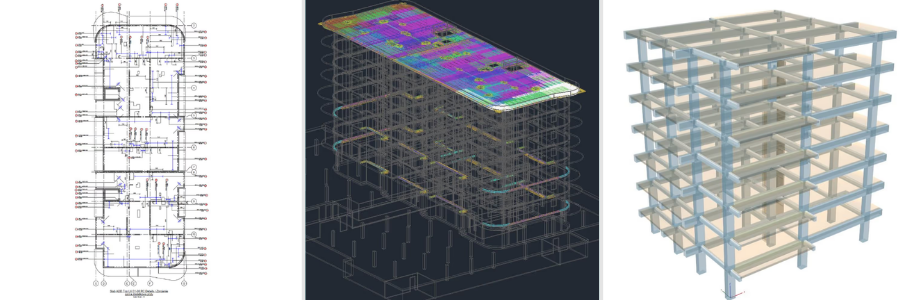
Rebar detailing and drawings by Cad Crowd design freelance experts

RELATED: Structural steel detailing services for companies: Steel detailer costs and rates complete breakdown

What’s a rebar shop drawing?

Every project comes with a set of construction documents. A rebar shop drawing is a blueprint created as a detailed visualization for reinforced components. It specifies and configures rebars to be placed in the concrete mix of various load-bearing components in a structure.

A rebar detailer creates a shop drawing based on the engineer’s latest design/construction plan. The problem is that in most projects, there’s barely any direct contact between the detailer and the engineer; any communication between them is typically bridged by the general contractor (GC). In case of unclear or missing information in the design plan, the detailer must submit an RFI (Request for Information) to the engineer through the GC. And the standard response time is around two weeks.

Professional rebar detailers are not mere “image editors” who receive a design plan and add rebar visualization to the drawings. They’re problem-solvers to figure out the most effective rebar configuration for the construction. The shop drawings are sent back to the engineers, and if approved, will eventually reach the hands of rebar fabricators and installers. A proper rebar shop drawing must contain at least the following information:

  • Rebar schedule: a comprehensive list of rebars required for the construction project. The list should mention the shapes, sizes, grades, and quantities of reinforcement steel rods. This is to make sure that all the materials are prepared and ready for fabrication.
  • Material specifications: additional information to reiterate the specifications of rebar, concrete elements, and other materials required for the installation. It provides insights into the overall strength, performance, durability, and cost factors of the structure.
  • Rebar details: visualization for the rebar assembly process. The main idea is to provide visual guides to the types and spacing of the rebars. Architectural visualization services may include representation of bends, hooks, and other fixtures. Keep in mind that the visualization is more than a mere image, but a data-driven drawing based on the intended design and strength of the structure.
  • Bar bending schedules: a complete list of rebars to be bent and cut during fabrication. If the bars are already cut and bent to specifications, the construction workers can be expected to finish the assembly and installation processes quickly. Every single bar should fit well in the designated spot without further modification on-site.
  • Clear cover: a visual representation to depict the space between the outer surface of the concrete and the nearest-positioned rebar unit. A safe distance keeps the rebar from corrosion and rust, so the reinforcement remains effective over an extended period of time.
  • Development and lap lengths: an estimation to show how the rebars should be spliced and lapped for a more seamless continuity and to optimize structural strength.
  • Anchorage details: information about the pattern and length of the rebar that must be anchored into the concrete. This is especially important if the anchorage has to be aligned with other structural elements by structural design services.
  • Spacing and location: construction drawings to represent the complete details of rebar placement inside the concrete. Every single rebar (with all the specifications) must be accounted for.
  • Structural notes: a set of instructions for the rebar installers/contractors. It’s filled with specific information such as construction methods and the required structural strength.

During the process of creating a rebar shop drawing, the detailer works closely with the general contractor, the structural engineer, and the fabricator to achieve high accuracy. Well-coordinated teamwork is expected to deliver error-free drawings that simplify both the fabrication and construction tasks.

RELATED: How to detail sheet metal shop drawings for increased fabrication accuracy for companies

Common Challenges in Rebar Detailing

Even a seasoned detailer doesn’t always produce accurate rebar shop drawings on the first attempt. Among the most common challenges are listed below:

  • Reinforcing steel clashes: using multiple drawings for separate structural elements makes the configuration susceptible to clashes, for example, rebars interfering with each other or sticking out of the concrete because the drawings aren’t correctly aligned. The good thing is that a unified, data-rich, realistic 3D model can provide a better visualization to help solve the issue for architectural design experts.
  • Intricate design: while there’s nothing wrong with complex designs, inexperienced detailers may find it challenging to interpret the engineer’s construction plan. A thorough analysis of load distribution is crucial to prepare the shop drawing because incorrect interpretation may lead to structural collapse if left unaddressed. It might be necessary to use an in-depth 3D model and structural analysis software to prevent mistakes.
  • Design modification and specification change: In the event that the architect or the engineer makes an alteration, especially concerning the construction plan of any of the structural elements, the rebar shop drawing must be redone. An alteration requires a systematic reassessment to identify potential effects on the rebar specifications, placement, schedule, and budget. It is wise not to commission rebar shop drawings until the design is finalized.

Most AEC companies and rebar detailers still use the conventional 2D imagery for shop drawings, which may not illustrate the placement and configuration of reinforcing steel with precision. 2D drawings are also difficult to interpret, further adding unnecessary challenges to an already intricate rebar detailing task. But the conventional way is slowly growing out of trend in favor of 3D modeling design services and BIM-based shop drawings. A data-rich model delivers a realistic visualization of the rebar with automatic cost estimation and a real-time update feature.

rebar designs and detailing by Cad Crowd freelancers

RELATED: Casework vs. millwork design: A detailed breakdown for freelancers and architectural firms

Takeaway

Meticulous planning and accurate cost estimation play significant roles in the success of every facet of a construction project. Among the most crucial aspects of a construction are well-built structural elements, such as foundations, beams, columns, slabs, trusses, and walls. Because all those load-bearing components form the backbone of durable structures, it only makes good sense to be fastidious about how you build them.

In designing load-bearing components, rebar detailing is a pivotal point that will determine the overall structural strength of the building. The rebar shop drawing serves as a blueprint for the configuration and placement of the reinforcing steel within the concrete. It makes sure that the rebar is fabricated to the correct specification and installed in accordance with the specific design requirements of the structure.

How Cad Crowd can help

Considering the importance of rebar shop drawings, it takes an unparalleled expertise in rebar detailing to produce precise shop drawings that guarantee not only the structural integrity of the building but also cost efficiency. Cad Crowd, the AEC-focused freelancing platform, is home to rebar detailing professionals committed to providing quality services at affordable rates. Request a quote today.

author avatar

MacKenzie Brown is the founder and CEO of Cad Crowd. With over 18 years of experience in launching and scaling platforms specializing in CAD services, product design, manufacturing, hardware, and software development, MacKenzie is a recognized authority in the engineering industry. Under his leadership, Cad Crowd serves esteemed clients like NASA, JPL, the U.S. Navy, and Fortune 500 companies, empowering innovators with access to high-quality design and engineering talent.

Connect with me: LinkedInXCad Crowd

Sega Cancels Its ‘Super Game’ Plan


Sega has cancelled its mysterious “Super Game” project five years after announcing it, according to its 2026 fiscal year financial results. The company made the decision following the weak performance of its free-to-play and “games-as-a-service” titles like Sonic Rumble Party. Sega also cited financial struggles with Angry Birds developer Rovio. 

It’s never been clear exactly what Super Game was, with Sega previously painting it in hilariously vague terms. In 2023 the company said it involved “the concept of a game that stands head and shoulder above normal games,” after previously describing it as “large-scale, global games.” Super Game also involved online play somehow, with Microsoft’s Azure cloud platform powering development. Sega was planning to invest about $880 million and release it in March of 2026. 

Whatever it was, it’s now dead. The company has shifted over 100 people who were working on free-to-play games over to development on games that people seem to actually care about. This includes “mainstay IPs” like reboots of Virtua Fighter, Golden Axe, Streets of Rage and Crazy Taxi that are still in progress. The company is also focusing on its biggest bright spot of late, movies, with upcoming titles including Sonic the Hedgehog 4, The Angry Birds Movie 3 and adaptations of OutRun, Golden Axe, Shinobi and Streets of Rage, among others.


AI voice startup Vapi hits $500M valuation after winning Amazon Ring over 40 rivals


Amazon Ring, facing a surge in customer-support calls during last year’s holiday season, evaluated more than 40 AI voice vendors before choosing startup Vapi to handle its inbound phone traffic. Today, Ring routes 100% of its inbound calls through Vapi’s platform.

That deployment helped Vapi raise a $50 million Series B led by Peak XV Partners at a valuation of around $500 million after investment, according to a person familiar with the matter.

Ring turned to Vapi in mid-Q4 last year, when it was weighing whether to expand call-center capacity, rely more heavily on traditional automated phone systems, or deploy AI agents that could respond more naturally to customers, Vapi Chief Executive Jordan Dearsley (pictured above, left) told TechCrunch. Dearsley believes Ring chose Vapi because if offered Ring engineers granular control over how the AI agents behaved in live customer interactions.

Jason Mitura, vice president of software development at Amazon Ring, said Ring’s customer satisfaction scores improved after deploying Vapi’s platform and that the company’s teams were able to tune the AI agent experience without depending on engineering. “A lot of AI tools promise great outcomes — Vapi has delivered on them,” he said.

Founded by Dearsley and his University of Waterloo classmate Nikhil Gupta (pictured above, right), Vapi grew out of an AI therapist Dearsley built in 2023 for conversations during his daily walks. The pair, who had gone through Y Combinator with productivity startup Superpowered, found that while few people wanted the therapy product itself, startups were increasingly interested in the low-latency voice infrastructure underneath it. This led them to pivot to Vapi and launch the platform publicly in 2024.

Vapi provides tools for companies to build, deploy, and manage voice agents across customer support, lead qualification, appointment scheduling, and outbound sales.

Image Credits:Vapi

The startup says it has now handled more than 1 billion calls through its platform, with usage accelerating as enterprises move more customer interactions onto AI systems. Vapi, Dearsley said, currently processes between 1 million and 5 million calls a day, with enterprise customers accounting for the bulk of that volume.

In addition to Amazon Ring, Vapi’s enterprise customers include Kavak, Instawork, New York Life, UnityAI, Cherry, and Intuit. The startup also operates a self-serve developer platform that has been used by more than 1 million developers.

“Because we started from self-serve and had such a wide developer footprint, we were already battle-tested at significant scale before we signed our first major enterprise customer,” Dearsley said.

Other investors participating in the Series B round included Microsoft’s M12, Kleiner Perkins, and Bessemer Venture Partners, bringing Vapi’s total funding to $72 million. The startup is currently at an annual recurring revenue run rate in the “healthy” eight figures, an investor source told TechCrunch.

Vapi is part of a growing wave of AI voice startups that includes Sierra, Decagon, PolyAI, Bland, Retell, and ElevenLabs, as companies race to build systems capable of handling customer conversations with minimal human involvement. Dearsley said Vapi differentiates itself by focusing less on pre-packaged applications and more on the infrastructure and orchestration layer behind voice agents, particularly for enterprises that want greater control over reliability, compliance, and model behavior.

The startup currently has around 100 employees and plans to use the new funding to expand its engineering, infrastructure, and go-to-market teams.

“The golden problem is taking this indeterminate beast that is a model and taming it,” Dearsley said. “If you can do that, then you can provide value to the world.”

When you purchase through links in our articles, we may earn a small commission. This doesn’t affect our editorial independence.