Every day, thousands of small businesses and home office users sit down at their computers with no idea that their network is essentially an open door. A 2023 report from IBM found that the average cost of a data breach reached $4.45 million globally, and small businesses are increasingly in the crosshairs. At PC Geeks, a trusted technology services company dedicated to helping everyday people and businesses take control of their digital environments, this is the problem we solve before it becomes a crisis. A professional computer setup paired with a secure network is not a luxury reserved for large corporations. It is something every working professional and small business owner deserves, and it is far more achievable than most people realize.
The challenge is that most people set up their computers and networks the way they assemble furniture without instructions: good enough until something goes wrong. A router left with its factory default password, a computer with software updates perpetually dismissed, and a home and office network sharing the same Wi-Fi signal are all extremely common, and all extremely risky. Understanding what a secure, professional setup actually looks like is the first step toward protecting your livelihood, your clients, and your peace of mind.
What “Professional Setup” Actually Means
A professional computer setup is not just about having a fast machine with a large monitor. It is about creating a workspace where hardware, software, and network infrastructure all work together intentionally. This means your computer is configured with the right operating system settings, your peripherals are properly connected and updated, and your workspace is optimized for both productivity and security. Think of it the way a well-designed office building works: every component serves a purpose, and nothing is left to chance.
Start With Your Hardware Foundation
The physical components of your setup matter more than most users acknowledge. A business-grade computer, whether desktop or laptop, typically comes with firmware protections and hardware encryption capabilities that consumer-grade machines lack. Pairing that machine with a quality router, rather than the device your internet provider hands you by default, gives you far more control over your network traffic. Routers from brands with strong security reputations offer features like firewall controls, traffic monitoring, and automatic firmware updates that the standard ISP-issued box simply does not.
Securing the Network Itself
Your Wi-Fi network is the gateway to everything connected inside your home or office, and it deserves serious attention. A strong network password using WPA3 encryption, the current gold standard in wireless security, is your first line of defense. Beyond that, segmenting your network by creating a separate guest network for visitors, smart devices, and anything that does not need access to your primary files keeps sensitive information isolated. If a smart thermostat or a visitor’s phone were to become compromised, network segmentation means that threat cannot reach your business documents or financial accounts.
Software Configuration and Updates
One of the most overlooked aspects of a secure professional setup is software hygiene. Operating system updates are not just about new features; they close security vulnerabilities that cybercriminals actively exploit. Enabling automatic updates, using a reputable antivirus solution with real-time protection, and configuring a firewall at both the router and the operating system level creates a layered defense that is far more effective than any single tool alone. A password manager is another underutilized asset, allowing you to maintain strong, unique credentials for every account without relying on memory or repetition.
The Role of a VPN and Remote Access Security
For anyone working remotely or accessing business resources from outside the office, a Virtual Private Network, commonly called a VPN, encrypts the data traveling between your device and the internet. This is especially important on public Wi-Fi networks, which are notoriously easy to exploit. A VPN essentially wraps your data in a private tunnel so that even if someone intercepts your connection, what they see is unreadable. Combined with multi-factor authentication, which requires a second form of verification beyond just a password, remote access becomes significantly harder for unauthorized users to exploit.
Backup Systems Are Part of Security
A truly professional setup accounts for what happens when something does go wrong. Ransomware attacks, hardware failures, and accidental deletions are all real and recurring events. Maintaining a 3-2-1 backup strategy, meaning three copies of your data stored on two different types of media with one copy kept offsite or in the cloud, ensures that no single incident can wipe out your work. Many businesses that suffer a major data loss without a backup do not recover. The ones that do had a plan in place before the problem arrived.
Building Confidence in Your Digital Environment
A secure, professional computer setup is ultimately about confidence. When your hardware is sound, your network is locked down, your software is current, and your data is backed up, you can focus on the work that actually matters. PC Geeks specializes in helping individuals and businesses assess where they are, identify the gaps, and build a setup that works as hard as they do. Whether you are starting from scratch or rethinking an existing system, the right configuration makes everything more reliable, more efficient, and far more secure. Reach out to PC Geeks today to schedule a professional network assessment and take the guesswork out of your digital security.
Rework is one of the costliest setbacks in any project. It not only causes a delay in the whole production but also weakens the client’s confidence in the output. The way the hours are extended beyond the committed ones, and the efforts being doubled, is indeed a challenge, as it may or may not be agreed on.
Sometimes, reworks do not really happen because the product design firm is incapable or lacks resources, or it could be because the product brief is not clear. It is important that the intention is set clearly so the working team wouldn’t have to assume, since revisions or rework happen when there are a lot of assumptions.
A properly structured brief could’ve prevented this. With this, it has a clear depiction and a structured direction of what’s expected to be delivered. Cad Crowd connects businesses to screened professionals, CAD specialists, and designers. This way, you can be assured that rework can be prevented.
🚀 Table of contents
The real cost of rework
Rework does not seem like a big deal at first. It starts with a simple scale request, like a color or a material change. It could also be an adjustment to sizing or a further request for a different scale. The request seemed minor, and it was often overlooked. From this, all adjustments have to be made for another duration, and all models would then have to be updated. These small things may look menial at first, but once stacked, their impact would be dramatic. It costs not only the time extensions, the resources, the efforts, but also the team’s morale.
In approaching how a product brief should start, it should focus on the question “What is really the problem?” It is often practiced how one should be interesting or amusing, or uniquely creative, to be sold in the market, but the core should not be neglected, and that is to properly specify the efficient solution by consumer product design companies. It should clearly deliver the context, the possible solutions, the existing solutions that fail, and why they failed. The data should be able to speak for itself. At this stage, it is essential that there is clarity in what the problem the entire project is addressing, as this will be the anchor of the project. This can prevent the repetition of work.
Identify the primary user precisely
A product or a project’s success is dependent on how a consumer or a user sees it. It is important that the brief clearly defines who the project or product serves, who its target market is, and how it fits them. Generic terms should be avoided and instead identify specifically who their products are intended for. It should be able to answer the questions “What are their routines?”, “Where are they most exposed to?” Break down the importance of their needs, what is the most prioritized feature, is it comfort, efficiency, price, or sustainability? With these being identified, design trade-offs would be much easier, and the vision is clearly aligned. If the end-user is clarified, there would be less feedback intended for revisions.
Translate goals into measurable criteria
Being vague about the product description can lead to subjective assumption of what it could mean. An example is wanting the product to be durable, but its lifecycle is not even mentioned in the brief. This could lead to guesswork, which could lead to rework. Instead of giving ambiguous goals, it is better to be specific and measurable, like when you want to be lightweight, then state how the weight should be. Indicate the surface textures, how smooth or how rough it should be. A criterion must be set, and it should be quantifiable, so the design process can be measured objectively. This way, there would be fewer assumptions, as there are clear metrics of how the development of the product should be.
Document functional requirements in detail
One of the causes of rework is that the functionality is not met. During the brief, a list of how it performs should be broken down and prioritized. Simple terms wouldn’t cut it, and too much may overcomplicate and overlap some features. It is best to be direct so that it can reduce interpretation errors.
Clarify physical constraints early
One of the details that is often overlooked is the physical constraints of a product, like how it must fit the manufacturing site, or the desired packages, or even the prefabricated model it should fit in. The product design expert cannot guess what would be the most appropriate fit unless it is clearly specified. The project brief should include all the dimensions of the product and its dimensional boundaries as well. There should also be the weight limits and size limitations. Ensuring all these details will limit redesign.
Outline manufacturing methods
When there is design, there is also manufacturing. These two are inseparable, as they are consecutive stages that typically go hand in hand. So, details regarding its manufacturing could also help improve visualization of the product clearly, meaning if there is a need for a molder, then add it. Or, if there is a need for sheet metal or some things that are to be fabricated, then it is best to indicate it with its corresponding material specification, such as thickness and finish. It should also be discussed what the anticipated volume is, so approaches for how it will be produced are considered. From this, redesign due to manufacturing proposal rejections can be reduced.
Provide transparent budget parameters
It is always best to be transparent regarding the budget constraints. Cost limitations are not to be hidden, because they may cause tensions among all the stakeholders. Knowing the budget can make the team strategize on how it will be distributed. Realistic approaches are considered, defining the materials needed and the tools as well. When all these are defined, the team prevents costly redesigns and creates a smarter and more efficient decision.
Establish clear deliverables
What to expect as an output is one of the measurable criteria if the work is done or not. The product brief should always have a list of the expected deliverables. Not only should it specify the files to be included, but also its required file formats. This way, there is less back-and-forth during the submission process. Measurement tolerances and scaling preferences should also be discussed, and if there’s a need for further support files, like a render for marketing. This will ensure that the design team knows what they’re expected to submit instead of guessing what the final output is required.
Set a structured review framework
Structured review and feedback make the project seamless and smooth all throughout. It is important to designate stages at which reviews will be done and who the proper correspondent is, such as other engineering design firms if needed. This will prevent confusion and keep the whole development focused and not scattered. In addition, it is best to specify revision limits for every stage and phase, so that there would be unnecessary iterations.
The stakeholders’ opinions and visions are all essential to the project, and often, confusion about which preferences are to be followed triggers tension within the team. In this case, internal alignment is to be done during the planning and brief. The engineering, marketing, finance, and even the operations should be able to agree on what the prioritized attributes are before the design stage. Although there are certainly times when there could be an undecided trade-off, it is best to define them. The progress would be slow if there’s an internal conflict, so a unified direction would definitely lessen the risks of alterations.
Address regulatory and compliance requirements
In some industries, compliance is non-negotiable, which means there are certain tests, certifications, and documents that are needed. These requirements must be specified during the brief and must be listed. Clarity of the requirements at this stage will prevent the list from being overlooked. It helps the working team to know and anticipate what else is necessary for documentation.
Anticipate integration challenges
Integration ambiguity could lead to more iterations if not addressed properly. To prevent this, provide the necessary and anticipated integration requirements. Data protocols, if necessary and involved, must be discussed as well as interface specifications. Expectations of compatibility should also be identified. This can prevent revision due to incompatibility.
Include risk assessment
In every project development, there is an inevitable risk. These uncertainties and vulnerabilities should clearly be identified during the initial brief; highlighting these challenges is a proactive approach to making a design decision. It lessens reaction-driven rework and makes the development process more efficient. It is best to anticipate challenges and risks instead of reacting and facing them.
Plan for controlled changes
Even though change is inevitable, it doesn’t mean that there is no appropriate solution for it. Inevitable change is costly, and when the project has a budget limitation, it would be challenging to handle even for experienced product development experts. For this, a documented variation management should be included in the discussion. The requirements have to be well-evaluated, and the project inclusion and exclusion criteria should be set. Implementing structured change control helps minimize scope creep and maintain project stability.
Encourage early collaboration
Encouraging the whole team for an early discussion is a great start. This collaboration at kickoff strengthens alignment and opens workability stability. The discussion would expose expectations and even the sudden assumptions that may be considered as challenges if not addressed. This way, any unclear items identified during the initial stage can be addressed immediately.
Document assumptions explicitly
In a project, assumptions could be present, but if not documented, this may lead to confusion and possibly a rework. So from the very start, it’s better to list down any unstated assumptions and possible risks. You can also document potential user behaviors early on. If any assumptions change along the way, just update the documentation accordingly. Keeping everything transparent helps avoid unnecessary rework.
Maintain version control
Tracking the briefs and the revisions being made is one way to reduce scattered updates. Having a centralized documentation of these updates will make it easier to track, and it makes the revision formal. This ensures that stakeholders understand what happened throughout the process and prevents repeated instructions. It also helps avoid informal or undocumented revisions.
Define technical specifications with precision
Technical specifications that are too vague may lead to assumptions for the working team or product engineering service. To prevent this, it is best to clearly identify what is really needed from the start. For an instant, if there’s a need for a material grade, then state it. Or if there’s a preferred surface finish, identify it. This will save a lot of time and effort for the whole team as they won’t be guessing. There would be less room for correction, and it can ensure a smooth transition of work.
Differentiate between requirements and preferences
There is a clear line between a preference and a requirement, but if these ideas are tangled together and mistaken for each other, then it would be a disaster. During the meeting or a brief, it is important to document which ones are considered as preferences; these could have cue lines such as “preferred” or “ideals”. Also state the non-negotiable ones so they would be the ones to be prioritized. This way, there would be prevention of the requirements being overlooked.
Provide context for brand alignment
The brand gives individuality and uniqueness to the product. To ensure that it aligns with the brand, proper context has to be provided. These includes color palette to be used, or the textures and some other visual references that are in accordance with the brand guidelines. A clear brand context would reduce relative ideas and assumptions on how it is aligned with it. It prevents awkward alignment that may lead to redesign.
Since some products have strict or non-negotiable compliance requirements, such as testing. Expecting and anticipation that the test would be in the brief. It should be able to note how the performance of the product will be evaluated, or how it will undergo certain testing. This would make the consumer product design experts know what the product is expected to undergo accordingly.
Clarify intellectual property expectations
Ownership terms should be set in the beginning, mentioning who has the rights to the design files as well as the revisions. Clear intellectual property boundaries can avoid possible disputes that may hinder the project’s progress. If there is a need for a patent, then note it so it can be anticipated later on. If there’s also a confidentiality expectation, then it is best to mention it during the brief.
Address sustainability considerations
Some countries take sustainability considerations seriously, and they see this as a requirement. If there is a need for it, then it must be discussed beforehand. Sustainability goals would require discussion about the materials to be used and their lifespan expectations. This will prevent redesign due to compliance. This way, strategies can be formed that align best with sustainability standards.
Document supply chain dependencies
Supply chain awareness is also important in the design decision. It is important to note if there are certain constraints that must be noted, like the lead times, geographic sourcing, and the suppliers they are partnering with, or something; just list them. The reason for this is to avoid the chances of rework because of the unavailability of some materials. This could be something that may be overlooked, but can be handled if addressed correctly by industrial design services.
Define communication protocols
Communication sounds easy and sometimes still leads to confusion. This is because there is no clarity on which channels are to be used, so it could be scattered. The right correspondence and alternative should be set formally, and the response time should be defined as well. This will prevent delays, as there would be no need to guess because of incomplete information.
Establish milestones with clear outcomes
Clear milestones would reduce ambiguity in what was expected to be done within a certain timeframe. It is best to define what progress is expected in every stage and the criteria to be met. This will make it easier for all stakeholders to track if the completion time is possible or if the timeline is realistic. All the stages and the review feedback should be updated to keep track.
Prepare for prototyping realities
In doing prototyping, proactive planning should be done to reduce frustration. Define the allocation for testing, what is the accepted performance and deviations, and if there are material limitations. This will lessen the cost it may incur for redesign or rework.
Avoid overloading the brief with unverified ideas
Not all the ideas are to be presented in the brief. It is important to note that a brief is what makes the project, so speculations or some raw ideas could cause a sway in the original vision. Weighing ideas can make the brief more efficient and meaningful, especially for prototype design engineering services. It should have a full context of all the things needed for the project’s success.
Balance detail with focus
To ensure that there is no overlapping of ideas or chaotic thoughts during the meeting, it is best to be strategic about it. Create an agenda and organize all the information logically. All the related requirements must be collated together, and the small details added next. It could have structured sections or even keywords. Having a logical train of thought would help avoid overlooked details.
Integrate feedback from previous projects
The history of past projects can add value to the present. The lessons learned must be documented to address and improve what went wrong in the past. Utilize the past recorded information to strengthen the briefs for a greater improvement and to not repeat the same mistakes. This experience could provide further clarity to the work.
Anticipate lifecycle expansion
Designing a product means also giving it life, and most likely it can extend further through other updated versions. With this, anticipation for design possibilities must be noted, and the upgrade pathways it has. This is an efficient way of designing, since it involves long term feature for the product. It protects investment.
Encourage documentation transparency
3D design services are not limited to CAD files; it also covers specifications, maintenance guidelines, and installation instructions. The whole documentation is a streamlined reference collated to produce the design. All the files should be listed in a way that is aligned with the formatting preferences with the help of.
Cost and performance are two things that matter the most in a product, and they must align. If there is a preferred durability, but with a limited budget, then recognize the trade-off. With this, it is best to collaborate with the design teams to welcome balanced solutions. Transparency could help prevent disappointment since expectations can now be set. This helps realistic decision-making.
Ensure leadership visibility
A leader gives firm direction to the group. If there is a defined leader who is responsible for the reviews and approvals, then it should be noted. This prevents stages wherein there is a rework because of late executive input.
Document packaging and distribution requirements
Packaging has an impact on the product design. The details of dimensions, the test standards, and even the storage conditions should be noted and considered. There should be clarity with the sizing expectation, so there would be no conflict with the logistics.
Define maintenance and service expectations
Not only is the lifespan included in the expectations of the product, but also its maintenance and serviceability. This means that if the product is said to be easily repaired, then the components must have easy access requirements. There should be maintenance documentation and an expected repair environment. This ensures that the lifespan is ensured and aligned with consumer expectations.
Strengthen briefs through iterative refinement
Not all initial briefs are perfect. It gives the context, but it is rarely the final. It has to be reviewed thoroughly and improved to clear up unclear sections. Critiques could be welcomed to challenge the ideas. A refinement of the first brief reduces the confusion. It gives confidence to the open innovation experts and protects the whole team from wasted time and effort.
Build collaborative partnerships
A great network creates a strong brief. Treat the designers as a strategic partner in collaborative work. Welcome the balance of ideas and technicalities. It is best to remain open for critique and challenge the ideas being presented. This rejects rigid thinking and encourages healthy feedback. This strategic collaboration helps improve the outcome of the project.
Quantify decision criteria before concept development
Measured decision criteria have to be set to define the evaluation process. In reviewing, it should be able to clearly identify which ones are prioritized. Document the weighted criteria, whether cost weighs more than performance, or is it durability that matters the most, or is aesthetics much preferred to weigh more? When these attributes are reviewed with quantities, it is easy to pinpoint and decide. There would be measurable standards that may ease the review process and lessen subjective judgment.
Address cross-functional dependencies
Some products are launched alone, and some are planned and aligned with seasonal campaigns. Whichever it is, it is best to take note of the marketing timelines, the procurement plans, and how the customer support workflow is. This cross-functional documentation has an impact since it gives designers better timeline decisions. It gives clarity and avoids rushed rework before launch.
Clarify digital integration requirements
In this current world, wherein most products are designed modernly, they often include digital components. Note in mind that when this is applicable, the software interfaces and integrations have to be defined. Indicate the security standards and the operating system or platforms. Doing early coordination can lessen integration rework.
Define tolerance philosophy
Design and manufacturing design services come hand in hand and are directly connected. Precision in design is defined by tolerances. The higher the tolerance is, the higher the manufacturing costs are. Clear tolerance expectations can help guide the designers in their decision-making. If the cost were weighted more than precision, then there would be an acceptable flexibility in how the outcome would be. Clearing this will prevent redesign due to precision expectations.
There are environmental factors that can often lead to unexpected redesign if not addressed early. They could include exposure to moisture, UV rays, corrosive substances, and extreme temperature change. The brief should have context on whether the product is supposed to be just for indoor or outdoor use. Setting these conditions should be discussed in the brief, as this information can reduce the risk of redesign due to testing failures.
Conclusion
A strategic product brief is not just an administrative requirement. It is one way to control costs and reduce risks in a project. It can shape the entire development process. The problems and risks, when defined and identified clearly, can be addressed early on, and rework can be prevented. A strong brief protects the costs and accelerates timelines, creating a positive connection among professionals. It gives confidence to the team and boosts morale.
In Cad Crowd, a great pool of vetted freelancers is ready to aid in translating the complex and detailed product briefs into production ready approach and solution. You can pair seamlessly with a talent who’s comprehensive with strategic clarity. Dramatically reduce rework with Cad Crowd. Improve life by letting Cad Crowd build your path in the market. Request a quote today.
MacKenzie Brown is the founder and CEO of Cad Crowd. With over 18 years of experience in launching and scaling platforms specializing in CAD services, product design, manufacturing, hardware, and software development, MacKenzie is a recognized authority in the engineering industry. Under his leadership, Cad Crowd serves esteemed clients like NASA, JPL, the U.S. Navy, and Fortune 500 companies, empowering innovators with access to high-quality design and engineering talent.
If your idea of great FPS level aesthetics is a hot mess of Black Mesa, Penumbra and Get Even – or you’re just driven wild by the sight of porcelain tiles peeling flirtatiously away from mortar – you might get on with Industria 2, which launches today. I’ve not played the first one, but I admired its parallel dimension Cold War-era Berlin. The second game introduces a new parallel dimension, summarised by developers Bleakmill as a tug-of-war between “industrial decay”, “boreal nature” and “otherworldly sprawling machine structures”. Phwoar!
Starting in Visual Studio 18.5, you can create and build Visual Studio extensions (VSIX) using an officially supported SDK-style project. This brings VSIX projects into the modern build and deployment pipeline, improving incremental build performance and making the build → deploy → debug workflow more reliable. Install the Visual Studio extension development workload to get the templates and tooling and try it out for yourself!
Note: Extensions written using the modern VisualStudio.Extensibility framework already supports SDK-style projects today. This update extends the same SDK-style experience to VSSDK-based Visual Studio extensions.
What We Are Adding:
Official SDK-style support for projects that produce VSSDK-based extensions.
Build time reductions of up to 75%! We’ve added end-to-end incremental build support including Fast Up To Date Check and up to date deployment logic. Through internal adoption, we see a reduction of up to 75% in build time in large solutions for small changes or changes confined to a single sub project.
Updated in-box templates: SDK-style by default, with the familiar project items (tool windows, classifiers, commands, etc.).
Project Usage
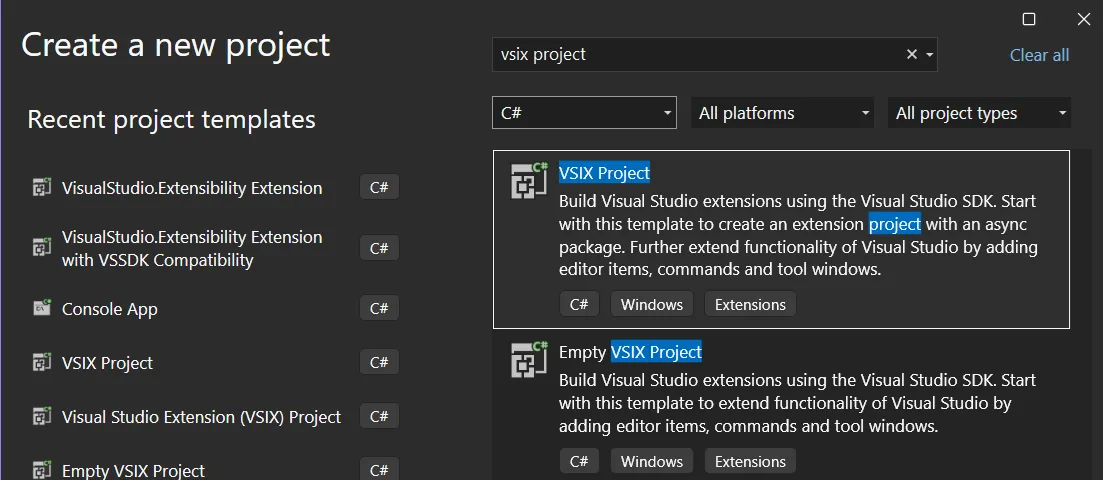
Creating a project is done the same way you are used to, using the “VSIX Project” or “Empty VSIX Project” template:
This will yield a much more compact csproj than before: only 20 lines:
If you create a new extension, you will automatically get full SDK-Style support.
Your existing MPF style extension will continue to work should you choose not to migrate. This update adds an official SDK-style option; it doesn’t force a conversion.
You can update your project to an SDK-style project file to take advantage of these features.
Vsixmanifest files included in SDK-style projects now open by default in the XML editor. The old designer is still available through the ‘Open With’ menu.
Migration In Brief
When available, you can do this in the project configuration:
<VSSDKBuildToolsAutoSetup>true</VSSDKBuildToolsAutoSetup> will setup most sensible defaults for you and reduce the size of your csproj. This will setup options like CreateVsixContainer as true, and the legacy DeployExtension to false.
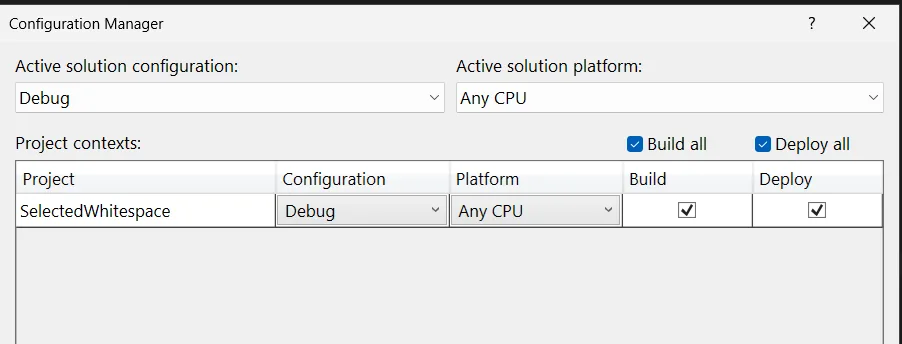
<VsixDeployOnDebug>true</VsixDeployOnDebug> Should be added to your csproj if you will add it to other solution files to ensure the deploy checkbox is set automatically.
Agentic conversion
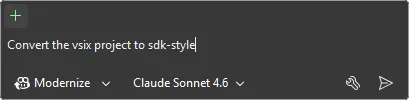
We’re experimenting with ways of making this as easy as possible for you. To that end, we’ve added an agent skill to the vs-agent-plugins repository you can use in conjunction with the Modernize agent. Let us know whether this workflow is helpful, or if you have a different agentic workflow in mind for extension development.
Reference projects
Here are a few extensions that are already converted, so you can use them as references.
We want to hear from you!
Please send us feedback and issues you encounter in Developer Community. Thank you, and happy extending!
Why 87% of IT Leaders Would Switch Productivity Suites
Overview
For years IT teams have closed the gaps in their tech stacks with connectors and add-ons. The result? A “frankentool” environment that’s expensive to maintain and complex to secure.
The data is staggering: only 6% of teams say their productivity suite is seamless. That’s why the next era of enterprise modernization won’t be about adding new features. It’ll be about unifying the tech you have—AI, collaboration, and device management—into a single, cohesive system.
In this new report from Google Workspace and JumpCloud, you’ll discover the full extent of the enterprise unification gap. And how to stop the cycle of tool complexity once and for all.
Grab your copy to learn:
How to align AI-driven productivity with strict identity and access management principles
Why 58% of DIY unification attempts fail and how to avoid common mistakes
The differences between how Microsoft vs. Google Workspace environments handle identity and device management at scale
Download the Report
Download the Report
Error: Contact form not found.
Trusted by Organizations Worldwide
About JumpCloud
JumpCloud is a cloud-based, unified IT management platform that centralizes identity, access, and device management, often serving as a modern, cloud-native alternative to Active Directory. It allows organizations to manage user identities, secure devices (Mac, Windows, Linux, mobile), and control access to resources from a single console, supporting hybrid and remote work.
The even better news is that you can get it all for just $34.97 (reg. $418.99) through May 31.
Mashable Deals
By signing up, you agree to receive recurring automated SMS marketing messages from Mashable Deals at the number provided. Msg and data rates may apply. Up to 2 messages/day. Reply STOP to opt out, HELP for help. Consent is not a condition of purchase. See our Privacy Policy and Terms of Use.
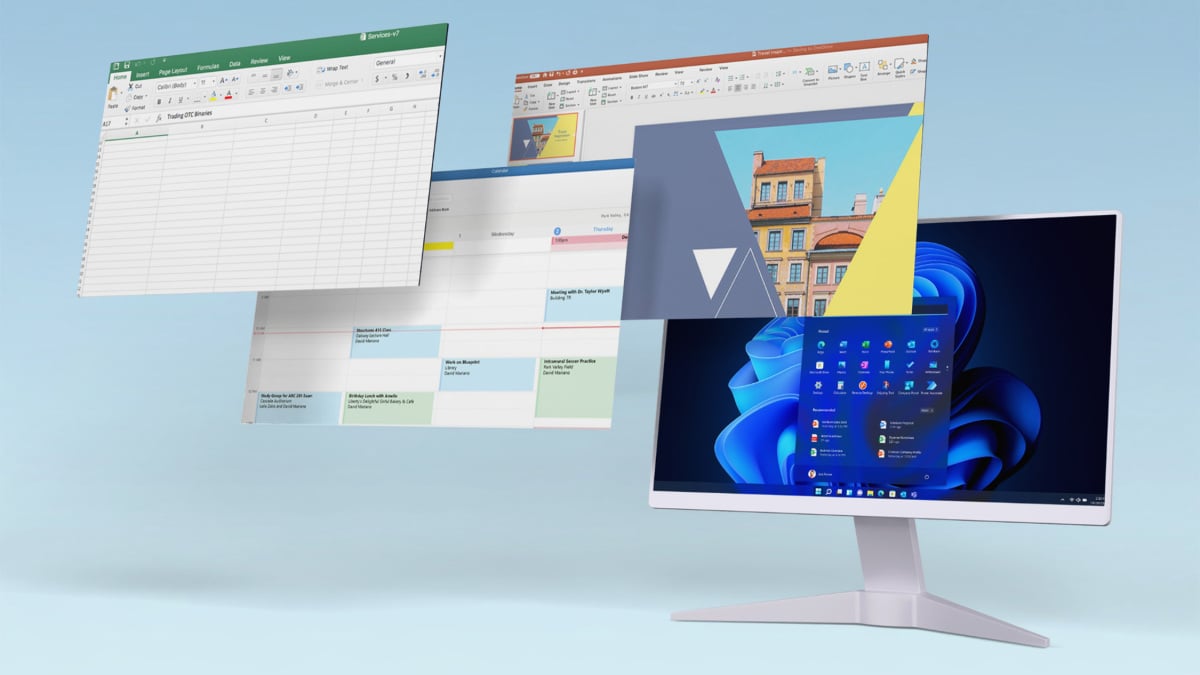
You’d be surprised what some fresh Microsoft tools and a new OS can do for your tried-and-true PC. This bundle can really spruce up an old device, starting with a mix of classic and new favorites in this Microsoft Office suite.
Microsoft Office Professional 2021 equips your computer with a suite of eight helpful apps. Get old staples you’ve used for decades, like Word, Excel, PowerPoint, and Outlook. Then see how new favorites like Teams, OneNote, Access, and Publisher can upgrade your workflow.
You don’t only get new tools to work with — you get a whole new operating system thanks to Windows 11 Pro. This bundle includes an OS designed with modern professionals in mind, featuring a powerful search experience, improved voice typing, snap layouts, and more.
If you haven’t been prioritizing your cybersecurity, you can rest easy knowing Windows 11 Pro amps things up. It offers biometric logins, encrypted authentication, and advanced antivirus defenses that can help keep your important data safe.
Mashable Deals
By signing up, you agree to receive recurring automated SMS marketing messages from Mashable Deals at the number provided. Msg and data rates may apply. Up to 2 messages/day. Reply STOP to opt out, HELP for help. Consent is not a condition of purchase. See our Privacy Policy and Terms of Use.
Plants vs. Zombies: Battle for Neighborville Direct Download
Kick some grass in Plants vs. Zombies: Battle for Neighborville, the wackiest shooter yet!
Welcome to Neighborville, where all is well. Except that a crazy, new, coniferous conflict between brain-less and botanicals is brewing! What are you gonna do, call the crops? Soil your plants? Prepare to kick some grass in a plant-on-zombie conflict that will take you to the outer edges of Neighborville and back again.
Go All Out in Online Multiplayer – Jump into the fray with up to 24 players in online multiplayer across a gigantic suburban skirmish. Bring the unique abilities of each character class to 6 PvP modes–including the new Battle Arena–and experience the unbeleafable thrills of combat.
Venture to the Outer Edges of Neighborville – The tension across the terra has expanded with free-roam regions that extend beyond the town of Neighborville. Squad up with up to 3 friends in the Giddy Park social region and take back Weirding Woods, Mount Steep and Neighborville Town Centre. It’s grow time! Far Far West
Customize Every Character for Battle – Join the newest bloom in the age-old battle between plants and zombies with 20 fully customizable classes at launch, including a Team Play class for each faction. Deck every character out with ludicrous looks and wacky weapons that show off your unique personality.
Features and System Requirements:
Choose from a large roster of plants and zombies with unique classes and special abilities.
Fight in team-based multiplayer with objective modes and competitive online matches.
Explore free-roam regions where you can complete quests, collect items, and fight AI enemies.
Play solo or with friends in split-screen and co-op modes.
Unlock cosmetics and upgrades to customize your favorite characters.
Screenshots
SystemRequirements
Minimum Requires a 64-bit processor and operating system
OS: 64-bit Windows 10
Processor: AMD: FX-4350 or Equivalent/ Intel: i3-3220 or Equivalent
Memory: 4 GB RAM
Graphics: AMD: Radeon HD 7730 or Equivalent/ NVIDIA: GeForce GT 640 or Equivalent
DirectX: Version 11
Storage: 15 GB available space
Support the game developers by purchasing the game on Steam
InstallationGuide
TurnOff Your Antivirus Before Installing Any Game
1 :: Download Game 2 :: Extract Game 3 :: Launch The Game 4 :: Have Fun 🙂
PDF is a widely versatile file format, and one often used when sharing CAD drawings. However, the amount of information in a PDF file is far less than that of a DWG file, which contains the necessary data for design.
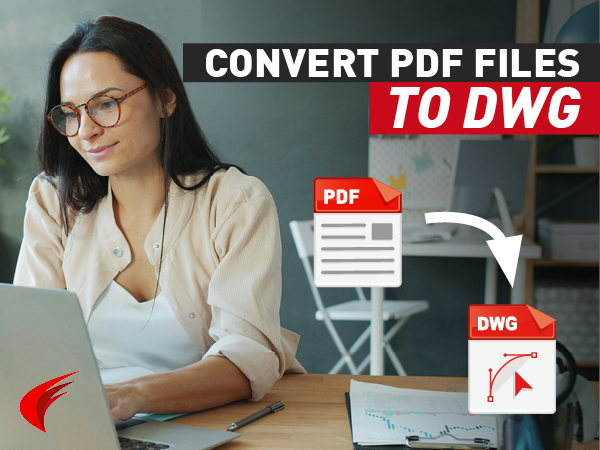
ARES CAD software can convert DWG drawings to PDF format, and naturally, it can also convert PDF to DWG with a single command – no need to install a separate PDF printer driver. ARES can also convert a PDF file that was originally converted from a DWG file back into a DWG file.
In this article, we explain how to convert PDF files to DWG files using ARES Commander, the world’s No. 1 AutoCAD alternative, as well as ARES Kudo and ARES Touch.
An advantage of ARES is that you can convert files with a single command, without having to install a separate PDF printer driver. To convert a PDF CAD drawing to DWG in ARES, use the IMPORTPDF command. Of course, you can also export the drawing and save it again in PDF format. For more details, please watch this video. PDF Import in “ARES” CAD Software
The ARES Trinity of CAD software comprises three distinct, yet interconnected, software applications: ARES Commander (desktop), ARES Touch (mobile), and ARES Kudo (cloud). All of them are equipped with 2D CAD features, allowing you to freely edit drawings by converting PDF files to DWG files. Watch this video to see the process of converting PDF to DWG with ARES Touch.
What if you have many PDFs to convert to editable DWG files? That could be time-consuming to complete manually. Thanks to ARES Kudo, you can use Online Drawings Automation to convert your PDFs automatically.
With this powerful service, users can schedule many tasks — including batch file conversion — to be handled in the cloud. To see how simple this hands-off process is, watch the video:
Can I convert PDF drawings to DWG for free with ARES?
ARES offers a 30-day free trial. During this trial period, you can convert to DWG for free. The 30-day free trial is available here.
Can I convert PDF drawings to DWG online with ARES?
The online version of ARES CAD software, called ARES Kudo, can be used in the cloud. ARES Kudo can not only convert PDF drawings to DWG, but can also edit DWG drawings online.
What is the difference between ARES DWG conversion and a free converter?
The biggest difference is likely the security issue. ARES is not merely a conversion app; it is a general-purpose CAD application and the No. 1 alternative to AutoCAD, and it has been adopted by world-renowned global companies. ARES provides robust security compared to free converters – it can be used with confidence in a secure environment.
To try the ARES Trinity of CAD software, simply create your free Graebert account and download the software: Start your 30-day free trial today
Overwatch x Hatred’s Reckoning is a deliberate clash of hope and darkness that lets both worlds stay true to themselves.
Five new Legendary skins reimagine Overwatch Heroes through Sanctuary’s lenses of Hell and chaos.
Available April 28–May 18, there will also be returning crossover skins, new challenges, and Twitch Drops through May 10.
Some collaborations are about swapping outfits. Overwatch x Hatred’s Reckoning, running April 28–May 18, is about figuring out how two very different worlds can borrow each other’s clothes—and still feel like themselves.
Overwatch is famously hopeful. It’s full of bright colors and Heroes who look like they believe things can get better, even when they’re knee‑deep in chaos. The world that inspires Hatred’s Reckoning, on the other hand, is all heavy atmosphere and big moods that don’t politely leave when the fight is over. Blending the two didn’t mean dialing either one down, it was about finding the overlap. Being able to bridge that gap without drifting into imitation required intention, restraint, and deep creative trust.
Interpretation was the key. The creative teams quickly realized that beneath the surface, both worlds actually take similar things very seriously: conviction, sacrifice, and what it means to keep fighting when things get grim. Once that clicked, the fun part began—asking what Overwatch Heroes might look like if they’d grown up in a different genre of battle.
Thus, five new Legendary skins were created, each playing with that “alternate fate” fantasy.
Ramattra x Mephisto turns hatred into something slow and inevitable—less explosion, more creeping dread.
Brigitte x Paladin is all about holding the line, faith and steel working together with zero hesitation.
Freja x Rogue keeps things quiet and efficient—clean shapes, quick strikes, no wasted motion.
Lifeweaver x Warlock leans into stark danger, where life and corruption are uncomfortably close friends.
And Mauga x Druid is joyful chaos showing up with muscles, teeth, and a very loud opinion.
Mauga’s skin proved to be a particularly creative puzzle. Turning a shapeshifting Werebear fantasy into a dual‑chaingun bruiser meant solving a lot of questions at once. His bear face, jaw, and eyes had to look great, animate smoothly, and still read clearly during gameplay. It was a balancing act between visual flair, technical reality, and “does this still feel like Mauga?” He’s the perfect example of exactly the kind of challenge the team loves tackling together.
In addition to these five skins, four Legendary skins return to complete the visual dialogue: Pharah x Inarius, Moira x Lilith, Reinhardt x Imperius, and Sombra x Gilded Hunter. Together, they act as echoes of earlier explorations of Sanctuary.
Alongside the skins, original event challenges return, joined by new rewards like the deliciously deadly Crab with a Knife Weapon Charm and Twitch Drops running now through May 10.
Hatred’s Reckoning proves that when hope and darkness collide, heroes rise—even when they’re wearing borrowed clothes from another world. Overwatch x Hatred’s Reckoning runs April 28–May 18.
Overwatch®
Blizzard Entertainment
☆☆☆☆☆ 73938
★★★★★
Xbox One X Enhanced
Ultimate Game Pass
Overwatch is an always-on and ever-evolving free-to-play, team-based hero shooter game set in an optimistic future, where every match is the ultimate 5v5 or 6v6 battlefield brawl featuring new heroes and maps, different ways to play, and unique cosmetics! Lead the charge, ambush your enemies, or aid your allies as one of Overwatch’s 40+ distinct heroes. Team up with friends, take them into battle across 25+ futuristic maps inspired by real-world locations, and master multiple unique game modes.
Reign of Talon – Season 2: Summit
Reach Heroic New Heights
The climb continues as a new Hero rises and the fight for a better future pushes higher than ever!
The story resumes in Reign of Talon – Season 2: Summit, raising the stakes as new DPS Hero Sierra joins the Overwatch ranks, and letting you stand with her in an Operation: Grand Mesa defensive event. Then celebrate your squad with the return of Post Match Accolades and explore a reworked Antarctica map. Plus, overclock justice as Mythic Volted Overdrive Solder: 76 and wield the Sumi-ichimonji Genji Mythic weapon to cut down your foes in style. Ramattra steps into Stadium alongside a new Lijiang Night Market map to expand experimentation and test your skills. And Spring has sprung in the Battle Pass and Shop, with Spring Fairy and Sakura looks for you to truly bloom on the battlefield. The climb is on, find out what lies beyond the summit!
I can definitely understand the cult following Lenovo ThinkPads have garnered over almost two decades of robust laptops. But as a PC gamer, I am perhaps less convinced by external graphics cards, i.e. eGPUs. Still, I’ve stumbled across a modding project combining the two things that I simply can’t look away from.
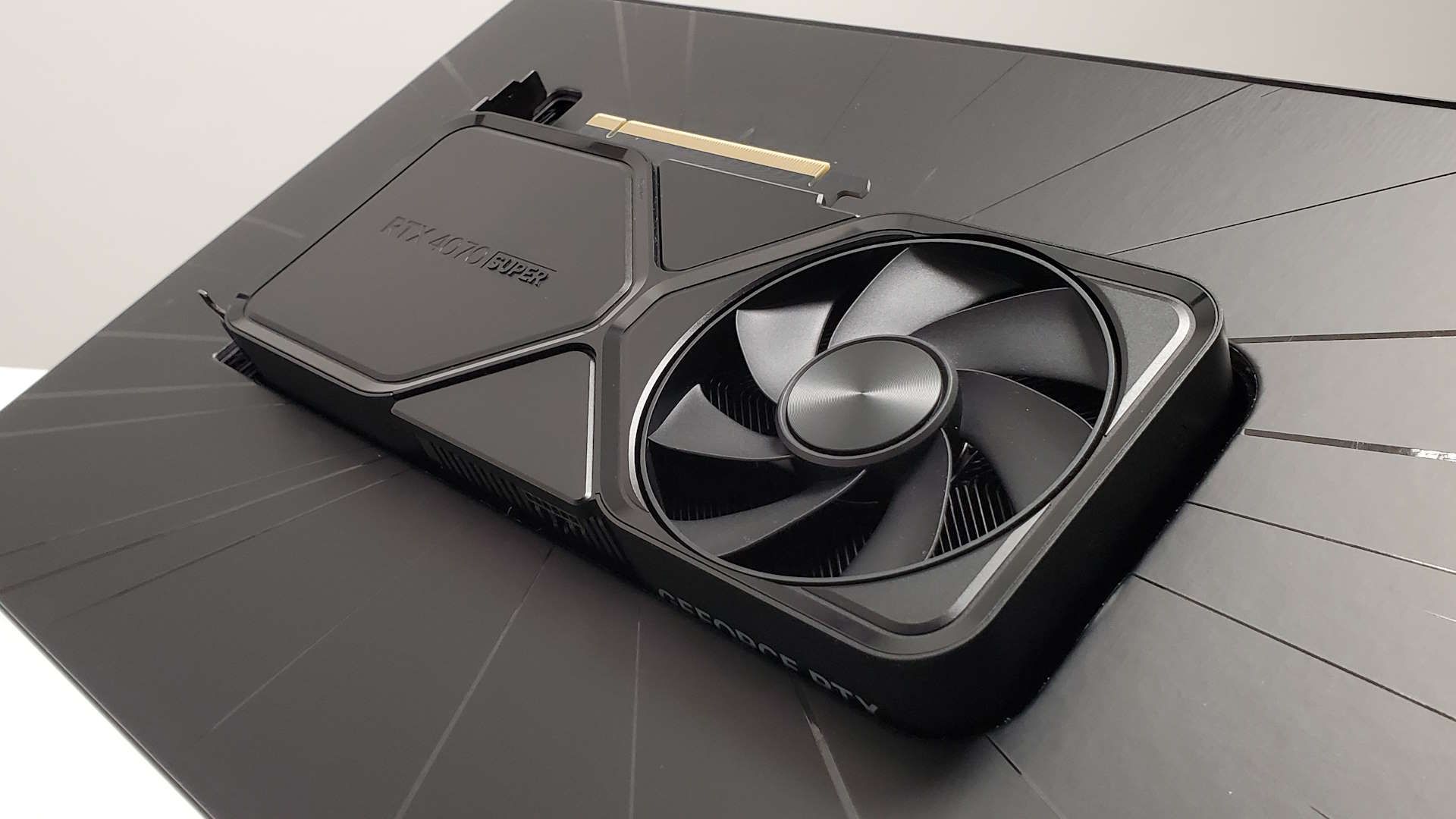
It turns out Instagram is a surprisingly good place to discover neat hardware projects. Case in point, user KabutoKunai has brought their 2008 ThinkPad up to date with an RTX 4070 Super. Opting for the chunky desktop version of the card, it will have to run outside of the laptop’s chassis like an eGPU—but how does the modder hook up all of this hardware, released decades apart?
Simple: via an OCuLink cable and a ‘sneaky’ internal M.2 slot. They first lifted the ThinkPad’s classic keyboard out of the way and removed the daughterboard beneath to get at the M.2 slot. They plugged in the OCuLink before replacing the daughter board. To better situate the OCuLink’s PCIe port, they created a custom, 3D printed socket to sit in the hard drive bay. This is arguably the most elegant half of the hardware mod.
The other half of the video sees the modder seating an MSI RTX 4070 Super on an external GPU logic board that converts the PCIe port back into another OCuLink cable (this arrangement is much like the OCuLink Dev Kit Framework just released). They then attached a ruddy great big Corsair RM750 PSU to the whole thing.
Bob’s your uncle, Debra’s your aunt, you still enjoy the form factor of the ThinkPad but with the option to plug in a lot more graphical grunt—and the less said about KabutoKunai’s booby mouse pad, the better.
The one other thing I don’t think I’ll ever get on with, though, is calling anything from 2008 ‘vintage’, as KabutoKunai does, hardware or otherwise. Metal Gear Solid 4: Guns of the Patriots and Persona 4 came out that same year—you can’t tell me that’s retro gaming now!
Keep up to date with the most important stories and the best deals, as picked by the PC Gamer team.