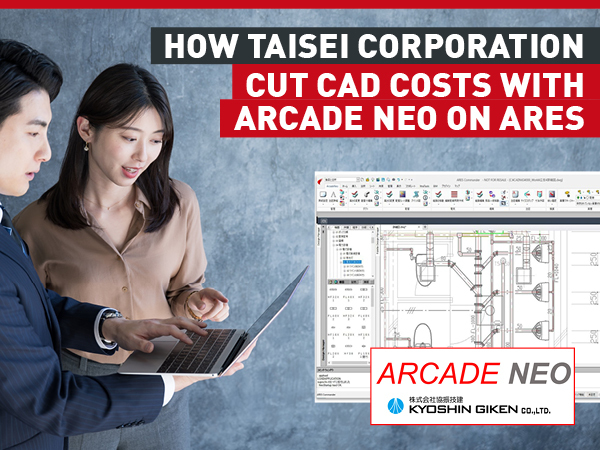
Why Taisei Corporation Chose ARCADE NEO for Building Services CAD
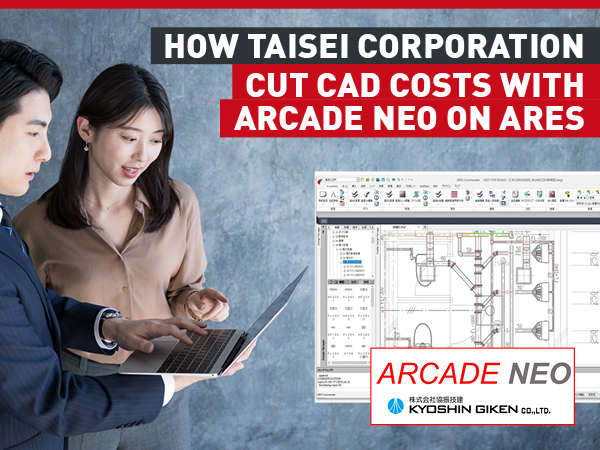
Customer Story | Taisei Corporation, Kyoshin Giken and ARES Commander
For large construction companies, changing CAD software is rarely as simple as replacing one application with another. Years of investment in specialized software, established design processes, and employee expertise can make even a relatively straightforward migration challenging.
But what happens when a major construction company decides that its preferred CAD platform should support the specialized applications it already relies on?
That was the challenge facing Taisei Corporation, one of Japan’s five largest construction companies, when it decided to move its specialized building services CAD solution from AutoCAD to ARES Commander.
Rather than abandoning the tools and workflows its designers had relied on for years, Taisei asked its long-standing technology partner, Kyoshin Giken, to redevelop its existing AutoCAD-based application for ARES Commander.
The result was ARCADE NEO, a specialized CAD solution built on approximately two decades of collaboration between the two companies.
This article is based on a customer interview originally conducted and published by Kyoshin Giken. Graebert has independently developed this story, incorporating additional context on CAD migration, ARES technologies, and third-party application development.
Their experience demonstrates that moving away from AutoCAD does not necessarily mean giving up the specialized applications, familiar workflows, or DWG files that organizations depend on.
Why did Taisei reconsider its AutoCAD-based CAD environment?
Taisei had worked with Kyoshin Giken for many years, using Brain Gear Supra, a specialized building services CAD application developed to operate on AutoCAD.
The application supported the technical requirements of building services design, where drawings must represent complex systems such as electrical installations, ductwork, water supply, and drainage.
Over time, however, the licensing conditions and costs associated with the underlying CAD platform, AutoCAD, became an important consideration.
In an interview published by Kyoshin Giken, a representative from Taisei’s BIM Promotion Office explained that changes to AutoCAD licensing, restrictions on older software versions, and subscription pricing contributed to the company’s interest in ARES Commander.
For an organization relying on specialized CAD workflows, such changes can affect more than software purchasing decisions. The CAD platform also needs to support applications and processes that have been refined over many years.
Taisei therefore explored moving the underlying CAD environment to ARES Commander while retaining the building services functionality its designers needed.
From Brain Gear Supra to ARCADE NEO: A customer-driven redevelopment project
The transition was not simply a case of installing the same application on different CAD software.
Taisei approached Kyoshin Giken with a request: could the existing AutoCAD-based Brain Gear Supra application be redeveloped for ARES Commander?
Kyoshin Giken undertook the project, using the established application as the basis for a new implementation.
The result was ARCADE NEO, designed to operate on ARES Commander while continuing to address the specialized requirements of building services design.
In many CAD migration projects, the availability of third-party applications is a major consideration. Organizations may depend on specialized tools for tasks that standard CAD software does not address directly.
Taisei’s experience illustrates another approach: working with a software development partner to bring established industry-specific functionality to a different DWG-based CAD platform.
For companies evaluating alternatives to AutoCAD, this raises an important question: could the applications they depend on be adapted to operate within a different CAD environment?
What does ARCADE NEO add to ARES Commander?
ARES Commander is much more than a cost-effective alternative to AutoCAD. It combines powerful professional 2D and 3D CAD capabilities with native DWG support, a familiar interface, and advanced productivity tools designed to help users work efficiently.
Beyond traditional desktop CAD, ARES Commander also offers AI-assisted workflows, BIM-to-DWG drawing automation, and cloud-based collaboration through ARES Trinity, helping organizations modernize the way they create, manage, and share technical drawings.
For Taisei, an important advantage was the opportunity to combine this DWG-based platform with the specialized functionality developed by Kyoshin Giken.
ARCADE NEO extends ARES Commander with dedicated tools for building services design, including equipment placement, drawing routes for electrical conduits, wiring, ductwork and piping, and generating material quantity reports.
Consider a simple example from Taisei’s original interview.
In conventional 2D drafting, a designer may need to manually represent different types of pipes through line styles, annotations, or symbols.
A specialized building services application can simplify this process by allowing the designer to specify the type of system being drawn, such as water supply or drainage, and apply the corresponding graphical representation automatically.
Instead of repeatedly constructing the same technical conventions through generic CAD commands, designers can work with tools that reflect the systems they are actually designing.
This is where the combination becomes particularly valuable: ARES Commander provides a modern, flexible CAD foundation, while ARCADE NEO delivers the industry-specific tools that building services designers need.
Introducing a new generation of designers to ARES Commander
One of the most interesting aspects of Taisei’s experience concerns employee training and the adoption of new CAD technology.
The company’s building services design department recruits graduates from different academic backgrounds, including architecture, mechanical engineering, electrical engineering, and environmental engineering.
Not everyone begins their career with previous CAD experience.
Rather than requiring new employees to learn AutoCAD first, Taisei has introduced an approach in which some younger designers begin their CAD experience directly with ARES Commander.
In the original interview, Taisei described this approach through a simple association: “CAD = ARES Commander.”
ARCADE NEO is consequently used predominantly by younger staff within the building services design department.
But what about experienced AutoCAD users?
One of ARES Commander’s key advantages is its familiar CAD environment. With native DWG compatibility, similar commands, keyboard shortcuts, and an intuitive interface, experienced AutoCAD users can make the transition with minimal disruption.
In fact, some customers have reported becoming comfortable with ARES Commander in less than an hour. This makes switching particularly attractive for organizations concerned about retraining costs, productivity, and business continuity.
An even more striking example comes from another Graebert customer, Metrica, which reported that employees who had previously worked with AutoCAD took approximately 15 minutes to learn ARES CAD software.
Although these are experiences reported by other customers rather than measured results from Taisei, they demonstrate why the learning curve can be an important advantage for organizations evaluating an AutoCAD alternative.
For Taisei, the approach also illustrates a broader opportunity: instead of considering CAD migration solely as a retraining challenge, organizations can introduce new employees directly to their preferred CAD environment.
Why specialized 2D CAD still matters in the BIM era
Taisei has also invested in the organizational development of Building Information Modeling (BIM).
In December 2021, the company established a BIM Promotion Office for building services design, complementing existing BIM support organizations for architectural and structural design.
These specialist teams help designers manage BIM-related workflows and maintain the consistency of design information.
The continued use of ARCADE NEO illustrates an important principle: the adoption of BIM does not necessarily eliminate the need for specialized 2D CAD applications.
Building services designers still work with detailed technical drawings, established DWG workflows, and industry-specific documentation requirements.
In this environment, BIM and 2D CAD can fulfill different but complementary roles.
ARCADE NEO is not presented as a replacement for BIM authoring software. Its value lies in supporting the specialized drafting processes required by building services designers.
This approach also helps explain why Taisei has continued working with Kyoshin Giken to refine its CAD tools while developing its broader BIM capabilities.
20 years of collaboration between Taisei and Kyoshin Giken
Perhaps the strongest aspect of this customer story is the partnership behind the technology.
Taisei and Kyoshin Giken have worked together for approximately two decades, beginning with the earlier AutoCAD-based Brain Gear Supra application.
Over the years, both organizations held regular discussions about operational issues, functionality requests, and software improvements.
Kyoshin Giken responded to customer feedback through bug fixes, workflow improvements, and continuing technical support.
The relationship was not without challenges. The original interview describes problems encountered during earlier software updates and the effort required to investigate and resolve them.
Rather than presenting the software as a finished product that required no further attention, the customer representatives emphasized the value of having a development partner that listened to users and continued improving the application.
The redevelopment of Brain Gear Supra into ARCADE NEO represents another stage in that relationship.
It demonstrates that successful enterprise CAD implementations depend not only on software capabilities, but also on the willingness of customers and developers to adapt technology to changing business requirements.
A broader relationship with ARES: Taisei’s mobile CAD deployment
Taisei’s experience with ARES extends beyond ARES Commander and ARCADE NEO.
In a separate customer story published by Graebert in 2021, Taisei described its deployment of ARES Touch on more than 4,000 iPads, helping construction teams access and work with DWG drawings on mobile devices.
The project integrated Microsoft OneDrive for Business and enterprise requirements including Mobile Device Management (MDM), Mobile Application Management (MAM), and Single Sign-On (SSO).
This deployment addressed a different challenge: enabling construction teams to access drawing information in the field while maintaining enterprise security and administration requirements.
Although separate from the ARCADE NEO redevelopment, it provides additional context for Taisei’s use of ARES across different working environments.
What can other enterprises learn from Taisei’s experience?
Taisei’s story highlights a challenge faced by many organizations considering an alternative to AutoCAD.
The issue is not simply whether another CAD application can open and edit DWG files. It is whether the organization can continue using the specialized workflows and applications on which its operations depend.
In Taisei’s case, the solution involved an established software development partner, a clear customer requirement, and the redevelopment of industry-specific software for ARES Commander.
The result was ARCADE NEO, which continues the development history of Brain Gear Supra on a different CAD platform.
For enterprise customers, the case illustrates the importance of evaluating the entire CAD ecosystem rather than the drafting application alone.
For software developers, it highlights another important opportunity: ARES Commander is not just an alternative to AutoCAD, but also a powerful CAD development platform.
Through its extensive APIs and SDKs, Graebert enables third-party developers to extend ARES Commander, migrate existing applications, and build new industry-specific CAD solutions. From specialized plugins to fully branded OEM applications, the ARES CAD Development Platform offers developers the flexibility to build on a modern, DWG-native CAD foundation.
And for organizations navigating the transition toward BIM, Taisei’s experience is a reminder that modernizing CAD workflows does not necessarily mean abandoning the tools and expertise that continue to support everyday design work.
Taisei’s experience demonstrates that organizations can choose a CAD platform that better meets their business requirements, while working with software partners to preserve and evolve the specialized applications they depend on.
Editorial note: This article is based on publicly available interviews and customer stories. References to additional ARES Commander capabilities and experiences from other Graebert customers are provided as separate context and should not be interpreted as features or measured outcomes specifically reported by Taisei.
Original interview: Taisei Corporation Customer Story – Kyoshin Giken
For CAD users and enterprise customers: Discover ARES Commander
For software developers and CAD solution providers: Explore the ARES CAD Development Platform
Try ARES Commander CAD Software yourself
See how ARES Commander, ARES Trinity and ARES Kudo could work for your team. Start the 30-day free trial at graebert.com and work with your DWG files in a CAD tool built around full DWG compatibility.