Nemotron Labs: How AI Agents Are Turning Documents Into Real-Time Business Intelligence


Editor’s note: This post is part of the Nemotron Labs blog series, which explores how the latest open models, datasets and training techniques help businesses build specialized AI systems and applications on NVIDIA platforms. Each post highlights practical ways to use an open stack to deliver value in production — from transparent research copilots to scalable AI agents.

Businesses today face the challenge of uncovering valuable insights buried within a wide variety of documents — including reports, presentations, PDFs, web pages and spreadsheets.

Often, teams piece together insights by manually reviewing files, copying data into spreadsheets, building dashboards and using basic search or template-based optical character recognition (OCR) tools that often miss important details in complex media.

Intelligent document processing is an AI-powered workflow that automatically reads, understands and extracts insights from documents. It interprets rich formats inside those documents — including tables, charts, images and text — using AI agents and techniques like retrieval-augmented generation (RAG) to turn the multimodal content into insights that other multi-agent systems and people can easily use.

With NVIDIA Nemotron open models and GPU-accelerated libraries, organizations can build AI-powered document intelligence systems for research, financial services, legal workflows and more.

These open models, datasets and training recipes have powered strong results on leaderboards such as MTEB, MMTEB and ViDoRe V3, benchmarks for evaluating multilingual and multimodal retrieval models. Teams can choose from among the best models for tasks like search and question answering.

How Document Processing Streamlines Business Intelligence

Document intelligence systems that can pull meaning from complex layouts, scale to huge file libraries and show exactly where an answer came from are incredibly useful in high-stakes environments. These systems:

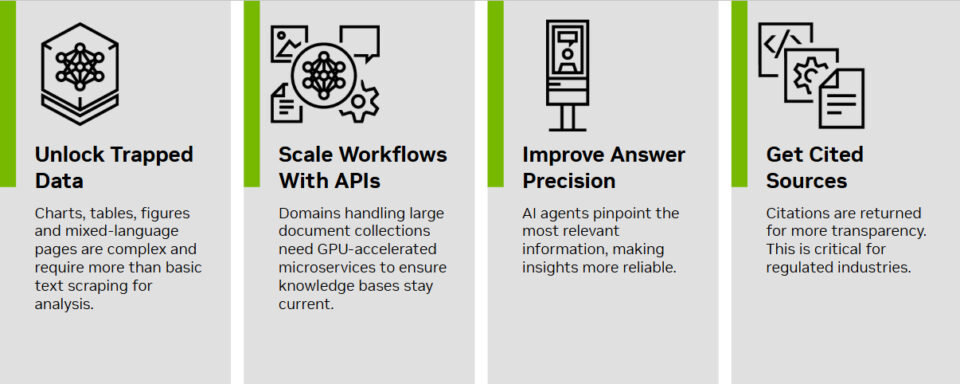
  • Understand rich document content, moving beyond simple text scraping to capture information from charts, tables, figures and mixed-language pages and treating documents as a human would by recognizing structure, relationships and context​​.
  • Handle large quantities of shifting data, ingesting and processing massive collections of documents in parallel, and keeping knowledge bases continuously up to date.​​
  • Find exactly what users need, helping AI agents pinpoint the most relevant passages, tables or paragraphs to a query so they can respond with precision and accuracy.​​
  • Show the evidence behind answers by providing citations to specific pages or charts so teams can gain transparency and auditability, which is critical in regulated industries.​​

The result is a shift from static document archives to living knowledge systems that directly power business intelligence, customer experiences and operational workflows.

Document Intelligence at Work

Intelligent document processing systems built on NVIDIA Nemotron RAG models, Nemotron Parse and accelerated computing are already reshaping how organizations across industries gain insights from their documents.​​

Justt: AI-Native Chargeback Management and Dispute Optimization

In financial services, payment disputes create significant revenue loss and operational complexity for merchants, largely because the evidence needed to handle them lives in unstructured formats. Transaction logs, customer communications and policy documents are often fragmented across systems and difficult to process at scale, making dispute handling slow, manual and costly.

Justt.ai provides an AI-driven platform that automates the full chargeback lifecycle at scale. The platform connects directly to payment service providers and merchant data sources to ingest transaction data, customer interactions and policies, then automatically assembles dispute-specific evidence that aligns with card network and issuer requirements.

The platform’s AI-powered dispute optimization, powered by Nemotron Parse, applies predictive analytics to determine which chargebacks to fight or accept, and how to optimize each response for maximum net recovery. Leading hospitality operators like HEI Hotels & Resorts use the platform to automate dispute handling across their properties, recapturing revenue while maintaining guest relationships.

By pairing document-centric intelligence with decision automation, merchants can recapture a significant portion of revenue lost to illegitimate chargebacks while reducing manual review effort.​

Read about how Justt’s chargeback management tool autonomously processes financial data to handle disputes for merchants.

Docusign: Scaling Agreement Intelligence

Docusign is the global leader in Intelligent Agreement Management, handling millions of transactions every day for more than 1.8 million customers and over 1 billion users.

Agreements are the foundation of every business, but the critical information they contain are often buried inside pages of documents. To surface the information, Docusign needed high-fidelity extraction of tables, text and metadata from complex documents like PDFs so organizations could understand and act on obligations, risks and opportunities faster.

Docusign is evaluating Nemotron Parse for deeper contract understanding at scale. Running on NVIDIA GPUs, the model combines advanced AI with layout detection and OCR. The system can reliably interpret complex tables and reconstruct tables with required information. This reduces the need for manual corrections and helps ensure that even the most complex contracts are processed with the speed and accuracy their customers expect.

With this foundation, Docusign will transform agreement repositories into structured data that powers contract search, analysis and AI-driven workflows — turning agreements into business assets that help organizations and their teams improve visibility, reduce risk and make faster decisions.

Edison Scientific: Research Across Massive Literature Scale

Edison Scientific’s Kosmos AI Scientist helps researchers navigate complex scientific landscapes to synthesize literature, identify connections and surface evidence.​

Edison needed a way to rapidly and accurately extract structured information from large volumes of PDFs, including equations, tables and figures that traditional information parsing methods often mishandle.​

By integrating the NVIDIA Nemotron Parse model into its PaperQA pipeline, Edison can decompose research papers, index key concepts and ground responses in specific passages, improving both throughput and answer quality for scientists.​​ This approach turns a sprawling research corpus into an interactive, queryable knowledge engine that accelerates hypothesis generation and literature review.​

The high efficiency of Nemotron Parse enables cost-efficient serving at scale, allowing Edison’s team to unlock the whole multimodal pipeline.

Designing an Intelligent Document Processing Application With NVIDIA Technologies

A robust, domain-specific document intelligence pipeline requires technologies that can handle data extraction, embedding and reranking, while keeping the data secure and compliant with regulations.​​

  • Extraction: Nemotron extraction and OCR models rapidly ingest multimodal PDFs, text, tables, graphs and images to convert them into structured, machine-readable content while preserving layout and semantics.
  • Embedding: Nemotron embedding models convert passages, entities and visual elements into vector representations tuned for document retrieval, enabling semantically accurate search.​​
  • Reranking: Nemotron reranking models evaluate candidate passages to ensure the most relevant content is surfaced as context for large language models (LLMs), improving answer fidelity and reducing hallucinations.​​
  • Parsing: Nemotron Parse models decipher document semantics to extract text and tables with precise spatial grounding and correct reading flow. Overcoming layout variability, they turn unstructured documents into actionable data that enhances the accuracy of LLMs and agentic workflows.

These capabilities are packaged as NVIDIA NIM microservices and foundation models that run efficiently on NVIDIA GPUs, allowing teams to scale from proof of concept to production while keeping sensitive data within their chosen cloud or data center environment.

The most effective AI systems use a mix of frontier models and open source models like NVIDIA Nemotron, with an LLM router analyzing each task and automatically selecting the model best suited for it. This approach keeps performance strong while managing computing costs and improving efficiency.

Get Started With NVIDIA Nemotron

Access a step-by-step tutorial on how to build a document processing pipeline with RAG capabilities. Explore how Nemotron RAG can power specialized agents tailored for different industries.​

Plus, experiment with Nemotron RAG models and the NVIDIA NeMo Retriever open library, available on GitHub and Hugging Face, as well as Nemotron Parse on Hugging Face.

Join the community of developers building with the NVIDIA Blueprint for Enterprise RAG — trusted by a dozen industry-leading AI Data Platform providers and available now on build.nvidia.com, GitHub and the NGC catalog.

Stay up to date on agentic AI, NVIDIA Nemotron and more by subscribing to NVIDIA AI news, joining the community and following NVIDIA AI on LinkedIn, Instagram, X and Facebook.  

Explore self-paced video tutorials and livestreams.


Reflection raises $2B to be America’s open frontier AI lab, challenging DeepSeek


Reflection, a startup founded just last year by two former Google DeepMind researchers, has raised $2 billion at an $8 billion valuation, a whopping 15x leap from its $545 million valuation just seven months ago. The company, which originally focused on autonomous coding agents, is now positioning itself as both an open-source alternative to closed frontier labs like OpenAI and Anthropic, and a Western equivalent to Chinese AI firms like DeepSeek.

The startup was launched in March 2024 by Misha Laskin, who led reward modeling for DeepMind’s Gemini project, and Ioannis Antonoglou, who co-created AlphaGo, the AI system that famously beat the world champion in the board game Go in 2016. Their background developing these very advanced AI systems is central to their pitch, which is that the right AI talent can build frontier models outside established tech giants.

Along with its new round, Reflection announced that it has recruited a team of top talent from DeepMind and OpenAI, and built an advanced AI training stack that it promises will be open for all. Perhaps most importantly, Reflection says it has “identified a scalable commercial model that aligns with our open intelligence strategy.”

Reflection’s team currently numbers about 60 people — mostly AI researchers and engineers across infrastructure, data training, and algorithm development, per Laskin, the company’s CEO. Reflection has secured a compute cluster and hopes to release a frontier language model next year that’s trained on “tens of trillions of tokens,” he told TechCrunch.

“We built something once thought possible only inside the world’s top labs: a large-scale LLM and reinforcement learning platform capable of training massive Mixture-of-Experts (MoEs) models at frontier scale,” Reflection wrote in a post on X. “We saw the effectiveness of our approach first-hand when we applied it to the critical domain of autonomous coding. With this milestone unlocked, we’re now bringing these methods to general agentic reasoning.”

MoE refers to a specific architecture that powers frontier LLMs — systems that, previously, only large, closed AI labs were capable of training at scale. DeepSeek had a breakthrough moment when it figured out how to train these models at scale in an open way, followed by Qwen, Kimi, and other models in China.

“DeepSeek and Qwen and all these models are our wake up call because if we don’t do anything about it, then effectively, the global standard of intelligence will be built by someone else,” Laskin said. “It won’t be built by America.”

Techcrunch event

San Francisco
|
October 27-29, 2025

Laskin added that this puts the U.S. and its allies at a disadvantage because enterprises and sovereign states often won’t use Chinese models due to potential legal repercussions.

“So you can either choose to live at a competitive disadvantage or rise to the occasion,” Laskin said.

American technologists have largely celebrated Reflection’s new mission. David Sacks, the White House AI and Crypto Czar, posted on X: “It’s great to see more American open source AI models. A meaningful segment of the global market will prefer the cost, customizability, and control that open source offers. We want the U.S. to win this category too.”

Clem Delangue, co-founder and CEO of Hugging Face, an open and collaborative platform for AI builders, told TechCrunch of the round, “This is indeed great news for American open-source AI. Added Delangue, “Now the challenge will be to show high velocity of sharing of open AI models and datasets (similar to what we’re seeing from the labs dominating in open-source AI).”

Reflection’s definition of being “open” seems to center on access rather than development, similar to strategies from Meta with Llama or Mistral. Laskin said Reflection would release model weights — the core parameters that determine how an AI system works — for public use while largely keeping datasets and full training pipelines proprietary.

“In reality, the most impactful thing is the model weights, because the model weights anyone can use and start tinkering with them,” Laskin said. “The infrastructure stack, only a select handful of companies can actually use that.”

That balance also underpins Reflection’s business model. Researchers will be able to use the models freely, Laskin said, but revenue will come from large enterprises building products on top of Reflection’s models and from governments developing “sovereign AI” systems, meaning AI models developed and controlled by individual nations.

“Once you get into that territory where you’re a large enterprise, by default you want an open model,” Laskin said. “You want something you will have ownership over. You can run it on your infrastructure. You can control its costs. You can customize it for various workloads. Because you’re paying some ungodly amount of money for AI, you want to be able to optimize it as much as much as possible, and really that’s the market that we’re serving.”

Reflection hasn’t yet released its first model, which will be largely text-based, with multimodal capabilities in the future, according to Laskin. It will use the funds from this latest round to get the compute resources needed to train the new models, the first of which the company is aiming to release early next year.

Investors in Reflection’s latest round include Nvidia, Disruptive, DST, 1789, B Capital, Lightspeed, GIC, Eric Yuan, Eric Schmidt, Citi, Sequoia, CRV, and others.

MLCommons and Hugging Face team up to release massive speech data set for AI research


MLCommons, a nonprofit AI safety working group, has teamed up with AI dev platform Hugging Face to release one of the world’s largest collections of public domain voice recordings for AI research.

The data set, called Unsupervised People’s Speech, contains more than a million hours of audio spanning at least 89 different languages. MLCommons says it was motivated to create it by a desire to support R&D in “various areas of speech technology.”

“Supporting broader natural language processing research for languages other than English helps bring communication technologies to more people globally,” the organization wrote in a blog post Thursday. “We anticipate several avenues for the research community to continue to build and develop, especially in the areas of improving low-resource language speech models, enhanced speech recognition across different accents and dialects, and novel applications in speech synthesis.”

It’s an admirable goal, to be sure. But AI data sets like Unsupervised People’s Speech can carry risks for the researchers who choose to use them.

Biased data is one of those risks. The recordings in Unsupervised People’s Speech came from Archive.org, the nonprofit perhaps best known for the Wayback Machine web archival tool. Because many of Archive.org’s contributors are English-speaking — and American — almost all of the recordings in Unsupervised People’s Speech are in American-accented English, per the readme on the official project page.

That means that, without careful filtering, AI systems like speech recognition and voice synthesizer models trained on Unsupervised People’s Speech could exhibit some of the same prejudices. They might, for example, struggle to transcribe English spoken by a non-native speaker, or have trouble generating synthetic voices in languages other than English.

Unsupervised People’s Speech might also contain recordings from people unaware that their voices are being used for AI research purposes — including commercial applications. While MLCommons says that all recordings in the data set are public domain or available under Creative Commons licenses, there’s the possibility mistakes were made.

According to an MIT analysis, hundreds of publicly available AI training data sets lack licensing information and contain errors. Creator advocates including Ed Newton-Rex, the CEO of AI ethics-focused nonprofit Fairly Trained, have made the case that creators shouldn’t be required to “opt out” of AI data sets because of the onerous burden opting out imposes on these creators.

“Many creators (e.g. Squarespace users) have no meaningful way of opting out,” Newton-Rex wrote in a post on X last June. “For creators who can opt out, there are multiple overlapping opt-out methods, which are (1) incredibly confusing and (2) woefully incomplete in their coverage. Even if a perfect universal opt-out existed, it would be hugely unfair to put the opt-out burden on creators, given that generative AI uses their work to compete with them — many would simply not realize they could opt out.”

MLCommons says that it’s committed to updating, maintaining, and improving the quality of Unsupervised People’s Speech. But given the potential flaws, it’d behoove developers to exercise serious caution.

Open source companies that go proprietary: A timeline


Open source might be the building blocks of the modern software stack, but companies building businesses off the back of open source software face a perennial struggle between keeping their community happy and ensuring that third parties don’t abuse the permissions afforded by the license.

Many companies have launched with lofty open source ambitions, only to duck for cover once the realities of the commercial world hit home. It’s all about protecting their bottom line, especially with investors (public or private) to appease.

But it can be difficult keeping tabs on all these changes, while also distinguishing those that have abandoned open source altogether and those that have sought sanctuary behind a less permissive (but still open source) license (as the likes of Element and Grafana have done in the past few years).

As such, TechCrunch has compiled a timeline of open source companies that have changed course over the past decade.

Movable Type (2013)

Movable Type created an open source version (called MTOS) of its web publishing software in 2007 under a “copyleft” GPL open source license, a move that positioned it more closely to WordPress. Such licenses afford certain freedoms, but stipulate that all derivative work be released under a similar license. At any rate, this move lasted until 2013, at which point Movable Type’s then owners ditched the open source product, opining that it “hurt the adoption” of the commercial versions.

“The community has not grown because of MTOS, nor have we seen download numbers that are any greater than our paid versions of Movable Type, so at this point it does not make any economic sense to continue to maintain and distribute something that is getting very little use,” the company wrote at the time.

SugarCRM (2014)

Founded initially in 2004, customer relationship management (CRM) software maker SugarCRM announced in 2014 that it would no longer provide an open source “community edition,” noting that its two core markets — developers and first-time CRM users seeking a cheap solution — were not effectively being served by the product.

The company did continue to support the last version (v6.5) of the open source incarnation for four more years, before pulling the plug in 2018.

Redis (2018)

Redis, creators of the popular in-memory database store, has been transitioning away from its open source roots since 2018, when it moved its “Redis Modules” (e.g. RediSearch) from an open source AGPL license to Apache 2.0 with a “Commons Clause” addendum (i.e. commercial restrictions). The following year, Redis replaced the Commons Clause with its own Redis Source Available License (RSAL) that promised to maintain some freedoms, but with notable restrictions related to competing database services — such as those provided by companies such as AWS.

In many ways, this was a bellwether of what was to come, as other companies would later cite the “Amazon problem” as their reason for switching their license up. Earlier this year, Redis’ transition to the world of proprietary was complete, when it announced that its core software would be shifting from a BSD 3-Clause license to a dual-license setup — RSAL or server side public license (SSPL).

MongoDB (2018)

In 2018, database company MongoDB moved away from an open source AGPL license to SSPL. The reason? Yup: to prevent cloud hyperscalers such as AWS from selling their own version of the service without contributing back.

Confluent (2018)

The “year that was” for open source license switching concluded with Confluent, a company that sells enterprise-grade tools and services around Apache Kafka, switching some of the components of its core platform from Apache 2.0 to a proprietary Confluent Community License.

This license stipulates a notable exclusion, one that forbids any competing service from offering Confluent’s wares “as-a-service.”

Cockroach Labs (2019)

Cockroach Labs, creator of the eponymous distributed SQL database known as CockroachDB, has continued to shake up its licensing ethos.

In 2019, the company’s founders announced that they were moving CockroachDB from the permissive Apache 2.0 license to the Business Source License (BUSL). Again, cloud hyperscalers such as AWS were the driving force behind the change.

“We’re witnessing the rise of highly integrated providers take advantage of their unique position to offer ‘as-a-service’ versions of OSS [open source software] products, and offer a superior user experience as a consequence of their integrations,” the founders wrote at the time.

Back in August, Cockroach Labs announced yet another change: It would consolidate its self-hosted product under a single enterprise license, as a way to encourage larger businesses to pay for the features they really need. 

Sentry (2019)

Sentry, the $3 billion company behind the app performance monitoring platform of the same name, was once available under a permissive BSD 3-Clause open source license. But in 2019, the company moved to BUSL, with co-founder and CTO David Cramer saying this was to counter “funded businesses plagiarizing or copying our work to directly compete with Sentry.”

Last year, Sentry launched its very own Functional Source License (FSL), which is similar to BUSL but a little simpler. And as of this year, Sentry is putting its weight behind a new licensing paradigm dubbed “fair source,” which, as TechCrunch reported at the time, is “designed to bridge the open and proprietary worlds, replete with new definition, terminology, and governance model.”

Elastic (2021)

It was several years in the making, but Elastic — creator of enterprise search engine Elasticsearch and the Kibana visualization dashboard — went proprietary in 2021. It was a familiar story, one that can be traced back to 2015 when AWS launched its own managed Elasticsearch service.

However, Elastic stands somewhat alone as one of the only companies to move away from open source, and then move back. Back in August, Elastic announced it would be adopting an AGPL license — different to the Apache 2.0 license it used prior to 2021, but open source nonetheless.

HashiCorp (2023)

HashiCorp also abandoned the open source ship last year, announcing that it was switching its popular “infrastructure as code” tool Terraform from a copyleft open source license to BUSL.

The familiar reason was to prevent certain vendors from monetizing Terraform without contributing anything back to the project.

An open source fork called OpenTofu was launched earlier this year by third parties, and as a notable aside, IBM snapped up HashiCorp for $6.4 billion.

Snowplow (2024)

Snowplow, a VC-backed platform that helps companies collect behavioral data for AI applications, this year switched from an open source Apache 2.0 license to the Snowplow Limited Use License Agreement.

The reason, the company said, was that it needs to fund its “exciting technology roadmap,” and thus everyone running its software in production should “pay for the value they receive in return.” The new license also explicitly prevents users from creating a competitive product built on top of Snowplow.

Python Interview questions – Provide an overview of Python.


Estimated reading time: 4 minutes

So you have landed an interview and worked hard at upskilling your Python knowledge. There are going to be some questions about Python and the different aspects of it that you will need to be able to talk about that are not all coding!

Here we discuss some of the key elements that you should be comfortable explaining.

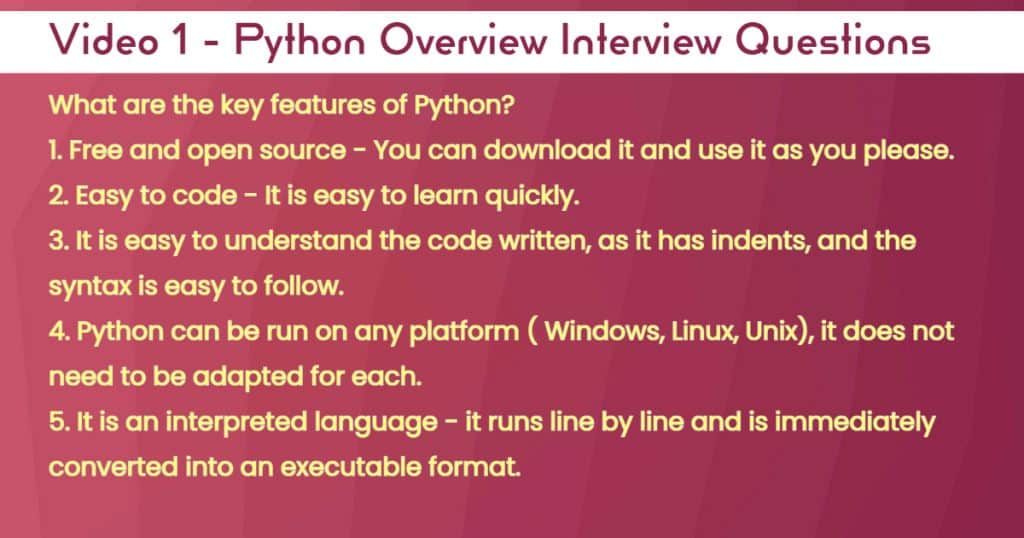
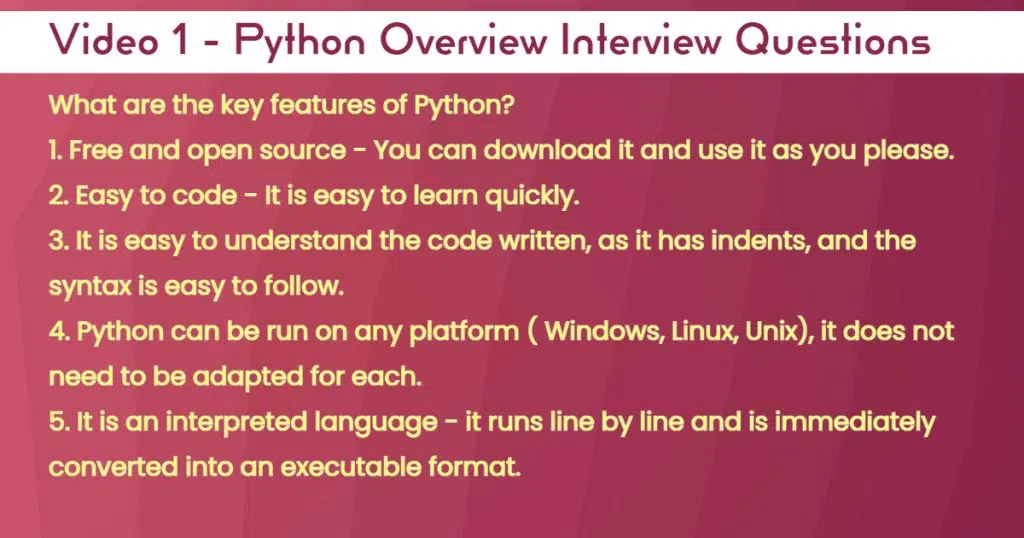
What are the key Features of Python?

In the below screenshot that will feature in our video, if you are asked this question they will help you be able to discuss.

Below I have outlined some of the key benefits you should be comfortable discussing.

It is great as it is open source and well-supported, you will always find an answer to your question somewhere.

Also as it is easy to code and understand, the ability to quickly upskill and deliver some good programs is a massive benefit.

As there are a lot of different platforms out there, it has been adapted to easily work on any with little effort. This is a massive boost to have it used across a number of development environments without too much tweaking.

Finally, some languages need you to compile the application first, Python does not it just runs.

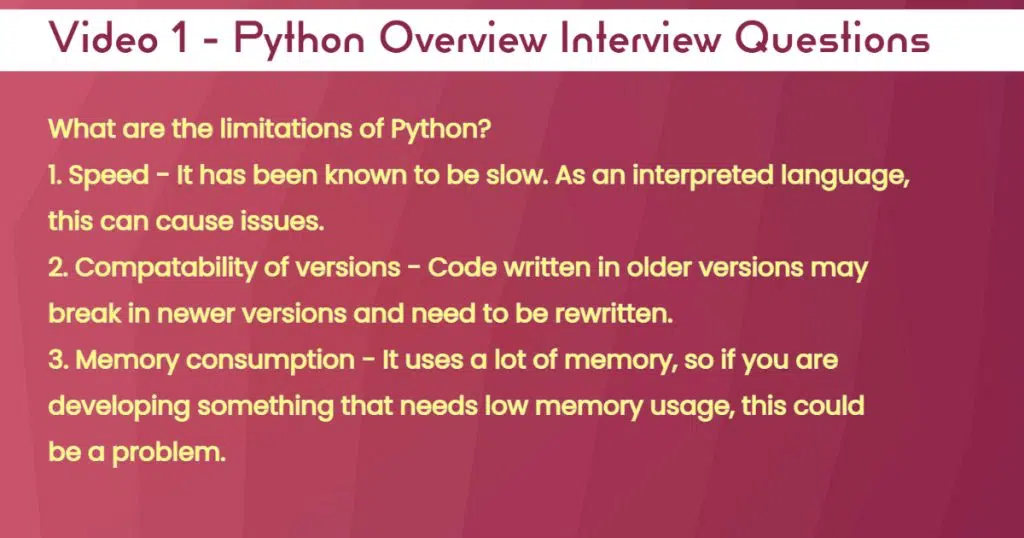
What are the limitations of Python?

While there is a lot of chat about Python, it also comes with some caveats which you should be able to talk to.

One of the first things to discuss is that its speed can inhibit how well an application performs. If you require real-time data and using Python you need to consider how well performance will be inhibited by it.

There are scenarios where an application is written in an older version of code, and you want to introduce new functionality, with a newer version. This could lead to problems of the code not working that currently exists, that needs to be rewritten. As a result, additional programming time may need to be factored in to fix the compatibility issues found.

Finally, As Python uses a lot of memory you need to have it on a computer and or server that can handle the memory requests. This is especially important where the application is been used in real-time and needs to deliver output pretty quickly to the user interface.


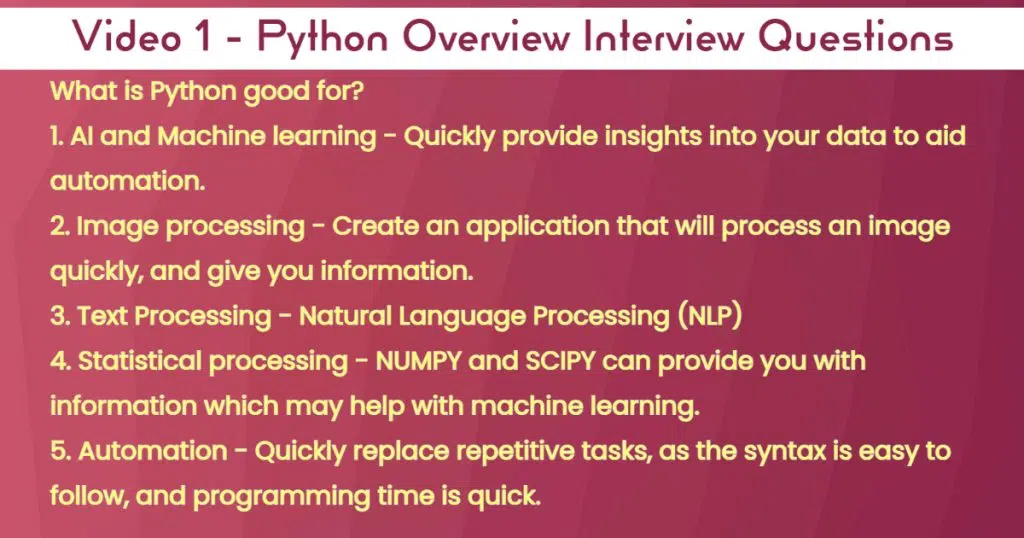
What is Python good for?

As detailed below, there are many uses of Python, this is not an exhaustive list I may add.

A common theme for some of the points below is that Python can process data and provide information that you are not aware of which can aid decision-making.

Alternatively, it can also be used as a tool for automating and or predicting the behaviour of the subjects it pertains to, sometimes these may not be obvious, but helps speed up the delivery of certain repetitive tasks.

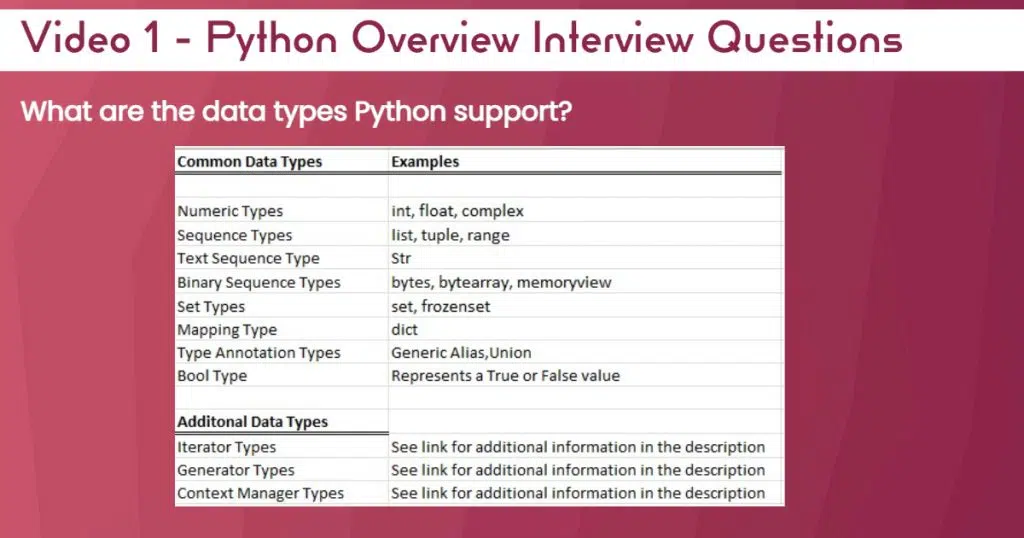
What are the data types Python support?

Finally below is a list of the data types you should be familiar with, and be able to discuss. Some of these are frequently used.

These come from the Python data types web page itself, so a good reference point if you need to further understand or improve your knowledge.