
How the UK Is Turning Sovereign AI Ambition Into Action With NVIDIA Technologies


A year ago at London Tech Week, NVIDIA founder and CEO Jensen Huang and U.K. Prime Minister Keir Starmer made a declaration: the U.K. would be an AI maker, not an AI taker. 

At this year’s event, NVIDIA and its partners are showcasing how that commitment is producing real momentum across the nation’s infrastructure, startups and enterprises. 

U.K. technology leaders are innovating across healthcare and life sciences, coding, agentic AI, inference and more — all running on sovereign AI deployments.

AI Minister Kanishka Narayan said: “A year ago, we said the UK would be an AI maker, not an AI taker. Today we’re delivering on that with sovereign compute powering British startups to push the boundaries of what AI can do, from drug discovery to healthcare to robotics. This is what it looks like when a country backs its own talent with the infrastructure to match.

“NVIDIA’s decision to invest billions here is a reflection of the strength of what’s being built in Britain. We are determined to make sure the next generation of AI breakthroughs happens in this country, and we have everything we need to make it happen.”

Commitment to Compute

Over the past year, the number of AI cloud providers planning to deploy AI infrastructure on U.K. soil has doubled. 

Nebius has announced plans to expand customers and cloud capabilities with three new deployments of advanced NVIDIA AI infrastructure, as the NVIDIA AI Cloud ecosystem partner continues to build out its commercial and AI R&D hub in London. Combined, the deployments are expected to reach 65 megawatts when fully ramped up in 2027.

CoreWeave is building in the U.K. Government’s AI Growth Zones, and seven more NVIDIA AI Cloud ecosystem partners have plans in the pipeline. BT and Nscale announced plans to build sovereign AI data centers across three existing BT sites in the U.K., combining NVIDIA AI infrastructure, Nscale’s full stack and BT’s trusted nationwide connectivity backbone. 

From Fund to Frontier

Central to that sovereign compute story is Isambard-AI — the U.K.’s most powerful computer. Built on 5,400 NVIDIA GH200 Grace Hopper Superchips and running entirely on zero-carbon electricity, it’s the engine behind some of the U.K.’s most ambitious AI research. 

The U.K. government’s Sovereign AI Fund is putting that capability to work by backing homegrown companies and providing the domestic infrastructure needed to scale their ambitions. 

Among its first recipients is Ineffable Intelligence, which recently announced a collaboration with NVIDIA to build the future of reinforcement learning infrastructure. 

Other recipients include four U.K.-based NVIDIA Inception startups, each pushing the AI frontier using Isambard-AI. These startups are:

Cosine Builds Sovereign Coding Platform

Cosine is building an end-to-end sovereign AI coding platform for highly regulated industries such as financial services, critical infrastructure and national security. Using Isambard, Cosine is training a new, large-parameter, mixture-of-experts, multimodal agentic LLM for natively handling data types beyond text and image. 

“Access to Isambard enables the project, full stop,” said Alistair Pullen, cofounder and CEO of Cosine. “We already have the people who know how to do this. We have the data. We have the infrastructure and the training. The thing we’ve never had is this level of compute.”

Cursive Trains Self-Improving AI Systems

Cursive is building self-improving AI systems that learn continuously from real-world data, enabling them to operate autonomously over long periods of time. This is unlocked through new memory-augmented architectures with dramatically larger context windows, currently in development using the Sovereign AI Fund resources. In addition, the team recently adopted the NVIDIA Megatron-LM framework for distributed training at scale.

“The Sovereign AI Fund is more than just processing power — it’s a statement about investing in AI in the U.K.,” said Talfan Evans, cofounder and CEO of Cursive. “Sovereignty is actually now a buying criterion — and it’s a challenge to tap into the resources we uniquely have as U.K. and European companies.”

Doubleword Optimizes Inference to Deliver Abundant Intelligence Tokens

Doubleword, the U.K.’s first dedicated inference lab, optimizes every layer of the AI stack to maximize what it calls “IQ per dollar.” The company deploys open models including NVIDIA Nemotron 3 Super 120B and builds on the NVIDIA Dynamo inference framework. 

On Isambard, Doubleword’s early results achieved 70x faster model cold starts — aka model loading times — and 4x lossless KV cache compression, critical advancements for long-running agentic workloads. The result: inference at 90-95% lower costs than other leading inference providers.
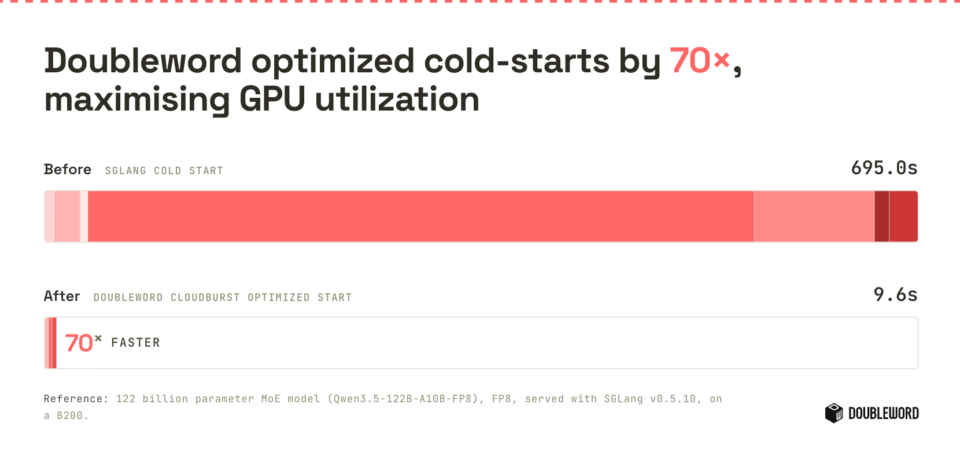
Image courtesy of Doubleword.

“Sovereign AI is most impactful at the inference layer,” said Meryem Arik, cofounder and CEO of Doubleword. “Inference is when you’re actually getting the value from the model — we want that value created in the U.K., with U.K. compute and U.K. data centers.”

Prima Mente Uses Foundation Models to Study Alzheimer’s and More

Prima Mente builds biological foundation models to identify new biomarkers, subtypes and drug targets of Alzheimer’s, Parkinson’s and ALS. With its Isambard allocation, the company is developing Pleiades 2, a foundation model combining five biological data modalities. 

Achieving nearly 3x speedups in model training with NVIDIA Blackwell GPUs, Prima Mente also uses NVIDIA Parabricks for genomic data processing and NVIDIA Transformer Engine for model optimization.

“Research shows Alzheimer’s might be 25 different subgroups of disease, and we want to help by using AI to identify these subtypes and the biology within the cells as they change,” said Hannah Madan, cofounder of Prima Mente.

Video courtesy of Nebius and Prima Mente.

AI Talent, Policy and Production

NVIDIA’s £2 billion investment in the U.K. startup ecosystem — in collaboration with leading venture capital firms — is bringing new capital and advanced AI infrastructure to major U.K. hubs including London, Oxford, Cambridge and Manchester. 

U.K. membership in the NVIDIA Inception program has increased by 50% over the past year. AI-native companies like Doubleword, Synthesia and PolyAI are scaling globally from U.K. roots. 

At last year’s London Tech Week, NVIDIA announced a collaboration with the U.K Department for Science, Innovation and Technology on 6G and AI skills. The 6G collaboration has seeded testbeds at four U.K. universities. In May, the NVIDIA Deep Learning Institute (DLI) delivered two new courses — added to support the nation’s wireless research community — to participants from over 30 U.K. universities.

Plus, as part of this AI skills collaboration, NVIDIA DLI courses are offered as part of QA’s AI Apprenticeships in England. 

And the NVIDIA Developer Program now includes more than 200,000 U.K. developers. 

The Sovereign AI Forum, which launched last year with seven charter members, convened the country’s AI leadership to turn policy into deployment roadmaps. Over the past year, the Forum has welcomed dozens of participants across government, industry and the startup community — turning policy into deployment roadmaps.

And enterprise AI is moving from pilot to production:

  • Apian is building digital twins of two National Health Service hospitals, combining autonomous devices, ground robots, computer vision and robotic simulation.
  • Deliverance AI is helping regulated enterprises to run, govern and scale AI agents inside their own environment — through a single control plane. The Agentic Operating System is built for organizations where data sovereignty is non-negotiable.
  • Glass Futures has installed an AI-driven digital twin of its glass furnace capable of testing and predicting new, optimal ways to make glass. The digital twin taps into NVIDIA accelerated computing and the NVIDIA PhysicsNeMo framework.
  • Orbital Industries has announced codesigned, NVIDIA Vera Rubin DSX AI Factory-compliant AI infrastructure that accelerates time to first token.
  • Reading Football Club is partnering with Stelia to establish an AI Centre of Excellence, combining Stelia’s full-stack AI platform with accelerated compute infrastructure from NVIDIA and Lenovo.

It all reflects momentous progress in U.K. AI leadership — and offers a glimpse of where it’s heading.

Join NVIDIA at London Tech Week.

Nemotron Labs: How AI Agents Are Turning Documents Into Real-Time Business Intelligence


Editor’s note: This post is part of the Nemotron Labs blog series, which explores how the latest open models, datasets and training techniques help businesses build specialized AI systems and applications on NVIDIA platforms. Each post highlights practical ways to use an open stack to deliver value in production — from transparent research copilots to scalable AI agents.

Businesses today face the challenge of uncovering valuable insights buried within a wide variety of documents — including reports, presentations, PDFs, web pages and spreadsheets.

Often, teams piece together insights by manually reviewing files, copying data into spreadsheets, building dashboards and using basic search or template-based optical character recognition (OCR) tools that often miss important details in complex media.

Intelligent document processing is an AI-powered workflow that automatically reads, understands and extracts insights from documents. It interprets rich formats inside those documents — including tables, charts, images and text — using AI agents and techniques like retrieval-augmented generation (RAG) to turn the multimodal content into insights that other multi-agent systems and people can easily use.

With NVIDIA Nemotron open models and GPU-accelerated libraries, organizations can build AI-powered document intelligence systems for research, financial services, legal workflows and more.

These open models, datasets and training recipes have powered strong results on leaderboards such as MTEB, MMTEB and ViDoRe V3, benchmarks for evaluating multilingual and multimodal retrieval models. Teams can choose from among the best models for tasks like search and question answering.

How Document Processing Streamlines Business Intelligence

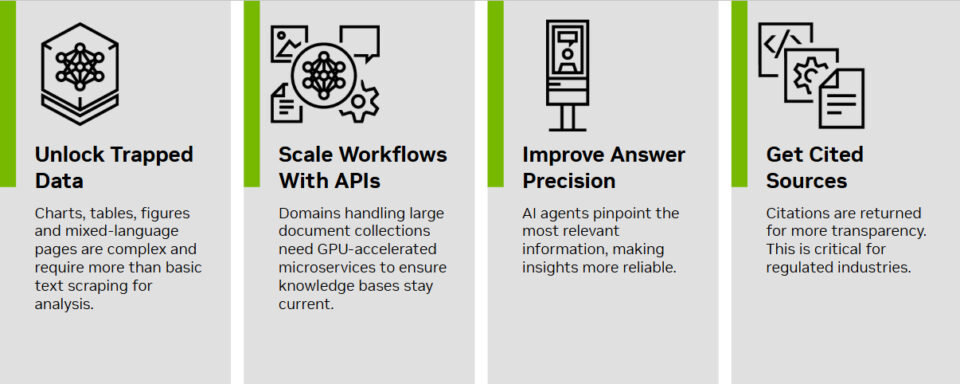
Document intelligence systems that can pull meaning from complex layouts, scale to huge file libraries and show exactly where an answer came from are incredibly useful in high-stakes environments. These systems:

  • Understand rich document content, moving beyond simple text scraping to capture information from charts, tables, figures and mixed-language pages and treating documents as a human would by recognizing structure, relationships and context​​.
  • Handle large quantities of shifting data, ingesting and processing massive collections of documents in parallel, and keeping knowledge bases continuously up to date.​​
  • Find exactly what users need, helping AI agents pinpoint the most relevant passages, tables or paragraphs to a query so they can respond with precision and accuracy.​​
  • Show the evidence behind answers by providing citations to specific pages or charts so teams can gain transparency and auditability, which is critical in regulated industries.​​

The result is a shift from static document archives to living knowledge systems that directly power business intelligence, customer experiences and operational workflows.

Document Intelligence at Work

Intelligent document processing systems built on NVIDIA Nemotron RAG models, Nemotron Parse and accelerated computing are already reshaping how organizations across industries gain insights from their documents.​​

Justt: AI-Native Chargeback Management and Dispute Optimization

In financial services, payment disputes create significant revenue loss and operational complexity for merchants, largely because the evidence needed to handle them lives in unstructured formats. Transaction logs, customer communications and policy documents are often fragmented across systems and difficult to process at scale, making dispute handling slow, manual and costly.

Justt.ai provides an AI-driven platform that automates the full chargeback lifecycle at scale. The platform connects directly to payment service providers and merchant data sources to ingest transaction data, customer interactions and policies, then automatically assembles dispute-specific evidence that aligns with card network and issuer requirements.

The platform’s AI-powered dispute optimization, powered by Nemotron Parse, applies predictive analytics to determine which chargebacks to fight or accept, and how to optimize each response for maximum net recovery. Leading hospitality operators like HEI Hotels & Resorts use the platform to automate dispute handling across their properties, recapturing revenue while maintaining guest relationships.

By pairing document-centric intelligence with decision automation, merchants can recapture a significant portion of revenue lost to illegitimate chargebacks while reducing manual review effort.​

Read about how Justt’s chargeback management tool autonomously processes financial data to handle disputes for merchants.

Docusign: Scaling Agreement Intelligence

Docusign is the global leader in Intelligent Agreement Management, handling millions of transactions every day for more than 1.8 million customers and over 1 billion users.

Agreements are the foundation of every business, but the critical information they contain are often buried inside pages of documents. To surface the information, Docusign needed high-fidelity extraction of tables, text and metadata from complex documents like PDFs so organizations could understand and act on obligations, risks and opportunities faster.

Docusign is evaluating Nemotron Parse for deeper contract understanding at scale. Running on NVIDIA GPUs, the model combines advanced AI with layout detection and OCR. The system can reliably interpret complex tables and reconstruct tables with required information. This reduces the need for manual corrections and helps ensure that even the most complex contracts are processed with the speed and accuracy their customers expect.

With this foundation, Docusign will transform agreement repositories into structured data that powers contract search, analysis and AI-driven workflows — turning agreements into business assets that help organizations and their teams improve visibility, reduce risk and make faster decisions.

Edison Scientific: Research Across Massive Literature Scale

Edison Scientific’s Kosmos AI Scientist helps researchers navigate complex scientific landscapes to synthesize literature, identify connections and surface evidence.​

Edison needed a way to rapidly and accurately extract structured information from large volumes of PDFs, including equations, tables and figures that traditional information parsing methods often mishandle.​

By integrating the NVIDIA Nemotron Parse model into its PaperQA pipeline, Edison can decompose research papers, index key concepts and ground responses in specific passages, improving both throughput and answer quality for scientists.​​ This approach turns a sprawling research corpus into an interactive, queryable knowledge engine that accelerates hypothesis generation and literature review.​

The high efficiency of Nemotron Parse enables cost-efficient serving at scale, allowing Edison’s team to unlock the whole multimodal pipeline.

Designing an Intelligent Document Processing Application With NVIDIA Technologies

A robust, domain-specific document intelligence pipeline requires technologies that can handle data extraction, embedding and reranking, while keeping the data secure and compliant with regulations.​​

  • Extraction: Nemotron extraction and OCR models rapidly ingest multimodal PDFs, text, tables, graphs and images to convert them into structured, machine-readable content while preserving layout and semantics.
  • Embedding: Nemotron embedding models convert passages, entities and visual elements into vector representations tuned for document retrieval, enabling semantically accurate search.​​
  • Reranking: Nemotron reranking models evaluate candidate passages to ensure the most relevant content is surfaced as context for large language models (LLMs), improving answer fidelity and reducing hallucinations.​​
  • Parsing: Nemotron Parse models decipher document semantics to extract text and tables with precise spatial grounding and correct reading flow. Overcoming layout variability, they turn unstructured documents into actionable data that enhances the accuracy of LLMs and agentic workflows.

These capabilities are packaged as NVIDIA NIM microservices and foundation models that run efficiently on NVIDIA GPUs, allowing teams to scale from proof of concept to production while keeping sensitive data within their chosen cloud or data center environment.

The most effective AI systems use a mix of frontier models and open source models like NVIDIA Nemotron, with an LLM router analyzing each task and automatically selecting the model best suited for it. This approach keeps performance strong while managing computing costs and improving efficiency.

Get Started With NVIDIA Nemotron

Access a step-by-step tutorial on how to build a document processing pipeline with RAG capabilities. Explore how Nemotron RAG can power specialized agents tailored for different industries.​

Plus, experiment with Nemotron RAG models and the NVIDIA NeMo Retriever open library, available on GitHub and Hugging Face, as well as Nemotron Parse on Hugging Face.

Join the community of developers building with the NVIDIA Blueprint for Enterprise RAG — trusted by a dozen industry-leading AI Data Platform providers and available now on build.nvidia.com, GitHub and the NGC catalog.

Stay up to date on agentic AI, NVIDIA Nemotron and more by subscribing to NVIDIA AI news, joining the community and following NVIDIA AI on LinkedIn, Instagram, X and Facebook.  

Explore self-paced video tutorials and livestreams.