How the UK Is Turning Sovereign AI Ambition Into Action With NVIDIA Technologies


A year ago at London Tech Week, NVIDIA founder and CEO Jensen Huang and U.K. Prime Minister Keir Starmer made a declaration: the U.K. would be an AI maker, not an AI taker. 

At this year’s event, NVIDIA and its partners are showcasing how that commitment is producing real momentum across the nation’s infrastructure, startups and enterprises. 

U.K. technology leaders are innovating across healthcare and life sciences, coding, agentic AI, inference and more — all running on sovereign AI deployments.

AI Minister Kanishka Narayan said: “A year ago, we said the UK would be an AI maker, not an AI taker. Today we’re delivering on that with sovereign compute powering British startups to push the boundaries of what AI can do, from drug discovery to healthcare to robotics. This is what it looks like when a country backs its own talent with the infrastructure to match.

“NVIDIA’s decision to invest billions here is a reflection of the strength of what’s being built in Britain. We are determined to make sure the next generation of AI breakthroughs happens in this country, and we have everything we need to make it happen.”

Commitment to Compute

Over the past year, the number of AI cloud providers planning to deploy AI infrastructure on U.K. soil has doubled. 

Nebius has announced plans to expand customers and cloud capabilities with three new deployments of advanced NVIDIA AI infrastructure, as the NVIDIA AI Cloud ecosystem partner continues to build out its commercial and AI R&D hub in London. Combined, the deployments are expected to reach 65 megawatts when fully ramped up in 2027.

CoreWeave is building in the U.K. Government’s AI Growth Zones, and seven more NVIDIA AI Cloud ecosystem partners have plans in the pipeline. BT and Nscale announced plans to build sovereign AI data centers across three existing BT sites in the U.K., combining NVIDIA AI infrastructure, Nscale’s full stack and BT’s trusted nationwide connectivity backbone. 

From Fund to Frontier

Central to that sovereign compute story is Isambard-AI — the U.K.’s most powerful computer. Built on 5,400 NVIDIA GH200 Grace Hopper Superchips and running entirely on zero-carbon electricity, it’s the engine behind some of the U.K.’s most ambitious AI research. 

The U.K. government’s Sovereign AI Fund is putting that capability to work by backing homegrown companies and providing the domestic infrastructure needed to scale their ambitions. 

Among its first recipients is Ineffable Intelligence, which recently announced a collaboration with NVIDIA to build the future of reinforcement learning infrastructure. 

Other recipients include four U.K.-based NVIDIA Inception startups, each pushing the AI frontier using Isambard-AI. These startups are:

Cosine Builds Sovereign Coding Platform

Cosine is building an end-to-end sovereign AI coding platform for highly regulated industries such as financial services, critical infrastructure and national security. Using Isambard, Cosine is training a new, large-parameter, mixture-of-experts, multimodal agentic LLM for natively handling data types beyond text and image. 

“Access to Isambard enables the project, full stop,” said Alistair Pullen, cofounder and CEO of Cosine. “We already have the people who know how to do this. We have the data. We have the infrastructure and the training. The thing we’ve never had is this level of compute.”

Cursive Trains Self-Improving AI Systems

Cursive is building self-improving AI systems that learn continuously from real-world data, enabling them to operate autonomously over long periods of time. This is unlocked through new memory-augmented architectures with dramatically larger context windows, currently in development using the Sovereign AI Fund resources. In addition, the team recently adopted the NVIDIA Megatron-LM framework for distributed training at scale.

“The Sovereign AI Fund is more than just processing power — it’s a statement about investing in AI in the U.K.,” said Talfan Evans, cofounder and CEO of Cursive. “Sovereignty is actually now a buying criterion — and it’s a challenge to tap into the resources we uniquely have as U.K. and European companies.”

Doubleword Optimizes Inference to Deliver Abundant Intelligence Tokens

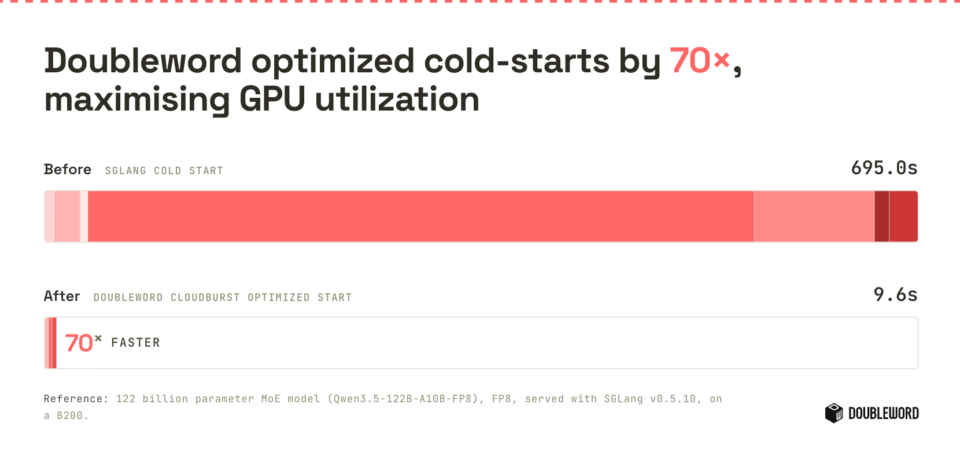
Doubleword, the U.K.’s first dedicated inference lab, optimizes every layer of the AI stack to maximize what it calls “IQ per dollar.” The company deploys open models including NVIDIA Nemotron 3 Super 120B and builds on the NVIDIA Dynamo inference framework. 

On Isambard, Doubleword’s early results achieved 70x faster model cold starts — aka model loading times — and 4x lossless KV cache compression, critical advancements for long-running agentic workloads. The result: inference at 90-95% lower costs than other leading inference providers.

Image courtesy of Doubleword.

“Sovereign AI is most impactful at the inference layer,” said Meryem Arik, cofounder and CEO of Doubleword. “Inference is when you’re actually getting the value from the model — we want that value created in the U.K., with U.K. compute and U.K. data centers.”

Prima Mente Uses Foundation Models to Study Alzheimer’s and More

Prima Mente builds biological foundation models to identify new biomarkers, subtypes and drug targets of Alzheimer’s, Parkinson’s and ALS. With its Isambard allocation, the company is developing Pleiades 2, a foundation model combining five biological data modalities. 

Achieving nearly 3x speedups in model training with NVIDIA Blackwell GPUs, Prima Mente also uses NVIDIA Parabricks for genomic data processing and NVIDIA Transformer Engine for model optimization.

“Research shows Alzheimer’s might be 25 different subgroups of disease, and we want to help by using AI to identify these subtypes and the biology within the cells as they change,” said Hannah Madan, cofounder of Prima Mente.

Video courtesy of Nebius and Prima Mente.

AI Talent, Policy and Production

NVIDIA’s £2 billion investment in the U.K. startup ecosystem — in collaboration with leading venture capital firms — is bringing new capital and advanced AI infrastructure to major U.K. hubs including London, Oxford, Cambridge and Manchester. 

U.K. membership in the NVIDIA Inception program has increased by 50% over the past year. AI-native companies like Doubleword, Synthesia and PolyAI are scaling globally from U.K. roots. 

At last year’s London Tech Week, NVIDIA announced a collaboration with the U.K Department for Science, Innovation and Technology on 6G and AI skills. The 6G collaboration has seeded testbeds at four U.K. universities. In May, the NVIDIA Deep Learning Institute (DLI) delivered two new courses — added to support the nation’s wireless research community — to participants from over 30 U.K. universities.

Plus, as part of this AI skills collaboration, NVIDIA DLI courses are offered as part of QA’s AI Apprenticeships in England. 

And the NVIDIA Developer Program now includes more than 200,000 U.K. developers. 

The Sovereign AI Forum, which launched last year with seven charter members, convened the country’s AI leadership to turn policy into deployment roadmaps. Over the past year, the Forum has welcomed dozens of participants across government, industry and the startup community — turning policy into deployment roadmaps.

And enterprise AI is moving from pilot to production:

  • Apian is building digital twins of two National Health Service hospitals, combining autonomous devices, ground robots, computer vision and robotic simulation.
  • Deliverance AI is helping regulated enterprises to run, govern and scale AI agents inside their own environment — through a single control plane. The Agentic Operating System is built for organizations where data sovereignty is non-negotiable.
  • Glass Futures has installed an AI-driven digital twin of its glass furnace capable of testing and predicting new, optimal ways to make glass. The digital twin taps into NVIDIA accelerated computing and the NVIDIA PhysicsNeMo framework.
  • Orbital Industries has announced codesigned, NVIDIA Vera Rubin DSX AI Factory-compliant AI infrastructure that accelerates time to first token.
  • Reading Football Club is partnering with Stelia to establish an AI Centre of Excellence, combining Stelia’s full-stack AI platform with accelerated compute infrastructure from NVIDIA and Lenovo.

It all reflects momentous progress in U.K. AI leadership — and offers a glimpse of where it’s heading.

Join NVIDIA at London Tech Week.

India Fuels Its AI Mission With NVIDIA


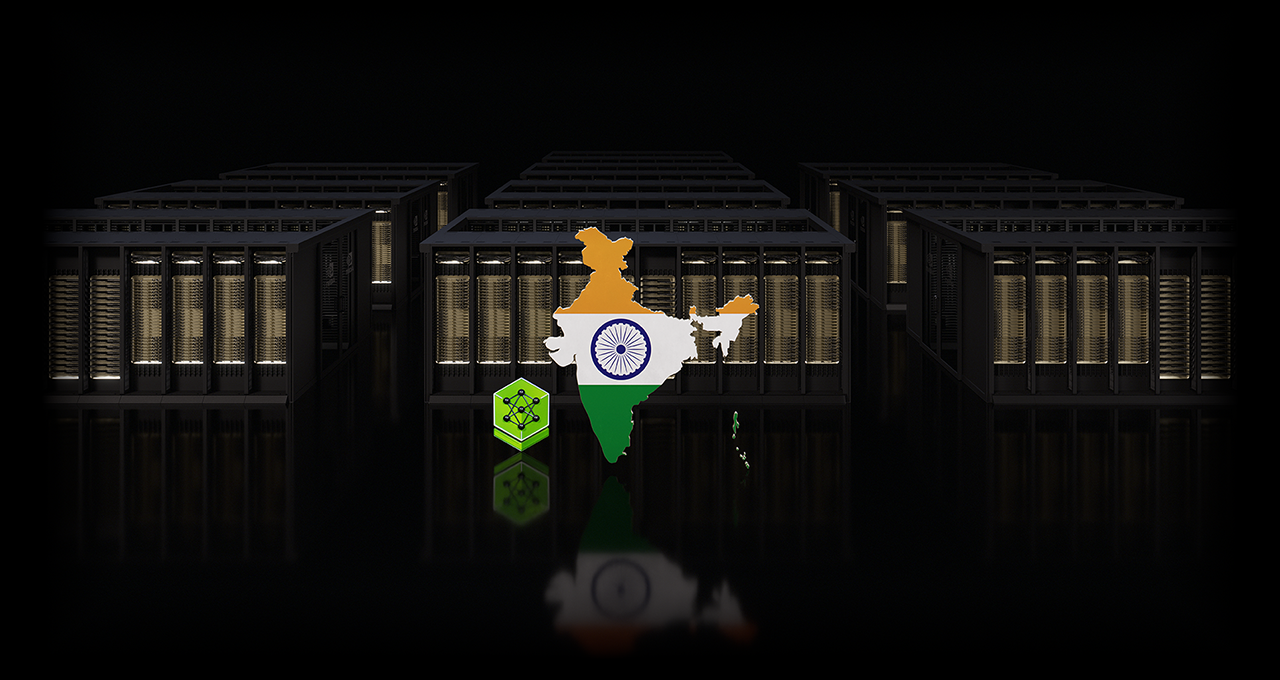
India is the nexus of AI innovation this week as the host of the AI Impact Summit, which brings together global heads of state and industry to chart the future of AI.

At the summit, taking place in New Delhi, industry leaders, government agencies, educational institutions and startups are sharing how they’re working with NVIDIA to drive the AI industrial revolution in the world’s most populous country.

These initiatives support the IndiaAI Mission, a government effort that’s infusing India’s AI ecosystem with over $1 billion to bolster the nation’s compute capacity and foster the development of sovereign AI datasets, frontier models and applications. The mission also supports AI education, startup innovation and frameworks for trustworthy AI.

Read how NVIDIA is supporting IndiaAI Mission priorities including:

NVIDIA Cloud Partners Boost India AI Infrastructure

To achieve its AI ambitions, India is investing heavily in its computing infrastructure. Under the IndiaAI Compute Pillar, the nation is building out its AI cloud offerings with systems including tens of thousands of NVIDIA GPUs.

NVIDIA is collaborating with next‑generation cloud providers Yotta, L&T and E2E Networks to deliver advanced AI factories to meet India’s growing need for AI compute and enable it to develop AI models and services that drive innovation.

  • Yotta is a hyperscale data center and cloud provider building large‑scale sovereign AI infrastructure for India, branded as Shakti Cloud, powered by over 20,000 NVIDIA Blackwell Ultra GPUs. Its campuses in Navi Mumbai and Greater Noida deliver GPU‑dense, high‑bandwidth AI cloud services on a pay‑per‑use model, designed to make advanced AI training and inference affordable and compliant for Indian enterprises and public sector customers.
  • Larsen & Toubro (L&T) is building sovereign, gigawatt-scale NVIDIA AI factory infrastructure in India to reinforce the country’s position as a global AI powerhouse in alignment with the IndiaAI Mission. The roadmap includes initial expansions in Chennai to 30 megawatts as well as a new 40-megawatt facility in Mumbai. These facilities will power sovereign cloud workloads and hyperscale deployments, delivering secure, energy‑efficient infrastructure for advanced AI applications.
  • E2E Networks is building an NVIDIA Blackwell GPU cluster on its TIR platform, hosted at the L&T Vyoma Data Center in Chennai. The TIR cloud compute platform will feature NVIDIA HGX B200 systems and NVIDIA Enterprise software as well as NVIDIA Nemotron open models to supercharge sovereign development across agentic AI, healthcare, finance, manufacturing and agriculture.

India’s AI cloud infrastructure will host workloads as well as manufacture intelligence for model training, fine-tuning and high‑scale inference. Capacity within these data centers will be reserved for model builders, startups, researchers and enterprises to build, fine-tune and deploy AI in India.

Further expanding access to NVIDIA AI infrastructure in India, Netweb Technologies is launching its Tyrone Camarero AI Supercomputing systems built on the NVIDIA Grace Blackwell architecture. The NVIDIA GB200 NVL4 platforms — manufactured in India by Netweb under the government’s “Make in India” mission — feature four NVIDIA Blackwell GPUs and two NVIDIA Grace CPUs to power scientific computing, model training and inference.

NVIDIA and India AI-Native Companies Build the Nation’s Frontier AI Models

Another key goal of the IndiaAI Mission — led by its Innovation Center Pillar — is to develop and deploy foundation models trained on India-specific data and domestic AI infrastructure.

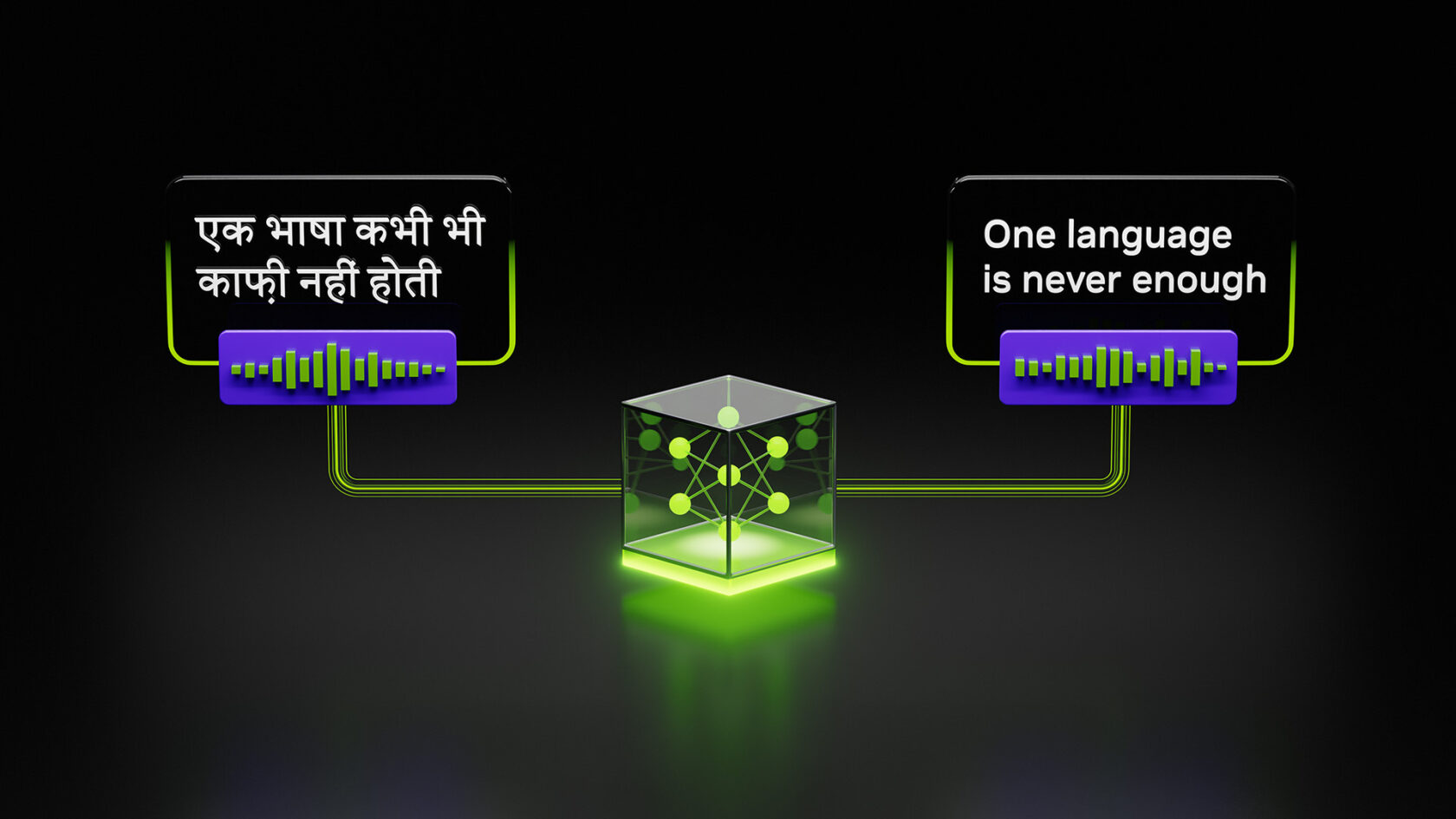
For a nation as multilingual as India — with 22 constitutionally recognized languages and over 1,500 more recorded by the country’s census — frontier AI models are a powerful tool to help its more than 1.4 billion residents interact with technology in their primary language.

Organizations across the country are building AI applications with NVIDIA Nemotron to support public-sector services, financial systems and enterprise operations in multiple languages.

NVIDIA Nemotron open models, datasets, tools and libraries enable organizations to build frontier speech, language and multimodal models at scale and across languages for government, consumer and enterprise applications. It includes India-specific datasets like Nemotron-Personas-India, an open dataset built from publicly available census data using NeMo Data Designer that includes 21 million fully synthetic Indic personas to enable population-scale sovereign AI development.

Adopters in India of Nemotron — and NeMo Curator, an open library for multilingual and multimodal data curation — include:

  • BharatGen, a sovereign AI initiative supported by the Government of India aimed at strengthening the country’s multilingual and multimodal AI ecosystem. As part of this effort, BharatGen has developed a 17-billion-parameter mixture-of-experts (MoE) model from the ground up, using the NVIDIA NeMo framework for pretraining and the NeMo RL library for post-training. The open source models are designed to power applications across public services, agriculture, security and cultural preservation.
  • Chariot, a company building AI systems for speech and multimodal communication. Using the NeMo framework, Chariot is developing an 8-billion-parameter model for real-time text to speech, supporting applications that improve accessibility and digital interaction across consumer and enterprise use cases.
  • Commotion, backed by Tata Communications, which has developed an AI operating system to automate complex enterprise workflows. By integrating NVIDIA Nemotron models and speech capabilities, the platform enables governed, production-grade AI deployments, helping enterprises scale AI across critical business operations.
  • CoRover.ai, which has deployed NVIDIA Nemotron Speech open models and NVIDIA Riva libraries for end-to-end, ultralow-latency speech AI — including the NVIDIA Riva Whisper v3 model for multilingual automatic speech recognition in English, Hindi and Gujarati. Powering customer service applications for the Indian Railway Catering and Tourism Corporation, CoRover’s platform supports around 10,000 concurrent users and more than 5,000 daily ticket bookings.
  • Gnani.ai, which offers enterprises a multilingual agentic AI platform that can interact with customers through voice and text. Gnani is building a 14-billion-parameter speech-to-speech model built on NVIDIA Nemotron Speech models, datasets and NeMo libraries including NeMo libraries through NVIDIA Cloud Partner E2E Networks — with plans to expand to a 32-billion-parameter model. By fine-tuning the NVIDIA Nemotron Speech model for Indic languages, Gnani has achieved a 15x reduction in inference costs, enabling the company to scale to support more than 10 million calls per day for customers in telecom, banking and hospitality.
  • National Payments Corporation of India (NPCI), which operates India’s retail payment and settlement systems and is deploying AI models to support digital financial services. Building on its production deployment of the AI-powered UPI Help Assistant — a pilot initiative for India’s Unified Payments Interface (UPI) — NPCI is exploring training FiMi, a financial model for India, using the NVIDIA Nemotron 3 Nano model and its own datasets. The model, fine-tuned with the NeMo framework, will support multilingual customer service across India’s banking ecosystem.
  • Sarvam.ai, a leader in full-stack sovereign generative AI that provides enterprise-grade multimodal, speech-to-text, text-to-speech, translation and reasoning models. The company is open sourcing its Sarvam-3 series of text and multimodal large language model variants, trained for 22 Indic languages, English math and code. Sarvam is using NeMo Curator to construct high-quality multilingual training data while adopting a subset of NVIDIA Nemotron datasets. The foundation models were pre-trained from scratch across 3B, 30B and 100B parameter sizes using the NVIDIA NeMo framework and Megatron-LM, and post-trained with NeMo RL. Training was conducted on NVIDIA H100 GPUs through NVIDIA Cloud Partners, including Yotta. With these sovereign models, Sarvam.ai’s new Pravah platform enables production-grade inference for Indian government and enterprise applications.
  • Soket.ai, which is using a modern large-model training stack on open NVIDIA Nemotron technologies, including NVIDIA Megatron and NVIDIA NeMo. These open source components enable scalable experimentation, training stability and efficient GPU usage, while preserving full control over the model’s data, design and life cycle.
  • Tech Mahindra, which has developed an 8-billion-parameter foundation model tailored for Indian languages and dialects. The model, built with Nemotron, is being designed for use in classrooms, where it can help make educational materials available in a wider range of Indian languages including Hindi, Maithili and Dogri. The team generated synthetic data with Nemotron libraries and tools such as NeMo Data Designer and conducted supervised fine-tuning with NeMo AutoModel.
  • Zoho, which is advancing its Zia LLM platform with proprietary models built using NVIDIA NeMo on the NVIDIA Blackwell and Hopper platforms, integrated across its software-as-a-service applications. This privacy-first architecture delivers contextual, production-grade AI for critical business workflows like customer relation management and finance, ensuring technology sovereignty and enterprise security at a global scale.

Developers building sovereign AI systems can access NVIDIA Nemotron and NeMo today. Nemotron models can be deployed anywhere on NVIDIA-accelerated infrastructure — including on NVIDIA DGX Spark, which is now available in India through qualified partners including PNY, RP tech India, Tech Data, a TD SYNNEX Company, as well as on NVIDIA Marketplace. A version manufactured in India as part of the “Make in India” initiative is available through Netweb.

DGX Spark also runs sovereign AI models by Indian model builders including Sarvam.ai.

Government and Academic Partnerships to Support Research in AI for Science and Engineering

Under its Application Development Initiative Pillar, the IndiaAI Mission is supporting high-impact AI applications — and its Startup Financing Pillar aims to democratize funding availability for AI entrepreneurs across the country.

NVIDIA is collaborating with government agencies, research institutions, venture capital firms and startups to advance projects aligned with these goals.

NVIDIA is collaborating with the Anusandhan National Research Foundation (ANRF), a statutory body under the Indian government, to spur even more cutting-edge AI research across the nation’s leading academic institutions. The initiative will support ANRF’s AI for Science & Engineering program and future AI programs.

NVIDIA will offer ANRF grantee institutions complimentary access to NVIDIA AI Enterprise software and specialized technical mentorship through the NVIDIA AI Technology Center. The collaboration will also include AI bootcamps, workshops and hackathons to strengthen India’s AI research ecosystem.

NVIDIA is also partnering with prominent venture capital firms including Peak XV, Z47, Elevation Capital,, Nexus Venture Partners and Accel India to identify and fund promising startups of all stages that are building AI solutions for India and international use. More than 4,000 of India’s AI startups are already part of the NVIDIA Inception program.

For more from the India AI Summit, learn how NVIDIA and global industrial software leaders are partnering with India’s largest manufacturers — and how India’s global systems integrators are building enterprise AI agents with NVIDIA.

Student raised security concerns in Mobile Guardian MDM weeks before cyberattack


A person claiming to be a student in Singapore publicly posted documentation showing lax security in a widely popular school mobile device management service called Mobile Guardian, weeks before a cyberattack on the company resulted in the mass-wiping of student devices and widespread disruption.

In an email with TechCrunch, the student — who declined to provide his name citing fear of legal retaliation — said he reported the bug to the Singaporean government by email in late May but could not be sure that the bug was ever fixed. The Singaporean government told TechCrunch that the bug was fixed prior to Mobile Guardian’s cyberattack on August 4, but the student said that the bug was so easy to find and trivial for an unsophisticated attacker to exploit, that he fears there are more vulnerabilities of similar exploitability.

The U.K.-based Mobile Guardian, which provides student device management software in thousands of schools around the world, disclosed the breach on August 4 and shut down its platform to block the malicious access, but not before the intruder used their access to remotely wipe thousands of student devices.

A day later, the student published details of the vulnerability he had previously sent to the Singaporean Ministry of Education, a major customer of Mobile Guardian since 2020.

In a Reddit post, the student said the security bug he found in Mobile Guardian granted any signed-in user “super admin” access to the company’s user management system. With that access, the student said, a malicious person could perform actions that are reserved for school administrators, including the ability to “reset every person’s personal learning device,” he said. 

The student wrote that he reported the issue to the Singaporean education ministry on May 30. Three weeks later, the ministry responded to the student saying the flaw is “no longer a concern,” but declined to share any further details with him, citing “commercial sensitivity,” according to the email seen by TechCrunch. 

When reached by TechCrunch, the ministry confirmed it had received word of the bug from the security researcher, and that “the vulnerability had been picked up as part of an earlier security screening, and had already been patched,” as per spokesperson Christopher Lee.

“We also confirmed that the disclosed exploit was no longer workable after the patch. In June, an independent certified penetration tester conducted a further assessment, and no such vulnerability was detected,” said the spokesperson.

“Nevertheless, we are mindful that cyber threats can evolve quickly and new vulnerabilities discovered,” the spokesperson said, adding that the ministry “regards such vulnerability disclosures seriously and will investigate them thoroughly.”

Bug exploitable in anyone’s browser

The student described the bug to TechCrunch as a client-side privilege escalation vulnerability, which allowed anyone on the internet to create a new Mobile Guardian user account with an extremely high level of system access using only the tools in their web browser. This was because Mobile Guardian’s servers were allegedly not performing the proper security checks and trusting responses from the user’s browser.

The bug meant that the server could be tricked into accepting the higher level of system access for a user’s account by modifying the network traffic in the browser.

TechCrunch was provided a video — recorded on May 30, the day of disclosure — demonstrating how the bug works. The video shows the user creating a “super admin” account using only the browser’s in-built tools to modify the network traffic containing the user’s role to elevate that account’s access from “admin” to “super admin.”

The video showed the server accepting the modified network request, and when logged in as that newly created “super admin” user account, granted access to a dashboard displaying lists of Mobile Guardian enrolled schools.

Mobile Guardian CEO Patrick Lawson did not respond to multiple requests for comment prior to publication, including questions about the student’s vulnerability report and whether the company fixed the bug.

After we contacted Lawson, the company updated its statement as follows: “Internal and third party investigations into previous vulnerabilities of the Mobile Guardian Platform are confirmed to have been resolved and no longer pose a risk.” The statement did not say when the previous flaws were resolved nor did the statement explicitly rule out a link between the previous flaws and its August cyberattack. 

This is the second security incident to beset Mobile Guardian this year. In April, the Singaporean education ministry confirmed the company’s management portal had been hacked and the personal information of parents and school staff from hundreds of schools across Singapore compromised. The ministry attributed the breach to Mobile Guardian’s lax password policy, rather than a vulnerability in its systems.


Do you know more about the Mobile Guardian cyberattack? Are you affected? Get in touch. You can contact this reporter on Signal and WhatsApp at +1 646-755-8849, or by email. You can send files and documents via SecureDrop.