This I Will Walk By Faith Wallpaper I created for you below is all about the summer vibes!!! Pool-side, having fun, and remembering to live our lives on fire for Jesus Christ, walking by faith and not by sight!
Download them below to all your tech and remember to hold onto God, in the good AND in the bad times!!
I Will Walk By Faith Wallpaper
These wallpapers are available for your phone, iPad, desktop computer, laptop, Instagram, and Facebook cover pictures. You also have a pin for Pinterest at the very bottom that you can share!
Need help saving them to your device? Click here for the full tutorial.
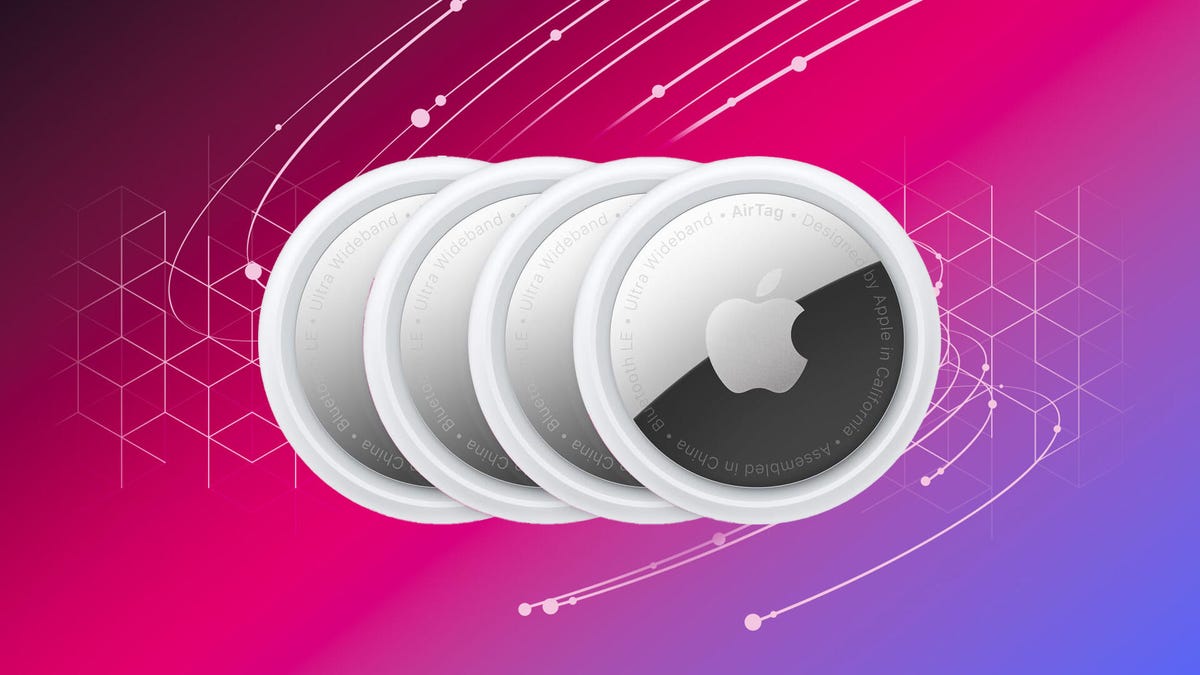
‘Tis the season for great holiday deals, and the Apple AirTag 4-Pack is one big example. As Black Friday and Cyber Monday approach, we’re seeing huge discounts on various tech items — often even bigger discounts than during Amazon Prime Day. At 26% off, the Apple AirTag 4-Pack is one of those products that I love so much that I have to share it with everyone, especially when it’s on sale.
I use AirTags to track wallets, keys, remote controls, and even my young kids. Over the past few years, AirTags have become this iPhone user’s go-to tracking device since they’re easy to use, small enough to slip in a bag or outerwear, and extremely reliable. And because there are so many aftermarket cases and holders made for AirTags, you can use them to track anything, including your bike, luggage, and car. They also make great holiday stocking stuffers, and can be split apart or gifted as the set.
You can now buy an Apple AirTag 4-pack for $73 — that’s $18 a piece for peace of mind. AirTags are nearly $30 each at regular price, so this is a great deal. Plus, they don’t frequently drop this low in price (they usually are on sale for $75-$85 dollars), and this is one of the lowest prices we’ve seen them this season. Right now you can snag this deal at AmazonBest Buy, and Walmart
Thanks to my husband, who always forgets where he puts his wallet, keys, and even his shoes, I’ve gone through several different Bluetooth trackers. While I can easily solve his incessant forgetfulness to lock the doors and close the garage with smart devices, I struggled for years to find a reliable Bluetooth tracker for our smaller items — until I tried the AirTag.
The Apple AirTag is so reliable for iPhone users that you can find out where it is down to a fraction of a foot’s length with your phone. The iPhone’s Find My app tracks the AirTag through Bluetooth, the Find My network, and ultra-wideband (UWB), a connectivity protocol that shows high-accuracy directional data. This results in highly accurate tracking information to help you find your lost devices within minutes.
Once I tried the AirTag, I couldn’t consider returning to another Bluetooth tracker. The Apple AirTag is reliable enough to trust it blindly with my home’s most frequently lost items. Thanks to how many AirTag holders exist for different devices, I use AirTags for my husband’s wallet, our car keys, our remote control, and even wristbands.
I like to keep tabs on our younger kids, so I give them an Apple AirTag on a wristband when we go to crowded places. As much as I try to hold their hands when out and about, I have three kids and only two hands, so it’s easy to find my rowdy toddler trying to escape my grip in search of shiny things or fun places to hide. While I tend to be hypervigilant of said threenager, having my kids wear AirTags gives me extra piece of mind during fairs and other crowded events.
While many sales events feature deals for a specific length of time, deals are on a limited-time basis, making them subject to expire anytime. ZDNET remains committed to finding, sharing, and updating the best offers to help you maximize your savings so you can feel as confident in your purchases as we feel in our recommendations. Our ZDNET team of experts constantly monitors the deals we feature to keep our stories up-to-date. If you missed out on this deal, don’t worry — we’re always sourcing new savings opportunities at ZDNET.com.
Physical AI describes AI models that can understand and interact with the physical world. Physical AI embodies the next wave of autonomous machines and robots, such as self-driving cars, industrial manipulators, mobile robots, humanoids and even robot-run infrastructure like factories and warehouses.
With virtual commissioning of robots in digital worlds, robots are first trained using robotic simulation software before they are deployed for real-world use cases.
Robotics Simulation Summarized
An advanced robotics simulator facilitates robot learning and testing of virtual robots without requiring the physical robot. By applying physics principles and replicating real-world conditions, these simulators generate synthetic datasets to train machine learning models for deployment on physical robots.
Simulations are used for initial AI model training and then to validate the entire software stack, minimizing the need for physical robots during testing. NVIDIA Isaac Sim, a reference application built on the NVIDIA Omniverse platform, provides accurate visualizations and supports Universal Scene Description (OpenUSD)-based workflows for advanced robot simulation and validation.
Three computers are needed to train and deploy robot technology.
A supercomputer to train and fine-tune powerful foundation and generative AI models.
A development platform for robotics simulation and testing.
An onboard runtime computer to deploy trained models to physical robots.
Only after adequate training in simulated environments can physical robots be commissioned.
The NVIDIA DGX platform can serve as the first computing system to train models.
NVIDIA Ominverse running on NVIDIA OVX servers functions as the second computer system, providing the development platform and simulation environment for testing, optimizing and debugging physical AI.
NVIDIA Jetson Thor robotics computers designed for onboard computing serve as the third runtime computer.
Who Uses Robotics Simulation?
Today, robot technology and robot simulations boost operations massively across use cases.
Global leader in power and thermal technologies Delta Electronics uses simulation to test out its optical inspection algorithms to detect product defects on production lines.
Deep tech startup Wandelbots is building a custom simulator by integrating Isaac Sim into its application, making it easy for end users to program robotic work cells in simulation and seamlessly transfer models to a real robot.
Using NVIDIA Isaac Sim, robotics company Galbot built DexGraspNet, a comprehensive simulated dataset for dexterous robotic grasps containing over 1 million ShadowHand grasps on 5,300+ objects. The dataset can be applied to any dexterous robotic hand to accomplish complex tasks that require fine-motor skills.
Using Robotics Simulation for Planning and Control Outcomes
In complex and dymanic industrial settings, robotics simulation is evolving to integrate digital twins, enhancing planning, control and learning outcomes.
Developers import computer-aided design models into a robotics simulator to build virtual scenes and employ algorithms to create the robot operating system and enable task and motion planning. While traditional methods involve prescribing control signals, the shift toward machine learning allows robots to learn behaviors through methods like imitation and reinforcement learning, using simulated sensor signals.
This evolution continues with digital twins in complex facilities like manufacturing assembly lines, where developers can test and refine real-time AIs entirely in simulation. This approach saves software development time and costs, and reduces downtime by anticipating issues. For instance, using NVIDIA Omniverse, Metropolis and cuOpt, developers can use digital twins to develop, test and refine physical AI in simulation before deploying in industrial infrastructure.
High-fidelity, physics-based simulations have supercharged industrial robotics through real-world experimentation in virtual environments.
NVIDIA PhysX, integrated into Omniverse and Isaac Sim, empowers roboticists to develop fine- and gross-motor skills for robot manipulators, rigid and soft body dynamics, vehicle dynamics and other critical features that ensure the robot obeys the laws of physics. This includes precise control over actuators and modeling of kinematics, which are essential for accurate robot movements.
To close the sim-to-real gap, Isaac Lab offers a high-fidelity, open-source framework for reinforcement learning and imitation learning that facilitates seamless policy transfer from simulated environments to physical robots. With GPU parallelization, Isaac Lab accelerates training and improves performance, making complex tasks more achievable and safe for industrial robots.
To learn more about creating a locomotion reinforcement learning policy with Isaac Sim and Isaac Lab, read this developer blog.
Teaching Collision-Free Motion for Autonomy
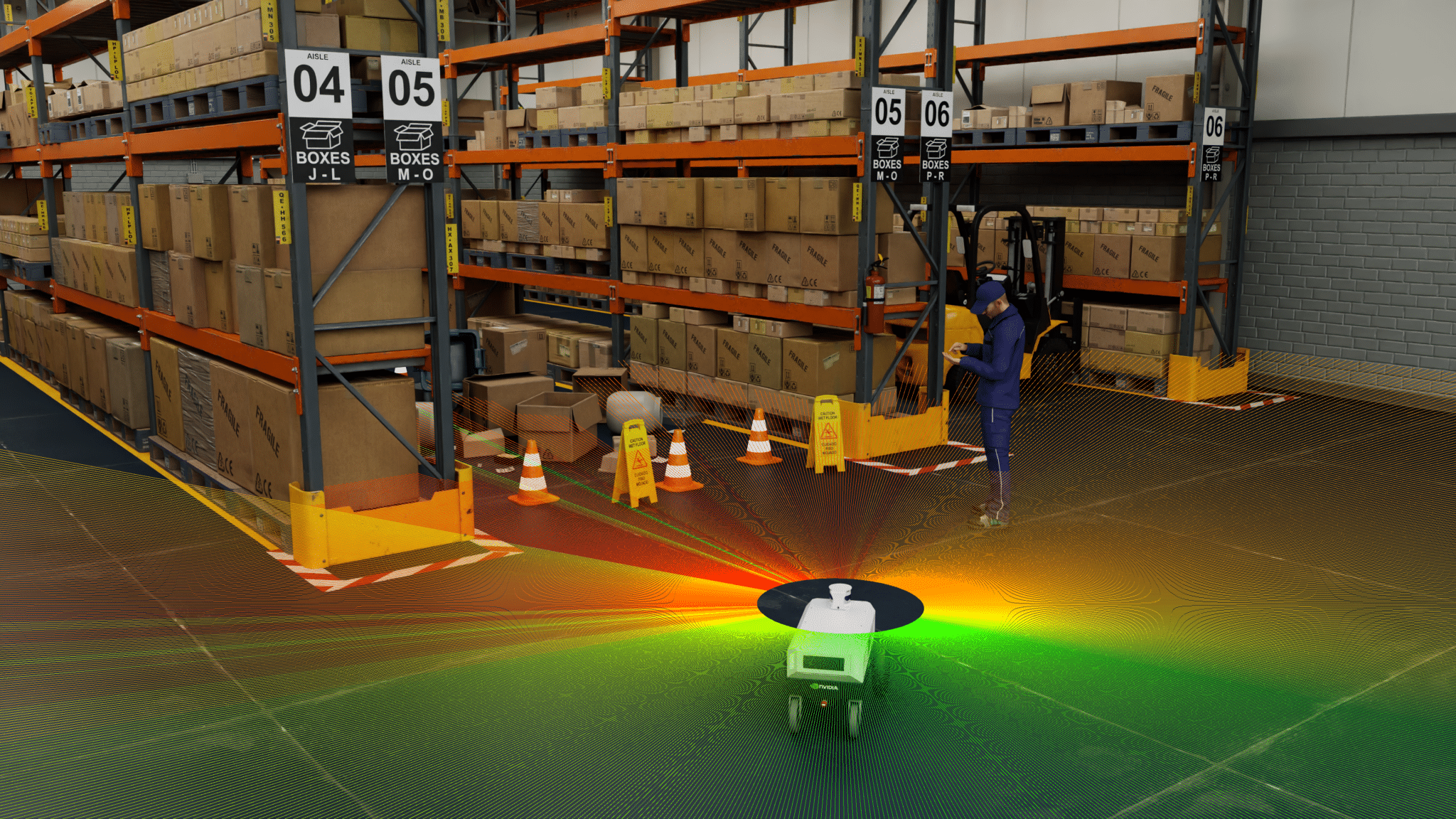
Industrial robot training often occurs in specific settings like factories or fulfillment centers, where simulations help address challenges related to various robot types and chaotic environments. A critical aspect of these simulations is generating collision-free motion in unknown, cluttered environments.
Traditional motion planning approaches that attempt to address these challenges can come up short in unknown or dynamic environments. SLAM, or simultaneous localization and mapping, can be used to generate 3D maps of environments with camera images from multiple viewpoints. However, these maps require revisions when objects move and environments are changed.
The NVIDIA Robotics research team and the University of Washington introduced Motion Policy Networks (MπNets), an end-to-end neural policy that generates real-time, collision-free motion using a single fixed camera’s data stream. Trained on over 3 million motion planning problems and 700 million simulated point clouds, MπNets navigates unknown real-world environments effectively.
While the MπNets model applies direct learning for trajectories, the team also developed a point cloud-based collision model called CabiNet, trained on over 650,000 procedurally generated simulated scenes.
With the CabiNet model, developers can deploy general-purpose, pick-and-place policies of unknown objects beyond a flat tabletop setup. Training with a large synthetic dataset allowed the model to generalize to out-of-distribution scenes in a real kitchen environment, without needing any real data.
How Developers Can Get Started Building Robotic Simulators
Get started with technical resources, reference applications and other solutions for developing physically accurate simulation pipelines by visiting the NVIDIA Robotics simulation use case page.
Robot developers can tap into NVIDIA Isaac Sim, which supports multiple robot training techniques:
Synthetic data generation for training perception AI models
Software-in-the-loop testing for the entire robot stack
Robot policy training with Isaac Lab
Developers can also pair ROS 2 with Isaac Sim to train, simulate and validate their robot systems. The Isaac Sim to ROS 2 workflow is similar to workflows executed with other robot simulators such as Gazebo. It starts with bringing a robot model into a prebuilt Isaac Sim environment, adding sensors to the robot, and then connecting the relevant components to the ROS 2 action graph and simulating the robot by controlling it through ROS 2 packages.
I have to say… the new Descript video editing is better than ever.
The video editing functionalities have improved, we have all new AI features, and now there’s a whole new way to record your polished pro-looking videos.
Descript video editing is so much better in the NEW Descript.
Here’s everything you need to know about how to use Descript in one crash course!
The “New” Descript is better than ever, so I put together this Crash Course to get you up and running.
VIDEO: Learn the NEW Descript in 23 Minutes
Some product links in this post are affiliate links, and I will be compensated when you purchase by clicking our links. Read my disclosure policy here.
Understanding Descript Basics
Descript stands out from other video editors with its unique drive workspace. This Descript video editing feature allows you to organize your projects just like you would on your hard drive or Google Drive. You can create folders, star them for easy access, and keep everything neatly organized. This saves time and reduces headaches down the road. To start a new project, simply hit “Start Project” and choose “Video Project.” You can import videos from Zoom, your hard drive, or record directly within Descript using the new “Rooms” feature.
Importing and Transcribing Videos
Importing a video into Descript is straightforward. Once imported, you have the option to transcribe it. This is useful if you want to edit your video based on the transcript. Keep in mind that your account comes with a limited number of transcription minutes, so use them wisely. Once transcribed, you’ll see your transcript on the left, the playback window in the center, and all the features and functions on the right.
Efficient Video Editing with Descript
Descript is designed to save you time. You can edit your video by highlighting mistakes or silences in the transcript and deleting them. This reflects in the timeline, and vice versa. For more traditional editing, you can split clips and delete sections directly in the timeline. Descript’s AI, known as Underlord, offers additional time-saving features.
The Underlord AI in Descript is like having an assistant built into your editor. It helps you identify word gaps, silences, and retakes, allowing you to shorten or remove them efficiently. This AI doesn’t take over your editing but assists you in making quicker decisions. For instance, the “Shorten Word Gaps” feature searches for silences and lets you remove them with a single click.
Descript‘s Studio Sound feature improves your audio quality, especially useful if you’re recording in noisy environments. However, if you’re in a quiet room with a decent microphone, you might not need it. If you do use it, adjust the intensity to avoid distortion.
Removing Filler Words and Editing for Clarity
While Descript offers a “Remove Filler Words” tool, I find that filler words are part of my natural speech. The “Edit for Clarity” function, however, can be useful if you want to refine your video further. Experiment with the intensity level to find what works best for you.
Descript offers advanced AI tools like eye contact correction and green screen effects. These features take time to process, so plan accordingly. They can significantly enhance your video, bringing you closer to a final product ready for export.
Fine-Tuning Your Edits
My editing philosophy is BFF: Basic, Fine-Tune, Fancy. After using AI to handle the basics, I move to fine-tuning. This involves tightening cuts, adjusting dead space, and ensuring everything flows smoothly. Descript’s keyboard shortcuts and blade tool make this process efficient.
Recording with Descript
Descript‘s recording feature allows you to create remote recording spaces, similar to Zoom or Riverside. You can select your camera and microphone, and even invite others to join. The quality might appear downgraded during recording to save bandwidth, but rest assured, the final output is high quality.
Hidden Shortcuts and Features
Descript is packed with hidden shortcuts that save time. You can duplicate compositions to experiment without fear of losing progress, adjust the playback speed to edit faster, and use highlighters to mark sections for later review. The “Ignore Media” function lets you hide sections without deleting them, offering flexibility in your editing process.
Adding Elements and Captions
Descript allows you to add text, titles, and other elements to your video. You can adjust their timing and position in the timeline. The captions feature creates dynamic captions from your transcript, customizable to fit your style and branding.
Exporting Your Final Video
When you’re ready to export, Descript offers two options: Publish and Export. Publishing is faster and happens in the cloud, while exporting saves directly to your hard drive. I recommend exporting for maximum control over your final file, allowing you to preview and back it up as needed.
Descript is a powerful tool that can transform your video editing process. With its intuitive interface and advanced features, you can create professional-quality videos with ease. If you found this guide helpful, don’t forget to grab my Descript cheat sheet for more tips and tricks!
I’ve been working on LaTex and I need to add code snippets of python in my work. I’m currently working on VSCode using the LaTex Workshoop extension. Recently, I saw that there was this library “minted” that was used for what I needed. I started setting up everythig, I even configured the LaTex workshop to work correctly with minted. I also installed the pygments library on my computer. Even with all this, I keep getting this error:
Package minted: Missing Pygments output; \inputminted was probably given a file that does not exist– otherwise, you may need the outputdir package option, or may be using an incompatible build tool, or may be using frozencache with a missing file.
It may be hard to remember, but George Clooney and Brad Pitt co-starred in a movie, “Wolfs,” that Apple released just two months ago.
On Friday, the film’s writer and director Jon Watts said Friday that a sequel is no longer happening; in a follow-up interview with Deadline, he explained that he “no longer trusted [Apple] as a creative partner.”
The company is reportedly scaling back its movie strategy. “Wolfs,” for example, was supposed to get a big theatrical release, but instead, it played in a limited number of theaters for just one week before launching on Apple TV+.
Watts, who also created the new Star Wars show “Skeleton Crew,” said Apple’s shift “was a total surprise and made without any explanation or discussion.”
“I was completely shocked and asked them to please not include the news that I was writing a sequel,” Watts said. “They ignored my request and announced it in their press release anyway, seemingly to create a positive spin to their streaming pivot.”
As a result, Watts said he “quietly returned the money they gave me for the sequel” and canceled the project.
Qualcomm’s Snapdragon 8 Elite is an exciting new mobile platform that’s destined to power many of next year’s flagship smartphones. The improvements Qualcomm has made in this year’s chip are highlighted by the fact that the chipmaker has dropped its traditional “Gen” designations to give the fourth-generation chip an identity all its own.
While the Snapdragon 8 Elite has already started showing up in some more niche flagships like the Realme GT 7 Pro, we likely won’t really get a taste of what it can do until more mainstream players like OnePlus and Samsung bring it to their phones. The OnePlus 13 has already been announced and will probably hit North American shores early next year. There’s also little doubt that the new chip will also be at the core of Samsung’s Galaxy S25 lineup, likely powering new Galaxy AI features and bringing the S25 Ultra’s cameras to new heights.
On the other side of the ring, Apple continues to flex its chipmaking muscles with the A18 Pro, which is at the heart of this year’s iPhone 16 Pro. We don’t have to wait to see what that chip is capable of, however, as Apple has already (mostly) put its best foot forward with Apple Intelligence and new computational photography features.
While it’s hard to compare the Snapdragon 8 Elite and A18 Pro on equal footing since both are used in fundamentally different mobile platforms, their differences raise some interesting questions. Most notably, does either piece of silicon give one platform a significant advantage over the other, or is it more about what phone makers do with the capabilities that are available to them? Let’s dig in and find out.
Snapdragon 8 Elite vs. Apple A18 Pro: specs
Specs
Snapdragon 8 Elite
Apple A18 Pro
Part number
SM8750-AB
A18 Pro
Process
3nm (N3E)
3nm (N3E)
CPU
Qualcomm Oryon CPU 64-bit Architecture 2 prime cores, up to 4.32GHz 6 performance cores, up to 3.53GHz
Apple CPU 64-bit Architecture 2 High-Performance cores, up to 4.04GHz 4 Efficiency Cores, up to 2.2GHz
GPU
Adreno 830 GPU Support for Unreal Engine 5.3 Nanite Adreno Frame Motion Engine 2.1 Snapdragon Game Super Resolution Snapdragon Game Post-Processing Accelerator HDR gaming (10-bit color depth, Rec. 2020 color gamut) Snapdragon Shadow Denoiser API support: OpenGL ES 3.2, OpenCL 3.0 FP, Vulkan 1.3 Hardware-accelerated H.265, VP9, AV1 decoder HDR Playback Codec support for HDR10+, HDR10, HLG, and Dolby VisionSnapdragon Adaptive Game ConfigurationSupport for Unreal Engine Chaos Physics Engine
Apple GPU 6 GPU Cores, up to 1.45GHz Support for Hardware-Accelerated Ray Tracing, Dynamic Caching, Mesh Shading, Hardware-accelerated HEVC, H.264, AV1, and ProRes Playback Codec support for HDR with Dolby Vision, HDR10+/HDR10, and HLG
Apple Neural Engine 16 cores, 35 trillion operations per second
Memory
Support for dual-channel LP-DDR5x memory, up to 5.3Gbps
Unified Memory, 8 GB LPDDR5X
Display
On-Device Display Support: 4K @ 60Hz QHD+ @ 240Hz
Apple Display Engine 120Hz ProMotion and Always-On Display Support
Camera
Qualcomm Spectra AI Triple 18-bit ISP
Limitless real-time Semantic Segmentation
Up to 48MP triple camera at 30 fps Up to 108MP single camera at 30 fps Up to 320MP photo capture Zero Shutter Lag
Slo-mo video capture at 1080p @ 480 fps
Massive Multi-Frame Noise Reduction with AI
Real-time AI skin and sky tone adjustments in 4K60 fps
Apple Image Signal Processor with Photonic Engine, Deep Fusion, and Smart HDR 5
ProRes and HEVC Video Recording in Dolby Vision 4K
Hardware Video Encoder (ProRes, HEVC)
Cinematic Slow Motion video capture at 4K @ 120 fps
Connectivity
Qualcomm FastConnect 7900 Wi-Fi 7 X80 5G Modem-RF System Bluetooth 6.0 Integrated Ultra Wideband (UWB)
USB Type-C 3.2 Gen 2 Integrated Ultra Wideband (UWB)
Snapdragon 8 Elite vs. Apple A18 Pro: CPU
Qualcomm
Qualcomm’s Snapdragon 8 Elite marks a significant jump over its predecessor when compared to Apple’s A18 Pro, as it’s the company’s first chip to move to TSMC’s 3-nanometer (3nm) fabrication process. Apple was the first to make the 3nm transition with its 2023 A17 Pro used in the iPhone 15 Pro lineup. However, it used an earlier version of TSMC’s process, dubbed N3B, which was beset by manufacturing problems that resulted in lower yields. It may also be the reason for the binned A17 Pro chips that have found their way into this year’s iPad mini 7 — there’s a good chance these are leftover chips from the N3B process that didn’t make the cut for the iPhone 15 Pro.
N3B wasn’t ready for prime time, which is likely why Qualcomm skipped that early 3nm process until it evolved into this year’s N3E. That’s not to say that the N3B process made the A17 Pro inferior in any way. The problems with it were related to production, but those chips that did come off the line successfully were still powerful enough to usher in a new era of mobile gaming and prepare Apple’s iPhone 15 Pro models for the new AI capabilities that would become the foundation of Apple Intelligence.
Qualcomm
Now that N3E is ready, the Snapdragon 8 Elite and Apple’s A18 Pro have adopted that more stable process. This puts them on the same core technology baseline, but that’s where their similarities end, as Apple and Qualcomm have each taken their silicon in different directions.
Unlike Apple, Qualcomm builds chips for third-party platforms, ranging from smartphones and tablets to ARM-based Windows PCs. It’s this last category that’s inspired the Snapdragon 8 Elite, which brings its new Oryon core technology that debuted in the Snapdragon X processors in last year’s AI PCs to the mobile space. However, this is a second generation of that core that boasts better performance and power efficiency than the ones found in its X chips and promise a 45% increase in performance. The two prime cores offer clock speeds of up to 4.32GHz versus 3.4GHz in last year’s chip. Six performance cores supplement that with 3.53GHz peak speeds, placing them ahead of even last year’s Snapdragon 8 Gen 3 Cortex-X4 prime core.
Apple
Apple’s A18 Pro takes a different approach, using a combination of performance and efficiency cores similar to Qualcomm’s previous silicon. A pair of high-performance cores deliver clock speeds of up to 4.04GHz, while the four efficiency cores only clock in at 2.2GHz.
While you might expect those differences would make the Snapdragon 8 Elite the better performer with eight cores and faster clock speeds across the board, benchmarks surprisingly place both chips roughly on par. The A18 Pro edges out the Snapdragon 8 Elite in single-core performance, while Qualcomm’s chip offers slightly better multicore performance, but they’re very close in both areas, proving that clock speeds and the number of cores don’t tell the whole story. Both chips are extremely powerful in their own right, and there’s no clear winner in raw CPU performance.
Snapdragon 8 Elite vs. Apple A18 Pro: GPU
Apple
In 2023, Apple announced it had developed “a breakthrough new GPU” for its A17 Pro, and touted it as the biggest redesign in its history. Features like an Apple-designed shader architecture, hardware-accelerated ray tracing, and Metal effect upscaling that works in conjunction with Apple’s Neural Engine (NPU) made the iPhone 15 Pro the first smartphone capable of handling full-quality AAA console games. The A18 Pro uses the same Apple-designed GPU, boosting overall performance by 20% and doubling the ray tracing performance.
However, it’s also fair to say that Apple’s move into AAA gaming was more of an indictment of the state of the Android gaming landscape than it was of Qualcomm’s Snapdragon chips. The Snapdragon 8 Gen 3’s Adreno GPU was still a match for the A17 Pro in raw specs, and the Snapdragon 8 Elite has taken that to a new level. Qualcomm says it’s the “first-ever Adreno GPU with sliced architecture,” and it delivers a 40% performance gain over the Gen 3 while adding support for Unreal Engine 5.3 Nanite.
ScreenshotQualcomm
The practical upshot of these improvements is a more realistic gaming experience with “film-quality 3D environments for total immersion” and support for the Unreal Chaos Physics Engine, which provides a whole new and more immersive level of realism for gaming.
It’s a significant push ahead for Qualcomm silicon. Apple’s advantage in this area has come from its ability to woo game developers and convince them to embrace its MetalFX engine. Last year’s A17 Pro delivered impressive results, and those are continuing with the A18 Pro, turning Apple’s iPhones into gaming powerhouses. Qualcomm hopes that if they build it, game developers will come, and it’s telling that the extremely gaming-focused ROG Phone 9 Pro is one of the first phones to pack in the Snapdragon 8 Elite.
Snapdragon 8 Elite vs. Apple A18 Pro: NPU
Qualcomm
With generative AI becoming a much bigger deal, there’s a third important aspect of modern silicon: the Neural Processing Unit (NPU). Apple calls this its Neural Engine, and it’s been packing these into its A-series chips since the A11 Bionic in 2017.
Qualcomm wasn’t far behind. While it didn’t make as much noise about NPUs in those days, the 2018 Snapdragon 845 introduced its first Hexagon Tensor Accelerator. In those days, NPUs were used primarily for under-the-hood features like computational photography. The Hexagon chip was originally a digital signal processor (DSP) that evolved into an NPU, and Apple’s early Neural Engine was primarily used to support then-nascent features like Face ID and Animoji on that year’s iPhone X.
We’ve come a long way since then. The Hexagon has evolved into a full-featured NPU with 14 cores in the Snapdragon 8 Elite, and Apple’s Neural Engine has grown from its humble dual-core beginnings to a 16-core subsystem that can handle up to 35 trillion operations per second (TOPS). Both are key to powering their respective platforms’ AI and other machine-learning features, including Galaxy AI on Samsung’s smartphones, Gemini Nano, and Apple Intelligence.
Apple
Apple is heavily pushing on-device generative AI as a privacy feature, so it’s built its Neural Engine in the A18 Pro and other recent A-series and M-series chips with that in mind. Qualcomm has been a bit slower in getting there; the Snapdragon 8 Gen 3 took the first steps into this arena, but the Snapdragon 8 Elite may have the first NPU that can effectively deliver on this thanks to an enhanced token limit that will support more complex and longer inputs without the need to send those requests to cloud servers.
NPUs also go deeper than merely consumer-facing AI features. They also drive things like camera enhancements, better power efficiency, and wireless communications. These things are much harder to quantify, but suffice it to say that the Snapdragon 8 Elite and A18 Pro should both be more than up to those tasks.
Snapdragon 8 Elite vs. Apple A18 Pro: power efficiency
Qualcomm
Despite all these performance gains, it’s impressive that both chips promise increased power efficiency. Qualcomm gains more over its predecessor, thanks to the shift to a 3nm process. Still, its second-generation Oryon CPU cores and the sliced architecture of its Adreno 830 GPU result in energy efficiency that matches the performance improvements — 40% faster gaming performance and 40% greater efficiency.
Qualcomm says this should translate to an extra 2.5 hours of gaming over its predecessor, all other things being equal. However, the reality of this is somewhat more complex, as things are seldom equal. The smartphones that the Snapdragon 8 Elite go into will have many other things drawing power, notably large high-refresh screens. The chip may be more efficient, but handset makers will have to work on using other components that don’t detract from that.
Joe Maring / Digital Trends
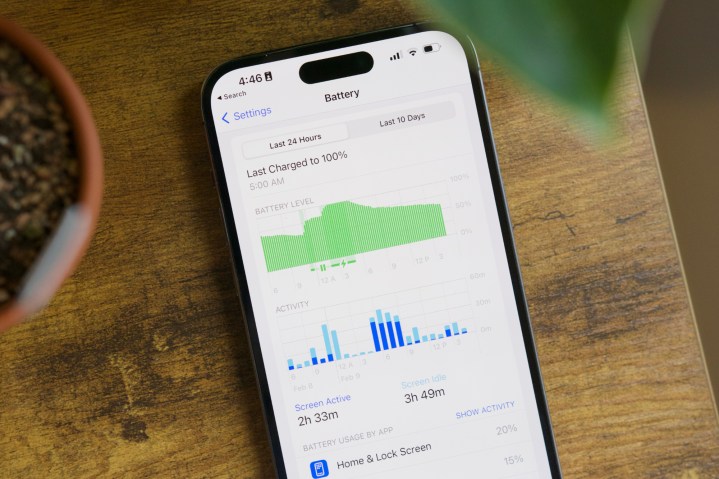
Apple gets a theoretical advantage here as it owns all the pieces, allowing us to see more measurable real-world results. The A18 Pro is only used in two smartphones, the iPhone 16 Pro and iPhone 16 Pro Max, both of which show noticeable, but modest improvements over their A17 Pro-equipped predecessors. Apple typically considers all-day battery life good enough, so the efficiency gains from its new chips are often poured into delivering more power to other aspects of the iPhone, such as the larger displays on this year’s models and the new Apple Intelligence features in iOS 18.
Some Android manufacturers may choose to do the same with Qualcomm’s Snapdragon 8 Elite, but the variety of platforms that will incorporate the new chip should result in at least some devices focusing more heavily on improving overall battery life.
Snapdragon 8 Elite vs. Apple A18 Pro: other features
Qualcomm
Once we get past the core components, the two platforms diverge significantly. Qualcomm bakes much more into its silicon, while Apple still relies on third-party chips (some of which are Qualcomm’s, ironically) to handle things like Wi-Fi, Bluetooth, and 5G connectivity.
The Snapdragon 8 Elite incorporates Qualcomm’s FastConnect 7900 platform, which includes Wi-Fi 7 support with peak speeds of 5.8Gbps, the X80 5G Modem-RF system, Bluetooth 6.0, and integrated Ultra Wideband. Apple mixes this up more, using Qualcomm’s Snapdragon X75 to handle its 5G connectivity and a Broadcom chip for Wi-Fi 7 and Bluetooth 5.3 in the iPhone 16 Pro models.
Similarly, Qualcomm promotes the camera capabilities of the image signal processor in its Snapdragon 8 Elite, which promises more NPU-powered computational photography features for things like multiframe noise reduction and enhancing lower-light video capture. The image signal processor can now handle 320-megapixel photos, 1080p slo-mo video at 480 frames per second (fps), zero shutter lag, and AI-powered skin and sky tone adjustments. However, it feels slightly disingenuous to focus too much on camera specs in a chip since these are simply maximum capabilities that may have little bearing on what we end up with in smartphones equipped with Qualcomm’s latest chip. It’s nice to know it’s raised the bar, but don’t expect to see too many phones with 480-fps slo-mo and the ability to capture 320MP photos.
Apple doesn’t tout the same for its A18 Pro because it’s simply part of the iPhone 16 Pro experience. Apple’s silicon is undoubtedly responsible for its new Photographic Styles and 4K/120 fps Cinematic Slow Motion, just like previous generations empowered real-time color grading for Dolby Vision video capture.
Snapdragon 8 Elite vs. Apple A18 Pro: final words
Qualcomm
It’s always been difficult to compare Apple’s A-series chips with anything else on the market in any meaningful way. Beyond benchmarks that fail to tell the whole story, Qualcomm’s Snapdragon 8 Elite and Apple’s A18 Pro live in entirely different worlds. You’ll never find a Qualcomm chip running iOS or an A-series chip running Android.
Apple uses its chips exclusively in its own devices, running its own operating systems, which means it controls all the pieces. The A18 Pro was designed with only two devices in mind, the iPhone 16 Pro and iPhone 16 Pro Max, and is unlikely to be used anywhere else. Meanwhile, Qualcomm has engineered its Snapdragon 8 Elite to power a broad range of Android smartphones across different disciplines, from gaming-focused phones like Asus’ ROG Phone 9 Pro to more general-purpose premium flagships like Samsung’s Galaxy S25 series (which are undoubtedly slated to use the new chipset). Each of those companies will use the Snapdragon 8 Elite in different ways, and Qualcomm has to design a chip that’s ready to address them all.
That makes the Snapdragon 8 Elite a more versatile chip, but that only matters because it needs to be. Apple can get away with a more single-minded approach for its A18 Pro. While this year’s Apple chip only gets modest improvements over its predecessor, that’s because it already leapt ahead last year when it moved to the early N3B 3nm process for the A17 Pro. Qualcomm has to play a bit of catch-up here, but it’s done so admirably with the Snapdragon 8 Elite, and there’s no doubt it’s ready to power new Android headsets that will take on this year’s Apple flagships. Now, it’s up to Android manufacturers to take that ball and run with it.
You are the Servonauts – a team of dedicated, enthusiastic and utterly replaceable service station attendants. Work together with your friends to refine fuel, build pipelines and manage mayhem in many exotic locations throughout the galaxy. When cars pull into your servo, they’ll request a specific kind of fuel. Build machines to refine this fuel, and combine fuels to make advanced recipes! But be careful – pumping the wrong fuel can have *explosive* consequences. To pump these cars, you’ll need Astroil’s patent-pending pipe technology! These wobbly, physically-simulated pipes can bend and stretch to get fuel where you need it. ICBM Escalation
They’re even partially lava-resistant (unlike the Servonauts)! Play in single-player with in-game support or grab your mates to jam it out as a duo, trio, or chaotic 4 player quartet. Work with your team and optimise your logistics as you aim to collect all three Gold Stars. Will this mean the Servonauts finally get a vacation? (Don’t be ridiculous…)
Features and System Requirements:
Work solo or with friends in local couch co-op to manage chaotic space gas stations across various exotic locations. Optimize logistics, tackle challenges, and aim for efficiency.
Aim to collect Gold Stars for top performance, with each level increasing in complexity and chaos.
Its colorful, cartoony art style and lighthearted tone make it suitable for players of all ages.
Screenshots
System Requirements
Recommended
OS: Windows 10 64 bit
Processor: Intel Core i5 or AMD equivalent
Memory: 4 GB RAM
Graphics: GeForce GTX 970 / Radeon RX 570
DirectX: Version 11
Storage: 3 GB available space
Support the game developers by purchasing the game on Steam
Installation Guide
Turn Off Your Antivirus Before Installing Any Game
1 :: Download Game 2 :: Extract Game 3 :: Launch The Game 4 :: Have Fun 🙂
It’s that wonderful time of year when Big Geoff’s Trailer Extravaganza starts gearing up to dole out awards to the year’s biggest games—which also means that it’s time for a lot of people with no dog in the race to get extremely upset about certain games not getting a nod.
This year, Palworld—which launched in January—is among the notable omissions from the list of nominees, and yeah, that is quite surprising. For a significant chunk of the year, it was a vast, all-consuming game that generated plenty of discourse and many, many hours played. But The Game Awards is not based on player numbers or articles written. It’s all vibes, folks. Just a bunch of folks saying “I like this game”. And this year, there weren’t enough of them to secure Palworld a nomination.
But this hasn’t stopped claims that it’s been “snubbed” from doing the rounds—an accusation which community manager John Buckley addressed on Twitter.
“No, I don’t think Palworld was snubbed,” he said. “Twitter has become such a banterless place. Stop being so over dramatic gamers. Not everything is a conspiracy.”
No, I don’t think Palworld was snubbed. Twitter has become such a banterless place. Stop being so over dramatic gamers. Not everything is a conspiracy. That being said…Satisfactory was 1000% snubbed and I’ll be voicing that opinion ad nauseam at The Game Awards in person😡November 18, 2024
Yep, Twitter sure is the worst.
Of course, it’s natural for fans to want their tastes to be vindicated by large corporate award shows. Is a game truly good if Geoff Keighley doesn’t give it a wee pat on the back? Snideness aside, I do get it. I also want the teams behind the games I like to get recognition for their skill and hard work. But when that doesn’t happen, it’s not a snub.
We’ve all got games we’d like to see get nominations. In Buckley’s case, it’s Satisfactory. In mine, it’s literally any strategy game. Like… just pop at least one up there. There are so many! A strategy category is way overdue. But see? It’s so easy to get wrapped up in this nonsense. We are all just dancing to Big Geoff’s tune.
Keep up to date with the most important stories and the best deals, as picked by the PC Gamer team.