After its rough launch, Payday 3 hasn’t been bringing in the cash its developer might’ve hoped for, with Starbreeze reporting sales of $7.7 million in its 2024 financial year, down from $44.5 million in its launch year of 2023. To put that in perspective, the very much aged Payday 2 brought in $3.9 million in sales in FY2024—more than half of what its sequel managed despite releasing 10 years prior.
All told, Starbreeze reported a full year loss of $18.5 million in 2024.
Payday 3 did get a big remedial update last year, but user reviews are still pretty mixed. It also saw the departure of its game director last September, and a Payday 3 lead producer characterized the 2023 launch as ‘disastrous’ in an interview that made it clear the development team was still hounded by the botched release.
According to Starbreeze, things are looking up, however. They’ve got Payday collaborations with PUBG and Roblox. They’ve got it as a free game on PlayStation Plus for February—which they clearly hope will bring in some longer-term users to buy DLC.
Beyond Payday, Starbreeze is also working on a co-op Dungeons & Dragons game that they say is being playtested internally, and has gotten a positive reception from potential business partners.
Keep up to date with the most important stories and the best deals, as picked by the PC Gamer team.
Have you ever been frustrated when Copilot doesn’t understand you? While it can’t read your mind, we’ve been working hard to make your coding experience smoother.
Previously, Copilot in Visual Studio could look at files in your repository, but you needed to specify the context of your code manually. We understand this wasn’t the most intuitive experience, so we’ve been working on a smarter way to infer information automatically.
Introducing Tool Calling: A Smarter Copilot
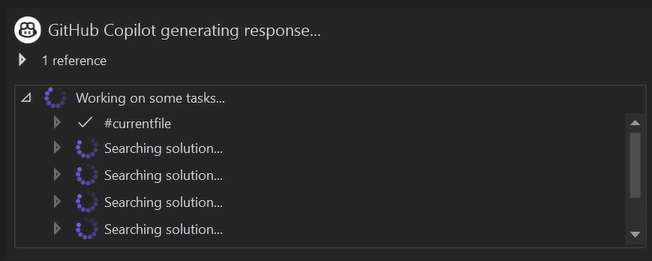
Tool Calling is here—a major update that changes how you interact with Copilot. Now, Copilot can automatically search for more relevant code or tools it needs to address your questions. This works with GPT-4o and Claude Sonnet.
You can now simply describe what you need in natural language, and Copilot can decide what of the information below is relevant:
Your current file
Open files or related files in your solution
Your whole codebase
debugger (locals, call stacks, etc.)
or Visual Studio itself
Web integration is also coming soon, allowing you to ask questions that span both local code and external data sources. (But for now you can use @GitHub.)
And that’s not all we added….
Smarter Knowledge Retrieval
Even more transparency and control
While Tool Calling is a significant improvement, it’s not perfect. To tweak any missteps, try the Retry button to generate a fresh response. You can also manually specify files, methods, classes, or entire solutions using # references in your prompts.
Help Shape the Future
Tool Calling enables both enhanced context retrieval and greater workflow automation. Please update to the latest version of Visual Studio to access upcoming features. We also invite you to try Chat again and share your feedback—let us know what works, what doesn’t, and how we can improve your experience.
Happy coding!
Want to try this out?
Activate GitHub Copilot Free and unlock this AI feature, plus many more.
No trials. No credit cards. Just your GitHub account. Get Copilot Free
In terms of ratings, Overwatch 2 could not have released at a worse time on Steam. The hero shooter’s online reputation was in the toilet after Blizzard spent years talking up all the cool PvE and campaign missions the sequel would have, only to deliver a fraction of them extremely late and eventually cancel the rest. So when the free-to-play game finally came to Steam in August 2023, it was summarily dunked on with tens of thousands of negative reviews. In 2025, Overwatch 2 rests at an “Overwhelmingly negative” Steam rating with over 300,000 reviews.
Here’s some good news: For the first time since its Steam debut, its “Recent reviews” rating, which only tracks reviews in the last 30 days, is at “Mixed.” That’s thanks to an influx of good vibes after this week’s Season 15 update, which brought the biggest shakeup to Overwatch 2 since 5v5 with hero perks.
“Overwatch 2 finally released,” wrote user delulu in a positive review.
“I quit last summer but S15 is actually really fun, and I appreciate the risky approach they took,” wrote user Melina in a positive review today. “It’s a really good time to get in Overwatch right now, so I highly recommend giving it a try!”
“If this is desperation, I’m all for it!!!!!! Let’s go competition,” wrote user Skriblyb in a positive review, presumably citing the rise of Marvel Rivals as motivation for Blizzard taking bigger swings with Overwatch.
User Devorp offered a less gracious read of Blizzard’s new rivalry in a negative review: “Devs ignore this game with no updates or balances and they only do something when Rivals is taking all of their users.”
(Image credit: Valve)
That’s not entirely accurate: Blizzard says it was cooking up its big perks update, which added 168 new upgrades to its 40+ hero roster overnight, long before Marvel Rivals arrived with a bang in December. Another gargantuan update arriving next season, Stadium, has been in development for over a year. That doesn’t mean Blizzard isn’t feeling the pressure of another popular hero shooter on the block, but it’s more likely that a steadily declining interest in Overwatch drove these larger changes in the first place. Rivals is undeniably an accelerant.
Keep up to date with the most important stories and the best deals, as picked by the PC Gamer team.
I noticed many of Overwatch’s latest positive reviews come from Steam accounts with only a handful of hours played, suggesting some are Battle.net players who booted the game on Steam so they could leave a positive review—the inverse of what happened when Overwatch 2 launched on Steam and garnered over 50,000 negative reviews in 24 hours.
It’s far too early to call this a comeback—and it’s up for debate if Overwatch 2 even needs a comeback as it’s never stopped being popular—but if a dunked-upon game can get back on the good side of its fickle Steam community, it’s a generally great sign for its health. Cyberpunk 2077 pulled it off after being widely criticized for launch bugs.
The Walking Dead and Invincible co-creator Robert Kirkman is the creative force behind Blood & Thunder – a new sci-fi comic from Skybound that sounds like Blade Runner with a talking gun…
The new series is set far in the future on an Earth that has integrated alien life into its society. As different as this society is, however, there’s still crime – and crimefighters. Bounty hunter Akeldama “Blood” Bledsoe and her talking gun Thunder are tasked with tracking down the galaxy’s deadliest criminal, little realising that this case will “unlock secrets about her past, present, and future,” according to Skybound’s synopsis for the new series.
Although based on Kirkman’s idea, the new series is written by Benito Cereno, illustrated by E.J. Su, colored by MSassyK, and lettered by Rus Wooton. Kirkman isn’t stepping away from the project, however – he will remain as a creative consultant. Here’s a preview of interior pages from the first issue…
Image 1 of 5
(Image credit: Image/Skybound)
(Image credit: Image/Skybound)
(Image credit: Image/Skybound)
(Image credit: Image/Skybound)
(Image credit: Image/Skybound)
“Blood & Thunder is a concept I’ve been dying to share with the world for quite some time. I’m so thrilled to be on the cusp of debuting what Benito Cereno, E.J. Su and I have cooked up,” said Robert Kirkman in a statement. “Monsters! Aliens! Space! Talking Guns! I dare you to find a comic that’s more exciting! Blood & Thunder! Shut up!”
“What happens when the best fighter in the colony finally finds something to fight for? That’s what we’re hoping to find out in Blood & Thunder, a book where E.J. Su and I have been given room to stretch our legs in exploring strange new worlds and the people who inhabit them,” added Benito Cereno. “I can’t wait for everyone to see the vibrant and explosive energy E.J. brings to each new environment, alien and familiar all at once.”
The main cover for Blood & Thunder #1 comes from E.J. Su and MSassyK, with variants for the issue also available from David Lopez, Andie Tong & Rex Lokus, Bernard Chang, J. Scott Campbell, as well as a blank sketch cover. You can check out all but the Campbell cover in the gallery below.
Image 1 of 5
E.J. Su and MSassyK’s main cover for Blood & Thunder #1.(Image credit: Image/Skybound)
David Lopez’s open-to-order variant cover for Blood & Thunder #1.(Image credit: Image/Skybound)
Andie Tong & Rex Lokus’s 1:10 Incentive cover for Blood & Thunder #1.(Image credit: Image/Skybound)
Bernard Chang’s 1:25 incentive variant cover for Blood & Thunder #1. (Image credit: Image/Skybound)
“I am thrilled to be partnered up with my old friend Benito, and working with Robert again is icing on the cake,” said E.J. Su. “If you love monsters, aliens, creatures, and going on adventures in strange new worlds, you’re going to love this. It was a blast dreaming up different environments and the inhabitants of those particular environments. There is also a lot of action, what else can you ask for? I can’t wait for everyone to see what we have been cooking up.”
Get the best comic news, insights, opinions, analysis and more!
Blood & Thunder #1 is published by Skybound/Image on May 7.
Robert Kirkman tells us about Void Rivals and the Energon Universe in an exclusive interview.
I am developing and environment in my organization. Here is the description of what I want to achieve in the environment setup:
It consists of 2 servers (computers).
1st server has a default instance SQL Server 2022 installed with database engine and analysis service. Following ports are opened: 1433 TCP, 1434 UDP, 2383 TCP. SSMS is also installed on this server.
2nd server has visual studio 2022 installed for developing tabular models. It has analysis service installed (BUT NOT DATABASE ENGINE). SSMS is also installed on this server.
When I ping server1 from server2, I get successful results. Also telnet on above 3 ports is working fine.
On both of these servers I have made a local user account with same name and password. Then I logged into both of these servers using that account. Its because SSAS uses windows authentication. (Please note that local user is necessary for further development in future, so I must have it and I can not exclude it.)
Both these servers run on same LAN.
The installed softwares on both servers have same version (2022).
Now, here is what I want to achieve:
In server 2 extract data from server 1’s database. And then create a tabular model.
Deploy back this tabular model onto server 1’s analysis service.
I have tried every method I could do:
Using visual studio directly.
Using deployment wizard.
Using cmd.
Using JSON files. (XMLA files not supported.)
Using synchronization method.
But none of them worked. I also tried another method: create a backup and restore it onto server 1. But got this error:
TITLE: Microsoft SQL Server Management Studio
The following system error occurred: A device attached to the system is not functioning.
The following system error occurred: A device attached to the system is not functioning.
The following system error occurred: A device attached to the system is not functioning.
(Microsoft.AnalysisServices.Core)
Amazon will discontinue its app store for Android on August 20 this year. The company sent a notice to developers indicating that they will no longer be able to submit new apps to the store.
The company said on a support page that it will also discontinue its Coins digital currency, which could be used to purchase games and apps on the app store.
“Starting August 20, 2025, you will no longer have access to the Amazon Appstore on your Android device. We will also be discontinuing the Amazon Coins program on August 20, 2025,” the company said on a support page.
Amazon said that it will refund any coins that users hold as of August 20.
The company added that the app store will still be functional on its own devices, such as Fire TV and Fire Tablet.
The company didn’t immediately respond to questions about the decision to discontinue the store.
Writing is an amazing pastime, but for many, getting paid for doing it can feel farfetched and unrealistic. Of course, finding good freelance writing jobs can be challenging even for experienced writers, and breaking into the business can be opaque if not difficult.
One of the biggest obstacles for writers attempting to get paid for their work is finding legitimate, paid, online writing jobs. It’s all too easy to stumble across freelance writing “gigs” that offer little more than exposure—which doesn’t put money in the bank.
A great resource for freelancers, this membership site is $40/month and you get access to more than 300 hours of “bootcamps” that teach you how to make money as a freelance writer and hundreds of forums where you can get any question answered. Whether you want to listen to expert guests on their podcast, access the 24/7 community of writers, or check out video and audio training materials, the Den has everything a freelancer needs to grow their career — all in one place.
If you’re serious about freelancing, this is worth considering. You can join at the links above, or read our full Freelance Writers Den review for more details.
So where should you look online for freelance writing jobs?
One of the top job boards for not just freelance writing jobs but remote work in general, FlexJobs enables you to create a custom job search profile to meet your specific needs. Select your categories (there are several under “Writing”), your preferred work schedule, your experience level and more to hone down your search results to those that best fit the freelance writer job you’re looking for. You can also set alerts so you’re notified when new jobs matching your search criteria are posted.
A subscription is $9.95/week, $24.95/month, $39.95 for three months or $59.95/year. Here’s a search for “writer” jobs if you want to try it.
SolidGigs is part job board, part productivity tool. Why? Because their team literally saves you hours of scouring job boards. They hand-pick the best gigs from around the web and compile them into a weekly email, including remote opportunities.
It’s $21/month to subscribe, and they offer a free 14-day trial. Along with curated job opportunities, you’ll also get access to business training courses and hundreds of lessons on freelancing and interviews with successful freelancers.
Freelance writer Kaitlyn Arford curates this handpicked, exclusive freelance opportunities list, which is hosted on Beehiiv and sent twice weekly to subscribers. With both a free tier and a paid tier, Kaitlyn covers a wide variety of writing jobs, including journalism, copywriting, content writing, fact checking, content design, content strategy, search engine optimization, public relations, marketing, social media, and more.
Working In Content aims to connect organizations with passionate content professionals. As a bonus, it values diversity, equity and inclusion, and it encourages the employers it works with to do the same.
Whether you’re a UX writer or a content strategist, this site is a great option to find work in content design, marketing, management and more. It offers full-time and contract roles that are either remote or in cities like Seattle, New York City and San Francisco.Be sure to subscribe to its free newsletter that shares expert interviews, resources and job opportunities once a week.
Created by Darren Rowse of ProBlogger, an authority site on blogging, the ProBlogger job board features part- and full-time, contract and freelance writer jobs across a wide variety of locations, industries and writing specialties.
Plus, given ProBlogger’s high profile in the blogosphere, it’s likely you can often find jobs posted by some big-time blogs and employers who have an idea what good writing is really worth. Besides content writing, it also lists a healthy dose of copywriting jobs.
This site is a content writing job board that includes remote, freelance, contract and full-time jobs. To peruse these hand-picked writing opportunities, visit the site online, sign up for daily job alerts or subscribe to its paid newsletter that shares brand new openings once per week for $19.50/month and up.
Another good resource: This site offers a content writing blog that features long-form interviews with prolific content writers, authors and founders who share tips of the trade.
Powered by Adobe, Behance is an online platform for creative professionals to showcase their work, find inspiration and connect with companies looking to hire.
Behance allows you to upload your past projects to quickly create a visually-pleasing online portfolio, making it a great resource for writers without a website. It has its own job board which you can browse to find your next career move or freelance writing job!
MediaBistro is a great resource for media freelancers of all stripes, offering online courses, tools and information that can help you navigate your career.
Be sure to check out the freelance job board section of the site, as well, for a wide range of jobs for all experience levels from industries like TV, PR/marketing, magazine and book publishing and social media—a little something for everyone.
FreelanceWriting provides a nice compendium of freelance writing and editing jobs with competitive pay rates.
With exclusive job opportunities as well as posts pulled from sites like Indeed and Craigslist, the job board consolidates a variety of gigs for everyone from newbie to seasoned freelancers. Save yourself the time of scouring numerous sites and let this newsletter bring the decent jobs right to your inbox.
Who Pays Writers? is a crowd-sourced list of publications that pay freelance writers—and it’s a gold mine. The list has hundreds of publications to explore; it not only shows you which publications are accepting submissions, it also tells you how much they pay per word.
The site primarily offers writers a good research opportunity to learn how much different publications pay, but there are some online blogging opportunities as well (depending on the publication). Maintained by an anonymous volunteer collective, the list is updated monthly.
Freelancer Sophie Lizard compiled a free ebook listing 75 blogs that pay $50 to $2,000 per post, broken down into sections like Writing Blogs, Food Blogs, etc. She also includes some good tips on how to approach these blogs, how to promote yourself once you’ve landed a post, and more.
To get the ebook, add your email address to her newsletter list—you’ll also get free access to her money-making toolkit and more.
If you’ve already got a LinkedIn profile (and you really should to attract new clients), don’t let it just sit there. Networking goes a long way in the freelance world, and LinkedIn is a great resource to do some networking through common connections.
While you’re doing that networking, check out the Jobs section and sign up for email alerts when jobs are posted that match your interests. Many will be location-based, but who’s to say you can’t approach these employers with a proposal for freelance writing services? Maybe they need someone to fill the gap in the hiring interim, or maybe the job could just as easily be done remotely but they hadn’t considered that. Talk about a different kind of pitch!
This invaluable resource updates daily with online writing jobs scooped from around the ‘net. It’s also got a rich archive filled with posts offering all kinds of tips and insight for beginning and experienced freelancers alike.
Along with the daily blog posts, you can also check out the Freelance Writing Gigs Board, where those in need of copy services of all sorts post jobs on the regular.
This one takes a little bit of forethought and footwork. Instead of simply listing online writing jobs, Where to Pitch offers a list of potential venues when you type in a topic you’re interested in working on. If you’re willing to put in that effort, you’re bound to find some new publications to pitch.
You can also sign up for the Where to Pitch newsletter, which gets you access to five real pitches that snagged the writer bylines in the New York Times, The Atlantic, NPR, and other large publications.
Although Upwork has a bit of a reputation for offering low-rate jobs, it’s definitely possible to find postings offering livable wages for writing jobs online. When this article was published, a job to write a finance/trading article for $500 and a ghostwriter gig for $600 were both listed.
Plus, you get the added benefit of rate transparency: You know exactly what you’re going to get before you even put in the effort to read the full job description! If you’re curious about this platform, here’s a longer post on why one writer says Upwork is legit.
Offering full-time, freelance and remote jobs opportunities, JournalismJobs.com can help you find writing, editing, reporting or copy editor gigs. You can also find jobs across a wide range on industries like non-profit, technology and TV, so you’ll never get bored with this website’s selections.
Plus, while you’re here, be sure to set job alerts to know right away about new freelance writer jobs, check out its section of career advice or even peruse the fellowship listings.
Freelance Writing Jobs for Beginners
If this list is helpful, you’ll get even more out of The Write Life’sebook: 71 Ways to Earn as a Freelance Writer. We suggest dozens of different ways to earn income online as a writer, including information on how much each gig pays and tips for how to land those freelance writing jobs. The bulk of the jobs we suggest are ones you can do from home.
Smart Blogger launched in 2012 and has since grown to become one of the world’s largest sites dedicated to writing and blogging. As well as a jobs page that lists hundreds of opportunities for freelance writers, they also have a resources and tools section which provides a number of valuable insights to help freelance writers in all areas of their work.
There’s good reason that Smart Blogger has over 300 thousand subscribers to date and any aspiring freelance writers would be well placed to become one themselves.
Contena markets itself as an online program and suite of tools designed to help users get started with freelance writing and remote work. They operate through a membership scheme with prospective users invited to fill out a simple form on their website, however anyone is able to view the list of jobs available, which is impressively extensive.
Independent reviews suggest Contena is indeed a great resource, so you should definitely check it out when seeking new opportunities.
Curated by content writer and marketer Chris Bibey, Freelance Framework is a daily newsletter delivering freelance writing gigs by email. Like most of these services, there’s a free tier and a paid tier, and the website features archives in case you want to search for something specific. Expect a variety of gigs spanning the globe.
Curated by James Durston, this Substack curates calls for pitches from other sites around the Internet including X (formerly Twitter), LinkedIn, and even other newsletters mentioned on this list. There’s a lot to go through, with many of the articles citing 75+ calls for journalism and/or writing pitches. There are three tiers for this newsletter: free, monthly, and annual.
Founded by Sonia Weiser, this bi-weekly newsletter became a must-have for freelance writers. Before being acquired by Study Hall, Sonia would gather dozens of calls for pitches and email them to her community. The service was previously offered through Ghost, where members were asked to contribute up to $10 per month.In addition to freelance writing jobs, she included career advice, resources on how much different outlets pay, and other helpful links.
Alright, but how do you run a freelance writing business, anyway?
Even with tons of resources for finding online writing jobs, it can be hard to know exactly what it takes to get your foot in the door with those editors. After all, you don’t just fall into a job (usually); you’ve got to prove to someone that you’re the right fit.
All of that to say nothing of the fact that running a freelance writing business is its own job, once you get started. You’ll have to negotiate pay raises, deal with editorial disagreements, and even—perish the thought—figure out self-employment taxes.
If you’re eager to learn about any of those topics, check out some of these helpful posts, created to help freelancers tackle every part of the writing-for-a-living experience.
We never said it was easy, but the writing life certainly is a rewarding one.
This is an updated version of a story that was previously published. We update our posts as often as possible to ensure they’re useful for our readers.
This post contains affiliate links. That means if you purchase through our links, you’re supporting The Write Life—and we thank you for that!
An anonymous reader quotes a report from New Atlas: New research by Purdue University, the latest in a series of Purdue-led studies, examined how scented products — in this case, flame-free candles — are a significant source of nanosized particles small enough to get deep into your lungs, posing a potential risk to respiratory health […] Scented wax melts are marketed as a flameless, smoke-free, non-toxic alternative to traditional candles, a safer way of making your home or office smell nice. To assess the truth of these claims, the researchers comprehensively measured the nanoparticles formed when they warmed wax melts in their mechanically ventilated test house. The tiny house is actually an architectural engineering laboratory called the Purdue Zero Energy Design Guidance for Engineers (zEDGE) lab. Designed and engineered to test the energy efficiency of a larger building, it’s full of sensors that monitor the impact of everyday activities on indoor air quality.
The researchers knew from their previous research that new nanoparticle formation was initiated by terpenes — aromatic compounds that determine the smell of things like plants and herbs — released from the melts and reacting with indoor atmospheric ozone (O3). They’d found that activities such as mopping the floor with a terpene-rich cleaning agent, using a citrus-scented air freshener, or applying scented personal care products like deodorant inside the zEDGE house resulted in pulsed terpene emissions to the indoor air within five minutes. Conversely, using essential oil diffusers or peeling citrus fruits caused a more gradual increase in terpenes.
In the present study, heating the scented wax contributed significantly to the number of new particles formed in the indoor air, particularly those smaller than 100 nanometers (nm). The resulting atmospheric concentrations were over one million nanoparticles per cubic centimeter (106 cm-3), which is comparable to concentrations emitted by traditional lighted candles (106 cm-3), gas stoves (105 – 107 cm-3), diesel engines (103 – 106 cm-3), and natural gas engines (106 – 107 cm-3). By comparison, there were no significant terpene emissions when unscented wax melts were heated. The researchers also examined respiratory tract deposited dose rates (RD), a useful way of studying air pollution that measures the number of particles deposited in the respiratory tract over time. They found that the new particle formation triggered by using scented wax melts indoors produced a median RD for 1.18 to 100 nm particles of 29 billion per minute (2.9 x 10¹⁰ min-1). That’s about 483 million particles per second. The majority of scented-wax-melt-formed particles were deposited in the upper airways. Their small size means they can migrate between cells and enter the bloodstream, potentially reaching organs such as the brain. The study was published in the journal Environmental Science & Technology Letters.
Sustainability has been the buzzword across many industries, leading to a global effort to promote business practices that focus on environmental responsibility.
The architectural design services industry is no exception. In fact, construction activities are considered major contributors to climate change because of their tendency to consume large amounts of naturally occurring resources, generate massive volumes of demolition waste, produce enormous carbon footprints during the fabrication and transportation of materials, and basically use too much energy to build anything. Construction is resource-intensive. The bigger the project, the more energy it consumes and the more waste it generates. It’s a crushing criticism, but otherwise, pretty accurate.
Cad Crowd helps designers and firms find the best BIM modelers, while our extensive experience has allowed us to vet many top BIM design experts who value sustainability. Here’s what we learned about the impact of BIM and how it can make your projects more sustainable.
🚀 Table of contents
What exactly is sustainability?
According to the Brundtland Commission (formerly known as the World Commission of Environment), the word “sustainability” can be defined as an approach to development that fulfills today’s necessities without having to compromise the next generations’ abilities to meet their future needs as well.
To put it in the context of architecture, sustainability talks mainly about design and how to create living spaces that have minimum environmental impacts, efficient power consumption, and effective waste management. Therefore, an architectural product can be regarded as “sustainable” when it implements environment-friendly approaches to material selections, component fabrications, construction methods, power generation, building maintenance, and waste disposal. This doesn’t in any way suggest that architects only have to think about the ecological impacts of their designs; the buildings (or all other architectural products, for that matter) can still be aesthetically pleasing without losing their sustainability credentials.
It’s then no surprise that the architectural industry has become much more environmentally considerate in just about everything it does. Not only is it about addressing the persistent criticisms but also adhering to the new standards in efficiency. Thankfully, with BIM (Building Information Modeling) services, sustainable architecture is no longer a vague concept but a realistic objective.
Over the last several decades, 3D CAD (computer-aided design) software has been a major driving force in the construction industry and architectural study at large. The ability to see and modify a building as a three-dimensional model on a computer screen has played a crucial role in better workflow, increased efficiency, and improved productivity in general. You’ve probably seen some online renderings of fancy architectural concepts created using 3D CAD services, too; they’re not real buildings but only photorealistic digital assets to showcase what the software is capable of.
BIM takes the sophistication a step higher. It does everything a 3D CAD software can and adds to the equation three more variables, including time, cost, and building operation, hence 6D. When all those aspects are considered, it becomes much easier to plan for sustainability. BIM still uses 3D modeling, but the software can handle a larger dataset that includes every minute detail about the project, like Bill of Materials, off-site and onsite component fabrication techniques, potential green energy output, and power consumption from typical daily operations (such as HVAC), waste collection and recycling, and more.
In addition to three-dimensional modeling and planning, BIM helps you make well-informed decisions about everything that matters in a sustainable design. Here are just a few examples.
Eco-friendly material selection
BIM and services companies allow you to choose from a wide range of construction materials. If sustainability is of the utmost importance, you can always go with certain materials that have the lowest environmental impact. Whether or not this would be the best decision will likely depend on the materials’ overall strength, workability, and durability. For example, it might not matter much if you’re choosing between steel or recycled steel as a load-bearing structure because both options have exactly the same properties anyway. That being said, the latter remains the better option as it takes much less energy to produce than the former.
Things can also get a little bit more complicated when it comes to flooring options. For instance, your client in a residential project wants to use hardwood flooring. Hardwood is indeed renewable, but it takes decades until you can possibly replace the trees harvested to fabricate your floor. Bamboos are also renewable, and they grow much faster than hardwood trees. The good thing is that reclaimed hardwood flooring is a viable option as well, but only if your client can approve the selection. BIM only facilitates the selection. You still have to make the decision.
Not every little piece of the building component has to be assembled onsite. BIM gives you the means to manage off-site prefabrication, which often involves partial installation, before transporting the components to the main construction area. Such an approach is not exactly unique or new and has been used forever to avoid unnecessary use of space, tooling, and, yes, labor. Both modular construction and off-site prefabrication features in BIM can help your project reduce material waste, power consumption, and emissions associated with transportation. Since everything is data-driven, computerized, and visualized in 3D, you don’t have to worry about inaccuracy.
Save power with natural lights
An effective way to save power is to turn off the lights and open the windows instead, but like many other things, it turns out to be much easier said than done. BIM software, through 3D modeling services, offers countless configurations for window layouts, sizes, and positioning to give you a better idea of what configuration works best in any design. More than just a digital modeling service, BIM simulates how the windows and ventilation affect natural light penetration and heating. You can tinker with a lot of options in the software interface to find the best configuration so that the occupants don’t rely too much on artificial lighting and electricity-hungry AC. This helps reduce power consumption but without sacrificing occupants’ comfort.
One thing that separates BIM software from typical 3D CAD modeling programs is its ability to offer detailed environmental analysis of a construction project. A lot of things can affect how a building functions or consumes energy, and BIM offers a clear overview of how a building can minimize its power usage.
For example, some materials can absorb heat and retain a comfortable temperature in a house all year round without having to use too much power for heating and cooling. When the temperature outside fluctuates, “thermal mass” materials like concrete or stone masonry help keep the inside temperature steady; drywall made of PCM (phase-change material) has also been found effective in reducing HVAC power consumption. And if the budget allows, water (such as a small indoor pool) has an excellent thermal mass as well.
Another important part of environmental analysis is the feasibility of solar panel installation. Based on the building/house orientation, elevation, and the topographic maps of the area, BIM might be used to measure sunlight duration and the potential amount of solar energy absorbed by a building’s roof and facade. BIM is not actually a solar modeling software, but it comes with capable features to offer useful insights into solar feasibility. You might need additional data, such as solar irradiation and PV cell specifications, to get more accurate results. If you happen to partner with BIM service providers based in the United States, most of them have additional tools to create a detailed simulation for solar panel installation, energy output estimation, and efficiency rate.
You can say that everything about BIM forces you to be proactive in finding the right solutions to achieve sustainable architecture. Its three-dimensional modeling allows you to be creative in design optimization, whereas the environmental analysis opens the door to maximum energy efficiency. The good thing is that BIM does it all not only over the course of the construction activities but continuously even after the building is completed.
The integration makes it easy to devise computerized (automated) monitoring for any building. For example, you can set a predetermined range of power consumption or solar energy generation; if the data falls outside of the range, it’s a sign that there’s a problem with the electrical system. It can be a faulty appliance, loose connection, wiring issues, etc. Thanks to early problem detection and constant monitoring, the building manager can pinpoint the root of the problem before the efficiency suffers too much.
Sustainable architecture is all about creating green designs that blend resource conservation and energy efficiency. The challenge is to make sure that all the reductions in power consumption and the use of non-renewable materials do not negatively affect the occupants’ well-being. And when the architectural planning and design firm’s focus is on environmental concerns, chances are you can’t do much better than tapping into the power of BIM software to help plan and monitor the entire project. At the end of the day, BIM is more than just a software, but a state-of-the-art methodological approach to sustainability that’s applicable at any stage of a project, from design and construction to building operation and maintenance.
BIM professionals at Cad Crowd
Although it’s easy to throw around the terms “sustainable architectures” and “green buildings” when planning for a project, creating a design that does prioritize resource conservation, functionality, and comfort at the same time is a monumental task. BIM is great and all, but you can only make it work to its full potential in the hands of a professional.
Cad Crowd is home to experienced BIM service providers in the United States. Every firm and independent freelancer in Cad Crowd has been vetted for technical skills, educational background, and BIM expertise to ensure their abilities to work effectively as part of your team.
MacKenzie Brown is the founder and CEO of Cad Crowd. With over 18 years of experience in launching and scaling platforms specializing in CAD services, product design, manufacturing, hardware, and software development, MacKenzie is a recognized authority in the engineering industry. Under his leadership, Cad Crowd serves esteemed clients like NASA, JPL, the U.S. Navy, and Fortune 500 companies, empowering innovators with access to high-quality design and engineering talent.