Building effective agentic AI systems requires rethinking how technology interacts and delivers value across organizations.
Bartley Richardson, senior director of engineering and AI infrastructure at NVIDIA, joined the NVIDIA AI Podcast to discuss how enterprises can successfully deploy agentic AI systems.
“When I talk with people about agents and agentic AI, what I really want to say is automation,” Richardson said. “It is that next level of automation.”
Richardson explains that AI reasoning models play a critical role in these systems by “thinking out loud” and enabling better planning capabilities.
“Reasoning models have been trained and tuned in a very specific way to think — almost like thinking out loud,” Richardson said. “It’s kind of like when you’re brainstorming with your colleagues or family.”
What makes NVIDIA’s Llama Nemotron models distinctive is that they give users the ability to toggle reasoning on or off within the same model, optimizing for specific tasks.
Enterprise IT leaders must acknowledge the multi-vendor reality of modern environments, Richardson explained, saying organizations will have agent systems from various sources working together simultaneously.
“You’re going to have all these agents working together, and the trick is discovering how to let them all mesh together in a somewhat seamless way for your employees,” Richardson said.
To address this challenge, NVIDIA developed the AI-Q Blueprint for developing advanced agentic AI systems. Teams can build AI agents to automate complex tasks, break down operational silos and drive efficiency across industries. The blueprint uses the open-source NVIDIA Agent Intelligence (AIQ) toolkit to evaluate and profile agent workflows, making it easier to optimize and ensure interoperability among agents, tools and data sources.
“We have customers that optimize their tool-calling chains and get 15x speedups through their pipeline using AI-Q,” Richardson said.
He also emphasized the importance of maintaining realistic expectations that still provide significant business value.
“Agentic systems will make mistakes,” Richardson added. “But if it gets you 60%, 70%, 80% of the way there, that’s amazing.”
Time Stamps
1:15 – Defining agentic AI as the next evolution of enterprise automation.
4:06 – How reasoning models enhance agentic system capabilities.
12:41 – Enterprise considerations for implementing multi-vendor agent systems.
19:33 – Introduction to the NVIDIA Agent Intelligence toolkit for observability and traceability.
Enterprises are exploring AI to rethink problem-solving and business processes. These initiatives require the right infrastructure, such as AI factories, which allow businesses to convert data into tokens and outcomes. Rama Akkiraju, vice president of IT for AI and machine learning at NVIDIA, joined the AI Podcast to discuss how enterprises can build the right foundations for AI success, and the critical role of AI platform architects in designing and building AI infrastructure based on specific business needs.
Roboflow’s mission is to make the world programmable through computer vision. By simplifying computer vision development, the company helps bridge the gap between AI and people looking to harness it. Cofounder and CEO Joseph Nelson discusses how Roboflow empowers users in manufacturing, healthcare and automotive to solve complex problems with visual AI.
Agentic AI enables developers to create intelligent multi-agent systems that reason, act and execute complex tasks with a degree of autonomy. Jacob Liberman, director of product management at NVIDIA, explains how agentic AI bridges the gap between powerful AI models and practical enterprise applications.
As Visual Studio extension authors, our goal is to create tools that empower developers across diverse environments. A key part of this mission involves ensuring that your extension commands remain accessible and consistent across all Visual Studio locales. In your VSSDK extensions, by adding the CanonicalName property to your commands in the .vsct file, you can achieve greater resilience and user satisfaction for your extension.
And with a few simple tricks, you can make your command names a lot prettier as well.
Why add the CanonicalName property?
When a Visual Studio extension supports multiple locales, the names of commands can vary based on localized resources. While this improves usability in specific languages, it can sometimes lead to inconsistencies or challenges in maintaining a stable reference to commands programmatically. For example, if a command’s name changes between locales, automation scripts, or even third-party integrations referencing that command may break.
The CanonicalName property solves this issue by providing a stable, locale-independent identifier for your commands. With this property:
Commands are more predictable: Developers referencing your extension programmatically can rely on a fixed name across all locales.
Better integration: Tools and integrations can seamlessly reference commands without needing locale-specific handling.
Enhanced user experience: End users benefit from consistent behavior and fewer issues caused by localization mismatches.
Step-by-step guide to adding CanonicalName
Here’s how you can add the CanonicalName property to your commands in the .vsct file of your Visual Studio extension:
1. Locate Your .vsct File
The .vsct (Visual Studio Command Table) file defines the commands for your extension. It’s usually found in the root folder of your Visual Studio extension project.
2. Add the CanonicalName Attribute to Commands
Within the .vsct file, commands are defined using the <Button>, <Combo> or <Menu> elements. To add the CanonicalName property, include it as a child inside the <Strings> element. Here’s an example:
The value you assign to CanonicalName must be unique across all commands in your extension. Use meaningful and descriptive identifiers that reflect the command’s purpose.
Best practices for using CanonicalName
Use PascalCase: Follow consistent naming conventions like PascalCase for the CanonicalName values.
Keep it descriptive: Make the names meaningful to help developers understand the purpose of the command without additional context.
Avoid localization: The CanonicalName should always remain in English and free from localization to ensure consistency.
Start with a period: This ensures that nothing is added in front of the command name. This is to avoid command names that look like OtherContextMenus.MyExtension.MyCommandName. The leading period is stripped automatically by VS, so it won’t show up.
Lead with the extension name: This is to make it very clear that this command is provided by your extension. It also makes it easy for users to search for all commands provided by your extension.
We’ve updated the XML Schema file
To reflect this best practice of providing the CanonicalName property with all commands, we’ve updated the schema file to provide in-editor warnings when it is missing. It’s just a warning and it doesn’t affect the VSCT Compiler which will continue to compile the command table as it always has. This is simply a change to make it easier for you to remember to add the property. It will be included in a future update to Visual Studio.
Conclusion
Adding the CanonicalName property to your commands in the .vsct file is a small but impactful change that enhances the resilience and usability of your Visual Studio extensions. By ensuring consistent references across all locales, you’ll provide a smoother experience for developers and maintain a higher-quality extension.
Take a moment to review your extension’s .vsct file and implement this property where necessary. It’s a straightforward step toward making your tools even more powerful and user-friendly.
To comply with the U.S.’ restrictions on exporting advanced semiconductor technology to China, chipmakers NVIDIA and AMD will soon begin selling new GPUs made for AI workloads in China, Taiwanese tech publication Digitimes reported, citing supply chain sources.
NVIDIA plans to sell a stripped-down AI GPU, code-named “B20,” while AMD is looking to target AI workload needs with its new Radeon AI PRO R9700 workstation GPU, Digitimes reported, adding that the companies will likely start selling these AI chips in China from July.
Earlier this week, Reuters reported that NVIDIA is working on a new budget AI chip built on its Blackwell architecture for China that is expected to be priced at $6,500-$8,000. In comparison, the company sells its H20 GPUs for $10,000-$12,000 each.
NVIDIA on Wednesday said it had incurred a $4.5 billion charge in Q1 due to licensing requirements impacting its ability to sell its H20 AI chip to companies in China, and it couldn’t ship an additional $2.5 billion of H20 chips in the quarter due to the restrictions. The company forecast that licensing requirements would result in an $8 billion hit to the company’s revenue in Q2.
Temporal Purge: Z is a wave-based, single-player zombie survival FPS. Travel to various locations throughout space and time, searching for a cure for the plague that has ravaged all human life. With an ever-expanding choice of weapons and maps, leaderboards to climb, and secrets to uncover, Temporal Purge: Z is infinitely replayable. Personally I would like the gun sounds to be a bit punchier and maybe see a test map, that just let’s you experiment with the given arsenal. I also think there could be a slight increase to ammo drops and a slight reduction in enemy hp, other than that it’s a fun game. Shape Shifter: Formations
Exactly as advertised! Fight against waves of zombie hordes, while trying to complete objectives and survive! Plays beautifully and keeps you on your toes the entire time! Really enjoyed paying, the only issue I encountered was not being able to sprint in some occasions for some reason. honestly enjoyed this game more than the last few cod zombies would highly recommend to anyone that loves round based.
Features and System Requirements:
Players traverse through different locations in space and time, utilizing interdimensional portals to combat zombie threats in diverse environments.
The game challenges players with escalating waves of zombies, requiring strategic thinking and adaptability to survive.
Players can command their own spaceship, adding a unique layer to the gameplay experience.
Screenshots
System Requirements
Recommended
Requires a 64-bit processor and operating system
OS *: Windows 7/8/10 64-Bit
Processor: Intel Core i3 4160/AMD FX 8350 better
Memory: 4 GB RAM
Graphics: Nvidia GTX 1050/AMD RX 560 or better
DirectX: Version 11
Network: Broadband Internet connection
Storage: 4 GB available space
Support the game developers by purchasing the game on Steam
Installation Guide
Turn Off Your Antivirus Before Installing Any Game
1 :: Download Game 2 :: Extract Game 3 :: Launch The Game 4 :: Have Fun 🙂
The platform for 3D modeling and rendering has changed radically and amazingly in recent years because of the advancement and distribution of artificial intelligence (AI) software and their integration step by step within the working process. For the best 3D modeling design firms on the market, giants like Cad Crowd, AI is no longer a word; it is changing their work into unprecedented levels in terms of stages of productivity and creativity.
Whereas traditional 3D rendering once depended so much on human intervention, AI-aided developments now are synchronizing everything from conceptualization to visualization with accuracy, saving time, and even opening new paths of innovation.
Hereafter, we will observe how AI is revolutionizing 3D rendering design, the technology utilized, and the impact on designers and clients both in the constantly changing arenas of architecture, interior design, product modeling, and beyond.
The emergence of AI in 3D rendering
AI’s introduction to 3D rendering started with the increasing necessity for quicker and more streamlined workflows for those industries that were highly reliant on high-fidelity visual output. Conventional 3D rendering was very time-consuming with extensive human intervention at almost every phase—concept and modeling to lighting and texture. Rendering would take hours or days based on the complexity of the model, with each detail being manually adjusted by designers.
Enter artificial intelligence: a game changer for reducing both time and labor-intensive processes while improving results. AI’s core strength in 3D rendering services lies in its ability to automate repetitive tasks, simulate realistic environments, and predict the best visual outcomes based on existing data. With machine learning and neural networks, AI can now help 3D modeling companies create lifelike renders in a fraction of the time.
Rendering, in short, is the operation of generating a two-dimensional image from a 3D model by mimicking light, shadow, and texture in a virtual world. Previously, it was a task that demanded copious amounts of computing power and long processing times. A perfect case in point would be rendering photorealistic images of architectural models, which could take a few hours or days to produce, especially when dealing with complicated models or high-definition textures.
AI-driven software like NVIDIA’s DLSS (Deep Learning Super Sampling) or AI-driven real-time rendering software such as Unreal Engine’s MetaHuman can now cut down rendering time by orders of magnitude. They can render lighting, shadows, and textures in real time, and designers receive instant or near-instant feedback. This has enabled 3D modeling firms to deliver high-quality visuals at a quicker speed, while pleasing the clients as well as the designers with quicker project timelines.
For designers and product designers, quicker rendering translates to more iterations, tighter feedback cycles, and overall better design. What used to take days now takes hours, with more time for creative development and refinement.
Increased realism and accuracy
One of the biggest benefits AI contributes to 3D rendering experts is the ability to render scenes more realistically. Machine learning algorithms can be trained with millions of pictures, videos, and patterns of real-world environments and can scan large amounts of information about them to make incredibly realistic models of natural worlds. This translates into product design and architecture as meaning 3D rendering can now reproduce real-world lighting effects, materials, and textures with breathtaking accuracy.
Software such as Chaos V-Ray and Autodesk’s Arnold is a case in point. These render algorithms utilize AI to simulate more accurately how light works, thus creating more textured outputs that are representative of the way light behaves around objects in reality. For instance, light transmitted through glass windows or shading cast on an irregular surface is simulated better now, incorporating yet another level of realism to the resulting render.
In addition, AI can be used to automate material and texture generation. Software such as Adobe’s Substance utilizes AI to automatically recommend the optimum textures for a model’s geometry and environment, saving a significant percentage of time spent on manually creating and applying textures. Apart from accelerating processes, it also gives the optimum quality of textures for a range of materials, adding visual interest to a design.
Enhancing user experience with AI-based solutions
In addition to altering the manner in which designers produce images and render them, AI is also enhancing the manner in which expert CAD designers engage with the creation process. Before, creating and working with 3D models involved learning complicated software and having vast knowledge of 3D geometry. However, AI-based solutions now ease the process through easy interfaces and intelligent assistants that can help designers navigate the process.
Take the case of AI-based design assistants like Autodesk’s AutoCAD and Revit. These aid design elements include auto-completion, auto-error checking, and even auto-tuning of models. These applications use machine learning to detect patterns and suggest design elements most likely to get the desired result. For interior designers and architects, this can substantially reduce the learning curve on 3D modeling software, allowing them to focus on creativity and innovation rather than technical challenges.
The potential of AI to predict user behavior also enhances productivity in the workflow. It can then recommend lighting schemes, camera positions, or even object positions that maximize the overall structure, something that would have required designers to spend many hours experimenting manually. This proactive, predictive method not only streamlines the process but also leads to more evolved and more harmonized visual arrangements.
AI and the future of virtual reality and augmented reality integration
The convergence of AI with other technologies, such as virtual reality (VR) and augmented reality (AR), is another space where a gigantic future lies for 3D modeling experts. VR and AR are already revolutionizing industries such as real estate, interior design, and entertainment by virtue of the fact that interactive experiences can be provided to end-users and consumers. If the VR and AR systems are combined with AI, even designers can provide more realistic, personalized, and interactive experiences.
AI-driven VR environments, for example, can adjust lighting or texture in real time automatically based on the user’s interaction, so it becomes an adaptive experience. It is simpler to work through architectural designs or product designs with this integration, providing a more enhanced user experience as well as a better understanding of how a space or product will perform in the real world.
For 3D modeling businesses, having AI available for the creation of quick VR or AR-ready models equips them with smoother presentation and interactive checking capabilities in design. Customers can walk through fully immersed 3D spaces or critique mock-ups of products as if they were really touching actual products, and improved communication and decision-making result from it.
Predictive AI in design innovation
Not only is AI a method of augmenting existing workflows; it’s also opening up new possibilities for innovation in design. With predictive analytics and pattern matching, AI will enable designers to predict future trends and propose substitute design solutions. Through analysis of large sets of data on past designs, customer behavior patterns, and industry trends, AI can propose suggestions for design elements that would otherwise remain hidden, which is especially useful for product design firms.
Artificial intelligence can also be used in 3D modeling to generate generative designs, wherein software goes through an enormous range of design options based on specific parameters. These algorithms generate out-of-the-box and new solutions that may be challenging or time-consuming for humans to accomplish on their own. This generation-based philosophy of design is increasingly popular among product designers and architecture firms when attempting to exceed the bounds of designing, creating new ideas, and operational solutions that integrate form, appearance, and functionality.
The impact of AI on client relations and expectations
AI also benefits 3D modeling firms by enhancing the quality and speed of the design, but also by enhancing client relations. Customers prefer to receive not only static renders but also a sense of how a space or an object will evolve over time, how it will interact with other objects, and how it will behave under different conditions. AI-based tools can make it feasible to facilitate such dynamic vision, with real-time, interactive, and fully immersive experiences for the clients of consumer product design firms.
Additionally, the capability of AI to produce highly accurate and photorealistic renders allows clients to better visualize what the final product would look like without having to be built or created yet. This minimizes the risk of miscommunication and misunderstanding between the clients and designers, resulting in more successful projects and greater client satisfaction.
As AI is increasingly incorporated in 3D rendering design, the ethical consequences of deploying it have to be considered. One of the biggest issues is employment loss. As more and more automated work is done by AI in the design process, designers’ and technical experts’ positions may be perilous. But almost all of the experts are sure that AI shall never replace human beings, but assist them so that the designers may use their energy in more strategic and inventive activities, and enable AI to do dull work.
The second issue is the utilisation of AI to enable diversity and inclusion in design. The AI systems are as good as the data with which they have been trained, and if the AI systems are created with biased or restrictive data, then chances are that they might actually end up reinforcing prevalent stereotypes or overlooking underrepresented design viewpoints. There is a need for HDR rendering design services to make sure AI software is used responsibly with blended input and control, not to inject biases into final products.
Conclusion
Artificial intelligence is turning 3D modeling and rendering into a more realistic, quicker, and more innovative process for solving design problems. For 3D modeling businesses, AI can produce higher-quality output in less time, enhance the user experience, and provide clients with more interactive and engaging design experiences. Though there are challenges ahead in the form of ethical issues and job displacement, the future of AI for 3D rendering is bright.
Cad Crowd is here for you
With each step into technology in AI, the applications of AI for design will multiply, offering novel ways of creative design, productivity, and customer satisfaction in 3D modeling. Don’t miss this opportunity to learn Cad Crowd and find your perfect 3D partner for your upcoming projects. Contact us now and request a free quote!
MacKenzie Brown is the founder and CEO of Cad Crowd. With over 18 years of experience in launching and scaling platforms specializing in CAD services, product design, manufacturing, hardware, and software development, MacKenzie is a recognized authority in the engineering industry. Under his leadership, Cad Crowd serves esteemed clients like NASA, JPL, the U.S. Navy, and Fortune 500 companies, empowering innovators with access to high-quality design and engineering talent.
Few games commit to building an alternate reality like Vice Undercover. Much of the game is played on the fictitious Amigo OS, an amalgam of Windows 3.1 and early Apple operating systems with a dozen built-in applications, a boxy media player, and even a persistent Clippy pastiche with all sorts of eager advice for you. But this isn’t a starry-eyed trip down memory lane—it’s a “narco-thriller” where you poke around in drug cartel communications, careful not to get caught.
“Paranoia is one of the core emotions we were going for. That fear of being caught, the moral ambiguity of what you’re doing, and sort of questioning what is right and wrong when you’re combating something like this,” said Cos Lazouras, co-CEO of indie dev Ancient Machine, in an interview with PC Gamer. “That kind of thing is part and parcel with the core of the gameplay.”
In Vice, which takes place in 1980s Miami, you play as an undercover cop with an hour a day to access a cartel-run computer. It looks to be informed by synthwave and neo-noir as much as it is by actual history, and Lazouras said that’s no mistake; there are plenty of treats for web historians and true crime buffs alike.
“The idea of, ‘what would have happened if Pablo Escobar and other cartels like that in the ’80s had access to the sort of technology we take for granted?’ What does that world look like,” he said. “We did a lot of research about the drug wars of the ’80s, and Miami was the central focus of cocaine distribution into the country … we have every criminal organization in this game, sometimes peripherally, but we’ve got everything from the yakuza, triads, Indonesian mob, the Italian mafia, the police as a big part of the corruption, government agencies.”
As a narrative game, the closest analog to fiddling around in Amigo OS is probably something like Her Story or the recently acclaimed Roottrees are Dead. It’s a nonlinear web of discoveries lying in wait, scattered about databases full of disparate information. If you’re the sort who’s always wished you could puff a stogie and illustrate a series of connections on a bulletin board using tacks and yarn, that’s how I imagined myself while checking out its demo on Steam.
You might notice that the Amigo isn’t quite as frustrating to navigate as it could be given its inspirations. According to Ancient Machine’s other co-CEO, Albert Ramon Puig, figuring out the right amount of friction was a tightrope walk unto itself.
“We discovered trying to simulate a desktop is crazy and it’s not fun. We decided to reinvent all the mechanics and incorporate things that are modern, like the alt-tab … You have chats, a lot of missions, a lot of applications, a big database. [The game is about] how to organize and investigate more than complicated mechanics.”
Keep up to date with the most important stories and the best deals, as picked by the PC Gamer team.
VICE Undercover – Story Trailer | PC Gaming Show 2024 – YouTube
Puig and Lazouras discovered in early playtests that players were flabbergasted when they realized how slow-going an era-appropriate OS would have been when frictionless alt-tabbing between a gazillion windows wasn’t always a given. To keep the focus on the story, they decided to hold back most of the jank—with a little leftover, as a treat.
“We did retain the dial-up modem, though,” said Lazouras. “So when you lose the internet, you do have to go in and re-dial up and reconnect … when you have five people giving you missions and contracts because you’re working for both the police and the cartel, and then these external characters start introducing themselves, then that desktop management becomes a key component.”
Old school cool aside, Vice Undercover is a game about living on the razor’s edge—something the team at Ancient Machine had no qualms with themselves working on their passion project. Lazouras said: “The policy that we set right from the start is no control from anybody else. We make this game, and it has to be like this.”
The team had a distributor lined up at one point, but working within the needs of that partnership “meant cutting [Vice Undercover] back way too much.” To make the game they wanted, the team had to take a chance. Lazouras said that only stoked his passion, looking back now on having written 500 character backstories for Vice Undercover’s labyrinthine plot. Coming from a background in AAA development, Lazouras was excited by the challenge of “having a really pared down solution to the core of a game” purely focused on the concept rather than the production values of “big, overblown games.”
“It’s a lot more fun working on something that’s just pure risk, especially when you put your own mortgage up on the line, because we’re self-funding it,” he said. Despite the complicated road behind, Lazouras is “super proud” of the game that’s slated to come out later this year.
“We really want you to feel like you’re an undercover cop buried under this storyline. I think we’ve achieved that. I think that’s the crowning glory of where we’re at with the game.”
Vice Undercover doesn’t have a release date locked in yet, but expect it on Steam sometime this summer.
This article explains how William Kolacek, the founder of A Simple Streaming in March 2020, had one goal when creating his company: make professional, private live streaming easy and accessible for life’s most meaningful moments. Fast forward to today, William and his team have completed over 1,500 live streams and operate with eight YoloBox units, a decision that’s transformed their efficiency, scalability, and revenue. Before switching to YoloBox, William’s setup relied on cameras and PCs, which often included long setup times and limited mobility. That all changed when he discovered YoloBox in May 2020. After the first flawless streams, William quickly expanded his gear to include eight YoloBoxes, giving his team the flexibility to cover multiple events simultaneously and on the go.
A Portable, Profitable Setup
The A Simple Streaming crew uses YoloBox with:
JVC GY-HM170 camera
Coman KX3636 tripod
Manfrotto 3137 tripod wheels
Marbero 167W battery
AT&T hotspot
This mobile-friendly rig lets them be fully operational in under 5 minutes without any wiring or PCs.
Favorite Features of YoloBox
William and his team rely on several YoloBox features that streamline their workflows:
SD card switching for pre-roll and highlight videos
Audio source selection for flexible mixing
Overlay graphics for branding and sponsorships
Built-in speed test for quick network checks
Fast, intuitive interface that anyone on the team can operate
William’s next move? YoloBox Pro, offers additional HDMI inputs and dual SD card video sources, making it ideal for expanding multi-cam coverage and live production flexibility.
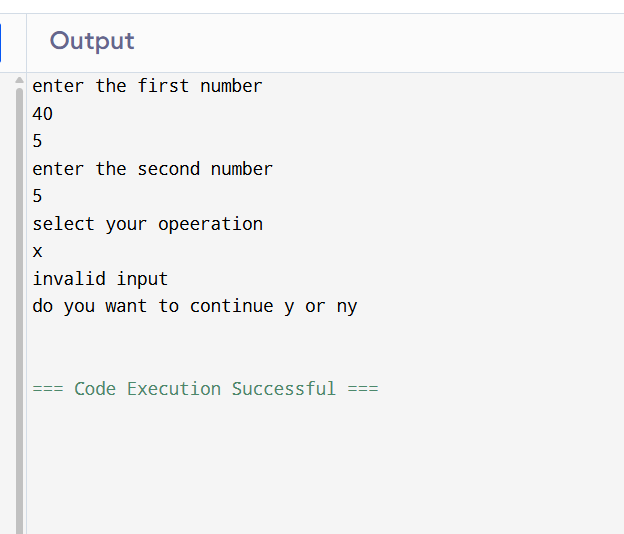
So I made this loop program in c that is basically a calculator, but i am getting issues with it in vs code(scanf isn’t working) and i tried it in online compiler but something’s off and the program terminates after clicking y.
#include<stdio.h>
int main(){
    int a;int b;char c;char ch="y";
    while(ch=='y'){
        printf("enter the first number\n");
        scanf("%d\n",&a);
        printf("enter the second number\n");
        scanf("%d\n",&b);
        printf("select your operation\n");
        scanf("%c\n",&c);
        if(c=='*'|| c=='x'){
            printf("product is %d\n",a*b);
        }
        else if(c=='/'){
            printf("quotient is %d\n",a/b);
        }
        else if(c=='-'){
            printf("difference is %d\n",a-b);
        }
        else if(c=='+'){
            printf("sum is %d\n",a+b);
        }
        else{
            printf("invalid input\n");
        }
        printf("do you want to continue y or n");
        scanf("%c\n",&ch);

    }
    return 0;
}
here is the output:
A C lang noob btw (had python in high school but now struggling in C)
The online Google Store is finally coming to India, offering a direct-to-consumer option for Pixel products for the first time in the region.
Customers in India can use perks like no-cost EMI payment plans, Instant Cashback, and discounts when buying directly from Google.
Google is partnering with Cashify to run an exchange program in India where you can get credit for trading in an old device.
Google is bringing its official online store to customers in India starting today, the company announced in a blog post. The Google Store will now sell Pixel phones, watches, and earbuds directly to buyers in India after previously utilizing third-parties like Flipkart and Amazon for distribution. To celebrate, the company is offering enhanced deals and exchange programs until the end of June.
“With the official Google Store now live in India, buying directly from Google gets you the peace of mind that comes with an authentic product, along with flexible payment options and reliable service,” Google writes in a blog post. “It’s also the best way to take advantage of launch offers and exclusive discounts available only on the Google Store.”
India is a major market for the Google Pixel brand, and smartphones in general. According to International Data Corporation (IDC) research, the smartphone industry shipped 151 million units in India last year. That represented a 4% growth year-over-year, signaling that India is a booming and lucrative market for smartphone manufacturers.
As such, Google’s push into India continues as it brings an official vector for buying Pixel products to customers in the country.
The announcement highlights the perks of buying directly from Google, like no-cost EMI payment plans and Instant Cashback when paying with certain credit cards. The company also offers limited-time Google Store discounts and enhanced credits when you swap your existing device. Google partnered with Cashify in India to make trade-in deals easy.
UPI payments are also supported on the Google Store in India, making quick and secure purchases possible. Plus, the company will price match your purchase within its return period.
“When you buy your Pixel directly from Google, you’re not just getting great value – you’re also getting the assurance that comes with it. Every device is 100% authentic and backed by Google Store,” the blog post explains. “If you find a better price at a selected retail partner or on Google Store within the return period, you may be eligible for a partial refund from Pixel Price Promise to match the lower price.”
Get the latest news from Android Central, your trusted companion in the world of Android
You can shop online at the Google Store in India starting today.
According to Bloomberg’s Mark Gurman(paywalled), this year’s iOS update won’t be called iOS 19. “Instead, Apple is planning to call it ‘iOS 26‘ as part of a new year-based naming strategy,” reports 9to5Mac. The new naming scheme will apply to all of Apple’s software platforms. From the report: Bloomberg explains that Apple is making this change to “bring consistency to its branding and move away from an approach that can be confusing to customers and developers.” The branding alignment comes as Apple is also reportedly planning dramatic redesigns for all of its platforms. The goal seems to be to unify everything both in terms of naming and design.