
‘Nightreign is a weird one’: Elden Ring Nightreign promises to be a divisive spinoff as reviewers say it’s both ‘deeply satisfying’ and a ‘frustrating slog’


Dawn has broken over Elden Ring Nightreign, by which I mean the review embargo has lifted and we can actually talk about FromSoft’s roguelike spinoff. And folks, there’s going to be a lot of deliberation in the days ahead.

In our Nightreign review, Tyler Colp wrote that it’s “both a trend-defying remix of Elden Ring and also a pile of complete bullshit that I shouldn’t have to deal with.” Having played a fair amount of Nightreign with Tyler myself, I stand by the assessment: Nightreign can be brilliant, but it can also be a despicable kind of brutal.

AI pioneer Rainbird Technologies names Klick Health as its exclusive North American Life Sciences Partner


LONDON, UK/NEW YORK, NYDecember 4, 2023 – Rainbird Technologies and Klick Health today announced an exclusive, new partnership that will bring Rainbird’s proven Decision Intelligence platform to life sciences companies across North America, reinforcing both companies’ success working in highly regulated industries.

As the exclusive Rainbird service partner in life sciences, Klick will pair its industry-leading knowledge, data, and tools with Rainbird’s decision intelligence automation platform to eliminate organizational bottlenecks and maximize opportunities for biopharmaceutical organizations bringing life-saving therapies to market. 

Focused on enhancing patient data analysis, optimizing clinical trial designs, and helping navigate the industry’s ever-evolving regulatory landscape, Klick will leverage the Rainbird AI platform and its unique capability to simulate human-like reasoning without losing accuracy, speed, or scalability. Unlike “bottom up” machine learning systems that try to learn from past approvals, Rainbird uses a “top down” decision intelligence approach that starts with policies and procedures, and how they relate, before reasoning its way to approve decisions. This approach is more useful for new brands, companies, and whenever change happens and previous approvals don’t exist or are no longer accurate. Rainbird can make decisions and explain how it got to its conclusions by applying logic.

Rainbird’s platform is used by the National Health Service (NHS) in the UK. It is also used globally in other regulated sectors, including financial and legal services, and is distinguished by its ability to deliver automation that’s intelligent with an additional layer of transparency and explainability. 

James Duez, Rainbird Co-Founder and CEO, said their cutting-edge technology gives clients a major advantage over other AI solutions where compliance with regulations is paramount. “We’re thrilled to join forces with Klick Health to drive exponential value in life sciences commercialization,” said Duez. “With our decision intelligence platform and Klick’s deep industry expertise, we are delivering trusted and transparent solutions in an era where explainability of AI is now critical. Together, we are empowering the next generation of solutions for life science clients.”

Klick’s EVP of Data Science Alfred Whitehead said, “Our partnership will usher in a new era of data-driven pharma commercialization – one that is powered by Rainbird’s intelligent automation decision intelligence and guided by Klick’s deep expertise in life sciences. He added, “This technology has already made significant impacts in other sectors, and its utility and adaptability will create tremendous opportunities for life sciences.”

Whitehead added, “We believe that leading with Rainbird’s decision intelligence approach, supported with large language models provided by platforms like OpenAI, Microsoft, AWS, and Google, will ultimately lead to the best results for our clients.”

Today’s news further bolsters Klick’s leadership in the AI and machine learning space. Last month, it announced groundbreaking research, published in Mayo Clinic Proceedings: Digital Health, around the AI model it created to detect Type 2 diabetes using 10 seconds of voice. Klick also recently launched the first ChatGPT plugin for life sciences companies in the U.S. and the first AI tool to be developed by an advertising agency to expedite project planning and increase the efficiency and velocity of delivery to clients.

About Rainbird Technologies

Rainbird’s revolutionary Decision Intelligence platform is transforming enterprise decision-making with trust and explainability at scale. For over a decade, Rainbird’s AI platform has enabled organizations to digitize human expertise into enhanced, yet transparent, extended knowledge graphs. Their advanced reasoning automates complex judgments at scale while providing auditable rationales behind each outcome.

Rainbird’s focus on explainability enables organizations to harness the promise of new techniques like generative AI while avoiding pitfalls like bias and hallucination. Their composite approach ensures AI-powered solutions are ethical, safe, and aligned with business values.

Rainbird augments human capabilities for faster, higher quality decisions. With Rainbird, leaders can utilize state-of-the-art neurosymbolic AI to drive efficiency and growth while prioritizing responsible adoption across the organization. Rainbird remains at the forefront of human-centric AI advancement. To this end, Rainbird is committed to best-in-class partnerships across sectors and geographies. Discover how Rainbird’s cutting-edge Decision Intelligence platform keeps regulated enterprises ahead in the innovation race. Connect with Rainbird on LinkedIn. For further details, explore www.rainbird.ai

About Klick Health
Klick Health is the world’s largest independent commercialization partner for life sciences, focused on hacking the boundaries of health by developing, launching, and supporting life sciences brands to achieve their full potential. The agency provides best-in-class marketing and advertising, media strategy and purchasing, medical affairs and medical communications, value and market access services, as well as enterprise omnichannel enablement among its specialized offerings. Klick’s client service is rooted in deep medical and scientific understanding, enabled by over 185 post-graduate, in-house medical experts; unrivaled decision sciences capabilities; and innovative, results-driven creative that has made it one of the most-awarded advertising agencies on the planet.

In 2023, Klick won 160 top creative honors and seven agency distinctions from the most respected advertising awards shows, including Clio Health Independent Agency of the Year, London International Awards’ Global and North American Independent Health Agency of the Year; and Cannes Lions’ #2 Healthcare Agency, #2 Healthcare Network, and #10 Independent Agency of the Year. Klick is also consistently ranked a Best Managed Company, Great Place to Work, Best Workplace for Women, Best Workplace for Inclusion, Best Workplace for Professional Services, Most Admired Corporate Culture, and a FORTUNE Best Workplace in Advertising.

Established in 1997, Klick Health (including Klick Katalyst and btwelve) has offices in New York, Philadelphia, Toronto, London, São Paulo, and Singapore. It is part of the Klick Group of companies, which also includes Klick Media Group, Klick Applied Sciences (including Klick Labs), Klick Consulting, Klick Ventures, and Sensei Labs. Follow Klick Health on LinkedIn and for more information on joining Klick, go to careers.klick.com.

Press Contact

For more information, please contact Klick PR at pr@klick.com or 416-214-4977

A Skyrim player has put their body on the line and proved High Hrothgar’s 7,000 steps are actually just 3,600, but they still took 45 minutes to climb


The climb from Ivarstead up to High Hrothgar is maybe the most famous hike in The Elder Scrolls 5: Skyrim – in no small part because of the Frost Troll halfway up ready to kill underleveled players. It’s claimed in-game that there are 7,000 steps, but that number has been debunked several times over the years using various methods. Now, one gamer has used a real-life stair climber to finally put this issue to bed.

YouTuber ShakeMistake, who has previously done feats such as walking across Death Stranding and Elden Ring, and swimming around Solstheim using motion controls, posts to Reddit about their achievement.

VisualStudio.Extensibility: Editor classification and updates to user prompt


We continue to invest in the VisualStudio.Extensibility SDK to allow users like you to create extensions that run faster and smoother than ever before! VisualStudio.Extensibility helps you build extensions that run outside the main Visual Studio IDE process for improved performance, reliability, and installation without restarting Visual Studio. Additional benefits include a sleek and intuitive .NET 8-based API and comprehensive, well-maintained documentation to help you develop amazing extensions faster than ever before.

For the latest up-to-date docs and installation instructions, visit https://aka.ms/VisualStudio.Extensibility. We encourage you to report bugs and suggest features via the issue tracker on our GitHub repo, where you can also find extension samples to help you get started. We have also launched a new video series on Visual Studio Toolbox to provide a more detailed tour of our samples. Check out the series here!

What’s new for VisualStudio.Extensibility for 17.14?

Our 17.14 release of VisualStudio.Extensibility includes the following features:

  • Text classification support
  • Updates to the ShowPromptAsync API

This release also includes a previously mentioned change regarding .NET runtime management requirements. VisualStudio.Extensibility extensions are executed on a separate .NET runtime host, unlike VSSDK extensions which run in the same process as devenv.exe, using the .NET Framework runtime. Since VisualStudio.Extensibility extensions operate on .NET, we must adhere to the runtime servicing lifetime of .NET. Consequently, the VisualStudio.Extensibility platform will be regularly updated to advance to newer versions of .NET LTS. For more information on how this affects you as an extension developer or consumer, please refer to our documentation here.

Color text in files with classification support

In Visual Studio 17.13, we added support for taggers in the editor, allowing advanced functionalities such as custom code lens providers. This enhancement laid the groundwork for the text classification feature we are introducing in 17.14. Text classification facilitates custom text coloring within an opened file, commonly referred to as semantic and syntactic colorization. The following snippet demonstrates the creation of classification tags, which are fundamental to implementing editor classification. Please note that the example provided is a very simplistic approach and should not be used without further refinement. For a more comprehensive guide on writing a classification extension, please refer to our documentation and sample materials.

private async Task CreateTagsAsync(ITextDocumentSnapshot document)
{
   List<TaggedTrackingTextRange<ClassificationTag>> tags = new();
   foreach (var line in document.Lines)
   {
      var match = LineRegex.Match(line.Text.CopyToString());

      if (match.Success)
      {
         foreach (Capture capture in match.Groups[FieldTextMatchName].Captures)
         {
            tags.Add(new(
new(document, line.Text.Start + capture.Index, capture.Length, TextRangeTrackingMode.ExtendNone),
new(ClassificationType.KnownValues.String)));
         }
      }
   }

   await this.UpdateTagsAsync(
      updatedRanges: [new(document, 0, document.Length)],
      tags,
      CancellationToken.None);
}

Display icons and prompt for input with an enhanced ShowPromptAsync API

We routinely assess suggestion tickets that track requests for new APIs to be integrated into VisualStudio.Extensibility. Numerous factors influence our decision on which features to prioritize, including the complexity and cost of implementation. In version 17.14, we are pleased to announce that we have addressed a community-requested feature by introducing icon support in our ShowPromptAsync API. Furthermore, we have added the capability to provide user-input prompt. Below is a code snippet demonstrating how to configure a user prompt with custom icons, titles, messages, and options. For more detailed information, please refer to our documentation.

// Show a prompt that accepts string input from the user, with a default value, custom title and custom icon.

string? feedback = await shell.ShowPromptAsync(
   $"Thank you for configuring {projectName}. Do you have any feedback?",
   new InputPromptOptions
   {
      DefaultText = feedbackPrompt,
      Icon = ImageMoniker.KnownValues.Feedback,
      Title = Title,
   },
   cancellationToken);

this.logger.TraceInformation($"Feedback received: {feedback}");

We want to hear from you!

We appreciate the time you’ve spent reporting issues/suggestions and hope you continue to give us feedback when using Visual Studio on what you like and what we can improve. Your feedback is critical to help us make Visual Studio the best tool it can be! You can share feedback with us via Developer Community: report any bugs or issues via report a problem and share your suggestions for new features or improvements to existing ones.

Stay connected with the Visual Studio team by following us on YouTube, Twitter, LinkedIn, Twitch and on Microsoft Learn.


Google Photos celebrates 10 years of wins and fails today


Google Photos logo on smartphone next to other devices and picture frame Stock photo 5

Edgar Cervantes / Android Authority

Do you remember when you first realized what a great app Google Photos is? My moment was a few years ago. I needed my driver’s license details, but didn’t have the card on me. I had a vague recollection that I might have taken a photo of it years earlier, but I wasn’t even sure if that was the case, much less where I could find it.

Until then, I’d mostly thought of Google Photos as just a chronological dump of snapshots. After a bit of tapping about, I hit the Collections tab and noticed the Documents folder. I opened it, and had the image I needed a few seconds later. As nerdy as it sounds, that moment was an eye-opener for me, and I’ve relied on the app’s features ever since.

Google Photos turns 10 years old today, so we’ll mark the milestone with a quick look at its successes, setbacks, and how it went from newcomer to default photo app for almost every Android phone.

After 10 years of Google Photos, what’s your verdict?

14 votes

A fresh take on photo storage

Pixel 9 Pro XL selfie

Ryan Haines / Android Authority

When Google Photos launched at I/O 2015, it felt like someone had finally figured out how people actually wanted to manage their photos. Most of us were juggling a mix of gallery apps, cloud backups that we sometimes forgot to turn on, and SD cards that we then misplaced in a drawer somewhere.

Google’s pitch was simple but a winner: unlimited free storage, automatic backups, and a smart, searchable interface that worked across Android, iOS, and the web. The app was fast, clean, and refreshingly free of bloat.

The storage was the instant hook for many, but Google Photos also sorted your shots into categories. Screenshots, videos, and the like were grouped into albums, and the app even created things like animations, collages, and stylized photos automatically. It felt like a gallery app that actually helped you enjoy your photos, not just hoard them.

Smartening up

Google Photos logo on smartphone next to imaging accessories stock photo 1

Edgar Cervantes / Android Authority

If 2015 was about solving the basics, the next couple of years were about showing off. Google Photos leaned hard into machine learning, adding genuinely impressive features that made other gallery apps feel outdated almost overnight.

You could search for “dog,” “beach,” or “birthday” and instantly see relevant photos, even if they weren’t tagged. It also recognized faces, letting you group photos by person even if their name was never mentioned. That sounds routine now, but it felt like magic back then.

Around the same time, Google added shared albums to which multiple people could contribute. This was as obvious as it was game-changing for me. I would often go on short breaks with friends, and after, you’d all just dump your photos into the group WhatsApp chat. I’m reasonably sure most of those snaps were lost in subsequent phone switches.

Refining the formula

Photo stack edited

Hadlee Simons / Android Authority

By the late 2010s, Google Photos had hit its stride. The app became even more polished, with a slicker interface and smoother device syncing. Google even added the option to order printed photo books, which were softcover or hardcover albums you could design in-app and have delivered to your door.

Some UI tweaks raised eyebrows as tabs and settings seemed to shift around every few months, but the core experience stayed strong.

I was looking at pictures that I might not have ever looked up again.

You might also remember getting Memories in 2019. I distinctly recall being annoyed that yet another app on my phone was sending me unsolicited notifications, and I must have swiped them away for months. Then I clicked on one at some point, and I loved it. I was looking at pictures from years earlier that I might not have ever looked up again if it weren’t for the happy little curation.

Some signs of change began to creep in around the turn of the decade. Auto-sync for folders like WhatsApp or Downloads became opt-in instead of automatic. Storage management tips and Google One prompts started showing up more frequently. It still felt like the best photo app, but you could tell the free ride might not last.

Google giveth and Google taketh away

Google Photos backup

Damien Wilde / Android Authority

Like all good money-spinner apps, Google Photos reeled us in, then the other shoe came flying out of the sky.

June 2021 marked the end of one of Google Photos’ most beloved features: unlimited free storage for “high quality” uploads. These were the lightly compressed photos and videos that didn’t count against your storage quota. From that point on, everything you uploaded started eating into your free 15GB limit, unless you paid for a Google One plan. It felt a bit like a bait-and-switch, but only because we’d gotten used to the generous free tier.

There were other subtle signs that the free ride was winding down. Folder backups for things like WhatsApp or Screenshots, which used to happen automatically, now needed to be manually toggled on. And one particularly handy feature disappeared altogether: the ability to guess a photo’s location using your Maps Timeline data. The feature was likely dropped for privacy reasons, but for those of us who were happy for Google to track our lives in the spirit of convenience, it was a shame to see it go.

New tools, such as improved editing features, more AI suggestions, and slicker Memories, were still being added, but many of the best ones were increasingly locked behind the Google One paywall. The app was still a mainstay for most of us, but the sheen was coming off.

The new normal

Close-up of the Google Photos app, showing the app logo.

Joe Maring / Android Authority

Google Photos doesn’t make headlines as often these days, but it’s still quietly running the show. It comes preinstalled on pretty much every Android phone — even ones that also include their own gallery apps — and for most users, it’s still the easiest and smartest way to manage photos.

There have been a few notable updates lately, like a Quick Edit feature for sharing-ready touchups and the ability to convert standard photos to Ultra HDR for brighter screens. While these additions are technically impressive, other apps have long since caught up in most respects, so Google Photos doesn’t quite have the same charm.

That said, Memories remain a highlight for me — a rare example of a push notification that I actually enjoy getting. Google Photos is still remarkably good at surfacing the photos I care about when I want them. Whether the next 10 years bring more magic or monetization remains to be seen.

Anthropic brings web search to free Claude users


Anthropic is continuing to trickle down features to its free users. The latest one to make the leap out of subscriber-only mode is web search, which the company to its AI chatbot Claude in March. According to Anthropic, connecting Claude to the web allows it to deliver more accurate responses based on the most up-to-date information available online. This feature is available to all Claude users starting today.

In addition, Anthropic has begun beta tests for voice mode on its mobile apps. This option lets users interact with Claude in natural conversations in an expansion of the platform’s existing dictation tools. There will be five voice options available to assign to Claude, and the AI assistant can provide full transcripts and voice mode summaries after a conversation.

May has been a busy month for Anthropic, which just launched last week. Opus 4 is a powerful coding-focused system that can use multiple tools in parallel and can run for several hours at a time, while Sonnet 4 is a hybrid reasoning model designed to move between quick queries and more complex ones. The current beta testing of voice mode will default to Sonnet 4.

Enhance productivity with AI + Remote Dev


May 27th, 2025 by Brigit Murtaugh, Christof Marti, Josh Spicer, Olivia Guzzardo McVicker

One of the features that makes VS Code so flexible and powerful is Remote Development. Whether you’re connecting to a secure VM from your local desktop, a hugely powerful computer from your tablet, or a containerized environment with all the dependencies your project needs – VS Code’s ability to develop anything from anywhere can help in just about any setup.

Now combine those capabilities with the flexibility and power of AI in VS Code, and you have an incredibly versatile dev environment. You can ensure chat conversations have context about your remote workspace, get AI help in setting up and debugging remote connections, and provide a more isolated space for agent mode to work autonomously.

In this blog, we’ll explore how your existing remote setups can be enhanced to “just work” with AI, along with some more customized AI + remote workflows that include custom instructions, chat participants, and agent auto-approvals.

What is Remote Development?

When we describe VS Code Remote Development, we refer to five main experiences:

  • Remote – SSH – Connect to any location by opening folders on a remote machine/VM using SSH.
  • Dev Containers – Work with a separate toolchain or container-based application inside (or mounted into) a container.
  • WSL – Get a Linux-powered development experience in the Windows Subsystem for Linux.
  • Remote – Tunnels – Connect to a remote machine via a secure tunnel, without configuring SSH.
  • GitHub Codespaces – Remote environments that are managed for you.

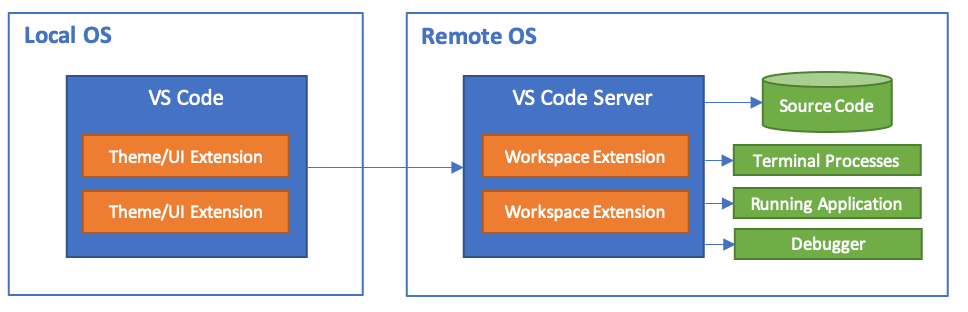
Remote architecture

How can you use AI in a remote environment?

We want to make the AI coding experience in VS Code as seamless as possible, whether you’re working on your local machine or connected to a remote environment. If you’re already using GitHub Copilot locally, we’ll automatically install it remotely. And GitHub Codespaces has it configured too!

While using AI in a remote environment will just work, there are additional AI features that can make your remote workflow even more powerful:

  • Custom instructions – Tailor your AI experience for your remote environment
  • Chat participants – Use chat to set up and troubleshoot your remote environment
  • Tool approvals – Run autonomous coding sessions safely in remote environments

Tailor your AI experience for your remote environment

One of the top requests we hear from users when working with an LLM is: How can I help the LLM better understand my code and coding practices? You can achieve this via custom instructions, which describe common guidelines or rules to get responses that match your specific coding practices and tech stack. Instead of manually including this context in every AI chat query, custom instructions automatically incorporate this information with every chat request (learn more in our recent blog post).

In our team’s recent self-hosting, we found it helpful to use custom instructions to not only tell Copilot about our code and coding practices, but to also provide more information about the type of remote environment we’re connected to, such as:

  • What kind of remote environment is this (i.e. a dev container vs a VM)?
  • What languages or toolchains are installed? What’s their purpose?
  • Where are toolchains installed (i.e. are they available on the PATH)?

Here’s an example instruction our team found helpful:

This is a dev container that includes `python3` and `pip3` pre-installed and available on the `PATH`, along with the Python language extensions for Python development.

To get started with custom instructions in a remote environment, you can use the same instruction files remotely that you were already using locally.

Configure AI for your dev container

Dev containers make it easier to get started with a project by having all tools and dependencies preconfigured. By adding custom instructions, you can make sure that the LLM is tailored to that environment instead of providing generic answers. For example, a dev container for Python coding might have custom instructions about which tools are installed, or which coding guidelines to follow (as shared in the example above).

Our team has taken steps to preconfigure custom instructions to make your life even easier when using dev containers. We publish dev container resources (like images and Features) to ease the process of creating and connecting to dev containers, and we now include custom instructions in these files. Here’s an example of how you can use the custom dev container instructions our team added:

  • Create a new dev container configuration using one of our images or Features. You could do this by hand, or via the Dev Containers: Add Dev Container Configuration Files… command supplied by the Dev Containers extension:

    Dev Containers: Add Dev Container Configuration Files command in VS Code Command Palette

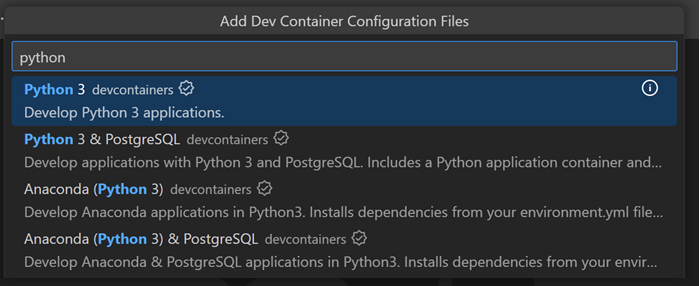
  • Follow the steps in the quick pick. For this example, we’ll select the Python Template:

    Select Python 3 dev container config in VS Code Command Palette

  • Build and connect to your dev container in VS Code:

    VS Code notification to reopen project in dev container

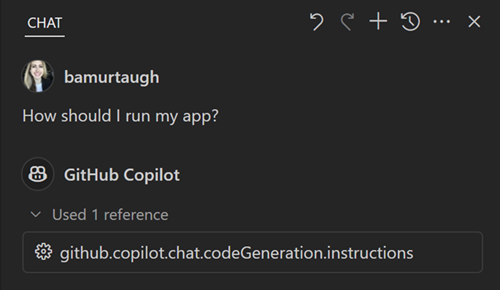
  • The environment you’ve selected and are now connected to is based on our Python Template, which includes custom instructions via the Python Feature. Try chatting with Copilot within your dev container – Copilot automatically pulls the custom instructions from the Python image!

    AI chat using custom instructions

In addition to using the custom instructions we’ve added to images and Features, you can add additional custom instructions to the devcontainer.json in your projects – we’ve made it so that custom instructions can merge successfully across images and Templates. You can use the "github.copilot.chat.codeGeneration.instructions" setting, just like what we did in the Python dev container config described above.

If you publish any dev container configurations for others to use, we recommend exploring how you might add custom instructions to them! Here is an example of using custom instructions in a Python dev container Feature:

"github.copilot.chat.codeGeneration.instructions": [
    {
        "text": "This dev container includes `python3` and `pip3` pre-installed and available on the `PATH`, along with the Python language extensions for Python development."
    }
],

Use chat to set up and troubleshoot your remote environment

Chat participants enhance your chat experience by providing domain-specific knowledge, such as how to interact with a database or a specific API. Type @ in the chat input field to view and select from the list of available participants – they’ll be available in Ask mode. There are several built-in chat participants like @workspace, @vscode, and @terminal. Extensions can also contribute chat participants.

The Remote – SSH extension includes a Copilot chat participant. Ask @remote-ssh for help configuring or troubleshooting elements of your remote environment:

Using Remote - SSH participant in VS Code chat panel

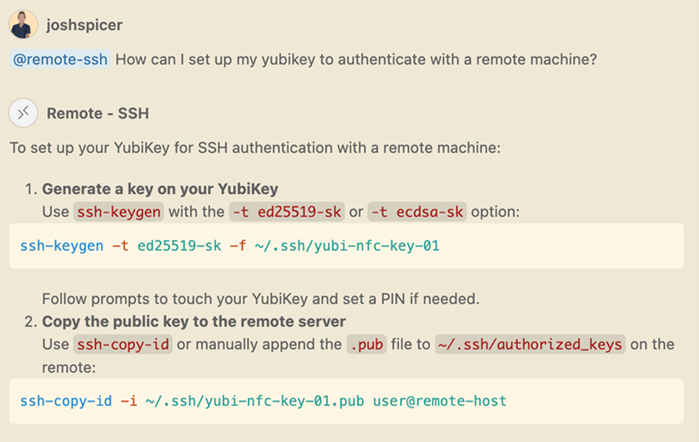
The participant is also knowledgeable about general SSH and remote development topics:

Asking Remote - SSH participant about remote auth

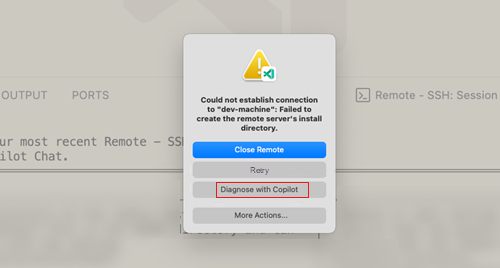
If a connection failure occurs, the Diagnose with Copilot feature provides a quick way to understand the problem:

Diagnose with Copilot option in notification

Copilot will investigate the issue and provide actionable insights:

Run autonomous coding sessions safely in remote environments

As part of completing the tasks for a user prompt, agent mode can run tools and terminal commands. Agent mode is powerful because it not only proposes code changes but can also run terminal commands and tools. For example, it can install project dependencies or run tests. However, some of these actions might be destructive, such as deleting files, modifying local configuration, and more. Therefore, you need to approve the use of tools and terminal commands in agent mode.

Agent mode tool approval options dropdown

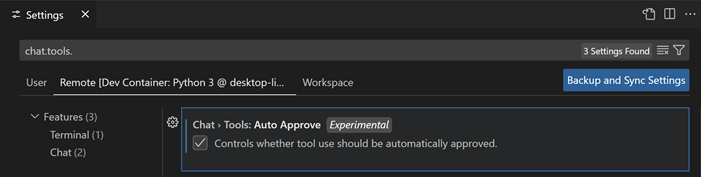
In case you want to auto-approve all tools, you can now use the experimental chat.tools.autoApprove setting. To give you some level of protection against inadvertent terminal commands or tool calls, you can choose to only set this in a dev container or remote machine to prevent your local dev machine from getting affected:

Auto Approve tool setting in VS Code remote settings

This will auto-approve all tools, and VS Code will not ask for confirmation when a language model wishes to run tools. This can help save time by giving more autonomy to agent mode, but bear in mind that with this setting enabled, you will not have the opportunity to cancel potentially destructive actions a model wants to take.

Note that remote environments that are part of your local machine (like dev containers) or that have access to your credentials will pose different levels of risk.

What’s Next

We’re excited about the future of Remote Development and AI in VS Code. Our monthly releases are packed with exciting new features, and we’re constantly looking ahead to what’s next, like supporting Copilot Chat in the web (vscode.dev, github.dev).

Happy (smart and remote) coding!
Brigit, Christof, Josh, and Olivia

Leak Shows Off Google Pixel 10 Colors


Google is preparing to launch its Pixel 10 series in August 2025, about a year after the Pixel 9 series debuted. As the launch approaches, leaks have revealed the color options for the new models. The information comes from Mystic Leaks on Telegram and has been reported by 9to5Google.

According to the leak, the standard Pixel 10, which is also expected to come with a 3-camera setup this time, will be available in four colors: Obsidian, Blue, Iris, and Limoncello. Obsidian is a familiar black shade that has appeared in previous Pixel models. Blue is making a return to the Pixel lineup after being absent in the Pixel 9 series, though the exact shade is not known yet. Iris is a purple tone that was seen on the Pixel 9a, and Limoncello is a yellow color.

The Pixel 10 Pro and Pixel 10 Pro XL will also come in four different colors: Obsidian, Green, Sterling, and Porcelain. Obsidian remains the black choice, while Green is a new addition that could be similar to past green hues in the Pixel series. Sterling is a gray shade, and Porcelain is a white tone, continuing the trend of more neutral (and boring) colors for the Pro models.

While the leak provides the names of the colors, it does not reveal the exact shades or finishes, leaving some details to be confirmed at launch. The Pixel 10 series is expected to run on Android 16.

SpaceX’s ninth test flight of Starship launches into space, ends in a spin


SpaceX’s Starship successfully separated from its Super Heavy rocket booster and reached orbit Tuesday evening, but later began spinning and made an uncontrolled re-entry into the Indian Ocean. SpaceX had cleared the surrounding airspace where Starship was coming down, according to the company.

The ninth test flight provided a mix of successes and failures for the company. It was the smoothest Starship test of the year, following two consecutive explosions. Starship, launched atop the Super Heavy booster, lifted off from SpaceX’s facility in southern Texas on Tuesday evening. It was also the first launch to use a flight-proven Super Heavy booster, which had launched and returned during Starship’s seventh flight test.

The heavy booster successfully separated and Starship entered space. But the ship was unable to open a side cargo hatch to deploy mock satellites in one planned test. Later in the flight, Starship lost attitude control, meaning it could no longer orient itself properly for re-entry.

The ninth flight test came less than a week after the Federal Aviation Administration cleared SpaceX to perform the test flight of its Starship rocket system following those back-to-back explosions earlier this year.

In January, SpaceX caught the Starship’s heavy booster rocket on its descent for a second time. Starship successfully separated from the booster and ignited its rockets to ascend to orbit, but it was soon lost after suffering an anomaly. Debris from Starship fell into the airspace near Puerto Rico, prompting the FAA to reroute several aircraft in the airspace.

SpaceX conducted another test in March. This time, the Super Heavy booster successfully separated was caught by the launch tower in Texas for a third time. Starship reached space, but eight minutes into the flight, the ship lost multiple Raptor engines and began to spiral.

As a result of the two explosions, the FAA expanded the size of hazard areas in the U.S. and other countries for the flight based on an updated safety analysis provided by SpaceX. After completing an investigation in the loss of Starship on its eighth flight test, SpaceX made several hardware changes to increase reliability.