There’s just something about solving mysteries in games. Piecing together clues, interrogating suspects, and finally discovering that oh-so-satisfying answer. It’s absolute magic.
Needless to say, I’m a bit of a genre obsessive—and particularly this year, I found myself sleuthing through a record number of modern classics.
I think 2025 was one of the best detective game years ever, if not the best. Who knows what it was about these particular twelve months that suddenly made the idea of criminals actually suffering consequences so appealing? That’s enough of me being hilarious—on with the list!
(Image credit: Hesperus Games)
The CEO of a tech startup has been murdered, and you need to solve it by identifying the names, job titles, and even the pets of everyone who worked there.
Openly inspired by The Roottrees are Dead (more on that game later!), this is much simpler. Piles of evidence are just dumped on you rather than revealed through anything as clever as that game’s brilliant built-in search engine. But it’s still a great little game that makes inspired use of the office setting.
God bless the HR nightmare who helped me identify most of the women on the systems team because he kept hounding them for dates on the workplace chat…. ugh.
(Image credit: Chaystar Unlimited LLC)
Proof that one of gaming’s least-respected genres can be an excellent way to tell a story. It’s a resource-management idle game (stop booing) where you unlock townsfolk and put them to work rifling through the bins, working at the diner, and practising a religion that involves worshipping a giant sloth. You’re rewarded with little nuggets of story that offer more insight into a murder that rocks the town.
Keep up to date with the most important stories and the best deals, as picked by the PC Gamer team.
Set over several distinct time periods, Asbury Pines smuggles a narrative of surprising scope into a game where all you really do is assign people jobs and then wish they’d hurry the hell up. So its managed to simulate the agonising wait for revelations between episodes of a TV detective drama. Er, good!
(Image credit: Bad Viking)
Customers come into your horrible little shop with queries like “my neighbour forgot my birthday, got any cursed talismans that’ll ruin her life?” or “I’d like a Munted Leg please! No, I don’t care to offer any details as to what that is”. You then use your almost-helpful books, along with your senses of sight, touch, smell, and general vibes to deduce which antiquity they want. And hand it over to a clearly dangerous individual instead of calling the police.
This sequel is packed with puzzles, like a macabre remake of Professor Layton and the Curious Village, if the professor decided to drown Luke in goat’s blood to make a nifty totem.
Very satisfying to chip away at, even if with each new sale you suspect you’re probably making the world worse. A bit like working for Microsoft.
(Image credit: Posh Cat Studios)
Posh Cat Studio wanted to make a detective game, but after a few weeks of researching murder, they ended up about as depressed as I was when Netflix suddenly pulled The Rise of the Golden Idol from my subscription. So they decided to take the excellent Golden Idol formula and instead apply it to more mundane mysteries, like ‘who broke my favourite mug?’ or ‘where did my cat wander off to?’
Lovely art and charming presentation make this an easy game to underestimate. But it’s actually got strong sleuthing chops and proves you don’t need high stakes to make a great detective game.
(Image credit: Inkle Ltd)
I was thrilled when Inkle gave us a surprise sequel to Overboard!, their excellent push-your-husband-to-his-death-then-try-to-get-away-with-it simulator. I was less thrilled when Expelled apparently didn’t sell nearly as well. Bah! Everyone missed out on the best boarding school adventure since Rockstar bullied potential uni— I mean, since Rockstar’s Bully.
Verity Amersham has been accused of throwing another student out of a window. Now you have to clear her name, solve plenty more schoolyard mysteries, and basically act like a right little scumbag. Go buy a million copies so they can make another one.
(Image credit: Spooky Doorway)
You’ve been summoned to Blake Manor to investigate the disappearance of Evelyn Deane. Could something sinister be afoot? Well, on my first morning of investigating I met two people who were planning on killing her before I’d barely even had breakfast, so let’s call that a ‘yes’.
Blake Manor is crammed with suspicious guests who are a delight to irritate. Break into their rooms, rifle through their belongings, then innocently ask why they keep a half-empty vial of poison on their nightstand.
Impeccable presentation perhaps disguises that this is more of a traditional point-and-click than it initially seems. But what kind of detective can’t appreciate a great disguise?
(Image credit: Evil Trout Inc)
The Roottree sisters have tragically died in a plane crash and it’s up to you to fill out their massive family tree, with all the investigative tools that ’90s dial-up has to offer.
Roottrees is a joyous send-up of the early internet, right down to the horrifying screech your computer makes when you first go ‘online’. You’ll type out those words in the search engine with 100% correct spelling or get nothing at all, bucko.
I’d love a modern-day sequel where you have to use the AI-poisoned bullshit that is search engines now, but I also don’t want to put the developers of one of 2025’s best games through such trauma.
(Image credit: Color Gray Games)
As moaned about briefly earlier, Netflix suddenly pulled this game’s excellent DLC from subscribers halfway through its roadmap. If they successfully buy Warner Bros, we’ll be lucky if the next Arkham game lets you play beyond Bruce Wayne’s parents being shot.
Anyway, the winning Golden Idol formula, wherein you poke around crime scenes for words and phrases then piece together what the Hell happened, reached incredible new heights here.
The highlight is the case set in someone’s brain that’s under attack. That screenshot above is their subconscious, complete with spinning balloon face screaming “I am a FOOL!” (instantly the series’ most relatable character). Developer Color Gray Games is clearly at the height of its powers. Can we pass some sort of law forcing it to make these wonderful games forever?
(Image credit: William Rous)
This itch.io game (ridiculously, completely free) sees you accessing the hard drive of a detective who apparently solved a murder, only for their computer to mysteriously be locked away by their superiors. Unfortunately the computer has no images, an inbox with only one message, and four short conversation transcripts. Oh, and the fourth transcript is actually missing half the title, so you can’t access it until you figure out what that was and type it in. Good luck!
Text adventures died out decades ago because of how little entertainment value there was in typing out a long theory only to be told ‘I don’t understand’. But Type Help knows that when you do type a correct deduction into its bloody computer, it feels better than winning the lottery on the same day all your childhood bullies get diagnosed with terminal illnesses.
You’ll endure that deliberately-frustrating interface for both the rush of those deductions and to get more of its gripping story that would be an all-time great detective yarn in any medium. Fingers crossed the upcoming remake can retain the stripped-back magic of 2025’s finest detective game.
Have you ever wanted to work with a trillion-parameter language model but hesitated because of infrastructure complexity, unclear deployment options, or unpredictable costs? You are not alone. As large language models become more capable, the operational overhead of running them often grows just as fast.
Kimi K2 changes that equation.
Kimi K2 is an open-weight Mixture-of-Experts (MoE) language model from Moonshot AI, designed for reasoning-heavy workloads such as coding, agentic workflows, long-context analysis, and tool-based decision making.
Clarifai makes Kimi K2 available through the Playground and an OpenAI-compatible API, allowing you to run the model without managing GPUs, inference infrastructure, or scaling logic. The Clarifai Reasoning Engine is designed for high-demand agentic AI workloads and delivers up to 2× higher performance at roughly half the cost, while handling execution and performance optimization so you can focus on building and deploying applications rather than operating model infrastructure.
This guide walks through everything you need to know to use Kimi K2 effectively on Clarifai, from understanding the model variants to benchmarking performance and integrating it into real systems.
What Exactly Is Kimi K2?
Kimi K2 is a large-scale Mixture-of-Experts transformer model released by Moonshot AI. Instead of activating all parameters for every token, Kimi K2 routes each token through a small subset of specialized experts.
At a high level:
Total parameters: ~1 trillion
Active parameters per token: ~32 billion
Number of experts: 384
Experts activated per token: 8
This sparse activation pattern allows Kimi K2 to deliver the capacity of an ultra-large model while keeping inference costs closer to a dense 30B-class model.
The model was trained on a very large multilingual and multi-domain corpus and optimized specifically for long-context reasoning, coding tasks, and agent-style workflows.
Kimi K2 on Clarifai: Available Model Variants
Clarifai provides two production-ready Kimi K2 variants through the Reasoning Engine. Choosing the right one depends on your workload.
Kimi K2 Instruct
Kimi K2 Instruct is instruction-tuned for general developer use.
Key characteristics:
Up to 128K token context
Optimized for:
Code generation and refactoring
Long-form summarization
Question answering over large documents
Deterministic, instruction-following tasks
Strong performance on coding benchmarks such as LiveCodeBench and OJBench
This is the default choice for most applications.
Kimi K2 Thinking
Kimi K2 Thinking is designed for deeper, multi-step reasoning and agentic behavior.
Key characteristics:
Up to 256K token context
Additional reinforcement learning for:
Tool orchestration
Multi-step planning
Reflection and self-verification
Exposes structured reasoning traces (reasoning_content) for observability
Uses INT4 quantization with quantization-aware training for efficiency
This variant is better suited for autonomous agents, research assistants, and workflows that require many chained decisions.
Why Use Kimi K2 Through Clarifai?
Running Kimi K2 directly requires careful handling of GPU memory, expert routing, quantization, and long-context inference. Clarifai abstracts this complexity.
With Clarifai, you get:
A browser-based Playground for rapid experimentation
A production-grade OpenAI-compatible API
Built-in GPU compute orchestration
Optional local runners for on-prem or private deployments
Consistent performance metrics and observability via Control Center
You focus on prompts, logic, and product behavior. Clarifai handles infrastructure.
Trying Kimi K2 in the Clarifai Playground
Before writing code, the fastest way to understand how Kimi K2 behaves is through the Clarifai Playground.
Step 1: Sign in to Clarifai
Create or log in to your Clarifai account. New accounts receive free operations to start experimenting.
Step 2: Select a Kimi K2 Model
From the model selection interface, choose either:
Kimi K2 Instruct
Kimi K2 Thinking
The model card shows context length, token pricing, and performance details.
You can adjust parameters like temperature and max tokens, and responses stream token-by-token. For Kimi K2 Thinking, reasoning traces are visible, which helps debug agent behavior.
Running Kimi K2 via API on Clarifai
Clarifai exposes Kimi K2 through an OpenAI-compatible API, so you can use standard OpenAI SDKs with minimal changes.
Kimi K2 Thinking is designed as a reasoning-first, agentic model, and its benchmark results reflect that focus. It consistently performs at or near the top of benchmarks that measure multi-step reasoning, tool use, long-horizon planning, and real-world problem solving.
Unlike standard instruction-tuned models, K2 Thinking is evaluated in settings that allow tool invocation, extended reasoning budgets, and long context windows, making its results particularly relevant for agentic and autonomous workflows.
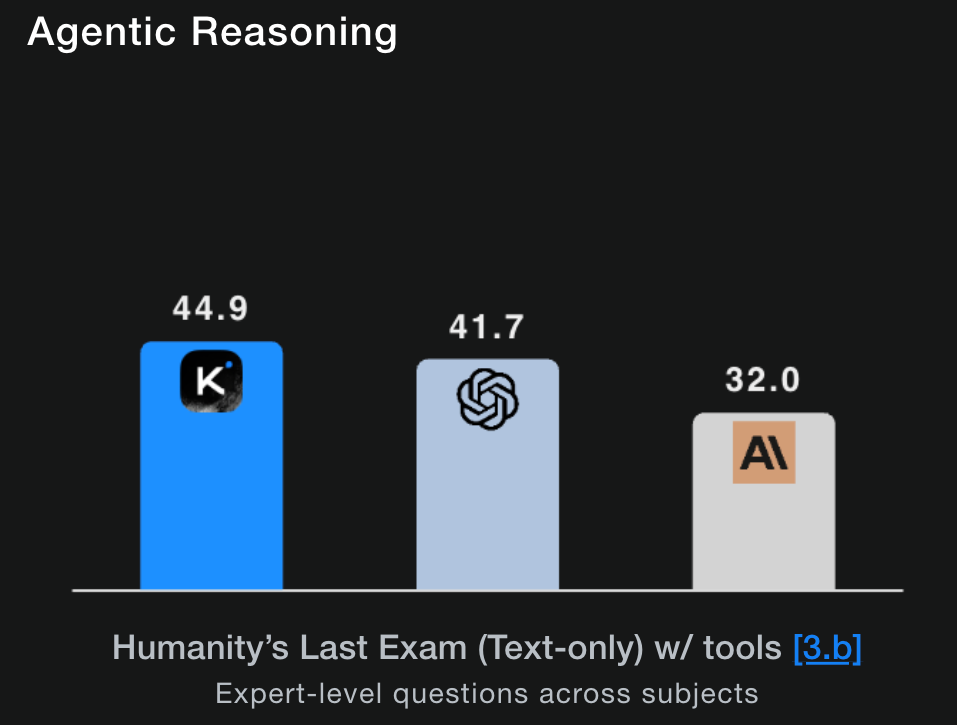
Agentic Reasoning Benchmarks
Kimi K2 Thinking achieves state-of-the-art performance on benchmarks that test expert-level reasoning across multiple domains.
Humanity’s Last Exam (HLE) is a closed-ended benchmark composed of thousands of expert-level questions spanning more than 100 academic and professional subjects. When equipped with search, Python, and web-browsing tools, K2 Thinking achieves:
44.9% on HLE (text-only, with tools)
51.0% in heavy-mode inference
These results demonstrate strong generalization across mathematics, science, humanities, and applied reasoning tasks, especially in settings that require planning, verification, and tool-assisted problem solving.
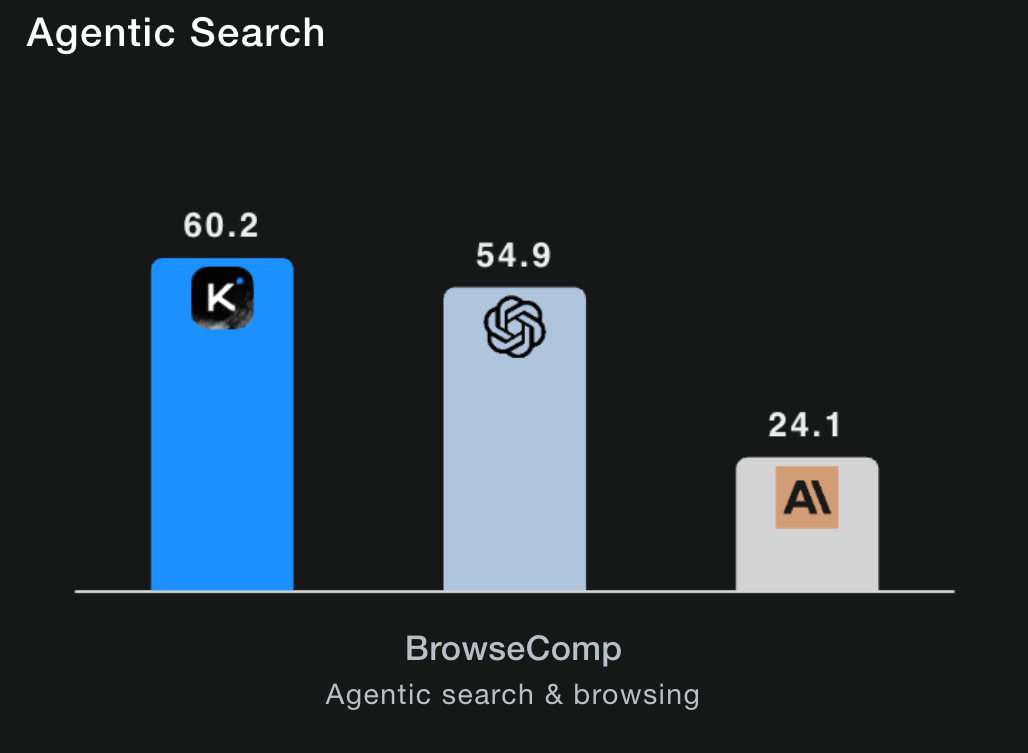
Agentic Search and Browsing
Kimi K2 Thinking shows strong performance in benchmarks designed to evaluate long-horizon web search, evidence gathering, and synthesis.
On BrowseComp, a benchmark that measures continuous browsing and reasoning over difficult-to-find real-world information, K2 Thinking achieves:
60.2% on BrowseComp
62.3% on BrowseComp-ZH
For comparison, the human baseline on BrowseComp is 29.2%, highlighting K2 Thinking’s ability to outperform human search behavior in complex information-seeking tasks.
These results reflect the model’s capacity to plan search strategies, adapt queries, evaluate sources, and integrate evidence across many tool calls.
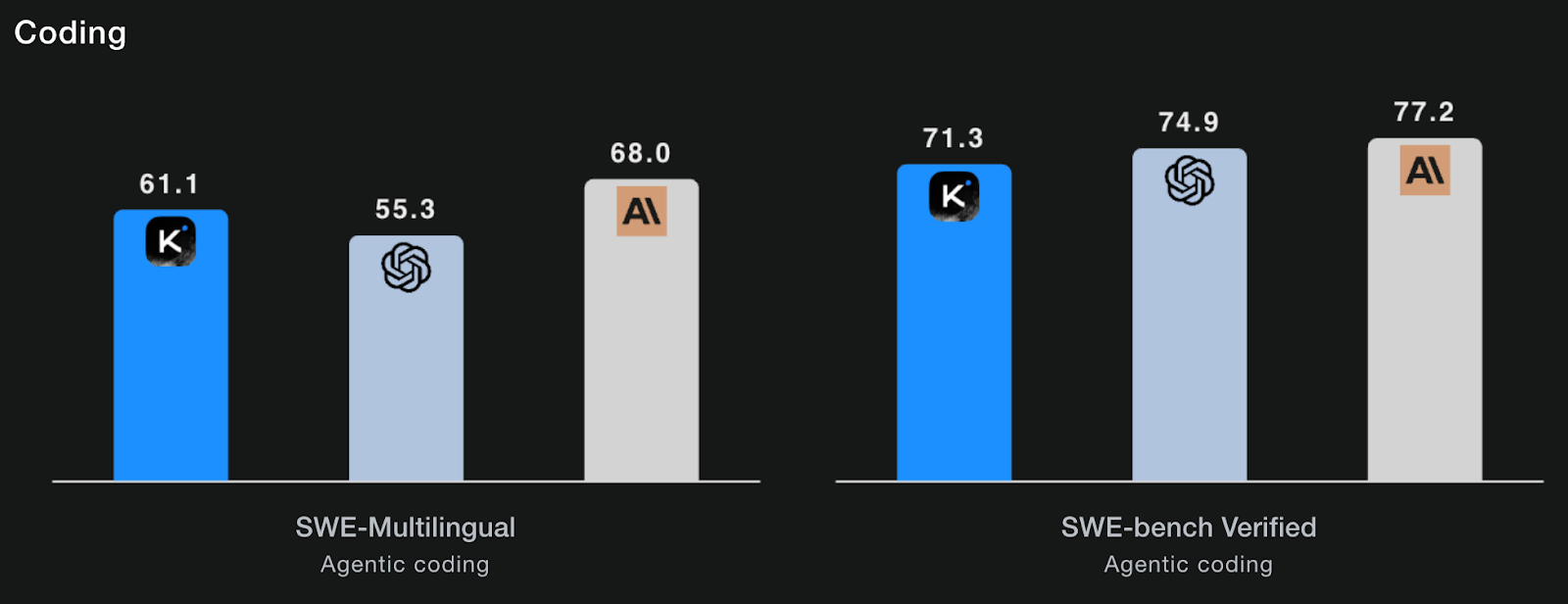
Coding and Software Engineering Benchmarks
Kimi K2 Thinking delivers strong results across coding benchmarks that emphasize agentic workflows rather than isolated code generation.
Notable results include:
71.3% on SWE-Bench Verified
61.1% on SWE-Bench Multilingual
47.1% on Terminal-Bench (with simulated tools)
These benchmarks evaluate a model’s ability to understand repositories, apply multi-step fixes, reason about execution environments, and interact with tools such as shells and code editors.
K2 Thinking’s performance indicates strong suitability for autonomous coding agents, debugging workflows, and complex refactoring tasks.
Cost Considerations on Clarifai
Pricing on Clarifai is usage-based and transparent, with charges applied per million input and output tokens. Rates vary by Kimi K2 variant and deployment configuration.
Current pricing is as follows:
Kimi K2 Thinking
$1.50 per 1M input tokens
$1.50 per 1M output tokens
Kimi K2 Instruct
$1.25 per 1M input tokens
$3.75 per 1M output tokens
For the most up-to-date pricing, always refer to the model page in Clarifai.
In practice:
Kimi K2 is significantly cheaper than closed models with comparable reasoning capabilities
INT4 quantization improves both throughput and cost efficiency
Long-context usage should be paired with disciplined prompting to avoid unnecessary token spend
Advanced Techniques and Best Practices
Prompt Economy
Keep system prompts concise
Avoid unnecessary verbosity in instructions
Explicitly request structured outputs when possible
Long-Context Strategy
Use full context windows only when needed
For very large corpora, combine chunking with summarization
Avoid relying exclusively on 256K context unless necessary
Tool Calling Safety
When using Kimi K2 Thinking for agents:
Define idempotent tools
Validate arguments before execution
Add rate limits and execution guards
Monitor reasoning traces for unexpected loops
Performance Optimization
Use streaming for interactive applications
Batch requests where possible
Cache responses for repeated prompts
Real-World Use Cases
Kimi K2 is well suited for:
Autonomous coding agents Bug triage, patch generation, test execution
Research assistants Multi-paper synthesis, citation extraction, literature review
Kimi K2 represents a major step forward for open-weight reasoning models. Its MoE architecture, long-context support, and agentic training make it suitable for workloads that previously required expensive proprietary systems.
Clarifai makes Kimi K2 practical to use in real applications by providing a managed Playground, a production-ready OpenAI-compatible API, and scalable GPU orchestration. Whether you are prototyping locally or deploying autonomous systems in production, Kimi K2 on Clarifai gives you control without infrastructure burden.
The best way to understand its capabilities is to experiment. Open the Playground, run real prompts from your workload, and integrate Kimi K2 into your system using the API examples above.
It should be exciting to be working with Lumion 3D rendering-capable designers and freelance architecture experts. Your assignment will be turned into a stunning, real-looking image by the best freelancer. They possess technical skills, creative flair, and a mind not biased against each project, small enough to be a single-house residential complex or a corporate firm. Cad Crowd is the ideal place to start with an actually overwhelming roster of supremely talented freelancers who can take building concepts and make them into actual, full-fledged reality with sophistication and detail.
Cad Crowd
Cad Crowd is one of the top marketplaces for Lumion 3D rendering and architectural modeling. It provides businesses with the best freelancers for high-end visualization, realistic rendering, and accurate 3D modeling. The site filtered its experts in depth to be consistent and in terms of offering projects. Architect firms use capability diversity, turnaround, and tailored service. The other sites also provide freelance services, but Cad Crowd’s architecture and 3D visualization expertise is a professional package for architecture firms who desire the best delivery and thus the best for customers in search of professionalism and quality.
Creads provides one with the way to use freelance designers in an attempt to achieve 3D modeling and rendering, amongst others, and even on Lumion work. It is on the cusp of possibility and multi-dimensional ability in design. Architecture firms can outsource specialists in order to attain visualizations and gain modeling, but one has more freedom in what one can have in specialty design as opposed to specialist architecture. To Cad Crowd, Creads is less filtered, specifically for 3D building services, but welcomes companies that need multi-disciplinary design consultancy. It can be used when there is a need for creativity in the design but for highly accurate architectural modeling and personal Lumion experience, Cad Crowd performs better.
Lemon.io takes pre-screened solo designers and developers to companies, for example, with the capacity to perform 3D modeling and rendering. While it has trained technical experts to employ as architectural visualizers, it applies vanilla tech and design freelance staff. Architecture firms can employ specialist Lumion experts, but don’t possess an architecture network. Lemon.io is less filtered for architecture rendering work compared to Cad Crowd, and that is what affects the experience provided. For companies in need of industry-best professional Lumion 3D rendering of the highest quality architectural standard, Cad Crowd features an even more professional, expert talent pool.
Malt is an online EU platform that brings companies and freelancers together for the purpose of offering any kind of service, for instance, 3D modeling design services, and rendering. The platform provides companies with browsing through experts by specialty, e.g., Lumion architectural visualizations. Malt does have a humongous number of skills to choose from, but they’re all one generalized and not so one-off actual architecture work rendering. Malt, though, does have a significantly more filtered approach to reach freelancers who actually receive specific types of architectural work. It’s suitable for businesses that need diversified creative freelancers but less curated through architecture, and therefore helpful to businesses that need quality, good, long-term Lumion rendering and modeling work output.
Flexiple is a screening company that matches businesses with screened freelancers to enable tech and design work, i.e., 3D modeling. Good screening and holds freelance professionalism in high esteem. Architecture firms can outsource Lumion experts, but the company is not an architectural visualization company but an overall design company. Flexiple could be less populated with fine individuals having a sufficient background in architecture compared to Cad Crowd, in spite of good freelance contacts. Companies that look for quality and realistic architecture drawings will employ Cad Crowd’s professional team in attempting to provide quality, project relevance, and authenticity in delivering high-quality Lumion 3D modeling and rendering.
Bark is a web platform service offering remote as well as local freelancers, such as 3D designers with 3D rendering expertise. Firms can commission Lumion services and get a series of quotes. The website is more varied, however, with loads more non-architectural types of services. In contrast to Cad Crowd, Bark would need to filter more so that contractors at least possess some experience in architectural modeling and Lumion rendering. Though convenient when it comes to locating freelancers on time, architectural practices searching for professionals and high-end rendering services will benefit more from Cad Crowd’s pre-screened list, with the guarantee that professionals are masters at anything other than architectural visualizations and high-end 3D modeling services.
Reedsy primarily seeks publishing freelancers, but they also possess visualizers and designers. Architecture firms placing orders for Lumion 3D modeling cannot accomplish mass availability in Reedsy. Even with guidance through experience and moderation, Reedsy’s publication bias lowers its architecture rendering work potential. Though architecturally and 3D visualization-based Cad Crowd has other specialist streams for high-level Lumion visualizations ordered by architecture firms, no equal quantity of specialist streams is present on Reedsy. Even though it could be the best for companies requiring ancillary design services but not professional, full-time, and architecture-specified 3D modeling and rendering, Cad Crowd is still the best option.
Kolabtree is an online platform that provides companies with freelance science and technical experts. While it has some 3D rendering services and modelers, its talent base is not best suited for the line of architectural visualization or rendering in Lumion. In comparison with Cad Crowd where the list of freelancers with necessary architecture and 3D modeling ability is thoroughly filtered, it will be even more professionally filtered under the practice of architectural work for Kolabtree. Companies seeking to get very realistic, professional-standard Lumion renders and model quality will be able to get more assured output on Cad Crowd. Kolabtree is best for focused technical advice and not long-term architecture visualization work.
Creativepool offers a general pool of creatives, i.e., artists and 3D modelers. Companies use experienced freelancers to do Lumion rendering, and the website is a generalist website with much room to imagine. The Creativepool is not architecture-specific like Cad Crowd and thus can give random expertise for architectural visualization services. Companies that need high-quality, accurate, and dependable Lumion 3D rendering will benefit from the high-quality, architecture-design-specific professional talent at Cad Crowd, which is faster and more dependable. Browsing on Creativepool is available to most freelance, independent, and individual creative professionals, but browsing the best unique architectural modeling occurs through Cad Crowd.
Crowdspring links businesses with creative freelancers, such as 3D experts, to conduct luxury modeling and visualization. There will be some chance of getting professional freelancers who are proficient in Lumion, but the platform is not of an architectural nature, and thus, this will impact the maturity of the level of expertise for more advanced architectural projects. Compared to Cad Crowd, a niche platform for architecture centered on model modeling and 3D rendering, it is more difficult to secure the right professionals to recruit on Crowdspring. Companies that need their best every time for Lumion graphics and high-end architectural modeling place themselves in an ideal position on Cad Crowd. Crowdspring is more appropriate for generic design jobs, but too broad for a custom architectural rendering service.
RenderHub presents independent design and 3D assets to work with. Architecture businesses can outsource model and visualization specialists, but the site is broad to other kinds of 3D work aside from architecture. RenderHub will not be as architecture visualization-oriented as Cad Crowd, and therefore, businesses need to search portfolios heavily so that the quality is what they are looking for. As much as it’s a suitable venue where one may access 3D capabilities, companies hiring professionals with experience in architecture-derived abilities in Lumion rendering will appreciate Cad Crowd’s professional network with dependability, accuracy, and higher outcomes for architectural services.
Yunojono unites companies with freelance experts such as 3D modelers and architectural visualization specialists. Successful hiring and talent are the business aim, but the horizon is open in most design disciplines. Building contractors needing to purchase Lumion renders can hire the top freelancers, though the network is less rigid. Far more expert professionals for advanced-level visualization work are provided by Yunojono than Cad Crowd, such as architectural 3D modeling and rendering experts. Firms needing extremely realistic, accurate Lumion renders do well with Cad Crowd, whose screened high-quality pros can offer quality consistency and experienced professionals on architecture projects.
SimplyHired is an open job search website where companies are able to post freelance work requests for 3D modelers and designers. It could be utilized with the aim of hiring Lumion rendering experts as freelancers, but typical site use requires businesses to do some actual screening of the candidates. Cad Crowd offers businesses a pre-screened list of experts whose specialty is in architecture, but SimplyHired makes no guarantees about architectural visualization. Companies searching for quality, quality 3D model and rendering services may be required to spend extra time sifting through freelancers. It is easy to sift through a list of leads on JustHired, but specialty Lumion rendering services are more effective and more reliable on Cad Crowd.
99studios uses project-by-project freelance visual artists and designers to offer 3D model services to companies. Yes, Lumion rendering specialists can be hired for work here, though architecture-based, which will bear on timeliness and quality of completion in projects. In contrast to high-architectural-skilled-Crowd, where freelancers are initially screened specifically for architectural visualizations and modeling, extra screening on 99studios would need to be done as a means of reaching quality. Architecture firms searching for authentic, professional, and trustworthy 3D images will always seek out Cad Crowd’s experts. Ongoing design work will be outsourced to 99studios, and top Lumion architecture visualization studios will utilize Cad Crowd as a professional and trusted middleman.
Toptal provides access to the world’s best freelance designers and 3D artists, such as Lumion experts in rendering. Toptal is extremely selective and retains freelancers who are at their best. Although Toptal employs the top experts, it is not a specialized field of architecture, and thus, there is no expert like Cad Crowd for architectural visualizations. As a specialist in 3D modeling and architectural visualization, Toptal would be more inclined to invest more in hiring top-exposure architects in the field. Those firms that need ongoing, real-world, and real-life Lumion renders will be able to take advantage of Cad Crowd’s incredibly skilled and committed community of professionals, the better option and better fit for architecture work, assured quality, and tight specs.
Envato Studio matches companies with creative freelancers such as visualization experts and 3D modeling freelancers. Firms are able to hire experts to do the Lumion render, although there is a huge reservoir of creative content on the site, which is not strictly architecture. Cad Crowd, however, is purportedly made up of a less expertized and professionalized pool of architects who would require deeper screening with regard to experience applicable to the projects. Business enterprises requiring such real-world professional and expert Lumion 3D modeling will increasingly be taken care of by Cad Crowd’s strongly vetted pool of talent. Envato Studio is ideal for creative work spanning a broad category, but not for individual architectural visualization work, which is safer and more suitable for Cad Crowd.
FreeUp provides businesses with pre-vetted designers in design, development, and marketing categories. Even though some of them actually perform like Lumion 3D modeling and rendering, the website isn’t architect-specialized or architect-based. Cad Crowd, on the other hand, would anticipate companies to filter freelancers more rigorously so that the architectural capability is assured. Companies looking for quality, realistic Lumion shots would value Cad Crowd’s expert-level, architecture-specialized talent pool. FreeUp is appropriate for general freelance services, but for precision-high and quality-specific architectural rendering services, Cad Crowd is the filtered and more reliable option.
Sribu is a newly launched website where corporations may outsource freelance designers to accomplish all types of work, such as 3D modeling. Despite the fact that it is possible that some of the freelancers could have had a clue about some facts in the background as it relates to Lumion rendering, the online site is not architectural or general. Whereas Cad Crowd, in which talented individuals within architectural visualizations are hired on a contract basis, Sribu would do one step better in providing freelancers with the capability required. Companies looking for professional, realistic, and high-quality Lumion renders will have more confidence with Cad Crowd. Sribu can be used for overall design needs, but companies looking for complete architectural modeling and rendering will obtain better output from Cad Crowd.
DeviantArt is a world to be discovered on the web for designers and artists, even those relatively skilled at 3D modeling. As likely as it is that businesses will hire talented freelancers to do the Lumion rendering, the site is not ready for the use of talented architectural projects. Unlike Cad Crowd, where the freelancers are handpicked to do 3D building modeling and rendering, DeviantArt has to sort them out and bargain to win your trust. Firms seeking top-grade, professional architectural renders will be stunned at Cad Crowd’s being more talented, faster, and tailored. DeviantArt is good enough to find creative genius, but for particular architectural modeling and precise Lumion rendering, Cad Crowd is the best bet.
ArtStation boasts a gigantic pool of expertise from professional visualization experts and 3D modelers. Companies can outsource to freelancing website professionals who are experts in Lumion rendering, but the site does have other markets too, like architecture. Cad Crowd, whose talent pool happens to be a pre-screened master architect, can stand out from ArtStation because, in certain situations, it may not be feasible to provide experience in sophisticated architectural modeling. Architecture firms that need the best, best-of-the-best, and precise Lumion 3D rendering will be best served by Cad Crowd’s pre-screened professional network. ArtStation is best used to find portfolios, but those seeking architecture-specific modeling and rendering services will be best served by Cad Crowd’s expert network of freelancers with extensive subject matter expertise.
LinkedIn ProFinder links businesses with professionals such as 3D experts and visualization consultants. By opening up rendering experts with the use of Lumion, the platform is integrated across various industries and is not specific to architecture. LinkedIn ProFinder would also spend longer generating experts with this amount of experience needed, as opposed to Cad Crowd, which already has a list of seasoned freelancers with years of experience in architectural 3D modeling and rendering. Companies that deal in architecture and need great, quality, and realistic renders from Lumion can use Cad Crowd’s talent pool. LinkedIn ProFinder is suitable for general freelancers seeking, but not too specific or an accurate fit for any of the services with professional architectural rendering.
ArchiStar is a freelancing website that is mainly aimed at helping architects and institutions locate design professionals, i.e., 3D modelers who are familiar with Lumion. Since the website is purely Architecture service-based, it is best suited to any visualization project. But whereas the pool of freelancers in ArchiStar may be smaller in terms of number in comparison to when it is about providing expertise, the portfolio is small and may even be smaller in number. Cad Crowd has more pre-screened talent pools with consistency and quality of services, as well as excellence in architectural 3D modeling and visualization services. Businesses that need excellent, realistic Lumion renders should enable Cad Crowd to do that for fast turnaround times, high quality, and professional polish.
Another new platform to try and tap the freelance designers, including the 3D designers and the visualization experts. Businesses can look for opportunities with Lumion rendering capacity, although the platform is not highly architecture-oriented, but generally. Dribbble will also have a better method of filtering through in making the decision to hire freelancers, with the ability to narrow down to architectural modeling and visualization, than Cad Crowd. Architectural companies that seek professional, precise, and quality Lumion rendering will be more stable and efficient with the utilization of Cad Crowd. Dribbble is wonderful at finding inspiration and portfolios, but for business-oriented, architecture-based 3D modeling and rendering, Cad Crowd has gathered experienced professionals who specialize in delivering quality, consistent output.
99designs allows companies to outsource freelance designers for any kind of creative project, including some 3D modeling and rendering. There are some freelancing Lumion experts, but the site overall has a slightly stronger focus on graphic and visual design than on general architectural design services. Cad Crowd is a niche site for screened architectural 3D modelers and renderers, but 99designs will not necessarily be looking to employ masters of highly detailed architectural backgrounds. Business companies that need the best realistic and solid Lumion rendering on building plans will adopt the Cad Crowd talent pool. 99designs is better used for complete design, but Cad Crowd would find itself more appropriate in advanced architectural visualisation.
GoPillar exposes one to 3D designers and freelancers for model work and visualization. Experienced freelancers for work with Lumion can be reached out to, yet the professionals here on the website are not architects. GoPillar would have to delve deeper to access quality and project fit than Cad Crowd, who delve deeper through architecture-capable experts with experience of having performed expertise in 3D rendering. Business organizations seeking professional, accurate, and realistic Lumion architectural renderings are best supported by Cad Crowd. Though they employ more professionals, Cad Crowd’s professionals are providing homogeneity, consistency, and competency to the architecture firms’ requests, as well as to quality rendering work.
Houzz brings home builders, business owners, and homeowners together with designers and familiarizes them with 3D visualization and modeling. Freelancers on Houzz would have Lumion skills, but with a focus on remodelling and interior designing instead of commercial building visualization and architecture. As for Cad Crowd, where pre-screened professionals are 3D model and rendering architects, Houzz could not be as ideal and precise in the delivery of up-to-the-minute visualization services. Architecture companies needing accurate, real, and professional Lumion renders would be best served by Cad Crowd. Houzz would be best for inspiration when designing, and not ideally suited for accurate visualization of architecture.
Behance contains working designers’ portfolios, 3D modelers’ portfolios, and visualization experts’ portfolios. Lumion may be searched by companies to have freelancers employed in order to create it, yet the platform is larger than architecture, so the right one must be chosen. While Cad Crowd excels in architecture visualization and 3D modeling, Behance lacks a filtered and architecture-focused pool of freelancers. Businesses demanding higher quality, precision, and Lumion renderings to apply to architecture schemes will be able to acquire their solution par excellence from Cad Crowd. Archinect is ideally suited to locate talent and see creative work, but when it comes to custom architectural visualizations, Cad Crowd is the way to go.
Archinect Jobs is design-career focused, connecting business and industry with design professionals like Lumion specialists and 3D modelers. Design-career focused, it’s a bit more job board in style, with a less specialized freelance option. Unlike Cad Crowd, a pre-screened freelancer site that’s good enough to develop useful architectural models and renderings, finding quality specialists on Archinect Jobs will be a slow process. Firms looking for quality, useful, and reliable Lumion renders are more likely to achieve reproducible results with the assistance of Cad Crowd. Freelance building visualization boasts a larger specialist readership on Cad Crowd compared to Archinect Jobs job listings.
CGArchitect is an architecture website that offers resources, portfolios, and freelancer guidance on 3D modeling and Lumion rendering. Although professionally oriented, the website is content- and community-oriented to a significant degree, and so is it where top professionals nowadays are practically impossible to come by for architectural design and drafting firms. From Cad Crowd’s direct matching and sourcing of freelancers to architectural competencies and Lumion, meeting this need with stable professionals would be more time- and expense-intensive. Businesses that need timely and quality Lumion rendering and architectural model accuracy would prefer Cad Crowd to be closer and quicker. CGArchitect only deserves for portfolio and inspirational projects, but professional services on freelance terms are better taken care of by Cad Crowd.
ArchiCGI offers 3D rendering, architectural visualization, i.e., those that are carried out in Lumion. The site offers skilled professionals in rendering, modeling, and photorealistic visualization. ArchiCGI is impressive, but Cad Crowd is impressive when it comes to product variety among freelancers and having access to more than one experienced practitioner capable of performing different types of work. Companies that need employment flexibility, rapid turnaround, and gigantic duty reliable architectural modeling may prefer Cad Crowd. ArchiCGI would be suitable for the highest-end rendering assignments, but Cad Crowd’s personally curated pool of talent is more capable of meeting custom architecture-based 3D modeling and rendering requirements.
Easy Render provides 3D visualization and rendering services and also has a facility for handling work in Lumion projects. They are capable of delivering high-end professional architectural visualizations and, hence, would be suitable for clients who need high-end renders. Cad Crowd is less conducive to Easy Render, having fewer freelancers to hire and fewer on whom one would need to commission the services of skilled specialists in order to meet the specifications of the project. Companies seeking quality professional, precise, and realistic Lumion renders will most likely favor Cad Crowd’s pre-screened pool of talent to become more involved and advanced in character. Although Easy Render can provide decent quality work, the Cad Crowd vision of introducing businesses to a pool of pre-screened architecture-expert freelancers is more suited for the provision of flexibility and continuity to high-end 3D model-building projects.
Contra is an internet platform that introduces specialist freelance creative masterminds in 3D to businesses. Although there are many different freelancers providing Lumion rendering and architectural model work, the portal is not architecture-specific. Although business startups are offered by Cad Crowd with pre-screened architecture-design freelancers, priority will be given to Contra because entrepreneurs are highly selective in filtering the candidates. Business startups’ need for quality, accurate, reproducible Lumion renders will be best addressed by Cad Crowd because it can meet their needs for architectural visualization. Contra will do for creative work on a hobby, but actual 3D architectural modeling services and rendering must be left to a professional network of Cad Crowd, which gives a great, sound solution.
Freelancer is a huge platform that brings businesses and freelancers with a very wide range of backgrounds. There are 3D modelers for architecture and Lumion specialists, but the market is enormous, and the quality of freelancers is extremely inconsistent. Regarding Freelancer’s screened architectural experts, Cad Crowd will require closer monitoring of projects and screening in order to provide quality. Companies requiring quality, good, right, and high-level Lumion rendering will be referred to Cad Crowd’s screened experts. For regular freelancer services, Freelancer would suffice, but for complex architectural visualization services, Cad Crowd is a great specialist, reliable, and trusted service.
Perfectlancer maintains a talent pool of 3D artists and designers freelancers who are highly qualified veterans in the business of Lumion rendering. Perfectlancer is non-exclusive and non-specialty architectural visualization. Cad Crowd stands apart in that it is not in a position to deliver the knowledge required in architecture to less-equipped experts. Organizations that require precise, real, and high-definition 3D renderings will be at ease with Cad Crowd. Perfectlancer would suffice for most design and creative tasks, but where high-quality, architecture-level Lumion modelings and renderings are needed by architecture companies, Cad Crowd is the wiser and better bet with a tried-and-tested pool of freelancers.
Kwork is a freelance website that provides diverse designs and 3D modeling services. While there might be a few live freelancers available today in Lumion rendering, the platform is not specialty architecture-focused. Whereas Cad Crowd cannot, Kwork may enable companies to sift through portfolios effectively and establish the level of competency they need. Companies that need high-quality and consistent architectural visualizations will be surprised at Cad Crowd’s managed platform. Kwork might be appropriate for general creative tasks, but professional architecture modeling and rendering somehow lands at Cad Crowd with exposure to very professional, architecture-specialized freelance experts who can deliver realistic and professional 3D.
Truelancer boasts a very high number of freelance experts, some of whom are freelance 3D artists. It’s not an architecture super site, however, and should hopefully be worth looking very hard for highly experienced Lumion talent freelancers. Truelancer is a more general skills platform than Cad Crowd, and this is now translating through to architectural render quality and consistency. Businesses that need very professional and consistent Lumion modeling will be best served by a vetted talent pool on Cad Crowd. Truelancer can only undertake generic freelance work, but not anything resembling high-end 3D visualization services, so Cad Crowd would be perfect for businesses needing professional, architecture-led 3D rendering work.
DesignCrowd is a site that brings business and freelance designers together to work on hundreds of inspirational projects. While there are a few freelancers available who are able to offer Lumion, the site leans more towards graphic design work rather than architect-based 3D modeling. Whereas Cad Crowd chooses masters with knowledge in architectural visualization, DesignCrowd will provide the same dull outcome for complex architectural work. Commercial businesses that need professional, realistic, and precise Lumion renders will fare better with Cad Crowd. Ordinary design jobs are best left to DesignCrowd, but accurate architectural 3D modeling and rendering are ideal with Cad Crowd since it employs a peer-reviewed, architecture-specialized group of freelancers.
PeoplePerHour is a fully freelance general market in which creative professionals are matched to businesses. There may be the occasional specialist professionals on there freelancing in Lumion, but the site itself isn’t an expert in architecture visualization websites. While PeoplePerHour is not even close to being as full of specialist expertise as Cad Crowd, there is possibly more to trawl through to find the good stuff. Businesses that require frequent on-target professional architectural 3D rendering will be amply served by Cad Crowd’s pre-screened professional network. IndividualsPerHour will do for elementary freelance level output, but advanced Lumion modeling and rendering demands Cad Crowd, and a tested-and-trusted, architecture-specialist talent pool.
Guru provides access to freelancers in numerous categories, including design and 3D modeling. They might be accessible elsewhere, but across projects, uniformity is not possible because the site is architecturally neutral. Apply this perception to Cad Crowd, which benefits from the services of a group of professional architectural 3D experts. Guru is not suitable for high-end architecture visualization companies that need them. It is best suited to receive general but heavy, realistic, professional Lumion rendering by Cad Crowd’s architecture-skilled freelancers in bulk, so it is best suited for companies that require quality, experts, and accurate architectural modeling.
Fiverr has access to an immense pool of talent among freelancers for 3D modeling and Lumion rendering services. The platform is highly generic in nature, though, and talent is highly diversified. Fiverr is not a skilled builder compared to Cad Crowd, and is able to offer an unbalanced strategy in luxury visualization work. Architecture firms that want to get accurate, realistic, and professional moments of Lumion will opt for Cad Crowd’s screened and experienced strategy. Fiverr could be beneficial for pilot or tiny orders, but for building companies that require regular, good-quality 3D modeling service, Cad Crowd is more professional and reliable.
Upwork is bringing companies in touch with freelance specialists in a broad range of miscellaneous fields, and 3D modeling and rendering are merely two of the options listed on their menu. There are a few freelancers familiar with Lumion itself, but the site is generic, and good candidates are iffy. With Cad Crowd, whose roster of experienced architects of established reputation and review history on some particular specified projects, Upwork would need to be sorted and project managed in order to deliver consistently. Business owners in search of world-class, professional, precise, and realistic Lumion renders of building models would have Cad Crowd professionals at their beck and call. Upwork could perhaps manage the freelance work alone, but a 3D architectural visualisation is always better and more cautious with Cad Crowd.
No matter if your home development or business development is small or large, your choice of Lumion 3D rendering designer is what can easily prove to be the turning point of success or failure. It has never been simpler to find the ideal employee for your position with so many sites to sift through. Cad Crowd provides an easy and secure means of reaching one-off experts who are keen to bring brilliant color to your building model. Visit Cad Crowd today and let trained Lumion 3D rendering artists who are raring to go make your next project come alive. Get a free quote here.
MacKenzie Brown is the founder and CEO of Cad Crowd. With over 18 years of experience in launching and scaling platforms specializing in CAD services, product design, manufacturing, hardware, and software development, MacKenzie is a recognized authority in the engineering industry. Under his leadership, Cad Crowd serves esteemed clients like NASA, JPL, the U.S. Navy, and Fortune 500 companies, empowering innovators with access to high-quality design and engineering talent.
Samsung is adding two brand new speakers to its audio lineup, along with updated soundbars boosted with AI features. While not as inconspicuous as the Samsung Frame, the new WiFi speakers, called the Music Studio 5 and 7, were designed to blend into your living room’s atmosphere with their minimalist design. However, if you’re looking for a more convenient option, Samsung also updated its flagship HW-Q990H soundbar, while also introducing the more affordable choice of the HW-QS90H.
Samsung built the Music Studio 5 with a four-inch woofer and dual tweeters, pairing them with a built-in waveguide to deliver better sound. To customize the sound, Samsung added its new AI Dynamic Bass Control that can make bass sound better without any distortion. You can even control the “gallery-inspired” speaker via voice or Bluetooth and it’s compatible with WiFi casting and streaming services.
Samsung
For an upgraded option, the Music Studio 7 comes with a 3.1.1-channel spatial audio that has top-, front-, left- and right-firing speakers to give a more immersive 3D audio experience. You can calibrate the sound even further with the Samsung Audio Lab Pattern Control Technology and the same AI Dynamic Bass Control feature seen with the Music Studio 5. Samsung says the Music Studio 7 can play Hi-Resolution Audio with up to 24-bit/96kHz audio processing and can either be used as a standalone speaker or paired with other Samsung audio devices.
Samsung
To round out its new audio offerings, Samsung debuted the HW-QS90H, or its All-in-One Soundbar, with a 7.1.2.-channel system that features 13 drivers, nine of which are wide-range speakers. The new soundbar’s built-in Quad Bass Woofer system means you can achieve deeper bass without a separate subwoofer. The All-in-One Soundbar even features Samsung’s Convertible Fit design that can handle being mounted on a wall or placed on a table, and a gyro sensor that can automatically adapt channel distribution depending on its orientation, like we saw with the QS700F.
Samsung even refreshed its flagship HW-Q990H soundbar this year and introduced to it the Sound Elevation feature that makes dialogue sound more natural and Auto Volume, which regulates a consistent volume across its channels for a more balanced sound. All of Samsung’s latest soundbars and speakers will be on display at CES 2026.
Google quietly brought its newer panorama system to the Pixel 8 series via a Pixel Camera update.
The new panorama mode uses HDR+ to stitch higher-quality frames with better lighting and detail.
Night Sight support is the real game-changer, letting you capture panoramas in low light, city nights, or dim interiors.
Google is breathing new life into its older flagship with a surprise update that brings the Pixel 9’s panorama mode to the Pixel 8 series. This update overhauls the interface and brings back the popular Photo Sphere experience (sort of), which was removed from new devices starting with the Pixel 8 in 2023.
The update was released quietly with Pixel Camera version 10.2, which began rolling out in early December and is now on the Play Store (via 9to5Google). For Pixel 8 owners, this update offers a more intuitive, guided shooting experience with smoother stitches and better results, especially when used with Night Sight.
This updated panorama mode uses the Pixel’s full HDR+ photo system to take individual high-quality frames and stitch them together. This method collects more image data, resulting in higher-quality images and improved dynamic range.
The interface is inspired by Photo Sphere and uses floating dots to guide you through the capture process. As you move your phone and line up each dot, a small preview appears above the viewfinder to show your progress.
The system also has a level indicator to help keep your shots straight, which is important for avoiding misalignments that can spoil a panorama.
Image 1 of 3
(Image credit: 9to5Google)
(Image credit: 9to5Google)
(Image credit: 9to5Google)
Shoot any direction
A standout feature of this update is its flexible capture direction. By tapping the settings gear, you can choose to capture left, right, up, or down when your phone is in landscape orientation.
The integration with Night Sight is particularly noteworthy. In panorama mode, you can set Night Sight to Off, Auto, or On, which allows you to take panoramic shots in low light. This feature could change how you photograph city skylines, starry nights, or indoor architecture.
Get the latest news from Android Central, your trusted companion in the world of Android
If you haven’t used panorama mode in a while, this update is a good reason to try it again.
Besides ChatGPT, Claude, and Gemini, the extensions harvest all conversations from Copilot, Perplexity, DeepSeek, Grok, and Meta AI. Koi said the full description of the data captured includes:
Every prompt a user sends to the AI
Every response received
Conversation identifiers and timestamps
Session metadata
The specific AI platform and model used
The executor script runs independently from the VPN networking, ad blocking, or other core functionality. That means that even when a user toggles off VPN networking, AI protection, ad blocking, or other functions, the conversation collection continues. The only way to stop the harvesting is to disable the extension in the browser settings or to uninstall it.
Koi said it first discovered the conversation harvesting in Urban VPN Proxy, a VPN routing extension that lists “AI protection” as one of its benefits. The data collection began in early July with the release of version 5.5.0.
“Anyone who used ChatGPT, Claude, Gemini, or the other targeted platforms while Urban VPN was installed after July 9, 2025 should assume those conversations are now on Urban VPN’s servers and have been shared with third parties,” the company said. “Medical questions, financial details, proprietary code, personal dilemmas—all of it, sold for ‘marketing analytics purposes.’”
Following that discovery, the security firm uncovered seven additional extensions with identical AI harvesting functionality. Four of the extensions are available in the Chrome Web Store. The other four are on the Edge add-ons page. Collectively, they have been installed more than 8 million times.
They are:
Chrome Store
Urban VPN Proxy: 6 million users
1ClickVPN Proxy: 600,000 users
Urban Browser Guard: 40,000 users
Urban Ad Blocker: 10,000 users
Edge Add-ons:
Urban VPN Proxy: 1,32 million users
1ClickVPN Proxy: 36,459 users
Urban Browser Guard – 12,624 users
Urban Ad Blocker – 6,476 users
Read the fine print
The extensions come with conflicting messages about how they handle bot conversations, which often contain deeply personal information about users’ physical and mental health, finances, personal relationships, and other sensitive information that could be a gold mine for marketers and data brokers. The Urban VPN Proxy in the Chrome Web Store, for instance, lists “AI protection” as a benefit. It goes on to say:
Is there a more infamous monkey-paw wish than the collective dream that all our favorite games could last forever? Well, the finger curled, because it seems like all major game publishers in the world only want to make games that go on to infinity.
With the rise of live-service games, it’s been a struggle to know when to put the controller down, especially when games like Fortnite release seasonal content like The Simpsons season pass that ask you to play long enough to unlock stupid sexy Flanders. Luckily, for us, episodic games, perfectly portioned into bite-sized morsels, have come back to rescue us from the endless grind.
In this case, I am talking specifically about Dispatch, the new episodic superhero game from AdHoc Studio. If the name is unfamiliar to you, AdHoc is a new game company founded by former members of Ubisoft, Night School, and perhaps most notably, Telltale Games, who blew up the episodic gaming scene with 2012’s The Walking Dead. The studio would later close due to a variety of factors internal and external, some of which I covered previously as a reporter. But by then, the episodic-games formula was starting to feel a bit played out, and the mood appeared to be shifting towards either more complete single-player experiences, or the early live-service games we know today.
But nowadays, the people yearn for games that deliver the sense of accomplishment when hitting credits, but also don’t require the kind of time investment most games demand. Dispatch perfectly models itself after the cable TV shows of old, with each episode adhering to a winning formula that never overstays its welcome.
Set in a modern-day Los Angeles — except in this version of the city, there are actual superheroes working together at a private security firm — Dispatch is best understood as a workplace comedy. Think The Office crossed over with The Boys. Players are asked to make both small and large choices as the hero, Robert Robertson III, which will not only determine his personality, but have big ramifications for how the story plays out. A short intro sets the stage for the episode’s plot, while in the middle is an interactive dispatching sim, followed by a big finale, a needle drop, and roll credits. A little formulaic, but so was television during the pre-prestige TV era.
Furthering the TV connection, Dispatch’s fully voiced storyline has a wonderful cast of TV alumni including Breaking Bad’s Aaron Paul, Westworld’s Jeffrey Wright, and thanks to a partnership with Critical Role, fan-favorite voice actors like Laura Bailey and Matt Mercer.
For the past week, playing Dispatch became a nightly ritual where after dinner, I’d retreat into the office for a single episode’s worth of Dispatch before returning to the living room to do something else for the evening. Just like a TV season, Dispatch is broken up into eight episodes, each about an hour, not including end credits. While there is always the urge to keep pushing forward and play right into the next episode, each section felt so perfectly calibrated for a single session of gaming that I could leave the next episode for the next night and not feel a pang of anxiety or FOMO. If anything, I could take the time to think over the choices I made in the previous episode, many of which feel weighty and substantial.
I don’t want to give the wrong impression about Dispatch by constantly comparing it to TV. Dispatch is first and foremost a game, and a damn good one too. The hero-dispatching sim alone is worthy of praise, and, ironically, something I could play endlessly. But there’s a confidence in direction that oozes from Dispatch. They know just when to hit you with the credits, knowing full well you will feel satisfied leaving the game until the next week when new episodes are set to drop.
The combination of talent, writing, and production in Dispatch all come together into a potent mix–a truly satisfying one too, which is not a description I’ve used for many games this year. You should read GameSpot’s positive review of course, but Dispatch has seemingly hit the perfect chord with players to the tune of 2 million copies sold. A major success for a new IP from a brand-new studio, and while I could go on about all the ways Dispatch has become a surprise hit of the year for me, the best thing about my time with it has been, well, that I spent a pretty short amount of time with it. Or rather, I spent the perfect length of time with it.
I’ve created a VS template using VS 2026, but no matter what I do, it doesn’t appear in the Add New Item menu. I used the Export Template feature. It stated that it couldn’t export, but the export file was generated nonetheless.
Files:
Assets Db Entity.zip: -AssetsDbEntity.cs -MyTemplate.vstemplate -_PreviewImage.png -_TemplateIcon.ico
AssetsDbEntity.cs:
/*
   @Date                 : 01.01.$year$
   @Author               : Stein Lundbeck
   @Description          : null
   @Version              : 1.0.0.1
   @Latest               : 01.01.$year$
*/

using SLT.Assets;

namespace $defaultnamespace$;

public interface I$safeitemname$ : IAssetsDb
{

}

public class $safeitemname$ : AssetsDb, I$safeitemname$
{

}
How does Meta AI stack up in the great chatbot arms race?
Advertisingly. Data-miningly. Like the avatar of rapacious consumption, slouching toward Bethlehem; like a fool’s bargain with the fae; like a self-fulfilling prophecy of ennui, tailored for maximum palatability and addictive potential. But since we can’t get rid of it by retconning Silicon Valley and/or hurling Zuck into the Sun, here’s what you need to know about Meta AI: where to find it, what it can do, and what’s really going on behind the proverbial curtain.
Introduction
Meta AI is a suite of artificial intelligence (AI) tools embedded across Meta’s software and hardware platforms (including Facebook, Instagram, WhatsApp, Messenger, VR, and Ray-Ban Meta smart glasses), as well as a web version and a standalone app. Collectively, Meta refers to this interconnected ecosystem of apps, devices, and virtual environments as the “metaverse.”
This is what the term “metaverse” once referred to. Credit: Meta
The term “Meta AI” refers to both the consumer-facing chatbot frontend and its behind-the-scenes infrastructure. However, Meta AI is also the name of Meta’s in-house R&D lab, which started off as Facebook Artificial Intelligence Research before the company’s 2021 rebrand.
What Can You Do With Meta AI?
Meta’s AI stack is thoroughly focused on social media, so its specialties are right at home on Facebook, WhatsApp and Insta. Here’s what Meta AI does, across the various platforms and services of the metaverse:
Facebook & Instagram
Search and content recommendations (people, posts, Reels, ads)
Image recognition (tagging, captioning)
Moderation (spam filtering & removal of harmful content)
There’s also a web version, which you can find at Meta.ai, and a standalone Meta AI mobile app. Both offer direct chatbot access for general queries, creative tasks, and some light-duty productivity assistance.
The Technology Behind Meta AI
Meta AI is based on a family of large language models known as LLaMA (a backronym for Large Language Model Meta AI). The current generation of LLaMAs is a mixture-of-experts model, three kobolds in a trench coat a sort of committee of smaller-scale, more focused AI tools, working together toward a single multifaceted goal. Most of those experts belong to a class of elaborate software models called transformers, originally developed to perform complex operations on huge grids of numbers called matrices. As of December 2025, the most recent version is LLaMA 4, released in three variants: Maverick, Scout, and a still-in-training preview version of Behemoth.
Credit: Meta
Llama 4 Scout is a “17 billion active parameter model with 16 experts,” according to a Meta press release from the launch. Maverick has roughly the same parameters but relies on its own bespoke internal panel of 128 experts, while the aptly titled Behemoth uses 16 experts but a whopping 288 billion active parameters. Meta also describes the Llama 4 model family as capable of fitting into the RAM on a single Nvidia H100 datacenter GPU, offering a tantalizing prospect for IT device manufacturers and decision-makers interested in AI models that can ultimately run on smaller local server installations or even on-device.
How to Access Meta AI
To access Meta AI from a web browser, you can go to Meta.ai to engage with it directly, or you can check out some AI features that are already live in the web versions of Metaverse apps. Facebook and Instagram users on mobile can access Meta AI via the app’s search bar or by interacting with the AI summaries that now appear under some posts and comments. There’s also a standalone app available on iOS and Android.
For users who have access to the AI rollout, Meta AI is enabled on Facebook by default, so you don’t have to seek it out. Rollout is on a per-account basis, so (at least in the US) once an account has access, it will have access on desktop and mobile devices. The same goes for Instagram. Not everyone has access to Meta AI on Instagram right now. If your account does, you’ll be able to tell by the Meta AI logo in the search bar.
Is Meta AI Available in All Countries?
Meta AI is available in many regions, but not universally. Since it’s still in its rollout phase, some features aren’t complete, and others aren’t yet available in languages other than English. (Voice features are strongest in English.) Availability is tied to Meta’s apps; if you can use Facebook/Instagram/WhatsApp in your country, you may encounter Meta AI, but features vary.
Credit: Meta
According to Meta’s FAQs, Meta AI is available in 200+ countries by way of metaverse apps like Facebook and Instagram, while the standalone iOS and Android apps are available in 186. However, even if the AI isn’t available in your country, you can use the app sans AI to configure the company’s Ray-Ban Meta glasses.
Some countries—and the entire EU—have restricted access to Meta AI altogether due to regulatory, privacy, and/or infrastructure concerns. Broadly, Meta’s data collection and use policies are in conflict with the EU’s General Data Protection Regulation (GDPR). That may change in the future, but for now, Meta AI is not available to private citizens who live in the EU.
Open-Source(ish)
Meta has long described LLaMA as “open-source,” emphasizing its availability for research and custom applications. But as usual, there’s more to the story than the corporate press releases let on.
The “open-source” label has received major community pushback from free software advocacy groups, developers, and academic and professional experts. In a January 2025 statement, the Free Software Foundation classified LLaMA 3.1 as nonfree software due to its license, which is incompatible with the GPL. But the line of criticism goes back years, at least as far as LLaMA 2. Mark Dingemanse, coauthor of a 2023 report that started with 15 and now compares 20 major LLMs to see how open their sources really are, had an absolutely scathing takedown of Meta’s claims about its LLaMA 2 model.
“Meta using the term ‘open source’ for this is positively misleading,” said Dingemanse, according to an IEEE Spectrum review of the paper. “There is no source to be seen, the training data is entirely undocumented, and beyond the glossy charts, the technical documentation is really rather poor.”
Later that year, Ars Technica characterized Llama 2 as “source-available,” rather than open-source, and an article in Nature bluntly accused Meta of “openwashing” systems (specifically, the company’s then-forthcoming LLaMA 3 model) “that are better understood as closed.”
What Data Does Meta AI Collect?
Everything that isn’t nailed to the floor. With some very specific exceptions, everything in Meta’s database is fair game: profile data, posts, photos, searches, interactions, hardware information, location data, and a vast subsurface web of weighted social and keyword associations. To Meta’s credit, at least the company is upfront about its Hooverish tendencies; they’re rolled right into the terms and conditions of access for the Metaverse. (As long as your definition of “upfront” includes making you wade through the Ferengi print with a magnifying glass.)
Specifically, Meta collects an array of information, including (but not limited to) the following:
Behavioral data: Likes, shares, follows, watch time, engagement patterns
Content data: Posts, images, captions, and metadata for moderation and recommendations
Device/context data: Location, device type, app usage (depending on permissions)
Meta has provided little detail about how they make use of all this information to train or refine their AI systems, but we do know that it enables spam filtering, content moderation, and ad targeting. The company claims not to use private messages for training, but still processes data to determine whether it’s sensitive.
Can You Disable Meta AI On Facebook or Instagram?
There is no way to fully disable Meta AI on Facebook, Instagram, WhatsApp, or anywhere else in the metaverse. When Meta AI becomes available to an account, it’s enabled globally by default. There are ways to opt out on a per-interaction basis, and you don’t have to engage with the AI’s chatbot tools, but consent to the data gathering is baked into the core metaverse ToS.
Credit: Meta
Don’t let that make you think we’re going gently into the good night. For more on how to avoid Meta AI where possible, check out our walkthrough on opting out of Meta AI (as much as you can, anyway) across the metaverse.
How Does Meta AI Compare to ChatGPT or Gemini?
Ultimately, the biggest difference between these chatbots is what they’re designed to do, but even there, you’ll find a great deal of functional overlap. At this point, these tools are all multimodal: full-fledged edifices unto themselves, capable of parsing and wrangling multiple media types, such as images, voice, video, and blocks of text.
Meta shares its competitive bracket with others in its weight class, including OpenAI, Google DeepMind, and Anthropic. However, unlike productivity-focused tools like Claude, Gemini, and many smaller-scale options, Meta AI has a decidedly social-media bent.
Still, there are some meaningful differences that distinguish Meta AI from its classmates. Meta is a social media juggernaut, and Meta AI is built to slipstream into the social media milieu like a fish takes to water. Where some AI chatbot services (i.e., ChatGPT, Claude, Gemini) excel at drier, more analytical applications such as content creation, copyediting, software engineering, or academic research, Meta AI was designed to manicure your social media feed and suggest friends, track and publicize events, offer related search terms, and use all of that to inform its ad suggestions.
Credit: Kenneth Cheung/Getty Images
Meta AI (LLaMA): Open-source models, integrated into social platforms. Focus on personalization, moderation, multimodal (text, image, VR).
Gemini (Google): Proprietary, multimodal (text, image, code). Integrated into the Google ecosystem (Search, Workspace).
Meta AI’s comparative strongest points are scale and integration. There are billions of unique users across Meta’s platforms. ChatGPT and Gemini both offer standalone versatility and enterprise productivity, and it’s true that our Gmail inboxes are loaded with information about our financial practices and career decisions. But we’d still argue that neither of them has anything like Meta’s raw access to the behavioral and financial patterns that describe a person’s life. Meta AI is less about standalone chatbot performance and more about embedded infrastructure.
Meta’s long-term vision for its AI involves more multimodal capabilities, deeper metaverse integration, and ongoing privacy debates. Meta AI doesn’t need to outthink ChatGPT or Gemini; it just needs to outlast them, so it makes like a barnacle on a ship’s hull, embedded in the endless scroll of our collective social life. That’s the real play: not so much brilliance as omnipresence. It’s about who owns the stage we’re all performing on. And in a world where attention is the currency, Meta’s AI is already sitting on a dragon’s ransom.
Understand the unique features and benefits of TFSAs, RRSPs, and FHSAs.
Learn how each account aligns with different financial objectives.
Discover strategies for combining these accounts to maximize savings.
Table of Contents
Introduction
Understanding the Tax-Free Savings Account (TFSA)
Exploring the Registered Retirement Savings Plan (RRSP)
Delving into the First Home Savings Account (FHSA)
Comparing Key Features of TFSA, RRSP, and FHSA
Strategies for Maximizing Your Savings
Common Mistakes to Avoid
Conclusion
Introduction
The landscape of personal savings in Canada presents several powerful options, but understanding which account type is best for your goals can make a significant difference. TFSAs, RRSPs, and FHSAs each provide distinct tax advantages and withdrawal rules, offering flexibility and potential growth for different stages in life. Before you decide where to put your savings, it’s wise to weigh the benefits of each.
For Canadians, factors like taxable income, timing, and long-term objectives all play a role in optimizing financial planning. Comparing your choices side by side can give you a clearer picture of how each account could serve you. To begin your research, consider exploring this helpful guide: Compare TFSA, RRSP, and FHSA in Canada.
Choosing between these accounts depends not only on tax treatment, but also on factors such as contribution limits, access to savings, and your specific short- or long-term financial needs. Whether you’re saving for retirement, planning to buy your first home, or building a financial safety net, understanding the fine print ensures you don’t leave money on the table.
It’s also important to consider how government programs may affect your choices. The Canadian government regularly updates contribution limits and account rules, making it essential to stay informed through reputable sources, such as the Canada Revenue Agency.
Understanding the Tax-Free Savings Account (TFSA)
The Tax-Free Savings Account (TFSA), launched in 2009, is a versatile savings vehicle open to Canadians aged 18 and older. With a TFSA, any interest, dividends, or capital gains earned are completely tax-free, not only while the funds remain invested, but also upon withdrawal. TFSAs do not offer a tax deduction for contributions; however, their flexibility makes them perfect for both short- and long-term savings goals, from vacation funds to retirement supplements.
TFSAs also provide unmatched access to your funds, allowing withdrawals at any time for any purpose without incurring tax consequences. Furthermore, any amount withdrawn gets re-added to your contribution room in the following year. This added flexibility, combined with tax-free growth, makes the TFSA an efficient tool for building an emergency fund or investing in market opportunities without a future tax hit.
Exploring the Registered Retirement Savings Plan (RRSP)
The Registered Retirement Savings Plan (RRSP) has been a staple of Canadian retirement planning since its introduction in 1957. The primary advantage lies in its tax-deferral structure: contributions are deducted from your taxable income, reducing your yearly taxes. Investments within an RRSP grow untaxed, and withdrawals, usually made in retirement, are taxed as income—often at a lower rate than during your peak earning years.
RRSPs are especially important for long-term retirement savings and can be utilized strategically for major life purchases through programs such as the Home Buyers’ Plan and the Lifelong Learning Plan. The annual contribution limit is 18% of your previous year’s earned income, up to a maximum ($31,560 for 2024), making it ideal for high-income earners looking to minimize current tax liabilities and secure their retirement.
Delving into the First Home Savings Account (FHSA)
Introduced in 2023, the First Home Savings Account (FHSA) combines the best features of TFSAs and RRSPs to help Canadians purchase their first home. Contributions are tax-deductible, reducing your tax bill today. Investment growth within the account is tax-free, and qualified withdrawals for home purchases are also tax-free. Individuals can contribute up to $8,000 per year with a lifetime cap of $40,000. If a house isn’t purchased within 15 years, unused FHSA funds can seamlessly transfer into an RRSP without impacting RRSP contribution room.
This makes the FHSA an excellent fit for those who have a clear intention of purchasing their first home within the next decade or so, offering dual advantages: immediate tax benefits and potentially tax-free withdrawals for a qualifying home purchase. For more details, see this MoneySense analysis of Canadian savings accounts.
Comparing Key Features of TFSA, RRSP, and FHSA
The three account types differ in several important ways, particularly in how contributions, growth, and withdrawals are treated for tax purposes. A Tax-Free Savings Account (TFSA) does not offer tax-deductible contributions, but all investment growth and withdrawals are completely tax-free and can be accessed at any time. A Registered Retirement Savings Plan (RRSP) allows tax-deductible contributions and tax-deferred growth; however, withdrawals are generally taxable unless made under specific programs. The First Home Savings Account (FHSA) combines features of both, offering tax-deductible contributions and tax-free growth, with tax-free withdrawals when used to purchase a first home. Contribution limits also vary, making these distinctions essential when planning for retirement or homeownership.
Strategies for Maximizing Your Savings
Start by maximizing your FHSA contributions to lock in both immediate tax savings and future tax-free withdrawals. Consider topping up your RRSP and leveraging the Home Buyers’ Plan to access an additional $35,000 per person towards your home purchase.
Prioritize RRSP contributions if your income is high, as the upfront tax deduction offsets your tax bill today, and investments can grow for decades tax-deferred. Supplement this by using a TFSA for growth that remains tax-free, even when you make withdrawals in retirement, which can complement government retirement benefits.
Flexible & Short-Term Needs:
Use your TFSA for an emergency fund or other short-term savings. Withdrawals won’t be taxed or impact government benefits, making it an ideal parking spot for accessible, ready cash.
Common Mistakes to Avoid
The Contribution room can be complex to track. Exceeding the limits in any account triggers a penalty of 1% per month on the excess amount, so check your available room regularly using the CRA portal or a trusted advisor.
Misunderstanding Withdrawal Rules:
RRSP withdrawals outside programs like the HBP are counted as taxable income and can quickly push you into a higher tax bracket. Always understand the implications before you tap these funds.
Ensure your contributions are directed into the accounts most closely aligned with your goals—TFSA for flexibility and accessibility, RRSP for long-term retirement savings, and FHSA for first-home buyers.
Conclusion
Ultimately, your choice between a TFSA, RRSP, and FHSA should reflect your personal financial picture—your goals, timeline, and income level. Thoroughly understanding the structure and restrictions of each can help you maximize your contributions, avoid tax penalties, and best support major life milestones.
Consulting a financial planner or regularly visiting resources such as MoneySense’s guide on RRSPs and TFSAs can help you stay updated and make informed decisions as your life and goals evolve.