Five and a half years after its 2020 Game Awards reveal, Crimson Desert has remained something of a mystery. Developer Pearl Abyss has promised a growing collection of mechanics and playstyles so bafflingly dense that it’s still hard to picture how exactly it’s all meant to fit together. Thanks to a freshly announced release date, however, we now at least know when we’ll see the full picture—and launch day is just two months away.
In a Steam news post, Pearl Abyss has confirmed that Crimson Desert has gone gold: The game’s primary development is, for all intents and purposes, complete and distribution-ready—aside from whatever tweaks might arrive in a day one patch. The announcement also brought us a release date: Crimson Desert will launch on March 19.
That means we’ve got just over eight weeks before we get our full and proper introductions to protagonist Kliff and the fantasy world of Pavel, and see just how well Pearl Abyss has managed to cram so many kinds of gameplay into one Kliff-shaped package. Kliff can seemingly do so many things that our Harvey Randall wrote last April after a hands-on preview that Crimson Desert is a kind of “action RPG tesseract” that’s barely contained by its seemingly -generic medieval fantasy trappings.
In the gameplay videos on Crimson Desert’s Steam page and YouTube channel, you can watch its gruff protagonist:
Swing a sword
Swing a spear
Swing an axe
Shoot a bow
Do kung fu
Grapple and throw enemies with pro wrestling techniques
Perform combat geomancy
Summon an artillery barrage
Execute stealth kills
Eat toast
Solve Breath of the Wild shrine-esque puzzles
Mine for ore
Cook a steak
Glide through the air using a cloak of writhing, animate shadow tendrils
Triple jump with a combination of lightning and nature magics
Enter a mysterious cubespace portal to traverse dimensions
Skydive
Swing Spider-Man-style with a wristmounted energy cord
Initiate goblin regime change
Perform fire rescue
Ride a horse
Ride a bear
Ride a dragon
Pilot a dwarven combat mech armed with heatseeking cluster missiles
And more!
In other words, Crimson Desert seems like a prime example of the rarely seen Witcher-Dragon’s-Dogma-Red-Dead-Shadow-of-Mordor-Zelda-Assassin’s-Creed-Spider-Man-like. As for whether or not it can fit all those pieces together in any coherent form, we’ll have to wait until March to find out.
Keep up to date with the most important stories and the best deals, as picked by the PC Gamer team.
2XKO launches today on Xbox Series X|S as a free-to-play title.
Team up with a friend or fight solo in 2v2 matches.
Find your main with 12 different champions to play.
Finally. 2XKO, the free 2v2 fighting game featuring League of Legends champions, launches today on Xbox Series X|S.
If you’ve been dying to get your hands on the game, you probably want to jump in right away. At the same time, booting it up for the very first time can be a little overwhelming. From champions, to Fuses, to teamplay mechanics, there’s a lot of information to absorb – especially for anyone new to tag fighters, or fighting games in general.
Here are some quick tips to help you get in-game and start having fun right away.
Grab a Duo Partner
2XKO is a 2v2 game, which means you can team up and fight as a duo. Whether you’re testing combos in Training mode or climbing the Ranked ladder together, the highs and lows of fighting games are better with friends.
Use your champ’s Assist moves by pressing A or back + A when they’re offscreen. Each champion has unique Assists, but here’s how to use a few:
When Braum uses Stand Behind Me Assist (back + A), he leaps to shield his ally from an attack. If you’re under pressure from the enemy team, this Assist can help you get some space back.
When Blitzcrank uses Rocket Grab Assist (A), they’ll extend their robotic arm to pull an enemy champion towards your team. Use this Assist to bring in opponents and follow up with your big hits.
When Vi uses Crater Maker Assist (back + A), she punches the ground and creates a hextech aftershock. It can hit opponents out of the air, so try this move if they’re jumping in.
When you’re playing with a friend, they can swap to you by hitting A right after your champion Assists. Coordinate to attack together, defend each other, and pull off tricky combos.
Find Your Main
Each character in 2XKO has a unique playstyle. For your first games, just pick the ones that look the coolest to you – you can always choose someone new in the next game.
Caitlyn, the Sheriff of Piltover, is our newest addition to the roster. Use her traps and deadly aim to stay ten steps ahead of the enemy duo.
Don’t forget that you’ll have two champions on your team, and they can play off of each other. If you’re looking for team-building suggestions, here are a few:
Caitlyn and Vi
Caitlyn uses her hextech-powered rifle to line up headshots, while Vi loves to brawl up-close. With their combined strengths, you’ll take down opponents at any range.
Darius and Ekko
Darius deals massive damage with his battle axe and makes opponents Bleed, but he’s on the slower side. Ekko can keep enemies guessing with fast movement and a teleport. Use Ekko to jump in (or out), and land big hits with Darius.
Ahri and Braum
Ahri is a quick spellcaster who excels in the air, while Braum is a supportive champion that can defend allies with a shield. Use Ahri’s magical foxfire to blast opponents, and if you find yourself under pressure, bring in Braum’s shield to retreat or position for your next move.
Try Pulse Combo
A combo is when you put together unique moves to damage an opponent. This can feel complicated when you’re still learning what your champion can do, but Pulse Combo is here to help.
In champion select, press RT to enable Pulse Combo. Once it’s on, you can press the same attack button repeatedly to automatically do a combo (if you land the first hit).
There are unique autocombos for the X, Y, and B buttons. Try each one to get an idea of the moves your champion can combine.
Play Tutorials
If you’re looking to improve your game, there are tons of tutorials to choose from in the Learning Hub. Here are the different types available:
Bot Beatdown: Win battles against bots to unlock chromas that change the color palette of four champions.
Tutorial: A series of fights to teach the basics of 2XKO, including movement, attacking, blocking. Completing this unlocks a set of cosmetics for your avatar.
Combo Trials: Learn combos for each champion, from beginner to expert-level difficulties.
Advanced Lessons: Level up with more advanced techniques for offense, defense, teamwork, and movement.
You can also find Training mode in the Learning Hub, where you can play against bots at your own pace.
Experiment with Fuses
Fuses are playstyle modifiers that change how your team works together. You pick your team’s Fuse after choosing your champions, so you can try each one out to see what suits you best.
Here are the Fuses that are available when you launch 2XKO for the first time:
Juggernaut: Play as a single champion with extra power. You can’t use Assists, but gain a few buffs, including bonus health, damage reduction, and additional bars of meter.
Sidekick: Your Point champion gains health and a defense boost. Your Assist champion can’t tag in, but gains supporting abilities.
Double Down: Combine your Point and Assist champions’ Super attacks.
There are two more advanced Fuses that can be unlocked by completing tutorials in the Learning Hub: 2X Assist and Freestyle.
2XKO is available for free in the Microsoft Store for Xbox. Check out the 2XKOwebsite and YouTube channel for more on how to play and to get a look at each champion. See you in the lobby!
2XKO
Riot Games
☆☆☆☆☆ 55
★★★★★
TEAM UP. TAG IN.
Welcome to 2XKO, the free-to-play fighting game from the makers of League of Legends and VALORANT.
2V2 COMBAT
In 2XKO, good teamwork makes the difference between victory and defeat. Fight solo to control both champions on your team, or grab a friend to duo with. Switch up your game every match with Fuses, powerful playstyle modifiers that change the rules your team plays by.
LEGENDARY FIGHTERS
League of Legends’ iconic champions take the stage with fresh movesets inspired by the MOBA and reimagined for fighting games. Immerse yourself in the world of Runeterra with beautifully crafted stages, cutting-edge 2D graphics, and original music tracks that bring your battles to life.
LOBBIES & MATCHMAKING
Step into a virtual arcade where your next duo partner—or rival—awaits. Ranked, Casual, and Private lobbies let you play your way whether you wanna compete, spectate, or just mash. Plus, with best-in-class rollback netcode and anti-cheat systems, 2XKO delivers fair, lag-free gameplay every time you queue up.
Way back in March of 2019, this weird thing happened where a relatively insignificant tech nonprofit called OpenAI became a “capped” for-profit company—whatever that is. The month earlier, OpenAI had announced the creation of an uncanny, über-powerful language model called GPT-2 that was supposedly just too dangerous to release. Then in November, OpenAI seemingly changed its mind and GPT-2 was released after all.
OpenAI said in the blog post about the release that it saw, “no strong evidence of misuse so far,” but added that it was impossible to “be aware of all threats.” Most people never used GPT-2, because OpenAI never injected it into a viral chatbot.
As someone who wrote about this at the time, it was puzzling to watch it all play out. OpenAI seemed like small potatoes, but it was also building creepy AI tech, and shifting in public image from being a do-gooder computer lab advertising its trepidation about harming a hair on anyone’s head to an enterprise that needed to ship something asap because it was clearly promising someone, somewhere, that they were going to get rich.
Document discovery from Elon Musk’s lawsuit against OpenAI and Microsoft has provided a tiny window into what was actually happening inside Microsoft during this bizarre time for this bizarre company, and how the transition may have turned OpenAI into the money-hungry beast it is today, with revenues growing tenfold between 2023 and 2025.
GeekWire’s Todd Bishop dug through the cache of emails, memos, texts and the like from Microsoft and OpenAI, and what he found was revealing. Microsoft, and CEO Satya Nadella in particular, had invested heavily in OpenAI by then, and were not quiet during OpenAI’s uneasy transition to for-profit status. Nor were they shy about the need to make money as soon as possible. Absolutely none of this should come as a surprise, but it makes for fascinating reading anyway.
During that gap where GPT-2 was sitting there unreleased and OpenAI had recently become a capped nonprofit, Microsoft’s chief financial officer, Amy Hood, weighed in about the company’s concerns about that “capped” part. She wrote in a July 14 email to a group including Nadella, “Given the cap is actually larger than 90% of public companies, I am not sure it is terribly constraining nor terribly altruistic but that is Sam’s call on his cap.”
GPT-3, which was even more exciting than GPT-2 was released in 2020, and the first version of OpenAI’s language model, Dall-E was released in January 2021. The next month, Microsoft and OpenAI were negotiating an additional injection of money from Microsoft, and Sam Altman wrote an email to Microsoft, saying “We want to do everything we can to make you all commercially successful and are happy to move significantly from the term sheet,” and he added that he wanted “to make you all a bunch of money as quickly as we can and for you to be enthusiastic about making this additional investment soon.”
In November of 2022, ChatGPT was released, and as you know, all hell broke loose. In January of 2023, Nadella sent a text message to Altman, saying “when do you think you will activate your paid subscription for ChatGPT?”
Altman said he was “hoping to be ready by end of jan, but we can be flexible beyond that. the only real reason for rushing it is we are just so out of capacity and delivering a bad user experience,” and asked “any preference on when we do it?”
“Let me think about it and weigh in. Overall getting this in place sooner is best,” Nadella replied. Two weeks later, he followed up and asked “how many subs have you guys added to ChatGPT?”
Three days later, the paid version of ChatGPT launched.
The package is pretty basic, and the OData Connection Manager is to SAP. I am also using package configuration for the connection string to the OData Resource
During design time, the OData Connection Manager test fine and the associated OData Source works correct. I am able to get data out of the specified source.
However, when I execute this, the package fails during run-time (In Visual Studio Debugger and Command Line using dtexec):
[(OData Source) [141]] Error: Cannot acquire a managed connection from the run-time connection manager. [SSIS.Pipeline] Error: … (OData Source) failed validation and returned error code 0xC020801F.
I tried a variety of different changes:
Setting the Protection Level to “DoNotSaveSensative” – when I do this I see the password is not being set.
Connection Manager – Set to “DelayValidation”
OData Source – turned off “ValidateMetaData”
Here is where it gets strange. If I use Fiddler, and have it decrypt the payload, I can see the payload but the SSIS package runs successfully. If I stop Fiddler, then the package fails during runtime
This tells me it is something with TLS encryption. I have tried a series of Regedit changes and have updated the .NET Framework as other posts recommend but to no avail.
I am not sure what to do next but any assistance would be appreciated
Last week, after reversing an earlier ban, the U.S. administration officially approved the sale of Nvidia’s H200 chips, along with a chip line by AMD, to approved Chinese customers. Maybe they aren’t these chipmakers’ shiniest, most advanced chips, but they’re high-performance processors used for AI, making the export controversial. And at the World Economic Forum in Davos on Tuesday, Anthropic CEO Dario Amodei unloaded on both the administration and the chip companies over the decision.
The criticism was particularly notable because one of those chipmakers, Nvidia, is a major partner and $10 billion investor in Anthropic.
“The CEOs of these companies say, ‘It’s the embargo on chips that’s holding us back,’” Amodei said, incredulous, in response to a question about the new rules. The decision is going to come back to bite the U.S., he warned.
“We are many years ahead of China in terms of our ability to make chips,” he told Bloomberg’s editor-in-chief, who was interviewing him. “So I think it would be a big mistake to ship these chips.” Amodei then painted an alarming picture of what’s at stake. He talked about the “incredible national security implications” of AI models that represent “essentially cognition, that are essentially intelligence.” He likened future AI to a “country of geniuses in a data center,” saying to imagine “100 million people smarter than any Nobel Prize winner,” all under the control of one country or another.
The image underscored why he thinks chip exports matter so much. But then came the biggest blow. “I think this is crazy,” Amodei said of the administration’s latest move. “It’s a bit like selling nuclear weapons to North Korea and [bragging that] Boeing made the casings.”
That sound you hear? The team at Nvidia, screaming into their phones.
Nvidia isn’t just another chip company. While Anthropic runs on the servers of Microsoft and Amazon and Google, Nvidia alone supplies the GPUs that power Anthropic’s AI models (every cloud provider needs Nvidia’s GPUs). Not only does Nvidia sit at the center of everything, it also recently announced it was investing in Anthropic to the tune of up to $10 billion.
Techcrunch event
San Francisco | October 13-15, 2026
Just two months ago, the companies announced that financial relationship, along with a “deep technology partnership” with cheery promises to optimize each other’s technology. Fast forward to Davos, and Amodei is comparing his partner to an arms dealer.
Maybe it was just an unguarded moment — it’s possible he got swept up in his own rhetoric and blurted out the analogy. But given Anthropic’s strong position in the AI market, it seems more likely he felt comfortable speaking with confidence. The company has raised billions, is valued in the hundreds of billions, and its Claude coding assistant has developed a reputation as a highly beloved and a top-tier AI coding tool, particularly among developers working on complex, real-world projects.
It’s also entirely possible that Anthropic genuinely fears Chinese AI labs and wants Washington to act. If you want to get someone’s attention, nuclear proliferation comparisons are probably a pretty effective way to do it.
But what’s perhaps most remarkable is that Amodei could sit on stage at Davos, drop a bomb like that, and walk away to some other gathering without fear that he just impacted his business adversely. News cycles move on, sure. Anthropic is also on solid footing right now. But it does feel that the AI race has grown so existential in the minds of its leaders that the usual constraints — investor relations, strategic partnerships, diplomatic niceties — don’t apply anymore. Amodei isn’t concerned about what he can and can’t say. More than anything else he said on that stage, that fearlessness is worth paying attention to.
We test every phone in real-world scenarios, focusing on its features, design, performance, cameras, battery life and overall value. We document our findings in an initial review that is periodically updated when there are new software updates, or to compare it against new phones from competitors such as Apple, Samsung, Google and OnePlus.
CNET’s Andrew Lanxon documents himself testing the Pixel 10 Pro’s selfie camera.
Andrew Lanxon/CNET
Photography
Photography is a major focus for most phones these days, so we take pictures and videos of various subjects in a variety of settings and lighting scenarios. We try out any new camera modes, such as ProRes Log video with genlock that debuted with the iPhone 17 Pro and 17 Pro Max, or the Gemini-powered Camera Coach tool that launched with the Google Pixel 10 series.
Battery life
Battery testing is conducted in a variety of ways. We assess how long a phone lasts during a typical day of use and note how it performs during more focused sessions of video calls, media streaming and gaming. We also conduct a video playback test as a simple, replicable measure of pure battery life, which isn’t always included in the initial review but sometimes added later in an update.
We test phone features all around the world.
Kevin Heinz/CNET
Performance measuring
We use benchmarking apps to measure each phone’s performance alongside our own anecdotal experiences using the phone for our review. Most notable are how the graphics and animations look. Are they smooth? Or do they lag or stutter? We also look at how quickly the phone switches between horizontal and vertical orientations, and how fast the camera app opens and is ready to take a photo.
We perform processor-heavy tasks such as editing photos, exporting videos and playing games. We evaluate whether a newer version of a particular phone includes enough features to make it worth upgrading from older models.
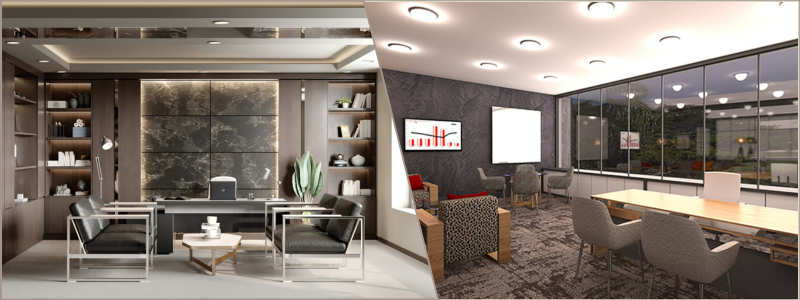
Today’s post covers a few tips about CGI in corporate office interior design and 3D rendering services. Corporate offices are among the most important spaces in modern life. Considering how every decision made in those spaces on a daily basis have the power to affect product planning, research and development, marketing strategies, public relations, employees’ welfare, finances, and just about everything else even remotely connected to the company’s operation, it makes perfect sense if corporate offices are fashioned to be as business-centric as possible by incorporating a lot of design cues from their respective brands’ visual identities. 3D Rendering professionals can do just that.
You can even say that a corporate office is a lot more than just a place of work. It is a physical expression of a company, a statement of the brand’s vision, a testament to its reputation, and to some extent a strategic tool to attract and retain talent. The office isn’t just a structure, a building where the C-suite and their subordinates assemble to perform their roles, but a purposeful asset that facilitates all the company’s activities to make sure everything functions as intended.
With that in mind, a corporate office needs a design that represents its importance. It should therefore surpass the mere purpose of polishing the space up with furniture and ornaments, but also to communicate the overall experience and ideas of the company itself. An expert 3D interior rendering firm can help.The lobby must bring forward collaborative energy, the executive boardroom has to outline the sense of sophistication, and even the library is supposed to be framed in a productive atmosphere.
For architectural render artists, visualizing a corporate office always presents an assortment of unique challenges. You can’t depict it simply as luxurious, because it’s not the place people have in mind when they want to feel glamorous; focusing entirely on the industrial side also isn’t true, either, as the atmosphere should also promote comfort. The visualization has to be well-balanced; a visualization that embodies corporate culture, ideals, professionalism, productivity, and visions for success.
Like the trade of 3D rendering itself, interior visualization is a blend of art and technical proficiency. A good interior has to be precise with hyper-realistic details, but without the lack of artistic touches for storytelling. And suppose a combination of technical mastery and distinctive styles is what you’re after. In that case, Cad Crowd can help you connect with hundreds of skilled and experienced professionals specializing in interior rendering of commercial, residential, or industrial spaces.
Practical guide to effective CGI of corporate office
Creating a visualization of corporate office interiors can be quite tricky. While it’s true that one of the main purposes of a render is to get the proposed design approved, a corporation (in this case, the project owner) isn’t a typical client. As a 3D visualization professional, you don’t want to present a generic, run-of-the-mill visualization to executives during a routine pitch and hope for high praise; these people need to be utterly impressed to even bother to take a second glance. C-suites are hard to please, but there is plenty you can do to try and convince them that the visualization you create is more than worth every penny.
A corporation doesn’t just give you the freedom to provide interior design services to craft an interior design for its office. It often has strict rules regarding the visual language and symbolism you must follow almost religiously. Big companies don’t make their design decisions on a whim, and neither should you about the visualization. Make sure you understand everything in the brief, even before the first polygon happens. When it comes to corporate design, the project brief must be treated as law.
Any information you can get about the company’s profile, brand identity, culture, goods and services, corporate structure, size, and areas of operation can contribute to the visual style. Think of the visual style as an extension of the company’s logo (with all its colors and typography), reflecting its values and visions. And then there’s also the “objective” of the interior design itself. Modern corporate offices are set to feel like a small neighborhood that consists of multiple zones with their own specific purpose. For example, the boardroom is intended to be a formal space designed to evoke the sense of prestige and sophistication, whereas the collaboration hub needs to showcase warmth and a stimulating atmosphere.
Reference board
A mood board is useful. It takes you to the right path leading to the visual style you should pursue and the message you want to convey with 3D rendering services. But since you’re working on a visualization of a corporate office, a mood board alone might not be enough; you need a reference board to keep you on track. References can be in any form and shape, from sample images of interior designs for commercial spaces and illustrated guides on how light behaves when it hits translucent objects, to a catalogue of fabric patterns and a database of material textures under a microscope.
Real-world photography also makes for an excellent point of reference. In fact, photographs of high-end interiors and office spaces should be your primary source of ideas. A lot of modern corporate office designs aren’t too far away from those of luxury retail and renowned hotels. We’re not just talking about the executive boardroom here, but also the lobby, reception desk, lounge, and sometimes, work bar. You’re not trying to imitate every detail from a specific building, but have a glimpse at the lighting positions, the scale of things, and perhaps at the type of premium materials in use for the flooring, furniture pieces, or ornaments.
Curated library
Now that you have loads of reference images and reading materials needed for the 3D modeling design service project, you can begin collecting digital assets (3D models, patterns, textures, materials, etc.) relevant to the project brief. It might serve you well to search only for premium assets instead of the generic low-poly ones. This is not to say you can’t use free assets from the Internet and polish them up later on; it’s just that you have a better chance of finding exactly the assets you need from premium libraries.
One of the issues with free assets is that most of them look somewhat “standard” or commonplace. Corporate offices are supposed to be filled with custom millwork, top-tier furniture brands, state-of-the-art lighting, and more. You see bespoke elements everywhere you look. For instance, you can’t just download free high-poly 3D models of Haworth or Herman Miller layout studio; they’re premium assets with hefty price tags attached to them. If you use premium assets, make sure the prices are well covered by your employer.
Don’t forget about tech elements such as modern laptops, smart boards, video-conferencing screens, touch panels, and audio equipment, among others. Corporate office 3D interior visualization services must demonstrate a seamless blend between technology and the rest of the design elements in a way that conforms with the atmosphere of the room.
In every 3D architectural visualization designer’s design, the scale is a non-negotiable groundwork on which everything else rests. It’s how you determine proper geometry and accuracy of each model in the frame. Scale is the bedrock of rendering, and even more so when you’re dealing with the likely spacious and complex corporate office interiors. Before you put the first model in the scene, be absolutely certain that the software tools (both the 3D modeling and rendering applications) are set to use a particular system unit, either metric or imperial, to match the design drafts and stick to it.
Never deviate from the initial system unit throughout the task to avoid confusion. Physical or geometry measurements seem trivial indeed, but they’re actually much more important than you think. Take, for example, the reflection of light: the distance between the object and the light source should determine how bright or dark the object appears in the scene. Say a library is 4m tall, while the ceiling of a meeting room is almost twice as high.
If the two rooms have the same total square footage, flooring type, as well as type and number of recessed lighting in a 3D photorealistic rendering, then the rays of light that directly hit the floor should look different. The same rule applies to Subsurface Scattering, Index of Refraction, and PBR materials. Camera angles and depth of field will only look realistic if the scene is adjusted to the right scale.
Perfect 90-degree corners are almost non-existent in real-world objects. Nothing is perfectly sharp, even in critical structural elements like structural beams or glass panels. Chamfer and bevel, on the other hand, are everywhere. Even a tiny, seemingly insignificant 1mm chamfer all around the edges of a bookshelf or a massive industrial desk in the middle of a conference room can help catch light and create the impression of geometrically perfect lines. A minuscule bevel is a subtle yet effective trick for realism. Besides, nobody wants to have sharp edges on objects they interact with on a daily basis.
Minding the invisibles
A good architectural visualization designer includes not only the visible elements in the scene. To know whether the design will actually work in real life, you need to include every single object that’s supposed to be in the room, even if you can’t see them. For instance, a ceiling system consists of housing for lights, acoustic tiles, a linear bar grille diffuser, and sprinkler heads. They are not likely to be the focal points of any corporate office interior visualization, but the ceiling is an element that affects the overall design.
The placements of those objects might have something to do with the furniture layout and size, or the positions of doors and windows. Every single design decision has to make sense and serve a purpose, and you can’t have that without taking into account all the objects in the room, visible or otherwise. Also, it would be very difficult to produce an accurate depiction of the light that bounces off the thin tablecloth if you don’t model the table materials, textures, and patterns underneath the fabric.
It’s the same thing with a drapery liner for glass windows, light switches on the wall, a hidden lamp in the middle of a hollow-center meeting table, etc. The transition of lighting effects between different materials also matters, such as from stone flooring to a metal door sill or from the flat surface of a wall to the slightly recessed power outlets.
Precision is the hallmark of a high-end visualization from an experienced 3D artist. Every object must be modeled to the highest level of accuracy, down to the smallest details, including parts of an object that are otherwise usually invisible or at least unnoticed. This is especially important for an object that’s supposed to be the main highlight of an interior. A custom credenza in an executive office, for example, can shine as the hero piece of the scene if the visualization highlights the decorative inlay, the hand-carved handles, or the shiny polished surface.
Instances or proxies
An open-plan office layout is perhaps out of fashion these days, but it doesn’t mean they’ve completely disappeared. Some companies still implement the concept to encourage collaboration, especially among those working on developing new ideas for products or services. When it comes to 3D visualizer services, an open-office concept can turn into a rendering nightmare. Imagine having to include many dozens of similar-looking chairs, desks, laptops, and office supplies within a single scene. And each object has to be a high-poly model.
One of the most effective workarounds is the “proxy” feature in the rendering software. It allows you to use lower-resolution models while editing and use only the high-poly ones for the final render. Either proxy and “instance” function helps improve performance in the viewport without sacrificing quality in the resulting imagery. It’s worth noting that not all the chairs and desk lamps in the scene are observed the same way; some of them are probably 100m away from the camera position, so you can use models with simpler geometry for those when creating your furniture rendering design, thanks to depth of field. If you decide to go this route, or if the scene allows for such an approach, the foreground and mid-ground should be the main areas of focus.
The only good lighting strategy for a corporate office interior is flexibility, meaning the lighting scheme has to cover multiple necessities. It needs to be bright enough for productivity, soft enough for comfort, sophisticated enough to impress clients, and versatile enough to cater to different settings or moods. A professional lighting design visualization requires layering, in the sense that you cannot rely on a single light source.
At the very least, you need three sources: the ambient light for base illumination (such as ceiling panels or cove lighting), accent light for when you need to highlight specific design features (typically lights to illuminate ornaments, textures, logos, etc.), and task-related light that facilitates the functions carried out in the room (for example under-cabinet in kitchen area or linear lights over desks).
Your selection of color temperature can make a huge difference in mood. As a general rule, a warm light between 3000 and 3500 Kelvin is suitable for hospitality areas like a collaboration hub, lounges, and lobbies. A neutral or cool light, anywhere from 4000 to 5000 Kelvin, is best for productivity zones such as open-office layout, boardroom, etc. Of course, the interior rendering designer may have to mix and match the different color temperatures to produce the layered scheme mentioned earlier.
Daytime render presents its own unique challenge for corporate interior space. Since the primary light source likely comes through a series of glass windows, everything may appear overly bright in the scene. High Dynamic Range Image (HDRI) is an excellent tool to create a natural-looking scene with proper reflections on glass and metal surfaces. If the project requires a view of the sky or outside environment, configure the exposure control to maintain a bright interior while preserving visibility and details of the exterior view.
It has been said time and again that perfection isn’t always the best move in 3D architectural rendering services. This doesn’t mean you’re allowed to make a lot of mistakes. The imperfection here refers to the scene itself, not the visualization. A perfect scene negates the realism effect, so it might be a good idea to introduce some smudges on the glass panels, a thin layer of dust on the surface of a tall bookshelf, or subtle wear on the polished stone flooring.
The “UVW Randomizer” feature in a rendering software can help create a realistic imperfection. It allows you to use different texture maps for similar objects to avoid repetitive details. For instance, not every wooden cabinet in the entire office has the same grain and shine.
Takeaway
From the perspective of rendering skill requirements, there doesn’t seem to be much of a difference between corporate offices and any other commercial spaces. What sets the former apart is perhaps the use of high-quality 3D models and how the objects are arranged in the scene to tell a story about brand identity. While the logos are used sparingly across the interior, the brand image must be everywhere in the scene, from the use of the logo’s accent colors to the way every screen displays the company’s name.
How Cad Crowd can help
A high-end rendering isn’t merely about the realistic lighting, shadows, and detailed 3D models; it’s also about how effective the imagery is at conveying a narrative. Cad Crowd is home to professional render artists experienced in creating hyper-realistic visualizations of corporate offices that seamlessly incorporate brand identity and compelling narrative to impress even the most demanding clients. Contact us today to get a free quote.
MacKenzie Brown is the founder and CEO of Cad Crowd. With over 18 years of experience in launching and scaling platforms specializing in CAD services, product design, manufacturing, hardware, and software development, MacKenzie is a recognized authority in the engineering industry. Under his leadership, Cad Crowd serves esteemed clients like NASA, JPL, the U.S. Navy, and Fortune 500 companies, empowering innovators with access to high-quality design and engineering talent.
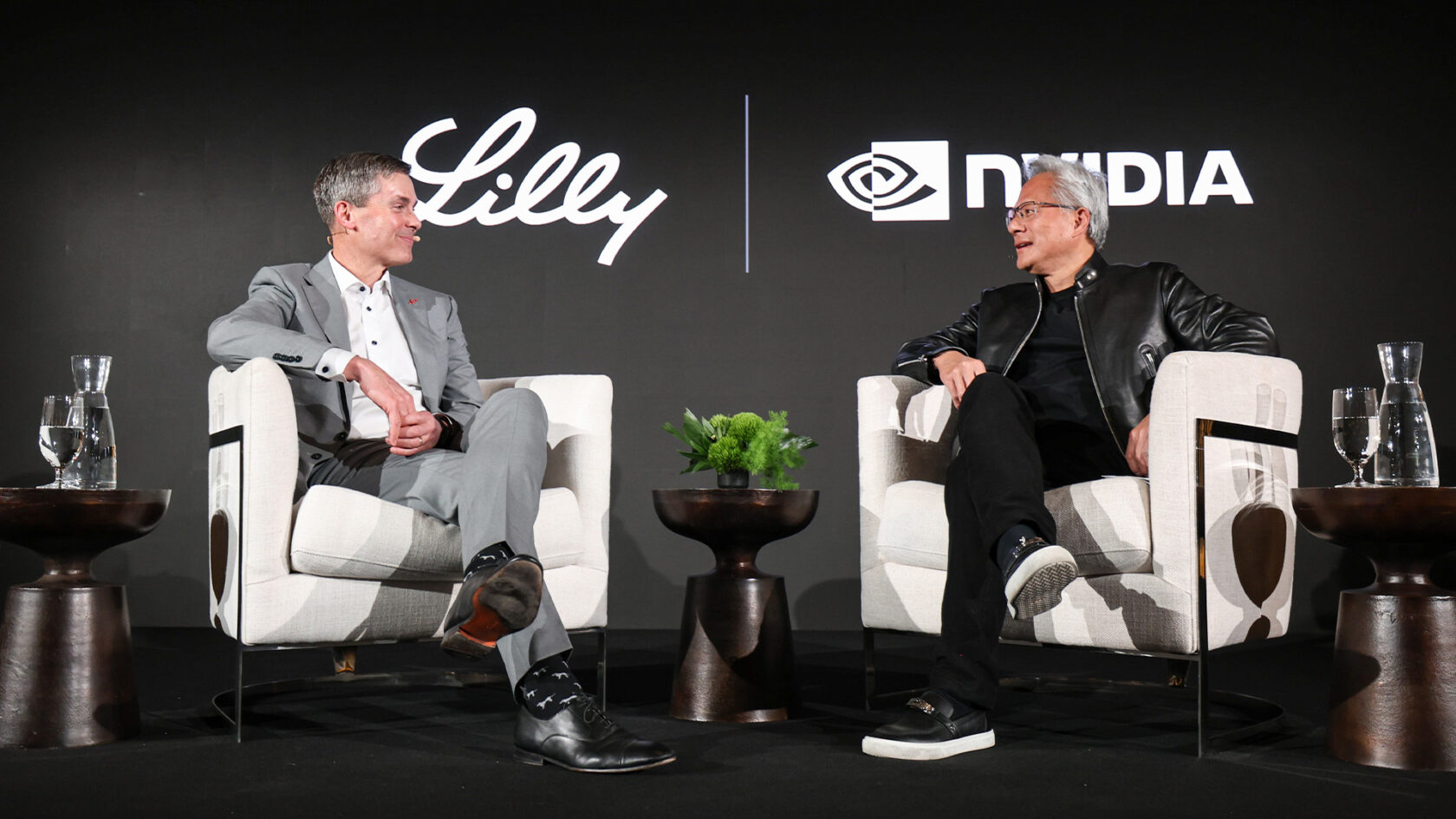
NVIDIA and Lilly are putting together “a blueprint for what is possible in the future of drug discovery,” NVIDIA founder and CEO Jensen Huang told attendees at a fireside chat Monday with Dave Ricks, chair and CEO of Lilly.
The conversation — which took place during the annual J.P. Morgan Healthcare Conference in San Francisco — focused on the announcement of a first-of-its-kind AI co-innovation lab by NVIDIA and Lilly.
“We’re systematically bringing together some of the brightest minds in the field of drug discovery and some of the brightest minds in computer science,” Huang said. “We’re going to have a lab where the expertise and the scale of that lab is sufficient to attract people who really want to do their life’s work at that intersection.”
The initiative will bring together Lilly’s world-leading expertise in the pharmaceutical industry with NVIDIA’s leadership in AI to tackle one of humanity’s greatest challenges: modeling the complexities of biology. The two companies will jointly invest up to $1 billion in talent, infrastructure and compute over five years to support the new lab, which will be based in the San Francisco Bay Area.
During the fireside chat, Ricks reflected on the painstaking work of drug discovery and AI’s potential to transform the cycle of pharmaceutical invention.
“Each small molecule discovery is like a work of art,” he said. “If we can make that an engineering problem, versus this sort of discovery, this artisanal drug-making problem, think of the impact on human life.”
The lab will operate under a scientist-in-the-loop framework, where agentic wet labs are tightly connected to computational dry labs in a continuous learning system. This framework aims to enable experiments, data generation and AI model development to continuously inform and improve one another.
“Machines are made to work day and night to solve this problem,” Ricks said.
By integrating AI into drug discovery, Ricks explained, pharmaceutical researchers can rapidly simulate a massive number of possible molecules, test them at scale in silico and filter out promising candidates. The next challenge is to find more biological targets using AI.
“The holy grail is that you put those two things together, and we can model the whole system at once,” Ricks said.
Huang and Ricks also discussed Lilly’s long history of harnessing computing for pharmaceutical research — and how diseases of the aging brain are the next frontier for drug discovery.
“I can’t imagine a more worthy field to apply computer science to,” Huang said. “Hopefully we can bend the arc of history.”
NVIDIA at J.P. Morgan Healthcare
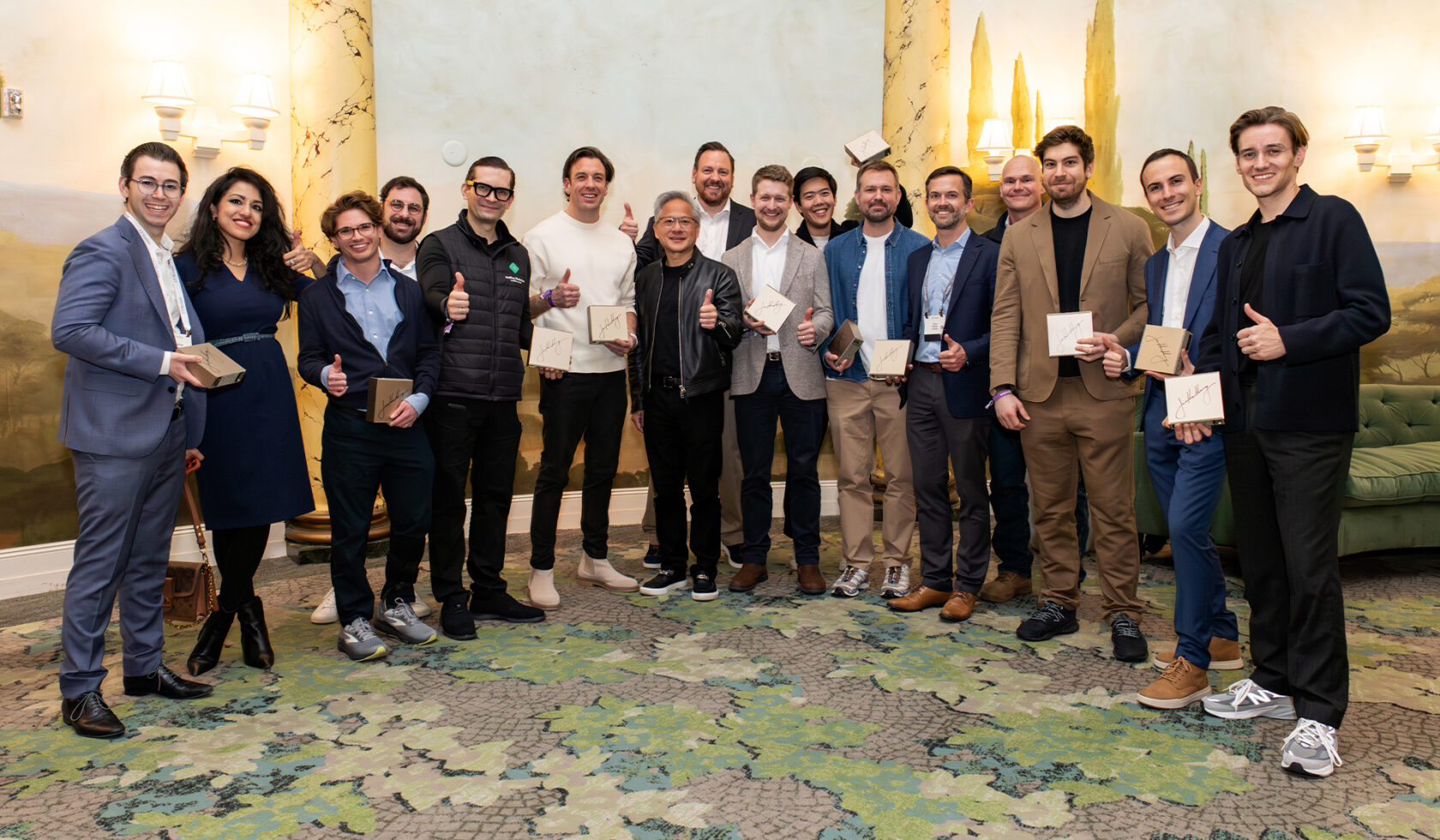
NVIDIA’s full-stack AI platform is accelerating the creation and deployment of leading foundation models across digital biology and drug discovery. To recognize some of the recent advancements, Huang raised a toast at J.P. Morgan Healthcare in honor of about a dozen leaders in the field — and the AI models they’ve pioneered.
“In the last 10 years, we’ve advanced AI 1 million times,” Huang said. “I believe that over the next 10 years, you will enjoy the same adventure that I’ve enjoyed in our generation … and so for each one of you — for your happy new year present and a thank you for everything that you do for the industry and for the future of humanity — I give to you a DGX Spark.”
Over a dozen leaders in AI and drug discovery received NVIDIA DGX Spark systems signed by NVIDIA founder and CEO Jensen Huang at the J.P. Morgan Healthcare Conference.
The honorees included:
Zach Carpenter, CEO of VantAI, developer of the Neo model family for co-folding and design across all biological molecules.
Gabriele Corso, CEO of Boltz, creator of one of the most well-established open-source families of biomolecular models.
Evan Feinberg, CEO of Genesis Molecular AI, which developed Pearl, a protein and small molecule structure prediction model.
Chris Gibson and Najat Khan, chairman and CEO, respectively, of Recursion, which developed the OpenPhenom vision transformer model for microscopy data.
Glen Gowers, CEO of Basecamp Research, creator of EDEN, a biodiversity-scale genome language model family.
Brian Hie, innovation investigator at the Arc Institute, which was a major collaborator in the development of Evo 2, part of the Evo family of DNA language models.
Max Jaderberg, president of Isomorphic, which is extending the capabilities of AlphaFold, the defining family of protein structure and interaction models.
Simon Kohl, CEO of Latent Labs, developer of the Latent-X family of generative models for protein sequence and structure.
Joshua Meier, CEO of Chai Discovery, which developed the Chai family of generative AI models for molecular structure prediction and design.
Tom Miller, cofounder and CEO of Iambic Therapeutics, developer of the NeuralPLexer model family for flexible, accurate and fast structure prediction for proteins and small molecules.
Alex Rives, head of science at Biohub, which created the ESM family of leading protein language models.
Alex Zhavoronkov, CEO of Insilico Medicine, which built Pharma.AI, an integrated model suite spanning target discovery, generative chemistry and clinical prediction.
At J.P. Morgan Healthcare, NVIDIA also announced a major expansion of the NVIDIA BioNeMo platform for AI-driven biology and drug discovery with tools including:
NVIDIA Clara open models for predicting RNA structures and ensuring AI-designed drugs are practical to synthesize.
BioNeMo Recipes to accelerate and scale biological foundation model training, customization and deployment.
BioNeMo data processing libraries such as nvMolKit, a GPU-accelerated cheminformatics tool for molecular design.
J.P. Morgan Healthcare is the world’s largest healthcare investment symposium, attracting over 8,000 global professionals including investors, policymakers and executives from across the healthcare industry.
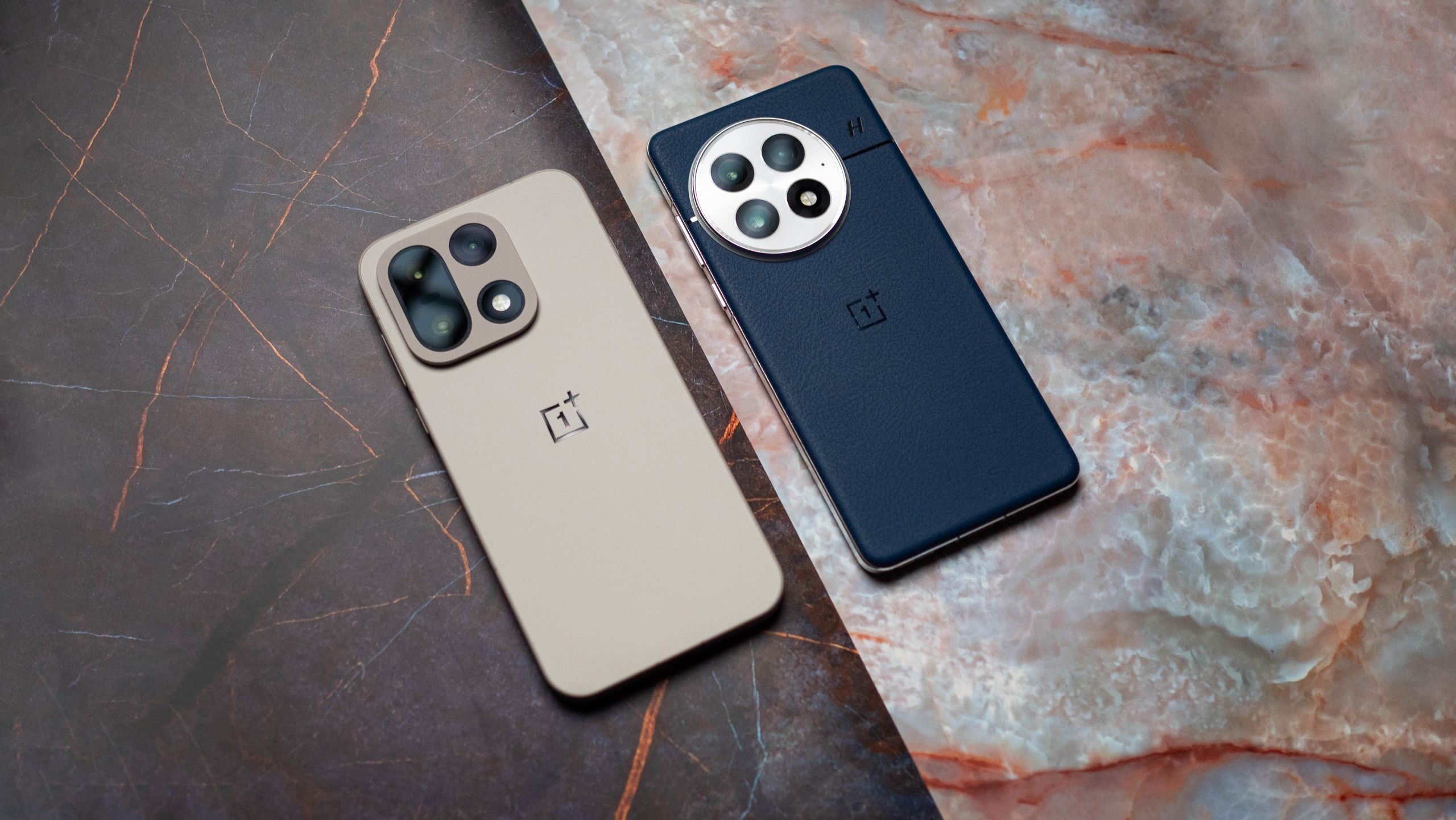
The OnePlus 13 was a standout phone that earned a rare 5/5 review score from Android Central, and delivered more at a lower price point than even the Samsung Galaxy S25 Ultra. OnePlus proceeded to lose its way with the OnePlus 15, leaning too hard into battery life and gaming performance at the expensive of durability. The OnePlus 13 was a well-rounded phone that excelled in performance, display quality, camera hardware, and battery life, but the OnePlus 15 tossed that identity aside.
The OnePlus 15’s specs were perplexing because the OnePlus 13 was already a long-lasting flagship phone. It had a 6,000mAh battery capacity with support for fast charging and a Qualcomm Snapdragon 8 Elite processor. Of course, many of us won’t say no to more battery, but expanding capacity shouldn’t come at the expense of other features. In this case, the OnePlus 15’s gargantuan 7,300mAh battery capacity and gaming focus did come at the expensive of other areas, like display quality and camera performance.
OnePlus might not be learning from its mistake, if this OnePlus 16 rumor is any indication. A post from OnePlus Club on X (formerly Twitter) claims that the OnePlus 15’s successor will sport a next-generation Glacier Battery with an even higher capacity. Specifically, the rumor claims the OnePlus 16 will have a capacity “approaching 9,000mAh.” Details are sparse, and it’s unclear what the exact battery capacity of the OnePlus 16 might be.
OnePlus 16 will be equipped with next-generation Glacier Battery with a capacity approaching 9,000mAh pic.twitter.com/kxq1wpSKx7January 18, 2026
However, if true, the OnePlus 16’s rumored high-capacity battery could spell bad news for the rest of the flagship smartphone.
OnePlus uses a few tricks to cram high-capacity battery cells into relatively small smartphones. The brand employs what it calls a Glacier Battery, which is a high-density, silicon-carbon battery developed in collaboration with CATL, a leading battery manufacturer. This technology helps OnePlus fit large batteries into small packages while managing thermals. OnePlus also splits large overall batteries into smaller dual-cell designs on phones like the OnePlus 15.
But even when using silicon-carbon battery chemistry and Glacier Battery designs, there are limits to how small a smartphone battery can get at high capacities. If the OnePlus 16’s battery capacity will truly approach 9,000mAh in size, it’s reasonable to expect these cells to take up more space inside the phone. It’s possible that OnePlus might have to make similar compromises on the OnePlus 16 to hit this target as it did on the OnePlus 15 this generation.
It’s very early in the OnePlus 16 rumor cycle, and everything is up in the air. Recent leaks have pointed to the OnePlus 16 course-correcting OnePlus’ mistakes with the OnePlus 15. It has already been billed as the most well-rounded OnePlus phone in years. The OnePlus 16’s rumored ~9,000mAh battery capacity could come in natural conflict with that possibility.
Get the latest news from Android Central, your trusted companion in the world of Android
The OnePlus 16 needs more than battery life and performance
To be clear, if the OnePlus 16 offers fast performance, long battery life, stellar camera quality, stylish design, and more, I’ll have little reason to complain. However, that sounds like the perfect smartphone, and devices are never perfect. There are always compromises, like how the OnePlus 15 sacrificed display resolution and camera quality in exchange for better stability while gaming, higher refresh rates, and longer battery life.
The OnePlus 15’s trade-offs were uninspiring for a few reasons. Notably, the OnePlus 15’s hallmark support of 165Hz refresh rates is only available on a few apps. If you don’t happen to use the apps and games that support the ultra-high refresh rates, the OnePlus 15 gives you worse display quality without any of the benefits. The phone also has a tendency to run warm in certain situations, which isn’t ideal for a gaming-focused flagship.
While we’ve tested the OnePlus 15’s cameras to perform well in many cases, it’s hard to justify paying more for less, and that’s what OnePlus is asking customers to do here. The OnePlus 15’s camera hardware is a downgrade compared to the OnePlus 13, and there’s no Hasselblad processing. The OnePlus DetailMax engine is solid, but some OnePlus fans will miss the old style of image processing.
With these shortcomings in mind, it’s very easy to make the case that the OnePlus 13 is a more well-rounded smartphone than the OnePlus 15. It’s proof that battery life isn’t everything. If the OnePlus 16 indeed plans to increase battery capacity by a significant margin yet again, the company must ensure this doesn’t hurt the phone’s overall versatility.
A mixed bag
While the OnePlus 15 is impressive in its gaming performance and long-lasting battery, it’s disappointing in others. Still, it’s easy to appreciate the fast Qualcomm Snapdragon 8 Elite Gen 5 chip and high-capacity battery onboard.
I used to LOVE school as a kid. I came from a broken home and to me, school was FUN, a place to play, to learn, to grow, to be shaped and molded, to test the waters of my personality. As an only child, it was GREAT!
There were certain teachers that really made an impact on my life, two in particular I remember in third and fourth grade and I just loved them. ❤️ I respected them. I wanted to BE like them when I grew up.
The right teacher can really make a massive difference in a child’s life, but that teacher may not ever know it because the child won’t know it until they are grown.
So today, I wanted to honor teachers everywhere, to thank you for all your hard work, your countless hours you pour into your work to help shape the hearts and minds of the little ones in your care; your endeavors are NOT unseen. 💎🥰
Today, we honor you with these super adorable free printable cute school coloring pages (hello school coloring page printable and hello teacher coloring page printable).
Free Printable School Coloring Pages (School Supplies Coloring Page)
Yes! Except for some large binders, all printables on the blog are 100% free for personal use. I make these because I genuinely want you to have something cute and helpful right now without having to spend a dime. You deserve a life that feels more peaceful, more organized, and more you, and if a simple printable can make your day feel lighter, I am so happy to give that to you.
Can I use these printables for my classroom or church group?
Absolutely! You’re welcome to print as many copies as you need for your own students or church groups. I only ask that you do not edit them in any way (leaving the full copyright line in tact) or sell them or host the digital files on other websites. Please always link back to this post to share with others.
What is the best way to print these high-quality printables?
For best results, I recommend printing on 8.5″x11″ white paper. These are professionally designed as high-resolution PDFs so they will stay crisp and clear, making them perfect for any printer.