Jeff Kaplan is tackling the real, gritty questions while showing off his new multiplayer action-survival FPS game The Legend of California. And what is the realest, grittest question an ex-Blizzard dev could answer? No, not that one. It’s actually about Tracer’s butt.
To the few of you who are fortunate enough to not have a clue what I’m talking about right now, look away now and spare what remaining braincells you have left. The size of Tracer’s butt was actually a huge deal 10 years ago, around the release of OG Overwatch.
Overwatch creator Jeff Kaplan confirms Blizzard never nerfed Tracer’s butt, it stayed the sameAnswering the real questions pic.twitter.com/lsifFQUkRpApril 9, 2026
Some players were outraged by the fact that Blizzard seemingly ‘nerfed’ the size of Tracer’s rump. In reality, Team 4 actually just changed one of her poses after a couple of players said it looked a bit weird. That’s it, that’s the whole controversy.
Article continues below
While it’s become something of a joke in the community now, with I hope not a lot of people retaining any genuine anger over the situation, it has plagued Overwatch throughout its entire existence: 10 years later Jeff Kaplan, the ex-director of Overwatch is still being haunted by the question.
But Kaplan has set the record straight (yet again) in a reply: “We actually didn’t nerf Tracer’s butt, it stayed exactly the same.” Before congratulating himself for an excellent reply, “That was a good repost I just had.” Thanks for letting us know Jeff, now get back to having fun riding around in your new Cowboy game.
Some players still aren’t fully convinced that Kaplan is telling the truth, but that’s not really a massive surprise seeing how important butt size continues to be in Overwatch. Just last year a bunch of players got themselves into a bit of a tizzy about Widowmaker’s Cammy skin for this exact reason. What can I say, only three things in life are certain: death, taxes, and people getting upset about butt size in Overwatch.
Keep up to date with the most important stories and the best deals, as picked by the PC Gamer team.
Florida Attorney General James Uthmeier announced on Thursday his office will investigate OpenAI for its alleged harm to minors, potential to threaten national security, and its possible link to a shooting that took place at Florida State University last year.
“ChatGPT may likely have been used to assist the murderer in the recent mass school shooting at Florida State University that tragically took two lives,” Attorney General Uthmeier said in a video posted to social media.
On the day of the FSU shooting last April, the suspect allegedly asked ChatGPT how the country would react to a shooting at FSU, and what time it would be busiest at the FSU student union. These messages could potentially be used as evidence against the suspect in an October trial about the shooting.
The attorney general cited further concerns about ChatGPT’s encouragement of suicide in certain instances, which have been documented in multiple lawsuits brought by families against OpenAI. He also mentioned his concern that the Chinese Communist Party could use OpenAI’s technology against the United States.
“As big tech rolls out these technologies, they should not — they cannot — put our safety and security at risk,” he said. “We support innovation. But that doesn’t give any company the right to endanger our children, facilitate criminal activity, empower America’s enemies, or threaten our national security.”
He also called on the Florida legislature to “work quickly” to protect children from the negative impacts of AI.
“Each week, more than 900 million people use ChatGPT to improve their daily lives through uses such as learning new skills or navigating complex healthcare systems,” an OpenAI spokesperson said in a statement to TechCrunch. “Our ongoing safety work continues to play an important role in delivering these benefits to everyday people, as well as supporting scientific research and discovery.”
Techcrunch event
San Francisco, CA | October 13-15, 2026
OpenAI added that it builds and continues to improve ChatGPT to understand user intent and respond in appropriate, safe ways. The company said it will cooperate with the Florida attorney general’s investigation.
On Wednesday, OpenAI unveiled its Child Safety Blueprint, which includes policy recommendations designed to improve children’s safety as it relates to AI.
This action comes as chatbot makers face pressure to confront their potential role in creating child sexual abuse material (CSAM). According to a recent report from the Internet Watch Foundation, there were over 8,000 reports of AI-generated CSAM in the first half of 2025, which represents a 14% increase year over year.
OpenAI’s blueprint recommends updating legislation to protect against AI-generated abuse material, refining the reporting process to law enforcement, and instituting better preventative safeguards against abusive uses of AI tools.
Software development is a fast-paced process in which developers continuously update code. Quality assurance, however, is generally falling behind. Traditional testing techniques, although useful, can be rigid and time-intensive. In 2026, the landscape is rapidly evolving due to generative AI.
Teams’ approach is being redefined by generative AI in software testing. It involves more than just finishing pre-written scripts. Instead, it introduces intelligent innovation. The system under analysis creates test cases, synthetic data, and automatically adjusts to changes in the code. Teams can now develop tests, detect defects more quickly, fix broken test scripts, or even anticipate potential issues using AI tools. This change is helping organizations transition from flaky to fearless testing, allowing teams to deploy software with greater confidence.
This article will cover how generative AI is rewriting the software testing rules in 2026, from flaky to fearless. So let’s start with an overview of software testing and its evolution.
The Evolution of Software Testing
Software testing was primarily done manually, where testers had to verify and describe each step in depth in their test cases. This strategy is effective, but it raises several issues. Automated testing simplified the process by allowing repetitive tests to be completed considerably faster. Software development organizations had grown, utilizing various automated testing tools to expedite the testing process. However, even this was insufficient; extensive human assistance was necessary, particularly in advanced testing processes.
This is when the intelligent component of generative AI entered the picture, rewriting software testing rules. Based on learnt patterns, it can “develop” entire applications from a predefined dataset. This may now generate and execute complicated or repetitive tests, seamlessly modifying them according to the existing pattern.
Knowing this background makes it clear why generative AI is the best course of action. Generative AI is a result that is self-generative and contextually aware, in contrast to previous iterations that merely received instructions. This will enable autonomous flexibility and reduce the amount of human testers’ effort previously required.
From Flaky to Fearless: How Generative AI is Rewriting the Rules of Software Testing?
Scriptless Test Automation
By employing automation testing tools, this testing method entails assessing software quality without using conventional scripts or code. The most likely use cases for various situations are generated by the tools based on the actions that testers take while going through the application. Scriptless test automation platforms are appropriate for a wide range of projects because they can conduct all kinds of testing, including functional and UI/UX testing.
Smarter Handling of Flaky Tests
The problem of flaky tests can be addressed by generative AI. AI can spot patterns that indicate instability through analyzing past test runs, system logs, and environmental factors. It can also identify flaky tests, identify whether code flaws or environmental problems are the cause of failures, arrange similar failures together for simpler analysis, and recommend solutions to stabilize unstable tests. This shortens the debugging time and boosts trust in automated testing methods.
A Transition to Self-Healing AI Automation Testing Tools
One of the most annoying aspects of the automation process is flaky tests brought on by UI changes. If the developer modifies a button’s ID, a conventional script fails. Generative AI provides self-healing capabilities. Although the “Submit” button is the same functional element, the system detects that its characteristics have changed. The test suite stays positive while the script is immediately updated to interact with the new element.
Generation of Synthetic Data
Testing is often hampered by the lack of high-quality data. The use of production data carries some privacy implications. Generative AI can effortlessly create different datasets. It can generate edge scenarios so that the application can handle unexpected user behavior with ease.
Software testing has been greatly improved by automation. However, with every changing software, traditional automation finds it difficult to maintain accuracy, like when code evolves, tests may become less relevant. Generative AI improves testing using an abundance of data and ongoing learning from new commands and database updates. Because of its flexibility, the AI may adjust test cases as necessary, which could increase development efficiency. The use of human intelligence might further optimize this process and lessen the workload for developers, even if outcomes may differ depending on database training.
Opportunities for Dynamic Testing
A standard environment is used when developing and testing models manually. Depending on how many data sets they employ, this may result in different restrictions. However, generative AI can develop a variety of models that the human brain could never have imagined. When AI lacks sufficient data, it may hallucinate, but even in those situations, it can provide multiple ideas. This thus greatly expands testing opportunities.
Future of Generative AI in Software Testing
Widespread use of Robotic Process Automation
The usage of robotic process automation is one of the major test automation innovations for 2026 that is becoming more prevalent. Software robots, or RPA, can replicate how testers interact with applications. It may mimic the same procedure by learning testing sequences and logging tester actions, saving a ton of time on tedious testing tasks.
Active Use of AI and ML in Software Testing
When addressing the latest trends in automation testing, it is impossible to overlook the impact AI and ML tools are having on the software testing operations. They have become essential for QA teams due to their capability to automate almost every facet of testing automation, including test case generation, execution, and maintenance.
TestMu AI (formerly LambdaTest) is transforming software testing by serving as an agentic AI quality engineering platform that goes beyond simple script execution toward autonomous validation. It reduces maintenance and transforms testing from manual, code-heavy approaches to AI-led, intent-based techniques by enabling natural language test generation, self-healing, and AI-driven intelligence. TestMu AI (formerly LambdaTest) is an AI testing platform to run manual and automated tests at scale. The platform allows performing both real-time and automated testing across more than 3000 environments and real mobile devices.
It offers advanced AI agent testers that can autonomously create test cases, self-heal using its generative AI agent, Kane AI, and offer intelligent, real-time insights. This helps teams release software faster while maintaining reliability and security. The agents facilitate the development of natural language tests, auto-healing of flaky tests, faster execution through HyperExecute, and context-aware, intelligent analysis of application modifications.
The platform also provides failure narratives that reduce maintenance times and improve test stability, rather than only fixing broken UI locators. Through the analysis of logs and traces, the platform’s test intelligence transforms its emphasis from speed to reliability by categorizing issues (bug, environment, or test debt) and predicting flaky tests before they impact CI/CD.
Intelligent Automation of Security Testing Driven by AI
AI is becoming more and more important in threat modeling and vulnerability screening. AI automation tools can discover challenging dependencies, generate adaptive fuzz tests, and spot abnormal patterns faster than manual methods. AI-augmented automation is crucial for proactive defense as cybersecurity risks increase.
Ethical Testing is Regarded as the Future of Testing
Since fair, impartial, and transparent algorithms are required, ethical testing is emerging as a significant testing trend. QA teams can actively find biased tendencies early in the software development cycle as testing for AI-driven systems expands.
More Organizations Will Implement Shift-Left Testing
As teams prioritize early software testing, shift-left testing is becoming more important. This approach facilitates scalable testing and improves cooperation between the development and testing teams. There are some indisputable benefits of involving testers early in the development cycle. Among these, cost reduction is one of the most crucial. Early code verification processes allow teams to find and address issues before they become more serious and require a lot of resources.
The Need for Cross-Browser Testing in the Cloud Is Growing
Cloud-based cross-browser testing stands out among the expanding test automation techniques that organizations have embraced this year. It is now crucial for organizations to extensively test their applications across all devices as the variety of devices grows constantly.
The Use of Exploratory Testing Will Increase
A technique that deviates from strict test cases and scripts is called exploratory testing. Rather, it allows testers to freely explore and test software in an intuitive manner. Because of this randomization, QA teams can detect problems in areas they would not normally search for, as well as unusual uses that have not been specified by scripted testing.
Microservices Testing Rapidly Evolves
Microservices testing has emerged as a result of the popularity of microservices architecture. Instead of testing the complete architecture, this testing strategy aims to evaluate the software as a collection of distinct, small functional components while closely observing the continuous performance.
Integrating Crowdsourced Testing
Crowdsourced testing is frequently used to speed up automation, especially when the organization wants to expand globally. Crowdsourcing’s ability to help organizations overcome resource limitations is its best feature. They do not need to be concerned about the tester’s proficiency with test automation tools. Instead, the time to market is significantly accelerated by allocating assignments based on the tester’s existing resources.
Strategy for Implementing Generative AI for Software Testing
First, clearly define the goals that testers want to accomplish with the Generative AI-based tool, rewriting software testing rules. What they are expecting to gain from using this tool, and why it’s necessary—whether they want to increase issue detection, reduce manual testing, improve test coverage, or achieve a combination of these benefits.
Numerous models and tools incorporate generative AI into conventional workflows. Every tool is diverse, with varying advantages and disadvantages. Testers must assess if it is consistent with the organization’s goals.
Resources with strong processing power are necessary for generative AI. Evaluate the existing configuration to determine if it can meet the needs of the AI.
To work with generative AI, one requires a certain set of skills, which may be obtained through upskilling and training. The foundations of generative AI, working with particular tools and comprehending its procedures, assessing the outcomes, and troubleshooting the problems required for successful application are all covered in basic training.
To assess performance, a continual monitoring procedure is necessary to establish specific objectives, infrastructure, and necessary training. Early problem detection can be achieved by keeping an eye on the critical areas and then the additional phases of the testing process.
Conclusion
To conclude, traditional software testing was slow, fragile, and challenging to maintain. For development teams, flaky tests and ongoing maintenance have been significant challenges. By autonomously creating tests, healing broken scripts, providing accurate data, and predicting potential issues, AI is significantly improving testing effectiveness and rewriting software testing rules. Instead of long hours creating and debugging tests, developers can now concentrate on developing better applications.
A new era of fearless testing can be established by teams releasing software with confidence and embracing their testing techniques. However, it is essential to understand that generative AI does not replace testers; rather, it provides them with powerful tools for working more rapidly and intelligently.
Amid customer dissatisfaction around Broadcom’s VMware takeover, rivals have been trying to lure customers from the leading virtualization firm. One of VMware’s biggest competitors, Nutanix, claims to have swiped tens of thousands of VMware customers.
Speaking at a press briefing at Nutanix’s .NEXT conference in Chicago this week, Nutanix CEO Rajiv Ramaswami said that “about 30,000 customers” have migrated from VMware to the rival platform, pointing to customer disapproval over Broadcom’s VMware strategy, SDxCentral, a London-based IT publication, reported today.
“I think there’s no doubt that the customer sentiment continues to be negative about Broadcom,” Ramaswami said, per SDxCentral.
Broadcom’s strategy has made VMware unaffordable or impractical for most small- to medium-size businesses (SMBs) and narrowed VMware’s focus to enterprise-size customers.
Nutanix hasn’t specified how many of the customers that it got from VMware are SMBs or enterprise-sized; although, adoption is said to be strongest among mid-market customers as Nutanix also tries wooing larger customers, often by starting with partial deployments.
During this week’s press briefing, Ramaswami reportedly said that some of the customers that moved from VMware to Nutanix during the latter’s most recent fiscal quarter represented Nutanix’s “strongest quarterly new logo additions in eight years.”
“Most of the logos came from our typical VMware migrations on to the [hyperconverged infrastructure] platform,” he said.
During the Nutanix conference, Brandon Shaw, Nutanix VP and head of technology services, said that Western Union has been migrating from VMware to Nutanix for six months, The Register reported. The financial services company is moving 900 to 1,200 applications across 3,900 cores.
Shaw said that Western Union has been exploring new IT suppliers to help it become more customer-focused. Despite Broadcom’s history of “decent lines of communication” with Western Union, Shaw said that Western Union had “challenges partnering with them.”
Nowadays, the rights to James Pond are co-owned by Gameware and System 3. The latter company decided to finally trademark the name in the UK last year, filing an application that would cover its use in categories including “Computer and electronic game programs” as well as “Toys, games and playthings” and “Clothing; footwear; headgear; sweatshirts; t-shirts; caps; jackets.”
The owners of the James Bond trademark and copyright, Danjaq LLC, filed an opposition in response. As reported by the World Trademark Review Journal via Time Extension, Danjaq opposed a similar trademark application in 2012—with the European Intellectual Property Office on that occasion, rather than the UK one—and that application ended up being rejected. In the UK, trademarks of parodies aren’t protected as they are under US law, so it seems like a long shot to try for a UK trademark after failing to secure a European one.
Article continues below
Gameware and System 3 are planning to relaunch James Pond with a sequel called James Pond and the Rogue AI. The name’s a bit on the nose given that the series’ original creator, Chris Sorrell, who is not involved, has decried “the fact that they’re promoting it with lazy, AI-generated bull-shit” and said, “I hate almost everything they do with a passion”.
Keep up to date with the most important stories and the best deals, as picked by the PC Gamer team.
Sony‘s acquisition of Bungie in 2022 was one of the most surreal transactions to take place in the games industry in recent years, and the irony of PlayStation buying the company that created the de facto mascot of Xbox isn’t lost on former Xbox executive Ed Fries, who led Microsoft‘s acquisition of Bungie 26 years ago.
Fries, who was VP of game publishing at Microsoft during the original Xbox’s launch, appeared on a recent episode of The Expansion Pass and shared his extremely unique perspective on what it’s like playing Marathon, a first-party PlayStation game developed by Bungie… on his Xbox.
“Bungie, and I’m having so much fun in Marathon, by the way … Bungie, the premier team when I left, I couldn’t imagine that they’d have a fight with the guy who took over for me after I left,” says Fries, seemingly referring to Xbox leadership’s alleged pressure campaign to force Bungie to release Halo 2 before it was ready, something Fries was vocally against. “They ended up leaving, and then they, you know, had funding from [NetEase] for a while, and ultimately got bought by Sony.
Article continues below
Ed Fries on Halo, Bungie & Building Xbox | Xbox 25th Anniversary – YouTube
“To me, it was so weird to launch Marathon and see a PlayStation logo come up, even though I’m playing on my Xbox.”
Fries was instrumental to Xbox buying Bungie back in 2000, and he reiterates this by saying he “made the initial call” and “left the acquisition,” adding that he never would’ve believed Bungie’s trajectory if you explained it to him way back then.
“If you would’ve told me, ‘Oh, Bungie will be part of Sony, you know, 25 years ago, I’d be like ‘What? No, I don’t think so.'”
I’ll be real, if you told 2015 me that 99% of what’s happening in the world today would eventually happen, I would believe almost none of it, and that definitely includes the people who made Halo working for PlayStation. All of the other stuff is a little too depressing to talk about here.
Weekly digests, tales from the communities you love, and more
Welcome to the 1.116 release of Visual Studio Code.
Happy Coding!
April 8, 2026
Add dedicated commands and keybindings to the Agents app to focus the Changes view (), the files tree within the Changes view, and the Chat Customizations view, enabling full keyboard navigation. #308327, #308322, #308265
Add an accessibility help dialog (⌥F1 (Windows Alt+F1, Linux Shift+Alt+F1)) to the Agents app chat input box that displays available commands and keybindings for screen reader users, with an option to control announcement verbosity. #308259
Add support for CSS @import link node_modules resolution, allowing you to Ctrl+click through imports like @import "some-module/style.css" when using bundlers. #295074
April 7, 2026
Add #-triggered file-context completions to the Agents app, scoped to the workspace chosen in the picker. #299057
We really appreciate people trying our new features as soon as they are ready, so check back here often and learn what’s new.
When setting up a new Android phone, you’re often given the choice to use gestures or 3-button navigation, an option you can always change later in the settings. In a recent poll, we asked whether you prefer to use gestures or 3-button navigation on your Android smartphone. Surprisingly, it seems many of you have strong feelings about this, as our poll received over 19,000 responses.
Based on the responses, it seems Android users overwhelmingly favor the 3-button navigation, which received 81% of the votes. As someone who was originally skeptical of gestures but has since fully embraced them, I found this somewhat surprising.
Why people love 3-button navigation
(Image credit: Android Central)
One reader, James, highlights some benefits that come with using 3-button navigation, with a focus on accessibility and clarity:
Article continues below
“Button navigation is *discoverable*. Gesture navigation is not. This is still important to people who aren’t as familiar with Android. This is still important for better accessibility.
Buttons also are clearer when it might not be obvious if your phone considers itself to be in portrait or landscape mode.”
Another reader, Vrijilesh, gives a good reason why they still use 3-button navigation, which boils down to third-party launchers.
I do. Because @Xiaomi @XiaomiIndia @XiaomiHyperOSIN @XiaomiHyperOS_ do not allow gesture navigation with other launchers apart from stock. And I cannot live without my Nova Prime!March 26, 2026
Another reader on X notes that gestures seem to be a mostly iPhone thing and that Android users prefer buttons, a statement that seems to be corroborated by our poll:
Get the latest news from Android Central, your trusted companion in the world of Android
The only people I’ve see doing gestures on a phone are using an iPhone. All the people I know and observed using an Android use 3 button navigation, including me.So no, it isn’t the way to go!Like everything in life, stuff is pushed onto us whether we want it or not!March 23, 2026
Mike Szekely on Facebook makes it clear and simple: “You’ll have to pry buttons out of my cold, dead hands.”
On the other hand, Alexander on Facebook comes to the defense of gestures, saying it’s more accessible than buttons.
“Gesture navigation gives you significantly better control over your device,” Turner comments. “Any part of the left or right hand side of my screen becomes the back button instead of me having to stretch my thumb from whatever current position it’s at to get to the back button.”
Sean also agrees, saying they prefer gesture navigation despite early skepticism.
“Gesture. Didn’t think I’d like it at first, but after a day or two on the pixel 5 at the time, I was hooked. Now button navigation feels completely backwards for me.”
(Image credit: Android Central)
That said, it looks like the masses have spoken: 3-button is the preferred method over gestures. And while both have their advantages, buttons are the more familiar method that consumers are comfortable with. Fortunately, unlike the iPhone, Android users still have a choice when it comes to navigating their phones.
This blog post focuses on new features and improvements. For a comprehensive list, including bug fixes, please see the release notes.
LLM inference at scale typically involves deploying multiple replicas of the same model behind a load balancer. The standard approach treats these replicas as interchangeable and routes requests randomly or round-robin across them.
But LLM inference isn’t stateless. Each replica builds up a KV cache of previously computed attention states. When a request lands on a replica without the relevant context already cached, the model has to recompute everything from scratch. This wastes GPU cycles and increases latency.
The problem becomes visible in three common patterns: shared system prompts (every app has one), RAG pipelines (users query the same knowledge base), and multi-turn conversations (follow-up messages share context). In all three cases, a naive load balancer forces replicas to independently compute the same prefixes, multiplying redundant work by your replica count.
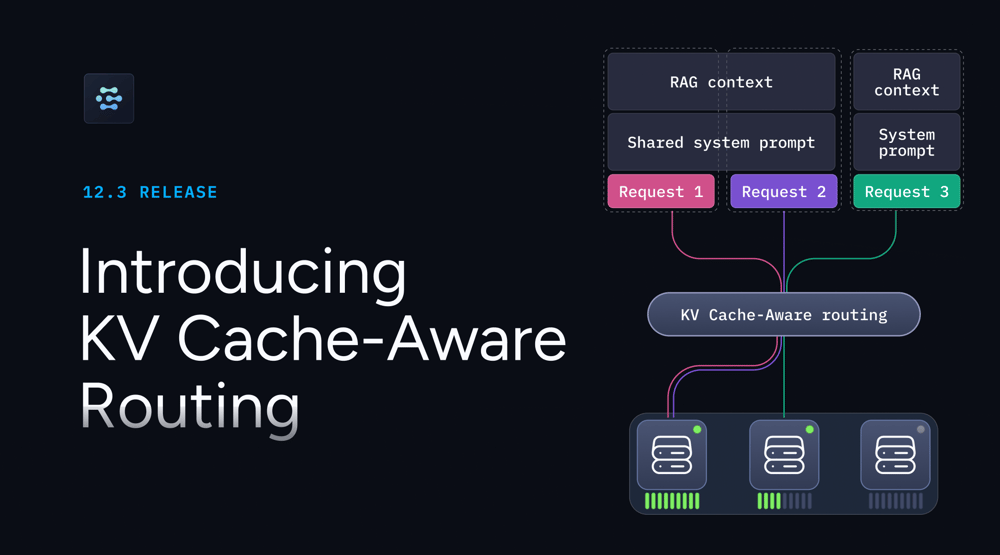
Clarifai 12.3 introduces KV Cache-Aware Routing, which automatically detects prompt overlap across requests and routes them to the replica most likely to already have the relevant context cached. This delivers measurably higher throughput and lower time-to-first-token with zero configuration required.
This release also includes Warm Node Pools for faster scaling and failover, Session-Aware Routing to keep user requests on the same replica, Prediction Caching for identical inputs, and Clarifai Skills for AI coding assistants.
KV Cache-Aware Routing
When you deploy an LLM with multiple replicas, standard load balancing distributes requests evenly across all replicas. This works well for stateless applications, but LLM inference has state: the KV cache.
The KV cache stores previously computed key-value pairs from the attention mechanism. When a new request shares context with a previous request, the model can reuse these cached computations instead of recalculating them. This makes inference faster and more efficient.
But if your load balancer doesn’t account for cache state, requests get scattered randomly across replicas. Each replica ends up recomputing the same context independently, wasting GPU resources.
Three Common Patterns Where This Matters
Shared system prompts are the clearest example. Every application has a system instruction that prefixes user messages. When 100 users hit the same model, a random load balancer scatters them across replicas, forcing each one to independently compute the same system prompt prefix. If you have 5 replicas, you’re computing that system prompt 5 times instead of once.
RAG pipelines amplify the problem. Users querying the same knowledge base get near-identical retrieved-document prefixes injected into their prompts. Without cache-aware routing, this shared context is recomputed on every replica instead of being reused. The overlap can be substantial, especially when multiple users ask related questions within a short time window.
Multi-turn conversations create implicit cache dependencies. Follow-up messages in a conversation share the entire prior context. If the second message lands on a different replica than the first, the full conversation history has to be reprocessed. This gets worse as conversations grow longer.
How Compute Orchestration Solves It
Clarifai Compute Orchestration analyzes incoming requests, detects prompt overlap, and routes them to the replica most likely to already have the relevant KV cache loaded.
The routing layer identifies shared prefixes and directs traffic to replicas where that context is already warm. This happens transparently at the platform level. You don’t configure cache keys, manage sessions, or modify your application code.
The result is measurably higher throughput and lower time-to-first-token. GPU utilization improves because replicas spend less time on redundant computation. Users see faster responses because requests hit replicas that are already warmed up with the relevant context.
This optimization is available automatically on any multi-replica deployment of vLLM or SGLang-backed models. No configuration required. No code changes needed.
Warm Node Pools
GPU cold starts happen when deployments need to scale beyond their current capacity. The typical sequence: provision a cloud node (1-5 minutes), pull the container image, download model weights, load into GPU memory, then serve the first request.
Setting min_replicas ≥ 1 keeps baseline capacity always warm. But when traffic exceeds that baseline or failover happens to a secondary nodepool, you still face infrastructure provisioning delays.
Warm Node Pools keep GPU infrastructure pre-warmed and ready to accept workloads.
How It Works
Popular GPU instance types have nodes standing by, ready to accept workloads without waiting for cloud provider provisioning. When your deployment needs to scale up, the node is already there.
When your primary nodepool approaches capacity, Clarifai automatically begins preparing the next priority nodepool before traffic spills over. By the time overflow happens, the infrastructure is ready.
Warm capacity is held using lightweight placeholder workloads that are instantly evicted when a real model needs the GPU. Your model gets the resources immediately without competing for scheduling.
This eliminates the infrastructure provisioning step (1-5 minutes). Container image pull and model weight loading still happen when a new replica starts, but combined with Clarifai’s pre-built base images and optimized model loading, scaling delays are significantly reduced.
Session-Aware Routing and Prediction Caching
Beyond KV cache affinity, Clarifai 12.3 includes two additional routing optimizations that work together to improve performance.
Session-Aware Routing keeps user requests on the same replica throughout a session. This is particularly useful for conversational applications where follow-up messages from the same user share context. Instead of relying on KV cache affinity to detect overlap, session-aware routing ensures continuity by routing based on user or session identifiers.
This works without any client-side changes. The platform handles session tracking automatically and ensures that requests with the same session ID land on the same replica, preserving KV cache locality.
Prediction Caching stores results for identical input, model, and version combinations. When the exact same request arrives, the cached result is returned immediately without invoking the model.
This is useful for scenarios where multiple users submit identical queries. For example, in a customer support application where users frequently ask the same questions, prediction caching eliminates redundant inference calls entirely.
Both features are enabled automatically. You don’t configure cache policies or manage session state. The routing layer handles this transparently.
Clarifai Skills
We’re releasing Clarifai Skills that turn AI coding assistants like Claude Code into Clarifai platform experts. Instead of explaining APIs from scratch, you describe what you want in plain language and your assistant finds the right skill and gets to work.
Built on the open Agent Skills standard, Clarifai Skills work across 30+ agent platforms including Claude Code, Cursor, GitHub Copilot, and Gemini. Each skill includes detailed reference documentation and working code examples.
Available skills cover the full platform: CLI commands (clarifai-cli), model deployment (clarifai-model-upload), inference (clarifai-inference), MCP server development (clarifai-mcp), deployment lifecycle management (clarifai-deployment-lifecycle), observability (clarifai-observability), and more.
Installation is straightforward:
Once installed, skills activate automatically when your request matches their description. Ask naturally (“Deploy Qwen3-0.6B with vLLM”) and your assistant generates the correct code using Clarifai’s APIs and conventions.
Full documentation, installation instructions, and examples here.
Additional Changes
Python SDK Updates
Model Serving and Deployment
The clarifai model deploy command now includes multi-cloud GPU discovery and a zero-prompt deployment flow. Simplified config.yaml structure for model initialization makes it easier to get started.
clarifai model serve now reuses existing resources when available instead of creating new ones. Served models are private by default. Added --keep flag to preserve the build directory after serving, useful for debugging and inspecting build artifacts.
Local Runner is now public by default. Models launched via the local runner are publicly accessible without manually setting visibility.
Model Runner
Added VLLMOpenAIModelClass parent class with built-in cancellation support and health probes for vLLM-backed models.
Optimized model runner memory and latency. Reduced memory footprint and improved response latency in the model runner. Streamlined overhead in SSE (Server-Sent Events) streaming.
Auto-detect and clamp max_tokens. The runner now automatically detects the backend’s max_seq_len and clamps max_tokens to that value, preventing out-of-range errors.
Bug Fixes
Fixed reasoning model token tracking and streaming in agentic class. Token tracking for reasoning models now correctly accounts for reasoning tokens. Fixed event-loop safety, streaming, and tool call passthrough in the agentic class.
Fixed user/app context conflicts in CLI. Resolved conflicts between user_id and app_id when using named contexts in CLI commands.
Fixed clarifai model init directory handling. The command now correctly updates an existing model directory instead of creating a subdirectory.
Ready to Start Building?
KV Cache-Aware Routing is available now on all multi-replica deployments. Deploy a model with multiple replicas and routing optimizations are enabled automatically. No configuration required.
Install Clarifai Skills to turn Claude Code, Cursor, or any AI coding assistant into a Clarifai platform expert. Read the full installation guide and see the complete release notes for all updates in 12.3.
Sign up to start deploying models with intelligent request routing, or join the community on Discord here if you have any questions.
When launching a new product in the market, it is important to understand how risky itcould get. It is a competitive approach, but it is prone to risks if not handled carefully. Haste and rushing launching are what make it fail. When the production team did not go through the process of validating and testing the product, it fell into a trap, and it may be hard to reverse it now. Launch failures are costly. It costs time, resources, effort, and budget, and weakens client confidence.
To reduce these risks and direct product launch to success, it is best to combine smart research, testing, and repeated cycles of prototyping design engineering services. It is better to invest in validating the product first before releasing it to the public. Cad Crowd makes it possible to connect vetted professionals to businesses that can aid in strengthening all development stages. They are a pool of experts that understands the importance of effective and strategic validation to ensure launch success.
🚀 Table of contents
Why most product launches fail
There are a lot of factors that impact failure in product launch. Most of the failures stem from the idea of an impulsive approach without confirming the demand. When the team only focused on assumptions, trends, internal interest, and excitement, and limited feedback, they were taking a subjective approach. Lack of testing real customer demand puts the product at risk. Not knowing what the consumers really want or what they think could be improved affects the whole outcome. Missteps could cause poor decision-making, letting impulsiveness increase the risks of failure.
Start with a clearly defined problem
Success always starts with identifying the problem first. Being clear about the goal of providing a solution to the problem is the best professional way to achieve success. Product design companies should be able to articulate all the pain points and lesson learnt to come up with the proper solutions. If the problems are too vague, the solution wouldn’t feel intentional and may be prone to overdesign. This will make customers confused and overwhelmed with features they don’t really think are necessary.
Identify a narrow target market
Designing for “everyone” looks like a warm accommodation to encourage everyone to try. But this approach is almost like a trap. It is a vague attempt at trial and error. Instead of being open to all, firms should narrow down and be specific to their target markets. Identify what these target users are looking for and collect relevant insight and feedback. This makes the whole validation measurable and makes the product launching intentional. It gives genuine solutions and makes users think they are considered in the design process.
Conduct structured customer interviews
One way to collect relevant insights is to receive feedback from real customers. Not all conversations or exchanges are considered relevant or useful. Strategic and systematic interviews are best to uncover what the users are expecting and looking forward to. Interviews could be documented to see and monitor patterns and trends, so there would be data to look back on to build an even stronger opportunity.
Analyze existing alternatives
In launching a new product, being prepared is one way to success. This includes knowing any existing alternatives to what the company is planning to launch. This makes them identify and understand competitors. It is expected that there would be comparisons conducted by customers. If a product has already existed and been used, it already has an edge since its functionality has been proven. It already serves its purpose. Then what makes the new one worth a try? Studying the existing alternatives would uncover what the customers want to improve. It could also help with the benchmarking of the costs.
Build a minimum viable concept
Before doing a full-blast development, consumer product design firms should consider that it could fail on the first try. It is best to do an early prototype to test its functionality first without compromising extensive resources. Doing a minimum viable concept would focus on gathering reactions and feedback, as these will expose flaws. Detecting flaws on the early stage would make it easier to fix.
Use landing pages to measure interest
A landing page makes it easier and faster to gauge consumer interest. Once presented to the public, there would be reactions towards it and insights as well. This is where firms would know whether there is hesitation and what rates and features are to be expected. From this stage, refinement could be done before it is produced.
Test with pre-orders or deposits
Pre-order makes the whole launch intentional, offering pre-orders secures not only demand interest but also early funding. This boosts morale in the team and makes it a lot easier to move around. It could also help understand the consumers who committed willingly.
Launch a smoke test campaign
Smoke testing is one way to measure interest based on the clicks and conversion rates. This is done by advertising the product before it fully exists. To know if the public is interested, there would be a lot of engagement. If there is low engagement, then the firms can make adjustments to turn it around. Smoke testing is a cost-effective tool that can protect production from failure.
Leverage surveys strategically
Aside from interviews, surveys add value to what the consumers want. Quantitative feedback supplements behavioral patterns exposed in qualitative research. The surveys should not only ask questions about checking if the user would be interested in buying the product, since it would lead to misleading optimism. Instead, the questions should be able to provide valuable insights about behavioral patterns, which can be useful for many companies, such as fashion design companies.
Prototype early and iterate often
Conducting rapid prototyping accelerates validation. While the users are able to experience the concept, feedback was documented to catch any flaws and readjusted early on. This iteration cycle would lead to a more concrete design tailored to the target audience, making it less likely to receive negative feedback during full release. Early alterations are of much lesser value than making a change on the last design stage. This mitigates risks.
Conduct usability testing
Validation is a combination of demand and usability. Consumers can express demand, but if it’s not user-friendly, it could backfire. Knowing how it functions and how it fits the users would be beneficial and lessen pain points. To check on this, testing regarding the product usability is recommended. This will reveal insights about the product and help the team align the design with user expectations.
Validate pricing early
Pricing influences product value and profitability. There are different thresholds in the market, and observing price points could reveal whether it’s a hit or not. Firms can explore pricing by using a tiered pricing model. Conducting these collects insights whether the product is considered underpriced or overpriced. From this, firms can check the revenue potential of the product.
Evaluate market size realistically
An accurate estimate of the target market size protects long-term viability. Product design experts should be able to assess the realistic number of demand leads. Having an overestimated number would lead to an inflated projection, resulting in an increase in wastage of resources. Being conservative in the number makes it intentional and sustainable.
Measure engagement, not just interest
Anyone can say they are interested, but not all are really committed. There’s a way to gauge the number, and this is by the engagement metrics. It reveals deeper insights and information as it uncovers behaviors. Genuinely curious and committed users would spend a lot of time on the landing page, engaging a lot more, and leaving comments. Those who are passive and do not engage much rarely purchase. Tracking engagements strengthens validation.
Use crowdfunding as validation
Crowdfunding not only serves as a validation tool but also ensures market readiness. Successful campaigns show that the message is delivered clearly and expresses demand. The comments could add information through quantitative feedback.
Users often express their insights and honest feedback on online communities. Sharing early concepts in these forums would earn real-time feedback and comments. Their constructive critiques could expose some blind spots and flaws that may be hard to fix in late design stages. Knowing this strengthens alignment with user needs, which is especially useful for engineering design firms.
Assess technical feasibility alongside demand
Being realistic in design is one way to launch success. To know if the concept will thrive makes the whole production smooth. Early feasibility check-ins avoid unrealistic timelines and could help in finding out cost implications. Technical feasibility can be conducted through a strategic collaboration between designers and engineers.
Set clear validation benchmarks
There should be a measurable criterion to know the metrics of success before validation begins. This helps in analyzing the data and removing ambiguities in decision-making. It is important that there are pre-determined standards to ensure rationality and prevent weak assessments.
Recognize when to pivot
Not all good and unique ideas are meant to thrive and be invested in. When the validation data says that it consistently fails, then it is time to pivot. There could be adjustments to be made to improve the data, and that could involve the target market, features, design, or usability. Resiliency doesn’t always solve the problem; sometimes, flexibility is the answer.
The input sometimes comes from the internal team’s work. They naturally tend to favor ideas that they have invested their time and effort in. This could distort validation interpretation, as the insights could be just internal optimism. This is why a more objective stream of approaches is much more reliable.
Incorporate cross-functional collaboration
Cross-functional collaboration collects diverse perspectives. This exposé overlooked challenges and lets everyone share their input. Being a unified team of engineers, marketers, designers, and even financial analysts could create an impactful view to execute stronger launches.
Document every insight
It is important to take note and document all insights and reviews received to ensure that all these are not lost. Recording the results and outcomes of interviews, iterations build historical data for the product, making it easier to track patterns in the future, and it also strengthens transparency and supports data-driven decision-making for product engineering companies.
Align validation with brand positioning
Not all validation approach is to be done hastily. It still should be aligned with the branding. Being consistent with the brand identity makes validation intentional. It strengthens market trust and enhances long-term success.
Leverage External Expertise
Fresh insights from the external specialists are always welcome. These inputs could sometimes be overlooked and may be a blind spot later on. Having an independent expert to check on the product reduces bias and ambiguity, strengthening validation accuracy and quality.
Validate the core assumption first
Every core assumption made to develop a product should have validation. It justifies the need and strengthens the concepts. Focusing on this core saves time and effort and ensures that there will be no scattered and messy experimentation.
Map the customer journey
Analyzing and understanding how consumers navigate the purchasing process exposes their behavior patterns and adds value to validation opportunities. Mapping their full journey can identify friction points that are beyond the product, which could be critical knowledge for product development experts. These issues are sometimes inevitable, but still, they can be lessened. Validation is a continued stage-by-stage examination and analysis, not only of the product but also of the whole production process.
Create problem-solution fit before product-market fit
Sometimes, firms tend to overlook solutions as they prioritize mass production. Firms should not chase it hastily and focus first on the problem. It is best to address a specific verified pain point, one that is urgent and recurring already, to ensure that customers feel like it fits. Doing this strengthens trust and a stable foundation for future scaling.
Quantify the cost of the problem
Customers are most likely to incline towards the offered solution if the problem is costly. Being costly does not only involve money, but it could also be about time, convenience, or the ease of mind. In validation, assess all the factors affecting the problem and compare them with production and revenue. The data will tell how the product positions itself in the market, whether it can really solve the problem or not. Once products are proven to solve expensive problems, it definitely increases purchase conversions.
Use rapid experiments instead of long development cycles
Doing a lot of rapid experiments looks costly at first, but it helps compress timelines. The small and controlled tests are able to collect insights in a short period of time, enough to adjust exposed flaws before full production. The traditional product development tends to be delayed since it would take months before receiving feedback. Taking controlled, scaled experiments reduces risks for large-scale failure.
Test distribution channels early
A product could interest a lot of users, but it may be difficult to distribute. In validation, testing distribution channels should also be accounted for. This included channels such as paid ads, parentship, or direct outreach. Understanding this during the early stages, with the help of new invention development services, reveals a lot of potential and risks. It gives insights into what an effective marketing strategy is fitted to address it.
Observe real behavior over stated intent
Not all who express the intent of buying are committed. It is still best to observe behavioral patterns to ensure there really is a genuine interest. The evidence could be checked in clicks, downloads, and payments provided. Consistency in all of these validates enthusiasm for the product. It is a measurable approach to know performance and satisfaction instead of relying on survey responses.
Validate retention, not just acquisition
Not all interests last. This meant that acquiring an initial interest meant it could guarantee long-term value. It could be deterred due to dissatisfaction with the product. There should be retention metrics to know whether the product delivers sustainability efficiency. This ensures that the product remains relevant and not just an impulsive decision to feed on initial curiosity.
Assess manufacturing and supply chain risks
Production feasibility should also be checked. This includes how the sourcing of materials is done and knowing the estimated lead times. It gives information about pain points to prevent delays in the timeline. Briefing with suppliers could help expose cost implications and limitations. These could help reduce manufacturing surprises and slips during the production process. Being ready ensures a smooth launch.
Incorporate cost modeling into early testing
Cost modeling should be done to accompany validation experiments. This ensures that the product not only caters to demand in the market but also sustains profitability. Financial modeling protects the product and industrial design firm in long term stability and clarifies viability. It should have data to which it can deliver without compromising the firm’s margins.
Develop clear success metrics
A clear success metric can objectively define benchmarks. Metrics that can help identify success include engagement, retention, and conversion rates. Success in pre-order could also be measured. Establishing these metrics makes it easier to track success. A clear standard removes ambiguities in results interpretation and strengthens decision-making.
Conduct competitive positioning analysis
Knowing where the new product positions itself along with its competitors gives a clear understanding of the product’s selling points and weak points. Spotting this early could help adjust to strengthen its launch success. In validation, rooms for improvement and opportunities can be identified and fixed for customers to recognize value addition, and would make them switch. This strong approach reduces the risks of production failure.
Test messaging with multiple audiences
Testing does not end in engagements. It could be furthered with messaging across varied demographics to refine target markets. Focused messaging improves marketing efficiency and helps with clear reasoning.
Run limited beta programs
Having a beta program is popular to provide structured feedback from real users, even when you begin with open innovation design services. From this, more detailed feedback about the experiences of the beta users helps correct issues before the public release. It uncovers real challenges users can face.
Document objections and concerns
It is inevitable to receive objections and raised concerns during the validation process, and it is important to document all of it as it adds valuable information. These concerns could be about the pricing, usability, reliability, and long-term functionality. When these are documented, patterns can be exposed. Addressing the concerns builds user trust and strengthens the final feature and offer of the product.
Monitor emotional reactions
While there is technicality in feedback, emotional feedback also matters. It is important to take into consideration the feelings of the users. Monitor and track whether they express excitement, frustration, or indifference with the new product. These signals indicate validation, which could have positive or negative implications. Understanding this supports and adds value to quantitative data.
Avoid feature creep during validation
It is important to stay aligned with simplicity instead of adding features midway. It will only complicate testing and may obscure the outcomes. When the process stays at its core and focuses on one hypothesis, it produces clear and coherent insights.
Test scalability assumptions
Knowing the limits of scaling in crisis management. This means that something that worked for 100 users may not be applicable to 100,000. It does not fully mean success even if it did on a small scale. This should be easily identifiable by concept design services. Validation should thoroughly analyze the support, capacity, and production limitations to project a realistic outcome to secure the firm’s reputation.
Evaluate legal and compliance factors
There are products that have to follow strict regulatory compliance. An early review and brief regarding the necessary tests, standards, and certification will avoid extensive rework. Legal validation is then considered, combined with the technical assessments. This ensures being market-ready and proactive in reducing unexpected challenges.
Measure customer acquisition cost
Understanding the cost implications to secure a customer determines long-term sustainability. This means there have to be marketing tests that provide benchmarks to project lifetime value. Knowing margins would help analyze its growth potential. The data could tell whether it’s a success or not or if there’s anything that needs to be focused on. Seeing unfavorable numbers during the early stages could be a cue to revise strategies before production.
Refine based on data, not ego
Validation results encourage data-driven decision-making. It lets the team focus more on the measurable evidence instead of personal preferences. This lessens ambiguity and biased insights. Prioritizing numbers instead of emotional attachment decreases the risk and improves outcomes.
Plan a phased launch
Planning a phased launch with design engineering services is a strategy to control and test a smaller market first before going into full production. This allows additional validation and lessens risks. Gradual and phased launching is more controlled and allows fine-tuning. It strengthens stability.
Encourage honest internal feedback
Although the internal team tends to provide biased insights, it is still a safe space to collect ideas. This can be done by encouraging them to speak up and provide honest feedback. Since they know more about the product, they have the best pool of insights that can be helpful. Having constructive skepticism boosts a healthy culture of open feedback. Diverse perspectives can reduce blind spots and flaws, making it a refined strategy.
Maintain transparent client communication
The client wouldn’t want transparency. Providing and sharing information regarding validation results openly, including challenges and risks, would make them feel involved. An honest and transparent communication lessens conflict and promotes healthy discourse. This communication builds confidence and trust between the client and the team, as the client was assured of the proper professionalism and diligence shown by the team.
Build validation into the standard workflow
Validation shouldn’t just be transitional or a one-time effort. It should be incorporated and integrated into the standard workflow. Having structured testing makes it more reliable and viable. Integrating validation strengthens the firm’s reputation, increasing user and client trust. Having a systematized and reliable workflow process ensures long-term results and outcomes.
Leverage specialized freelance talent
To add value to validation, sometimes a specialized professional isneeded and encouraged to discuss with. There is confidence when a professional is involved, as they contribute their experience to the concept. With them, technical accuracy is achieved, and it improves the overall performance of the product for consumer product design experts. It aligns the product rationally in the market, aligned with the project intent and the firm’s goals.
Strengthen prototyping capabilities
Investing in advanced prototyping makes it easier to attract strong user feedback. Having advanced modeling and visualization tools makes it feel real and clear. A reliable prototype makes it a strong representation. It enhances trust and confidence with the stakeholders. It gives them a clear picture of what was to be expected.
Build long-term learning systems
Every validation effort is a continued documentation of valuable knowledge. It establishes a reliable database on pain points, lessons learned, and opportunities. It gives patterns that can be useful for future production. It encourages data-driven decisions and transforms the workflow to reduce ambiguity.
Conclusion
Innovation should always be backed by numbers and data. It operates in an environment where it should be balanced and done cautiously. Validation secures new product concepts before they are released on a full scale to the public.
Conducting thorough feasibility studies, rapid and controlled experiments, prototype testing, and incorporating measurable criteria significantly lessens financial loss and reputational damage. It also promotes sustainable and intentional production. It strengthens not only its connection with the users but also the client’s interest.
For firms and businesses that seek connection with vetted experts, specialized in product design, modeling, and even rapid prototyping, browsing the Cad crowd is a great start. Check it out now and turn your next product launch into a success, backed with reliable numbers and validation. Ensure confidence in success with Cad Crowd. Request a quote today.
MacKenzie Brown is the founder and CEO of Cad Crowd. With over 18 years of experience in launching and scaling platforms specializing in CAD services, product design, manufacturing, hardware, and software development, MacKenzie is a recognized authority in the engineering industry. Under his leadership, Cad Crowd serves esteemed clients like NASA, JPL, the U.S. Navy, and Fortune 500 companies, empowering innovators with access to high-quality design and engineering talent.