Welcome to Rock Bottom. An incremental mining game about swinging your pickaxe, collecting ores, and going deeper than ever before. Every run makes you stronger. Every upgrade sticks forever. The Incident at Galley House
Swing your pickaxe through procedurally generated caves filled with valuable ores and hidden treasures. Transform raw ore into bars with your smelter Invest your hard-earned resources into a sprawling skill tree of permanent upgrades. From the overgrown Sunken Canopy to the Spore-light canopy and beyond. Each layer brings new challenges and richer rewards.
Screenshots
SystemRequirements
Minimum Requires a 64-bit processor and operating system
OS: Windows 10 64-bit
Processor: Intel Core i3
Memory: 4 GB RAM
Graphics: Nvidia GeForce GTX 550
Storage: 500 MB available space
Support the game developers by purchasing the game on Steam
InstallationGuide
TurnOff Your Antivirus Before Installing Any Game
1 :: Download Game 2 :: Extract Game 3 :: Launch The Game 4 :: Have Fun 🙂
Alright, folks. It’s pop quiz time. I’ll even make it multiple choice.
Q. What do you call the interface item that moves with your mouse and has vertical and horizontal lines with a little box in the middle?
A. Crosshair B. Cursor C. Both D. Neither
The answer, dear reader, is C. Both. Like a few other things in AutoCAD, this element is named differently depending on where you look.
Did you know you could customize it to your personal preference? Like most things in AutoCAD, you absolutely can. Some are more common than others, so I’ll group them that way, as I present them to you (in no particular order, other than the groups).
AutoCAD Crosshair Size
Probably the most common change is the size. This is most easily found in the Display tab of the Options dialog. There, you’ll find a text box and slider to define the size to display as a percentage of the screen size. Notice that here, and in the tooltip, this UI element is called Crosshairs, all while telling us via the tooltip that you’re setting the CURSORSIZE variable. Hmm.
Anyway, by default it is set to 5, or 5% of the screen. Some people like it bigger. You do you. Valid settings go from 1 to 100, with 100 showing the Cursor as full screen.
Next up is the little box in the middle, as I so eloquently described it earlier. This is controlled by the PICKBOX system variable, or you can use the handy slide control as found under the Selection tab of the Options dialog. Its default is 3, and valid settings can be from 0 to 50. When set to zero, selection previewing of objects is not available.
AutoCAD Aperture
Next is Aperture, which isn’t really a visual part of the crosshair, but it does affect how it works. You know that invisible area that defines when AutoCAD detects and locks onto objects when Object Snap (OSNAP) modes are active? Well, that’s the Aperture. The default is 10, which is larger than the Pickbox, so if you change the Pickbox size, I suggest bumping up the Aperture by a similar ratio.
You can set it from a handy slider control in the Drafting tab of the Options dialog. Its system variable name is APERTURE, so you can just type that in also. Valid settings are 1 to 50.
AutoCAD Crosshair Color
Finally, we come to the crosshair’s color. Change it to whatever floats your boat by clicking on the Colors button in the Display tab of the Options dialog. Choose Crosshairs from the elements list and use the color pulldown to suit your current mood, or maybe your favorite sports team. It’s up to you. Or you could be like me, and leave it to its default. It’s your choice.
Uncommon Changes
You know those little glyphs that show up next to your crosshair or pickbox that indicate what editing command you’re using? Those are called Badges, and you can control whether you see them or not. Below is an image showing the Erase badge.
There is no GUI control for these, so you’ll have to remember the system variable, CURSORBADGE. Set it to 1 to turn them off, or leave it at its default value of 2 to turn them on.
This next one flies under the radar, as I’ve never come up with a single good reason to use it, except to prank one of your co-workers (which is not condoned by anyone here at Tuesday Tip HQ).
It’s called CURSORTYPE, and again, it’s nowhere to be found in the GUI, so you’ll have to type it in. If you do, you can set it to 1, which will change the normal AutoCAD crosshair into a Microsoft Windows® mouse pointer. Now you know.
Recall in the opening quiz, I described the cursor/crosshair as being vertical and horizontal lines? Well, they don’t have to be. There are a couple of ways to change that. One is another system variable called SNAPANG, which rotates the crosshair for you to a specified angle. In the image below, I’ve set SNAPANG to 25, which is the angle that the line is drawn. With ORTHO turned on, it’s a great way to draw at the same angle as your objects.
The other rotation mechanism is, of course, the ISODRAFT command. Your easiest method will be to turn it on from the Status Bar. The icon has a menu associated with it, which will allow you to change the drawing plane that you need. Do you like keyboard shortcuts as I do? Use CTRL-E to cycle through Top, Left, or Right planes.
One last thought
Remember that tease about the other function with different names? You probably know it as PUBLISH. Well, as an old sportscaster was fond of saying, “not so fast, my friends.”
If you go to the pulldown menu for the Quick Action Toolbar (QAT), you’ll find one of the possible entries is Batch Plot. You’ll find it named that way in the Plot flyout menu of the Application Menu (the big A in the corner). Go figure…
More Tuesday Tips
Check out our whole Tuesday Tips series for ideas on how to make AutoCAD work for you.
Home to leading manufacturers, robotics pioneers, infrastructure builders and iconic gaming companies, of course, Japan is one of the world’s centers of AI — building across the full stack with NVIDIA technologies. This week NVIDIA and its partners in Japan are showcasing the AI ecosystem’s latest advancements. Check back here for updates.
NVIDIA and SEGA Celebrate 30 Years of Innovation, Bringing ‘VIRTUA FIGHTER CROSSROADS’ and Other Legendary SEGA Games to NVIDIA RTX Spark
NVIDIA and SEGA are celebrating more than three decades of collaboration by bringing VIRTUA FIGHTER CROSSROADS and future SEGA titles to NVIDIA RTX Spark — a new superchip for slim Windows laptops and compact desktop PCs.
This builds on the companies’ long-standing relationship, which began 30 years ago when NVIDIA worked with SEGA on burgeoning graphics technology for arcade systems and gaming consoles — with the NVIDIA NV1 chip powering the first Virtua Fighter title on PC, among the world’s first 3D fighting games.
SEGA will support RTX Spark, giving gamers new ways to experience SEGA’s iconic franchises, including the upcoming VIRTUA FIGHTER CROSSROADS.
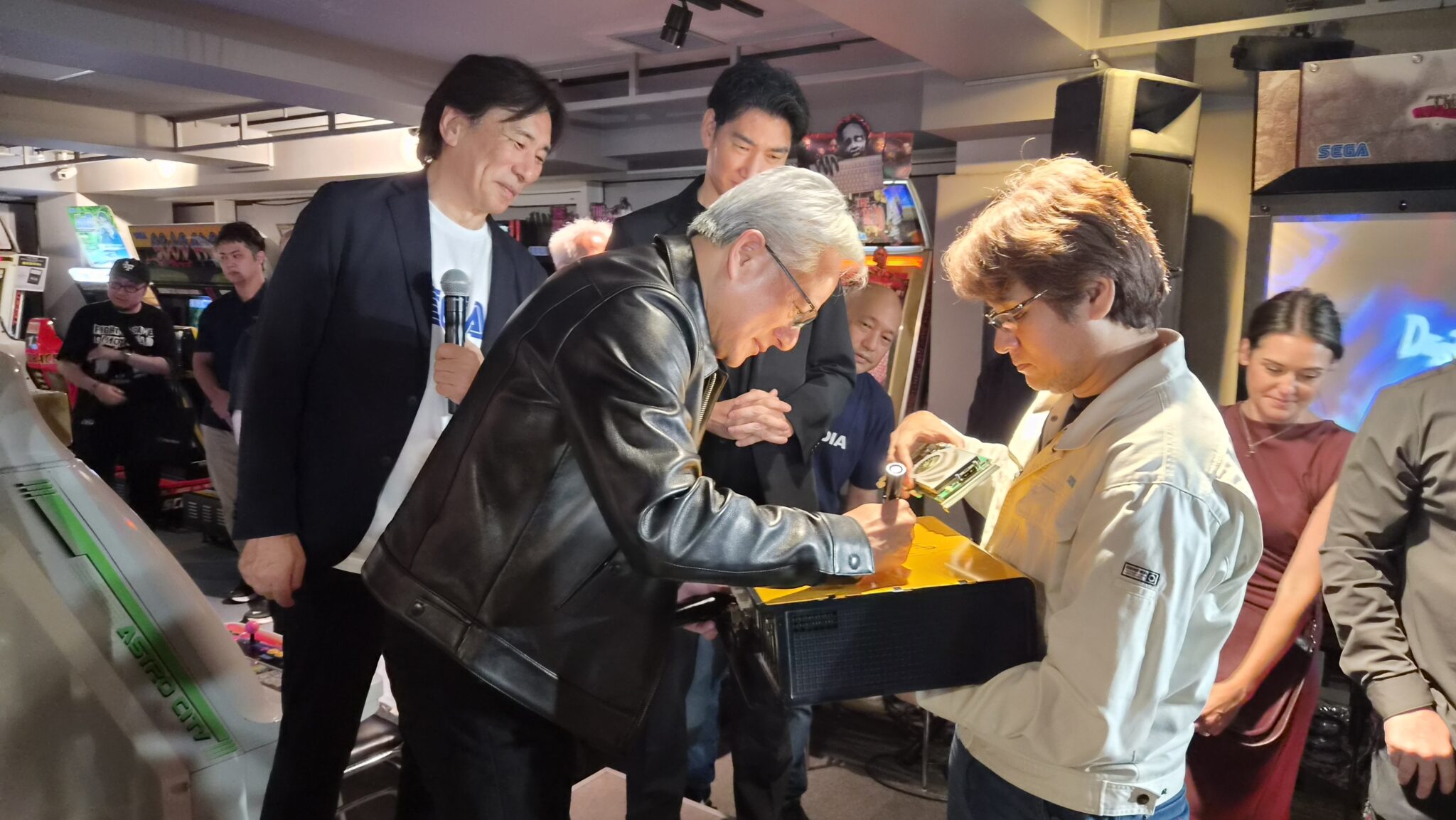
Announced from the heart of Akihabara, a global gaming technology hub, at the original SEGA Akihabara Arcade (now GiGO Akihabara 3), VIRTUA FIGHTER CROSSROADS coming to RTX Spark reinforces the companies’ commitment to innovation and shows a glimpse of the future of gaming on a new era of Windows PCs designed for personal agents, AI, creating and gaming.
NVIDIA founder and CEO Jensen Huang joined SEGA CEO Haruki Satomi; SEGA chief operating officer Shuji Utsumi; Yu Suzuki, creator of Virtua Fighter; and former SEGA President Shoichiro Irimajiri, at the birthplace of countless arcade memories to celebrate the milestone.
They showcased how technology partnerships can evolve across generations of hardware and software, connecting the gaming industry’s heritage with its future.
The expanding NVIDIA RTX Spark ecosystem — including SEGA and other industry leaders — will offer gamers new experiences harnessing NVIDIA ray tracing, DLSS and AI technologies, while preserving and celebrating the iconic franchises they know and love.
You open the model picker, scroll past a dozen options, and pause. How are these models different? Which one should you actually use? And once you’re a few hundred messages deep, how much capacity is even left before things start dropping off?
We’ve all been there. These are the kinds of questions Visual Studio now makes a little easier to answer. Here’s a closer look at how you can see, compare, and get more from the models you already have.
A model picker that works the way you do
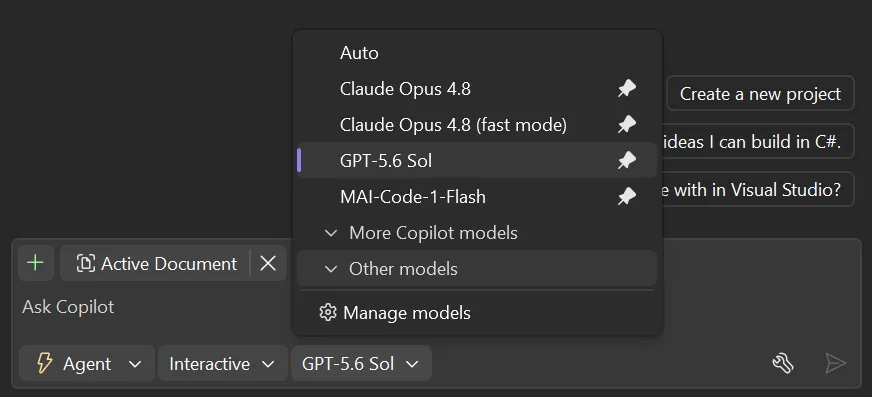
The model picker presents a long list of models you’ve needed to scroll through every single time. Starting in 18.9 Insiders 1, you can better focus on the models you care about most. Pin the models you actually reach for and they stay right at the top. Expand to see the full list, and collapse to hide the ones you never touch to send them out of your way.
What’s left is a short, familiar list that looks like your workflow, not the full catalog. It’s a small change you’ll feel every day.
The full story on every model
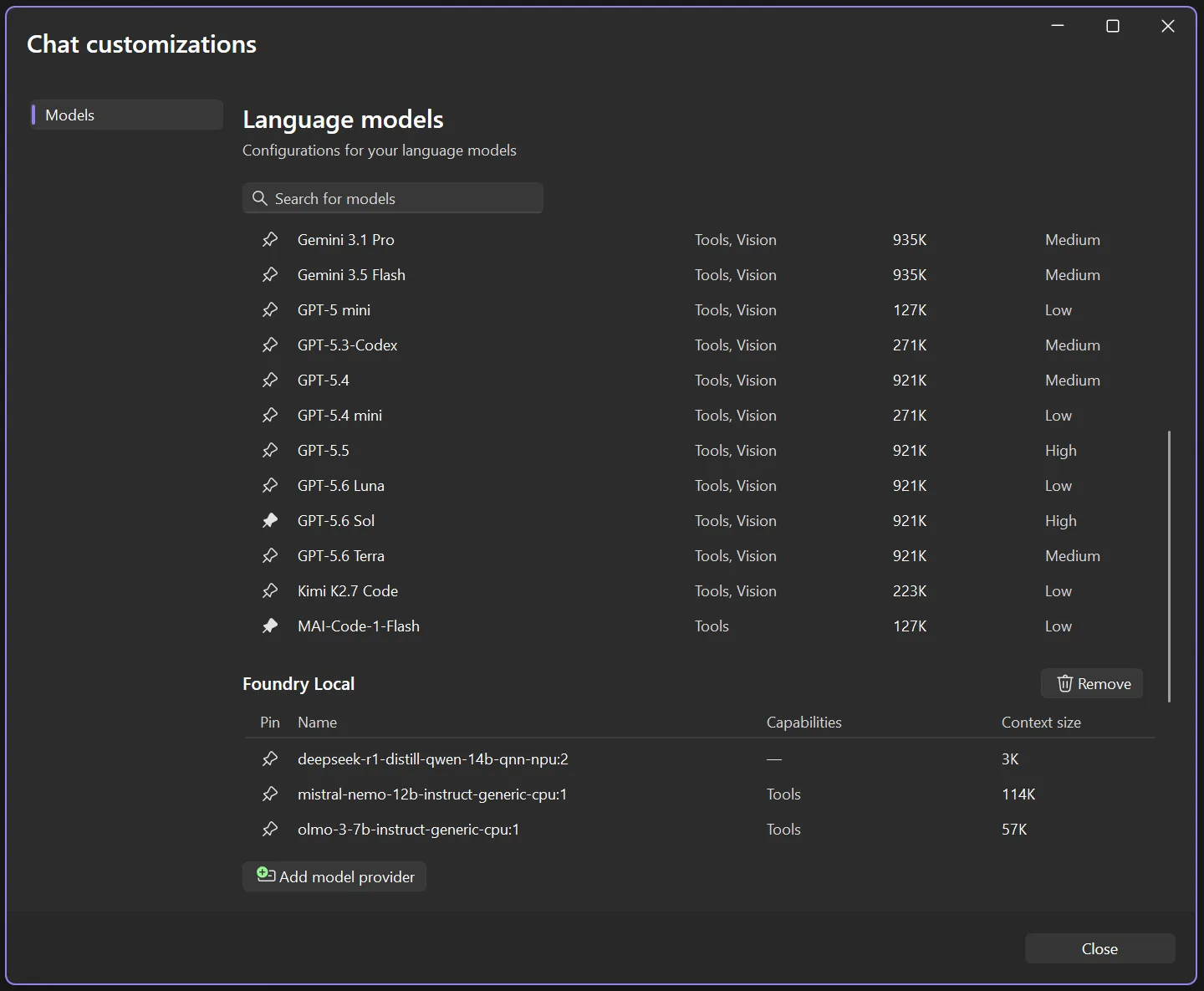
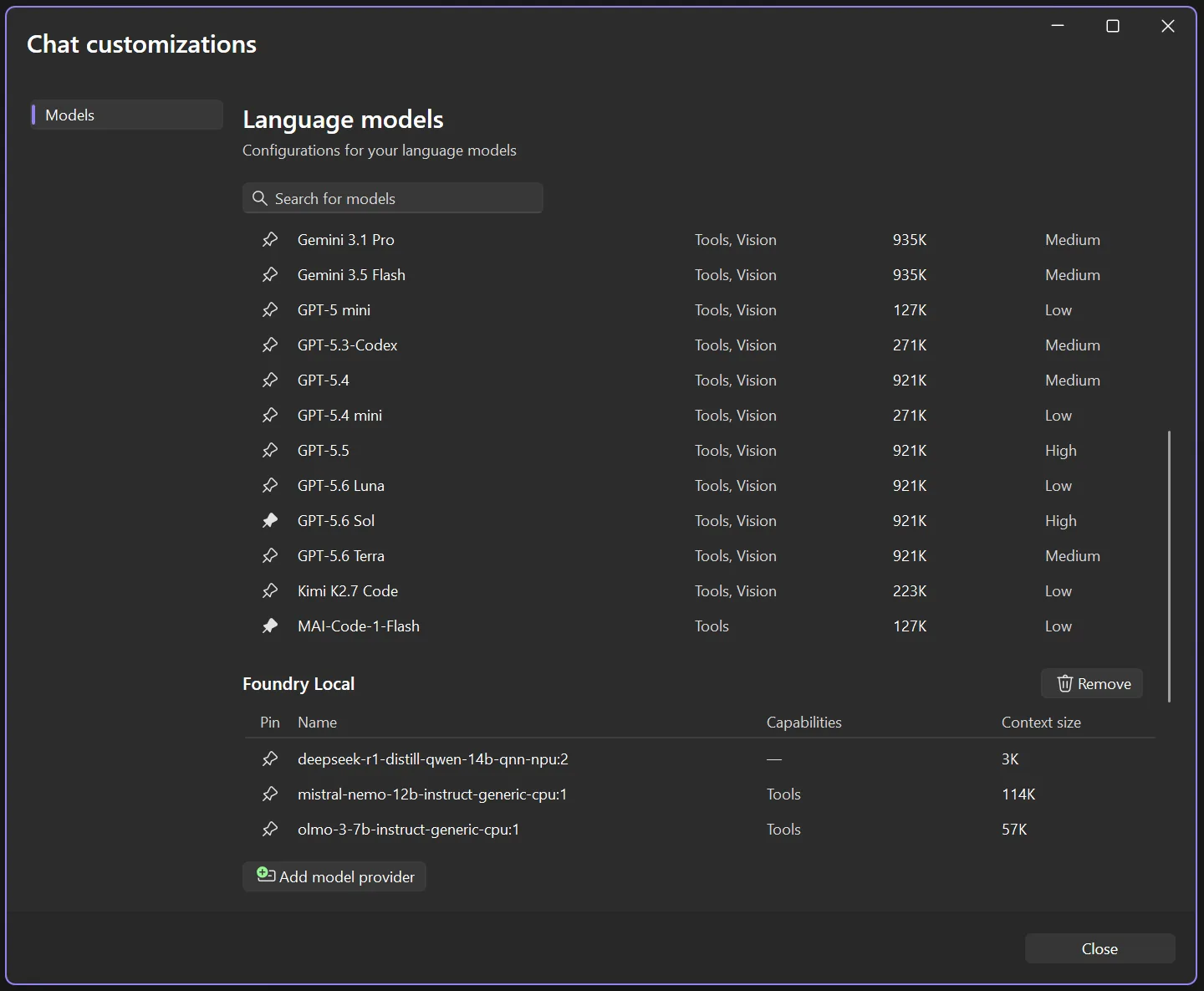
But sometimes the model picker isn’t enough. You might want to take a closer look at the model details, and compare specs. Select Manage models and the new language models view opens up with everything laid out side by side: what each model is capable of, how big its context window is, and what the cost level is. No more guessing whether a model supports vision, or which one gives you the most space to work.
Your own models live here too, right alongside the Copilot lineup. Pin them, review their capabilities, or wire up a new provider, all without leaving the view.
See how much capacity you’ve got left
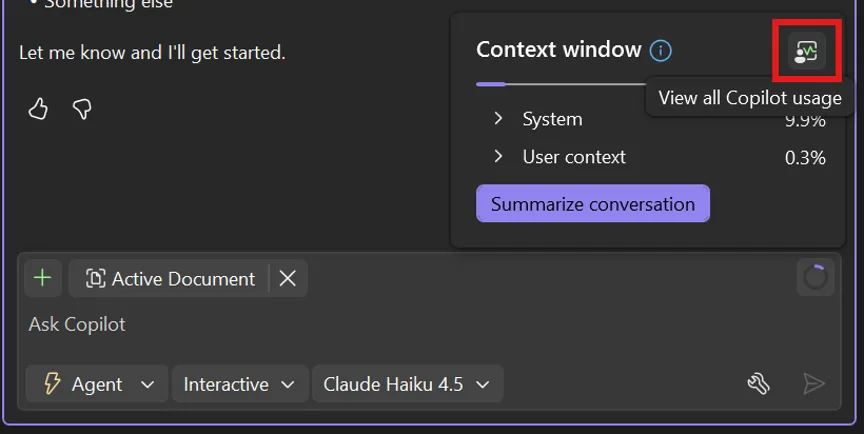
Knowing a model’s context window size is one thing. Knowing how much of it you’ve used is what really matters when a conversation runs long. So as you work, Visual Studio shows you how full your context window is getting, no math required. In 18.6.0 and onward, click the donut chart icon in the upper right corner of your prompt box to see your context window usage for the current thread.
When you’re brushing up against the limit, you’ll see it approach 100% and you can decide when it’s time to summarize the conversation, start a new thread, choose a model with a higher context size, or make any other adjustments.
In 18.9 Insiders 1 onward, you’ll also catch a glimpse of an additional button to open the Copilot Usage window and see your full Copilot plan usage, so nothing sneaks up on you. The Copilot Usage window can also be accessed in earlier versions from the Copilot badge menu dropdown.
Work with more confidence
Picking a model, checking what it can do, keeping tabs on your context window: none of it should slow you down or leave you guessing. These updates are all about giving you a little more clarity in the moments that matter, so you can spend less time wondering and more time building.
And we’re just getting started, so keep an eye out for more updates coming soon!
Give it a try in the latest Visual Studio Insiders and let us know what you think.
It feels like we can’t go more than a few days without hearing about some new problem Pixel phones are having; judging by user reports online, you’d think Google’s hardware is barely functional. But a lot of us use Pixel phones every day without incident, which makes it hard to gauge how widespread issues that crop up in places like Reddit really are.
In a poll running on Android Authority for the past couple of weeks, we asked readers about their experience with Google’s latest Pixel 10 Pro XL. Thousands of people responded — and it turns out that most of them haven’t had any significant problems with the phone. “There’s always background noise with Pixels,” our own Stephen Radochia wrote about his months-long experience using the Pixel 10 Pro XL, “but most of it is overblown.”
As Stephen tells it, though, he hasn’t had any real issues with the 10 Pro XL to speak of. Nearly 6,000 people responded to a survey running in his write-up, with more than 70% saying their experience lines up with Stephen’s: 4,110 respondents indicated that their experience with the Pixel 10 Pro XL has been “excellent.”
That leaves about 29% of respondents that have had real issues with the Pixel 10 Pro XL (the survey response specifically called out overheating, bugs, and poor performance). That’s nearly a third of a fairly large sample size, but it’s still hard to say what 1,700 people indicating they’ve had some combination of issues with a mass-market product really means for average users.
I haven’t used a Pixel 10 Pro XL at all, personally, but I’ve been using a Pixel 9 Pro for almost two years now, and I haven’t had any serious issues with it. I’ve had similar experiences with several prior models, too — but maybe I’m just lucky.
Have you had a good run with Pixel phones? Do you think online discourse over Pixel issues has gotten out of hand? Tell us about it in the comments.
Thank you for being part of our community. Read our Comment Policy before posting.
What am I even on this planet for, really? To play videogames? To partake in an unhealthy diet? To make awkward sexual passes at the consenting partner of my choice? All of the above.
I might as well dig my own grave and climb into it because there’s a robot on the brink of accomplishing all of those important tasks in my place. As a human, I’m officially obsolete because the NEO Home Robot can use an Xbox controller, open a bag of Funyuns, and slowly, awkwardly remove someone’s clothing. Well, I had a good run. Goodbye, everyone.
As you can see in the video, NEO, created by Palo Alto company 1X Technologies, has some pretty finely articulated hands that appear to be capable of (slowly) performing household chores, including:
Latest Videos From
Swirling invisible wine in a glass
Changing a lightbulb before the bulb is inexplicably smashed with a hammer
Daintily picking up a screw
Separating grapes
Lifting a 20 pound weight for less than a second before a suspiciously quick edit
Slowly, creepily, unzipping someone’s hoodie
Connecting non-Lego brand Legos
Using an Xbox controller, sort of
Opening a bag of Funyuns and removing one Funyun while (inexplicably, again) a human attacks it with a hammer
Creepily plugging itself in so it can continue being creepy
A lot to unpack there. First, I can absolutely see the potential of a robot that can perform basic household chores, pick things up, and yes, even remove articles of clothing: for an elderly person or someone with a disability (who is also fabulously wealthy because these robots cost $20,000 or a require a $500 monthly subscription fee), a helper bot could be life-changing.
But this little robot is just… weird. Red flag number one: anyone, human or otherwise, that wears a white sweater with white gloves as it putters around the house is a serial killer. That’s just science. NEO’s face, which can be glimpsed briefly staring down at the lightbulb it just switched on, is also startling: pitch black eyes on an otherwise featureless head. Can’t you imagine it bludgeoning you with that 20 pound weight while it silently tilts its head to one side, its button eyes wide and unblinking, as if attempting to comprehend death?
(Image credit: 1X Technologies)
The video itself is weird. Why is NEO attacked with a hammer, twice? Wouldn’t zipping up the hoodie be a far less creepy demonstration of its skills than slowly unzipping it? And I can’t quite see the point of teaching NEO to use the Xbox controller. Are we so advanced we’re outsourcing not just our chores but our hobbies to robots?
There is one bit of good news that may stave off my obsolescence for a year or so: I did a bit of digging into NEO and it appears that at the moment, most of its actions are accomplished not autonomously but via a human pilot operating it remotely with VR gear, as seen in this Wall Street Journal video.
Keep up to date with the most important stories and the best deals, as picked by the PC Gamer team.
Knowing there’s a person slowly performing all those tasks behind the scenes sort of doubles the creepiness of the already creepy robot. Not only is NEO staring at you with its dead black eyes, there are living eyes behind those eyes—probably some 19-year-old intern in Palo Alto—peering at you as you issue commands like “distribute Funyuns” and “slowly undress me.”
So, the $20,000 robot that will replace me requires a whole other person to run the robot replacing me. Makes more sense to just keep me around, doesn’t it? I’m much cheaper: the only subscription I require is a month of HBO a couple times a year.
As cloud-native CAD adoption continues to grow, Onshape users are increasingly looking for modern alternatives to AutoCAD for their DWG editing and drafting needs. To fill this need, more and more engineers are choosing ARES CAD software from Graebert.
But when evaluating ARES as an AutoCAD replacement, Onshape users may encounter a few common misconceptions. This article explains the differences between ARES Kudo, ARES Commander, and Onshape Drawings, and helps you determine which solution is the best fit for your workflow.
How Onshape Users Benefit from a Professional DWG CAD Solution Like ARES
Onshape includes the Onshape Drawings module, which is powered by ARES Kudo technology. This sometimes leads users to assume that ARES products are simply an extension of Onshape Drawings — but they are not. Let’s take a look at the fundamental differences.
The primary purpose of Onshape Drawings is to create and annotate 2D views that remain linked to the 3D Onshape model. When the model changes, the drawings created from it can be updated automatically. ARES products serve a different purpose: they provide full DWG editing capabilities.
When working in ARES, you can edit native DWG files with a complete set of CAD drafting tools. However, the DWG file is independent from the Onshape model. Unlike in Onshape Drawings, there is no automatic association between a DWG file in ARES and the original Onshape design.
This distinction is important, because some users expect drawings in ARES to maintain a live connection to the Onshape model. In reality, you gain the power of professional DWG editing tools, but work outside of Onshape’s associative drawing environment.
ARES Kudo: The Natural Choice for Browser-Based Users
For many Onshape users, ARES Kudo is the first ARES product they discover, because it is available directly through the Onshape App Store. ARES Kudo is a cloud-based DWG editor that runs entirely in a web browser, making it a natural fit for engineers and designers who already work primarily in Onshape. If your DWG editing needs are only moderately frequent and you prefer a fully browser-based workflow, ARES Kudo may be all you need.
Many users choose ARES Kudo because it offers:
Professional DWG editing directly in the browser
No software installation
Integration with many cloud storage platforms
Familiar workflows for users already accustomed to cloud-native applications.
For users who frequently work outside the office environment, Graebert also offers ARES Kudo Professional, which includes ARES Touch for smartphones and tablets. While ARES Kudo can be accessed from a mobile browser, it is not tailored for use on small screens. ARES Touch is custom-built for use on iOS and Android devices, and it provides several advantages:
Native mobile application experience
Optimized touch interface
Online and offline access
Better performance on tablets and smartphones.
The Full AutoCAD Alternative for Onshape Users: ARES Commander
One of the biggest misconceptions among Onshape users is that ARES Kudo is always the best replacement for AutoCAD. For many AutoCAD users, especially those working with the full version of AutoCAD, ARES Commander is actually the better choice — and it costs only a little more than ARES Kudo.
ARES Kudo offers functionality comparable to AutoCAD LT. It is intended for general DWG editing and drafting. ARES Commander, on the other hand, is a desktop application designed for professional CAD users who need:
Advanced 2D drafting capabilities
Better performance on large and complex drawings
Enhanced customization options
3D solid modeling
STEP import and export
Professional CAD productivity tools.
For organizations replacing the full version of AutoCAD, ARES Commander provides a smoother transition than ARES Kudo, because its feature set is much closer to what experienced AutoCAD users expect.
In addition to a familiar interface, native DWG compatibility, and the professional tools that CAD teams require, ARES Commander offers another important benefit: It remains significantly more affordable than AutoCAD.
Importing Onshape STEP Files into ARES Commander
Another powerful advantage of ARES Commander is its support for STEP files and 3D solids. An Onshape model can be exported as a STEP file and imported into ARES Commander, where it becomes a 3D solid model.
This enables workflows such as:
Creating section views
Generating detailed manufacturing drawings
Producing flattened views
Preparing documentation based on imported geometry.
However, it’s important to understand that the model in ARES Commander is not linked to the original model in Onshape. Any changes made in Onshape would require a new export and import process.
Recommended Videos for More Information:
How to Work with DWG Files Stored in Onshape Using ARES?
Both ARES Kudo and ARES Commander can work with DWG files stored in Onshape. ARES Commander includes a Cloud Storage palette that allows users to connect directly to supported cloud platforms, browse project files, and work on local cached copies while maintaining synchronization with the cloud source. When connected to Onshape storage, users can open, edit, and save DWG files while keeping them stored within the Onshape environment.
However, there is one important requirement that organizations may overlook when planning their deployment: To access and edit DWG files stored in Onshape, the ARES user must also have an Onshape subscription.
This works perfectly when the same person uses both Onshape and ARES. For example:
Mechanical engineers design parts in Onshape
The same engineers create or edit DWG files in ARES.
In this scenario, integration is seamless. However, many companies have separate teams for these parts of the workflow. For example:
Product designers working in Onshape, and
Drafters working in AutoCAD (or ARES).
If the drafting team only needs access to DWG files and does not use Onshape for design work, purchasing an Onshape subscription for every DWG editor may not be cost-effective.
Using Shared Cloud Storage for DWG Collaboration Between ARES and Onshape Using Shared Cloud Storage for DWG Collaboration Between ARES and Onshape
For teams that allocate design and drafting responsibilities to different users, a more practical workflow is often to use cloud storage as the collaboration hub. ARES products integrate with major cloud platforms including:
Microsoft OneDrive
Microsoft SharePoint
Google Drive
Dropbox
Box
In this workflow:
The CAD team creates and edits DWG files using ARES.
Files are managed through shared cloud storage.
Whenever a design reaches an approved milestone, an Onshape user uploads the validated DWG version into Onshape as part of the official project documentation.
This approach helps companies save money by avoiding unnecessary Onshape subscriptions, while maintaining collaboration between design and drafting teams.
Comparing ARES Kudo and ARES Commander: Which is Best for Onshape Users?
For most Onshape users evaluating an AutoCAD replacement, the decision comes down to how the alternative solutions work.
Choose ARES Kudo if:
You prefer a browser-based workflow.
You need DWG editing capabilities occasionally.
Your drafting requirements are similar to AutoCAD LT.
You want to stay entirely in the cloud.
Choose ARES Commander if:
You are replacing the full version of AutoCAD.
You need DWG editing capabilities frequently.
You work with large or complex drawings.
You need advanced CAD features.
You require STEP import/export and 3D solid modeling.
You want the smoothest transition from AutoCAD.
Replace AutoCAD in Your Onshape Workflow with ARES
As engineering teams move toward cloud-native design platforms like Onshape, they also need modern DWG tools that fit into these workflows.
Whether you choose ARES Kudo for browser-based drafting that replaces AutoCAD LT, or ARES Commander as a full AutoCAD replacement, rest assured that both solutions provide professional CAD capabilities and native DWG compatibility — while offering significantly more flexibility and value for modern CAD teams.
It’s an unfortunate rite of passage nowadays for popular indie games to have their concept taken from them by ripoffs that are devoid of any real creativity. The latest casualty? Meccha Chameleon, which has now been pilferred by copycats across Steam, Fortnite, and Roblox.
The most egregious example, and the one that brought this to my attention (thanks GamesRadar), is Scribble Hunt, a game where you “paint the bunny man—a hide-and-seek where you blend in like a chameleon”—very subtle.
Image 1 of 2
(Image credit: Scribble Bunny)
(Image credit: lemorion_1224)
It’s the same as Meccha Chameleon (but worse) in almost every way. You can hide in different poses and try to paint over your character as best you can to blend into the background. Meanwhile hunters with paint guns will try to find the hiders by shooting around at suspicious objects. Even the UI looks almost identical to Meccha Chameleon’s, which is annoying because that’s the only part I find slightly lacking in the OG game—but it’s unlike any of these games to actually improve on the original concept.
Latest Videos From
The only real difference is the maps, which still look quite similar, and the models that have bunny ears instead of being plain clay figures. To top it all off, Scribble Bunny has an AI disclosure on its Steam page, which makes sense considering Meccha Chameleon came out barely a month ago, so Scribble Bunny has had a pretty tight turnaround.
But this isn’t the only example of a Meccha Chameleon ripoff. There’s Chameleon Hide and Seek in Fortnite and a slew of copycats in Roblox (the usual suspect) which include classics like Paint to Survive, Paint and Seek, Paint or DIE, and my personal favourite Paint or Oof.
We’ve seen the same thing happen to other popular indie games like REPO, which had a ripoff turn up on the Nintendo eShop, and Peak, with the devs going as far as to announce that they’d rather players pirate their game than play a “microtransaction Roblox slop ripoff”. With it being increasingly hard for games to break through the white noise that is Steam, hit games are like gold dust to those who want to capitalise on it and make a quick buck. So, as always, I’d recommend checking out the real deal and joining the other 15 million people who’ve enjoyed Meccha Chameleon.
Keep up to date with the most important stories and the best deals, as picked by the PC Gamer team.
Miles Wang, an OpenAI researcher whose work includes using AI to accelerate scientific and biological discovery, is leaving the ChatGPT maker to launch a new startup focused on developing AI models for drug discovery, according to four people with knowledge of his plans. Several other OpenAI researchers are expected to join the new company.
Wang is in talks to raise about $200 million at a $2 billion valuation, two of the people said. Lightspeed is in discussions to lead the funding round, according to sources. Talks are ongoing, the deal may not be final and details could change.
Wang disputed the story’s funding figures and description of the company but did not specify the correct numbers or details. Lightspeed didn’t respond to a request for comment.
The funding discussions point to investor interest in applying AI to make breakthroughs in life sciences. Chai Discovery, a two-year-old startup developing AI models that can predict molecular interactions to identify new drugs, announced on Tuesday that it raised $400 million at a $3.8 billion valuation. (Co-founder Josh Meier also passed through OpenAI as a researcher.) Meanwhile, Google DeepMind spinout Isomorphic Labs, which also develops AI models for drug discovery, raised a $2.1 billion Series B in May.
Wang’s new startup may be working on AI models that will help find new uses for existing drugs and possibly those that previously failed in trials, a couple of sources told TechCrunch. Finding new uses for FDA-approved drugs can result in significantly faster time to revenue than developing new drugs from scratch, as these medicines have already been tested for safety.
Wang joined OpenAI in 2024 after dropping out from Harvard, where he was working on a bachelor’s degree in computer science. (In recent years, investors are once again comfortable betting on young founders who haven’t completed college.)
At OpenAI, he co-authored research papers, including evaluating how AI models can automate and accelerate scientific discovery.
When you purchase through links in our articles, we may earn a small commission. This doesn’t affect our editorial independence.
Satoru Iwata was already a legend in the gaming community while he served as Nintendo president, and that legacy has only grown since his untimely death in 2015. He led the company through the highs of the Wii and DS era, but it’s his actions through the financial lows of the Wii U and 3DS generation that are perhaps best remembered these days. Game developers are now subjected to the constant threat of mass layoffs at major publishers, but Iwata took a different approach.
Iwata famously slashed his own salary by 50% in 2011, in response to poor financial results following the launch of the 3DS. Other executives at Nintendo took smaller pay cuts as well, but the company did not lay off employees even during a period of three back-to-back years of operating losses as both the 3DS and Wii U failed to gain ground.
In 2013, an investor asked Iwata why Nintendo was not restructuring in the wake of those poor financial results. “If we reduce the number of employees for better short-term financial results,” Iwata argued, “employee morale will decrease, and I sincerely doubt employees who fear that they may be laid off will be able to develop software titles that could impress people around the world.”
Latest Videos From
You may have seen that quote being resurfaced back in 2024, when mass layoffs were happening across the game industry, and it’s sadly still relevant now, because those layoffs have never really stopped.
“Some employers publicize their restructuring plan to improve their financial performance by letting a number of their employees go,” Iwata said in 2013, “but at Nintendo, employees make valuable contributions in their respective fields, so I believe that laying off a group of employees will not help to strengthen Nintendo’s business in the long run. Our current policy is to achieve favorable results by continuously cutting unnecessary expenses and increasing business efficiency.”
That policy doesn’t really seem to have changed since Iwata’s death, though there are caveats to keep in mind. Most notable is that Japanese labor laws make it much harder for employers to simply cut their workers, as compared with the at-will employment regulations in the US and some other Western countries.
I don’t want to put Nintendo on a pedestal here – the company certainly has other issues beyond its unwillingness (or inability) to lay off employees – but Iwata’s recognition of the human cost to the developers left behind when layoffs strike remains remarkable, especially as we continue to see devs cut by the hundreds and the thousands at publishers like Sony and Microsoft.
Weekly digests, tales from the communities you love, and more