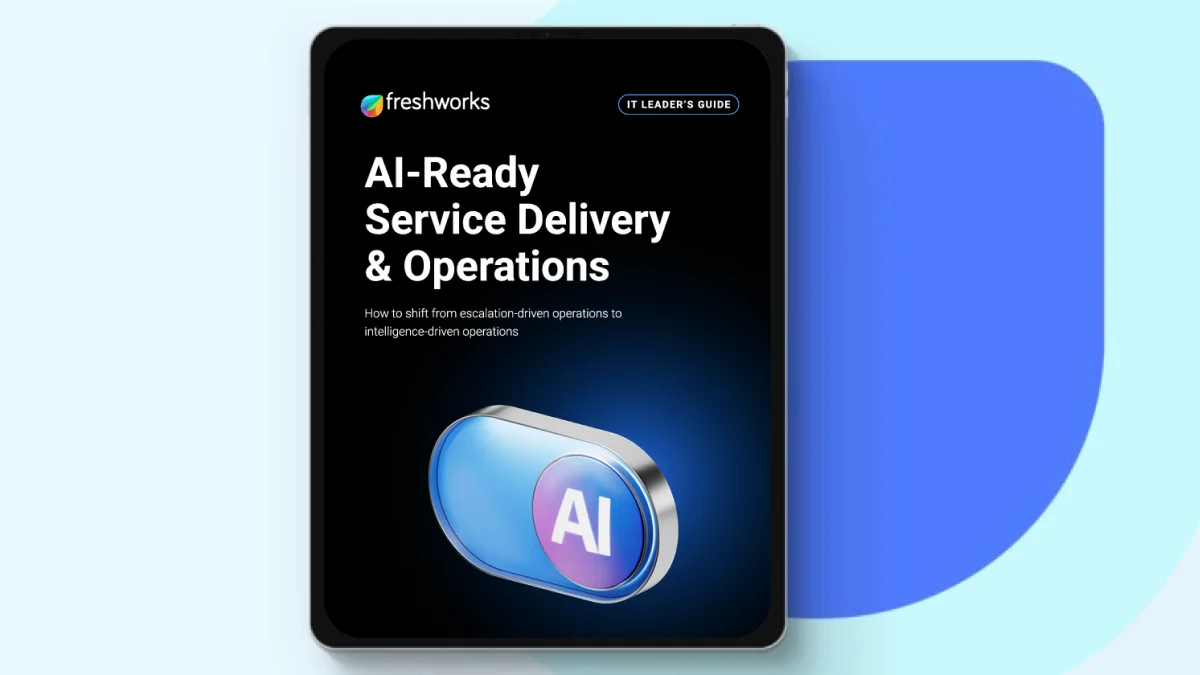
The IT Leader’s Guide to AI-Ready Service Delivery & Operations


freshworks logo

The IT Leader’s Guide to AI-
Ready Service Delivery &
Operations

How to shift from escalation-driven operations to intelligence-driven operations

Most organizations are adopting AI on a foundation that wasn’t built to support it. As hybrid infrastructure and service volume grow faster than teams can manage manually, IT leaders must shift from escalation-driven to intelligence-driven operations. This guide provides the five stages to building an AI-ready service model that drives faster resolutions and delights employees.

In this guide, you will learn how to:

  • Identify the Hidden Costs: Understand the price of disconnected service and operations in the AI era.
  • Follow the 5-Stage Roadmap: Move from Stage 1 (Building the Foundation) to Stage 5 (Leading the Business).
  • Break the Silos: Learn how to bridge the gap between service and operations to get ahead of failure.
  • Amplify Your Team: Use native AI copilots and agents to supercharge operational efficiency and drive bottom-line savings.
  • Delight Your Employees: Transition to people-first AI software that delivers exceptional service experiences.

Download the Guide

Download the Guide

Error: Contact form not found.

fershworks

About Freshworks Inc.

Freshworks Inc. (NASDAQ: FRSH) creates AI-boosted business software anyone can use. Purpose-built for IT, customer support, and sales and marketing teams, our products are designed to let everyone work more efficiently and deliver more value for immediate business impact. Headquartered in San Mateo, California, Freshworks operates around the world to serve more than 67,000 customers, including American Express, Blue Nile, Bridgestone, Databricks, Fila, Klarna, and OfficeMax. For the freshest company news, visit www.freshworks.com and follow us on Facebook, LinkedIn, and X

The post The IT Leader’s Guide to AI-Ready Service Delivery & Operations appeared first on Tech Research Online.

RJ Scaringe has raised more than $12 billion across three startups and investors still want more


Investors can’t seem to get enough of RJ Scaringe or his ideas.

In less than a decade, the serial entrepreneur best known for his EV company Rivian, has raised more than $12.3 billion from venture capital firms, as well as strategic and institutional investors for his three — and counting — startups. If the latest $400 million raise for his new venture Mind Robotics is an indicator, investors are still happily piling in.

Outsized raises for newly minted startups have become more common in recent years. But those hundred-million-plus seed rounds have generally been reserved for buzzy defense tech startups or AI companies founded by former OpenAI or Anthropic employees.

Those supersized seeds certainly weren’t flowing toward something as niche as an electric micromobility startup. And yet in 2025, Scaringe raised $105 million for exactly that — a startup called Also, which he founded that same year. The total has since surpassed $300 million, with DoorDash among its backers.

Jiten Behl, partner at Eclipse and former chief growth officer at Rivian, has spent years watching and learning from Scaringe. His firm is now one of Scaringe’s biggest backers, leading rounds in both Also and Mind Robotics — Scaringe’s industrial AI and robotics startup that he also founded last year.

Storytelling and communication are one of his superpowers, according to Behl, who joined Rivian when the company had just a handful of employees.

“When RJ explains a certain issue, topic, opportunity, vision, he just has this very unique ability to communicate it so effectively, and it comes across so credible,” Behl said. “He’s not trying to undersell the difficulty or oversell the opportunity, and that’s an art.”

Scaringe isn’t the only serial entrepreneur to repeatedly attract massive amounts of capital, but founders who can raise billions across multiple ventures remain rare. The self-professed car enthusiast who earned his doctorate in mechanical engineering from MIT, joins a small cadre of entrepreneurs that includes Tesla CEO and SpaceX co-founder Elon Musk, OpenAI CEO Sam Altman, Anduril and Oculus founder Palmer Luckey, and Jack Dorsey, who founded Square (now called Block) and Twitter.

The difference, at least in the view of some investors TechCrunch spoke to, is that he is able to separate selling the idea from selling himself. “He is very comfortable and confident in his own personality, and he’s not trying to be an Elon,” Behl said, noting that many have tried to make the comparison over the years.

“It’s not about him,” another insider familiar with Scaringe’s companies told TechCrunch. “When you talk to him, he has enthusiasm about the product that is completely external.”

Of course, there is confidence and even a little ego, the same source mused, but “it doesn’t weigh on you.” The source also added that Scaringe also has a unique ability to make you feel like the most special person in the room — a sentiment others echoed.

Giving that kind of undivided attention to an investor, supplier, or exec at a manufacturer is a challenge at the scale Scaringe is attempting. He is running three companies, often traveling between Palo Alto, Irvine, Rivian’s factory in Normal, Illinois, and a second factory soon to open in Georgia. And then there is family — Scaringe has three sons with his ex-wife.

Joe Fath, another partner at Eclipse, credits his open-mindedness and collaborative nature for helping him attract investment and juggle these connected, yet disparate businesses.

He noted that Scaringe also “has the rare combination of being a truly great engineer while also having an exceptional instinct for product design,” said Fath, who previously worked at a major Rivian backer T.Rowe Price. “Very few founders can operate at that level technically while also understanding what resonates emotionally with customers — both consumers and commercial buyers. That combination is incredibly uncommon and has clearly been part of what makes Rivian’s products (and now ALSO and Mind’s) so differentiated.”

The pace of Scaringe’s fundraising over the past eight years is particularly notable, and doesn’t seem to be slowing.

More than $11 billion, and by far the largest slice of VC and strategic capital, went into Rivian — most of it between 2018 and its blockbuster IPO in 2021. That’s a startling timeline especially considering the company, initially called Mainstream Motors, had existed since 2009. For years, Rivian operated as a small, unknown entity until its breakout moment in late 2018 at the Los Angeles Auto Show, when it revealed prototypes of its all-electric R1T truck and R1S SUV.

The money soon flowed, and from every direction. In early 2019 and just a couple of months after that reveal, Rivian raised a $700 million funding round led by Amazon. U.S. automaker Ford would invest $500 million and make plans to collaborate on a since-scrapped future EV program. Cox Automotive contributed $350 million. Rivian would close out the year with a $1.3 billion round — its fourth in 2019 — led by funds and accounts advised by T. Rowe Price Associates, with additional participation from Amazon, Ford, and funds managed by BlackRock.

In July 2020, Rivian raised $2.5 billion and another $2.65 billion six months later. As whispers of an IPO got louder, Rivian closed another $2.5 billion private funding round led by Amazon’s Climate Pledge Fund, D1 Capital Partners, Ford Motor and funds and accounts advised by T. Rowe Price Associates Inc. Third Point, Fidelity Management and Research Company, Dragoneer Investment Group and Coatue also participated.

Then the IPO came. Rivian raised nearly $12 billion in gross proceeds after locking in $78 per share. Its market cap hit $100 billion when it debuted on Nasdaq in November 2021. Today, it stands at $18.2 billion today, a significant comedown that also reflects the broader struggles of the EV sector.

The ability to raise that much capital, despite those headwinds, is exceptional. But Scaringe didn’t stop with Rivian. If anything, the pace has accelerated. Also and Mind Robotics have together raised more than $1.3 billion so far, with Mind Robotics moving especially fast: $115 million in its first year, $500 million in March, and another $400 million just this week.

Rivian also continues to land notable backers through high-profile deals like the $5.8 billion joint venture with Volkswagen Group and a robotaxi partnership valued at up to $1.25 billion with Uber.

“Now, the big question is, how much can he do?” Behl said. “That’s a question [that] already assumes that he’s reaching his limit. The thing is, he doesn’t look at it that way. His perspective is that there is huge value to be created, there is huge impact to be created, and I just have to do it.”

When you purchase through links in our articles, we may earn a small commission. This doesn’t affect our editorial independence.

Honor just gave us a clearer idea of when its Robot Phone is coming


What you need to know

  • Honor has officially confirmed that the Robot Phone will launch globally in Q3 2026.
  • The Robot Phone features a gimbal-like camera system that can automatically track movement.
  • Honor partnered with ARRI to bring more advanced cinema-style video features to the phone.

Honor’s Robot Phone, which ended up winning one of our best showcase awards at MWC 2026, finally has a launch window.

At MWC, Honor officially showcased the Robot Phone after first teasing it late last year as a concept. Back in Barcelona, the company only confirmed that the phone would launch in the second half of 2026, but it has now narrowed things down further, officially confirming a Q3 2026 launch window.

Honor has been heavily hyping up the Robot Phone ever since its first teaser. We also got to see it in person at MWC, and for those who don’t remember, the Robot Phone features a gimbal-style camera system on the back that can automatically track your movement. It’s almost like having a DJI Osmo Pocket built directly into a smartphone.

Latest Videos From

Honor Robot Phone demo

(Image credit: Sanuj Bhatia / Android Central)

In fact, Honor even took the Robot Phone to the Cannes Film Festival’s China Night event to showcase it again. During the event, the company also announced a partnership with ARRI, the German camera maker known for high-end cinema and motion picture equipment. That partnership could mean the Robot Phone ends up bringing some genuinely serious video capabilities.

Notion just turned its workspace into a hub for AI agents


Productivity software maker Notion is stepping into the agentic era.

In a livestreamed product announcement on Wednesday, the company, known best for its collaborative note-taking app, introduced a new developer platform that extends the capabilities of its custom AI agents, connects with external agents, and allows teams to build automated multistep workflows that can pull in data from any database.

By building an orchestration layer — a system that coordinates AI work across multiple tools and data sources — Notion is positioning itself as more than a note-taker with AI features and instead as a hub where people and agents can collaborate across tools and databases.

In February, Notion first launched its Custom Agents — AI teammates that handle repetitive tasks like answering frequently asked questions, compiling status updates, and automating workflows. Since then, Notion customers have built over 1 million agents, the company says.

However, these agents had limitations. They couldn’t connect with external data or use custom logic. External agents that companies used also didn’t have a way to connect with the Notion workspace. Teams had to work around these problems by using third-party automation platforms or writing their own scripts that run on their own infrastructure.

“It’s true that, historically, Notion hasn’t been the most developer-focused platform,” said Ivan Zhao, Notion co-founder and CEO, during the livestream. “But things are changing.”

Image Credits:Notion

Now, Notion will allow teams to deploy their own custom code. With its new Workers, Notion’s cloud-based environment for running custom code, customers can write their logic and deploy it to a secure sandbox (an isolated environment that keeps the code from interfering with other systems). This allows teams to do things like sync their data into Notion, build custom tools, and trigger work with webhooks — which are automated signals that kick off actions when something happens in another app — without needing to rely on external infrastructure.

You don’t even have to write the code. The company points out that your preferred AI coding agent can do it for you.

The Workers will use the same credit system as Custom Agents, but Notion is making this free through August, so developers can experiment.

Syncing external data sources is also a part of the Notion Developer Platform. Powered by Workers, the database sync feature can pull in data from any database with an API. That means you could access data from places like Salesforce, Zendesk, Postgres, and others within your own Notion databases — and keep the data current.

Zhao noted that this means that Notion’s users can now “use your Notion database as a sheer canvas to power both your workflows and your agents.”

Image Credits:Notion

Workers can also build agent tools with custom logic, for those times when connecting with a third-party via MCP — short for Model Context Protocol, an emerging standard that lets AI tools connect to external data and services — isn’t enough.

Another addition allows Notion’s users to chat directly with external AI agents they use, assign them work, and track their progress, as if they were one of Notion’s own custom agents. At launch, Notion says that Claude Code, Cursor, Codex, and Decagon are supported partner agents, but it plans to add more.

There’s an External Agent API, too, if teams want to connect their own internal agents with Notion, like those they’ve built specifically for their company’s needs.

Image Credits:Notion

Developers and agents interact with Notion’s new Developer Platform via the Notion CLI, a command-line tool for developers, available on the company’s Business and Enterprise Plans.

The Developer Platform represents a shift in strategy for Notion as it becomes more of a programmable platform than just an application, setting it up to compete with other workflow automation platforms. As businesses increasingly look to automate knowledge work and build internal AI systems, a platform that ties together agents, custom code, and live data in one place starts to look less like a productivity app and more like core infrastructure.

It also follows the broader trend among AI companies, which have been moving beyond the AI chatbot to offer agentic tools that can take actions across different software platforms.

“Any data, any tool, any agent — that’s the big picture for the Notion Developer Platform,” Zhao said.

When you purchase through links in our articles, we may earn a small commission. This doesn’t affect our editorial independence.

Meta Connect 2026 confirmed for September, and we’re thinking AI and Quest


What you need to know

  • Meta announced that its Connect 2026 event will take place from September 23-24.
  • Its evening keynote will dive into AI, VR, wearables, and more, and Meta says it will also host developers sessions for more details.
  • We’ve seen the company already reveal Muse Spark, its new LLM that is reportedly going to bring in a new “people first” era.

If you’ve been spinning with news and new reveals, this Meta announcement keeps that going with a teaser about what’s next for VR and more.

Like many other companies, Meta Connect is the time for consumers and developers to see what’s coming next from the company. This year will be no different, as Meta revealed that its Connect 2026 event will be held from September 23-24. Those looking to attend will have to head to Menlo Park, California, to the company’s campus.

AI voice startup Vapi hits $500M valuation after winning Amazon Ring over 40 rivals


Amazon Ring, facing a surge in customer-support calls during last year’s holiday season, evaluated more than 40 AI voice vendors before choosing startup Vapi to handle its inbound phone traffic. Today, Ring routes 100% of its inbound calls through Vapi’s platform.

That deployment helped Vapi raise a $50 million Series B led by Peak XV Partners at a valuation of around $500 million after investment, according to a person familiar with the matter.

Ring turned to Vapi in mid-Q4 last year, when it was weighing whether to expand call-center capacity, rely more heavily on traditional automated phone systems, or deploy AI agents that could respond more naturally to customers, Vapi Chief Executive Jordan Dearsley (pictured above, left) told TechCrunch. Dearsley believes Ring chose Vapi because if offered Ring engineers granular control over how the AI agents behaved in live customer interactions.

Jason Mitura, vice president of software development at Amazon Ring, said Ring’s customer satisfaction scores improved after deploying Vapi’s platform and that the company’s teams were able to tune the AI agent experience without depending on engineering. “A lot of AI tools promise great outcomes — Vapi has delivered on them,” he said.

Founded by Dearsley and his University of Waterloo classmate Nikhil Gupta (pictured above, right), Vapi grew out of an AI therapist Dearsley built in 2023 for conversations during his daily walks. The pair, who had gone through Y Combinator with productivity startup Superpowered, found that while few people wanted the therapy product itself, startups were increasingly interested in the low-latency voice infrastructure underneath it. This led them to pivot to Vapi and launch the platform publicly in 2024.

Vapi provides tools for companies to build, deploy, and manage voice agents across customer support, lead qualification, appointment scheduling, and outbound sales.

Image Credits:Vapi

The startup says it has now handled more than 1 billion calls through its platform, with usage accelerating as enterprises move more customer interactions onto AI systems. Vapi, Dearsley said, currently processes between 1 million and 5 million calls a day, with enterprise customers accounting for the bulk of that volume.

In addition to Amazon Ring, Vapi’s enterprise customers include Kavak, Instawork, New York Life, UnityAI, Cherry, and Intuit. The startup also operates a self-serve developer platform that has been used by more than 1 million developers.

“Because we started from self-serve and had such a wide developer footprint, we were already battle-tested at significant scale before we signed our first major enterprise customer,” Dearsley said.

Other investors participating in the Series B round included Microsoft’s M12, Kleiner Perkins, and Bessemer Venture Partners, bringing Vapi’s total funding to $72 million. The startup is currently at an annual recurring revenue run rate in the “healthy” eight figures, an investor source told TechCrunch.

Vapi is part of a growing wave of AI voice startups that includes Sierra, Decagon, PolyAI, Bland, Retell, and ElevenLabs, as companies race to build systems capable of handling customer conversations with minimal human involvement. Dearsley said Vapi differentiates itself by focusing less on pre-packaged applications and more on the infrastructure and orchestration layer behind voice agents, particularly for enterprises that want greater control over reliability, compliance, and model behavior.

The startup currently has around 100 employees and plans to use the new funding to expand its engineering, infrastructure, and go-to-market teams.

“The golden problem is taking this indeterminate beast that is a model and taming it,” Dearsley said. “If you can do that, then you can provide value to the world.”

When you purchase through links in our articles, we may earn a small commission. This doesn’t affect our editorial independence.

Inside ITSM 2026: Die Zukunft der internen IT


TOPdesk - SvG

Inside ITSM 2026: Die
Zukunft der internen IT

Von Tickets zur Strategie: Wie DEX, Kollaboration und KI die Rolle der IT verändern

Sie arbeiten nicht in der IT, um den ganzen Tag Passwörter zurückzusetzen oder das x-te Ticket zum Druckerproblem zu bearbeiten.

Aber irgendwie frisst das die meiste Zeit Ihres Arbeitstages.

Kleine Probleme häufen sich immer weiter an. IT-Teams werden für Probleme in Anspruch genommen, die Enduser eigentlich selbst lösen könnten. Und die wichtigeren Aufgaben wie die Beseitigung der Ursachen, die Verbesserung der Systeme und die Planung werden immer weiter aufgeschoben.

Das betrifft nicht nur Ihr Team.

Tatsächlich gibt mehr als die Hälfte der IT-Fachkräfte an, dass sie ständig mit kleineren Problemen zu kämpfen haben, die kostbare Zeit für wichtigere Aufgaben rauben.

Genau diese Lücke beleuchtet dieser Bericht von TOPdesk.

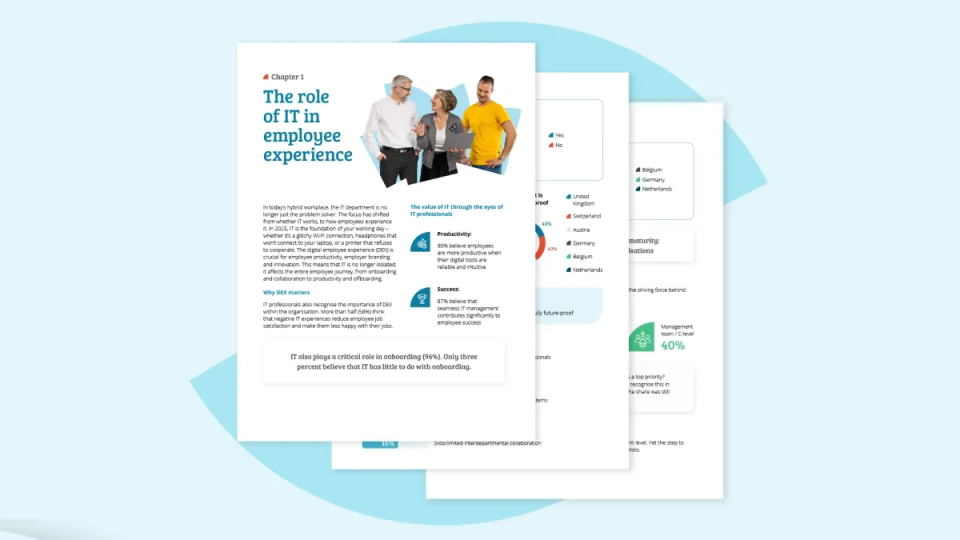
Auf Grundlage der Erkenntnisse von über 3.000 IT-Fachleuten im DACH-Raum zeigt der Bericht, was sich derzeit in IT-Teams verändert: warum Servicedesks sich überlastet fühlen, warum die Employee Experience zunehmend in den Aufgabenbereich der IT fällt und warum KI die Arbeitsweise Schritt für Schritt verändert.

In diesem Bericht erfahren Sie:

  • Warum IT-Teams in reaktiven Aufgaben stecken bleiben, anstatt die eigentlichen Probleme zu beheben
  • Wo wiederkehrende Probleme unbemerkt die Zeit von IT-Teams beanspruchen
  • Wieso die Employee Experience zunehmend in den Zuständigkeitsbereich der IT fällt
  • Wo KI und Automatisierung helfen (und wo noch nicht)
  • Was überforderte Teams von solchen unterscheidet, die sich weiterentwickeln

Jetzt den kostenlosen Bericht downloaden

Jetzt den kostenlosen Bericht downloaden

Error: Contact form not found.

Über TOPdesk:

TOPdesk hilft Unternehmen, ihr Serviceniveau zu verbessern und ihre Abteilungen mit benutzerfreundlicher Servicemanagement-Software voranzubringen. Mit über 25 Jahren Erfahrung liegt der Fokus auf einer Lösung, die einfach zu implementieren und zu bedienen ist und skalierbar mit Ihren Anforderungen wächst.

TOPdesk - About Image

The post Inside ITSM 2026: Die Zukunft der internen IT appeared first on Tech Research Online.

Uber has always wanted to be more than a ride; now it has reason to hurry


For years, Uber talked about becoming a super app. Then Waymo started picking up passengers in San Francisco, and the conversation grew more urgent. The company has been trying to embed itself inside the AV industry — as a data provider, an investor, and a distribution platform — but the consumer-facing bet may be just as important.

Two weeks ago, Uber held its annual GO-GET product event in New York and announced something its executives had been circling for a long time: users in the U.S. can now book hotels inside the Uber app, through a partnership with Expedia Group, with access to more than 700,000 properties worldwide. Uber One members — the company’s subscription tier at $9.99 a month — get 20% off a rotating list of 10,000 hotels and 10% back in credits. Vacation rentals through Vrbo will follow later this year, along with restaurant reservations via OpenTable. In the meantime, a “Shop for Me” feature lets users order from stores that aren’t even on the platform.

The announcements, taken together, were the most concrete picture yet of something Uber has been trying to conjure since at least 2019: that an app with 199 million monthly active users could become the app they use for nearly everything.

Praveen Neppalli Naga, Uber’s CTO, offered the clearest explanation of the company’s thinking at TechCrunch’s StrictlyVC event late last month in San Francisco. The super app concept has existed for years in India and Southeast Asia, he noted, but U.S. versions have mostly flopped by bolting services onto traffic rather than building toward a reason to stay.

His answer to what fits? Membership. Every new category — food, groceries, now hotels — gives someone another reason to pay for Uber One. “I take Uber, go to the airport, take a flight, take another Uber, go to a hotel, go to a restaurant,” he said. “There is a flow you can actually build into it.”

Flights are not available yet, though Naga didn’t rule them out. Uber tried flight booking in Europe years ago without success. “First let’s get the hotel things done,” he said. Financial services sound like a possibility too — Uber already offers a debit card to drivers in Mexico — though how far that goes, or when, remains unclear. Said Naga: “Never say never.”

Uber isn’t alone in this race. Airbnb, arguably the company most directly threatened by Uber’s hotel push, announced its own transportation ambitions in late March — a partnership with Welcome Pickups to offer airport transfers in 125 cities across Asia, Europe, and Latin America, structured to keep users inside the Airbnb app rather than sending them to Uber. Meanwhile, Elon Musk has spent three years promising to turn X into an “everything app” in the WeChat mold, and is now nearing what he describes as a long-stated goal: X Money, a banking and payments platform built inside the social network, is expected to launch publicly soon. X claims 500 million monthly active users.

Techcrunch event

San Francisco, CA
|
October 13-15, 2026

The big question is how many super apps the American market will actually support. WeChat works in China partly because the alternative was a patchwork of inferior options. In the U.S., people already have apps they like for most of what Uber wants to do. Getting them to consolidate inside a single platform requires either a compelling reason — Uber One’s discounts, say — or a seamless enough experience that switching feels worth it.

Uber’s bet is that its installed base is the moat. Its users have already handed over a credit card. Convincing them to book a hotel, or order from a store they’d never find on Uber Eats, is an easy lift compared with convincing them to download something new. Its most recent earnings, reported a few days ago, suggest Uber Eats may be the strongest argument for that thesis: delivery revenue grew 34% year over year in the first quarter, to $5.07 billion, making it easily the fastest-growing part of the business and pulling almost even with mobility in gross bookings.

Uber’s stock is still down about 8% from a year ago — suggesting that Wall Street isn’t fully convinced. But the company says that 50 million people are now paying for Uber One, and together they account for roughly half the company’s total bookings.

When you purchase through links in our articles, we may earn a small commission. This doesn’t affect our editorial independence.

These are the 5 features that make the Samsung Galaxy Watch 8 worth it


Among the compelling options from Samsung, Google, and OnePlus, I went with the Galaxy Watch 8 as my Wear OS smartwatch of choice. The price was a big reason, since the Samsung Galaxy Watch 8 starts at $350, and discounts and trade-ins further lower the cost. Another factor was the watch’s design, which is much thinner and lower-profile than a Pixel Watch or OnePlus Watch. More than anything else, the Samsung Health suite won me over.

There are a handful of Samsung Health features that genuinely provide insight into your fitness and long-term health using the Galaxy Watch 8’s sensors. I can glance at my watch a few times daily and get instant snapshots of how I’m feeling using underlying sensor data. You can too, using these five Galaxy Watch 8 features. They’re also available on the Galaxy Watch 8 Classic and the Galaxy Watch Ultra.

Inside ITSM 2026: The Future of Internal IT


You didn’t get into IT to reset passwords and chase tickets all day.

But somehow, that’s where most of the time goes.

Small issues keep piling up. Teams get pulled into things users could’ve solved themselves. And the bigger work like fixing root causes, improving systems, planning, keeps getting pushed.

This isn’t just your team. It’s happening everywhere.

In fact, more than half of IT professionals say they’re constantly dealing with minor issues that take time away from more important work.

That’s the gap this report from TOPdesk explores.

Based on insights from thousands of IT professionals, it shows what’s changing inside IT teams right now: why service desks feel stretched, why employee experience is becoming part of IT’s job, and why AI is starting to shift how work gets done.

In this report, you will learn how to:

  • Understand why IT teams stay stuck in reactive work instead of fixing root problems
  • Identify where recurring issues are quietly draining your team’s time
  • See how employee experience is becoming part of IT’s responsibility
  • Understand where AI and automation are helping (and where they’re not yet)
  • Recognize what separates teams that are overwhelmed from those that are evolving