Lidar-maker Luminar files for bankruptcy


Lidar company Luminar has filed for Chapter 11 bankruptcy protection after months of layoffs, executive departures, and a legal fight with its largest customer, Volvo.

The company aims to sell off its lidar business during the bankruptcy proceeding, and has already reached a deal to sell its semiconductor subsidiary. While the company will continue to operate during the bankruptcy process to “minimize disruptions” for its suppliers and customers, Luminar will eventually cease to exist once it’s completed.

“After a comprehensive review of our alternatives, the board determined that a court-supervised sale process is the best path forward,” Paul Ricci, Luminar’s CEO said in a statement. “As we navigate this process, our top priority is to continue delivering the same quality, reliability and service our customers have come to expect from us.”

The bankruptcy case, filed in the Southern District of Texas on Monday morning, comes at the end of a tumultuous year for a company that was valued at more than $3 billion when it went public in a reverse merger in 2020.

Luminar founder Austin Russell abruptly resigned from the CEO role in May following a “code of business conduct and ethics inquiry,” though he remained on the company’s board. In October, he launched a new effort called Russell AI Labs and made a bid to buy Luminar outright. (It’s unclear if Russell plans to pursue the lidar assets in the bankruptcy case; representatives for the former CEO did not immediately respond to requests for comment.)

The company, meanwhile, cut 25% of its workforce — its second layoff of the year. Luminar’s chief financial officer left the company, the company defaulted on a number of loans, and the Securities and Exchange Commission opened an investigation.

Luminar was also hit with an eviction lawsuit in October at one office and it exited a lease on another in November.

Techcrunch event

San Francisco
|
October 13-15, 2026

Another big blow came in November when Volvo, an early backer of Luminar and its largest customer heading into this year, canceled a five-year-old contract with the lidar-maker. Luminar said it has taken legal action against Volvo over the dissolution, but it has also been hit with its own legal claim from the contract manufacturer that actually made the lidar sensors.

Luminar is claiming to have between $100 million and $500 million in assets and between $500 million and $1 billion in liabilities, according to the bankruptcy filings. Among those liabilities is a $10 million debt owed to Scale AI, which was helping Luminar with data labeling. Luminar also owes more than $1 million to AI software company Applied Intuition.

Waymo’s co-CEO on the challenge of scaling robotaxis safely


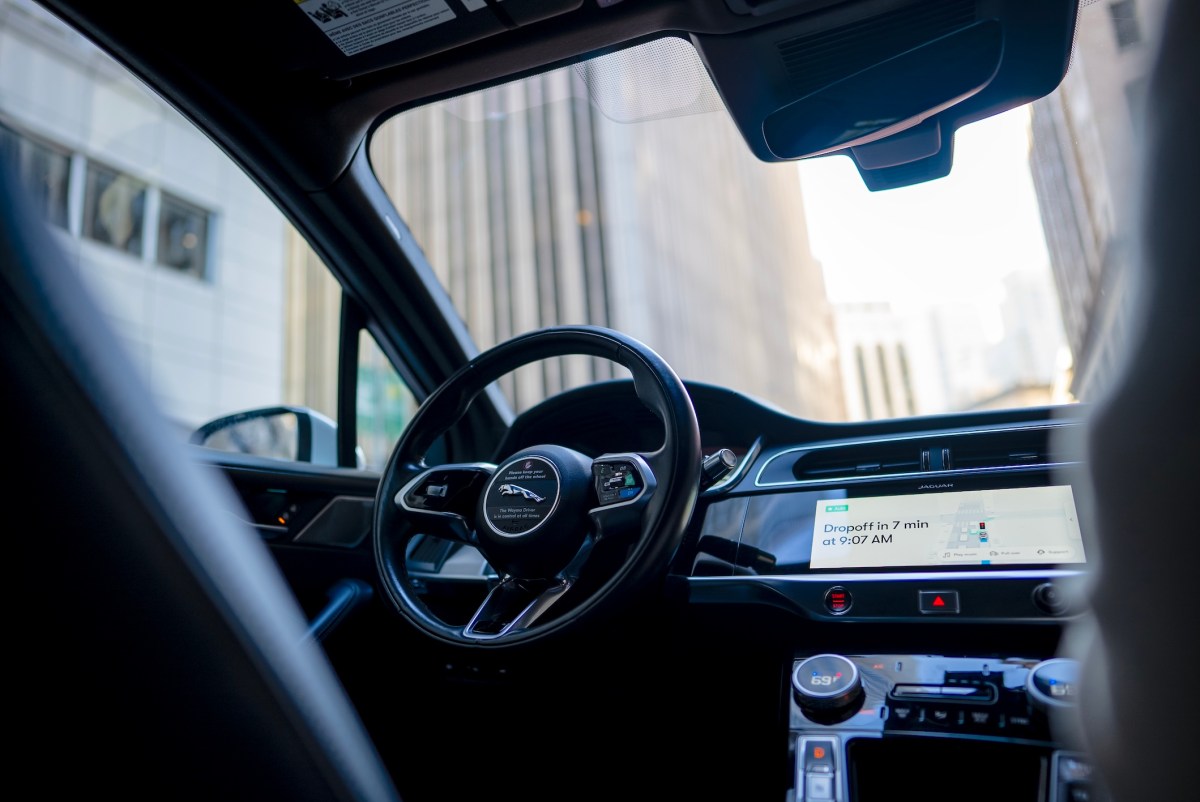
Waymo’s co-CEO, Tekedra Mawakana, had a clear message during her interview on the TechCrunch Disrupt 2025 stage Monday: “It is imperative that we scale.”

Mawakana was speaking in the context of how Waymo balances fundraising (and burning through that money) with eventually achieving profitability. But she was also clear in the interview that she believes Waymo can increase road safety by reaching that scale.

All this helps explain why the company has been on an expansion tear this year, and expects to launch in many more U.S. cities — D.C., Miami, Denver, Dallas, Seattle, and Nashville — as well as in London in 2026. It’s a furious pace that has seen the autonomous vehicle company leverage multiple partnerships with the likes of companies like Uber, Lyft, and Avis.

“By the end of 2026, you should expect us to be offering 1 million trips per week,” she said.

Mawakana spent a lot of time during the interview with TechCrunch Transportation Editor Kirsten Korosec talking about the challenges of safely reaching that kind of scale.

The Waymo co-CEO maintained that the company is operating at a level that is safer than the typical human driver. And while she didn’t name names, she took a shot at competitors, saying they aren’t doing enough to prove that their autonomous vehicle technology is truly safe.

“It is incumbent upon [them] to be transparent about what’s happening,” she said. “And if you are not being transparent, then it is my view that you are not doing what is necessary in order to actually earn the right to make the road safer.”

Her comments come as the company continues to iron out edge cases during its expansion — with one of the most recent incidents coming in Atlanta, Georgia, where a Waymo vehicle pulled out in front of a stopped school bus, leading to an investigation from the National Highway Traffic Safety Administration.

Waymo itself recently released a report claiming its vehicles are already five times safer than most human drivers, and 12 times safer with respect to pedestrians.

Still, Waymo vehicles have been caught making a number of head-scratching decisions.

“It’s important to recognize, it’s not going to be perfection, but that doesn’t mean you shouldn’t be accountable for transparency,” Mawakana said on stage. “I think…we really worry as a company about those days. You know, we don’t say whether, we say when, and we plan for them.”

Mawkana also said Waymo doesn’t think in terms of “how many [incidents] are allowable.”

“We know they’re going to happen because our cars are on the road with humans, and unfortunately, right now, the state of the roads and the state of human driving is there is a lot of deaths, and there are a lot of injuries being caused on the roadways,” she said.

And when asked whether the public would accept a death caused by a robotaxi in the face of the promise of greater safety, Mawakana said: “I think that society will.”

Tesla is testing a robotaxi service that Elon Musk claims will launch next year


Elon Musk said he hopes to launch a service that will let people hail self-driving Tesla vehicles in California and Texas sometime in 2025 — and claims his company has already been testing the service in the Bay Area with employees.

The comments, made Wednesday on Tesla’s third-quarter earnings call, go farther than what Musk promised two weeks ago at its Cybercab unveiling event. On that stage, Musk promised that Model 3 and Model Y owners would be able to use an “unsupervised” version of Tesla’s Full Self-Driving software in California and Texas. But he made no mention of the ride-hailing network, despite Tesla having teased the idea for years.

It’s unclear if Tesla would be required to get permission from California’s Department of Motor Vehicles to conduct the tests Musk said his company is already performing. The DMV did not immediately respond to a request for comment.

David Lau, Tesla’s VP of software engineering, said on the call that the cars employees have been hailing have had safety drivers at the wheel. And to be clear, no Tesla vehicles can currently drive themselves without human intervention.

Today, Tesla’s Full Self-Driving software, or FSD, is considered an advanced driver assistance system — not a self-driving system like the one Waymo uses in its robotaxis. FSD offers some automated features that are available on highways and city streets, however the system still requires the driver to pay attention and take control.

Musk said on the call that Tesla would go through the proper regulatory approval process in California before opening such a service to everyday consumers, though he lamented the red tape and said he expects smoother process in his home state of Texas. The regulatory process in California to launch a commercial robotaxi service has multiple tiers that require approval from the DMV and the California Public Utilities Commission. Waymo is the only company currently allowed to operate a commercial drvierless robotaxi service in San Francisco.

Musk also opined that Tesla might launch the service in other states by the end of next year, too.

These claims come after years of Musk overpromising on Tesla’s ability to develop software that can autonomously drive cars. He originally promised in 2016 in a since-deleted post on Tesla’s website that “All Tesla Cars Being Produced Now Have Full Self-Driving Hardware,” and in the following years made it seem that it would only take the flip of a switch to fill the streets with self-driving cars.

Even the hardware part of that promise has not borne out.

Tesla has had to upgrade cars with those early version of the so-called “Full Self-Driving” hardware. And Musk admitted on Wednesday’s call that cars equipped with what Tesla calls “Hardware 3” — which it started building into its EVs in 2019 — may not ultimately be able to drive themselves. If Tesla does someday get to the point where its software can drive vehicles without supervision, and it doesn’t work on Hardware 3, Musk promised to swap out that hardware at no cost to owners.