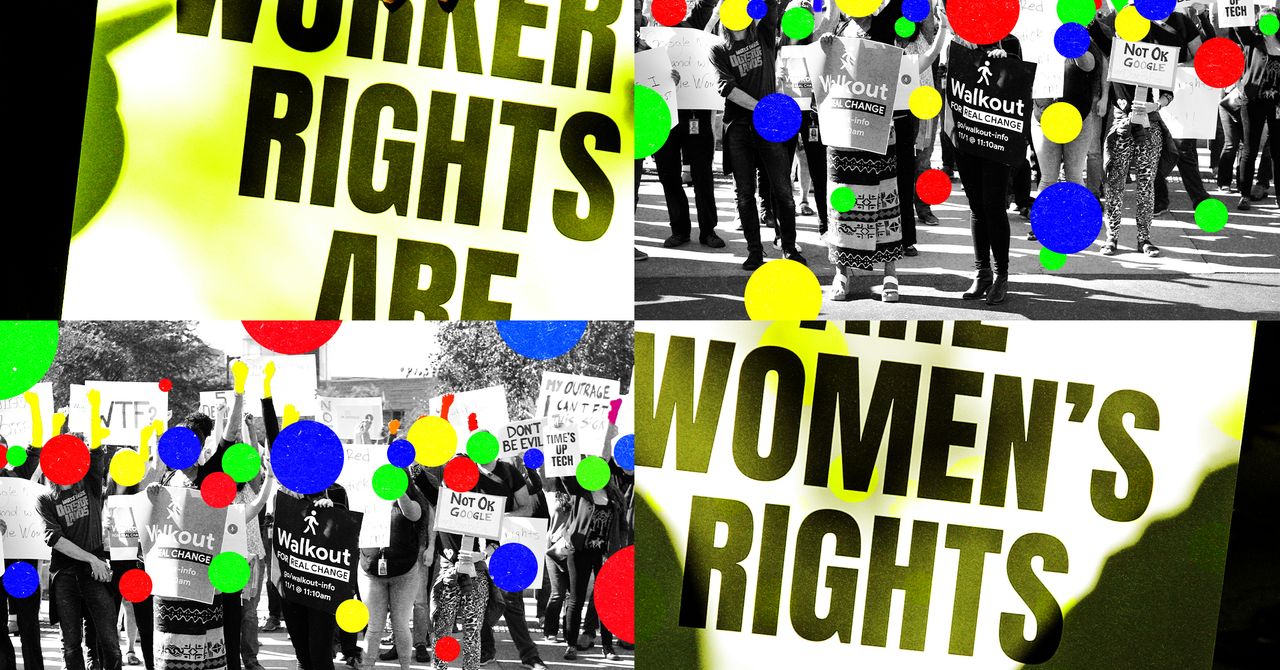
In 2018, Claire Stapleton was living in New York, raising a young child, and working at Google as a marketing manager. In October of that year, upset with how the company had handled sexual harassment claims, she helped organize what became known as the Women’s Walkout. In this new excerpt from her book Don’t Be Evil, she explains how one Google Group helped start it all.
On the Saturday after I started the womens-walk Google Group, I sprang awake at 6 and opened my laptop, stealing time before my son Malcolm stirred. My inbox was dotted with the usual weekend emails from my manager, Marion. We were in the middle of a big push involving Article 13, a piece of EU legislation that would hold platforms liable for user-generated content. I’d strenuously avoided learning the ins and outs of this particular bit of lobbyist infighting. But the drumbeat went on. “#SaveYourInternet!” we screeched from our Twitter and Instagram accounts, multiple times a day, with slick branded graphics. It was supposedly “top urgency,” despite being both inside baseball and counter to every brand goal we’d set for the year.
I’d been at YouTube long enough to know the truth: If Google wanted this law overturned so badly, Article 13 was probably good for the world. The company didn’t want limits on growth, accountability, or liability; it wanted a frictionless, consequence-free internet and the endless consolidation of power that came with it.
I couldn’t absorb Marion’s Saturday to-do list. My mind was consumed by the Women’s Walk. I refreshed the tab where I’d set up the new Google Group. An avalanche of names had joined— only a handful I knew. Most were strangers, and yet their presence felt like a new kind of belonging.
I wasn’t overthinking anything; I was just writing, sending, doing. The energy was right there, primed. I typed an email—from my own account, my name fully attached, come what may.
From: Claire Stapleton Sat, Oct 27, 2018 at 6:46 am
To: womens-walk
*rolls up sleeves*
welcome to ground zero of the google women’s walkout / a day without women (naming/branding tbd).
couple of open Q’s for the group (200 of us and counting!) as we start to formulate the statement of purpose and next steps:
what do you hope this collective action accomplishes (could be what we express/communicate to leadership, could be an action leadership agrees to take, could be a more existential cultural change we set into motion)? put another way:
why are you here?
thoughts on when we should do it? mindful of giving us enough time to make this as global, inclusive, and big as we can while also capitalizing on the rage-buzz-momentum we have flowing right now. there’s also the US midterms (a week from Tuesday) to consider.
please forward to friends who’d be interested in getting involved.
–claire
Replies shuffled in all weekend. People wrote under their real names; the anonymity cloak was gone. The I’m so fucking mad emails gave way to discussions of culture, then strategy. We made our first decision almost immediately: The walkout would be Thursday, November 1—just five days away. The US midterms were November 6; waiting would dilute everything, especially our greatest asset: rage.
What followed was a week at Google unlike any other. Here’s how it unfolded.
The Walkout was all I wanted to work on, but there was the usual rigmarole first. Article 13 had momentarily faded, so we pivoted to a slate of uninspired Halloween tweets—special-effects makeup tutorials, a stop-motion pumpkin. The contrast between that bullshit and the walkout planning—with its electricity and urgency as women across Google convened—was almost psychedelic.