The alliance will join the forces of both companies to enhance AI-driven insights, automation and decision-making capabilities to businesses worldwide
London (UK) and São Paulo (Brazil), January 24, 2024 – Qintess, a global technology and digital transformation company with origins in Brazil, and Rainbird Technologies, a leader in decision intelligence, announce a strategic partnership to join forces between two industry pioneers to deliver cutting-edge AI capabilities to businesses worldwide.
The alliance will focus on a joint go-to-market approach, maximising the sale of Rainbird’s solutions while elevating Qintess’ service offerings. The collaboration will articulate a joint value proposition that leverages the strengths of both organisations, ensuring clients receive the best of both worlds: advanced AI technology and exceptional service delivery.
With Qintess being a global technology company with roots in Brazil and specialising in digital transformation, operating in the USA, the United Kingdom, Portugal, Chile, and Colombia, and one of the leaders in the Brazilian and Latin American markets, as well as having over 20 years of experience in the global market, this partnership with Rainbird looks to bring together Rainbird’s advanced technology and Qintess’ expertise in digital transformation, creating an alliance poised to reshape the landscape of AI solutions.
Combining Rainbird’s powerful decision intelligence technology with Qintess’ strategic consulting and implementation capabilities, the partnership aims to provide clients unparalleled AI-driven insights, automation and decision-making capabilities.
James Duez, Rainbird Co-Founder and CEO, expresses his enthusiasm for the partnership, stating, “This alliance with Qintess represents a significant milestone in our mission to democratise AI and its application in business decisioning. By combining our expertise in trusted AI-powered decisions with Qintess’ proven track record in digital transformation to reshape and develop business’ models in a innovative way, we are creating a perfect partnership that will drive innovation and deliver tangible business outcomes. Our joint efforts will enable clients to harness the full potential of AI, ensuring decisions are made with precision, fairness and transparency”.
“This marks a strategic alliance for both companies. We are committed to surpassing our customers’ expectations and leading them into the digital environment. Leveraging Qintess’ expertise in Experience Management, Agile Software Engineering, and data-driven decision-making, along with Rainbird’s proficiency in AI, we aim to expedite their business results by optimizing their capabilities and processes innovatively and swiftly,”stated Nana Baffour, CEO of Qintess.
About Rainbird Technologies
Rainbird’s revolutionary Decision Intelligence platform is transforming enterprise decision-making with trust and explainability at scale. For over a decade, Rainbird’s AI platform has enabled organisations to digitise human expertise into enhanced, yet transparent, extended knowledge graphs. Their advanced reasoning automates complex judgments at scale while providing auditable rationales behind each outcome.
Rainbird’s focus on explainability enables organisations to harness the promise of new techniques like generative AI while avoiding pitfalls like bias and hallucination. Their composite approach ensures AI-powered solutions are ethical, safe, and aligned with business values.
Rainbird augments human capabilities for faster, higher quality decisions. With Rainbird, leaders can utilise state-of-the-art neurosymbolic AI to drive efficiency and growth while prioritising responsible adoption across the organisation. Rainbird remains at the forefront of human-centric AI advancement. To this end, Rainbird is committed to best-in-class partnerships across sectors and geographies. Discover how Rainbird’s cutting-edge Decision Intelligence platform keeps regulated enterprises ahead in the innovation race.
About Qintess Qintess is an expert in digital transformation, combining strategy, design, and technology to develop innovative solutions aligned with best ESG practices. With a portfolio focused on customer experience, agile automation, apps development, systems modernization, decision science, and data analytics, Qintess’ solutions enable companies to operate quickly, flexibly, and sustainably, keeping up with the changes of an ever-evolving market. With approximately 3,000 employees, Qintess operates in Brazil, Chile, Colombia, the United States, the United Kingdom, and Portugal.
For more information, please contact Qintess PR at marcelo@massinteligencia.com.br or bianca@massmedia.com.br
Hello reader who is also a reader, and welcome back to Booked For The Week – our regular Sunday chat with a selection of cool industry folks about books! I am still cross-referencing my way through Blood Meridian, both incredibly vivid prose-poetic alchemy of the profound and harrowingly mundane, and also a bit like if a bible ate a pulp paperback then shat out a second, stupider bible with at least twice the people getting severed dicks shoved in their mouths. I love literature so much.
I’ve got a stack of history books next to my desk on a certain part of the world during a specific period of time, all of which are now full of notes and underlined sentences. Unfortunately, I can’t really say anything about them without making it very obvious what our next game is going to be about. Sorry!
What did you last read?
Over the last decade, I have been a loyal reader of Jimmy Maher’s games history blog, The Digital Antiquarian, which is one writer’s attempt to chronicle the entire history of computer-based video games. In 2011, he started with games from the 70s like Hunt the Wumpus, Adventure, and Oregon Trail, and by 2025 he had reached 1998 – meaning Baldur’s Gate, Starcraft, and Half-Life have all made recent appearances. (For those keeping score at home, that means he roughly covers two historical years per calendar year.) Frankly, there is nothing out there – physical or digital – with this combination of breadth and depth. When covering games – many of which have never had anyone write serious histories of them – he reaches back to contemporary articles and other sources to place the works in their appropriate context and to actually verify the stories that have been told (and have grown) over the years. Not to name any names, but not every game developer has proven to be an accurate source on, for example, how many copies their game actually sold or on who was to blame for a project’s mistakes, and Jimmy does the best he can to set the record straight.
If a reader is not sure where to begin with his work, I would recommend starting with A Game of Falling Shapes, the third article in his series on Tetris, which launches the reader on the implausible-yet-true story of how Tetris escaped the Soviet Union and conquered the world, circling the globe and passing through many hands along the way, some of which belonged to, shall we say, very colorful characters. While his work hits the predictable high points of computer gaming (consoles makes only brief appearances – a necessary allowance for such an already implausible project), some of his best work involves unearthing forgotten dead-ends, such as Interplay’s misbegotten Realms of the Haunting, and pursuing tangents too good to pass up, such as the many (failed) attempts to lay the first Trans-Atlantic telegraph cable (as a prelude to the story of the Internet).
While choosing a blog might feel like a cheat for a column about my bookshelf, the Digital Antiquarian’s existence as a living document online makes it far superior to the static books on game history which are frozen in time as soon as they are printed. His articles build on top of one another, often linking back to past themes which he might not have even been aware of at the time, and the comments section is frequently visited by the game developers themselves, who help him make corrections and give extra context to the decisions they made at the time. These developers don’t always agree with each other – which will actually be indispensable to future historians who won’t have the chance to talk with them while they are still alive. The impetus to get the story down now, while we still can, is the same reason I started my Designer Notes podcast back in 2014, and I have to admit it was a strange feeling when Jimmy started using my interviews as primary source material. Indeed, I wish I had picked my subjects better to match up with his schedule. I just interviewed Charles Cecil (of Beneath a Steel Sky and the Broken Sword series), and he had some record-scratching stories to tell about how the games business worked in the UK of the 80s – some of which had already made it into Jimmy’s articles on Charles and some of which I was hearing for the first time.
What book do you find yourself bothering friends to read?
Sticking with the games history theme, I have encouraged many game developers to find a copy of the Second Edition of Richard Rouse III’s Game Design: Theory and Practice, which contains extensive interviews with seven of the most important game developers of the last century – Sid Meier, Will Wright, Chris Crawford, Steve Meretzky, Doug Church, Jordan Mechner, and Ed Logg. I’ve read plenty of developer interviews over the years, which tend to stick to some marketing beat and to be light on actual introspection, but Rouse somehow got enough time with his subjects to fill 20-30 pages for each one, going deep into what motivated their design decisions. I’ve never found a better collection of interviews.
What book would you like to see someone adapt to a game?
I’d love to see someone turn Dune into a sprawling, turn-based strategy game. I know Dune has a storied history in games, and Dune 2, as the first modern RTS, is one of the most important strategy games of all-time. (Indeed, the Digital Antiquarian extensively covered how Virgin accidentally ended up with two unrelated games on Dune at the same time, which is why Dune 2 is not really a sequel.) However, the Dune books have always struck me as being fundamentally contemplative works – much less about action and reaction than about prediction and preparation. They are about understanding the world above all else, and giving players time to think and plan – even to improvise and imagine – is what turn-based strategy games do better than any other genre. Someone should make it happen! (The recent board game, Dune: Imperium, may not be sprawling, but its tight action economy and dangerous Intrigue deck do a surprisingly good job of capturing Dune’s paranoid yomi.)
You’ll have noticed Soren has cleverly sidestepped the issue of naming every book ever written by refusing to tell me what he’s reading, and also forgetting to answer two of my questions. Truly, the man is three moves ahead of the rest of us. One week ahead of us is another guest, likely destined for similar success at naming all the books. Book for now!
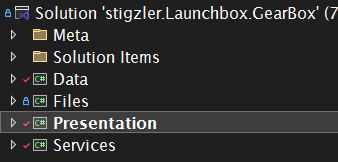
I’ve recently updated a solution from .framework to .net 9.0. Sadly, it’s caused no end of issues – not with the code or framework, but with the VS UI elements and functionality. The setup is a bit odd, so will explain it first. I’m developing a plugin for an application that has two executables – Launchbox.exe and Bigbox.exe. My plugin takes the form of four class libraries, with Presentation containing the hook into the applications:
I need to be able to debug my code when running both Launchbox and Bigbox.exe. In framework – this was simple – I would just set up different debug profiles via Microsoft Child Process Debugging Power Tool 2022 as per the process here: https://magoarcade.org/writing-plugins-for-launchbox/
This essentially ran either launchbox.exe or bigbox.exe (depending on the selected configuration) and attached the debugger. I could also specify different build paths for different configs (which I can’t do now – but separate issue).
I have/had different configs set up:
The different release configs just help a post-build script increment the right semvar component in assembly version.
However, now in .net 9, I cannot for the life of me find a way to do this. If I go to Presentation>Properties>Debug, I get the folowing:
However, there appears to be no way to map the relevant debug profile to the relevant configuration.
Configuration manager doesn’t seem to have any way to do this:
I can do something via Solution>Properties, but there doesn’t appear to be a way to map the "multi-start-up projects" Debug Target to different configs as this is greyed out:
It feels like MS’s version of progress is to compulsively jump backwards. What am I missing, doing wrong, or is it a VS design issue?
Four former Volkswagen executives received prison sentences Monday for their role in the emissions-cheating scandal that fundamentally transformed Europe’s car market. The verdict, delivered after a three-year trial in Braunschweig, Germany, marked the latest chapter in a 10-year-long saga that reshaped the continent’s relationship with diesel technology.
Jens Hadler, who oversaw diesel engine development, received the harshest sentence of four and a half years for orchestrating what judges called “particularly serious” fraud. His team had installed software allowing vehicles to recognize emissions testing, temporarily increasing pollution controls during inspections while running dirty the rest of the time.
The scandal’s impact extended far beyond corporate boardrooms. Before 2015, diesel vehicles commanded over half of Europe’s car market, marketed as environmentally friendly alternatives to gasoline. Today, that figure has collapsed to just 10% of new car sales.
The whole affair also accelerated Europe’s transition toward electrification. Electric vehicles and plug-in hybrids now account for 25% of new car sales, while Volkswagen itself has become Europe’s leading EV manufacturer, selling three times as many battery-powered cars as Tesla in April, reports The New York Times.
Dyson is compared to Apple on a regular basis for a reason: Both brands have built their businesses on reputations for innovation, design excellence and an image of prestige that sets them apart from the pack. Similar to Apple, Dyson rarely offers discounts on its products and it rather opts to present an image of premium and pricing strategy that adds strength to the value and appeal of its products.
That is the strategy which renders genuine deals on Dyson products rare, even during gigantic sale events like Black Friday. For a brief moment in time, this high-tech hair dryer can be found on Amazon for $399, which is $100 less than its standard price of $499. This is an all-time record low price, and it’s a one-time chance for anyone who’s considered purchasing a premium hair styling device.
Dyson Supersonic hair dryer is the “crème de la crème” of Dyson hair care technology. What sets it apart from others is its ability to adapt and evolve based on your individual styling patterns. With smart attachments pre-programmed with recommended airflow and temperature, the Supersonic takes much of the guesswork out of styling. The settings can be fully personalized and the tool remembers them so you get the same tailored experience every time you style with it.
You will love the Supersonic Wave+Curl diffuser which has two modes to suit different hair types and styling outcomes. On Dome mode, air is drawn into the dome and dispersed throughout the hair for natural waves or curls for a defined and sleeker finish. This is great for that person who wants to embrace their natural texture and achieve professional-grade results at home. With Diffuse mode, air is gently diffused through longer prongs, penetrating deeper into hair to create textured, voluminous curls and coils.
The Hyperdymium motor creates a powerful jet of focused air at high velocity, quickly and efficiently drying your hair without having to overheat. That is crucial since excessive heat can ruin your hair, dry it out, and remove shine. The Supersonic Nural also features Dyson’s Air Multiplier technology that draws in air from its surroundings and amplifies airflow by three times.
It also constantly tracks the temperature of the air and controls it accordingly to prevent excessive heat exposure. This maintains the natural shine of your hair intact and reduces the risk of heat damage to a minimum which makes it a perfect choice for a person who likes to style their hair frequently or has hair health problems.
All else equal, the Dyson Supersonic Nural Hair Dryer on Amazon for $399 is a deal that’s hard to beat. At its all-time low price point, it’s an opportunity to buy one of the most highly-rated and prestigious hair dryers available for sale at a significant discount. Don’t miss this Memorial Day chance before it’s gone.
Technological development in the real estate marketplace, which is very rapidly developing today, affects properties at every stage of design, marketing, and sales. Among these technological developments, 3D visualization is one area that will take a game-changer to a new level of sophistication in real estate to enhance customer experience and improve the efficiency of real estate transactions.
From virtual tours to interactive models, 3D visual tools are transforming property sales and helping developers, as well as real estate companies, showcase properties better, enhance engagement, and speed up the decision-making process.
Cad Crowd has years of experience as a leading platform that connects the best freelance 3D designers with companies and firms. The article will aim to talk about how 3D visualization services are revolutionizing the face of property sales. It will look at key applications, advantages, and prospects of the technology in the real estate business.
🚀 Table of contents
Emergence of 3D visualization in real estate
The term refers to the creation of digital models and representations of properties using advanced CAD and rendering software. This means that maybe the same models that were previously represented as static images may now represent immersive virtual environments. While 2D blueprints and architectural drawings services have been the standard for decades, an opportunity has been opened up by 3D technology to more dynamically and visually invitingly represent properties.
Whereas earlier, it was the architects and designers who used the said technology for this very purpose, nowadays, the same applies to real estate marketing and sales. Today, with 3D visualization technology, a developer’s concept of a property is now directly translated to real property, where this technology helps the buyer and investor experience the property in ways that were hardly imaginable earlier.
Key applications of 3D visualization in property sales
Virtual tours to a property
Among the most famous uses of 3D visualization in real estate lies in the possibility of providing online virtual property tours. This will enable potential buyers from the comfort of their homes to explore the house. Compared to traditional photography or video tours, 3D virtual tours allow a higher level of interactivity for design and drafting companies. The viewers can “walk” through rooms, zoom in on details, change perspective, and it becomes an even more immersive experience.
Virtual tours are especially beneficial for properties in construction or at the development stage. That way, developers can show their clients what the final product would look like even though the property is not yet complete. This program not only boosts confidence among the intending buyers but also expedites sales since the clients can make informed decisions much earlier in the process of development.
Interactive 3D models
Users can delve deeper into a property by engaging with interactive 3D models. It may also include features such as 360 views, changeable options including color change of walls and furniture, and viewing floor plans from various angles. This kind of tool is invaluable for real estate service companies because it can give potential buyers more control over their browsing experience of the property.
It is also possible to avail architectural 3D modeling services that demonstrate entire building complexes or residential communities with interactive 3D models. By adding surrounding landscapes, roads, and amenities, these models provide a far-reaching perspective of the property in context, which would be much more comprehensive as far as the value proposition of the development is concerned.
Photorealistic 3D renderings
Photorealistic 3D renderings are taken from images that provide potential buyers with lifelike images of a property and are quite useful in pre-sale properties that haven’t been constructed yet. Highly sophisticated software is required to create these renderings, and high-end rendering used at conveyance conveys the detailed features of a property, such as the texture on walls or lighting effects during the day.
In high-end real estate markets, aesthetics play a big part, and photorealistic renderings carry a good amount of sway when it comes to a buyer’s decision-making process. They help buyers see exactly what the finished property will look like, as well as help them see how specific design elements will come together in life. It builds trust and sets realistic expectations, eliminating the guesswork that often accompanies off-plan purchases.
Augmented reality (AR) and virtual reality (VR)
AR and VR have taken 3D visualization in real estate to a whole new level. While rich visualization is delivered through detailed 3D renderings and interactive models, AR and VR services even immerse the potential buyer fully. Prospective buyers can use their smartphones or tablets to superimpose 3D property models over their real environment, and they can see what the property would look like on that particular plot of land or in that particular neighborhood.
On the other hand, VR allows buyers to experience a property as if they were really inside it. Buyers can walk through properties wearing a VR headset, touch doors or furniture, and get an actual feel of space and scale. This can, in fact, prove helpful for international buyers or clients who cannot come and see the properties in person, thus being able to make confident purchases from all around the world.
Real-time customization of interior design
3D visualization tools also offer the facility for real-time customization. For example, a person with a house purchase consideration would be able to make changes in the interior design of his future house. It is possible to do this while choosing finishes and furniture layout modifications or investigating color scheme changes. It gives the client a chance to modify and see the changes in an instant in a 3D model, which also works great for the interior designer.
This feature means to developers that there is an unreplaceable sales argument where buyers would have the feeling that owning the design process would strengthen their emotional connection to the property. Moreover, because of personalization, the selling price is higher than the premium paid for personal features.
Advantages of 3D visualization for developers and real estate companies
Upgrade of marketing and sales tools
Real estate marketing today has traditionally revolved around static images, floor plans, and written descriptions to preview a property. Though these are productive in themselves, they don’t evoke the dynamic involvement needed to capture the attention of consumers. That all changes with 3D visualization, an interactive and immersive technology that changes how properties are presented to the market.
With interactive 3D models, virtual tours, and photorealistic renderings today, developers and real estate companies now have the possibility of a much more engaging way to experience properties when showing prospective buyers homes. Clients now can almost “walk” through homes, move through rooms, and go around layouts from the comfort of their own devices. It not only catches attention but also helps the prospective buyer form a kind of emotional bond with the property.
Visual storytelling plays a very important role in the buying process. Buyers can envision all elements of the property, from the architectural style aesthetics to interior design services, down to photorealistic quality. Developers can convey the full potential of the space and, through this ability, provide buyers with the possibility to make informed decisions with complete confidence. In a competitive market, this difference could make more impact, thereby qualifying more leads and ensuring increased sales.
Faster decision
The old process of buying a property is quite slow, from doing site visits, meeting with architects, and reviewing paper documents. The patience that it requires sometimes drags the decision-making process out, and the loss in business occurs when the buyer hesitates or takes too much time to decide.
All that the buyer needs to know for 3D visualizer services is realized at the outset. In today’s world, instead of visiting ten properties in person, a client can surf through virtual tours and explore interactive models, which give an overall view of the property. Buyers can quickly and efficiently evaluate properties across town or on the other side of the world.
Accelerated decision-making works in favor of developers with reduced sales cycles realized. Projects can be sold and finished faster because buyers are now able to make faster decisions in the market. This not only ensures greater profitability but also completes the development process in a much more efficient manner. The need to wait around for the actual building, or even for that matter, the somewhat blueprints, is eradicated as buyers know the exact way the final product would look. There will be more confident and swift buying decisions so that the product will gain even more value.
Better communication with customers
The two biggest battles in the minds of developers and real estate agents are always how best to communicate complicated design concepts to customers. “Technical drawing and architectural plans are undoubtedly important, but the truth is that sometimes a lack of expertise makes them hard to explain,” notes Antonio Elis, especially when expectations are sure to be destroyed, or future revisions will be on the horizon if something hasn’t been fully understood in the presentation.
This is a barrier that 3D presentation design tools overcome by allowing an intuitive way of presenting design ideas, which is extremely visually appealing. The developers do not have to use all the industrial terminologies or 2D plans when using all-inclusive 3D models to present the layout, features, and design elements of an entire property. Clients may be able to view the property entirely, thus enabling instant feedback, and ensuring that their expectations are consistent with the final product.
To a certain extent, this is because better communication decreases the possibility of misinterpretations and creates a more collaborative process. This increases the feelings of involvement and being informed by the buyers, which increases satisfaction and confidence in the developer. The developer can ensure that the preference of clients is met by creating a more transparent and visually appealing dialogue, thereby minimizing the need to make costly adjustments later.
Cost control is highly crucial, especially when it comes to large projects. So, for developers and architectural design companies, this is a high cost overrun in case of delays or design changes in the later stages of the project. To an extent, 3D visualization renders the scenario cost-effective with fewer preliminary models and less numbers of trial designs. Developers can develop virtual models that are eminently changeable instead of a time-consuming, expensive prototype. Changes to design can easily be performed by a person quickly and efficiently in a 3D environment; this also ensures no manual revision corrections are required, which helps save time.
Thirdly, 3D visualization minimizes site visits to a physical site, especially for international clients or off-plan sales. The clients can view and explore the house anywhere in the world without having to travel. The method saves time as well as logistical costs that accrue from the logistics of making a visit, that is, traveling costs for both parties: the buyer and the real estate agent.
These savings can be very lucrative to developers because fewer site visits and fewer rounds of manual cycles mean fewer overhead costs. The ability to use 3D visualization to identify and address design issues during the planning stages minimizes the chances of construction delays. Faster completion of projects and better workflow results.
Greater buyer confidence
To the best of anyone’s knowledge, buying a property is one of the biggest investments you can ever have in your lifetime. It is, hence, very overwhelming to most. The uncertainty that always characterizes the product at hand, especially with off-plan purchases, creates thus hesitations or second thoughts in doing so. 3D visualization procedure helps discount such concerns because it depicts the property clearly and to the T.
With 3D real estate rendering services, clients will be able to go into every aspect of a house-from the biggest plan all the way to the smallest design feature, be it finishes, fixtures, or landscaping. This type of openness allows buyers to have a proper expectation of what they buy because it creates trust and confidence in the developer.
Due to this, the buyers are more confident, and this gives the developers fewer cancellations or renegotiations. This is because when they see what they are getting, they tend to pull out very few from deals that were already made because of some unprojected design aspects or features. It is this aspect of 3D visualization that builds the developer-buyer relationship and makes sales go as smoothly as possible with high client satisfaction rates.
More tips to boost the sales of a property using 3D visualization
The real estate market is continuously changing, and its trend of using 3D visualization proves to be a great tool to sell properties. It not only gives the buyer an experience against a two-dimensional photograph or floor plan but also enables him to live in a space much more easily. This is how real estate developers and agents can successfully use the scope of 3D visualization to sell more properties.
Show pre-construction properties
One of the most valuable uses for 3D visualization is the provision of properties that are still in construction or even planning stages. Buyers do not invest in a project unless they see something in front of them; therefore, providing a detailed model of the 3D structure gives an excellent impression of the exterior and interior spaces, making the property look more realistic – usually with the help of 3D structural design services.
These graphics may highlight attractive architectural details, landscaping, or selections in interior design that can make a project attractive to buyers. Developers can now offer virtual tours through the property with the help of users who can go for a “walk-through” and see rooms from different angles, thereby selling properties much earlier than when the construction is finished.
Interior personalization for buyers
Personalization is needed today in a competitive real estate market, and 3D visualization makes it easier to offer potential buyers options tailored to their choice. For example, with interactive 3D models, buyers can opt for whatever design options they may like, including different colors of paint, flooring, cabinetry, and even furniture layouts. Real estate agents and developers can bridge individual preferences by enabling the client to see how different choices affect the look and feel of a space, thus making the property more appealing to a larger public.
This personalization also allows developers to advertise the property at different price points, effectively meaning that buyers can preview what real-time difference premium finishes or upgrades will look like. It creates buy engagement and builds an even deeper level of emotional connection between the buyer and the property, which may equate to a more speedy decision and higher sale prices.
Virtual tours for international buyers
For buyers who cannot be there physically, 3D virtual staging tours are the beauty that marked the world. One can experience a property interactively from any part of the world at his or her own pace. It’s very valuable for international investors or out-of-town buyers to make confident decisions without the need to be physically present onsite.
These virtual tours can be accessed via websites or specialized apps and are mostly compatible with headsets, thus offering the buyer an immersive experience. Therefore, by increasing their reach with 3D visualization, real estate professionals can tap into a wider audience. Thus, the chances of sale increase by percentages.
Emotion is largely attached to the buying decision, and 3D visualization sets that emotional appeal ablaze in the hearts of buyers by bringing the house to life for them. It not only lets them see the space but also lets them feel how they would live there. The lighting, texture, and general ambiance of space are much better carried by the 3D rendering than even static photos or 2D drawing plan services. Buyers can imagine having dinner in the dining room or just relaxing in the living room.
Such emotional connection will likely make them make decisions faster since they feel sure that the property fits their needs and lifestyle. Sharp visuals also evoke a feeling of luxury and exclusivity that can justify a higher price.
Integration with marketing and social media
3D rendering services and virtual tours can be great marketing aids, especially on social media. Rich graphic images are likely to be shared and viewed online, thereby increasing the potential for generating interest in a property. This is something developers and agents can do for advertisements and websites as well as virtual open houses. This attracts tech-savvy buyers while also offering a professional edge that inspires trust.
Providing more detailed visual representations, customization options, and virtual tours not only assists in a better buyer experience but also enables developers to cover a much wider audience for their property. Properties that make use of these tools are sure to attract more attention than usual and help build stronger emotional connections, resulting in faster and higher-priced deals.
The future of 3D visualization in real estate
As 3D visualization technology continues to evolve, its impact on the real estate industry will only grow. Advancements in AR, VR, and AI will enable even more immersive and interactive experiences, allowing buyers to not only explore properties but also simulate daily life within them. For example, future applications could allow buyers to “experience” a home’s lighting throughout the day or visualize how their furniture would fit within a space.
Moreover, as these technologies become more accessible and cost-effective, they will likely become the norm rather than a luxury, with even smaller real estate companies and developers adopting 3D presentation services and tools as part of their standard sales process.
Sustainability will also play a key role in the future of 3D visualization. As more developers focus on eco-friendly building practices, 3D models can help visualize the environmental impact of a property and demonstrate how sustainable design features, such as solar panels or green roofs, will be integrated.
3D visualization is transforming the way properties are sold, offering a host of benefits for both developers and real estate services companies. By providing immersive, interactive, and photorealistic representations of properties, these tools help enhance marketing efforts, accelerate decision-making, and build stronger connections between buyers and sellers.
Developers and real estate services companies need to keep up with the technological trends now more than ever. Gone are the days when they can just settle for what’s available. Cad Crowd can help you find 3D visualization experts who will showcase your real estate projects in the best possible light. We’re an industry-leading platform that can help you find the best design professionals for your real estate projects. Request a quote today.
MacKenzie Brown is the founder and CEO of Cad Crowd. With over 18 years of experience in launching and scaling platforms specializing in CAD services, product design, manufacturing, hardware, and software development, MacKenzie is a recognized authority in the engineering industry. Under his leadership, Cad Crowd serves esteemed clients like NASA, JPL, the U.S. Navy, and Fortune 500 companies, empowering innovators with access to high-quality design and engineering talent.
A commercial shoot for the Pixel 10 Pro was leaked, offering early visuals of the device.
The Pixel 10 Pro should be retaining a similar design to its predecessor, including the protruding camera visor and triple camera system with a temperature sensor.
The leak also indicates that Google is likely planning an early summer event to launch the Pixel 10 series.
Google is preparing for the Pixel 10 series lineup, and it is pretty evident that the company appears to be shooting for the commercials of its products. Thanks to a new leak, we get to see a glimpse of the shoot alongside some sneak peeks of the upcoming handset.
The leak comes through a photographer, Mark Teasdale, on X (via DroidLife), where he happened to go out for a walk and spotted a commercial shoot happening with over 20 crew shooting a man with a phone — and that happens to be the Pixel 10 Pro, going by the images.
🎬 Just out for a walk…stumbled onto a full-on commercial shoot for the Google Pixel 10 📱They had a macro probe lens, a Panavision rig, and 20+ crew members…to film someone holding a phone 😂If the Pixel camera’s so good, why not just use it? 👀 #BTS #Vancouver pic.twitter.com/muDluZfK75May 23, 2025
The images from the so-called “Ask more of your phone” shoot here include a storyboard of the commercial, which comprises some Pixel 10 Pro shots in a couple of angles revealing its design, and some hands-on of the device where one can see the notable protruding camera visor similar to the predecessor Pixel 9 Pro. It includes the triple camera setup next to the popular temperature sensor.
The successor looks largely the same as the previous iteration — in the commercial shoot images and also matches the previously leaked Pixel 10 Pro renders.
While a lot of older-generation Pixel phones have shown up before the release in several ways, like renders, someone dropping the phone in a café, or its retail box surfacing, the latest commercial shoot leak still comes as an interesting way to see the phone beforehand.
Image 1 of 2
(Image credit: Android Headlines/ via OnLeaks)
(Image credit: Android Headlines/ via OnLeaks)
With Google done with its annual developer conference last week and the Android Show a week before that, the next big event is the Pixel 10 series. We will likely get devices like Pixel 10, Pixel 10 Pro, Pixel 10 Pro XL, and the Pixel 10 Pro Fold this time around.
Get the latest news from Android Central, your trusted companion in the world of Android
Looking for the most recent regular Connections answers? Click here for today’s Connections hints, as well as our daily answers and hints for The New York Times Mini Crossword, Wordle and Strands puzzles.
I was thrilled to see one of my teams, the Twins, show up in today’s Connections: Sports Edition. That particular category is pretty easy for anyone who even idly follows major-league baseball. Read on for hints and the answers.
Connections: Sports Edition is out of beta now, making its debut on Super Bowl Sunday, Feb. 9. That’s a sign that the game has earned enough loyal players that The Athletic, the subscription-based sports journalism site owned by the Times, will continue to publish it. It doesn’t show up in the NYT Games app but now appears in The Athletic’s own app. Or you can continue to play it free online.
Hints for today’s Connections: Sports Edition groups
Here are four hints for the groupings in today’s Connections: Sports Edition puzzle, ranked from the easiest yellow group to the tough (and sometimes bizarre) purple group.
Yellow group hint: Splish-splash.
Green group hint: Midwestern baseball.
Blue group hint: Big Green is another one.
Purple group hint: B-ball is another one.
Answers for today’s Connections: Sports Edition groups
My daughter saw this let your light shine Scripture verse wallpaper tropical background and fell in love with it! Isn’t it stunningly gorgeous?!?! The vibrant colors. Wow!
So I had some fun and added text to create this amazing Scripture verse wallpaper for all your tech devices!
In a world where many Christians are hiding their light under a bushel, let’s be followers of Christ that
LIVE.
OUT.
LOUD!! 🎉
Let Your Light Shine Scripture Verse Wallpaper
Add these wallpaper backgrounds to your social media, iPads, phones, computers and laptops to encourage and inspire you all day to remember to let your light shine for Jesus.
We are His ambassadors and that is soooo easy to forget as the day goes on and we’re out in the world. Remind yourself so that you’re constantly remembering to act in a godly way so as to draw people to Christ! 💖
The Bible verse used in the wallpaper image is: “So let your light shine before men, that they may see your good works, and glorify your Father which is in heaven” – Matthew 5:16
Grab the wallpapers below…
Need help saving them to your device? Click here for the full tutorial.
Phone (1849 x 3798 px):
Laptop (2550 x 2048 px):
iPad (2550 x 3382 px):
Instagram (2550 x 2550 px):
Desktop Computer (2550 x 1435 px):
Facebook Cover (2550 x 948 px):
Enjoy!!! 💕🎁
For more COOL Christian wallpapers, check out this collection here.
The FAA last week cleared SpaceX’s Starship to fly again after concluding its review of the previous flight, which ended in an explosion, and the next test could now take off as soon as Tuesday. SpaceX is eyeing May 27 for Starship’s ninth flight test, with a launch window opening at 7:30PM ET (6:30PM local time for the Texas Starbase). This launch will mark the first time SpaceX reuses a Super Heavy booster; the booster for flight nine previously flew with Starship’s seventh flight test earlier this year. While single-use parts have been replaced, SpaceX says it’s reusing 29 of the booster’s 33 Raptor engines.
As always, viewers at home will be able to watch along by tuning into the livestream, starting about 30 minutes before Starship launches. That will be available on SpaceX’s website and in a broadcast on its X profile.
To view this content, you’ll need to update your privacy settings. Please click here and view the “Content and social-media partners” setting to do so.
SpaceX conducted Starship’s eighth flight test back in March, but the vehicle ran into some issues a few minutes after launch. The Super Heavy booster was able to return to the launch site after separation from the upper stage and be successfully caught by the tower’s “chopstick” arms, but as for the ship itself, several Raptor engines shut off, causing it to tumble and ultimately blow itself up.
SpaceX says the issue was likely due to “a hardware failure in one of the upper stage’s center Raptor engines that resulted in inadvertent propellant mixing and ignition.” It’s since made some changes to prevent that from happening again. SpaceX said in an update on May 22 that “engines on the Starship’s upper stage will receive additional preload on key joints, a new nitrogen purge system, and improvements to the propellant drain system.”
For flight nine, the Super Heavy booster won’t return to the launch site, but will instead splash down in the ocean. The Starship upper stage will attempt to deploy eight Starlink dummy satellites, and SpaceX is otherwise looking to this flight to test “several experiments focused on enabling Starship’s upper stage to return to the launch site.”