When it comes to tinkering with electronics and messing with components, my fat little fingers make it difficult. Take one look at my gaming PC build and, if you’re a fan of neat cable management, you might pass out on the spot. Fortunately, ReStory: Chill Electronics Repair offers exactly what the name suggests, and this charming indie is already highly rated on Steam, so now’s a great time to grab it at its lowest price yet.
Some of the best cozy games still offer a satisfying challenge while focusing on the relaxing atmosphere we all need more of. ReStory: Chill Electronics Repair (which I’ll simply call ReStory from now on) does exactly that. You run a small repair shop in the mid-2000s–clearly the peak era, if you ask me–fixing customers’ electronics while searching the early internet for replacement parts.
The game leans into that nostalgia with Nintendo DS-style handhelds to clean and repair, alongside everything from retro consoles to old computers. Each customer comes with a little backstory, adding personality to every repair job. The devices are recreated with plenty of detail, making it feel like you’re actually learning how to fix them, and carefully taking them apart is strangely satisfying. It helps that I’m doing it in-game rather than on real hardware, where I’d almost certainly break something.
Every action is backed by satisfying sound design, and the game never overwhelms you with lengthy tutorials or holds your hand too tightly. There’s enough guidance for players like me, who know very little about the inner workings of electronics, while still letting you experiment, clean components, replace parts, and slowly put everything back together.
It’s no surprise that ReStory already has an “Overwhelmingly Positive” rating on Steam, with 97% positive reviews from more than 600 players. It deserves a much bigger audience, and it’s exactly the kind of overlooked indie gem I love stumbling across.
Better yet, you don’t have to pay full price. ReStory is currently just $15.99 / £10.79 at Fanatical, a 20% discount from its list price, making it cheaper than buying it on Steam right now. If you’ve been looking for a relaxing indie to unwind with, this is an easy recommendation.
Google was already in the midst of doing some heavy brand reworking with Gemini, and Android 17 only furthers those actions. Google says that Android is no longer an “operating system” but, rather, an “intelligence system.” This sounds like marketing nonsense, and I’m some of it certainly is, but the idea is that Android is moving beyond a traditional point-and-click (or tap) UI and, instead, becoming a system that does exactly what you ask of it.
Case in point, the newer Gemini Automation features which will navigate entire apps and websites for you with a single command. I used it to order food and tea from two different restaurants and all I had to do was hit confirm. While I’d argue that having Gemini order food for me is silly and completely unnecessary, seeing Gemini have the ability to navigate complex UIs without error is impressive, and there will no doubt be more sensible reasons to use this feature in the near future.
Android 17 is shaping up to be a more social-media-focused update, and on the other side of Pause Point, the company launched Screen Reactions, which makes it incredibly easy to record yourself over another video. It’s an incredibly useful feature and very easy to use. It makes me wonder what other social features the Pixel 11 will introduce.
Another feature I hope to see on the Pixel 11 Pro Fold is the Gamepad. It basically turns your foldable into a mini game console of sorts with a dedicated control pad on the bottom half of the screen, which should enhance the gaming experience. Google also says it will include native controller remapping for those of you who use external controllers, which is a great way to appeal to mobile gamers.
One feature I can’t wait to get my hands on is Pause Point. It’s supposed to remind you to take a break from distracting apps with things like timers, breathing exercises, and even suggestions for less-distracting apps to use. Because we all need a reminder to take a break from social media, right? It’s actually a pretty thoughtful feature, one I never expected from Google.
(Image credit: Google)
Google has been low-key hyping up its Pixel 11 series for some time, although we just didn’t know it. Earlier this year, the company gave us a glimpse of new features arriving with Android 17, and while the update is already out, there are still some features that haven’t arrived yet, and likely more that Google hasn’t even teased. What are you looking forward to the most?
(Image credit: Nicholas Sutrich / Android Central)
Everything is becoming more expensive, including things that are supposed to be cheap.
The latest example is DeepSeek’s AI services, as reported by Bloomberg. The Chinese AI firm sent a notice to users on Thursday warning of a “significant” price increase, though it did not specify just how significant it would be. DeepSeek has been known for its extremely cheap services relative to the competition, especially with regards to its western counterparts, so this is probably not the most welcome news among DeepSeek users.
To be more specific, DeepSeek currently charges less than a dollar per million input and output tokens, which is how AI services are sold to customers. By comparison, Anthropic’s Fable 5 model charges $10 per million input and $50 per million output tokens. It was probably unsustainable for DeepSeek to continue charging so little compared to the competition, especially as the company plans to build a huge data center in Inner Mongolia.
But still, you can’t count on anything staying cheap anymore. Not even AI, the thing that’s making everything else expensive in the first place.
Welcome to Critical Hit, where Mollie (or someone else on the PC Gamer team) celebrate and lament all things videogame music, audio design, and the ways our favourite games make our ears tingle. This week I’m that “someone else”, and I’m here to talk your ear off about time signatures!
So I’ve recently given in and decided I won’t be waiting for Deltarune’s final chapter before I played it all in one go—too many of my mates were talking about it, so I sat my butt down to get ahead of the invariable, accidental spoilers and chew through chapters one to five.
You don’t need me to tell you that Toby Fox, developer of Deltarune (and Undertale preceding it) is an excellent composer. The dude made Megalovania, which has somehow survived being piledrivered into memedom, even by the Pope of all people, and still, inevitably, slaps. But the rest of his discography is flooded with bangers. The man can work a leitmotif, lemme tell ya.
Deltarune is no different, though for this Soundtrack Sunday, I want to focus heavily on one song from it: The Third Sanctuary, because this song might be one of my favourite tunes in a videogame ever. I cannot stop listening to this thing, even if it’s a nightmarish affront to rhythm.
Latest Videos FromPC Gamer
Spoilers for Chapter 4, if you’ve not played it yet.
The Third Sanctuary plays in Chapter 4 during the recreation of the church dark world, spawned from the hands of your good time pal and occasional chalk-eating high school dinosaur friend (I promise you this makes perfect sense if you play the game) Susie.
This attempt at recreation is somewhat flawed—see, a dark world in Deltarune is a reflection of the objects around it, who turn into its inhabitants, but it’s also a reflection of the person who created it. Susie is uncertain and conflicted for so many reasons I could write a whole other article on them.
An uncertain, mysterious prophecy weighing overhead that Susie has sworn to defy. A realisation that her new mentor figure died years ago, his ashes scattered over a hammer in the next room over. The dark world she creates is a mirror to the one the chapter primarily takes place in, reflecting this—and The Third Sanctuary represents this fragile ground by, well, just give it a listen.
Keep up to date with the most important stories and the best deals, as picked by the PC Gamer team.
63. The Third Sanctuary (DELTARUNE Chapter 3+4 Soundtrack) – Toby Fox – YouTube
Even if you don’t know anything about how music is constructed, you can sense the trepidation and strangeness in it—the starting, the stopping. The next bar of the song starts just a half-heartbeat before (or after) you think it’s gonna.
That’s due to its use of unusual time signatures, which I’ll try my best to explain. A time signature is a representation of rhythm in a song, the most ubiquitous form being 4/4, four beats in each bar. The second (bottom) number represents what kind of beats they are, also known as the note value, and the first (top) number represents how many of them are in a bar.
Britney Spear’s “Hit Me Baby One More Time” is a good 4/4 song to get your brain around the concept—sing the titular line to yourself while counting to four, and you’ll feel the rhythm: Hit(1) me Ba(2)-by One(3) more time(4)!
Another time signature you might be familiar with is 3/4 time, where there are three beats in a bar—this is what most waltzes are constructed out of (bum-BAH-BAH, bum-BAH-BAH). There’s also 5/4, which is most famously associated with the Mission Impossible theme tune.
I won’t go too far into the second number, but to keep it very simple: It’s always 2, 4, 8, or 16—2 is a half-note, 4 is a quarter-note, and so on. These can be interchangeable, for instance, you could write a 3/4 song as a 3/8 song, if you wanted—you’d just have to adjust the length of the notes accordingly, but because the number of beats in a bar isn’t changing, they can be functionally identical-sounding.
So, what time signature does The Third Sanctuary use? Yes. Yes is the answer.
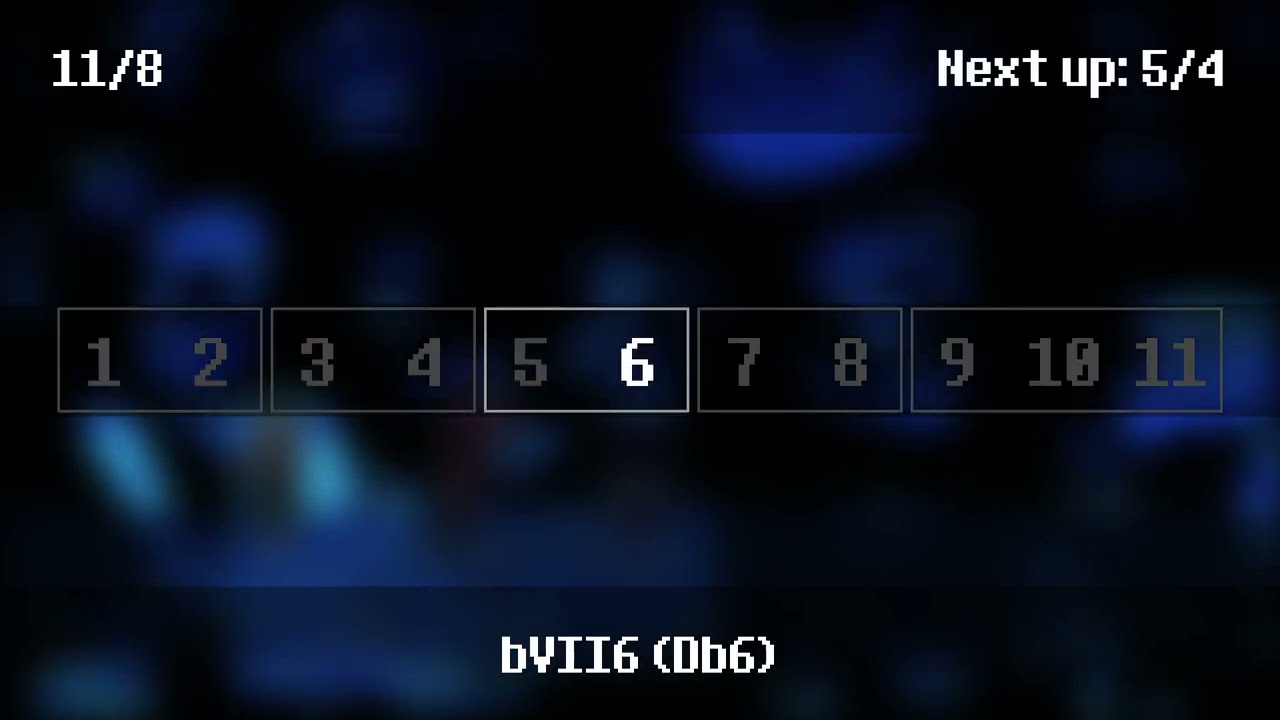
The Third Sanctuary starts out in 9/4 time, then jolts to 11/8 time with a random 4/8 thrown in there (because why not), interludes with 5/4, back to 11/8, jumpscares you with two bars of 12/8, back to 5/4 for a bit, and then the finale: A dance between 12/8 and 11/8, alternating, because who needs to be able to keep track of anything.
The Third Sanctuary – Time Signature Visualizer (Deltarune Ch.4) – YouTube
You can use an excellent visualiser, created by YouTuber 17a and embedded above, to keep track—and while this might seem like utter madness, Toby Fox isn’t just goofing off here and attempting to make drum cover artists have a heart attack, he’s using it to tell a story.
This chapter’s been out for a while now, so I am by no means the only person to come up with this analysis. But The Third Sanctuary’s time signatures of 12/8 and 11/8 don’t just clash with each other, they slowly come together over the course of the song, as though comforting each other in the darkness of Chapter 4—quite fittingly, finding each other in the dark.
The melodies present in those final bars swell and grow hopeful, despite the uncertain, stuttering strangeness of the time signatures they’re trapped in. More importantly, the main melody bridges the gap between those time signatures and flows over them in a determined way, just like Susie herself after discovering the grim truth of a (yet-to-be-revealed) prophecy.
The Third Sanctuary is incredible not just because it sounds good in spite of its time signatures, but because through them it tells the story of the entire chapter. When a friend of mine showed their musician pal the track, their analysis pretty much accurately summed up the major themes of the story despite the fact they’d never played it.
And then there’s the covers and the fan songs that have spun out of it. For the former, I’d like to share this lovely rendition by the Live Videogame Orchestra—something about hearing actual, breathing musicians manage to get a handle on the track is kinda magical.
The Third Sanctuary – DELTARUNE [Jazz Tentet Cover] – YouTube
But there’s also fan-inspired renditions. The hilariously-named 5ndth Sanctuary by IamDaDogeOfDaFuture is one of my favourites, having a wild run from 11/8, up to 15/8, up to 29/8—and still somehow managing to tickle my brain in a pleasing way. Here’s the song impossibly mashed into 4/4. Here’s the song in 5/4. People are playing with time and it’s awesome.
Toby Fox has successfully created his own little genre-pod of Math Rock enthusiasts in Deltarune’s fanbase, and I couldn’t be more delighted. The Third Sanctuary is an utter mess, it’s a drummer’s nightmare, and it’s also one of the most thoughtful moments of storytelling in a videogame, one that’s inspired countless of time-signature mad renditions.
I leave you with 4rd (not a typo) Sanctuary. This actually isn’t a fan-song, it’s a version Toby put in Chapter 5. I’m not analysing it in this article, I’ve got other things to do, but I’d like you to listen to it anyway.
In 2026, the architecture and engineering field has caught up with the growing trends. 3D rendering was once a “nice to have” feature that became one of the practical tools that businesses rely on to showcase the project with ease before construction begins. It is greatly used not just to help the 3D design team but also serves as a marketing asset to secure funding and clients. For the businesses to catch up with the growing demand, they are now facing a challenge.
This is whether to opt for an in-house 3D rendering team or outsource the work to external experienced freelancers. While each option has its own benefits and challenges, it really depends on the project’s needs. For companies who prefer flexible and cost-effective options, CAD Crowd is the right platform to connect them to experienced 3D rendering professionals. This blog will help in breaking down the options to know which one is a more suitable choice.
What are 3D rendering services?
3D Rendering services translates all the technical ideas and designs into a realistic digital representation using specialized software. It shows what the building or structure will look like once it is constructed. The quality of the visualization usually depends on the project goals, as it can look highly photorealistic as needed. By having a 3D render, everyone, including the stakeholders, can easily grasp and better understand the concept and make informed decisions before committing to construction.
Why 3D rendering matters in 2026
In 2026, when advanced technology has been greatly utilized, people have a greater expectation when it comes to visuals. They want more than a basic image, it must be detailed and easy to understand. This is why 3D rendering is only an option but an essential tool for many businesses. With this, it is easy to market it to potential customers and influence their buying decisions. This also helps in guiding the internal team to improve their design and reduce costly mistakes before the construction starts.
In-house photorealistic 3D rendering is about building an internal team to handle all rendering work instead of looking for external services. It involves hiring a reliable and qualified professional and investing in specialized software, equipment, and any hardware needed to produce a high-quality render. It is not a simple process since it has to be compatible with one another. It could be an expensive decision, but having an in-house team sets the future of the project as there is an ensured consistency to match the company’s branding and expectations. They can easily expand and market their services in the industry without much worry.
Defining outsourced 3D rendering
Outsourced 3D rendering means that the company opted to hire an external professional to do the rendering services instead of doing it internally. The freelancers usually work remotely and already have the software and equipment they need to deliver the expected outputs. In this option, the company can choose a massive pool of talent, suitable for their project. This is a more flexible option and a cost-efficient approach as it removes the need for long-term commitment and can be paid project-based.
Advantages of in-house 3D rendering
Full creative control
To have an internal 3D design team for 3D rendering means to closely oversee how the project is handled from start to finish. The company can easily and conveniently set their brand, style and expectations without having to explain much since they are all working in the same company. It is easier to provide feedback and ensure that the visuals match exactly what the vision is. This means taking full control of how the project will be done, instilling the style, standards, processes and expectations. There would be less guesswork needed if the external team really understands it the way it was supposed to be intended.
Faster internal communication
Since it is an internal team, communication is much simpler and quicker. There’s no need to consider mismatched time zones and setting up meetings for discussion. The long turnaround time for back-and-forth approval of design could be lessened. The design could also be updated in real-time based on the comments provided. This quick feedback loop is more efficient and reduces misunderstandings. The deadline could easily be met.
An in-house 3D rendering team means having close collaboration with other departments such as design, engineering, and marketing. This makes the collaboration a lot more seamless since everyone is part of the same company. The sharing of ideas and comments would be easier and aligned with the company’s goals. Having close coordination among different departments helps in producing an output that feels more cohesive and consistent across other projects. This strengthens the quality and unique branding of the project.
Better data security
Having a 3D rendering work internally keeps all the files, designs and any sensitive documentation be secured within the company’s systems. This lessens the worry of having it leaked to external parties. The risk of having unauthorized access can be reduced. Since everyone works in the same company, security protocols can be enforced, such as internal approvals and restricted access. When the project requires non-disclosure and an extra layer of protection, having an internal team handle it is a better option to have peace of mind, as it helps protect valuable intellectual property.
Consistent output quality
Since it is an in-house 3D rendering team, it is only natural that the team can produce consistent results. Generally, since the internal team is already familiar with the company’s style, preferences and quality standards, the in-house 3D modeling design team can easily adjust and align their work in it. This way, it’s unlikely to have a mismatched or inconsistent design output. This maintains the consistent level of quality across all outputs, making it more reliable and strengthening the company’s identity.
Disadvantages of in-house 3D rendering
High initial investment
Building an in-house 3D rendering team requires a lot of preparation, especially financially wise. A large upfront investment is needed even before the work starts. This includes the extensive effort of screening the right professionals, paying for the recruitment and onboarding services. Training for the onboarded professionals is also required to ensure that they align with the company’s standard workflow. There are also some things to consider, like the equipment and software needed to produce a high-quality render. The costs of putting up an in-house team are a major financial commitment.
There is so much more than building an in-house team. It does not end with the upfront expenses, as running it means having to allocate funds to keep it running smoothly. This includes paying for the monthly salaries of the employees, overhead costs, employee benefits, and sometimes recurring software subscription fees. It could also include maintenance for hardware and equipment used so it remains updated and working. This means that the company is still paying the whole set-up, whether it has an ongoing project or not.
Limited scalability
An in-house 3D product rendering team may experience a sudden increase in workload, and they wouldn’t be able to keep up since it was beyond expectations. This happens because the team size is fixed and can’t commit to adding some more since there’s no guarantee that the busy days will be long. When this happens, the employees may feel overworked and render overtime and could lead to project delays.
Talent limitations
Having an in-house 3D rendering team could mean limited capabilities since it is hard to pull a professional who has the exact skills you need for various projects. There could be instances wherein their current experience and skills are not enough to cater to a new project. This limits the company’s pool of competencies to offer. The output’s quality will be dependent on the in-house current skills and experience and may be difficult to keep up with the growing trends and complex projects.
Risk of underutilization
Every business has its downtime, wherein there are fewer projects to work on. In cases like this, the company is still paying the monthly salaries, employee benefits, overhead costs and software subscriptions. It could feel like they are paying without any output. Idle times like this could make the rendering team look inefficient and when this keeps up, it could cost more than the revenue and may be harder to justify maintaining a full-time in-house team.
Outsourcing 3D Rendering costs less since there’s no need to invest in full work setup and the company just focuses on what skills their project needs. In outsourcing 3D rendering, the pay is only output-based or project-based, which makes it easier to control and handle costs. There’s no need to worry about the equipment and software fees since the talent already has it. This approach is cost-efficient since it avoids long-term financial commitment and can allocate funds for it when needed.
Access to global talent
When looking for an external rendering 3D design professional, companies can explore several global platforms instead of local hires. This expands their search and would be able to find a talent that is exactly to their expectations. They can choose depending on the complexity and diversity of the project. Professionals may differ due to their past experiences and fields of work and having global access to these makes businesses strategize to find one that is suitable for their needs. This also ensures that the hires are expected to produce high-quality output that matches the scope of work given.
Scalability and flexibility
Since external hires are frequently output or project-based, there’s no commitment to pay them when there’s little to no work ongoing. The company can easily reduce costs by decreasing external support or just stop for a while. This removes the challenge of inefficiency and loss of revenue. This flexibility allows the businesses to stay efficient even during seasonal workloads, it allows them to scale up and down based on the workload and set timelines, making the whole operation adaptive.
Faster turnaround times
Outsourcing 3D visualization services work in a different way. They can remotely work with the perks of flexible time that allows progress to continue outside company working hours to meet the deadline. They can adjust accordingly and may operate 24/7. This makes the production more efficient for businesses who have tight deadlines and need fast results without having to overload the internal team. This way, they can rely on the external team and focus on other things to keep the business running smoothly.
In Outsourcing 3D rendering works, there’s no need to worry about what equipment and software are needed since it is already taken care of. All equipment and software costs are inclusive of the pay. Aside from having to avoid investing in costly equipment, the companies wouldn’t have to worry about which equipment, software and hardware are compatible with the project they’d work on. The companies can leave the technical side to the outsourced 2D & 3D design professionals and focus on the management.
Disadvantages of outsourcing 3D rendering
Communication challenges
Sometimes, not all remote work can be a smooth process. There could be challenges when it comes to how the communication goes, especially with the time zones. Delays in responses could be experienced and instances wherein there is a misunderstanding in the instructions given. This whole repetitive cycle of communication could take longer than expected and may cause project delay. Although inevitable, this challenge can be resolved through proper communication management by setting a fixed meeting schedule to catch up and clear out instructions and queries.
Less direct control
Since this is an external hire, the companies have no choice but to trust the outsourced professionals. This means to fully rely on their capabilities and ability to deliver the tasks without close supervision. They should be able to fully understand the instruction in the way that the company has intended it to be. To reduce conflicts, the company has to set clear instructions or produce Standard Operating Procedure (SOP) for the task to ensure that there would be no ambiguity that could lead to additional revisions and delays.
Quality variability
It is inevitable that once the company has opted to hire externally for different projects, there could be noticeable variance when it comes to the quality of the output. It could be a hit or miss opportunity and could risk the unique branding and identity of the company. It is important to do a quality check of the output or set a standard checking of what is expected to be produced. It is also critical to check the team’s portfolio, feedback, and fully screen the professional to hire before committing to work with them.
Sharing business and project details to an external team could be a breach of security, especially when the project includes sensitive information. There could be uncontrolled unauthorized access to the data and lead to data leaks. The businesses have to be more careful in distributing the technical documents by adding another layer of security to the data access or make the outsourced talents sign a Non-Disclosure Agreement (NDA). This secures and maintains control over intellectual property.
Dependency on external providers
One of the most overlooked challenges of relying on outsourced talents is the project is now dependent on them. This means that even when the project is completed and finished, there could be instances where there are post-queries or fixes that are needed to do. The company will have no choice but to turn to the outsourced talents and let them do the fix, but if they’re unable and occupied with other projects, it could lead to delay. Simply put, there’s no guarantee that the support is consistent unless agreed upon the contract/terms.
Cost breakdown: in-house 3D rendering
Salaries and benefits
Hiring a professional in 2026 is more than just paying for the salary. There are still other expenses that have to be taken into account. Some of the expenses include healthcare benefits, insurance, bonuses and other employee benefits. The total pay depends on the professional’s worth of experience and skills and may actually demand a higher compensation. Over time, the company may not be able to satisfy the employee demands, which could cause conflict.
Software licensing
Since the 3D CAD rendering designer needs specialized equipment to complete their outputs, the businesses need to invest on subscription fees. These licenses could be expensive and sometimes the cost is per user, which means the more you have on the team who uses it, the costlier it would be. When added up, it may be a lot for the company to sustain, especially if there are not many projects coming in.
3D rendering requires high-performance computers and devices. It has to be powerful enough to run the application needed to do the design outputs. These devices are not cheap and sometimes would even require having an upgrade, such as adding in more storage and upgrading the RAM. It means that it’s more than just investing in the equipment and hardware but also knowing what makes it worth buying. It has to be suitable for the software to run.
Training and development
To keep the internal CAD design team updated, it requires continuous training and upskilling. The company has to conduct training to make sure that they remain competitive to produce designs that are aligned with the modern market. It means not only investing time to do training but also money in conducting workshop courses and training programs. These efforts are done to remain active and efficient for the betterment of the team.
Office space and utilities
All teams needed a designated office as their work area. This keeps them comfortable while working. Setting up an office does not end with the bare rooms, but also the desk units and furniture it needs. Aside from that, the company also pays for the utilities and maintenance of the room. It has to be ensured that the room is enough to house high-powered computers for long hours. Although it may seem like secondary expenses, it still adds up to the overall cost of maintaining an internal team.
Cost breakdown: outsourced 3D rendering
Per-project pricing
Outsourcing 3D rendering is more of a project-based or output-based pricing. This is considered as one of its advantages since it does not deal with any other overhead costs. This makes budgeting a lot easier, especially when the company is not ready to invest and commit to building an in-house team yet. The pay for every project or output depends on the agreed terms, and the complexity of the project.
There could be times where 3D visualization freelancers could charge hourly rates depending on the complexity and level of expertise needed to complete the project. This is sometimes offered upfront and discussed if amenable. Doing an hourly rate is usually done for the scopes that are not yet clear and require a lot of revisions to do. Since it is not predictable, freelancers would have to charge every hour of work.
Package deals
Some services are offered in packages and in bundles to make it more affordable. Instead of just paying for the render service, they can offer to create technical documents that could be useful as well. This would be a lot more useful for large-scale projects since it requires a lot of technical documentation needed. It also saves time to do a back-and-forth asking for other services.
Reduced overhead costs
Outsourcing 3D rendering has drastically reduced costs by cutting down hidden expenses that come with running and maintaining an in-house team of designers. Outsourcing 3D rendering is simply paying just for the work given without worrying about additional costs like employee salaries, benefits, their devices and equipment, and even some other utilities. Product design companies can significantly save more money by getting external talent without any financial burden and long-term commitment in running a full internal team.
In-house vs outsourcing
Consistency in output
In terms of consistency, in-house teams could deliver a more consistent result that is more aligned with the company’s identity and standards. This is because they already know the set expectations and how the visuals usually look like. Unlike in outsourcing who may sometimes misunderstand brand identity and instructions. Their quality depends on how clear the instructions are.
Outsourcing could offer a wider range of expertise since companies can look for a technical design engineering professional who matches exactly what their project need. While an internal team could be lacking and may need further training to do a different task.
Workload management
Relying on outsourcing can make the businesses handle multiple projects at the same time since the work can be distributed to multiple freelancers. This saves them from peak seasons and when the deadlines are tight. It could be hard for an in-house team to pull this off since the human resources may be limited and too exhausted to handle several projects at once.
Hybrid approach: best of both worlds
Combining in-house and outsourcing
A hybrid approach could be very much helpful in leading a project since it keeps the work to its core to produce an output that is much aligned to the company’s qualities. Freelancers could do the work and the internal team will oversee it to ensure it is within the expectations and is consistent with past outputs.
Cost optimization
A hybrid approach prioritizes both cost and quality since it can reduce costs while maintaining the quality of work. It did not fully rely on the outsourced CAD designer and instead balanced both to control finances and quality more effectively. This is one of the efficient cost-cutting strategies that doesn’t compromise quality.
With a hybrid set-up, there is an efficient distribution of roles and responsibilities between the internal and external teams. One team can focus on the full technical side while the other is more on the sensitive and management tasks. Through this, both teams wouldn’t feel too exhausted and less mistakes will be made since the balance prevents bottlenecks and pressure, especially during tight deadlines.
When to choose in-house rendering
An in-house 3D rendering setup is a suitable option for product concept design companies with consistent large volumes of rendering work. It needs to take full control of the work to maintain its quality and brand identity. Whenever there’s a need to revise or edit, they can easily tap into their internal team. They also seamlessly communicate and strategize how their processes work to plan steady growth and expand their capabilities to serve more markets.
When to choose outsourcing
Outsourcing 3D rendering is the most ideal option to companies who couldn’t commit yet to long-term expenses and only have a limited budget. This could mean that they are still unsure if the volume of work will increase or decrease over time, so they’d need a more flexible option. This helps in lessening financial pressure while ensuring that the work will be delivered with the best of quality and the talent hired is fit and suitable for the project scope.
Decision-Making checklist
Choosing between in-house and outsourced 3D rendering really depends on several factors and company needs. To know what fits the business best, it must consider the budget limitations. Next, what type of service support is needed to know how much it will cost. The company must also be able to forecast if this is long-term or short-term work. Complexity also matters since they may be tasks that are hard to find in a localized pool of talents. Finally, assess all these factors and compare if an in-house set-up is capable or an additional help will do to meet the current demand of work.
In 2026, 3D rendering is accessible and can help businesses to thrive in the world of evolving technology. It has made companies catch up and utilize rendering to compete in the market. Choosing an efficient approach can make or break the company since everything has a price to pay. Companies can choose running an in-house set-up to take full control of the quality of work, making it the foundation for long-term growth. The can also keep the hiring process simple and cost-effective by opting for outsourcing.
This way, they can ensure that the tasks are of good quality. Start-up are now leaning towards having an in-house team and hiring freelances to balance the outcome of the project. It is also flexible because not all projects lasts that long, and business owners can immediately stop their services which allows them to save some costs in labor expenses. With Cad Crowd, you are assured that the quality of your in-house team will be just the same as your hired freelancers. Contact us for a free quote.
MacKenzie Brown is the founder and CEO of Cad Crowd. With over 18 years of experience in launching and scaling platforms specializing in CAD services, product design, manufacturing, hardware, and software development, MacKenzie is a recognized authority in the engineering industry. Under his leadership, Cad Crowd serves esteemed clients like NASA, JPL, the U.S. Navy, and Fortune 500 companies, empowering innovators with access to high-quality design and engineering talent.
In 2007, Marvel Comics took one of the bravest editorial decisions in its long history. Editor-in-chief Joe Quesada felt that the company’s most popular character, Spider-Man, needed a major retcon to ensure his longevity. The result was “One More Day,” a four-part crossover, written by J. Michael Straczynski with art by Quesada, that is still discussed and loathed today as one of the worst stories in Spidey’s long tenure.
According to many fans, “One More Day” negatively influenced the character for the following two decades. In the story, Spider-Man makes a deal with Mephisto to save the life of Aunt May, who had been shot by an assassin as a consequence of Peter’s unmasking during Civil War. In exchange, the demon wants Peter’s marriage to Mary Jane. After the two accept the deal, history is remade. In the new canon, Peter was late to his wedding due to his activities as Spider-Man, prompting him and MJ to reconsider their marriage. As a bonus, Doctor Strange finds a way to wipe Spider-Man’s secret identity from everybody’s mind.
Image: Marvel Comics
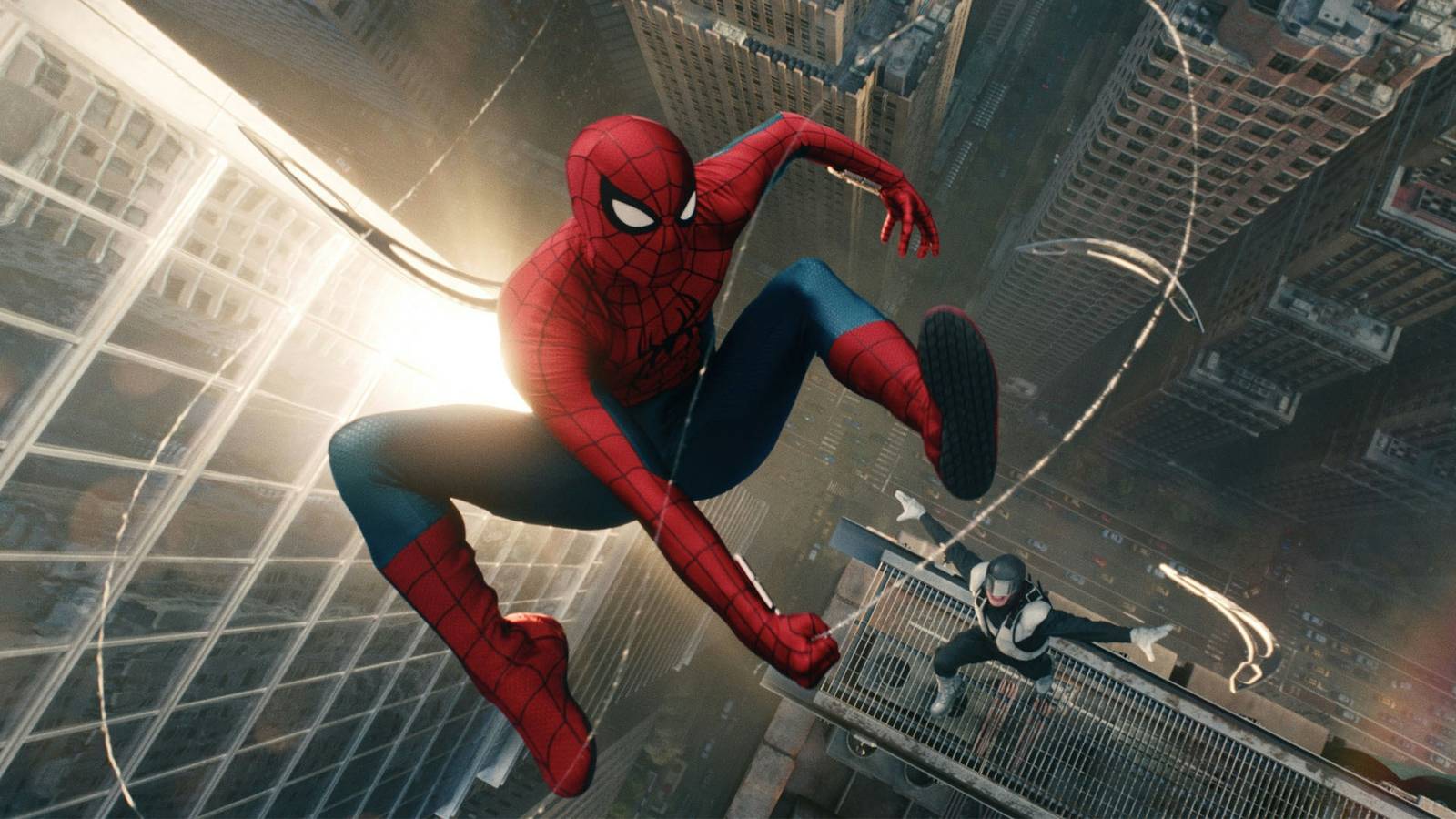
Some elements of this storyline were adapted for the movies Spider-Man: No Way Home and Spider-Man: Brand New Day. The former introduces Strange’s mind-wipe spell, which erases not just Peter’s identity as Spider-Man but his whole existence from everyone’s mind. The latter shows us the dire consequences of such a reality-altering effect. However, while Spider-Man: Brand New Day’s portrayal of Peter’s isolation and depression was mostly effective, it was not enough to wipe away the curse of “One More Day.” In fact, the movie ended up repeating one key mistake from the comics.
To understand why Brand New Day missed a great chance to right the wrongs of “One More Day,” knowing what exactly that much-maligned crossover got wrong is necessary. Often quoted as the most prominent example of an editorial mandate interfering with good storytelling, “One More Day” was inspired by Marvel Comics’ long-standing belief that Spider-Man will only appeal to readers if the character is young, immature, and down on his luck. A mature Peter Parker, who was dealing with the daily challenges of married life, did not fit the comics’ perceived readership.
Mostly, readers disagree with the way these changes were implemented, a sentiment echoed by Straczynski, who later revealed how he fought with Quesada over how to erase the marriage. The story uses a supernatural deus ex machina to establish a new status quo, rather than letting the characters deal with mature issues, like divorce, which would have been a more natural way to end Peter and MJ’s marriage. Some of the best Spider-Man stories ever deal with adult issues, such as drug abuse (The Amazing Spider-Man vol.1 96–98) or death (“The Night Gwen Stacy Died,” The Amazing Spider-Man vol. 1 121–122).
Brand New Day is, for a good half of its runtime, an “adult” movie. Just think of the great opening sequence where Peter watches his friends’ lives go on without him while he survives in a decrepit attic eating delivery food. It was so dark that, when Peter jumps from a roof for the first time, I thought the movie would show him hesitating until the last possible moment before shooting his web. If we are to accept “One More Day” as a necessary evil, this is what was missing from that story and the ones that followed: showing its consequences. But if the purpose was to make Spider-Man appeal to younger audiences, then the comics surely couldn’t follow a depressed Peter Parker forever.
Unfortunately, Brand New Day makes the same mistake. As soon as the movie turns its focus to its villain(s), it becomes just another entry in the Marvel Cinematic Universe’s assembly line of family-friendly action romps. And it’s not even a goodone. Jean Gray’s story, besides being unbearably cliché, has absolutely no connection to Peter, ending up as a forgettable distraction from the interesting parts of the movie. It also makes no sense in the context of the franchise, and seems retrofitted to introduce an X-Men character into a movie where she doesn’t really belong. (And I challenge everyone who is reading this to remember the name of the other main villain in the film without looking it up.)
Spider-Man: No Way Home’s decision to adapt the mind-wipe storyline was brave. The movie’s story works, and is praised by fans, because it doesn’t feel like a forceful way to make a character unhappy to shake up things for a franchise. Peter doesn’t cast the spell to save Aunt May, and her death forces him to make a decision: rushed, perhaps wrong, but a heartfelt one. The action and multiversal shenanigans in the movie never overshadow what is ultimately a deeply personal story.
Image: Marvel Comics
Brand New Day, instead, feels like two disconnected movies. A heartwrenching tale of isolation that shows how dangerous the axiom “with great power comes great responsibility” can be if brought to its extreme, and a trite superhero romp that, on its own, would have scored lower than Eternals. My impression is that audiences focused on the first one and almost ignored the second, which explains Spider-Man: Brand New Day’s record-breaking success.
“One More Day” ruined Spider-Man comics in an attempt to cater to a younger audience. That strategy would end up paying off in other, much more profitable forms of media: movies and streaming. The Disney Jr. show Spidey and his Amazing Friends is Marvel’s most popular series. It has been watched for about 1.25 billion hours since its 2021 launch, according to Nielsen. “The dream for a fictional character is to be able to resonate across generations for generations,” Marvel Studios president Kevin Feige said to the Wall Street Journal.
No Way Home fixed the most glaring issue with “One More Day,” which made Peter a coward who tries to run from the consequences of his actions (the opposite of the lesson he learned from Uncle Ben). Brand New Day had a chance to explore that idea in meaningful ways, but it should have stayed focused on telling a Peter Parker story. Instead, we got superhero team-ups, a MacGuffin plot, and the X-Men (kind of).
Brand New Day’s main sin is being a big studio movie that follows the industry’s playbook while also daring to give us glimpses of something much more interesting. It was probably unrealistic to expect a mature Spider-Man movie, but Brand New Day did a pretty good job of tricking me into believing it could be one. The “One More Day” curse persists. You win again, Mephisto.
Despite its ferocious popularity, people still tend to swear off anime entirely. These are usually the people whose reference of the medium pertains to a certain stereotype or to the few seconds of anime they once saw on a computer somewhere in the early 2000s.
But Japan has been producing some of the most emotionally resonant and visually audacious storytelling in contemporary media for half a century, and a great deal of it looks nothing at all like the stereotype it holds.
So here’s a case for the uninitiated. Start with self-contained films you can knock out in a single evening before graduating to series worth committing wholly to. The common thread, if you’re keeping score, is that not one of these requires you to know anything about anime, or Japan for that matter, going in.
Note that many of these picks are available in both the original Japanese audio with subtitles or as “dubs” with dialog dubbed by English voice actors. Dive in however you’d like.
Solo Leveling
If you want something fast, slick and unapologetically addictive, start here. Adapted from a South Korean web novel and webtoon by the Japanese animation studio A-1 Pictures, Solo Leveling follows Sung Jinwoo, an E-rank hunter regarded as the weakest of his profession. After being slaughtered during a dungeon expedition, he awakens with access to a mysterious system that only he can see–and which allows him to become stronger in a world where everyone else’s abilities are effectively fixed. Watching him transform from expendable underdog into an overwhelmingly powerful fighter is pure wish fulfillment, driven by propulsive pacing and enormous battles.
The Girl Who Leapt Through Time
This 2006 film is one of the softest possible landings into anime, with a concept that is simple to follow. Makoto is an ordinary teenager who unexpectedly discovers that she can leap backward through time. She initially uses the ability to redo poor test results, avoid awkward confessions, and correct everyday embarrassments. But manipulating time has consequences for the people around her, forcing Makoto to confront a future she may not be able to reverse.
Frieren: Beyond Journey’s End
Most fantasy stories end when the heroes defeat the great evil. Frieren begins there. After completing a decade-long quest, the elven mage takes off on a solitary journey, returning after 50 years to find that her human companions have aged while she has remained unchanged. Regret at missing out on reconnecting earlier and the pain of witnessing the death of one of her friends sets her on a journey of self-discovery. The result is a quiet, beautifully animated meditation on memory, mortality, and the meaning we find in seemingly fleeting relationships.
Nausicaä of the Valley of the Wind
Take a trip back to the anime of the ’80s, when writer-director Hayao Miyazaki was helping redefine what Japanese animation could accomplish—even before he cofounded Studio Ghibli. Set in a world poisoned by ecological catastrophe, the film follows Princess Nausicaä as she tries to prevent a war between human kingdoms while understanding the enormous toxic forest spreading across the planet. It is a postapocalyptic adventure but also a remarkably prescient story about environmental destruction and humanity’s impulse to conquer what it fears.
Death Note
For viewers who think anime means sprawling fights and exaggerated superpowers, Death Note offers a psychological thriller instead. High school student Light Yagami discovers a supernatural notebook that allows him to kill anyone whose name he writes inside it, provided he knows their face. With this discovery, he launches a crusade to eliminate criminals. What follows is a compulsive, morally murky battle of wits about justice, power, and how quickly idealism can become tyranny.
The Colors Within
Totsuko is a Catholic girls’ school student with an ability to see people’s emotions as colors. She joins a band with two people whose auras she’s drawn to, and so unfolds a musical odyssey of emotion and connection, tuned to classic anime characteristics. This 2024 Japanese drama film is a great watch if you’re after something with a bit more depth.
Jujutsu Kaisen
For anyone who wants supernatural horror with spectacular action, Jujutsu Kaisen is an easy gateway. High school student Yuji Itadori swallows a cursed finger to save a classmate and becomes the vessel of Ryomen Sukuna, a reincarnated sorcerer known as the King of Curses. Yuji is brought into the secretive world of jujutsu sorcerers, who fight supernatural beings created from humanity’s negative emotions. The series becomes considerably darker as it progresses, but its humor, memorable characters, and inventive battles make the commitment worthwhile.
The Tale of the Princess Kaguya
Japan’s most famous folklore reimagined in a hand-drawn masterpiece by Isao Takahata took eight years to make. As if sketched in real time, the story unfolds with a bamboo cutter who discovers a tiny girl inside a stalk. He raises her and watches her transform into a woman of impossible beauty. But the girl is slowly suffocated by everyone else’s plans for her, including five noble suitors competing for her hand.
Kiki’s Delivery Service
Even if you have never explored anime, you have probably encountered this one. Hayao Miyazaki’s 1989 fantasy follows Kiki, a 13-year-old witch who leaves home as part of her training and settles in a seaside city with her talking cat, Jiji. She begins supporting herself by running an airborne delivery service, only to find her confidence—and her ability to fly—beginning to disappear. Ostensibly a children’s film, it is also an unusually perceptive story about independence, loneliness, and creative burnout.
Spirited Away
Hayao Miyazaki’s 2001 masterpiece remains one of the strongest arguments for animation as serious cinema. Ten-year-old Chihiro unknowingly enters a mysterious spirit world where her parents eat food at an abandoned amusement park and are transformed into pigs. She then finds work in a magical bathhouse as she searches for a way to save them.
How Chuhai Labs brought the feel of classic on-rails shooters to modern players.
The team behind the game breaks it all down.
All-star voice cast including Jonah Scott, Suzie Yeung, Edward Bosco, and Daman Mills.
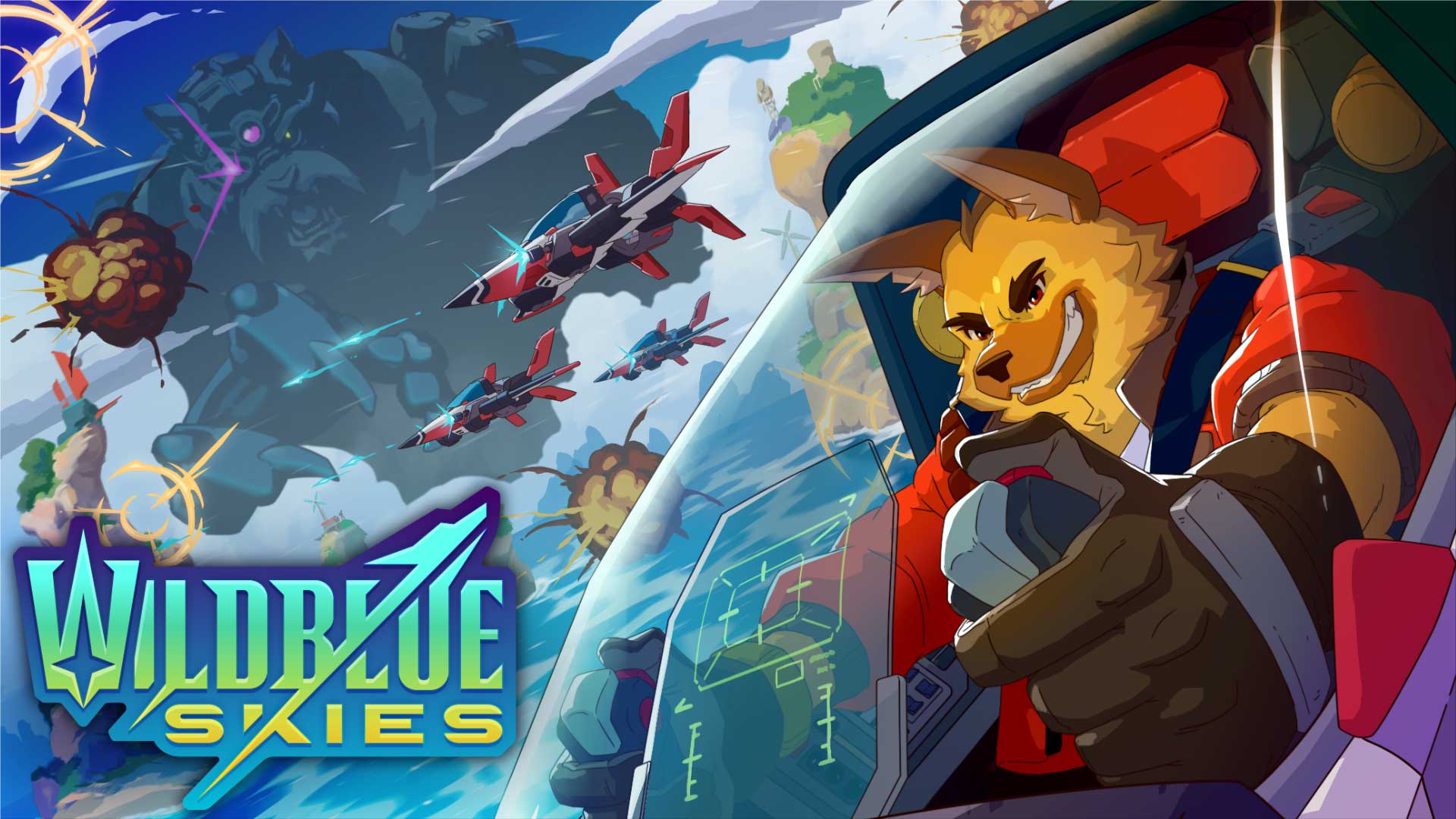
When we set out to make Wild Blue Skies, we knew exactly what we were taking on.
The on-rails shooter is one of those genres that lives in people’s memories in a very specific way. It’s not just a game type; it’s a Saturday morning, it’s a borrowed controller, it’s a high score that means something. We didn’t want to just make another one. We wanted to make the one that reminded you why you loved them in the first place.
For our studio director Giles Goddard, that connection to the genre runs deep. His passion for on-rails shooters is woven into the DNA of Chuhai Labs and when the team came together to make Wild Blue Skies, it felt almost inevitable. A lot of us grew up playing these games. We’re fans first. That matters when you’re trying to get something right.
Here’s how we did it.
Embracing Limitations, Not Fighting Them.
One of the first things we realized when making Wild Blue Skies was just how much of the feel of classic on-rails shooters was driven by the limitations of their time and that we shouldn’t be afraid to embrace them.
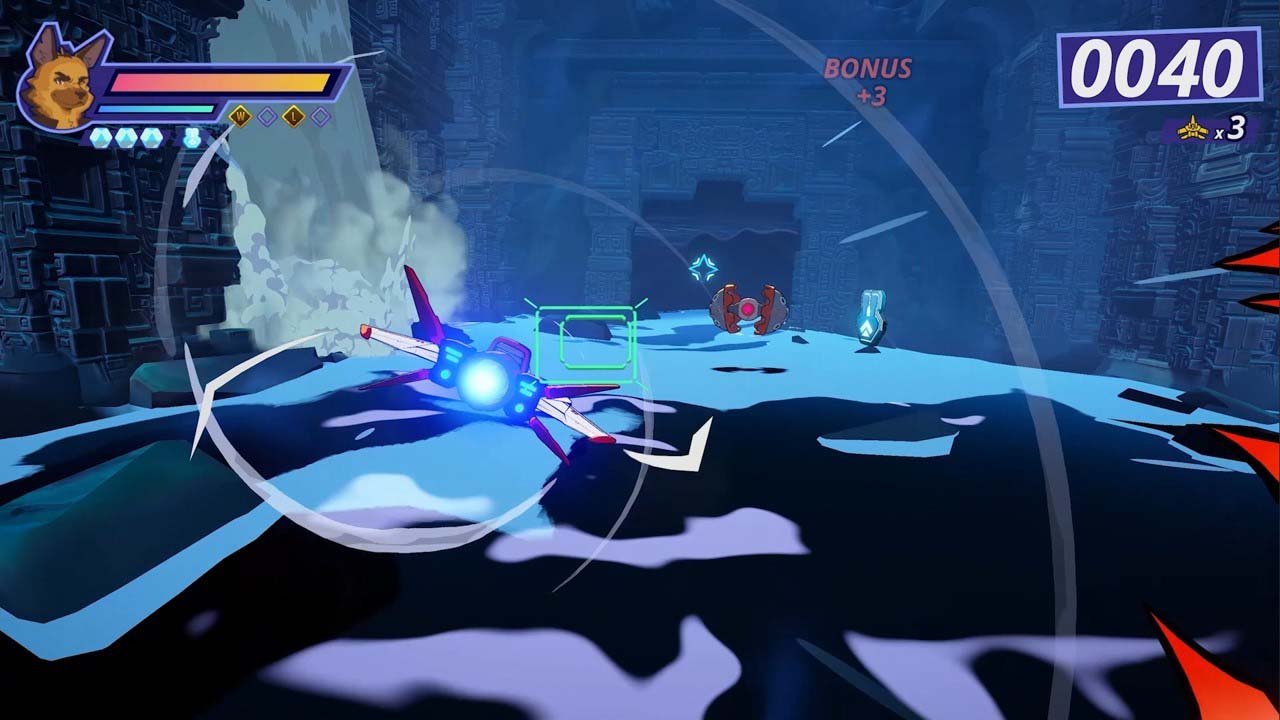
The biggest example? View distance. We spent a long time in development being able to see far off into the distance, which made enemies feel like they were spawning out of thin air and made you want to shoot farther than they could. One day, we reduced the view distance significantly and everything clicked. You would be focusing on what was happening now. Enemies felt more natural. Missions were immediately more exciting.
Camera and controls were a huge focus early in development. We wanted the aircraft to immediately feel good. To give you the means to fly and fight through our world without feeling overwhelmed.
It was a controversial change at the time. But everyone felt it the moment they picked up the controller.
That lesson shaped how we approached the entire project. In an era where the sky is the limit, we found it important to set clear pillars and embrace working with constraints. Does not matter if they’re driven by hardware, resources, or the type of game you’re making. Limitations can be your biggest ally.
Making the Plane Feel Right.
Camera and controls were a huge focus early in development. We wanted the aircraft to immediately feel good. To give you the means to fly and fight through our world without feeling overwhelmed.
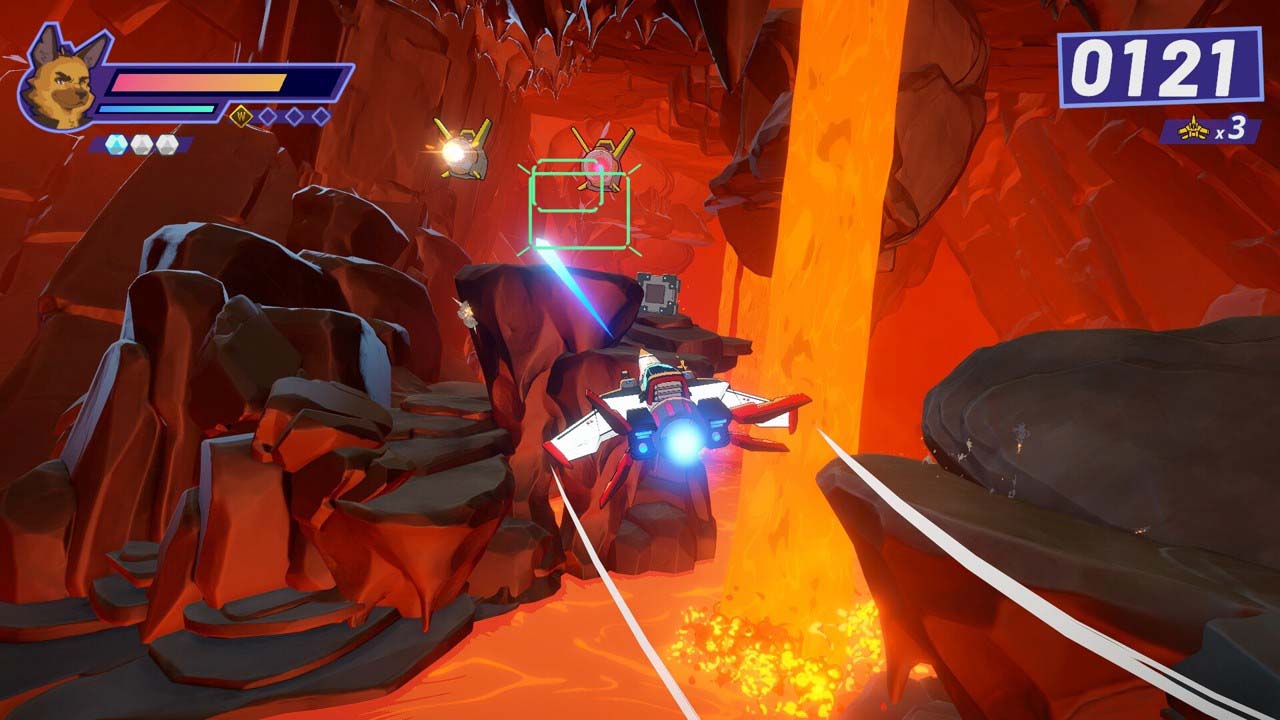
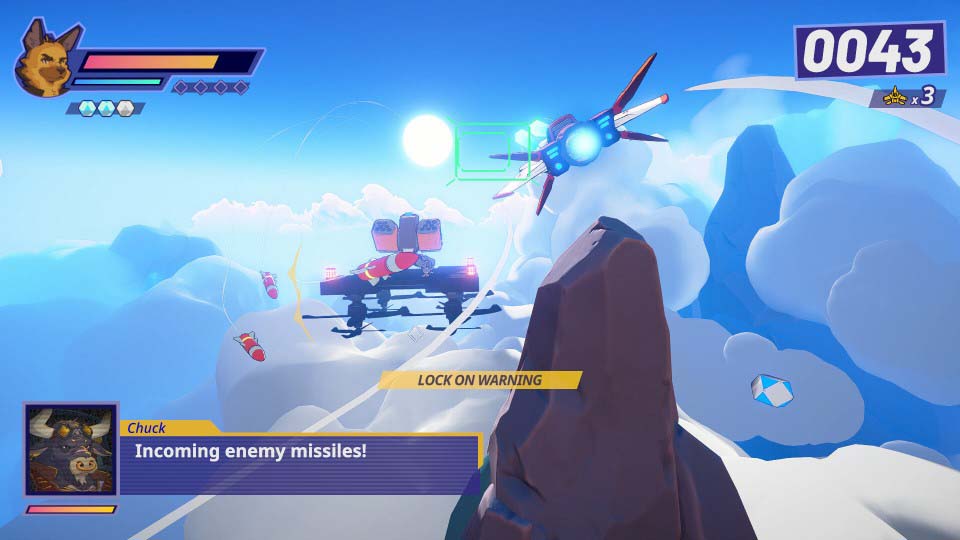
The framing of the plane in on-rails missions was an especially key topic. We wanted you to feel like you were flying around the frame, keeping a strong focus on the world while being careful not to obstruct their view. We used a dithering technique on the plane in conjunction with careful tuning to help achieve this. It’s a small detail that makes a big difference in how connected you feel to the cockpit.
The result is a control scheme that feels immediately familiar but rewards mastery. Dodge rolls deflect enemy fire when timed right. Not just a defensive tool, but an aggressive one. In free flight missions, the brake can be used to pull a 180 and get behind enemies chasing you. Every mechanic has a skill ceiling. Something you can learn in five minutes and spend hours getting good at.
A World Built from the Ground up.
We wanted our missions to feel like bite-sized episodes in a grander story and that meant building a world first. We started by concepting environments and built out a high-level world map before we made a single mission.
Each mission started with an environment and a high-level narrative pitch. From there, we blocked out the geometry, breaking each mission into sections and creating set pieces for you to fly through. We’d stub in placeholders for encounters and dialogue (flying through grayboxed environments with floating text describing what you’d eventually see) and playtest relentlessly. When the pacing felt right, we’d move on to implementing encounters, art, dialogue, and sound. Continuously playtesting. Continuously tuning.
Pacing is everything in an on-rails shooter. You are always being pushed forward, so the rhythm of quiet moments, enemy waves, hazards, and climactic encounters has to be exactly right. We got there through iteration. A lot of it.
The Visual Language of a Saturday Morning Cartoon.
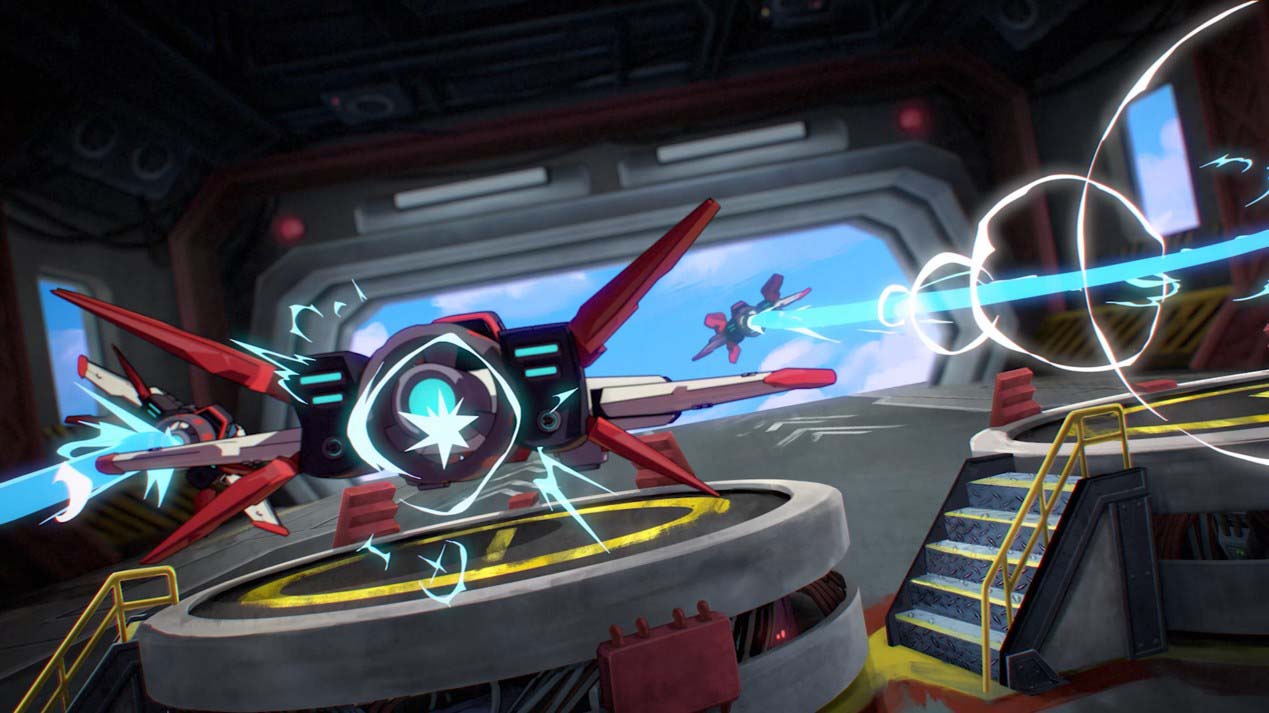
Our main source of visual inspiration came from classic Japanese animated films, particularly the work coming out of Studio Ghibli. We loved how you could see yourself in the characters and get lost in the painted backgrounds.
The team crafted an outlined cel-shaded look to make our characters, enemies, and planes really pop off the screen. Environments were treated from a painterly angle. Softer details with light, shadow, and fog to make the world feel vibrant and full of life. And since we were modernizing the gameplay, the UI was brought up to speed too: clean, simple shapes that let you gather the information you need at a glance.
The goal was always to make Wild Blue Skies feel like you’d just been thrown into a 90s action movie and Saturday morning cartoon at the same time.
The Blue Bombers and the Voices Behind Them.
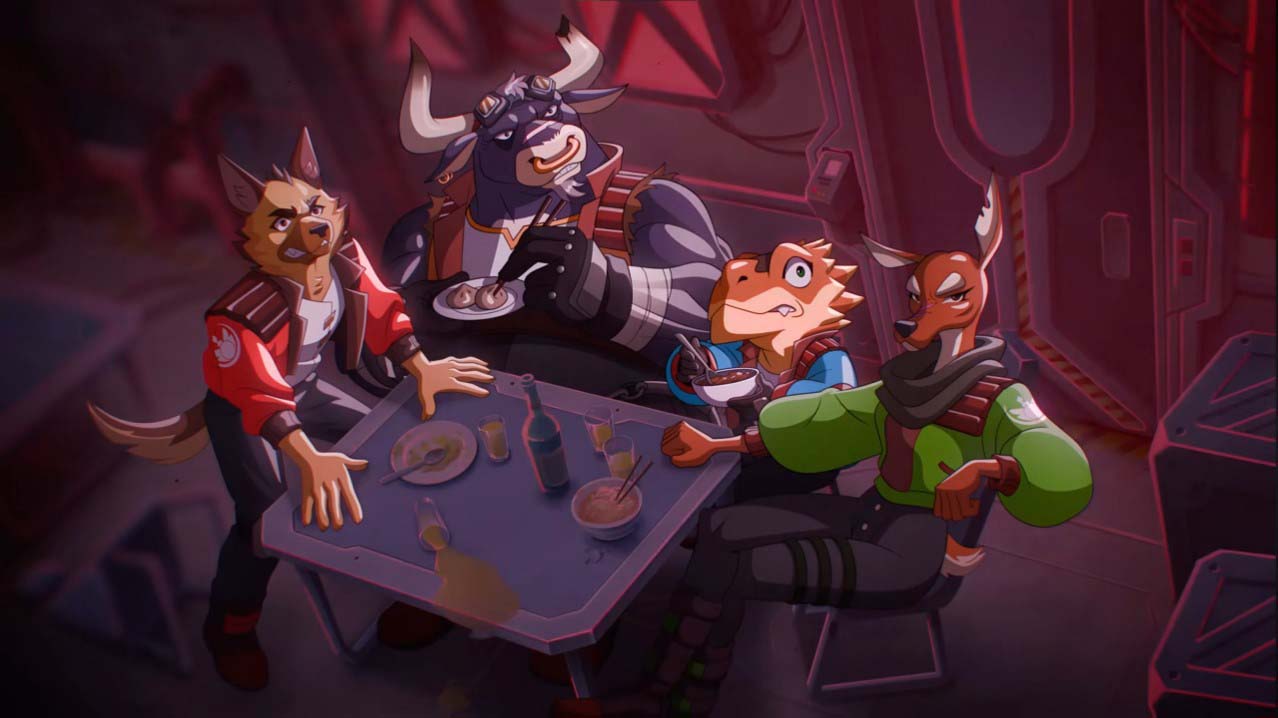
We had a lot of fun concepting characters that would fit that era of cheesy one-liners and strong personalities. Bowie, Thorne, Chuck, and Roe were designed to feel instantly familiar. The kind of squad you’d remember from the cartoons you grew up watching, while being entirely their own thing.
Bringing them to life required voices that could match that energy. We were incredibly lucky to land a cast that did exactly that! Jonah Scott as Bowie Stray, known for Legoshi in Beastars and Sniper Mask in High-Rise Invasion; Suzie Yeung as Roe Whitetail, known for Yuffie in Final Fantasy VII Remake and Makima in Chainsaw Man; Edward Bosco as Chuck Barbacoa, known for Albedo in Overlord and Il Dottore in Genshin Impact; and Daman Mills as Thorne, known for Frieza in Dragon Ball Super and Blade in Honkai: Star Rail.
We can’t wait to see which characters become your’ favorites.
This is just a glimpse of how we brought the feel of a 90s arcade cockpit to Wild Blue Skies.
Jump in and experience it for yourself when it launches August 13 on XBOX Series X|S and XBOX on PC. And thanks to XBOX Play Anywhere support, your mission progress and achievements will fly with you no matter where you choose to play. To keep up with our latest breakthroughs, find Chuhahi Labsover on X (Twitter) and Instagram.
Wild Blue Skies
Balor Games
☆☆☆☆☆
★★★★★
$14.99
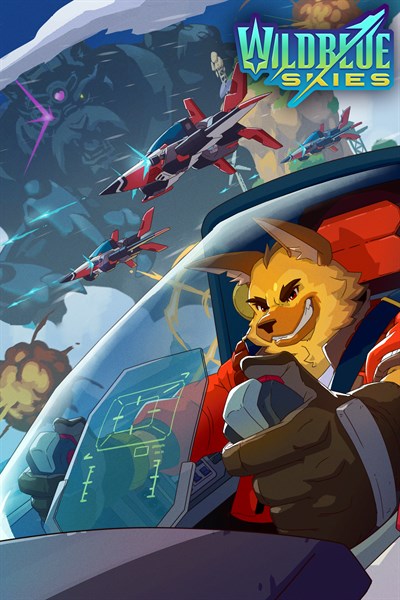
Wild Blue Skies is a modern take on the classic on-rails adventures of the ’90s, built for players who grew up chasing high scores and for a new generation hungry for the real thing.
Soar over oceans, desert ridges, and perilous caves, battling waves of enemies and pushing back Grimclaw’s forces. With the help of your squad, you’ll fight to restore peace while experiencing the thrill of classic arcade flight-combat!
Easy-to-learn controls make Wild Blue Skies accessible for newcomers and genre veterans alike, while stunning anime-inspired visuals immerse you in a hand-crafted universe. With branching paths, thrilling missions, and a score system that rewards mastery, every flight is an adventure worth repeating.
A Squad Worth Saving
Meet Bowie, Thorne, Chuck, and Roe: the Blue Bombers. Four pilots, one unbreakable squad. Each one brings their own personality and voice to every sortie. With rival squad encounters and character banter woven throughout the campaign, getting to know them is half the adventure.
Fly Your Way
No two playthroughs are the same. Branching mission paths keep every flight fresh, with secrets and hidden paths rewarding players who want to master everything the game has to offer.
Master the Skies
Easy to pick up. Deeply rewarding to master. Push yourself to earn every medal, uncover every secret path, and find the difference between finishing a mission and truly owning it.
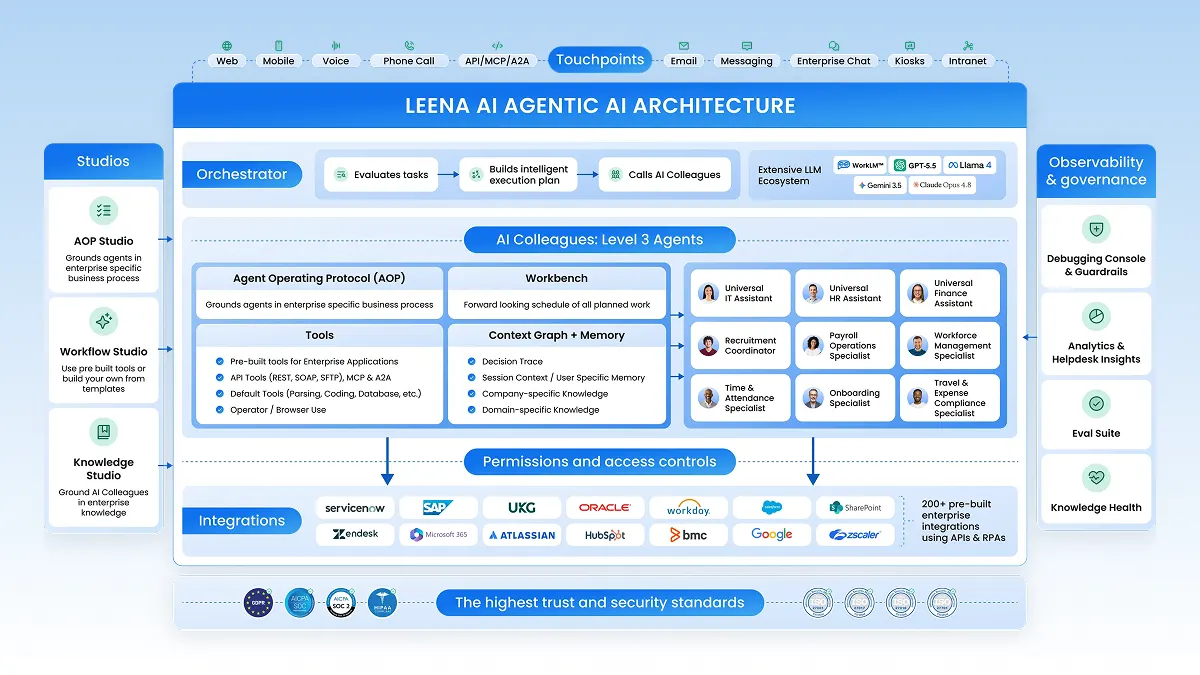
Ever wondered why so many enterprise AI projects fail to move beyond the pilot stage?
Getting an AI assistant to answer questions is relatively easy. Getting it to work across your business systems, follow security policies, and complete real tasks is where things become more complex.
This webinar explores the technology, integrations, and governance needed to build AI that can work across the enterprise securely, reliably, and at scale.
In this webinar, you’ll learn:
Why do many AI initiatives lose momentum after the pilot stage?
What it takes to connect AI securely across enterprise systems
The key components of an architecture built for real-world adoption
Do you remember a few years ago when it was reported the Leprechaun franchise was coming back? Lionsgate apparently means it for real this time, as it’s brought on two writers to script its new film.
That would be Patrick Melton and Marcus Dunstan, according to Deadline. After previously teaming on 2022’s Unhuman and the screen story for 2019’s Scary Stories to Tell in the Dark, the pair have reunited to revitalize this dormant franchise. In the producer’s chair are father-and-son duo Oren and Miles Koules—longtime producers on the Saw franchise—with the latter telling Deadline he was ready to work on “a terrifying new way into the rich world of Leprechaun.“
Last we heard in 2023, Lionsgate had filmmaker Felipe Vargas on hand to direct a new Leprechaun in what would’ve been his feature film debut. (Vargas’ takes comes after Jane Schoenbrun was approached to helm a reboot a year prior, which they ultimately passed on in favor of I Saw the TV Glow.) Plans with Vargas fell through, but the studio’s not given up, likely because of the success Alienand Predatorsaw when they came back to theaters. And they’re not the only ones: Texas Chainsaw Massacre and Nightmare on Elm Streetaren’t far behind, and Saw could be joining them as well.
Plot details on the Leprechaun revival are currently under wraps, but we’ll have more as news emerges—including whether Warwick Davis is game to make a return of some kind.