Blaze Entertainment’s new Evercade gaming handheld device, the Evercade Nexus, is now available to preorder ahead of its October 2026 launch window. Billed as the successor to the Evercade EXP-R handheld, the Nexus is a $200 portable that’s compatible with Evercade’s other cartridge-based releases, and features plenty of onboard storage for more, plus wireless multiplayer capabilities. Even better, all units ship with a Banjo-Kazooie Double Pack cartridge, and if you preorder at Best Buy, you’ll also get a collection of Data East-published arcade games as a bonus
Decentralized finance company Drift says it has suspended withdrawals and deposits after confirming a security incident.
The crypto platform said in a post on X that it was “experiencing an active attack,” and that it was working to “contain the incident.”
Security researchers and public blockchain data suggest the losses could be significant. Blockchain security firm CertiK said on X that hackers may have stolen around $136 million, while crypto analytics firm Arkham put the figure at around $285 million stolen.
If confirmed, this would make the Drift hack the largest crypto theft of the year, according to the Rekt leaderboard, a site that tracks crypto thefts by size.
It’s not clear who is behind the attack, and a spokesperson for Drift did not immediately respond to a request for comment.
Security firms say North Korea was behind the most crypto thefts last year, netting at least $2 billion in stolen cryptocurrency, funds the regime is believed to use to finance its nuclear weapons program and skirt international sanctions that restrict its access to the global financial system.
NASA’s Space Launch System (SLS) rocket and Orion spacecraft launched from Kennedy Space Center in Cape Canaveral, Florida, at 6:35 p.m. ET on Wednesday, carrying a crew of four astronauts to low-Earth orbit. In about 25 hours, Orion will set course toward the Moon.
At T-0, the SLS boosters ignited in an explosion of fire, generating a whopping 8.8 million pounds of thrust to propel the Orion spacecraft skyward. The SLS lifted off about 11 minutes into the 2-hour launch window, which opened at 6:24 p.m. Shortly after ignition, the rocket cleared the launch tower, surpassed supersonic speed, and jettisoned its solid rocket boosters.
At 6:43 p.m., the rocket’s core stage separated, placing the Orion spacecraft and the upper stage (also known as the interim cryogenic propulsion stage) into LEO. About 16 minutes later, Orion’s solar array wings unfurled, completing a key configuration step. These arrays supply power to all of Orion’s systems, from propulsion to life support.
This is only the second flight for the SLS, the third for Orion, and the first crewed flight for both vehicles. It’s difficult to overstate how incredible it was to see them perform so spectacularly. Artemis 2 will serve as a critical stepping stone to a crewed lunar landing, currently slated for 2028. That ambitious goal has never felt more attainable.
Liftoff, at last
This achievement was a long time coming. It’s been 54 years since the last Apollo mission returned to Earth, and humans have not left low-Earth orbit since. Over the next nine days, the Artemis 2 astronauts will venture deeper into space than the Apollo missions ever did, swinging around the far side of the Moon and back to Earth.
The Artemis 2 launch also follows multiple delays. NASA had hoped to launch during the February window, but the SLS experienced hydrogen leaks during the wet dress rehearsal that derailed those plans. Then the March window went, well, out the window when NASA had to roll the SLS back to the Vehicle Assembly Building to repair a helium flow issue.
Today, tanking both the core and upper stages of the rocket went remarkably smoothly, with no major leaks or issues. Now that Orion is finally in space, humanity is poised to return to the Moon. If everything goes as planned over the next several hours, the ICPS will perform burns to boost the spacecraft’s orbit in preparation for its journey to the Moon.
Approximately 3 hours and 30 minutes after launch, Orion will separate from the ICPS, and the upper stage will begin a proximity operations demonstration to test its ability to maneuver and operate safely in close proximity to Orion. Once that’s complete, the ICPS will reenter Earth’s atmosphere and splash down in the Pacific Ocean. Orion will perform a burn to adjust its orbit, and that will conclude the first day of flight.
10 days of history in the making
Assuming the mission proceeds as planned, Orion will perform the critical translunar injection burn about 25 hours after launch. This will set the spacecraft on the path to the Moon.
Orion should enter the lunar sphere of influence on the fifth day of flight. At that point, the pull of the Moon’s gravity will be stronger than Earth’s, helping the spacecraft make a fuel-efficient lunar flyby. Orion will swing around the far side of the Moon, giving the Artemis 2 astronauts a full day to observe the surface. They will see parts of the far side never before seen with the naked eye.
NASA expects Orion to exit the lunar sphere of influence and enter a return trajectory on the seventh day of flight. The spacecraft will perform a couple more burns to adjust its trajectory on the ninth and tenth days of flight before the crew capsule separates from the service module. The crew capsule will reenter Earth’s atmosphere at speeds reaching 25,000 miles per hour (40,000 kilometers per hour) and splash down off the coast of San Diego, California.
Gizmodo will be following the mission every step of the way, bringing you the latest updates as humanity makes its epic return to lunar space. Watch this space for news on all things Artemis 2.
According to a recent job listing, Blizzard is cooking up a new game in an engine and a genre that none of its releases have used before. The studio is looking for a “Lead Designer, Innovation” to run development on a “AAA open-world shooter” without a name.
Right now, every Blizzard game except Hearthstone (made with Unity) were made with in-house engines, but this unnamed shooter will likely use Unreal Engine. The listing says the lead designer will need experience working with the popular engine for prototyping features.
On top of that, the job also requires “15 years of professional experience in game design or a related discipline”, which tells me Blizzard wants someone who’s probably done this kind of work before, possibly even more than once. Given the amount of layoffs the studio endured in the last few years, I’d imagine there are plenty of former Blizzard veterans out there who would fit the bill.
Article continues below
On Bluesky, Blizzard game designer Jeff Hamilton says the “fairly unique design role” will be part of his team, but his post sadly provides no clues on what the project even is—and neither does his LinkedIn page. My best guess is the new Starcraft third-person shooter mentioned in Bloomberg reporter Jason Schreier’s 2024 book Play Nice: The Rise, Fall, and Future Of Blizzard Entertainment.
Schreier’s reporting said Blizzard was “incubating” the project under the helm of former Far Cry producer Dan Hay. The book doesn’t mention a genre or even a timeframe for when it would be properly announced, but Blizzard is hosting a BlizzCon in September that could be where it’ll show up. Windows Central reporter Jez Corden corroborated Schreier’s reporting via his own sources in January, too.
Now before you get too excited, let’s remember that Blizzard also spent six years on a survival game only to cancel it after a massive round of layoffs in 2024. It’s possible this game—much like the infamous Starcraft: Ghost shooter that never was—might not see the light of day, especially when the videogame industry layoffs haven’t really slowed down.
However, the time is ripe for Starcraft to come back. The last game in the series was released 11 years ago (unless you count the Nova Covert Ops campaign that came out 10 years ago). An open-world shooter is a big leap from an RTS, but I imagine Starcraft fans will take anything at this point.
Keep up to date with the most important stories and the best deals, as picked by the PC Gamer team.
SAP NLP Search Solutions: Adding Intelligent Search to Your SAP Environment
The Data Access Problem Most SAP Shops Have Stopped Talking About
The data is in SAP. Everyone knows it is there. But getting to it requires knowing which transaction code to use, which fields to filter, and often which table names to query — knowledge that lives in a small group of power users and SAP consultants, not in the operations team, the supply chain planner, or the plant manager who actually needs it.
The result is a predictable pattern: analysts spend hours pulling reports. Decisions wait for data. The people closest to the operational problem rely on spreadsheet exports that are already 24 hours stale by the time they reach the right desk.
SAP NLP search solves this at the access layer. It lets users ask questions in plain language and get answers drawn from live SAP data — without transaction codes, without filter configurations, and without a power user in the loop.
USM Business Systems is a CMMi Level 3, Oracle Gold Partner Artificial Intelligence (AI) and IT services firm based in Ashburn, VA. We design and deploy SAP NLP search solutions for manufacturers, pharma companies, logistics operators, and other enterprises where the gap between SAP data and operational decision-making is costing time and accuracy.
What SAP NLP Search Actually Is?
SAP NLP search is a natural language interface layered on top of SAP data. A user types or speaks a question — ‘Which suppliers are running more than 5 days late on open POs this week?’ or ‘What is the current inventory for material X across all plants?’ — and the system retrieves the relevant SAP data and returns a plain-language answer or a structured result.
The technical architecture underneath involves three components working together:
A retrieval layer that connects to SAP Datasphere views, HANA models, or structured data extracts and fetches the records relevant to the query
An LLM (large language model) that interprets the natural language question, reasons about the retrieved data, and formulates a response the user can act on
A user interface layer, typically embedded in SAP Fiori or a standalone web application, that surfaces the interaction in a format the team already uses
This architecture is known as retrieval-augmented generation (RAG). It is the standard pattern for enterprise AI search because it grounds the LLM’s responses in your actual data rather than its training knowledge — which means the answers are accurate to your environment, not generic.
Where SAP NLP Search Delivers Measurable Value?
Supply Chain and Procurement
Supply chain teams field constant questions about supplier performance, open purchase order status, inventory positions, and demand deviations. In a typical SAP environment without NLP search, each of these questions requires a different transaction, a different filter configuration, and often a trip to the analyst team.
With NLP search on SAP Ariba and S/4HANA data, a supply chain planner asks the question directly and gets the answer in under 30 seconds. Forrester research found that enterprises deploying AI-assisted data access in supply chain operations reduced average data retrieval time by 68% within 90 days of deployment.
Plant managers and production supervisors need fast access to quality data, work order status, equipment maintenance history, and production schedule adherence. In SAP PP and SAP PM, this data exists but requires navigation through multiple transaction codes.
NLP search allows a plant manager to ask ‘What is the current first-pass yield for line 3 this week compared to last week?’ and get an answer pulled from SAP QM data — in the moment, on a tablet on the shop floor. The decision that used to wait for an end-of-day report happens in real time.
Finance teams use SAP NLP search to answer variance questions, retrieve specific transaction histories, and surface exceptions without constructing custom reports. Compliance teams in regulated environments use it to pull audit-relevant data on demand — a capability that previously required either a SAP power user or a scheduled report.
Buyers and category managers use NLP search to surface contract terms, pricing history, and supplier qualification status from SAP Ariba without navigating the full Ariba interface. A buyer preparing for a supplier negotiation asks what the last five purchase prices were for a given material category and gets the answer directly from SAP contract and PO data.
How does NLP search on SAP handle questions the system cannot answer?
A well-designed SAP NLP search system will indicate when a query falls outside its data coverage rather than generating a fabricated answer. This is controlled by the retrieval layer — if the relevant data is not in the configured Datasphere view or HANA model, the system returns a ‘data not available’ response. Configuration of the retrieval layer’s scope is a key design decision during deployment.
Can SAP NLP search be used by non-technical users without SAP training?
Yes — that is the primary value proposition. Users who have never navigated an SAP transaction code can access operational data through plain language questions. The system requires user management and access controls, but the operational interface requires no SAP knowledge. Teams report adoption rates of 80%+ within 30 days when the deployment covers data that users actively need.
What a SAP NLP Search Deployment Involves?
Phase 1: Data Domain Scoping (Weeks 1-2)
Define which SAP data the search system will cover. This is not ‘all of SAP’ — it is a specific set of data domains aligned to the team or use case being served first. Supply chain planner access to procurement and inventory data is a typical first domain. Finance team access to transaction history and variance data is another common starting point.
Phase 2: Data Readiness (Weeks 2-4)
Build or validate the Datasphere views or HANA models that the retrieval layer will query. This phase surfaces master data quality issues that need resolution before the NLP layer can produce reliable answers. Budget 2-4 weeks depending on the cleanliness of the target data domain.
Phase 3: Retrieval Layer Build (Weeks 4-6)
Configure the retrieval system that connects user queries to the relevant SAP data. This includes the embedding model that converts queries and data into a format the LLM can reason about, the vector search or structured retrieval logic, and the data access controls that ensure users only see data they are authorized to access.
Phase 4: LLM Integration and Response Configuration (Weeks 6-8)
Connect the retrieval layer to the LLM, configure the response format, and build the prompt structure that guides the model to produce useful, accurate answers rather than general responses. Test on 50-100 representative queries across the target data domain. Tune accuracy.
Phase 5: UI Integration and Rollout (Weeks 8-10)
Deploy the interface — typically a Fiori tile, a Teams integration, or a standalone web application — and roll out to the target user group. Collect feedback on query coverage gaps and expand the data domain in the next iteration.
A first-domain deployment typically reaches productive use in 10-12 weeks. Enterprises that have invested in SAP Datasphere can move faster because the data layer is already structured.
What Separates Good SAP NLP Search From Poor Implementations?
Scoped retrieval, not open-ended LLM access. The model must be grounded in your SAP data, not relying on its training knowledge. RAG architecture is the standard. Implementations without a proper retrieval layer produce hallucinated data.
SAP data structure knowledge. The engineers building the retrieval layer need to understand SAP table relationships, master data objects, and SAP Datasphere modeling — not just LLM APIs. The two skill sets are both required.
Access control from the start. SAP data carries access restrictions for good reasons. An NLP search system that allows any user to query any data field is a governance problem. Role-based data access needs to be designed into the retrieval layer from the beginning.
Iteration planning. No first deployment covers every query the users will try. The difference between a successful deployment and an abandoned one is whether the team has a process for expanding data coverage based on user feedback.
Why USM Business Systems?
USM Business Systems is a CMMi Level 3, Oracle Gold Partner AI and IT services firm headquartered in Ashburn, VA. With 1,000+ engineers, 2,000+ delivered applications, and 27 years of enterprise delivery experience, USM specializes in AI implementation for supply chain, pharma, manufacturing, and SAP environments. Our SAP AI practice places specialized engineers inside enterprise programs within days — on contract, as dedicated delivery pods, or on a project basis.
Ready to put SAP AI into production? Book a 30-minute scoping call with our SAP AI team.
Does SAP NLP search require SAP Datasphere, or can it work with HANA directly?
Both work. SAP Datasphere is preferred for new deployments because it provides a governed, semantically structured data layer that is well-suited to retrieval-augmented generation. HANA views and OData APIs can serve as the retrieval source for organizations that have not yet adopted Datasphere, though more custom engineering is required.
Which LLM works best for SAP NLP search?
The answer depends on your governance requirements. Azure OpenAI (GPT-4) is the most common choice for enterprises with existing Microsoft agreements and data residency requirements. Anthropic Claude and AWS Bedrock models are increasingly common in regulated industries that require stronger content controls. The LLM selection is less important than the retrieval layer architecture.
How is accuracy measured for SAP NLP search?
The primary accuracy metric is the rate at which the system returns a correct answer to queries tested against known SAP data. A second metric is the rate of ‘I cannot answer this’ responses versus hallucinated answers — the former is acceptable; the latter is not. Measure both during the testing phase and set minimum thresholds before production rollout.
Can SAP NLP search write data back to SAP, or is it read-only?
Most initial deployments are read-only — the system retrieves and presents data but does not modify SAP records. Write-back capability, where the system can initiate a SAP workflow or update a field based on a user instruction, is the next level and requires agentic architecture rather than pure NLP search.
What user adoption approach works best for SAP NLP search?
Start with the team that has the most acute data access pain and the most frequent need to query SAP. Supply chain planners, procurement buyers, and plant managers are typically the highest-value early adopters. Get that team productive, collect their feedback on query gaps, and use their results as the business case for expanding to the next team.
When you let loose your imagination on how the exterior face of a building is created, you’d think it may start from a sketch, a photo taken during a walk, or an idea from a meeting. This may be different in the world of architecture, as imagination will not be enough to build the concept. There are different factors to be considered to complete the design: precision, lighting, materials, and audience perspectives. That’s where realistic exterior rendering services come in. It turns an idea in your head into something you can actually see and almost feel, like it’s real.
Realistic exterior rendering is more than just about making something look pretty on a screen, but it also shows how everything comes together, taking in the geometric aspects of the building, its textures, lighting, and the environment around it as well. It gives the audience an idea of what it looks like in the real world. A well-executed render can give life to abstract ideas to concrete ones, be it an office, a residential, or a commercial building. This article will explore everything behind the renders, how it is done, the techniques, and even the most detailed ways to make a render stand out above average, so it looks realistic.
Understanding the purpose of realistic exterior renders
It is important that we understand first the purpose a realistic render exists in order to appreciate it. This is all about communication. Architects, developers, and marketing teams often need to show their ideas to clients, investors, or regulatory boards who can’t fully understand technical drawings or floor plans. A 3D exterior render turns those complicated plans into a visual that helps stakeholders understand what the building looks like, how it fits into its surroundings, and even the kind of mood it sets.
But showing how a structure looks is not really the only goal of rendering. Realistic exterior renders also aim to impress and bring the project’s vision to life and can further help in selling the idea, lifestyle, or brand it delivers. In a competitive market, the way a project is presented could really make a difference. A strong render may help in securing funding and permits and could also improve a company’s image. It blends technical accuracy with creative storytelling, which makes exterior rendering feel both an art and a science.
Starting with the blueprint: The importance of accuracy
A strong understanding of the basics can establish precise exterior rendering. Everything is built from a blueprint or architectural drawing services, and this serves as the foundation. A 3D drafter depends on these plans as the reference for the structure’s dimensions, shape, and layout for it to look accurate. The reference must be correct and aligned so that the 3D model will be too, as even advanced software can’t make up for the mistakes the original one has. Conflicts such as misalignment of walls, misplaced windows, and awkward roof angles can instantly make a render look unrealistic.
After doing the main model, drafters often do final touches, such as adding details that may not be present in the original drawings but can significantly improve the realism of the structure. Details like including exterior fixtures and drainage, as well as adding textures that could react to light and shadows, could show how a professional mindset is delivered, since paying attention to these subtle touches can make the building feel real to the viewer.
Material selection: More than just texture
One of the key elements of making an exterior render real is the materials. There’s a huge gap between a realistic render and a cartoonish one, and that’s how the surfaces are shown. In reality, various materials react to light differently, like how concrete can scatter light while glass reflects it, and how wood absorbs it. Even the metal may look dull or shiny depending on how the finish is. These are some things a cartoonish model can’t showcase, since most of them are just colors with no texture at all. A skilled 3D drafter pays attention to these details and recreates them in the software.
Textures may play a big role in this process as they define how a material simulates in real life. Drafters combine different texture maps to control color, surface roughness, and the way light reflects off a material. Scaling is also important and considered for each material. For instance, a rendered brick wall could appear too big or small and may impose an awkward appearance on the structure. Also, the materials should make it look like it’s affected by its surroundings, adding in weathering and aging. These surface adjustments can contribute to making the façade not look too flat under a natural setting.
Lighting the scene: The silent narrator
An accurate model can still feel lifeless if combined with poor lighting. That is why lighting design services are undeniably one of the most influential factors in rendering. It’s not only for the technical aspect, but it can also add to the artistic side. It sets the mood by defining shadows, highlights, and textures. Adjusting the lighting by setting it bright mid-day can highlight the sharp structures of the building, while making it into warm sunset lighting could make the structure feel inviting.
In order to achieve realistic lighting, HDRI is often used to replicate how light behaves in real outdoor environments. This helps simulate natural lighting and reflects details such as shadows, reflections, and sometimes other color changes that the light may influence. Some drafters or artists even add artificial lighting, if needed. This could include street ornaments and interior lighting inside glazing and windows. It is deemed believable to feel real when shadow, reflection, and brightness adjustments are all incorporated into the model, which is why it plays such a big role in the process.
Camera angles and composition: Guiding the viewer’s eye
How we view and see a building is influenced by composition and camera angles. Our perception can be shaped in any way a 3D drafter aims it to be, since they have full control over the viewpoint. They can choose angles; they emphasize it to be. They can highlight some key features or walk through the scene. The purposes of choosing an angle may differ, like how an artist sets it too low to make a building somehow feel imposing, and a high angle helps show its placement and layout in its surroundings.
Choosing a lens matters too, since wide-angle views may tend to exaggerate depths and emphasize more of its surroundings, while a telephoto view could compress and give focus to certain details. Oftentimes, several camera set-ups were done before picking the final scene of the building, knowing how certain angles could impose a different mood or atmosphere of how a building may feel. Mindful selection of scenes or framing is practiced to ensure that the render tells the story the architect or client wants to share.
Integrating environment and context
Every building does not exist on its own. Its surroundings, including the external landscaping and neighboring structures and streets, shape how it’s positioned in our viewpoint. Architectural drafting experts often add these details and elements to the model to give a true sense of place. Mindful placement and scaling of hardscape, softscape, trees, and planting, and even vehicles, could make the scene feel lived in rather than staged.
Aside from all of that, integrating outdoor conditions like fog, rain, or any reflections on a wet surface could further enhance the scene to make it feel real. However, just adding elements without careful judgment could make it look distracting or lacking. Realistic references should still be represented to get a correct simulation of the setting. Weather and seasonal changes, subject to project goals, can also be incorporated into the scene to make it feel authentic.
After applying materials, lighting, and some environmental elements, a render can be further completed with some post-processing. This is about tweaking things such as contract, color grading, sharpness, and other visual details meant to make the scene feel even more realistic. Subtle adjustments like correcting the exposure or applying a vignette can give a render a cinematic touch without taking the focus away from the structure. It just adds some dramatic feeling to it.
Post-processing is also where the drafters or artists often add little touches like some moving trees, water reflections, and a soft glow of the windows in the dusk. These details enhance the atmosphere of the scene and make it feel alive. Integrating all of it together shapes the emotions of a viewer. It is important to note that even though it makes everything feel alive, it still should be controlled because enhancements like these are for support and not to overshadow the building.
The role of software and tools
In every refined render lies a set of professional software tools. For 3D modeling design services, programs such as 3ds Max, Maya, Blender, and Cinema 4D are often used, while for heavy rendering, V-Ray, Corona, and Lumion are utilized. Each software is used according to its strengths and functions, which differ uniquely. Artists usually pick which one to use based on the project’s needs, the workflow required, and client preferences.
Certainly, these softwares keeps evolving, with frequent updates and even version changes, making the renders even closer to realism. And now, real-time rendering gives immediate feedback, making it even easier to alter and refine the scene. Software alone doesn’t mean you’d have an instant great render; it still depends on skill, creativity, and judgment of the drafter, who turns all those resources and information into something both accurate and visually compelling
Collaboration between artists and clients
Even though the 3D drafters or artists are the ones creating the model, rendering is not something done by themselves only. It is still a collaboration among 3D artists, architects, designers, and clients. These stakeholders are working closely to ensure that the render is aligned with the project’s vision. Setting clear communication and deliverables helps the team to set a smooth flow among the team. This process often circles around artists sharing the draft along the way, tweaking and refining based on feedback.
This approach can also serve as a risk mitigation process that helps during the pre-construction stage. A render can reveal conflicts in design, lighting issues, and other element clashes. From this, adjustments can be made without being costly. In this way, a good render serves not only as a marketing tool but also reduces risks, apart from adding value beyond just looking good.
Maintaining realism without overloading detail
What separates a seasoned professional from any other is how these artists are able to convey what they want to deliver, which may somehow look like they’re telling a story to their viewers, which is essential for architectural design firms. Anyone can present how technically skilled they are and may be showy about the techniques they have integrated into the model, but a professional one can balance both realism and clarity, giving only the context and not overwhelming the people.
Advanced techniques for enhanced realism
In basic modeling, we have understood that the render starts with the materials and lighting. To be more detailed, advanced techniques can be applied to enhance the model. One useful technique is photorealistic texturing, as the name implies, it’s an almost perfect picture of the real-world surfaces. It convinces the viewers that it is real. For materials like stone, wood, and brick, procedural textures can be used aside from texture maps. Procedural textures generate patterns that allow infinite variety even without all that stiff repetition, which can be very helpful to make the texture realistic to the eye and not too staged.
In real life, we can observe how light interacts beneath the surfaces. For materials like frosted glass, thin concrete panels, or any other translucent glazing, real-life light penetration can be significantly simulated by using an advanced technique such as subsurface scattering. This is a technique that plays with light and how it is simulated in the environment. This subtle touch can dramatically improve the realism of the materials.
Another technique related to lighting is photometric lighting. This is more of an accounting accuracy of light sources, such as lumens or candelas. This technique is used by architects to verify that the design is compliant with the standards and can perform in real life as well. This just shows how architects and designers are mindful not only to appeal to the audience with the aesthetics but also to show how well it can function in real life setting.
The exterior renders would feel like they were lacking if the surrounding environment is not well-incorporated. Adding in natural elements such as planting, water features, and even slope variations can definitely make the scene even more complete for architectural design & drafting companies. To do this, it does not mean just adding elements to the model. It still needs to be properly done. Scaling is one way to make it right since inappropriate sizes may disrupt the perspective and view. This is why it is very important to do the scaling first and carefully check the elements’ placement so it won’t feel like just being added to complete a picture, but rather simulate its alignment to the surroundings.
Adding water features can enhance further realism, but it needs to be done carefully since water reacts differently according to its type. For instance, a calm pond can feel like it reflects nearby structures and the sky, while a fountain can show full motion play in the environment. To be able to demonstrate the same outcome, experienced artists control and sometimes involve physics simulation.
Integrating natural elements into their appropriate placement helps the final render achieve a realistic design. This meant importing geographical data or drone imagery to shape how it can be perceived in real life. The position and layout of the building with the roads and other infrastructure should be placed in a way that makes sense, so the render looks good and feels realistic.
Human interaction and scale
When you see a perfectly rendered building, you could feel emptiness by seeing it. One subtle way to give life is by bringing in human elements. These may include occupants, walking neighbors, pets, and even cars. These features not only add life to the scene but also help the audience understand the proportional reference of the building, whether in comparison to the environment or to other structural elements. Integrating human activities like walking, talking, or driving in the scene can also feel inviting, as it helps to suggest how the place is meant to be used.
Still, these details are to be handled with care. The added elements should always complement and support the functionality of the building, how the people shown were dressed, their body languages and even the interaction can influence the atmosphere of the building. An example of this is how corporate buildings are often introduced with people dressed formally, carrying briefcases in surroundings with busy cars, and how 3D residential rendering services are simulating warm homes and friendlier neighborhood interactions. These details matter in determining the function and lifestyle of how the building is set to deliver.
Embracing weather and seasonal variations
Natural touches, such as weather and seasons, help in making the render feel even more alive. The mood of the scene changes with the use of elements such as sun, rain, clouds, and fog. Imagine how a building can look sharp and detailed when it’s in bright sunlight, but looks so soft with shadows if in a cloudy setting. The rain could show reflections, and how fog can create depth simply by making distant objected faded.
The seasonal setting is sometimes used for more of a marketing approach, showing how the structure fits in year-round. It could show a warm and cozy autumn or a cold winter, depending on what mood they are trying to portray. It could also give an idea of how cherry blossoms or summer can brighten up the neighborhood. A skilled renderer can recreate all these while keeping lighting, materials, and texture consistent and making them feel realistic.
Optimizing render time without sacrificing quality
While realism is the ultimate goal, there are still limitations that can influence the outcome. To achieve a certain level of quality, time and resources should be accounted for. Aiming for a high-quality render can be costly since there would be a lot of frames and elements, and this can take a lot of time to work on. With these, professional 3D artists came up with techniques to balance both quality and efficiency without compromising either.
Artists often simplify details for objects that are far from the camera, using fewer elements and lower resolution material textures, since they may be too small or too far for the audience to notice. This common technique is called level of detail (LOD) management. Additionally, artists also practice the utilization of render passes, which is done by breaking it down to shadows, reflections, and lighting. This allows easy and convenient adjustment and alteration to certain parts if needed, without the need to undergo rendering again, saving quite a lot of time.
Demanding projects are a lot more demanding, and to manage this, artists rely on render farms or cloud-based systems. This meant spreading the whole workload among multiple devices. This can aid and support high-resolution images, animations, or virtual reality content. These approaches and strategies aim to not only rely on technical skill, but also practice working efficiently and follow a smart workflow.
The psychology of perception in exterior renders
Interestingly, realism isn’t all just about the visuals or what our eyes can see, but about how we perceive it. Experienced artists notice how people notice and observe light, texture, and materials, and they use that to walk through with the viewer’s experience and relate it to the model. Shadows and contrasts can create depth, while brightness can set the mood. These things influence our brain, so whenever small mistakes are noticed, it can make the render feel fake, especially for HDR rendering design services.
Human perceptions are what make the artist decide on the technique they use, and this is how they trick the audience to make it feel real. The tones, materials, and textures are adjusted in a way that the artist thinks relates to how it will be perceived in a certain scene. They’d adjust positions and align reflections and shadows to highlight important features. Doing all these adjustments to make it relative to a human experience and perception can actually be convincing and engaging, which makes the render look natural.
Not all professional 3D artists can really perfect exterior rendering; there are still struggles and challenges being encountered. One of the most common challenges is overloading the scene. It is indeed tempting to include a lot of details and elements in a scene, like some tree, or another passerby, or a cute cat that can liven up the atmosphere, but having a lot of things happening in the scene can distract the audience and may stray from what the building is all about. It is better to be selective and focus on the main subject first and work your way around it than to show everything around it.
Another frequent error is inconsistent lighting and misalignment of materials. It could be how reflections do not really match the nearby structures, or that the textures are of the wrong scale, or a shadow falls in the opposite direction. These things, individually, may look small but can subtly make the render feel off. These errors are sometimes observed during draft reviews, which is why continued communication is needed for review and quality checking.
Finally, overlooking the context can make a render fall flat. It is important to take into account the relationship of the building to its surroundings, considering its terrain, landscaping, or any cultural context. Knowing its function and the role it plays in the surroundings can make the render feel like it belongs there and not feel disjointed. A successful 3D rendering design service should make the structure blend seamlessly into the environment, respecting the physical setting and the context of the project.
The value of iteration and feedback
Not all renders are successful at first try. It is still a series of adjustments, tweaking, refinement, and multiple applications of feedback. This iteration allows the final render to align with its respective vision and project goals, all while ensuring it still feels realistic.
Feedback is what makes the render real. It gives the stakeholders chances to check and suggest subtle changes, whether it’s for the perspective, lighting, materials, or any other elements in the model. These feedbacks are incorporated and applied into the model without losing its overall look. Iteration gives room for improvement and exploration of creativity, and sometimes it can be time-consuming and tedious, but this adds depth and variety to the project.
Rendering for marketing, planning, and visualization
And while renders are often an aid to support marketing, their function is not just for promoting the structure, as it also serves planning support and helps the design team foresee possible construction clashes and conflicts, assess material selection, and coordinate with the engineering team. 3D architectural rendering services also function as a medium for engagement among stakeholders, giving access to understanding the discipline behind the technical side of modelling.
As marketing support, renders in this function focuses with the visual and emotional appeal to the audience. It is meant to be relatable and resonate with the audience, inviting them and having a warm welcome feeling that will make them enjoy the ambiance, be it a residential or corporate building. Still, a combination of technical accuracy and creative story is what’s needed and has to be balanced.
Keeping up with industry trends
Exterior rendering keeps advancing quickly as time goes on. New technology and techniques are constantly being introduced, such as real-time rendering, virtual reality, and even artificial intelligence. These tools are reshaping how artists create visuals. Convenient and on-the-spot adjustment and tweaking of lighting, camera angles, and such are now possible with real-time engines. AI tools have become a support in generating finishes, optimizing scenes, and improving post-processes, making it easier to streamline workflows without sacrificing quality.
Professional 3D artists keep on being adaptive to current trends, trying to keep up even if it means learning something way out of their usual. Upskilling helps the artists stay updated and aligned with the current standards of efficiency, realism, speed, and engagement. It is important to be flexible, especially for companies that not only want the aesthetics but also want them to be technically accurate and appealing to modern times.
Styling and aesthetic considerations
Certainly, realism is obviously important, but style matters just as much. It is crucial to balance technical accuracy, project intent, and the visuals it is meant to portray. There are some projects that may need to opt for hyper-realistic renders, which show every crack in the walls or pavement, or a cloud reflection in the glazing. Others could try to explore styles depending on their brand instead of copying reality perfectly.
Colors can also influence how everything ties up together. When not thought of, the colors may feel random and not put-together. A consistent color scheme can emphasize a building’s important features. Styles can really vary, and it is okay as long as there’s consistency and it is still aligned with the project’s intent.
Measuring success in exterior rendering
Success in exterior rendering isn’t just about how the model looks; functionally, it matters too. Sure, the building can look real, convincing, and be perfectly aligned with the project’s objectives, but it should also be functional. In a way, it should be able to communicate proper scale, context, materials, and influence people in their decisions to approve designs. After all, a successful render could serve as a tool to simultaneously aid design, marketing, and planning.
To determine the success of render, it can be measured with feedback from the client expressing their satisfaction, approval from authorities, engagement in marketing, and how well it can secure investors. Professionals pay attention closely to feedback to improve their approach. This shows how rendering is not just an art but a form of result-driven discipline.
High-quality visuals are costly but can offer a strategic advantage, especially for companies. This is because investing in professional exterior rendering can make a brand look stronger. It builds confidence in both the team and client, knowing that they’re in the right hands. From this stage, potential risks and conflicts in the design can be spotted, so it is really a great risk-mitigation asset. On top of that, renders are considered a great marketing tool because they can make a project appealing, adding value, speeding up approvals, and securing funding and sales.
In the competitive market, what sets the standard architectural drawings apart from the render is how one can grab the attention of the viewers. Renders can give an edge to the company, combining both technical accuracy and visual context that leaves a remarkable impression.
Conclusion: Bringing your vision to life
Realistic exterior rendering is more than just making a digital model to show how a structure looks. It is a discipline of translating architectural drawings accurately into a compelling narrative. Using necessary tools and software, as well as tweaking lighting, environmental elements, and applying human perception, professional 3D artists make renders that are accurate and engaging.
From planning up to the final marketing presentation, the renders turn imagination into reality. It all started with planning, drawing, scaling, material selection, and aesthetics, all of which allowed all stakeholders to communicate their preferences and understand the project vision fully. And through careful and mindful styling, applying advanced techniques and thorough iteration, all these preferences and feedback were turned into a single visual story that resonates not only with the developer but most importantly with the audience.
Working with professional 3D artists has always been the key to getting the most out of professional exterior rendering. On Cad Crowd, you can find experienced freelancers who specialize in high-quality exterior visualization. Partnering with experts who know both the creative side and the technical side of rendering lets your vision come to life in a way that’s clear, realistic, and aligned with your project goals.
Check out Cad Crowd today, and you’ll discover top-notch 3D artists who can turn your ideas into visuals for your project and branding. With the right talent, your imagination, design, and concept can go beyond blueprints and sketches. Request a quote today.
MacKenzie Brown is the founder and CEO of Cad Crowd. With over 18 years of experience in launching and scaling platforms specializing in CAD services, product design, manufacturing, hardware, and software development, MacKenzie is a recognized authority in the engineering industry. Under his leadership, Cad Crowd serves esteemed clients like NASA, JPL, the U.S. Navy, and Fortune 500 companies, empowering innovators with access to high-quality design and engineering talent.
April Fools’ Day is here, meaning you can trust even less of what you read on the internet today. Plenty of corporations are getting in on the fun, including game developers and publishers. Some are obvious parodies, while others are ideas we wouldn’t mind becoming a reallity, like how the Palworld dating sim started as a joke and now will be an actual game.
Here are some of our favorite April Fools’ Day jokes from video game companies, starting with one that needs to become a real thing pronto.
Nier: Cosmic Horror announced
Because of time zone differences around the world, April 1 began in Japan while those of us in the United States were still in March. Those time differences caused some slight confusion when Nier’s Japanese X account seemingly announced a new Nier project, Nier: Cosmic Horror. Part of the confusion stemmed from the fact that a Nier cosmic horror game sounds dope AF and fans have already been teased that there might be more Nier on the way. Alas, we got got.
The Witcher 3’s Project ROACH
Another announcement we honestly wouldn’t say no to is CD Projekt Red’s Project ROACH (Ride On A Controller Horse), a controller built from a toy horse for immersive riding in The Witcher 3: Wild Hunt. You can head here for more details on the Roach controller, named after Geralt’s trusty steed.
Pragmata is a Mega Man game (JK)
Capcom had some fun with the fan theory that the upcoming third-person shooter Pragmata is secretly a Mega Man game. A short video on the game’s official X account showed child-like android Diana running to stand next to Mega Man, with the next shot replacing his face with that of Paragmata‘s astronaut Hugh. Surely, this will quell any further speculation from fans that Pragmata is a Mega Man game.
Bubsy’s OnlyPaws
While you wait for Bubsy 4D‘s launch in May, you can check out his OnlyFans-like site. That’s right, welcome to OnlyPaws, baby, AKA BubsyPaws. A whole gallery of paw pics awaits for the paw fetishists among us — as well as a donation link to The Wildcat Sanctuary. Bubsy publisher Atari is looking to raise money for a non-profit in Minnesota that provides sanctuary for wild cats (and their paws).
Lords of the Fallen’s Helmet Vision
Taking immersion to a new level, Lords of the Fallen‘s X account teased a joke update that would add a Helmet Vision mode to the game, limiting your field of view to what the openings on in-game helmets look like. Some players are actually expressing their desire for it in replies to the post, because apparently Soulslike games aren’t hard enough.
Lies of P patch notes
Speaking of Soulslikes, the team behind Lies of P shared some fake patch notes on Reddit to mark the occasion. If these tweaks were real, they’d make the game far more difficult, like not being able to heal during the final boss fight. Another proposed “tweak,” Ergo Inflation, would make the cost of leveling correspond with real-world inflation. The game’s subreddit has also been taken over by Disney’s Pinocchio.
Men are underrepresented in games
The X account for Satisfactory, a factory-building game, lampooned the idea that men are underrepresented in games. Set to Linkin Park‘s “Somewhere I Belong,” it shows a flip-flop-wearing, beanie-clad, gun-toting man doing Cool Man Things, like shootin’, walking away from an explosion, and choosing the coolest, manliest vehicle of them all: a Cybertruck.
Crusader Kings mocks DLSS 5 AI upscaling tech
Nvidia’s new DLSS 5 technology caused quite a stir earlier this month, as it essentially adds a Snapchat beauty filter over a game’s graphics. The social accounts for Crusader Kings 3 got in on the fun with a video showcasing the power of “all-new CKSS technology” that would AI slop-ify the game’s graphics. One commenter on YouTube joked that the developers should fire their artists, to which the Crusader Kings 3 account responded with, “They are packing their belongings as we speak!”
A Warhammer 40,000 musical
Chalk this up as another bit that doesn’t sound half bad: Warhammer jokingly announced a Warhammer 40,000 musical, The Emperor Protects. The fake trailer showcases a variety of songs and features performers clad in elaborate costumes, which some YouTuber commenters theorize are actually Warhammer community cosplayers.
Sanic Hegehog merch
Image:
Sega is selling official Sanic and Shedew T-shirts for April Fool’s. Sanic Hegehog is an intentional misspelling of Sonic the Hedgehog and originated from a YouTube video where someone drew Sonic in MS Paint. Sanic fanart has become popular in its own right, and now Sega is selling new merch inspired by the meme — for today only.
Meet the Owlbrick
Owlcat Games, makers of Warhammer 40,000: Rogue Trader and the upcoming The Expanse: Osiris Reborn, has unveiled the Owlbrick, a Steam Machine with the face of an owl. Designed for CRPGs, it helps you with in-game romances and will even play through combat for you. It promises up to 60 FPS in 8K* resolution (*upscaled from 360p). Sign me up!
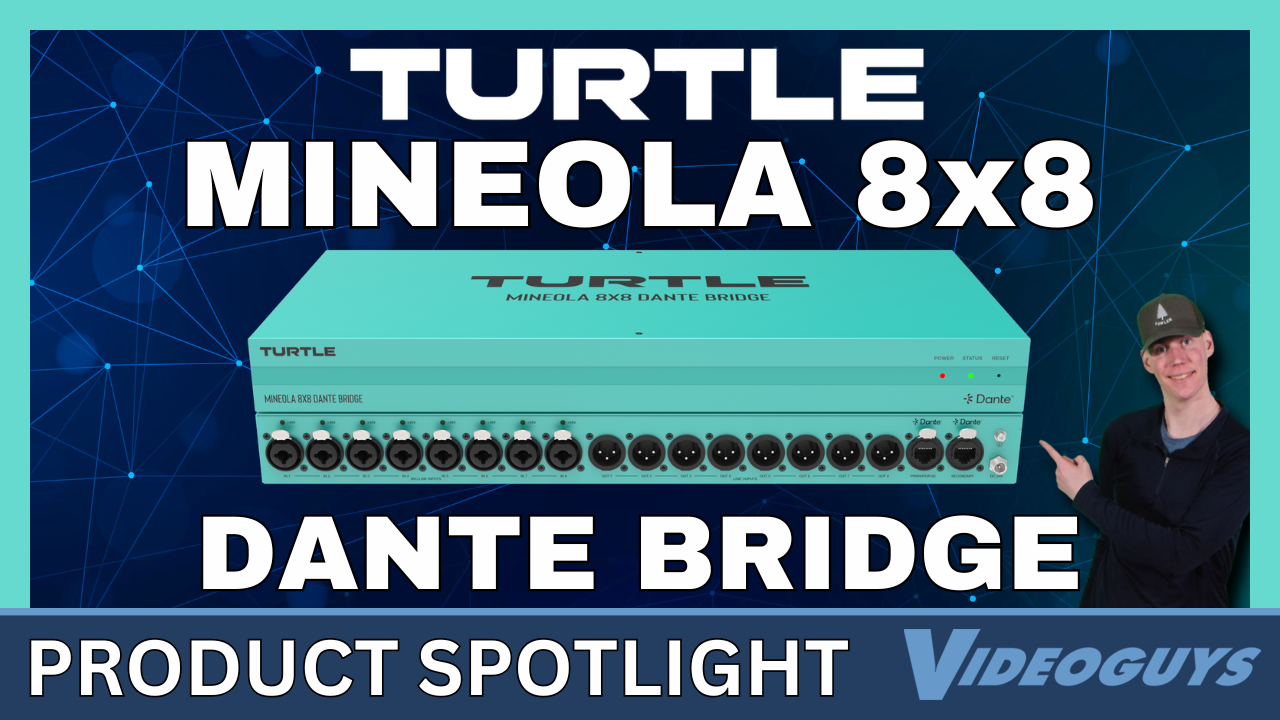
If you’re working in modern AV or broadcast environments, chances are you’re already familiar with Dante Controller and the power of networked audio. But what happens when you need to bring traditional analog gear into that ecosystem?
The Turtle AV Mineola 8×8 is a powerful audio interface designed to bridge the gap between analog audio sources and Dante-enabled networks. Whether you’re connecting microphones, mixers, or other outboard gear, this compact unit simplifies the process—no extra converters or complicated signal chains required.
It’s built for professionals who need reliability, flexibility, and clean audio in environments like live production, broadcast studios, houses of worship, and education facilities.
Key Features That Stand Out
The Mineola 8×8 is packed with features that make it a versatile addition to any AV workflow:
8 Analog Inputs & 8 Outputs Easily route multiple audio sources and destinations with full flexibility.
Combo XLR/TRS Inputs with Mic Preamps Built-in preamps and 48V phantom power let you connect professional microphones directly.
Balanced XLR Outputs Deliver clean, noise-free audio to your downstream equipment.
Dual etherCON Dante Ports Redundant primary and secondary network connections ensure reliability in critical environments.
Power over Ethernet (PoE) Simplifies installation by delivering both power and data over a single cable.
Built-In DSP Control Access EQ, gain, delay, and presets through an intuitive web interface—no external processing required.
Seamless Dante Integration Works effortlessly with Dante-based systems for smooth routing and management.
Why It Matters
Integrating analog audio into a digital network used to require multiple pieces of gear and added complexity. The Mineola 8×8 eliminates those barriers by combining everything into a single, rack-friendly unit.
This makes it ideal for:
Broadcast and live production setups
House of worship installations
Educational AV systems
Corporate and government AV environments
With PoE support and redundant networking, it’s also a strong choice for permanent installs where reliability is critical.
Scalable for Any Workflow
Not every setup needs an 8×8 configuration—and Turtle AV understands that. The Mineola series is available in multiple configurations, including 2×2, 4×4, and 16×16 models, so you can scale your system based on your exact needs.
Whether you’re building a small production rig or a large, multi-room audio network, there’s a Mineola solution that fits.
Built for Professional Use
The Mineola 8×8 is TAA compliant and backed by a 5-year warranty, making it a dependable choice for professional and government applications alike. Its rugged design allows it to fit seamlessly into racks, flypacks, and control rooms without adding unnecessary complexity.
Final Thoughts
The Turtle AV Mineola 8×8 is a smart, efficient solution for anyone looking to integrate analog audio into a Dante network. With robust I/O, built-in DSP, and simple network connectivity, it removes the friction from hybrid audio workflows.
If you’re upgrading your system or designing a new one from scratch, the Mineola 8×8 is a reliable tool that helps future-proof your audio infrastructure while keeping your setup clean and manageable.
Bookmarks in Visual Studio have always been a simple, reliable feature. Many developers use them regularly, and over the years we’ve heard consistent feedback from those users. Bookmarks were useful, but there were a few core gaps that kept them from being as effective and relevant as they could be.
Navigation was one of the biggest pain points. You could move between bookmarks, but there was no easy way to jump directly to a specific bookmark using the keyboard. That made bookmarks harder to rely on once you had more than a few. Another common request was sharing. Bookmarks worked well for personal, local navigation, but there was no good way to share them with teammates or reuse them across repos, branches, or pull requests.
That feedback is what led to Bookmark Studio, a new experimental Visual Studio extension that builds on the existing bookmark experience by filling in those missing pieces, without changing how bookmarks fundamentally work.
Faster, more intentional navigation
One of the core additions in Bookmark Studio is slot‑based navigation.
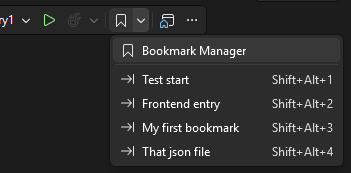
Bookmarks can be assigned to slots 1 through 9 and jumped to directly using simple keyboard shortcuts like Alt+Shift+1 through Alt+Shift+9. This makes bookmarks feel more deliberate and easier to rely on when you want fast access to a handful of important locations.
New bookmarks are automatically assigned the next available slot when possible, so fast navigation often works without any extra setup. Bookmark Studio also integrates with Visual Studio’s existing bookmark commands, which means your current shortcuts and muscle memory continue to work as expected.
A single place to work with bookmarks
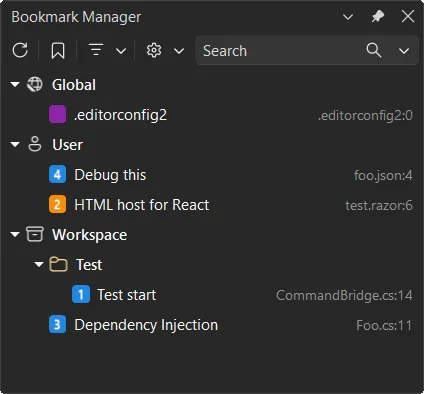
Bookmark Studio also adds a dedicated Bookmark Manager tool window.
The manager shows all bookmarks in one place and makes it easy to browse, search, and navigate between them. You can filter by name, file, location, color, or slot, and jump directly to a bookmark with a double‑click or keyboard navigation. It’s designed to make bookmarks easier to revisit, especially when switching context or coming back to code later.
Optional structure, when you need it
Another piece of feedback we heard was the need for just a bit more organization.
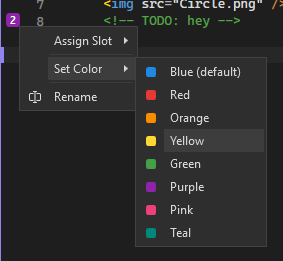
With Bookmark Studio, bookmarks can have labels, colors, and folders. None of this is required, and you can keep using bookmarks exactly as you do today. But when you’re debugging, refactoring, reviewing code, or exploring unfamiliar areas of a codebase, that extra context can make bookmarks more useful and easier to reason about.
All bookmark metadata is stored per solution, so it stays with your work across sessions.
Bookmarks you can share and reuse
Bookmarks are often most valuable when they capture intent, not just location.
Bookmark Studio makes it easy to export bookmarks as plain text, Markdown, or CSV. That means you can include bookmarks in pull requests, share investigation paths with teammates, or move useful bookmark sets between repos. Instead of being a purely personal tool, bookmarks can become a lightweight way to communicate context and decisions.
Bookmarks that stay put as code changes
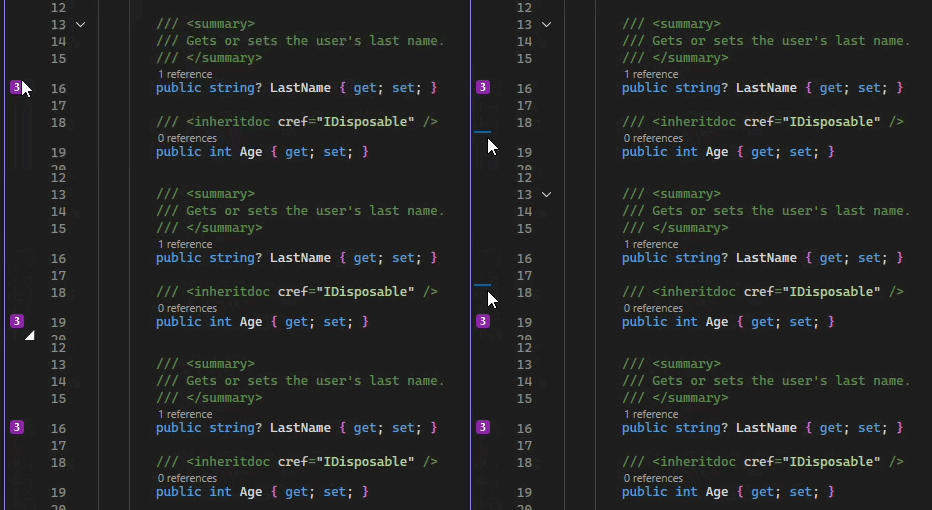
Bookmark Studio tracks bookmarks as text moves during editing, so they stay attached to the relevant code instead of drifting to the wrong line. This makes bookmarks more dependable during active development, especially when files are changing frequently.
A focused improvement, not a reinvention
Bookmark Studio doesn’t try to replace tasks, TODO comments, or issue tracking. It doesn’t introduce a new workflow you have to learn. Instead, it fills in the gaps that many bookmark users have pointed out over time, making bookmarks easier to navigate, easier to share, and more useful as part of everyday development.
If you already use bookmarks in Visual Studio, Bookmark Studio should feel familiar within minutes. And if you’ve ever wished bookmarks could do just a little more, this extension is worth a look.
You can download Bookmark Studio today from the Visual Studio Marketplace. As always, feedback and pull requests are welcome on the GitHub repo.
Google is making Gemini in Google Home feel less robotic and more natural to use.
You no longer need exact commands—Gemini now understands casual phrases and context better.
Device recognition is improved, reducing mix-ups like confusing a “lamp” with a “light.”
Google’s smart home setup is quietly changing in important ways. If you’ve ever struggled with stiff voice commands or awkward controls, you’ll probably relate to this update.
Chief Product Officer Anish Kattukaran announced several improvements on X that make Gemini feel like the helpful housemate you’ve always wanted. The main point is that you no longer have to use technical language to control your living room.
In the past, smart assistants had trouble if you didn’t remember the exact name of a device or a color. Google has redesigned how Gemini understands natural language and recognizes devices. The company says the system now responds faster and is much better at telling apart items with similar names, like a “lamp” and a “light”.
Article continues below
Expressive lighting is here
This new language flexibility leads to one of the best upgrades: expressive lighting. Now, you don’t need to remember exact color names or struggle to describe the mood you want. Instead of searching for the word “cerulean,” you can just ask for “the color of the ocean,” “the glow of the moon,” or even your favorite team’s colors. Gemini understands these requests and picks the right color for your smart bulbs.
There are also big improvements for your larger appliances. Precision controls now let you manage your home devices in detail. You can set exact humidity levels or start dinner early by saying, “Preheat the smart oven to 350°”. For heating and cooling, advanced climate management now supports holding temperature presets. You can also clear active modes without having to go through every option.
The update also makes the assistant available to more people. Early access to Gemini for Home is now live in Mexico, and Spanish language support is available in all supported countries. To try it, update your Google Home app to version 4.12.
Families benefit as well, since kids with supervised Google accounts can now use Gemini for Home along with everyone else. Whether they need help spelling a word or want to hear a new joke, the AI is ready to help them learn and have fun.
Get the latest news from Android Central, your trusted companion in the world of Android
If you use your smart speaker for daily updates, Gemini Live now offers more detailed and interactive news summaries. You can ask, “Catch me up on tech news,” and then ask follow-up questions to learn more about a story during the conversation.
The Android app is also improved. The Google Home app now supports all the new Android 16 features, including edge-to-edge display and predictive back gestures that show you where your back swipe will go.
Android Central’s Take
For months, Gemini felt like a step back from the old Google Assistant. Remember when it couldn’t tell the difference between my “living room lamp” and “living room light”? This update finally shows Google using its AI for real usefulness instead of just making bad poems. Still, let’s not celebrate too much. We’re just getting basic features, like describing “ocean blue” without needing a color code, and turning off heating without cycling through every mode. That’s not innovation; it’s just fixing what should have worked all along.