Zuckerberg caught on hot mic telling Trump ‘I wasn’t sure’ how much to promise to spend on AI in the US


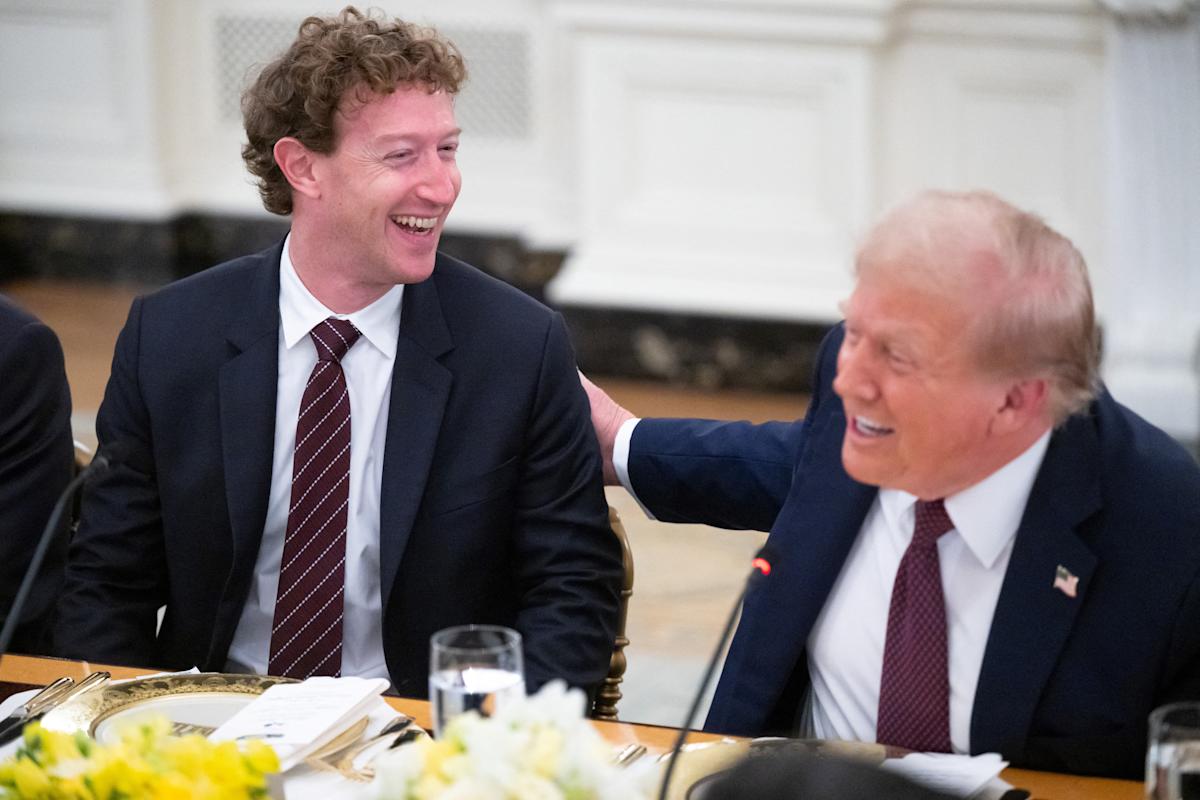
Mark Zuckerberg has certainly come a long way in his relationship with President Donald Trump. Almost exactly a year after the president threatened the Meta CEO with imprisonment, the two sat side-by-side at a White House dinner, alongside numerous other tech CEOs.

The nearly three dozen CEOs and execs in attendance took turns praising and thanking Trump. But Zuckerberg’s comments were especially notable. In one moment that was widely shared on social media, Trump turns to Zuckerberg and asks “how much are you spending, would say, over the next few years?” Zuckerberg responded that it was “probably going to be something like, I don’t know, at least $600 billion through [20]28 in the US.” Trump seemed to approve. “That’s a lot, thank you Mark, it’s great to have you.”  

But it was a hot mic moment captured later between the two that was especially telling. Zuckerberg, turning to Trump, apologizes and says “sorry, I wasn’t ready …I wasn’t sure what number you wanted to go with.” 

You can watch the whole moment play out in the clip below:

While Zuckerberg has spent the last year trying to curry favor with Trump, their interactions show just how much those efforts have been paying off. A year ago, the then-former president was threatening the Facebook founder with jail time. Now, after donating $1 million to his inauguration, changing Meta’s policies and renouncing DEI, adding a pro-Trump booster to his board, paying $25 million to settle a four-year-old lawsuit  and several private meetings, the two seem to have patched things up. Not only is Zuckerberg promising to spend massive amounts on money in the US on AI infrastructure, he’s seemingly confirming that Trump approves of the specific number.

The Mysterious Shortwave Radio Station Stoking US-Russia Nuclear Fears


Since early this year, RIA-Novosti has published roughly one story per week on UVB-76, suggesting its coded messages are related to missile strikes on Iran, the war in Ukraine, and negotiations with Trump.

RT, which had once pooh-poohed the idea that UVB-76 was part of Moscow’s nuclear deterrence, began regularly posting its broadcasts on X, writing in April that the station often broadcasts “coded alerts pre-major events”—particularly around phone calls between Trump and Putin—and suggesting that it operates as a “nuke failsafe.”

Chatter about the station grew on Telegram, the messaging app popular in Russia. Channels claimed that UVB-76 grew active “during periods of escalation” of military activity and that it served as a kind of oracle, sending its coded messages “before global events.” Some of these channels, some with millions of subscribers, are themselves close to the Russian Ministry of Defense.

“In the time of tension between Russia and the West,” Goldmanis says, “such articles are ideal for mounting tension and fear.” There is some irony in the fact that Russians seem to be spooking themselves with tales of their own military communications network, but he argues that it speaks to a deeper fear in Russia: “Fear of losing the war, fear of the state collapse, fear of Western nuclear action, fear of their own government and military.”

All of this domestic shadowboxing, in turn, drove international headlines. The British tabloid The Sun proclaimed that Russia’s “doomsday radio station” had transmitted its “cryptic ‘nuke’ code.” Belgium’s Het Laatste Nieuws reported that the radio messages had caused “heightened alertness among military analysts worldwide.” Politika, a Serbian daily newspaper, penned a lengthy article that claimed that UVB-76 “put fear in the hearts of NATO generals and the Pentagon,” which have been powerless to crack its code. (That article was republished in Russian by RT’s foreign translation service.)

Amid this new attention, Moscow’s communications regulator Roskomnadzor—responsible for monitoring, regulating, and censoring all mass media, including both shortwave radio and the internet—commented on UVB-76 for the first time. A spokesperson for the agency didn’t say much, telling RT that information about the frequency and its purpose “is not publicly available.”

As public interest increased, UVB-76 kept churning out messages. On May 23, an operator read out the code “БЕЗЗЛОБИЕ,” roughly translated to “the absence of malice,” and “ХРЮКОСТЯГ,” or “oink,” followed by a series of numbers. This message, in particular, caught the attention of Dmitry Medvedev.

Medvedev has served as both president and prime minister of Russia and now serves on the hawkish Security Council of Russia as deputy chairman. Analysts at the Institute for the Study of War say Medvedev is frequently deployed by the Kremlin to “inflammatory rhetoric, often including nuclear blackmail, into the information space to spread fear among Western decision-makers and discourage future military aid to Ukraine.”

“Doomsday Radio: May’s ‘lack of malice’ has been replaced by a fierce ‘oink,’” Medvedev wrote on his Telegram channel. Invoking a wave of Ukrainian drone attacks that had roiled Moscow, Medvedev levied thematic insults against the Ukrainians and their backers in Europe: “Pigs,” “hogs,” and “boars.” He ended the post: “Password: ‘БЕЗЗЛОБИЕ.’ Answer: ‘ХРЮКОСТЯГ,’” the two UVB-76 codewords.

“Spasms of the Dead Hand”

Coincidental or intentional, Russia’s new fascination with UVB-76 comes just as it attempts to ratchet up fear of nuclear armageddon. To do that, Moscow is turning to that bit of Cold War lore: The Dead Hand.

Throughout the Cold War, there was a pervasive idea that the Soviets had built some kind of doomsday device. Popularized by films like Fail Safe and Dr. Strangelove, the idea went that Moscow had developed the ability to launch its ballistic missiles, even if all the Communist Party leadership were dead. Such a response could effectively end life on Earth.

It’s the Economy, Donald | WIRED


If economic trends continue, tariffs—which amount, despite the president’s insistence otherwise, to taxes on US companies and ultimately on US consumers—coupled with rising unemployment could be a ticking time bomb.

“If this experiment fails, it’s gonna fail horribly, and I think we’ll begin to see the impacts of that sooner than later,” says a second Trumpworld strategist.

Not Rocket Science

There’s plenty of cope going around in the GOP and the Trump White House.

“I think we’ve shown that the inflation bit has been resolved,” a White House official tells me. “When the private sector is willing to work with us, and is understanding and appreciative of our mandate to reshore manufacturing, we have shown time and time again we are willing to meet with them halfway.”

Could there be more concern about the jobs numbers, particularly given a decline in the labor participation rate and revisions bringing job growth from the hundreds of thousands this spring to the tens of thousands?

“No,” a Republican member of Congress close to the president tells me in a text message when asked if they’re worried about the labor market. “Not at all. Revenue from tariffs have been good. Plus big tax cuts just passed. More to come with potential massive trade deal on 15th.” (August 15th was the day Trump met with Russian president Vladimir Putin in Alaska; no such trade deal materialized.)

Economists I talked to, though, aren’t buying it.

“All signs look pretty pessimistic on the inflation front,” James Angel, a finance professor at Georgetown University, tells me in an email. “You don’t have to be a rocket scientist to figure out that tariffs will increase the prices we pay for imported goods. No amount of spin will change that.”

Justin Wolfers, an economist at the University of Michigan, says the labor market is looking grim even before the tariffs have fully kicked in. There’s “no question job growth has slowed,” he says.

Wolfers adds that one of Trumpworld’s biggest justifications for the tariffs not being a big deal for American consumers simply doesn’t hold up. As the first Trumpworld strategist pointed out, some companies—most notably American automakers like General Motors—have shown in their earnings reports that they’re willing to eat the cost of the tariffs at the expense of their own profits.

“That’s what you would normally expect to happen in the short run, because businesses don’t change their prices minute-by-minute every time the president opens his mouth,” Wolfers says. “Now that the tariffs are set, and they’re seeing margin compression, that’s the point at which you’d expect businesses to start to think about repricing.”

Wolfers says consumers should expect to feel more pain “in the second half of this year.”

Angel says that even a continuation of the status quo with perpetually delayed tariffs could still have devastating consequences.

“The economic chaos with on-again, off-again tariffs has caused business and consumer expectations to drop,” the Georgetown professor explains. “That in itself is likely to cause a recession.”

Citizen Cope

Trump’s vendetta against Federal Reserve chairman Jerome Powell doesn’t calm my sources’ jitters, as Trump has made clear that he would like Powell’s eventual replacement to cut interest rates, even if doing so conflicts with the Fed’s dual mandate of keeping prices stable and employment full.

It also doesn’t help, sources tell me, that Trump fired the head of the Bureau of Labor Statistics after the most recent job numbers showed significant revisions and a slowdown in hiring over the past several months. (EJ Antoni, Trump’s pick to lead the BLS, has little relevant experience beyond being the Heritage Foundation’s chief economist; as WIRED reported, a now-deleted Twitter account using his name showed a fixation on red-pilled conspiracy theories.)

Trump’s administration may look to buy a stake in Intel


Intel has had some recent struggles in delivering results for its shareholders, but the company could soon be answering to an additional boss. The current administration is reportedly in talks to have the US government acquire a stake in the chipmaker. Bloomberg first reported the news without specifics about the size or value of the potential share the government wants to buy. According to a newer report by Bloomberg and The New York Times, the Trump administration is looking to take a 10 percent stake in Intel as part of its efforts to give domestic chip manufacturing a boost.

The administration is reportedly considering converting the $10.86 billion in federal grants Intel is getting from the US Chips and Science Act into equity instead. It’s still early days, and the White House is still deciding on the exact size of the stake. Intel initially shared plans to construct a semiconductor facility in Ohio in 2022 while Pat Gelsinger was still at the helm of the company. Since then, the project has faced delays, and at its latest quarterly earnings report, execs said Intel would “slow the pace” on the Ohio construction, as well as scrapping other international building plans and making workforce cuts.

The potential for government ownership of Intel is the latest swing of the administration’s attitude toward the company. A few days after calling for his resignation over connections to China, President Donald Trump met with CEO Lip-Bu Tan and seemed to now hold a more positive outlook on the company leader.

A representative from Intel told Bloomberg in a statement that the company is “deeply committed to supporting President Trump’s efforts to strengthen US technology and manufacturing leadership. We look forward to continuing our work with the Trump administration to advance these shared priorities, but we are not going to comment on rumors or speculation.”

Update, August 18 2025, 10:31AM ET: This story has been updated to include new reports that the Trump administration is looking to take a 10 percent stake in Intel.

Trump Says Pam Bondi Should Release Part of Epstein Files


President Donald Trump angered his own supporters recently when his U.S. Department of Justice said it wouldn’t be releasing any more information about the late sex offender Jeffrey Epstein. But after days of outrage, including from the Deputy Director of the FBI, Dan Bongino, Trump is now signaling that Attorney General Pam Bondi might release something. Still, don’t expect to see anything that would make Trump look bad.

Trump spoke to reporters outside the White House on Tuesday and was asked about recent comments by his daughter-in-law, Lara Trump, who said that there should be “more transparency” around the so-called Epstein files. Trump said Bondi had “handled that very well” but claimed “credibility is important,” suggesting that much of what’s in the files isn’t credible.

Trump, who was a friend of Epstein’s for years, was asked by reporters whether he had been briefed on the files by his AG and whether his own name appeared anywhere. Trump insisted it had been a “very quick briefing,” and went on to give a simple “no” about whether his name was in the files.

“No, no, she’s given us just a very quick briefing. And in terms of the credibility of the different things that they’ve seen,” Trump said.

The president then went into a conspiracy theory that he seems to have concocted in recent days, which purports that his political adversaries had invented the files. “And I would say that, you know, these files were made up by Comey,” Trump said, referring to the former FBI director James Comey, who the president fired in 2017.

“They were made up by Obama,” Trump continued, “they were made up by the Biden… you know. And we went through years of that with the Russia, Russia, Russia hoax. With all of the different things that we had to go through, we’ve gone through years of it.” Trump first made that claim in a Truth Social post on July 12.

But then Trump said that perhaps Bondi could release files that she thinks are “credible,” without elaborating on what that means in Trump’s eyes. “But she’s handled it very well. And it’s going to be up to her,” Trump said of Bondi. “Whatever she thinks is credible, she should release.”

The Trump regime had previously promised to release all of the files, even holding a media event at the White House back in February where right-wing influencers received binders marked “Epstein Files: Phase 1,” implying there would be more to come. As it turned out, nothing in those binders was new information.

There is some truth to the fact that the FBI and DOJ, more broadly, are reluctant to release files that may implicate innocent parties who spoke with law enforcement. The Privacy Act of 1974 was passed to provide those kinds of protections. The reason the FBI releases files on celebrities only after they’ve died is due to that federal law, and even then, the names of living people are often still redacted. Dead people don’t have privacy rights under U.S. law.

But many Americans still want answers about the Epstein case, perhaps because Trump’s attitude that there’s nothing to reveal is so suspicious, given the attitude of his other top officials. Bongino and Patel spent years insisting the Epstein files should be released, suggesting the late sex offender didn’t really kill himself, but then pulling a 180 as soon as they got into power.

Bongino has reportedly clashed with Bondi over the issue, even not showing up for work last Friday after an explosive argument, according to multiple reports. And it’s not clear what his future looks like at the agency. Credible news outlets say he’s back at work, but he hasn’t tweeted since July 9.

Bondi herself seemed eager to release whatever files were available until relatively recently. She verbally stumbled when asked about the files during a cabinet meeting last week, and Trump cut in to berate reporters and ask why people were still asking about Epstein at all. Bondi also attempted to explain why a full minute was missing from the nearly 11 hours of “raw” video released from outside Epstein’s jail cell. As Wired reported, the video wasn’t really raw, but was edited with software like Adobe Premiere Pro.

Donald Trump and Jeffrey Epstein hang out
From left, Donald Trump and his girlfriend (and future wife), former model Melania Knauss, financier (and future convicted sex offender) Jeffrey Epstein, and British socialite Ghislaine Maxwell pose together at the Mar-a-Lago club, Palm Beach, Florida, February 12, 2000. (Photo by Davidoff Studios/Getty Images)

For their part, right-wing influencers seem to be making an effort to tell everyone to drop the Epstein story. Charlie Kirk said he doesn’t want to talk about Epstein anymore when there are more important stories like NATO, and Dinesh D’Souza, who received a pardon from Trump, told his listeners that people should “move on.” Tim Pool has even claimed that Democrats still calling for the release of the Epstein files just want to see “child porn.”

It seems pretty clear that the vast majority of Americans, to say nothing of the most diehard conspiracy theorists, are not ready to just move on. Just 3% of Americans say they’re satisfied with the amount of information the government has released about the Epstein case, according to CNN. Fifty percent say they’re dissatisfied, with 29% saying it doesn’t matter to them either way, and the rest saying they haven’t heard enough to have an opinion.

Whatever Trump and Bondi decide to do, this story isn’t going away anytime soon.

Elon Musk’s New Political Party Sparks MAGA Backlash Online


The suspense is finally over. Elon Musk, the visionary behind Tesla and SpaceX, officially declared the formation of a new political party on Saturday, July 5, 2025. His stated aim: to challenge the long-standing dominance of both the Republican and Democratic parties.

“Today, the America Party is formed to give you back your freedom,” the controversial tech entrepreneur announced on X (formerly Twitter) at 3:46 PM ET.

The creation of the “America Party” is nothing short of a bombshell, particularly given Musk’s significant financial contributions and political alignment with Donald Trump in the lead-up to the 2024 presidential election. Last year alone, Musk spent nearly $290 billion to support Trump’s return to the White House. This timely alliance granted the self-described “Techno King” an unprecedented level of influence for a tech entrepreneur in American politics. Trump, in turn, entrusted Musk with a custom-created federal department: the now infamous Department of Government Efficiency, or DOGE.

DOGE, however, quickly became a lightning rod for criticism, seen by many as emblematic of the very dysfunctions it was meant to fix within the federal government. Its methods and decisions, including the closure of federal agencies and drastic cost cutting at essential institutions, provoked widespread rejection of the billionaire.

This backlash manifested in protests outside Tesla showrooms, a drop in the electric vehicle maker’s stock price, and a noticeable plunge in profits and sales. Tesla’s sales erosion continued into the second quarter of 2025, during which the carmaker’s global deliveries fell by 13.5%. Tesla’s reputation, and that of Musk, suffered significantly, especially as the carmaker’s customer base heavily includes progressives and liberals who viewed his political alignment as a sharp departure from their values. Under increasing pressure from the markets, Musk formally withdrew from his government role at the end of May.

His public fallout with Trump began almost immediately after his departure, marked by a public spat between the two powerful figures on June 5. After a few weeks of relative calm, Musk reignited the feud by sharply criticizing the “One Big Beautiful Bill,” President Trump’s signature piece of legislation. He then publicly vowed to launch a political party and do everything he could to defeat Republican elected officials who voted for it.

As promised, on June 30, Musk formalized the political party he had previously hinted at, following the bill’s signing into law. The initial post announcing the party’s formation generated more than 3 million views in less than an hour, signaling the immediate and widespread attention it commanded.

Reactions on X, Musk’s social network, were acutely mixed. Users who visibly supported the MAGA movement and the Grand Old Party (GOP) expressed palpable disappointment and anger. Many lamented that the billionaire’s decision would, at best, fracture the conservative vote and, at worst, pave the way for Democratic victories in upcoming elections, particularly the crucial 2026 midterms.

“Why not just try and take over the GOP with more America First candidates?” asked one user, clearly disheartened by the billionaire’s move.

Roger Stone, a long time ally of President Trump, weighed in, commenting, “I have huge respect for @elonmusk and everything he has done for free speech and to ferret out waste fraud and corruption in federal spending. But I would rather see him pursue his efforts at electoral reform within the Republican Party primaries rather than having a new party splitting the vote of sane people and letting the Marxist Democrats gain control again.”

Another disappointed user questioned the legitimacy of the decision: “So a little over a million people across the entire world take your poll and you’re convinced this is what Americans want? And you do understand Democrats (who now despise you) would vote yes, knowing that you’ll end up splitting the Republican party. Don’t do this.”

“@elonmusk you need to rethink this one,” one user pleaded. “All you can hope to accomplish is to hand power over to democrats for decades with a successful 3rd party.”

An angry user directly challenged Musk’s character: “Has anyone thought about the fact that Elon Musk turned his back on someone he called a friend because things weren’t going his way? This is the kind of person you want to get behind?”

“This will fracture the right and split the vote. I’m against this, and so should you,” another user declared.

“I hope you know what you’re doing, Elon, because if you don’t, you’re about to hand over the Democrats to Congress, and then we’ll be completely out of options,” another user cautioned.

Conversely, other users, many of them avid fans of the billionaire, seemed amused by the announcement, which did not appear to surprise them. “You do throw a decent party 🎉😂,” joked Jason Calacanis, a well known tech investor and friend of Musk.

“Good split the GOP vote,” rejoiced another user, while another enthusiastically proclaimed, “Rest in Peace to the Republican Party!”

Prominent political scientist Ian Bremmer commented simply, “The people have spoken.” Another user expressed confidence in Musk’s judgment: “Your instincts have a good track record. I hope they are correct once again.”

Musk remains convinced that neither the Republicans, who currently control the government, nor the Democratic opposition adequately represent a significant portion of Americans. He appears confident that the political environment is favorable for a new movement. Data from a 2024 Gallup study suggests broad dissatisfaction with the two major parties: 43% of Americans identified as independents, while only 28% identified as Republican and 28% as Democrat.

With a net worth estimated at $361 billion by the Bloomberg Billionaire Index as of July 4, Musk certainly possesses the financial capacity to pursue his ambitious political endeavor.

European leaders worry they’re too reliant on U.S. tech


European governments may be reconsidering their use of American technology and services, according to a new report in The New York Times.

The flashpoint seems to come after President Donald Trump sanctioned Karim Khan, the chief prosecutor at the International Criminal Court, over the ICC’s decision to issue arrest warrants for Israel’s Prime Minister Benjamin Netanyahu and former defense minister Yoav Gallant.

In response, Microsoft turned off Khan’s email address. Casper Klynge, a former diplomat who has also worked for Microsoft, told the NYT that Microsoft’s action became “the smoking gun that many Europeans had been looking for,” pushing them to look at alternative options. (Some ICC workers have reportedly switched over to Swiss email service Proton, for example.)

“If the U.S. administration goes after certain organizations, countries or individuals, the fear is American companies are obligated to comply,” Klynge said.

For its part, Microsoft said it has subsequently made policy changes to protect customers similar situations, and it noted that it did not shut down the email accounts of four ICC judges who Trump sanctioned earlier this month. In addition, just this week, CEO Satya Nadella announced new “sovereign solutions” to protect European institutions.

Elon Says Trump Is ‘in the Epstein Files’ as Their Relationship Publicly Implodes


Everyone knew the day would come when the relationship between Elon Musk and Donald Trump actually imploded. And that day is finally here, with Musk going scorched-Earth and now saying Trump is in the “Epstein Files,” a reference to the late pedophile Jeffrey Epstein.

“Time to drop the really big bomb: @realDonaldTrump is in the Epstein files. That is the real reason they have not been made public. Have a nice day, DJT!” Musk wrote on X.

The open feud between the two men started when President Trump said he was “very disappointed” in Musk during a press conference in the White House on Thursday, suggesting the billionaire might be developing “Trump Derangement Syndrome” after he criticized the so-called Big Beautiful Bill. Trump even poked fun at Musk’s black eye, saying, “Do you want a little makeup?”

Now Musk is having a full-blown meltdown on his social media platform X, retweeting memes making fun of Trump, joking that Trump may have been replaced with a body double, and saying it might be time to form a new political party. There’s also the accusation that Trump is in “the Epstein Files,” the long-fabled government files showing the powerful people who were associated with Epstein. Trump was rather openly Epstein’s friend for years, but many MAGA supporters refuse to believe there was anything nefarious happening between the two.

“Without me, Trump would have lost the election, Dems would control the House and the Republicans would be 51-49 in the Senate,” Musk wrote Thursday. “Such ingratitude.”

Musk, who reportedly spent over $250 million in the 2024 election to help elect Trump and other Republicans, was responding in his tweet to a video of Trump saying he was “very disappointed” in the billionaire.

Musk also wrote, “Remember this @realDonaldTrump?” while quote-tweeting a video from March where Trump essentially did an ad for Tesla at the White House. The president bought a Tesla after the publicity stunt, which was one of many blatantly unethical moves by the two men during Musk’s stint as the head of DOGE. In the video, Trump can be heard calling Musk a “patriot” who has “never asked me for a thing.

Musk also retweeted a meme from an account called Not Jerome Powell that uses the format of a Trump interview from his first term with Jonathan Swan. The meme shows Trump saying, “I have a plan to cut spending” before handing Swan a piece of paper that reads “increase spending.”

Meme retweeted by Elon Musk making fun of Donald Trump.
Screenshot: X

Musk responded to Trump’s claims in the televised Oval Office press conference on Thursday that he only got upset after EV “mandates” had been killed, though it seems like the two men may have been confused about what the other was talking about.

“This is me in 2021!” Musk tweeted, sharing a video clip where he said Tesla didn’t need to rely on tax credits anymore. Trump seemed to be talking about a bill passed by Republicans in the Senate last month that makes it illegal for states like California to phase out vehicles with internal combustion engines. But the so-called Big Beautiful Bill doesn’t include anything about mandates, instead killing the tax credits that people can get for buying EVs. However, Musk obviously has benefited from government intervention, which has put billions of dollars in his pocket over the years.

Whatever Trump and Musk meant when it comes to the details of legislation around electric vehicles, these guys are clearly lashing out in ways that were long predicted. There have long been rumors that Trump didn’t like Musk, but they were clearly able to put their personal differences aside and work together in their quest to destroy the federal government.

Trump hit back during Musk’s tweet-storm with some posts of his own Thursday, really starting to put some oomph into his newfound hate for the billionaire oligarch.

Post from Donald Trump about Elon Musk on June 5, 2025.
Screenshot: Truth Social

“Elon was ‘wearing thin,’ I asked him to leave, I took away his EV Mandate that forced everyone to buy Electric Cars that nobody else wanted (that he knew for months I was going to do!), and he just went CRAZY!” Trump wrote.

Then Trump delivered a line that every oligarch hates to hear. The president said he might have to take away Musk’s billions in subsidies and contracts.

Post from Donald Trump about Elon Musk on June 5, 2025.
Screenshot: Truth Social

“The easiest way to save money in our Budget, Billions and Billions of Dollars, is to terminate Elon’s Governmental Subsidies and Contracts. I was always surprised that Biden didn’t do it!” Trump wrote. Musk heavily relies on government contracts through his companies like SpaceX.

Musk responded to the threat with a quote-tweet about someone ending the contracts for SpaceX’s work shuttling astronauts to the International Space Station. “This just gets better and better,” Musk wrote with two crying-laughing emojis. “Go ahead, make my day…”

Social media sites also started to become filled with memes on Thursday, making fun of the rift between the two men, including a Mean Girls reference.

Ashley St. Clair, the right-wing author and mother of one of Musk’s children, also chimed in on X, writing, “hey @realDonaldTrump lmk if u need any breakup advice.” 

Tesla’s stock is down 14% on the day at the time of this writing, with a share price of $284. And while Musk always seems to find a way to juice his stock with whatever new shiny object he can concoct, this rift with Trump and disillusionment with MAGA is sure to be a hurdle for the short term. When Musk is dropping references to Trump being in the so-called Epstein files, you know things are going to only get messier from here.


Elon Musk tries to stick to spaceships


Elon Musk’s interview with CBS Sunday Morning seemed to get off to an awkward start, as reporter David Pogue asked the SpaceX CEO about his thoughts on his ally Donald Trump’s policies, including growing restrictions on international students.

“I think we want to stick to the subject of the day, which is, like, spaceships, as opposed to, you know, presidential policy,” Musk said.

Pogue looked surprised, replying, “Oh, okay, I was told, ‘Anything’s good.’”

“No,” Musk said, while looking into the distance. “Well … no.”

He did, however, comment on the controversy around his Department of Government Efficiency, which has been making aggressive cuts across federal agencies, and which Musk complained had become “the whipping boy for everything.”

“If there was some cut, real or imagined, everyone would blame DOGE,” he said.

Musk also suggested that he’s “a little stuck in a bind” when it comes to the Trump administration, where “I don’t want to speak out against the administration, but I also don’t want to take responsibility for everything the administration’s doing.”

Pogue’s interview was conducted before SpaceX’s Starship test flight on Tuesday, which saw the ship successfully launch but lose control on reentry. Asked whether there’s anything linking his various companies — in addition to SpaceX, there’s Tesla (which faces ongoing anti-Musk protests), xAI and X (formerly Twitter), Neuralink, and The Boring Company — Musk replied, “I guess you could think of the businesses as things that improve the probable trajectory of civilization.”

At the time, Musk was supposedly pulling back from his government work but said he would remain involved for a “day or two” per week. He told Pogue, “DOGE is going to continue, just as a way of life. And I will have some participation in that, but as I’ve said publicly, my focus has to be on the companies at this point.”

Pogue noted that after their conversation, an interview clip of Musk’s comments criticizing the Trump-backed budget bill drove a news cycle of their own — and soon after, Musk said he was ending his time as a special government employee. Trump, however, subsequently said Musk is “not really leaving.”

The Middle East Has Entered the AI Group Chat


Donald Trump’s jaunt to the Middle East featured an entourage of billionaire tech bros, a fighter-jet escort, and business deals designed to reshape the global landscape of artificial intelligence.

On the final stop of the tour in Abu Dhabi, the US president announced that unnamed US companies would partner with the United Arab Emirates to create the largest AI datacenter cluster outside of America.

Trump said that the US companies will help G42, an Emirati company, build five gigawatts of AI computing capacity in the UAE.

Sheikh Tahnoon bin Zayed Al Nahyan, who leads the UAE’s Artificial Intelligence and Advanced Technology Council and is in charge of a $1.5 trillion fortune aimed at building AI capabilities, said the move will strengthen the UAE’s position “as a hub for cutting-edge research and sustainable development, delivering transformative benefits for humanity.”

A few days earlier, as Trump arrived in Riyadh, Saudi Arabia announced Humain, an AI investment firm owned by the kingdom’s Public Investment Fund. The Saudi firm launched with blockbuster deals already inked with Nvidia, AMD, Qualcomm, and AWS—US tech giants capable of building the infrastructure needed to train and power cutting-edge AI models.

Trump said in a speech in Riyadh that US and Saudi companies would do deals worth hundreds of billions of dollars, with a focus on infrastructure, tech, and defense.

The deals forged in the Middle East this week are meant to strengthen the global importance of American silicon and AI, but they will also help nations like Saudi Arabia play a more significant role in the global race to develop and distribute cutting-edge technology.

“It will help the Saudis and the UAE become bigger players in providing AI infrastructure,” says Paul Triolo, a partner at DGA-Albright Stonebridge Group, a geopolitical consulting group. “It’s a big deal to get access to these GPUs.”

Saudi Arabia’s deal with Nvidia, which dominates the market for AI training hardware, will amount to 500 megawatts of capacity and involve “several hundred thousand of Nvidia’s most advanced GPUs over the next five years,” the company said in a statement.

According to one estimate, this could translate to around 250,000 of Nvidia’s most advanced chips, which are four times better at training and 30 times better at inference (running models that have already been trained) than the next-best offering. This capacity could lead Saudi Arabia to create frontier AI models.

AWS and Humain said they would jointly invest $5 billion in infrastructure in Saudi Arabia. AWS said in March that it will build an AI infrastructure zone in the country, investing more than $5.3 billion. Humain and AMD said they would spend $10 billion on AI infrastructure in Saudi Arabia and the US over the next five years.

Saudi Arabia, the UAE, and other nations in the region have vast quantities of oil money, access to plenty of power, and a strong desire to shift toward more high-tech economies by building out cutting-edge tech infrastructure. The countries also, however, have significant business ties to China, which sells technology to the region, placing them at the nexus of a growing geopolitical rivalry over the future of AI.

Diffusion Rule

A few days before Trump’s visit to the Middle East, his administration reversed a major Biden-era ruling that would have limited the sale of cutting-edge chips globally. The directive created tiers of nations with different access to cutting edge chips, and sought to limit how many chips Saudi Arabia and the UAE could buy. Critics of the rule suggested it might push some countries to buy Chinese technology instead.

In a statement announcing the change, the US Bureau of Industry and Security said the Biden rule “would have stifled American innovation and saddled companies with burdensome new regulatory requirements” and “undermined U.S. diplomatic relations with dozens of countries by downgrading them to second-tier status.”