SpaceX’s ninth test flight of Starship launches into space, ends in a spin


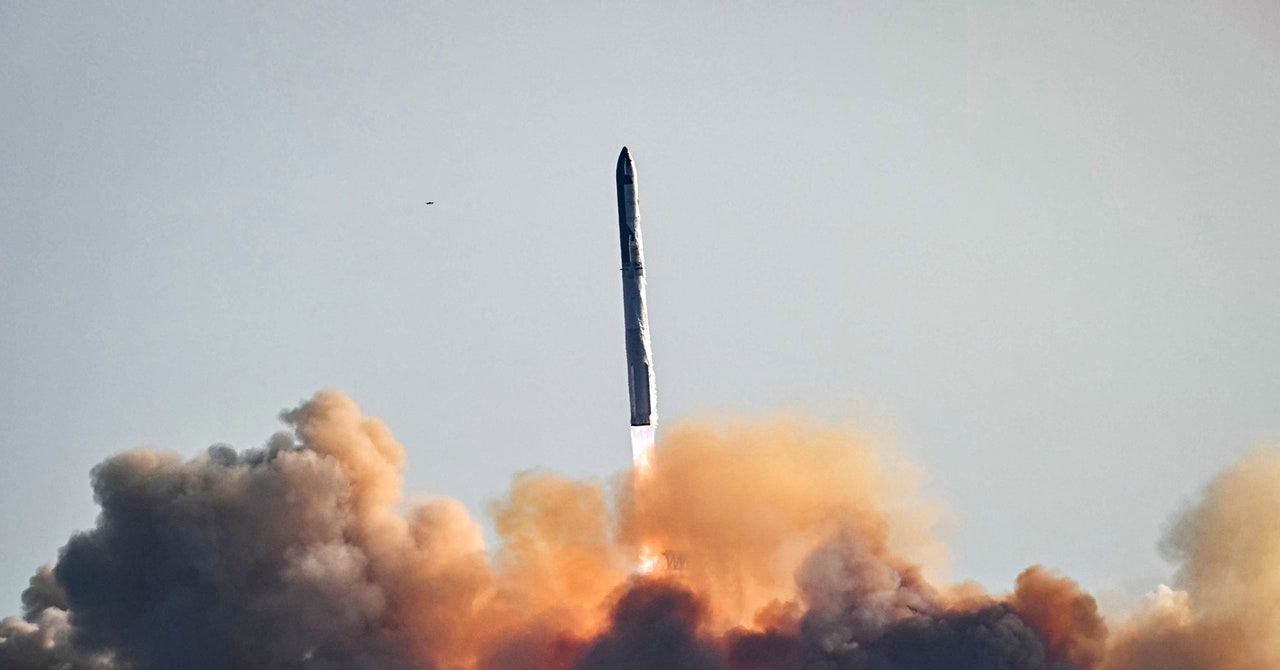
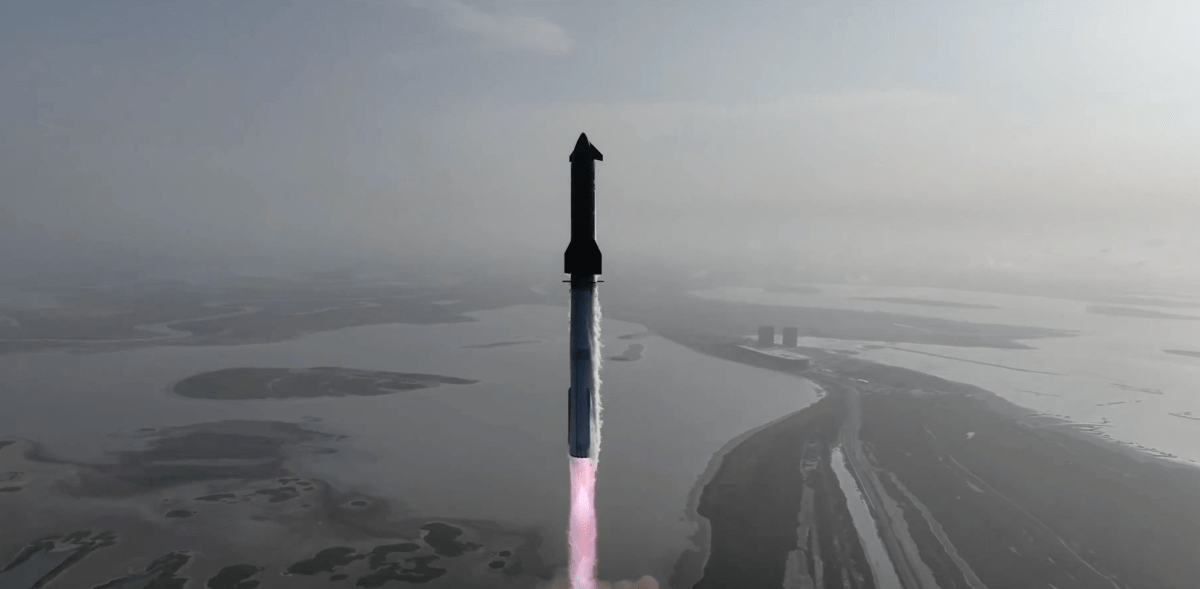
SpaceX’s Starship successfully separated from its Super Heavy rocket booster and reached orbit Tuesday evening, but later began spinning and made an uncontrolled re-entry into the Indian Ocean. SpaceX had cleared the surrounding airspace where Starship was coming down, according to the company.

The ninth test flight provided a mix of successes and failures for the company. It was the smoothest Starship test of the year, following two consecutive explosions. Starship, launched atop the Super Heavy booster, lifted off from SpaceX’s facility in southern Texas on Tuesday evening. It was also the first launch to use a flight-proven Super Heavy booster, which had launched and returned during Starship’s seventh flight test.

The heavy booster successfully separated and Starship entered space. But the ship was unable to open a side cargo hatch to deploy mock satellites in one planned test. Later in the flight, Starship lost attitude control, meaning it could no longer orient itself properly for re-entry.

The ninth flight test came less than a week after the Federal Aviation Administration cleared SpaceX to perform the test flight of its Starship rocket system following those back-to-back explosions earlier this year.

In January, SpaceX caught the Starship’s heavy booster rocket on its descent for a second time. Starship successfully separated from the booster and ignited its rockets to ascend to orbit, but it was soon lost after suffering an anomaly. Debris from Starship fell into the airspace near Puerto Rico, prompting the FAA to reroute several aircraft in the airspace.

SpaceX conducted another test in March. This time, the Super Heavy booster successfully separated was caught by the launch tower in Texas for a third time. Starship reached space, but eight minutes into the flight, the ship lost multiple Raptor engines and began to spiral.

As a result of the two explosions, the FAA expanded the size of hazard areas in the U.S. and other countries for the flight based on an updated safety analysis provided by SpaceX. After completing an investigation in the loss of Starship on its eighth flight test, SpaceX made several hardware changes to increase reliability.

Trump fires Copyright Office director after report raises questions about AI training


President Donald Trump has fired Shira Perlmutter, who leads the U.S. Copyright Office.

The firing was reported by CBS News and Politico, and seemingly confirmed by a statement from Representative Joe Morelle, the top Democrat on the Committee for House Administration.

“Donald Trump’s termination of Register of Copyrights, Shira Perlmutter, is a brazen, unprecedented power grab with no legal basis,” Morelle said. “It is surely no coincidence he acted less than a day after she refused to rubber-stamp Elon Musk’s efforts to mine troves of copyrighted works to train AI models.”

Perlmutter took over the Copyright Office in 2020, during the first Trump administration. She was appointed by Librarian of Congress Carla Hayden, who Trump also fired this week.

Trump alluded to the news on his social network Truth Social, when he “ReTruthed” a post from attorney Mike Davis linking to the CBS News article. (Confusingly, Davis seemed to criticize the firing, writing, “Now tech bros are going to attempt to steal creators’ copyrights for AI profits.”)

As for how this ties into Musk (a Trump ally) and AI, Morelle linked to a pre-publication version of a U.S. Copyright Office report released this week that focuses on copyright and artificial intelligence. (In fact, it’s actually part three of a longer report.)

In it, the Copyright Office says that while it’s “not possible to prejudge” the outcome of individual cases, there are limitations on how much AI companies can count on “fair use” as a defense when they train their models on copyrighted content. For example, the report says research and analysis would probably be allowed.

Techcrunch event

Berkeley, CA
|
June 5


BOOK NOW

“But making commercial use of vast troves of copyrighted works to produce expressive content that competes with them in existing markets, especially where this is accomplished through illegal access, goes beyond established fair use boundaries,” it continues.

The Copyright Office goes on to suggest that government intervention “would be premature at this time,” but it expresses hope that “licensing markets” where AI companies pay copyright holders for access to their content “should continue to develop,” adding that “alternative approaches such as extended collective licensing should be considered to address any market failure.”

AI companies including OpenAI currently face a number of lawsuits accusing them of copyright infringement, and OpenAI has also called for the U.S. government to codify a copyright strategy that gives AI companies leeway through fair use.

Musk, meanwhile, is both a co-founder of OpenAI and of a competing startup, xAI (which is merging with the former Twitter). He recently expressed support for Square founder Jack Dorsey’s call to “delete all IP law.”

Musk clashes with neighbors in exclusive Austin suburb


Elon Musk may have a sizable fan base, but residents of the upscale Austin suburb of West Lake Hills, Texas, are unimpressed by their celebrity neighbor, reports the New York Times. Instead, a $6 million home Musk purchased in 2022 has become the center of a battle after his team erected an unauthorized 16-foot chain-link fence, installed a metal gate, and mounted outward-facing cameras.

“I call that place Fort Knox,” says Paul Hemmer, a Tesla owner and retired real estate agent who lives across the street and serves as president of the neighborhood homeowners association.

Musk’s security personnel, many visibly armed, and their vehicles have disrupted the tranquil street, and the prospect of his return from Washington has some worried over more than Musk’s failure to obtain construction permits. “If you follow him at all in the news, he’s always guilty of building stuff and then asking for permission later,” Hemmer complained in a planning meeting.

For Hemmer, the billionaire’s proximity may come at the steepest price. Per the Times, Musk’s security team once reported him to police, claiming he was naked in the street. Hemmer, who has flown drones over Musk’s house looking for ordinance violations, countered he was on his own property in his underwear.

We Mapped DOGE’s Silicon Valley and Corporate Connections


Since the first days of the Trump administration, Elon Musk’s so-called Department of Government Efficiency (DOGE) has been everywhere in the federal government, moving fast and breaking things. In a matter of weeks, DOGE operatives have spread across dozens of government agencies as they have attempted to terminate tens of thousands of federal employees. With so much focus on where DOGE is going, WIRED wanted to take a beat to look at where they’ve come from and what that might tell us about how they’re thinking about reshaping the federal government.

The big takeaway: Many on the DOGE team are from Musk’s world. If Musk is America’s CEO, then DOGE has become his Silicon Valley executive branch.

We’ve mapped out a non-exhaustive list of people affiliated with DOGE, including creating a searchable table with each member, their corporate history, and the agencies they’ve been connected to. Readers can check that out, and click through it, below. We plan to keep updating this as we find more DOGE operatives or as known affiliates move to new agencies.

We’re focused on the new people brought in under the second Trump administration or directly hired into agencies—as Special Government Employees (SGEs) or regular employees—who are operating as members of DOGE teams. This gets a little tricky because there are technically two DOGEs established under the president’s executive order. There’s the US DOGE Service (USDS), formerly the US Digital Service, that’s a permanent organization. Then there’s the temporary USDS organization, which wraps up on July 4, 2026, and through which SGEs can be hired.

Here’s what we’ve learned:

The DOGE world, as it stands, seems to break down into roughly three categories: former Trump officials, conservative lawyers, and imports from the Silicon Valley area (funders, founders, technologists, or people connected to them). In that first category we find people like DOGE spokesperson Katie Miller, the wife of White House deputy chief of staff for policy Stephen Miller. The two of them have been Musk’s guides to DC.

In that second category are people like James Burnham and Austin Raynor, both former clerks for conservative Supreme Court justices Neil Gorsuch and Clarence Thomas, respectively. Jacob Altik, another conservative lawyer on the DOGE squad, has been selected to clerk for Gorsuch. Jeremy Lewin, who was part of DOGE’s dismantling of the United States Agency for International Development (USAID), worked with Second Lady Usha Vance’s former law firm Munger, Tolles & Olson, a firm that has also represented Tesla.

Then, the biggest throughline of all: Of those Silicon Valley imports, one of the most clear themes across DOGE’s ranks is fairly obvious: a connection to Elon Musk. Forty-nine people on our list have connections to Musk, his companies, or his greater network. This connection is most often through one of his allies or one of his companies. There are the obvious people like Steve Davis, president of Musk’s Boring Company, who have followed Musk across his various ventures. (Davis previously worked at SpaceX and assisted Musk in his overhaul of X, formerly Twitter.) Davis spearheaded the DOGE recruitment efforts before inauguration day and has continued to play a pivotal role in the organization. Similarly, SpaceX employee Brian Bjelde, who is now at the Office of Personnel Management (OPM), also helped Musk downsize Twitter’s staff in 2022.

There are people like many of the young engineers WIRED first identified who were given the keys to different government agencies, like Marko Elez, Luke Farritor, and Edward Coristine, who were all interns or employees at one of Musk’s companies: SpaceX, Tesla, xAI, X, and Neuralink. (Musk has been involved in others, but these are the ones he controls.)

Not Even DOGE Employees Know Who’s Legally Running DOGE


Before Trump was inaugurated, the USDS administrator was Mina Hsiang. After she left, Ted Carstensen was the highest-ranking legacy USDS leader, but he resigned from the organization on February 6.

“After Ted resigned, we received no correspondence as far as who the head of this organization was,” says a current USDS employee, who requested anonymity due to concerns of retaliation.

Some people WIRED spoke with at USDS view Amy Gleason, a former USDS official who served in the first Trump administration, as a liaison between legacy USDS, DOGE, and other agencies, but little is known about her official role. Steve Davis, a longtime Musk associate and the president of the Boring Company, is another name rumored to be formally leading DOGE. Davis has worked with Musk for years, and led the billionaire’s cost-cutting efforts when taking over Twitter, now X, in 2022. Davis went as far as sleeping in the Twitter HQ with his wife, Nicole Hollander, and their child. (Hollander is now a high-level General Services Administration official.)

“Steve Davis has always been articulated as the leader of DOGE, but when I ask if he’s the administrator, [managers] say we don’t know,” one former USDS employee tells WIRED. “When I ask if he’s the interim administrator, they say ‘we don’t know.’ They’ve said Brad Smith [a health care entrepreneur with ties to Davis] is serving in a chief of staff role.”

Meanwhile, as USDS staffers are trying to figure out who is running their agency, dozens of them have been laid off. Around 50 people out of USDS’s approximately 200 employees were fired on Friday. Sources tell WIRED that product managers, designers, and members of the talent team were hit the hardest, along with some engineers.

“No rhyme or reason. Literally in the middle of work,” another source said of the Friday night firings. “There are so many of us.”

“I have heard that our directors at USDS (legacy) still have not received any kind of list or justification for the intention to terminate emails sent Friday evening,” says another source at the agency.

Last week, multiple agencies were rocked by sudden layoffs. Dozens of Consumer Financial Protection Bureau employees were fired after receiving emails botching their names and roles. Later in the week, the entire CFPB team tasked with investigating big tech were terminated, a former CFPB official told WIRED. After the CFPB firings, other agencies, including the General Services Administration, the Centers for Disease Control and Prevention, the Department of Education, the Department of Veterans Affairs, the Department of Transportation, the Department of Energy, terminated thousands of workers.

The White House did not respond to multiple requests for comment.

While Musk’s DOGE workers have taken over at USDS for the last month, very few legacy employees have interacted with their new colleagues whatsoever. Earlier this month, WIRED reported that DOGE had built a “firewall” separating Musk’s team from the rest of the organization’s workforce. The only time legacy staff had a meeting with a representative from DOGE was on February 1 with Stephanie Holmes, who identified herself as the team’s new HR person.

The only other experiences legacy USDS staff have had with DOGE staff were their surprise one-on-one interviews with DOGE-affiliated engineers who refused to identify themselves during the first week of the Trump administration.

EFF sues Elon Musk and DOGE to block their access to federal employee data


The Electronic Frontier Foundation, along with multiple federal employee unions, have filed a lawsuit against Elon Musk and his Department of Government Efficiency (DOGE) team to block their access to sensitive and identifying information on millions of Americans. Specifically, the plaintiffs are looking to block them from being able to access data stored by the Office of Personnel Management (OPM) and to delete any information they’ve collected so far. The lawsuit also names OPM and Acting Director Charles Ezell as defendants.

In early February, Reuters reported that Musk’s aides locked OPM employees out of the agency’s systems. “We have no visibility into what they are doing with the computer and data systems,” one of its sources said back then. The OPM has the largest collection of employee data in the US and contains sensitive information on both past and current federal employees, as well as on job applicants for federal positions who applied through USAJobs.gov. As the EFF notes, the agency’s records contain federal employees’ names, birthdates, home addresses, social security numbers, work experience, union activities, salaries, performance reviews, demotions, life insurance, death benefits as well as classified information NDAs. The list even includes the first names and last name initials of CIA employees in highly sensitive roles.

In its announcement, the EFF explained that the mishandling of information in OPM’s systems could lead to “significant and varied abuses,” and that DOGE’s “unchecked access” on its own puts federal employees at risk of privacy violations and even political pressure and blackmail. The foundation also emphasized the risk federal employees are facing with DOGE’s access to unrestricted information and Musk’s ownership of X. It cited Musk’s old tweets naming specific government personnels whose jobs he would cut even before he had access to OPM’s database.

OPM violated the Privacy Act of 1974 when it gave DOGE “unrestricted, wholesale access” to its systems, the EFF said. Under the Privacy Act, the written consent of the individual whose data is being shared is required if government records are to be disclosed. Meanwhile, the plaintiffs are accusing Musk and his DOGE agents of exceeding “the scope of their legal authority” by controlling OPM’s systems, because it has resulted in the the unlawful disclosure of the their contents. “Our case is fairly simple: OPM’s data is extraordinarily sensitive, OPM gave it to DOGE, and this violates the Privacy Act,” the EFF wrote. “We are asking the court to block any further data sharing and to demand that DOGE immediately destroy any and all copies of downloaded material.” Last week, a federal judge blocked Musk and DOGE from accessing Treasury Department information and ordered them to destroy any data they’ve already collected.

Elon Musk said he’s not interested in acquiring TikTok


Elon Musk recently said he is “not chomping at the bit to acquire TikTok.”

Musk made those remarks during an interview at the WELT Economic Summit on January 28. A video of the interview was published today.

The interview came after President Donald Trump delayed a law requiring parent company ByteDance to sell TikTok or see it banned in the United States. At the time, there were reports that the Chinese government was open to a deal in which Musk (a key Trump ally) would acquire the app. Trump even told reporters that he’d like to see Musk or Oracle chairman Larry Ellison acquire TikTok; he’s also signed an executive order to create a sovereign wealth fund that could purchase a stake in the app.

But Musk claimed that he wasn’t interested, flatly stating, “I have not put in a bid for TikTok.”

“I don’t have any plans for what would I do if I had TikTok,” he said in the interview. “I guess I would look at the algorithm and try to decide: How helpful or useful is this algorithm? And what can we do to shift the algorithm to be more productive and ultimately be beneficial to humanity?”

He added that he doesn’t “use TikTok personally” and is “not that familiar with it.” And he described his acquisition of Twitter (now X) as an anomaly in his career: “I usually build companies from scratch.”

Musk’s comments on TikTok came nearly 20 minutes into the interview, which initially focused on his plans for his Department of Government Efficiency (DOGE) under the Trump administration. Musk and his allies have subsequently taken control of federal agencies and gained access to large troves of sensitive data

“With respect to government, really the challenge is overcoming bureaucracy,” he said. “I think bureaucracy is perhaps the penultimate boss battle. The ultimate boss battle is defeating entropy … The second hardest battle is defeating bureaucracy. That’s how difficult it is to improve government.”

SEC lawsuit claims Musk gained over $150 million by delaying Twitter stake disclosure


After a more than two-year investigation, the Securities and Exchange Commission has sued Elon Musk over his delayed disclosure of the Twitter stock he amassed before announcing his intention to acquire the company in 2022.

In a court filing, the SEC says that Musk filed paperwork with the SEC disclosing his purchase of Twitter shares 11 days after an SEC-mandated deadline to do so. (Federal law, as the SEC notes in its statement, requires investors to publicly report when they have acquired a more than 5 percent stake in a company.) This delay, according to the regulator, allowed Musk to buy up even more Twitter stock at a time when other investors were unaware of his involvement with the company.

From the lawsuit:

During the period that Musk was required to publicly disclose his beneficial ownership but had failed to do so, he spent more than $500 million purchasing additional shares of Twitter common stock. Because Musk failed to timely disclose his beneficial ownership, he was able to make these purchases from the unsuspecting public at artificially low prices, which did not yet reflect the undisclosed material information of Musk’s beneficial ownership of more than five percent of Twitter common stock and investment purpose. In total, Musk underpaid Twitter investors by more than $150 million for his purchases of Twitter common stock during this period. Investors who sold Twitter common stock during this period did so at artificially low prices and thus suffered substantial economic harm.

The regulator has been investigating Musk for years, and has long been at odds with the owner of X. At one point, the SEC accused Musk of attempting to stall and use “gamesmanship” to delay its investigation into his investment in Twitter. Last month, Musk shared a copy of a letter addressed to SEC Chair Gary Gensler in which Musk’s lawyer, Alex Spiro, accused the regulator of “six years of harassment” targeting Musk. The letter indicated that Musk refused a settlement offer from the SEC related to its Twitter investigation.

Musk also faced a from other Twitter investors and an related to the delayed disclosure. However, as The New York Times , it’s unclear if the SEC’s latest action will amount to much, as Gensler is expected to step down following the inauguration of President Donald Trump.

X didn’t immediately respond to a request for comment. In a statement to The Times, Spiro called the SEC’s action a “a single-count ticky-tack complaint,” calling it “an admission by the S.E.C. that they cannot bring an actual case.”

Elon Musk Calls Out NASA’s Moon Ambitions: ‘We’re Going Straight to Mars’


Although SpaceX founder Elon Musk is known for outspokenness and controversial comments on his social media site X, he has been relatively restrained when it comes to US space policy in recent years.

For example, he has rarely criticized NASA or its overall goal to return humans to the moon through the Artemis program. Rather, Musk, who has long preferred Mars as a destination for humans, has more or less been a team player when it comes to the space agency’s lunar-focused plans.

This is understandable from a financial perspective, as SpaceX has contracts worth billions of dollars to not only build a Human Landing System as part of the Artemis program but also to supply food, cargo, and other logistics services to a planned Lunar Gateway in orbit around the moon.

But privately, Musk has been critical of NASA’s plans, suggesting that the Artemis Program has been moving too slowly and is too reliant on contractors who seek cost-plus government contracts and are less interested in delivering results.

Silent on Policy No Longer

During the past 10 days, Musk has begun airing some of these private thoughts publicly. On Christmas Day, for example, Musk wrote on X, “The Artemis architecture is extremely inefficient, as it is a jobs-maximizing program, not a results-maximizing program. Something entirely new is needed.”

Then, on Thursday evening, he added this: “No, we’re going straight to Mars. The moon is a distraction.”

These are definitive statements that directly contradict NASA’s plans to send a series of human missions to the lunar south pole later this decade and establish a sustainable base of operations there with the Artemis program.

It would be one thing if Musk was just expressing his opinion as a private citizen. But since playing a significant part in the election of Donald Trump as the next president of the United States last year, Musk has assumed an important advisory role for the incoming administration. He was also partly responsible for the expected nomination of private astronaut Jared Isaacman to become the next administrator of NASA. Although Musk is not directing US space policy, he certainly has a meaningful say in what happens.

So What Does This Mean for Artemis?

The fate of Artemis is an important question not just for NASA but for the US commercial space industry, the European Space Agency, and other international partners who have aligned with the return of humans to the moon. With Artemis, the United States is in competition with China to establish a meaningful presence on the surface of the moon.

Based upon conversations with people involved in developing space policy for the Trump administration, I can make some educated guesses about how to interpret Musk’s comments. None of these people, for example, would disagree with Musk’s assertion that “the Artemis architecture is extremely inefficient” and that some changes are warranted.

With that said, the Artemis program is probably not going away. After all, it was the first Trump administration that created the program about five years ago. However, it may be less well-remembered that the first Trump White House pushed for more significant changes, including a “major course correction” at NASA.

“I call on NASA to adopt new policies and embrace a new mindset,” then-vice president Mike Pence said in May 2019. “If our current contractors can’t meet this objective, then we’ll find ones that will.” (Speaking of the vice president, it’s unlikely that the National Space Council will be reconstituted under JD Vance).

Elon Musk’s pro-Trump critics claim they’re being censored on X


Conservatives critical of Elon Musk are accusing the platform he owns of censoring them, CNN reports.

Political activist Laura Loomer sparked an online debate within the Right about work visas known as H-1Bs, which Musk supports. Loomer now claims her account has been unverified and demonetized, accusing Musk of being a “free speech fraud.”

Meanwhile, another conservative activist, Charles C. Johnson, claims X banned his account because he “embarrassed” Musk by writing about his father’s alleged involvement with an emerald mine, something Musk has long denied. (Neither this nor Loomer’s accusations have been substantiated.)

Elon has long publicly supported free speech, posting that it’s “the bedrock of democracy.” But Musk has also been accused of silencing people on the platform, notably in 2022 when X temporarily suspended journalists covering the suspension of an account tracking his jet.

X didn’t immediately respond to a request for comment.