
Build AI Anywhere With NVIDIA Jetson


As a discerning AI investor who values style and substance, Sarah Guo knows this season’s standout accessory isn’t the latest designer purse — but what’s inside it. 

In a recent video, Guo, founder of AI-native venture capital firm Conviction and co-host of the AI podcast No Priors, highlighted how the NVIDIA Jetson platform for edge AI and robotics gives busy developers both power and portability in one agentic-ready AI platform built for the physical world — and every industry. The best part? It all fits in one handbag.

Compact enough to carry in a bag, yet powerful enough to take on the toughest problems, NVIDIA Jetson modules and developer kits power robots, autonomous machines and real-world AI projects in classrooms, labs and makerspaces — wherever inspiration strikes — enabling developers to build using industry-transforming frontier open models at the highest standard of safety and security.

Whether for a student running their first robotics project on Jetson Orin Nano Super, a professor bringing cutting-edge AI to their curriculum on Jetson AGX Orin or a researcher pushing the limits of autonomous systems with Jetson AGX Thor, the platform enables building, learning and launching the next generation of intelligent robots — in every classroom, every lab and every country. 

As Guo shows: bring the bag, Jetson brings the robot brain. 

Check back here throughout the week for a series of examples — beginning with the Jetson Orin Nano Super below — to help developers navigate the NVIDIA Jetson platform and get started on their next robotics breakthroughs.

NVIDIA Jetson Orin Nano Super: Ideal for Building a First AI Robot

Robots deserve a real brain and, apparently, an incredibly chic commute. When Guo popped the Jetson Orin Nano Super into her Jacquemus Mini, she gained the entire AI stack right at her fingertips — now with a cute handle: clutch!

Jetson Orin Nano Super brings desktop-class generative AI to a handbag-friendly developer kit, offering first-time builders a practical path to learning computer vision, building AI agents, prototyping edge AI and more. With 67 trillion operations per second (TOPS) of AI performance, Jetson Orin Nano Super helps developers get started on the problems they’ve always wanted to solve.

To help builders move from inspiration to implementation, NVIDIA Jetson Device Skills and Jetson BSP Skills give students, researchers and developers an easier way to harness coding AI agents to create, optimize and deploy real-world AI at the edge.

Robot builders can get inspired to start their first — or next — dream project with these innovative examples of Jetson Orin Nano Super in action:

Self Driving My EV Car  | Model SidewalkPilot

A custom SidewalkPilot AI model autonomously executes maneuvers in a toy electric vehicle using Jetson Orin Nano Super.

Reachy Mini Jetson Assistant

Reachy Mini Jetson Assistant is a low-latency, fully on-device voice and vision assistant for Reachy Mini Lite powered by NVIDIA Jetson Orin Nano Super. Everything runs locally with GPU acceleration — no cloud, no API keys, no internet required at runtime. Get started here.

Building My First AI Robot From Scratch

Coding with Lewis constructed an AI-powered robot using Mistral — an open-weight model — showing that first time robotics developers can build from the ground up using Jetson Orin Nano Super.

Robotics AI Podcast

Using Jetson Orin Nano Super, Asier Arnaz built a Yocto-powered Robotics AI video podcast featuring two AI models discussing topics in real-time and highlighting what makers are creating at the edge.

Inspired yet? Get started by joining our livestream series. Across three modules, developers can learn to run generative AI, build claw agents and bring vision-language and vision-language-action models to power real-world physical AI applications — all on NVIDIA Jetson.

Bring Powerful AI to Real-World Machines With Jetson AGX Orin

With 275 TOPS of AI performance, Jetson AGX Orin is there when workloads get more complex. For Guo, it’s simple: more TOPS, more tote.


For more advanced makers, Jetson AGX Orin brings the full power of AI into coursework, capstone projects and applied research, powering advanced robots, autonomous machines and AI at the edge — and proving serious AI no longer has to live in a server room, or be reserved for those who can afford one. 

Jetson AGX Orin lets builders test real ideas in real environments, then carry the whole thing to class, the lab, the demo table or that first investor meeting.


With versatility for advanced robotics curriculum and serious startup projects, Jetson AGX Orin can support computer vision, generative AI, autonomous navigation and more, making it ideal for transforming virtually every industry, whether creating delivery bots, smart vision capabilities or industrial automation.


Go next-level with these innovative examples of Jetson AGX Orin in action:

Live VLM WebUI

A browser-based interface streams live vision language model inference on Jetson AGX Orin, letting users interact with a VLM in real time through their camera feed.

SMoRes

A Carnegie Mellon University robotics team’s autonomous system builds a 3D map of an environment while simultaneously searching for survivors in time-critical rescue scenarios.

Tomorrow, build bigger than ‘back to school’ with Jetson AGX Thor.
NVIDIA GTC Showcases Virtual Worlds Powering the Physical AI Era


Editor’s note: This post is part of Into the Omniverse, a series focused on how developers, 3D practitioners, and enterprises can transform their workflows using the latest advances in OpenUSD and NVIDIA Omniverse.

NVIDIA GTC last week showcased a turning point in physical AI: Robots, vehicles and factories are scaling from single use cases and isolated deployments to sophisticated enterprise workloads across industries. 

At the center of this shift are new frontier models for physical AI, including NVIDIA Cosmos 3, NVIDIA Isaac GR00T N1.7 and NVIDIA Alpamayo 1.5. 

NVIDIA also released the NVIDIA Physical AI Data Factory Blueprint, designed to push the state of the art in world modeling, humanoid skills and autonomous driving, as well as the NVIDIA Omniverse DSX Blueprint for AI factory digital twin simulation.

Open source agentic frameworks such as OpenClaw extend the AI stack all the way to operations — enabling long‑running “claws” that use tools, memory and messaging interfaces to orchestrate workflows, manage data pipelines and execute tasks autonomously on dedicated machines. 

“With NVIDIA and the broader ecosystem, we’re building the claws and guardrails that let anyone create powerful, secure AI assistants,” said Peter Steinberger, creator of OpenClaw, in an NVIDIA press release from GTC. 

OpenUSD is a driving force behind the scalability of physical AI — providing a common, scene‑description language that lets teams bring computer-aided design (CAD) data, simulation assets and real‑world telemetry into a shared, physically accurate view of the world. 

Simulating the AI Factory Before It’s Built

Modern AI factories are complex — spanning thermals, power grids, network load and mechanical systems. Building them on time and on budget becomes much easier when using simulation technology. 

To tackle this, NVIDIA introduced the Omniverse DSX Blueprint at GTC, a reference architecture that unifies simulation across every layer of an AI factory through a single digital twin. This enables operators to optimize performance and efficiency before a rack is installed in the real world.

Compute Is Data: Real-World Data Is No Longer the Moat

Real-world data used to function as a moat for physical AI — but it doesn’t scale. The real world is messy, unpredictable and full of edge cases, and the pipelines to process, simulate and evaluate data are fragmented. The bottleneck isn’t just data — it’s the entire data factory.

To help address this, NVIDIA introduced at GTC its Physical AI Data Factory Blueprint, an open reference architecture that transforms compute into large-scale, high-quality training data. Built on NVIDIA Cosmos open world foundation models and the NVIDIA OSMO operator, it unifies data curation, augmentation and evaluation into a single pipeline, enabling developers to generate diverse, long-tail datasets from limited real-world inputs.

Leading physical AI developers including FieldAI, Hexagon Robotics, Linker Vision, Milestone Systems, Skild AI and Teradyne Robotics are already tapping the blueprint to speed up robotics projects, vision AI agents and autonomous vehicle programs.

Microsoft Azure and Nebius are the first cloud platforms to offer the blueprint, turning world-scale compute into turnkey data production engines.

“Together with cloud leaders, we’re providing a new kind of agentic engine that transforms compute into the high-quality data required to bring the next generation of autonomous systems and robots to life,” said Rev Lebaredian, vice president of Omniverse and simulation technologies at NVIDIA, in this press release. “In this new era, compute is data.”

From OpenUSD to Reality: Seamless Design to Deployment

Converting CAD files to OpenUSD is a critical step in the physical AI pipeline — transforming engineering data into simulation-ready assets that developers can use to build, test and validate robots in physically accurate virtual environments. 

Using tools like the NVIDIA Omniverse Kit software development kit and NVIDIA Isaac Sim, teams can optimize and enrich 3D data for real-time rendering, simulation and collaborative workflows.  

Companies including FANUC and Fauna Robotics are using this seamless CAD-to-OpenUSD workflow to speed up robotic system design and validation.

Transforming Manufacturing and Logistics Through Industrial Digital Twins

“Factories themselves are now robotic systems,” Lebaredian said during his special address on digital twins and simulation at GTC. 

All factories are born in simulation. The NVIDIA Mega Omniverse Blueprint provides enterprises with a reference architecture to design, test and optimize robot fleets and AI agents in a physically accurate facility digital twin before a single robot is deployed on the floor. 

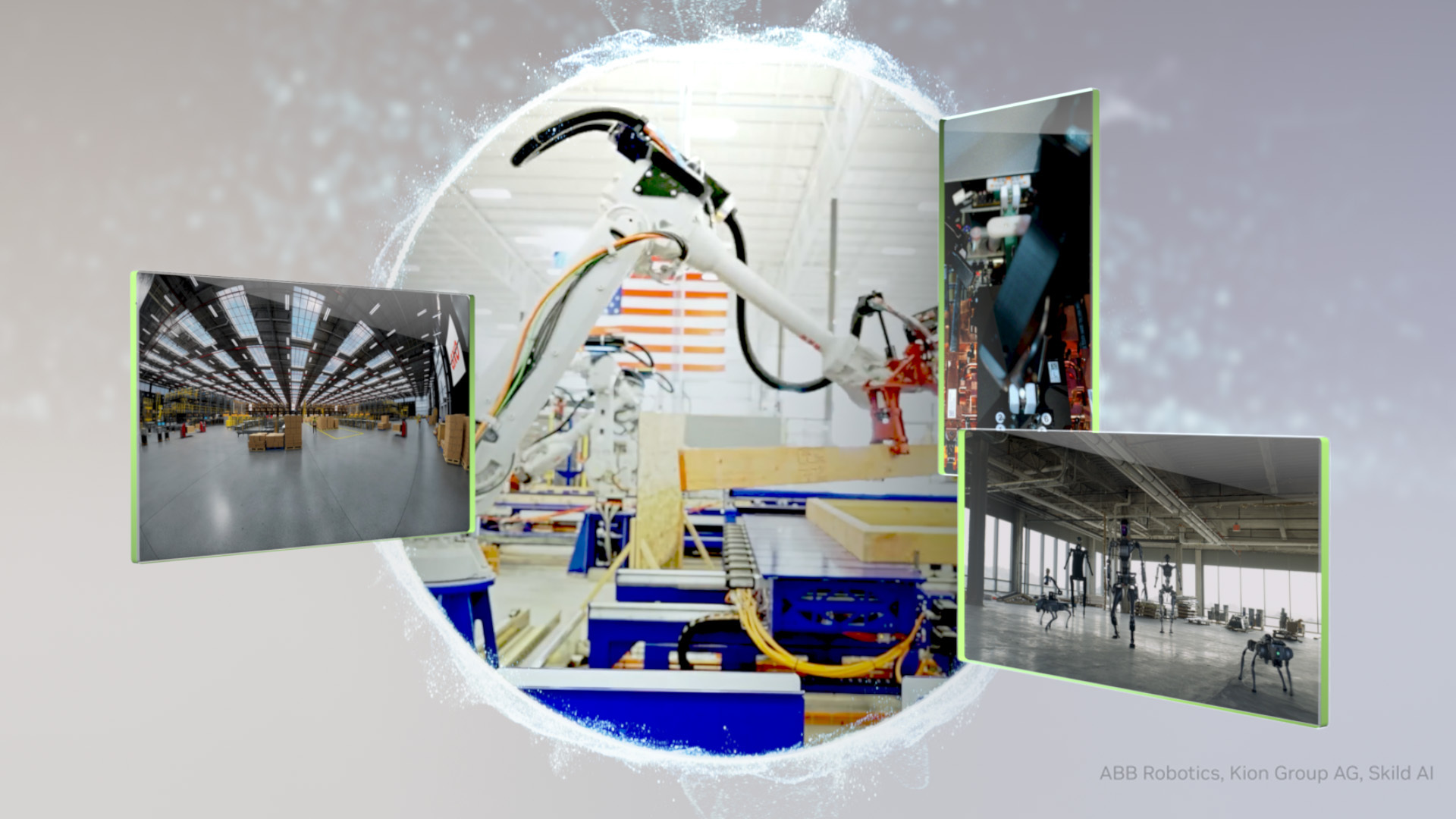
KION, working with Accenture and Siemens, is using this blueprint to build large-scale warehouse digital twins that train and test fleets of NVIDIA Jetson-based autonomous forklifts for GXO, the world’s largest pure-play contract logistics provider. 

Physical AI Steps From Simulation to the Real World

NVIDIA is partnering with the global robotics ecosystem — including leading robot brain developers, industrial robot giants and humanoid pioneers — to enhance production-level physical AI. 

ABB Robotics, FANUC, KUKA and Yaskawa, which have a combined global install base of over 2 million robots, are using NVIDIA Omniverse libraries and NVIDIA Isaac simulation frameworks to validate complex robot applications and production lines through physically accurate digital twins. These companies have also integrated NVIDIA Jetson modules into their controllers to enable real-time AI inference. 

Robot development starts with the robot brains, which is why leading developers including FieldAI and Skild AI are building theirs using NVIDIA Cosmos world models for data generation and Isaac simulation frameworks to validate policies in simulation. 

Meanwhile, Generalist AI is using NVIDIA Cosmos to explore generating synthetic data. This combination allows robots to become proficient in any task — from supply chain monitoring to food delivery — at an exceptional pace. 

Read all of NVIDIA’s announcements from GTC on this online press kit and watch the keynote replay. Catch up on all Physical AI Days sessions from GTC and watch the developer livestream replay.