MCP servers connect LLMs to external tools and data sources through a standardized protocol. Public MCP servers provide capabilities such as web search, GitHub access, database queries, and browser automation through structured tool definitions.
These servers typically run as long-lived stdio processes that respond to tool invocation requests. To use them reliably in applications or share them across teams, they need to be deployed as stable, accessible endpoints.
Clarifai allows MCP servers to be deployed as managed endpoints. The platform runs the configured MCP process, handles lifecycle management, discovers available tools, and exposes them through its API.
This tutorial walks you through how to deploy any public MCP server. We’d be using the DuckDuckGo browser server as a reference implementation. The same approach applies to other stdio-based MCP servers, including GitHub, Slack, and filesystem integrations.
DuckDuckGo Browser MCP Server
The DuckDuckGo browser MCP server is an open-source MCP implementation that exposes web search capabilities as callable tools. It allows language models to perform search queries and retrieve structured results through the MCP protocol.
The server runs as a stdio-based process and provides tools such as ddg_search for executing web searches. When invoked, the tool returns structured search results that LLMs can use to answer questions or complete tasks that require current web information.
We use this server as the reference implementation because it does not require additional secrets or external configuration. The only requirement is defining the MCP command in config.yaml, which makes it straightforward for us to deploy and test on Clarifai.
If you’d like to build a custom MCP server from scratch with your own tools and logic,this guide walks through that process using FastMCP.
Now that we have defined the reference server, let’s start.
Set Up the Environment
Install the Clarifai Python SDK:
Set your Clarifai Personal Access Token as an environment variable. Retrieve your PAT from the security settings in your Clarifai account.
Clone the runners-examples repository and navigate to the browser MCP server directory:
The directory contains the deployment files:
config.yaml: Deployment configuration and MCP server specification
1/model.py: Model class implementation
requirements.txt: Python dependencies
Configure the Deployment
Before uploading, update config.yaml with your Clarifai model identifiers and compute settings. This file defines the model metadata, MCP server startup command, and resource requirements. Clarifai uses it to start the MCP server, allocate compute, and expose the server’s tools through the model endpoint.
The mcp_server section defines how the MCP server process is started. command specifies the executable, and args lists the arguments passed to that executable. In this example, uvx duckduckgo-mcp-server starts the DuckDuckGo MCP server as a stdio-based process.
The model implementation in 1/model.py inherits from StdioMCPModelClass:
StdioMCPModelClass starts the process defined in config.yaml, discovers the available tools through the MCP protocol, and exposes those tools through the deployed model endpoint. No additional implementation is required beyond inheriting from StdioMCPModelClass.
The DuckDuckGo MCP server runs on CPU and requires minimal resources.
Upload & Deploy MCP Server
Upload the MCP server using the Clarifai CLI:
The –skip_dockerfile flag is required when uploading MCP servers. This command packages the model directory and uploads it to your Clarifai account.
After uploading your MCP server, deploy it on compute so it can run and serve tool requests.
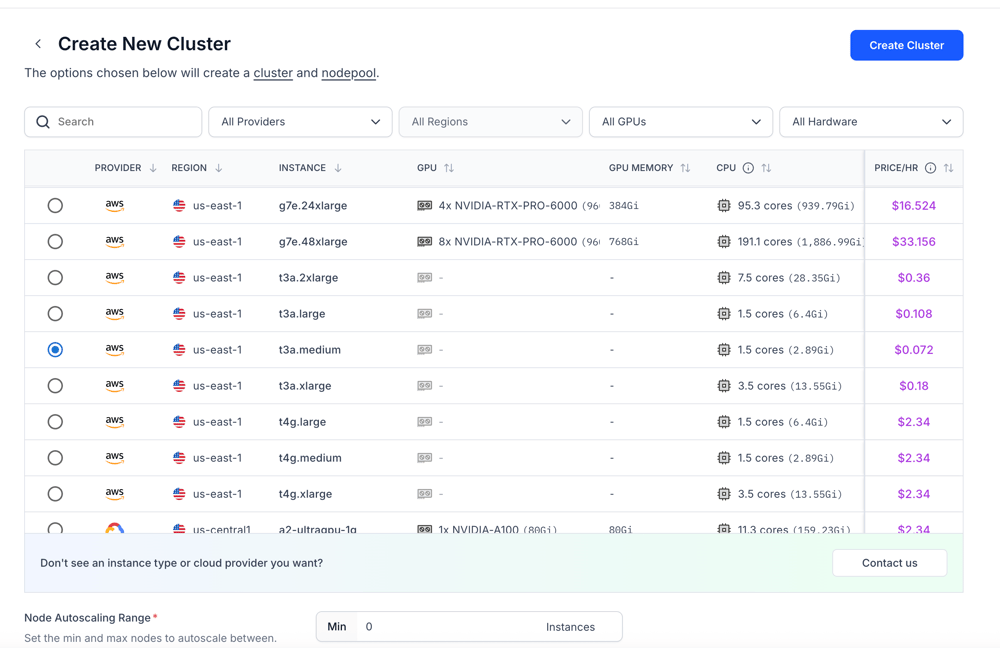
Go to the Compute section and create a new cluster. You will see a list of available instances across different providers and regions, along with their hardware specifications.
Each instance shows:
Provider
Region
Instance type
GPU and GPU memory
CPU and system memory
Hourly price
Select an instance based on the resource requirements you defined in your config.yaml file. For example, if you specified certain CPU and memory limits, choose an instance that satisfies or exceeds those values. Most MCP servers run as lightweight stdio processes, so GPU is typically not required unless your server explicitly depends on it.
After selecting the instance, configure the node pool. You can set autoscaling parameters such as minimum and maximum replicas based on your expected workload.
Finally, create the cluster and node pool, then deploy your MCP server to the selected compute. Clarifai will start the server using the command defined in your config.yaml and expose its tools through the deployed model endpoint.
You can follow the guide to learn how to create your dedicated compute environment and deploy your MCP server to the platform.
Using the Deployed MCP Server
Once deployed, we can interact with the MCP server using the FastMCP client. The client connects to the Clarifai endpoint and discovers the available tools.
Replace the URL with your deployed MCP server endpoint.
This client establishes an HTTP connection to the deployed MCP endpoint and retrieves the tool definitions exposed by the DuckDuckGo server. The list_tools() call confirms that the server is running and that its tools are available for invocation.
Integrate with LLMs
The tools exposed by your deployed MCP server can be used with any LLM that supports function calling. Configure your MCP client and OpenAI-compatible client to connect to your Clarifai MCP endpoint so the model can discover and invoke the available tools.
Your MCP server is now deployed as an API endpoint on Clarifai, and its tools can be accessed and invoked from any compatible LLM through the MCP client.
Frequently Asked Questions (FAQs)
Can I deploy any MCP server using this method?
Yes. As long as the MCP server runs as a stdio-based process, it can be defined in the mcp_server section of config.yaml. Update the command and arguments, upload the model, and the server will be exposed through its own endpoint.
Do MCP servers require Docker to deploy?
No. When uploading MCP servers using the Clarifai CLI, the –skip_dockerfile flag allows the deployment without requiring a custom Dockerfile.
Can I use deployed MCP servers with any LLM?
Yes. Any LLM that supports function calling or tool calling can use the tools exposed by a deployed MCP server. The tools must be formatted according to the model’s function calling schema.
Do MCP servers require API keys?
It depends on the server implementation. Some public MCP servers, such as the DuckDuckGo example used in this guide, do not require additional secrets. Others may require API credentials defined in environment variables or configuration.
Closing Thoughts
We converted a stdio based MCP server into a publicly accessible API endpoint on Clarifai. Its tools can now be discovered and invoked by any LLM that supports function calling.
This approach lets you move MCP servers from local development into stable, shareable infrastructure without changing their core implementation. If a server runs over stdio, it can be packaged, deployed, and exposed through Clarifai.
You can now deploy your own MCP servers, connect them to your models, and extend your LLM applications with custom tools or external integrations. For more examples, explore the runners-examples repository.
Over the years, numerous people have suggested Xbox might be better suited as a standalone company rather than being a division of Microsoft, and now another person has shared that view.
Rhys Elliott of Alinea Analytics wrote that the “most logical long-term move” for Microsoft would be to spin off Xbox. He said Xbox has “some of the most valuable IP in the business” under its belt, including Xbox franchises and titles from subsidiaries like Activision and Bethesda.
Elliott–an industry analyst known for his insightful and opinionated takes–pointed out that gaming, as a business, has lower profit margins than some of Microsoft’s other business areas, and a standalone version of Xbox could be “free from the burden of matching the ROI of Azure or the ubiquity of Windows.”
When I originally wrote this post, I had no idea how God would use it. As a result of it, I was asked to speak on a public Christian radio station. It was definitely out of my wheelhouse (I’m an introvert through and through). 😊 I was so nervous and scared but they walked me through it and it came out great! I think that as we go through life and are obedient to what He’s called us to do, we never know the results HE can do when WE obey. He can use our obedience far further than we can ever imagine, so I implore you, as you go through your life, always obey God no matter what He asks you to do. Even when it seems silly or crazy or far out of your comfort zone, obey. Never stop obeying Him because He has good plans for you (Jeremiah 29:11), much bigger than you can see right now. 🥰
I had a friend recently ask me how I keep an organized home with such a messy family. Organizing with a messy family is beyond frustrating, right?! I mean…
No one puts anything up (after what I just cleaned up today, seriously, they are all pigs! lol) and I’m an organized fiend. How do I maintain balance in my home? Sanity even! Although I’m far from perfect, these are the things that help me the most to have a tidy home…
The first thing I would say is to chose your battles (Colossians 3:1-4).
Is it really THAT important your spouse put the cap back on the toothpaste (they make pumps you know. haha!) or that the dishes are done every single night? But when you find a can of molded food under someone’s bed, okay, now that’s a battle to fight for. Mold can lead to some serious health risks.
I always like to think in terms of Jesus coming…
So, if Jesus came tomorrow, would it matter if the toothpaste cap wasn’t on or the toilet seat lid was up?
If I had one week to live would I really care if the dishes were done every night?
But, I would be concerned of the molded food, because my kids could get hurt. It could lead to asthma, allergies, and respiratory problems. So, that would be a battle I would chose, for their best interest. And that is really the point. When you are living for someone else with their needs ahead of your own, then all the little petty stuff doesn’t really matter, does it?
This principle can be applied to everything in your life.
If your friend and you are having a disagreement, for example, is it really worth fighting over? Even if it’s the truth of Christ, we don’t always have to fight for it. We can’t control other people to believe what the Bible says and it’s not our job to go around forcing them to. 💯
Offer the gospel, offer the truth, but it’s really up to them if they want to accept it or not. That part isn’t our job….to believe FOR them. They answer to God, not to us. Our job is to go about our lives as witnesses to others as Biblical, God-fearing holy Christians striving to do our best for our wonderful Savior.
Choosing your battles will help you live a much more peaceful life! Romans 12:18.
Regarding Children
1) Teach them young
Applying Proverbs 22:6 to this area of our lives can help. Teach them early the way that you want them to go. The quicker you start teaching them how to clean and why it’s so important, the easier it is when they get older.
My kids have been doing little things since they were two. I’d have them fold washrags or bring me dishes from the table. The earlier you start, the better! You may want to implement a cleaning chore chart and stickers to make it more fun for them too! 🎉
2) Have clear consequences
If you don’t do this, then this will happen. If you do what I ask, you will be rewarded. After all, as a Christian, does not the Lord do that with us? Chastise His children when we fall off the wagon and go our own way, bless us when we are in full obedience to Him. Today, I just got done cleaning my daughter’s room, uh yeah, thus the inspiration for this post 😊.
Her room has been messy for a little while and I’ve asked her to clean it several times. She played, I think, more than cleaned because you still couldn’t see the floor, much less walk in there. It was so messy, you couldn’t tell the clean clothes from the dirty. I don’t know how she gets dressed every morning to be very honest. And just in case you think that boys are messier than girls, my daughter proves THAT theory wrong! 😆 She is, at least double as messy as my son has ever been.
Maybe there’s some system to the madness and I’m immune to it. It took me an hour and a half to clean her room. Some of her toys ended up in the trash, and everything was sorted, and cleaned to my standard. When she got home I expected her to be really upset with me and she asked about a few specific toys, but after a little while in her room for homework, she came out and said “THANK YOU. Thank you for cleaning my room.” Now, some mom’s might really be offended by that. But I wasn’t.
Related:
You see, I see it. That spark inside her that LIKES a clean room…and if cultivated, she will be a clean girl just like her momma. I told her that she was welcome. That I love her and I’m not trying to just be mean, but that God’s standard is that we clean up after ourselves. That we work hard (Proverbs 31:13b; Proverbs 31:17), are not lazy (Proverbs 31:27), or live like pigs.
That this standard is for our good, and that since He put me in charge to manage my home (Proverbs 31:27a), it was my job to enforce HIS rules. She can argue with a lot of people, she can argue with me, but when it’s right there, black and white in Scripture, it’s hard to argue with the God who created it all. 😊
3) If all else fails, do what my mother used to do
Take away toys, but do it in a godly fashion, with genuine love in your heart, so as not to provoke your children (Colossians 3:21).
When MY room was messy as a child, my mom would go in my room while I was in school and clean it. The difference is that she took away EVERYTHING that was on the floor! I mean, everything. Clothes, toys, anything that was on the floor I had to EARN it back! You can easily start out small. They pick up after themselves when you ask, give them something back.
If they are still not getting the hint, take away their better toys, the ones they love. Every child has SOMETHING they REALLY love. If they don’t have something they truly love, buy it for them with the purpose that you can train them in love.
For my daughter, that was an iPad. The reason she has one is because it’s really important to her. So, when she is in trouble, I can take it away and she gets the message loud and clear and it helps straighten up her behavior.
Every child is different.
My son responds better with conversations (talking things out in detail in a back-and-forth conversation, so he understands it), my daughter responds better with toys taken away. You have to find what is important to them to get the message across that keeping a clean home is important to God and to you. It’s as simple as that.
4) Slow and steady wins the race
They are not going to change overnight. It will take a long time, years sometimes. Be prepared to work with them in establishing new habits. Being a mom is not for sprinters. It’s a L-O-N-G race. Think 20k marathon. Consistent actions, consistent punishments/rewards will get you there….and prayer, lots of prayer for your children’s hearts. Because changing an action is easier than changing a heart, but the heart is ultimately what we want to sow to.
Regarding Your Spouse
My husband was probably THE messiest person known to mankind, let me just say that upfront. He never cleans anything, never helps clean anything, never helps take care of the kids, it’s all me.
I came to Christ AFTER we were married. Some time after. And it was a constant daily struggle to maintain peace in our home because well…he’s on one side of eternity, and I’m on the other. And while God has given me such a care and concern for him, I know that I personally could not change him. It would have to be God.
So, not only did I live with a messy husband, but I had to endure the last several years (since giving my life to God), in a hostile situation where my husband deliberately made a mess and did things purposely that he knew would upset me and tried to cause me to stumble in my walk with the Lord.
With all that as a precursor…every marriage is different, and while you CAN encourage your spouse to be neater, you cannot try to control, manipulate, or change them. Changing them is a work of the Lord.
5) Think service
It’s a hard balance to be in, I get it.
Trust me, I get it!!
But, I also know that the Bible has a lot to say about our relationships with our spouses. Like…
Putting them ahead of ourselves (Philippians 2:3-4)
Doing things in this world as unto the Lord (Colossians 3:23-24)
Treating others how we want to be treated (Luke 6:31)
How being quick to disagree/fight is like a leaky faucet dripping and it’s better to live on the corner of a roof than to live with someone like that (Proverbs 27:15-16; Proverbs 21:9)
Pretty strong words. 💯
But applied practically, you can expect to suffer for Christs’ name sake. You can expect to just clean up the mess, and know you’re doing it FOR and UNTO the Lord, NOT your husband. The rewards are in Heaven, my friend! Keep your focus on God, not the world!!! 💎
Constantly and consistently pray that God will mold, shape, and change your spouse’s heart. If something is important to you, it should be important to your spouse, but like in my case, it was the exact opposite.
As a Christian woman, although under the authority of someone wicked, God is my supreme court and He will only allow what is to my benefit. When it is not to my best interest, God will change the situation, and as an update to my story, He has.
He provided a way of escape (1 Corinthians 10:13) and my husband left – at the time, devastating, but in the end, a great and glorious gift of the Lord! 🎁
And God has used his leaving for His good in so many ways, one of which, this blog was born. I never would have started it while being married to him. Praise the Lord, for the Lord is good, His mercy endures forever! ❤️
7) It’s not over yet: sanctification
Focus on your pitfalls.
Focusing on what you WANT: I want a clean home. I want my husband to help clean our home are your desires. Be sure that your desires line up with Scripture. Nowhere in the Bible does it say that it is a man’s job to clean the home.
In fact, just the opposite is true. Is is a woman’s responsibility (although a godly husband WILL help his wife in all things, one being helping to clean the home as that is a part of loving her – Ephesians 5:25).
But let me tell you, just in case you think a man’s job is easier than a woman’s, I can tell you from experience now being single for so long, that it is MUCH, much harder!
Simply put, focus on what the Lord has YOU to do, don’t focus on how someone else is not keeping YOUR standards. I say that in love, only because I was there myself.
I was so focused on HIS failures, that I didn’t take a look at my own. When I stopped caring how HE was sinning against the Lord, how he wasn’t a Christian, or a good husband, how he was trying to make me suffer purposely, and started focusing on my own sin and how I could be a better wife, mother, and Christian, despite whatever he was doing, my life drastically changed!
I started to grow by leaps and bounds in my Christian walk. I started to run!! 1 Corinthians 9:24; Philippians 3:12–14; Hebrews 12:1. And I’ve been running ever since! 💎
Reports from users and comments from hardware manufacturers suggest that AMD may have discontinued support for the Ryzen Z1 Extreme APU.
This would mean that several high-end PC gaming handhelds running Windows 11, like the ASUS ROG Ally, will no longer receive new drivers.
As a result, these handhelds could miss out on day-one optimizations for major game releases, which could lead to performance issues.
The handheld PC gaming market is full of options to choose from, be it the Steam Deck, MSI Claw, Lenovo Legion Go, and so on. If you’re thinking about picking one up for yourself, you may want to avoid any handhelds with an AMD Ryzen Z1 Extreme APU. Troubling reports cast serious doubt on the longevity of these devices.
Don’t want to miss the best from Android Authority?
According to Tom’s Hardware, reports from handheld users and hardware manufacturers alike suggest that after two and a half years, AMD may have discontinued support for the Ryzen Z1 Extreme APU. This affects several high-end handheld gaming PCs that run Windows 11, including the ASUS ROG Ally, ROG Ally X, Lenovo Legion GO, and GO S. If this is true, then these devices may no longer receive driver updates going forward.
Reportedly, a Korean Lenovo community support representative told one user that there were “no more plans” to issue new drivers for the original Legion Go. Multiple users on Reddit also report that their devices have not received new drivers for several months.
So what does this mean for gamers who own affected handhelds? You’ll still be able to play games on your device, but the experience will suffer. Since you’re not receiving new drivers, you’ll miss out on day-one optimizations for major game releases. As a result, the likelihood of crashes and poor performance will be greater.
If you’re concerned about the longevity of your handheld gaming PC, you could try swapping out Windows for a Linux-based OS, like SteamOS or Bazzite. These operating systems use open-source drivers that don’t depend on AMD’s support.
Thank you for being part of our community. Read our Comment Policy before posting.
My Voice Zoo is a unique idle zoo game brought to life with your own voice. Record your sounds through the microphone and turn them into animal calls, creating a one-of-a-kind zoo found nowhere else. Start building your very own zoo, complete only with your voice!
Create animal cries using your microphone,and build a one-of-a-kind zoo found nowhere else. Whenever the animals cry, your voice echoes and income builds up. .hack//G.U. Last Recode
That income can be used to adopt new animals, helping your zoo grow bigger and livelier over time. You can enjoy it naturally without complicated controls, simply by leaving it idle,
free from competition or the pressure to optimize, and experience cozy and gentle healing. Build and enjoy a truly special zoo, completed only with your voice!
Key Features
Create Animal Voices: Roar like a lion, quack like a duck, baa like a sheep, or squawk like a penguin — every animal’s voice can be made with your own.
Idle Income Loop: Each time your animals cry out, income is generated and can be used to adopt even more animals.
Build Your Own Zoo: Your recorded voices become the animals’ cries, creating a zoo that exists nowhere else.
Collect & Grow: Adopt adorable animals, give them names, and expand your collection into a larger and livelier zoo.
Cozy & Relaxing: From moments of laughter to small surprises, enjoy stress-free fun with no competition or pressure.
Only your voice can complete this extraordinary zoo. Start your journey now in My Voice Zoo!
Features and System Requirements:
MyVoiceZoo is a quirky simulation game where your voice directly controls the gameplay.
Speak, shout, or whisper to interact with animals and influence their behavior in real time.
Each creature reacts differently, turning your voice into the main gameplay mechanic.
The game blends humor, experimentation, and light puzzle-solving in a playful setting.
Creative voice-based interactions make every session feel unique and unpredictable.
Screenshots
SystemRequirements
Minimum
OS *: Windows 7 or later
Processor: Intel Core i3
Memory: 2048 MB RAM
Graphics: Intel HD Graphics 4000 or better
DirectX: Version 10
Storage: 300 MB available space
Support the game developers by purchasing the game on Steam
InstallationGuide
TurnOff Your Antivirus Before Installing Any Game
1 :: Download Game 2 :: Extract Game 3 :: Launch The Game 4 :: Have Fun 🙂
Visualization and rendering are the most commonly used words in architecture, and also the most confusing. Are they the same animal, just differently dressed, or do they serve entirely different purposes? If you’ve ever found yourself scratching your head as you flick through a design portfolio, then this guide is for you. You’ll learn not just what each service entails but how to find the right talent for your next architectural project, and why Cad Crowd is a great place to come looking for seriously skilled freelance professionals in this area.
Setting the scene: You are an architectural design expert, a designer, or even a client with this really ambitious dream of turning a plot of land into the next iconic skyscraper or chic residential complex. Your mind is filled with ideas, like confetti being thrown in a parade. However, unless you are able to show someone else that idea stays in your brain, like some rare Pokémon that nobody knows about. That’s where architectural visualizations and renderings come into play. They translate imagination, bridge concept and reality, and sometimes even rescue client presentations that would be adrift in some muggy waters of misunderstandings.
🚀 Table of contents
Understanding architectural visualizations
Architectural visualization is a medium that expresses highly detailed, often three-dimensional depictions of designs. Consider this as a kind of crystal ball through which the architect, client, and stakeholders are granted permission to look into the future. This can range from the simplest 3D model showing space and scale to complex photorealistic scenes that make one question whether the building already exists.
Indeed, it is in the beauty of architectural visualization that it can be so versatile: from interior layouts to exterior facades, from lighting effects to landscaping details-everything could be shown within one single visualization. If ever you experienced admiration for some sort of computer-generated image, which felt so real you could almost feel the sunlight beating on your face, chances are high you were looking at an architectural visualization.
Well, here is where things get very interesting: now, architectural visualization services have not only become technical but have also become a storytelling device, enabling architects to actually talk about the space experience. With the ability to virtually walk through a hotel lobby in the future and notice how the sun filters through skylights or how shadows dance on textured walls, it shows you what it looks like in reality and goes beyond being more than a drawing to an experience that can delight, persuade, and inspire.
It’s not about slapping shapes and textures together to make a visualization. It requires knowledge of software, lighting, materials, and spatial perception. Among professionals, 3ds Max, SketchUp, Blender, and Revit are common; additional rendering engines like V-Ray or Corona bring the finished image to life. A good visualization artist takes that blueprint and develops an exciting digital model that is often colored enough to sometimes be mistaken for a photograph when it crops up.
But probably the most important, and least talked about, aspects of visualization come in problem-solving for designs well before a single brick has been laid. Such is the case, for example, when an office building visualized in 3D shows that certain windows are oriented to the street at an awkward angle, with considerable glare inside offices. Being able to catch this in a visualization allows architects to make adjustments in the design much earlier in the process, and saves a great deal of time and money, and quite a fair share of frustration at the construction phase.
These visualizations are priceless in the case of complex structures, too. Think about a modern museum where swooping curves cross planes; any flat blueprint can only begin to give a sense of what it’s like to walk through such a space. A good visualization captures human movement through galleries, light and material interactions, and a realistic sense of scale that drawings alone can’t provide.
The other interesting application involves virtual walkthroughs whereby an architect can afford a client an opportunity to see deeply into his or her potential building and get a feel of the inside as if it were currently standing. It would prove more useful in residential work, such as for 3D residential rendering services, when clients want to feel the flow of rooms, or in commercial developments, when the impact of such areas as a lobby, an atrium, or a public area needs to be fully grasped.
By contrast, architectural renderings are the final presentation in relation to a particular building or structure. Though renderings could use 3D models, they can also be made as 2D illustrations or digital paintings. Briefly put, a rendering is just the finished and presentable version of any design showing style, materiality, and atmosphere.
You can sort of think about renderings as the Instagramworthy architecture; it’s done with considerations of composition and lighting, even sometimes an artistic flourish. Other than flat visualizations that may have their focal point on technical accuracy and spatial understanding, renderings are to amaze, absolute emotional drums beating. Renderings can be realistic, semi-realistic, or even stylized, depending on the formality you wish to portray.
Renderings are crucial during the pitching for a client or stakeholder who is not used to reading architectural drawings. One well-rendered image can tell them about the scale, function, and aesthetic appeal in one glance, perhaps difficult with a floor plan or wireframe model. In other words, renderings are a kind of secret weapon when you want someone to fall in love with a project they have never seen physically.
Renderings also provide artistic license that the visualizations sometimes cannot. Emphasis can be given to certain elements of the design, colors can be changed based on mood, or the light effects can be exaggerated to help show architectural features. This is particularly useful within marketing materials where the purpose is to grab attention and communicate a sense of quality and desirability that is especially relevant for photorealistic rendering services.
While creation often goes along with the process of visualization, the mindset differs. Where it is to understand and explore a design through the process of visualization, rendering revolves around presentation and persuasion. It’s the difference between walking through rehearsal and performing the final show. Both have their place, but knowing when to use each service is key to communicating your vision effectively.
There are key differences between renderings and visualizations.
By now, you might say to yourself, aren’t these two terms twins separated at birth? The best answer would go both ways: yes and no. Though alike in some ways, visualizations and renderings are used for different purposes in the architecture workflow.
By nature, visualizations are exploratory. It’s one way the architect can test an idea, play with spatiality, lighting, and material to anticipate certain problems in design. They are sort of the blueprint of imagination-a sandbox where creativity and practicality meet.
Renderings, however, are persuaders. They take the output of visualizations and make from it clear, evocative images that speak effectively to clients or investors. Rendering concerns mood, color, material, or flavor, and where the design affects an emotional sense. They are made to artfully sell a vision and not just to illustrate.
Another point of differentiation would be the degree of polish. Visuals can range from raw models and technical viewpoints to even schematic visuals. The most refined ones are usually renderings, with advanced lighting, real textures, and surroundings such as landscaping, sky, and people through HDR rendering services.
Also, timing and purpose essentially distinguish the two. Visualizations are commonly done at the design stage of a project when architects do quick iterations to explore options, while renderings are used either at the culmination of a project or at presentations, whereby the intent may be to impress, communicate, and get approvals or investments.
Analogically, that would be: Visualization would be the bridge tested by an engineer under virtual loads, just to make sure everything stands strong and sturdy, whereas the rendering would be a photo of that bridge at sunset, with light displaying it softly and with pedestrians walking down and birds flying over. Both are important, but they serve entirely different functions.
Why both services are valuable
It may be that one of the services is enough or that one overcomes another. But in fact, both architectural visualization and rendering make their contribution to the process in their own way. That is where visualizations help architects and designers to make decisions sooner in the design process. This reduces the risks associated with expensive mistakes, improves the understanding of clients, and drives innovation. The renderings communicate a final vision that is engaging, in which the clients, investors, and other stakeholders are on track with the direction of the design.
Combined, they are the architectural dynamic duo of sorts. While the ability to visualize takes one on a tour around the city before it is built, a rendering allows them to show it at its best. In that respect, both help each other in the design process to make it easier, better performed, and much more engaging.
By applying views and renderings, architectural design firms can establish that the project is structurally sound while at the same time visually and emotionally stimulating. The renderings act as a bridge between technical precision and aesthetic values, allowing appreciation of function and beauty alike in design.
The role of freelance talent
And therein lies the interesting plot. With the recent mushrooming of freelance marketplaces, like Cad Crowd, how architects and developers gain access to such skill sets has been redefined. Instead of being at the mercy of in-house talent tied down by geographical location or availability, firms today can connect with skilled freelance artists around the world. Visualization and rendering can be outsourced to freelancers, and more often than not, they bring fresh insights and creative solutions that your in-house team might have missed.
Cad Crowd lets you easily access portfolios, read reviews, or hire experts in just the kind of architectural service you need. Be it an ultra-detailed work by interior visualization services, exterior renderings, or full 3D walkthroughs, this platform connects you with a deep pool of experienced talent that will make your vision come alive in the best possible way.
Freelancers are more productive and budget-friendly than employees. You will have to pay only for the required expertise that may fall within a certain period of time and without additional costs for maintaining permanent staff. What’s more, a lot of freelance artists have broad experience in new software, trends, and techniques that will keep your visualizations and renderings qualitative, competitive, and up-to-date.
Both visualizations and renderings require advanced software; however, the approach can be different. In architectural visualization, programs such as SketchUp, Rhino, and Revit enable the creation of detailed models, while tools like Lumion and Twinmotion allow architects to create realistic walkthroughs. In cases involving renderings, 3ds Max, Blender, V-Ray, or Corona are common for making something quite polished. Other professionals even use Adobe Photoshop to refine the textures, lighting, and details in a presentation.
Of course, mastering these tools is a matter of time, experience, and artistic feeling. A skilled visualization or rendering artist would know not just the software but also composition, lighting, color theory, and perspective. They can take that abstract and turn it into compelling, immersive experiences.
More so, such skills can be outsourced to freelancers who let architectural design and drafting firms focus on the core aspect of design and have the technical and artistic heavy lifting done by professionals. This can help speed up project execution, raise the quality of the output, and please clients who can quite literally see and understand the designs being proposed.
Congratulations if you have made it this far! By now, you understand the basics of both architectural visualizations and renderings, understand the differences between them, know their roles within the design process, and why both are indispensable tools for modern architects and clients alike. But here is the thing: knowing the theory is one thing; understanding how to put it into practice is where the real magic happens. Let’s proceed further with practical applications, benefits of hiring freelancers, common pitfalls, and tips that can make your next architectural project amaze everybody who is involved.
When to use visualisations
Think of architectural visualization as a creative laboratory where one can conduct as many experiments as one wants, keep checking on ideas, and test any concept without real-world consequences. If you have done a visualization, you have designed a residential complex, experimenting with layouts and natural light at different times of day, and observing how furniture is placed to maintain continuity across the flow of space. You can instantly tweak a wall here or move a window there and see its impact-all this without a single swinging hammer.
These are particularly helpful for complex or unconventional projects. Think of a museum with undulating walls, asymmetrical staircases, and huge open spaces. The classic blueprint will only get you so far. A 3D visualization lets architects, clients, and contractors understand the spatial relationships and foresee and plan for any challenges before ground is even broken. You are giving your team X-ray vision, allowing them to see not just the structure but how people will move through it, how light will interact with the surfaces, and how materials will interact in a three-dimensional context, which may be exemplified even further through 3D animation services.
Other major benefits of visualizations are versatility: It is not just a question of what a building will look like, but how it will feel. It can be a walkthrough, panoramic views, or even an interactive model that the client themselves can walk around. Participation of this kind turns observers from passive to active participants in the design process, and that, simply stated, makes decisions easier and faster.
When to use renderings
Renderings are about persuasion and presentation. Where the visualizations help you experiment, renderings will help you sell the idea. Think of them as the red-carpet version of your architectural project: polished, detailed, and designed to impress. Rendering tends towards mood, style, and aesthetic qualities in a design. These images show investors, clients, or the public how to fall in love with a building they’ve not yet stepped inside of.
With this, the difference in marketing material for a luxury apartment complex comes in with raw visualization and fine rendering. The rendering may then be able to show how sunlight actually flows in through the glass from floor to ceiling, how shiny floors are polished, and greenery surrounds this place, for example, by utilizing HDR rendering design services. Even with people enjoying space, one could create an impression of life and action inside. Such a level of detail creates excitement while emotionally engaging potential buyers or investors closer with the project.
This will be especially helpful for regulatory approvals and public presentations. Indeed, one well-composed image often conveys your design intent much more effectively than any technical drawing. It helps the nonspecialist understand the vision in an instant when they are baffled by plans and elevations. A rendering is far more than a picture; it’s a story, a narrative that summons people to imagine the space, feel the ambiance, and picture themselves therein.
Combining visualizations and renderings
Now, this is where all the real fun begins. Visualizations and renderings are not mutually exclusive; using them in concert could be a game-changer. Take advantage of the visualizations in order to explore ideas, test configurations, and refine designs. Once an idea is finalized, render the visualizations to present the final vision to clients and stakeholders in a compelling way.
Think of it as cooking: visualization is your rehearsal, tasting, adjusting the seasoning, and perfecting the recipe. Rendering is an art to plate up nicely, garnish, and make it ‘Instagram-ready’. Without one or another, your project will just never bloom into success and impress or satisfy everyone involved.
Taken all together, all these services ensure efficiency. You will not have to make guesses at what might work and just hope your final images turn out right; you do your iterations in the visualizations. By the time you actually get to rendering, you know your design is solid, and your polished images reflect the final structure accurately.
Several traps related to visualizations and renderings that even the most seasoned architects and interior design experts fall into include general reliance on renderings too early in the process. Sure, an elaborate rendering looks great, but if problems are in the underlying design, issues will only reveal themselves later in the process, which can lead to costly revisions. The answer is relatively simple: use visualizations first for exploration and save renderings for final presentations.
Another trap is avoidance of context. Buildings aren’t space ships; they relate to the environment. A rendering of a cool skyscraper might look great on a blank void, but when it faces the cityscape with surrounding buildings, roads, and natural elements, it just doesn’t blend in as well. It is context-things like surrounding structures, landscaping, and lighting-that make visualizations and renderings believable-think about the ground below.
On the other side, there is another trap in over-complicating the models. Indeed, it is almost very tempting to include in a model every imaginable detail, from intricate furniture to several dozen decorative elements. While that may sound impressive, doing so can most definitely make render times longer, iterations cumbersome, and sometimes distract from the core design. It is all about that one thing: getting a balance where enough detail is included to get the point across, not so much to lose the message.
Finally, the power of collaboration is underestimated, hindering results. Architects, designers, and visualization artists should collaborate early in a project; this also includes rendering specialists. The rendering artist brought in late to the project might not grasp exactly that mood or context intended by the design. This will make sure the visualizations and renderings early support the design intent and technical constraints to meet client expectations.
It pays to hire freelancers
That is where Cad Crowd really comes out on top, because not every firm is in a position to invest in an in-house visualization and rendering team. CAD design freelancers offer a flexible, cost-effective means: you get access to specialized talent, pay for what you need, and benefit from fresh ideas from professionals who are often working on a wide range of projects.
Freelancers bring years of experience, too. Some of them could have taken years to amass experience on a host of software platforms, styles, and types of projects. They know how to use light, perspective, and composition in such a way that it transforms this complex architectural concept into a visually brilliant image.
It is not going to be hard to hire through Cad Crowd, as you can see their portfolio of work, verify previous work, and find those artists whose style best fits your idea. Cad Crowd does make it really easy for you to connect with freelancers who are professionals in architectural visualizations and renderings, it an interior perspective, exterior shot, or immersive 3D walkthroughs.
Besides, if you work with freelancers, then it goes much faster. You scale up or down depending on your needs to avoid bottlenecks. This way, you focus on the core of your design and pass on the heavy technical and artistic lifting to experts.
Working with freelancers tips
Communication really is the key to getting the most from freelancers. Give clear, concise briefs, reference images, and any technical specifications. Be transparent with deadlines and expectations, and keep up a routine check-in to review progress. The more information provided, the more a freelancer can take a vision and create compelling visualizations and renderings.
The other tip is to let some creativity in. You might have a clear vision, but 3D rendering freelancers always offer insight into ideas and suggestions that add to the finished product. Their collaboration will yield higher returns; it brings into play your excellence in design and their mastery of visualization and rendering techniques.
Of course, it always makes a lot of sense to start off with a small project or test job if this is the first time you work with a particular freelancer. At least that way, you can get a sense of his style, his responsiveness, and his ability to meet your expectations before you commit him to a larger assignment. If you find a freelancer whose work meets your standards, you have the potential for a long-term, fruitful partnership.
Practical applications
It has also been established that visualizations and renderings are not confined to high-budget projects alone. They have something to say in residential development, areas of commercial importance, public infrastructures, and even in the planning aspect of the city. Through visualization, architects can test zoning regulations, sunlight studies, and traffic flow while communicating the proposal to the public through renderings.
This could also mean visualization of a city planning project by simulating how a new park or building is going to interact with the current cityscape, including shadows, pedestrian traffic, and spatial relationships. These renderings take those concepts and develop them into visually appealing renderings that stakeholders, residents, and officials can understand and rally behind.
Even small projects benefit from the visualization: renovation for a single-family house can be visualized to test furniture layout, lighting, and materials by interior design firms. Then, a final design rendering is communicated to the homeowners so they can confidently make decisions without costly changes during construction.
The future of architectural visualization and rendering
Indeed, the future is bright. Advances in software, VR, AR, and AI-powered tools are wholly reinventing the game in developing visualizations and renderings. Today, and increasingly so, architects and designers do have the ability to offer real-time walkthroughs, full immersion into virtual experiences, and even interactive presentations that allow clients to see every aspect of the project well before laying the first brick.
Freelancers within Cad Crowd networks have so far been the early adopters wanting to push state-of-the-art techniques on projects, so design work is not only visually stunning but also technologically forward-thinking.
Conclusion
Architectural visualization and rendering go way beyond images; they are enabling instruments between imagination and reality. It helps in the exploration, experimentation, and refinement of the design, while rendering communicates, persuades, and inspires. Blended, they ensure projects are technically sound and visually stimulating.
Thanks to freelance marketplaces like Cad Crowd, access has never been easier to a pool of expert talent. Detailed interior visualizations, exterior renderings, or immersive 3D walkthroughs- whatever your client needs, rest assured that there are skilled pros prepared to bring ideas into action. Freelancers enable architects and developers to free up precious time and limit costs, while improving the quality of the project.
Look through Cad Crowd and hire some of the most exceptional freelancers of 3D architectural visualization and rendering artists who help bring your ideas alive in stunning, compelling, highly professional presentations. The right mix of visualizations and renderings done by expert freelancers can actually take architectural projects from concept to reality with clarity, impact, and style. Request a quote today.
MacKenzie Brown is the founder and CEO of Cad Crowd. With over 18 years of experience in launching and scaling platforms specializing in CAD services, product design, manufacturing, hardware, and software development, MacKenzie is a recognized authority in the engineering industry. Under his leadership, Cad Crowd serves esteemed clients like NASA, JPL, the U.S. Navy, and Fortune 500 companies, empowering innovators with access to high-quality design and engineering talent.
Amazon’s latest attempt to gain a foothold in games, 2025’s multiplayer co-op game show King of Meat, has failed. Developer Glowmade and publisher Amazon Game Studios confirmed Monday that King of Meat will shut down in April, and that players who purchased the game will receive full refunds.
“Despite the creativity and innovation Glowmade brought to King of Meat, the game has unfortunately not found the audience we hoped for,” Amazon Game Studios said in a statement on the King of Meat website. “As a result, we have made the difficult decision to conclude our investment in the game, and King of Meat‘s servers will close on April 9, 2026. Players will be able to access and play all existing content until then, so we encourage you to enjoy your remaining time in the game with your fellow Contenders.”
King of Meat‘s closure likely won’t come as a surprise to players, or anyone who’s paid attention to Amazon’s game output over the past decade. While the game received mostly positive reviews on Steam — critics were more harsh, based on aggregate review data from OpenCritic — King of Meat peaked at 320 concurrent players there. Based on our hands-on experience with the game at launch, console players didn’t show up either.
“I dove in on PlayStation 5 across its maiden weekend and was very rarely able to matchmake with enough players to get a full four-player team going,” Polygon’s Giovanni Colantonio wrote in our early impressions of King of Meat. “I came back on launch day proper and had an even tougher time finding even one teammate. Things don’t seem too promising on Steam either, where the game currently has 58 reviews at the time of writing, pulled from the game’s five days of early access.”
Glowmade and Amazon unveiled King of Meat in 2024 at Gamescom Opening Night Live and released it the following year on PlayStation 5, Windows PC, and Xbox Series X.
Xflow, an Indian fintech startup, has secured backing from both Stripe and PayPal Ventures in a $16.6 million funding round. The investment comes as the company works to carve out a position in cross-border B2B payments, a market still dominated by banks and manual processes.
The Series A round was led by General Catalyst, with participation from existing investors Square Peg, Stripe, Lightspeed, and Moore Capital, while PayPal Ventures joined as a new backer. The all-equity round values the Bengaluru-based startup at $85 million post-investment and brings its total funding to more than $32 million to date.
Despite rapid digitization in domestic payments, cross-border B2B transfers for Indian exporters remain heavily reliant on banks, often with limited visibility into fees, settlement timelines, and the final amount received in rupees. The friction is particularly acute for larger exporters moving millions of dollars into India to fund salaries and local operations, creating an opening for fintech infrastructure players such as Xflow that promise greater transparency and speed in international money movement.
Founded in 2021, Xflow provides cross-border payment infrastructure for businesses ranging from exporters and SaaS firms to platforms and freelancers, enabling them to collect international payments, manage foreign exchange, and settle funds in India.
“Cross-border B2B payments were stuck in a different age compared to UPI,” co-founder Anand Balaji (pictured above, center) said in an interview, referring to India’s widely used instant domestic payments network, the Unified Payments Interface.
Balaji, who previously helped build out Stripe’s India business, founded Xflow with former Stripe colleagues Ashwin Bhatnagar (pictured above, right) and Abhijit Chandrasekaran (pictured above, left).
Last year, Xflow said it enabled Indian businesses to collect payments from more than 100 countries in over 25 currencies. It processed close to $1 billion in annualized cross-border payment volume last year, marking roughly 10-fold growth from the same period in 2024, Balaji told TechCrunch.
Techcrunch event
Boston, MA | June 9, 2026
According to the company, its customer base has expanded to about 15,000 businesses spanning SaaS firms, global capability centers (which are offshore units that multinationals operate in India), IT services exporters, freelancers, and fintech platforms.
Transaction sizes vary widely by segment, with global capability centers averaging about $1 million to $2 million per transaction, goods exporters around $30,000 to $40,000, and freelancers roughly $3,000, according to Balaji.
Xflow is positioning itself as a payments infrastructure provider rather than a direct payments application, offering APIs that allow platforms and exporters to embed cross-border money movement into their own products.
“We didn’t want to build the next Wise — we want to power the next thousand Wises,” Balaji said.
The startup has also introduced an AI-based foreign exchange tool to help finance teams optimize the timing of currency conversions. Xflow says the feature has generated incremental gains for some customers through data-driven foreign exchange decisions.
The tool allows businesses to set target conversion rates rather than accepting prevailing bank quotes. Balaji likened the feature to limit orders in trading — instructions to buy or sell only at a specified price.
“What we’ve added is the prediction layer and the ability to actually set a limit order,” he said. The model currently provides a three-day forecast with about 92% confidence, Balaji said, though TechCrunch could not independently verify that figure.
Xflow faces competition from banks that still dominate large cross-border B2B transfers, as well as fintech players such as Wise, Payoneer, and Skydo at the lower end of the market. But Balaji said the startup’s focus on high-value transactions and API-led infrastructure differentiates it from many rivals.
The startup plans to deploy the new capital toward building additional products on top of its core payments infrastructure and securing regulatory licenses in new markets, Balaji said. Xflow is preparing to roll out import capabilities in the coming months and is pursuing licenses in markets including Singapore, while already holding a payments license in Canada, even as it remains focused on India as its primary market.
Xflow said it has also received final authorization from the Reserve Bank of India for a Payment Aggregator–Cross Border (PA-CB) license covering both exports and imports. The startup has signed platform partnerships with Easebuzz and Drip Capital to embed its cross-border capabilities into their offerings.
Backing from Stripe and PayPal Ventures, Balaji said, has helped strengthen the startup’s credibility with banking and regulatory partners, even as it continues to work with multiple payment providers commercially.
The startup currently has about 65 employees as it scales its cross-border infrastructure business.
Menace has the bones to become one of the best strategy and tactics games released in years. The new early access game from the creators of Battle Brothers, years in the making, blends campaign strategy and platoon tactics—think the quicker-playing fun of Jagged Alliance or X-Com with the best bits of tabletop and board wargames.
In Menace, you’re in charge of a shipful of volunteer space marines sent on a politically unpopular mission through a malfunctioning faster-than-light travel gate to a remote planetary system ruled by criminals, megacorporations, and military juntas. Naturally, this goes disastrously wrong and your ship half-explodes due to that busted warp gate and lots of people on board die. You’re in charge because everyone above you in the chain of command is dead.
I can’t stress enough how much fun Menace’s core strategy play is.
So now you’re spearheading a peacekeeping mission that’s low on manpower, supplies, and weapons… but you’re going to do it anyway, because that’s just what a TCR marine team does. That means you’ll be recruiting new soldiers not just from your own ship, but from the scum and mercenaries and villains of the Wayback system. You’ll take them into different strategic operations, each a series of tactical battle missions against giant alien bugs, space pirate raiders, renegade local army units, and the eponymous Menace.
I can’t stress enough how much fun Menace’s core strategy play is, even with a few early access quibbles and only something like a third of its full content implemented. The basic rules simplify the kind of ultra-crunchy stuff you find in dense wargames into a faster-playing game without sacrificing any cool simulation—so you still have individual to-hit rolls for every bullet and five different assault rifles to choose from, it’s just elegantly automated or combined into more accessible systems.
You can go into this game with a basic understanding of combat infantry tactics and pretty much start winning missions using the core military theories of fire-and-maneuver or fix-and-flank.
(Image credit: Overhype Studios)
One of the most basic concepts in Menace is suppression and morale. Soldiers panic when shot at, even to the point of paralysis if enough lead (or lasers, or plasma) is flying at them. They’ll also decide to retreat and regroup if they don’t like their odds, or if something especially scary happens. You know, like an orbital laser cannon cutting a building and some soldiers and their tanks in half. (Shout out to the orbital ion laser cannon I put on my ship. Only required selling my soul to a megacorporation! Totally worth it.)
It’s cool because of how it applies to not just the enemy, but to you. Your soldiers can get pinned down, or take hits and decide to beat a temporary retreat, and that’s just a natural part of combat you have to work around. Unless you’re fighting a swarm of bugs. Pro tip: They do not care about getting pinned down. You also have to compensate for your squad capabilities meaningfully degrading over time—if a squad member dies that means they’re literally not firing their weapon, so the squad has fewer chances to hit and does less damage.
Keep up to date with the most important stories and the best deals, as picked by the PC Gamer team.
Each of your teams in combat is either a squad of 3-9 soldiers or a single vehicle, all built around a squad leader or pilot with a particular personality. They have individualized silly barks to say and even relationships with each other that come out under fire and in events between missions. You can bring along stuff like armored APCs, or battle walkers, powered armor troops, mortars, automatic grenade launchers, and a lot, lot more.
(Image credit: Overhype Studios)
The level of customization is truly a delight, and nearly every weapon feels like it has a purpose or niche to be useful—a mortar might not be much use against bugs because it doesn’t scare them, but pirates or rogue army conscripts will hit the dirt as soon as the first shell falls. On top of weapons, armor, and accessories, each squad leader has their own progression tree of perks that change up combat… and each one definitely has more than one viable build.
There are simply a ton of interesting choices to make, and it’s a surprise to me that this is only a portion of the final game.
Fan-favorite recon operator Darby, for example, can do work as a sniper-spotter able to lock down enemy special assets and identify their weak points—or can be built into the leader of a close-in, stealthy, aggressive squad that cleans up whole enemy units from the shadows before disappearing into the dark again.
There are simply a ton of interesting choices to make, and it’s a surprise to me that this is only a portion of the final game. New weapons and enemies have already been added since launch on February 5.
(Image credit: Overhype Studios)
Developer Overhype is actively fixing problems with enemy behavior and weapon balance, and there are definitely systems that feel like incomplete early access placeholders such as the availability of equipment and new squad leaders on the black market. There’s also no end game, as of now—again, just the first third or so of the campaign. But Battle Brothers had such a reliable update tempo both in and after early access that I’d be shocked if something went wrong here.
Cool choices
What really solidifies Menace for me is a part that some players seem to dislike but which I find profoundly refreshing. Menace is transparently running on specific wargame-style rules where you have a supply limit each mission and everything costs supply points to deploy. You can’t simply throw every single soldier you have in their best gear at every problem; these limitations simulate the situation you’re in, where your damaged, yet operational, expedition just can’t sustain going full-bore until it gets more capacity over time.
(Image credit: Overhype Studios)
Menace breaks with the tradition of other modern tactics games and gives you straight-up objectives to accomplish, after which the mission simply ends. One mission might ask you to stop enemies from getting past you—in which case some enemies really will try to blitz your checkpoint without stopping to fight. Another might have you defend a base location for a set number of rounds, but penalize you for not protecting its buildings from getting blown up.
One of my favorites asks you to break through an enemy position so that allies can follow up and exploit the weakness you’ve made. It’s not always about killing every enemy you see to win—in fact, it rarely is, because your few dozen marines serve as a strategic scalpel that cuts out specific problems, not a sledgehammer-sized army.
It means you’re always making a cool choice. You’re building a new setup to accomplish each mission based on the intel you gathered, the weapons you’ve scavenged, and which of your personnel is fit to fight right now. It’s pure thrill, the exact power fantasy for the side of you that wants to be a strategic-tactical field commander and run the operation to whatever doctrine you’ve cooked up. Do read the short manual before starting, though. It helps.
I really can’t recommend Menace enough if you’re a tactics fan, wargamer, or strategy enthusiast who isn’t scared of some sharp early access edges. If not, add it to your wishlist for launch—trust me. You can find Menace on Steam.